• About

Brandon Ray Kirk

~ This site is dedicated to the collection, preservation, and promotion of history and culture in my section of Appalachia.

Brandon Ray Kirk

Tag Archives: James A. Nighbert

Anderson Hatfield Property in Logan County (1869-1893)

12 Friday Feb 2021

Posted by Brandon Ray Kirk in Big Sandy Valley, Hatfield-McCoy Feud, Matewan

≈ Leave a comment

Tags

A.E. Steel, Anna Hatfield, Appalachia, Beech Creek, Big Sandy River, Charles R. Mounts, Conley Bottom, Conleys Creek, Daniel Christian, Dempsey Branch, Devil Anse Hatfield, Double Camp, Double Camp Branch, E.S. Murphy, Ephraim Hatfield, Floyd Hatfield, genealogy, George Hatfield, Grapevine Creek, Harrison Steel, history, Island Creek, J.D. Sergeant, Jacob Francesco, James A. Nighbert, James Ferrell, James Mounts, John Green, Johnson Hatfield, justice of the peace, L.D. Steel, Levicy Hatfield, Lewis Steel, Lick Fork, Little Kanawha Lumber Company, Logan County, Logan District, logging, Magnolia District, Magnolia Township, Mash Field, Mate Creek, Mates Creek, Meadow Branch, Mill Seat Fork, miller, Mingo County, Moses Christian, Nancy Hatfield, Philadelphia, Pigeon Creek, Plyant Mayhorn, Polly Hatfield, Preacher Anse Hatfield, Road Fork, Samuel Mayhorn, splash dams, splashing, Stuart Wood, Thacker Creek, timbering, Tug Fork, Tug River, Valentine Wall Hatfield, West Virginia, William Tiller, Wolf Pen Fork

The following land information is derived from Land Book 1866-1872, Land Book 1873-1874, Land Book 1880-1886, Land Book 1887-1892, and Land Book 1893-1899, as well as various deed books, at the Logan County Clerk’s Office in Logan, WV:

Anderson Hatfield

[Property listed in name of Levecy Hatfield in 1869, Levica Hatfield in 1870-1871, Levisa Hatfield in 1872, 1874, and 1876, Levitna Hatfield in 1873, Lavisa Hatfield in 1875, Levica Hatfield in 1889, Lovicy Hatfield in 1890-1891, Lovica Hatfield in 1892, and Levicy Hatfield in 1893.]

No property listed in land books for 1865-1867.

On October 19, 1867, George* and Nancy Hatfield of Pike County, KY, deeded 100 acres on Mate Creek to Levicy Hatfield of Logan County, WV, for five hundred dollars. The property began in the upper end of Mash Field and extended to the mouth of Meadow Branch. Witnessed by JP William Tiller on October 19, 1867.

No property listed in the land book for 1868.

1869: Magnolia Township

100 acres Mates Creek $4.20 per acre no building $420 total

55 acres Mates Creek $2.10 per acre $75 building $136.50 total

[Note: Based on the land book, both tracts were acquired in 1869 from George Hatfield of Kentucky. Also, the 55-acre total value figure did not include the value of the building. Note the actual date of purchase for one of the tracts was 1867, as per the deed.]

1870: Magnolia Township

100 acres Mates Creek $4.20 per acre no building $420 total

55 acres Mates Creek $2.10 per acre no building $136.50 total

1871-1872: Magnolia Township

100 acres Mates Creek $4.20 per acre no building $420 total

55 acres Mates Creek $2.10 per acre no building $115.50 total

[Note discrepancy in the valuation for the 55-acre tract.]

1873: Magnolia District

100 acres Mates Creek $5.25 per acre no building $441 total

55 acres Mates Creek $4.20 per acre no building $420 total

1874: Magnolia District

100 acres Mates Creek $4.20 per acre no building $420 total

55 acres Mates Creek $2.10 per acre $115.50 total

On December 29, 1874, Anderson and Lovicy Hatfield sold 200 acres to Polly Hatfield (all of Logan County) for $780 on Mates Creek. Began at the foot of the north hill at the upper end of the old Mash Field, a conditional corner between Ephraim Hatfield and Anderson Hatfield to the mouth of Meadow Branch to include all the land that George Hatfield had deeded to Lovicy Hatfield. Anderson and Lovicy signed the deed using an “x.” Justice of the peace Valentine Hatfield witnessed the deed on December 29, 1874.

[Note the original 100 acres from the 1867 deed has now become 200 acres.]

1875: Magnolia District

100 acres Mates Creek $4 per acre $50 building $400 total

55 acres Mates Creek $0.25 per acre no building $13.75 total

1876: Magnolia District

100 acres Mates Creek $4 per acre no building $400 total

55 acres Mates Creek $0.25 per acre no building $13.75

[Note: In 1876, according to the land book, Anderson Hatfield transferred 200 acres on Mates Creek worth $0.25 per acre and with a total worth of fifty dollars to Polly Hatfield; the deed is dated 1874 (see above); the 1878 land record corrected the acreage to 55 acres by order of P.A. Counts]

1877: Magnolia District

No records available for this year.

On July 2, 1877, Anderson and Lovicy Hatfield deeded 150 acres at Double Camp and Road forks of Mates Creek for $75 to Floyd Hatfield (all of Logan County). Began at the back line of the John Green survey below Double Camp, then up the main ridge to the top of the point above Road Fork, thence to John Green survey line. Anderson and Lovicy signed the deed using an “x.” Justice of the Peace Valentine Hatfield witnessed the deed on July 2, 1877.

On December 24, 1877, Anderson and Levisa Hatfield deeded 1500 acres on Grapevine Creek to James Vance, Jr. (all of Logan County) for $1400. Began near the mouth of Wolf Pen Fork, thence to the top of the mountain between Grapevine and the river, thence with mountain to dividing ridge between Grapevine and Beech Creek, thence to head of Thacker Creek, thence down ridge between Thacker and Mates Creek… References the ridge between the Wolf Pen and Mill Seat Fork. Anderson and Levicy signed the deed using an “x.” Justice Valentine Hatfield witnessed the deed on December 24, 1877.

1878: Magnolia District

Anse Hatfield owned no property in 1878.

[In 1878, as per the land book, Anderson Hatfield transferred 150 acres on Double Camp and Road Fork of Mate to Floyd Hatfield worth twenty cents per acre and with a total worth of $20. Records showed this as “transferred from Anderson Hatfield.” Note: The deed (above) shows the transfer as 1877.]

1879: Magnolia District

No records exist for this year.

1880-1881: Magnolia District

As per land book, Anse Hatfield owned no land.

On December 9, 1880, Anderson Hatfield, Lovicy Hatfield, Elias Hatfield, and Henry Mitchell deeded 200 acres on Wolf Pen Fork of Grapevine Creek to Robert Cox (all of Logan County) for $200. Anderson Hatfield, Lovicy Hatfield, Elias Hatfield, and Henry Mitchell signed the deed. Justice of the peace Valentine Hatfield witnessed the deed on December 10, 1880.

1882: Magnolia District

The Hatfield page is missing from the land book.

On January 28, 1882, Anderson and Vicy Hatfield deeded 200 acres at Lick Fork of Grapevine Creek to Johnson Hatfield (all of Logan County) for $250. Began at a large rock near the creek bank just above the garden field at the mouth of Lick Fork, thence running out to the center of the point above Lick Fork…to the head of Lick Fork and down the top of the ridge between Grapevine and Thacker Creek… Anderson and Vicy Hatfield signed the deed. Justice Valentine Hatfield witnessed the deed on January 28, 1882.

1883: Magnolia District

Records for this district are blank.

1884: Magnolia District

37 acres Tug River $1 per acre no building $37 total

2900 acres Grape Vine, Tug River $1.25 per acre $50 building $3625 total

[Note: In 1884, Anse transferred 100 acres to Daniel Christian on Grape Vine and Sandy River worth $1.25 per acre with no building and valued at $125. In 1884, Anse transferred 150 acres on Beech Creek and Sandy River to Jacob Francesco worth $1 per acre with no buildings and total value at $150. This latter tract states “by A. Hatfield by P. Mayhorn” and adds that “books don’t show A. Hatfield is owner.” Anse is not named in the 1884 deed to Jacob Francesco.]

1885: Magnolia District

37 acres Tug River $1 per acre no building $37 total

2750 acres Grapevine Creek and Tug River $1.25 per acre $50 building $3437.50 total

[In 1885, he transferred 50 acres on Sandy River to Moses Christian worth $1.25 per acre with a total worth of $62.50. In 1885, he transferred 100 acres on Grapevine Creek to Samuel Mayhorn worth $1.25 per acre with a total worth of $125.]

1886: Magnolia District

No property listed for him in 1886.

[In 1886, he transferred 500 acres on Pigeon Creek to James Ferrell worth $1.12 per acre with a total worth of $500. This note referenced him as “A. Hatfield Sr.” In 1886, he transferred 25 acres on Tug River to E.S. Murphy worth $1 per acre and a total worth of $25. In 1886, he transferred 340 acres on Beech Creek to Harrison Steel valued at $2.25 per acre and with a total worth of $765. This latter note stated: “2 years back tax and with interest; transferred from Ans Hatfield.”]

1887: Magnolia District

37 acres Tug River $1 per acre no building $37 total

2360 acres Grape Vine $1.25 per acre $50 building $2950 total

[Note: For both entries, the record reads: “one yr bk tax & interest.” In 1887, he transferred 69 acres on Sandy River worth $1 per acre and total worth of $69 to James Mounts. In 1887, he transferred with others 100 acres on Sandy River worth $1 per acre and total value of $100 to Charles R. Mounts. In 1887, he transferred 200 acres on Beech Creek to Harrison Steel worth $1 per acre and total value of $200.]

1888: Logan District

[On April 10, 1888, Lewis S. Steel sold 200 acres on Island Creek to Vicie Hatfield for $900. Deed Book L, p. 53.]

[On May 1, 1888, Anse and Levicy Hatfield agreed to a quit claim deed for mineral rights to 600 acres in the head of Island Creek to Stuart Wood for $1, and fifty cents per acre once surveyed and the title perfected. Deed Book K, p. 158-159.]

[On May 10, 1888, L.D. and A.E. Steel sold 250 acres on Island Creek to Levicy Hatfield for $500. Deed Book L, p. 52.]

1888: Magnolia District

No property listed for him, but a note in 1893 lists back taxes owed for:

Anderson Hatfield

2656 1/2 acres Grapevine Creek $3.50 per acre no building $9297.75 total

[Note: In 1888, he transferred 300 acres on Grapevine, Sandy River worth $1.25 per acre and total value of $375 to J.D. Sergeant of Philadelphia, PA. In 1888, he transferred along with others 1385 acres on Sandy River worth $1.25 per acre and total worth of $1632 to J.D. Sergeant.]

1889: Logan District

Levica Hatfield

250 acres Island Creek $1 per acre no building $250 total

200 acres Island Creek $1.40 per acre no building $280 total

1889: Magnolia District

Anderson Hatfield

2656 1/2 acres Grapevine Creek $3.50 per acre no building $9297.75 total

[On April 9, 1889, Anse and Levisy Hatfield deed to James E. Price, trustee, for $825 the mineral rights of 821 acres on Island Creek. Deed Book 47, p. 67-70.]

[On September 6, 1889, Anse Hatfield deeded all of the timber on his Island Creek property to the Little Kanawha Lumber Company for $352. References Anse having the right to put in a grist mill at the splash dam. Deed Book O, p. 410-411.]

1890-1891: Logan District

Lovicy Hatfield

250 acres Island Creek $1 per acre no building $250 total

200 acres Island Creek $1.40 per acre no building $280 total

[On November 21, 1891, Anse and Levicy Hatfield deeded to Stuart Wood and J.A. Nighbert for one dollar a right of way for splashing timber at the 821 acres. References Conley Bottom, the mouth of Dempsey Branch, and Conley’s Creek. Deed Book M, p. 189.]

1890-1891: Magnolia District

Anderson Hatfield

2656 1/2 acres Grapevine Creek $3.50 per acre no building $9297.75 total

1892: Logan District

Lovica Hatfield

250 acres Island Creek $2 per acre no building $500 total

200 acres Island Creek $5 per acre $500 building $1000 total

[On June 18, 1892, Anse and Levicy deeded to G.R. Buskirk for $2 his timber on 400 acres. Deed Book Q, p. 370.]

1892: Magnolia District

Anderson Hatfield

2656 1/2 acres Grapevine Creek $3.50 per acre no building $9297.75 total

1893-1894: Logan District

Levicy Hatfield

250 acres Island Creek $2 per acre no building $500 total

200 acres Island creek $5 per acre $500 building $1000 total

1893: Magnolia District

Anderson Hatfield

2656 1/2 acres Grapevine Creek $3.50 per acre no building $9297.75 total

[Note: In 1893, the tract at Grapevine Creek was noted: “entered with 5 yrs back taxes and interest.”]

1894: Magnolia District

Anderson Hatfield

2656 1/2 acres Grapevine Creek $3.50 per acre no building $9298 total

*George Hatfield (1804-1883), son of Ephraim and Anna (Musick) Hatfield; father of “Preacher Anse” Hatfield.

NOTE: Many discrepancies exist between the land books and deeds for Anderson Hatfield.

Logan Court House, Floyd Addition (1885-1890)

29 Sunday Mar 2020

Posted by Brandon Ray Kirk in Guyandotte River, Logan

≈ Leave a comment

Tags

Appalachia, Aracoma, C.R. Williams, Cecil L. Hudgins, Coal Street, Dingess Street, Elm Street, F.M. White, Floyd Addition, G.M. Dingess, G.W. Morgan, Guyandotte River, history, J.B. Buskirk, J.S. Aldridge, J.S. Miller, James A. Nighbert, John Chafin, Kell McNeely, L.H. Thompson, Logan, Logan County, Main Street, map, maps, Morgan Street, R.N. French, Stratton Street, Thomas Whited, W.A. Hale, West Virginia, White Street

IMG_5505

Plat Record Book 1, Logan County Clerk’s Office, Logan, WV. Note: At the time of this survey and map, Logan Court House (or Logan) was named Aracoma.

Image

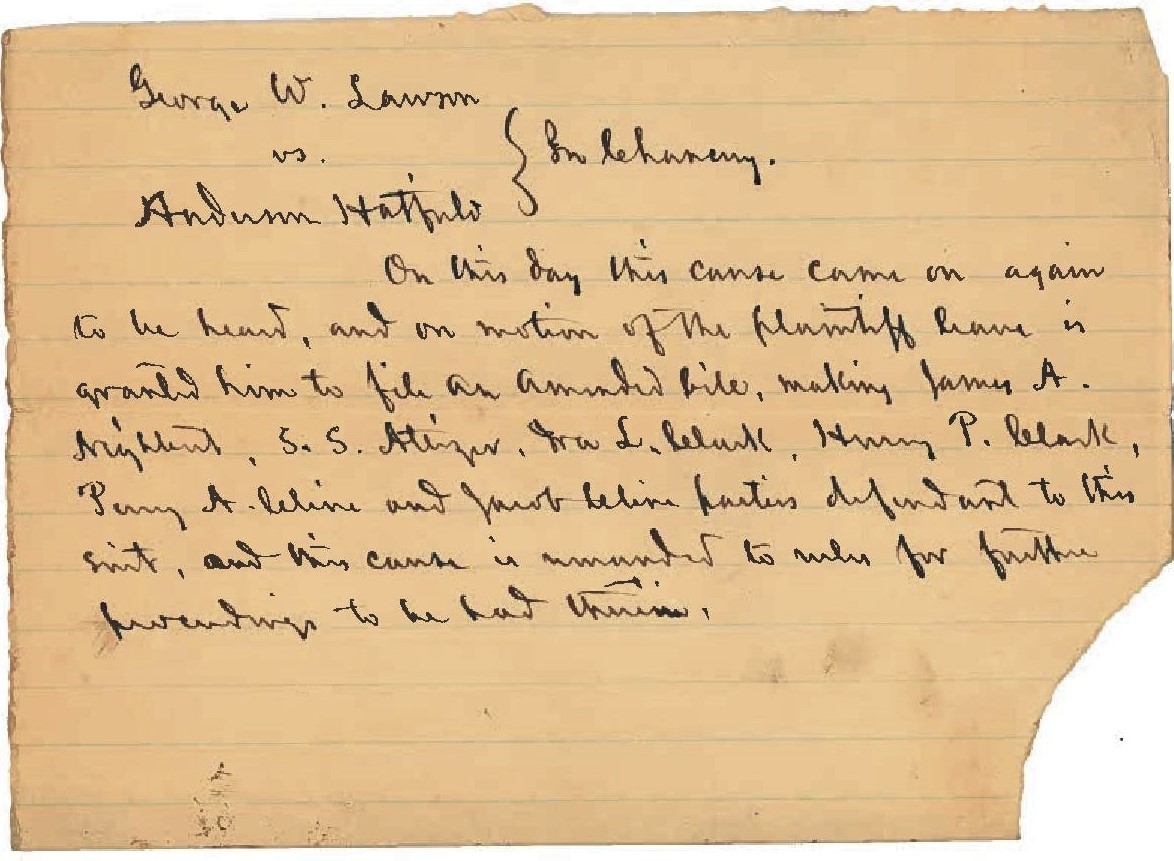
George W. Lawson v. Anderson Hatfield

06 Sunday Jan 2019

Tags

Appalachia, Devil Anse Hatfield, genealogy, George W. Lawson, Hatfield-McCoy Feud, Henry P. Clark, history, Ira L. Clark, Jacob Cline, James A. Nighbert, Logan County, Perry Cline, S.S. Altizer, West Virginia

62

G.W. Lawson v. Anderson Hatfield, Logan County, WV.

Posted by Brandon Ray Kirk | Filed under Big Sandy Valley, Hatfield-McCoy Feud

≈ Leave a comment

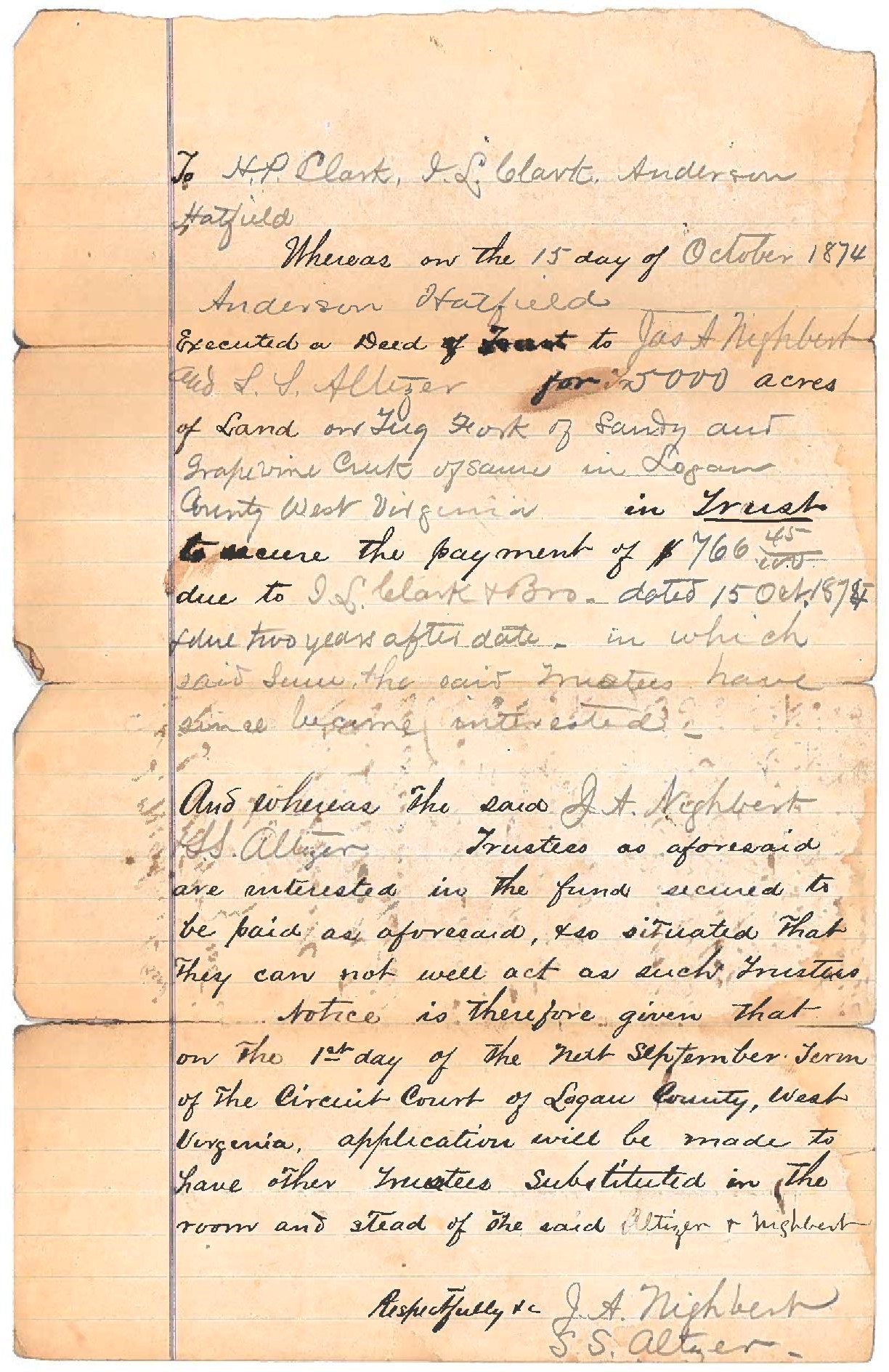
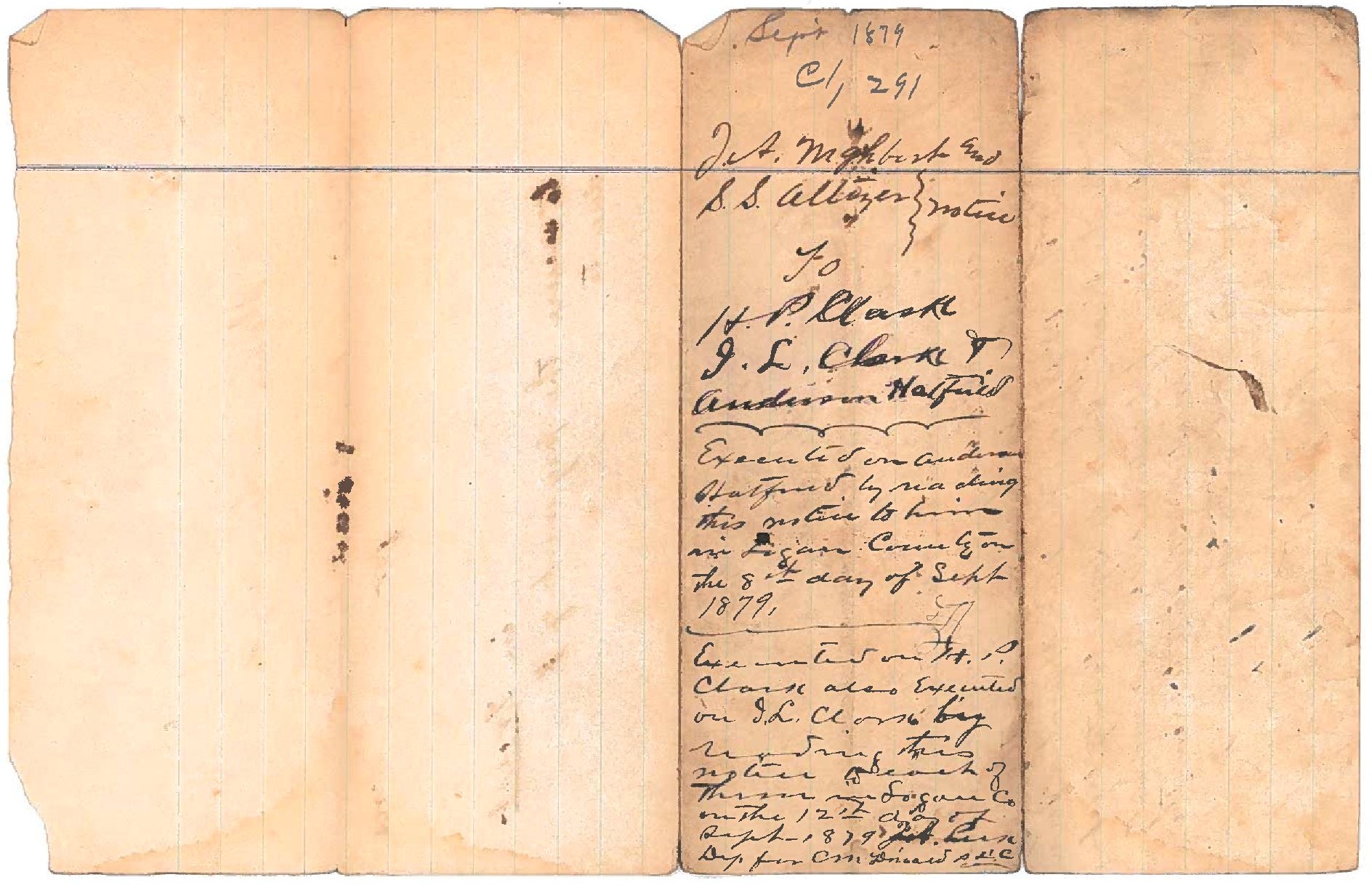
James Nighbert, S.S. Altizer Notice to Anse Hatfield (1874, 1879)

05 Saturday Jan 2019

Posted by Brandon Ray Kirk in Big Sandy Valley, Hatfield-McCoy Feud

≈ Leave a comment

Tags

Anderson Hatfield, Appalachia, Big Sandy River, genealogy, Grapevine Creek, H.P. Clark, history, James A. Nighbert, Logan County, S.S. Altizer, Tug Fork, West Virginia

nighbert and hatfield 1

Nighbert and Altizer notice, 1874.

nighbert and hatfield 2

Served on Anse Hatfield “by reading this notice to him in Logan County” on 8 September 1879.

John R. Browning Debt to James A. Nighbert (1860)

07 Thursday Jun 2018

Posted by Brandon Ray Kirk in African American History, Logan

≈ Leave a comment

Tags

African-Americans, Appalachia, genealogy, history, James A. Nighbert, John R. Browning, Logan County, slavery, Virginia, West Virginia

IMG_1355

John R. Browning Check to James A. Nighbert, Logan County, (W)VA, 1860.

IMG_1356.JPG

John R. Browning Promissory Note to James A. Nighbert, Logan County, (W)VA, 1860-1861. Note reference to “Negro boy” named Simon.

For more information about John R. Browning, follow this link: https://www.familysearch.org/ark:/61903/3:1:33S7-9BSZ-9N3H?i=46&cc=1473181

Recollections of A. Peterson Christian of Simon, WV (c.1943)

28 Monday May 2018

Posted by Brandon Ray Kirk in Big Creek, Gilbert, Guyandotte River, Logan, Timber, Wyoming County

≈ Leave a comment

Tags

Appalachia, Betty Shoals, Big Branch Shoal, Big Creek, Big Cub Creek, Blackburn Mullins, Burrell Morgan, Byron Christian, Chapman Browning, Charley Toler, Copperas Fork, Ed Robertson, Eli Blankenship, Eli Morgan, Elk Creek, Ellis Toler, Epson Justice, Fred B. Lambert, Fred B. Lambert Papers, G. Pendleton Goode, genealogy, Gilbert, Guyandotte, Guyandotte River, H.C. Avis, Hickory Shute, history, Hugh Toney, Humphrey Cline, Huntington, James A. Nighbert, James Pine Christian, Jesse Belcher, John Buchanan, John Justice, justice of the peace, Lane Blankenship, Lark Justice, Leatherwood Shoal, Lewis Mitchell, Little Kanawha Lumber Company, Logan County, Logan Court House, logging, Marshall University, Mingo County, Morrow Library, Paren Christian, Peter Cline Jr., Peter Cline Sr., Peterson Christian, Pineville, pushboats, rafting, Raleigh County, Roughs of Guyan, Salt River Shute, Sanford Morgan, Simon, Spice Creek, Staffords Mill, West Virginia, White Oak Cliff, Wyatt Toler, Wyoming County

Recollections of A. Peterson Christian of Simon, WV, provided by G. Pendleton Goode of Pineville, WV, January 1, 1944:

I was born on Spice Creek, Logan Co., now Mingo County, West Va. on Oct. 12, 1857 — Now 86 years of age, Son of Rev. Byron Christian, and grandson of James Pine Christian (1800-1892), one of the justices who organized Logan County in 1824.

About 1867, people began what we called saw-logging. Dr. Warren from Big Creek brought the first six yoke ox team to our neighborhood, used them two years and then sold them to Chapman Browning who lived on Spice Creek. There sprang up among us, what we called timber merchants, among those were Paren Christian, Chapman Browning, Col. John Buchanan, H.C. Avis, Blackburn Mullins and Epson Justice and many others. Besides hauling and rafting their own timber, they would buy rafts of other parties and run them to Logan Court House and sell others to John and Lark Justice and afterwards to Ed Robertson and James Nighbert.

I entered the logging business in 1875, on a small scale. Lewis Mitchell and I bought some timber and made up a raft, and when the river reached rafting stage, Brother Mont Lewis and I started down the river with the raft which swung across the head of “Island 16,” but when the big July 12th freshet came it swept our raft away and we lost it. My next adventure in logging was in the spring of 1876, when Mont and I bought some timber in the bluff opposite the mouth of Elk Creek and with some loose logs in “Island 16,” we made up two rafts, but there was no rafting stage that summer, but when the ice went out the next winter, both rafts went with it and we lost them also.

Rafting down Guyandotte River from Reedy to Logan Court house was a great art during the 1870s and 80s. There were different opinions about the bad places along the stream. People at Logan Court house thought that the river from Spice down was real bad; but the river men around Spice did not mind running from there down, but said that up Copperas Fork, the Betty Shoals, Staffords Mill, and the White Oak Cliff was too bad for anybody to run a raft. The river men around about Gilbert said that the river from there down was a little rough but they didn’t mind it, but from Epson Justice’s up to Reedy was so rough that no person had any business trying it. But when you came up to Big Cub, Long Branch and Reedy and talked with the old pilots, such as Jesse Belcher, Lane Blankenship, Peter Cline Jr., Humphrey Cline and Peter Cline Sr. and numerous other persons such as oar carriers and seconds they would say something like this, “Well, the river for a few miles is pretty rough, especially at Wyatt Toler’s mill dam, the Fall Rock, near Charley Toler’s mill dam, the Hickory Shute, the Leatherwood Shoal, the Big Branch Shoal and the Salt River Shute, but if a man has good judgment about the drain and the water he will have but little trouble.” So you see all depends on whom you are talking to as to where the rough is on the Guyandotte River. The only way to find this out is to go through on a raft yourself.

I remember very well the thrill I got the first time I went through the “Roughs” on a raft. I got on at the mouth of Big Cub Creek; in a few minutes we were at the upper end of Leatherwood Shoal. We worked the raft to the proper position in the hole of water just above the shoal. We could look along the top of the water to the upper end of the shoal but there was such a fall there we could see the water until we dropped over the upper end of the shoal. The bow of the raft struck a wave and the water flew over our heads. I was carrying the oar and held the stern down on the raft while my second held my clothes to keep the oar from throwing me off. From there on to the lower end of the shoals (about ¼ mile) as soon as the raft would rise on one wave, it would plunge into another until we got through the shoal. From that time (1876), I followed running from Reedy to Guyandotte until about 1890.

It took 4 men to run a raft from Reedy or Cub to Spice. Then 2 men could take it from there to Logan C.H. Then we would latch two of those rafts together and 2 men would take those rafts through to Guyandotte.

In 1889, the Little Kanawha Lumber Co. came to Wyoming County and began logging on a big scale. The winter was warm and rainy. All goods and supplies were hauled from Prince Station on the C. and O. Ry. The roads through Raleigh were so muddy that a four-horse team could pull only 1000 or 1200 pounds, so in April Alec, Henry Blankenship and I made a push boat 50 feet long and 6 feet wide and 18 inches deep. We landed it at the mouth of Reedy Creek and started to Guyandotte with five men. I had about $95.00 in money, and the men from here to Elk sent money by me to buy flour. When I left Elk, I had about $260.00. Among the men that sent money by me to buy flour were Burrell Morgan, Ellis Toler, Eli Blankenship, Eli Morgan, Sanford Morgan and Chapman Browning and the only one alive now is Burrell Morgan. We reached Guyandotte the 3d day, where I bought 45 lbs of flour, 300 lbs of bacon and a lot of other things and after laying over at Capt. Toney’s for 2 days on account of high water, we arrived at the mouth of Spice Creek in 8 days from Guyandotte. I received $125 per 100 lbs. freight which gave me a nice profit for my trip. At that time and long before the people of Logan brought their goods up on push boats.”

Source: Fred B. Lambert Papers, Special Collections Department, Morrow Library, Marshall University, Huntington, WV.

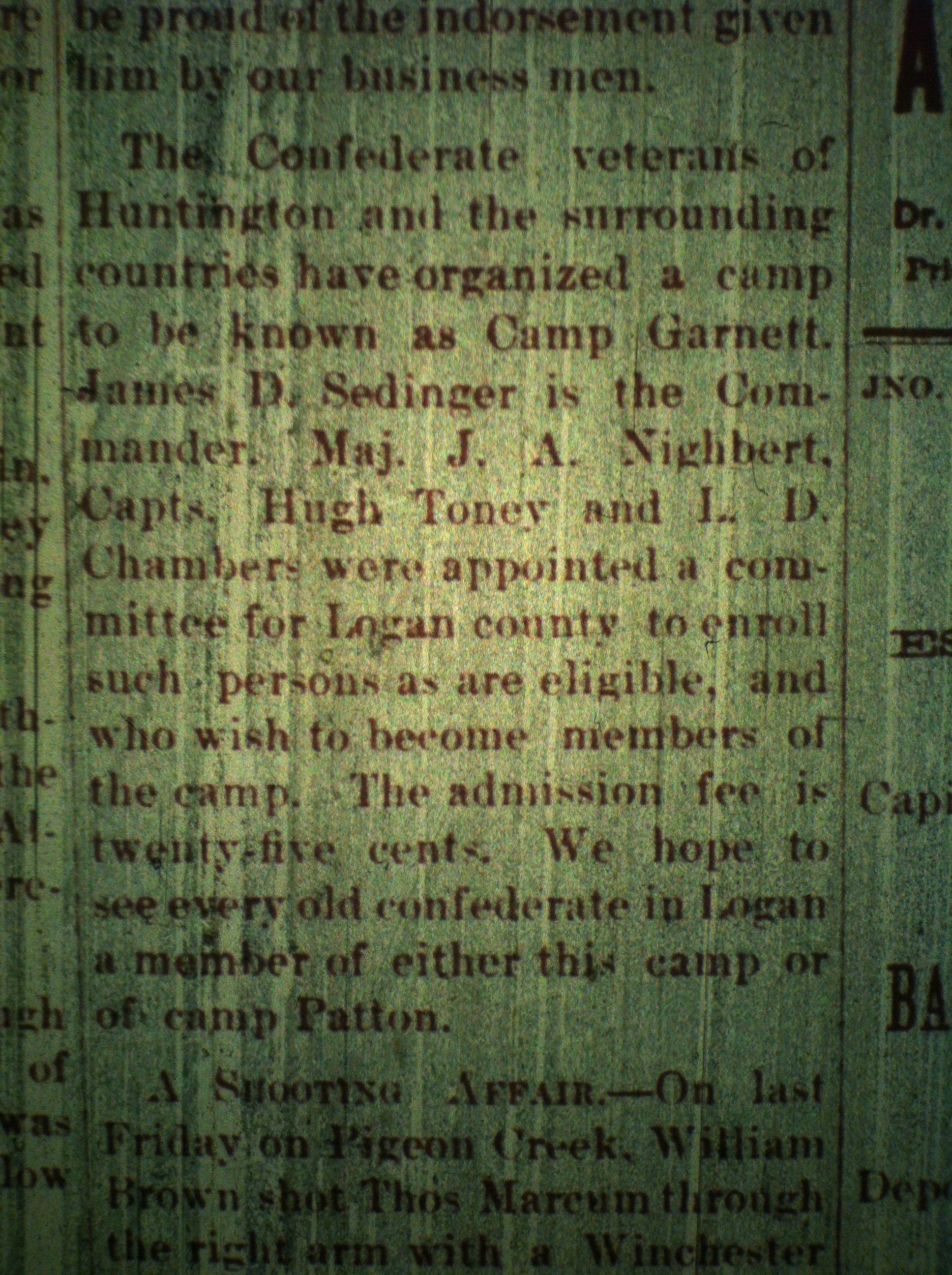
Camp Garnett, United Confederate Veterans (1890)

30 Thursday Mar 2017

Posted by Brandon Ray Kirk in Civil War, Huntington, Logan

≈ Leave a comment

Tags

Appalachia, Camp Garnett, Camp Patton, civil war, Confederate Army, genealogy, history, Hugh Toney, Huntington, James A. Nighbert, James D. Sedinger, L.D. Chambers, Logan, Logan County, Logan County Banner, United Confederate Veterans, West Virginia

Gamp Garnett organize LCB 01.09.1890

Logan County Banner (Logan, WV), 9 January 1890.

Logan County, WV, Political Commentary and Voting Trends (1824-1900)

05 Monday Sep 2016

Posted by Brandon Ray Kirk in Chapmanville, Civil War, Logan

≈ Leave a comment

Tags

Abraham Lincoln, Andrew Jackson, Arthur I. Boreman, Battle of Kanawha Gap, Boone County, Boone Democrat, Chapmanville District, Charleston Daily Star, Chesapeake and Ohio Railroad Company, civil war, Confederacy, Democratic Party, First Wheeling Convention, Franklin Pierce, Grover Cleveland, Guyandotte Valley Railroad Company, Hardee District, Henry Clay Ragland, history, Horace Greeley, Horatio Seymour, Isaac E. McDonald, James A. Nighbert, James Buchanan, James K. Polk, James Lawson, John Bell, John Breckenridge, Lewis Cass, Logan Banner, Logan County, Logan County Banner, Logan District, Magnolia District, Martin Van Buren, Parkersburg Sentinel, Parkersburg State Journal, politics, Samuel J. Tilden, Second Wheeling Convention, slavery, Stephen Douglas, Triadelphia District, Virginia Ordinance of Secession, West Virginia, West Virginia Statehood Referendum, William H. Crawford, William Jennings Bryan, William Straton, Winfield Scott Hancock, Wyoming County

Democrats who lived in Logan County, West Virginia, prior to 1896 may best be thought of as Democrats of the Jeffersonian and particularly the Jacksonian variety. The earliest settlers and their immediate progeny likely carried popular political viewpoints across the mountains from Virginia. Logan County Democrats appear to have believed in states’ rights, although few residents owned slaves. The old Democrats of the Civil War generation guided Logan County’s political scene until the 1890s, when the national political climate shifted toward issues relating to gold/silver, imperialism, etc. Still, the Confederate veterans of the county continued activity until the 1910s, even raising the Confederate flag over the courthouse as late as 1911. The Logan County Banner (later the Logan Banner), a Democratic organ since its inception in 1889, remained silent about issues that divided the Democratic Party in the 1890s. Based on its editorials, the Banner—operated by men of the Civil War era—was more concerned about industrial progress, particularly the development of a railroad in the Guyandotte Valley, than the national political issues that emerged in the 1890s. Examination of the active participants in the railroad effort include both Democrats and Republicans, locals and outsiders…

Logan County was organized in 1824. Voting trends from 1824 until 1856 reveal a strong preference for Democratic candidates:

1824: William H. Crawford (Democratic-Republican)
1828: Andrew Jackson (Democrat, 90+ percent)
1832: Andrew Jackson (Democrat, 90+ percent)
1836: Martin Van Buren (Democrat)
1840: Martin Van Buren (Democrat)
1844: James K. Polk (Democrat)
1848: Lewis Cass (Democrat)
1852: Franklin Pierce (Democrat)
1856: James Buchanan (Democrat, 80-90 percent)

We know, based on the above presidential tallies, the county was heavily Democratic. Because the Democratic Party was closely linked to slavery during this era, it is useful to consider local slave statistics.

1850 Logan County Slave Census:  26 slave owners in Logan County; 84 slaves (largest slave owner had 10)

1860 Logan County Slave Census:  27 slave owners in Logan County; 80 slaves (largest slave owner had 7)

We know the county voted heavily for John Breckenridge in the 1860 presidential election. What is remarkable to modern residents is this: Logan Countians gave no votes to Abraham Lincoln (see below):

Logan County Presidential Election Results (1860):
John Breckenridge (Southern Democratic), 271
John Bell (Constitutional Union), 100
Stephen Douglas (Democratic), 6
Abraham Lincoln (Republican), 0

We know Logan County’s delegate to the Virginia Secession Convention favored secession. James Lawson, the delegate to the Secession Convention for Logan, Boone, and Wyoming counties, voted in favor of the Ordinance of Secession on 17 April 1861.

We know the county did not favor anti-secession political developments in Wheeling. Logan declined to send delegates to the First Wheeling Convention (May 13-15, 1861).

We know the voters of Logan County favored secession. Here are results for Logan County regarding the Secession Ordinance in Virginia (23 May 1861):
For: 518
Against: 63

We know Logan County did not support the political gatherings in Wheeling. Logan County sent no delegates to the Second Wheeling Convention, First Session (June 11-25, 1861). Likewise, it sent no delegates to the General Assembly of the Reorganized Government of Virginia (July 1-26, 1861) or to the Second Wheeling Convention, Second Session (August 6-21, 1861).

In the mind of local people, Logan County was invaded in 1861. On 25 September 1861, Union soldiers attacked Confederates at the Battle of Kanawha Gap (Chapmanville). The battle was a Confederate loss.

Due to the absence of its men and election irregularities, Logan County did not vote heavily on the question of “West Virginia.” This was true for many counties in western Virginia: West Virginia Statehood Referendum (24 October 1861): 34 percent turnout statewide; 18,408 for statehood and only 781 opposed! We can be sure that Logan did not favor “West Virginia.” Logan County sent no delegate to the West Virginia Constitutional Convention (26 November 1861).

Logan Countians overwhelmingly enlisted to fight for the Confederacy (60-90%). According to one estimate, Logan County contributed over 780 soldiers to the Confederacy. Contributions to the Union Army were less than 60. Based on the 1890 census, the following number of Union veterans lived in Logan County:
Chapmansville District: 7
Hardee District (later Mingo County): 16
Logan District: 13
Magnolia District (later Mingo County): 9
Triadelphia District: 11

During the war, Logan sent delegates to participate in the Confederate government in Richmond. Isaac E. McDonald represented Logan, Boone, and Wyoming counties at the Confederate General Assembly from 1861 to 1863. James A. Nighbert represented Logan, Boone, and Wyoming counties at the Confederate General Assembly from 1863 to 1865.

Because Logan was known as a Confederate stronghold and recruiting station, the town was invaded in 1862. Union troops burned the Logan Courthouse (15 January 1862).

Logan County was one of 15 counties in WV that did NOT vote in the 1864 U.S. presidential election (most were south of the Kanawha River).

After the war, Logan Countians refused to recognize West Virginia as a legitimate state and refused to pay taxes to the new state. Guerillas and gangs were active in the county. Governor Arthur I. Boreman sent troops into the county in order to collect taxes and maintain order.

Ex-Confederate disenfranchisement was common after the war. In 1868, of 888 voters in Logan County, only 125 voted for president. In 1870, 220 voted for the Democratic candidate for governor while 70 voted for the Republican (total 290). In Logan County, it was difficult to find any men who had NOT served in the Confederacy who could hold political office (or practice law, or teach).

Maj. William Straton (namesake of Stratton Street) typified Logan County political leadership during this time.

After the war, Democrats and Republicans largely chose/maintained party identification based on their views of the war. Logan had been heavily Democratic before the war; Logan was pro-Confederate during the war; Logan was strongly Democratic after the war

Logan County in Presidential Elections After the War:
1868: Horatio Seymour (Democrat)
1872: Horace Greeley (Democrat)
1876: Samuel J. Tilden (Democrat, by 90+ percent)
1880: Winfield Scott Hancock (Democrat, by 90+ percent)
1884: Grover Cleveland (Democrat, by 90+ percent)
Winfield Scott Hancock’s victory in Logan County is somewhat noteworthy considering that he was a former Union general.

On 30 October 1886, the Parkersburg Sentinel reported: “Logan county is so intensely democratic that there are thirteen democratic candidates running for the legislature and only one republican. Nevertheless one of the thirteen democrats will be elected.”

In 1888, Logan Countians voted for Grover Cleveland (Democrat).

The Logan County Banner was established on 7 March 1889 by Henry Clay Ragland (editor) and J.A. Nighbert (business manager). On 28 March 1889, it stated:

The paper will be devoted to the best interests of the people of Logan county. To the improvement of the education and morals of its people, and to the development of its great material resources. Politically, the Banner will be Democratic. Every one connected with it is a Democrat, but at the same time it will be fair to the opposition, and will heartily accord to the Republican party due credit for any good work which it may do. In addressing the questions which may arise in the Democratic party, as to its management and its leaders, the Banner will be Independent and will acknowledge no faction or factions, but will labor earnestly and zealously for the success of the party, and not for any individual.

In 1892, it reported: “Three years ago in order to furnish the people of Logan county with a home paper, we unfurled the Banner. We expected neither money nor glory, and our expectations have been fully realized.” On 3 January 1895, Ragland stated: “When I first went into the newspaper business I had no idea of continuing on for any length of time. My only desire was to see a newspaper in Logan county which would truly reflect the character of its people and be able to defend them from the many slanders which have been heaped upon them by the outside world…”

The Banner‘s reputation as a Democratic organ was well-known. In April 1889, the Parkersburg State Journal referred to it as “Democratic to the core.” On 11 July 1889, the Charleston Daily Star said: “The Logan County Banner is being made one of the best country weeklies in the State. As long as it continues as it has begun Logan may be depended upon for her customary Democratic majority.” On 13 January 1898, the Boone Democrat said of the Banner: “We cheerfully hail it, and hope that it may long continue to wave in the vanguard of Logan Democracy.”

The Banner never failed to applaud Democratic gains. On 6 November 1890, it stated: “Glorious old Chapmansville always does her fully duty. The Democratic vote increased from 205 in 1888 to 210, and the Republican vote decreased from 28 in 1888 to 14.”

This editorial, from 15 September 1892, is one example of Banner political commentary:

We have heard that there are several so-called Democrats born and reared in the mountain fastnesses of old Logan who have avowed their intention of ‘scratching’ one or another of the nominees of our party when they ides of November shall roll around, but we hope for the credit of Logan’s ‘rock-ribbed, copper-bottomed’ democracy that such reports are false. It is but natural that bitter feelings should be engendered by the clashing of the claims of rival candidates before our conventions but the conventions have done their work now, well and conscientiously, and every true Democrat in hearty and earnest response to the bugle call of freedom must face about with his brethren and forgetting all private feuds and grievances join in the charge upon our friends the enemy. That Democrat who falters in his duty in this the crisis of our party’s need betrays the trust reposed in him by the party of the people, forfeits his claim upon the confidence and good will of his compeers and deserves to be incarcerated in the bottom-most pit of damnation. You cannot afford to let a petty desire for revenge prevent you from casting a straight Democratic ticket on the 8th day of November. If you have ever harbored such a thought, exorcise the evil spirit that has taken possession of you and come back to the fold on bended knee and ask forgiveness for the wicked thoughts of your heart. The people have spoken and ‘the voice of the people is the voice of God.’ We feel sorry for that Democrat who, when the glorious news flashes over the wires next November that Cleveland, MacCorkle, Alderson and Mahood are elected can’t forget one or more of them was scratched on his ticket. Verily, like the Judas of old, he will feel like sneaking off with down cast eyes and hanging himself to the nearest tree. Logan expects every Democrat to do his whole duty during this campaign. The eyes of friend and foe alike are turned towards the mountains of old Logan whence cometh our help. Every Republican in the county is alert, active and zealous in the support of his whole ticket, and it behooves every Democrat to see to it that he does not prove a traitor in the camp of his friends. Stop a minute, friend, and think of the issues involved in the fight that is now upon us. Do you want the robber tariff barons to keep on heaping up their multiplied millions from your hard-earned dollars? Do you want your polls to be manned by Federal soldiers or maybe negroes from Virginia or North Carolina?

In 1892, Logan Countians voted for Grover Cleveland (Democrat).

During the mid-1890s, the Banner offered more brief political commentary. Here are some examples. On 21 June 1894, it stated: “The Logan Republican club was organized last Saturday night, with 20 members.” On 9 September 1896: “There is a meeting of the W.J. Bryan club at Chapmansville next Saturday evening. Everybody is invited to attend.”

Logan Countians voted for William Jennings Bryan (Democrat) in 1896 and 1900.

Election of 1892 LCB 11.10.1892

Logan County Banner, 10 November 1892.

Major Nighbert marries (1889)

13 Thursday Aug 2015

Posted by Brandon Ray Kirk in Logan

≈ Leave a comment

Tags

Appalachia, Aracoma, Dyke Garrett, genealogy, history, James A. Nighbert, Logan, Logan County, Logan County Banner, U.S. South, Vicie Nighbert, West Virginia, William Straton

Major Nighbert marries LCB 12.26.1889

Logan County Banner, Logan, WV, 26 December 1889


James Andrew Nighbert

29 Wednesday Jul 2015

Posted by Brandon Ray Kirk in Civil War, Logan

≈ Leave a comment

Tags

36th Virginia Volunteer Infantry Regiment, Appalachia, civil war, Confederate Army, Elizabeth Nighbert, genealogy, George W. Nighbert, Germany, Henry H. Hardesty, history, James A. Nighbert, Knights of Honor, Logan, Logan County, Montgomery County, National Democratic Convention, R.A. Brock, Revolutionary War, Richmond, U.S. South, Virginia, Virginia and Virginians, West Virginia, Wythe County

From “Virginia and Virginians, 1606-1888,” published by H.H. Hardesty, we find this entry for James Andrew Nighbert, who resided at Logan, West Virginia:

Is descended on his father’s side from German ancestors who many years ago settled in America. They were a family of patriots, and as bravely served in the defense of their adopted country as they had done in their Fatherland. Both paternal and the maternal grandfathers of the subject of this sketch were Continental soldiers in the Revolutionary war. George W. Nighbert and his wife, Elizabeth Scaggs, are the parents of James Andrew Nighbert; the father was born in Wythe county and the mother in Montgomery county, Va.; their son, James Andrew, was born in Montgomery county, Va., and moved to Logan county, same State, in 1844. Here he has since resided. He espoused the Southern cause during the civil war, and served as first lieutenant in Co. B, 36th Va. Inf., and was major in 1st regiment Va. State Line; was member of the Virginia Legislature from 1863 until 1865; President of the County Court, Logan county, from 1880 to 1888; was one of the delegates to the National Democratic Convention in 1888; at the present time he is the largest resident land owner in Logan county, in the management of which he is at present engaged. He is a large-hearted, generous citizen, thoroughly interested in the progress of his State and county, always ready to devote his time, talents, means and influence to aid a progressive movement, and has contributed largely to render Logan one of the leading counties in the State. Mr. Nighbert is a member of the Knights of Honor.

Source: Dr. R.A. Brock, Virginia and Virginians, 1606-1888 (Richmond, VA: H.H. Hardesty, Publisher, 1888), p. 836.

Major William Straton

28 Saturday Jun 2014

Posted by Brandon Ray Kirk in Civil War, Logan

≈ Leave a comment

Tags

Allen B. Straton, Bella Wilkinson, civil war, David Straton, genealogy, Henry Clay Ragland, history, James A. Nighbert, John B. Wilkinson, John F. Aldridge, Logan Banner, Logan County, Mary Perry, Minnie Straton, photos, U.S. South, Vicie Nighbert, West Virginia, West Virginia Legislature, William Straton, Williamson

Straton Headstone

Major William Straton headstone, Logan, WV, 2010

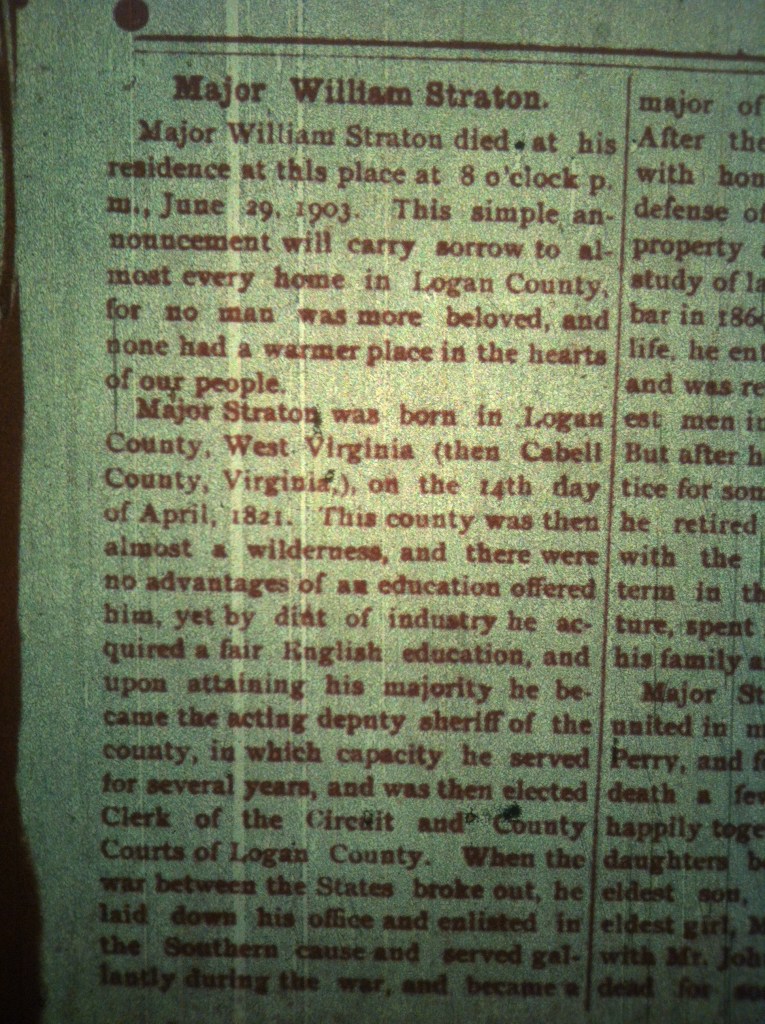
Major Straton obit LB 7.2.03 1

William Straton obituary, Logan (WV) Banner, July 2, 1903

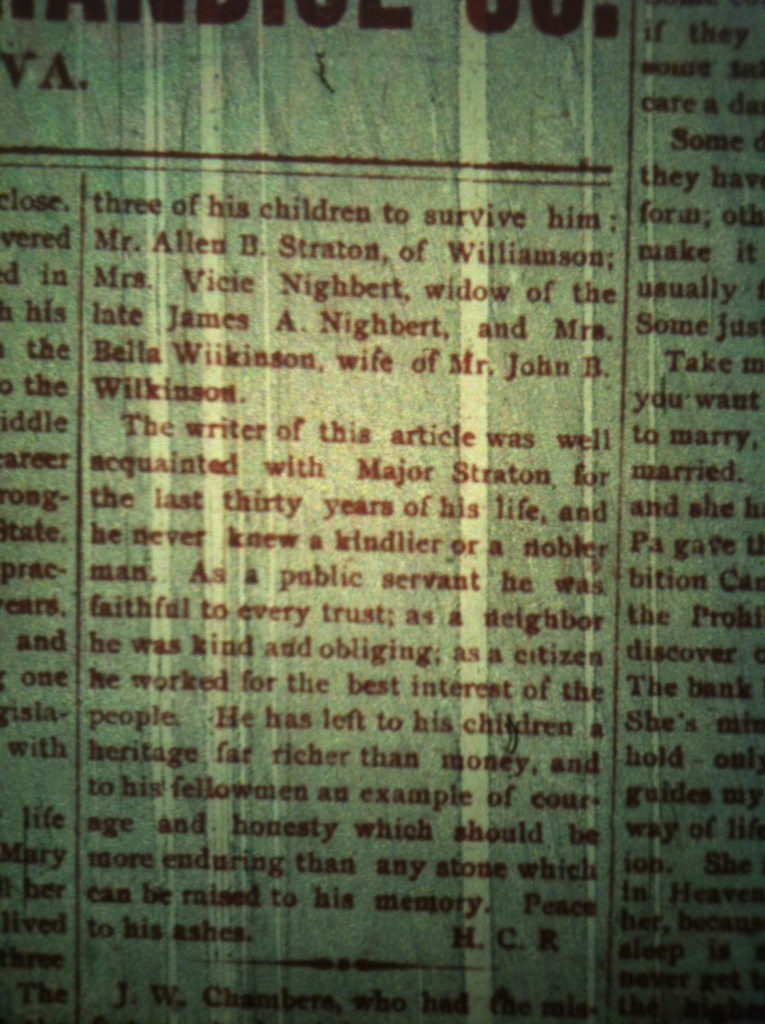
Major Straton obit LB 7.2.03 2

William Straton obituary, Logan (WV) Banner, July 2, 1903

Major Straton obit LB 7.2.03 3

William Straton obituary, Logan (WV) Banner, July 2, 1903


Major William Straton Grave

Major William Straton footstone, Logan, WV, 2010

Feud Poll 1

If you had lived in the Harts Creek community during the 1880s, to which faction of feudists might you have given your loyalty?

Categories

  • Adkins Mill
  • African American History
  • American Revolutionary War
  • Ashland
  • Atenville
  • Banco
  • Barboursville
  • Battle of Blair Mountain
  • Beech Creek
  • Big Creek
  • Big Harts Creek
  • Big Sandy Valley
  • Big Ugly Creek
  • Boone County
  • Breeden
  • Calhoun County
  • Cemeteries
  • Chapmanville
  • Civil War
  • Clay County
  • Clothier
  • Coal
  • Cove Gap
  • Crawley Creek
  • Culture of Honor
  • Dingess
  • Dollie
  • Dunlow
  • East Lynn
  • Ed Haley
  • Eden Park
  • Enslow
  • Estep
  • Ethel
  • Ferrellsburg
  • Fourteen
  • French-Eversole Feud
  • Gilbert
  • Giles County
  • Gill
  • Green Shoal
  • Guyandotte River
  • Halcyon
  • Hamlin
  • Harts
  • Hatfield-McCoy Feud
  • Holden
  • Hungarian-American History
  • Huntington
  • Inez
  • Irish-Americans
  • Italian American History
  • Jamboree
  • Jewish History
  • John Hartford
  • Kermit
  • Kiahsville
  • Kitchen
  • Leet
  • Lincoln County Feud
  • Little Harts Creek
  • Logan
  • Man
  • Matewan
  • Meador
  • Midkiff
  • Monroe County
  • Montgomery County
  • Music
  • Native American History
  • Peach Creek
  • Pearl Adkins Diary
  • Pecks Mill
  • Peter Creek
  • Pikeville
  • Pilgrim
  • Poetry
  • Queens Ridge
  • Ranger
  • Rector
  • Roane County
  • Rowan County Feud
  • Salt Rock
  • Sand Creek
  • Shively
  • Spears
  • Sports
  • Spottswood
  • Spurlockville
  • Stiltner
  • Stone Branch
  • Tazewell County
  • Timber
  • Tom Dula
  • Toney
  • Turner-Howard Feud
  • Twelve Pole Creek
  • Uncategorized
  • Warren
  • Wayne
  • West Hamlin
  • Wewanta
  • Wharncliffe
  • Whirlwind
  • Williamson
  • Women's History
  • World War I
  • Wyoming County
  • Yantus

Feud Poll 2

Do you think Milt Haley and Green McCoy committed the ambush on Al and Hollene Brumfield in 1889?

Blogroll

  • Ancestry.com
  • Ashland (KY) Daily Independent News Article
  • Author FB page
  • Beckley (WV) Register-Herald News Article
  • Big Sandy News (KY) News Article
  • Blood in West Virginia FB
  • Blood in West Virginia order
  • Chapters TV Program
  • Facebook
  • Ghosts of Guyan
  • Herald-Dispatch News Article 1
  • Herald-Dispatch News Article 2
  • In Search of Ed Haley
  • Instagram
  • Lincoln (WV) Journal News Article
  • Lincoln (WV) Journal Thumbs Up
  • Lincoln County
  • Lincoln County Feud
  • Lincoln County Feud Lecture
  • LinkedIn
  • Logan (WV) Banner News Article
  • Lunch With Books
  • Our Overmountain Men: The Revolutionary War in Western Virginia (1775-1783)
  • Pinterest
  • Scarborough Society's Art and Lecture Series
  • Smithsonian Article
  • Spirit of Jefferson News Article
  • The Friendly Neighbor Radio Show 1
  • The Friendly Neighbor Radio Show 2
  • The Friendly Neighbor Radio Show 3
  • The Friendly Neighbor Radio Show 4
  • The New Yorker
  • The State Journal's 55 Good Things About WV
  • tumblr.
  • Twitter
  • Website
  • Weirton (WV) Daily Times Article
  • Wheeling (WV) Intelligencer News Article 1
  • Wheeling (WV) Intelligencer News Article 2
  • WOWK TV
  • Writers Can Read Open Mic Night

Feud Poll 3

Who do you think organized the ambush of Al and Hollene Brumfield in 1889?

Recent Posts

  • Logan County Jail in Logan, WV
  • Absentee Landowners of Magnolia District (1890, 1892, 1894)
  • Charles Spurlock Survey at Fourteen Mile Creek, Lincoln County, WV (1815)

Ed Haley Poll 1

What do you think caused Ed Haley to lose his sight when he was three years old?

Top Posts & Pages

  • Early Anglo Settlers of Logan, WV (1937)
  • Alice Dingess piano
  • History for Boone County, WV (1928)
  • Battle of Curry Farm (1864)
  • Thomas C. Whited

Copyright

© Brandon Ray Kirk and brandonraykirk.wordpress.com, 1987-2023. Unauthorized use and/or duplication of this material without express and written permission from this blog’s author and/or owner is strictly prohibited. Excerpts and links may be used, provided that full and clear credit is given to Brandon Ray Kirk and brandonraykirk.wordpress.com with appropriate and specific direction to the original content.

Archives

  • February 2025
  • January 2025
  • October 2023
  • September 2023
  • December 2022
  • November 2022
  • May 2022
  • April 2022
  • February 2022
  • November 2021
  • October 2021
  • September 2021
  • June 2021
  • May 2021
  • April 2021
  • March 2021
  • February 2021
  • January 2021
  • December 2020
  • November 2020
  • October 2020
  • July 2020
  • June 2020
  • May 2020
  • April 2020
  • March 2020
  • February 2020
  • January 2020
  • December 2019
  • November 2019
  • October 2019
  • September 2019
  • August 2019
  • July 2019
  • June 2019
  • May 2019
  • April 2019
  • March 2019
  • February 2019
  • January 2019
  • December 2018
  • November 2018
  • October 2018
  • September 2018
  • August 2018
  • July 2018
  • June 2018
  • May 2018
  • April 2018
  • March 2018
  • February 2018
  • January 2018
  • December 2017
  • November 2017
  • October 2017
  • September 2017
  • August 2017
  • July 2017
  • June 2017
  • May 2017
  • April 2017
  • March 2017
  • February 2017
  • January 2017
  • December 2016
  • November 2016
  • October 2016
  • September 2016
  • August 2016
  • July 2016
  • June 2016
  • May 2016
  • April 2016
  • March 2016
  • February 2016
  • January 2016
  • December 2015
  • November 2015
  • October 2015
  • September 2015
  • August 2015
  • July 2015
  • June 2015
  • May 2015
  • April 2015
  • March 2015
  • February 2015
  • January 2015
  • December 2014
  • October 2014
  • September 2014
  • August 2014
  • July 2014
  • June 2014
  • May 2014
  • April 2014
  • March 2014
  • February 2014
  • January 2014
  • December 2013
  • November 2013
  • October 2013
  • September 2013
  • August 2013
  • July 2013
  • June 2013
  • May 2013
  • April 2013
  • March 2013
  • February 2013
  • January 2013
  • December 2012
  • November 2012

Enter your email address to follow this blog and receive notifications of new posts by email.

Join 2,925 other subscribers

Tags

Appalachia Ashland Big Creek Big Ugly Creek Blood in West Virginia Brandon Kirk Cabell County cemeteries Chapmanville Charleston civil war coal Confederate Army crime culture Ed Haley Ella Haley Ferrellsburg feud fiddler fiddling genealogy Green McCoy Guyandotte River Harts Harts Creek Hatfield-McCoy Feud history Huntington John Hartford Kentucky Lawrence Haley life Lincoln County Lincoln County Feud Logan Logan Banner Logan County Milt Haley Mingo County music Ohio photos timbering U.S. South Virginia Wayne County West Virginia Whirlwind writing

Blogs I Follow

  • OtterTales
  • Our Appalachia: A Blog Created by Students of Brandon Kirk
  • Piedmont Trails
  • Truman Capote
  • Appalachian Diaspora

BLOOD IN WEST VIRGINIA is now available for order at Amazon!

Blog at WordPress.com.

OtterTales

Writings from my travels and experiences. High and fine literature is wine, and mine is only water; but everybody likes water. Mark Twain

Our Appalachia: A Blog Created by Students of Brandon Kirk

This site is dedicated to the collection, preservation, and promotion of history and culture in Appalachia.

Piedmont Trails

Genealogy and History in North Carolina and Beyond

Truman Capote

A site about one of the most beautiful, interesting, tallented, outrageous and colorful personalities of the 20th Century

Appalachian Diaspora

  • Subscribe Subscribed
    • Brandon Ray Kirk
    • Join 787 other subscribers
    • Already have a WordPress.com account? Log in now.
    • Brandon Ray Kirk
    • Subscribe Subscribed
    • Sign up
    • Log in
    • Report this content
    • View site in Reader
    • Manage subscriptions
    • Collapse this bar
 

Loading Comments...