• About

Brandon Ray Kirk

~ This site is dedicated to the collection, preservation, and promotion of history and culture in my section of Appalachia.

Brandon Ray Kirk

Tag Archives: Henderson Dingess

In Search of Ed Haley 319

12 Thursday Jun 2014

Posted by Brandon Ray Kirk in Big Harts Creek, Ed Haley, Harts, Lincoln County Feud

≈ 2 Comments

Tags

Al Brumfield, Ben Adams, Bernie Adams, Brandon Kirk, Cain Adkins, Caroline Brumfield, Cecil Brumfield, Dave Dingess, Ed Haley, fiddle, French Bryant, Harriet Brumfield, Harts Creek, Henderson Dingess, history, Hollene Brumfield, Hugh Dingess, John Hartford, John W Runyon, Lillian Ray, Logan, Milt Haley, Paris Brumfield, Sallie Dingess, Smokehouse Fork, Tom Martin, writing

A little later, Brandon visited Lillian Ray, a seventy-something-year-old daughter of Cecil Brumfield who lived in a beautiful two-story house on the Smokehouse Fork of Harts Creek. Lilly, he discovered, had a lot of the old Dingess family photographs. To Brandon’s surprise, there were several thick-paged Victorian velvet-covered albums full of tintypes and a few boxes of sepia images on decorative cardboard squares. Only a few were labeled, but he recognized some of the faces: Al Brumfield, Henderson and Sallie Dingess, Hugh Dingess, Mrs. Charley Brumfield, Mrs. John Brumfield, and Dave Dingess. No doubt, there were pictures in the album of Ben Adams and Hollena Brumfield in their youth.

Before leaving, Brandon asked Lilly about Ed Haley. She said she remembered him coming to her father’s house when he lived in the old Henderson Dingess homeplace. He would just show up, leading himself with a cane, and stay for two or three days. Lilly hated to see him come because he was so hateful to the Brumfield children — “always running his mouth.” She described him as a “little short man” who “drank a lot” and told how he and Bernie Adams once borrowed a fiddle from her father and then pawned it off in Logan. The fiddle originally belonged to Tom Martin.

Not long after visiting Lilly, Brandon sent me a letter updating me on his research along with pictures of people we’d only imagined. As they turned up, I wondered if I were to go into a room with Al, Paris, Milt, Green, French, Cain, Runyon — without knowing who any of them were — which ones would I take to strictly on a personality basis? Which ones would I have a gut reaction to think, “Well, he’s a pretty fair good old boy,” or, “Boy, I don’t know about that feller there. Something’s just not right.” I mean, you walk in the room and, “That’s Al Brumfield?” No way. “That’s Cain Adkins?” Nope, I can’t believe that.

In Search of Ed Haley 311

28 Wednesday May 2014

Posted by Brandon Ray Kirk in Ed Haley, Harts, Lincoln County Feud

≈ 1 Comment

Tags

Al Brumfield, Ann Brumfield, Appalachia, Ben Adams, Bob Adkins, Brandon Kirk, Burl Adams, Cain Adkins, crime, Daisy Ross, Ed Haley, Green McCoy, Guyandotte River, Harts, Harts Creek, Henderson Dingess, history, Howard Dalton, Imogene Haley, Joe Adams, John Frock Adams, John Hartford, John W Runyon, Lawrence Haley, Lawrence Kirk, Lincoln County, Logan County, Major Adkins, Milt Haley, Paris Brumfield, Peter McCoy, Sallie Dingess, Trace Fork, West Virginia, writing

Two months later, Brandon was still digging, but in a different way. He was knee-deep in land records at the Lincoln and Logan County court houses. He was curious — based on the economic aspect of the 1889 feud — to know about property ownership for feudists, particularly those with land around the mouth of Harts Creek.

He started with the Brumfields.

In 1889, Paris Brumfield owned 771 acres of land worth $1020, while his wife owned 367 acres worth $483. Al Brumfield had 295 acres (195 acres on Brown’s Branch and 100 acres on the Guyan River) worth $642. By combining Al’s totals to that of his parents, the Brumfields owned a total of 1433 acres of land worth $2143. A little further up Harts Creek, Henderson and Sarah Dingess owned 546 acres (five tracts) worth $1234.50 with a building valued at 100 dollars.

How did these totals compare to the land holdings of their enemies?

Well, Cain Adkins owned 205 acres worth $420 (with no buildings listed for 1889), while John Runyon owned 100 acres worth $187.50. Ben Adams owned at least 340 acres in Lincoln and Logan Counties (2 tracts) worth $380. By combining Ben’s property with that of Adkins and Runyon they owned 645 acres worth $987.50 — not even half of the Brumfield family holdings.

Based on these records, we realized that it might have been the financial superiority of the Brumfields and Dingesses which caused Adams, Runyon, and/or Adkins to act out against them (through Milt and Green).

But there was also a reason for the Brumfields to feel a little threatened themselves: John Runyon, whose 100 acres of property was situated geographically closest to them near the mouth of Harts Creek, had accumulated his estate in only three years of residence in Harts. His first tract, totaling 75 acres, was worth $1.50 and was deeded by A.S. “Major” Adkins in 1887. The other tract, totaling 25 acres and worth three dollars per acre, was deeded in 1888. Neither tract contained a building, according to land records.

Al’s 100 acres near the mouth of Harts Creek, in contrast, reflected eight years of effort.

Brumfield was likely concerned that Runyon had acquired so much land at the mouth of Harts in such a short time, especially since it was property that he wanted for himself.

It was immediately clear in looking at the feud in mild economic terms that Milt Haley and Green McCoy were pawns in a larger game between local elites. While Paris Brumfield, Al Brumfield, Cain Adkins, John Runyon, and Ben Adams were leading citizens, property owners and businessmen, Milt and Green were timber laborers and musicians who owned no property whatsoever. Based on what we’d heard from Daisy Ross, it was easy to see why Green might have took a shot at Paris, but why did he attack Al? And what was Milt’s motivation for even getting involved in the whole mess? Was he pulled into the fray because of his friendship to Green, as Daisy Ross had said? Or did he have connections to Ben Adams (a possible economic dependence on the timber-boss, his residence nearby Adams on Trace, or the fact his wife was related to Ben)?

And what did either man hope to gain from the assassination of Al Brumfield? I mean, that’s a hell of a lot to risk for a side of bacon and a few dollars. I had this nagging suspicion that they were maybe innocent of the crime, but Brandon was pretty well convinced of their guilt (as had been Lawrence Haley). He did, however, leave an opening by pointing out how Bob Adkins, Howard Dalton, Joe Adams and Lawrence Kirk had all heard that they were innocent. Bob and Joe had actually mentioned other suspects: Burl Adams, a nephew to Ben Adams, and John “Frock” Adams, a half-brother to Ed’s mother (who later shot his wife’s head off with a shotgun in his front yard). There was also the testimony of Preacher McCoy, who said Milt and Green were “as innocent as Jesus Christ on the cross.”

In Search of Ed Haley 310

26 Monday May 2014

Posted by Brandon Ray Kirk in Big Harts Creek, Ed Haley, Ferrellsburg, Lincoln County Feud

≈ Leave a comment

Tags

8th of January, Arkansas Traveler, Big Branch, Billy Adkins, Billy in the Lowground, Blackberry Blossom, Brandon Kirk, Dood Dalton, Ed Haley, Ferrellsburg, fiddling, Green McCoy, Green Shoal, Harts Creek, Henderson Dingess, history fiddle, Lop-Eared Mule, Milt Haley, Mingo County, Soldiers Joy, Ward Browning, West Fork, West Virginia, writing

A week or so later, Brandon and Billy visited Ward Browning, an older gentleman in Ferrellsburg whose wife was a descendant of Henderson Dingess. Ward said Milt Haley was from “back in the country at the head of Harts toward Mingo County.” The first year of Ed’s life, Milt dipped him repeatedly in water because someone told him it would make a baby healthy; instead, it made him go blind. Milt was hired with Green McCoy to kill the Brumfields. Later, they were captured and taken across the river from Green Shoal and kept under a dogwood bush where they were beaten through the night and then killed around daylight.

Ward said he used to see Ed Haley at Dood Dalton’s home on Big Branch in the late 1930s. Ed would stay around Dood’s place for two or three weeks at a time. He was a “star” — the best around. He and Dood sat on the porch and played for crowds of people in the yard who clapped their hands and had a good time. There was never any trouble. No one took him for granted. He sometimes made up to four dollars a day playing there in hard Depression times.

Ward said Ed carried his fiddle in a case and kept a stick to find his way in the road. He had a great personality and would tell wild stories of his exploits. He drank heavily and was “bad to fight,” but was always sober at Dood’s. Ward said he played “Billy in the Lowground”, “Lop-Eared Mule”, “Arkansas Traveler”, “Soldiers Joy”, “Blackberry Blossom”, and ‘8th of January”.

Brandon was also busy at the Haley-McCoy grave on West Fork. He seemed to be coming around on my idea to exhume Milt Haley and Green McCoy. I’d joked him relentlessly that we might do it only to find it completely empty. He was still against the idea, although his curiosity was getting the better of him.

“As I had been dwelling a lot on the Haley-McCoy grave recently, I finally decided to satisfy my curiosity to a limited extent,” he wrote. “I borrowed a metal detector and raced up to the grave on West Fork at the edge of dark to see what it would pick up (belt buckle, handcuffs, perhaps even the murder weapon). I first tested it on my keys, which I laid upon the ground. Running the detector over them caused a loud buzz. I then placed a pile of leaves over the keys and the detector still buzzed. As a last preliminary test, I laid a thick rock on top of my keys and ran the machine over it and it still registered the buzz. Content that the machine worked fairly well, I then eagerly began gliding it over the grave. Unfortunately, I picked up no real buzz. There was one spot that seemed to repeatedly register a slight buzz but nothing conclusive.”

Brandon signed his letter, “Digging Around (Almost Literally)…”

Spottswood Items 10.16.1903

23 Friday May 2014

Posted by Brandon Ray Kirk in Big Harts Creek, Chapmanville, Dingess, Green Shoal, Spottswood, Timber

≈ Leave a comment

Tags

Augusta Bryant, Belle Dora Adams, C.J. Plaster, Chapmanville, Dicy Adams, Dingess, Doc Turner, Enel Deskins, genealogy, George Bryant, Green Jackson, Green Shoal, Harts Creek, Henderson Dingess, history, Hugh Evans, Isaac Marion Nelson, John Workman, Kentucky, Logan, Logan Banner, Logan County, Major Adams, Mingo County, Ollie Bryant, Peter Carter, Smokehouse Fork, Solomon Adams, Solomon Adams Sr., Spottswood, Sr., timbering, W.J. Bachtel, West Virginia, William Kelley, Zack Williams

“DeLay,” a correspondent from Spottswood in Logan County, West Virginia, offered the following items, dated October 12, 1903, which the Logan Banner printed on Friday, October 16, 1903:

As no one wrote to The Banner from this place last week, I will write a few items this week. Some of the correspondents from this place seem to write more to throw mud in their neighbors’ faces than to give the news of the place.

Mrs. Augusta Bryant, after an illness of some weeks died last Friday night at the home of her parents at this place. The bereaved relatives have our sympathy.

Sol Adams, Sr., made a business trip to Logan Friday.

Green Jackson of Logan was visiting friends and relatives here Sunday.

Miss Belle Dora Adams spent Saturday and Sunday with her parents at this place.

Enel Deskins of Dingess was a visitor at this place Sunday.

Rev. I.M. Nelson preached a fine sermon last Sunday in memory of Henderson Dingess at the home of the deceased.

W.J. Bachtel is on the sick list.

William Kelly and another man from Kentucky passed through the ville Sunday enroute for Greenshoals.

Jesse Carter made a business trip to Logan Friday.

Major Adams while cutting timber the other day almost cut his foot off, but we are glad to announce that he is improving fast, and we hope to see him out again soon.

C.J. Plaster sold his land to Hugh Evans for $390 and went to Dingess. On awaking one morning he discovered that he had in some way been relieved of $65. He at once swore out a warrant for Zachary Williams, who was arrested and bound over to answer an indictment.

Dr. Turner of Chapmanville has the contract to build the schoolhouse at John Workman’s for $375.

Peter Carter was in Logan on business Monday.

Dingess Family

24 Monday Mar 2014

Posted by Brandon Ray Kirk in Big Harts Creek, Ed Haley, Lincoln County Feud

≈ 3 Comments

Tags

Appalachia, genealogy, Harts Creek, Henderson Dingess, history, Hugh Dingess, Logan County, Sallie Dingess, U.S. South, West Virginia, writing

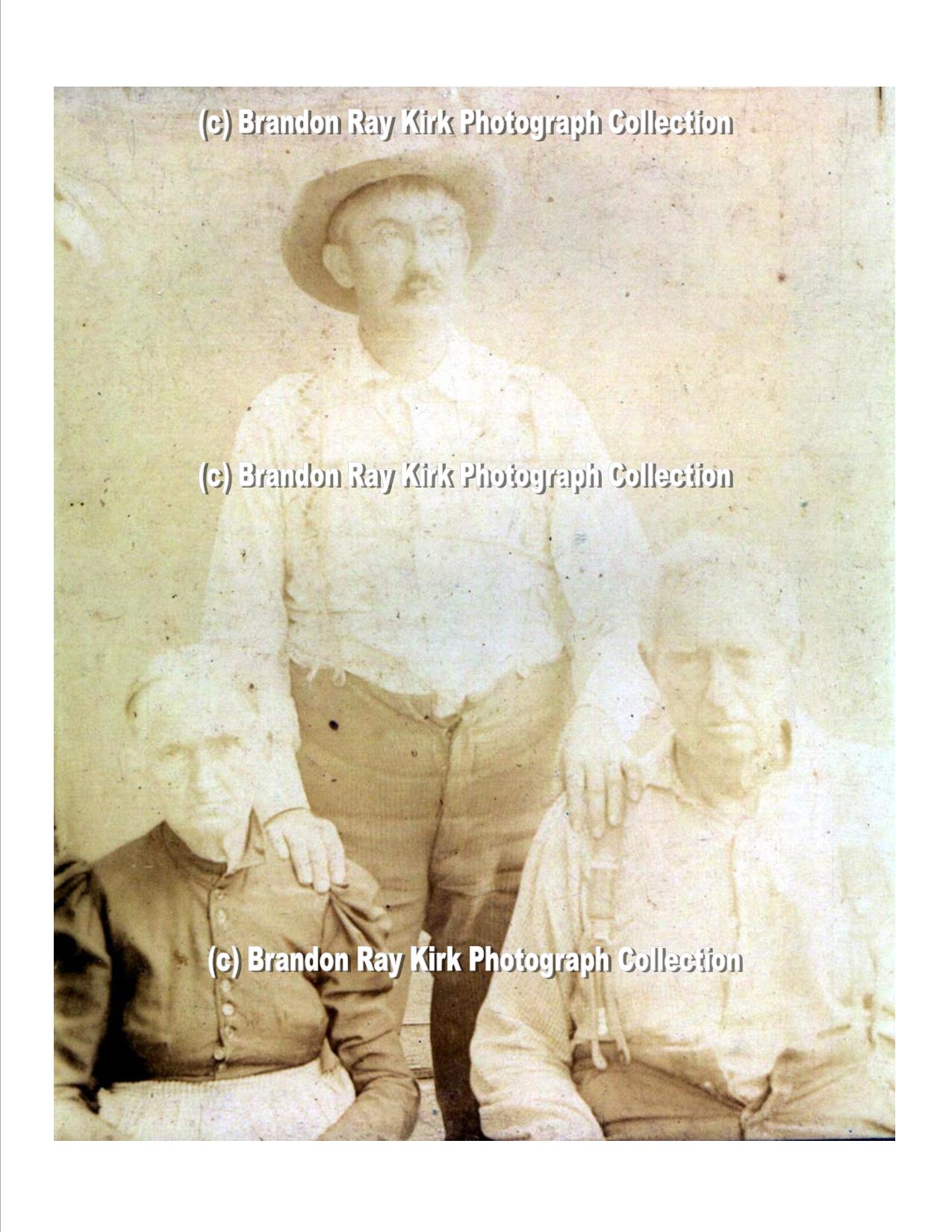
Hugh Dingess stands behind his parents, Sallie (Adams) Dingess and Henderson Dingess

Hugh Dingess stands behind his parents, Sallie (Adams) Dingess and Henderson Dingess

In Search of Ed Haley 272

24 Monday Mar 2014

Posted by Brandon Ray Kirk in Big Harts Creek, Culture of Honor, Ed Haley, Lincoln County Feud

≈ 1 Comment

Tags

Al Brumfield, Albert Dingess, Ben Adams, Brandon Kirk, Charlie Dingess, crime, Dave "Dealer Dave" Dingess, Dave Dingess, feud, fiddler, fiddling, French Bryant, Green McCoy, Harts Creek, Harve Dingess, Harvey "Long Harve" Dingess, Henderson Dingess, history, Hollene Brumfield, Hugh Dingess, Maude Dingess, Millard Dingess, Milt Haley, Thompson Branch, writing

Either way, Milt Haley and Green McCoy were paid a side of bacon and some money to eliminate Al Brumfield. Maude Dingess said Milt and Green ambushed Al and Hollena Brumfield as they rode down Harts Creek on a single horse. Hollena’s brothers, Harvey and Dave, followed behind them on separate horses.

“I guess they thought he was gonna have trouble or they wouldn’t a been doing that,” Maude said, somewhat logically.

As they made their way past Thompson Branch, Brumfield spotted two men hiding in the weeds. He ducked somehow to avoid harm, but Hollena was shot from the horse.

“Al just went on,” Maude said, while Dave and Harve “ran back up here to their mother and daddy’s house to get somebody to go down there with them.”

They later returned with a sled and hauled Hollena’s bloody body back to Smoke House.

In a short time, Milt and Green were rounded up and taken to Hugh Dingess’ home at the mouth of Bill’s Branch.

“I’d say old man Hugh got them kids and took them maybe to some of their relatives’ houses or somewhere else,” Harve Dingess said. “Maybe up to old Albert Dingess’ or somewhere like that. See, old Albert just lived on up the road a mile, mile and a half.”

Harve continued, “They said they all had a big feast there and I guess they had a lot of the corn whiskey there and all of them drinking and playing music. And they said they made the old man Haley — he was a fiddle player — they said they made him play that fiddle all night and all of them drunk a dancing. They said that they just kept telling him to keep that fiddle a going.”

I wondered where Milt got the fiddle at Hugh’s and Maude said, “They sent somebody to somebody’s house that had a fiddle I bet and brought it back. Back in them days you know a lot of households had them old instruments in them.”

I asked if Milt was considered a good fiddler and Harve said, “At that time, I think they said he was. Supposed to’ve been very good.”

Harve had never heard much talk about Green McCoy but stressed: “I know I did hear them talk about them making the old man play the fiddle all night and all of them a dancing and cooking and having a big feast there and drinking their moonshine.”

I said, “Most people that are gonna kill somebody, they don’t want to get to know them. If you have an execution, the executioner don’t want to get to know the prisoner because the more he gets to know that prisoner the harder it is for him to conduct the execution. To have two guys to play music for you before you’re fixing to kill them — that’s a good way to get to know them real quick. Boy, I don’t see how they did that.”

“I guess that’s the reason they kept old French Bryant,” Harve said. “They said he didn’t care for nothing. They said he was one of the leaders. He was a hollering, ‘Let’s go! Let’s do it!’ Pushing the thing, from what I could understand. He was a hollering, ‘Let’s kill the sons of bitches!’ That’s what I heard over the years. I even heard Millard say that one time. French was the one wanting to hang them up to the walnut tree and I think they finally decided against that.”

Brandon wondered who else was in the gang and Maude said, “Hugh and Charlie Dingess was into that. They was Grandpap’s boys — the older boys. Hugh was rough and over-bearing. Harve’s grandfather, ‘Short Harve,’ was into that. Burl Farley was into it, too.”

Maude doubted that Henderson Dingess was involved due to his advanced age (approximately 58 years), but we felt it was entirely possible since (1) men his age and older participated in the Hatfield-McCoy feud and (2) these guys had reportedly shot his daughter. Harve said he figured that his great-grandfather Albert Dingess was in on it because “he was just that kind of guy.”

“Dealer Dave” Dingess was probably involved, too, Harve said, because “them Dingesses all hung together. They was just a band of outlaws, as we would call it, that day and time.”

Harve and Maude hadn’t heard much about the story beyond that, although they knew that Milt and Green were taken away from Hugh’s when the Brumfields learned that another mob was forming to rescue them. They never confessed to committing the ambush on Al and Hollena Brumfield but everyone figured that Ben Adams was behind the trouble. As a result, Maude said the Brumfields and Dingesses were “against” Ben in following years. At one point, they tried to burn his home. Maude’s father was one of the few Dingesses who never held a grudge. He often referred to him as “poor old Uncle Ben.”

In Search of Ed Haley 271

23 Sunday Mar 2014

Posted by Brandon Ray Kirk in Big Harts Creek, Culture of Honor, Ed Haley, Lincoln County Feud, Timber

≈ Leave a comment

Tags

Al Brumfield, Albert Dingess, Ben Adams, Billy Hall, Brandon Kirk, Burl Farley, Charlie Dingess, crime, Dave Dingess, feud, Floyd Dingess, Harts Creek, Harve Dingess, Harvey "Long Harve" Dingess, Henderson Dingess, Hollene Brumfield, Hugh Dingess, John W Runyon, Logan County, Maude Dingess, Milt Haley, Rockhouse Fork, Sallie Dingess, timbering, West Virginia

Brandon asked Maude Dingess about her grandparents, Henderson and Sallie (Adams) Dingess. Maude said Grandpap Henderson was “kindly the leader of his family” but he had a real time keeping his older sons — Charlie, Floyd, and Hugh — in line. They ran around a lot with their uncle Ben Adams, who was Sallie Dingess’ youngest brother. Uncle Ben Adams was pretty tight with the Dingesses in the early years (he named his first three children after them) but was reportedly a bad influence on the Dingess boys. At some point, Maude said, her uncles “turned their meanness on him.”

One time, after Charlie Dingess whipped Ben in a fight, Ben came to complain to Sallie. Henderson saw him coming and told her, “Go out there and tell him to go home. We don’t want no trouble with them.” Sallie went outside and said to her brother, “Now Ben. You just go right back home. Don’t you get off here. There’s no use to quarrel at Charlie and Floyd ’cause you’ve made them what they are. You taught it to them.”

In subsequent years, Henderson tried to “distance” himself from Ben. He often made snide comments, like telling his son Dave that he was “all Adams” when he wouldn’t work.

“If I knew where the Adams vein was in your body, I’d drive a knife in it and let it run out,” Henderson would say.

Brandon asked Maude if her uncle Floyd Dingess was killed over timber in 1888.

“Floyd was tough,” she said. “Floyd was killed there at the mouth of Rock House. He had some logs there and that was his brother-in-law he was into it with, Bill Hall. They just got to quarreling over the logs, I guess. Floyd was bent down to drive the dregs in the logs and Bill Hall run up behind him and knocked him in the head with a pole axe.”

“I’ve heard Maude’s father talk about it,” Harve said. “He said when they’d be a floating the logs out of here — you know, huge water — Floyd Dingess would run them logs like a gray squirrel.”

Maude said, “He was a small man. Dad said Floyd was much of a man to be a little fella like that. He said he saw him do things a big man couldn’t do.”

As soon as we asked about Milt Haley’s death, Harve said, “It was all over timber. The Adamses around in the other creek yonder, they was all wanting to make a dollar out of timber, no doubt. Ben Adams and them had their own dam built somewhere up main Hart — splash dam. Well now, up in this fork, old Albert Dingess had a big one up there. Burl Farley had one too on up above it. They kept a huge dam there and when they’d get ready to float their logs, everybody would turn their dams out at once and let them go. When they would knock them there dams off and everybody had their timber ready to float out of here the timber would get mixed a going down. Naturally, it would. When they’d get down there at Hart — the Brumfields had the boom in there that caught the timber and hold it out of the river and then they’d make up their rafts there — and they’d have to pick through that and sort their timber out. They had their brands on it, but they’d slip and change their brands. Maude’s father, I heard him talk that they’d get down there and they’d get in the awfulest arguments ever was over whose logs were whose and whose belonged to what. I guess they had a time with it.”

In addition to all the hard feelings over people stealing logs, there was a lot of animosity toward Al Brumfield — even among his in-laws — because of the toll he charged at his boom.

“They was having to pay a toll down there at Hollene’s and they didn’t want to pay any toll,” Maude said. “And that’s what Al’s wife was shot over.”

“The Mullinses put this old guy [Milt Haley] up to doing the dirty work, I think,” Harve said. “Now, I ain’t sure on that. I’ve heard that talked a little bit.”

Brandon told Harve and Maude how Ben Adams was supposedly the one who hired Milt and Green to kill Al Brumfield and Maude confirmed, “He did. I thought it was Ben ’cause, you know, they talked that here.”

“That’s what the word was,” Harve said. “The Adamses and Mullinses around there. See, the Adamses and Mullinses was always locked in through marriage. They said that old Ben was the head of it. I just heard Maude’s brothers talking, you know, that he was a pretty ruthless man.”

Maude said, “He was awful hidden in his ways but Dad always bragged on him. Ben was his uncle.”

Brandon said, “People that live in Harts, down at the mouth of the creek, they’ve all been told that John Runyon hired those two men. People up here on the creek have always been told it was Ben Adams. What it looks like is that they both were in on it.”

Harve said, “It’s possible that they were in cahoots because now… Seems to me like, something I did hear… Somebody talked that in the past — might have been Maude’s father — that there was another person or some other people — which could have been the very people you’re talking about — tried to horn in on the Brumfields there at the mouth of the creek at one time and they had some problems with it. Like they tried to put a boom in of their own and squeeze old Hollene out.”

“I think Ben did that,” Maude said.

“Well, Ben could have been in on it with this other guy like he’s talking about,” Harve said.

Blood in West Virginia

11 Tuesday Mar 2014

Posted by Brandon Ray Kirk in Big Harts Creek, Big Sandy Valley, Civil War, Culture of Honor, Harts, Lincoln County Feud, Music, Timber

≈ 2 Comments

Tags

Al Brumfield, Appalachia, Blood in West Virginia, Brandon Kirk, Cain Adkins, feud, Green McCoy, Henderson Dingess, history, John W Runyon, Lincoln County, Paris Brumfield, West Virginia, writers, writing

You may pre-order my book at Pelican Publishing Company: http://www.pelicanpub.com/index.php

You may pre-order my book directly at Pelican Publishing Company’s website or at the website of any major bookseller. http://www.pelicanpub.com/index.php

In Search of Ed Haley 249

24 Monday Feb 2014

Posted by Brandon Ray Kirk in Big Harts Creek, Culture of Honor, Ed Haley, Lincoln County Feud, Timber

≈ Leave a comment

Tags

Al Brumfield, Ben Adams, Billy Hall, crime, Ed Haley, Eveline Dingess, feud, Floyd Dingess, Harts Creek, Henderson Dingess, history, Hollene Brumfield, Hugh Dingess, Imogene Haley, John W Runyon, Kentucky, Kiahs Creek, Robinson Creek, West Virginia, writing

At the time of the ambush on Al and Hollena Brumfield, Henderson Dingess and his family were in no mood to see yet another one of their fold die violently. Less than a year before, on November 15, 1888, Floyd Dingess, an older son of Henderson, was murdered while working logs at the mouth of Rockhouse Fork on Harts Creek. It was a horrific deed: Floyd, whose wife was several months pregnant, was murdered by his own brother-in-law, Billy Hall. Floyd had never been popular with the Halls. He reportedly made a habit of bullying Billy. It was said that when he came home from working, his wife would clatter pots and pans in the kitchen just so her family wouldn’t hear his footsteps.

When Billy finally shot Floyd on that fateful day, some of the younger Dingess boys were fishing in the creek nearby. They raced home to tell their family what had happened, while Billy quickly returned home and received instructions to hide out in Robinson Creek, Kentucky. Meanwhile, Floyd’s pregnant wife was floated across the creek to her husband, who died in her arms. Hugh Dingess, Floyd’s brother, tracked Billy to Kiah’s Creek but lost his trail. For years, Hugh was devastated by his brother’s death. He used to get drunk and shoot the Halls’ cattle.

The Dingesses eventually learned the whereabouts of Billy Hall and prepared to fetch him by force. The Halls on Harts Creek caught wind of their plan and sent word to Billy to escape by train to Tennessee, which he did — and was never heard from again.

Surely, when Milt Haley and Green McCoy shot Hollena Brumfield less than a year later, the Dingess family was determined to execute a harsh revenge. It was, after all, the second attack on their clan in several months. We wondered then, why would Milt, Green, Runyon, and Ben Adams — knowing the fate of poor Billy Hall — want to risk their lives (and fortunes) to attack Brumfield? Surely Milt and Green — taking a cue from Billy Hall — were well aware that once they committed their heinous act, the only avenue open to them was to flee the state forever. We also wondered if Milt just abandoned Emma and Ed on Trace Fork or if there was some kind of arrangement to later meet him in Kentucky?

In Search of Ed Haley 231

24 Friday Jan 2014

Posted by Brandon Ray Kirk in Ed Haley

≈ Leave a comment

Tags

Andrew D. Robinson, Ben Adams, Boney Lucas, Chloe Mullins, Ed Haley, Harts Creek, Henderson Dingess, history, Imogene Haley, Jackson Mullins, Logan County Banner, logging, McCloud & Company, Paris Brumfield, Peter Mullins, timbering, Turley Adams, Van Prince, Warren, Weddie Mullins, West Virginia, writing

Ed Haley was born in 1885 at Warren, a small post office established the previous year five miles up Harts Creek just below the mouth of Smoke House Fork. It was a place of 300 to 500 people chiefly led in its daily affairs by Henderson Dingess, Andrew Robinson, Anthony Adams, Ben Adams, and Burl Farley — all connected genealogically through the Adams family. At Warren, in 1884, the primary business was a general store called McCloud & Company. Henderson Dingess, father to Hollena and the patriarch of the clan, was a distiller and storekeeper. Ben Adams, a brother-in-law to Dingess, was a general store operator. Andrew Robinson was the local postmaster. Van Prince was a physician, perhaps assisting in Ed Haley’s birth or in the treatment of his measles.

Henderson Dingess, a prominent personality from that era, was the son of pioneer parents, born in 1829 to John and Chloe (Farley) Dingess. His wife, Sarah Adams (1833-1920), was a daughter of Joseph and Dicie (Mullins) Adams, who settled on Harts Creek from Floyd County, Kentucky, in the late 1830s. Henderson and Sarah lived in a two-story log house on land partly granted to him by the Commonwealth of Virginia in 1856. There, at the mouth of Hog Pen Branch, they raised eleven children, many of whom were active in the 1889 troubles. In the late 1880s, roughly the time of Milt Haley’s murder, Henderson and Sarah owned a 93-acre tract of land on Smoke House with a building valued at $100. They also owned an additional 350 acres on main Harts Creek and a 44-acre tract on nearby Crawley Creek worth $6.00 per acre with a $20 building on it.

At that time, Harts was caught up in the regional timber boom. According to The Logan County Banner, an estimated one million dollars worth of timber went out of the area in 1889. Perhaps prompted by this capitalistic invasion of the local economy, violence became the norm in Harts. Beginning with Paris Brumfield’s murder of Boney Lucas “over logs” in the early 1880s, there were at least six area killings before the turn of the century. (The Brumfields were involved in four of them and the Dingesses in three.) It was an era when Harts lost its innocence and began to earn the rough reputation it still carries today.

More than likely, following the horrific events of 1889, little Ed Haley and his mother lived for a brief time with Jackson and Chloe Mullins on Trace Fork. This changed a little later when, in 1891, Jackson and Chloe began to deed property to their three children. On March 18, they deeded their homestead to son Peter for 25 dollars. Deed records specify the property as a 20-acre tract of land, which began somewhere around the mouth of Trace and continued up to the Jackson Mullins Branch (basically the present-day Turley Adams property). The following day, Jackson and Chloe deeded another 20-acre tract to son Weddie Mullins for 25 dollars. This tract basically included everything from Jackson Mullins Branch to Jonas Branch.

On March 19, 1891, Jackson and Chloe deeded Imogene Haley 20 acres of land on Trace Fork for 25 dollars. In the property index, Imogene’s surname was spelled as “Hauley”, while the deed referred to her as “Immagin A. Haley.” Her land began at Jonas Branch and continued on up the creek. In the original deed, it was described as follows:

Beginning at the mouth of William Jonas branch thence up the Branch with the center of the branch to a _______ tree on the right hand side of the Branch as you go up the branch near a Chestnut that ________ on the left side of said branch thence acrosf the fields to some willow bushes at the front of the hill thence up the point with the center of the point to the brow of the Mountain thence with the brow of the Mountain to Mary Mullins line thence down the mountain to a bush thence a strate line crosfing the creek to a ash thence up the hill to the back line of the parties of the first part thence down the creek with the line of the said opposite the mouth of William Jonas branch thence down the hill a strate line to the Beginning supposed to contain 20 acres more or less.

An 1891 tax book listed “Emigene Hawley’s” property as being worth $2.00 per acre and having a total worth of $40. Records do not indicate if there was a house or building located on the property. In any case, Emma died soon after: an 1892 tax book lists her property under the name of “Immogen Hailey heirs”, which would have been Ed Haley. More than likely, seven-year-old Ed remained living in the home of his grandparents, Jackson and Chloe, for several more years.

At that time, Logan County was in the middle of a timber boom, which gave employment to Ed’s family on Trace Fork. “Some of the finest timber in the State is found in Logan county,” writes The Mountain State: A Description of the Natural Resources of West Virginia (1893). “Magnificent forests of oak, poplar, ash, lynn, maples, beech, birch, pines, hickory and other varieties still cover the greater part of the county in their primitive state. For thirty years timber men have been at work, destroying the forests and still in all this time not over a fourth of the timber has been removed. As an estimate of the value of the timber still standing in Logan county, three million dollars will not be far amise.”

In Search of Ed Haley 207

02 Monday Dec 2013

Posted by Brandon Ray Kirk in Ed Haley

≈ Leave a comment

Tags

Al Brumfield, Brandon Kirk, Cecil L. Hudgins, George Fry, Green McCoy, Harts Creek, Henderson Dingess, John W Runyon, Logan County Banner, Milt Haley, V R Moss, William C. Fry, writing

Toward the end of June 1995 Brandon made a trip to the Cultural Center in Charleston, West Virginia, where he spent several hours researching the story of Milt Haley’s murder using old microfilmed copies of the Logan County Banner. By examining the articles chronologically, a new perspective on the 1889 trouble emerged: the “official news accounts of the day” vs. oral tradition.

On page three of a Thursday, September 26, 1889, edition of the Banner was an article titled “Serious Shooting on Hart’s Creek, In Lincoln County” which detailed the ambush at Thompson Branch:

On last Sunday, while Mr. Allen Brumfield and his wife, who live near the mouth of Hart’s creek, in Lincoln county, were returning home from a visit to Mr. Henderson Dingess, father-in-law of Mr. Brumfield, and when about a mile and a half below Mr. Dingess, they were fired upon by some parties in ambush. Mrs. Brumfield was serious if not fatally wounded, the ball entering her right jaw near the ear and coming out near the nose, carrying away the greatest portion of the right jaw. Mr. Brumfield was shot through the right arm and another ball passed through his vest, grazing his breast. A son of Mr. Dingess, who was with them, was shot through the leg. Dr. C.L. Hudgins of this place, and Dr. V.R. Moss, of Barboursville, were sent for and Dr. Hudgins dressed the wound on Monday. We have not learned the names of the parties who were suspected of the shooting, but learn that they are being hunted for, and if found will be properly punished.

The Banner mentioned on its Thursday, October 10, 1889, society page: “John W. Runyon, of Harts Creek, and W.C. Fry, of Guyandotte, were in town Tuesday on business.” W.C. Fry was William Christian Fry, a brother to George Fry, at whose home the Haley-McCoy murders took place a few weeks later. We wondered, were he and Runyon in town together on business? And did their simultaneous trip to Logan have anything to do with George Fry’s home later being selected as the “murder house?”

The Banner first reported Milt Haley’s death in an article dated Thursday, October 31, 1889, and titled “MORE MURDERING/Two Prisoners Taken from their Guards and Shot to Pieces:”

On Thursday of last week, Green McCoy and Milton Haley, the parties charged with the shooting of Allen Brumfield and his wife, on Harts creek in Lincoln county a short time ago were [held by a group of] citizens under charge of Al Brumfield. They were brought to Chapmanville in this county and wished to remain there over night, but fearing that an effort would be made to [kill] the prisoners, citizens there would not take them in. The guards, with the prisoners under their charge, then started down the river, a portion of the guard crossing to the opposite, leaving but the officer and three guards in charge of the prisoners. About six miles below Chapmanville, the guards and prisoners stopped at George Fry’s, at Mouth of Green Shoals in Lincoln county to stay all night. About 8 o’clock a number of persons supposed to be about twenty, came to Fry’s house, and demanded the prisoners. Mr. Fry and family were told to go into the kitchen and the guard to leave the house. The mob then entered the house and began shooting. The prisoners were dragged out of the house and shot down in the yard in front of the door. Not being satisfied with putting several balls through each of the men the mob took rocks and mashed their heads all to pieces. After finishing their murderous work the crowd dispersed, leaving the neighbors to look after the dead bodies.

No effort has been made to arrest any who were engaged in the outrage, yet it is pretty generally understood who were the leaders of the gang.

More than likely, the portion of the guard “which crossed the river and left the main group,” if true, went to alert Brumfield’s friends as to where the prisoners would be held that night.

In Search of Ed Haley 206

29 Friday Nov 2013

Posted by Brandon Ray Kirk in Big Harts Creek, Ed Haley, Lincoln County Feud, Timber

≈ Leave a comment

Tags

Al Brumfield, Allen Martin, Andrew D. Robinson, Andrew Robinson, Anthony Adams, Appalachia, Ben Adams, Ben Robinson, Boardtree Branch, Chloe Gore, Chloe Mullins, crime, David Robinson, Dicy Adams, Elizabeth Abbott, genealogy, general store, Greasy George Adams, Green McCoy, Harts Creek, Harvey Adams, Henderson Dingess, history, Hollena Brumfield, Hugh Dingess, Jackson Mullins, John Frock Adams, John M. Adams, John Robinson, Joseph Adams, Joseph Robinson, Lincoln County Feud, Logan County, Logan County Banner, Lucinda Brumfield, May Adams, Meekin Branch, Milt Haley, Peter Carter, Rhoda Robinson, Sallie Dingess, Solomon Adams, Spicie McCoy, Susan Abbott, Ticky George Adams, timber, Trace Fork, Victoria Dingess, Viola Dingess, West Virginia, Wilson Abbott

Ben Adams — the man who supposedly hired Milt Haley and Green McCoy to assassinate Al Brumfield — was born in 1855 to Joseph and Dicy (Mullins) Adams on Big Harts Creek in Logan County, (West) Virginia. His older sister Sarah married Henderson Dingess and was the mother of Hollena Brumfield, Hugh Dingess and several others. He was a first cousin to Jackson Mullins, Milt Haley’s father-in-law, and a brother-in-law to Chloe Mullins, Milt’s mother-in-law, by her first marriage to John Adams.

In 1870, 17-year-old Ben lived at home with his mother, where he worked as a farmer. He was illiterate, according to census records. His neighbors were Andrew Robinson and Henderson Dingess, both of whom had married his sisters (Rhoda J. and Sally). In the next year, according to tradition, he fathered an illegitimate child, William Adams, who was born to Lucinda Brumfield (niece of Paris).

In 1873, Ben married Victoria Dingess. Victoria was born in 1856 and was a first cousin to Hollena Brumfield and Hugh Dingess. The marriage made for an interesting genealogical connection: Ben was already Hugh’s uncle; now he was also his brother-in-law, as Hugh was married to Victoria’s sister, Viola (his first cousin). Ben’s daughter Sally, who was named after Hollena’s mother, later married a cousin of Spicie McCoy, Green’s wife. For all practical purposes then, Ben Adams was genealogically connected to all sides of the feud — making it a true intra-family feud from his perspective.

For the first decade or so of his marriage, Ben lived with his mother on family property, although he did acquire land and open a general store business. In 1880, he was listed in the Lincoln County Census with his mother Dicy, aged 63, and family. He was 26 years old, Victory was 23, Sally was six, son Charlie was four, daughter Patsy A. was two, and son Anthony was a few months old. George Greaar, age 20, was a boarder. In 1881, he purchased 25 acres on the Meekin Branch of Trace Fork. Three years later, he was listed in a business directory as the proprietor of a general store. At that same time, his brother-in-law and neighbor Henderson Dingess was a distiller.

Later in the decade, Ben fathered three more children: George “Greasy” (1885), Harvey (1886), and May (1889). In 1889, the time of Milt Haley’s ambush of Al Brumfield, Adams owned 260 acres on the Boardtree Branch of Trace Fork valued at $1.00 per acre in Logan County.

Anthony Adams — Ben’s brother and ally in the 1889 troubles — was a prominent timberman on Harts Creek. Anthony had been born in 1849 and was the husband of Pricie Alifair Chapman, Burl Farley’s half-sister. In 1884, Adams was listed in a business directory as a blacksmith. In 1889, he owned two 50-acre tracts of land, one valued at $3.50 per acre with a $30 building on it, the other valued at $2.00 per acre. By that time, he had three sons of fighting age who may have participated in the feud: Solomon Adams (born 1869), Horatio “Rush” Adams (born 1871), and Wayne Adams (born 1874), as well as a son-in-law, Harrrison Blair (born c.1867).

A quick examination of the Adams genealogy gives a clue as to Ben’s other 1889 allies. First there was brother “Bad John” Adams. Adams was deceased at the time of the Haley-McCoy incident, but he had been married to Chloe Gore — mother of Emma Jean (Mullins) Haley. He had three sons of fighting age in 1889: Joseph Adams (born 1859), John Frock Adams (born 1861), and Ticky George Adams (born 1865)…as well as son-in-law Sampson Thomas.

Rhoda J. Robinson was a sister to the three Adams brothers. She had several children who may have allied with Ben: David Robinson (born 1860), Ben Robinson (born 1866), John R. Robinson (born 1868), and Joseph Robinson (born 1870). There was also brother Solomon Adams, who may have offered his loyalty to Ben, along with sons John M. Adams (born 1869) and Benjamin Adams (born 1867), and sons-in-law David Robinson and Peter Carter (c.1873).

As for Ben himself, he stayed busy with timber after the feud. According to an 1896 article from the Logan County Banner: “Benj. Adams, of Hart, is hauling some fine poplar from trace fork.” In 1901, he married Venila Susan Abbott, a daughter of Wilson and Elizabeth (Workman) Abbott, and had at least eight more children (born between 1901 and 1921). Not long after his remarriage, he was accused of murdering a local postman named Jim Allen Martin — and nearly went bankrupt paying for his legal defense. He died in 1910 and was buried on the hill near the mouth of Trace Fork.

In Search of Ed Haley 204

27 Wednesday Nov 2013

Posted by Brandon Ray Kirk in Big Harts Creek, Chapmanville, Ed Haley, Harts, Music

≈ Leave a comment

Tags

Al Brumfield, Anthony Adams, Ashland, Bill's Branch, blind, Brandon Kirk, Cain Adkins, Cecil Brumfield, Chapmanville, Charley Davis, Cow Shed Inn, Crawley Creek, Dave Brumfield, Dick Thompson, Earl Brumfield, Ed Haley, Ellum's Inn, fiddler, fiddling, Fisher B. Adkins, Green McCoy, Harts Creek, Henderson Dingess, Hoover Fork, Hugh Dingess, John Brumfield, Kentucky, Lincoln County, Lincoln County Schools, Logan, Logan County, Milt Haley, music, Piney Fork, Smokehouse Fork, Trace Fork, Trace Mountain, West Fork, West Virginia, writing

A few days after visiting Earl Brumfield, Brandon dropped in on his good friends, Charley Davis and Dave Brumfield. Davis was an 88-year-old cousin to Bob and Bill Adkins. Brumfield was Davis’ son-in-law and neighbor. They lived just up Harts Creek near the high school and were familiar with Ed Haley and the story of his father, Milt. Charley said he once saw Ed in a fiddlers’ contest at the old Chapmanville High School around 1931-32. There were two other fiddlers in the contest — young men who were strangers to the area — but Ed easily won first place (a twenty-dollar gold piece). He was accompanied by his wife and a son, and there was a large crowd on hand.

Dave said Ed was mean as hell and laughed, as if it was just expected in those days. He said Ed spent most of his time drinking and playing music in all of the local dives. Sometimes, he would stop in and stay with his father, Cecil Brumfield, who lived in and later just down the road from the old Henderson Dingess place on Smoke House Fork. Dave remembered Ed playing at the Cow Shed Inn on Crawley Mountain, at Dick Thompson’s tavern on main Harts Creek and at Ellum’s Inn near Chapmanville. Supposedly, Ed wore a man out one time at a tavern on Trace Mountain.

Dave said he grew up hearing stories about Ed Haley from his mother’s people, the Adamses. Ed’s blindness was a source of fascination for locals. One time, he was sitting around with some cousins on Trace who were testing his ability to identify trees by their smell. They would put first one and then another type of limb under his nose. Dave said Ed identified oak and walnut. Then, one of his cousins stuck the hind-end of an old cat up under his nose. Ed smiled and said it was pussy willow.

Dave said he last saw Ed around 1945-46 when he came in to see his father, Cecil Brumfield. Ed had gotten drunk and broken his fiddle. Cecil loaned him his fiddle, which Ed never returned. Brumfield later learned that he had pawned it off in Logan for a few dollars to buy a train ticket to Ashland. Cecil bought his fiddle back from the shop and kept it for years.

Dave’s stories about Milt Haley were similar to what his Aunt Roxie Mullins had told me in 1991. Milt supposedly caused Ed’s blindness after getting angry and sticking him head-first into frozen water. Not long afterwards he and Green McCoy were hired by the Adamses to kill Al Brumfield over a timber dispute. After the assassination failed, the Brumfields captured Milt and Green in Kentucky. Charley said the two men were from Kentucky — “that’s why they went back there” to hide from the law after the botched ambush.

The vigilantes who captured Milt and Green planned to bring them back to Harts Creek by way of Trace Fork. But John Brumfield — Al’s brother and Dave’s grandfather — met them in the head of the branch and warned them to take another route because there was a rival mob waiting for them near the mouth of the hollow. Dave said it was later learned that Ben and Anthony Adams — two brothers who had ill feelings toward Al Brumfield — organized this mob.

The Brumfield gang, Dave and Charley agreed, quickly decided to avoid the Haley-McCoy rescue party. They crossed a mountain and came down Hoover Fork onto main Harts Creek, then went a short distance down the creek and turned up Buck Fork where they crossed the mountain to Henderson Dingess’ home on Smoke House Fork. From there, they went up Bill’s Branch, down Piney and over to Green Shoal, where Milt played “Brownlow’s Dream” — a tune Dave said (mistakenly) was the same as “Hell Up Coal Hollow”. Soon after, a mob beat Milt and Green to death and left them in the yard where chickens “picked at their brains.” After Milt and Green’s murder, Charley said locals were afraid to “give them land for their burial” because the Brumfields warned folks to leave their bodies alone.

Brandon asked about Cain Adkins, the father-in-law of Green McCoy. Charley said he had heard old-timers refer to the old “Cain Adkins place” on West Fork. In Charley’s time, it was known as the Fisher B. Adkins place. Fisher was a son-in-law to Hugh Dingess and one-time superintendent of Lincoln County Schools.

In the years following the Haley-McCoy murder, the Brumfields continued to rely on vigilante justice. Charley said they attempted to round up the Conleys after their murder of John Brumfield in 1900, but were unsuccessful.

In Search of Ed Haley 184

19 Saturday Oct 2013

Posted by Brandon Ray Kirk in Ed Haley

≈ Leave a comment

Tags

Al Brumfield, Bob Adkins, Charlie Conley, crime, Green McCoy, Henderson Dingess, history, Hollene Brumfield, Hugh Dingess, John Brumfield, Lincoln County, Milt Haley, writing

A few days later, I picked Brandon up at his apartment in Huntington and we drove to see Bob Adkins in Hamlin. We parked on the street in front of Bob’s house (just past the red light) and walked up onto the front porch where his wife, Rena, a very friendly and cordial lady, met us at the door. She welcomed us inside to the living room. We listened to Bob speak of Milt Haley’s death. It was clear that his memory had faded somewhat since my last trip to see him in 1993.

“Well, what the trouble was there, that fella Runyon, he had a saloon and a little old grab-a-nickel store right across the creek there at the mouth of Harts,” Bob said. “And Aunt Hollene and Al Brumfield, they had a big store over there on the lower side of the creek. They was competitors in a way, you know. And that fella Runyon, he wanted to get rid of them, see. He hired these two thugs to kill them. These fellas Milt Haley and Green McCoy were two characters. And a fella by the name of Runyon gave them a side of bacon and a can of lard to kill them…each.”

Bob laughed, fully aware of how it would all turn out and seemingly amused.

“They got in a big sinkhole up above the road with a high-powered gun — a .30.30 Winchester.”

According to Bob, Haley and McCoy waited in that sinkhole for Al and Hollena Brumfield to pass by.

“Ever Sunday, Aunt Hollene — she was my mother’s aunt — she’d go up to the forks of Big Hart about ten miles up there to visit her father, old Henderson Dingess. Al had a fine riding horse and he’d get on the horse and she’d ride behind him. They’d go up there on a Sunday and have dinner with her father. And they’d been up there — it was a pretty summer day — and they came along about three or four o’clock in the evening. They shot at Al’s head and that high-spirited horse jumped and that bullet missed his head and hit Hollene in the side of the jaw — knocked her teeth out. That knocked her off’n the horse. Of course, that horse sprang and run. But they had come down off’n the hill and they aimed to shoot Aunt Hollene again. And she a laying there in the road — her eyes full of blood. She couldn’t see hardly who it was. She begged them not to shoot her anymore — she told them she was dying anyway.”

So where was Al Brumfield at that time?

“Al got offa the horse down below there and come back under the creek bank and got to shooting at them see and they took off,” Bob said. “Hollene got over that. She was my mother’s aunt. I was around her home a lot. She lived in that big white house in Hart. Burned down now.”

How did they figure out who ambushed the Brumfields?

“Well, they didn’t know who it was,” Bob said. “But they noticed they weren’t around home, the Brumfields and Dingesses did. They was watching all around to see who it was. And these two guys just left their families and went into Kentucky. Just deserted their families. Then they knew who it was. After they got a hold of them, the Dingesses and the Brumfields, they told them the whole story. That was at my grandfather’s home. They took one guy out there in the yard and gagged him so he couldn’t make a noise and stuck a gun in his back and told him if he made any noise they’d shoot him. So he listened to that other fella inside the house. That other fella broke down and cried and he told them the truth about it. And they killed both of them over at Green Shoal. Took them out in the yard and shot them all to pieces. Walked off and left them. I was born and raised about three quarters of a mile below there.”

I asked Bob why the Brumfields did not avenge John Brumfield’s murder with the same ferocity. John, I knew from Brandon, was killed by Charlie Conley at a Chapmanville Fourth of July celebration in 1900.

“I don’t know,” he said. “But I’ll tell you, John Brumfield, he was mean as a snake anyway. He treated them fellers pretty rough. And they killed him up there in the head of Hart in an association ground. They just walked up to him in that association ground — a whole bunch of people there — and shot his brains out.”

An association ground?

“They had them once a year near an old schoolhouse,” Bob said. “People’d all gather in and they had a place where they traded horses. Half a mile away, an old country preacher would preach to them. It was kind of a rough place up in there at that time.”

In Search of Ed Haley 180

09 Wednesday Oct 2013

Posted by Brandon Ray Kirk in Ed Haley

≈ 2 Comments

Tags

Al Brumfield, Appalachia, Brandon Kirk, feud, Green McCoy, Harts, Harts Creek, Henderson Dingess, Hollene Brumfield, James V. Henderson, John W Runyon, Milt Haley, Wild Bill, writing

Having satisfied my thirst for Brumfield family history, Brandon pulled out some great newspaper articles pertaining to the 1889 troubles. He began with one from the Ceredo Advance dated Wednesday, October 2, 1889, and titled “Disappointed Love Leads to a Desperate Double Crime in Lincoln County:”

HUNTINGTON, W.Va.  September 27 – Word has just reached here of a sensational crime on Big Hart’s creek, in Lincoln county, 90 miles up the Guyandotte River. Al Brumfield, a newly married man, and his bride had spent the day with his wife’s parents some distance up the creek. Just at dusk, on their return, and when near their home, they were fired upon by a man who sprang from the bushes by the road-side. Mrs. Brumfield was shot in the head and fell to the ground unconscious. Her husband was shot in the right lung but managed to crawl to a neighbor’s for assistance.

The nearest physician, twenty-five miles distant, was summoned, but arrived too late to render the woman any assistance and she died in a few hours. The latest information is that Brumfield is also dying. He claims he recognized the assassin, but refuses to say who it was. It is the belief of the neighborhood that a suitor of Mrs. Brumfield, who failed to win her, is the assassin.

The article was full of errors but its implication of a single “assassin” with a personal attachment to Hollena Brumfield was interesting.

On Wednesday, October 9, 1889, Ceredo Advance ran a letter from “WILD BILL,” written on September 27. Wild Bill gave his address as Warren, West Virginia — a now extinct post office on Harts Creek below the mouth of Smoke House Fork.

ED. ADVANCE: — As you have had no communication from this place for some time I will give you a few items. There have been several cases of flux in this vicinity and two or three deaths. Farmers are busy saving fodder and cutting up corn. Our neighborhood was thrown into a state of confusion last Sunday evening about 3 o’clock. One mile from this place some low down villain attempted to assassinate Mr. Brumfield and wife. They had been on a visit to Mrs. Brumfield’s father, Mr. Henderson Dingess, and as they returned home they were shot from the brush, one ball striking Mrs. Brumfield just in front of the right ear and ranging around the cheek bone and striking her nose producing a serious but not fatal wound, and one ball striking Mr. Brumfield in the right arm below the elbow producing only a flesh wound. They were cared for and dressed by Drs. Moss, of Cabell county, and Hudgins, of Logan county. They will recover. Mr. Brumfield is a prominent merchant living at Hart, W.Va., and is a good citizen, highly esteemed by his neighbors. His wife is a noble and kind-hearted lady and beloved by all her acquaintances. They have a large train of friends who sympathize with them in their distress. The object of the attempted murder is believed to be robbery. The good and law-abiding citizens should unite and rid the earth of such miserable miscreants.

Based on this September 27 letter, written a week after the ambush at Thompson Branch, there were two theories regarding the motive for the crime: one, it was done by a jealous suitor; two, it was an attempted robbery.  In either case, this second article again referred to the attacker in the singular sense…sort of.

By October 24, locals had deduced Haley and McCoy’s guilt, captured them in Kentucky and murdered them at Green Shoal. WILD BILL was apparently unaware about this latter act because on October 25 he again sent a letter to the Ceredo Advance (printed on November 6).

ED. ADVANCE – Mr. Allen Brumfield, who was shot in the arm near this place about a month ago, has got about well. His wife, who was shot at the same time, is improving very slowly, but she will get well. The perpetrators of the awful crime — Milton Haley and Green McCoy — have been arrested. Haley did the shooting and McCoy is accused of being an accomplice, but the latter will be released by turning state’s evidence against Haley. The law should be enforced against such persons to the utmost extent. Our neighborhood is in a state of intense excitement and may terminate in a deadly feud between two parties…

[Since the above was written a mob took Haley and McCoy from the officers and killed them. — ED]

God only knows what our country will come to, as the deadly Winchester is fast becoming the ruling factor in our land.

Well just who was this WILD BILL? He seems to have access to a lot of information regarding the growing feud on Harts Creek. Maybe it was “Detective Wild Bill,” who history records as a participant in the Hatfield-McCoy Feud in the nearby Tug Valley.

A story featured in the Ceredo Advance titled “A Visit to the Lincoln County Battle Field” and dated Wednesday, November 13, 1889, was most interesting:

Mr. J.V. Henderson, editor of the Charleston Nonpareil, was in this city today [Nov. 7], having just returned from the scene of the recent trouble in Lincoln county. He went to get a full description of the places and the causes which led to the trouble for the metropolitan dailies. Mr. Henderson went into the house where Green McCoy and Milton Haley were murdered, and made a map of the house and its surroundings. He also made a map of the Hart’s Creek country, giving the location of each faction — the Brumfields and the Runyons. While going up Hart’s Creek he was met by two men acting as pickets, armed with Winchester rifles, who asked him where he was going and what was his business. Mr. Henderson told them that he was a newspaper man and wanted to get information regarding the trouble in that vicinity. They told him that they would give him one hour to get off the creek and leave the country.

Mr. Henderson took the hint and left at once. He says he learns that both factions are heavily armed and are expecting an attack at any time. Each side has pickets out ready to give the alarm in the event of hostile movements by the other side. The road up Hart’s Creek is blockaded, and travelers through that region avoid the place.

Unfortunately, few issues of the aforementioned Charleston Nonpareil survive in libraries today. Brandon later located copies of the Nonpareil for February and May of 1889 and February and June of 1890 — the times just prior to and just after the trouble — but none for the fall of 1889, which would have maybe mapped the murder site and the location of the feudists’ homes. There was one interesting development: according to The Cabell County Record, Mr. J.V. Henderson, “one of the best known figures in West Virginia newspaper work,” died at the Spencer insane asylum in 1898 at the ripe age of 43.

In Search of Ed Haley 178

29 Sunday Sep 2013

Posted by Brandon Ray Kirk in Ed Haley

≈ Leave a comment

Tags

Al Brumfield, Boney Lucas, Brandon Kirk, George Fry, George W. Ferrell, Green McCoy, Henderson Dingess, history, Hollene Brumfield, John Hartford, John W Runyon, Milt Haley, Paris Brumfield, The Lincoln County Crew, writing

After a few hours of digesting this material, I met Brandon Kirk in the hall near the copier. Brandon, a neatly groomed young man wearing a tie, was freighted down with satchels. We introduced ourselves and were soon in the study room where Brandon started fishing through his bags and pulling out letters, notebooks, folders and photo albums. Within a few minutes, the table was covered. It was as if someone had walked up with a giant garbage bag full of papers and dumped it all out in front of me.

One of the first things Brandon showed me was a small account of Milt Haley’s murder titled “The Brumfield-McCoy Feud”, which was originally published in a 1926 edition of Lambert’s Llorrac.

The Brumfield-McCoy Feud took place in the month of September, about 1888, some three miles up Hart’s Creek. Hollena Brumfield and her husband, Allen Brumfield, had been visiting Henderson Dingess, father of Mrs. Brumfield, one Sunday and were about two miles below Mr. Dingess’ on their way home. Green McCoy and Milt Haley laid in wait for them. Mr. and Mrs. Brumfield were riding down the creek, Mrs. Brumfield being on the same horse behind her husband. McCoy and Haley began shooting at them, one bullet striking Mr. Brumfield in the arm, and the other tearing away a portion of Mrs. Brumfield’s face, disfiguring her for life. Mr. Brumfield jumped from his horse and ran, and in that way escaped further injury. McCoy afterwards told that they were bribed by John Runyons with a barrel of flour and a side of bacon to McCoy, and twenty-five dollars in money to [Haley]. The murderers escaped into Kentucky but were captured a little later and brought back. Allen Brumfield supplemented the reward offered by the state with one of his own.

It seems the cause of the trouble was bad feeling between John Runyons and Al Brumfield. Runyons had a store and saloon at the mouth of Hart’s Creek. Brumfield had a store on Guyan River about a fourth of a mile below Hart, on the south side of the Guyan and sold whiskey on a houseboat. John Dingess [Mrs. Brumfield’s brother] was a bartender.

McCoy and Haley were brought back and kept over night at the house of George Fry. The next morning a number of men, presumably Brumfield’s friends came in, and the two prisoners were shot and killed.

Along with the above article was another version of “The Lincoln County Crew”, which gave George (and not Tom) Ferrell as the author.

Come all young men and ladies, come fathers, mothers, too;

I’ll relate to you the history of the Lincoln County crew.

Concerning bloody rows, and many a thieving deed,

Dear friend, pray lend attention to these few lines I say.

It was in the month of August all on a very fine day;

Allen Brumfield he got wounded they say by Milt Haley.

But Brumfield couldn’t believe it, nor hardly thought it so;

He said it was McCoy who shot that fatal blow.

They shot and killed Boney Lucas, a sober and innocent man,

And left his wife and children, to do the best they can.

They wounded Rufus Stowers, although his life was saved;

And he seemed to shun the grog shop, since he stood so near his grave.

Allen Brumfield he recovered, some weeks and months had past;

It was at the house of George Fry, these men they met at last.

Green McCoy and Milt Haley, about the yard did walk;

They seemed to be uneasy and no one wished to talk.

And then they went into the house, and sat down by the fire,

And little did they think, dear friends, they had met their final hour.

The sting of death was near them, _________________________

A few words passed between them concerning a row before.

The people some got frightened, began to rush out of the room;

When a ball from some one’s pistol laid the prisoners in the tomb.

Their friends then gathered ’round them, their wives to weep and wail;

Tom Ferrell was arrested, and soon confined to jail.

The butchers talked of lynching him, but that was all the fear;

And when the day of trial came, Tom Ferrell he came clear.

And then poor Paris Brumfield, relation to the rest,

He got three balls shot through him, they went straight through his breast.

The death of these few men have caused great trouble in our land;

Men to leave their wives and children to do the best they can.

Lincoln County’s still at war, they never, never cease;

Oh, could I only, only see my land once more in peace.

I composed this as a warning, a warning to all men;

Your pistols will cause trouble, on that you may depend.

In the bottom of the whiskey glass, the lurking devil dwells;

It burns the hearts of those who drink, and sends their soul to hell.

In Search of Ed Haley 122

02 Sunday Jun 2013

Posted by Brandon Ray Kirk in Ed Haley

≈ Leave a comment

Tags

Al Brumfield, Bill Fowler, Charley Brumfield, genealogy, George Ward, Guyandotte River, Henderson Dingess, history, Hollene Brumfield, John Brumfield, Paris Brumfield, West Virginia, writing

Allen Brumfield — the man Milt Haley supposedly ambushed — was born in March of 1860 at Harts, in what was then Logan County, Virginia. His parents were Paris and Ann B. (Toney) Brumfield. Paris was a Confederate veteran, storekeeper and local politician — and one of the most notorious figures in the early history of Harts. Ann was a red-haired orphan raised by a property-rich school-teaching aunt. In 1880, 20-year-old Al Brumfield was listed in census records as living with his cousin, W.T. “Bill” Fowler, the chief businessman in Harts. Al was recorded as a farmer but was likely watching Fowler’s business closely, learning everything he could. His father, meanwhile, a heavy-drinking violent sort, had recently moved his mistress (and her illegitimate children) near the family home.

Upon reaching manhood, Brumfield was relatively tall with sandy-colored hair. He was a Democrat in politics. He married Hollena Dingess around 1881, presumably in Lincoln County. Hollena was the daughter of Henderson and Sarah (Adams) Dingess, somewhat wealthy residents of the Smoke House Fork of Big Harts Creek. Al and Hollena had six known children: Henry Beecher Ward Brumfield (born April 1883), Grover Cleveland Brumfield (born January 1884), Hendrix Brumfield (born November 29, 1886), George Brumfield (born c.1888), Belle Brumfield (born January 19, 1892), and Shirley Brumfield (born May 1, 1894).

Soon after marrying, Al built a small, boxed house on the bank of the Guyandotte River at the Shoals just below Harts. Nearby, he ran a whiskey boat. He and his wife were equally ambitious in their desire to accumulate wealth and political power. In a bold move to corner the timber market in Harts, Brumfield constructed a boom at the Narrows on Harts Creek to catch all logs coming out of the creek. Each logger was assessed a ten-cent per log tax. In a short time, he was on his way to amassing a small fortune.

In the early 1890s, he forced his cousin Bill Fowler to sell him his important property at the mouth of Harts Creek, where he began construction of a beautiful two-story white home. It was completed in two years and was a real mansion in its day. Illuminated with carbide lighting at a time when few people in the valley had the monetary power to afford such a luxury, it was dubbed “The Light House” by loggers who plied the river.

Throughout the 1890s, Brumfield was the business kingpin in Harts. He complemented his timber business by operating a store, saloon, ferry, sawmill and gristmill — and protected his entire business interest by serving as leader of the local vigilante group. In 1899, he successfully petitioned the government to reinstate the Harts post office, which had been discontinued in 1894, and served as its postmaster from 1900 until 1905.

“There is a postoffice in Hart’s creek now, and Al Brumfield is the postmaster,” wrote The Cabell Record on Thursday, April 5, 1900.

Almost simultaneous with Brumfield’s successes were his personal tragedies. On November 3, 1891, his brother Charley murdered his father, which had numerous implications within the family. In that same time frame, Al took on a mistress who bore him two illegitimate children and caused a great deal of spousal grief. And poor Hollena — who had already been shot in the face — was severely crippled when a steam-operated gristmill exploded with her inside, throwing her sixty feet into the air and breaking her hip. A little later, around 1900, Brumfield’s son George died of stomach trouble. And on July 4, 1900, his brother John was murdered by Charley Conley at a Fourth of July celebration in Chapmanville.

Just after the turn of the century, Al began to suffer from some debilitating disease, which eventually caused him to go blind. “Al Brumfield, of Hart, recently returned from Cincinnati, where he had his eyes treated, says that his sight is better,” according to The Cabell Record of Thursday, May 2, 1901. “He was almost blind.” Hollena hired George Ward, a local Negro, to care for him. In 1904, perhaps sensing that he might not survive the sickness, he deeded much of his property to his wife.

In Search of Ed Haley 115

23 Thursday May 2013

Posted by Brandon Ray Kirk in Big Harts Creek, Ed Haley, Spottswood, Warren, Whirlwind

≈ Leave a comment

Tags

Andrew Jackson, Ben Adams, Bill Abbott, Bob Mullins Cemetery, Buck Fork, Chloe Mullins, civil war, Confederate Army, Dicy Adams, Ed Haley, Elizabeth Mullins, Enoch Baker, genealogy, Harts Creek, Henderson Dingess, history, Hollene Brumfield, Imogene Haley, Imogene Mullins, Jackson Mullins, Jane Mullins, Jeremiah Lambert, John Frock Adams, John Gore, John Q. Adams, Joseph Adams, Kentucky, Logan County, Margaret Gore, Mathias Elkins, Peter Mullins, Riland Baisden, Spencer A. Mullins, Tennessee, Ticky George Adams, timbering, Trace Fork, Turley Adams, Van Buren Mullins, Weddie Mullins, Weddington Mullins, West Virginia, writing

Ed Haley’s grandfather, Andrew Jackson Mullins, was born about 1843 to Peter and Jane (Mullins) Mullins. Jackson, as he was called, was named in honor of President Andrew Jackson, that early American icon. Like many folks in those days, Peter and Jane Mullins appear to have been caught up in the Jackson mystique. They even named one son Van Buren, after his vice president. Jackson Mullins was the first child born to Peter following the family exodus from Kentucky or Tennessee to Logan County, (West) Virginia. The 1850 Logan County Census listed him as seven years old. In 1860, he was eighteen. During the Civil War, Jackson served in the Confederate army. Brothers Weddington and Van Buren served as Confederates. In the late 1860s, Jackson married the slightly older Chloe Ann (Gore) Adams, a widow. Chloe had been born around 1840 to John and Margaret (Dingess) Gore, pioneer residents of Harts Creek. She had first married John Quincy “Bad John” Adams, a first cousin to Jackson, with whom she had four children: Dicy (born 1857), Joseph (born May 1858), John C. “Frock” (born c. 1861) and George Washington “Ticky George” (born 15 Jul 1864). She and Jackson had three children: Imogene Mullins (born c.1868), Peter Mullins (born May 1870), and Weddington Mullins (born April 10, 1872). Jackson and Chloe are thought to have lived on Trace Fork, perhaps at the present-day site of the Turley Adams home where they certainly lived in later years.

What little is known of Jackson Mullins — the man who partially raised Ed Haley — comes through deed records and census records. On February 13, 1869, his uncle Spencer A. Mullins wrote him a note that read: “Mr. A.J. Mullins and wife: you will pleas Come down and git your Deed for the Buck fork Land. I will not pay the taxes any longer.” In 1869 he purchased 200 acres of land on the creek from Riland Baisden. The next year he was listed in the 1870 census as 27 years old with 700 dollars worth of real estate and 200 dollars worth of personal property. His daughter — Ed Haley’s mother — first appeared in that record as “Em. Jane Mullins,” age two.  An April 1871, Justice Jeremiah Lambert provided a receipt to him for $2.80 “in the cost of the peace warrant in favor [of] him against Benjamin Adams.” An 1871 Logan County tax receipt listed A.J. Mullins as a resident of “Hearts Creek.” On February 28, 1877, the Logan County Court appointed him as “Surveyor of Roads in Precinct No. 76 in place of Weddington Mullins for the time of two years commencing April 1, 1877.” On December 17, 1877, the Logan County Clerk provided a receipt to him for recording a deed from Henderson Dingess and wife (parents to Hollene Brumfield). An 1878 tax receipt shows him in charge of six tracts totaling 244 acres under the ownership of “John Adams Heirs.”

The 1880 Logan County Census listed Jackson as 37 years old, while his wife was 40. Children in the household were John C. Adams (aged eighteen), George Adams (aged 15), “Emagane Mullins” (aged 12), Peter Mullins (aged 9), and Weddington Mullins (aged 6). That same year, Jackson sold five tracts of land totaling over 200 acres to brother-in-law Mathias Elkins for 3,000 dollars. He also sold 50 or so acres on Buck Fork to his father Peter and stepmother Elizabeth for 600 dollars. In February 1881, the Logan County Court reappointed him to relieve his brother Weddington as Surveyor of Public Roads for Precinct No. 76 “commencing April 1st, 1881.” That same year, he secured land from the John Q. Adams estate and bought 100 acres on Trace Fork from A.A. Low, attorney. On August 7, 1883, Enoch Baker, a timber boss on Harts Creek,  provided a receipt to him for fifteen dollars “in payment for a Stove.” In 1886, Jackson deeded 37 tracts on Trace Fork to stepsons Joseph and John Adams. On April 2, 1888, he signed a promissory note agreeing to pay William Abbott $41.75 plus interest within a year. Because he was illiterate, he signed the note with an “X.”

In March 1891, Jackson and Chloe Mullins deeded their property on Trace Fork to their three children: Imogene Haley, Peter Mullins, and Weddie Mullins.

In the 1900 Logan County Census, Jackson gave his birth date as March of 1845, while Chloe gave hers as July 1834. Ed Haley first appears in the 1900 Logan County Census as “James E. Haley, born August 1885,” and living in their home. His birth date of 1885 was two years later than what was given by the Haley family records. By 1910, Jackson lived with son Peter Mullins, while Chloe was in the home of Weddie Mullins’ widow, Mag. Ed was absent from the census entirely, indicating that he was gone from Harts by that time. A few years later, in 1915, Jackson Mullins died and was buried in an unmarked grave at the Bob Mullins Cemetery on main Harts Creek. His widow died in 1919.

Bob Adkins Interview, Part 2 (1993)

18 Monday Feb 2013

Posted by Brandon Ray Kirk in Breeden, Ed Haley, Guyandotte River, Hamlin, Harts, John Hartford, Lincoln County Feud

≈ Leave a comment

Tags

Al Brumfield, Appalachia, Bob Adkins, Breeden, Cincinnati, crime, feud, feuds, Green McCoy, Guyandotte River, Harts Creek, Henderson Dingess, history, Hollene Brumfield, John Dingess, John Hartford, John W Runyon, Kentucky, Lincoln County Feud, Milt Haley, Norfolk and Western Railroad, Thompson Branch, Tug River, Twelve Pole Creek, West Virginia

Wow. So what about Al Brumfield, the guy who got into the feud with Milt?

“Well, he was a little more tamer fellow than old Paris but he was kind of a rough character — mean as a snake,” Bob said. “All those Brumfields were, you know. They was a tough outfit, all of them was.”

Al and his wife Hollena lived in a large white house at the mouth of Harts Creek, which Bob said had recently burned. They had a store and log boom nearby and kept a boat tied up at the riverbank for easy access across the Guyandotte. Things were going great for them until John Runyon (who Bob called “the root of all evil”) moved in from Kentucky.

“That fellow Runyon, he had a saloon and a store right across the creek there at the mouth of Harts, you know — a shebang,” Bob said. “And Aunt Hollene and Al Brumfield, they had a big store over there on the other side of the creek, over on the lower side of the creek. They was competitors in a way, you know. This fellow Runyon hired these two thugs to kill them, so as to get rid of their competition. And he hired Milt Haley and Green McCoy to kill them. They got a side of bacon and a can of lard and five dollars to do that…each. And these fellows, Milt Haley and Green McCoy, were two characters. I don’t know why they ever took a chance on that. Them boys got into that before they knew what they was into. Them Brumfields was mean as the devil up there.”

Bob spun out the details of Milt and Green’s ambush of Al Brumfield.

“Every Sunday, Al and Hollene would get on their horse and they’d ride up to the Forks of Big Hart about ten miles to visit her father. He was old Henderson Dingess, my great-grandfather. Al had a fine riding horse and he’d get on the horse and she’d ride behind him, see? And they’d been up there on a pretty summer day, and they’d done had dinner with her father.”

Haley and McCoy, meanwhile, laid in wait for them in a sinkhole at Thompson Branch with a .30/.30 Winchester.

“And Al and Hollene came along about three or four o’clock in the evening and those thugs laywaid them on the side of the hill up there as they came back down Harts Creek. They shot at Al’s head. That horse jumped and that bullet missed his head and hit Hollene right in the face right there and the bullet knocked her teeth out and came out this side here. It knocked her off of the horse.”

Al was carried on down the creek by his horse, which “sprang and run” so Milt and Green came off the hill toward his wife.

“They aimed to shoot Aunt Hollene again — and she a laying there in the road, her eyes full of blood. She couldn’t see hardly who it was. But she begged them not to shoot her anymore, because she figured they’d already killed her. She told them she was dying and begged them out of it.”

At that point, Al came back up along the creek bed shooting toward them “and they got scared and they run.”

Bob said, “Well, the Brumfields didn’t know who it was so they watched all around to see who it was. They watched Runyon like a hawk but he changed his name and walked right off. He left his store, his saloon and his family and went back to Kentucky. They hunted for years for him but they never did find him. He never poked his head around there anymore, not even to contact his family.”

Milt and Green also disappeared from the neighborhood — which caused locals to assume that they were guilty of some role in the trouble.

“And these two guys just left their family and went into Kentucky and just deserted their families,” Bob said. “Then they knew who it was. And they started looking for them.”

Al Brumfield put out a $3,000 reward for their capture. Detectives were told to search in river towns, as both men had run rafts out of the Guyan River.

A detective caught Green McCoy first in a Cincinnati restaurant. He identified him by noticing a nick in one of his ears. Just before apprehending him, the detective walked up and said, “I think you’re the man I’m looking for.” Once caught, Green gave the whereabouts of Milt, who was found working a butter churn on a steamboat at the river. Both men were jailed. Al Brumfield was informed of their capture by letter.

Brumfield organized two of his brothers-in-law and perhaps one of his brothers into a posse and rode to the rendezvous point (presumably in the vicinity of Cincinnati). He posed as a sheriff, paid the reward, took possession of the two men, then headed across eastern Kentucky and up the Tug River to Williamson. He and his gang rode a train on the N&W across Twelve Pole to Breeden, where they crossed the mountain and spent a night at the home of John Dingess, Hollena’s brother. Dingess ran a large country store and saloon, Bob said, but “nothing exciting happened around there.”

In Search of Ed Haley 46

05 Saturday Jan 2013

Posted by Brandon Ray Kirk in Ed Haley

≈ Leave a comment

Tags

Al Brumfield, Appalachia, Bob Adkins, feud, Green McCoy, Harts Creek, Henderson Dingess, history, Hollene Brumfield, John Hartford, John W Runyon, Lincoln County, Milt Haley, West Virginia, writing

     Several months later, I spotted a follow-up article about Milt Haley’s murder in the Spring 1992 edition of Goldenseal titled “Settling Family Differences.” It was based on an interview with Bob Adkins, a Lincoln County gas driller born just after the turn of the century at Ferrellsburg, West Virginia. It was rough country in there during his childhood.

     “I know of 18 murders within ten miles of where I grew up,” Bob said. “Never knew of anyone to kill a stranger. They were settling their own family differences. People lived by the gun. Never saw but one fistfight. I made it a point to tend to my own business.”

     Bob’s great-grandfather Henderson Dingess was the father of the Hollena Brumfield (spelled “Haline” in the article) shot in the face by Milt Haley and Green McCoy. Henderson and his wife Sally (Adams) Dingess lived on the Smoke House Fork of Harts Creek in what was then Lincoln County (but is today Logan County).

     “The Dingesses made part of their living floating logs downstream,” Bob said. “They also had an orchard and a federal licensed brandy making operation.”

     Al and Hollena Brumfield were wealthy businessmen at the mouth of Harts Creek on the Guyandotte River. Al’s father Paris Brumfield “lived half a mile below there on good bottom land,” Bob said. Al and Hollena “built a boom across [Harts] Creek to catch logs that were floated into the Guyan in the spring. Al charged by the log and prospered. They built an eight-room house and put in a store. Haline ran the store and offered food and lodging to travelers.”

     There was a picture of the Brumfield home in the article — it was the same place where Lawrence had said his grandmother was shot in a feud.

     Bob gave a great account of Milt’s murder, expounding on what I already knew while opening up a few new leads.

A fellow named Runyan [spelled “Runyon” in other sources] came in from Kentucky and put in a store and saloon and made competition for Haline and Al Brumfield. Well, when that fellow came and put in a store it was believed that he would like to get rid of Al.

Every Sunday Al and Haline rode up the hollow to Harts Creek to see her daddy, Henderson Dingess. They both rode on one horse. Runyan gave some men a side of bacon and a barrel of flour to kill them. They got in a sinkhole and shot at Al on the way back. Al jumped off, but they hit Haline in the cheek and the bullet went out the other cheek. Al ran and got away and then came back for Haline. She knew there were two men but she didn’t know who they were. Thought it was Burl Adams but became convinced it wasn’t him.

The men got away, but when it was found out that Milt Haley and Green McCoy had disappeared suddenly that night everyone agreed that they had been hired by Runyan to kill Al Brumfield. Runyan also left Harts that night. Runyan just left, and they looked for him the rest of their lives.  Then they missed Milt Haley and Green McCoy. They just left their families and disappeared. Figured it was by steamboat on the Ohio.

News got to Cincinnati that $1,500 was offered for Haley, Runyan, and McCoy. A detective there found [Haley and McCoy] and when Al heard they had his men he went down posing as sheriff, paid the reward, got them on the N&W train to Wayne County by Kenova, then up Twelve Pole Creek to Tug River. Breeden was a railroad stop and they walked from there to Harts by Left Fork of Twelve Pole.

Haline’s brother, John Dingess, had a saloon at Dingess on the way. They stayed there and stayed the next night at Grandpa’s [Hugh Dingess]. His daughter Brooke was 14 at the time. That night they took Milt Haley out, told McCoy they had hanged him, then McCoy told the whole story. Haley was held and made to listen to McCoy. Then they brought Haley in and he called McCoy yellow and still denied all of it.

Next day they went along West Fork of Harts to Fry. Stayed at Aunt Catherine Fry Adkins’s house at Fry. She was in the kitchen with the two men tied together, everyone drinking. Someone shot the lamp out over her head. Then they shot the men and took axes to their heads. This wasn’t much strange. They took the law into their own hands but made sure it was the right people.

Al Brumfield come to Grandpa [Adkins]’s that night but slept up the hollow. [They] took the bodies to West Fork of Harts and buried them in the same grave. Their relatives kept quiet.

     After repeatedly studying Bob Adkins’ story in Goldenseal, I concocted a theory about Ed’s mother that coincided somewhat with Lawrence’s story about her shooting at the Brumfield place. Bob told in the article how his father Albert Adkins met his mother Brooke Dingess while boarding at Hollena’s in the 1890s. They were married after Albert’s first wife Emma Jane Hager died of tuberculosis in 1901. Well…what if this Emma Jane Hager had been Emma Jean Haley? Had Emma Haley abandoned Ed and changed her last name so as to lose her identity as the widow of a man accused of attempted murder? Was the transportation slow enough and the memories of locals distorted enough by time to make such a transition of identity? It seemed a plausible enough theory, so I resolved to explore it by contacting Bob the next time I was in West Virginia.

Newer posts →

Feud Poll 1

If you had lived in the Harts Creek community during the 1880s, to which faction of feudists might you have given your loyalty?

Categories

  • Adkins Mill
  • African American History
  • American Revolutionary War
  • Ashland
  • Atenville
  • Banco
  • Barboursville
  • Battle of Blair Mountain
  • Beech Creek
  • Big Creek
  • Big Harts Creek
  • Big Sandy Valley
  • Big Ugly Creek
  • Boone County
  • Breeden
  • Calhoun County
  • Cemeteries
  • Chapmanville
  • Civil War
  • Clay County
  • Clothier
  • Coal
  • Cove Gap
  • Crawley Creek
  • Culture of Honor
  • Dingess
  • Dollie
  • Dunlow
  • East Lynn
  • Ed Haley
  • Eden Park
  • Enslow
  • Estep
  • Ethel
  • Ferrellsburg
  • Fourteen
  • French-Eversole Feud
  • Gilbert
  • Giles County
  • Gill
  • Green Shoal
  • Guyandotte River
  • Halcyon
  • Hamlin
  • Harts
  • Hatfield-McCoy Feud
  • Holden
  • Hungarian-American History
  • Huntington
  • Inez
  • Irish-Americans
  • Italian American History
  • Jamboree
  • Jewish History
  • John Hartford
  • Kermit
  • Kiahsville
  • Kitchen
  • Leet
  • Lincoln County Feud
  • Little Harts Creek
  • Logan
  • Man
  • Matewan
  • Meador
  • Midkiff
  • Monroe County
  • Montgomery County
  • Music
  • Native American History
  • Peach Creek
  • Pearl Adkins Diary
  • Pecks Mill
  • Peter Creek
  • Pikeville
  • Pilgrim
  • Poetry
  • Queens Ridge
  • Ranger
  • Rector
  • Roane County
  • Rowan County Feud
  • Salt Rock
  • Sand Creek
  • Shively
  • Spears
  • Sports
  • Spottswood
  • Spurlockville
  • Stiltner
  • Stone Branch
  • Tazewell County
  • Timber
  • Tom Dula
  • Toney
  • Turner-Howard Feud
  • Twelve Pole Creek
  • Uncategorized
  • Warren
  • Wayne
  • West Hamlin
  • Wewanta
  • Wharncliffe
  • Whirlwind
  • Williamson
  • Women's History
  • World War I
  • Wyoming County
  • Yantus

Feud Poll 2

Do you think Milt Haley and Green McCoy committed the ambush on Al and Hollene Brumfield in 1889?

Blogroll

  • Ancestry.com
  • Ashland (KY) Daily Independent News Article
  • Author FB page
  • Beckley (WV) Register-Herald News Article
  • Big Sandy News (KY) News Article
  • Blood in West Virginia FB
  • Blood in West Virginia order
  • Chapters TV Program
  • Facebook
  • Ghosts of Guyan
  • Herald-Dispatch News Article 1
  • Herald-Dispatch News Article 2
  • In Search of Ed Haley
  • Instagram
  • Lincoln (WV) Journal News Article
  • Lincoln (WV) Journal Thumbs Up
  • Lincoln County
  • Lincoln County Feud
  • Lincoln County Feud Lecture
  • LinkedIn
  • Logan (WV) Banner News Article
  • Lunch With Books
  • Our Overmountain Men: The Revolutionary War in Western Virginia (1775-1783)
  • Pinterest
  • Scarborough Society's Art and Lecture Series
  • Smithsonian Article
  • Spirit of Jefferson News Article
  • The Friendly Neighbor Radio Show 1
  • The Friendly Neighbor Radio Show 2
  • The Friendly Neighbor Radio Show 3
  • The Friendly Neighbor Radio Show 4
  • The New Yorker
  • The State Journal's 55 Good Things About WV
  • tumblr.
  • Twitter
  • Website
  • Weirton (WV) Daily Times Article
  • Wheeling (WV) Intelligencer News Article 1
  • Wheeling (WV) Intelligencer News Article 2
  • WOWK TV
  • Writers Can Read Open Mic Night

Feud Poll 3

Who do you think organized the ambush of Al and Hollene Brumfield in 1889?

Recent Posts

  • Logan County Jail in Logan, WV
  • Absentee Landowners of Magnolia District (1890, 1892, 1894)
  • Charles Spurlock Survey at Fourteen Mile Creek, Lincoln County, WV (1815)

Ed Haley Poll 1

What do you think caused Ed Haley to lose his sight when he was three years old?

Top Posts & Pages

  • About
  • U.B. Buskirk of Logan, WV (1893-1894)
  • Perry A. Cline Deed to Anderson Hatfield (1877)
  • Tice Elkins in Ferrellsburg, WV
  • Aracoma High School in Logan, WV (1929)

Copyright

© Brandon Ray Kirk and brandonraykirk.wordpress.com, 1987-2023. Unauthorized use and/or duplication of this material without express and written permission from this blog’s author and/or owner is strictly prohibited. Excerpts and links may be used, provided that full and clear credit is given to Brandon Ray Kirk and brandonraykirk.wordpress.com with appropriate and specific direction to the original content.

Archives

  • February 2025
  • January 2025
  • October 2023
  • September 2023
  • December 2022
  • November 2022
  • May 2022
  • April 2022
  • February 2022
  • November 2021
  • October 2021
  • September 2021
  • June 2021
  • May 2021
  • April 2021
  • March 2021
  • February 2021
  • January 2021
  • December 2020
  • November 2020
  • October 2020
  • July 2020
  • June 2020
  • May 2020
  • April 2020
  • March 2020
  • February 2020
  • January 2020
  • December 2019
  • November 2019
  • October 2019
  • September 2019
  • August 2019
  • July 2019
  • June 2019
  • May 2019
  • April 2019
  • March 2019
  • February 2019
  • January 2019
  • December 2018
  • November 2018
  • October 2018
  • September 2018
  • August 2018
  • July 2018
  • June 2018
  • May 2018
  • April 2018
  • March 2018
  • February 2018
  • January 2018
  • December 2017
  • November 2017
  • October 2017
  • September 2017
  • August 2017
  • July 2017
  • June 2017
  • May 2017
  • April 2017
  • March 2017
  • February 2017
  • January 2017
  • December 2016
  • November 2016
  • October 2016
  • September 2016
  • August 2016
  • July 2016
  • June 2016
  • May 2016
  • April 2016
  • March 2016
  • February 2016
  • January 2016
  • December 2015
  • November 2015
  • October 2015
  • September 2015
  • August 2015
  • July 2015
  • June 2015
  • May 2015
  • April 2015
  • March 2015
  • February 2015
  • January 2015
  • December 2014
  • October 2014
  • September 2014
  • August 2014
  • July 2014
  • June 2014
  • May 2014
  • April 2014
  • March 2014
  • February 2014
  • January 2014
  • December 2013
  • November 2013
  • October 2013
  • September 2013
  • August 2013
  • July 2013
  • June 2013
  • May 2013
  • April 2013
  • March 2013
  • February 2013
  • January 2013
  • December 2012
  • November 2012

Enter your email address to follow this blog and receive notifications of new posts by email.

Join 2,925 other subscribers

Tags

Appalachia Ashland Big Creek Big Ugly Creek Blood in West Virginia Brandon Kirk Cabell County cemeteries Chapmanville Charleston civil war coal Confederate Army crime culture Ed Haley Ella Haley Ferrellsburg feud fiddler fiddling genealogy Green McCoy Guyandotte River Harts Harts Creek Hatfield-McCoy Feud history Huntington John Hartford Kentucky Lawrence Haley life Lincoln County Lincoln County Feud Logan Logan Banner Logan County Milt Haley Mingo County music Ohio photos timbering U.S. South Virginia Wayne County West Virginia Whirlwind writing

Blogs I Follow

  • OtterTales
  • Our Appalachia: A Blog Created by Students of Brandon Kirk
  • Piedmont Trails
  • Truman Capote
  • Appalachian Diaspora

BLOOD IN WEST VIRGINIA is now available for order at Amazon!

Blog at WordPress.com.

OtterTales

Writings from my travels and experiences. High and fine literature is wine, and mine is only water; but everybody likes water. Mark Twain

Our Appalachia: A Blog Created by Students of Brandon Kirk

This site is dedicated to the collection, preservation, and promotion of history and culture in Appalachia.

Piedmont Trails

Genealogy and History in North Carolina and Beyond

Truman Capote

A site about one of the most beautiful, interesting, tallented, outrageous and colorful personalities of the 20th Century

Appalachian Diaspora

  • Subscribe Subscribed
    • Brandon Ray Kirk
    • Join 787 other subscribers
    • Already have a WordPress.com account? Log in now.
    • Brandon Ray Kirk
    • Subscribe Subscribed
    • Sign up
    • Log in
    • Report this content
    • View site in Reader
    • Manage subscriptions
    • Collapse this bar
 

Loading Comments...