Tags
Al Brumfield, Ann Brumfield, cemeteries, crime, feud, genealogy, history, John Brumfield, Lettie Brown, Moses Brown, Paris Brumfield, Paris Brumfield Family Cemetery, tourism, West Virginia
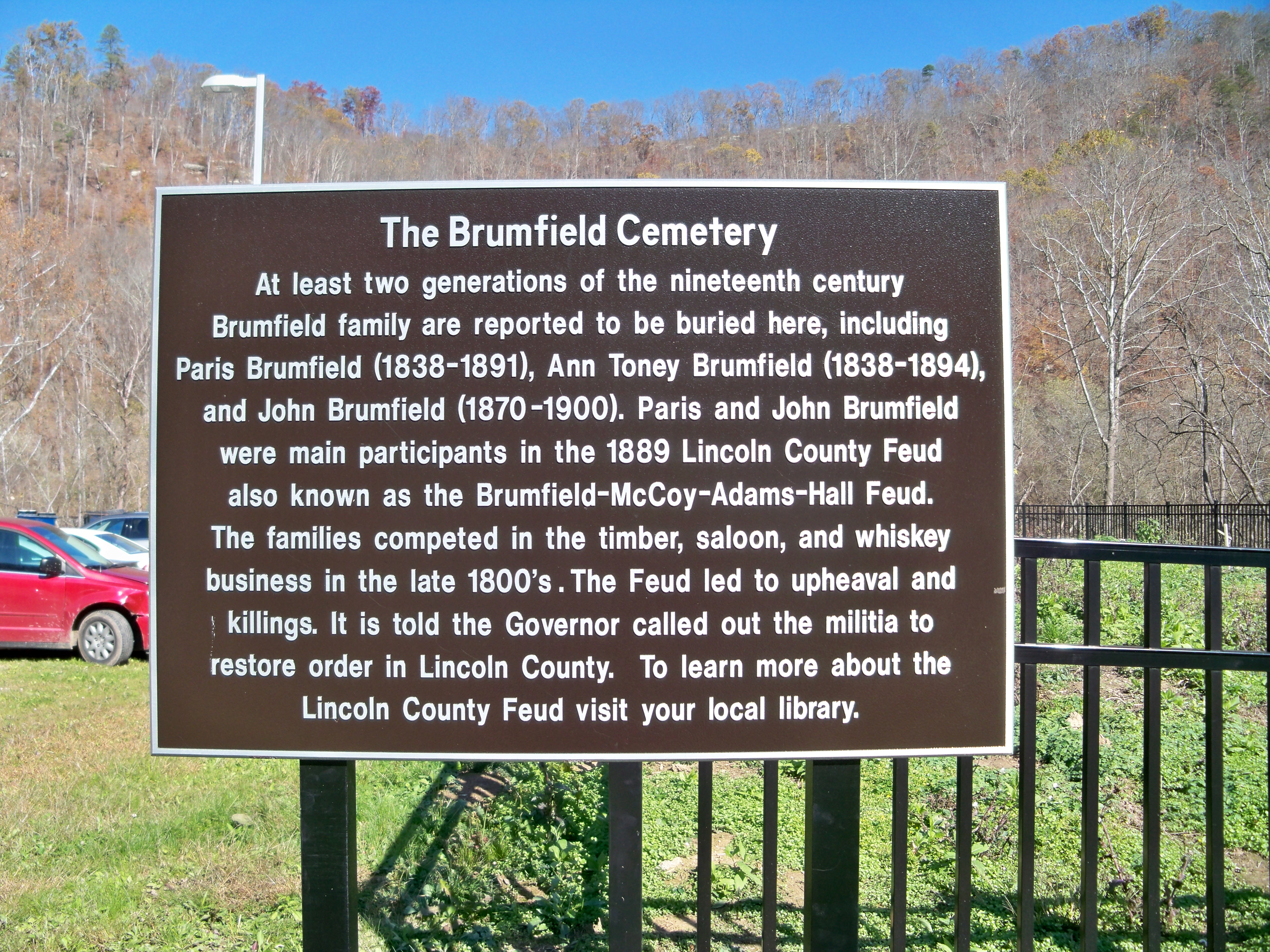
Harts, Lincoln County, WV, c.2012.

07 Tuesday Jan 2014
Posted in Cemeteries, Culture of Honor, Harts, Lincoln County Feud
Tags
Al Brumfield, Ann Brumfield, cemeteries, crime, feud, genealogy, history, John Brumfield, Lettie Brown, Moses Brown, Paris Brumfield, Paris Brumfield Family Cemetery, tourism, West Virginia
Harts, Lincoln County, WV, c.2012.
06 Monday Jan 2014
Posted in Ed Haley
Tags
Alice Workman, Augusta Bryant, Billy Adkins, feud, French Bryant, genealogy, Harts, history, Hollena Brumfield, Martha Bryant, Milt Haley, Polly Bryant, writing
Later that evening, I expressed an interest in visiting Alice Workman. Alice was Billy’s aunt by marriage and lived right across the street in Harts. More importantly, she was the daughter of French Bryant, who, according to some sources, had murdered Milt Haley and Green McCoy at Green Shoal.
French Bryant, according to Billy’s notes, was born in 1855 or 1858 in Logan County, (West) Virginia. His parents were Rufus and Lucy Adeline (Caldwell) Bryant. French married Polly Dingess, a daughter of William and Emaline (Stollings) Dingess, and settled on Marsh Fork, a tributary of the West Fork of Harts Creek, in Logan County. He and Polly had six children: Carolina (1880), Edna (c.1882), Almeta “Allie” (1885), Fannie (1889), Hollena (1890), and Auglin (1896).
Just after the turn of the century, in 1902, French married Augusta Bryant, a cousin, and had one child, Gladys (1903). In 1904, he married Martha Ann Carter (1882-1964) and had nine children: Clarence (1905), Ruth (1907), Ruby (1907), McDonald “Doc” (1909), Robert Lee (1911), Wilson “Wig” (1913), Pearl (1915), Ann (1917), and Alice (1921). He and Martha raised their family on Piney Creek, a small West Fork tributary in Logan County.
French died on February 9, 1938 and was buried on the ridge in the head of Piney and Hugh Dingess Branch.
I wondered if Alice might be willing to talk about her father with us. I pictured her as an ancient woman — much like Roxie Mullins — who was full of stories and family heirlooms. I asked Billy if we were going to stir up any trouble asking her about Milt and Green’s murder and he laughed and said, “I don’t think so. Just don’t forget — you get to go back to Nashville. I have to live here.”
Alice greeted us at her back door. I was surprised to find that she was a relatively young woman, just slightly older than I. Billy told her that we were doing research on some of the old-timers around Harts and wondered if she had any old pictures of her father. Within a few seconds, she produced an incredible photograph of French Bryant in his younger days. Instead of looking like an “axe-wielding murderer” or a “feuding hillbilly with a chip on his shoulder,” he was a real “stud” — neatly groomed, in shape, and sporting a respectable suit (bowtie and all).
Alice said she didn’t know much about her father’s early life because he died when she was a teenager. In his younger days, he had supposedly worked as a stonecutter and made railroad ties. “They say he was a real dancer in his younger days,” she said, smiling. He eventually settled in the head of Piney Creek, where Alice was raised.
Billy told Alice that I was interested in the old vigilante mob in Harts — people like French Bryant, his grandpa Fed, the Brumfields… She sort of laughed, saying, “Yeah, yeah,” but didn’t offer any information. We got the impression that she probably didn’t know anything about her father’s supposed participation in the 1889 mob and that if she did she wasn’t going to tell us about it. She did say that her father loved Hollena Brumfield and used to visit her in Harts. We knew that he had named a child after her.
Alice basically remembered her father in his graying old age. She said he kept the mustache of his youth, packed a pistol only for protection, and seldom drank anything. He was baptized about two years before he died. His widow (Alice’s mother) thereafter settled on a West Fork farm — the same place where Lawrence Haley and I had stopped when looking for directions to Milt’s grave in 1993.
30 Monday Dec 2013
Posted in Big Ugly Creek, Ed Haley
Tags
Bill Duty, Billy Adkins, Chloe Mullins, Durg Fry, Ed Haley, fiddlers, genealogy, Green McCoy, history, Hollena Brumfield, John Wesley Berry, Jupiter Fry, Mayme Ferrell, Milt Ferrell, Milt Haley, music, writing
I asked Mayme who her father’s favorite fiddler was and she laughed and said, “I suppose my daddy’s favorite fiddler was a man named Jupiter Fry. He married my daddy’s aunt.”
Billy asked, “Was he a brother to Durg Fry?”
“Yes,” she said. “You smart people. He went to New York one time and won a fiddling contest. He used to live down the creek here on the Laurel Fork of Big Ugly. My daddy used to go around there to Uncle Jupiter’s — they didn’t have much — and they would play poker all night long with just two or three pennies. They were very, very poor. Not many people were very well off. You wouldn’t think it by looking at this dilapidated place now but we had quite a bit. All the buildings are torn down. We had plenty — enough for us. We had some money here all the time. But Uncle Jupiter was the best fiddler in the country at one time.”
I asked Mayme if Jupiter was a right- or left-handed fiddler and she said, “Oh goodness, I don’t know. I don’t remember Uncle Jupiter. I remember Durg. He played some, too. He was right-handed. Durg would play and dance while he played. He did the hoedown. He did enjoy dancing.”
I asked Mayme if she remembered hearing any talk about Milt Haley and Green McCoy and she said, “Heavens, yes. Why didn’t I listen? Daddy talked about them. There was a great deal said but I just dismissed it from my mind. I didn’t try to remember it. Did Hollene Ferguson come in there in any way? She was a real kind person. I was there a few times. Incidentally, my mother’s daddy built that house.”
What was his name?
“John Wesley Berry. He was a riverboat captain and a carpenter from Guyandotte.”
I said, “I know Hollene put people up for the night and I’ve heard that Ed Haley had gone through there and stopped off and played the fiddle.”
“Well, Ed Haley frequented the place in this area,” Mayme said. “He’s been on this creek, too.”
She wasn’t sure if her father ever met Ed but she heard him talk about him.
Brandon figured they knew each other based on some interesting genealogical connections: one of Milt Ferrell’s uncles married Money Makin’ Sol Mullins’ granddaughter, while another uncle married a sister to Chloe Mullins (Ed’s grandmother).
I got kinda excited about Mayme confirming Ed’s trips through Big Ugly.
“Well see, we knew that he’d been to see Bill Duty a lot,” I said. “And we have found that Milt Haley, his father, was actually living in Bill Duty’s household at one time.”
“Milt Haley lived with Bill Duty before Bill Duty ever moved here, when he was still down in Logan County,” Brandon said, “and we think Milt may’ve moved up this way with Bill when he moved up here.”
“Well, I think maybe he did,” Mayme said quickly. “I think maybe he did. You’re awakening some old memories. I think he lived with them.
“Was there music in Bill Duty’s household?” I asked.
“I don’t know about that,” Mayme said. “Bill Duty married my daddy’s aunt.”
“Let me ask you a question,” I said to Mayme. “In the community back when you were a little girl did most people talk about the Haley-McCoy affair, or did they try not to talk about it for fear that somebody might hurt them or something?”
“I don’t think that there was any fear of being hurt,” she said. “They were not quite as notorious as the Hatfields and McCoys were.”
Just before we left, Mayme “made” me promise to come back and play for her in the fall.
I asked her for a favor: Could I go up into the old part of her house?
“Sure,” she said, “Just be careful.”
When I opened the door from the living room leading into the original cabin, I was so overwhelmed with sights and smells of the nineteenth century that it chilled me to the bone. It was dark, except for a little light streaming through a window, and everything was dilapidated, dusty, damp — and in most cases, ruined. A lot of the furniture had just rotted or collapsed to the floor and there were piles of papers everywhere at my feet. It was as if the people living there fifty years ago had just walked out, blew out the candles and never went back. Upstairs was the same. The whole experience made such an impression on me that I later began packing a picture of Mayme’s cabin in my fiddle case and eventually used it as a graphic on one of my albums.
19 Thursday Dec 2013
Posted in Big Harts Creek, Ferrellsburg, Timber
Tags
Appalachia, Ferrellsburg, genealogy, history, life, Lincoln County, photos, Samp Davis, timbering, U.S. South, West Fork, West Virginia

Samp Davis, an old timber man from West Fork, Lincoln County, WV.
29 Friday Nov 2013
Tags
Appalachia, banjo, culture, Fourteen Mile Creek, genealogy, history, Holly Sias, life, Lincoln County, music, photos, West Virginia

Holly “Hod” Sias, Lincoln County, West Virginia, 1925-1940.
29 Friday Nov 2013
Posted in Big Harts Creek, Ed Haley, Lincoln County Feud, Timber
Tags
Al Brumfield, Allen Martin, Andrew D. Robinson, Andrew Robinson, Anthony Adams, Appalachia, Ben Adams, Ben Robinson, Boardtree Branch, Chloe Gore, Chloe Mullins, crime, David Robinson, Dicy Adams, Elizabeth Abbott, genealogy, general store, Greasy George Adams, Green McCoy, Harts Creek, Harvey Adams, Henderson Dingess, history, Hollena Brumfield, Hugh Dingess, Jackson Mullins, John Frock Adams, John M. Adams, John Robinson, Joseph Adams, Joseph Robinson, Lincoln County Feud, Logan County, Logan County Banner, Lucinda Brumfield, May Adams, Meekin Branch, Milt Haley, Peter Carter, Rhoda Robinson, Sallie Dingess, Solomon Adams, Spicie McCoy, Susan Abbott, Ticky George Adams, timber, Trace Fork, Victoria Dingess, Viola Dingess, West Virginia, Wilson Abbott
Ben Adams — the man who supposedly hired Milt Haley and Green McCoy to assassinate Al Brumfield — was born in 1855 to Joseph and Dicy (Mullins) Adams on Big Harts Creek in Logan County, (West) Virginia. His older sister Sarah married Henderson Dingess and was the mother of Hollena Brumfield, Hugh Dingess and several others. He was a first cousin to Jackson Mullins, Milt Haley’s father-in-law, and a brother-in-law to Chloe Mullins, Milt’s mother-in-law, by her first marriage to John Adams.
In 1870, 17-year-old Ben lived at home with his mother, where he worked as a farmer. He was illiterate, according to census records. His neighbors were Andrew Robinson and Henderson Dingess, both of whom had married his sisters (Rhoda J. and Sally). In the next year, according to tradition, he fathered an illegitimate child, William Adams, who was born to Lucinda Brumfield (niece of Paris).
In 1873, Ben married Victoria Dingess. Victoria was born in 1856 and was a first cousin to Hollena Brumfield and Hugh Dingess. The marriage made for an interesting genealogical connection: Ben was already Hugh’s uncle; now he was also his brother-in-law, as Hugh was married to Victoria’s sister, Viola (his first cousin). Ben’s daughter Sally, who was named after Hollena’s mother, later married a cousin of Spicie McCoy, Green’s wife. For all practical purposes then, Ben Adams was genealogically connected to all sides of the feud — making it a true intra-family feud from his perspective.
For the first decade or so of his marriage, Ben lived with his mother on family property, although he did acquire land and open a general store business. In 1880, he was listed in the Lincoln County Census with his mother Dicy, aged 63, and family. He was 26 years old, Victory was 23, Sally was six, son Charlie was four, daughter Patsy A. was two, and son Anthony was a few months old. George Greaar, age 20, was a boarder. In 1881, he purchased 25 acres on the Meekin Branch of Trace Fork. Three years later, he was listed in a business directory as the proprietor of a general store. At that same time, his brother-in-law and neighbor Henderson Dingess was a distiller.
Later in the decade, Ben fathered three more children: George “Greasy” (1885), Harvey (1886), and May (1889). In 1889, the time of Milt Haley’s ambush of Al Brumfield, Adams owned 260 acres on the Boardtree Branch of Trace Fork valued at $1.00 per acre in Logan County.
Anthony Adams — Ben’s brother and ally in the 1889 troubles — was a prominent timberman on Harts Creek. Anthony had been born in 1849 and was the husband of Pricie Alifair Chapman, Burl Farley’s half-sister. In 1884, Adams was listed in a business directory as a blacksmith. In 1889, he owned two 50-acre tracts of land, one valued at $3.50 per acre with a $30 building on it, the other valued at $2.00 per acre. By that time, he had three sons of fighting age who may have participated in the feud: Solomon Adams (born 1869), Horatio “Rush” Adams (born 1871), and Wayne Adams (born 1874), as well as a son-in-law, Harrrison Blair (born c.1867).
A quick examination of the Adams genealogy gives a clue as to Ben’s other 1889 allies. First there was brother “Bad John” Adams. Adams was deceased at the time of the Haley-McCoy incident, but he had been married to Chloe Gore — mother of Emma Jean (Mullins) Haley. He had three sons of fighting age in 1889: Joseph Adams (born 1859), John Frock Adams (born 1861), and Ticky George Adams (born 1865)…as well as son-in-law Sampson Thomas.
Rhoda J. Robinson was a sister to the three Adams brothers. She had several children who may have allied with Ben: David Robinson (born 1860), Ben Robinson (born 1866), John R. Robinson (born 1868), and Joseph Robinson (born 1870). There was also brother Solomon Adams, who may have offered his loyalty to Ben, along with sons John M. Adams (born 1869) and Benjamin Adams (born 1867), and sons-in-law David Robinson and Peter Carter (c.1873).
As for Ben himself, he stayed busy with timber after the feud. According to an 1896 article from the Logan County Banner: “Benj. Adams, of Hart, is hauling some fine poplar from trace fork.” In 1901, he married Venila Susan Abbott, a daughter of Wilson and Elizabeth (Workman) Abbott, and had at least eight more children (born between 1901 and 1921). Not long after his remarriage, he was accused of murdering a local postman named Jim Allen Martin — and nearly went bankrupt paying for his legal defense. He died in 1910 and was buried on the hill near the mouth of Trace Fork.
25 Monday Nov 2013
Posted in Ed Haley
Tags
Al Brumfield, Appalachia, Betty Meade, Earl Brumfield, Fed Adkins, genealogy, history, Hollena Brumfield, Jim Brumfield, life, Lincoln County, West Virginia, writing
In West Virginia, Brandon was busy interviewing local folks about Ed Haley and his father’s 1889 murder. He first dropped in on Earl Brumfield, a grandson to Al Brumfield, who lived at Barboursville, near Huntington. Earl was born in 1914 — nine years after Al’s death — and was a Depression era schoolteacher in Harts. At the time of Brandon’s visit, Earl was bed-fast and withered with age and in poor health and was barely able to speak plainly. Brandon started asking him general questions about the Brumfields.
Earl said Al Brumfield was bad to chase women throughout his marriage to Hollena. He had a mistress in a little town downriver named Betty Meade, who bore him two illegitimate children. When Hollena found out about his affair, she enlisted the help of her brother-in-law Jim Brumfield to kill the woman. Supposedly, Al knocked Jim’s gun away just before the shooting started and did it with such force that he broke his younger brother’s arm.
Earl said Al had other affairs. One time, Hollena was in the yard and saw him with a woman hid behind a log across the river. Outraged, she fetched a shotgun and shot at him every time he poked his head out from the log. This, of course, sounded like a tall tale — but it surely had a glimmer of truth in it.
Apparently, Al’s infidelity was a constant source of trouble in his marriage. Earl laughed telling about it, but it would have made for a terrible situation, especially since Hollena was a shattered beauty. Maybe Al’s infidelity was what drove Hollena to have her reported affair and love child with Fed Adkins in the early 1890s. Either way, Hollena had her revenge when Al was sick and near the end of his life. According to Earl, she often confined him to the upstairs of their house while she stayed downstairs. If he needed something or was feeling contrary, he would peck his cane on the floor to get her attention.
20 Wednesday Nov 2013
Posted in Ed Haley
Tags
Ed Haley, Ella Haley, genealogy, history, Ironton, Kentucky, life, Mona Haley, Ohio, photos

Mona Haley Mullins-Hager, daughter of Ed Haley.
12 Tuesday Nov 2013
Posted in Ed Haley
Tags
Boney Lucas, Cat Fry, Charley Brumfield, crime, genealogy, history, Hollena Brumfield, Ida Taylor, Jim Brumfield, Letilla Dial, Paris Brumfield, Sarah Lucas, writing
To get to Ida’s house, we drove a short distance up Green Shoal Road, a somewhat narrow strip of pavement that snaked its way alongside the creek. We were welcomed inside by some of her family, who knew Billy and Brandon. Just inside the door, I spotted Ida sitting in a chair near a bed and a fireplace. In the initial small talk, we learned that Ida was born on Green Shoal in 1914 and had lived there all of her life. Brandon began by showing her a picture of her grandfather, Paris Brumfield. She said her father Jim Brumfield (1880-1965) had spoken of him.
“Dad said he kindly mistreated their mother,” she said. “He drinked an awful lot. The children were afraid of him. Now, I can remember Dad talking about seeing him get killed. Uncle Charley was the one killed him, his own son. I think Dad said he was about 16 years old — maybe older. Dad said he was hid up on the hill behind a foddershock when Uncle Charley shot him. Said he was laying down the drawbars and said Charley told him not to come any farther and he just kept going and he shot him in the back. He said he saw the dust jump out of his jacket. He’s told us kids that lots of times.”
Jim was practically raised by his brother Al in Harts because his mother died not too long after his father’s murder. In 1900, he was with his brother John at Chapmanville when they were attacked by the Conleys. He was stabbed and carried a piece of the knife blade in his body for the rest of his life. A little later, he fell out with his older siblings (Al, Rachel, and Charley), who he felt had “swindled” him out of some of the family property.
Brandon asked Ida if she remembered going to visit Hollena Brumfield and she said, “I never was there. Dad didn’t think much of her as a sister-in-law.”
Ida said she’d kinda been raised away from all the Brumfields around Harts.
“They used to come here, but we never was down in there too much,” she said. “The first time I was ever in Uncle Charley’s house is when I attended his funeral. And Uncle Bill’s house, I never was there at all. But I always liked him. He was here quite a bit, Uncle Bill was, you know. Spent a little time in jail for killing a man. I was afraid of him, though. He was a little guy and wore a little sandy mustache. He dodged around up in here after they found this man dead. He’d been dead quite a while and he’s supposed to got beat up at Uncle Bill’s house. I think he beat him up with an axe handle as well as I remember. They carried him back in there someplace. That’s what we were told. Billie killed Uncle Bill. Said he was drinking whiskey out of a half a gallon jar and Billie slipped around the house and shot him. They thought that was over his mother, too. They was really rough down in there.”
Ida said she heard about the Haley-McCoy killings from her mother Letilla Dial and grandmother Cat Fry (the infamous “Aunt Cat”). Ida’s mother Til was raised by Sarah Lucas, who married a Brumfield and then later a Workman. Hearing the name Lucas caused me to ask Ida if she knew anything about Boney Lucas.
“Oh, yeah,” she said. “They was raised up on the creek here. Boney Lucas — I’m not sure but I believe that was Aunt Sarah Workman’s brother. I can remember hearing her talk about Boney Lucas. Now, they were raised down here someplace in a log house.”
11 Monday Nov 2013
Posted in Big Harts Creek, Civil War, Whirlwind
Tags
34th Battalion Virginia Cavalry, Appalachia, Barney Carter, civil war, genealogy, Harts Creek, history, Hoover Fork, Logan County, photos, West Virginia

Capt. Barney Carter (1821-1902), resident of Hoover Fork of Big Harts Creek, Logan County, West Virginia, served as captain of Company D, 34th Battalion Virginia Cavalry.
11 Monday Nov 2013
Posted in Ed Haley
Tags
Big Ugly Creek, Bill Duty, Billy Adkins, Brandon Kirk, genealogy, Harts, history, Imogene Haley, John Hartford, Maude Duty, Milt Haley, Solomon Mullins, writing
I asked Billy about Bill Duty. We had found Milt living with Duty’s family in an 1870 Logan County census and knew from reading an interview with his son in the Lambert Collection that his family settled on Big Ugly Creek in the early 1880s. Billy turned us loose with his Duty notebook, where we soon located his notes on the family of “William Marshall Duty” (1838-c.1910). He said the family originally came to the area looking for work in timber. In 1900 and 1910, Bill Duty lived on the Broad Branch of Big Ugly Creek. We could find no apparent “blood connection” between him and Milt Haley but his wife Emma Ferrell was a great-granddaughter of Money Makin’ Sol Mullins (Ed’s great-great-grandfather). It was a seemingly distant family connection that might have played a part in Milt’s choice of Emma Mullins for a wife. Billy said we should talk with Maude Duty, a widow of one of Bill Duty’s grandsons, for more information along those lines.
That night, after hours of watching Billy and Brandon shuffle through genealogy books, census records and notebooks filled with handwriting, I realized just how difficult it would be to familiarize myself with all the characters and family relationships in the story of Milt Haley’s death. While I had little chance to memorize them, I made the effort to at least document them because they seemed to help explain a lot about Milt’s story. There were other things, of course, to mix into the blend, such as grudges, hatreds, and dislikes.
There was another important reason for documenting the genealogy: knowing how people were connected to each other helped me to objectively weigh in any slant in their stories (whether intentional or not). For instance, if I were talking to a nephew of “Uncle Al Brumfield,” I would probably get a somewhat complimentary account of his character; but if I were talking to someone whose family had feuded with him, comments might be less than flattering. It seemed obvious, then, that who I talked to, their genealogical connection to who they spoke of, where I talked to them, in whose company I talked to them, and what exactly they said (or didn’t say) were all important to note.
02 Saturday Nov 2013
Posted in Lincoln County Feud
Tags
Appalachia, crime, culture, feud, genealogy, Harts, history, life, Lincoln County, photos, West Virginia, Will Adkins

G.W. “Will” Adkins, member of the 1889 mob
01 Friday Nov 2013
Posted in Fourteen, Wewanta, Women's History
Tags
Appalachia, Caleb Headley, Elizabeth Jane Farley, Fourteen, Fourteen Mile Creek, genealogy, history, Lincoln County, midwife, photos, Sarah Headley, Sulphur Spring Fork, U.S. South, West Virginia, William Floyd Farley
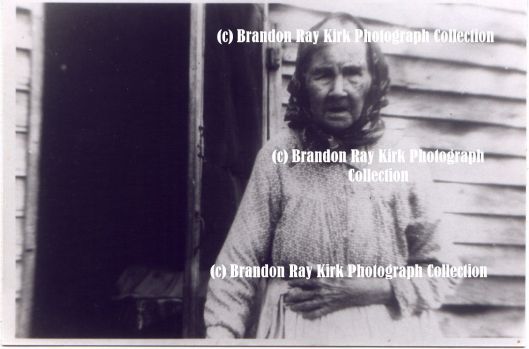
Sarah Ann (Farley) Headley, daughter of William F. and Jane (Clark) Farley and wife of Caleb Headley. Sarah (1849-1945) is my great-great-great-grandmother. She lived at Sulphur Spring Fork of Fourteen Mile Creek in Lincoln County, WV.
25 Friday Oct 2013
Posted in Big Ugly Creek, Ferrellsburg, Music
Tags
Archibald Harrison, Arena Ferrell, Big Ugly Creek, C&O Railroad, Cleme Harrison, Daniel Fry, Don McCann, Ferrellsburg, genealogy, George W. Ferrell, Guy Harrison, Guyandotte River, Guyandotte Valley, Harold Ray Smith, Harts Creek District, history, Keenan Ferrell, Laurel Hill District, Lincoln County, Logan County, Martha E. Harrison, Martha Harrison, music, Nancy Fry, Nine Mile Creek, Phernatt's Creek, Tazewell County, Virginia, writing
Around the turn of the century, in the years just prior to the arrival of the C&O Railroad in the Guyandotte Valley, George W. Ferrell, a musician in present-day Ferrellsburg, busily wrote songs about local personalities and events. Today, Ferrell’s solitary grave is marked with an ornate tombstone that sits at the edge of what was, until recent years, a garden.
George W. Ferrell was born on October 10, 1874 to Archibald B. and Martha E. (Fry) Harrison. Archibald was the son of Guy P. and Cleme (Harmon) Harrison of Tazewell County, Virginia. Mary was the daughter of Daniel H. and Nancy P. (Bailey) Fry of Logan County. Ferrell’s birthplace is not known because, soon after his parents married in 1865, they left the area, settling at first in Kentucky and then elsewhere.
In 1878, George, then four years old, returned to Lincoln County with his parents. In 1880, his family lived near the mouth of Big Ugly Creek or at the “Bend,” just across the Guyandotte River. Shortly thereafter, they made their home at Phernatt’s Creek, further downriver in Laurel Hill District.
By 1889, Ferrell’s father — who was perhaps recently divorced from his mother — had sold all of the family property in Harts Creek District and at Phernatt’s Creek and relocated to Nine Mile Creek.
Details concerning Ferrell’s early life remain elusive. It is not known who influenced him musically or when he even started writing or playing music. There is no indication of his father or mother being musicians but his mother’s first husband, Jupiter Fry, was a well-known fiddler on Big Ugly. Some of his first songs may have been inspired by his father’s stories of the Civil War.
At some point in his young life, and for reasons unknown, Ferrell was adopted by Keenan and Arena Ferrell, a childless couple at Ferrellsburg in Lincoln County.
“I heard he was just a big old boy when the Ferrells took him in,” said Don McCann, current owner of the property surrounding Ferrell’s grave. “They didn’t have any children of their own.”
In the 1900 Lincoln County Census, Ferrell was listed as their 25-year-old adopted son. More than likely, he was assisting the Ferrells in the operation of their store and business interests.
It is easy to see how Ferrell would have become acquainted with his future foster parents.
“His father worked a lot of timber around Big Ugly or Green Shoal,” said Harold R. Smith, Lincoln County genealogist and historian. “And that would have put him in close contact with the Ferrells at Ferrellsburg.”
But why was he not living with his mother (wherever she was), who died in 1901, or his maternal grandmother, who was alive on Big Ugly? And what was his connection to the Ferrells?
25 Friday Oct 2013
Posted in Harts, Women's History
Tags
Appalachia, Caroline Brumfield, chickens, culture, farming, genealogy, history, life, Lincoln County, photos, West Virginia

Caroline Dingess Brumfield feeding chickens, Harts, West Virginia, 1920s
19 Saturday Oct 2013
Posted in Fourteen
Tags
Appalachia, Caleb Headley, Fourteen, genealogy, Gladys Kirk, history, Johnny Headley, Moses Headley, Sarah Headley, Ward Adkins, West Virginia, Will Headley, writing
On July 18, 1903, Billy and Sarah Sias, with Sarah and Moses C. Headley, sold 30 of the remaining 34 acres of Caleb Headley’s estate to Cosby (Headley) Fry. It was located just across the creek from Caleb’s old home place.
“Beginning on a beech and white oak corner to John H. Fry & the company on a point below the Hinkles branch thence,” the deed for this 30-acre tract reads, “with John H. Fry line to Albert Neace corner thence with said Neace line to S.A. Sias corner thence down the creek with the meander of said creek to the mouth of the branch opposite Sarah Headley house she now lives in thence up said branch to the mouth of the first drain on the lower side of said branch thence up said drain to the back line between the company & Caleb Headley deceased thence with said line to the beginning it being part of Caleb Headley’s deceased.”
The remaining four acres of Caleb Headley’s estate remained in tax books from 1903 until 1910, when it was dropped with the following notation: “improper by sheriff.” Oddly enough, its value had risen from $2.50 per acre to $4.00 per acre in 1905.
In 1903, the same year Sarah and Moses Headley sold the remainder of the family estate to the Frys, they bought 45 acres of land (containing the original home place) from Sarah Sias. They kept it until 1909, when they sold it to Zack Neace. In 1918, Neace sold it to Van Alford, a son-in-law to Johnny Headley.
By the early twenties, Sarah Headley still made her home with her single sons, Ballard and Moses. In 1922, Moses married Lizzie Nelson (at his residence according to records) and soon left Sulphur for good. First, he settled in Chapmanville, then South Charleston, where he died and was buried.
“Uncle Mose married Lizzie Nelson and moved to Chapmanville,” said Ward Adkins, late resident of Sulphur Springs, in a 2003 interview. “He lived in a log cabin he had built and moved in there before they even finished a floor.”
In 1924, Ballard Headley married Claire D. Clark. About that same time, Will Headley opened a store near his home at the mouth of Sulphur.
“They had a small grocery store, him and Maw, from about 1924 until about 1927 just over from where the church house is now,” said Adkins.
In July of 1929, Johnny Headley’s wife, Emaline, died of dysentery flux and he remarried early the following year to widow named Emarine Elkins.
Throughout that time, Sarah Headley just came and went, staying with first one relative and then another.
“Ever since I can remember she would drop in and maybe stay a week with us, then she’d go somewhere else and stay,” said Adkins. “She’d go up on Harts Creek a lot of times and stay. She’d stay with Bal maybe a week and Uncle Johnny over on Steer Fork.”
“She used to come to Grandpa Johnny Headley’s and stay a few nights,” said the late Gladys Kirk, a granddaughter of Johnny Headley and a resident of West Fork. “Then she would go on back to Will’s. I was small at that time, maybe eight or nine years old. She wouldn’t do anything. She’d sit around. She was too feeble to cook or anything. She held on to a big red handkerchief she packed with her everywhere she went. It was folded. We never got to look in it but it looked like she had something in it. She told someone it was her burying clothes, whatever that meant. And when Grandmaw Headley would get meals ready Grandma Sarah would make the kids line up and she’d say, ‘They’s nobody going to the table to eat until they washed their hands.'”
Around 1935-36, Sarah Headley moved in with Will permanently.
“I guess she finally got too old to go from place to place,” said Adkins. “Anyhow, she come to our house and stayed there till she died. She’d got rid of her furniture by then but she had a whole set of these old big woven baskets she kept her clothes in. She was a kind person. I liked to hear her tell tales, you know. And I don’t know how many skirts she would have on at once. Six or seven — maybe more. She’d pull up that apron, run her hand down in there, get her pipe and her tobacco out. She died in 1945 when I was away fighting in World War II.”
19 Saturday Oct 2013
Posted in Ed Haley, Music, Women's History
Tags
Appalachia, Clay County, culture, genealogy, guitar, history, life, Logan County, Nora Martin, photos, Ugee Postalwait, West Virginia

Nora (Douglas) Martin, daughter of Rosie Hicks Day, Clay County, WV, 1913-1925
15 Tuesday Oct 2013
Posted in Fourteen
Tags
Appalachia, Ballard Headley, crime, Dave Headley, Dave Merrill, Fourteen Mile Creek, genealogy, Harry Tracy, history, Sarah Headley, Will Headley, writing, Zachary Neace
During the 1890s, Sarah Headley remained on Sulphur Spring Fork, although tax records and oral tradition do not indicate the exact location of her dwelling house. In that span of time, according to tax records, her property valuations increased significantly. In 1891, a 50-acre tract climbed from $100 to $125, a 45-acre tract went from $69 to $90 and a 26-acre tract jumped from $39 to $156.
In 1892, Margaret Headley, Sarah’s youngest daughter, married Zachary T. Neace, a well-to-do timberman on the creek. In subsequent years, they lived in Virginia, the place of Neace’s origin, or on Fourteen Mile Creek.
In 1893, Sarah Headley — perhaps taking advantage of a rising evaluation on her property — sold a 45-acre tract of land worth $90 to an unknown party, leaving her with only 76 acres of the 455 acres she had owned just after her husband’s death in 1882.
A few years later, Dave Headley, Sarah’s 23-year-old son, was accidentally shot and killed.
“Dave was aiming to sell this guy a gun and this guy was looking at it and it went off and shot Dave in the head,” said Ward Adkins, a step-great-grandson to Sarah Headley, in a 2003 interview. “When Will and Uncle Johnny first heard about it they aimed to kill that guy, then they found out it was an accident.”
In the late 1890s, Will Headley, who had left Sulphur around the time of the disastrous house fire and spent time with his uncle Burl Farley on Harts Creek, moved back to Fourteen after marrying Caroline Lucas, a daughter of William R. and Emily (Fry) Lucas. He and his wife settled near the mouth of Sulphur where he continued to assist his mother and family.
During that time, Sarah Headley was still somewhere on Sulphur. In 1897, she sold 42 acres — including 16 acres of the old homeplace — to Sarah A. (Nelson) Sias, whose husband Billy had bought 174 acres from Headley in 1884. Three years later, she was listed there in the Lincoln County Census as “Sarah A. Hedley,” age 51, with sons Ballard, age 20, and Moses, age 15.
Just after the turn of the century, Ballard Headley joined the army and left Sulphur Spring for a few years.
“Uncle Bal joined the army and they sent him West,” said Adkins. “I think he was in one or two Indian skirmishes and he deserted and joined a gang with Harry Tracy and Dave Merrill, two famous outlaws. I was reading a book about Harry Tracy. I asked him, ‘Did you ever hear of Harry Tracy when you was out West?’ He said, ‘Son, I rode with him.’ He said, ‘We was horse thieves. We’d steal horses from one state and take them into another state and sell them and then steal some there and take them somewhere else and sell them.’ He wasn’t afraid of nothing. He told me himself he held up a passenger train one time, too.”
Harry Tracy, the outlaw supposedly befriended by Headley, was born in Wisconsin in 1874. At a young age, he drifted west to Wyoming where he hooked up with a gang of cattle rustlers who worked with Butch Cassidy and the Sundance Kid. In 1897 he was arrested in Salt Lake City but escaped and went to Colorado where he joined the Hole-In-The-Wall gang. He was arrested there and sent to jail in Aspen, Colorado, but escaped a short time later after nearly killing a guard with a lead pipe. He next went to Oregon, where he met gambler Dave Merrill in a saloon. The pair committed their first crime together in January of 1899. They were soon arrested and Tracy and sent to Oregon State Penitentiary. In December of 1899, he and Merrill were transported to Olympia, Washington to face charges, where they again escaped. They were both free for New Year’s in 1900, but were captured again in Portland a short time later. On the morning of June 9, 1902, Tracy and Merrill broke out of prison, leaving behind dead and wounded guards. On June 28, Tracy killed Merrill in a duel near Napavine, Washington. Thereafter, he hijacked a boat, which dropped him off near Seattle. He slipped through the city and crossed the Snoqualmie Pass, before he killed himself after a shoot out with a small posse in Creston, Washington.
“Uncle Bal was mean,” Adkins said. “He wasn’t out West long but when he came back here he told my grandpa Neace, who ran the post office, ‘If any mail comes here for George Golden, it will be for me. You hold it for me.’ Sure enough, there was. And by the time the government tracked him down for desertion he was blind as a bat. Some people said he put his eyes out to keep from going back in the army but he didn’t. He said he’d caught this disease and it got in his eyebrows and he put red persipity in there to kill it and got out and got to working and went to sweating and it got in his eyes and put his eyes out.”
“Now Bal was awful intelligent,” Adkins continued. “He’d come up and he’d have me to read the Bible to him. He belonged to the church. And he knew the Bible all ready, I don’t know why he’d want me to read it. But I’d try to skip on him. Maybe I’d just down here eight or ten verses. He’d say, ‘Hold on, back up there.’ Then he’d start quoting it off to me.”
14 Monday Oct 2013
Posted in Fourteen
Tags
Appalachia, Burl Farley, Caleb Headley, Cole and Crane Company, genealogy, history, John Henan Fry, Johnny Headley, Moses Headley, Sarah Headley, Ward Adkins, Will Headley, writing
In 1881, Dr. Caleb Headley died of a lingering Civil War wound, leaving his young widow, Sarah, in a tough predicament. As the 32-year-old mother of six children — ranging in age from fifteen to two — she assumed charge of the family estate (a $100 house and 455 total acres), all of which was situated on a creek where she had no in-laws or immediate family to assist her. She chose not to remarry but did commence some sort of an affair with a Porter, which resulted in the birth of a son named Moses C. Headley on December 20, 1884.
The initial task of keeping the family afloat financially fell on Caleb’s oldest son, Johnny Headley. “After Caleb died, Uncle Johnny had to keep Grandma Sarah, and his brothers and sisters,” said Ward Adkins, an 81-year-old step-great-grandson to Doctor Headley, in a 2003 interview. “He ran rafts and made whisky and he farmed to make money. Everybody made whisky. It wasn’t a big thing.” In the mid-1880s, Johnny Headley married Emaline Susan Sias, a daughter of Henry C. and Sarah (Plumley) Sias, and settled on nearby Steer Fork.
Sarah, meanwhile, deeded off large parts of her property to provide for her remaining children. In 1884, she sold 174 acres of the family property to William A. “Billy” Sias, a neighbor and son of the local postmaster. Two years later, she sold 160 acres adjoining the homeplace to John Neace.
Around that time, her oldest daughter, Ida Cosby Headley, married John Henan Fry, a son of Christian T. and Elizabeth (Hunter) Fry of Green Shoal. They settled near Sarah on Sulphur. “Old man John Henan Fry was a quiet, docile kind of fellow and easy-going,” said Adkins. “Aunt Cos was awful good to kids, but now some of her boys were pretty rough and kind of sneaky. They’d pilfer a few things along the way from neighbors. They said they had a big cave up in that hollow and it was plumb full of chicken feathers and bones and geese feathers where they’d steal them chickens and things and take them up there and eat them. They just done as they pleased.” John Henan and Cosby Fry remained nearby until 1923, when they moved to Daisy in Logan County. (In 1925, Everett and Annie Sias bought their property.)
In the late 1880s, based on tax records, Sarah Headley’s financial woes continued. The valuation of her home, estimated at $100 from 1882 until 1887, dropped to $50 by 1890, before finally leaving the record books altogether by 1891. In that same time frame, the Headley home was destroyed by fire.
“Will said when he was eleven or twelve years old, the house burned and the family almost starved to death,” said Adkins. “He said the corn crib was close enough to the house when it burned that the fire parched all the corn. Well, they ground that corn up in an old coffee grounder, I guess. Then they’d ‘thrash’ birds at night using pine knots for light. One would kick the brush pile and scare the birds out and the other one would take the brush and knock them down. And Will said they’d clean them birds and cook them in with that parched corn they ground up and make a gruel. They ate that all winter. They had it tough. Grandma Sarah dug may apples and sold them for three cents per hundred pound.”
In this time of extreme hardness, Will Headley, Sarah’s third oldest son, went to live with her brother, Burl Farley, a wealthy timber man on Big Harts Creek in Logan County.
“When Will was about twelve year old, he went up on Harts Creek somewhere to stay with his uncle Burl Farley,” said Adkins. “Uncle Burl was pretty well to do. He worked for Cole and Crane Timber Company up on Pigeon Creek — the Brown’s Fork of Pigeon, I believe Will said. Will worked up there with him. Uncle Burl ran the timber part of it and Granddad took care of the stables and ran errands.”
“Will used to pushboat for a company on the Guyan River,” Adkins continued. “They took stuff out like ginseng. He told me it was so cold one winter — you might have heard them talk about that cold Friday or cold Saturday — his ears froze and busted. He said they bought chickens where they tied up for the night and they would dip them down in the water and pull them back out and all them feathers would just pull right out. He called it ‘scalding them’ but it wasn’t. It was just so cold it shrunk their skin up and the feathers come out easy.”
14 Monday Oct 2013
Posted in Big Sandy Valley, Big Ugly Creek, Ed Haley
Tags
Appalachia, Big Ugly Creek, Bill Duty, civil war, Fred B. Lambert, genealogy, history, Jeff Duty, John Hartford, Milt Haley, Tom Ferrell, Tug River, writing
We next looked at Logan County census records, where Milt Haley appeared in 1870 as “T. Milton Haley,” aged 13, living with a Bill Duty on Rich Creek in the Tug Valley. Duty’s home in Hardee District was relatively far away from the Harts area. Ten years later, in 1880, there was no trace of Milt or Duty anywhere in West Virginia, indicating that they may have lived outside the state at that time.
Had they moved together across the Tug into Kentucky?
We got back in the Lambert Collection for help…and found a circa-1934 interview with Jeff Duty, Bill Duty’s son.
At the time of the interview, Jeff was living at Dollie, a now extinct post office on Big Ugly Creek just upriver and over Green Shoal Mountain from Harts. He didn’t mention Milt Haley but gave a great account of his family story:
Grandfathers both came from Russell County, Virginia. Grandfather Geo. Duty came to Pigeon Creek in what is now Mingo County, before the Civil War. Grandfather James Ferrell settled on Big Creek, Logan County before the Civil War. Grandmother Duty was a Jackson and Grandmother Ferrell was a Fields.
Father was born in what is now Mingo County, and volunteered in 1861 as a Confederate. My father, William Duty, was in Gettysburg and Fort Donelson battles. They fought here seven days and seven nights. He was twice wounded. Father Wm. Duty lived in Mingo until fifty-one years ago, when he moved to Big Ugly, Lincoln County [around 1883]. When we moved to Big Ugly there were only three houses from Broad Branch, which is about one-half the length of Big Ugly to the head of Big Ugly, and now there are about two hundred. Big Ugly is nineteen miles long. There were plenty of deer, wild cats, coons, &c. when my father came. Wolves were here for about fifteen years after we came. Tom Ferrell killed the last deer killed about here about forty-five years ago.
My father was a rather big farmer for this part of the country, raising 1,000 bushels of corn a year, and always raising wheat. He had the first “chaff Piler” threshing machine brought in. It took about twelve horses to pull it. When it came on the first trip, my mother had about twenty geese in the yard, and when they heard it they took to the woods and did not come back for three or four days. My father had six children: John lived on Broad Branch, Lincoln County; Jeff here at Dollie; Phidelia Vernatter-Chapman lives in Boone County; Annie Steele lives in Logan County; George lives within three miles of Hurricane, Putnam County; Martha lives in Logan; she married Queen. My father, Wm. Duty, was the man who rode a $150.00 horse to death to save Tom Ferrell, who was in jail, in Hamlin, about 1889, for killing a man named Butcher, from a mob of Butcher relatives. Tom Ferrell is my cousin.
I am sixty-seven. I have eleven children, of whom three are dead: Alva, Lula, Stonewall, Solomon, Vernonda, Thos. Jefferson, Lee, Musco, Ira, Doska, Maggie. Mrs. Duty was Betty Pauley; her people came from Virginia. “Tiger Bill” Pauley was her father.
Writings from my travels and experiences. High and fine literature is wine, and mine is only water; but everybody likes water. Mark Twain
This site is dedicated to the collection, preservation, and promotion of history and culture in Appalachia.
Genealogy and History in North Carolina and Beyond
A site about one of the most beautiful, interesting, tallented, outrageous and colorful personalities of the 20th Century
 Brandon Ray Kirk