Lost John and his Allied Kentuckians
27 Monday Apr 2015
Posted in Ferrellsburg, Music
27 Monday Apr 2015
Posted in Ferrellsburg, Music
31 Sunday Aug 2014
Posted in Ed Haley, John Hartford, Music
Tags
Arthur Smith, banjo, Ben Walker, Benny Martin, Bernie Adams, Billy Adkins, blind, Brandon Kirk, Buddy Emmons, Clayton McMichen, Doug Owsley, Durham, Ed Haley, fiddlers, fiddling, Green McCoy, Haley-McCoy grave, Harts, history, Imogene Haley, Indiana, Jeffersonville, John Hartford, Johnny Hager, Lawrence Haley, Mark O'Connor, Matt Combs, Melvin Kirk, Michael Cleveland, Milt Haley, Mona Haley, music, Nashville, North Carolina, Smithsonian, Snake Chapman, Tennessee, Texas Shorty, Ugee Postalwait, Webster Springs, West Virginia, Wilson Douglas, writing
When Ed first went out into the neighborhood with his dad’s fiddle and armed with his melodies (as interpreted by his mother) I think he probably caused not a small sensation amongst family and neighbors and his ear being as great as it was I think he picked up an incredible amount of other music really fast. I think he played with a lot of ornaments when he was a teenager and up into maybe even his thirties. Snake Chapman and Ugee Postalwait have alluded to this. Snake said the dining room recordings just didn’t sound as old-timey as he remembered Ed playing and Ugee said she remembered him and her dad talking about the little melodies between the notes. Of course Ed had to have been through a lot of subtle changes in style since that time. I think in later years he stripped a lot of the ornaments out of his fiddling in order to appeal to the Arthur Smith-Clayton McMitchen crowd who loved the radio style that was so much in vogue at that time. This might have helped make a little more money on the street. People have always liked to hear someone play and sound just like what they hear on the radio or a record. But I think if someone had asked Ed if he had done that consciously that he would have denied it and if he was in a bad mood they might have even had a fight on their hands.
I keep having this idea of Ed imitating other instruments on the fiddle because I’ve tried it myself and wouldn’t it be something that some of these great parts was really an imitation of John Hager’s banjo playing. I’d love to know where that passage is or whether it even exists.
It’s obvious that when Ed had good firm second that wouldn’t slow down for anything, he really leaned back on the beat and got in that little pocket where so many great musicians like to be. Ella and Mona really held up a good solid beat, but I’ll bet Ed was hard on them — a real taskmaster. It’s all in that rhythm section. Wilson Douglas told me one time that Ed always told him to play it real lazy. Texas Shorty, Benny Martin, and Buddy Emmons refer to it as holding on to the note as long as you can before you start the next one. This is an important part of Ed’s feel and sound and it really comes through on the dining room recordings. I get it by playing as slow as I can against a beat I hope is not gonna move, and then I swing the notes with a dotted note feel — a real lilt if I can get it — and just drag on the beat as hard as I can ’cause I know it’s not gonna slow down. I’d love to know just when Ed figured that out or if it was always there. I always think of Ed in his younger years playing on top of the beat or even ahead of it like I did when I was young and full of piss and vinegar. Actually when you’re playing alone you do hafta pretty well stay on top of the beat to hold the time or at least set it, cause you are the beat but you have to keep from rushing which we will tend do when we get to hard passages in order to get them over with. We’ll not do that no more. Mark O’Connor told me one time that while he is playing a tune he’ll play on top of and behind the beat on purpose. He described playing behind it as letting the beat drag you along…almost like water skiing. Oh, to have known what Ed and John Hager or Bernie Adams sounded like together.
I think Ed worked on his fiddling probably daily most of his life so it is fair to say that it was changing all the time. This would explain the varying descriptions of his playing that have come down. I’m sure they’re probably all accurate. Lawrence, Ugee, and Mona always said Ed played with great smooth long bow strokes and Snake Chapman always was adamant about him playing with short single strokes and Slim Clere said the same thing — that he bowed out everything — no bow slurs. Of course, in the dining room sessions you can hear both ways. It’s amazing how well Ed did without the feedback of working with a tape recorder. What an incredible ear he had. As far as I know, the only time he probably heard himself played back was the recordings we have. I hope there are others out there but I’ve come to doubt it.
Brandon and I have always had a gut feeling that if we’d dug down into the hillside a little further at Milt and Green’s grave we might have found something. We only went down five feet and then we were defeated by the rain. What if we had gone down the requisite six feet? What if, like the probe, Owsley had misjudged the bottom of the grave shaft due to the mud and water? What if it hadn’t rained and muddied up the work area? If Melvin Kirk and Ben Walker went so far as to bury the men in a deep grave, why not assume they would have gone for the standard six feet grave traditionally dug? In the following weeks, old timers around Harts kept telling Brandon and Billy, “If they didn’t dig at least six feet, it’s no wonder they didn’t find anything.” We didn’t want to question the professionalism of experts like the Smithsonian forensic team or seem like we wanted to find Milt and Green so badly that we couldn’t accept the concept that they were gone…but what if? The explanation that Doug Owsley gave us about the coal seam and underground stream made a lot of sense. Needless to say we were really disappointed. I had started to rationalize that not finding anything might indicate that they were buried in the nude and just thrown in the hole with no box or winding sheet or anything.
I was in Durham, North Carolina, the other day and I saw a fiddler on the street and I automatically found myself thinking of Ed. I didn’t have to fill in or rearrange much in my imagination to see him there playing on the street — even though this man was standing up, and played nothing like him. Of course when Ed was younger he probably stood up to play all the time like in the Webster Springs picture…dapper and wearing his derby. I always seem to picture Ed sitting down. Another great thrill for me is a young blind fiddler from Jeffersonville, Indiana, named Michael Cleveland who when he plays I can see Ed at nineteen. He stands up so straight he almost looks like he’s gonna fall over backward the way Lawrence said his dad did. When he plays I can’t take my eyes off of him thinking of Ed. Now my friend Matt Combs, who has done a lot of the transcriptions for this book, sits with me and plays Ed’s notes off of the paper, and I play off the top of my head, so in that sense it’s like playing with him.
I guess it’s time to just leave this alone and get back to my study of the fiddle. Maybe get geared up for “Volume Two.” I spend long hours here at the dining room table with my tape recorder and I can hear Lawrence and feel Ed as I try and play my way back into the past. I find that the study of Ed’s music leads me to the study of all music and the way it’s played.
28 Thursday Aug 2014
Posted in Ed Haley, John Hartford, Music
Tags
Brandon Kirk, Ed Haley, fiddle, fiddler, fiddling, history, Howdy Forrester, John Hartford, Lawrence Haley, music, Nashville, Tennessee, U.S. South, writing
For me a “tune” is a specific order of notes played by a certain person on a certain day at a certain time and given a certain name and if you want to really pin it down you could include the latitude and longitude of the event. If you were not there to personally witness this happening then the word of some one else is okay as long as you include that in the triangulation so that when you have put out this information you can lean back and say to your listener, “Now…you know as much about it as I do and you can draw your own conclusions.” This works for events and etc. Sometimes these sort of documented rumors are as close as we can get to the truth and it’s better than nothing.
I’ve been thinking about how much Ed probably wouldn’t like to think about a whole lot of what we have put in this book. For sure he didn’t like to talk about it, especially to his family. I guess I don’t blame him — he lived it. It’s easy for us to get into all of it from our totally secure positions here in 2000 knowing what we know. And from the vantage point of our research, there are probably some areas where we know things that Ed never did.
We decided to call this book “The Search for Ed Haley: Volume One” because we know that after it comes out people will be calling us saying, “Well, you didn’t call me,” and “You didn’t get that right,” and no telling what. But then that gives us fuel for Volume Two. Of course there is the chance (and it has crossed my mind) that when this book comes out that some of the old Harts Creek animosities might still be smoldering and some people might feel hurt. God, I hope not. Everybody has encouraged us and said it was time to bring out the truth.
In case you hadn’t figured it out, Brandon wrote most all of this book and I just went through and “Hartfordized” it. Even though I have my name up top, Brandon is the one who did all the work. A typical day for us would be Brandon back in the office transcribing taped interviews, making chapters out of them, and working and reworking the words. Me, I’ll be sitting at the dining room table out in the other room sawing on a fiddle. At first when Brandon would bring me a chapter I would go through it on the laptop and make corrections and reword some things. Then Brandon very quickly caught on to what it was I was after, and after awhile he would bring me chapters and I would just read them in amazement and not do anything to them, and we would just go on. It really is wonderful, ’cause even though we know every word in the book when we read it back we still learn things. “Oh, that’s why that happened that way. Well I’ll be damned.”
I’ve given this story a lot of thought and most of what I’m about to say is from instinct and gut reaction cause we didn’t necessarily have cold hard facts. I think Ed learned a lot from his mother in the period right after his dad’s death when he and her probably spent a lot of time in that cabin hid out together from the community at large and his only contact was through his mother’s family (his grandparents). Ed found a fiddle that his father had left behind (very possibly the one in the photograph which looks home made) and started sawing around on it. His mother in her grief over her late husband was probably all the time whistling and singing the old melodies, most of which he had played, and Ed picked them up much in the way that Howdy Forrester told me he picked up a lot of melodies from his mom’s whistling and singing around the house. They were the melodies Ed and his mother shared. His unusually natural technique developed because he had such a great ear and naturally not being able to see he was not in a position to pick up bad technical habits from other fiddlers. His mother probably coached him much in the same way that Lawrence coached me a hundred years later…saying things like, “That just don’t sound right.” “Pop never played that many notes.” “Pop’s groups of notes were smaller.” But then because we both could see, Lawrence also said things like, “Your bow hold don’t look like Pop’s” and “Pop held his fiddle down here and turned it.”
21 Thursday Aug 2014
Posted in Big Harts Creek, Ed Haley, Music
Tags
Appalachia, Bernie Adams, culture, Dood Dalton, fiddle, fiddler, fiddling, genealogy, guitar, Harts Creek, history, life, music, photo, U.S. South, West Virginia
19 Tuesday Aug 2014
Tags
Arkansas, Arkansas Traveler, Ashland, banjo, Brandon Kirk, Ed Haley, Ella Haley, fiddle, fiddler, fiddling, Grayson, Harts, history, Holden, Jim Tackett, John Hartford, John Tackett, Kentucky, Lincoln County, Logan County, Logan Court House, music, Ohio, Portsmouth, Red River, Reece Tackett, Trace Fork, West Fork, writing
The next day, Brandon and I visited Reece Tackett, a banjo-picker who lived in a nice yellow house just up West Fork. Reece was born in 1909 and raised around Grayson in eastern Kentucky. His grandfather, Jim Tackett, was a fiddler from the Red River area of Arkansas who played for square dances in large farmhouses. He taught Reece’s father, John Tackett, how to play the fiddle. Reece said his father played “the old way — not flashy.” He used a homemade fiddle and “had to go to pine trees to get rosin.” He moved to a farm about nine miles from Grayson, where he made fiddles and played close to home, never as far away as Portsmouth, Ohio.
Reece said he moved to Holden in Logan County when he was sixteen to work with his uncle and brother in the coalmines. He used to watch Ed Haley and his wife play “beautiful” tunes like “Arkansas Traveler” on weekends at the Logan Courthouse. He said Ed wasn’t a big man and had fingers “about like a lead pencil.” His wife played the mandolin.
“She was pretty good on her singing,” Reece said. “She was dressed like the real old ladies. She had the long dress on and the apron.”
Ella kept a cup fastened to herself somehow.
“I’ve tossed many a nickel and dime in their cup,” Reece said.
Sometimes, people would pretend to put money in their cup and then steal from it.
Ed was usually paid about ten or fifteen cents per tune. There were no dollars and most of the coal miners were paid in company script.
Reece said he moved to Harts in 1946 and had no idea that Ed was from Trace Fork or even lived in Ashland.
10 Sunday Aug 2014
Posted in Big Harts Creek, Ed Haley, John Hartford, Music
Tags
blind, Brandon Kirk, Cacklin Hen, Cas Baisden, Clyde Haley, Ed Haley, Ella Haley, Ewell Mullins, fiddling, Harts, Harts Creek, history, John Hartford, Logan County, music, Peter Mullins, Robert Martin, Trace Fork, West Virginia, World War II, writing
Early the next morning, Brandon and I arrived on the bus in Harts and drove to see Cas Baisden, who we spotted in a porch swing up main Harts Creek, just above the mouth of Smoke House Fork. It was a pastoral scene: a somewhat old farmhouse, several chickens in the yard and a few cattle in the distance who’d done a marvelous job of clearing the mountainside just back of the place. As we pulled up to the house, I realized that it was built fairly high off of the ground — probably as a precaution against flooding. Cas just kind of stared down at us as we unloaded from the car.
Once he figured out who we were, he invited us in to the living room. There we learned that Cas was eighty-seven years old and had spent his whole life on Harts Creek.
“I was born in 1910,” he said. “The only five years I was gone from here was when I was in the Army. I left here the second day of April ’42. I spent five year in the Air Force. Never was off the ground.”
Wow — I had to ask, “What is the secret to living so long?”
“Working, working, buddy,” Cas said. “I work ever day a little bit. I wish you’d a seen the coal and stuff I packed in this morning. I got two calves down there and chickens and cats and dogs. I live on tobacco, Cheerios, and milk.”
Ever drink any whiskey?
“Barrels of it,” he said. “It’s been ten or twelve years since I quit fooling with drinking. Yeah, I went up here and joined the church and things. A fella never knows what he misses when he gets in a church. I used to be rougher’n a cob.”
Cas was partly raised by Uncle Peter Mullins, so he remembered Ed Haley well.
“He’d come up there to Peter’s and just go from house to house playing music and eating,” he said. “He used to go up to Ewell’s — I guess where he was raised — and come down that road just a running and hollering and whooping and cutting the awfulest shine that ever was and you wouldn’t a thought he could a stayed in that road. I don’t know how he done it, but he’d take spells like that. If he got a hold of you with a knife, though, he was dangerous. Hang on you and cut as long as they’s a thread on you. Him and that old woman, they’d get drunk and they’d fight up there. You know, it’s a wonder they hadn’t a killed one another. I believe they did try to cut one another up there at old man Peter’s one time.”
What about the Haley kids?
“Why them young’ns would do anything,” Cas said. “Clyde went out here where Robert Martin used to live on that mountain and went down in the well and they had a time a getting him out. And up here a little bit was a big sycamore and he was up in there and we’d throw rocks at him, son, and if we’d a hit him and knocked him out of there he’d been killed. I believe Clyde was the meanest one among them, I don’t know.”
I asked Cas if he ever played music and he said, “Nah, I done well to call hogs. But now Ed was about as good a fiddler as they was. Nobody could play better than Ed. He could play anything on earth he wanted to play.”
Cas had memories of Ed playing at Uncle Peter’s, either outside for small crowds or inside for “big dances” before “they finally broke up and quit.” The old dances started about the “edge of dark” and people would just “jump around — most people never could dance” – until sun-up. There was no trouble — just “fiddle, dance, drink” — although a person had to watch out for what Cas called the “old hedgehogs.”
I asked him if Ed ever drank much at the dances and he said, “Sure. He’d get to drinking and have more fun than the one’s a dancing.”
When Ed wasn’t around to play dances on Trace, Robert Martin would show up and fiddle tunes like “Cacklin’ Hen”. Martin had the first radio “that was ever in this country” so people went to his house “out on the mountain” and listened to it until “way late in the night.”
06 Wednesday Aug 2014
Posted in Ed Haley, John Hartford, Music
Tags
Ashland, fiddle, fiddling, John Hartford, Kentucky, mandolin, Mona Haley, music, photos, Poage Landing Days

Mona Haley and John Hartford performing at Poage Landing Days in Ashland, Kentucky, 1996
05 Tuesday Aug 2014
Posted in Ed Haley, John Hartford, Music
Tags
Ashland, Bobby Taylor, Brandon Kirk, Ed Haley, Ed Haley Fiddle Contest, fiddling, Good Old Country Town Where I Was Born, Green McCoy, Harold Postalwait, history, J P Fraley, Jimmy McCoy, John Hartford, Kentucky, Mona Haley, music, Ugee Postalwait, writing
In September, Brandon and I met in Ashland for the “Second Annual Ed Haley Memorial Fiddle Festival.” Before the contest, we talked with Mona, who’d written down the words to three of Ed’s old songs on yellow notebook paper. It was the first time I’d seen any lyrics for “Good Old Country Town Where I Was Born”:
Oh, the days are sad and the nights are long
And the whole wide world is going wrong
And it’s all because I’m far away from home.
When I bow my head and close my eyes
It’s then I stop and realize:
Oh, what a fool I was to ever roam.
There’s a long, long trail a winding
To a land that’s fair and bright.
It’s a trail I’m always finding
When I go to sleep at night.
I dream of climbing up the hills
Where I used to hear those whippoorwills
In the good old country town where I was born.
I tried to figure out just what it’s all about,
Why I ever left home.
I got a notion in my head
The old hometown was most too dead.
I learned a thing or two
As you’re a bound to do
When you’re a roaming around.
I made up my mind right now
I’d soon be homeward bound.
Oh the sun shines brighter every day
And the breezes blow your blues away
In the good old country town I’m longing for.
It’s a place where clothes don’t make the man
And they mean it when they shake your hand
And a stranger won’t be turned from any door.
It’s a land of milk and honey
Where the folks are on the square.
Though they don’t have lots of money
You’re always welcome there.
I know I’m just a small town guy
But I’m going back to live and die
In the good old country town where I was born.
When I get off at the station
And I see those happy smiles,
I can tell the whole creation
I would walk a thousand miles
Just to be back there where the skies are blue
And to know my friends are always true
In that good old country town where I was born.
That afternoon, everyone headed to the contest, which was held in a downtown auditorium. There were a lot of familiar faces. J.P. Fraley and Bobby Taylor were judges. Contest organizers seated the Haley family at the front of the crowd. Mixed among the family were Brandon, Ugee Postalwait, Harold Postalwait, and Jimmy McCoy, a great-grandson of Green McCoy.
01 Friday Aug 2014
Posted in Big Harts Creek, Ed Haley, John Hartford, Music, Shively
Tags
Arkansas Traveler, Billy in the Lowground, Birdie, Black Bottom, Brandon Kirk, Brushy Fork of John's Creek, Charles Conley Jr., Charlie "Goo" Conley, Charlie Conley, Dixie Darling, Dood Dalton, Down Yonder, Drunken Hiccups, Ed Haley, Ella Haley, fiddle, fiddler, fiddling, Garfield's Blackberry Blossom, Goin' Across the Sea, Handome Molly, Harts Creek, Hell Among the Yearlings, history, I Don't Love Nobody, John Hartford, Logan, Logan County, music, Pickin' on the Log, Stackolee, The Fun's All Over, Twinkle Little Star, West Virginia, Wog Dalton, writing
After a few minutes of downplaying his ability, Charlie had his wife fetch his fiddle from inside the house. With some hesitation, he put it against his chest and took off on “The Fun’s All Over”.
After he’d finished, I asked him if Ed played with the fiddle at his chest and he said no — he put it under his chin.
Charlie played some more for us: “Birdie”, “Stagolee”, “Twinkle Little Star”, and “I Don’t Love Nobody”.
He seemed a little displeased with his playing, remarking, “Boys when your fingers stop working like they used to, you don’t do as you want to. You do as you can.”
Brandon asked Charlie, “Do you remember how Ed pulled his bow when he played?”
“He held it like that toward the middle and just shoved it,” Charlie said. “He played a long stroke. When he’d be playing a long stroke, I’d be a playing a short stroke and every now and then you’d see him turn his head around and listen to ya. If you missed a note, buddy, he called you down right there. ‘That ain’t right,’ he’d say. ‘That ain’t right.’ Man, he’d sit in playing ‘er again just like a housefire.”
I asked, “When Ed would play a tune, how long would he play it for?”
“He’d play as long as they’d dance,” he said.
Would he play it for fifteen minutes?
“No, hell, he’d play for an hour at a time,” Charlie said. “After he finished a tune, he’d hit another’n.”
I wondered if Ed ever played “Down Yonder”.
“Yeah, I’ve heard him play it,” Charlie said. “He played everything in the world, Ed did.”
What if someone asked him to play something he didn’t like?
“He’d shake his head no and he’d play something else,” Charlie said. “That’s just the way he was…he was a stubborn old man. He had one he played he called ‘Handsome Molly’.”
“That’s almost ‘Goin’ Across the Sea’,” I said. “Did Ed play ‘Goin’ Across the Sea’?”
Charlie said, “Yeah, that old woman would sing it.”
I got out my fiddle, hoping to get Charlie’s memory working on more of Ed’s tunes. I played “Blackberry Blossom” and “Brushy Fork of John’s Creek” with little response other than, “Yep, those are some of old man Ed’s tunes.”
Then, when I played “Hell Among the Yearlings”, Charlie caught me off guard by saying, “That’s called ‘Pickin’ on the Log’.”
At that juncture, he took hold of his fiddle and played “Arkansas Traveler” and “Billy in the Lowground”.
I could tell he was loosening up, so I got him to play “Warfield”. It was about the same thing as the Carter Family’s “Dixie Darling”, to which it would be real easy to sing:
Goodbye girls, we’re goin’ to Warfield.
Naugatuck’s gone dry.
It was great to watch Charlie because he was the first active fiddler I’d met on Harts Creek.
During our visit, Brandon and I were able to formulate some idea of Charlie’s background. He was born in 1923. His father Charlie, Sr. went by the nickname of “Goo” to distinguish him from his uncle Charlie Conley — the one who’d killed John Brumfield in 1900. Charlie’s earliest memories of fiddling were of watching his father play “some” on old tunes like “Drunken Hiccups”. He also remembered Dood Dalton.
“Yeah, I’ve heard him play,” he said. “I don’t know how good he was, but I’ve heard him jiggle around on the fiddle. He used to come up home. I was raised right up in the head of this creek up here. Him and my daddy was double first cousins and my daddy had an old fiddle. They’d get it out and they’d play on it half of the night — first one and then another playing on it — but I couldn’t make heads or tails of what they was playing.”
Charlie didn’t know that his great-grandfather Wog Dalton had been a fiddler.
Charlie told us a little bit about his early efforts at fiddling.
“My daddy had that old fiddle and I heard him fool with it so much I said to myself, ‘Well, I’ll just see if I can do anything with it.’ And I started fooling with it and the more I fooled with it the more I wanted to fool with it and I just got to where I could play it a little bit.”
Charlie got good enough to fiddle for dances all over Logan County, sometimes getting as much as fifty dollars a night at Black Bottom in Logan.
“You had to duck and dodge beer bottles all night,” he said. “Man, it was the roughest place I ever seen in my life. They’d get their guts cut out, brains knocked out with beer bottles and everything.”
It sounded a lot like my early days back home.
I asked Charlie how he met Ed and he said, “I got acquainted with him up there at Logan when him and his wife played under that mulberry tree there at that old courthouse. And I’d hear about him playing square dances. I was playing over there at this place one time — he was there. This guy had got him to come there and play, too. He just sit down there, buddy, and we set in playing. We fiddled to daylight. People a dancing, I’m telling you the truth, the dust was a rolling off the floor.”
Charlie said the last dance he remembered on Harts Creek was in 1947.

31 Thursday Jul 2014
Posted in Big Harts Creek, Ed Haley, Lincoln County Feud, Shively
Tags
Alton Conley, Big Creek, blind, Blood in West Virginia, Brown's Run, Burl Farley, Charles Conley Jr., Charlie Conley, Clifford Belcher, Conley Branch, crime, Ed Belcher, Ed Haley, Ella Haley, fiddler, fiddling, Green McCoy, Green Shoal, Guyandotte River, Harts Creek, history, John Brumfield, Lincoln County Feud, Logan, Logan County, Milt Haley, Mona Haley, music, Robert Martin, Smokehouse Fork, Warfield, West Virginia, Wirt Adams, writing
From Clifton’s, we went to see Charlie Conley, Jr., a fiddler who lived on the Conley Branch of Smokehouse Fork of Harts Creek. Wirt Adams had mentioned his name to us the previous summer. We found Charlie sitting on his porch and quickly surrounded him with a fiddle, tape recorder, and camera.
When I told him about my interest in Ed Haley’s life, he said Ed played so easy it was “like a fox trotting through dry leaves.”
Charlie said Ed was a regular at Clifford Belcher’s tavern.
“Right there, that’s where we played at on the weekends,” he said. “He used to play there a lot, the old man Ed Haley did. Me and another boy, Alton Conley — he’s my brother-in-law, just a kid… I bought him a guitar and he learned how to play pretty good. He could second pretty good to me, but he couldn’t keep up with that old man. He knowed too many notes and everything for him. The old man realized he was just a kid.”
Charlie told us an interesting story about how Ed came to be blind.
“Milt and Burl Farley, they was drinking where Burl lived down at the mouth of Browns Run. And Ed was just a little baby — been born about a week. Old man Burl said to Milt, ‘Take him out here and baptize him in this creek. It’ll make him tough.’ And it was ice water. He just went out and put him in that creek and baptized the kid and the kid took the measles and he lost his eyes. That’s how come him to be blind.”
That was an interesting picture: Milt and Burl hanging out on Browns Run. We had never really thought about it, but there was a great chance that all the men connected up in the 1889 troubles knew each other pretty well and maybe even drank and played cards together on occasion. For all we knew, Milt may have worked timber for Farley.
Brandon asked Charlie if he knew what happened to Milt Haley.
“They said the Brumfields killed him,” Charlie said. “Him and his uncle was killed over at a place called Green Shoal over on the river somewhere around Big Creek. They were together when they got killed. That was way back. I never knew much about it.”
Obviously Green McCoy wasn’t Ed’s uncle, but I had to ask Charlie more about him.
“All I can tell you is he was old man Ed’s uncle,” he said. “They lived over there on the river, around Green Shoal.”
So Ed was raised on the river?
“No, he lived down here on the creek, right where that old man baptized him in that cold water at the mouth of Browns Run,” Charlie said. “That’s where he was born and raised at, the old man was.”
I guess Charlie meant that Green lived “over there on the river,” which was sorta true.
He didn’t know why Milt Haley was killed, but said, “Back then, you didn’t have much of a reason to kill a man. People’d get mad at you and they wouldn’t argue — they’d start shooting. Somebody’d die. I know the Conleys and the Brumfields had a run in over there on the river way back. Oh, it’s been, I guess, ninety year ago. Man, they had a shoot-out over there and right to this day they got grudges against the Conley people. I’ve had run-ins with them several times. I say, ‘Look man, this happened before my time. Why you wanna fool with me for?’ But they just had a grudge and they wouldn’t let go of it.”
When we asked Charlie about local fiddlers, he spoke firstly about Robert Martin.
“They said Robert was a wonderful fiddler,” he said. “I had a half-brother that used to play a guitar with him when he played the fiddle named Mason Conley. I used to play with his brothers over there on Trace and with Wirt and Joe Adams. Bernie Adams — he was my first cousin. They said Robert was a wonderful fiddler.”
What about Ed Belcher?
“Yeah, Ed was pretty good, but he couldn’t hold old man Ed Haley a light to fiddle by. Belcher was more of a classical fiddler. Now, he could make a piano talk, that old guy could. I knowed him a long time ago. I noticed he’d go up around old man Ed and every oncest in a while he’d call out a tune for him to play. Ed’d look around and say, ‘Is that you, Belcher?’ Said, ‘Yeah,’ and he’d set in a fiddling for him. Maybe he’d throw a half a dollar in his cup and walk on down the street.”
Brandon said to Charlie, “Ed Belcher lived up at Logan, didn’t he?” and Charlie blew us away with answer: “Well now, old man Ed Haley lived up there then at that time. They lived out there in an apartment somewhere. The little girl was about that high the last time I seen her.”
Well, that was the first I heard of Ed living in Logan — maybe it was during his separation from Ella, or maybe there was an earlier separation, when Mona was a little girl.
I asked about a tune called “Warfield” and Charlie said, “That ‘Warfield’ is out of my vocabulary, buddy. I’ve done forgot them old tunes, now.”
28 Monday Jul 2014
Posted in Culture of Honor, Ed Haley, Lincoln County Feud, Music
Tags
Ashland, blind, Cincinnati, Crosley Radio Weekly, Ed Haley, Ella Haley, feud, fiddler, fiddling, Green McCoy, Hamlin, history, Kentucky, Lincoln County Feud, Lincoln Republican, Milt Haley, music, Ohio, West Virginia, WLW
About that time, Brandon found this teeth-rattling article while scanning through microfilm of the Lincoln Republican at the public library in Hamlin, West Virginia. It was titled “Ed Haley and Wife Play for the Radio” and dated Thursday, August 28, 1924.
The Crosley Radio Weekly, published at Cincinnati, Ohio, contains a good picture of Ed Haley and wife, the blind musicians so well known in Hamlin, with an interesting story of Mr. Haley, which we reproduce as follows:
The picture above is that of Mr. and Mrs. Ed Haley, of Ashland, Ky., blind fiddlers, who soon will entertain WLW listeners with a most interesting concert. They have the reputation of being the best old-time music makers of the mountains of West Virginia and Kentucky, making a living for themselves and their three children by playing at dances and county fairs. Mr. Haley is shown playing a fiddle connected with which there is a very interesting story of the old mountain feud days. His father was involved in the famous Brumfield-McCoy feud and was captured by the Brumfields. He was told he was to be shot to death in five minutes, during which time he calmly played his fiddle, the same one his son plays for radio listeners and which he was holding when the above picture was taken. The feudist and a friend was shot to death when the five minutes expired and both their bodies were buried in a wooden box. The fiddle, however, was kept by the Brumfields for some years and later returned to the son of the murdered man.
25 Friday Jul 2014
Posted in Calhoun County, Ed Haley, John Hartford, Music
Tags
Akron, Banjo Tramp, Black Sheep, Calhoun County, Canton, Chloe, Ed Haley, fiddle, fiddlers, fiddling, Gus Meade, harp, Jo LaRose, John Hartford, Kerry Blech, Laury Hicks, Lawrence Haley, music, Ohio, Parkersburg Landing, Ragpicker Bill, Rector Hicks, Rounder Records, Stackolee, Sugar in the Morning, Tommy Jarrell, Traditional Music and Dance in Northeast Ohio, West Virginia
Not long after visiting Ugee, I received some great information in the mail regarding Rector Hicks, a fiddler and nephew to Ed’s friend Laury Hicks. Rector grew up watching his uncle Laury play the fiddle.
“Rector was born out in the country around Chloe, Calhoun County, West Virginia, in 1914,” Joe LaRose wrote in Traditional Music and Dance in Northeast Ohio (March 1985). “His father was a good mouth harp player, but no one else in his family played music. Rector learned from fiddlers who lived in his area, beginning to play the instrument when he was around ten years old. Rector learned a lot from time spent with a distant cousin, Laury Hicks, a generation older than Rector and one of the foremost fiddlers in the area. ‘I don’t know of a fiddle player, really, that played like him. Ed Haley said Laury was the best fiddler he ever heard on the old time tunes, you know, and old fast ones. Hisself, he said that. And I always thought he was.'”
While at Laury’s, Rector Hicks also had the opportunity to see Ed.
“He was hard to figure out,” Rector told LaRose. “When I was around him most I didn’t know too much about fiddling, and a lot of that stuff I could pick up now if I was around him. How he got all that in there with his bow like he did you’d never believe it. He just set there this way (passes the length of the bow back and forth across the strings) but everything seemed like it just come in there. If you’d hear him play… Now that record, that’s not Ed Haley. That’s him, but that’s no good. You don’t get a lot of what he puts in. But he puts every note in that thing. His left hand, his fingers just flew. But his right hand… He just set there and his fiddle laid on his arm, set there and rocked. That’s the way he played. All them fastest tunes he played, didn’t seem like he put any of the bow in hardly. But it was all in there.”
Rector seemed to idolize Haley, at least according to Kerry Blech, a fiddling buff and friend of mine.
“Rector, when he was a teenager, had saved up some money and got him a pretty good fiddle and when Ed would come and stay at Laury’s house Rector would always come over,” Kerry wrote. “For a couple of years, Ed would tease him and say, ‘Well, I really like that fiddle you got, Rector. We should swap.’ And once he did and went off and played in some other town, then came back through about a week later and got his fiddle back. Rector said he was just really thrilled to’ve had Ed’s fiddle for even a week.”
As Rector got older and learned more about the fiddle, he really patterned after Haley’s style.
“Rector’s approach to playing has much in common with Haley’s,” LaRose wrote of Hicks. “Like Haley, Rector holds his fiddle against his upper arm and chest and supports it with his wrist (he does not rock the fiddle under the bow, though, like Haley did.) Rector uses a variety of bow strokes. Like Haley, he uses the length of the bow, sometimes playing a passage of several notes with one long stroke, deftly rocking the bow as he plays. He will accent the melody at chosen times with short, quick strokes. Rather than overlay the melody with a patterned or constant bow rhythm as some dance-oriented fiddlers do, Rector adapts his bowing to the melody of the particular tune he’s playing. Much of the lilt and movement of his tunes is built into the sequence of notes played with his left hand.”
Rector apparently kept in touch with Ed’s family, who he sometimes visited long after Haley’s death, and was very disappointed with the quality of fiddling on the Parkersburg Landing album.
“When I met Rector in the mid-70s, the Haley LP had just come out and Rector called me up to tell me it was awful,” Kerry wrote. “He said it was not representative of the man’s genius. He told me that he knew the man, and although many years had passed, the Haley genius was still in his mind’s eye. He also said that there were many other home recordings beyond what Gus Meade had copied. He said that Haley’s children had split up the recordings, that Lawrence had a number of them, and that a daughter, who lived in the Akron-Canton area, had over a hundred of them, and that Rector occasionally went over there and listened. He said that the family was irritated by how the Rounder record came to be and did not want to be involved with any of us city folk any more, afraid that someone would exploit their father’s music.”
At that time in his life, Rector mostly played Tommy Jarrell tunes but also several Ed Haley tunes, like “Birdie”, “Sugar in the Morning” (“Banjo Tramp”), “Ragpicker Bill”, “Black Sheep”, and “Staggerlee”.
24 Thursday Jul 2014
Posted in Ed Haley, John Hartford, Music
21 Monday Jul 2014
Posted in Calhoun County, Ed Haley, John Hartford, Music
Tags
Alabama, Arnoldsburg, Ashland, Bill Day, Brandon Kirk, Buttermilk Mountain, Calhoun County, Catlettsburg, Cincinnati, Doc White, Ed Haley, Ella Haley, England, fiddlers, fiddling, George Hayes, Grand Ole Opry, Great Depression, Harvey Hicks, history, Jean Thomas, Jilson Setters, John Hartford, Kentucky, Laury Hicks, Minnie Hicks, Mona Haley, music, Nashville, Nora Martin, Rogersville, Rosie Day, Sweet Florena, Ugee Postalwait, West Virginia, writing
I asked Ugee if Laury ever listened to the Grand Ole Opry and she said, “Yes. He got to hear it the year before he died. He got a radio. Let’s see, what is his name? George Hayes. We had Hayeses that lived down at Arnoldsburg. And he brought Dad up a little radio when Dad was down sick.”
Now, did Ed Haley ever hear the Grand Ole Opry?
“Oh, yes. He heard it down in Kentucky.”
Did he like it?
“No. He went to Cincinnati one time. They was a gonna make records — him and Ella — but they wanted to pick out the one for him to play. Nobody done him that a way. So he said, ‘I’ll pick my own.’ He went to Nashville once. I don’t know as he went to the Grand Ole Opry but he went to Nashville. Somebody drove him, took him down. But when he found out what they done, he didn’t have no use for that.”
Ugee made it clear that she had missed out on most of Ed’s wild times. She knew nothing about his running around with people like Doc White or chasing women. She did say he was bad about telling “dirty jokes.”
“Many a time he’s told me, ‘All right, Ugee. You better get in the kitchen. I’m gonna tell a dirty joke.’ And he’d tell some kind and you could hear the crowd out there just a dying over it. Ella’d say, ‘Mmm, I’ll go to the kitchen, too.'”
I asked Ugee about Ed’s drinking and she told the story again about her brother Harvey giving him drinks to play “Sweet Florena”. She sang some of it for me:
Oncest I bought your clothes, sweet Florena.
Oncest I bought your clothes, sweet Florene
Oncest I bought your clothes but now I ain’t got no dough
And I have to travel on, sweet Florene.
After finishing that verse, Ugee said, “That’s part of the song. And Ella didn’t like to hear that song. I think it reminded her of some of his old girlfriends or something. And she didn’t like for him to play ‘Buttermilk Mountain’, either. He’d throw back his head and laugh. She’d say, ‘Don’t play that thing. I don’t want to hear that thing.’ But she’d second it. She’d draw her eyes close together.”
Brandon asked Ugee about her aunt Rosie Hicks, who was Laury’s sister and a close friend to the Haley family. She said Aunt Rosie was working in Ed’s home in Catlettsburg when she met Blind Bill Day (her sixth husband) during the early years of the Depression. It was a rocky marriage, according to Rosie’s only child, Nora (Davis) Martin.
“I was gonna tell you about him hitting Aunt Rosie,” Ugee said. “He came through the house and Aunt Rosie was upstairs quilting and all at once — Nora said she was in the kitchen cooking — and she heard the awfulest noise a coming down the stairs and said, ‘Mommy had old Bill Day by the leg and was bringing him bumpety-bump down the stairs, dragging him. Got him in the kitchen. He just walked up and hit her with that left hand right in the mouth. She just jerked his britches off of him and started to sit his bare hind-end on the cook stove — and it red hot.’ And Nora said, ‘Oh, Mommy, don’t do that. You’ll kill him.’ She said, ‘That’s what I’m a trying to do.’ And she grabbed her mother and him both and jerked them away from there.”
Ugee was more complimentary of Day’s colleague, Jean Thomas.
“I’ve got cards from her and letters and pictures,” she said. “I’ve been to her house — stayed all night with her. She was nice. She was too good to Bill Day. She spent money on him and give him the name of Jilson Setters. Sent him to England and he played for the queen over there.”
Brandon wondered if Bill Day was a very good fiddler.
“Well, I’m gonna tell ya, I stayed all night with Aunt Rosie and Bill Day one time,” Ugee said. “They lived on 45th Street in Ashland, Kentucky. My brother took me and my mom down there and he hadn’t seen Aunt Rosie for a long time. She’d married again and she lived down there in Ashland, Kentucky. And we aimed to see Ed and Ella, but they was in Cincinnati playing music. That’s who we went to see. So Harvey, he filled hisself up with beer. That’s the first time I ever seen a quart bottle of beer. Anyway, we went up there to hear Uncle Bill play. Harvey laid down on the bed like he was sick. He wasn’t sick: he wanted me just to listen to that fellow play that fiddle. He knowed I’d get sick of it. And he played that song about the Shanghai rooster. I never got so tired in my life of hearing anything as I did that. He only played three pieces. Harvey laid there, he’d say, ‘Play that again. I love it.’ And I had to sit there and listen to it, ’cause I didn’t want to embarrass him by getting up and walking out. I walked over to Harvey and I said, ‘You’re not sick and you’re not tired, so you get up.’ Said, ‘Ugee, I’ve got an awful headache. I drove all the way down here.’ I said, ‘That bottle that you drank give you the headache, so you get up and you listen to your Uncle Bill.’ He went to the toilet. I said, ‘I’m telling you right now — you’re gonna listen to Uncle Bill if I have to listen to him.’ Harvey said, ‘I’m not listening to him no longer. I’ve heard all I want to hear of Uncle Bill.’ I got Harvey up and then I run and jumped in the bed and I covered my head up with a pillow. But we stayed all night and Aunt Rosie went home with us. She told him she’s a going up to Nora’s, but she went to Calhoun with us in the car, and I reckon while she’s gone old Bill tore up the house. I don’t think they lived together very long after that ’cause it wasn’t very long till she come back home. It was home there at my dad’s.”
Brandon asked if Day ever played with Ed in Calhoun County and Ugee said, “Oh, no. If he had, Dad woulda kicked him out.”
Okay, I thought: so Laury had no tolerance for lesser fiddlers. What about Ed?
“Ed Haley, if somebody was playing a piece of music and they wasn’t hitting it right, he’d stick his hands in his pockets and say, ‘Goddamn, goddamn,'” Ugee said. “Dad’d say, ‘Boy, ain’t he good?’ Ed would cuss a blue streak. Then after the man was gone, whoever it was, Dad and Ed would go to mocking him. Dad and Ed Haley was like brothers. They loved each other. Ella and Mom, too. Jack was the baby the first time I seen Ed after he was married. They was expecting Lawrence, so they named him after my dad. Then when she had Mona, why instead of calling her Minnie, she named her after Mom.”
20 Sunday Jul 2014
Posted in Calhoun County, Ed Haley, John Hartford, Music
Tags
Alabama, banjo, Booger Hole, Brandon Kirk, Calhoun County, Dixie, Ed Haley, Elizabeth Hicks, fiddle, fiddlers, fiddling, Gid Tanner, Hinkey Dinkey Dee, Jasper McCune, Jim McCune, John Hartford, John McCune, Laury Hicks, Minnie Hicks, Mount Airy, music, North Carolina, Perry Meadows, Ralph Haley, Rogersville, Skillet Lickers, Tom McCune, Ugee Postalwait, Washington Hicks, West Fork Gals, West Virginia, writing
As Ugee spoke about her life, I pulled out the Laury Hicks fiddle and began to play. For Ugee, hearing it painted pictures and conjured up images from long ago. Her eyes teared up, full of emotion and melancholy.
“I never thought I’d hear Dad’s fiddle played again,” she said, after I played one tune.
For the next half-hour, I played for her, intermittently asking things like, “Did you ever hear Ed play ‘The Star Spangled Banner’?”
“I certainly have.”
What about “Dixie”?
“Oh my god, yes. Him and Dad both played ‘Dixie’.”
Did they play “West Fork Gals”?
“Oh, yeah. I don’t think they was any fiddling pieces back then they didn’t know.”
Before putting the fiddle back in the case, I asked what Ed did when he needed repairs on his fiddles.
“They didn’t work on their fiddles very much,” Ugee said. “They kept their fiddles in good shape. I’ve seen Dad string the bow hair off a horse’s tail. Seen him do that a many a time. He’d string up the bows for Ed, too. Dad could do all of that.”
Did Ed trade fiddles a lot?
“Oh, yeah. Anybody that came along. He’s been there with three or four. He used to come and try to trade some of them off to Dad. Sometimes Dad’d trade with him, sometimes he didn’t. I’ve seen my dad have as high as seven fiddles.”
I showed Ed’s fiddle to Ugee and she said, “Ed Haley got that fiddle from Dad. Ed traded him a real dark-looking fiddle. Ed got my guitar, too. He wanted it for Ralph.”
Brandon asked Ugee about her father’s background, a very important thing considering his strong presence in Ed’s life. She said he was born in 1880 to Washington and Elizabeth (McCune) Hicks in Calhoun County.
“Well, he come very near to getting killed when he was young,” she said. “Perry Meadows stabbed him seven times with a knife right around the heart in a fight. They didn’t think he’d live at all. He told Perry if he lived, ‘I’ll get you.’ He liked to beat Perry to death after he got older. Old Mrs. Meadows was gonna indict Dad over it it but Dad rode a pony horse and went with Ab Moss’ mother to Mount Airy, North Carolina. Back then, they wasn’t no roads — just trails. Took his big dog with him named Ring. He come very near to beating Perry to death, though, I guess. They was friends afterwards. Perry lived down the road just about half a mile below us. Dad never cared that much about Perry but he treated him right.”
Ugee spoke little about Laury’s bachelor days but implied that his musical skill and talent at square dancing made him popular with the ladies.
“They wouldn’t have a square dance in the country without having Laury Hicks,” she bragged.
She felt Laury inherited his musical talent from his mother’s side of the family, the McCunes. Laury’s uncle Jim McCune, who lived at the infamous “Booger Hole,” had musical children: John was a good fiddler on two or three tunes, while Jasper was the best banjoist in the area. Another son Tom “could play the banjo, but he was the best whistler I ever heard in my life. Dad give him a dollar a day to come up and whistle for him when he was bad sick.”
“All them McCunes could play music and they could dance, too,” Ugee said, before adding that they were mostly known as singers.
In 1904, Laury married Minnie Shaver. Because he was so close to his mother (he was her “favorite”), he remained living at home with his new bride. Years later, he played his fiddle and sang for his mother at her deathbed. Ugee sang all she could remember of the song:
There was an old man, he had a wooden leg.
He had no tobaccer but tobaccer he’d beg.”
“That was Grandpap Hicks’ favorite and the night that Granny died in 1923 I was putting her to bed and he was just see-sawing on the fiddle. She said ‘Laury, play your dad’s tune,’ and he said, ‘Oh Mam, I have to change the key.’ She said, ‘Don’t make no difference. Play Wash’s piece.’ I never will forget: I went to the kitchen and he was playing that and he hollered, ‘Hey, Ugee! Come here quick!’ And I come back in and seen they was something wrong with Granny. And I run and aimed to work with her…she was gone.”
Ugee couldn’t remember the title of her grandfather’s favorite tune, nor any more words to it, but Brandon later found those lyrics in a song recorded by Gid Tanner and His Skillet Lickers called “Hinkey Dinkey Dee”.
19 Saturday Jul 2014
Posted in Calhoun County, Ed Haley, John Hartford, Music, Roane County
Tags
Akron, Alabama, blind, Brandon Kirk, Calhoun County, Christmas, crime, Ed Haley, Ella Haley, fiddle, fiddling, Harvey Hicks, history, John Hartford, Johnny Hager, Laury Hicks, Marietta, measles, Milt Haley, music, Ohio, Parkersburg, Rogersville, Soldiers Joy, Spencer, Stinson, Ugee Postalwait, Webster Springs, West Virginia, writing
On April 12, 1997, Brandon and I went to see Ugee Postalwait in Rogersville, Alabama. For the most part, she repeated a lot of the same stories I’d heard before, maybe with a new detail or two here and there. We began with her memories of Ed and Johnny Hager, who came to her father’s house around 1913. Brandon asked her specific questions about Johnny, which caused her to say: “He was a little short fella, slender. He was a nice person. Well-mannered. He was a good banjo-player. John Hager was a good friend of Dad and Mom’s both — all of us. Us kids, too. He used to write Mom and Dad. He wrote them from Webster Springs and he wrote them from Greenbrier. Different places where he was at. John wrote a letter back home and said he quit traveling with Ed ’cause Ed drank. He couldn’t take it. I’ve often wondered and studied about what become of him.”
Later, Ed sometimes came with a guitar player, but Ugee couldn’t recall his name.
Brandon was curious to know how far Ed traveled with his music, so he asked if Ed and Ella ever played around Parkersburg.
“I’m pretty sure they have,” Ugee said, “and Marietta, too. Harvey took them up to Akron to play music and they crowded that street so bad up there that they passed a law up there, you couldn’t stand on the corner and play music any more. They wouldn’t allow them to stand on the street. They had to move. See, they was such a crowd got around them.”
I asked, “How much do you reckon Ed would take in of a night?”
Ugee said, “I have seen Ed and Ella take in as much as a hundred dollars right there in Spencer.”
Wow, were they using a cup or a hat to collect money?
“They never used no cup. Just sit a box down or hat down and people come through and throwed money in it. Anyone that come along and dropped money in there, they’d play just the same.”
Would he play me anything I’d ask for?
“Why sure. He’d play it for you and then maybe if you asked for it again he might play you something else and call it that. He didn’t care to rename songs, like ‘Soldiers Joy’. He might call that ‘Runnin’ the Soldier’ or ‘Runnin’ the Track’ or something like that.”
I reminded Ugee that she heard Ed say he just picked up a fiddle and started playing it when he was small and she said, “Oh, yeah. He’d sit in the floor and play on that fiddle. Somebody brought something in that had two strings on it. He wasn’t very old. Just barely a walking, he said. Just like him a talking to me one time, telling me about his dad. Telling about them a lynching him. He said, ‘Goddamn him, they oughta lynched him.’ And I never asked him why. Why would a man say that about his dad? Maybe he was thinking about that man putting him in that barrel of water and causing him to be blind. But Ella’s eyes, they was ate out with blue vitriol.”
Ugee fully believed that measles had caused Ed’s blindness because they almost “put her blind,” too, when she was a girl.
“I must have been about five years old,” she said. “Well, Ed musta been there, too. Musta been the same year he was there that I had the measles and I went blind in my eyes. Couldn’t see nothing for three or four days. Had Granny’s bed set up by the side of the fireplace. I remember that instead of springs, it had rope. And Christmas time come up. And Dad, he played Santa Claus, I reckon. He got me jellybeans. I couldn’t see nothing for two or three weeks. I didn’t think I’d ever see again. Back then, they called them the ‘big’ measles and the ‘little’ measles. The big ones, they called the German measles. And I had them bad. Harvey come around — he was older than I was — he’d say, ‘You stink’, ’cause he could smell that fever on me.”
Brandon asked Ugee what year she was born in, to kind of help us better understand the time frame of her memories.
“I was born in 1907,” she said. “I got married in 1924. I left and went to Akron, but we come back ever month for a long time. If we knowed Ed was a coming in, we was there. I moved back in 1930. We lived on the farm until 1941. Then we went to a farm at the mouth of Stinson.”
At some point, Ugee moved back to Akron, where she lived when I first met her in 1991.
15 Tuesday Jul 2014
Posted in Big Harts Creek, Ed Haley
Tags
Andy Mullins, Ashland, blind, Brandon Kirk, Columbus, Dobie Mullins, Ed Haley, Edith Dingess, Ella Haley, Ewell Mullins, Ferrellsburg, fiddling, genealogy, Harts Creek, history, Huntington, Imogene Haley, John Hartford, Kentucky, Lancaster, Lawrence Haley, Liza Mullins, Liza Napier, Logan, Mud Fork, music, Nashville, Ohio, Ora Booth, Pat Haley, Peter Mullins, West Virginia, writing
By the spring of 1997, Brandon and I were at a reflective point in our research efforts. We had begun to lose our edge. After all, how many times could we ask, “Now, how did Ed Haley hold the bow?” or “Do you remember the names of any tunes he played”? We decided to step away from interviewing people and focus on writing what we knew about Ed’s life and music. I spent long hours in Nashville at my dining room table listening to Ed’s recordings and working with the fiddle, while Brandon — in his three-room house in Ferrellsburg — transcribed interviews, re-checked facts, and constructed a manuscript. This went on for quite some time.
Eventually, Brandon came to visit and we decided to telephone a few people and ask more questions. Our first call went out to Edith Dingess, the only surviving child of Ed’s uncle, Peter Mullins. Andy and Dobie Mullins had told us about her several months earlier when we visited them on Harts Creek. Edith, they said, had recently moved from her home on Mud Fork in Logan to stay with a daughter in Columbus, Ohio. When we dialed her up, her daughter said, “She might be able to give you some information. Her memory is pretty bad. She’s 81 years old and she’s had a couple of real major heart attacks.”
I first asked Edith if she knew about Ed’s mother — her aunt — who apparently died in the early 1890s. Unfortunately, Edith didn’t know anything about her. As a matter of fact, she said she barely remembered Ed, who we knew had been practically raised by her father. She said he was a “nice person, likeable” who would “laugh and joke and go on.”
“I know Ed Haley used to come to our house with Mrs. Haley and they had a little girl. Might’ve had some boys — older,” Edith said. “I believe they lived down around Huntington. They’d come up home when my dad was a living and we was all home — I was young then — and they’d play music and we’d have company. We used to have some square dances at our house. We had some good times when he come up there.”
Edith said Ed’s children led him around, but he also got around using a cane.
Before we hung up, Edith gave us the telephone number of her niece, “Little Liza,” who lived with a daughter in Lancaster, Ohio. This was wonderful; I had first heard about Little Liza from Lawrence and Pat Haley in 1991. Little Liza had grown up in Uncle Peter’s home and was a featured face in family photographs. Prior to this lead, I wasn’t even sure if she was still alive.
When we called Liza, we first spoke with her daughter, Ora Booth, who gave the familiar introduction: “I don’t know if you’ll get too much out of her or not. She’s kinda forgetful and she repeats herself a lot. All I can do is put her on the phone and see what you get out of her. She’s seventy-six and her mind just comes and goes on a lot of things.”
I told Liza that I was good friends to Lawrence and Pat Haley, had heard a lot about her, and was very interested in Ed’s life. She said Ed used to stay a week or two with Uncle Peter — who she called “Poppy” — before heading back to Ashland. To our surprise, she had no idea exactly how Ed was related to her family.
“It’s been so long and you know I’ve been sick and everything and been operated on for cancer and stuff and I just don’t feel good,” she said. “When you get old, your mind just comes and goes.”
Just when I thought Liza’s memories of Ed had all but disappeared, she said, “I tell you, he was awful bad to drink all the time. Lord, have mercy. Anything he could drink, he’d drink it. That might have been half what killed him. He was a mean man. Just mean after women and stuff. I don’t know whether he could see a bit or not, but you’d get and hide from him and he’d come towards ya. I was scared of him.”
I asked Liza who Ed played music with when he visited at Peter’s and she said, “He just played with his wife. He didn’t have nobody else to play with. Lord, him and her’d get into a fight and they’d fight like I don’t know what.”
I wondered if Ed fought with his kids.
“Yeah, they liked to killed Ed Haley one time up there,” she said. “They’d just get into a fight and the kids’d try to separate their mommy and daddy and it’d just all come up. I had to holler for Ewell to come down there and get them boys off’n Ed Haley ’cause I was afraid they’s a gonna kill him. I didn’t want that to happen, you know? He got down there and buddy he put them boys a going. They was mean. I guess they took that back after Ed Haley. Yeah, he’d come up there and go here and yonder. After Mommy and Poppy got so bad off, people’d bring him down there and set him off and I had to take care of them, so Poppy just told him, said, ‘Ed, she has to wait on us and she can’t wait on you. You’ll just have to go somewhere else.’ He did.”
That was a horrible image.
11 Friday Jul 2014
Posted in Big Harts Creek, Culture of Honor, Ed Haley, Lincoln County Feud, Warren
Tags
Al Brumfield, Albert Dingess, Anthony Adams, Ben Adams, Bill Brumfield, Bill's Branch, Billy Adkins, blind, Blood in West Virginia, Boardtree Bottom, Brandon Kirk, Buck Fork, Burl Farley, Carolyn Johnnie Farley, Cecil Brumfield, Charley Brumfield, Charlie Dingess, crime, Ed Haley, Fed Adkins, fiddling, French Bryant, George Fry, Green McCoy, Green Shoal, Hamlin, Harts Creek, Harve "Short Harve" Dingess, Hell Up Coal Hollow, Henderson Dingess, history, Hugh Dingess, John Brumfield, John Dingess, Kentucky, life, Lincoln County Feud, Low Gap, Milt Haley, murder, Paris Brumfield, Polly Bryant, Smokehouse Fork, Sycamore Bottom, Tom Maggard, Trace Fork, Vilas Adams, West Fork, West Virginia, Will Adkins, Williamson, writing
Al rounded up a gang of men to accompany him on his ride to fetch the prisoners in Williamson. Albert and Charlie Dingess were ringleaders of the posse, which included “Short Harve” Dingess, Hugh Dingess, John Dingess, Burl Farley, French Bryant, John Brumfield, and Charley Brumfield. Perhaps the most notorious member of the gang was French Bryant – “a bad man” who “did a lot of dirty work for the Dingesses.” On the way back from Kentucky, he tied Milt and Green by the arms and “drove them like a pair of mules on a plow line.”
“French Bryant run and drove them like a pair of horses ahead of these guys on the horses,” John said. “That’s quite a ways to let them walk. Old French, he married a Dingess. I knew old French Bryant. When he died, he was a long time dying and they said that he hollered for two or three days, ‘Get the ropes off me!’ I guess that come back to him.”
When the gang reached the headwaters of Trace Fork — what John called “Adams territory” — they sent a rider out ahead in the darkness to make sure it was safe to travel through that vicinity.
Waiting on the Brumfield posse was a mob of about 100 men hiding behind trees at Sycamore Bottom, just below the mouth of Trace Fork. This mob was led by Ben and Anthony Adams and was primarily made up of family members or people who worked timber for the Adamses, like Tom Maggard (“Ben’s right hand man”).
As the Brumfield rider approached their location, they began to click their Winchester rifles — making them “crack like firewood.” Hearing this, the rider turned back up Trace Fork, where he met the Brumfields and Dingesses at Boardtree Bottom and warned them about the danger at the mouth of Trace. They detoured safely up Buck Fork, then stopped at Hugh Dingess’ on Smokehouse where they remained for two or three days, not really sure of what to do with their prisoners. They made a “fortress” at Hugh’s by gathering about 100 men around them, fully aware that Ben Adams might make another effort to recapture Milt and Green.
While at Hugh’s, they got drunk on some of the red whiskey and apple brandy made at nearby Henderson’s. They also held a “trial” to see if Milt and Green would admit their guilt. They took one of the men outside and made him listen through the cracks between the logs of the house as his partner confessed on the inside. About then, the guy outside got loose and ran toward Bill’s Branch but was grabbed by “Short Harve” Dingess as he tried to scurry over a fence.
After this confession, the Brumfields and Dingesses considered killing Milt and Green on the spot but “got scared the Adamses was gonna take them” and headed towards Green Shoal.
John didn’t know why they chose George Fry’s home but figured Mr. Fry was a trusted acquaintance. He said they “punished” them “quite a bit there” but also got one to play a fiddle.
“These people that killed them, they made them play their last tune,” John said. “One of them would play and one guy, I think, he never would play for them. I forgot which one, but they never could get one guy to do much. The other one’d do whatever they’d tell him to do. That’s just before they started shooting them. The tune that they played was ‘Hell Up Coal Hollow’. I don’t know what that tune is.”
After that, the mob “shot their brains out” and left them in the yard where the “chickens ate their brains.”
A neighbor took their bodies through Low Gap and buried them on West Fork.
John said there was a trial over Haley and McCoy’s murders, something we’d never heard before. Supposedly, about one hundred of the Brumfields and their friends rode horses to Hamlin and strutted into the courtroom where they sat down with guns on their laps. The judge threw the case out immediately because he knew they were fully prepared to “shoot up the place.”
This “quick trial,” of course, didn’t resolve the feud. Back on Harts Creek, Ben Adams often had to hide in the woods from the Dingesses. One time, Hugh and Charlie Dingess put kerosene-dowsed cornstalks on his porch and set them on fire, hoping to drive him out of his house where they could shoot him. When they realized he wasn’t home, they extinguished the fire because they didn’t want to harm his wife and children. Mrs. Adams didn’t live long after the feud. Ben eventually moved to Trace Fork where he lived the rest of his life. Charlie never spoke to him again.
John also said there seemed to have been a “curse” on the men who participated in the killing of Haley and McCoy. He said Albert Dingess’ “tongue dropped out,” Al Brumfield “was blind for years before he died,” and Charlie Dingess “died of lung cancer.” We had heard similar tales from Johnny Farley and Billy Adkins, who said mob members Burl Farley and Fed Adkins both had their faces eaten away by cancer. Vilas Adams told us about one of the vigilantes drowning (Will Adkins), while we also knew about the murders of Paris Brumfield, John Brumfield, Charley Brumfield, and Bill Brumfield.
Just before hanging up with John, Brandon asked if he remembered Ed Haley. John said he used to see him during his younger days on Harts Creek.
“When he was a baby, old Milt wanted to make him tough and he’d take him every morning to a cold spring and bath him,” he said. “I guess he got a cold and couldn’t open his eyes. Something grew over his eyes so Milt took a razor and cut it off. Milt said that he could take that off so he got to fooling with it with a razor and put him blind.”
John said Ed made peace with a lot of the men who’d participated in his father’s killing and was particularly good friends with Cecil Brumfield, a grandson of Paris.
09 Wednesday Jul 2014
Posted in Calhoun County, Ed Haley, Music
Tags
Amos Morris, Billy Adkins, Brandon Kirk, Calhoun County, Doc White, Dolly Bell, fiddler, fiddling, history, Ivydale, Jimmy Triplett, John Hartford, John Morris, Johnny Hager, Laury Hicks, Minnie Moss, music, Ocie Morris, Pigeon on the Gate, Stinson, Walker, West Virginia, Wilson Douglas, writing
Around that time, as Billy and Brandon wandered in the woods of eastern Kentucky, I called Jimmy Triplett, a fiddler and protégé of Doc White in West Virginia. Doc, in addition to being Ed’s friend, was a jack of all trades — fiddler, doctor, dentist… I’d recently heard that he was a photographer and wondered if maybe he had pictures of Ed or Laury Hicks. Jimmy wasn’t really sure.
“It was way back when he was a youth that he took pictures,” he said. “I guess he was considered an amateur, but he made a lot of photographs used for postcards.”
I asked Jimmy if Doc ever talked about Ed and he said, “Yeah, he talked about how good he was and everything. He said that he was one of the best that he ever heard.”
What kind of tunes did Doc play?
“The main one Doc plays is ‘Pigeon on the Gate’ — he got that from Ed Haley,” Jimmy said. “I think it would be in standard tuning — it’s a D tune. I don’t know that there’s that many other tunes that he got off of Ed Haley that he played, but he talked about him a whole bunch and then described seeing him and his wife play.”
Jimmy played a tape over the telephone of Doc talking and playing “Pigeon on the Gate”.
“Here’s one they call the ‘Pigeon on the Gate’,” Doc said. “Ed Haley, a blind man, played that tune from Kentucky. Best fiddler that ever I heard draw a bow. His wife was blind and she played the mandolin. They used to come through the country and stop at our houses and stay for days and play with us. You ought to’ve heard him play the fiddle. He’d make them fellas over there sick.”
Jimmy referred me to John Morris, an Ivydale-area fiddler who’d known Doc and even learned “Pigeon on the Gate” from him. John was too young to remember Ed personally (he was fifty-something) but had heard a lot of stories.
“I growed up hearing about Ed Haley from my dad,” John said. “I heard a lot of other stories about him later. He used to come here and stay at my grandparents’ house some. Their names were Amos and Ocie Morris. They just lived about a mile and a half from the train station and it was on the way to Calhoun County and they were from Calhoun County. He’d ride the train to Ivydale. If it was the evening train, usually a lot of people from Calhoun County — the next county back — stayed at my grandparents’ house. He’d stay at my grandpaw and grandmaw’s up here and then go on the next day. He usually, I think, visited with Laury Hicks mostly.”
What about Laury?
“Laury Hicks was evidently a riverman,” John said. “I believe it was Aunt Minnie Moss that said he could take a hog’s head of salt or something under each arm and he poled boats up and down the Elk River and hauled supplies when they used them flatboats. I’ve heard stories of his strength — what a strong and robust kind of a man he was. My dad said that when Laury Hicks died, Ed Haley wasn’t here and the next time he come through they took a chair and set it out at Laury Hicks’ grave and Ed Haley sat out on Laury Hicks’ grave and fiddled for about four hours.”
John said stories abounded about Ed among the people of Calhoun County.
“They told that they was having church over there someplace one night in an old school building or something on top of the hill between Walker and Stinson,” he said. “Ed happened to be in the country and they wanted him to play some hymns. He got started playing and he got off of playing hymns and they wound up breaking up church and having a dance. And they was about to take him up over it — about to get in trouble with the law over it — for breaking up church.”
I asked John if he thought that was a true story and he said, “Well, I’ve heard that. I know Ed cussed all the time. He was bad to cuss and swear. I heard that my Grandmaw Morris about put him away from the table for swearing at the table. Dad said he swore continuously.”
It was coincidental that John would mention Ed’s profanity. A few days later, Brandon met a niece to Johnny Hager at a genealogical meeting and she said Johnny quit traveling with Ed because he used foul language and because he had another woman in Calhoun County. Supposedly, when this woman died Ed played the fiddle at her grave all night. This “other woman” story may have had some merit: Wilson Douglas told me that Ed had an illegitimate daughter in that country.
07 Monday Jul 2014
Posted in Ashland, Big Sandy Valley, Ed Haley, John Hartford, Music
Tags
Annadeene Fraley, Ashland, banjo, Brandon Kirk, Ed Haley, Ed Haley Fiddle Contest, fiddlers, fiddling, history, J P Fraley, John Hartford, Kentucky, mandolin, Mike Compton, music, Nancy McClellan, Paul David Smith, Peter Even, photos

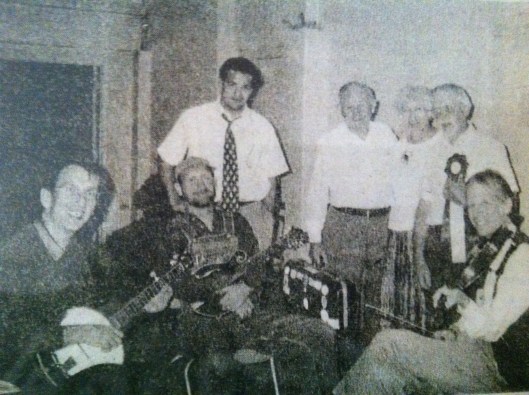
(L-R) Peter Even, Mike Compton, Brandon Kirk, J.P. Fraley, Nancy McClellan, Paul David Smith, and John Hartford.
Writings from my travels and experiences. High and fine literature is wine, and mine is only water; but everybody likes water. Mark Twain
This site is dedicated to the collection, preservation, and promotion of history and culture in Appalachia.
Genealogy and History in North Carolina and Beyond
A site about one of the most beautiful, interesting, tallented, outrageous and colorful personalities of the 20th Century