• About

Brandon Ray Kirk

~ This site is dedicated to the collection, preservation, and promotion of history and culture in my section of Appalachia.

Brandon Ray Kirk

Tag Archives: Charleston

Harts 06.19.1925

30 Thursday Apr 2015

Posted by Brandon Ray Kirk in Harts, Holden

≈ Leave a comment

Tags

Alva Koontz, Bessie Adkins, Big Creek, Bob Brumfield, Burl Farley, C&O Railway, Caroline Brumfield, Charles Brumfield, Charles C. Brumfield, Charleston, circuit clerk, Cora Adkins, Elliot Fleur, Ethel Brumfield, Fisher B. Adkins, genealogy, Gill, Grant Cremeans, Hamlin, Hardin Marcum, Harts, Herhert Adkins, history, Holden, Huntington, James Auxier Newman, James Porter, Jessie Brumfield, John McEldowney, Lincoln County, Logan, Logan Banner, Mary Ann Farley, Mattie Gill, Ranger, Salt Rock, Shirley McEldowney, studebaker, Sylvia Cyfers, Vesta Cyfers, West Virginia

An unnamed local correspondent at Harts in Lincoln County, West Virginia, offered the following items, which the Logan Banner printed on 19 June 1925:

Mr. Chas. C. Brumfield, of this place are visiting friends and relatives at Logan and Holden this week.

Alva Koontz and James Auxier Newman, of Huntington were seen to pass through this town enroute to Big Creek, today.

Mr. and Mrs. Burl Farley, of Salt Rock, were guests of Mrs. Chas. Brumfield at Harts Sunday.

Hardin Marcum and Elliot Fleur, C. & O. operators of Ranger, were calling on Miss Jessie Brumfield Saturday evening at Harts.

Robert Brumfield, of this place has purchased a fine new Studebaker car this week.

Mr. and Mrs. John McEldowney and children of Charleston are visiting relatives at this place.

Rev. Porter, Minister of the Baptist church preached an able sermon here Sunday which was largely attended.

Fisher Adkins, of Harts made a flying trip to Huntington Sunday.

Misses Jessie Brumfield and Cora Adkins were guests of Sylvia and Vesta Ciphers and Miss Mattie Gill, of Gill, Sunday and reported a fine time.

Mr. and Mrs. Herbert Adkins of Harts and Miss Ethel Brumfield were visiting friends at Hamlin, Sunday.

Hon. Grant Cremeans the Circuit Clerk, and family of Hamlin were guests of Mr. and Mrs. Chas. Brumfield, Friday.

Big Creek News 05.24.1923

11 Monday Aug 2014

Posted by Brandon Ray Kirk in Big Creek, Leet, Logan, Toney

≈ Leave a comment

Tags

Alta Gill, Big Creek, Bill Vance, Brad Toney, Charleston, Dr. Whithill, genealogy, Georgia Lilly, Guyan Valley Hospital, Hazel Toney, history, Huntington, J. Green McNeely, Jesse Toney, Kentucky, Leet, Lincoln Republican, Logan, Logan County, Logan Sheriff's Office, Louisville, Mayhill Ferrell, measles, Opal Hager, Spears, Toney, Wayne B. Toney, Wealthy Lambert, West Virginia, Willie Harmon

An unnamed local correspondent from Big Creek in Logan County, West Virginia, offered the following items, which the Lincoln Republican printed on Thursday, May 24, 1923:

The Operetta given Saturday night by the Glee Club was enjoyed by many citizens of Big Creek. The Operetta was a great success and shows great talent among the girls of this place.

Miss Mayhill Ferrell spent the weekend with relatives in Logan.

Mr. Bill Vance made a business trip to Huntington Thursday.

Miss Hazel Toney has returned to her position in the Sheriff’s office in Logan, after a visit to home folks here.

Mr. Willie Harmon is in Charleston on business.

Dr. Whithill was called to Leet recently to see Miss Wealthy Lambert, who is very ill with measles.

Miss Opal Hager is spending the week with relatives at Spears.

Uncle Brad Toney, of Toney, was the recent guest of relatives here.

Miss Georgia Lilly, who has been ill for some time, was removed to the Guyan Valley Hospital Sunday.

Rev. J. Green McNeely, of Logan, was a visitor here Sunday.

Mr. W.B. Toney motored to Logan Sunday to see the big ball game.

Jessie Toney, of this place is in Louisville, Ky., attending the dental college.

Mrs. Alta Gill was a Huntington visitor Sunday.

Big Creek News 04.12.1923

27 Sunday Jul 2014

Posted by Brandon Ray Kirk in Big Creek, Big Ugly Creek, Holden, Logan, Rector, Toney

≈ Leave a comment

Tags

Arline Kitchen, Baptist, Benevolent and Protective Order of Elks, Big Creek, Big Ugly Creek, Birchard Toney, Charleston, Charley Lilly, Columbus, D.E. Owens, Dixie Toney, Easter, education, Flossie Barker, Floyd Lilly, genealogy, Gilbert Thompson, Green McNeely, history, Holden, Hub Vance, Huntington, J.H. Kitchen, Keenan Toney, Limestone School, Lincoln Republican, Logan, Logan Lodge, Maggie Lucas, Methodist Episcopal Church South, Nellie Parsons, Ohio, Rector, Robert Stone, Stone Branch School, Tom Vance, Toney, Walter Fry

An unnamed local correspondent from Big Creek in Logan County, West Virginia, offered the following items, which the Lincoln Republican printed on Thursday, April 12, 1923:

Charley Lilly is in very poor health.

Arline, daughter of Mr. and Mrs. J.H. Kitchen, has been very ill during the past week.

Mrs. Robert Stone was a business visitor in Huntington the past week.

The Stone Branch school closed on April 5th. Many were present and all report a fine time.

Mr. Tom Vance was a recent visitor in our midst.

Mrs. Floyd Lilly left Saturday for Charleston where she will pay an extended visit to her sister, Mrs. Nellie Parsons.

Miss Maggie Lucas has just closed a successful term of school at Lime Stone. The pupils there all want Miss Lucas back next year.

Mr. D.E. Owens, of Columbus, Ohio, was calling on friends here recently.

Mr. K.E. Toney, of Toney, who has large business interests in this city was here the early part of the week looking after business affairs and mingling with friends.

Rev. J. Green McNeely, of Logan, delivered very able sermons to the Baptist congregation in this city, at the M.E. Church, South, Saturday night and Sunday afternoon. Rev. McNeely is a splendid expounder of the gospel and the people of our city are always delighted to hear him.

Miss Dixie Toney returned home Saturday evening from a shopping visit in Huntington.

Mr. Walter Fry, prominent young citizen of Rector, was in the city yesterday on matters of business.

Uncle Hub Vance continues in very poor health.

Mr. W. Birchard Toney, of this place attended Logan Lodge, No. 391, B.P.O.E., Thursday evening.

Miss Flossie Barker, of Logan, spent Easter with friends here.

Gilbert Thompson, of Holden, was the recent guest of friends in our midst.

In Search of Ed Haley 344

26 Saturday Jul 2014

Posted by Brandon Ray Kirk in Ed Haley, John Hartford, Lincoln County Feud, Music

≈ Leave a comment

Tags

Ashland, banjo, Bobby Taylor, Brandon Kirk, Charleston, Clyde Haley, Cultural Center, Deborah Basham, Ed Haley, Ella Haley, Forked Deer, Green McCoy, Grey Eagle, history, Jack Haley, John Hartford, Kentucky, Lawrence Haley, life, mandolin, Michigan, Milt Haley, Mona Haley, music, Pat Haley, Patsy Haley, Ralph Haley, Ralph Mullins, Rounder Records, San Quentin, Scott Haley, Smithsonian Institution, Steve Haley, West Virginia, writing

Around that time, Brandon and I received confirmation from Doug Owsley at the Smithsonian that he was interested in exhuming the Haley-McCoy grave. Doug gave us instructions on what we needed to do before his office could actually become involved — most importantly, to get permission from the state authorities, as well as from Milt’s and Green’s descendants. We felt pretty good about our chances of getting support from the family but weren’t sure what to expect from “officials.” For some guidance in that department, we called Bobby Taylor and Deborah Basham at the Cultural Center in Charleston, who told us all about exhumation law and codes in West Virginia. They felt, considering the interest of the Smithsonian, that we would have no trouble on the bureaucratic end of things.

Meanwhile, Rounder Records was in the final stages of releasing a two-CD set of Ed’s recordings called Forked Deer. The sound quality was incredible on the re-masters although to the uninitiated ear some of the music still sounded like it was coming from behind a waterfall in a cellophane factory. In addition to Forked Deer, Rounder was slated to release two more CDs of Ed’s music under the title of Grey Eagle in the near future.

I was very excited about all of these tunes getting out because I had fantasies of some “young Turk” fiddler getting a hold of them and really doing some damage.

In July, I called Pat Haley to tell her about the CDs, but we ended up talking more about her memories of Ed.

“I know when we lived in 1040 Greenup — when I first came over here — Pop would play very little. Only if he was drinking and maybe Mona would get him to play. I never knew of Pop ever playing sober. I didn’t hear Pop play too much but then his drinking days were just about over. But Mom would play. They had a mandolin and might have been a banjo and Mom would play a little bit. I didn’t know their brother, Ralph. He passed away, I believe, in ’46 or ’47 and I didn’t come into the family until ’48 — when I met Larry — but we married in ’49.”

Pat and I talked more about Ed’s 1951 death.

“Larry and I lived with Mom and Pop on 2144 Greenup Avenue and little Ralph lived with us,” she said. “Clyde had just come home from San Quentin, and a couple of months before Pop died Patsy was due to have Scott and so she moved into the house with us. Her and Jack had the front living room as their bedroom so that Patsy could be close to the hospital. Scott was born January 4th. My Stephen was born January 27th. We were all in the same house when Pop died. But about three days before Pop died, Clyde decided to rob his mother and came in in the middle of the night and stole her sweeper and radio while we were sleeping and he was picked up by the police and he was in jail when his daddy died. He didn’t get to come to his daddy’s funeral. His mother’s either, actually. He was in a Michigan prison when his momma died.”

John W. Runyon 1

30 Monday Jun 2014

Posted by Brandon Ray Kirk in Big Harts Creek, Big Sandy Valley, Harts, Inez, Timber, Wyoming County

≈ Leave a comment

Tags

Adam Runyon, Adam Runyon Sr., Alden Williamson Genealogy, Aquillia Runyon, Aubrey Lee Porter, Billy Adkins, Bob Spence, Brandon Kirk, Charleston, civil war, Clarence Hinkle, Crawley Creek, Cultural Center, Ellender Williamson, Enoch Baker, Garrett and Runyon, genealogy, Harts, Hattie Hinkle, Henderson Dingess, history, Inez, Izella Porter, James Bertrand Runyon, James Muncy, John W Runyon, John W. Porter, Kentucky, Land of the Guyandot, Lawrence County, Logan County, Logan County Banner, logging, Martin County, Mary Runyon, Milt Haley, Moses Parsley, Nat's Creek, Nellie Muncy, Nova Scotia, Peach Orchard, Pigeon Creek, Pike County, Pineville, Rockcastle Creek, Runyon Genealogy, Samuel W. Porter, Stephen Williamson, timbering, Wayne, Wayne County, Wealthy Runyon, West Virginia, Wolf Creek, writing, Wyoming County

In the late summer of 1996, Brandon and Billy turned their genealogical sights on John W. Runyon, that elusive character in the 1889 story who seemed to have stirred up a lot of trouble and then escaped unharmed into Kentucky. They arranged a biographical outline after locating two family history books titled Runyon Genealogy (1955) and Alden Williamson Genealogy (1962). Then, they chased down leads at the Cultural Center in Charleston, West Virginia; the Wyoming County Courthouse at Pineville, West Virginia; the Wayne County Courthouse in Wayne, West Virginia; the Martin County Courthouse at Inez, Kentucky; and at various small public libraries in eastern Kentucky. Runyon had left quite a trail.

John W. Runyon was born in February of 1856 to Adam and Wealthy (Muncy) Runyon, Jr. in Pike County, Kentucky. He was a twin to James Bertrand Runyon and the ninth child in his family. His mother was a daughter of James Muncy — making her a sister to Nellie Muncy and an aunt to Milt Haley. In other words, John Runyon and Milt Haley were first cousins.

According to Runyon Genealogy (1955), Adam and Wealthy Runyon left Pike County around 1858 and settled on the Emily Fork of Wolf Creek in present-day Martin County. In 1860, they sold out to, of all people, Milt Haley’s older half-brother, Moses Parsley, and moved to Pigeon Creek in Logan County. John’s grandfather, Adam Runyon, Sr., had first settled on Pigeon Creek around 1811. The family was primarily pro-Union during the Civil War.

At a young age, Runyon showed promise as a timber baron.

“The first lumber industry in Logan County of any importance was started on Crawley Creek by Garrett and Runyon during the year 1876,” Bob Spence wrote in Land of the Guyandot (1978). “Garrett and Runyon deserve credit for their efforts in opening the lumber business in Logan County. They were the first to hire labor in this field. It might be of interest to note here that they originally brought trained men from Catlettsburg… In a few years, Garrett and Runyon left Logan [County], and soon Enoch Baker from Nova Scotia came to Crawley Creek to take their place.”

John may have put his timber interests on hold due to new developments within his family. According to Runyon Genealogy, his mother died around 1878 and was buried at Peach Orchard on Nat’s Creek in Lawrence County, Kentucky. His father, meanwhile, went to live with a son in Minnesota. In that same time frame, on Christmas Day, 1878, Runyon married Mary M. Williamson, daughter of Stephen and Ellender (Blevins) Williamson, in Martin County, Kentucky. He and Mary were the parents of two children: Aquillia Runyon, born 1879; and Wealthy Runyon, born 1881. John settled on or near Nat’s Creek, where his father eventually returned to live with him and was later buried at his death around 1895.

During the late 1880s, of course, Runyon moved to Harts where he surely made the acquaintance of Enoch Baker, the timber baron from Nova Scotia. An 1883 deed for Henderson Dingess referenced “Baker’s lower dam,” while Baker was mentioned in the local newspaper in 1889. “Enoch Baker, who has been at work in the County Clerk’s office and post office for several weeks, is now on Hart’s creek,”  the Logan County Banner reported on September 12. Baker was still there in December, perhaps headquartered at a deluxe logging camp throughout the fall of 1889.

After the tragic events of ’89, Runyon made his way to Wayne County where he and his wife “Mary M. Runyons” were referenced in an 1892 deed. Wayne County, of course, was a border county between Lincoln County and the Tug Fork where Cain Adkins and others made their home. He was apparently trying to re-establish himself in Martin County, where his wife bought out three heirs to her late father’s farm on the Rockhouse Fork of Rockcastle Creek between 1892-1895.

In the late 1890s, John’s two daughters found husbands and began their families. On January 3, 1896, Wealthy Runyon married Clarence Hinkle at “John Runyonses” house in Martin County. She had one child named Hattie, born in 1899 in West Virginia. On March 29, 1896, Aquillia Runyon married Samuel W. Porter at Mary Runyon’s house in Martin County. They had three children: John W. Porter, born in 1897 in West Virginia; Aubrey Lee Porter, born in 1899 in Kentucky; and Izella Porter, who died young.

Leet News 03.18.1915

25 Wednesday Jun 2014

Posted by Brandon Ray Kirk in Big Ugly Creek, Leet, Rector, Timber

≈ Leave a comment

Tags

Albert Wall, Charleston, Dr. Crockett, Edna Hager, genealogy, history, Huntington, Island Creek, John B. Mullins, Leet, Lincoln County, Lincoln Republican, Miss Doyle, Rector, Sheridan, T J Bolin, timbering, typhoid fever, Webb Terrill Gillenwater, West Virginia

“Observer,” a local correspondent from Leet in Lincoln County, West Virginia, offered the following items, which the Lincoln Republican printed on Thursday, March 18, 1915:

W.T. Gillenwaters, of Rector, was a business visitor here Tuesday.

Dr. Crockett returned from Charleston Sunday, where he had been on important business.

T.J. Bolin spent Sunday with his family in Huntington.

Albert Walls will move to Sheridan in a few days. We regret to lose Mr. Walls, as he is one of our best citizens, but wish him success in his home.

Miss Doyle, a trained nurse of Huntington, is here in charge of Miss Edna Hager, who is very low with typhoid.

John B. Mullins, who is employed on Island Creek, spent Sunday with his family near this place.

The big lumber mill at this place only runs about one-third time now. The boys here that voted for the party that put lumber practically on the free list have thoroughly repented and say they will never do so any more.

There are several cases of typhoid on the creek above here and we are informed they are no better.

Toney News 01.23.1913

02 Monday Jun 2014

Posted by Brandon Ray Kirk in Big Creek, Ferrellsburg, Toney

≈ Leave a comment

Tags

Big Creek, Charleston, Clerk Lucas, Dollie Toney, education, Ettie Baisden, F.M. Toney, Ferrellsburg, Fisher B. Adkins, Garnett Hager, genealogy, George H. Thomas, history, L.D. Brinegar, Lincoln County, Lincoln Republican, Lula Fowler, Margaret Adkins, McCorkle, Toney, Virgie Collins, West Hamlin, West Virginia

“Progressive,” a local correspondent from Toney in Lincoln County, West Virginia, offered the following items, which the Lincoln Republican printed on Friday, January 23, 1913:

The weather is fine and the farmers are beginning to hustle around preparing for their next year’s crop.

F.B. Adkins returned from Charleston Saturday and reports a very pleasant trip.

Miss Margaret Adkins and Mrs. Lula Fowler, of Ferrellsburg, were the guests of Miss Dollie Toney last Saturday.

Miss Dollie Toney will close her school in a few days. She has taught a very successful school and the patrons seem to be well pleased.

The Toney Lodge met Saturday night and transacted some very important business.

Misses Virgie Collins and Garnett Hager, of Big Creek and Clerk Lucas, of Toney, were the guests of Miss Dollie Toney Sunday.

L.D. Brinegar having finished his job of concrete work near Toney last Tuesday, returned to his home at West Hamlin.

Mr. and Mrs. F.M. Toney and daughter, of Big Creek, visited home folks Sunday.

We were pleased to have Misses Dial and Ettie Baisden in our midst Sunday.

Geo. H. Thomas returned home Saturday after spending several days with friends at McCorkle.

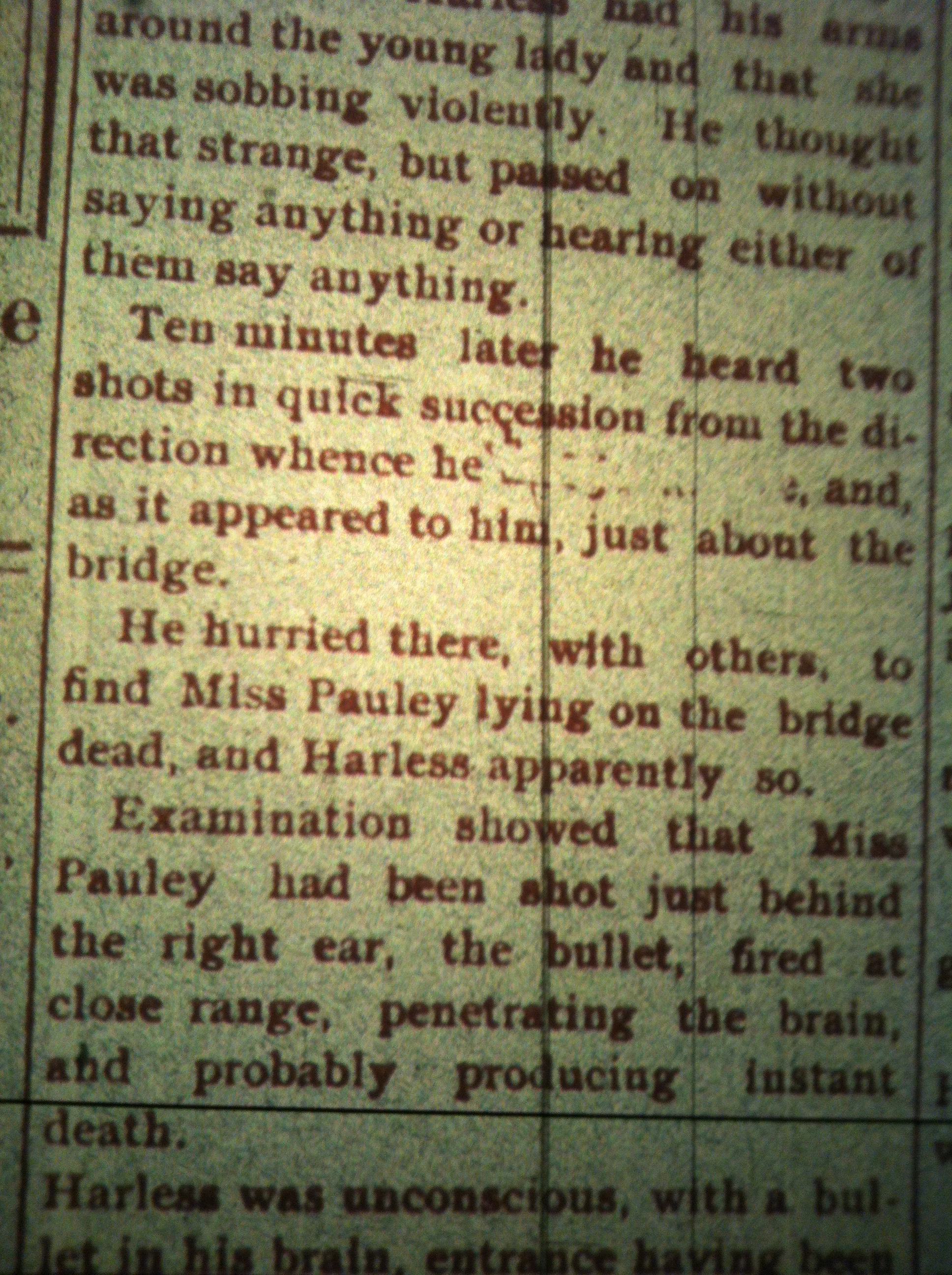
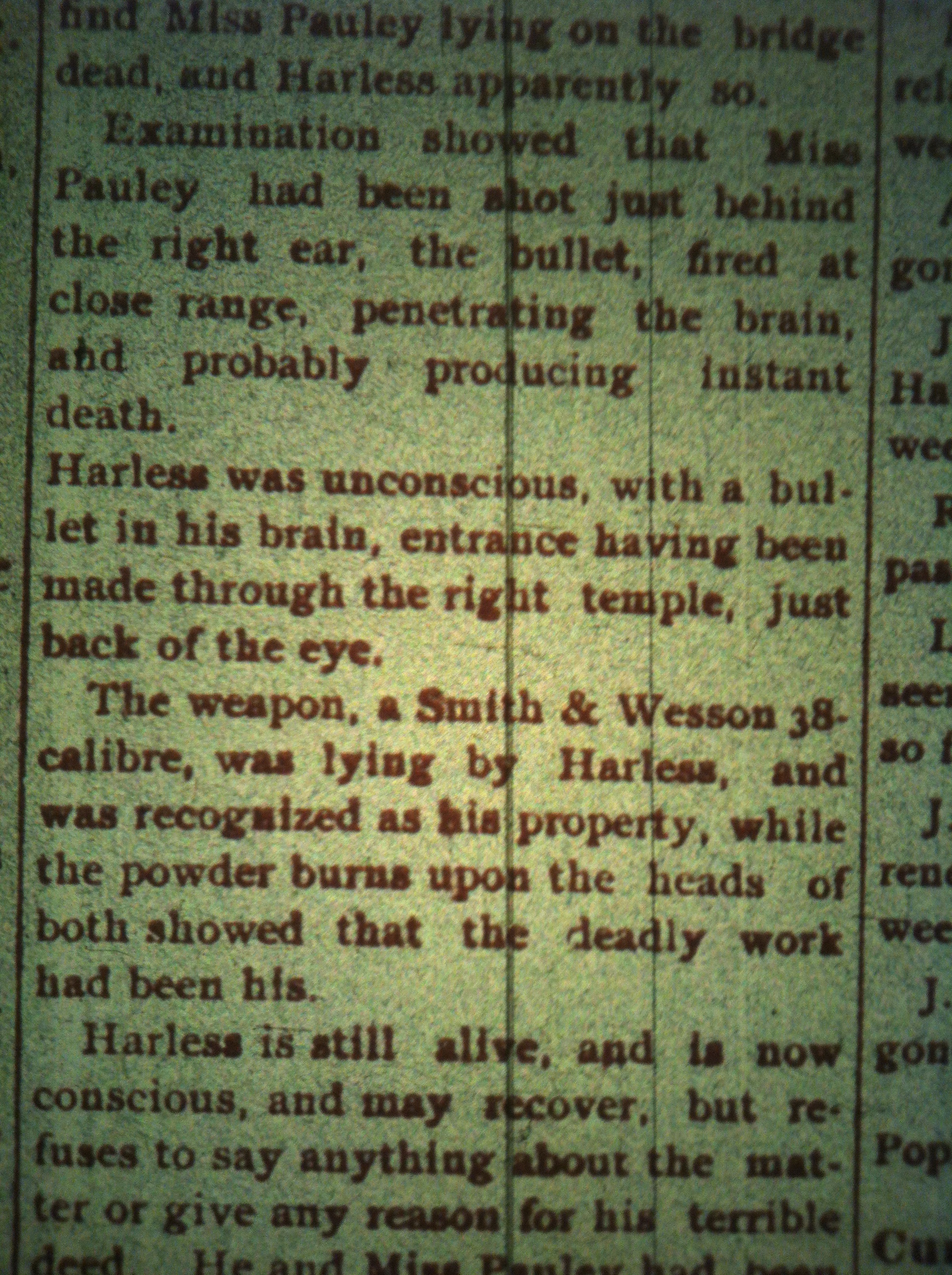
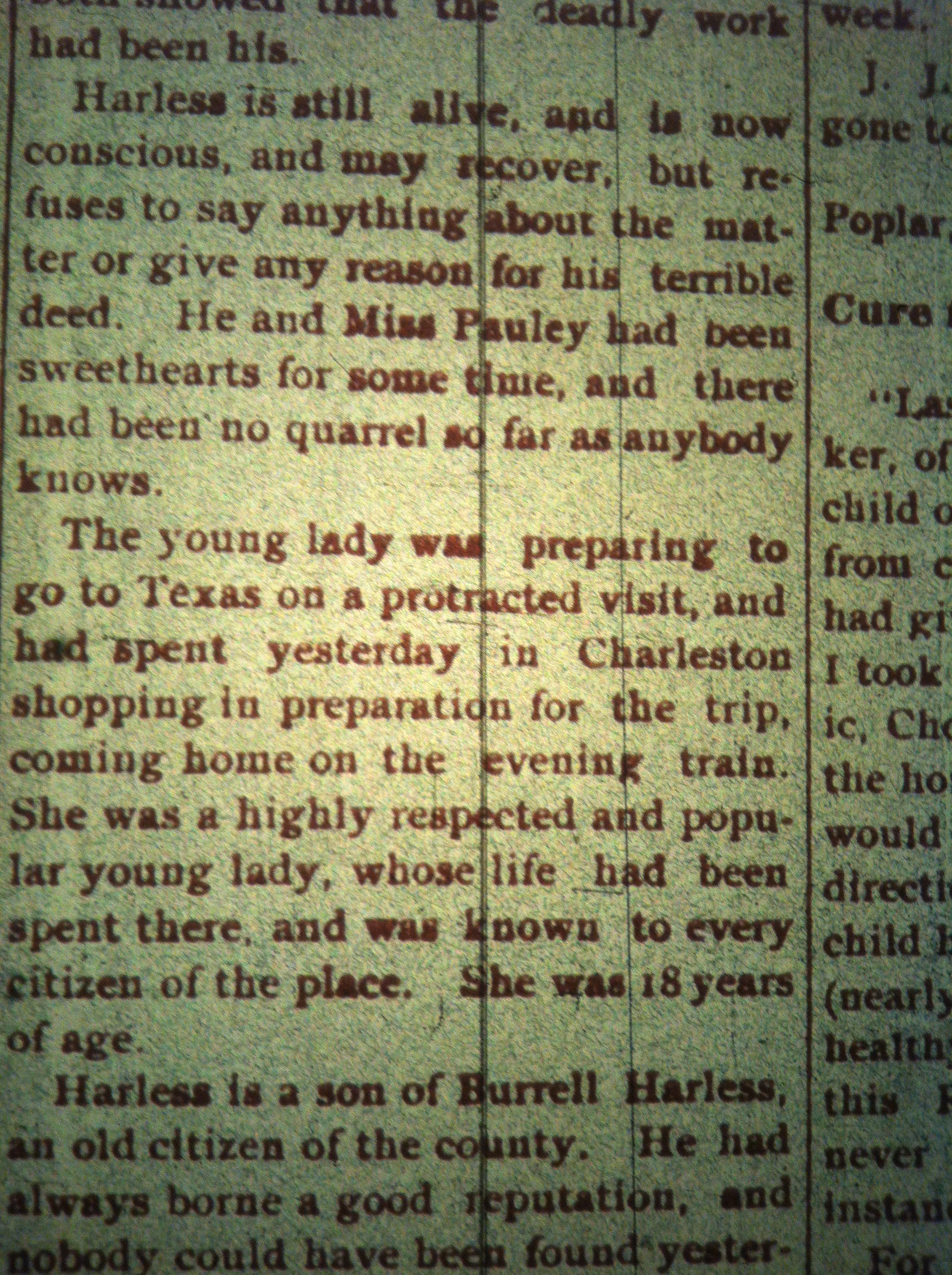
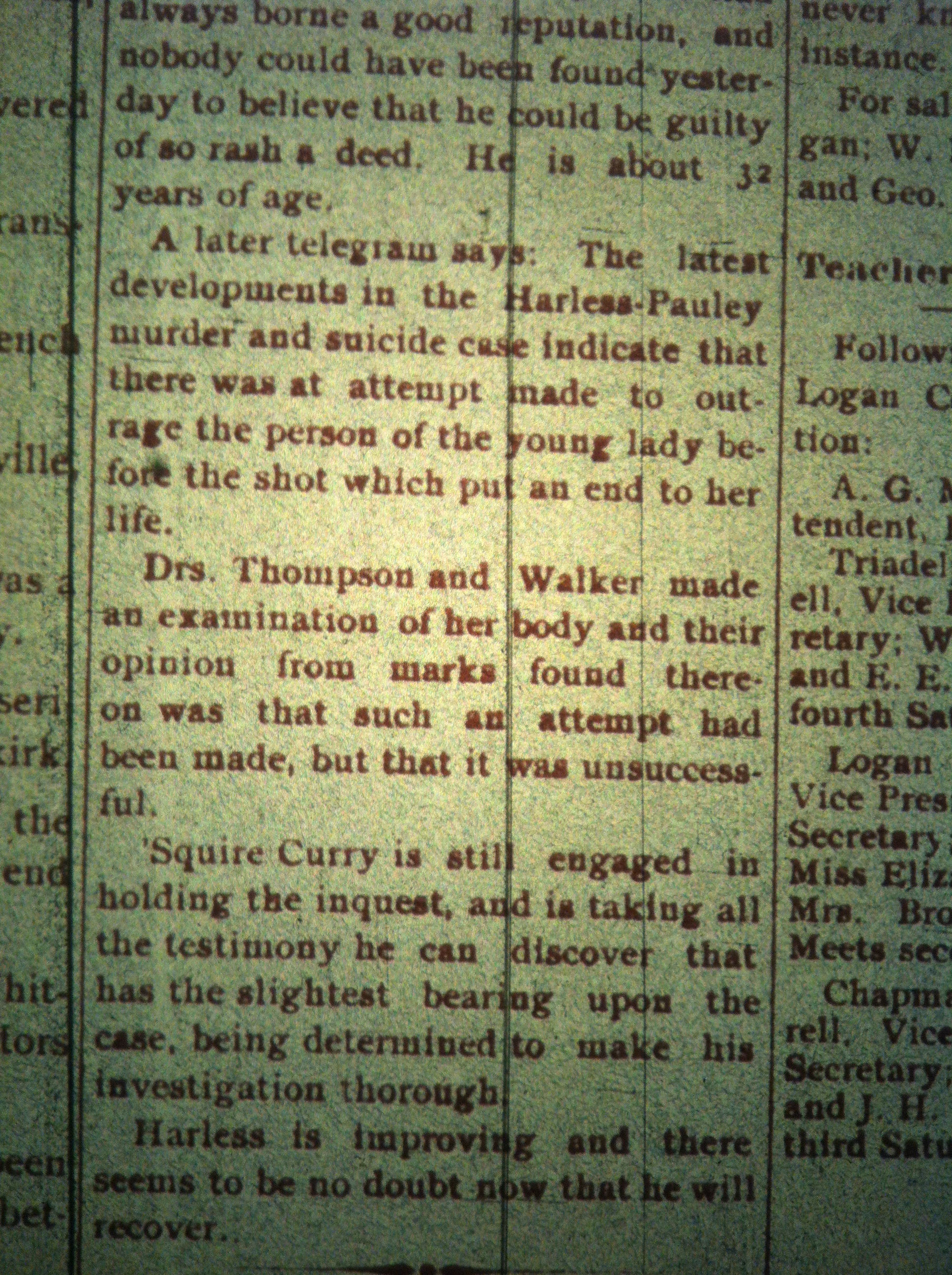
Wyatt Harless kills Maude Pauley 1901

26 Monday May 2014

Posted by Brandon Ray Kirk in Culture of Honor

≈ Leave a comment

Tags

Appalachia, Boone County, Brownstown, Burrell Harless, Charleston, crime, Dr. Thompson, Dr. Walker, history, Lens Creek, Logan County Banner, love, Maude Pauley, Texas, West Virginia, Wyatt Harless

Wyatt Harless kills Maude Pauley, Logan County Banner, August 1, 1901

Wyatt Harless kills Maude Pauley, Logan County (WV) Banner, Thursday, August 1, 1901

Wyatt Harless kills Maude Pauley LCB 8.1.01 2 Wyatt Harless kills Maude Pauley LCB 8.1.01 3 Wyatt Harless kills Maude Pauley LCB 8.1.01 4 Wyatt Harless kills Maude Pauley LCB 8.1.01 5 Wyatt Harless kills Maude Pauley LCB 8.1.01 6 Wyatt Harless kills Maude Pauley LCB 8.1.01 7

In Search of Ed Haley 308

21 Wednesday May 2014

Posted by Brandon Ray Kirk in Ed Haley

≈ Leave a comment

Tags

Ashland, Billy in the Lowground, Bonaparte's Retreat, Charles Gardner, Charleston, Dallas, Done Gone, fiddling, Flatfoot Nash, French Carpenter, Georgia Slim Rutland, Gunboats Through Georgia, history, John Hartford, Kentucky, music, West Virginia, Wilson Douglas, writing

Back in Nashville, I called Wilson Douglas to thank him for being such a good host on my recent trip to West Virginia. I also had a few questions, starting with whether or not Ed played a tune called “Gunboats Through Georgia”.

“Oh, yeah,” Wilson said. “Well, they wasn’t very many, John, that he didn’t play. And he played a danged tune, him and French Carpenter, called the ‘Flatfoot Nash’.”

Wilson paused, then said, “I told you about Ed Haley commending Georgia Slim, didn’t I? He said he believed that Georgia Slim was the best fiddler on some of them there Southern tunes he ever heard. He said nobody could touch him on the ‘Billy in the Lowground’. Now, Georgia Slim — way back there in ’37, ’38 — he went and stayed with Ed Haley a lot in the wintertime.”

Wilson’s memories of Georgia Slim caused me to recall my theory that Ed was a grandfather of the Texas contest fiddling style. I hadn’t thought much about that lately so I called up Charles Gardner, an authority on Texas fiddling. Charles said Georgia Slim had influenced a lot of Texas fiddlers when he played over Dallas radio in the early 1940s. At that time, he was fresh from the Ashland-Charleston area, his playing no doubt filled with Haley and Kessinger licks. It seemed very possible to me that the unfamiliar parts he played on tunes like “Done Gone” and “Bonaparte’s Retreat” were learned from Ed or at least based on his approach.

In Search of Ed Haley 307

18 Sunday May 2014

Posted by Brandon Ray Kirk in Calhoun County, Civil War, Ed Haley, Music

≈ 2 Comments

Tags

Ashland, Atlanta, Big Ugly Creek, Birdie, blind, Boatin' Up Sandy, Catlettsburg, Chapmanville, Charleston, Cincinnati, civil war, Clark Kessinger, Coalton, Crawley Creek, Ed Haley, Ella Haley, fiddlers, fiddling, Girl With the Blue Dress On, Godby Branch School, Grantsville, Grayson, Great Depression, Green Shoal, Harts School, history, Hugh Dingess School, John Hartford, Kentucky, Lawrence Haley, Logan, Margaret Arms, Mona Haley, music, Orange Blossom Special, Pat Haley, Ralph Haley, Slim Clere, Sweet Georgia Brown, Tennessee Waggoner, The Old Lady Carried the Jug Around the Hill, Wewanta, writing

We hadn’t played long until Slim was telling me more about his background.

“I came from a line of Irish fiddlers,” he said. “My dad, his brothers, and his dad…  The old man was so good on the fiddle — he was in the Civil War — my grandfather — that the soldiers all chipped in and bought him a fiddle and he didn’t have to fight. He was from Coalton on the road to Grayson out back of Ashland.”

Slim said his dad played “The Old Lady Carried the Jug Around the Hill” and “Girl With the Blue Dress On”.

Here comes the girl with the blue dress on, the blue dress on, with the blue dress on.

Everybody’s crazy about the girl with the blue dress on…

I asked him if his father played “Catlettsburg” and he said yes, although it was not the same version as what Ed played.

“My dad played it,” Slim said. “He played ‘Birdie’, ‘Tennessee Waggoner’. He got these two fingers cut when he was working at a steel mill and his fingers stayed stiff so he had to play the rest of his life with these two fingers. I don’t remember when he played with all five ’cause I was too small. He played ‘Boatin’ Up Sandy’.”

Every now and then, Slim would tell me something about Ed.

“Every Saturday Ed would go to a county courthouse someplace,” he said. “Believe it or not, he was in Grantsville one time when I was up there, sitting on the steps up there at the courthouse. I walked over, I said, ‘Ed, aren’t you out of place?’ He said, ‘You’re liable to find me anywhere.'”

I asked Slim if he ever saw Ed drunk and he said, “I don’t think I ever saw him sober. He didn’t get too high. Seemed like it give him more pep.”

I asked Slim if he remembered Sweet Georgia Brown coming to see Ed in Ashland and he said, “He was up in Ashland at one time. We called him Brownie. Well, he wasn’t around Ed too much. Ed was a close guy. He didn’t associate with a lot of people. Now, he liked me pretty well…but most fiddle players don’t like fiddle players.”

Speaking of fiddlers, Slim said he had met a lot of them during his lifetime. I wondered if he ever met any as good as Ed and he said, “Clark Kessinger was the closest. I think Clark learned from him. See when Clark made records for Brunswick — they had a studio down in Ashland — Ed wouldn’t play on it. He wouldn’t make records. Didn’t want to. He wouldn’t play over the radio. He said they wasn’t any money in that. He wanted to be somewhere somebody could throw a nickel or dime in that cup. He was very poor. He wasn’t starving to death, but — his wife was blind, too — there was no way that they could make any money. And he had a 17- or 18-year-old boy — he was a good guitar player, but he wouldn’t play with him. I don’t remember what his name was. He was ashamed of his father and mother — to get out in public. Not for any personal reasons…just the fact he could see and they couldn’t.”

Slim began talking about his own career in music, mostly his Depression-era radio work. He mentioned working with or meeting people like Bill and Charlie Monroe and Earl Scruggs and even credited himself with bringing “Orange Blossom Special” to Charleston from Atlanta in October of 1938. He kind of caught us by surprise when he spoke of having played all through the Guyandotte Valley.

“We played personal appearances up and down through there,” Slim said. “Played schools and theaters: Godby Branch School, up on Crawley Creek — one room school — and Hugh Dingess School — it was about an eight-room red brick building — Green Shoal, Wewanta. Harts School, I guess I must have played that school fifteen times. From about ’39 on up to 50-something. Everybody turned out when we played Harts. It was supposed to be the meanest place they was on the Guyan at that time. Came across Big Ugly Creek there. See, it goes from Lincoln County over into Boone. I used to broadcast down in there. I’d say, ‘All you Big Ugly girls be sure to come out and see us now.'”

I asked Slim if he played with any local musicians and he said, “No, we went in and played the show. Once in a while, we’d have amateur contests and they’d come in. Well, we’d have fiddling conventions at big high schools.”

I asked Slim if he ever saw Ed around Harts and he said, “No, not down there. Only time I ever seen Ed was around Ashland and Logan and Chapmanville. He played at the bank in Chapmanville. Chapmanville was 12 miles from Logan.”

Later that night, Brandon and I found some more family photographs in a box at Pat Haley’s. One was of Ella, while others were of Margaret Arms. Margaret was a real “mystery lady”: nobody seemed clear on her relationship to the Haley family. Lawrence Haley had remembered her as a cousin to either Ed or Ella, while Mona called her “Margaret Thomas” and said she lived in Cincinnati.

In Search of Ed Haley 305

14 Wednesday May 2014

Posted by Brandon Ray Kirk in Calhoun County, Clay County, Ed Haley, Music

≈ Leave a comment

Tags

Appalachia, Arnoldsburg, Ashland, banjo, Ben Friend, Bernard Postalwait, Bill Stutler, Bob Carr, Brandon Kirk, Calhoun County, Camp Chase, Charleston, civil war, Clay, Clay County, Clendenin, Ed Haley, Ed Williams, Edden Hammons, fiddlers, fiddling, history, Hog Run Hollow, Jack McElwain, John Hartford, Kentucky, Kim Johnson, Laury Hicks, Lawrence Haley, Lincoln Republican, Luther Carder, music, Pat Haley, Pisgah Bridge, Richwood, Sol Carpenter, St. Albans, Ugee Postalwait, West Virginia, William E. Chilton, Williams River, Wilson Douglas, writing

Brandon and I got a good night’s sleep at Pat Haley’s home in Ashland, then took off the next morning to see Wilson Douglas in Clendenin, West Virginia. I wanted to hear more about his memories of Ed, play some music, and go see the old Laury Hicks homeplace. Wilson met us on his porch with Kim Johnson, a banjo player. We all went inside and got settled, where Kim mentioned that Laury first invited Ed to his house after meeting him in St. Albans, near Charleston. Wilson was quick to offer new details about Ed — of a more seedy variety. He said Ed “ran around” a lot with Bernard Postalwait when he was in the area. They usually got drunk and went “women crazy” and stayed gone all night. Hicks apparently had a “wild side,” too. Wilson hinted that he was a moonshiner who sometimes left home on timber jobs…and never showed up.

We wasted little time in taking off to see some of Ed’s old stomping grounds in Clay and Calhoun Counties. There was a slight drizzle, just enough to wet everything.

Our first stop was the Hicks homeplace, which had been overtaken by weeds on my previous visit in 1994. The weeds were gone this time, so we got out of the car and maneuvered through the rotting remains of an outhouse, chicken coop, cellar base, parts of an old fence, and scattered boards — all damp and colored dark brown due to the light rain dropping down around us.

It was a far cry from the “old days” when (according to Ugee Postalwait) the family had farmed corn, wheat and cane all the way back up the mountain to the head of Hog Run Hollow. Gone were the apple and peach orchards. Gone were the gardens down by the creek (now taken in by the paved road). And, most obviously, gone was the old Hicks home, the last of four houses built on the site (the final one having been constructed in 1936).

We soon made our way up the hill to the cemetery, where Brandon took pictures. I just kind of stared at Laury’s grave — picturing Ed playing there after Laury’s death in 1937.

As we came off the hill, Wilson said Hicks was rumored to have died from “some bad cases of VD.”

Later that day, Wilson showed us Clay, the seat of government for Clay County. This was the place where Ed Haley arrived by train from Charleston enroute to the home of Laury Hicks. Lawrence Haley once told me about his father walking from Clay to Arnoldsburg, a town some thirty miles away. Brandon had found this great article titled “Old-Time Fiddlers Will Gather At Clay Saturday” from a 1921 edition of the Lincoln Republican.

Clay, W.Va., Jan. 10 — Elaborate preparations are being made in the little city of Clay for the old-time fiddlers’ contest which will be held on Saturday night, January 22. An attendance surpassing anything ever held in Clay is expected, and the hospitable citizens of this town have appointed a committee to look after the welfare of its guests. Similar contests have been held in various other sections of West Virginia this winter, but they cannot even compare to the one which will be held in Clay, it is predicted. Old-time fiddlers from far and near are coming to compete, and, if possible, carry off the honors of the evening.

Among some of the celebrated old-time fiddlers who will be here is “Jack” McElwaine of Erbacon, in Webster county. “Jack” has played the fiddle for more than fifty years, and between times has been justice of the peace, preached the gospel and practiced law. He learned to play under Saul Carpenter, the most famous old-time fiddler of them all, and who played himself out of Camp Chase during the Civil war. Another fiddler equally famous is “Edin” Hammons, who hails from the head of Wiliams river, and whose sole occupation all through life has been hunt, trap and play the fiddle. “Edin” has killed more bears, deer and played the fiddle more than any other man on Williams River.

It is said that Senator William E. Chilton and Colonel Bob Carr of Charleston have been given invitations to attend the contest and compete with these old-time fiddlers.

Several local celebrities are expected to enter the contest, and the old mountaineer fiddlers are looking forward to this part of the contest with great pleasure and saying “the city fellers will have to fiddle some to beat them.” No complete list of the fiddlers who enter the contest has been made public, but some fifteen or twenty are expected. Ben Friend, Ed Williams, Luther Carder and “Bill” Stutler, men who have been winning prizes in other contests, will be there.

People of Clay and surrounding country are looking forward to this event with great anticipation and pleasure. The last contest of the kind was held at Richwood, Thursday night of last week, and fully 200 persons were unable to get into the theater where it was held.

There are very few of the real old time fiddlers who play the old mountain tunes living today, and within a very short time there will be none left and no one to take their place. The younger generation has neither talent nor desire for this kind of music. At any rate, one can not find a young man of today who can play the fiddle in the “good old-fashioned way.”

Clay, I found, was a small shell of a town with a nice old courthouse sitting high on the hill. There was the typical arrangement of buildings: sagging old businesses hinting at lost prosperity, a small bank, dollar stores, a car dealership, a post office, and a Gino’s restaurant. No red lights and basically one two-lane thoroughfare through town. There was a hotel with the weekly newspaper office headquartered beneath where, I was told, you could go in late and help yourself to a key and then pay for your room the next morning on your way out. After passing through town and crossing the Pisgah Bridge, we spotted an old section of residences and a community church. The track bed was still visible but the railroad was long gone.

Toney News 9.29.1910

08 Tuesday Apr 2014

Posted by Brandon Ray Kirk in Ferrellsburg, Toney

≈ Leave a comment

Tags

Big Ugly Creek, Charleston, education, farming, Ferrellsburg, Fisher B. Adkins, genealogy, Green Shoal School, Hamlin, history, Jim Brumfield, Kentucky, life, Lincoln County, Lincoln Republican, logging, Lottie Lucas, Louisville, Low Gap, Matthew Farley, Patton Thompson, Philip Hager, Toney, Walt Stowers, West Virginia

“Ruben,” a local correspondent at Toney in Lincoln County, West Virginia, offered the following items, which the Lincoln Republican printed on Thursday, September 24, 1910:

The weather is fine.

The farmers are busily engaged in their tobacco and corn.

Mr. Stowers, the genial merchant at Ferrellsburg, is thinking of resigning the store business and taking up the study of medicine. His many friends will be sorry to see him depart for Louisville.

F.B. Adkins, prominent school teacher and business man, of Ferrellsburg, was calling on friends here Sunday.

Capt. Hill has just returned from a business trip to the Capital City, and made a fine horse trade on his way home.

Quite a number of people attended the funeral of Patterson Thompson at Low Gap Sunday.

M.C. Farley is attending Federal Court at Huntington.

The Lucas Bros.’ log job on Big Ugly is nearing completion.

Philip Hager, of Hamlin, passed through our midst last week, looking after road affairs.

The Green Shoal school is progressing nicely.

Miss Lottie Lucas was shopping in Ferrellsburg last Saturday.

Jim Brumfield had a barn raising Saturday in order to take care of a large crop of tobacco.

Whirlwind 1.9.1919

22 Saturday Mar 2014

Posted by Brandon Ray Kirk in Big Harts Creek, Whirlwind

≈ Leave a comment

Tags

Alex Henderson, Alex Hensley, Budda Carter, Burlie Riddle, Charleston, Dingess, Frank Adams, genealogy, history, influenza, Joseph Blair, Kentucky, Logan County, Logan Democrat, moonshining, Moses Tomblin, Mud Fork, South Carolina, Wes Vance, West Virginia, Whirlwind, World War I

“Blue Eyed Beauty,” a local correspondent at Whirlwind in Upper Hart, Logan County, West Virginia, offered the following items, which the Logan Democrat printed on Thursday, January 9, 1919:

We are having some real winter weather here at this writing.

Alex Hensley, who has been in the training camp at Charleston, So. Car., arrived home Sunday.

Joseph Blair is staying with the homefolks, helping nurse him through the influenza.

Alex Henderson is spending the winter with “Budda” Carter.

We hear that Burlie Riddle will leave in a few days for an extended visit with relatives in Kentucky.

Frank Adams, mail carrier, became water bound and was unable to make his usual trip between Whirlwind and Dingess Wednesday and Thursday.

United States marshals were in this vicinity Wednesday looking for illicit stills. It is said they failed to find any, but arrested Rev. Wese Vance for harboring deserters.

Mrs. Mae Thompson is staying with her mother, Mrs. Ona Blair.

Moses Tomblin quit his work on Mud fork Thursday on account of bad weather.

In Search of Ed Haley 254

02 Sunday Mar 2014

Posted by Brandon Ray Kirk in Big Sandy Valley, Ed Haley, Music

≈ Leave a comment

Tags

blind, Charleston, Ed Haley, Ella Haley, fiddlers, history, John Spaulding, Josie Cline, Kentucky, Kermit, Martin County, Mont Spaulding, music, Norton, Virginia, Warfield, Wayne County, West Virginia, writing

John and Mary A. Spaulding were the parents of Josie Cline and Mont Spaulding, two fiddlers in Kermit, West Virginia, somehow affiliated with Ed Haley. In all, John and Mary had six children: Mont Spaulding (1860), Josephine Spaulding (c.1864), Virginia Spaulding (c.1867), Linsy Spaulding (1870), Nickiti Spaulding (c.1873) and Lizzie Spaulding (1878). In 1870, the Spauldings lived in the Lincoln District of Wayne County, West Virginia. In the late 1870s, they moved over to the Warfield area of Martin County, Kentucky. John died around 1878. In 1880, Mont was listed in census records as a blind person. In 1900, he and his mother Mary lived with his sister Lizzie Fitzpatrick in Martin County.

In 1910, according to census records, “Monterville Spaulding” lived in the Big Elk Precinct of Martin County where he was listed as a 48-year-old widowed traveling musician. Listed with him in that census were five children, including 20-year-old Dora Spaulding and 11-year-old James Spaulding. Based on this census, there was a solid (although not genealogical) connection between Ella Haley and the Spauldings. Between 1911-12, Ella received several postcards from a “Mont, Dora, and Jim Spaulding” from various places — Richmond, Virginia; Charleston, West Virginia; and Norton, Virginia. In light of the 1910 census, which gave Mont’s occupation as that of a traveling musician while listing him with two children named Dora and James, it seemed obvious that Ella knew Mont from her early years. Mont was gone from Martin County in 1920.

In Search of Ed Haley

10 Monday Feb 2014

Posted by Brandon Ray Kirk in Ed Haley, Music

≈ Leave a comment

Tags

Blackberry Blossom, Cacklin Hen, Charleston, Ed Haley, fiddler, Forked Deer, Great Depression, Hell Among the Yearlings, history, Huntington, life, music, photos, Ragged John, WOBU

Depression-era advertisement for Ed Haley records, Charleston, WV

Ed Haley records offered for sale during the Depression, Charleston, WV

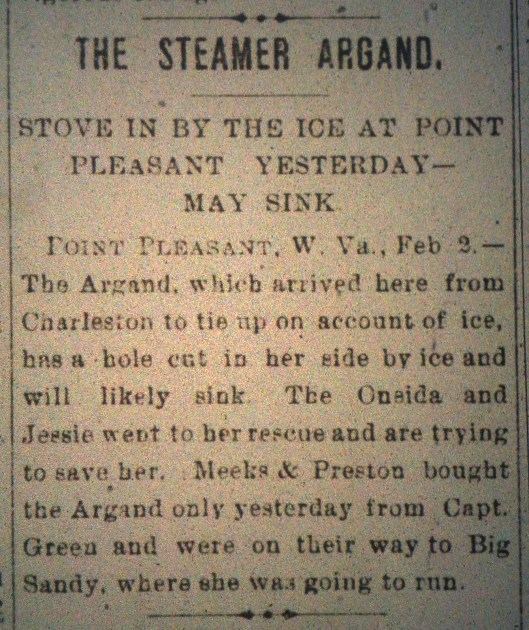
Steamboat: Argand (1900)

25 Thursday Apr 2013

Posted by Brandon Ray Kirk in Big Sandy Valley, Huntington

≈ Leave a comment

Tags

Appalachia, Argand, Big Sandy River, Charleston, culture, history, Jessie, Kentucky, Paintsville, photos, Point Pleasant, steamboats

Argand

Argand Likely to Sink HA 02.02.1900

Huntington (WV) Advertiser, 2 February 1900

Bob Adkins Interview, Part 1 (1993)

15 Friday Feb 2013

Posted by Brandon Ray Kirk in Big Harts Creek, Ed Haley, Hamlin, Harts, Huntington, Lincoln County Feud

≈ Leave a comment

Tags

Al Brumfield, Appalachia, Bob Adkins, Charleston, Charley Brumfield, crime, Emma Jane Hager, genealogy, Goldenseal, Griffithsville, Hamlin, Harts, Harts Creek, history, Hollena Brumfield, Huntington, Imogene Haley, John Hartford, Lawrence Haley, Lincoln County, Lincoln County Feud, Milt Haley, Paris Brumfield, Philip Hager, West Hamlin, West Virginia

The next day, Lawrence and I decided to go see 89-year-old Bob Adkins in Hamlin, West Virginia. In a recent Goldenseal article, Bob had given his biography, including his family’s connection to the story of Milt’s murder. Since reading his narrative, I’d been anxious to ask him about Milt, as well as to confirm or disprove my suspicion that his father’s first wife Emma Jane Hager was the same person as Ed’s mother.

To get to Bob’s house, we took Route 10 out of Huntington to Lincoln County. We turned off onto Route 3 just inside the county line at West Hamlin, then drove on for about ten minutes, crossed a hill and cruised into Hamlin — Lincoln County’s seat of government. Bob Adkins’ nice two-story house sat just past a block of small struggling businesses and through the only red light in town. We found Bob out back relaxing on a patio near a flower garden in full bloom.

After all the introductions, I mentioned my theory about Ed’s mother, which Bob shot out of the water right away. He was positive that Emma Jane Hager was not the same person as Emma Haley.

“No, Emma Jane Hager was old man Philip Hager’s daughter,” Bob said. “Dad got her from Griffithsville, 10 miles toward Charleston. Dad come down there and stole her.”

Bob knew all about Milt’s death but stressed that what he knew about it was hear-say, that he didn’t want to get sued and that we couldn’t take his word as gospel because there was “so dern many of ’em a shootin’ and a bangin’ around amongst each other” in Harts that he sometimes got his stories confused. Maybe Bob did have a foggy memory, as he claimed, but I found him to be a walking — or rather, sitting — encyclopedia of Harts Creek murders.

“I was born and raised up there until I was nineteen years old, but I was never afraid,” Bob said. “I walked all hours of the night and everything and do as I please, but I always tended to my business, you know. Kin to most of them. I never bothered nobody. Nobody never bothered me, but that doesn’t say they wouldn’t shoot you. Well, all you had to do was tend to your own business.”

Bob eased into the story of Milt’s death by giving Lawrence and I some background on the Brumfields. He knew a lot about them because Hollena Brumfield, the woman Milt supposedly shot, was his mother’s aunt and “about half way raised her.” She was a Dingess prior to marrying Al Brumfield.

“Now those Dingesses up there, I never knew of them to bother anybody much,” Bob said of his kinfolk. “Some of the older ones shot and banged around a little bit. But look out for them Brumfields. They was into it all the time. If they couldn’t get anybody else to shoot, they’d shoot theirselves — their own people.”

Al Brumfield’s father Paris was the most notorious of the old Brumfields.

“Well, one thing, he killed an old pack peddler up there at Hart, took his stuff and threw him in the river,” Bob said of the Brumfield patriarch. “And he killed another man, too. I forget the other fellow’s name. Son, he was a mean old man, I’ll tell you that. Why, he’d kill anybody. He lived about three quarters of a mile from the mouth of the creek down the river there in at the end of a bottom, see?”

Bob kind of chuckled.

“Yeah, killed that old pack peddler,” he said. “That’s what they said he did. I don’t know. He was a mean old devil. And boy, he’d killed two men.”

I wanted to know more about the Brumfields since they seemed to have been so wrapped up in the story of Milt Haley.

“What happened to Paris Brumfield?” I found myself asking.

“I tell you, old Paris, he got what was coming to him,” Bob said. “He was as mean as a snake and he would beat up on his wife every time he got drunk. And Paris’ wife got loose from him and she came down to her son Charley’s for protection. Charley was a grown man and was married and had a family and he lived down the road a quarter of a mile. Charley told her to come on in the house and there’d be nobody to bother her there and he told her to stay back in the room and he would take care of it. Old Paris, he was drunk and he didn’t get exactly where she was and he finally figured out where she was and old Paris come down there to get his wife. When he come down, Charley, his son, was setting on the porch with a Winchester across his lap. A Winchester is a high-powered gun, you know? And that day and time, they had steps that came up on this side of the fence and a platform at the top of the fence and you walked across the platform and down the steps again. That kept the gates shut so that the cattle and stuff couldn’t come into the yard. Well, he got up on that fence and Charley was setting on the porch with that Winchester. He said, ‘Now, Paw don’t you step across that fence. If you step across that fence, I’m going to kill you.’ And Paris quarreled and he fussed and he cussed and he carried on. That was his wife and if he wanted to whip her, he could whip her. He could do as he pleased. He was going to take his wife home. Charley said, ‘Now, Paw. You have beat up on my mother your last time. You’re not going to bother Mother anymore. If you cross that step, I am going to kill you.’ And he kept that up for a good little while there. ‘Ah, you wouldn’t shoot your own father.’ Drunk, you know? And Charley said, ‘You step your foot over that fence, I will.’ Paris was a little shaky of it even if he was drunk. Well, after a while he said, ‘I am coming to get her,’ and when he stepped over that fence, old Charley shot him dead as a doornail.”

You mean he killed his own father?

“His own father,” Bob said. “He killed him. That got rid of that old rascal. And that ended that story. They never did even get indicted for that or nothing. Everybody kept their mouth shut and nobody didn’t blame Charley for it because old Paris had beat up on his mother, you know? Everyone was glad to get rid of him.”

In Search of Ed Haley 18

05 Wednesday Dec 2012

Posted by Brandon Ray Kirk in Ed Haley

≈ Leave a comment

Tags

Appalachia, Ashland, blind, Charleston, Clark Kessinger, Ed Haley, fiddler, fiddlers, fiddling, history, John Hartford, Kentucky, Lawrence Haley, music, U.S. South, West Virginia

Lawrence and I drove to an Ashland restaurant where I asked more about Haley’s background between bites of seafood. I was desperate for clues about his early musical experience.

Just where did he learn to play?

Lawrence said his dad was like other mountain folks: music “absolutely come freely to these people.” He said, “A lot of people think old-time music is a simple art form because so many people that play it have a poor educational background. These people think, ‘If they can learn to play it, it has to be a simple thing to do.’ But it’s actually a complicated business.”

A little later, I asked him about Clark Kessinger and Charleston, West Virginia.

“I been to Charleston with Pop a few times, but if Clark Kessinger was around he never let Pop know,” he said. “He’d probably request a tune from him. Of course, Pop was pretty sharp on voices, too. He recognized a lot of people just by their voice. If Clark come up and requested a piece of music from him, Dad probably knew it. He never said anything to me about it. We were just kids.”

I said, “Well, Clark Kessinger studied your dad close. Of course, he knew what good fiddling was.”

“You have to give him credit for that,” Lawrence said, taking a bite of fish.

In Search of Ed Haley 10

28 Wednesday Nov 2012

Posted by Brandon Ray Kirk in Ed Haley

≈ Leave a comment

Tags

Annadeene Fraley, Appalachia, Ashland, banjo, Benny Thomasson, blind, books, Catlettsburg, Charleston, Cherry River Rag, Clark Kessinger, Cripple Creek, DC, Dunbar, Ed Haley, fiddler, fiddling, Georgia Slim Rutland, Gus Meade, Harts Creek, history, J P Fraley, John Hartford, Kentucky, Lawrence Haley, Library of Congress, life, Liza Mullins, Logan County, Marietta, music, Ohio, Ox in the Mud, Parkersburg, Parkersburg Landing, Pat Haley, Ralph Haley, Rouder Records, Sourwood Mountain, Steve Haley, Washington, West Virginia, Wilcox-Gay, writing

I spent the next two months thinking about the best way to approach Lawrence Haley. It was imperative that I made the right impression — should I call or write? Should I ease into the situation or just tell him how great I thought his father was? It was a fantastic moment — a period of time just before “contact” when I was mostly daydreaming and not nearly so swept away. In that instant, I was content to just talk with Ed Haley’s son and find out as much as I could about one of the world’s greatest fiddlers.

I finally decided to write Lawrence a letter, a perfectly natural thing to do since he was a retired postman. I had a million questions but limited myself to this:

Dear Mr. Haley,

 I am deeply inspired by your father and his music. I’ve almost completely worn out the Parkersburg Landing album and have become very interested in him. I believe him to be the best as well as the most important fiddler of our time. Through his influence on Clark Kessinger and Georgia Slim who in turn influenced Benny Thomasson he could be considered the grandfather of the present Texas contest fiddling style.

 I would have given anything to have heard him and seen him. I’ve read everything I can find and have talked to J.P. and Annadene Fraley at length for any little tidbit about him. I would love to meet you and hear you talk of him.

Yours very truly,

John Hartford

Because of my promise to Gus Meade, I was careful not to divulge the fact that I had heard any of Ed’s tunes not featured on Parkersburg Landing and had resolved that if I should be so lucky that Lawrence would at some future time play some of them I would act surprised.

A few days later, after getting the “go-ahead” from Annadeene Fraley by telephone, I gave Lawrence a call. He was extremely nice and seemed happy that I was interested in his father. He said he used to watch me on TV years ago.

“You’re the guy with the derby that danced and played the fiddle at the same time,” he said in a somewhat raspy voice.

I hesitantly asked about his father’s records. He said he had most of his dad’s original home recordings, as well as reel-to-reel copies made by the Library of Congress.

“I got four little seven-inch tapes here with some music on them,” he said, before reading the titles. I carefully wrote each title down, taking special note of the ones I had never heard of. Lawrence said his father sometimes named tunes after places where he played, like with “Catlettsburg”, a small river town near Ashland, or with “Parkersburg Landing”, a West Virginia city just below Marietta, Ohio.

“I don’t know where Pop gets all these names from,” Lawrence said, as if Ed were still alive to name them. “I think when my dad went somewhere and played, and if people liked what they heard, that’s the way he named them. Like that ‘Parkersburg Landing’, he was probably up in Parkersburg, West Virginia, playing and people liked it so that’s what he called it. I’m not sure how they got named but that’s what I’d say.”

There were other tunes like “Dunbar”, named for a small town near Charleston, West Virginia, and “Cherry River Rag”, named after a river in eastern West Virginia.

After reading Ed’s titles, Lawrence said, “Pop played quite a few more pieces than that, of course. It’s really hard to say how many of his records are out there that I don’t know about. Several years ago, this guy brought me one of his records with a tune on it called ‘Ox in the Mud’. He said he had wanted it on a record so bad he took Pop to one of these recording studios and had it made. Well, I traded him one of those Parkersburg Landing albums for it and I guess he was satisfied with that because he got quite a bit more music.”

Wow – the prospect of finding more Ed Haley records was exciting. I could just imagine digging through a box in some antique store along the Ohio River and finding Haley records mixed in with old Big Band orchestra albums and selling at a quarter each.

Putting such thoughts aside, I turned my mind back to Lawrence, who was actually holding Ed Haley records at that moment in Ashland, Kentucky. I asked him about the type of records and their general condition.

“The records are mostly Wilcox-Gay plastic records,” he said. “When I took them to the Library of Congress in Washington, some of them was in pretty bad shape. The hole where the spindle was, some of them was wore oblong and they had to put weights and everything else on them and they come up with a flutter in them. I allowed Rounder Records to make a copy of them because they said they was gonna put out a couple of albums.”

I said, “Well, I’ll tell you what. I’ve never heard anything like it. I’ve heard a lot of fiddling that was made on old records at that time and your dad was so far ahead of any of them it’s not funny. In the one sense, he’s an old-time musician. In the other, he’s modern. That knocked me out. He may be the heaviest musician I ever heard. His syncopation and his timing and his intonation… Because them old-timey notes, you know, you can’t hit them right on the head. You’ve got to shade them. And to shade them, you’ve got to really know if they’re in tune or not and not just anybody can do that. And boy, he is a master of it.”

I was obviously a little carried away and caught up in the moment.

Lawrence sort of laughed and said, “I know he was a good, fine fiddler. My dad held the fiddle out onto his left side right at the top of his bicep where his arm and chest met – the armpit, just about. It was more of a classical violinist’s stance than the old mountain fiddler holding it down towards his knee or close to his knee and right in front of him. I’ve seen him lean his chin over on the base of the violin at times. You know, like people trying to hold that fiddle up there on their shoulder and under their chin, they can’t get their fingers right if they don’t let go of the fiddle on the neck of it. Well, Pop didn’t have to dip the bow a lot of times. What he did, he’d rock the fiddle to that string to meet the bow, see? And that was tricky, too.”

I said, “I’ll tell you what, he’s got one of the best bow arms I’ve ever heard. He gets those notes out so clear.”

Lawrence interjected, “He used all the bow, too. A lot of people, they’ve got to saw the bow back and forth. My dad used every inch of the bow from one end to the other. He didn’t grab the bow up on the strings like a lot of fiddlers. You know, half way up the bow. He got right back on the bow where you tighten the string and his finger was on that tightening fret. His little finger was wrapped around that, more or less.”

I said, “It sounds like he long-bowed a lot, where he’d pull that bow down and get four or five notes on a bow stroke.”

“Yes he did,” Lawrence said without hesitation. “Pop would use every bit of that bow to get it.”

Discussing Ed’s bowing prompted me to think about Ed’s fiddle. I had looked at it many times in the Parkersburg Landing picture and wondered if it survived fifty years after his death.

“I’ve got the old fiddle,” Lawrence said, “but it’s really not playable. We lived at a place one time where we had an excess of moisture and it got to this old fiddle and it started coming apart. My son Steve took it and had some instrument re-builder to put it back together but they never could get it back together right so it’s lost all of its intonation. I’ve got it but it’s not really worth playing because it hasn’t got the resonance to it.”

I told Lawrence I was hoping to be back in Ashland in a few days and would love to visit him and see his father’s records.

“Well, if you come up and you can get a hold of some kind of portable tape player I don’t care to let you copy Pop’s records,” he said. “They will probably just set here till some kind of magnetism comes along and takes all the information off of them. But they’re here and I hope nothing happens to them.”

Well, this was an unexpected offer from someone who was reportedly so over-protective of his father’s music.

I asked Lawrence how old Ed was when he passed away and he said, “Let’s see. I was about 23 or 24. Right now, I’m an old man. I’ve had quite a bit of heart problems. I spent the biggest part of November in the hospital on a ventilator. I was having congestive heart failure. I guess you hear how my voice sounds. They rammed something down my vocal box between my vocal chords and I’ve never got my voice back right. Well, I’m more or less living one day at a time. I’m 63 now.”

I said, “Well, you’re exactly ten years older than I am.”

“Well, you’re getting up there, too, aren’t you? Not the young man we remember on TV,” Lawrence said.

Hoping to get more at the source of Ed’s music, I asked Lawrence if his dad talked about where he learned to play.

“Not to me, no,” he said. “I’ve heard some stories but just like all other legendary people whenever a story is told twice it’s been embellished quite a bit. One fella said to keep from starving to death my dad sat out and eat wild onions with a piece of cold cornbread that he’d take out of the kitchen of my great-aunt Liza’s house, who raised him. But that wasn’t true. I’ve heard Pop tell me personally that he’d take a salt-shaker and a big onion and something like that and a piece of cornbread and go out in the garden and get him a tomato and eat that. I’ve never heard him talk about eating wild onions.”

I had given little thought to Ed’s childhood and birthplace.

“Where he was raised it was kind of rough country up in West Virginia,” Lawrence said. “He come out of Logan County, West Virginia, out in a country called Harts Creek. We used to go up there quite often until I was about nine or ten years old because my dad would go back there. He’d go around courthouse days and play music out in the courthouse lawn for change and things and that’s the way he made his living. He’d go to fairs and any other activities that might draw a crowd where he could play music. That’s how him and my mother made their money and raised us kids.”

How many kids were there in the family?

“They was seven of us all together,” Lawrence said. “I was the youngest boy and then I had a sister younger than me. But I had one brother to die when he was in infancy so really there was only five boys and one girl they raised. They got us up one way or the other without jerking us too hard.”

I asked Lawrence if he remembered his father playing for dances.

“I remember one afternoon we walked from Morehead, Kentucky down to Farmers,” he said. “That’s four or five miles. At that time they didn’t have too good a roads through there so we walked the railroad tracks. I was just a kid. We went to these people’s house and they rolled back the rugs and things and Pop sat there and played all night until the sun come up. I don’t know when Pop made the arrangements. Just him and my mother.”

For the next minute or so, I really bragged on Ed’s music. I had listened to it for years and had a lot of emotion about it. Finally, Lawrence said, “Well, I’ve heard him make a sour note on a few of these records but I think he learned his violin real good.”

Lawrence said his father played the fiddle from the time he was a small child.

“The way I understood it, he become blind when he was a couple of years old and they couldn’t figure out what to do with my dad,” he said. “He was blind and living out on the farm and somebody made him a violin out of a cigar box and he started out from there and just self-taught hisself, I reckon. As he went along, he got a hold of old instruments, I guess, and showed some promise and somebody looked after him and saw that he got the right things any way.”

I was very interested in Haley’s early travels, particularly before he married and settled in Ashland.

“I guess by the time Pop was eighteen, nineteen years old — that’s back at the turn of the century — he was traveling all over West Virginia and eastern Tennessee and western Old Virginia and parts of Ohio and eastern Kentucky,” Lawrence said. “He went to White Sulphur Springs and Webster Springs — these places that were pretty well known as spas and health resorts. He went to the state capital around Charleston. I’ve heard Pop talk about when he’d be in Charleston. He said he’d guarantee if he was at the Capitol building or somewhere playing music, Clark Kessinger would be there a listening trying to learn his style. I think that’s the way that Clark Kessinger got his style of Ed Haley, just watching him around Charleston, West Virginia.”

I told Lawrence that Kessinger was a great fiddle player but that he wasn’t even close to his dad.

That seemed to delight Lawrence, who was quiet for a moment before saying, “I’m glad to hear somebody say that. That’s one reason I agreed to let Rounder Records make an album or two. I thought there might be somebody out there that would appreciate that type of music and want to preserve it some way or the other. Once bluegrass and country rock and all that took off the old mountain-type music that came over from England and Ireland and Scotland and some of the Dutch and Scandinavian countries has just about been lost.”

Easing into more musical dialogue, I told Lawrence about my theory that Haley was a grandfather of the modern Texas contest fiddling style.

“Well, I don’t know about all of that John,” he said, “but when he’d start a piece over — he’d play each piece about four or five times — he had a different variation. It would still be the same piece of music but it always seemed to vary some from the first run through to the second run through. Well, I’ve seen him vary the speed even. When he is getting toward the end — maybe the last run — he’ll speed up the tempo and things like that or make some different finger work. And that was some of the difficulties my brother had about making records with him. My brother played the mandolin or guitar and my mother played the mandolin some.”

Lawrence said his father’s blindness, as well as his distaste for the up-and-coming commercial music industry, hindered his willingness to record music.

“When radio first took off they tried to get my dad to make records, but he always felt he couldn’t do it because they had to cue him in as to when to start,” he said. “My brother had quite a bit of problems like that when he made those home-made records with my dad. And on top of that, my dad felt that recordings were just some way for somebody to take him. After so many records had been sold over a thousand, he might get two cents on the record or something like that. He felt like he’d rather get out on the street and play it for free among friends. I’ve come to the conclusion, Why not?”

I asked Lawrence if Ed played around the house and he said, “Yeah, he’d practice sometimes. I’ve seen him get out the fiddle and just play for himself. He’d listen to a piece of music… One that I can think of real good, but I don’t think he ever really come out and made any version of it for hisself was Vaughn Monroe’s ‘Ghost Riders in the Sky’. I think he figured the afterlife was about like Vaughn Monroe’s ‘Ghost Riders in the Sky’: what you did all your life was gonna be your hell if you didn’t do it right, if you didn’t enjoy it.”

While crediting some of Ed’s contemporaries, Lawrence seemed to regard his father as a highly gifted prodigy surrounded by mediocrity. He implied that his father humbly felt the same way, although it was an occasional source of aggravation, especially in his later years. “A lot of guys would get around Pop and aggravate him,” Lawrence said, “but I think he enjoyed music.”

I told Lawrence I would give almost anything to have seen his father play.

“Well, it’s a shame there’s no kind of video of Pop because he had an easy style of violin playing. It didn’t look strenuous to him.”

Ever conscious of genetics, I asked Lawrence if any of his family played music. He said his son Steve Haley — who lived just north of me in Hendersonville — was a former band instructor.

“He graduated from Morehead as a music major and taught high school band in Knoxville. His two daughters are taking violin lessons and are in whatever little junior symphony they have there in Hendersonville. They play semi-classical stuff.”

I asked Lawrence if Ed played any instruments aside from the fiddle and he said, “My dad was an old hammer-thumb banjo-picker like Pappy Jones. He played ‘Cripple Creek’ and ‘Sourwood Mountain’ — really just about anything he played on the fiddle. And he put just about as many notes in on the banjo as he did on the fiddle. I’m not a bragger about my dad but he was a good banjo player, too.”

This was a new twist: I hadn’t even considered that Haley might have been a multi-instrumentalist.

“I never seen Pop play a piano,” Lawrence said, “but he could set down and play a piece of music on our old pump organ. And he taught my older brother Ralph how to play the guitar. Sometimes my dad would be playing the fiddle and my brother would be trying to pick up a piece of music with him and he’d tell Ralph what chords to hit, how to change chords and all that. He could make a run between notes and my dad could, too. Yeah, Pop could play any instrument, or I guess a little bit on anything that was handy to him anyway.”

I wondered if there were any recordings of Haley playing the banjo.

“No, not a thing on the banjo. My brother Ralph, when he come out of the service — in 1946, I guess it was — he got a hold of one of these Army surplus machines that had a cutting needle on it that cut the grooves and that’s what he made all these records on. Some of them are paper with a plastic coat on them. Others are a solid plastic. But most of them are all scratched and some of the paper ones are wore completely through the plastic into the paper. I’ve tried to keep them here at home. Some parts of the records are good.”

Just before hanging up, Lawrence said, “It was kind of a surprise to us to have got your letter. Annadeene called here and told us that you’ve been trying to get a hold of us. Our daughter, when you was here, she’d just had her operation, I guess. I think they’re gonna give her some radiation treatment and we will be making some trips back up there to Ohio but we’ll try to be here if you come.”

At that point, Lawrence turned the telephone over to his wife Pat who said in a pleasant British accent, “I do invite you and whoever you’re bringing with you to stay with us overnight or whatever. I have a front bedroom with two double beds and it’s just Larry and I that live here and we appreciate you showing an interest.”

In Search of Ed Haley 7

26 Monday Nov 2012

Posted by Brandon Ray Kirk in Ed Haley

≈ Leave a comment

Tags

Appalachia, Ashland, Billy in the Lowground, Birdie, Blackberry Blossom, blind, books, Catlettsburg, Charleston, Clovis Hurt, Columbus, Doc Holbrook, Ed Haley, fiddle, fiddler, Flannery's Dream, Forked Deer, Grayson, Greenup, history, J P Fraley, James A Garfield, John Hartford, Kentucky, Lawrence Haley, logging, Morehead, music, Ohio, Old Sledge, Parkersburg Landing, Portsmouth, Ralph Haley, Rounder Records, Route 60, Snake Chapman, Soldiers Joy, Tennessee Wagner, The Wild Rose of the Mountain, West Virginia, Wild Wagner, writing

A few days later, while re-reading the liner notes for Parkersburg Landing, I focused in on the name of J.P. Fraley as one of the informants for Ed’s biographical information. Encouraged by my success in contacting Snake, I got J.P.’s telephone number from a mutual friend and just called him up. He lived near Grayson, Kentucky, a small town southwest of Ashland and roughly mid-way between Ashland and Morehead on Route 60. I could tell right away that Ed Haley was one of his favorite subjects.

As soon as I mentioned Haley’s album, J.P. just took off. “You know, he never did make a commercial record. Those little old things, they had a cardboard center. They was home recordings. At the time, Rounder was a making the record that I did, The Wild Rose of the Mountain, and I told them about Ed Haley. And we was lucky with Lawrence, one of his boys…”

J.P. stopped.

“John, I’ll tell you quickly the story of it. Lawrence was really proud of his daddy, but people around Ashland would say, ‘Aw, he was just a bum.’ Well, he wasn’t a bum. Anyway, I got a hold of Lawrence and he was dubious about even letting us make an album of the records. He was pretty well put out because his daddy never did get recognition, but I told him Rounder was legitimate. He said, ‘I’ll go with you and take them records.’ He insisted on it. He was on the verge of being a retired postman. So he went to the Smithsonian and finally come out with the album. It tickled me to death that they did it.”

J.P. paused and then said, “Well, so much for that. I’m on your nickel,” – as if what he’d just told me was something I didn’t really care to hear.

I asked him to tell me more, specifically about his memories of seeing Haley on the street. He said, “You know, he fascinated me. When I was just a kid learning to fiddle, my daddy was a merchant. He’d take me into Ashland and stand me on the street just to listen to this blind fiddler and his boy play. I was about twelve or fourteen. Well, even earlier than that I was listening to him on the street – watching him – and I swear to god, his fingers, when he played the fiddle just looked like they was dancing. It was out of this world. Now, I don’t know which world’s fair it was, but they picked him up – I think it was Mr. Holbrook, the doctor – and took him to the world’s fair and the critics in New York – might have been ’35 or somewhere in there – wrote about him. Said he was a ‘fiddling genius.’ Just what I already knew, and I was just a kid.”

In the 1940s, one of J.P.’s friends, Clovis Hurt, had a run-in with Haley at Murphy’s Ten Cent Store in Ashland. “Clovis Hurt played fiddle in a band. He discovered Ed playing on the street and it just had him washed away. So Clovis told Ed that he was a fiddler. Ed said, ‘Have you got a fiddle?’ He said, ‘Yeah.’ Ed said, ‘Where’s it at?’ He said, ‘It’s in the car.’ Ed said, ‘Get it and play me a tune.'” J.P. chuckled. “Now, this happened. They was several of us around there when this took place. Clovis never did like Ed after what happened. He got his fiddle out and he played a tune called ‘Grandmaw’s Chickens’. It sounded like a whole flock of them – scared chickens. Ed said, ‘Listen, I wanna tell you something. Don’t you play the fiddle in public anymore. You’re just a learning it a little bit.’ Clovis hated him. Well, I mean he didn’t hate him, but he said he didn’t like him. Said he didn’t have any personality. I said, ‘Well, Clovis, he didn’t have to have. He made it with the fiddle.’ But he was nice enough.”

So Ed wasn’t afraid to speak his mind, even though he was blind?

“Oh, no,” J.P. said. “I’ve heard him get loud. He would actually try to fight if somebody bothered him. He’d tell them, ‘Come around here.'”

Haley apparently had a cranky side: according to Parkersburg Landing, he “was known for his irascible moods and anyone who did not properly appreciate music was liable to his scorn.

I asked J.P. about Haley’s fiddle and he said, “Well, Ed wouldn’t fool with a cheap instrument. Over the years, he had several fiddles. This doctor I told you about – Doc Holbrook – he had one of Ed’s fiddles and I got to keep it for two or three years.”

As for Haley’s technique, J.P. said he “leaned” the fiddle against his chest when playing and held the bow at its end. I wondered if he played long or short bow strokes. “He done it both. I know when he played for his own benefit he used more bow. But he played a lot for dances and as they used to say they had to play ‘quick and devilish.'”

Did he play in cross-key?

“Oh Lord, yeah.”

What about bluegrass music? Did he like it?

“I honestly don’t think Ed woulda fooled with it. He didn’t do a whole lot of double-stopping or too many minors and stuff.”

Being an avid collector of fiddle tunes, I was very curious about Haley’s repertoire. J.P. said, “Oh, Lord. I play some of his tunes: ‘Birdie’ and ‘Billy in the Lowground’. And he played tunes like ‘Old Sledge’. He played all the standards like ‘Soldiers Joy’ and ‘Forked Deer’ and all of that. ‘Wagner’. He didn’t call it ‘Tennessee Wagner’, but he called it ‘Wild Wagner’. He played a tune that I woulda loved to learned – one called ‘Flannery’s Dream’. He was limited but now he would play hymns, too – especially on the street, on account of this is the whole Bible Belt. He played some waltzes. They were crudely pretty. I don’t remember him a singing at all, but now I have heard his wife sing and him backing her on the fiddle.”

I asked J.P. if he remembered Haley playing the eastern Kentucky version of “Blackberry Blossom” and he said yes – that he played it, too. He knew a little bit about the tune’s history: “Well, General Garfield was a fiddler. A lot of people didn’t know it. I guess it had to be in the Civil War. The ‘Blackberry Blossom’ – the old one – was General Garfield’s favorite tune. Ed – I never will forget it – he told me that that was General Garfield’s ‘Blackberry Blossom’.” This “Garfield’s Blackberry Blossom”, J.P. said, was a different tune entirely than the one made famous by Arthur Smith. J.P. said local fiddler Asa Neal also played the tune. “He was from around the Portsmouth area. He’s dead, and he was quite a fiddler. Now, he knew Ed. Fact of the matter, he learned a lot from Ed, but he was about Ed’s age.”

J.P. said Haley never talked about where he learned to play. “I have an idea that it was probably a lot like I learned. See Catlettsburg was a jumping off place, I call it, for loggers and coal miners and rousters and so forth, and they was always some musicians in them. And Ed had this ability – he couldn’t read – but he had an ear like nobody’s business. If he heard a tune and liked it, he’d play it and he’d just figure out his own way to do it.”

J.P. was on a roll: “See, Ed has become more or less of a legend now…and rightfully so. His range was from, say, Portsmouth, Ohio to Ashland, Catlettsburg, and up to Charleston, West Virginia. I think he was at Columbus, Ohio, and then he went to the world’s fair. He played consistently up and down the river. He made good money on the boats.”

I asked J.P. how Haley got around to all of those places and he said, “What he would do, especially when that boy was living… He drank all the time and it was easy for him with his cronies. Somebody would move him here or yonder in a car. But now, like if he was a going to Portsmouth or someplace, usually Mr. Holbrook – he lived down at Greenup – he’d take him anywhere he wanted him to. And doctored him. I mean, if he got sick or anything, he took care of him.”

Doc Holbrook “was a pretty famous doctor in the area. He was known pretty well for a pneumonia doctor, which was hard to find then.”

J.P. kept mentioning “that boy” – meaning one of Haley’s sons – so I asked him about Haley’s family, particularly Lawrence. He said, “Fact of the matter, I didn’t know Lawrence at all. I had done something. I don’t know what it was. I think I’d played at the Smithsonian and had given Ed credit for some of the tunes and Lawrence read about it. And he called me and he almost cried thanking me for recognizing his daddy for what he could do. You see, when it comes to his daddy, he’s got up like a shield. He’ll say, ‘You can come this far, but you ain’t gonna go no farther.’ But once you know him, well, he became a good friend of mine. Now Annadeene, my wife, she worked with his wife a little while at a sewing factory and she broke a lot of ice, too. They’re on good terms with us.”

I told J.P. how much I’d like to meet Lawrence and his family sometime and he said, “Well, I’ll tell you, John. You’re welcome to yell at us anytime you want to and we’ll get you in contact with them.”

← Older posts
Newer posts →

Feud Poll 1

If you had lived in the Harts Creek community during the 1880s, to which faction of feudists might you have given your loyalty?

Categories

  • Adkins Mill
  • African American History
  • American Revolutionary War
  • Ashland
  • Atenville
  • Banco
  • Barboursville
  • Battle of Blair Mountain
  • Beech Creek
  • Big Creek
  • Big Harts Creek
  • Big Sandy Valley
  • Big Ugly Creek
  • Boone County
  • Breeden
  • Calhoun County
  • Cemeteries
  • Chapmanville
  • Civil War
  • Clay County
  • Clothier
  • Coal
  • Cove Gap
  • Crawley Creek
  • Culture of Honor
  • Dingess
  • Dollie
  • Dunlow
  • East Lynn
  • Ed Haley
  • Eden Park
  • Enslow
  • Estep
  • Ethel
  • Ferrellsburg
  • Fourteen
  • French-Eversole Feud
  • Gilbert
  • Giles County
  • Gill
  • Green Shoal
  • Guyandotte River
  • Halcyon
  • Hamlin
  • Harts
  • Hatfield-McCoy Feud
  • Holden
  • Hungarian-American History
  • Huntington
  • Inez
  • Irish-Americans
  • Italian American History
  • Jamboree
  • Jewish History
  • John Hartford
  • Kermit
  • Kiahsville
  • Kitchen
  • Leet
  • Lincoln County Feud
  • Little Harts Creek
  • Logan
  • Man
  • Matewan
  • Meador
  • Midkiff
  • Monroe County
  • Montgomery County
  • Music
  • Native American History
  • Peach Creek
  • Pearl Adkins Diary
  • Pecks Mill
  • Peter Creek
  • Pikeville
  • Pilgrim
  • Poetry
  • Queens Ridge
  • Ranger
  • Rector
  • Roane County
  • Rowan County Feud
  • Salt Rock
  • Sand Creek
  • Shively
  • Spears
  • Sports
  • Spottswood
  • Spurlockville
  • Stiltner
  • Stone Branch
  • Tazewell County
  • Timber
  • Tom Dula
  • Toney
  • Turner-Howard Feud
  • Twelve Pole Creek
  • Uncategorized
  • Warren
  • Wayne
  • West Hamlin
  • Wewanta
  • Wharncliffe
  • Whirlwind
  • Williamson
  • Women's History
  • World War I
  • Wyoming County
  • Yantus

Feud Poll 2

Do you think Milt Haley and Green McCoy committed the ambush on Al and Hollene Brumfield in 1889?

Blogroll

  • Ancestry.com
  • Ashland (KY) Daily Independent News Article
  • Author FB page
  • Beckley (WV) Register-Herald News Article
  • Big Sandy News (KY) News Article
  • Blood in West Virginia FB
  • Blood in West Virginia order
  • Chapters TV Program
  • Facebook
  • Ghosts of Guyan
  • Herald-Dispatch News Article 1
  • Herald-Dispatch News Article 2
  • In Search of Ed Haley
  • Instagram
  • Lincoln (WV) Journal News Article
  • Lincoln (WV) Journal Thumbs Up
  • Lincoln County
  • Lincoln County Feud
  • Lincoln County Feud Lecture
  • LinkedIn
  • Logan (WV) Banner News Article
  • Lunch With Books
  • Our Overmountain Men: The Revolutionary War in Western Virginia (1775-1783)
  • Pinterest
  • Scarborough Society's Art and Lecture Series
  • Smithsonian Article
  • Spirit of Jefferson News Article
  • The Friendly Neighbor Radio Show 1
  • The Friendly Neighbor Radio Show 2
  • The Friendly Neighbor Radio Show 3
  • The Friendly Neighbor Radio Show 4
  • The New Yorker
  • The State Journal's 55 Good Things About WV
  • tumblr.
  • Twitter
  • Website
  • Weirton (WV) Daily Times Article
  • Wheeling (WV) Intelligencer News Article 1
  • Wheeling (WV) Intelligencer News Article 2
  • WOWK TV
  • Writers Can Read Open Mic Night

Feud Poll 3

Who do you think organized the ambush of Al and Hollene Brumfield in 1889?

Recent Posts

  • Logan County Jail in Logan, WV
  • Absentee Landowners of Magnolia District (1890, 1892, 1894)
  • Charles Spurlock Survey at Fourteen Mile Creek, Lincoln County, WV (1815)

Ed Haley Poll 1

What do you think caused Ed Haley to lose his sight when he was three years old?

Top Posts & Pages

  • Early Schools of Logan County, WV (1916)
  • Jack Dempsey’s Broadway Restaurant Location in New York City (2019)
  • Blood in West Virginia
  • Anthony Lawson founds Lawsonville
  • Blood in West Virginia: Brumfield v. McCoy (2014)

Copyright

© Brandon Ray Kirk and brandonraykirk.wordpress.com, 1987-2023. Unauthorized use and/or duplication of this material without express and written permission from this blog’s author and/or owner is strictly prohibited. Excerpts and links may be used, provided that full and clear credit is given to Brandon Ray Kirk and brandonraykirk.wordpress.com with appropriate and specific direction to the original content.

Archives

  • February 2025
  • January 2025
  • October 2023
  • September 2023
  • December 2022
  • November 2022
  • May 2022
  • April 2022
  • February 2022
  • November 2021
  • October 2021
  • September 2021
  • June 2021
  • May 2021
  • April 2021
  • March 2021
  • February 2021
  • January 2021
  • December 2020
  • November 2020
  • October 2020
  • July 2020
  • June 2020
  • May 2020
  • April 2020
  • March 2020
  • February 2020
  • January 2020
  • December 2019
  • November 2019
  • October 2019
  • September 2019
  • August 2019
  • July 2019
  • June 2019
  • May 2019
  • April 2019
  • March 2019
  • February 2019
  • January 2019
  • December 2018
  • November 2018
  • October 2018
  • September 2018
  • August 2018
  • July 2018
  • June 2018
  • May 2018
  • April 2018
  • March 2018
  • February 2018
  • January 2018
  • December 2017
  • November 2017
  • October 2017
  • September 2017
  • August 2017
  • July 2017
  • June 2017
  • May 2017
  • April 2017
  • March 2017
  • February 2017
  • January 2017
  • December 2016
  • November 2016
  • October 2016
  • September 2016
  • August 2016
  • July 2016
  • June 2016
  • May 2016
  • April 2016
  • March 2016
  • February 2016
  • January 2016
  • December 2015
  • November 2015
  • October 2015
  • September 2015
  • August 2015
  • July 2015
  • June 2015
  • May 2015
  • April 2015
  • March 2015
  • February 2015
  • January 2015
  • December 2014
  • October 2014
  • September 2014
  • August 2014
  • July 2014
  • June 2014
  • May 2014
  • April 2014
  • March 2014
  • February 2014
  • January 2014
  • December 2013
  • November 2013
  • October 2013
  • September 2013
  • August 2013
  • July 2013
  • June 2013
  • May 2013
  • April 2013
  • March 2013
  • February 2013
  • January 2013
  • December 2012
  • November 2012

Enter your email address to follow this blog and receive notifications of new posts by email.

Join 2,927 other subscribers

Tags

Appalachia Ashland Big Creek Big Ugly Creek Blood in West Virginia Brandon Kirk Cabell County cemeteries Chapmanville Charleston civil war coal Confederate Army crime culture Ed Haley Ella Haley Ferrellsburg feud fiddler fiddling genealogy Green McCoy Guyandotte River Harts Harts Creek Hatfield-McCoy Feud history Huntington John Hartford Kentucky Lawrence Haley life Lincoln County Lincoln County Feud Logan Logan Banner Logan County Milt Haley Mingo County music Ohio photos timbering U.S. South Virginia Wayne County West Virginia Whirlwind writing

Blogs I Follow

  • OtterTales
  • Our Appalachia: A Blog Created by Students of Brandon Kirk
  • Piedmont Trails
  • Truman Capote
  • Appalachian Diaspora

BLOOD IN WEST VIRGINIA is now available for order at Amazon!

Blog at WordPress.com.

OtterTales

Writings from my travels and experiences. High and fine literature is wine, and mine is only water; but everybody likes water. Mark Twain

Our Appalachia: A Blog Created by Students of Brandon Kirk

This site is dedicated to the collection, preservation, and promotion of history and culture in Appalachia.

Piedmont Trails

Genealogy and History in North Carolina and Beyond

Truman Capote

A site about one of the most beautiful, interesting, tallented, outrageous and colorful personalities of the 20th Century

Appalachian Diaspora

  • Subscribe Subscribed
    • Brandon Ray Kirk
    • Join 789 other subscribers
    • Already have a WordPress.com account? Log in now.
    • Brandon Ray Kirk
    • Subscribe Subscribed
    • Sign up
    • Log in
    • Report this content
    • View site in Reader
    • Manage subscriptions
    • Collapse this bar
 

Loading Comments...