• About

Brandon Ray Kirk

~ This site is dedicated to the collection, preservation, and promotion of history and culture in my section of Appalachia.

Brandon Ray Kirk

Tag Archives: Burbus Toney

Guyandotte River Navigation (1848)

24 Sunday May 2020

Posted by Brandon Ray Kirk in Coal, Guyandotte River, Timber

≈ 2 Comments

Tags

Andrew Elkins, Appalachia, Burbus Toney, coal, Corbin Bryant, David Dingess, farming, flatboats, Francis Browning, genealogy, Guyandotte River, Harvey S. Dingess, Henderson Dingess, Henry Conley, history, James Bailey, Jefferson Thompson, Kanawha County, Logan County, navigation, rafting, Ralph Lucas, sheep, Squire Toney, timber, tobacco, Virginia, West Virginia, West Virginia State Archives, William E. Browning, William Farley, William Toney

The following petition is imperfectly transcribed and will be corrected at a later date:

A Petition of Citizens of Logan County praying for the appropriation of money to clear out the obstruction in the navigation of the Guyandotte River (July 17, 1848)

Petition to the Senate and House of Representatives of the Virginia Legislature by the “citizens of the County of Logan” who “represent to your body that they live in a County of Boundless resources of wealth, with a soil adapted to the growth and culture of all most all the substantial ___ of Life. The Indian corn, Rye, oats, Tobacco, hemp, Flax, potatoes, cabbages, carrots, pumpkins are grown as well perhaps in this county as any other region in the commonwealth whilst there is no county can exceed it on firsts: Particularly Peaches by planting on the North Hill Sides they never fail to yield their fruits and the peaches often measure from 2 1/2 to 3 inches in diameter, it is believed also that the ___ would grow well and by proper and well directed enterprize and industry ___ may yet be made in our County to gladden the Hearts of the Citizens and strangers. That your Humble body may have some Idea of the Rich character of our County. They respectfully State as cattle can be gotten of the county, better than almost anything else, in which they could spend their capital or employ their time, that many cattle are annually raisen and drove from the County. That these vast herds of cattle live through the winter without being far from the Produce of the farm with the exception of a few days of Heavy snow and __ rains from the rich character of our hills fine grapes will soon upon them it is believed that no portion of the world would be better adapted to the growing of sheep as not much attention hath yet been paid to the growing of sheep there is no fine Breeds in the county yet our sheep are large and very thrifty. There is perhaps no county that can boast of finer growth of timber which now is and must continue to be in great demand upon the Ohio river and we have no doubt our County abounds with valuable minerals of many descriptions. There is every portion of in the county Rich and deep veins of Bituminous coal and several Banks of the Canal Coal have been found and doubtless the county is filled with it, this Coal above if it could be gotten to market would bring in a great resource of wealth.”

“Yet all of these vast resources are locked and remain valueless for the want of outlet or the means of getting them to market and the necessaries of Life brought to the county for Sale owing to the obstruction of the navigation of the Guyandotte river, and taxed something like one cent on the Pound, this on ___ coffee, nails, Tobacco &c, operates verry __ the Guyandotte River is here. Great chance of communication–the articles of salt may be brought across the county from Kanawha But almost everything else must and __ be Brought up the river and there is no other Possible __ of getting out with our lumber and coal and wool and other products.”

The petition hopes the “Honorable Body” will “appropriate a sufficient sum of money together with what may be raised By individuals to remove the obstructions of the navigation of said river By the ___ upheavals and the Flat Boat and Rafts Downwards at the proper stages of the tide.”

Some signatures of interest to me (there were many others):

Ralf Lucas

Burbus Toney

Henry Conley

Corbon Bryant

Squire Toney

Francis Browning

James Bailey

William E. Browning

Andrew Elkins

H.S. Dingess

William Farley

Henderson Dingess

Jefferson Thompson

William Toney

David Dingess

Source: Library of Virginia, General Assembly Legislative Petitions, Logan County, Reel 111,” located at the WV State Archives.
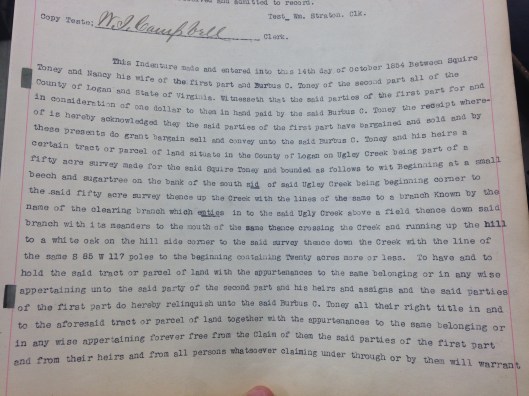
Squire Toney Deed to Burbus Toney (1854)

12 Monday Mar 2018

Posted by Brandon Ray Kirk in Big Ugly Creek

≈ Leave a comment

Tags

Appalachia, Big Ugly Creek, Burbus Toney, Clearing Branch, genealogy, history, James Ferrell, justice of the peace, Lincoln County, Logan County, Nancy Toney, Spencer A. Mullins, Squire Toney, Virginia, West Virginia

Squire Toney to Burbus Toney Deed 1

Deed Book C, page ____, Logan County Clerk’s Office, Logan, WV. Note: This property is located in present-day Lincoln County, WV.

Squire Toney to Burbus Toney Deed 2

Deed Book C, page ___, Logan County Clerk’s Office, Logan, WV.

Burbus Toney Deed to Squire Toney (1854)

26 Friday Jan 2018

Posted by Brandon Ray Kirk in Big Creek

≈ Leave a comment

Tags

Appalachia, Burbus Toney, genealogy, Guyandotte River, history, justice of the peace, Keziah Toney, Lick Hollow, Limestone Branch, Lincoln County, Logan County, Lorenzo D. Hill, Noah Haner, Squire Toney, Tan Trough Branch, Virginia, West Virginia, William Smith

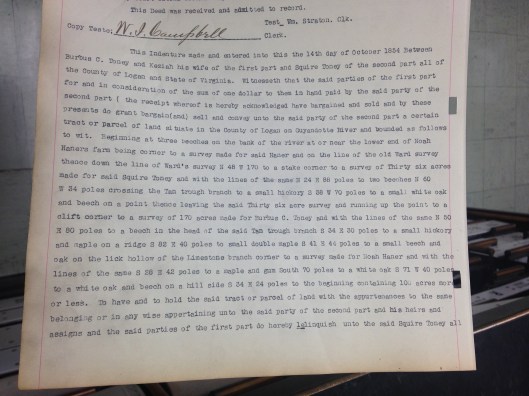
Burbus Toney to Squire Toney Deed 1

Deed Book C, page 422, Logan County Clerk’s Office, Logan, WV. This property is located in present-day Lincoln or Logan County, West Virginia.

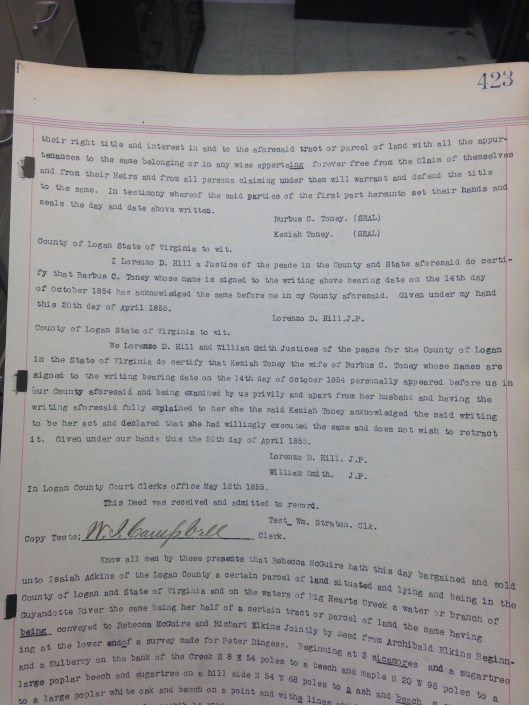
Burbus Toney to Squire Toney Deed 2

Deed Book C, page 423, Logan County Clerk’s Office, Logan, WV.

Admiral S. Fry Letter (1880)

11 Monday Sep 2017

Posted by Brandon Ray Kirk in Green Shoal, Huntington, Lincoln County Feud, Music, Women's History

≈ 3 Comments

Tags

Admiral S. Fry, Anderson County, Appalachia, Burbus Toney, Charleston, Cincinnati, Franklin County, Garnett, genealogy, George Fry, Green Shoal, history, Huntington, J.S. Caldwell, Kansas, Lincoln County, music, Ohio, Ottawa, Rhoda Fry, Tolbert S. Godby, West Virginia

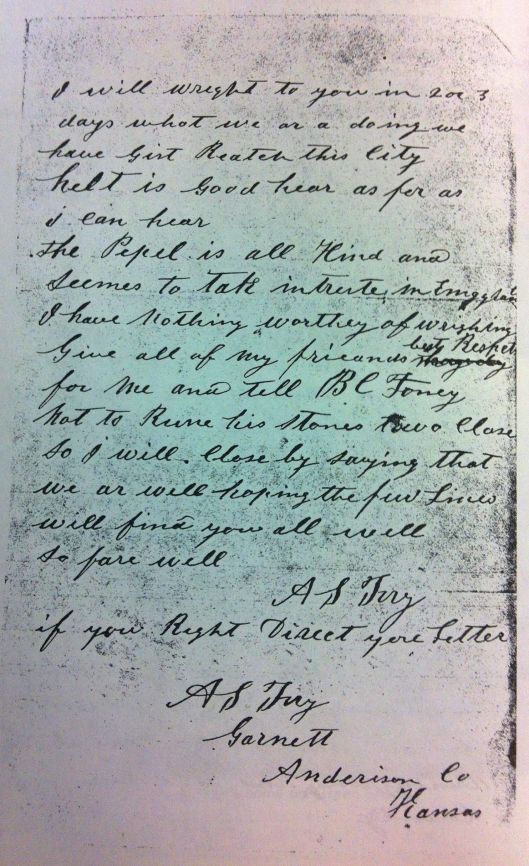
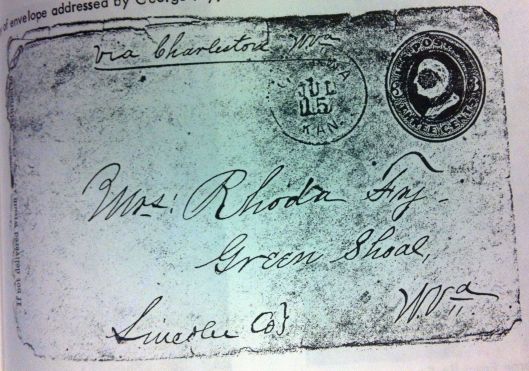
A.S. Fry Letter 1A.S. Fry Letter 2A.S. Fry Letter 3

A.S. Fry Letter 4

I descend from three of A.S. Fry’s siblings: Christian Fry, Emily (Fry) Lucas, and Druzilla (Fry) Abbott. A.S. Fry’s son, George Fry, is a central character in my book, “Blood in West Virginia: Brumfield v. McCoy.”

Harts Creek District (c.1883)

08 Saturday Apr 2017

Posted by Brandon Ray Kirk in Big Harts Creek, Big Ugly Creek, Fourteen, Green Shoal, Guyandotte River, Harts, Leet, Little Harts Creek, Timber, Warren, Wewanta

≈ 3 Comments

Tags

Adam Lambert, Andrew D. Robinson, Appalachia, B.C. Curry, Big Ugly Creek, Boone County, Burbus Toney, Charles Spurlock, constable, Edley Elkins, education, Fourteen Mile Creek, genealogy, Guyandotte River, Harts Creek, Harts Creek District, Henry H. Hardesty, Hezekiah Adkins, history, Isaac Elkins, James White, Jefferson District, Jeremiah Lambert, Jesse Gartin, John Fry, John H. Brumfield, John Lucas, justice of the peace, Kiahs Creek, Laurel Hill District, Lewis Queen, Lincoln County, Little Harts Creek, Little Ugly Creek, Logan County, Methodist, miller, Rhoda Elkins, Richard Adkins, Richard Elkins, Sarah Elkins, Squire Toney, timber, timbering, Wayne County, West Virginia, William Lucas, William West

From “Hardesty’s History of Lincoln County, West Virginia,” published by H.H. Hardesty, we find this entry for Harts Creek District in Lincoln County, West Virginia:

This is the most southern subdivision of the county. It derives its name from Harts creek, a tributary of the Guyandotte river. On the north is Laurel Hill district, on the northeast is Jefferson, east Boone county, on the south Logan, and on the west Wayne. Guyandotte river flows northwest and divides the district into two nearly equal parts. There are several small streams, among which are Little and Big Harts creeks, Little and Big Ugly creeks, Kiahs creek, and Fourteen Mile creek.

The first settler was Richard Elkins, who reared his cabin in the month of September, 1807. Here he removed his family, and here Charles Spurlock became his first neighbor. Other early settlers were: Esquire Toney, John Lucas, Edley Elkins, John Fry, Hezekiah Adkins, John Brumfield, and Richard Adkins. Rhoda, a daughter of Edley and Sarah Elkins, was the first white child born in the district. The first grist mill was built  by James White about the year 1821. It was a small tub-wheel mill, water being the propelling power. Isaac Elkins built the first saw mill in 1847 or 1848. It was constructed on the old sash-saw plan, and had a capacity for cutting from 800 to 1,000 feet per day.

The first school was taught in a log cabin one mile above the mouth of Big Harts creek about the year 1832, but who the teacher was cannot now be ascertained. The date, however, is remembered by an old resident, because it was the year in which he first visited this section. The first house for educational purposes was built near the mouth of Big Harts creek in 1834. It was a five-cornered building, one side being occupied by the ever-present huge fire place. There are now ten public school houses in the district, “some of which,” says an informant, “are in bad condition, but will soon be replaced by frames;” 334 boys and girls attend school in this district.

The first sermon was preached here in the year 1823 by a Methodist minister named William West, and here the same year he gathered a little church, one of the first ever formed in the valley of the Guyandotte river; but of its history or who composed its membership, nothing is known. When the writer asked of an old settler the question: “Who were the first members?” his reply was: “The register is gone, and no one living can tell.” When asked who organized the first Sabbath school, he replied: “There never was one in the district.”

The first township officers were as follows: Supervisor, Burbus Toney; justice of the peace, Jeremiah Lambert; constable, Jesse Gartin; clerk, Andrew Robinson; treasurer, B.C. Curry; school commissioners, Adam Lambert, William Lucas, and Lewis Queen. According to the census of 1880, the population was 1,116.

Source: The West Virginia Encyclopedia, Vol. 7 (Richwood, WV: Jim Comstock, 1974), p. 106-107.

NOTE: I descend from Richard Elkins, John Fry, John H. Brumfield, and Jeremiah Lambert.

Green Shoal (WV) Post Office

12 Monday Jan 2015

Posted by Brandon Ray Kirk in Ferrellsburg, Green Shoal, Toney

≈ Leave a comment

Tags

Admiral S. Fry, Burbus Toney, C. Brumfield, Erastus Kelly Steele, Ferrellsburg, Fry, George W. Ferrell, Green Shoal, Green Shoal Post Office, Guyandotte River, Harts Creek District, James H. McComas, Lincoln County, Logan County, postmaster, Route 10, Toney, Virginia, West Virginia

Green Shoal Creek is a tributary of the Guyandotte River located in Harts Creek District of Lincoln County, West Virginia. Prior to 1863, the stream was located in Virginia, and prior to 1869, it was located in Logan County. Today, it is situated on Route 10 between the communities of Ferrellsburg and Toney. Prior to the Civil War, Green Shoal was a sort of community hub for the Harts Creek area. Green Shoal had the first post office located in the Harts area.

Green Shoal Post Office was established on January 4, 1855. It was discontinued on July 9, 1866. Burbus C. Toney, son of Squire and Nancy (Brown) Toney, was postmaster from 1855 to 1866.

Green Shoal Post Office was re-established on November 25, 1873. Admiral S. Fry, a Confederate veteran and merchant, served as postmaster until November 1, 1878. Kale Steele served as postmaster until November 17, 1879. The post office was discontinued on November 17, 1879.

Greenshoal Post Office was established on December 20, 1899. James H. McComas served as postmaster until April 5, 1901. According to one period newspaper account, C. Brumfield replaced McComas on April 2, 1901. Official records cite McComas as postmaster until December 22, 1902. George W. Ferrell, adopted son of local merchants, served as postmaster from December 22, 1902 until December 27, 1904. At this latter date, the post office was discontinued to Ferrellsburg.

In the twentieth century, the Green Shoal area was called “Fry.”

Harts Creek and Big Ugly Creek land grants (prior to 1850)

16 Wednesday Jul 2014

Posted by Brandon Ray Kirk in Big Harts Creek, Big Ugly Creek

≈ 3 Comments

Tags

Abijah Workman, Abner Vance, Arnold Perry, Big Ugly Creek, Buck Fork, Burbus Toney, Charles Spurlock, Edmund Toney, Elias Adkins, genealogy, George Spears, Green Shoal, Guy Dingess, Guyandotte River, Harts Creek, Harvey Elkins, Henderson Branch, Henry Conley, history, Hoover Fork, Isaac Adkins, Jacob Stollings, James White Jr., John Fry, John Gore, John H. Brumfield, John Rowe, John Workman, Joseph Adams, Joseph Fry, Joshua Butcher, Kiahs Creek, Levi Collins, Lorenzo Dow Hill, Marsh Fork, Mekin Vance, Moses Brown, Moses Workman, Obediah Workman, Patton Thompson, Peter Dingess, Peter Mullins, Price Lucas, Ralph Lucas, Richard Elkins, Richard Vance, Robert Hensley, Rockhouse Fork, Samuel Lambert, Smokehouse Fork, Squire Toney, Trace Fork, William Dalton, William Wirt Brumfield

Listed below are land grants and early deeds citing the Harts Creek and Big Ugly Creek areas of what was then Logan and Cabell counties, Virginia. The list will be updated and improved periodically.

1812   Squire Toney         100 acres   1 1/2 poles from A.W. grave

1813   Jacob Stollings       185 acres   Harts Creek, mouth

1814   Henry Conley         N/A            Hearts Creek

1815   George Spears       300 acres   Guyan River at upper end of William Brumfield’s line

1817   Edmund Toney       40 acres     Guyan River near Harts Creek

1819   William Brumfield   75 acres     Below Big Ugly on Guyan River

1819   William Brumfield   75 acres     Waters Guyandotte

1821   Charles Spurlock     N/A           mouth of Harts Creek

1824   Jacob Stollings       50 acres     N/A

1824   Peter Dingess        170 acres    Harts Creek

1827   John Goare           N/A             Marsh Fork

1828   Elias Adkins          N/A              Waters Guyandotte

1828   Richard Elkins       18 acres       Harts Creek

1828   John Fry               N/A              Green Shoal Creek

1833   Isaac & Elias Adkins   N/A          Mouth of Harts Creek from Richard Elkins

1834   Henry Conley        N/A              Harts Creek

1834   Abner Vance, Jr.   N/A              Harts Creek

1834   Richard Vance       N/A              Smokehouse

1835   Isaac Adkins          N/A              Waters Guyandotte

1835   Moses Brown          N/A              Guyandotte River

1835   John H. Brumfield   N/A              Waters Guyandotte

1836   Harvey Elkins          N/A             Harts Creek

1836   Richard Elkins          N/A             Harts Creek

1836   Squire Toney           N/A             Ugly Creek

1837   Richard Vance         25 acres      Trace Fork

1838   Joseph Adams         100 acres     Mouth Rockhouse Fork from Guy Dingess

1838   John H. Brumfield    255 acres     Big Ugly Creek

1838   Ralph Lucas            N/A              Ugly Creek, Green Shoal

1838   John Rowe              38 acres       Ugly Creek

1841   Joseph Adams         30 acres       Buck Fork

1841   Moses & John Workman   N/A      Harts Creek

1842   Joseph Adams         N/A              Harts Creek

1842   Robert Hensley        N/A              Smokehouse

1842   Lorenzo Dow Hill      N/A              Buck Fork of Harts Creek

1842   Peter Mullins            25 acres      Harts Creek, from Abijah Workman and Mekin Vance

1842   Burbus Toney          N/A              Limestone

1843   Joshua Butcher        N/A              Smokehouse

1843   Price Lucas              N/A              Harts Creek

1843   James White, Jr.      N/A              Rockhouse?

1844   Joseph Adams         N/A              Four Tracts, Harts Creek and Buck Fork

1844   Peter Mullins            50 acres       First lower branch of Trace Fork

1844   Meken Vance           N/A              Harts Creek

1846   John Workman         N/A              Hoover Fork

1847   William Dalton          N/A             2 Tracts, Harts Creek, Kiahs Fork

1847   Samuel Lambert       N/A             Marsh Fork

1847   Arnold Perry             N/A             Hoover’s Fork

1847   Obediah Workman    N/A             Henderson’s Branch

1848   Joseph Fry               N/A             Ugly Creek

1849   John H. Brumfield     N/A             Ugly Creek

1849   Levi Collins              N/A             Ugly Creek

1849   Peter Mullins            N/A             Harts Creek

1849   Patten Thompson     N/A             Marsh Fork

In Search of Ed Haley 251

26 Wednesday Feb 2014

Posted by Brandon Ray Kirk in Ed Haley, Lincoln County Feud, Music

≈ Leave a comment

Tags

Admiral S. Fry, Al Brumfield, Arena Ferrell, Boney Lucas, Burbus Toney, Cat Fry, Charles Lucas, Christian Fry, crime, Eliza Fry, Evermont Ward Fry, genealogy, George Fry, George McComas, George W. Ferrell, Green Shoal, Guyandotte, history, James L. Caldwell, Jesse James, John Brumfield, Milt Haley, Paris Brumfield, The Lincoln County Crew, Watson Lucas, West Virginia, writing

According to the Fry history, A.S. Fry eventually moved to Guyandotte, a river town in Cabell County, “where he built and owned a hotel. The Jesse James gang, who robbed a Huntington bank, stayed in his hotel for several nights.” His son George, meanwhile, took control of the family interests at Green Shoal. He presumably lived in the family homestead, where he was located at the time of Milt and Green’s murder in 1889. Deed records refer to it “as the old A.S. Fry homestead above the mouth of Green Shoals” and describe it as follows:

BEGINNING at the mouth of Green Shoals Creek, thence up with the meanderings of said creek to a survey made by C.T. fry, thence with the line of same to a white oak corner on a point, thence up the said point with the line of Chas. Lucas to the top of the mountain, thence running with the ridge to the head of a little ravine to a dog-wood corner made by C.T. Fry, thence down the hollow with C.T. Fry’s and B.C. Toney’s lands to a walnut corner made by said C.T. Fry, thence down the hill with John Fry’s and B.C. Toney’s line to the river, thence down with meanderings of the river to the place of beginning, containing seventy-five acres, more or less.

Although the deed was vague in giving its coordinates, it clearly proved that the “A.S. Fry homestead” — and thus the site of Milt and Green’s murder — was on the same side of the river as the railroad tracks.

By 1889, when the Brumfield gang took over the Fry house, George and his wife Eliza had a six-year-old daughter and a one-year-old son. Cat Fry, a niece, also lived in the home. The family was connected to various participants in the 1889 troubles. Eliza’s older brother was married to Paris Brumfield’s sister, while two of her sisters were married to Brumfield’s nephews. These marriages were perhaps complicated when Paris murdered Mrs. Fry’s brother, Boney Lucas.

Following the Haley-McCoy murders, George Fry suffered some bad luck. In 1892, his wife reportedly had an illegitimate child by John Brumfield (Al’s younger brother). Four years later, his father sold the family homestead on Green Shoal to Arena Ferrell, a local storekeeper. George’s wife died around 1902 “when her children were young” (according to one source) and was buried in the old Fry Cemetery at Green Shoal. A.S. Fry himself was murdered at his hotel in 1904. George afterwards moved to Guyandotte where he died on May 19, 1905. Control of family businesses thereafter went to his brother Evermont Ward Fry, who was still alive as late as October 1939.

As for the “murder house” itself, Arena Ferrell deeded it to her adopted son George W. Ferrell, who is credited with writing “The Lincoln County Crew” — the song about Milt’s death. In 1899, he sold it to George R. McComas, who in turn sold it to J.L. Caldwell three years later. (This was probably the same J.L. Caldwell referred to in George Fry’s 1880 letter.) It was around that time (1902-04) when the railroad came through the Guyan Valley, which apparently had a direct effect on the “murder house.”

“The railroad now runs through one side of the house as well as that of the school building,” Ward told Fred Lambert. “This school was about one fourth mile above our residence.”

In 1915, Caldwell sold the property back to Arena Ferrell. Then, in 1919, it was transferred to Watson Lucas, whose heirs sold it to the current owners, the Lamberts, in the 1960s.

In Search of Ed Haley 250

25 Tuesday Feb 2014

Posted by Brandon Ray Kirk in Culture of Honor, Ed Haley, Lincoln County Feud

≈ Leave a comment

Tags

Admiral S. Fry, Anderson County, Burbus Toney, Charles Lucas, Cincinnati, civil war, Eliza Fry, Evermont Ward Fry, Franklin County, Fred B. Lambert, Garnett, genealogy, George Fry, Green Shoal, history, James L. Caldwell, Kansas, Lucinda Lucas, Ohio, Ottawa, Rhoda Fry, Will Fry, writing

A.S. Fry — the man who owned the home where Milt Haley and Green McCoy were murdered — was a former officer in the Confederate army and early businessman in Harts. According to the Fry history, “Shortly after his return home from the War, his adventurous spirit led him to Kansas and on to Texas; his family remained in Lincoln County. After his return from the West, his youngest son was born.” This son, Evermont Ward Fry, was born in 1872 and was later interviewed by Fred Lambert.

“When I was a boy, people gathered for a week’s religious meetings,” Fry told Lambert. “My father would keep from forty to fifty people. They held meetings in the summer or early fall. The people came on horseback from all directions. The preaching was at the Green Shoal School house; this was an old log building. Before it stood three or four beech trees. Preaching was under these trees. On one occasion my father’s house caught fire. He kept store and had just received an order of five or six dozen buckets. It was the nighttime, but he got out the fire buckets and the men formed a line up from the river. They put out the fire, but one end of the house was pretty badly burned.”

In subsequent years, A.S. Fry made other trips West, apparently with his son, George. George Franklin Fry was born in 1858 and was married to his first cousin, Eliza Virginia Lucas, a daughter of Charles and Lucinda (Fry) Lucas.

“Mrs. Rhoda Fry — Wear in this city and will Remain Hear for a few days,” A.S. Fry wrote to his wife from Ottawa, Franklin County, Kansas, on July 14, 1880. “Lands is from $3 to $20 dollars per acor. Thare is fine crops hear. We may By Land in this County. This is said to be the beste County in the state and thare is thousands of acors for sail heare. It is vary warm. I don’t know when I will be at home. I will wright when I will be at home and I want you and Ward to meet me at huntington. This is a nice Country. I will wright to you in 2 or 3 days what we ar a doing. We have Gist Reatch this City. The Pepel is all Kind and seemes to tak intrust in Emzy Jane. I have nothing worthey of wrighting. Give all of my frieands best Respects for me and tell BC Toney not to Rune his stones two close. So I will close by saying that we ar well. Hoping the last few Lines will find you all well. So fare well. If you Right Direct yere Letter A.S. Fry, Garnett, Anderison Co., Kansas.”

“We wrote you from Cincinnati Ohio regarding Goods,” George wrote as an attachment to the aforementioned letter. “We bough[t] a little stock — and if Will has not gone after them go at once — they are in care of J.L. Caldwell. We also sent Bills at same time. In close you will find a butiful song bough[t] on Train.”

In Search of Ed Haley 146

08 Thursday Aug 2013

Posted by Brandon Ray Kirk in Ed Haley

≈ Leave a comment

Tags

Burbus Toney, Cain Adkins, Caleb Headley, civil war, education, Elias Adkins, Green Shoal, Harts Creek, history, Philip Hager, Thomas H. Buckley, West Virginia, writing

In 1855 Green Shoal became the first post office in the Harts area, with Burbus C. Toney acting as postmaster. At that time, the Kiah’s Creek United Baptist Church in nearby Wayne County served the religious needs of the community. Politically, the area was overwhelmingly Democratic and aligned itself with the South during the War Between the States. One study of veterans places the percentage of Harts-area Confederate veterans at 90 percent. Locals were more concerned with states’ rights than slavery; there were fewer than thirty slaves in the entire area just prior to the war. Likewise, in 1890, there were only seven Union veterans living in Harts; most had arrived after the war.

In the late 1860s, Harts residents continued their efforts to improve educational opportunities for young people by constructing a school on the West Fork of Harts Creek.

“The school started in 1865 in an old hunter’s cabin,” said Kile Topping. “The teacher had to take guns with him to school because there were wild animals in the woods. All the students studied out loud and listened to the squirrels jump off of trees on to the top of the cabin. There was no floor in the school and students would stump their toes on briers.”

In 1867 Lincoln County was formed from Cabell County and, within two years, had pulled the lower section of Harts Creek within its boundaries from Logan County and Wayne County. The formation of this new county bisected the community of Harts into halves: those who lived on the upper part of the creek — such as Jackson Mullins — were in the Chapmanville District of Logan County and those who lived along the lower portion of the creek — such as Al Brumfield — were in the Harts Creek District of Lincoln County.

Within a short time, the people of Harts were caught in the industrial wave overtaking the nation. The arrival of the timber industry changed the community forever from a stereotypical mountain agricultural-oriented place to one of small-scale commerce. Settlements with impressive store buildings and homes formed along the riverbank and at the mouth of local creeks. New people moved into the area from eastern Kentucky looking for work in timber, helping to change the genealogical make-up of the community. Flatboats, pushboats, small steamboats, ferry boats, and rafting were all themes from this era.

Things were looking up in terms of education as well. “Harts Creek Township has never had a fair opportunity to place her schools in good condition,” wrote county superintendent James Alford in 1871. “A portion of this township formerly belonged to Logan county, and a portion to Wayne county, and school affairs became considerably confused in making this township. But the citizens are manifesting great interest in their schools, and will no doubt, at no distant day, have their schools in full operation; and, with the assistance of competent teachers, make great improvement in the youth of the township.” It was worse in Logan County: “Chapmansville Township, in which I reside, has had no schools taught in it until the last year,” wrote county superintendent C.S. Stone. “The opposers of the free schools fought the thing back until last year, when the cause of education gained the ascendancy.”

In 1871, Harts area teachers were Canaan Adkins, Stephen Lambert, and William T. Fowler, and (likely) Elisha W. Vance and J.W. Gartin. All had No. 5 Certificates (the lowest) except for Lambert, who had a 4. Teachers listed in educational directories for the following year were: Caleb Headlee, Thomas P. Moore, Isaac Nelson, Henry Spears, V.B. Prince and (possibly) Elias Adkins, Philip Hager and J.B. Pullen. Moore, Prince and Spears had a No. 4 Certificate, while Nelson had a 5 and Headlee had “no grade on certificate.”

The county superintendent was full of compliments for the Harts area in his 1872 report. “Hart’s creek has also built two school houses this year,” wrote Superintendent J.W. Holt. “The buildings are of logs, but are really neatly and substantially gotten up, and reflect credit upon the contractors and the township. This township is exhibiting a very commendable spirit upon the subject of education, and in the course of another year will have her school affairs in good working order.” Attendance was low in the region. In 1872, Superintendent C.S. Stone of Logan County wrote: “It appears that the mass of the people do not take hold of the thing right; they do not appreciate properly the great benefit of a general education. They generally admit that schools are the thing they want, and that public schools are the only means that will diffuse a general education, but there is something in its operative influences not altogether right.”

In the late 1870s, an agitated superintendent Marion Vickers wrote of the educational situation: “There is a great irregularity in the attendance of our children. Is not this non-attendance too large for an enlightenend community? How can the children of our country receive the many benefits of our school system, unless they are sent to school. Should not parents consider that they are depriving their children of that which will be of more benefit to them than anything else within their power to give? While passing around and seeing so many naturally intelligent youths growing up in ignorance, with almost every possible opportunity offered for improvement, I am almost ready to say: ‘Give us a compulsory system of education.'” In that time frame, 1877-1878, the Harts teachers were: John Gore, T.H. Buckley and Canaan Adkins and (maybe) Henry Shelton. Buckley and Adkins had No. 2 Certificates.”

Feud Poll 1

If you had lived in the Harts Creek community during the 1880s, to which faction of feudists might you have given your loyalty?

Categories

  • Adkins Mill
  • African American History
  • American Revolutionary War
  • Ashland
  • Atenville
  • Banco
  • Barboursville
  • Battle of Blair Mountain
  • Beech Creek
  • Big Creek
  • Big Harts Creek
  • Big Sandy Valley
  • Big Ugly Creek
  • Boone County
  • Breeden
  • Calhoun County
  • Cemeteries
  • Chapmanville
  • Civil War
  • Clay County
  • Clothier
  • Coal
  • Cove Gap
  • Crawley Creek
  • Culture of Honor
  • Dingess
  • Dollie
  • Dunlow
  • East Lynn
  • Ed Haley
  • Eden Park
  • Enslow
  • Estep
  • Ethel
  • Ferrellsburg
  • Fourteen
  • French-Eversole Feud
  • Gilbert
  • Giles County
  • Gill
  • Green Shoal
  • Guyandotte River
  • Halcyon
  • Hamlin
  • Harts
  • Hatfield-McCoy Feud
  • Holden
  • Hungarian-American History
  • Huntington
  • Inez
  • Irish-Americans
  • Italian American History
  • Jamboree
  • Jewish History
  • John Hartford
  • Kermit
  • Kiahsville
  • Kitchen
  • Leet
  • Lincoln County Feud
  • Little Harts Creek
  • Logan
  • Man
  • Matewan
  • Meador
  • Midkiff
  • Monroe County
  • Montgomery County
  • Music
  • Native American History
  • Peach Creek
  • Pearl Adkins Diary
  • Pecks Mill
  • Peter Creek
  • Pikeville
  • Pilgrim
  • Poetry
  • Queens Ridge
  • Ranger
  • Rector
  • Roane County
  • Rowan County Feud
  • Salt Rock
  • Sand Creek
  • Shively
  • Spears
  • Sports
  • Spottswood
  • Spurlockville
  • Stiltner
  • Stone Branch
  • Tazewell County
  • Timber
  • Tom Dula
  • Toney
  • Turner-Howard Feud
  • Twelve Pole Creek
  • Uncategorized
  • Warren
  • Wayne
  • West Hamlin
  • Wewanta
  • Wharncliffe
  • Whirlwind
  • Williamson
  • Women's History
  • World War I
  • Wyoming County
  • Yantus

Feud Poll 2

Do you think Milt Haley and Green McCoy committed the ambush on Al and Hollene Brumfield in 1889?

Blogroll

  • Ancestry.com
  • Ashland (KY) Daily Independent News Article
  • Author FB page
  • Beckley (WV) Register-Herald News Article
  • Big Sandy News (KY) News Article
  • Blood in West Virginia FB
  • Blood in West Virginia order
  • Chapters TV Program
  • Facebook
  • Ghosts of Guyan
  • Herald-Dispatch News Article 1
  • Herald-Dispatch News Article 2
  • In Search of Ed Haley
  • Instagram
  • Lincoln (WV) Journal News Article
  • Lincoln (WV) Journal Thumbs Up
  • Lincoln County
  • Lincoln County Feud
  • Lincoln County Feud Lecture
  • LinkedIn
  • Logan (WV) Banner News Article
  • Lunch With Books
  • Our Overmountain Men: The Revolutionary War in Western Virginia (1775-1783)
  • Pinterest
  • Scarborough Society's Art and Lecture Series
  • Smithsonian Article
  • Spirit of Jefferson News Article
  • The Friendly Neighbor Radio Show 1
  • The Friendly Neighbor Radio Show 2
  • The Friendly Neighbor Radio Show 3
  • The Friendly Neighbor Radio Show 4
  • The New Yorker
  • The State Journal's 55 Good Things About WV
  • tumblr.
  • Twitter
  • Website
  • Weirton (WV) Daily Times Article
  • Wheeling (WV) Intelligencer News Article 1
  • Wheeling (WV) Intelligencer News Article 2
  • WOWK TV
  • Writers Can Read Open Mic Night

Feud Poll 3

Who do you think organized the ambush of Al and Hollene Brumfield in 1889?

Recent Posts

  • Logan County Jail in Logan, WV
  • Absentee Landowners of Magnolia District (1890, 1892, 1894)
  • Charles Spurlock Survey at Fourteen Mile Creek, Lincoln County, WV (1815)

Ed Haley Poll 1

What do you think caused Ed Haley to lose his sight when he was three years old?

Top Posts & Pages

  • Baisden Family Troubles
  • About
  • Jeff and Harriet Baisden
  • Origin of Place Names in Logan County, WV (1937)
  • Early Newspapers of Lincoln County, WV

Copyright

© Brandon Ray Kirk and brandonraykirk.wordpress.com, 1987-2023. Unauthorized use and/or duplication of this material without express and written permission from this blog’s author and/or owner is strictly prohibited. Excerpts and links may be used, provided that full and clear credit is given to Brandon Ray Kirk and brandonraykirk.wordpress.com with appropriate and specific direction to the original content.

Archives

  • February 2025
  • January 2025
  • October 2023
  • September 2023
  • December 2022
  • November 2022
  • May 2022
  • April 2022
  • February 2022
  • November 2021
  • October 2021
  • September 2021
  • June 2021
  • May 2021
  • April 2021
  • March 2021
  • February 2021
  • January 2021
  • December 2020
  • November 2020
  • October 2020
  • July 2020
  • June 2020
  • May 2020
  • April 2020
  • March 2020
  • February 2020
  • January 2020
  • December 2019
  • November 2019
  • October 2019
  • September 2019
  • August 2019
  • July 2019
  • June 2019
  • May 2019
  • April 2019
  • March 2019
  • February 2019
  • January 2019
  • December 2018
  • November 2018
  • October 2018
  • September 2018
  • August 2018
  • July 2018
  • June 2018
  • May 2018
  • April 2018
  • March 2018
  • February 2018
  • January 2018
  • December 2017
  • November 2017
  • October 2017
  • September 2017
  • August 2017
  • July 2017
  • June 2017
  • May 2017
  • April 2017
  • March 2017
  • February 2017
  • January 2017
  • December 2016
  • November 2016
  • October 2016
  • September 2016
  • August 2016
  • July 2016
  • June 2016
  • May 2016
  • April 2016
  • March 2016
  • February 2016
  • January 2016
  • December 2015
  • November 2015
  • October 2015
  • September 2015
  • August 2015
  • July 2015
  • June 2015
  • May 2015
  • April 2015
  • March 2015
  • February 2015
  • January 2015
  • December 2014
  • October 2014
  • September 2014
  • August 2014
  • July 2014
  • June 2014
  • May 2014
  • April 2014
  • March 2014
  • February 2014
  • January 2014
  • December 2013
  • November 2013
  • October 2013
  • September 2013
  • August 2013
  • July 2013
  • June 2013
  • May 2013
  • April 2013
  • March 2013
  • February 2013
  • January 2013
  • December 2012
  • November 2012

Enter your email address to follow this blog and receive notifications of new posts by email.

Join 2,925 other subscribers

Tags

Appalachia Ashland Big Creek Big Ugly Creek Blood in West Virginia Brandon Kirk Cabell County cemeteries Chapmanville Charleston civil war coal Confederate Army crime culture Ed Haley Ella Haley Ferrellsburg feud fiddler fiddling genealogy Green McCoy Guyandotte River Harts Harts Creek Hatfield-McCoy Feud history Huntington John Hartford Kentucky Lawrence Haley life Lincoln County Lincoln County Feud Logan Logan Banner Logan County Milt Haley Mingo County music Ohio photos timbering U.S. South Virginia Wayne County West Virginia Whirlwind writing

Blogs I Follow

  • OtterTales
  • Our Appalachia: A Blog Created by Students of Brandon Kirk
  • Piedmont Trails
  • Truman Capote
  • Appalachian Diaspora

BLOOD IN WEST VIRGINIA is now available for order at Amazon!

Blog at WordPress.com.

OtterTales

Writings from my travels and experiences. High and fine literature is wine, and mine is only water; but everybody likes water. Mark Twain

Our Appalachia: A Blog Created by Students of Brandon Kirk

This site is dedicated to the collection, preservation, and promotion of history and culture in Appalachia.

Piedmont Trails

Genealogy and History in North Carolina and Beyond

Truman Capote

A site about one of the most beautiful, interesting, tallented, outrageous and colorful personalities of the 20th Century

Appalachian Diaspora

  • Subscribe Subscribed
    • Brandon Ray Kirk
    • Join 787 other subscribers
    • Already have a WordPress.com account? Log in now.
    • Brandon Ray Kirk
    • Subscribe Subscribed
    • Sign up
    • Log in
    • Report this content
    • View site in Reader
    • Manage subscriptions
    • Collapse this bar
 

Loading Comments...