• About

Brandon Ray Kirk

~ This site is dedicated to the collection, preservation, and promotion of history and culture in my section of Appalachia.

Brandon Ray Kirk

Tag Archives: Big Sandy River

Ephraim Hatfield Property in Logan County (1865-1885)

02 Tuesday Feb 2021

Posted by Brandon Ray Kirk in Big Sandy Valley, Hatfield-McCoy Feud, Matewan

≈ Leave a comment

Tags

Appalachia, Beech Creek, Big Sandy River, Double Camp Branch, Ephraim Hatfield, genealogy, Hatfield-McCoy Feud, history, Lewis Ferrell, Logan County, Magnolia District, Magnolia Township, Mates Creek, Meador Branch, Mingo County, Murphys Branch, Nancy Varney, Patterson Hatfield, Smith Hatfield, Straight Fork, Valentine Wall Hatfield, West Virginia

The following land information is derived from Land Book 1866-1872, Land Book 1873-1874, Land Book 1880-1886, and Land Book 1887-1892 at the Logan County Clerk’s Office in Logan, WV:

Ephraim Hatfield

1865-1867: Magnolia Township

70 acres Murphys Branch, Mate Creek $0.50 per acre no building $35 total

125 acres Meadors Branch, Mate Creek $0.50 per acre no building $62.50 total

115 acres Mate Creek $6.00 $200 building $690 total

45 acres Double Camp $2.00 no building $90 total

20 acres South Side, Mate Creek [added in 1871, five years back tax]

24 acres Straight Fork $3.00 per acre no building $72 total

84 acres Beech Creek $5.00 per acre no building $420 total

1868: Magnolia Township

The book contains no entries for Magnolia Township)

1869-1872: Magnolia Township

70 acres John Murpheys Branch, Mate Creek $0.52 per acre no building $36.75 total

[125-acre tract was gone by 1869, bestowed to Nancy Varney, who had 125 acres on “Meadow” Branch worth $0.52 1/2 in 1869]

115 acres Mate Creek $6.30 per acre $200 building $724.50 total

45 acres Double Camp $2.10 per acre no building $94.50 total

20 acres South Side, Mate Creek $0.52 1/2 per acre no building $10.50 total

24 acres Straight Fork $3.15 per acre no building $75.60 total

84 acres Beech Creek $5.25 per acre no building $441 total

1873: Magnolia District

70 acres John Murpheys Branch, Mate Creek $0.52 per acre no building $36.75 total

[Note: The above building was likely noted in error.]

113 acres Mate Creek $6.30 per acre $200 building $724.50 total

[Note: The 115-acre tract is likely noted as 113 acres in error.]

45 acres Double Camp $2.10 per acre no building $94.50 total

20 acres South Side, Mate Creek $0.52 1/2 per acre no building $10.50 total

24 acres Straight Fork $3.15 per acre no building $75.60 total

84 acres Beech Creek $5.25 per acre no building $441 total

1874: Magnolia District

115 acres Mates Creek $6.30 per acre $200 building $724.50 total

45 acres Double Camp $2.10 per acre no building $94.50 total

20 acres S Side Mate Creek $0.52 per acre 1/2 no building $10.50 total

24 acres Trough? Fork $0.15? per acre no building $75.60 total

[Note: He transferred the 84-acre tract to Valentine Hatfield]

1875: Magnolia District

115 acres Mates Creek $4.00 per acre $45 building $460 total

45 acres Double Camp of Mates Creek $0.25 per acre no building $11.25 total

20 acres Double Camp $0.25 per acre no building $5.00 total

24 acres Strat Fork $0.25 per acre no building $6.00 total

1876: Magnolia District

115 acres Mate Creek $0.25 per acre no building $11.25 total

45 acres Double Camp Mates Creek $0.25 per acre no building $5.00 total

20 acres Double Camp Mates Creek $0.25 per acre no building $6.00 total

24 acres Straight Fork $0.25 per acre no building $18.75 total

1877: Magnolia District

Records are missing for this year.

1878: Magnolia District

15 acres Mates Creek $4.00 per acre $25 building $60 total

20 acres Double Camp Branch Mate Creek $0.25 per acre no building $5.00 total

24 acres Strate Fork Mate Creek $0.25 per acre no building $6.00 total

368 acres Mates Creek $0.10 per acre no building $36.80 total

[Note: In 1878, Ephraim transferred one tract of 100 acres on Mate Creek worth four dollars per acre containing a $25 building with a total worth of $400 to Smith and Patterson Hatfield. He also transferred one tract of 50 acres on Nashes Buck? Hollow Double Camp worth twenty-five cents per acre with no building and total worth of $12.50 to Floyd Hatfield.]

1879: Magnolia District

Records are missing for this year.

1880: Magnolia District

15 acres Mates Creek $4.00 per acre $25 building $60 total

20 acres Double Camp Branch Mate Creek $0.25 per acre no building $5.00 total

24 acres Strate Fork Mate Creek $0.25 per acre no building $6.00 total

68 acres Mates Creek $0.10 per acre no building $36.80 total

[Note: In 1880, Ephraim transferred 300 acres from the 368-acre tract to Ellison Hatfield. Note also that he died before the 1880 census.]

1881: Magnolia District

15 acres Mates Creek $4.00 per acre $25 building $375.00? total

20 acres Double Camp Branch Mate Creek $0.25 per acre no building $99.00 total

24 acres Strate Fork Mate Creek $0.25 per acre no building $200.00

68 acres Mates Creek $0.25 per acre no building $109.00

[Note errors in total valuation for his property.]

1882: Magnolia District

The Hatfield page is missing from records.

1883: Magnolia District

Records are missing for this year.

1884: Magnolia District

15 acres Mates Creek $5.00 per acre $40 building $75 total

20 acres Double Camp Branch $1 per acre no building $20 total

68 acres Mates Creek $1 per acre no building $68 total

[Note: The 50-acre tract was listed under Ephraim, Sr. and was transferred from Floyd Hatfield. The 114-acre tract was transferred from a commissioner.]

1885: Magnolia District

15 acres Mates Creek $5 per acre $40 building $75 total

20 acres Double Camp Branch, Mates Creek $1 per acre no building $20 total

68 acres Mates Creek $1 per acre no building $68 total

1886-1888: Magnolia District

No property is listed for 1886, 1887, and 1888.

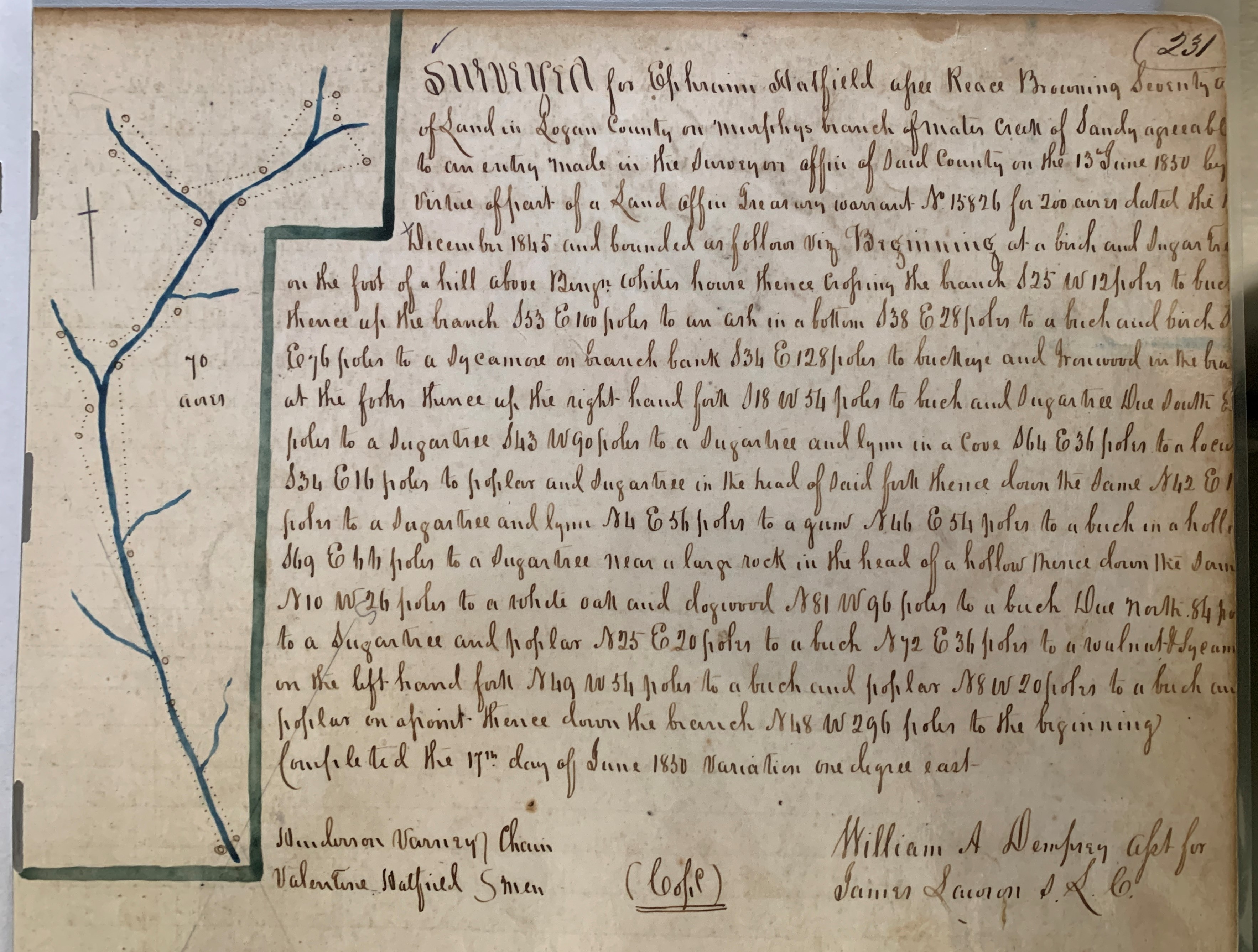
Ephraim Hatfield Survey (1850)

02 Tuesday Feb 2021

Posted by Brandon Ray Kirk in Big Sandy Valley, Hatfield-McCoy Feud

≈ 2 Comments

Tags

Appalachia, Big Sandy River, Ephraim Hatfield, genealogy, Henderson Varney, history, James Lawson, Logan County, Mate Creek, Reece Browning, surveyor, Tug Fork, Valentine Hatfield, Virginia, West Virginia, William A. Dempsey

Ephraim Hatfield, 50 acres, Surveyors Record Book B, page 231, Logan County Clerk’s Office, Logan, WV.

A Poem (1897)

22 Tuesday Dec 2020

Posted by Brandon Ray Kirk in Big Sandy Valley

≈ Leave a comment

Tags

A.M. Lunsford, Abner Vance, Appalachia, Big Sandy River, crime, Daniel Horton, history, Logan, Logan County Banner, poems, poetry, West Virginia

This song was composed and sung by Elder Abner Vance, under the gallows, about 80 years ago. Given by Rev. A.M. Lunsford, October 14, 1897.

A POEM.

[Published by Request.]

Green are the woods where Sandy flows.

And peace it dwelleth there;

In the valley the bear they lie secure

The red buck roves the knobs.

But Vance no more shall Sandy behold,

Nor drink its crystal waves,

The partial judge pronounced his doom,

The hunter has found his grave.

The judge he said he was my friend

Though Elliott’s life he had saved.

A juryman did I become

That Elliott he might live.

That friendship I have shown to others,

Has never been shown to me;

Humanity it belongs to the brave,

And I hope it remains to me.

‘Twas by the advice of McFarlin

Judge Johnson did the call,

I was taken from my native home

Confined in a stone wall.

My persecutors have gained their request,

Their promise to make good,

For they ofttimes swore they would never rest,

Till they had gained my heart’s blood.

Daniel Horton, Bob and Bill,

A lie against me swore,

In order to take my life away,

That I might be no more.

But I and them together must meet

Where all things are unknown.

And if I’ve shed the innocent blood

I hope there’s mercy shown.

Bright shines the sun on Clinche’s hill,

And soft the west wind blows,

The valleys are covered all over with bloom,

Perfumed with the red rose.

But Vance no more shall Sandy behold,

This day his eyes are closed in death,

His body’s confined in the tomb.

Farewell my friends, my children dear,

To you I bid farewell,

The love I have for your precious souls

No mortal tongue can tell.

Farewell to you my loving wife,

To you I bid adieu,

And if I reach fair Caanan’s shore

I hope to meet with you.

Source: Logan County Banner (Logan, WV), 13 November 1897.

Aly Hatfield Survey (1849)

03 Thursday Dec 2020

Posted by Brandon Ray Kirk in Big Sandy Valley

≈ Leave a comment

Tags

Aly Hatfield, Anthony Lawson, Appalachia, Big Sandy River, genealogy, history, James Lawson, Logan County, Mingo County, Tug Fork, Virginia, West Virginia, William Collins

Survey of 75 acres, Right Hand Fork of Ben Creek of Sandy, Logan County, VA. This property is located in present-day Mingo County, WV.

Wharncliffe, Mingo County, WV (2020)

24 Wednesday Jun 2020

Posted by Brandon Ray Kirk in Big Sandy Valley, Wharncliffe

≈ Leave a comment

Tags

Appalachia, Ben Creek, Big Sandy River, Mingo County, Norfolk and Western Railroad, photos, Tug Fork, West Virginia, Wharncliffe

IMG_2680

The old railroad town of Wharncliffe is gone. 30 May 2020

IMG_2671

Mouth of Ben Creek, Mingo County, WV. 30 May 2020

Devon, Mingo County, WV (2019)

22 Sunday Mar 2020

Posted by Brandon Ray Kirk in Big Sandy Valley

≈ Leave a comment

Tags

Appalachia, Beech Creek, Big Sandy River, Devon, history, Kentucky, Mingo County, photos, Tug Fork, West Virginia

IMG_9885

Here’s a beautiful old landmark. Devon, Mingo County, WV. 12 July 2019

IMG_9876

This way to the Tug Fork. Devon, Mingo County, WV. 12 July 2019

IMG_9877

Mouth of Beech Creek in Devon, Mingo County, WV. 12 July 2019

IMG_9879

That’s Kentucky across the river! Devon, Mingo County, WV. 12 July 2019

Recollections of Tom Brown about Timbering on Big Sandy River (1979)

19 Thursday Sep 2019

Posted by Brandon Ray Kirk in Big Sandy Valley, Timber, Twelve Pole Creek

≈ Leave a comment

Tags

Appalachia, Big Sandy River, Bragg Creek, Fort Gay, history, Horse Creek, Kenova, logging, Mingo County, Naugatuck, Ohio River, pushboats, rafting, steamboats, timber, timbering, Tom Brown, Tug Fork, Twelve Pole Creek, Wayne County, West Virginia

The following interview excerpt of Tom Brown (born c.1909) was conducted at Fort Gay in Wayne County, WV, on December 15, 1979.

***

It was probably hard to get around back then, to go to church.

Well the only way you could get around through this country was up and down creeks or on horseback or wagon. And roads were in the creek most of the way. And where they cut timber and logs they had tram roads built back in the heads of the hollows and they had tracks–they built their track out of 2″ X 4″s–and they hauled these logs or ties from the mills back to the heads of the hollows back to the railroads. And they logged out of the mountains and they ran lots of rafts down Tug River. I’ve see high as four to five. They started the rafts running in the spring. They run them out of Mingo County and generally a lot of them was set out in Naugatuck.

That’s how they got them, they used rafts and boats?

Yes, they used rafts. Logs. They’d put these logs together… Sometimes a raft would be maybe 200 or 300 feet long.

200 or 300 feet long?

Almost as wide as the river. The man would stay on that and they’d pull the men to, I guess, Kenova and the Ohio River down here. And they would log them through the winter. The spring waters came and they started down the rivers with the rafts. The river banks were all cut clean.

That’s what I was going to ask you about. They had to be cut clean, didn’t they?

Yes, they was all cut clean. But the rafts… Well they ran logs down Twelve Pole Creek to… Back then people used to put their logs in the creek when it would raise and run them plumb out down Twelve Pole to Kenova. Heads of these creeks… And sometimes I can remember Bragg Creek and Horse Creek… They was a sawmill. There was locks in at Saltpeter and they pushed just like water to Bragg Creek. I’d say along 1916-1917. And almost the travel was boats. It went down on a little showboat. It used to come up an old paddle wheel boat.

That was in about 1917?

About 1917, ’18, ’19, along that.

Could you get a ride on that showboat if you wanted to?

No, they just pulled in and parked and had a show every night, like the picture show, the movie picture show had.

How long did that showboat go up and down the river? How many years did that last?

Well, I don’t know. It would just come up every once in a while maybe, and just stopped at certain places maybe. Places you know at that time… That was about as far as it could get up. And then things was brought up on pushboat. They loaded ties and stuff like that. I remember them loading them on the boat at the river at the mouth of Horse Creek. It was about as far as boats could come up the river.

Hatfield Family History (1937)

03 Sunday Mar 2019

Posted by Brandon Ray Kirk in Big Sandy Valley, Hatfield-McCoy Feud, Huntington, Matewan

≈ Leave a comment

Tags

Abner Vance, Alexander Varney, Ali Hatfield, Andrew Hatfield, Appalachia, B.H. Justice, Bettie Vance, Big Sandy River, Cabell County, Celia Hatfield, Ephraim Hatfield, Ferrell Evans, Frank Evans, genealogy, Guyandotte Valley, Hatfield-McCoy Feud, Henry Clay Ragland, history, Humphrey Trent, Jacob Hatfield, James Hatfield, James Justice, John Justice, John Toler, Joseph Hatfield, Logan, Logan Banner, Logan County, Logan County Banner, Logan Court House, M.A. Hatfield, Matewan, North Spring, Peter Cline, Phoebe Hatfield, sheriff, Thomas Hatfield, Thomas Smith, Valentine Hatfield, West Virginia, William E. Justice, Wyoming County

From the Logan Banner of Logan, WV,  comes this bit of history for the Hatfield family, printed on May 11, 1937:

History Of Hatfield Clan Recorded In Banner Files

Ephraim Hatfield Was One of The Quietest Men In The County—Yet He Was Father Of Those Engaged In Famous Feud

Henry Clay Ragland, editor of The Logan Banner in 1896, was, among other things, a genealogist for Logan county.

He lived at a time when most of the children and grandchildren of Logan county’s first settlers were still alive and he had access to a wealth of first-hand information that has served as the basis for family histories in Logan county up to the present.

An account of the entrance of the Hatfield family into this section of the country is clipped verbatim from a Logan County Banner dated Wednesday, April 29, 1896.

“At what is still known as the Hatfield place on Horsepen, Valentine Hatfield, of Washington county, Va., settled at quite an early day. He was the father of nine sons and three daughters, and from them have sprung many of the Hatfields of the Guyandotte and Sandy Valleys.

“Valentine Hatfield married a Miss Weddington, and he was a half brother of Thomas Smith. His sons were Ali, who married a daughter of Ferrell Evans; Joe, who also married a daughter of Ferrell Evans; Ephraim, who married Bettie Vance; (This Ephraim was one of the quietest men in the county, and was for a long time a justice of the peace, yet he was the father and grandfather of the Hatfields who were engaged in the Hatfield-McCoy feud) Andrew, who married a daughter of Humphrey Trent, and whose descendants live in Wyoming county; Thomas, who married a daughter of Frank Evans; John, who married a daughter of Abner Vance; James, who married a daughter of John Toler; (Squire M.A. Hatfield and James Hatfield are the sons of this marriage) Jacob, who married a daughter of Peter Cline; and Valentine, who was never married.

“Of his three daughters, Phoebe married Alexander Varney; Celia married James Justice, who was at one time sheriff of Logan county, and who was the father of John Justice, a prominent merchant in Logan Court House (the name of the city at that time), B.H. Justice, a merchant and timber dealer of Cabell county, and William E. Justice, a merchant at North Spring and at one time a member of the West Virginia legislature.

“Joseph Hatfield, a brother of Valentine Hatfield, settled about the same time at Matewan.”

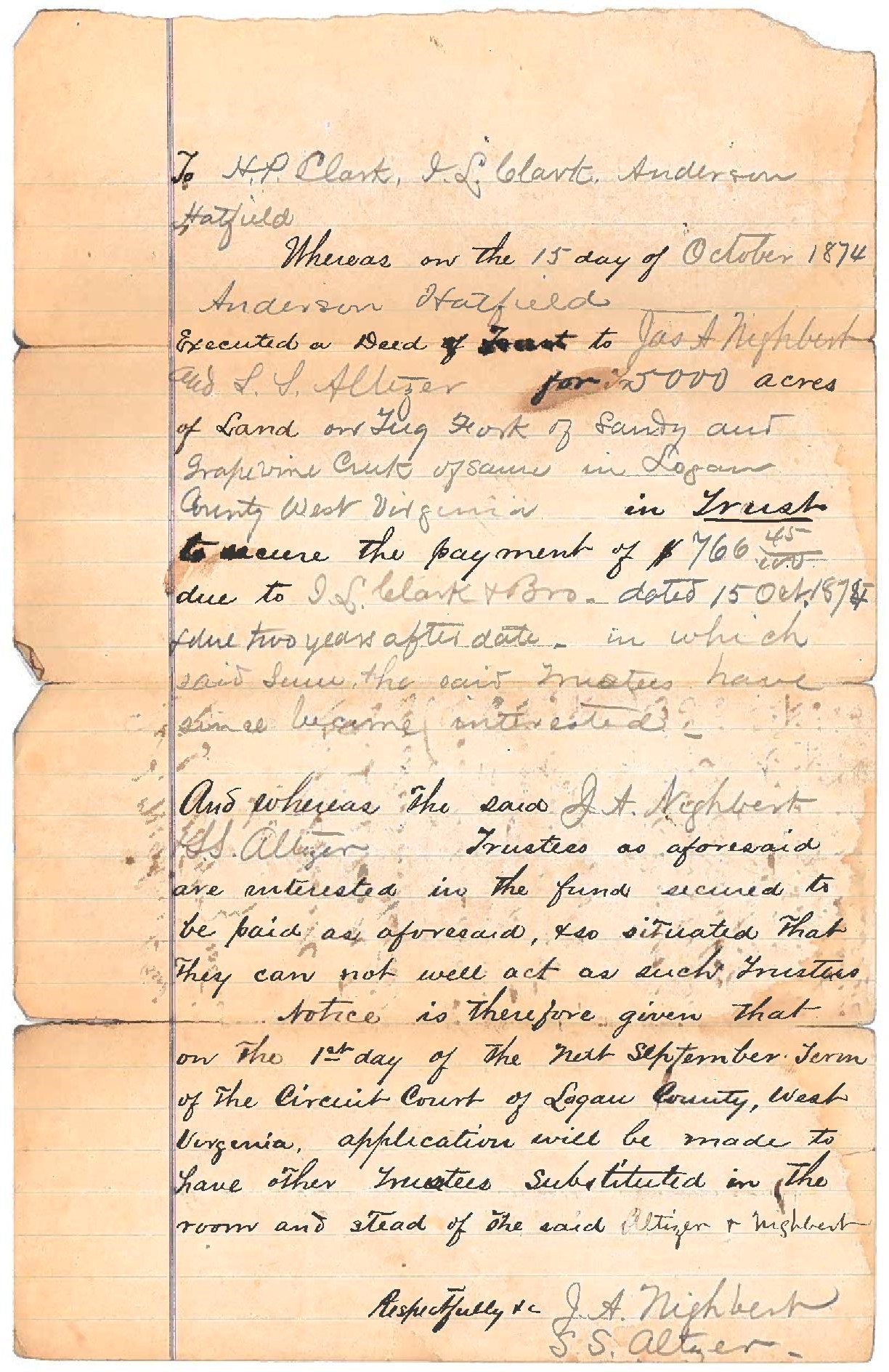
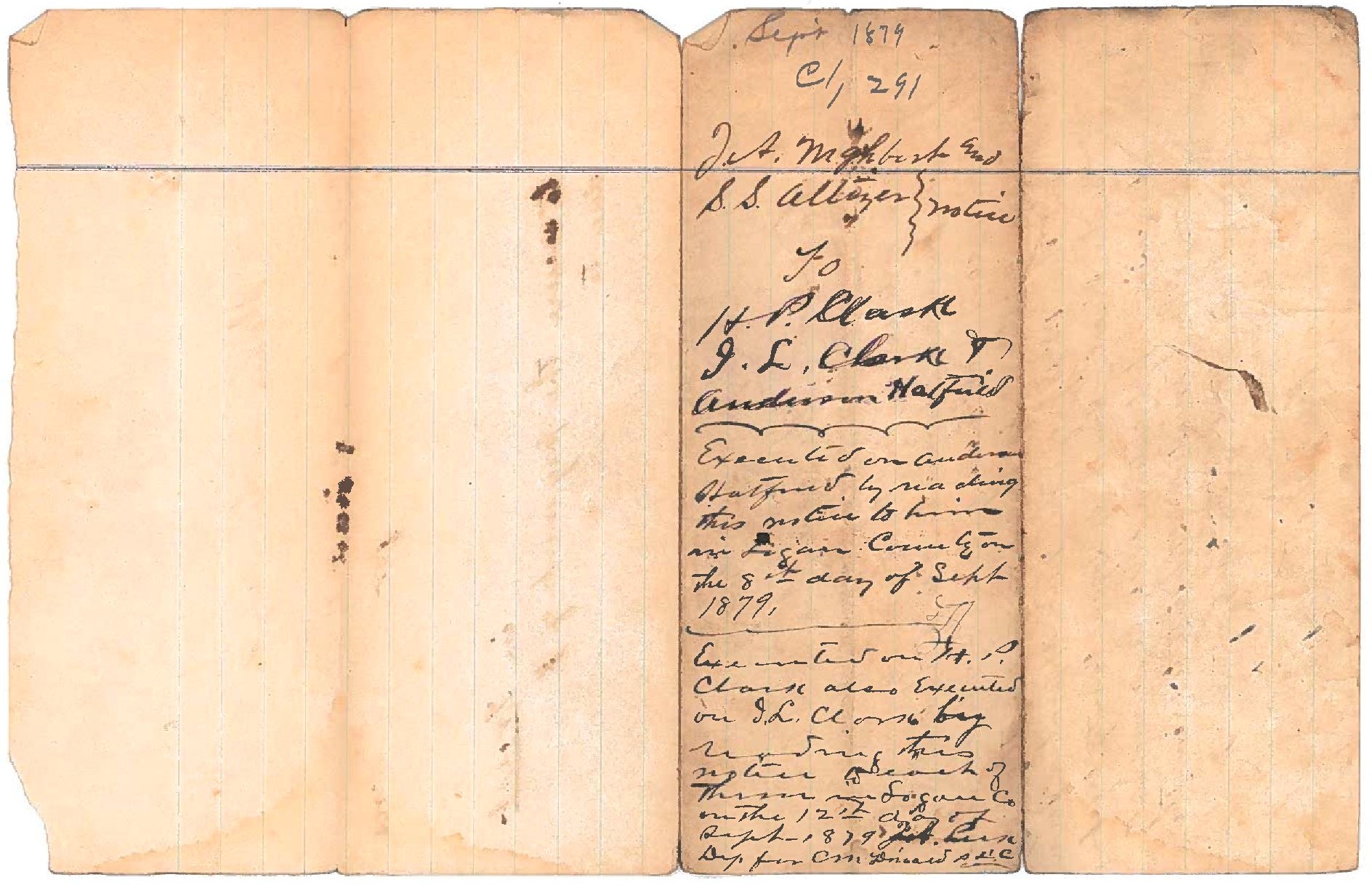
James Nighbert, S.S. Altizer Notice to Anse Hatfield (1874, 1879)

05 Saturday Jan 2019

Posted by Brandon Ray Kirk in Big Sandy Valley, Hatfield-McCoy Feud

≈ Leave a comment

Tags

Anderson Hatfield, Appalachia, Big Sandy River, genealogy, Grapevine Creek, H.P. Clark, history, James A. Nighbert, Logan County, S.S. Altizer, Tug Fork, West Virginia

nighbert and hatfield 1

Nighbert and Altizer notice, 1874.

nighbert and hatfield 2

Served on Anse Hatfield “by reading this notice to him in Logan County” on 8 September 1879.

History for Jenkins, KY (1928)

04 Tuesday Dec 2018

Posted by Brandon Ray Kirk in Big Sandy Valley, Coal

≈ Leave a comment

Tags

Appalachia, Big Sandy River, C&O Railroad, coal, Consolidation Coal Company, Cumberland Mountains, Devil John Wright, Devil Judd Tolliver, Hazard Herald, history, James A Garfield, Jenkins, John Fox Jr., John W. Wright, Kentucky, Kentucky River, Letcher County, Little Elkhorn Creek, Little Shepherd Amphitheatre, Logan Banner, Nick Dann, photos, Pound Gap, Rocky Branch, Shelby, The Trail of the Lonesome Pine, Virginia, West Virginia

Here is a bit of history for Jenkins, Kentucky, based on a newspaper account provided in 1928:

IMG_7109.JPG

Welcome to Jenkins! 26 August 2018.

Nestling in the valley of the Little Elkhorn, within “a stone’s throw” of the famous Pound Gap, is Jenkins, one of the few great mining towns of the world. The term “mining camp” cannot rightly be used when speaking of Jenkins, because it is not a “camp” in any sense of the word, but rather a city built by the great Consolidation Coal Company for the accommodation of its thousands of employees.

IMG_7106.JPG

Little Shepherd Amphitheatre. 26 August 2018.

Never was a city planned more carefully, says the Hazard (Ky.) Herald. The men in charge of the construction work were chosen from the top of their respective professions, and the building of the plant was carried out to a plan with the health, safety, education, sanitation, convenience and enjoyment of life by the miners, as its chief object cost was a very secondary consideration.

IMG_5964.JPG

Devil John Wright, dubbed Devil Judd Tolliver by John Fox, Jr. in The Trail of the Lonesome Pine. Photo credit unknown.

Twenty years ago this spot was a wild mountain farm, owned by that famous mountaineer, John W. Wright. His home, a hewn log affair, stood near where the Methodist church has since been erected. For miles in every direction the unbroken forest swept away over hill and down valley, some of which had slept undisturbed since the beginning of time.

IMG_7121.JPG

St. George Catholic Church. 26 August 2018.

The mountaineers, on their seldom made visits to this wild region, would look up at the rugged mountains, like giant sentinels guarding the gates of another world, and wonder, what good could ever come of such a land. At night, the few settlers were lulled to sleep by the hoot owl’s call and awakened in the morning by the yelp of the fox.

IMG_7108.JPG

This way to Little Shepherd Amphitheatre. 26 August 2018.

Then one day news spread over the hills that Wright had disposed of his lands and that a great town was about to be built by some men from “away off yonder.” Surveying parties were camped on the Kentucky river, and along Elkhorn. Railroads were pushing into the hills from the east and west. Farmers, on their way to mill or meeting, would stop and ask questions of the engineers, learn all they could of the town that “they had heard was going to be” and then hurry home to toll the news to their neighbors, adding to the story until it becomes a fanciful fairy tale.

Jenkins KY

Jenkins. Photo credit unknown.

The roars of explosives soon were heard for many miles, children at first would run screaming to their mother [illegible line] skirts asking to be told what it was they had heard “away over yonder,” while old women smoked their pipes and wondered if “Garfield was coming up the Sandy again.”

IMG_7123.JPG

Jenkins Post Office. 26 August 2018.

Coming into wild, rugged country like the head of Elkhorn, and laying off and building a city was a feat worthy of the greatest engineering skill, and that was the sort employed by the Consolidation Company.

The nearest railroad was still miles away. Everything needed in construction must be freighted across the Cumberlands, over roads almost impassable by wagon. For 12 months preparation for this gigantic plant went on before the actual construction work began. Roads were graded across the mountain by Pound Gap and a lumbering concern was induced to build their narrow gauge railroad from Glomorgan to Rocky Branch, leaving only about five miles that supplies must be transported by wagon freight. The Pound Gap country was a beehive of activity. Freighters were so numerous on the road that it took the best part of a day to make the trip from Jenkins to Rocky Branch and return. Every few yards the driver would be forced to turn out so that another could pass.

IMG_9322.JPG

Consolidation Coal Company Meat Market. Photo credit unknown.

Hundreds of carpenters, masons and helpers were at work building houses. The houses they constructed were of a type foreign to the coal fields across the mountains in Virginia. A giant power plant was built, the water of Elkhorn were harnesses to create the power to run the greatest mining plant in the south. The dam built across the stream has formed one of the most beautiful lakes in America, it has been stocked with fish and lined with row boats for the recreation of the coal miners and their families.

IMG_7122.JPG

Jenkins. 26 August 2018.

Every home was built for convenience and comfort. Sanitation was provided and each house was wired for electricity. Word went out into the mining camps close by in Virginia that the “Jenkins company” would not tolerate kerosene lamps in their houses and required that their employees use electricity for illumination. These “other camps” were forced to remodel their plants in keeping with the pattern on which the great Consolidation plant was built, until today, the old order has been replaced with the new throughout Virginia, West Virginia and Kentucky: thanks to the lead of the Consolidation Coal Company.

IMG_7112.JPG

Jenkins. 26 August 2018.

Jenkins is well lighted; has an excellent water system; fire department and paved streets in the business section. Many beautiful homes line the handsome drive, skirting the lake. These, unlike the ordinary mining town houses, are set well back from the driveway in park like lawns, well shaded with grand old oaks and other native trees.

Some of the most substantial business buildings to be found in the Cumberland region are here in Jenkins. Among these are the recreation building, housing a drug store, hotel, post office, Western Union office, barber shop, pool room, printing office, and drink stand. The First national Bank building is the most beautiful building in Letcher county; vine-clad with clinging ivy gives it the appearance of having grown there.

IMG_7114

Jenkins Dept. 26 August 2018.

The most widely known business institutions in Jenkins are the Consolidation Coal Company store, the First National bank, the Jenkins Steam Laundry, the Modern Pressing Shop, Nick Dann’s Auto Sales and Repair Shop, and the numerous businesses housed under the roof of the mammoth recreation building. The town is on the Kentucky state highway and is served by the C. & O. railroad system from Shelby junction.

Source: Logan (WV) Banner, 2 October 1928.

Old Records Found in Bank Vault (1936)

27 Thursday Sep 2018

Posted by Brandon Ray Kirk in Big Sandy Valley, Guyandotte River, Hamlin, Huntington, Logan

≈ 3 Comments

Tags

Appalachia, Big Sandy River, Cabell County, Guyan Valley Bank, Guyandotte River, H.M. Booth, Hamlin, history, Huntington, James Barbour, Logan, Logan County, Mary Morris, Pennsylvania, Peter Dingess, Philadelphia, Richmond, Robert Brooke, Robert Morris, Robert Morris Grant, Russell County, Tug Fork, Virginia, West Virginia, William Crammond, Wythe County

Old Peter Dingess Deed LB 08.19.1936 7

320,000 Acres of Land Hereabouts Sold for Five Shillings According to Old Records Found in Old Vault

H.M. Booth, in cleaning out the vault of the old Guyan Valley Bank preparatory to moving his offices from Logan to Hamlin, uncovered a number of old documents that dated back to the time when “horse and buggy days” were a fact and not merely a political equation.

Many of these old papers, including deeds, receipts, account books and other papers of a semi-personal nature, are originals, while others are notarized copies of originals. They make interesting reading in these days of speed, radios, high prices and typewriters.

The old documents were all hand written, in clear, flowing script, the capital letters often decorated with fancy scrolls and shaded lines. Many of them were written with a quill pen.

Of particular interest is one deed, 12 ½ by 15 ½ inches, written on sheepskin. The ink has not faded, and although the skin is old and discolored, the deed is easily read. It was made in the days when Logan county was unheard of, and all this vicinity was part of Cabell county, Virginia. It seems strange, now, to think of a governor in Richmond, Virginia, parceling out land in Logan county.

The deed reads, in part: “James Barbour, Esq., Governor of the Commonwealth of Virginia: To all whom these presents shall come, Greeting: Know ye, that by virtue of a Land office Treasury warrant, No. 6126, upon the 9th day of Sept. 1780, there is granted by the said Commonwealth unto Peter Dingess, a certain Tract or Parcel of Land, containing one hundred and twelve acres, by survey, bearing date the 31st day of March, 1813, situate in the County of Cabell, joining to his own deeded land, and bounded as followeth, to-wit:”

Then follows a detailed description of the boundaries of the land, in which prominent trees and landmarks play a common part. After the description of the land, which was written in pen and ink, came the regular printed form as follows:

“In witness whereof, the said James Barbour, Esq., Governor of the Commonwealth of Virginia, hath hereunto set his Hand, and caused the Seal of the said Commonwealth to be affixed at Richmond, on the twenty-fifth day of October, in the Year of our Lord, One thousand eight hundred and fourteen, and of the Commonwealth the thirty-ninth.”

Down in the lower right hand corner of the paper can be plainly seen the signature of James Barbour, governor of Virginia at that time.

A notarized copy of another land deed was signed by Robert Brooke, Governor of Virginia in 1795, and was dated March 23 of that year. It deeded through the Land Office treasury warrants numbered from 472 to 530, inclusive, a parcel of land containing 480,000 acres, “by a survey made the 10th of September, 1794.” The land was described as being in the county of Wythe, on the Tug and Guyandotte rivers. This grant of land was known as the “Robert Morris Grant.”

Evidently, from the records, Robert Morris became involved in difficulties, for after a considerable amount of legal red tape, all duly recorded, there is a document showing where “Robert Morris and Mary, his wife, of Philadelphia, sell to William Crammond of Philadelphia as well for and in consideration of the sum of five shillings lawful money of Pennsylvania to them well and truly paid do grant bargain and sell, alien and enteoff release and confirm to the purchased 320,000 acres of land in the counties of Wythe and Russell, lying on both sides of Sandy Creek.”

Among the records of accounts paid found by Mr. Booth were numerous fees paid out for “boating freight from Huntington.” Six dollars and fifty cents is entered “for a suit of clothes,” and another entry shows where four dollars and a half were paid for two pair of shoes.

Source: Logan (WV) Banner, 19 August 1936

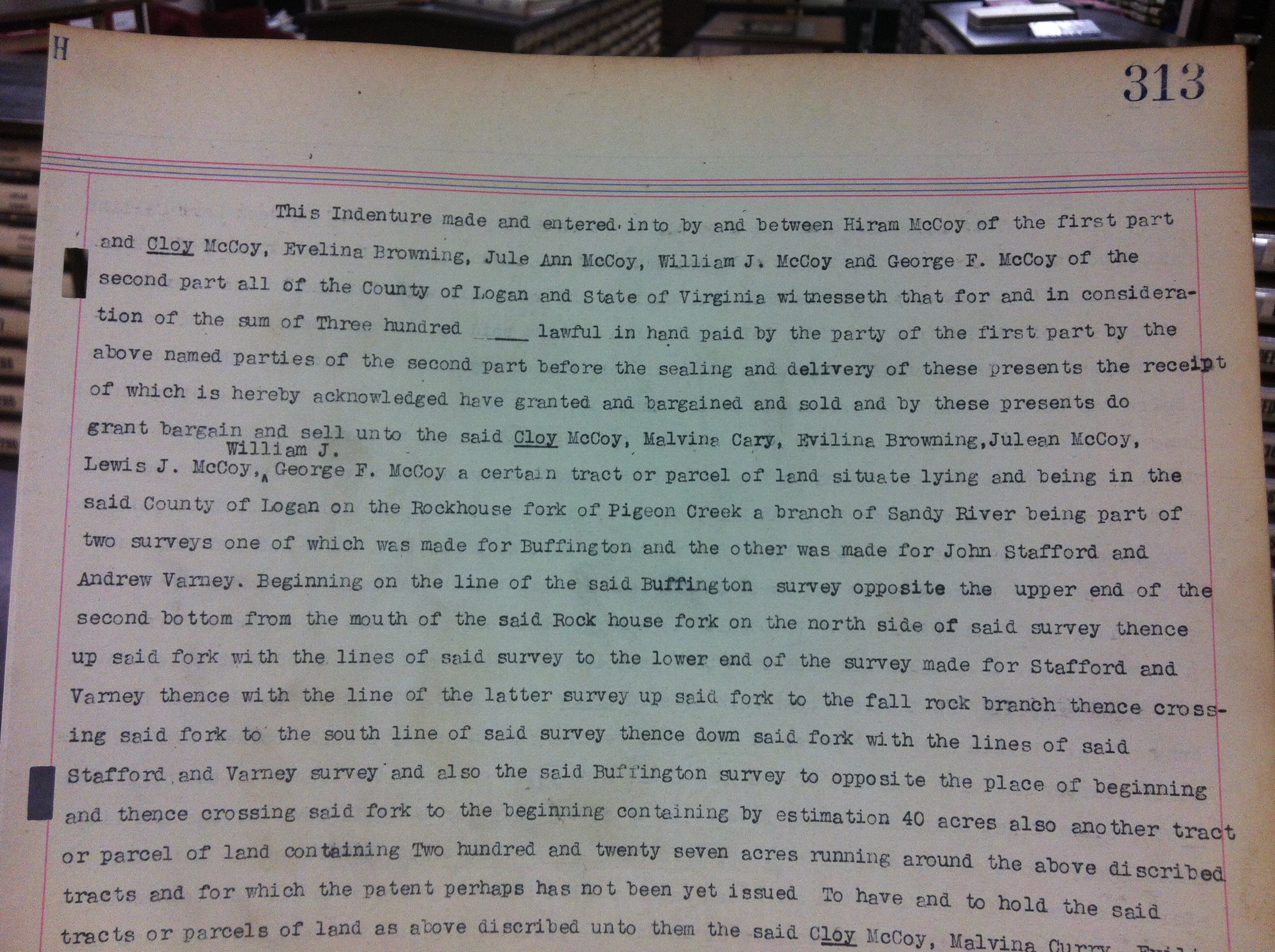
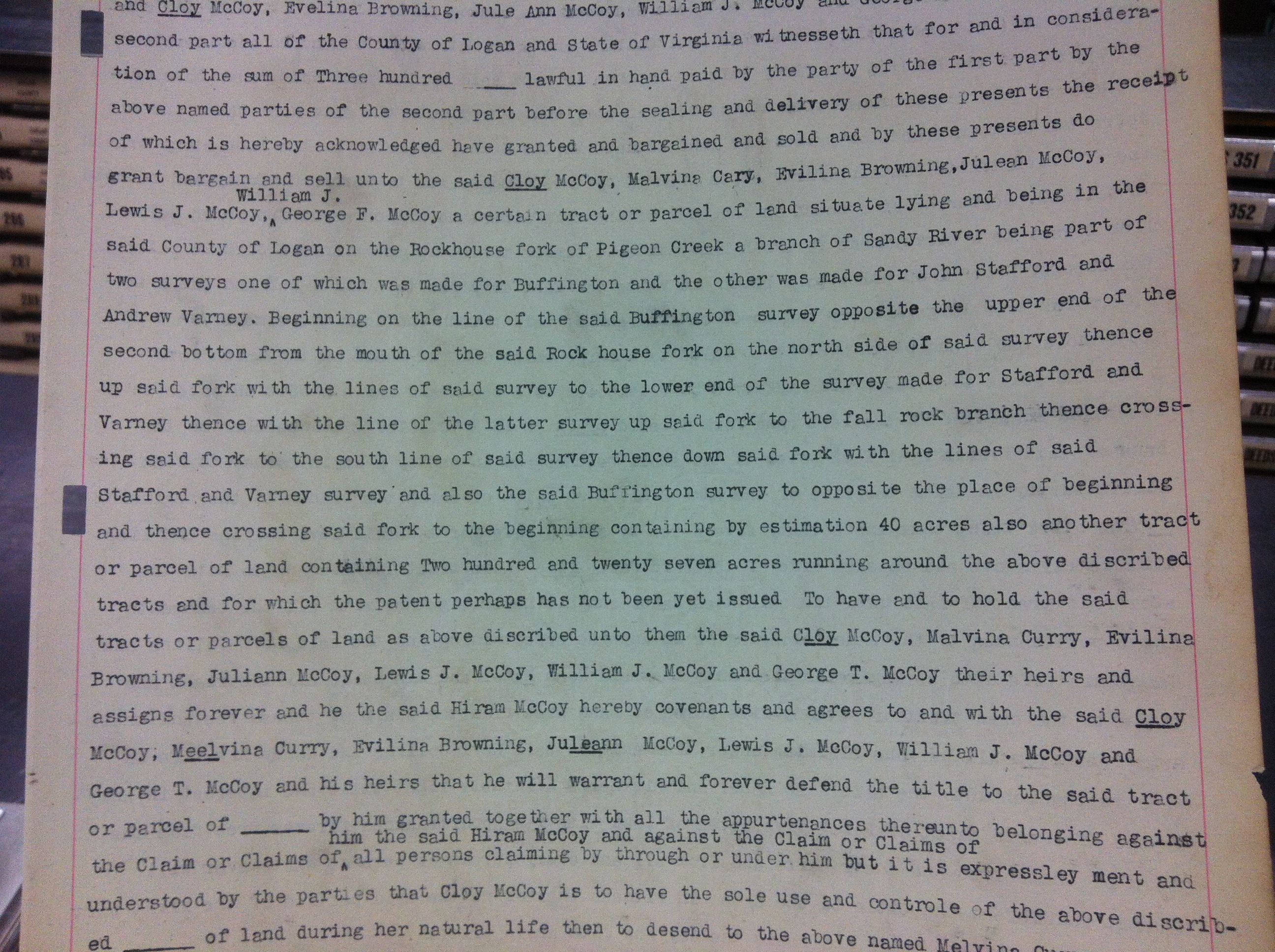
Hiram McCoy Deed to McCoy Heirs (1853)

07 Friday Sep 2018

Posted by Brandon Ray Kirk in Big Sandy Valley, Hatfield-McCoy Feud, Lincoln County Feud

≈ Leave a comment

Tags

Andrew Varney, Appalachia, Big Sandy River, Chloe McCoy, Eveline Browning, genealogy, George F. McCoy, Harts Creek, Hatfield-McCoy Feud, Hiram McCoy, history, John Stafford, Julie Ann McCoy, Lewis J. McCoy, Lincoln County Feud, Logan County, Melvina Curry, Pigeon Creek, Randolph McCoy, Rockhouse Fork, Salena Vance, Sarah McCoy, Virginia, West Fork, West Virginia, William J. McCoy

Hiram McCoy to McCoy Heirs 1853 2

Deed Book C, page 313, Logan County Clerk’s Office, Logan, WV. Note: This property is located in present-day Mingo County, WV.

Hiram McCoy to McCoy Heirs 1853 3

Deed Book C, page 313, Logan County Clerk’s Office, Logan, WV. Hiram McCoy was a brother to Sarah McCoy, wife of Randolph.

Hiram McCoy to McCoy Heirs 1853 4

Deed Book C, page 313, Logan County Clerk’s Office, Logan, WV. Hiram’s granddaughter Salena (Browning) Vance settled on West Fork of Harts Creek and was an important character in the Lincoln County Feud.

Civil War in the Guyandotte and Big Sandy Valleys (1862)

03 Monday Sep 2018

Posted by Brandon Ray Kirk in Big Sandy Valley, Chapmanville, Civil War, Guyandotte River, Pikeville, Tazewell County

≈ Leave a comment

Tags

Abington Virginian, Appalachia, Big Sandy River, Cabell County, Chapmanville, civil war, Confederate Army, genealogy, Guyandotte River, history, John B. Floyd, John Clarkson, John Dils, John Letcher, Kanawha River, Kentucky, Levisa Fork, Lincoln County, Logan County, Ohio River, Pigeon Creek, Pike County, Pikeville, Prestonsburg, Smyth County, Tazewell County, Union Army, Virginia, Virginia State Line, Washington County, Wayne County, West Virginia

Confederate General John B. Floyd composed this letter detailing military activity in the Guyandotte and Big Sandy valleys in late 1862, which was published by the Abington Virginian on January 2, 1863.

***

OFFICIAL REPORT OF GEN. FLOYD

Headquarters Virginia State Line,

Camp Clarkson, Tazewell Co.,

December 17, 1862

His Excellencey, John Letcher,

Governor of Virginia—

SIR: After my last communication to you I prepared an expedition consisting of a strong force of Cavalry under Colonel John Clarkson, to operate against the enemy in the counties of Wayne, Cabell, &c. He set out from Chapmansville on the 14th November, in the direction of Cabell down the Guyandotte river, over a rough and difficult road. The following day he fell in with a detachment of the enemy which he quickly routed and dispersed. He continued the march until a few miles of the Ohio river, breaking up the “Home Guard” organization of the enemy, which are very numerous in all that country, and taking prisoners every day.

A strong guard of Yankee troops, acting as a guard for the Pierpont Assessor for the county of Wayne, was attacked and dispersed after a short skirmish, in which was killed and wounded some of the enemy and took a few prisoners. Col. Clarkson proceeded then, according to the previous directions given him, to the Sandy river, to attack a large and formidable organization of the enemy composed mainly of the native population, and very strong posted amidst the cliffs and forests upon the precipitous banks of that river. He succeeded in taking them by surprise completely, and after killing and wounding a number of them, took a large number of prisoners, and surprised entirely the rest of the force. This force and organization were formidable and extremely dangerous to the peace and quiet of all the country round about for many miles, the loyal people were nearly all driven from their country and all were robbed. After that, Col. Clarkson, according to previous understanding, made a junction with me at the mouth of Pigeon Creek, in Logan county, on the Kentucky border, whither I had gone with the infantry and a section of the mounted howitzer battery.

I learned from Col. Clarkson that the enemy had started a number of boats with valuable supplies, from the mouth of Sandy to a post recently established at Pikeville, a point at the head of navigation on the Louisa Fork of Sandy. These boats were in charge of a strong guard, and were intended to furnish a complete outfit for a force deemed sufficient for them, by their commander, to march upon and destroy the salt works in Smyth and Washington counties.

I determined at once to attack this train, and from its distance, being more than forty miles off, it became necessary to send mounted men. Besides this reason, I found it inconvenient to move the infantry in that direction, on account of the number of prisoners with which we were encumbered. The cavalry and mounted men were put in motion within an hour and proceeded upon the march, which was uninterrupted, day or night, until the enemy were overtaken, attacked and routed.

Our people captured ten of the enemy’s transport boats, laden with valuable supplies. A great deal of these supplies was distributed amongst the men, and much of them was brought off; but a very large amount of most valuable supplies was necessarily destroyed for want of transportation to bring them away. A train of one hundred pack mules would have brought away a very large amount of extremely valuable stores, which were committed to the fire and the river.

The night following the capture of these boats (indeed, just twelve hours after the attack upon the boats,) our forces engaged that of Col. Dils, posted in an extremely strong position on the summit of a mountain on the road leading from Prestonsburg to Pikeville. This position was taken and held without any knowledge on our part, and as the attack was made after the night, and entirely unexpected, we were taken at a great disadvantage. But our men behaved with great steadiness and resolution, received the attack and charged the enemy, driving him from his position, and dispersing them entirely. The rout was complete, and the post at Pikeville, consisting of a thousand men, was entirely broken up. The prisoners and the Union people in that neighborhood reported Colonel Dils as killed in the fight that night.

For more detailed statements of this expedition I refer you to the report of Col. Clarkson. In our operation through the country, we made a number of recruits in the counties of Cabell, Wayne, Logan, &c.

My object in this campaign was, as far as possible, to prevent the occupation by the Yankee forces, of the country between the Kanawha Valley and Kentucky border, as well as to destroy the military organization of the country under the traitor government in Wheeling. Both objects were fully attained, as long as I was able to remain in the country. The military organizations, very numerous and well appointed in every particular, were almost entirely destroyed, and the attempts to set up the spurious government were entirely failed.

I was compelled to leave the country, held by me for more than three months alone, for the want of Quartermaster’s supplies. We were without tents, or clothing, or cooking utensils, or axes; and after the inclement weather of winter set in, we could no longer remain in the field. With these stores supplied, I would have remained in that country throughout the winter months. We were able to procure food (meat and bread) in the country, nearly all of it taken from the enemy.

The campaign, from first to last, was one of hardship and privations; but they were borne without complaint by the men, who are unsurpassed in hardship, activity and capability to endure privations. They deserve great praise for their constancy and general good conduct.

The officers generally deserve commendation, but to Col. Clarkson too much credit cannot be given for his energy, activity and courage. The obstacle she encountered, of every sort, throughout these expeditions, were of the most formidable character, but they were also most gallantly surmounted.

I have the honor to be, very respectfully,

Your obedient servant,

JOHN B. FLOYD,

Maj. Gen. Commanding Va. State Line

NOTE: I bolded Gen. Floyd’s description of activity in the Guyandotte Valley that occurred between Chapmanville and the lower section of the river near present-day Huntington.

Battle of Kanawha Gap (1861)

10 Sunday Jun 2018

Posted by Brandon Ray Kirk in Barboursville, Big Creek, Boone County, Chapmanville, Civil War, Guyandotte River, Tazewell County

≈ 5 Comments

Tags

129th Regiment Virginia Militia, 1st Kentucky Infantry, 34th Ohio Volunteer Infantry Regiment, 5th Virginia Regiment, Abram S. Piatt, Appalachia, Baltimore & Ohio Railroad, Barboursville, Battle of Kanawha Gap, Big Creek, Big Sandy River, Boone County, Burlington Weekly Hawk-Eye, Camp Enyart, Ceredo, Chapmanville, Charleston, Chicago Daily Tribune, Cincinnati Daily Press, Cincinnati Gazette, civil war, Cleveland Morning Leader, Coal River, Confederate Army, Daily Green Mountain Freeman, David S. Enyart, Eli Thayer, Evening Star, George McClellan, Greenbrier County, Guyandotte River, H.C. Evans, Harpers Ferry, Herman Evans, history, J.V. Guthrie, J.W. Davis, Jacob D. Cox, John Dejernatt, Kanawha River, Kanawha Valley, Logan County, Logan Court House, M.H. Wood, National Republican, O.P. Evans, Ohio, Ohio River, Parkersburg, Pomeroy Weekly Telegraph, Portsmouth, Richmond Whig, Robert E. Lee, Samuel Smoot, Sewell Mountain, Southwestern Times, Staunton Spectator, T.W. Rathbone, Tazewell County, Tug Fork, Union Army, Virginia, West Virginia, West Virginia Division of Culture and History, Wheeling, William Baisden, William Rosecrans, William S. Rosecrans, Zouaves

The following newspaper accounts describe the Battle of Kanawha Gap near present-day Chapmanville, Logan County, WV, which occurred on September 25, 1861:

Cleveland (OH) Morning Leader, 3 October 1861

GALLIPOLIS, Oct. 2.

The expedition planned by Col. J.V. Guthrie of the First Kentucky Regiment, and sent out under Lieut. Col. Enyart and Col. Piatt, has returned. They encountered the enemy at Chapmansville under Col. J. Lucien Davis, of Greenbrier, and utterly routed them. The enemy lost between fifty and sixty killed. Our loss was four killed. The expedition returned to Charleston on the 30th ult.
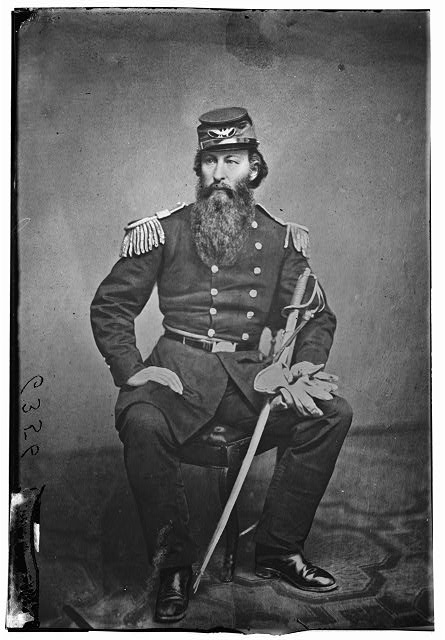
david s. enyart photo

Col. David S. Enyart, 1st Kentucky Infantry (Union).

Evening Star (Washington, DC), 4 October 1861

A Confederate Camp in Western Virginia Broken Up and Routed

CINCINNATI, Oct. 3 — A body of Federal troops, under Lieut. Col. Enyart, attacked a camp of rebels at Chapmansville, in Logan county, Va., near the Kentucky line, routing them, killing sixty and taking seventy prisoners. The same body of rebels were afterward intercepted in their retreat by Col. Piatt, who killed forty and made a large number prisoners.
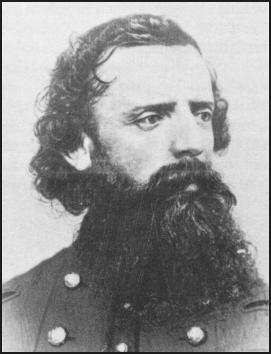
abram s. piatt photo

Col. Abram S. Piatt (1821-1908), 34th Ohio Infantry Regiment.

New York (NY) Herald, 4 October 1861

FIGHT WITH THE REBELS AT CHAPMANSVILLE

Cincinnati, Oct. 3, 1861.

The Kanawha correspondent of the Commercial of this city says that five companies of the First Kentucky regiment, four companies of the Thirty-fourth Ohio regiment and one company of the Fifty Virginia regiment, under Lieutenant Colonel Enyart, surrounded and attacked the rebels at Chapmansville, and after a short engagement completely routed them, killing sixty and taking seventy prisoners. The rebels in escaping were intercepted by Colonial Piatt, who killed forty and took a large number of prisoners. The country between Charleston and Wyandot river is now freed from secession power. This is the most effective blow given the rebels in this part of the valley.

IMG_2256.JPG

One section of the Kanawha Gap Battle Site, Chapmanville, Logan County, WV, 9 June 2018.

Daily Green Mountain Freeman (Montpelier, VT), 7 October 1861

Chapmansville, Va., the scene of the most recent engagement, is a small post village in Logan county, Va. Logan county is in the extreme Western portion of Virginia, the Tug Fork of the Big Sandy being the boundary line between it and the State of Kentucky. It is one of the largest, wildest and most sparsely inhabited counties in the State.

IMG_2238.JPG

Part of the Kanawha Gap Battle Site, Chapmanville, Logan County, WV, 9 June 2018.

National Republican (Washington, DC), 7 October 1861

THE SITUATION.

The two affairs at Chapmansville, reported three or four days since, in which the enemy lost one hundred killed and a proportionate number of wounded, will, it is supposed, restore permanent peace to the Virginia counties western of the Kanawha. Chapmansville is on the turnpike from Charleston to Logan county Court-house, and is about twenty-five miles to the south of Barboursville, the shire town of Cabell county. The secessionists in that part of Western Virginia have been numerous and pertinacious. They have once had possession of Guyandotte on the Ohio river and for a long time they threatened Ceredo (Mr. Thayer’s colony,) which lies on the river between Guyandotte and the Kentucky line. There have been two engagements with them in the rear of Ceredo, one at Barboursville, one at Logan county Court-house, one at Boone county Court-house (which town was burnt by the national troops,) and finally two at Chapmansville. The truth is, that in large portions of numerous, and, but for the early occupation of that region by the National troops, would have controlled it, not because they were the majority, but because one secessionist is, everywhere, a match for three Union men.

The secessionists are reckless, violent, and desperate, while their opponents, if not timid are at any rate remarkably pacific. We doubt, indeed, from all the information we can get, whether throwing out of the account Wheeling and Parkersburg, the terminal on the Ohio river of the Baltimore and Ohio railroad, Western Virginia had more elements of Union strength than the Valley of Virginia. From Harper’s Ferry south for fifty miles, the Union men have been numerous from the first, and it is a matter of deep regret that it did not consist with the plans of military strategy adopted at the headquarters of the army here, to occupy (at least) the northern part of the Valley of Virginia. It is consoling, that a different policy was adopted in retrospect to Western Virginia. That region was promptly taken possession of, cleared of the rebel armies by Gen. McClellan, and has since been victoriously held by Gen. Rosecrans. All attempts of the enemy to affect a re-entrance into Western Virginia are promptly repulsed.
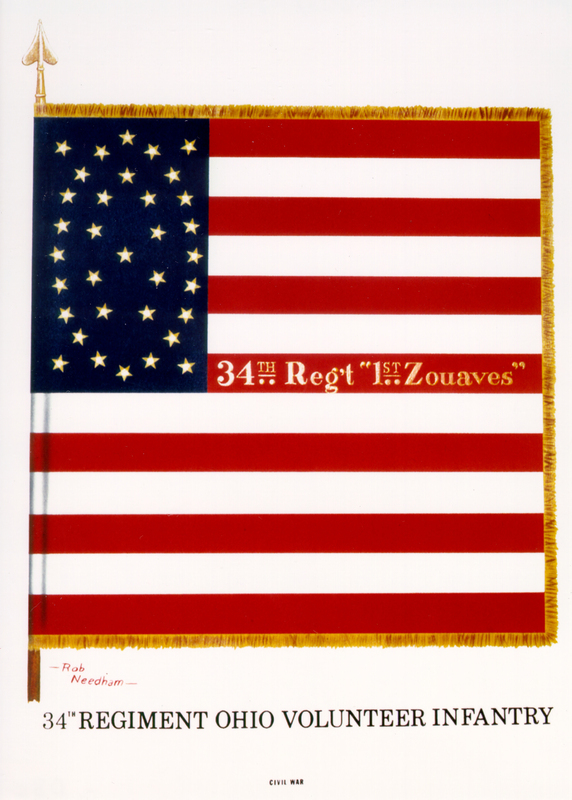
34th Ohio Volunteer Infantry Regiment, Piatt's Zouaves Flag Photo.jpg

Staunton (VA) Spectator, 8 October 1861

Status at Sewell’s Mountain.

The enemy, under Gen. Rozencrantz, and our forces under Gen. Lee, are both upon Sewell Mountain very near each other. A fight has been daily expected there for some time, but the enemy have been fortifying ever since they have been there, and there will not be a fight unless we attack them in their entrenchments. They are afraid to attack us, and it is probable that our force is too weak to risk an attack on them within their fortification. It may, therefore, be some time before an engagement will take place. We understand that we had sent a force of four regiments to their rear for the purpose of cutting off their supplies—that we succeeded in getting around them, but were compelled to return because we did not have sufficient supplies ourselves. We also learn that Col. Jas. W. Davis of Greenbrier, whilst commanding a force of militia in Logan county, attacked a part of the enemy, and was shot down at the first fire. The militia, after several rounds caught the Yankee fever which made their cowardly legs run off with their brave hearts, and they left their commander in the hands of the enemy, who, we fear, has died from his wound.
IMG_2923

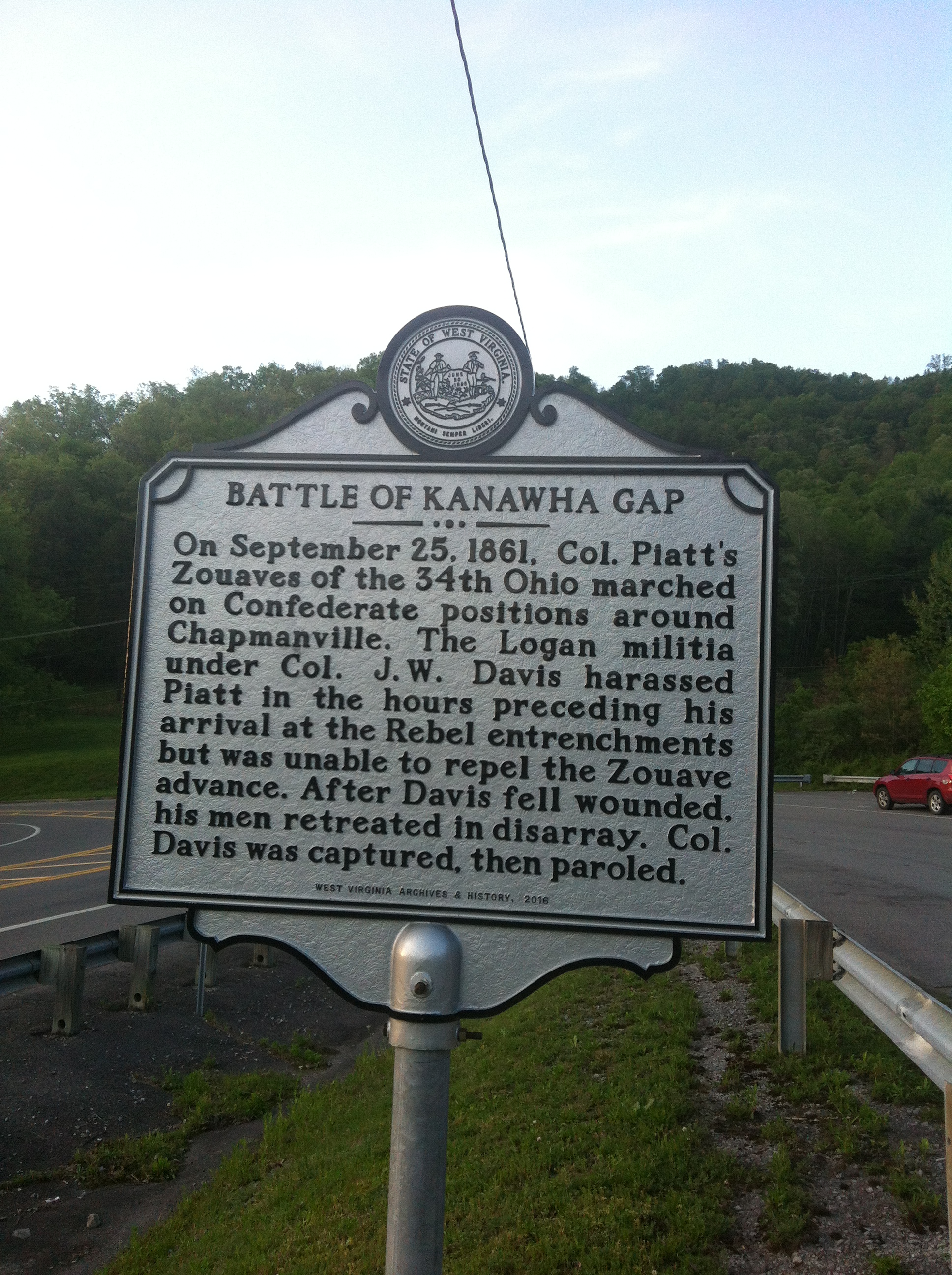
New historical sign placed by the WV Division of Culture and History located at the 119 ramp in Chapmanville, WV. 26 April 2017.

Chicago (IL) Daily Tribune, 9 October 1861

A Splendid Achievement of the Ohio Zouaves–“Wood Up” the Battle Cry.

[The following letter is exclusively devoted to the fight which the Piatt Zouaves had with the rebels near Chapmansville, Va. It is distinct from the victorious fight which the command of Lieut. Col. Enyart had with another body of rebels, in the same vicinity. EDS. CINCINNATI COM]

CAMP ENYART, KANAWHA, Oct. 2, 1861. EDS. COM.: The Zouave Thirty-fourth Regimens, Ohio, have had a chance to show their metal. This was on Wednesday, on Kanawha Gap, near Chapmansville, Va. After marching 42 miles, they came upon the enemy, who were behind breastworks, but could not stand our boys’ steady fire, for they retreated in utter consternation, their Col. J.W. Davis, of Greenbrier, Va, (but the traitor is a native of Portsmouth, Ohio,) being mortally wounded. We killed 20, took 3 prisoners, a secesh flag, 20 feet long with FIFTEEN STARS, 4 horses, 1 wagon, 10 rifles (one of which I claim), 12 muskets, and commissary stores (very low.) We lost 3 killed, 9 wounded, one since died. The route of the enemy was complete, although they had a brave, skillful commander, and strong position, with two days’ information of our intentions. They fled the moment their commander fell. The fight lasted about 10 minutes opposite the breastworks, but a running fire was kept up previous to that, by the Bushwhackers and rebel cavalry for two hours. At every turn of the road over the mountains, they would fire upon our advance men, wheel round, and gallop away. This kind of fight was kept up till we came suddenly upon their breastworks, immediately in line of our entire column. It was made on the side of a knoll, between two mountain sides, the road running between the mountain on our left. The wily rebel commander had adroitly cut down the brush on the right, placing a force of 100 men on the mountain top on our right, who raked our column from the front to the center. This was to draw our attention from their breastworks. Our men naturally fired upon the rebels on their right, steadily advancing up the road, until within 20 feet of the enemy’s works, when the rebels suddenly opened fire, from their right, left and center. The order from Col. Piatt and Lieut. Col. Toland, to flank right and left was immediately responded to by the Zouaves with a hurrah, a Zouave yell, and a cry of “wood up” from Little Red; a dash by our boys upon the enemy’s breastworks, above which about 300 rebel heads suddenly appeared, unknown by our men till that moment. They sent a perfect storm of bullets around, over, under, and into our men. A few minutes more and our boys were inside the breastworks, chasing them over the mountains, the enemy running away like cowards as they proved to be. They left 29 dead behind. Their force was 450 infantry and 50 cavalry. Our force was 560.

We buried our three brave dead comrades that night, carried our wounded to the house wherein the rebel Colonel lay, mortally wounded, deserted by all his men but one. Our whole column finally marched into the little town of Chapmansville, formerly headquarters of the enemy, and camped for the night.

34th Ohio Volunteer Infantry Regiment, Piatt's Zouaves Captain Photo.jpg

34th Ohio Volunteer Infantry Regiment, Piatt’s Zouaves, Captain Photo.

Pomeroy (OH) Weekly Telegraph, 11 October 1861

Brilliant Action in the Kanawha Valley.

CHARLESTON, Va., Sept. 30, ’61. Eds. Cin. Com.–Information having been brought to Col. J.V. Guthrie, commanding this post, that a large force of Rebels were gathered at Logan Co., Lt. Col. Enyart, of the 1st Kentucky, was at once sent to engage them. His force was composed of five companies of the 1st Kentucky, four companies of the 34th Ohio–German Regiment–under command of Col. A.S. Piatt, and one company of the 5th Virginia Regiment, under command of Maj. M.H. Wood.

Col. Enyart, with the Kentucky force, surrounded and attacked the Rebels at Chapmanville, and after a short but decisive engagement, completely routed them, killing 60 and taking 70 prisoners. The Rebels, in escaping, were intercepted by Col. Piatt, who surprised them and killed 40 men, and took a large number of prisoners.

The force of the Rebels is now completely broken up, and the country between this point and Guyandotte River is now freed from Secession power. This is the most effective blow given the Rebels in this part of the Valley.

In great haste. Further particulars by next boat.

Very respectfully,

M. CLEMENS,

Lieut. Col. 5th Va. Reg’t.
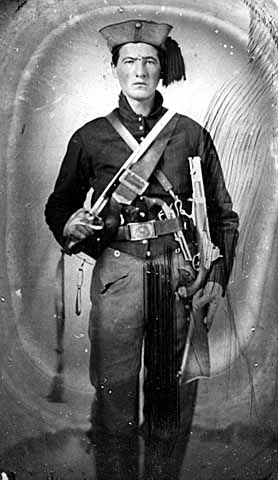
34th Ohio Volunteer Infantry Regiment, Piatt's Zouaves Soldier Photo

34th Ohio Volunteer Infantry Regiment, Piatt’s Zouaves, Soldier.

Evening Star (Washington, DC), 11 October 1861

THE BATTLE OF KANAWHA GAP.

The Western Virginia correspondent of the Cincinnati Gazette gives the following account of the late engagement at Kanawha Gap:

There were about 1,050 troops under the command of Colonels Enyart and Piatt, who left their camp Monday morning, 30th ulto., and took up their line of march for the enemy.

The forces moved together until they reached Peytona, on Cole river, where they separated; Col. Enyart going up Cole river. Col. Enyart did not meet the enemy in force at any place but his men did meet and ford swollen rivers, and marched on short rations, and were anxious to meet with the running enemy of Old Virginia. Col. Enyart did not meet Col. Piatt until they met on the Kanawha, on their return.

Col. Piatt’s command immediately proceeded thence to Boone Court House, and camped that night one mile beyond. The next day, after proceeding some sixteen miles,t hey came up with the advance guard of the enemy, consisting of cavalry, when a brisk fire was exchanged, the cavalry retreating. After the retreat of cavalry the battalion was immediately put in order of battle. The advance guard of fifteen men was led forward by Adj’t Clarke, proceeding along the road. Scouts were sent out on either side of the road to meet and repulse the sharp-shooters of the enemy.

The force proceeded in this order for about two miles, meeting the pickets of the enemy, exchanging shots with them incessantly, and driving them back with increased confusion at each charge.

Being unable to ascertain the position of the rebels, the entire force halted for a few moments, and Col. Piatt rode in advance and took observations with his glass, but could not ascertain their force and position, as it was covered with a thick growth of underbrush. After these observations a command was issued to forward the column. The scouts moved on the rapidity and enthusiasm, the main body moving up the narrow road cautiously and firmly. The fire continued to increase, and shots were rapidly exchanged from the right and left with the enemy, until our advanced guard reached within sixty yards of their main force. The column was some eighty yards from the enemy when they received a perfect volley of fire upon their right, indicating that the rebels were in force in that direction. Company “A,” commanded by Capt. Rathbone, was ordered to deploy as skirmishers to the right, up the side of the mountain, and if possible to flank the enemy on the left. Company “C,” commanded by Capt. Miller, was ordered to the right, up a similar mountain, to flank the enemy on their left. Company “I,” commanded by Capt. Anderson, was ordered directly up the ravine, on the left. In this position he drew the concentrated fire of the rebels upon his company, who made use of the knowledge thus obtained by rapidly charging upon and destroying the enemy’s breastworks. The center moved directly up the road. With this disposition of the forces, Col. Piatt routed them from their confusion. Capt. Anderson was the first to mount their breastworks, his men following him in the face of a terrible fire without flinching or confusion.

As Capt. Anderson sealed the breastwork, Capt. Miller closed upon the left and Capt. Rathbone came in upon the right, his men crying “Zouave!” The main column moving up the road in double quick–until they were brought to a temporary halt by obstructions placed in the road by the enemy.

The rebels, terrified by the strange bravery and almost wild enthusiasm that was exhibited by each advancing column, ran in confusion, leaving their dead, wounded, clothing, guns, horses, &c., making their escape by Capt. Rathbone’s right; his company being too far up the mountain to cut off their retreat. Capt. West, commanding company F, was detailed to scour the mountain on the west, on the left of the road. Capt. O.P. Evans on the west side of the mountain, on the right side of the road. Capt. Herman Evans, commanding Company H, on the east side of the mountain, on the left of the road.

Each of these companies moved with dispatch, yet such was the knowledge of the rebels of teh by-paths in the mountains, and belonging to the “F.F.V.’s,” and having been drilled at running all summer, that but two were captured.

Among interesting objects captured was a genuine secession flag, captured by Lieut. Brown.

The enemy’s loss was thirty killed and fifty wounded.

We regret to know that four of our men were killed and eight wounded.
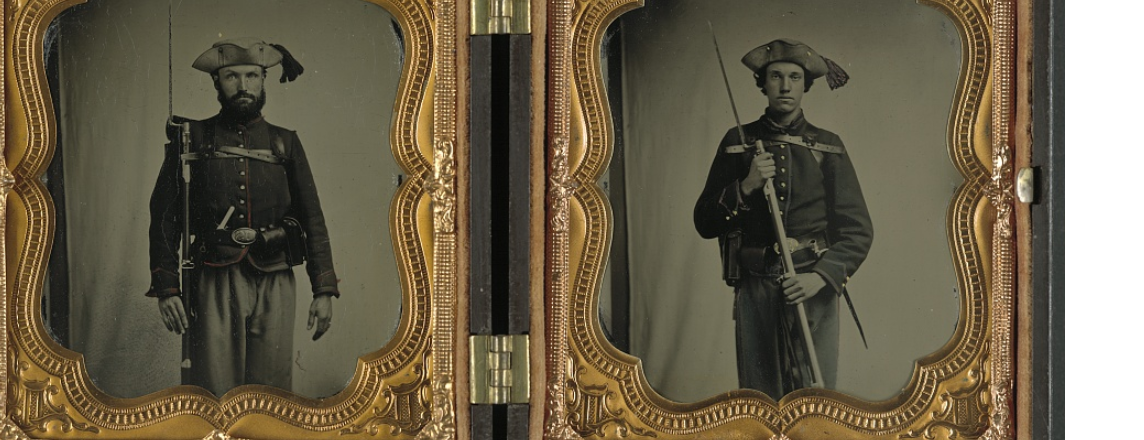
34th Ohio Volunteer Infantry Regiment, Piatt's Zouaves Soldiers Photo 2.jpg

34th Ohio Volunteer Infantry Regiment, Piatt’s Zouaves, Soldiers. Here’s a link to Captain T.W. Rathbone’s Civil War diary: http://resources.ohiohistory.org/ohj/browse/displaypages.php?display[]=0071&display[]=33&display[]=56

Burlington (IA) Weekly Hawk-Eye, 12 October 1861

The fight at Chapmansville was a sharp and bloody affair. Five of Piatt’s Zouaves were killed. The rebels lost thirty-five killed.

IMG_2235.JPG

Part of the Kanawha Gap Battle Site, Chapmanville, Logan County, WV, 9 June 2018.

National Republican (Washington, DC), 17 October 1861

The thirty-fourth regiment (first Zouaves) have been actively engaged since they came to the Kanawha Valley. Since the glorious victory they won near Chapmansville where the rebel commander, Colonel Davis, was mortally wounded, the Union sentiment has advanced on the Cole River. Two companies have been organized, and are ready to go to work to defend their own homes and give the organized regiments an opportunity to advance into the heart of the enemy’s country.

IMG_2254.JPG

Part of the Kanawha Gap Battle Site, Chapmanville, Logan County, WV, 9 June 2018.

Cincinnati (OH) Daily Press, 22 October 1861

Captain H.C. Evans, of Piatt’s Zouave Regiment, yesterday called in our office and exhibited a Secesh flag, captured at the Chapmansville fight, on the 24th ult.

34th Ohio Volunteer Infantry Regiment, Piatt's Zouaves Soldiers Photo

34th Ohio Volunteer Infantry Regiment, Piatt’s Zouaves, Soldiers.

Clarksville (TN) Chronicle, 25 October 1861

The Fight in Logan County, Va.

[From the Richmond Whig of the 15th.]

We yesterday published the Yankee account of a battle in Logan county, which as usual, was manufactured out of whole cloth. The following are the facts as given by the South-western Times, (Tazewell county) of the 10th inst.:

From Samuel Smoot, Esq., of Boone county, who was in the fight, we learn the following particulars of the battle near Chapmanville, Logan county, on the 25th ult: The Yankees numbered 700, and commenced the attack upon our troops–the Logan militia–in a low gap between Guyandotte river and Big Creek, where they were engaged in raising a temporary breastwork. Our troops numbered 220, but there were only about 80 of them engaged in the fight. They were commanded by Col. J.W. Davis, of Greenbrier, a brave and gallant officer, who was severely, but not dangerously wounded, in the arm and breast. As soon as it became known that Col. Davis was wounded, the militia commenced a retreat. The commanding officer of the Lincoln troops afterwards confessed to Col. Davis, who was taken prisoner, that at the same moment a portion of the Yankees were running, and that one more round would have completely dispersed them.

The loss of the Yankees, by their own confession to Col. Davis, was 40 killed and a number wounded; among the former were four Union men, all of whom are represented by the Yankees to be most arrant thieves and cowards. Our loss was two killed and three or four wounded, besides Col. Davis, whose valuable services are at present lost to the Confederacy, being paroled by the enemy.

On the following day our scouts killed one of their pickets, and wounded another, at a point about half way between Logan Court House and Chapmanville, promising to give them particular thunder before daylight next morning. This with some news from a lady on the road, and some account of the militia of the surrounding counties, found on the person of Col. Davis, caused a hasty stampede for their headquarters, in the valley of the Kanawha. It seems that high water, bad roads, nor anything else could impede their rapid flight. They tore down a meeting house in Boone county to make rafts whereon to cross the river. They drowned two of their wounded, lost a wagon containing their entire stock of ammunition, and were fully persuaded that they were followed by two thousand cavalry, of which the Yankees in the West are about as fearful as their Eastern brothers are of masked batteries.

Upon the whole, we are much gratified at the result of this fight. It has, for the present, driven the cowardly thieves from the country, given renewed energy to the true patriots of Logan and the adjoining counties, fully convincing them that with the assistance of two or three hundred of their gallant friends in Tazewell county, they will be fully able to thrash any number that Gen. Cox or his friends shall dare to send against them.”

Note: An almost identical version of this story appeared in the Staunton (VA) Spectator on 22 October 1861.
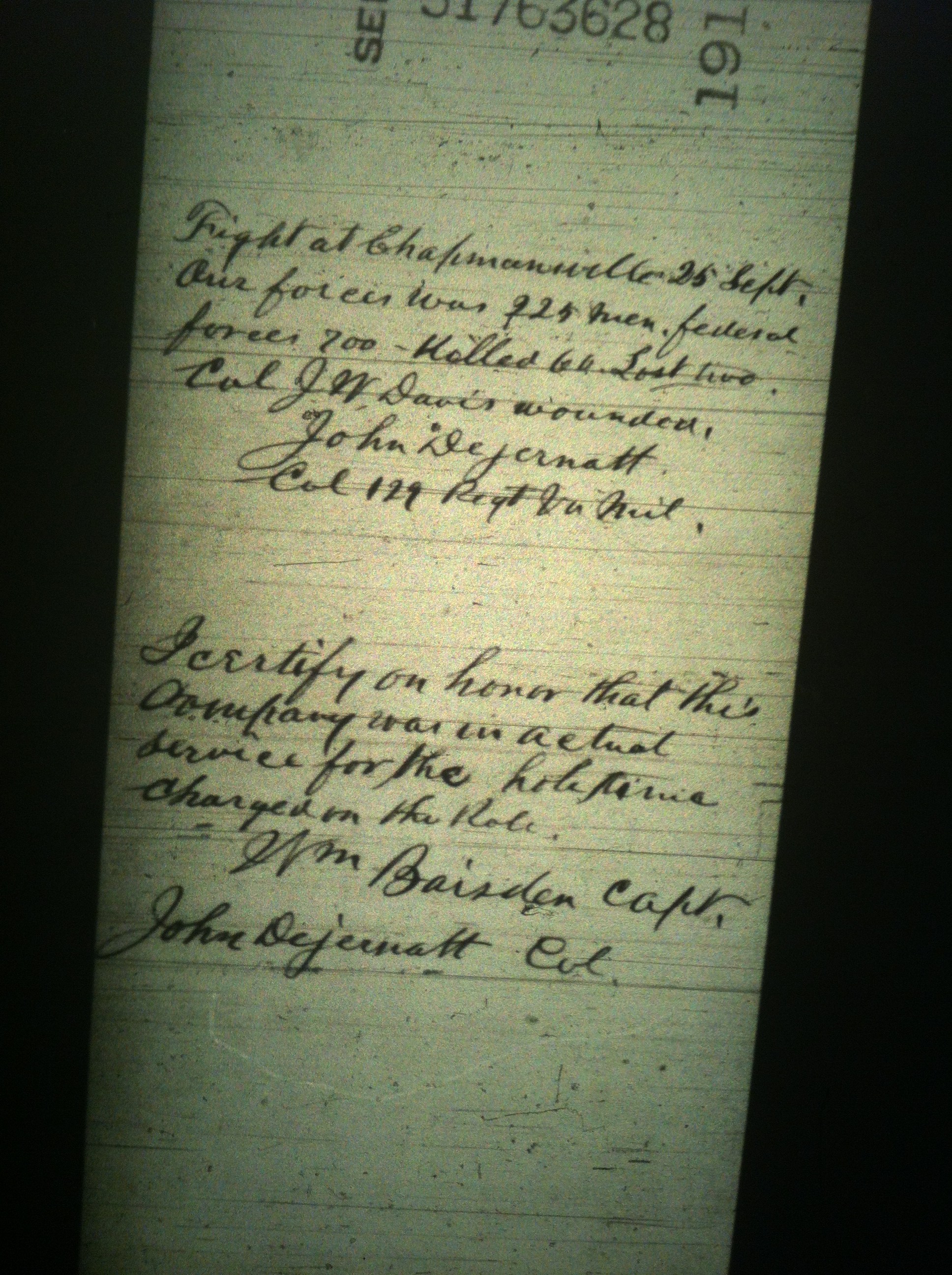
IMG_7149.JPG

Record relating to the 129th Virginia Militia (Confederate), which was present at the Battle of Kanawha Gap.

Big Sandy River Log Raft

04 Monday Sep 2017

Posted by Brandon Ray Kirk in Big Sandy Valley, Timber

≈ Leave a comment

Tags

Appalachia, Big Sandy River, history, Kentucky, logging, photos, timber, timbering, West Virginia

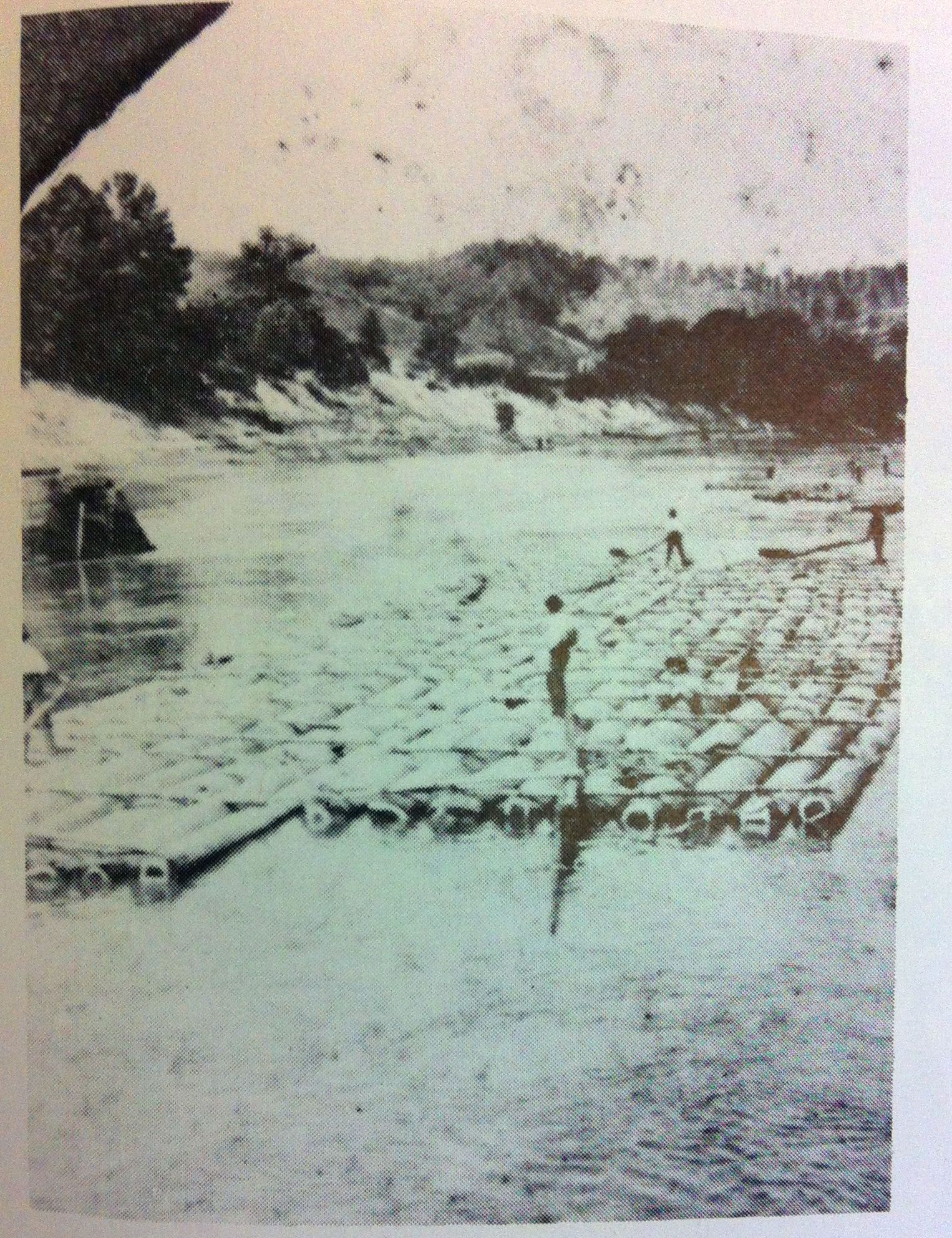
Big Sandy Log Raft

Big Sandy River log raft. Source of photograph to be determined.

Image

Kentucky Counties in the Big Sandy Valley

04 Tuesday Jul 2017

Tags

Appalachia, Big Sandy River, Floyd County, Hindman, Inez, Johnson County, Kentucky, Knott County, Letcher County, Levisa Fork, map, Martin County, Paintsville, Pike County, Pikeville, Prestonsburg, Russell Fork, Tug Fork, West Virginia, Whitesburg

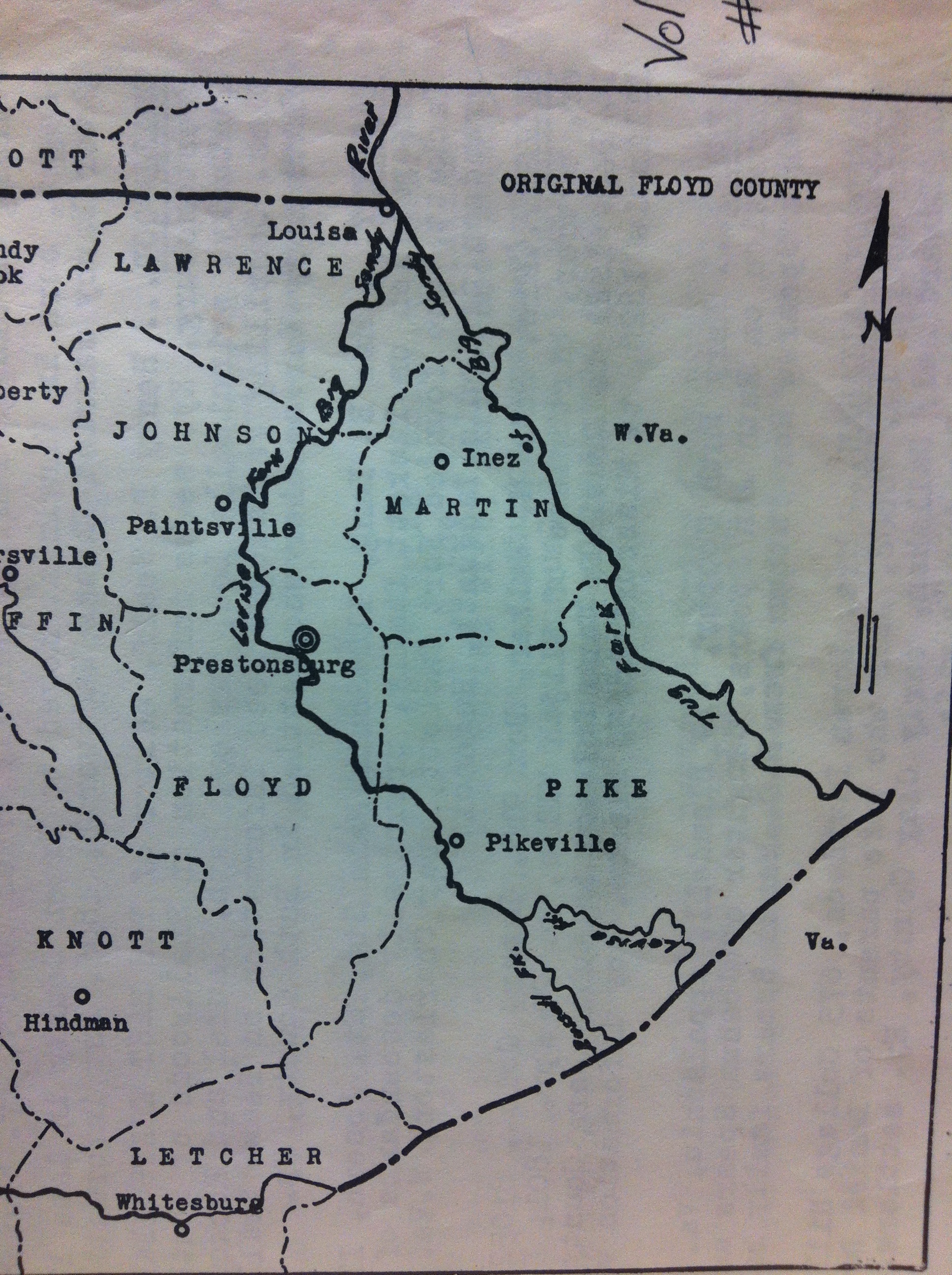
Map of Big Sandy Kentucky Counties.JPG

Kentucky Counties in the Big Sandy Valley.

Posted by Brandon Ray Kirk | Filed under Big Sandy Valley

≈ Leave a comment

Thealka Is Chartered (1900)

16 Tuesday May 2017

Posted by Brandon Ray Kirk in Big Sandy Valley, Huntington

≈ Leave a comment

Tags

Appalachia, Big Sandy River, Captain Christian, E.A. Woodruff, Guyandotte Shoals, history, Huntington, Huntington Advertiser, Ohio River, steamboats, Thealka, West Virginia

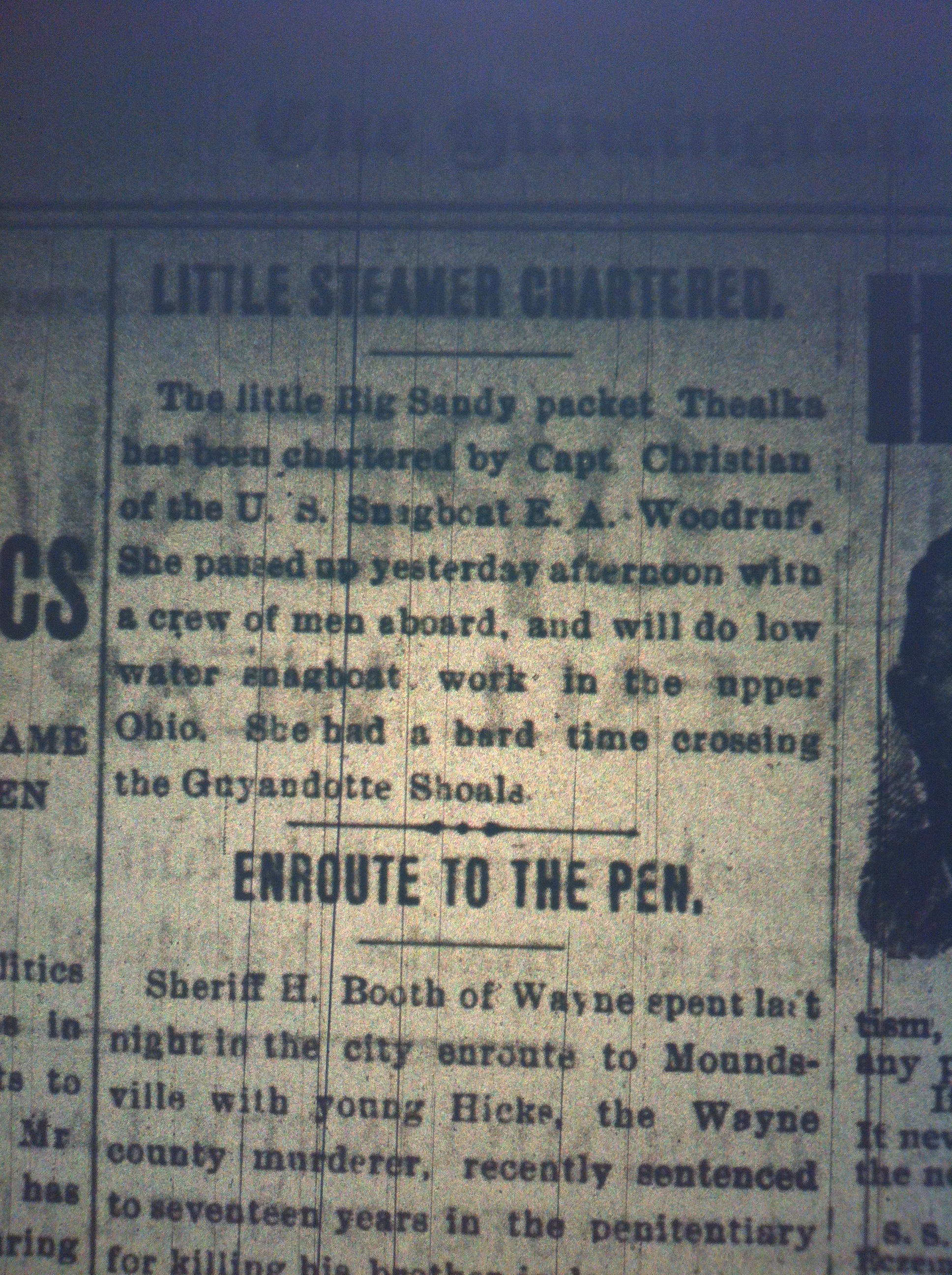
Thealka Steamboat HA 10.09.1900.JPG

Huntington (WV) Advertiser, 9 October 1900.

Andy Hatcher Burns (1897)

14 Sunday May 2017

Posted by Brandon Ray Kirk in Big Sandy Valley

≈ Leave a comment

Tags

Andy Hatcher, Appalachia, Big Sandy River, history, Kentucky, Paintsville, steamboats

Steamer Andy Hatcher Burns HuA 12.27.1897.JPG

Huntington (WV) Advertiser, 27 December 1897.

Migration to the Guyandotte Valley (1910)

05 Friday May 2017

Posted by Brandon Ray Kirk in Big Sandy Valley, Coal, Guyandotte River, Logan

≈ Leave a comment

Tags

Appalachia, Big Sandy River, C&O Railroad, coal, Guyandotte Valley, history, Holden, Huntington, Huntington Advertiser, Kentucky, Levisa Fork, Logan County, West Virginia

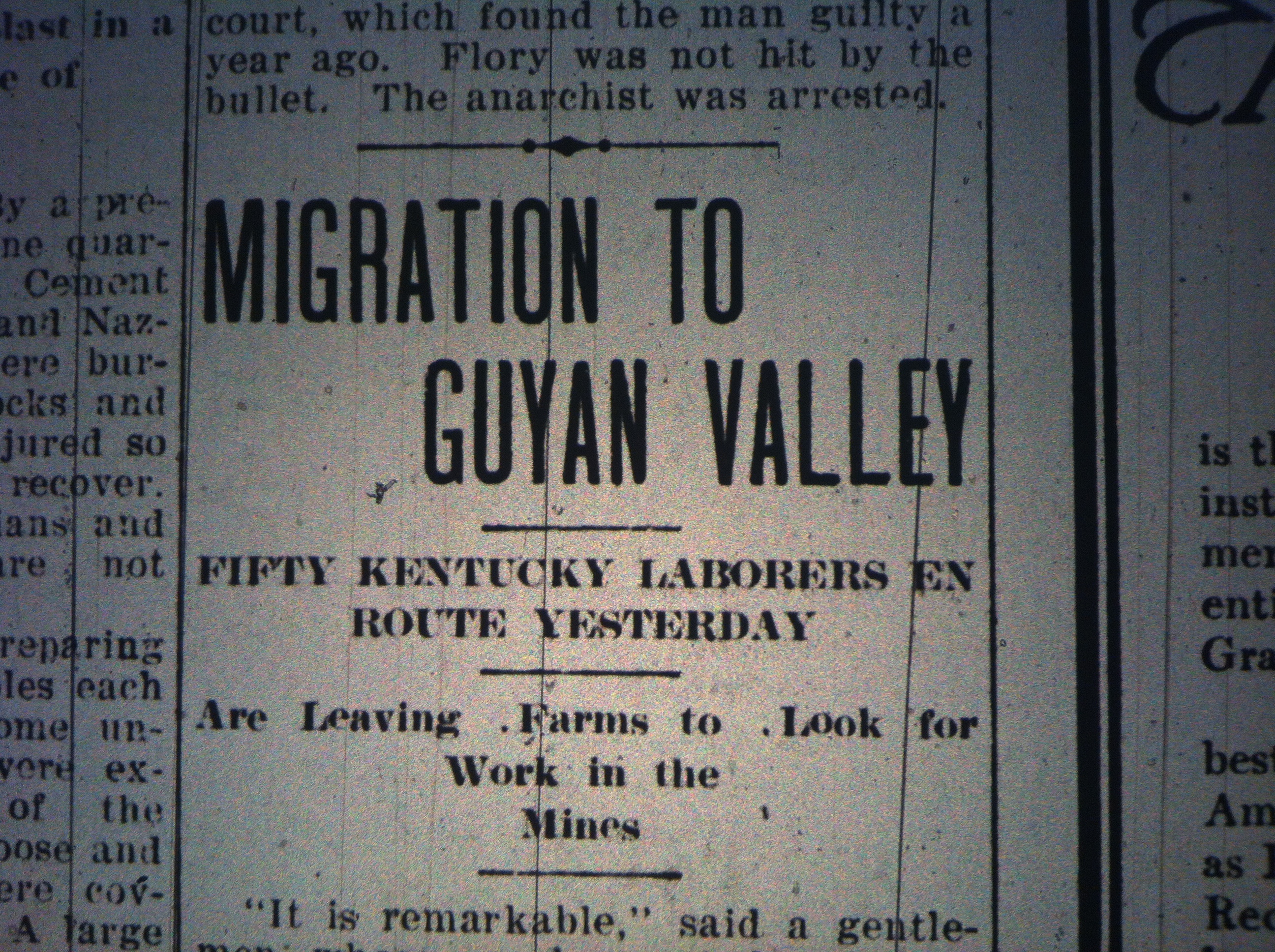
Migration to Guyandotte Valley HA 04.14.1910 1

Migration to Guyandotte Valley HA 04.14.1910 2

Huntington (WV) Advertiser, 14 April 1910

Recollections of the Civil War in Cabell County, WV (1862)

13 Tuesday Sep 2016

Posted by Brandon Ray Kirk in Barboursville, Civil War, Hamlin

≈ 1 Comment

Tags

1st Regiment Virginia State Line, Abbs Valley, Ball Gap, Barboursville, Big Sandy River, Cabell County, civil war, Clint Lovette, Coal River, Confederate Army, G.W. Hackworth, Guyandotte, Guyandotte River, Hamlin, history, J.C. Reynolds, John B. Floyd, Kanawha River, Levisa Fork, Mud River, Mud River Bridge, Ohio, Proctorville, Thomas H. Perry, Tug Fork, Tylers Creek, Van Sanford, Virginia, West Virginia

About 1910, Rev. Thomas H. Perry reflected on his long life, most of which was spent in the vicinity of Tylers Creek in Cabell County, West Virginia. In this excerpt from his autobiography, Mr. Perry recalled the early years of the Civil War in his locale:

Immediately after our first defeat we began to plan for another exit to Dixie, as so few of our men made their escape to Dixie after being fired into at the falls of Guyan, for we knew now for a certainty that we must go south and be a soldier or go north a prisoner; for the Federals were going through the country picking up men and sending them away as far as they could. This last plan was for us to meet at Ball Gap, on Mud river, early in the morning, and a company of armed men would meet us there to guard us out to Dixie. Early that morning I met thirty or forty young men at the Ball Gap. We appointed G.W. Hackworth as our leader, and we moved on Mud river, and the young men came to us all along the way, and when we arrived six miles above Hamlin, we had from one to two hundred men in our company. From there we crossed the mountain to the Guyan valley, and then up the river and over the mountains and through the woods for ten days and nights, and we found ourselves in Aps [sic] valley, Virginia. Here we organized a military company* by electing G.W. Hackworth, captain; Van Sanford, J.C. Reynolds and Clint Lovette, lieutenants. No one knows but myself the feelings I had the day I took the oath to support the constitution of the Southern Confederate States of America and to discharge my duty as a soldier. As they swore me they handed me a bible. I remembered that this is the book that I had been preparing myself to preach, and it says: “Thou shalt not kill,” and it gave me trouble as long as I was a soldier.

We drilled at this place two or three weeks, and had eighty-four men in our company, and they generally used us as scouts, operating from the Kanawha river westward, down into Kentucky and eastern Tennessee. There would be times that we would not see our regiment for two months, and then again we would be with them every day for two months. The Federals were trying to make their way up Coal river, Guyan river, Tug river, and the Levisa fork of Big Sandy river, in Kentucky. Their idea was to destroy the New river bridge and the King salt works. General Floyd had a brigade of soldiers somewhere about the headwaters of these rivers; sometimes he would send large scouting parties down these rivers and drive out everything before them. Sometimes when we would be driving them down one river they would be moving up some other river. I have crossed the mountains between these rivers so many times and was shot at by men in the brush and suffered from hunger and cold so many times that it makes me think of war as the darkest days of my life. At one time I went three days and nights without one bite to eat; in many places we had to live on the country that we were in, and the soldiers in front would get all the citizens had to eat, and the rear guard suffered for food; we did not have battles like Lee and Grant, but to many of our poor boys the battle to them was as great as that of Gettysburg or Cold Harbor was to some of them.

At one time my company and some other company was ordered to Cabell county, and we came to Mud river bridge and went into camp for eight or ten days at this place. During our stay in this camp we had no trouble in getting food for our horses and soldiers for the Reeces and Morris and Guinns and Kilgores and others who lived in this neighborhood had an abundance of this world’s goods at that time. One morning our captain said he wanted eight volunteers who would go afoot for three or four days; he had no trouble in getting the eight men; I was one of that number; Lieutenant Lovette was in command, and at noon that day we ate dinner near Barboursville, and at night we were in Guyandotte. Several times the next day we would stand along the river front and see the Federal soldiers in Proctorville. In the middle of that afternoon we started back for Mud river bridge, and the next day our command broke camp, and we started for Dixie. Why these eight men were sent to Guyandotte I never knew, and why General Floyd sent such large scouting parties to Mason, Cabell and Wayne counties, as he did at this time, I never knew, unless it was to give protection to those who were desirous of going south with their families and chattels, which a great many did, and stayed until after the war.

Source: From Youth to Old Age by T.H. Perry, Chapter 6, p. 16-18. Note: As of 1862, Cabell County remained a part of Virginia and Lincoln County did not exist.

*Company F, 1st Regiment Virginia State Line

← Older posts
Newer posts →

Feud Poll 1

If you had lived in the Harts Creek community during the 1880s, to which faction of feudists might you have given your loyalty?

Categories

  • Adkins Mill
  • African American History
  • American Revolutionary War
  • Ashland
  • Atenville
  • Banco
  • Barboursville
  • Battle of Blair Mountain
  • Beech Creek
  • Big Creek
  • Big Harts Creek
  • Big Sandy Valley
  • Big Ugly Creek
  • Boone County
  • Breeden
  • Calhoun County
  • Cemeteries
  • Chapmanville
  • Civil War
  • Clay County
  • Clothier
  • Coal
  • Cove Gap
  • Crawley Creek
  • Culture of Honor
  • Dingess
  • Dollie
  • Dunlow
  • East Lynn
  • Ed Haley
  • Eden Park
  • Enslow
  • Estep
  • Ethel
  • Ferrellsburg
  • Fourteen
  • French-Eversole Feud
  • Gilbert
  • Giles County
  • Gill
  • Green Shoal
  • Guyandotte River
  • Halcyon
  • Hamlin
  • Harts
  • Hatfield-McCoy Feud
  • Holden
  • Hungarian-American History
  • Huntington
  • Inez
  • Irish-Americans
  • Italian American History
  • Jamboree
  • Jewish History
  • John Hartford
  • Kermit
  • Kiahsville
  • Kitchen
  • Leet
  • Lincoln County Feud
  • Little Harts Creek
  • Logan
  • Man
  • Matewan
  • Meador
  • Midkiff
  • Monroe County
  • Montgomery County
  • Music
  • Native American History
  • Peach Creek
  • Pearl Adkins Diary
  • Pecks Mill
  • Peter Creek
  • Pikeville
  • Pilgrim
  • Poetry
  • Queens Ridge
  • Ranger
  • Rector
  • Roane County
  • Rowan County Feud
  • Salt Rock
  • Sand Creek
  • Shively
  • Spears
  • Sports
  • Spottswood
  • Spurlockville
  • Stiltner
  • Stone Branch
  • Tazewell County
  • Timber
  • Tom Dula
  • Toney
  • Turner-Howard Feud
  • Twelve Pole Creek
  • Uncategorized
  • Warren
  • Wayne
  • West Hamlin
  • Wewanta
  • Wharncliffe
  • Whirlwind
  • Williamson
  • Women's History
  • World War I
  • Wyoming County
  • Yantus

Feud Poll 2

Do you think Milt Haley and Green McCoy committed the ambush on Al and Hollene Brumfield in 1889?

Blogroll

  • Ancestry.com
  • Ashland (KY) Daily Independent News Article
  • Author FB page
  • Beckley (WV) Register-Herald News Article
  • Big Sandy News (KY) News Article
  • Blood in West Virginia FB
  • Blood in West Virginia order
  • Chapters TV Program
  • Facebook
  • Ghosts of Guyan
  • Herald-Dispatch News Article 1
  • Herald-Dispatch News Article 2
  • In Search of Ed Haley
  • Instagram
  • Lincoln (WV) Journal News Article
  • Lincoln (WV) Journal Thumbs Up
  • Lincoln County
  • Lincoln County Feud
  • Lincoln County Feud Lecture
  • LinkedIn
  • Logan (WV) Banner News Article
  • Lunch With Books
  • Our Overmountain Men: The Revolutionary War in Western Virginia (1775-1783)
  • Pinterest
  • Scarborough Society's Art and Lecture Series
  • Smithsonian Article
  • Spirit of Jefferson News Article
  • The Friendly Neighbor Radio Show 1
  • The Friendly Neighbor Radio Show 2
  • The Friendly Neighbor Radio Show 3
  • The Friendly Neighbor Radio Show 4
  • The New Yorker
  • The State Journal's 55 Good Things About WV
  • tumblr.
  • Twitter
  • Website
  • Weirton (WV) Daily Times Article
  • Wheeling (WV) Intelligencer News Article 1
  • Wheeling (WV) Intelligencer News Article 2
  • WOWK TV
  • Writers Can Read Open Mic Night

Feud Poll 3

Who do you think organized the ambush of Al and Hollene Brumfield in 1889?

Recent Posts

  • Logan County Jail in Logan, WV
  • Absentee Landowners of Magnolia District (1890, 1892, 1894)
  • Charles Spurlock Survey at Fourteen Mile Creek, Lincoln County, WV (1815)

Ed Haley Poll 1

What do you think caused Ed Haley to lose his sight when he was three years old?

Top Posts & Pages

  • New Year's Raid (1888): Randolph McCoy's Testimony
  • Ran'l McCoy's Final Months (1914)
  • Alice Adams
  • Devon, Mingo County, WV (2019)
  • Sliger Lumber Company (1895)

Copyright

© Brandon Ray Kirk and brandonraykirk.wordpress.com, 1987-2023. Unauthorized use and/or duplication of this material without express and written permission from this blog’s author and/or owner is strictly prohibited. Excerpts and links may be used, provided that full and clear credit is given to Brandon Ray Kirk and brandonraykirk.wordpress.com with appropriate and specific direction to the original content.

Archives

  • February 2025
  • January 2025
  • October 2023
  • September 2023
  • December 2022
  • November 2022
  • May 2022
  • April 2022
  • February 2022
  • November 2021
  • October 2021
  • September 2021
  • June 2021
  • May 2021
  • April 2021
  • March 2021
  • February 2021
  • January 2021
  • December 2020
  • November 2020
  • October 2020
  • July 2020
  • June 2020
  • May 2020
  • April 2020
  • March 2020
  • February 2020
  • January 2020
  • December 2019
  • November 2019
  • October 2019
  • September 2019
  • August 2019
  • July 2019
  • June 2019
  • May 2019
  • April 2019
  • March 2019
  • February 2019
  • January 2019
  • December 2018
  • November 2018
  • October 2018
  • September 2018
  • August 2018
  • July 2018
  • June 2018
  • May 2018
  • April 2018
  • March 2018
  • February 2018
  • January 2018
  • December 2017
  • November 2017
  • October 2017
  • September 2017
  • August 2017
  • July 2017
  • June 2017
  • May 2017
  • April 2017
  • March 2017
  • February 2017
  • January 2017
  • December 2016
  • November 2016
  • October 2016
  • September 2016
  • August 2016
  • July 2016
  • June 2016
  • May 2016
  • April 2016
  • March 2016
  • February 2016
  • January 2016
  • December 2015
  • November 2015
  • October 2015
  • September 2015
  • August 2015
  • July 2015
  • June 2015
  • May 2015
  • April 2015
  • March 2015
  • February 2015
  • January 2015
  • December 2014
  • October 2014
  • September 2014
  • August 2014
  • July 2014
  • June 2014
  • May 2014
  • April 2014
  • March 2014
  • February 2014
  • January 2014
  • December 2013
  • November 2013
  • October 2013
  • September 2013
  • August 2013
  • July 2013
  • June 2013
  • May 2013
  • April 2013
  • March 2013
  • February 2013
  • January 2013
  • December 2012
  • November 2012

Enter your email address to follow this blog and receive notifications of new posts by email.

Join 2,925 other subscribers

Tags

Appalachia Ashland Big Creek Big Ugly Creek Blood in West Virginia Brandon Kirk Cabell County cemeteries Chapmanville Charleston civil war coal Confederate Army crime culture Ed Haley Ella Haley Ferrellsburg feud fiddler fiddling genealogy Green McCoy Guyandotte River Harts Harts Creek Hatfield-McCoy Feud history Huntington John Hartford Kentucky Lawrence Haley life Lincoln County Lincoln County Feud Logan Logan Banner Logan County Milt Haley Mingo County music Ohio photos timbering U.S. South Virginia Wayne County West Virginia Whirlwind writing

Blogs I Follow

  • OtterTales
  • Our Appalachia: A Blog Created by Students of Brandon Kirk
  • Piedmont Trails
  • Truman Capote
  • Appalachian Diaspora

BLOOD IN WEST VIRGINIA is now available for order at Amazon!

Blog at WordPress.com.

OtterTales

Writings from my travels and experiences. High and fine literature is wine, and mine is only water; but everybody likes water. Mark Twain

Our Appalachia: A Blog Created by Students of Brandon Kirk

This site is dedicated to the collection, preservation, and promotion of history and culture in Appalachia.

Piedmont Trails

Genealogy and History in North Carolina and Beyond

Truman Capote

A site about one of the most beautiful, interesting, tallented, outrageous and colorful personalities of the 20th Century

Appalachian Diaspora

  • Subscribe Subscribed
    • Brandon Ray Kirk
    • Join 787 other subscribers
    • Already have a WordPress.com account? Log in now.
    • Brandon Ray Kirk
    • Subscribe Subscribed
    • Sign up
    • Log in
    • Report this content
    • View site in Reader
    • Manage subscriptions
    • Collapse this bar
 

Loading Comments...