Tags
Appalachia, culture, Ferrellsburg, history, Isaac Marion Nelson, life, Lincoln County, photos, West Virginia
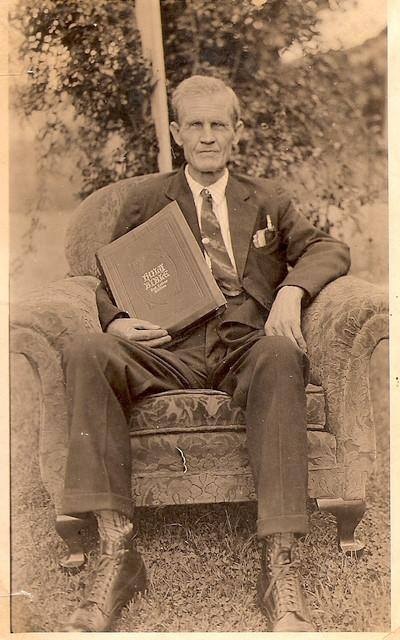
Isaac Marion Nelson, resident preacher of Ferrellsburg, Lincoln County, WV, c.1920s

16 Saturday Nov 2013
Posted in Ferrellsburg
Tags
Appalachia, culture, Ferrellsburg, history, Isaac Marion Nelson, life, Lincoln County, photos, West Virginia
Isaac Marion Nelson, resident preacher of Ferrellsburg, Lincoln County, WV, c.1920s
13 Wednesday Nov 2013
Posted in Lincoln County Feud
Tags
Appalachia, Charley Brumfield, crime, culture, feud, Harts, history, life, Lincoln County, photos, West Virginia
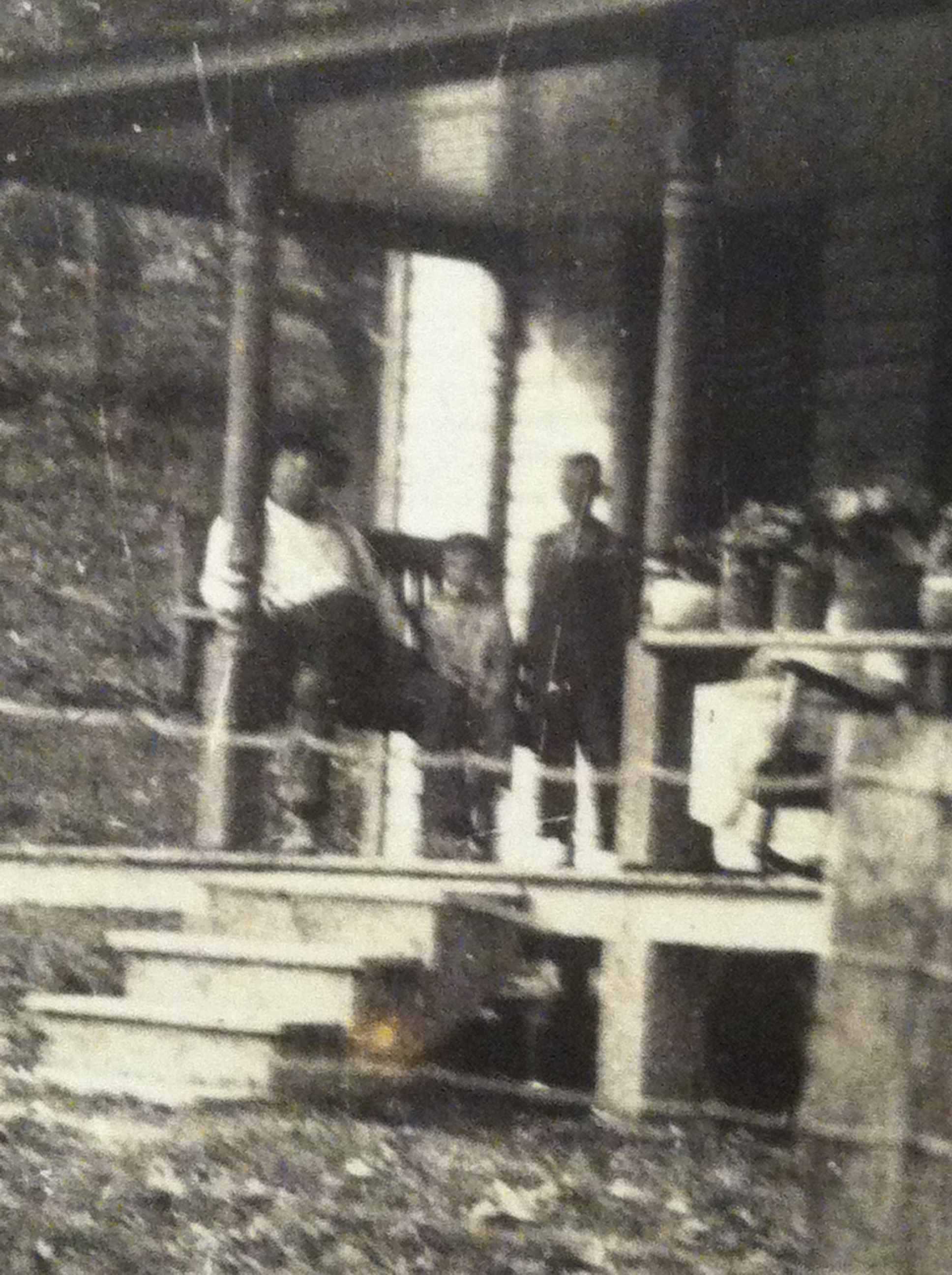
Charley Brumfield on his porch with children, Harts, Lincoln County, WV, 1915-1926
12 Tuesday Nov 2013
Posted in Lincoln County Feud
Tags
Appalachia, crime, feud, George Fry, Green McCoy, Green Shoal, history, Milt Haley, photos, West Virginia
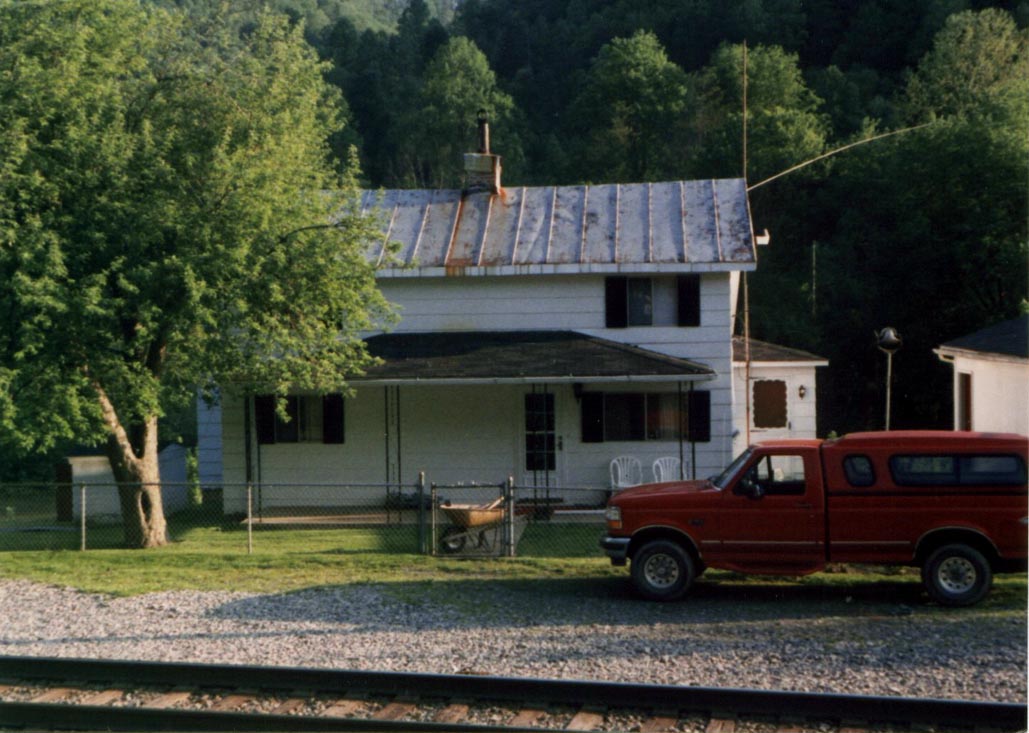
The Murder House? Green Shoal, Lincoln County, WV, 1995
11 Monday Nov 2013
Posted in Green Shoal, Lincoln County Feud
Tags
Appalachia, crime, feud, George Fry, Green McCoy, Green Shoal, history, Lincoln County, Lincoln County Feud, Milt Haley, murder, photos, West Virginia

Site of the Haley-McCoy murders, Green Shoal, Lincoln County, WV.
11 Monday Nov 2013
Posted in Ed Haley
Tags
Appalachia, Bill Adkins, Dood Dalton, Doran Lambert, Ed Haley, feud, Green Shoal, Harts, history, Ida Taylor, Jim Brumfield, Tucker Fry, writing
Early the next day, Brandon and I met Billy at his home, with plans to go see the site of the “murder house” at Green Shoal. We found his father, Bill, Sr., seated in a wooden rocking chair very much “in his own world.” He’d been born in 1906, making him one of the oldest citizens living in Harts. Curious, I got my fiddle out and played a few tunes for him. The old gentleman just stared at me like I was crazy. He never said a word. Billy told him we were interested in Ed Haley’s life and he surprised us all when he said Ed used to stay with his father for two or three days at a time. Oh yeah, he said…Ed even slept in the same bed with him and his brothers, who were children at the time. Wow! Bill said Haley was a very serious guy (“not carrying on much”) and had a reputation for being “bad to fight.” He often got with a local fiddler named Dood Dalton and played all night for a house full of people at the Adkins home. Bill also remembered him playing in front of the old Adkins Store/Harts Post Office around 1916 when it faced the railroad tracks. All he could recall about Ed’s technique was that he tapped his feet and pulled a long, smooth bow.
After talking with Bill, Billy, Brandon, and I drove out of Harts Bottom onto Route 10 past the old Adkins store and on up the road to Green Shoal. At that location, standing in a little drizzle, we surveyed the possible sites of the murder house. Suddenly, an older man Brandon and Billy recognized as Doran Lambert came walking down to where we stood on the railroad tracks. A descendant of Paris Brumfield, he lived where the Tucker Fry home stood in 1889. Doran said the murders didn’t happen at Tucker’s place, as Billy thought, but at the present-day location of his father’s garage just up the river between the Guyan River and the C&O Railroad.
We asked Doran more about the Haley-McCoy killings. He said his aunt Ida Taylor, who lived just up Green Shoal, could tell us all about it. A niece to Al Brumfield, her father Jim was Paris’ youngest son. We decided right away to try and see her.
11 Monday Nov 2013
Posted in Big Harts Creek, Civil War, Whirlwind
Tags
34th Battalion Virginia Cavalry, Appalachia, Barney Carter, civil war, genealogy, Harts Creek, history, Hoover Fork, Logan County, photos, West Virginia

Capt. Barney Carter (1821-1902), resident of Hoover Fork of Big Harts Creek, Logan County, West Virginia, served as captain of Company D, 34th Battalion Virginia Cavalry.
02 Saturday Nov 2013
Posted in Lincoln County Feud
Tags
Appalachia, crime, culture, feud, genealogy, Harts, history, life, Lincoln County, photos, West Virginia, Will Adkins

G.W. “Will” Adkins, member of the 1889 mob
02 Saturday Nov 2013
Posted in Ed Haley
Tags
Appalachia, Billy Adkins, Boone County, Chloe Mullins, Clintwood, crime, Ed Haley, history, Hollene Brumfield, Imogene Haley, slavery, Solomon Mullins, writing
After talking with Lola, we walked down the street with Billy Adkins and spent a few hours filtering through genealogy books at his kitchen table. Billy, I discovered, had two large bookcases filled with categorized three-ring binders dedicated to Harts families. One of the first things we dug out were notes pertaining to Ed’s mother, Emma Jean Haley. Years earlier, Lawrence Haley had told me that someone shot her in the doorway of what I later learned to be Al Brumfield’s house. In his notes, Billy recorded her as re-marrying James Benton Mullins, a son of Peter and Jane Mullins, which we ruled out immediately: James B. was her uncle. The Emma who had actually had married this fellow was born in 1876 (about eight years after Emma Haley) and was listed in other sources with the maiden name of Johnson.
“I don’t know where I found that out but somebody told me that that woman right there was Milt Haley’s widow,” Billy said. “But that date’s totally wrong, see.”
Whether or not Ed’s mother had ever remarried anyone, based on census information, Brandon was convinced that she had died in the 1890s. In the 1900 Logan County Census, her mother Chloe Mullins listed seven of her nine children as being alive. The seven accounted for were Joseph Adams, John Adams, Ticky George Adams, Peter Mullins, and Weddie Mullins. The two who were not listed in the 1900 census were Dicy (Adams) Thomas, whose husband was listed as a widower in the census, and Ed’s mother.
We found out from Billy’s notes that Emma Haley descended from a notorious counterfeiter named Solomon Mullins.
“Money Makin’ Sol,” as he was called, was born to John and Jane Mullins on the Broad River in North Carolina in 1782. Around 1806, he married Sarah Cathey; he settled in Kentucky by 1810.
“Solomon was always ready for action,” according to photocopied papers at Billy’s house. “He served in the War of 1812 in Cpt. David Gooding’s Company of Kentucky Volunteer Militia. After the war, Solomon, evidently ready for more action, began counterfeiting coins. Family tradition has it that Solomon found one of John Swift’s ‘Lost Silver Mines’ in the hills of eastern Kentucky and ‘South of the Mountain’ in Southwestern Virginia. Thus he became known as ‘Money Making Sol’, and I might add always the ‘genius’, stayed one step ahead of his trouble. In 1837 Solomon decided to join his father and his two brothers in Russell County. He bought a farm and built a shop just a little ways from his house where he began making money again. He melted the silver down and didn’t seem to care who saw him.”
“I was born August 29, 1840, at my father’s home below Clintwood,” according to a 1926 interview with one Nancy Mullins. “The Mullins mixed with the Indians. I have heard it said that Grandpa John Mullins was about one-fourth Indian. Grandpa John had at least two brothers. One was named Sol and he owned a lot of slaves. He was a moneymaking man. He lived on the other side of the branch in a bottom near my father’s home. He had a crowd of slave wenches. He made money on Holly Creek back of Press Harris’ home. He had his work place under a cliff. Pa and Uncle John used to help him work at this business. They would ‘strike’ for Sol. While they lived there, his slave women would take guns and go hunting. They would kill deer and pack them in on their backs. The government got after Sol and he went to West Virginia where he died.”
“Solomon Mullins moved to the waters of Holly Creek, about two miles northeast of Clintwood, [Virginia,] where he lived for several years,” according to Sutherland’s The Mullins Family in Dickenson County (1967). “He owned several slaves, mostly women, who worked in the fields and hunted in the woods. He made counterfeit money for several years under a cliff near Holly Creek. The cliff is still pointed out by neighbors as ‘Sol’s Cliff.’ He was caught at work once by a detective and when he saw he was caught, he ordered the detective to help him work, saying: ‘Grab that hammer and strike this.’ He hoped this would make the detective afraid to tell on him, but it didn’t do any good. He managed to get pure silver and mixed other metal with it to make the counterfeit money. He would pay $2 of his counterfeit money for $1 of the government money. At last, he took a scare and left this country.”
In 1837, Sol and his son Peter were involved in making counterfeit coins in Russell County, Virginia. As a result, according to Boone County, West Virginia, History (1990), they moved to Marion County, Tennessee, where they renewed their counterfeiting activity. In the winter of 1841-42, after pressure from government authorities in Tennessee, Sol and Peter moved with their families and slaves to the North Fork of Big Creek in Logan (now Boone) County, (West) Virginia.
“They rode mules and walked all the way,” according to Boone County. “He died in 1858 and Sarah died about 1872.”
As Brandon flipped through the Sol Mullins notes, I could see his brain working, making connections. Suddenly, he said, “Sol was a great-grandfather to both Emma Haley and Hollena Brumfield…making them third cousins.”
Oh my.
01 Friday Nov 2013
Posted in Fourteen, Wewanta, Women's History
Tags
Appalachia, Caleb Headley, Elizabeth Jane Farley, Fourteen, Fourteen Mile Creek, genealogy, history, Lincoln County, midwife, photos, Sarah Headley, Sulphur Spring Fork, U.S. South, West Virginia, William Floyd Farley
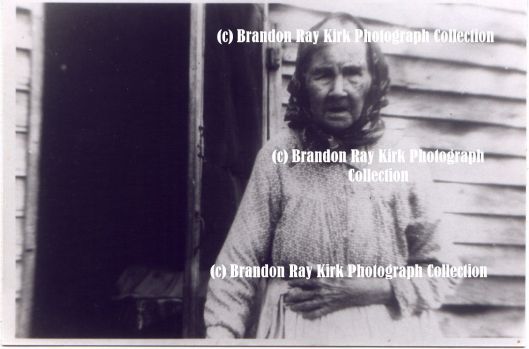
Sarah Ann (Farley) Headley, daughter of William F. and Jane (Clark) Farley and wife of Caleb Headley. Sarah (1849-1945) is my great-great-great-grandmother. She lived at Sulphur Spring Fork of Fourteen Mile Creek in Lincoln County, WV.
01 Friday Nov 2013
Posted in Ed Haley
Tags
Appalachia, Billy Adkins, Cain Adkins, Cat Fry, crime, feud, George Fry, Green McCoy, history, Lola McCann, Milt Haley, Vinnie Workman, writing
Before heading to Billy’s, we became knee-deep in conversation about Milt Haley’s death. Billy told us about the Brumfields retrieving Milt and Green in Kentucky.
“Now, I don’t know where they come from over there,” he said. “I know they had a bogus warrant, the people that went to get them. They made up a fake warrant and got them. Then when they started back down through here, they was a big bunch of people was waiting to attack them. That was Cain Adkins and them and his family. They was fields full of them up on Big Branch. And somebody tipped them off, and so they went up what’s called Bill’s Branch. And so they took up Bill’s Branch and down Piney and then over to Frank Fleming holler.”
From Frank Fleming hollow, the Brumfield gang went over a mountain and crossed the river to a Fry house near the mouth of Green Shoal. At some point, according to Lola, a group of men came in and shot out the lights. Cat Fry crawled under a bed while either Milt or Green shouted to the other, “Stand up and die like a man!” Lola heard that one of the men “died a praying and the other died a cussing.”
I asked Billy if he’d heard how Milt and Green were killed.
“I’ve heard so many stories, I don’t know,” he said. “I just heard they was shot. I heard they was tied up to a tree. Tied to a chair back to back in the kitchen.”
Lola said she heard that Milt and Green were shot and hung.
“The table Milt and Green had their last meal on ended up with my grandmother, Vinnie Thompson Workman,” Billy said. “And there was bullet holes in the table.”
I asked Billy if he had any pictures of the “murder house” and he said, “No, I don’t know of anybody would. It’s where Doran’s house is. It was over there against the hill — an old log house. Of course, the railroad and stuff wasn’t there, you see. That was the old John and Catherine Fry house to start with. And then John’s son Baptist, he lived there next. That was my grandmaw’s grandpaw. And after he died, I guess this George Fry lived there. Charley Fry and George Fry both lived there and I don’t remember which one lived there when they killed them there.”
At that point, Lola completely changed the direction of the conversation when she said, “Billy, Cain Adkins was kin to us.” She’d never met Cain and had no clue what happened to him but knew that he once owned most of the lower end of West Fork at one time. All the old-timers referred to him as “Uncle Cain” because he’d been a well-respected person in the community.
Lola said George Thomas (one of Ed’s cousins, we later learned) owned the Cain Adkins farm in the years prior to her birth. Her father bought the place from him around 1905. At that time, the only remnant of Cain’s life there was his apple orchard by the creek. The Haley-McCoy grave was on the family lands.
“You go up almost to the top where it gets real flat,” Lola said. “They’s a path used to be up there. It’s up pretty much on the hill. It ain’t way up there, I’d say the first flat.”
Brandon asked her, “Now, did you tell me that some old woman used to come up there and decorate that grave?”
“They always came as long as they lived, I guess, and decorated the grave,” Lola said. “That was their wives. I was only four or five years old, but I can remember seeing them. One of them was tall and slim. But they stopped at our house every time they come.”
25 Friday Oct 2013
Posted in Ferrellsburg, Women's History
Tags
Appalachia, culture, Ferrellsburg, Guyandotte River, history, life, Lincoln County, photos, West Virginia
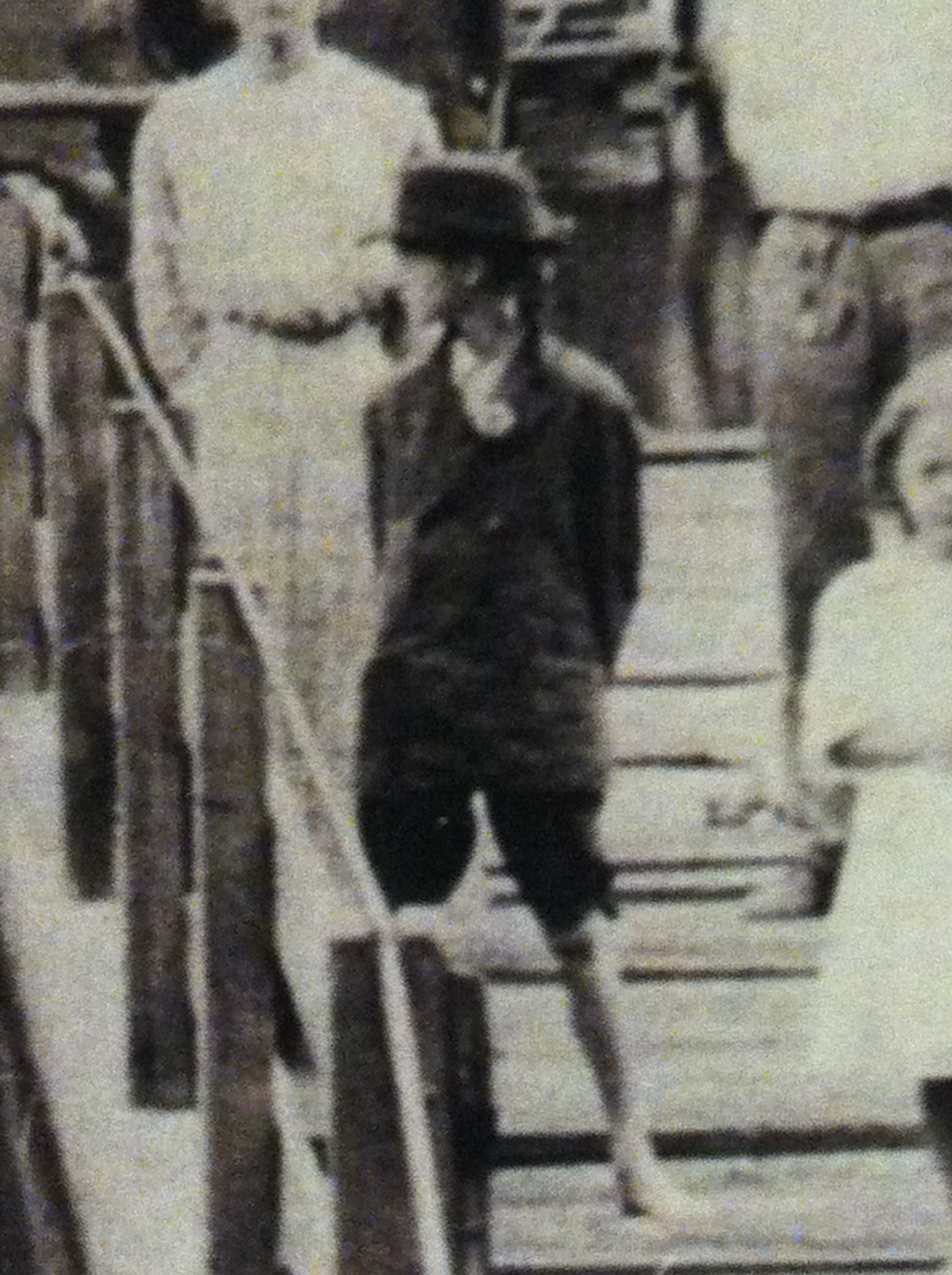
Ferrellsburg Ferry, Lincoln County, West Virginia, 1905-1915
25 Friday Oct 2013
Posted in Harts, Women's History
Tags
Appalachia, Caroline Brumfield, chickens, culture, farming, genealogy, history, life, Lincoln County, photos, West Virginia

Caroline Dingess Brumfield feeding chickens, Harts, West Virginia, 1920s
19 Saturday Oct 2013
Posted in Fourteen
Tags
Appalachia, Caleb Headley, Fourteen, genealogy, Gladys Kirk, history, Johnny Headley, Moses Headley, Sarah Headley, Ward Adkins, West Virginia, Will Headley, writing
On July 18, 1903, Billy and Sarah Sias, with Sarah and Moses C. Headley, sold 30 of the remaining 34 acres of Caleb Headley’s estate to Cosby (Headley) Fry. It was located just across the creek from Caleb’s old home place.
“Beginning on a beech and white oak corner to John H. Fry & the company on a point below the Hinkles branch thence,” the deed for this 30-acre tract reads, “with John H. Fry line to Albert Neace corner thence with said Neace line to S.A. Sias corner thence down the creek with the meander of said creek to the mouth of the branch opposite Sarah Headley house she now lives in thence up said branch to the mouth of the first drain on the lower side of said branch thence up said drain to the back line between the company & Caleb Headley deceased thence with said line to the beginning it being part of Caleb Headley’s deceased.”
The remaining four acres of Caleb Headley’s estate remained in tax books from 1903 until 1910, when it was dropped with the following notation: “improper by sheriff.” Oddly enough, its value had risen from $2.50 per acre to $4.00 per acre in 1905.
In 1903, the same year Sarah and Moses Headley sold the remainder of the family estate to the Frys, they bought 45 acres of land (containing the original home place) from Sarah Sias. They kept it until 1909, when they sold it to Zack Neace. In 1918, Neace sold it to Van Alford, a son-in-law to Johnny Headley.
By the early twenties, Sarah Headley still made her home with her single sons, Ballard and Moses. In 1922, Moses married Lizzie Nelson (at his residence according to records) and soon left Sulphur for good. First, he settled in Chapmanville, then South Charleston, where he died and was buried.
“Uncle Mose married Lizzie Nelson and moved to Chapmanville,” said Ward Adkins, late resident of Sulphur Springs, in a 2003 interview. “He lived in a log cabin he had built and moved in there before they even finished a floor.”
In 1924, Ballard Headley married Claire D. Clark. About that same time, Will Headley opened a store near his home at the mouth of Sulphur.
“They had a small grocery store, him and Maw, from about 1924 until about 1927 just over from where the church house is now,” said Adkins.
In July of 1929, Johnny Headley’s wife, Emaline, died of dysentery flux and he remarried early the following year to widow named Emarine Elkins.
Throughout that time, Sarah Headley just came and went, staying with first one relative and then another.
“Ever since I can remember she would drop in and maybe stay a week with us, then she’d go somewhere else and stay,” said Adkins. “She’d go up on Harts Creek a lot of times and stay. She’d stay with Bal maybe a week and Uncle Johnny over on Steer Fork.”
“She used to come to Grandpa Johnny Headley’s and stay a few nights,” said the late Gladys Kirk, a granddaughter of Johnny Headley and a resident of West Fork. “Then she would go on back to Will’s. I was small at that time, maybe eight or nine years old. She wouldn’t do anything. She’d sit around. She was too feeble to cook or anything. She held on to a big red handkerchief she packed with her everywhere she went. It was folded. We never got to look in it but it looked like she had something in it. She told someone it was her burying clothes, whatever that meant. And when Grandmaw Headley would get meals ready Grandma Sarah would make the kids line up and she’d say, ‘They’s nobody going to the table to eat until they washed their hands.'”
Around 1935-36, Sarah Headley moved in with Will permanently.
“I guess she finally got too old to go from place to place,” said Adkins. “Anyhow, she come to our house and stayed there till she died. She’d got rid of her furniture by then but she had a whole set of these old big woven baskets she kept her clothes in. She was a kind person. I liked to hear her tell tales, you know. And I don’t know how many skirts she would have on at once. Six or seven — maybe more. She’d pull up that apron, run her hand down in there, get her pipe and her tobacco out. She died in 1945 when I was away fighting in World War II.”
19 Saturday Oct 2013
Posted in Ed Haley, Music, Women's History
Tags
Appalachia, Clay County, culture, genealogy, guitar, history, life, Logan County, Nora Martin, photos, Ugee Postalwait, West Virginia

Nora (Douglas) Martin, daughter of Rosie Hicks Day, Clay County, WV, 1913-1925
16 Wednesday Oct 2013
Tags
Appalachia, Cabell County, Doc Suiter, Dolph Spratt, fiddlers, Fred B. Lambert, Guyandotte River, history, John Thomas Moore, logging, Lucian Mitchell, Paris Brumfield, Thomas Dunn English, timbering, W.M. Carter, writing
The weather was also a problem for loggers, who often plied the river in freezing temperatures.
“I was on the water that cold Saturday, about 1900,” W.M. Carter of Ferrellsburg told Fred B. Lambert, regional historian. “People froze to death, finger and toe nails froze off, but we went on.”
Some loggers built fires on their rafts to battle the cold.
“I have had fires on a raft in winter by throwing sand between close logs,” Mitchell said.
For warmth and a little light-hearted comfort, the loggers drank whiskey along the way. A resident of the Salt Rock area told Lambert about hearing “a hundred men passing his home, one night, about 1896” who “were gloriously drunk and filled the air with such cursing and yelling as one hears not more than once in a lifetime.” Johnson’s Representative Men of Cabell County, West Virginia (1929) said “they were often so boisterous that children playing along the banks ran away in fright as they heard these raftsmen sweeping by, yelling and swearing lustily. Yet, they were only a lot of mountaineers taking their trips as high adventure.”
In addition to their whiskey, loggers also used music to alleviate the hardship of their trip. They always had one or two fiddlers with them who sometimes played on the ride downriver. Thomas Dunn English’s poem “Rafting on the Guyandot” hinted at that part of the journey with the line: “Where’s the fiddle? Boys, be gay!” The fiddles were brought out again after dark, when loggers were camped at various points on the riverbank, in the yard of inns or at houses along their route where people made a business of caring for them. Raftsmen spent their evening eating packed lunches (or fresh, home-cooked meals if they were lucky), drinking, dancing, then sleeping it all off in preparation for the next day.
I could just picture Milt Haley playing the fiddle under the stars and lifting the spirits of burly men who were gathered around their campfires.
“If no bad luck overtook them, they could make the whole journey to Guyandotte in one or two days,” according to The Llorrac.
At that location, their timber was caught in a boom, then examined by measuring crews, who paid them based on the quality and usability (per cubic foot) of each log.
“Here they were delivered to sawmills or run into the Ohio where they were gathered into ‘fleets’ containing many rafts,” Lambert wrote. “They were sold to lumber dealers in Cincinnati, Louisville, Jeffersonville, Indiana, or other cities, and floated down the river.”
Having rid themselves of their timber, the loggers found vacant hotel rooms or boarding houses in the town of Guyandotte and set about the business of “having a good time.” Locals had no choice but to surrender to them and prepare for the worst.
Ferrell’s Centennial Program put it thusly: “When the timbermen had anchored their rafts, the good people of the town anchored themselves at home.”
The whole scene was as exciting and dangerous as any thing in the Wild West. There were a lot of horrible atrocities, like when John T. Moore was burned to death after some loggers renting the upstairs of his large house caught the whole place on fire.
“I’ve seen some fancy fights in Huntington among the raftsmen,” Lucian Mitchell said. “Policemen usually didn’t interfere. Dolph Spratt of Mingo County or Paris Brumfield hit Doc Suiter. He toned down after that.”
After several days of hell-raising, loggers bought a final half-gallon of the best whiskey and made plans to return home. Most made their way back upriver on borrowed or rented horses and mules — or less dramatically by walking. (To get to Harts by foot was a six or seven day trip.)
“They often went in crowds of twenty-five to fifty,” Lambert wrote.
It was rare for them to return home sober, and when they did, it often warranted special attention by local newspapers.
“We note with satisfaction that the raftsmen all returned home safely,” one reported, “and we are pleased to say that the absence of drunkedness among them on this trip was indeed gratifying.”
15 Tuesday Oct 2013
Posted in Fourteen
Tags
Appalachia, Ballard Headley, crime, Dave Headley, Dave Merrill, Fourteen Mile Creek, genealogy, Harry Tracy, history, Sarah Headley, Will Headley, writing, Zachary Neace
During the 1890s, Sarah Headley remained on Sulphur Spring Fork, although tax records and oral tradition do not indicate the exact location of her dwelling house. In that span of time, according to tax records, her property valuations increased significantly. In 1891, a 50-acre tract climbed from $100 to $125, a 45-acre tract went from $69 to $90 and a 26-acre tract jumped from $39 to $156.
In 1892, Margaret Headley, Sarah’s youngest daughter, married Zachary T. Neace, a well-to-do timberman on the creek. In subsequent years, they lived in Virginia, the place of Neace’s origin, or on Fourteen Mile Creek.
In 1893, Sarah Headley — perhaps taking advantage of a rising evaluation on her property — sold a 45-acre tract of land worth $90 to an unknown party, leaving her with only 76 acres of the 455 acres she had owned just after her husband’s death in 1882.
A few years later, Dave Headley, Sarah’s 23-year-old son, was accidentally shot and killed.
“Dave was aiming to sell this guy a gun and this guy was looking at it and it went off and shot Dave in the head,” said Ward Adkins, a step-great-grandson to Sarah Headley, in a 2003 interview. “When Will and Uncle Johnny first heard about it they aimed to kill that guy, then they found out it was an accident.”
In the late 1890s, Will Headley, who had left Sulphur around the time of the disastrous house fire and spent time with his uncle Burl Farley on Harts Creek, moved back to Fourteen after marrying Caroline Lucas, a daughter of William R. and Emily (Fry) Lucas. He and his wife settled near the mouth of Sulphur where he continued to assist his mother and family.
During that time, Sarah Headley was still somewhere on Sulphur. In 1897, she sold 42 acres — including 16 acres of the old homeplace — to Sarah A. (Nelson) Sias, whose husband Billy had bought 174 acres from Headley in 1884. Three years later, she was listed there in the Lincoln County Census as “Sarah A. Hedley,” age 51, with sons Ballard, age 20, and Moses, age 15.
Just after the turn of the century, Ballard Headley joined the army and left Sulphur Spring for a few years.
“Uncle Bal joined the army and they sent him West,” said Adkins. “I think he was in one or two Indian skirmishes and he deserted and joined a gang with Harry Tracy and Dave Merrill, two famous outlaws. I was reading a book about Harry Tracy. I asked him, ‘Did you ever hear of Harry Tracy when you was out West?’ He said, ‘Son, I rode with him.’ He said, ‘We was horse thieves. We’d steal horses from one state and take them into another state and sell them and then steal some there and take them somewhere else and sell them.’ He wasn’t afraid of nothing. He told me himself he held up a passenger train one time, too.”
Harry Tracy, the outlaw supposedly befriended by Headley, was born in Wisconsin in 1874. At a young age, he drifted west to Wyoming where he hooked up with a gang of cattle rustlers who worked with Butch Cassidy and the Sundance Kid. In 1897 he was arrested in Salt Lake City but escaped and went to Colorado where he joined the Hole-In-The-Wall gang. He was arrested there and sent to jail in Aspen, Colorado, but escaped a short time later after nearly killing a guard with a lead pipe. He next went to Oregon, where he met gambler Dave Merrill in a saloon. The pair committed their first crime together in January of 1899. They were soon arrested and Tracy and sent to Oregon State Penitentiary. In December of 1899, he and Merrill were transported to Olympia, Washington to face charges, where they again escaped. They were both free for New Year’s in 1900, but were captured again in Portland a short time later. On the morning of June 9, 1902, Tracy and Merrill broke out of prison, leaving behind dead and wounded guards. On June 28, Tracy killed Merrill in a duel near Napavine, Washington. Thereafter, he hijacked a boat, which dropped him off near Seattle. He slipped through the city and crossed the Snoqualmie Pass, before he killed himself after a shoot out with a small posse in Creston, Washington.
“Uncle Bal was mean,” Adkins said. “He wasn’t out West long but when he came back here he told my grandpa Neace, who ran the post office, ‘If any mail comes here for George Golden, it will be for me. You hold it for me.’ Sure enough, there was. And by the time the government tracked him down for desertion he was blind as a bat. Some people said he put his eyes out to keep from going back in the army but he didn’t. He said he’d caught this disease and it got in his eyebrows and he put red persipity in there to kill it and got out and got to working and went to sweating and it got in his eyes and put his eyes out.”
“Now Bal was awful intelligent,” Adkins continued. “He’d come up and he’d have me to read the Bible to him. He belonged to the church. And he knew the Bible all ready, I don’t know why he’d want me to read it. But I’d try to skip on him. Maybe I’d just down here eight or ten verses. He’d say, ‘Hold on, back up there.’ Then he’d start quoting it off to me.”
15 Tuesday Oct 2013
Tags
Appalachia, Carol Caraco, Fred B. Lambert, history, Logan County, logging, Lucian Mitchell, Milt Haley, rafting, timbering, West Virginia, writing
Milt Haley, by all accounts, made his living as a timber man. He was probably lured “over the mountain” from the Tug River section by the timber industry that evolved in the Guyandotte Valley following the Civil War. It certainly played a role in his death. Really, for all practical purposes, logging was imbedded in the life fabric of every person living around Harts Creek in 1889…including little Ed Haley, who grew up in the era when timbering and steamboats gave way to coal and the railroad.
“Almost from the very beginning of history in this region, logs have been rafted on the Guyandotte and floated to Cincinnati and even to more distant markets,” according to Fred B. Lambert’s The Llorrac (1926). “In autumn, men with saws and axes went into the woods and cut down the trees. At first, the trees were so plentiful that they could be cut and rolled directly into the stream. In some cases, the bark was peeled from the logs and they were allowed to slide down the mountain side. But gradually the timber along the shore became scarce, and timbermen were compelled to go farther and farther into the hills or up the creeks, until now most of the virgin timber has been cut, and they are beginning on the second growth and, in some places, even on the third.”
The logging season began with the construction of logging camps “during the late winter and early spring months before the spring rains began to swell the creeks and rivers,” according to River Cities Monthly.
The men who came into these camps for work “were men in every sense of the word, and their beards of many days growth betrayed the fact that razors as well as some one to use them were quite scarce…,” Lambert wrote. They worked silently but would “yell like wild men” if something “unusual” happened. They were “master hands at swearing” and often fought amongst themselves, be it for sport or in fits of rage. Because of their wild nature, a foreman was often hired to regulate their activity. At night, they slept on bundles in crude log cabins. If the camp was large enough, a mess hall was constructed and a cook was hired to serve them bacon, beans, bread, coffee “or whatever may be brought into the camp from the surrounding country.”
According to Carol Caraco’s The Big Sandy (1979), loggers marked their timber by branding it with their initials. After branding their logs, they got them out of the hollow and to the river, usually by use of horse or oxen and cant hooks. Another often-used method involved splash dams. “When thousands of logs accumulated behind the timber and stone splash dam, a key wedge would be removed and the timber spewed forth,” Caraco wrote. As the logs made their way down the creek, many were jammed or land-locked along the bank.
At the mouth of creeks and rivers were “taker-ups” and booms. “The taker-ups were free-lance agents who caught and held unrafted logs until the owners appeared,” according to Caraco. “When their charge for this service proved excessive, the legislature standardized fees. Other times loose logs were stopped by a boom, a dam of huge poplar logs reinforced by a giant chain stretched across the stream.”
This boom concept, as well as questions about branding, were apparently at the heart of the 1889 troubles.
According to The Llorrac, “After the logs were all in the river, they were arranged into a raft and held in position by hickory pins driven through the small tiepoles. Later they were made more secure by the use of iron ‘chain dogs.’ Three men were required to build a raft; one to sight or place the logs, one to carry poles, and one to drive pins or chaindogs. They received a dollar a day each and it took about a day. The rafting was done in the fall and winter so as to be ready to go out on the first ‘log-tide’ of spring or early summer. An experienced raftsman always knew when it was safe to go. And well he did, for below him were the treacherous falls and shoals and eddies ready, without a moment’s notice, to hurl him to a terrible death. When the day came for the trip and the oarsmen decided that the river was at safe ‘log tide,’ the great ropes were loosened, the men took their places, the raft slowly moved into the current, and the wild ride was on.”
Based on Lambert’s notes, rafts moved at speeds of eight or nine miles per hour in convoys of fifty or more.
“There was an oarsmen at the bow’ and another behind, directing, with their strokes, every movement of the raft,” he wrote. “No one who has ever been near the river when rafts were passing, can fail to have heard the strange calls of the raftsmen to each other as they rounded the bends of the river or passed through dangerous chutes or rapids.”
“The man on the bow didn’t have to know much,” according to Lucian Mitchell, an old rafter who spoke with Lambert. “The man at the stern knew where to go, where the shoals were, and how to work up to the point on a hard bend and knew the Jordan sands at the mouth of Bear Creek. Sometimes a raft would cork the river by bowing and swing around in such a position as to get both ends afoul. If another raft came down it was rulable to hit this raft in the middle and cut it in two pieces.”
“This was a thrilling time,” The Llorrac claimed. “The front oar was often broken, leaving the raft unmanageable and, in the language of the raftsmen, it sometimes ‘swarped’ or turned completely around and even went to pieces. Let no one minimize the danger. If by accident, a man lost his balance and fell into the water, he was generally carried at once by the eddies to the bottom of the river; or, he drifted under the raft and was seen no more until his body was found, drifting far below, after many days or even months. In case they escaped these dangers they were still subject to sunken logs or great stones.”
Lucian Mitchell of Logan County downplayed the drowning aspect, saying, “Not many drowned. Most could swim.”
14 Monday Oct 2013
Posted in Fourteen
Tags
Appalachia, Burl Farley, Caleb Headley, Cole and Crane Company, genealogy, history, John Henan Fry, Johnny Headley, Moses Headley, Sarah Headley, Ward Adkins, Will Headley, writing
In 1881, Dr. Caleb Headley died of a lingering Civil War wound, leaving his young widow, Sarah, in a tough predicament. As the 32-year-old mother of six children — ranging in age from fifteen to two — she assumed charge of the family estate (a $100 house and 455 total acres), all of which was situated on a creek where she had no in-laws or immediate family to assist her. She chose not to remarry but did commence some sort of an affair with a Porter, which resulted in the birth of a son named Moses C. Headley on December 20, 1884.
The initial task of keeping the family afloat financially fell on Caleb’s oldest son, Johnny Headley. “After Caleb died, Uncle Johnny had to keep Grandma Sarah, and his brothers and sisters,” said Ward Adkins, an 81-year-old step-great-grandson to Doctor Headley, in a 2003 interview. “He ran rafts and made whisky and he farmed to make money. Everybody made whisky. It wasn’t a big thing.” In the mid-1880s, Johnny Headley married Emaline Susan Sias, a daughter of Henry C. and Sarah (Plumley) Sias, and settled on nearby Steer Fork.
Sarah, meanwhile, deeded off large parts of her property to provide for her remaining children. In 1884, she sold 174 acres of the family property to William A. “Billy” Sias, a neighbor and son of the local postmaster. Two years later, she sold 160 acres adjoining the homeplace to John Neace.
Around that time, her oldest daughter, Ida Cosby Headley, married John Henan Fry, a son of Christian T. and Elizabeth (Hunter) Fry of Green Shoal. They settled near Sarah on Sulphur. “Old man John Henan Fry was a quiet, docile kind of fellow and easy-going,” said Adkins. “Aunt Cos was awful good to kids, but now some of her boys were pretty rough and kind of sneaky. They’d pilfer a few things along the way from neighbors. They said they had a big cave up in that hollow and it was plumb full of chicken feathers and bones and geese feathers where they’d steal them chickens and things and take them up there and eat them. They just done as they pleased.” John Henan and Cosby Fry remained nearby until 1923, when they moved to Daisy in Logan County. (In 1925, Everett and Annie Sias bought their property.)
In the late 1880s, based on tax records, Sarah Headley’s financial woes continued. The valuation of her home, estimated at $100 from 1882 until 1887, dropped to $50 by 1890, before finally leaving the record books altogether by 1891. In that same time frame, the Headley home was destroyed by fire.
“Will said when he was eleven or twelve years old, the house burned and the family almost starved to death,” said Adkins. “He said the corn crib was close enough to the house when it burned that the fire parched all the corn. Well, they ground that corn up in an old coffee grounder, I guess. Then they’d ‘thrash’ birds at night using pine knots for light. One would kick the brush pile and scare the birds out and the other one would take the brush and knock them down. And Will said they’d clean them birds and cook them in with that parched corn they ground up and make a gruel. They ate that all winter. They had it tough. Grandma Sarah dug may apples and sold them for three cents per hundred pound.”
In this time of extreme hardness, Will Headley, Sarah’s third oldest son, went to live with her brother, Burl Farley, a wealthy timber man on Big Harts Creek in Logan County.
“When Will was about twelve year old, he went up on Harts Creek somewhere to stay with his uncle Burl Farley,” said Adkins. “Uncle Burl was pretty well to do. He worked for Cole and Crane Timber Company up on Pigeon Creek — the Brown’s Fork of Pigeon, I believe Will said. Will worked up there with him. Uncle Burl ran the timber part of it and Granddad took care of the stables and ran errands.”
“Will used to pushboat for a company on the Guyan River,” Adkins continued. “They took stuff out like ginseng. He told me it was so cold one winter — you might have heard them talk about that cold Friday or cold Saturday — his ears froze and busted. He said they bought chickens where they tied up for the night and they would dip them down in the water and pull them back out and all them feathers would just pull right out. He called it ‘scalding them’ but it wasn’t. It was just so cold it shrunk their skin up and the feathers come out easy.”
14 Monday Oct 2013
Posted in Big Sandy Valley, Big Ugly Creek, Ed Haley
Tags
Appalachia, Big Ugly Creek, Bill Duty, civil war, Fred B. Lambert, genealogy, history, Jeff Duty, John Hartford, Milt Haley, Tom Ferrell, Tug River, writing
We next looked at Logan County census records, where Milt Haley appeared in 1870 as “T. Milton Haley,” aged 13, living with a Bill Duty on Rich Creek in the Tug Valley. Duty’s home in Hardee District was relatively far away from the Harts area. Ten years later, in 1880, there was no trace of Milt or Duty anywhere in West Virginia, indicating that they may have lived outside the state at that time.
Had they moved together across the Tug into Kentucky?
We got back in the Lambert Collection for help…and found a circa-1934 interview with Jeff Duty, Bill Duty’s son.
At the time of the interview, Jeff was living at Dollie, a now extinct post office on Big Ugly Creek just upriver and over Green Shoal Mountain from Harts. He didn’t mention Milt Haley but gave a great account of his family story:
Grandfathers both came from Russell County, Virginia. Grandfather Geo. Duty came to Pigeon Creek in what is now Mingo County, before the Civil War. Grandfather James Ferrell settled on Big Creek, Logan County before the Civil War. Grandmother Duty was a Jackson and Grandmother Ferrell was a Fields.
Father was born in what is now Mingo County, and volunteered in 1861 as a Confederate. My father, William Duty, was in Gettysburg and Fort Donelson battles. They fought here seven days and seven nights. He was twice wounded. Father Wm. Duty lived in Mingo until fifty-one years ago, when he moved to Big Ugly, Lincoln County [around 1883]. When we moved to Big Ugly there were only three houses from Broad Branch, which is about one-half the length of Big Ugly to the head of Big Ugly, and now there are about two hundred. Big Ugly is nineteen miles long. There were plenty of deer, wild cats, coons, &c. when my father came. Wolves were here for about fifteen years after we came. Tom Ferrell killed the last deer killed about here about forty-five years ago.
My father was a rather big farmer for this part of the country, raising 1,000 bushels of corn a year, and always raising wheat. He had the first “chaff Piler” threshing machine brought in. It took about twelve horses to pull it. When it came on the first trip, my mother had about twenty geese in the yard, and when they heard it they took to the woods and did not come back for three or four days. My father had six children: John lived on Broad Branch, Lincoln County; Jeff here at Dollie; Phidelia Vernatter-Chapman lives in Boone County; Annie Steele lives in Logan County; George lives within three miles of Hurricane, Putnam County; Martha lives in Logan; she married Queen. My father, Wm. Duty, was the man who rode a $150.00 horse to death to save Tom Ferrell, who was in jail, in Hamlin, about 1889, for killing a man named Butcher, from a mob of Butcher relatives. Tom Ferrell is my cousin.
I am sixty-seven. I have eleven children, of whom three are dead: Alva, Lula, Stonewall, Solomon, Vernonda, Thos. Jefferson, Lee, Musco, Ira, Doska, Maggie. Mrs. Duty was Betty Pauley; her people came from Virginia. “Tiger Bill” Pauley was her father.
09 Wednesday Oct 2013
Posted in Fourteen
Tags
Appalachia, Caleb Headley, Fourteen Mile Creek, Henry Farley, history, Lincoln County, medicine, Sarah Headley, Ward Adkins, West Virginia, Will Headley, writing
The new “Mrs. Headley” — Sarah Farley — was born on May 26, 1849 to William Floyd and Elizabeth Jane (Clark) Jones-Farley in Logan County, (West) Virginia. She was a full 21 years younger than Caleb’s oldest child and barely older than his youngest child by his first wife. Her grandfather was Captain Henry Farley, who led an Indian raid down the Guyandotte River through present-day Logan County in the early 1790s and was one of the county’s earliest settlers.
Caleb and Sarah Headley had the following children: Lat. Headley, born May 1, 1866, died before 1870; John Timothy Headley, born April 20, 1867, married Emaline Susan Sias then Emarine Elkins in 1930, died March 29, 1956; Ida Cosby Headley, born March 23, 1869, married John Christian Henon Frye, died September 22, 1948; Caleb David Headley, born February 22, 1872, died about 1895; William Franklin “Will” Headley, born August 25, 1875, married Caroline Lucas, died January 1960; Margaret Headley, born March 28, 1878, married Zachary T. Neace, died 1911; and Ballard P. Headley, born April 14, 1880, married Claire D. Clark in 1924, died circa 1958.
Headley, a doctor, and Sarah, a midwife, combined to serve the medical needs of the community.
“Doctor Headley treated whatever ailed people,” said Ward Adkins, in a 2003 interview. “And Grandma Sarah was a midwife from the time she was young. She delivered way over a hundred babies, practically all of us. People paid them with whatever they had: chickens, garden stuff.”
In the 1870 Lincoln County Census (Harts Creek District, Household #16), Headley was listed as 62 years old, while Sarah was 27, John was 3 and Cosby was 1. Caleb had $160 worth of real estate and $350 of personal property.
Two years later, in 1872, Headley bought 145 acres of land valued at one dollar per acre from George Hager.
“Beginning at a chestnut oak, corner to Harman Stroud on the ridge between the Big Branch and the Sulphur Spring Branch,” according to the deed, “thence N. 20 W. 100 poles to a white oak and ash on the middle point of Big Branch, thence S. 87 E. 85 poles to a stake a corner to Daniel Messer, thence with his line, S. 70 E. 196 poles to a white oak and beech, a corner to Brumfield’s heirs lands, thence S. 5 W. 160 poles to a double beech, thence N. 55 W. 84 poles to a maple corner to Corbin Estep, thence with his line, S. 71 W. 43 poles to a locust, thence N. 45 W. 155 poles more or less and with Stroud’s calls to the beginning.”
In 1879, Headley purchased 62 acres worth one dollar per acre from a land company.
“Beginning at a poplar on the John Fry Branch,” reads the deed, “thence south 52 poles to a white oak S. 30 E. 40 poles to a ‘sour gum’ E. 70 W. 156 poles to a stake, N. 45 E. 153 poles to a poplar and beech in the old Hager Line, then with it S. 16 E. 77 poles to the beginning.”
In 1880, Caleb was listed in the Harts Creek District of Lincoln County as a 72-year-old physician. Interestingly, this was the first instance in which Headley, who claimed to have been a practicing physician for nearly fifty years in an interview conducted during the early 1880s, declared his occupation as anything other than farming.
“I know Will said he could cure cancer,” said Adkins. “He said he was born with a cancer on his stomach and he had to sleep on a pillow until he was four years old. He had to wait until that sore was large enough for his daddy to take it off. Will had a scar as big as a fifty-cent piece on his stomach. He showed it to me several times. He said, ‘That’s where Paw took the cancer off of me.’ Grandpaw Neace told me that, too. He took one off of some of their family. He died with his secret, though. He never did tell nobody what he knew.”
In 1881, Headley bought 150 acres of land worth two dollars per acre from G.W. Hager, giving him a total property acreage of 357.
The following year, he either purchased more land or surveyed his existing properties. Tax books record him with the following tracts: 210 acres worth two dollars per acre containing a $100 building; 200 acres worth $1.50 per acre; and 45 acres worth $1.50 per acre. In total, according to tax records, he owned 455 acres worth $888.
Around that time, Henry H. Hardesty published a biographical sketch on Headley and several of his neighbors in a Lincoln County history.
“Caleb Headley is now a prosperous farmer, owning 600 acres of good land on Fourteen-mile creek, a portion of which is heavily timbered with oak, poplar and pine; coal and iron ore in abundance. There is a fine sulphur spring upon the land, on the creek three miles from Guyan river, which has been visited by people from many parts of the United States, and it is pronounced of excellent medicinal quality by all.”
This sulfur spring, which provided the entire creek with a name and generated some interest as a spot for healing is still remembered by older residents of the area today.
“It was just up here around the curve from my house,” said Adkins. “It’s not there now. It’s been destroyed. It had a round rock and that rock was about two feet high and it was dressed all the way around. And someone had hollowed it out about two inches from the edge and it sat right down in that spring. People used to gather there when I was growing up to play marbles and pitch horseshoes. Dad used to send us up there to get him a bucket of water after we come out of the field. Sulfur is a blood purifier, they said.”
Not long after providing his biography to Hardesty, Caleb Headley passed away.
“Doctor Headley died in, I believe it was 1881,” said Adkins. “Will said his dad died when he was about six years old and he was born in August of 1875. I think he finally died of a Civil War wound.”
Tax records do not list Headley’s property as being in his estate until 1886.
Writings from my travels and experiences. High and fine literature is wine, and mine is only water; but everybody likes water. Mark Twain
This site is dedicated to the collection, preservation, and promotion of history and culture in Appalachia.
Genealogy and History in North Carolina and Beyond
A site about one of the most beautiful, interesting, tallented, outrageous and colorful personalities of the 20th Century

