Brumfields
19 Sunday Jan 2014
Posted in Harts
19 Sunday Jan 2014
Posted in Harts
17 Friday Jan 2014
Posted in Big Harts Creek, Lincoln County Feud
Tags
Appalachia, culture, Dave Dingess, feud, Harts Creek, history, life, Logan County, photos, West Virginia
17 Friday Jan 2014
Tags
Appalachia, culture, East Lynn, guitar, history, life, music, photos, Ralph McCoy, Spicie McCoy, Wayne County, West Virginia
14 Tuesday Jan 2014
Posted in Big Harts Creek, Ed Haley, Lincoln County Feud
Tags
Anthony Adams, Appalachia, culture, feud, genealogy, Harts Creek, history, life, Logan County, photos, West Virginia
13 Monday Jan 2014
Posted in Big Harts Creek, Ed Haley
10 Friday Jan 2014
Posted in Ed Haley
Tags
Appalachia, banjo, Boone County, culture, fiddle, fiddler, fiddling, history, Johnny Hager, life, music, photos, U.S. South, West Virginia
10 Friday Jan 2014
Posted in Ed Haley
Tags
Appalachia, Arthur Smith, banjo, Ed Belcher, Ed Haley, fiddlers, George Mullins, Geronie Adams, Grand Ole Opry, Harts Creek, history, Joe Adams, Johnny Hager, Logan County, music, Robert Martin, West Virginia, writing
I wondered if people around Trace listened to the radio, especially the Grand Ole Opry, in the early days.
“They was a few radios,” Joe said. “We had one here. We ordered it from a company called Jim Brown. It had five batteries. And like Jerry Clower said, you’d take them and set them in front of the fire and get them hot and then plug them in, they’d play. They was kindly hard to get — they didn’t cost much. I think they was about ten or twelve dollars for all of them. But Robert Martin had one on top of that hill and my brother had one on Twelve Pole, and on Saturday night when the Grand Ole Opry come on, it was a sight to watch these people a going. It come in good and clear. Robert learned a lot of Arthur Smith tunes off the radio. Yeah, Arthur Smith come down there at Branchland and stayed a week with him and I was talking to Robert after he left and he said, ‘I wish you boys’d come down.’ I said, ‘Well, if you’d a let us know, we woulda come.'”
Brandon said to Joe, “I remember you were telling me last time I talked to you that you thought Robert Martin was about the best around.”
Joe said, “In the modern music. Now, in the old-time music, you’d take Ed Haley and Johnny Hager and Ed Belcher. Ed Belcher, he stayed at George Mullins’ and he was like my brother: he was an all around musician. He could tune a piano and play it, he could play an organ. He could play anything he picked up. I never did hear him play a banjo but he could play anything on the fiddle or guitar. He’d note the guitar all the time. He played like these fellers play on Nashville. They was several people around here had banjos and played. Geronie Adams — Ticky George’s boy — he played a banjo a little bit. And they was a fella — Johnny Johnson — played with Robert Martin out on that hill. He was from someplace in Kentucky.”
I asked Joe what kind of banjo style Johnny Hager played.
“He played the old…,” he started. “They’s some of them calls it the ‘overhand’ and some of them call it just ‘plunking’ the banjo. They was several people played like that. Bob Dingess down here, he played that a way a little bit. My dad, he played the banjo and he played that.”
I asked Joe how Ed dressed in the early forties.
“Well, he wore dress pants most of the time,” he said. “He wore mostly colored shirts — blue or green or just any color. Work shirts. Most of the time he wore suspenders with them. And had buttons sewed on them to buttom them with. Buttons on the inside. Mostly he wore slippers. They was a lace-up slipper. Three laces. He could tie his shoes just as good as you could tie yorn. He wasn’t a big man — he was a little small man. About 5’4″, 5’5″.”
Brandon asked what Ed was like when he wasn’t playing and Joe said, “Well, he’d just sit around and talk and tell tales about first one thing and then another. They’d just talk about how hard they was raised and how they come up.”
Did the ladies like him?
Joe said, “They all liked him but they wasn’t girlfriends. If he went into a place to play, they’d all come around and hug him and talk to him.”
07 Tuesday Jan 2014
Posted in Ed Haley, Green Shoal, Harts, Lincoln County Feud, Music, Toney
Tags
Appalachia, banjo, Bell Morris, Billy Adkins, Brandon Kirk, Bud Workman, Bumble Bee, Charley Davis, crime, Dave Dick, Don Morris, Ed Haley, Greasy George Adams, Green McCoy, Green Shoal, Harts, history, Hollena Brumfield, Hollene Brumfield, Hugh Dingess, Irvin Workman, Milt Haley, Peter Mullins, Ranger, Route 10, Toney, writing
Back at Billy’s, the subject of the “murder table” came up again. Supposedly, the table upon which Milt and Green had eaten their last meal somehow eventually ended up in the possession of Billy’s family. He suggested visiting his aunt Don Morris, who as a child had eaten from the table many times. Taking the cue, we loaded in the car and drove up Route 10 to Don’s house. Don lived at Toney, a small residential settlement just upriver from Green Shoal.
Don was a pleasant lady — very eager to help — and was aged probably in her seventies. After all the introductions, I asked her about the table. She said her grandfather Irvin Workman must have gotten it soon after the 1889 troubles. “He had it way back when he was raising his family,” Don said. “Then my dad, Bud Workman, when he moved out with my mother, they took the table with them.”
I asked, “Who told you that table was the Haley-McCoy table?” and she said, “My dad. It was in his father’s house before it was in his.”
“And you said that people would come by to see it?” I asked. “Who would come to see it?”
Don said, “I imagine it was relatives of the people that was involved in it.”
Don seemed to remember the table well, so I asked her for some paper so I could try to sketch it based on her memories. I started out asking about the length of the table, the style of its legs, and so forth…estimating everything by comparing it to Don’s current table. It was like doing a police sketch. After I had a rough drawing of the table, I asked her about the size and angle of the bullet holes.
Satisfied, I asked Don if she’d heard anything about Milt and Green’s death.
“It was pretty complicated,” she said. “Well, they got those men in and fed them. They knew they was gonna kill them all the time and they let them eat first. I can’t remember too much about the actual thing, because they didn’t talk too much about it in the family. Grandpa did sometimes. Well, I understood they shot them around the table after they ate. But it was execution style. Now, I couldn’t swear to it.”
Don figured the only light in the room was a kerosene lamp in the middle of the table. There was a story, Brandon said, that Hugh Dingess “shot out the lights” just before the murders — which presumably meant this lamp. While this may have occurred (perhaps so no one could witness the subsequent murders and thus testify in a future trial), it seemed unlikely. I mean, the room was probably really crowded if only half the people supposedly there were actually there and shooting in the room would have seemed dangerous. Of course, shooting a kerosene lamp could have set the whole house on fire.
“Well, I have heard they did, and I’ve heard they didn’t, so I couldn’t say which is true,” Don said of the lights. “I don’t think they could have without burning down the table.”
Brandon asked, “Was one of the men supposed to have played music before they killed him?” and she said, “He sang, didn’t he? It seems to me he played the banjo and sang a song. I guess they thought since they was going out anyway they might as well go out in style.”
I said, “Now, I heard that the wives went down there to try to plead for their lives and they turned them away. Have you ever heard that?”
Don answered, “Yes, I’ve heard that, but whether or not it’s true I’m not sure. My husband’s mother Bell Morris was related to the McCoys.”
I said, “Just for the record, what happened to that old house?” and she said, “I bet it burned.”
Don wondered why I was so interested in Milt Haley and I explained that I was researching the story of his son, Ed Haley, of which he was a very important part. I asked if she ever heard Ed play and she said, “I’m not sure, seems that maybe I did a long time ago. I think Haley played with Dave Dick. Dave played banjo. He was blind.” Brandon said Charley Davis had described Dick as a “pretty good” banjo-picker who mostly played “little ditties” like “Bumble Bee”. He lived downriver around Ranger but stayed in Harts for a week or so at a time with different families, sometimes playing for dances. Kids used to imitate him by bumping into things.
After mentioning Ed’s name to Don our conversation dwindled off to me asking if she knew people like Peter Mullins, Greasy George, or Hollena Brumfield. She gave answers like, “Well, I used to know a Peter Mullins. His foot was turned back. I remember watching him go up the hill there at the house.” As for Hollena Brumfield: “I knew one down here at this big old house at Hart. They put in a restaurant and you know it didn’t do too well. She said, ‘We got hotdogs on ice.’ Yeah, I knew those people.”

31 Tuesday Dec 2013
Posted in Big Harts Creek, Ed Haley
21 Saturday Dec 2013
Posted in Harts, Women's History
20 Friday Dec 2013
Posted in Ed Haley
Tags
Appalachia, Calhoun County, Doc White, Ed Haley, fiddling, history, Laury Hicks, life, moonshine, music, West Virginia, Wilson Douglas, writing
The next day, Wilson Douglas and Kim Johnson came on the bus where Wilson spun another one of his great stories, this time about Ed and Doc White.
Ed was already over at Laury Hicks’, but Laury was gone somewhere. That mail carrier brought the word through that Ed wanted Doc to come over and go down there to Bear Fork and play some music for that dance. Well, Doc lived in Ivydale. He played the fiddle a little, the banjo a little. He come down there and he got me one evening. Doc said, “Now, if you’ll drive, we’ll both go. We’ll hear Ed fiddle.” I said, “All right.” So we started. It must’ve been four o’clock in the evening. It was warm, you know. It was maybe the middle of August.
We stopped over on the Calhoun County line. That’s between Calhoun and Clay. Doc said, “Stop here. I know this old lady here. We’ll get some wine.” She had a bunch of green beans and set them out along the road selling them you know in little baskets. She said, “Now Doc, I’m gonna sell them beans right there for six dollars a basket.” Doc said, “My god, I don’t want to buy them beans.” So she kept on, you know. She looked at me and winked. Said, “Now Doc, better take a couple of baskets. Well, I’m gonna rake in here and show you how nice they are.” She had a quart jar of moonshine in each one of them. She was a bootlegging and Doc said, “Yeah, by god, yeah, I’ll take two baskets.”
We got down the road a little bit, Doc he pulled them two-quart fruit jars out and throwed them baskets and green beans over the hill. I said, “Now, look, Doc. If you get too drunk and cause trouble over there, they’ll throw all of us in jail.” Time we got to Bear Fork they was all drunk but me and I was a driving. Some old man there was calling that dance and Ed Haley was fiddling some of the prettiest fiddling I ever heard, but as the evening progressed the alcohol went to working on him. He lost his coordination. And he got so high, he was a making bad notes. Doc did, too. Doc was a talking fine — his glasses way down on the end of his nose. And Doc said, “Well, we better go home.” They liked Ed. They wanted to keep him all night. He said, “I gotta go with Doc and this boy. I gotta get back over to Laury Hicks’.” We come in the next morning. He was so drunk when we got back to Hicks’ I had to lead him up the steps. That’s the way it happened, all them things over there.
19 Thursday Dec 2013
Posted in Big Harts Creek, Ferrellsburg, Timber
14 Saturday Dec 2013
Posted in Ed Haley
Tags
Appalachia, Ed Haley, fiddle, fiddling, history, John Hartford, Laury Hicks, Lawrence Haley, music, Ugee Postalwait, West Virginia, writing
After pouring over all of this new information, I called Ugee Postalwait and asked if she could sing me any more of Ed’s songs. I hadn’t been thinking much about Laury Hicks lately and it seemed like a good time to just “check in” on that facet of Ed’s story. It wasn’t long until she was spinning this story that gave me insight into Ed’s ability to take a little melody and make it into a tune.
“One time when I was a little girl, somebody went up or down the road at night a singing, ‘Blue-eyed rabbit went away, the blue-eyed rabbit went to stay. Doodledy-do, doodledy do, doodledy do do doodledy do’,” Ugee said. “So I got up and that’s all I was singing all day long. Ed said, ‘What are you trying to sing?’ I said, ‘I’m a singing ‘Doodledy Doo’.’ Dad and him said, ‘Well it’s got a name. What is it?’ I said, ‘I don’t know.’ Said, ‘Where’d you hear it?’ I said, ‘I heard it in the night.’ Said, ‘Did you dream it?’ I said, ‘No, I didn’t dream it.’ They fooled around with that piece there for weeks trying to play it. When Ed Haley and Dad got done playing that, they had all kinds of runs in that there piece. One’d be a playing it and then the other’n, then they’d bring the different runs in on that song. Someone liked it real well when Ed was a playing it and wanted to know what the name of it was. He said, ‘Well, the one that give me the name of it said it was ‘Doodledy Doo’.’ Ed just laughed and would tell Aunt Rosie about him a playing that piece.”
This story was very interesting since I was starting to formulate this improvable theory that Ed first learned to play fiddle tunes by listening to his mother whistle or hum them. As a young widow who had lost her husband in tragic circumstances, she may well have been determined to pass along some of her beloved’s music to little Ed as best as she could. Of course, he may well have begun playing before Milt’s death, even “sneaking” and playing on his fiddle when his father was out working timber. (I’d had a similar experience with an old fiddle in my grandfather’s closet as a boy.)
I asked Ugee if Ed ever talked about where he learned to play and she said, “He told me about somebody leaving an old fiddle laying around when he was a boy. I don’t remember who the man was.” I told her his father had been a fiddler and asked if maybe he’d meant “my old man left an old fiddle laying around” and she said, “Some old man left an old fiddle laying around and I just wonder if it was his dad. And he picked that up and went to see-sawing on it and he said he found out he could play the fiddle. He said that was all he was good for: to play the fiddle. That’s all he studied. I asked him if he went to school to learn to play the fiddle. He said no.”
I just couldn’t shake the image of Ed playing on Milt’s fiddle. If he hadn’t fooled with it before Milt’s death, maybe he picked it up afterwards (“it was just laying around”) and learned to play with his mother’s help. I had these images of Emma whistling or singing Milt’s tunes to him and saying, “Yeah, do that.” “Don’t do that.” I got chills thinking about the way Ed may have began learning tunes and the way I used to ask Lawrence, “Did he do this?” “Did he play this?” Or the way he would say to me, “Pop didn’t do it like that.”
12 Thursday Dec 2013
Posted in Big Harts Creek
12 Thursday Dec 2013
Posted in Ed Haley
Tags
Al Brumfield, Appalachia, Aracoma, Ben Adams, feud, Green McCoy, Hollena Brumfield, John W Runyon, Logan County Banner, Milt Haley, Oakland House, West Virginia, writing
Thereafter, on January 9, 1890, came this powerful bit of news in soft faded print: “John Runyon, Deputy Sheriff of Lincoln county, and Benjamin Adams, of Harts Creek, registered at the Oakland House Saturday [Jan. 4]. Mr. Runyon says that every thing is quiet on Harts Creek, and thinks that the Brumfield-McCoy war is at an end.”
The implications of this tiny find were huge. First of all, John Runyon didn’t leave the Harts area for Kentucky immediately after Milt and Green’s murders, as we had been told. Secondly, he had distanced himself enough from the trouble by January of 1890 to provide the local paper a quote concerning the status of the feud. So what had happened between November 1889 when The Ceredo Advance reported the feud as having a Brumfield faction and a Runyon faction, and January 1890 when Runyon dubbed it a “Brumfield-McCoy war?” The newspapers themselves were confused because one of them said regarding the factions at work in the feud: “if two sides [it] could be said to have…”
Obviously, by January of 1890 Runyon had found a way to separate himself from the trouble, perhaps at the expense of Ben Adams. But why would he be so bold as to register at the Oakland House (a popular meeting place for timbermen) at the same time as Adams? And what was his reaction when the newspaper reported him there with “old Ben Adams”? Surely, the Brumfields and Dingesses felt their joint occupancy at the hotel was just too suspicious — as did we. No doubt, Runyon’s statement that “every thing is quiet on Harts Creek” changed immediately.
We were also fascinated by the fact that Runyon was a Lincoln County deputy-sheriff. Previously, we had only heard that Runyon was the owner of a small “grab-a-nickel” store near the mouth of Harts Creek. How did he get to be a deputy? Wouldn’t that position have been best served by someone from a large family (meaning many votes for the sheriff) and with deep roots in the area? Maybe we had underestimated Runyon. His status as a deputy-sheriff was perhaps an indicator that he had more power and was more of a threat to local businessmen and politicians like Al Brumfield than we’d figured.
Also, as an officer of the law, Runyon should have played a prominent role in settling the 1889 troubles, first in regard to Hollena and Al’s shooting, then later in regard to Milt and Green’s murder. The fact he was a local lawman and a suspect in the crime may have explained why the Brumfields resorted to using vigilante justice in handling Milt and Green. What kind of justice could they have expected from Runyon and his friends in the county seat after all, if he was an enemy or maybe even behind the hiring of Milt and Green in the first place? We wondered, did the Brumfields ask him to accompany their posse to fetch Milt and Green in Kentucky, or was he already a suspect in the crime? Obviously, there were a lot of questions along those lines.
29 Friday Nov 2013
29 Friday Nov 2013
Posted in Big Harts Creek, Ed Haley, Lincoln County Feud, Timber
Tags
Al Brumfield, Allen Martin, Andrew D. Robinson, Andrew Robinson, Anthony Adams, Appalachia, Ben Adams, Ben Robinson, Boardtree Branch, Chloe Gore, Chloe Mullins, crime, David Robinson, Dicy Adams, Elizabeth Abbott, genealogy, general store, Greasy George Adams, Green McCoy, Harts Creek, Harvey Adams, Henderson Dingess, history, Hollena Brumfield, Hugh Dingess, Jackson Mullins, John Frock Adams, John M. Adams, John Robinson, Joseph Adams, Joseph Robinson, Lincoln County Feud, Logan County, Logan County Banner, Lucinda Brumfield, May Adams, Meekin Branch, Milt Haley, Peter Carter, Rhoda Robinson, Sallie Dingess, Solomon Adams, Spicie McCoy, Susan Abbott, Ticky George Adams, timber, Trace Fork, Victoria Dingess, Viola Dingess, West Virginia, Wilson Abbott
Ben Adams — the man who supposedly hired Milt Haley and Green McCoy to assassinate Al Brumfield — was born in 1855 to Joseph and Dicy (Mullins) Adams on Big Harts Creek in Logan County, (West) Virginia. His older sister Sarah married Henderson Dingess and was the mother of Hollena Brumfield, Hugh Dingess and several others. He was a first cousin to Jackson Mullins, Milt Haley’s father-in-law, and a brother-in-law to Chloe Mullins, Milt’s mother-in-law, by her first marriage to John Adams.
In 1870, 17-year-old Ben lived at home with his mother, where he worked as a farmer. He was illiterate, according to census records. His neighbors were Andrew Robinson and Henderson Dingess, both of whom had married his sisters (Rhoda J. and Sally). In the next year, according to tradition, he fathered an illegitimate child, William Adams, who was born to Lucinda Brumfield (niece of Paris).
In 1873, Ben married Victoria Dingess. Victoria was born in 1856 and was a first cousin to Hollena Brumfield and Hugh Dingess. The marriage made for an interesting genealogical connection: Ben was already Hugh’s uncle; now he was also his brother-in-law, as Hugh was married to Victoria’s sister, Viola (his first cousin). Ben’s daughter Sally, who was named after Hollena’s mother, later married a cousin of Spicie McCoy, Green’s wife. For all practical purposes then, Ben Adams was genealogically connected to all sides of the feud — making it a true intra-family feud from his perspective.
For the first decade or so of his marriage, Ben lived with his mother on family property, although he did acquire land and open a general store business. In 1880, he was listed in the Lincoln County Census with his mother Dicy, aged 63, and family. He was 26 years old, Victory was 23, Sally was six, son Charlie was four, daughter Patsy A. was two, and son Anthony was a few months old. George Greaar, age 20, was a boarder. In 1881, he purchased 25 acres on the Meekin Branch of Trace Fork. Three years later, he was listed in a business directory as the proprietor of a general store. At that same time, his brother-in-law and neighbor Henderson Dingess was a distiller.
Later in the decade, Ben fathered three more children: George “Greasy” (1885), Harvey (1886), and May (1889). In 1889, the time of Milt Haley’s ambush of Al Brumfield, Adams owned 260 acres on the Boardtree Branch of Trace Fork valued at $1.00 per acre in Logan County.
Anthony Adams — Ben’s brother and ally in the 1889 troubles — was a prominent timberman on Harts Creek. Anthony had been born in 1849 and was the husband of Pricie Alifair Chapman, Burl Farley’s half-sister. In 1884, Adams was listed in a business directory as a blacksmith. In 1889, he owned two 50-acre tracts of land, one valued at $3.50 per acre with a $30 building on it, the other valued at $2.00 per acre. By that time, he had three sons of fighting age who may have participated in the feud: Solomon Adams (born 1869), Horatio “Rush” Adams (born 1871), and Wayne Adams (born 1874), as well as a son-in-law, Harrrison Blair (born c.1867).
A quick examination of the Adams genealogy gives a clue as to Ben’s other 1889 allies. First there was brother “Bad John” Adams. Adams was deceased at the time of the Haley-McCoy incident, but he had been married to Chloe Gore — mother of Emma Jean (Mullins) Haley. He had three sons of fighting age in 1889: Joseph Adams (born 1859), John Frock Adams (born 1861), and Ticky George Adams (born 1865)…as well as son-in-law Sampson Thomas.
Rhoda J. Robinson was a sister to the three Adams brothers. She had several children who may have allied with Ben: David Robinson (born 1860), Ben Robinson (born 1866), John R. Robinson (born 1868), and Joseph Robinson (born 1870). There was also brother Solomon Adams, who may have offered his loyalty to Ben, along with sons John M. Adams (born 1869) and Benjamin Adams (born 1867), and sons-in-law David Robinson and Peter Carter (c.1873).
As for Ben himself, he stayed busy with timber after the feud. According to an 1896 article from the Logan County Banner: “Benj. Adams, of Hart, is hauling some fine poplar from trace fork.” In 1901, he married Venila Susan Abbott, a daughter of Wilson and Elizabeth (Workman) Abbott, and had at least eight more children (born between 1901 and 1921). Not long after his remarriage, he was accused of murdering a local postman named Jim Allen Martin — and nearly went bankrupt paying for his legal defense. He died in 1910 and was buried on the hill near the mouth of Trace Fork.
25 Monday Nov 2013
Posted in Ed Haley
Tags
Al Brumfield, Appalachia, Betty Meade, Earl Brumfield, Fed Adkins, genealogy, history, Hollena Brumfield, Jim Brumfield, life, Lincoln County, West Virginia, writing
In West Virginia, Brandon was busy interviewing local folks about Ed Haley and his father’s 1889 murder. He first dropped in on Earl Brumfield, a grandson to Al Brumfield, who lived at Barboursville, near Huntington. Earl was born in 1914 — nine years after Al’s death — and was a Depression era schoolteacher in Harts. At the time of Brandon’s visit, Earl was bed-fast and withered with age and in poor health and was barely able to speak plainly. Brandon started asking him general questions about the Brumfields.
Earl said Al Brumfield was bad to chase women throughout his marriage to Hollena. He had a mistress in a little town downriver named Betty Meade, who bore him two illegitimate children. When Hollena found out about his affair, she enlisted the help of her brother-in-law Jim Brumfield to kill the woman. Supposedly, Al knocked Jim’s gun away just before the shooting started and did it with such force that he broke his younger brother’s arm.
Earl said Al had other affairs. One time, Hollena was in the yard and saw him with a woman hid behind a log across the river. Outraged, she fetched a shotgun and shot at him every time he poked his head out from the log. This, of course, sounded like a tall tale — but it surely had a glimmer of truth in it.
Apparently, Al’s infidelity was a constant source of trouble in his marriage. Earl laughed telling about it, but it would have made for a terrible situation, especially since Hollena was a shattered beauty. Maybe Al’s infidelity was what drove Hollena to have her reported affair and love child with Fed Adkins in the early 1890s. Either way, Hollena had her revenge when Al was sick and near the end of his life. According to Earl, she often confined him to the upstairs of their house while she stayed downstairs. If he needed something or was feeling contrary, he would peck his cane on the floor to get her attention.
18 Monday Nov 2013
Posted in Harts
Tags
Appalachia, Harts, Henry S. Godby, history, Lincoln County, West Virginia, Wheeling Intelligencer

Wheeling Intelligencer, December 3, 1870.
18 Monday Nov 2013
Posted in Chapmanville, Civil War, Ed Haley, Green Shoal, Guyandotte River, Harts
Tags
Admiral S. Fry, Andrew D. Robinson, Andrew Robinson, Appalachia, Big Branch, Bill Fowler, Chapmanville, Confederate Army, Dicy Roberts, Elias Adkins, Francis Fork, G.S. Fry, general store, Green Shoal, Harts, Harts Creek, Harts Creek District, Henry H. Hardesty, Henry S. Godby, history, Hollena Brumfield, Isham Roberts, Jack Johnson, James P. Mullins, Joseph Workman, Marsh Fork, Martha Jane Brumfield, merchant, Milt Haley, Paris Brumfield, Sallie Dingess, Sand Lick Run, teacher, Thomas H. Buckley, timber, West Fork
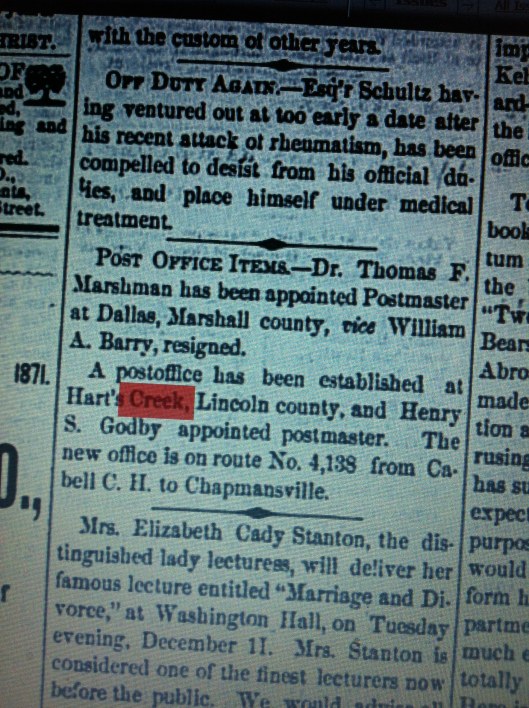
The town of Harts — originally named Hart’s Creek — was established at the mouth of Big Harts Creek in the summer or fall of 1870 when Henry S. Godby, a peg-legged Confederate veteran from Chapmanville, petitioned the government for the creation of a post office called “Hart’s Creek.” At that time, Green Shoal was the most thriving spot in the Harts section of the Guyandotte River. A.S. Fry was its chief businessman and postmaster. Godby’s effort to establish Harts as a postal town was a short-lived venture. By 1876, Green Shoal still reigned supreme in local affairs. According to a business directory, it could boast a gristmill, free school and a Baptist and Methodist church. T.H. Buckley and G.S. Fry were physicians, while Joseph Workman was a clergyman.
Around that time, in 1876, Bill Fowler — a local general storekeeper — petitioned the government for the creation of a “Hearts Creek” post office and established his business headquarters at Harts. Fowler had migrated to the area in 1847 and married a daughter of Elias Adkins, an early settler. After a short stint as a schoolteacher in 1871, Fowler was by 1876 a general storekeeper and owner of some 30 acres of land on the Marsh Fork of West Fork. In March of 1877, he became postmaster of “Hearts Creek;” he was also a saloon keeper according to oral tradition. As his business interest generated profits (primarily in timber), he extended his land holdings. In 1878, he purchased 75 acres on the Guyan River from Abner Vance, valued at $5.00 per acre. The following year, he added a 90-acre tract to his estate on the west side of the Guyan River, valued at $3.25 per acre, which he purchased from brothers-in-law, Aaron and Enos Adkins.
Throughout the period, Fowler was unquestionably the chief businessman in Harts. Curiously, Andrew D. Robinson replaced him as postmaster of Hearts Creek in 1879. Robinson was a Union veteran and former township clerk, justice of the peace, and secretary of the district board of education. He was a brother-in-law to Ben Adams, as well as Sallie Dingess (Hollena Brumfield’s mother). In 1881, Robinson shortened the name of the Hearts Creek post office to “Hart.”
The Green Shoal area, meanwhile, fell into a state of decline as a local economic center. A.S. Fry gave up his postmaster position in 1878. He maintained his local business interests well into the next decade, then turned them over to his son George and left to pursue a hotel business in Guyandotte, a town situated at the mouth of the river in Cabell County. The Green Shoal post office was discontinued in 1879.
By 1880 — roughly the time that Milt Haley came to Harts from “over the mountain” — Harts reigned supreme as the hub of local business affairs. In that year, according to census records, the population of the Harts Creek District was 1,116. There were 1,095 white residents, fifteen blacks and six mulattos. 93-percent of locals were born in Virginia or West Virginia, while six percent were born in Kentucky. Most men worked at farming, although A.S. Fry and Paris Brumfield both had stores. In 1882-1883, Brumfield was listed in a state business directory as a distiller.
At that time, Bill Fowler was the undisputed kingpin of the local business scene. According to Hardesty’s History of Lincoln County, published around 1884, Fowler owned 200 acres of land at the mouth of Harts Creek and 254 acres on Mud River. He also owned 200 acres on Sand Lick Run, a branch of Francis Fork, based on land records at the Lincoln County Courthouse. “That situated on Hart creek produces well,” Hardesty wrote, “and has a good orchard and a part is heavily timbered with oak, poplar and pine; coal and iron ore are quite abundant.” Fowler was the father of four small children, recently born to his second wife.
There were other notable business folks in the neighborhood, namely Isham Roberts, who operated a store near Fowler on the Guyandotte River. He was the son of Dicy Roberts and the stepson of Jack Johnson, a local farmer. In the early 1880s, he married Martha Jane Brumfield, a daughter of Paris Brumfield, and opened a store on rental property at the mouth of Harts Creek. By 1884, when Hardesty wrote his history of the county, he referred to Roberts as “a prosperous young merchant in Hart Creek district, having his headquarters on Guyan river, at the mouth of Big Hart creek. His prices are the most reasonable and the business very extensive.” Roberts was the postmaster at Harts from 1883 until 1884, when Dr. T.H. Buckley replaced him.
James P. Mullins, who operated a general store building above Roberts at Big Branch, was also a budding merchant. By 1882, Mullins was the owner of a $200 storebuilding situated on a 203-acre tract of land. Over the next few years, he added another 55 acres on lower Harts Creek and 150 acres on Francis Fork (this latter tract likely acquired for timbering purposes). Hardesty referred to Mullins as being “of good business qualifications and prosperously engaged in merchandising, with business headquarters on Hart creek, one and one-half miles from its mouth.” In that year, Mullins purchased an additional 93 acres on Harts Creek. One year later, the value of his store building increased by $100, hinting at his growing prosperity.
Writings from my travels and experiences. High and fine literature is wine, and mine is only water; but everybody likes water. Mark Twain
This site is dedicated to the collection, preservation, and promotion of history and culture in Appalachia.
Genealogy and History in North Carolina and Beyond
A site about one of the most beautiful, interesting, tallented, outrageous and colorful personalities of the 20th Century