Harts area businesses (1918-1919)

Tags

, , , , , , , , , , , , , , , , , , , , , , , , , , , , , , , , , , , , , , , , , , , , , , , , ,

The following entries were published in R.L. Polk’s West Virginia State Gazetteer and Business Directory (1918-1919):

ATENVILLE. Population 20. In Lincoln County, on the C&O and Guyan Valley Ry., 27 miles south of Hamlin, the county seat, and 22 north of Logan, the banking point. Baptist church. Telephone connection. Arnold Perry, postmaster.

Anthony Adams, general store

Catherine Adkins, general store

CHARLES ADKINS, GENERAL STORE

Delta Adkins, general store

Hollena Ferguson, general store

Jeremiah Lambert, general store

John Thompson, general store

William M. Workman, general store

William Wysong, general store

FERRELLSBURG. Population 200. On the Guyandotte branch of the C&O Ry, in Lincoln County, 30 miles south of Hamlin, the county seat, and 18 north of Logan, the nearest banking town. Telephone connection. Express, Adams. Tel, W U Mail daily.

H Adkins & Sons, general store

Mrs. Hollena Ferguson, general store

J.W. Stowers, general store

HARTS. (R.R. name is Hart.) Population 15. On the Guyandot Valley branch of the C&O RR, in Lincoln County, 30 miles south of Hamlin, the county seat, and 21 from Logan, the banking point. Express, Adams. Telephone connection.

Charles Adkins, general store

Wesley Ferguson, general store

SPOTTSWOOD. In Logan County, 15 miles northwest of Logan, the county seat and banking point, 10 from Chapmanville, the shipping point. Express, Adams. Mail R F D from Atenville.

Mrs. T. J. Wysong, general store

WHIRLWIND. Population 250. In Logan County, 16 miles northwest of Logan, the county seat and banking point, and 2 from Dingess, the shipping point. Express, Southern. Baptist church. Mail daily. James Mullins, postmaster.

D. Adams, apiarist

Frank Adams, mail carrier

Grover Adams, ginseng

Sol Adams, saw mill

Lindsey Blair, watchmaker

Reece Dalton, live stock

Callo. McCloud, poultry

C.M. Mullins, ginseng

George Mullins, horse dealer

JAMES MULLINS, General Store and Photographer

J.M. Workman, flour mill

NOTE: Some person cited above are duplicated in the original record.

In Search of Ed Haley 332

Tags

, , , , , , , , , , , , , , , , , , ,

The next day, at the fiddling contest, Brandon met George Carr of Madison, West Virginia. George said Ed was the reason he started playing the fiddle many years ago.

“I was raised in Calhoun County,” he said. “I first saw Ed Haley as a small boy in the one-room Walker School House. Sometime in the early ’30s, about ’34, ’35, I’d say. Him and his wife came and they played for us and he fascinated me with that fiddle. And he had a son called ‘Puckett’ and I don’t know what ever became of him. But Ed and his wife would play on the streets in Spencer where the stock sale was every Friday and they would play there and she pinned a tin cup in her apron and they got nickels and dimes and quarters and fifty cents but no greenbacks. He stayed with a fella by the name of Laury Hicks who was a local fiddler and a self-taught veterinarian. His wife, Minnie Hicks, was a midwife — delivered many, many babies — who held my father in her arms when he was a small baby and he died in ’75 and he was 77 years old.”

Dr. Ivan Tribe endorses “Blood in West Virginia”

Tags

, , , , , , , , , , , , , ,

I proudly announce Dr. Ivan Tribe’s endorsement of my book, Blood in West Virginia: Brumfield v. McCoy. Dr. Tribe, Professor Emeritus of History at Rio Grande University, ranks as one of Appalachia’s most distinguished and recognized historians. Best known for his Mountaineer Jamboree (1984), the definitive history of country music in West Virginia, Dr. Tribe is author of six additional books, beginning with Albany, Ohio: The First Fifty Years of a Rural Midwestern Community (1980). Dr. Tribe has also contributed over two hundred articles, composed at least eighty sets of liner notes for albums, and written more than forty record and book reviews. Throughout his long career as an educator and author, he has consistently offered top-notch scholarship on the subjects of traditional country music, bluegrass music, and coal mining communities. While I recommend any one of Dr. Tribe’s writings, his Mountaineer Jamboree remains a personal favorite. Receiving praise from such an outstanding scholar and accomplished author means a great deal to me.

Here is Dr. Tribe’s endorsement of Blood in West Virginia:

“Except for the Hatfield-McCoy Feud which spilled over into two states, eastern Kentucky is better known as Appalachia’s feud country. However, Brandon Kirk’s book demonstrates that Lincoln County, West Virginia had a feud that has been largely overlooked by prior chronicleers. The Brumfields versus a variety of persons named Adkins, McCoy, and Haley made the community of Harts a real hot spot among mountain communities in the late 1880s. Kirk’s Blood in West Virginia tells a fascinating story that elevates the Lincoln County feud to its proper place in Appalachian and West Virginia History.”

Big Ugly News 1916

Tags

, , , , , , , , , , , , , , , , , , ,

During the summer of 1916, two articles printed in the Lincoln Republican offered news regarding Big Ugly Creek in Lincoln County, West Virginia.

ARE MOVING RAILROAD FROM US (Thursday, July 20, 1916)

The Guyan, Big Ugly and Coal River railway running from Gill to a point eight miles above Rector, on Big Ugly creek will soon be a thing of the past, says the Barboursville News. The B. Johnson & Son people who have been operating extensively in that section in the tie and timber business did the last cutting of timber last Thursday and began to tear up the track on the upper end of the line. The iron of that part of the road beyond Leet will be taken up at once and the four miles between the latter place and Gill will be removed as soon as the lumber at Leet is hauled out.

Most of the residents of Leet have moved away in the past week to other timber openings. Albert Gill, a local merchant has bought many of the houses from the company and will tear them down and use the lumber for fencing.

There were between three and four hundred people living at Leet, and most of them will go elsewhere.

COAL GOOD ON BIG UGLY (August 31, 1916)

Civil Engineer Philip Hager was here over Sunday from Big Ugly, where he and his crew have been busy for two or three weeks making coal openings for the Huntington Gas & Development Co. A lot of good coal has been located and the prospects for big coal development on Big Ugly at an early date now looking good.

In Search of Ed Haley 331

Tags

, , , , , , , , , , , , , , ,

About an hour later, Brandon showed up at Pat’s, followed by various members of the Haley clan: Noah, Clyde, and a bunch of children and grandchildren. The house was soon full of people — talking and eating. It was a bittersweet moment due to Lawrence’s absence, although his spirit was everywhere. I watched the Haleys — Ed’s children and grandchildren — business executives, gamblers, bar owners — mix with one another. Conversation was friendly between them, although there seemed to be an estrangement — especially among the younger ones. Basically, they were raised up separate from each other (the “Kentucky Haleys” vs. the “Ohio Haleys”); to be honest, it was as if they really didn’t know each other that well.

I realized that the binding force in Ed’s family — the glue that held all of them together — was the music…or at least the memory of it. Children who had never met before were sitting in the floor together or running through the house and yard — some hearing about Ed for the first time. I kept thinking about how one of them might some day pick up a fiddle and naturally crank out some of those “Haley licks.”

Brandon and I sat in the living room with Noah, Clyde, and Mona. Clyde immediately started talking about Ed.

“I used to hate him — hate that man — the way he treated Mom,” he said.

“Evidently, Mom cared for him or she wouldn’t a let it go on,” Noah said.

“I learnt as I got older and got a little tolerance in my mind I learned to forgive my hate for my dad to something else,” Clyde said. “I give it to God or whatever you want to call it.”

“I think the reason you didn’t like him Clyde was because when we stole them ducks there at Keyser Creek, he took each one in a room by ourself and he took a strap and he held us by the arm and he beat the hell out of us,” Noah said, laughing.

“That was Mr. Runyon’s ducks,” Clyde said. “Yeah, he beat us with the buckle part of that belt.”

“Yeah, and I think that’s why you didn’t like him,” Noah said. “I remember that beating we got.”

Clyde said, “Oh, we got a good one, didn’t we?”

I asked where Ed lived when that happened and Clyde said, “That was a four-room house. Ralph, our oldest brother, he had made a trapdoor in that floor and he used to bootleg moonshine through that trapdoor.”

“Clyde, you remember the cow he stole and kept it under the porch?” Noah asked.

Clyde said, “Yeah, Ralph did that. That wasn’t a cow. That was a calf. Our house stood up on stilts and Ralph or somebody had fenced that all in to keep that calf in. Got that while he was in the CCCs.”

Noah said, “And he built a trapdoor so he could go down through the floor…”

“In the bedroom,” Mona added.

Clyde laughed and said, “Ralph got that calf in the house and he was trying to put that calf up in Mom’s lap and it done something all over Mom.”

In Search of Ed Haley 330

Tags

, , , , , , , , , , , , , , , , , , , , , , , , , , ,

Meanwhile, plans were underway for an “Ed Haley Fiddle Festival” in Ashland. The whole idea was conceived by Pat Gray, a local real estate agent who’d been inspired by an article in the Ashland Daily Independent regarding our interest in Ed’s life. Pat incorporated the “festival” (which was actually a fiddling contest) into Ashland’s Poage Landing Days, a citywide carnival-like celebration centered on the downtown area. The fiddle contest was scheduled to take place in the basement/auditorium of a Presbyterian church in Ashland. Pat declared me the “Grand Marshall” of the Poage Landing Parade, booked my band and I for an evening show and even offered to put us up at her place.

We pulled into Ashland on September 20th, 1996 and parked the bus in a church parking lot just down the hill from Pat Haley’s. Mike Compton, my mandolin player, and I walked up to Pat’s for breakfast (at her invitation) where I found her entertaining Mona and Patsy (Jack’s wife). Mona had written out the words to some of Ed’s songs for me, like “My Happy Childhood Days Down on the Farm”:

When a lad I used to dwell

In a place I loved so well

Far away among the clover and the bees.

Where the morning glory vine

‘Round our cabin door did twine

And the robin red breast sang among the trees.

In my happy boyhood days down on the farm.

There was a father old and gray

And a sister young and gay

And a mother dear to keep us from all harm.

There I passed life’s sunny hours

Running wild among the flowers

In my happy boyhood days down on the farm.

It was obvious that Mona had been thinking a lot about Ed’s music, so I didn’t waste any time getting my fiddle out for her. She caught me a bit off guard when she asked me if she could accompany me using Mike’s mandolin. The next thing I knew, she was playing right along with me — scarily like her mother. After we’d finished a tune everyone got really quiet, then Patsy looked at Mike and said, “You’ve just lost your job.”

Several tunes later, I asked Mona about Ed’s bowing style. There was a lot of conflicting information on that, so I wanted to get her opinion again. She said Ed “mixed things up,” or more specifically, that he varied his bowing between long and short strokes.

I had kinda figured that was true and had even come to think that maybe he had “area bowings,” much like his “area tunes.” It’s really a very natural thing. I play different tunes and different ways when I’m with the Goforths and Hawthornes in Missouri than when I’m with Earl Scruggs and Benny Martin in Nashville, or Fletcher Bright, or Jim Wood, or Bruce Molsky and Brad Leftwich, or Charlie Acuff, or Buddy Spicher, or Hoot Hester.

I should say here that all this business of bow holds, short and long bow strokes, and whether Ed held the fiddle under his chin or not, should never be taken as Scripture. In my own experience, I’ve held the fiddle under my chin, on my arm, on my chest, with all kinds of chin rests, no chin rests, shoulder rests, and used different kinds of bows. (I even used to tape a tin penny nail or two on the bow shaft for weight when I pulled it for long square dances so I wouldn’t have to press down with my index finger.) I’ve bowed heavy, light, long strokes, short strokes, off-string, on-string, and so forth. I’m sure that Ed’s technique — like mine or probably any musician — was constantly changing. What I have tried to document with Ed is who saw him play a certain way, where and when. It’s important to keep that in mind so as to not get lost in the contradictions.

John W. Runyon 3

Tags

, , , , , , , , , , , , , , , , , , , , , , , , , , , , , , , , , , , , , , , , , ,

The John W. Runyon family seems to have headed further south to try their luck elsewhere. In February 1902, Mary Runyon, her recently remarried daughter, Wealthy (Runyon) Hinkle-Fry, and her former son-in-law Clarence Hinkle were listed in Martin County deed records as residents of Buchanan County, Virginia.

John Runyon, meanwhile, soon gave up on his case in Wyoming County. A court entry dated April 2, 1902 and titled “John W. Runyon vs. Buskirk and Wittenberg” mentions how he “failed to give bond for costs as required in an order entered at a former term of the Court.” The Court ruled that “the defendants recover of the plaintiff their costs in their behalf expended in their defense herein including an attorneys fee of $10.00.” Included in this record was a list of thirty-four “Petit Jurors” who were, for some reason, to be paid “out of the County Treasury to wit” for their services in this case, some of them serving as many as nine days and being paid as much as eighteen dollars. It wasn’t clear why jurors served up to nine days, as records indicate that the court dismissed Runyon’s case before it went to trial.

After a short stay in Virginia, the Runyon family returned to Martin County and settled near the old Stidham Post Office on Rockcastle Creek, several miles north of the countyseat of Inez. On June 25, 1903, Wealthy Fry died at the age of 22 years old. Aquillia Porter died on February 20, 1910. A few months later (April 20) her husband remarried to Maude Williamson. Both of the Runyon girls were buried in the Williamson family cemetery at Stidham. Runyon’s legal problems, meanwhile, continued in Martin County as late as the 1910s.

On the bright side, John and Mary Runyon Fork purchased many acres of land around Rockhouse between 1893-1917 and sold at least 1,001 acres in that same vicinity between 1904-1932. Most of it went to their family: Sam Porter got 100 acres in 1910, 50 acres in 1917 and 35 acres in 1925. Various members of the Williamson family also bought tracts from John and Mary Runyon.

In 1920, John W. Runyon was listed in the Martin County Census as a resident of the Stafford Fork Precinct. He was a 65-year-old general laborer. His wife Mary was 55 years old. Asa G. Williamson, age 52, brother-in-law, was also in the household. Next door was the family of grandson John W. Porter, a 23-year-old farmer, with wife Etta M. (age 23). There were two children listed: Analena, age three; and Virginia Lee, age one. Aubrey Lee Porter, 22-year-old brother to John, who was also present in the home and employed as a coal miner.

John Runyon died on January 12, 1925 in Martin County. His widow spent her final years under the care of his niece, Mary (Runyon) Fields, who had been listed with the family in the 1900 Wyoming County Census. Mary was a daughter of John’s twin brother. She married Bill Fields and participated in much of the “family business” (marriage records, land transactions). Mary Runyon was still alive in 1952, when the Runyon genealogy book was assembled and was a source on the Adam Runyon family line.

Back in Ferrellsburg, Brandon called Bill Porter, an 80-year-old man in the Inez-area who was distantly connected to John Runyon’s family. He hadn’t known Runyon personally but said, “He was a well-thought of person. He followed the timber business. Everywhere he went he had bad luck. He was pretty bad to crook people.”

Mr. Porter said the Runyon place sat just above the old Stidham Post Office at Graveyard Point and told all about the Runyon descendants. He said Aubrey Porter married a Williams and raised a family of three children (including one son named Jimmy) in Columbus, Ohio. John W. Porter had two children — Merrill and John, Jr — and lived in Norfolk, Virginia. Hattie (Hinkle) Apney had two daughters: one named Guiniford, who married Russell Goble (an active member of the Inez School Board for years), and Jean, who married Virgil Ramey. Mr. Porter thought Hattie divorced her husband and moved to Point Pleasant, West Virginia, where she died.

Low Gap United Baptist Church moderators, 1898-1944

Tags

, , , , , , , , , , , , , , , , , , , , , , ,

List of Moderators for the Low Gap United Baptist Church at Low Gap, near Ferrellsburg, Lincoln County, WV:

Gilbert Moore (1898-1899)

Isaac Marion Nelson (1899)

Andrew Elkins (1899)

Isaac Marion Nelson (1900-1902)

Mathias Elkins (1903-1904)

Isaac Marion Nelson (1904)

Mathias Elkins (1904-1907)

M.F. Barker (1907-1908)

Isaac Marion Nelson (1908-1913)

Grover Gartin (1914-1915)

Benjamin W. Walker (1915-1917)

George W. Hensley (1917-1921)

Unknown (1921-1923)

Paris Hensley (1923)

John Bryant (1923)

George W. Hensley (1924-1925)

Charles Curry (1926-1927)

Stonewall Hensley (1928)

Charles Curry (1929-1931)

George W. Hensley (1931-1932)

Musco Adkins (1932)

Elcanan C. Lucas (1933-1941)

Josiah S. Tomblin (1941)

Golden Headley (1941-1942)

Arnold Bailey (1942-?)

Smith Wiley (1944-?)

Jackson Mullins military record, 1862-1863

Tags

, , , , , , , , ,

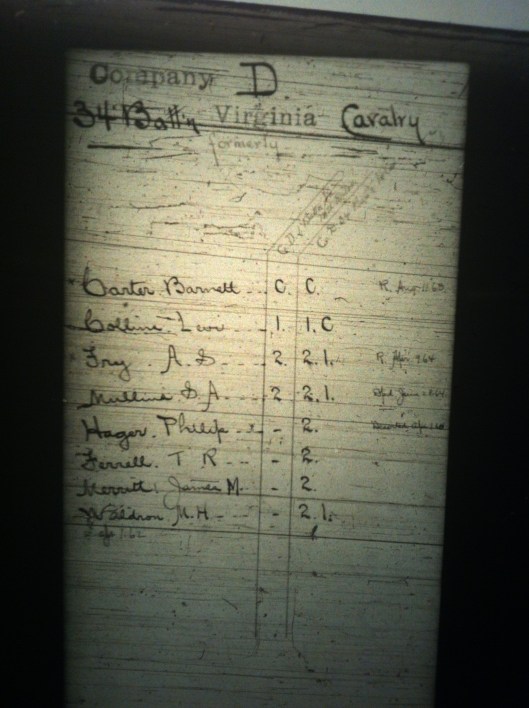
A J Mullins military record 1

Jackson Mullins military record, Company D, 34th Battalion Virginia Cavalry, 1862-1863


A J Mullins military record 2

Jackson Mullins military record, Company D, 34th Battalion Virginia Cavalry, 1862-1863


A J Mullins military record 3

Jackson Mullins military record, Company D, 34th Battalion Virginia Cavalry, 1862-1863


John W. Runyon 2

Tags

, , , , , , , , , , , , , , , , , , , , , , , , , , ,

In that same time frame, John W. Runyon moved his family to Baileysville in Wyoming County, West Virginia, where he opened a business under the name of “Porter and Runyon.” He began to buy various items by credit at a store owned by Buskirk and Wittenberg, a partnership of contractors operating under the powerful Cole and Crane Company.

According to Bowman’s Reference Book of Wyoming County History (1965): “C. Crane and Co., by its contractors, Buskirk and Wittenburg, began a new era of removing timber by water. The company began building dams as soon as possible after taking over the contract.”

Buskirk and Wittenburg were often permitted to construct “roads for their convenience” and to destroy bridges for the purpose of splashing so long as they had them rebuilt. They built the only splash dam ever constructed on the Guyan River around 1903.

“The company maintained well stocked commissaries and logging camps to take care of their men,” according to the Wyoming County history. The main camp in their operation “had a commissary, blacksmith shop, business office, and post office named Vorheis, in honor of Buskirk’s daughter who had married a man named Vorheis. There were camps at Baileysville… Camps and stores were relocated from time to time as needed.” Their stores “carried a large and varied stock, including up-to-date clothing.”

Runyon’s bill at Buskirk’s and Wittenberg’s store began on May 22, 1899, when he bought a nine-dollar suit, and extended until July 17, 1900, when the store debt totaled $6,495.78. According to the bill, Runyon primarily purchased ordinary store items: bacon, beans, fruits, vegetables, coffees, tobacco, herbs, spices, silverware, kitchen utensils, nails, soap, shoes, hats, gloves, watches, candy, and various types of clothing. He also had bought a plethora of luxury items: a case of oysters, Cuban Gentlemen Cigars, several boxes of chewing gum, a box of roasted peanuts, dolls, musical instruments (including a violin), picture frames, guns, locks, turpentine, Castor Oil, clocks, fire crackers, and fishing gear.

Beginning on September 28, 1899, Runyon and Porter paid periodically on the bill (although Porter’s name was seldom mentioned specifically) and Runyon personally contributed $280.00 in January of 1900. The business folded around September 13, 1900, when Runyon made his last payment to Wittenberg and reduced his bill to $640.15.

Meanwhile, the census enumerator registered Runyon as follows: “John W. Ru[n]yon, logger, rents home, born Feb 1856 in KY, age 44, married 20 years, both parents born KY; Mary M. Ru[n]yon, born January 1861 in KY, age 39, married 20 years, mother of 1 child which is living, parents born in KY; Mary M. Ru[n]yon, born March 1889 in KY, age 11, niece, both parents born in KY.” John’s son-in-law Clarence Hinkle was listed two households away as a logger. Sam Porter was not listed in the census — perhaps well aware of the impending debt owed to Buskirk and Wittenberg. Little Mary Runyon was a daughter of John’s twin brother.

There were other legal troubles. In June of 1901, Drs. S.A. Daniel and C.W. Hall sued Runyon for a $50 debt (with interest). Apparently the doctors had rendered services to a James Ramey with the understanding that Runyon would pay his bill. When the trial took place on June 15, Runyon failed to show up. The court waited for an hour, then heard the plaintiff’s case and ruled against him. Curiously enough, Runyon appealed the decision on June 24, with funds for his appeal bond ($120) coming from the very doctors who originally sued him. In September a summons was delivered to an Anderson Beverly to appear as Runyon’s witness. On April 2, 1902 his appeal came before the court and the doctors didn’t appear even “though thrice solemnly called.” As a result, the judge ruled in Runyon’s favor and stated that he was to be paid “$5.00 for their false clamor herein” and that he “recover of the plaintiffs his costs in this behalf expended including an attorneys fee of $5.00 allowed by statute.”

By that time, Runyon was in a more serious lawsuit with Buskirk and Wittenberg over his store debt. In early July of 1901, Wittenberg sued Runyon and Porter, stating that he had not received a payment from them since September of the previous year. Wittenberg’s contacts with area politicians and influential residents had obvious legal implications. Runyon and Porter were issued a summons to appear in court on the first Monday in August to answer “A.R. Wittenberg of a plea of Trespass on the case in assumpsit damages $6,500.00.” Wittenberg’s use of the figure $6,500 referred to the original debt of $6,495.78, although records show the amount actually owed was $640.15. On the outside of this summons the following was written in poor handwriting, probably by a deputy-sheriff: “Serve[d] on the within name John W. Runyon by delivering to him an office copy of the within summon[s] in person on July 12, 1901.” A summons couldn’t be served to S.W. Porter who was “not found within my bailiwick this July 13, 1901.”

Porter was apparently not a resident of West Virginia (probably Kentucky). An affidavit of Non-Residence was filed on his behalf on August 5, 1901.

“This day I.E. Christian Personally appeared before me E.M. Seuter a Notary Public within and for said Wyoming County, West Virginia and upon oath says that S.W. Porter one of the defendants in the above styled action is a Nonresident of the State of West Virginia,” it read.

Because Wyoming County law couldn’t find him to serve a summons, an Order of Publication was issued on the first Monday in August 1901.

“At Rules held in the Clerk’s Office of the Circuit Court of Wyoming County on the first Monday in August 1901 A.R. Wittenberg vs. John W. Runyon and S.W. Porter partners trading and doing business under the firm name and style of Porter and Runyon,” it read. “The object of the above suit is to obtain a Judgment in favor of the plaintiff against the defendants for the sum of $640.15 and it appearing from an affidavit made and filed with the papers of this cause that S.W. Porter defendant in the above signed cause is a non resident of the State of West Virginia, and on motion of the plaintiff it is ordered that said defendant S.W. Porter do appear at Rules to be held in the clerk’s office of the circuit court of Wyoming County within one month after the first publication of this order and do what is necessary to protect his interest in this suit.”

Wittenberg spent five dollars and fifty cents paying for this publication, which was featured in the Wyoming Tribune from August 9th until August 30th.

It did little good. Porter was basically untouchable by Wyoming County authorities barring extradition papers.

Information at the Wyoming County Courthouse indicated that he never showed up to answer for his part in the failed business and, in so doing, crippled Runyon’s case against Wittenberg.

There is little information available on the actual trial, although records show the judge ruled against Runyon for $614.50 on September 30, 1901. Totaled near this figure was a compilation of the plaintiff’s costs ($32.81), which indicated that he was expected to pay that fee as well. Presumably, all of this debt fell on Runyon since his partner had left the state. He decided to appeal the case but as a non-property owner in Wyoming County, the owner of a failed business, and with no local contacts loyal enough to assist him, he was unable to put forth enough money to post the necessary bond. Wittenberg, meanwhile, prepared his case and hired lawyers.

John W. Runyon 1

Tags

, , , , , , , , , , , , , , , , , , , , , , , , , , , , , , , , , , , , , , , , , , , , , , , , , , , , , , ,

In the late summer of 1996, Brandon and Billy turned their genealogical sights on John W. Runyon, that elusive character in the 1889 story who seemed to have stirred up a lot of trouble and then escaped unharmed into Kentucky. They arranged a biographical outline after locating two family history books titled Runyon Genealogy (1955) and Alden Williamson Genealogy (1962). Then, they chased down leads at the Cultural Center in Charleston, West Virginia; the Wyoming County Courthouse at Pineville, West Virginia; the Wayne County Courthouse in Wayne, West Virginia; the Martin County Courthouse at Inez, Kentucky; and at various small public libraries in eastern Kentucky. Runyon had left quite a trail.

John W. Runyon was born in February of 1856 to Adam and Wealthy (Muncy) Runyon, Jr. in Pike County, Kentucky. He was a twin to James Bertrand Runyon and the ninth child in his family. His mother was a daughter of James Muncy — making her a sister to Nellie Muncy and an aunt to Milt Haley. In other words, John Runyon and Milt Haley were first cousins.

According to Runyon Genealogy (1955), Adam and Wealthy Runyon left Pike County around 1858 and settled on the Emily Fork of Wolf Creek in present-day Martin County. In 1860, they sold out to, of all people, Milt Haley’s older half-brother, Moses Parsley, and moved to Pigeon Creek in Logan County. John’s grandfather, Adam Runyon, Sr., had first settled on Pigeon Creek around 1811. The family was primarily pro-Union during the Civil War.

At a young age, Runyon showed promise as a timber baron.

“The first lumber industry in Logan County of any importance was started on Crawley Creek by Garrett and Runyon during the year 1876,” Bob Spence wrote in Land of the Guyandot (1978). “Garrett and Runyon deserve credit for their efforts in opening the lumber business in Logan County. They were the first to hire labor in this field. It might be of interest to note here that they originally brought trained men from Catlettsburg… In a few years, Garrett and Runyon left Logan [County], and soon Enoch Baker from Nova Scotia came to Crawley Creek to take their place.”

John may have put his timber interests on hold due to new developments within his family. According to Runyon Genealogy, his mother died around 1878 and was buried at Peach Orchard on Nat’s Creek in Lawrence County, Kentucky. His father, meanwhile, went to live with a son in Minnesota. In that same time frame, on Christmas Day, 1878, Runyon married Mary M. Williamson, daughter of Stephen and Ellender (Blevins) Williamson, in Martin County, Kentucky. He and Mary were the parents of two children: Aquillia Runyon, born 1879; and Wealthy Runyon, born 1881. John settled on or near Nat’s Creek, where his father eventually returned to live with him and was later buried at his death around 1895.

During the late 1880s, of course, Runyon moved to Harts where he surely made the acquaintance of Enoch Baker, the timber baron from Nova Scotia. An 1883 deed for Henderson Dingess referenced “Baker’s lower dam,” while Baker was mentioned in the local newspaper in 1889. “Enoch Baker, who has been at work in the County Clerk’s office and post office for several weeks, is now on Hart’s creek,”  the Logan County Banner reported on September 12. Baker was still there in December, perhaps headquartered at a deluxe logging camp throughout the fall of 1889.

After the tragic events of ’89, Runyon made his way to Wayne County where he and his wife “Mary M. Runyons” were referenced in an 1892 deed. Wayne County, of course, was a border county between Lincoln County and the Tug Fork where Cain Adkins and others made their home. He was apparently trying to re-establish himself in Martin County, where his wife bought out three heirs to her late father’s farm on the Rockhouse Fork of Rockcastle Creek between 1892-1895.

In the late 1890s, John’s two daughters found husbands and began their families. On January 3, 1896, Wealthy Runyon married Clarence Hinkle at “John Runyonses” house in Martin County. She had one child named Hattie, born in 1899 in West Virginia. On March 29, 1896, Aquillia Runyon married Samuel W. Porter at Mary Runyon’s house in Martin County. They had three children: John W. Porter, born in 1897 in West Virginia; Aubrey Lee Porter, born in 1899 in Kentucky; and Izella Porter, who died young.

Major William Straton

Tags

, , , , , , , , , , , , , , , , , , , ,

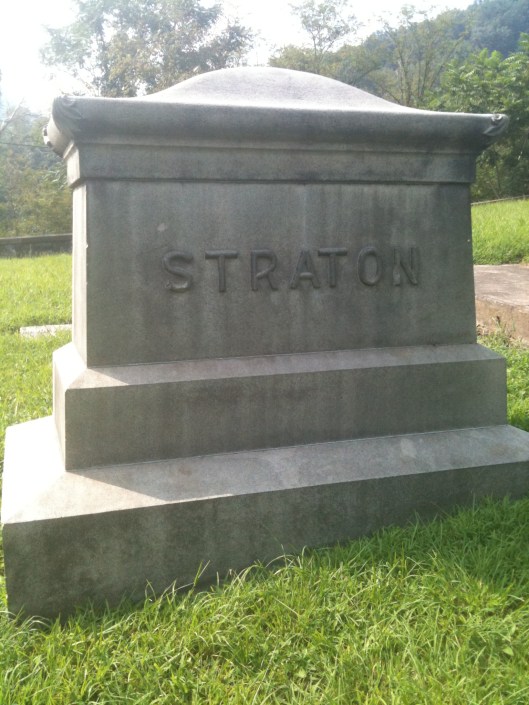
Straton Headstone

Major William Straton headstone, Logan, WV, 2010

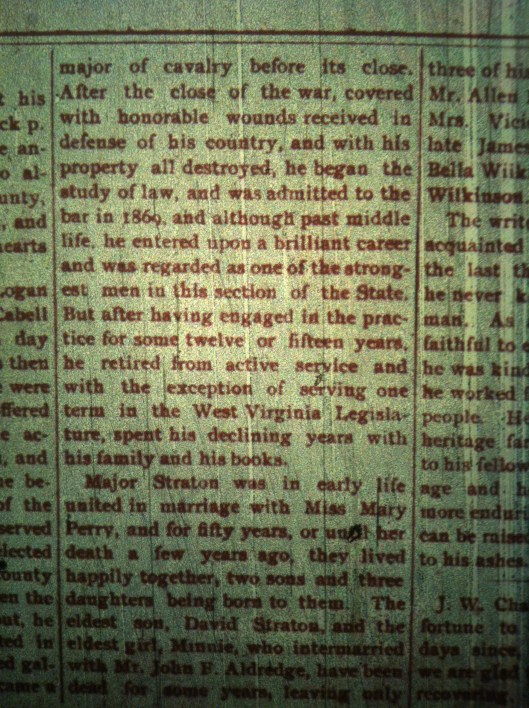
Major Straton obit LB 7.2.03 1

William Straton obituary, Logan (WV) Banner, July 2, 1903

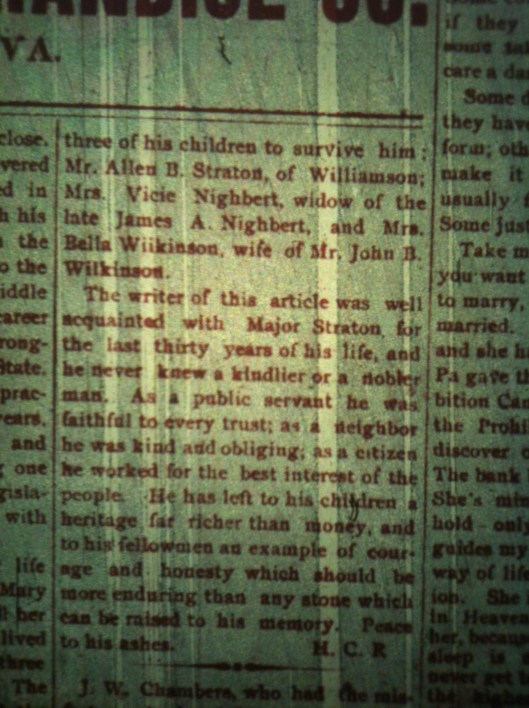
Major Straton obit LB 7.2.03 2

William Straton obituary, Logan (WV) Banner, July 2, 1903

Major Straton obit LB 7.2.03 3

William Straton obituary, Logan (WV) Banner, July 2, 1903


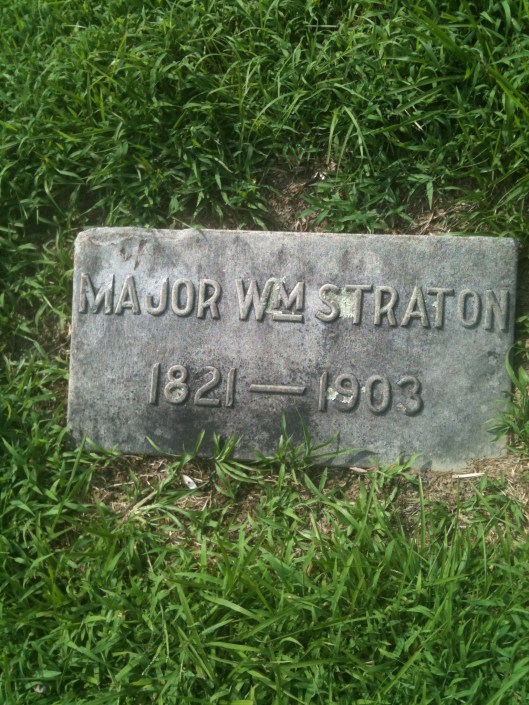
Major William Straton Grave

Major William Straton footstone, Logan, WV, 2010

Dr. Ronald L. Lewis endorses “Blood in West Virginia”

Tags

, , , , , , , , , , , , , , , , ,

I proudly announce Dr. Ronald L. Lewis’ endorsement of my book, Blood in West Virginia: Brumfield v. McCoy. Dr. Lewis, professor emeritus of history at West Virginia University and Historian Laureate of West Virginia, ranks as one of Appalachia’s most distinguished and recognized historians. Best known for his award-winning book, Transforming the Appalachian Countryside (1998), an unsurpassed study of the timber industry in West Virginia, Dr. Lewis is author of five books, beginning with Coal, Iron, and Slaves (1979), as well as numerous articles. Throughout his long career in academia, he has consistently offered top-notch scholarship on the subjects of ethnicity, labor, industrialization, and social change, particularly as they apply to West Virginia and Appalachian history. While I would recommend any one of Dr. Lewis’ writings, his Transforming the Appalachian Countryside remains a personal favorite. Receiving praise from such an outstanding scholar (and personal hero) means a great deal to me.

Here is Dr. Lewis’ endorsement of Blood in West Virginia:

“The family feud is indelibly linked with Appalachia in American popular culture. As portrayed by sensationalist reporters and local color writers of the late 19th century, feuding was evidence of the genetic and/or cultural degeneracy of a people whose lack of social institutions and isolation had arrested their culture in a frontier state as American progress bypassed the region on its way westward. Appalachia was ‘a strange land with peculiar people’ and ‘a place where time stood still.’ Unfortunately, there is not a shred of evidence for this social construction of the region or the ‘hillbilly’ stereotype: that Appalachians were governed by an irrational predisposition to violence. Since the 1980s, scholars have rejected the popular-culture view of drunken hillbillies ready to shoot at the drop of a hat to protect family honor. Brandon Kirk’s Blood in West Virginia is one of the modern community studies that obliterate the stereotype; his intensive research of the Brumfield-McCoy feud that occurred in 1889-90 at Hart, West Virginia, reinforces the revisionist view that feuds occurred as the result of industrial capitalism, rather than the lack of it. Most Appalachian feuds occurred in the mountain counties of southern West Virginia and eastern Kentucky during the last two decades of the 19th century when railroad, timber, and coal development virtually transformed the region’s economy from its traditional agricultural economy into a rural-industrial one. Kirk clearly demonstrates that the Brumfield-McCoy feud was a struggle between rival factions to control the area’s economic and political development. Family ties among the feudists were incidental. Motives for the feud were, therefore, not peculiar to Appalachian culture; after all, violence for economic and political control in industrializing America was as American as apple pie. Blood in West Virginia is an exciting story well-told; fortunately, it is one that preserves the truth rather than perpetuates the stereotypes.”