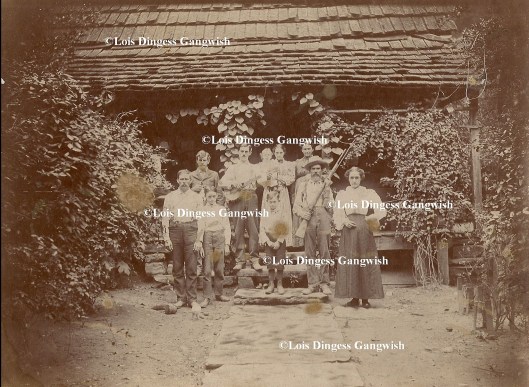
Aaron Altizer

Tags

, , , , , , , , , , , , , , , , , , , , , , , , , , , , , , , ,

From “Virginia and Virginians, 1606-1888,” published by H.H. Hardesty, we find this entry for Aaron Altizer, who resided at Man, West Virginia:

Son of Emory and Margaret (Griffith) Altizer, was born July 23, 1826, in Floyd county, Va. His father was born Mar. 5, 1788, in Montgomery county, Va., and died there Jan. 10, 1875. His mother was born June 6, 1781, in Pittsylvania county, Va., and died Mar. 16, 1883, in Montgomery county. On May 27, 1847, he was married to Sarah Scaggs, the marriage occurring in Montgomery county, where she was born Mar. 22, 1828. She died June 7, 1876, leaving 10 living children and two deceased: Perry G., born Mar. 20, 1848; Joseph, born Aug. 23, 1849; Mary M., born April 6, 1851; Corilda B., born Sept. 8, 1853, and died Aug. 11, 1854; Charles T., born April 12, 1855; Parthenia, born Feb. 9, 1857, and died May 18, 1858; George R., born Jan. 30, 1859; Andrew B., born May 23, 1861; Emory, born April 9, 1863; William, born April 26, 1865; Aaron L., born May 8, 1868, and Henry, born April 6, 1871. On April 15, 1878, Mr. Altizer was married to Mary Aliff, who was born June 10, 1839, in Roanoke county, Va. Mr. Altizer was elected justice of the peace in 1865, serving until 1870; elected county superintendent, serving one term; elected deputy sheriff, serving from 1873 to 1875; again in 1884 he was elected justice of the peace, serving four years; is at present postmaster at Man, Logan county, W.Va., and is engaged in farming.

Source: Dr. R.A. Brock, Virginia and Virginians, 1606-1888 (Richmond, VA: H.H. Hardesty, Publisher, 1888), 814-815.

The Life of Pioneers 3

Tags

, , , , , , , , , ,

This history of early life in Logan County, West Virginia, was written by Howard and Daisy Adams. Howard (1906-1976) and Daisy (b.1915) were children of Major and Belle Dora Adams of Trace Fork of Harts Creek. Titled “The life of pioneers during the latter half of the eighteenth century and the beginning of the 19th century” and written in the late 1960s or early 1970s, their history marks the only known attempt by local people to reconstruct the story of pioneer life. This part of the history includes information regarding interior furnishings of log cabins.

For light they had candles and oil lamps which usually set on the, you guessed it, the dresser. Also the pills and bottles of medicine such as Samaraten oil, Turpentine, Iodine, Castor oil, Epsom salts, swamp root, Raymond’s pills, etc. all were setting on dresser. Some of these were put on a long board over the fire place. This board was called a fire board mantel. Now maybe a little table called a stand table and a trunk. This was about all the big house had in the way of furniture.

The people always had plenty of quilts and blankets and feather bed and shuck or straw mattresses, good big pillows. Boy, you sure could sleep soundly if it wasn’t for the big old clock striking so loud.

The kitchen had a table for eating with a long bench behind it next to the wall. Also a small table to set water and other things on. Yes, they had a cupboard safe to keep food and dishes, knives and forks, spoons, butcher knives, etc. in. And as to the way of cooking, some people cooked the old way over a big wood fire in the fireplace using what was known as a skillet and lid. Later they had stoves. A little stove with a step-up in the middle of it. They called it a step stove. The skillets, pots, pans and etc. were hung on the nails driven in the wall near the stove.

They had old time flat irons which were used to iron or press their linens and clothes with. Not too much pressing was done.

The kitchen had a small cellar under the floor. It was cribbed or boarded up and had shelves for storing canned vegetables and sweet potatoes.

To keep out the cold air the cracks between the logs of house were filled with clay. It was called chinking or daubing the house.

James S. Aldredge

Tags

, , , , , , , , , , , , , , , , , ,

From “Virginia and Virginians, 1606-1888,” published by H.H. Hardesty, we find this entry for James S. Aldredge, who resided at Logan Court House in Logan County, West Virginia:

Late Logan county surveyor, residing at Logan Court House, W.Va., was born in Floyd county, Va., Jan. 26, 1859; was married in Logan county, W.Va., on Mar. 16, 1879, to Miss Alice B. Perry, who was born in Logan county Aug. 14, 1855; their home has been brightened by the following sons and daughters, all now residing with their mother: Stanton and George L., born Feb 10, 1880; Cora B., born Jan. 31, 1882; Thomas E., born June 21, 1884; James C., born Jan. 2, 1887. Mr. J.S. Aldredge was elected surveyor of Logan county in 1884, which office he filled most acceptably until his death, Aug. 4, 1887. This sad occurrence was deeply lamented by all who had known him. He was a man of the highest nobility of character, and though cut down in the prime of his young manhood, yet had done much to endear him to many friends who regret his untimely death. His widow and children reside in the beautiful home he had made for them at Logan Court House, [W]Va.

Source: Dr. R.A. Brock, Virginia and Virginians, 1606-1888 (Richmond, VA: H.H. Hardesty, Publisher, 1888), 814.

Francis M. Alderman

Tags

, , , , , , , , , , , , , , , , , , , ,

From “Virginia and Virginians, 1606-1888,” published by H.H. Hardesty, we find this entry for Francis M. Alderman, who resided in Wyoming County, West Virginia:

Francis M. Alderman was born Dec. 10, 1836, in Floyd county, Va. He enlisted in the service of the Confederate States in 1861 in Co. F, 45th Va. V., I., serving until the close of the war; was wounded in the battle of Cross Lanes, Va. On Mar. 14, 1864, in Bland county, Va., he was united in marriage with Virginia O. Comesford, who was born April 18, 1843, in Giles county, Va. The result of this union has been five children: George W., born July 14, 1866, married; Harman H., born Feb. 14, 1868, married; James F., born Oct. 26, 1871; Frank W., born Nov. 25, 1873; and Ollie C., born Nov. 24, 1885. Mr. Alderman is engaged in farming near Sun Hill, Wyoming county, W.Va., which is his address.

Source: Dr. R.A. Brock, Virginia and Virginians, 1606-1888 (Richmond, VA: H.H. Hardesty, Publisher, 1888), 814.

Fourteen Mile Creek Post Offices

Tags

, , , , , , , , , , , , , , , , , , , , , ,

Fourteen Mile Creek, located in Harts Creek District and Laurel Hill District of Lincoln County, West Virginia, has hosted two post offices: Fourteen (1877-1933) and Wewanta (1903-1947). Today, no post office exists on Fourteen Mile Creek. I descend from several of these postmasters.

Fourteen Post Office (1877-1933)

Albert M. Adkins: 10 January 1877 – 27 April 1880

Andrew Elkins: 27 April 1880 – 22 June 1898

William A. Sias: 22 June 1898 – 26 July 1898

James W. Sias: 26 July 1898 – 6 July 1905

Tice Elkins: 2 January 1907 – 6 February 1907

Albert Neace: 6 February 1907 – 19 August 1916

Henry H. Sias: 19 August 1916 – 15 October 1918

Post office discontinued: 30 September 1918, effective 15 October 1918, mail to Wewanta

Alta M. Farley: 14 April 1926 – 30 December 1933

Post office discontinued: 9 December 1933, effective 30 December 1933, mail to Ranger

Wewanta Post Office (1903-1947)

Alexander C. Collins: 6 May 1903 – 30 September 1903

Elihu D. Burdett: 30 September 1903 – 4 May 1904

Winfield S. Enochs: 4 May 1904 – 14 February 1921

Rayburn Adkins: 14 February 1921 – 23 February 1923

Earl McCoy: 23 February 1923 – 18 November 1924

A. Vinson Ramey: 18 November 1924 (9 December 1924, assumed charge) – 15 September 1947

Post office discontinued: 3 September 1947, effective 15 September 1947, mail to Ranger

Source: U.S. Appointments of Postmasters, 1832-1971, maintained by the National Archives and Records Administration.

Post Offices of Wayne County, WV

Tags

, , , , , , , , , , , , , , , , , , , , , , , , , , , , , , , , , , , , , , , , , , , , , , , , , , , , , , , , ,

The following post offices in Wayne County, West Virginia, represent some of my favorite locations: Adkin’s Mills (1869-1891), Cove Creek (1869-1912), Cove Gap (1877-?), Kiahsville (1884-?), Queen’s Ridge (1884-?), and Stiltner (1906-?). This list will be updated as time permits.

Adkin’s Mills Post Office (1869-1891)

Chapman Adkins: 19 August 1869 – 19 February 1873

Noah Peters: 19 February 1873 – 11 August 1874

Joseph Workman: 11 August 1874 – 14 March 1876

Nathaniel Turner: 14 March 1876 – 5 July 1876

John H. Napier: 5 July 1876 – 8 October 1877

Albert Watts: 8 October 1877 – 23 April 1879

Chapman Fry: 23 April 1879 – 8 January 1880

William Vaughan: 8 January 1880 – 20 September 1888

Charles W. Tabor: 20 September 1888 – 15 August 1889

Thomas Jackson: 15 August 1889 – 14 January 1891

Changed to East Lynn: 14 January 1891

Cove Creek Post Office (1869-1912)

Walter Queen: 17 May 1869 – 11 August 1870

John H. Queen: 11 August 1870 – 31 July 1871

Post office discontinued: 31 July 1871

Jackson Adkins: 8 April 1873 – 25 November 1874

Jesse Fry: 25 November 1874 – 31 May 1881

Walter Queen: 31 May 1881 – 16 August 1889

Walter Frasher: 16 August 1889 – 27 August 1909

Lindsey Frasher: 27 August 1909 – 15 July 1912

Post office discontinued: 15 July 1912, mail to East Lynn

Cove Gap Post Office (1877-?)

John McCoy: 10 January 1877 – 9 October 1877

Alexander Collins: 9 October 1877 – 23 October 1878

George W. Wiley: 23 October 1878 – 31 August 1885

Charles W. Tabor: 31 August 1885 – 20 January 1886

Frank M. Dickson: 20 January 1886 – 16 August 1887

William P. Mankin: 16 August 1887 – 12 October 1889

Rufus Pack: 12 October 1889 – 11 November 1889

G.F. Collins: 11 November 1889 – 8 March 1890

Mrs. Malinda M. Enochs: 8 March 1890 – 17 April 1896

Winfield S. Enochs: 17 April 1896 – 28 July 1898

Walter G. Sparks: 28 July 1898 – 6 November 1900

Rayburn Adkins: 6 November 1900 – 30 January 1901

Leander J. Adkins: 30 January 1901 – 31 January 1903

George W. Wiley: 31 January 1903 – 8 August 1912

Rayburn Adkins: 6 June 1914 – 6 January 1921

Samuel Dyer: 6 January 1921 – ?

Kiahsville Post Office (1884-present)

Joshua Queen: 16 June 1884 – 19 July 1895

Thomas P. Maynard: 19 July 1895 – 1 December 1921

Raymond Maynard: 1 December 1921 – ?

Queen’s Ridge Office (1884-?)

Louis C. Queen: 16 June 1884 – 5 May 1914

Checker S. Queen: 5 May 1914 – 13 September 1917

Willie Jones: 13 September 1917 – ?

Stiltner Post Office (1906-?)

Sherman Maynard: 12 November 1906 – 31 May 1907

William D. Frasher: 31 May 1907 – 18 June 1914

Frank H. Fry: 18 June 1914 – 7 December 1918

William D. Frasher: 19 April 1929 – ?

Source: U.S. Appointments of Postmasters, 1832-1971, maintained by the National Archives and Records Administration.

Additional notes provided by Lucian W. Osborn in his “History of East Lynn Community” (1927): “There was no post office in this section until after the Civil War and the people here and for many miles above here had to go to Wayne Court House for their mail. But in 1868 Adkins Mill postoffice was established at the water mill then owned by Attison Adkins, one and one-half miles from our present community center. Chapman Adkins was the first postmaster. I am told that the amount of mail then received was so small that no mail bags were required to carry it in, and the mail only went once a week. After a few years the office was moved to the community center, and after going through various hands W. D. Vaughan was appointed postmaster in 1876. He moved the office down to where “Uncle Robert” Napier lived, a short distance from where the railroad depot now stands. Later Mr. Vaughan moved the office to where he now resides and kept it till about 1888 when C. W. Tabor was appointed postmaster. The office was then moved back to the community center and placed in H. Watts’ store. Soon after this the name was changed from Adkins Mill to East Lynn. Mr. Vaughn informs me that when he took charge of the office the pay for one month was only about five dollars and that not as much mail was received at the office in two months as is now received in one day.”

Big Harts Creek Post Offices

Tags

, , , , , , , , , , , , , , , , , , , , , , , , , , , , , , , , , , , , , , , , , , , ,

Big Harts Creek, located in Harts Creek District of Lincoln County, West Virginia, and Chapmanville District of Logan County, West Virginia, has hosted seven post offices: Hearts Creek/Hart’s Creek/Hart/Harts (1870-present), Warren (1884-1894), Spottswood (1901-1908), Halcyon (1906-1923), Whirlwind (1910-1950s), Enzelo (1916-1922), and Shively (1926-?). Today, one post office exists at the mouth of Harts Creek in the town of Harts.

Enzelo Post Office (1916-1922) — located in the Logan County section of Harts Creek

Ulysses S. Richards: 22 March 1916 – 15 December 1922

Post office discontinued: 15 December 1922

Halcyon Post Office (1906-1923) — located near the mouth of Marsh Fork of West Fork of Harts Creek in Logan County

Albert Dingess: 3 May 1906 – 20 April 1921

Everet Dingess: 20 April 1921 (took possession), 11 May 1921 (acting postmaster), 21 September 1921 – 14 July 1923

Post office discontinued: 14 July 1923, mail to Ferrellsburg

Hearts Creek Post Office (1870-1872) — located at the mouth of Big Harts Creek in Lincoln County

Henry S. Godby: 3 November 1870 – 20 November 1872

Post office discontinued: 20 November 1872

Hart’s Creek Post Office (1877-1880) — located at the mouth of Big Harts Creek in Lincoln County

William T. Fowler: 2 March 1877 – 9 September 1879

Andrew D. Robinson: 9 September 1879 – 2 December 1880

Post office discontinued: 2 December 1880

Hart Post Office (1881-1910) — located at the mouth of Big Harts Creek in Lincoln County

Andrew D. Robinson: 6 July 1881 – 12 November 1883

Isham Roberts: 12 November 1883 – 3 June 1884

Thomas H. Buckley: 3 June 1884 – 1 July 1884

George W. Adkins: 1 July 1884 – 25 May 1885

William E. “Ross” Fowler: 25 May 1885 – 30 October 1891

Post office discontinued: 30 October 1891, mail to Fourteen

Allen Brumfield: 19 January 1900 – 6 September 1905

Hollena Brumfield: 6 September 1905 – 25 July 1907

Hollena Ferguson: 25 July 1907 – 30 July 1910

Post office discontinued: 30 July 1910, mail to Queens Ridge

Harts Post Office (1916-present) — located at the mouth of Big Harts Creek in Lincoln County

Lewis Dempsey: 5 April 1916 – 12 April 1921

Herbert Adkins: 12 April 1921, 30 April 1921 (assumed charge) – 31 December 1953 (retired)

Glen R. Dial: 31 December 1953 (assumed charge), 22 January 1954 (acting postmaster), 8 March 1955 (confirmed) – 29 July 1966 (removed)

Shively Post Office (1923-?) — located on Smokehouse Fork of Big Harts Creek in Logan County

A. Butcher: 1923-1924

Ina E. Adams: 4 December 1925 (acting postmaster), 18 January 1926 – 2 August 1935

John S. Butcher: 2 August 1935 (assumed charge), 18 September 1935 (acting postmaster), 25 October 1935 – 1 January 1949

Mrs. Sallie Farley Adkins: 1 January 1949 (assumed charge), 10 June 1949, 1 October 1949 (assumed charge) – 22 July 1958 (resigned)

Nora St. Clair: 22 July 1958 (assumed charge) –

Spottswood Post Office (1901-1908) — located near the mouth of Trace Fork in Logan County

Alice Adams: 9 October 1901 – 4 August 1905

Alice Adams Dingess: 4 August 1905 – 31 December 1908

Post office discontinued: 31 December 1908

Warren Post Office (1884-1894) — located near the mouth of Smokehouse Fork in Lincoln County (today Logan County)

Andrew D. Robinson: 17 June 1884 – 17 January 1894

Post office discontinued: 17 January 1894

Whirlwind Post Office (1910-1950s)

L.W. Riddle: 31 March 1910 – 25 May 1911

Sol Riddell: 25 May 1911 – 30 April 1914

James Mullins: 30 April 1914 –

NOTE: For more information regarding the Whirlwind PO, see other posts at this blog.

Source: U.S. Appointments of Postmasters, 1832-1971, maintained by the National Archives and Records Administration; Polk’s West Virginia State Gazetteer & Business Directory, 1923-1924 (Detroit, MI: R.L. Polk & Company, 1923). 
The Life of Pioneers 2

Tags

, , , , , , , , , , ,

This history of early life in Logan County, West Virginia, was written by Howard and Daisy Adams. Howard (1906-1976) and Daisy (b.1915) were children of Major and Belle Dora Adams of Trace Fork of Harts Creek. Titled “The life of pioneers during the latter half of the eighteenth century and the beginning of the 19th century” and written in the late 1960s or early 1970s, their history marks the only known attempt by local people to reconstruct the story of pioneer life. This part of the history includes information regarding log cabins and interior furnishings.

Now for naming the rooms of the building. The larger building had a partition run across it cutting off 12 feet on one end and leaving 18 feet on the other end. The big room was called the “Big House” and the small one was just plain back room. The ell was called the kitchen. A ladder made of pins and driven in the logs formed a stairway to the upper floor of the main building. Some time they got hold of lumber and made a sort of winding stairway to the second floor of their houses.

Now for the heating system. Well, a section of logs was cut out in the end of the big house and back end of the kitchen a section of floor was left out for the hearth which was made of big flat rocks. Now two structures were erected made of rocks and clay. These rock structures were 2 or 3 feet in diameter and hollow. They towered on above the buildings. They were made hollow so the smoke from the fire would escape through them. They were called chimneys.

Now for the furniture of the pioneer. The furniture mostly consisted of beds. Usually 2 set in the big house, one on each side of the fireplace, one or 2 in the back room and 2 or 3 upstairs. A dresser which had a chest of drawers and a mirror or looking glass as it was called sat in the big house.

Also a chest of drawers without a mirror, but it had a big pitcher and bowl set on it. This was called the washstand. The drawers of these two pieces of furniture were filled with linens such as sheets, pillows, slips, towels, shirts, socks, dresses, etc. All important papers were kept in the top small drawers, as well as razor soap, shaving mugs, hair and clothes brushes, etc.

They had large wall clocks which were kept on shelves nailed up high on the wall to keep the children from them. These clocks were wound with keys or cranks. Some of them were wound each night and some run 8 days with one winding. They struck or banged away every hour and 1/2 hour. A small hammer hit a gong or a big spring inside the clock. Boy, you had to be a sound sleeper not to be waked by those old time clocks.

As clothes presses were unheard of, all clothing that couldn’t be put in the dresser drawers were hung on the wall or behind doors by nails in the walls.

Every body had a shotgun or an old hog rifle as it was called and it was set behind the door too.

Yes they had chairs made from hard wood. They were made by boring holes in pieces of round wood about 2 1/2 inches in diameter and putting little sticks called rounds in the holes. The bottoms or seats were made of hickory bark laced back and forth across the top rounds of chair. The back legs of a chair were longer than the front, reaching up to your shoulders when sitting down. They were held together with thin pieces of board for a back rest.

Burl Farley Bridge

Tags

, , , , , , , , , , , , , ,

James Burl Farley of Browns Run of Harts Creek was a leading timber figure in the Guyandotte Valley. He was also a key participant in the Lincoln County Feud. Farley later relocated to Roach in Cabell County, WV.

James Burl Farley of Browns Run of Harts Creek was a leading timber figure in the Guyandotte Valley. He was also a key participant in the Lincoln County Feud. Farley later relocated to Roach in Cabell County, WV.

Big Ugly Creek Post Offices

Tags

, , , , , , , , , , , , , , , , , , , , , , , , , , , , , , , , ,

Big Ugly Creek, located in Harts Creek District of Lincoln County, West Virginia, has hosted four post offices: Rector (1902-1939), Gill (1903-1968), Leet (1907-?), and Dollie (1919-1934). Today, no post offices exist on Big Ugly Creek.

Dollie Post Office (1919-1934)

Walton Ferrell: 10 December 1919 – 29 January 1923

Laura Ferrell: 29 January 1923 – 19 September 1933

Thomas Ferrell: 19 September 1933 (acting postmaster), 12 January 1934 – 31 March 1934 (appointment rescinded on 31 March 1934)

Post office discontinued: 24 March 1934, effective 14 April 1934, mail to Rector

Gill Post Office (1903-1968) — located at the mouth of Big Ugly Creek

Thomas J. Gill: 8 October 1903 – 9 June 1926/12 August 1927

Bradley W. Gill: 9 June 1926/12 August 1927 (conflicting dates in the record) – 9 October 1926

Arabelle Gill: 9 October 1926 – 6 November 1940 (deceased 6 November 1940)

Andrew J. Cyfers: 1 January 1941 (assumed charge), 11 January 1941 (acting postmaster) – August or October 1941 (see below)

Nannie F. Cyfers: 5 August 1941, 1 October 1941 (assumed charge) – 30 September 1956 (retired 30 September 1956)

Ruth B. Cyfers: 30 September 1955 (assumed charge), 4 October 1956 (acting postmaster), 19 October 1956 (assumed charge), 17 November 1967 (resigned)

Florence Vance: 17 November 1967 (acting postmaster) – 26 January 1968

Post office discontinued: 26 January 1968, mail to Ranger

Leet Post Office (1907-?) — located at the mouth of Laurel Fork of Big Ugly Creek

Albert Walls: 17 May 1907 – 3 September 1912

Linzy Huffman: 3 September 1912 – 15 February 1917

Moved to Gill: 15 February 1917

Albert J. Gill: 22 July 1921 – 30 May 1925

Post office discontinued: 30 May 1925, mail to Gill

John H. Brumfield: 18 September 1925 – 15 December 1927

Post office discontinued: 15 December 1927, mail to Rector

Grace DeHaven: 31 May 1934 – 30 November 1961, 30 November 1961 (retired)

Mildred DeHaven: 30 November 1961 (assumed charge), 13 April 1962 – ?

Rector Post Office (1902-1939)

John E. Stone: 17 July 1902 – 4 May 1903

Wallace Toney: 4 May 1903 – 13 July 1905

Leander C. Toney: 13 July 1905 – 14 March 1919

John Milton Ferrell: 14 March 1919, 5 April 1919 (assumed charge) – 25 June 1934

Walter Toney: 25 June 1934 (assumed charge), 20 August 1934 (acting postmaster) – 5 December 1934

Dixie Toney: 5 December 1934, 24 January 1935 (assumed charge) – 18 March 1938

Laura Ferrell: 18 March 1938 (assumed charge), 23 March 1938 (acting postmaster) – 3 November 1938

Martha J. Toney: 3 November 1938 – ? (order rescinded on 12 November 1938)

Post office discontinued: 11 March 1939, effective 31 March 1939, mail to Leet

Source: U.S. Appointments of Postmasters, 1832-1971, maintained by the National Archives and Records Administration.

The Life of Pioneers 1

Tags

, , , , , , , , , , , , ,

This history of early life in Logan County, West Virginia, was written by Howard and Daisy Adams. Howard (1906-1976) and Daisy (b.1915) were children of Major and Belle Dora Adams of Trace Fork of Harts Creek. Titled “The life of pioneers during the latter half of the eighteenth century and the beginning of the 19th century” and written in the late 1960s or early 1970s, their history marks the only known attempt by local people to reconstruct the story of pioneer life. This part of the history includes information regarding weddings and log cabins.

The settlements were few and far between, meaning the population was not crowded too much. Regardless of distances a few people, young men and young women, met and got acquainted and after a boy had gone to see one girl several times it was called going sparkin’ or courting. Well after a while they got to caring a lot for each other and found they were in love. Now they decided they loved each other dearly and wanted to get married. So the boy got up enough nerve and asked the parents of the girl for her hand in marriage. When the parents consented a date was set for the wedding. Next a marriage license was secured and a big dinner was prepared at the home of the bride. A parson was found and asked to perform the wedding ceremony. People or friends of both families came for several miles to attend the wedding. Rings and honeymoons were hardly ever mentioned by poor folks. As soon as the parson had performed the wedding and hand-shaking and qreeting, wishing both bride and groom good luck was over now, began the eating of the wedding dinner or supper, whichever name suited the hour of the day. Next wine or liquor was set up and a little drinking was done by all including most parsons too. If the boy failed to set up drinks to his friends the crowd would get out a lot of cow bells and ring them all around or sometimes a fence rail was brought in and the boy forced to ride the rail as it was called. Well so much for the wedding. Usually a square dance followed on the night of the wedding.

Now as the young man and his wife had to make a living for themselves they selected a tract of land or section as it was called. Sometimes people could file a claim on land. Other times it was bought cheap or a parent deeded his heir a piece of land. Most all the land in this county at this time was covered with forests of timber, such as large trees, brush, rock, etc. So first a clearing had to be made for a set of farm building by cutting down all the trees on the spot selected. The only available building material was the timber or logs cut down from clearing the land. A site was chosen for the dwelling house. Now enough logs were picked out and cut to the proper length for the building. A foundation was made using rocks around 12 inches square. They were piled up around the outside dimensions of foundation to correct height for leveling building. Now two long oak logs were laid on foundation rocks. These were laid the long way of building and called “bed sills.” Then smaller logs were laid crosswise on the sills spaced 2 or 3 feet apart. These were called sleepers. They were to support the floor of the house. The floor of a pioneer house was made by splitting large trees and turning the split of flat side up. They were notched on bottom and leveled up on the sleeper. A lot of chopping had to be done to get the floor level. These floor logs were called “Puncheons.” Now the walls of the house was made by the logs laid on top of each other and notched at the ends to hold them in place. A lot of old timers made two story houses, which were around 16 feet high. So far we have not mentioned the size of the house. The average house was 18 feet wide by 30 feet long and one story about 7/12 feet, a two story around 14 to 16 feet high. Now back to building our house. The logs were laid up to the roof. Even the gable ends and roof framing made of logs. Now the roof or cover for a house was made by cutting a large oak tree and sawing the tree in blocks 2 or 3 feet long. These blocks were split up into thin pieces about 1/2 inch thick and they were called boards. These were nailed or pined on roof timbers. Sometimes when there were no nails boards were weighted down with rocks or heavy timbers to keep them in place or to keep them from blowing off. Now we have the house built. They had to saw out doors and windows. Strips of wood were nailed or pined to outside of logs where a door or window was the be made. Window glass was not around in those days so a shutter was made of boards for to shut the windows or a sliding window made. Door locks were hard to find so the door which was made of boards too had to be held closed by a piece of wood 2 inches wide by 6 inches long by one inch thick nailed on inside door facing with one nail in its center. It turned around and around and was called a door button. Most houses had an ell attached to the main building. The ell was made of same construction as main house. Its size was about 14 feet wide and 20 feet long and one story high.