Dingess News 08.13.1891

Tags

, , , , , , , , , , , , , , , , , , , , , , ,

“Quousquo Tandem,” a local correspondent at Dingess in present-day Mingo County, West Virginia, offered the following items, which the Logan County Banner printed on August 13, 1891:

Presuming upon the absence of any regular correspondent from this place I will give your readers the happenings at Dingess.

For the last few days there has been dearth of rain.

Health in general is good, except among some of those engaged in hard work and addicted to the too free use of water. An indisposition is prevalent at present, something akin to dysentery.

William Mullins, who was lately injured at the sawmill, is rapidly recovering.

Dingess now boasts of a string band, composed of a number of our Italian citizens, who are at present engaged in working in the tunnel, and “oft through the still night” may be heard the dulcet strains of the mandolin and violin cello ringing in harmony as they are gently wafted above.

Commodore Andrew Perry’s mill is running full time and things are speeding along nicely. Although not a large man, Commodore has a heart as big as the whole county, and he deserves all the success he is having.

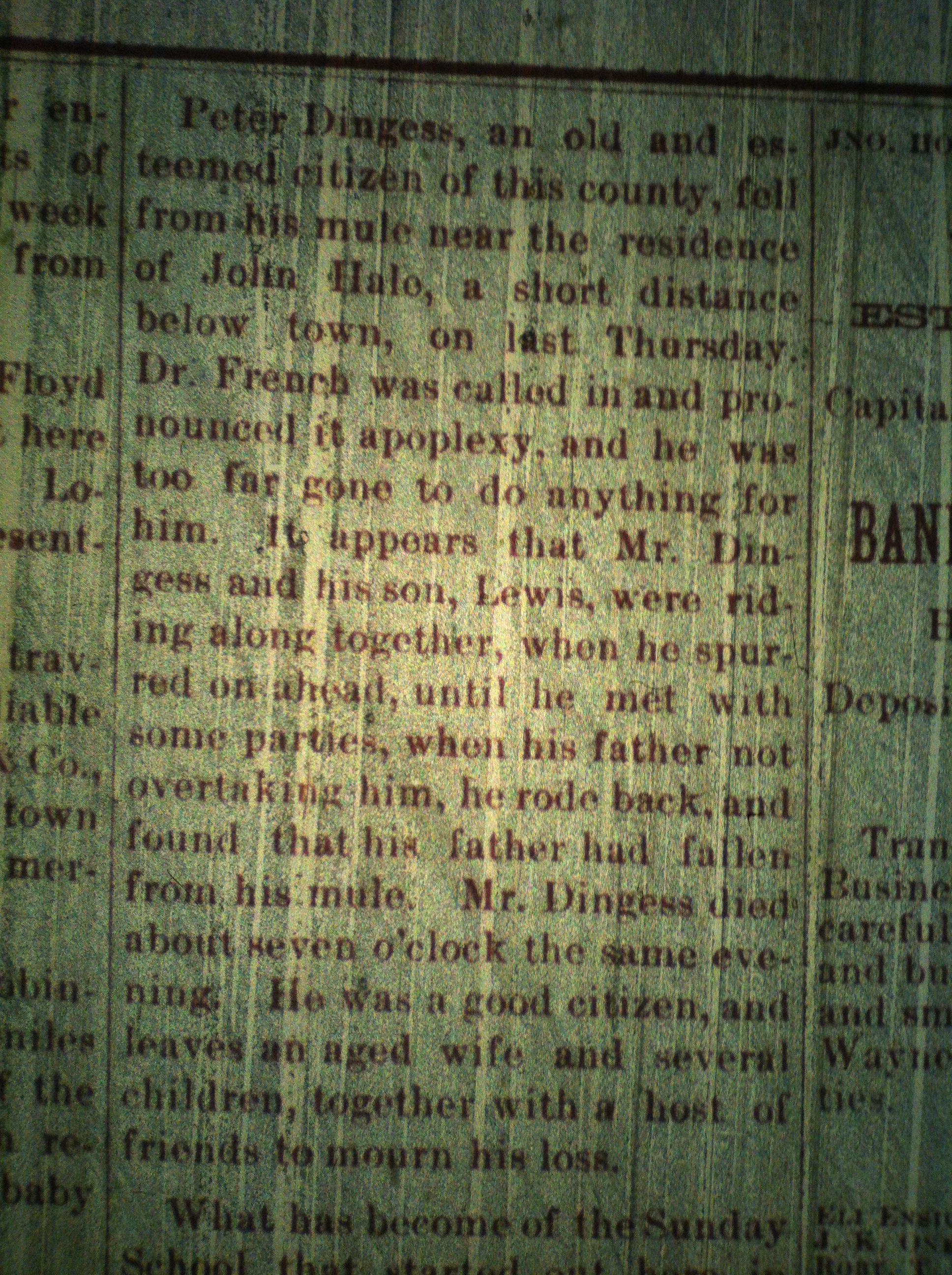
Peter Dingess is hauling for the Perry mill and keeps an abundant supply of logs in the yard.

Jack Dingess has developed into a full-fledged “Boniface.” He has at present stopping with him some twelve or more men engaged in arching the tunnel. He sets a good table and has pleasant accommodations. At night, after the inner man has been refreshed all adjourn to the front porch, where an open air concert is rendered by the “string band,” in the delectation of all within hearing distance.

“Uncle” Jim Spaulding, son and daughter, and Jack Mounts left for a brief visit to their homes in Wayne county, last week.

Lias Perry is again with us looking well and hearty after his visit home.
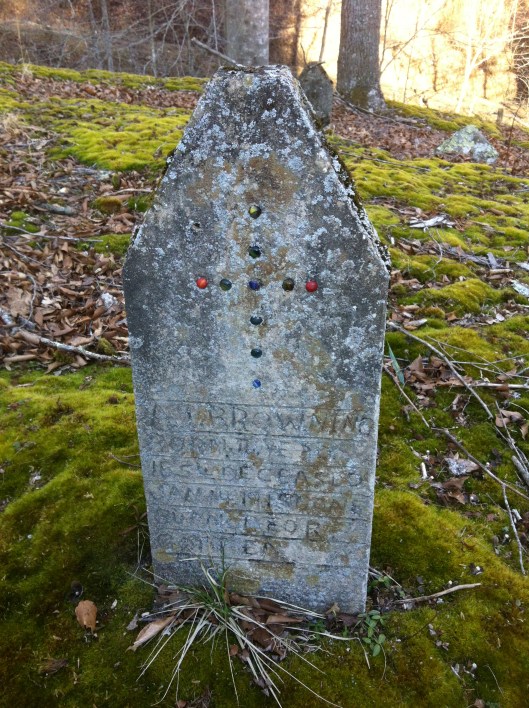
Jackson Browning grave (2014)

Tags

, , , , , , , , , , , , ,

IMG_1573

Andrew Jackson Browning grave (March 2014), located at Jack Browning Hollow of Harts Creek, Lincoln County, WV. During the Civil War, Jack served in the 129th Regiment Virginia Militia (Carter’s and Buchanan’s companies) and the 34th Battalion Virginia Cavalry (Company D).


The Life of Pioneers 6

Tags

, , , , , , , , , , ,

This history of early life in Logan County, West Virginia, was written by Howard and Daisy Adams. Howard (1906-1976) and Daisy (b.1915) were children of Major and Belle Dora Adams of Trace Fork of Harts Creek. Titled “The life of pioneers during the latter half of the eighteenth century and the beginning of the 19th century” and written in the late 1960s or early 1970s, their history marks the only known attempt by local people to reconstruct the story of pioneer life. This part of the history includes information regarding garden food and butter-making.

Everyone had a large garden which produced much of the eating of old-timers. Beans, corn, cucumbers, potatoes, beets, melons, pumpkins, squash, onions, mustard, and lettuce, parsnips, were all produced in large quantities. Yes, cabbage, tomatoes, peas, and a lot I’ve forgotten.

Most pioneers had an orchard of apples, pear, peaches, plums from which they got a lot of good eating. These fruits were put up in many ways, especially apples. They were canned, sulfured, dried, and made into apple butter. Making apple butter was done by peeling a lot of apples and slicing them up in small pieces. Then putting them in a big copper or brass kettle which was set in a furnace. To keep the apple butter from sticking or burning in the kettle after a fire was built around it a stir stick was used. To describe a stir stick it was a piece of one by five inch board about 2 feet long with a lot of holes bored in it. A handle was fastened to the top end of the board. The handle was around 8 feet long and was pushed and pulled across and around in the kettle of apples all day long. Apples were added to the big kettle about noon. Then the sugar or molasses was added along with flavor such as vanilla or cinnamon bark which gave the apple butter a good taste. After the sweetening was put in the butter began to flop out everywhere. You had to stir fast and watch out for the flopping butter because if it hit you it burned badly. Boyd I liked to lick those apple butter spoons. Well, enough about apple butter.

We mentioned butter from milk but never told how it was made. The milk from the cow was strained and put in a stone churn size 4 gallon. It was left in the churn until it soured or got thick as they called it. Then it was churned up and down by a churn-dasher: a one by 6 inch circular piece of wood on a handle. After it was churned about 30 minutes butter would form on top of the milk. Then it was dipped off with a spoon and put in a dish, salted, and set up to get cold. So long, butter.

David C. Bailey

Tags

, , , , , , , , , , , , , , , , , , , , , , , , , ,

From “Virginia and Virginians, 1606-1888,” published by H.H. Hardesty, we find this entry for David C. Bailey, who resided at Oceana, West Virginia:

Was born in Logan county, W.Va., April 3, 1843, but subsequently removed to Wyoming county, where he was living at the breaking of the war of the rebellion. Here, June 28, 1865, he was united in marriage to Lucinda J. Lambert, native of Tazewell county, Va. Of this union 12 children have been born: Ollie E., Thomas J., George C., Humphrey, Ira, Mary, Rachel A., Frank O., Albert, Romeo, David H., and Orvie. They reside with their parents at their beautiful home on Clear Fork, not far from its junction with Guyandotte River. Mr. Bailey is at this time engaged in farming; besides his handsome residence, he owns extensive coal and timber lands. As a citizen, he is highly respected; as a friend, he is beloved by all who know him. He has held several offices with honor, among others that of county superintendent, to which he was elected in 1879, continued in office till 1885, having been re-elected in 1884. His post office is Oceana, Wyoming county, W.Va.

Source: Dr. R.A. Brock, Virginia and Virginians, 1606-1888 (Richmond, VA: H.H. Hardesty, Publisher, 1888), 816.

The Life of Pioneers 5

Tags

, , , , , , , , , ,

This history of early life in Logan County, West Virginia, was written by Howard and Daisy Adams. Howard (1906-1976) and Daisy (b.1915) were children of Major and Belle Dora Adams of Trace Fork of Harts Creek. Titled “The life of pioneers during the latter half of the eighteenth century and the beginning of the 19th century” and written in the late 1960s or early 1970s, their history marks the only known attempt by local people to reconstruct the story of pioneer life. This part of the history includes information regarding clothes washing and outbuildings.

The pioneers done their own washing of clothes. They had a large black kettle set in a furnace made of mud and rocks. The kettle was partly filled with water and some homemade soap added to the water. Then the dirty clothes were dumped in the kettle and a fire built around the kettle and a fire built around the kettle to make it boil. After the clothes had boiled a while a small batch of them was taken out at a time and laid on a large block about 2 feet high and 2 feet in diameter. Then a paddle about 3 feet long 1 inch thick and 4 inches wide was used to pound the clothes as they were taken from the big kettle and placed on the bottling block as it was called. While the clothes were being pounded with the paddle the hot water and dirt would fly everyway. You had to watch out and not get burned from hot water. It was hard work, but the clothes were made clean. Later on a few people got hold of a gadget called a wash board. It had corrugated tin fastened on one side and the clothes were soaped and wet then rubbed up and down on the wash board which took the dirt out of them. This was a hard way doing laundry.

There had to be several buildings erected on the farm, such as barn for cows and horses to be sheltered in, sheep house for sheep. Cribs for corn. A smoke house to keep meat. Salt, flour, meal, etc. in a well house near the well. I will describe one or two of these houses. The well house first. It was about 6 feet wide by 10 feet long and had no floor except the dirt or ground. Some big flat rocks were laid on the ground in the well house and large tubs set on the rocks. Cold water from the well was poured in the tubs and milk, eggs, butter, etc. were set in the water to keep them cool. Water had to be changed 2 or 3 times a day especially on hot days. Now the smoke house. It was about 10 X 16 feet and had a floor in the front end. About 6 feet of floor across the back was left out. The ground space in back of smoke house was used for building a fire to smoke the meat. That would be stored in later. Some folks who put up a lot of canned vegetables made a cellar or can-house for them. The cellar was made by digging a hole in the side of a hill near the house and boarding it up or cribbing it up with logs, which ever were available. Shelves were made in it and the canned vegetables stored away.

Hugh C. Avis

Tags

, , , , , , , , , , , , , , , , , ,

From “Virginia and Virginians, 1606-1888,” published by H.H. Hardesty, we find this entry for Hugh C. Avis, who resided at Rich Creek, West Virginia:

Was born in Logan county, W.Va., June 6, 1842, where he was married Jan. 21, 1869, to Martha J. Dingess, of same county. They have had six children: Ella A., born Nov. 28, 1869; Mary F., born June 18, 1871; next were twins, who died unnamed; John C., born Dec. 14 [year omitted]; James, born April 8, 1877. The oldest is married, the others live with their parents. John and Sarah (Moar) Dingess were parents of Mrs. Avis; her father was born in Logan county, where he died July 18, 1884, aged 76; the mother was born in Monroe county, Va., and now lives in Logan county at an advanced age. The subject of this sketch is at this time engaged in farming and merchandising; he owns a valuable farm on Guyandotte River, a large dry goods store and extensive coal and timber lands in Logan county. As a man of honor and moral excellence he is esteemed by all who know him. His post office address is Rich Creek, Logan county, W.Va.

Source: Dr. R.A. Brock, Virginia and Virginians, 1606-1888 (Richmond, VA: H.H. Hardesty, Publisher, 1888), 815-816.

Dingess 6.26.1890

Tags

, , , , , , , , , , , ,

“Jim Yats,” a local correspondent at Dingess in present-day Mingo County, West Virginia, offered the following items, which the Logan County Banner printed on June 26, 1890:

Farming is at a stand still in this locality on account of so much rain.

Railroading is lively along this part of the line. Mr. King is working two crews, one at day, the other at night.

W.F. Farley is teaching our public school at this place.

Smith Dingess and Mary Chafin were united in the holy bonds of matrimony at this place last Friday.

Simon S. Altizer

Tags

, , , , , , , , , , , , , , , , , , , , ,

From “Virginia and Virginians, 1606-1888,” published by H.H. Hardesty, we find this entry for Simon S. Altizer, who resided at Logan Court House, West Virginia:

Present clerk of the county court, residing at Logan C.H., W.Va., is a native of Montgomery county, Va., where he was born Oct. 26, 1846. He is descended from a family that has always ranked as one of the most honorable and most highly respected of the State. The esteem in which he is held by his county people has been shown by the offices of trust to which they have frequently elected him, among others that of superintendent of public schools in Logan county, to which he was elected in 1880, and served until 1882; was for 10 years a member of the public school teachers’ examining board; was first appointed clerk of the county court in 1886, and after serving for one year was re-elected by ballot, and ever since has continued to hold this office with the same honor and integrity that has always distinguished him in all business and social relations. He owns a handsome residence in the town Logan Court House, and a large and valuable farm five miles from that place, situated on mineral lands adjacent to Guyandotte River. The records of his wife and children: Roxie Lawson, born in Logan county, W.Va., Oct. 5, 1856, married to Simon S. Altizer in same county, Sept. 7, 1870. Children: Ella E., born Dec. 7, 1872, died Sept. 21, 1886; Julia Y., born Aug. 13, 1875; Mary E., born Nov. 28, 1878; Nellie G., born Oct. 22, 1880; Roxie E., born Feb. 24, 1883; William E.A., born Aug. 4, 1885; James N., born Feb. 5, 1888; all residing with their parents.

Source: Dr. R.A. Brock, Virginia and Virginians, 1606-1888 (Richmond, VA: H.H. Hardesty, Publisher, 1888), 815.

The Life of Pioneers 4

Tags

, , , , , , , , , , , ,

This history of early life in Logan County, West Virginia, was written by Howard and Daisy Adams. Howard (1906-1976) and Daisy (b.1915) were children of Major and Belle Dora Adams of Trace Fork of Harts Creek. Titled “The life of pioneers during the latter half of the eighteenth century and the beginning of the 19th century” and written in the late 1960s or early 1970s, their history marks the only known attempt by local people to reconstruct the story of pioneer life. This part of the history includes information regarding the well and bathing.

To get the water supply, a large hole was dug in the earth down till water was reached. Then a flat rock wall was made around the edge of the well to keep the dirt from falling in and filling up. Also the rocks kept the water clean and clear. Some folks had springs nearby from which they got their water. To get the water from a well a large post 12 or 15 feet high with forks on the top of it was set in the ground near the well. Then a long pole about 30 feet long was laid up in the fork of the post and a pin put through forks and pole. It worked as a swivel or pivot and was called a well sweep or ______. These words were not found in any dictionary. They were pioneer slang and to convey messages or to tell the idea to each other.

Back to getting the water out of the well. A long wire, chain, rope, or grapevine was tied on top of the pivot pole and the bottom end of the rope was tied to a oaken bucket. The bucket was made of oak staves and hoops or bands. The bucket was lowered in the well by pulling down the pivot pole. When the bucket was filled with water the pole or pivot drew the water up out of the well. So that was one way of getting water. It always worked too. Some pioneers had a wheel called a pulley with a chain or rope run through it and a bucket on each end of rope so you lowered one bucket in the well to be filled with water, then you pulled water up by hand at the same time lowering the other empty bucket.

Bathrooms were unheard of in those days. So to get a bath you put water in a big kettle, heated it with firewood, then poured the water in a big trough made from a big log that had been chopped out, or dug out as they said, which formed a basin for holding water. Then in you got and washed off, as it was called. If they did not have a trough or big tub for a bath, they just went down to the creek to the old swimming hole and stripped off all clothes and got in and washed off. Boy, I bet there were lots of peeping Toms in those days.