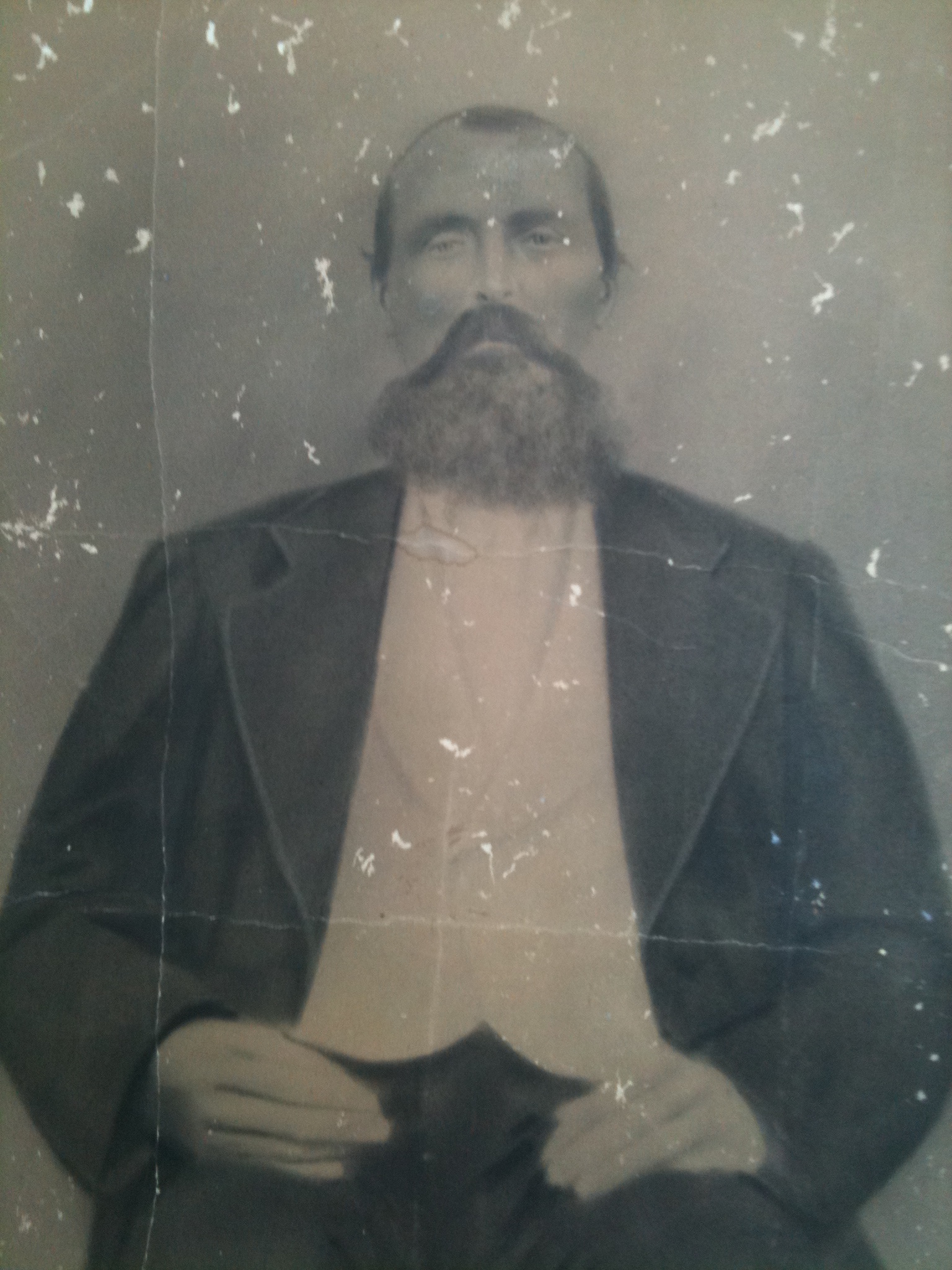
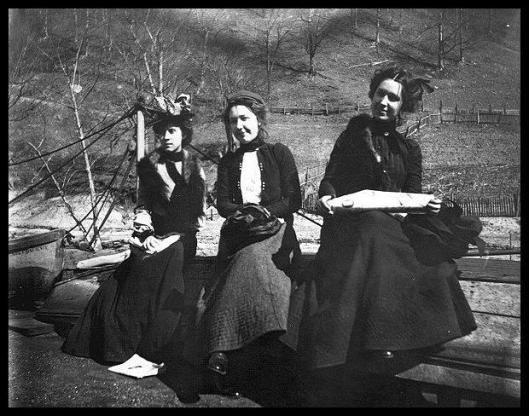
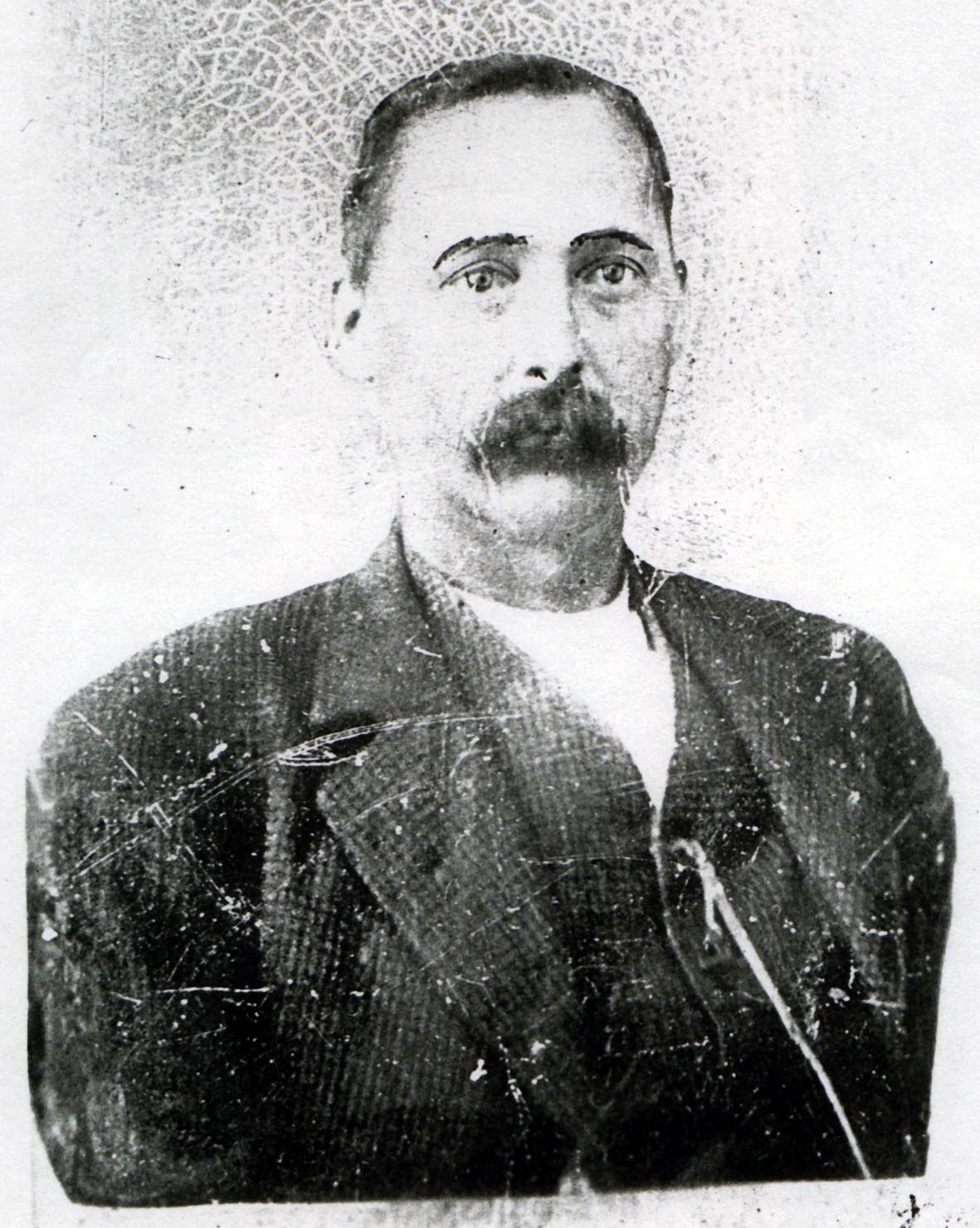
Caleb Headley 3

Tags

, , , , , , , , , , , ,

In 1881, Dr. Caleb Headley died of a lingering Civil War wound, leaving his young widow, Sarah, in a tough predicament. As the 32-year-old mother of six children — ranging in age from fifteen to two — she assumed charge of the family estate (a $100 house and 455 total acres), all of which was situated on a creek where she had no in-laws or immediate family to assist her. She chose not to remarry but did commence some sort of an affair with a Porter, which resulted in the birth of a son named Moses C. Headley on December 20, 1884.

The initial task of keeping the family afloat financially fell on Caleb’s oldest son, Johnny Headley. “After Caleb died, Uncle Johnny had to keep Grandma Sarah, and his brothers and sisters,” said Ward Adkins, an 81-year-old step-great-grandson to Doctor Headley, in a 2003 interview. “He ran rafts and made whisky and he farmed to make money. Everybody made whisky. It wasn’t a big thing.” In the mid-1880s, Johnny Headley married Emaline Susan Sias, a daughter of Henry C. and Sarah (Plumley) Sias, and settled on nearby Steer Fork.

Sarah, meanwhile, deeded off large parts of her property to provide for her remaining children. In 1884, she sold 174 acres of the family property to William A. “Billy” Sias, a neighbor and son of the local postmaster. Two years later, she sold 160 acres adjoining the homeplace to John Neace.

Around that time, her oldest daughter, Ida Cosby Headley, married John Henan Fry, a son of Christian T. and Elizabeth (Hunter) Fry of Green Shoal. They settled near Sarah on Sulphur. “Old man John Henan Fry was a quiet, docile kind of fellow and easy-going,” said Adkins. “Aunt Cos was awful good to kids, but now some of her boys were pretty rough and kind of sneaky. They’d pilfer a few things along the way from neighbors. They said they had a big cave up in that hollow and it was plumb full of chicken feathers and bones and geese feathers where they’d steal them chickens and things and take them up there and eat them. They just done as they pleased.” John Henan and Cosby Fry remained nearby until 1923, when they moved to Daisy in Logan County. (In 1925, Everett and Annie Sias bought their property.)

In the late 1880s, based on tax records, Sarah Headley’s financial woes continued. The valuation of her home, estimated at $100 from 1882 until 1887, dropped to $50 by 1890, before finally leaving the record books altogether by 1891. In that same time frame, the Headley home was destroyed by fire.

“Will said when he was eleven or twelve years old, the house burned and the family almost starved to death,” said Adkins. “He said the corn crib was close enough to the house when it burned that the fire parched all the corn. Well, they ground that corn up in an old coffee grounder, I guess. Then they’d ‘thrash’ birds at night using pine knots for light. One would kick the brush pile and scare the birds out and the other one would take the brush and knock them down. And Will said they’d clean them birds and cook them in with that parched corn they ground up and make a gruel. They ate that all winter. They had it tough. Grandma Sarah dug may apples and sold them for three cents per hundred pound.”

In this time of extreme hardness, Will Headley, Sarah’s third oldest son, went to live with her brother, Burl Farley, a wealthy timber man on Big Harts Creek in Logan County.

“When Will was about twelve year old, he went up on Harts Creek somewhere to stay with his uncle Burl Farley,” said Adkins. “Uncle Burl was pretty well to do. He worked for Cole and Crane Timber Company up on Pigeon Creek — the Brown’s Fork of Pigeon, I believe Will said. Will worked up there with him. Uncle Burl ran the timber part of it and Granddad took care of the stables and ran errands.”

“Will used to pushboat for a company on the Guyan River,” Adkins continued. “They took stuff out like ginseng. He told me it was so cold one winter — you might have heard them talk about that cold Friday or cold Saturday — his ears froze and busted. He said they bought chickens where they tied up for the night and they would dip them down in the water and pull them back out and all them feathers would just pull right out. He called it ‘scalding them’ but it wasn’t. It was just so cold it shrunk their skin up and the feathers come out easy.”
In Search of Ed Haley 181

Tags

, , , , , , , , , , , ,

We next looked at Logan County census records, where Milt Haley appeared in 1870 as “T. Milton Haley,” aged 13, living with a Bill Duty on Rich Creek in the Tug Valley. Duty’s home in Hardee District was relatively far away from the Harts area. Ten years later, in 1880, there was no trace of Milt or Duty anywhere in West Virginia, indicating that they may have lived outside the state at that time.

Had they moved together across the Tug into Kentucky?

We got back in the Lambert Collection for help…and found a circa-1934 interview with Jeff Duty, Bill Duty’s son.

At the time of the interview, Jeff was living at Dollie, a now extinct post office on Big Ugly Creek just upriver and over Green Shoal Mountain from Harts. He didn’t mention Milt Haley but gave a great account of his family story:

Grandfathers both came from Russell County, Virginia. Grandfather Geo. Duty came to Pigeon Creek in what is now Mingo County, before the Civil War. Grandfather James Ferrell settled on Big Creek, Logan County before the Civil War. Grandmother Duty was a Jackson and Grandmother Ferrell was a Fields.

Father was born in what is now Mingo County, and volunteered in 1861 as a Confederate. My father, William Duty, was in Gettysburg and Fort Donelson battles. They fought here seven days and seven nights. He was twice wounded. Father Wm. Duty lived in Mingo until fifty-one years ago, when he moved to Big Ugly, Lincoln County [around 1883]. When we moved to Big Ugly there were only three houses from Broad Branch, which is about one-half the length of Big Ugly to the head of Big Ugly, and now there are about two hundred. Big Ugly is nineteen miles long. There were plenty of deer, wild cats, coons, &c. when my father came. Wolves were here for about fifteen years after we came. Tom Ferrell killed the last deer killed about here about forty-five years ago.

My father was a rather big farmer for this part of the country, raising 1,000 bushels of corn a year, and always raising wheat. He had the first “chaff Piler” threshing machine brought in. It took about twelve horses to pull it. When it came on the first trip, my mother had about twenty geese in the yard, and when they heard it they took to the woods and did not come back for three or four days. My father had six children: John lived on Broad Branch, Lincoln County; Jeff here at Dollie; Phidelia Vernatter-Chapman lives in Boone County; Annie Steele lives in Logan County; George lives within three miles of Hurricane, Putnam County; Martha lives in Logan; she married Queen. My father, Wm. Duty, was the man who rode a $150.00 horse to death to save Tom Ferrell, who was in jail, in Hamlin, about 1889, for killing a man named Butcher, from a mob of Butcher relatives. Tom Ferrell is my cousin.

I am sixty-seven. I have eleven children, of whom three are dead: Alva, Lula, Stonewall, Solomon, Vernonda, Thos. Jefferson, Lee, Musco, Ira, Doska, Maggie. Mrs. Duty was Betty Pauley; her people came from Virginia. “Tiger Bill” Pauley was her father.

Caleb Headley 2

Tags

, , , , , , , , , , ,

The new “Mrs. Headley” — Sarah Farley — was born on May 26, 1849 to William Floyd and Elizabeth Jane (Clark) Jones-Farley in Logan County, (West) Virginia. She was a full 21 years younger than Caleb’s oldest child and barely older than his youngest child by his first wife. Her grandfather was Captain Henry Farley, who led an Indian raid down the Guyandotte River through present-day Logan County in the early 1790s and was one of the county’s earliest settlers.

Caleb and Sarah Headley had the following children: Lat. Headley, born May 1, 1866, died before 1870; John Timothy Headley, born April 20, 1867, married Emaline Susan Sias then Emarine Elkins in 1930, died March 29, 1956; Ida Cosby Headley, born March 23, 1869, married John Christian Henon Frye, died September 22, 1948; Caleb David Headley, born February 22, 1872, died about 1895; William Franklin “Will” Headley, born August 25, 1875, married Caroline Lucas, died January 1960; Margaret Headley, born March 28, 1878, married Zachary T. Neace, died 1911; and Ballard P. Headley, born April 14, 1880, married Claire D. Clark in 1924, died circa 1958.

Headley, a doctor, and Sarah, a midwife, combined to serve the medical needs of the community.

“Doctor Headley treated whatever ailed people,” said Ward Adkins, in a 2003 interview. “And Grandma Sarah was a midwife from the time she was young. She delivered way over a hundred babies, practically all of us. People paid them with whatever they had: chickens, garden stuff.”

In the 1870 Lincoln County Census (Harts Creek District, Household #16), Headley was listed as 62 years old, while Sarah was 27, John was 3 and Cosby was 1. Caleb had $160 worth of real estate and $350 of personal property.

Two years later, in 1872, Headley bought 145 acres of land valued at one dollar per acre from George Hager.

“Beginning at a chestnut oak, corner to Harman Stroud on the ridge between the Big Branch and the Sulphur Spring Branch,” according to the deed, “thence N. 20 W. 100 poles to a white oak and ash on the middle point of Big Branch, thence S. 87 E. 85 poles to a stake a corner to Daniel Messer, thence with his line, S. 70 E. 196 poles to a white oak and beech, a corner to Brumfield’s heirs lands, thence S. 5 W. 160 poles to a double beech, thence N. 55 W. 84 poles to a maple corner to Corbin Estep, thence with his line, S. 71 W. 43 poles to a locust, thence N. 45 W. 155 poles more or less and with Stroud’s calls to the beginning.”

In 1879, Headley purchased 62 acres worth one dollar per acre from a land company.

“Beginning at a poplar on the John Fry Branch,” reads the deed, “thence south 52 poles to a white oak S. 30 E. 40 poles to a ‘sour gum’ E. 70 W. 156 poles to a stake, N. 45 E. 153 poles to a poplar and beech in the old Hager Line, then with it S. 16 E. 77 poles to the beginning.”

In 1880, Caleb was listed in the Harts Creek District of Lincoln County as a 72-year-old physician. Interestingly, this was the first instance in which Headley, who claimed to have been a practicing physician for nearly fifty years in an interview conducted during the early 1880s, declared his occupation as anything other than farming.

“I know Will said he could cure cancer,” said Adkins. “He said he was born with a cancer on his stomach and he had to sleep on a pillow until he was four years old. He had to wait until that sore was large enough for his daddy to take it off. Will had a scar as big as a fifty-cent piece on his stomach. He showed it to me several times. He said, ‘That’s where Paw took the cancer off of me.’ Grandpaw Neace told me that, too. He took one off of some of their family. He died with his secret, though. He never did tell nobody what he knew.”

In 1881, Headley bought 150 acres of land worth two dollars per acre from G.W. Hager, giving him a total property acreage of 357.

The following year, he either purchased more land or surveyed his existing properties. Tax books record him with the following tracts: 210 acres worth two dollars per acre containing a $100 building; 200 acres worth $1.50 per acre; and 45 acres worth $1.50 per acre. In total, according to tax records, he owned 455 acres worth $888.

Around that time, Henry H. Hardesty published a biographical sketch on Headley and several of his neighbors in a Lincoln County history.

“Caleb Headley is now a prosperous farmer, owning 600 acres of good land on Fourteen-mile creek, a portion of which is heavily timbered with oak, poplar and pine; coal and iron ore in abundance. There is a fine sulphur spring upon the land, on the creek three miles from Guyan river, which has been visited by people from many parts of the United States, and it is pronounced of excellent medicinal quality by all.”

This sulfur spring, which provided the entire creek with a name and generated some interest as a spot for healing is still remembered by older residents of the area today.

“It was just up here around the curve from my house,” said Adkins. “It’s not there now. It’s been destroyed. It had a round rock and that rock was about two feet high and it was dressed all the way around. And someone had hollowed it out about two inches from the edge and it sat right down in that spring. People used to gather there when I was growing up to play marbles and pitch horseshoes. Dad used to send us up there to get him a bucket of water after we come out of the field. Sulfur is a blood purifier, they said.”

Not long after providing his biography to Hardesty, Caleb Headley passed away.

“Doctor Headley died in, I believe it was 1881,” said Adkins. “Will said his dad died when he was about six years old and he was born in August of 1875. I think he finally died of a Civil War wound.”

Tax records do not list Headley’s property as being in his estate until 1886.

In Search of Ed Haley 180

Tags

, , , , , , , , , , , , ,

Having satisfied my thirst for Brumfield family history, Brandon pulled out some great newspaper articles pertaining to the 1889 troubles. He began with one from the Ceredo Advance dated Wednesday, October 2, 1889, and titled “Disappointed Love Leads to a Desperate Double Crime in Lincoln County:”

HUNTINGTON, W.Va.  September 27 – Word has just reached here of a sensational crime on Big Hart’s creek, in Lincoln county, 90 miles up the Guyandotte River. Al Brumfield, a newly married man, and his bride had spent the day with his wife’s parents some distance up the creek. Just at dusk, on their return, and when near their home, they were fired upon by a man who sprang from the bushes by the road-side. Mrs. Brumfield was shot in the head and fell to the ground unconscious. Her husband was shot in the right lung but managed to crawl to a neighbor’s for assistance.

The nearest physician, twenty-five miles distant, was summoned, but arrived too late to render the woman any assistance and she died in a few hours. The latest information is that Brumfield is also dying. He claims he recognized the assassin, but refuses to say who it was. It is the belief of the neighborhood that a suitor of Mrs. Brumfield, who failed to win her, is the assassin.

The article was full of errors but its implication of a single “assassin” with a personal attachment to Hollena Brumfield was interesting.

On Wednesday, October 9, 1889, Ceredo Advance ran a letter from “WILD BILL,” written on September 27. Wild Bill gave his address as Warren, West Virginia — a now extinct post office on Harts Creek below the mouth of Smoke House Fork.

ED. ADVANCE: — As you have had no communication from this place for some time I will give you a few items. There have been several cases of flux in this vicinity and two or three deaths. Farmers are busy saving fodder and cutting up corn. Our neighborhood was thrown into a state of confusion last Sunday evening about 3 o’clock. One mile from this place some low down villain attempted to assassinate Mr. Brumfield and wife. They had been on a visit to Mrs. Brumfield’s father, Mr. Henderson Dingess, and as they returned home they were shot from the brush, one ball striking Mrs. Brumfield just in front of the right ear and ranging around the cheek bone and striking her nose producing a serious but not fatal wound, and one ball striking Mr. Brumfield in the right arm below the elbow producing only a flesh wound. They were cared for and dressed by Drs. Moss, of Cabell county, and Hudgins, of Logan county. They will recover. Mr. Brumfield is a prominent merchant living at Hart, W.Va., and is a good citizen, highly esteemed by his neighbors. His wife is a noble and kind-hearted lady and beloved by all her acquaintances. They have a large train of friends who sympathize with them in their distress. The object of the attempted murder is believed to be robbery. The good and law-abiding citizens should unite and rid the earth of such miserable miscreants.

Based on this September 27 letter, written a week after the ambush at Thompson Branch, there were two theories regarding the motive for the crime: one, it was done by a jealous suitor; two, it was an attempted robbery.  In either case, this second article again referred to the attacker in the singular sense…sort of.

By October 24, locals had deduced Haley and McCoy’s guilt, captured them in Kentucky and murdered them at Green Shoal. WILD BILL was apparently unaware about this latter act because on October 25 he again sent a letter to the Ceredo Advance (printed on November 6).

ED. ADVANCE – Mr. Allen Brumfield, who was shot in the arm near this place about a month ago, has got about well. His wife, who was shot at the same time, is improving very slowly, but she will get well. The perpetrators of the awful crime — Milton Haley and Green McCoy — have been arrested. Haley did the shooting and McCoy is accused of being an accomplice, but the latter will be released by turning state’s evidence against Haley. The law should be enforced against such persons to the utmost extent. Our neighborhood is in a state of intense excitement and may terminate in a deadly feud between two parties…

[Since the above was written a mob took Haley and McCoy from the officers and killed them. — ED]

God only knows what our country will come to, as the deadly Winchester is fast becoming the ruling factor in our land.

Well just who was this WILD BILL? He seems to have access to a lot of information regarding the growing feud on Harts Creek. Maybe it was “Detective Wild Bill,” who history records as a participant in the Hatfield-McCoy Feud in the nearby Tug Valley.

A story featured in the Ceredo Advance titled “A Visit to the Lincoln County Battle Field” and dated Wednesday, November 13, 1889, was most interesting:

Mr. J.V. Henderson, editor of the Charleston Nonpareil, was in this city today [Nov. 7], having just returned from the scene of the recent trouble in Lincoln county. He went to get a full description of the places and the causes which led to the trouble for the metropolitan dailies. Mr. Henderson went into the house where Green McCoy and Milton Haley were murdered, and made a map of the house and its surroundings. He also made a map of the Hart’s Creek country, giving the location of each faction — the Brumfields and the Runyons. While going up Hart’s Creek he was met by two men acting as pickets, armed with Winchester rifles, who asked him where he was going and what was his business. Mr. Henderson told them that he was a newspaper man and wanted to get information regarding the trouble in that vicinity. They told him that they would give him one hour to get off the creek and leave the country.

Mr. Henderson took the hint and left at once. He says he learns that both factions are heavily armed and are expecting an attack at any time. Each side has pickets out ready to give the alarm in the event of hostile movements by the other side. The road up Hart’s Creek is blockaded, and travelers through that region avoid the place.

Unfortunately, few issues of the aforementioned Charleston Nonpareil survive in libraries today. Brandon later located copies of the Nonpareil for February and May of 1889 and February and June of 1890 — the times just prior to and just after the trouble — but none for the fall of 1889, which would have maybe mapped the murder site and the location of the feudists’ homes. There was one interesting development: according to The Cabell County Record, Mr. J.V. Henderson, “one of the best known figures in West Virginia newspaper work,” died at the Spencer insane asylum in 1898 at the ripe age of 43.

Caleb Headley 1

Tags

, , , , , , , , , , , , , , , , , , , , ,

In the years following the Civil War, Caleb Headley migrated from Wetzel County, West Virginia to the Sulphur Spring Fork of Fourteen Mile Creek in Lincoln County, bringing with him a young wife and some degree of knowledge about medicine. Behind him were Pennsylvania roots, a soldier’s experience in the Mexican and Civil wars, as well as a failed marriage. About fifteen years later, he passed away and was buried on a hill near his home.

Today, Ward Adkins, an 81-year-old walking encyclopedia of Sulphur Spring history, is the best source on Dr. Headley’s life. He was partly raised by Headley’s son, Will, his step-grandfather, who told Adkins what little he knew about his father and eventually gave him a very important family heirloom: a geography book containing genealogical information in his father’s handwriting.

Caleb Headley was born on April 11, 1808, the first son and second child of Dr. Thomas and Sarah (Asher) Headlee, in Pennsylvania. Thomas was born around 1775 in New Jersey and was the son of a Revolutionary War veteran. Sarah was born around 1785 in Virginia.

Caleb had seven known or suspected brothers and sisters: Elizabeth Headley, born about 1807, Mary Headley (c.1811-1881), Anthony Headley (August 11, 1812 – January 1, 1894), Jerusha Headley (March 16, 1815 – May 16, 1884), Sarah Headley (August 22, 1817 – June 18, 1900), Elisha Headley (August 24, 1820 – August 2, 1895), and Nancy Headley, born about 1822.

In 1822, according to Hardesty’s History of Wetzel County, Thomas Headley settled in Tyler County, (West) Virginia with his family where he taught young Caleb what he knew about doctoring prior to his death, which reportedly occurred around 1830 in Monongalia County, (West) Virginia.

On November 2, 1826, Caleb married Nancy Ann Wright in Pennsylvania. Nancy was born on October 15, 1808 in Virginia. Her parents were born in Maryland.

Caleb and Nancy had ten children: Charity Headley, born March 1, 1828; Elizabeth Jane Headley, born June 2, 1829; Thomas J. Headley, born November 23, 1831; Joshua Headley, born April 7, 1832; Sarah A. Headley, born December 8, 1833; Caleb Samuel Headley, born March 30, 1836 or 1837; George Washington Headley, born May 21, 1839; Benjamin Franklin Headley (May 31, 1841 – April 11, 1918), Anthony Headley, born June 3, 1844, and Elijah Headley, born August 1, 1850.

During the 1830s and ’40s, Caleb lived in Tyler County where he was, by his own admission, a practicing physician, member of the Methodist Church and for sixteen years a justice of the peace.

“I don’t think Caleb had any schooling to be a doctor,” Adkins said, in a 2003 interview. “As far as I know, the only thing he had as far as a medical education was studying under his daddy. His daddy was a doctor.”

In 1846, the portion of Tyler County occupied by Headley became Wetzel County.

Some time between 1846 and 1848, Headley reputedly served as a lieutenant in the Mexican War. While no military records have been located at the present time to verify his service, one of his sons made the claim that he had been an officer in the war.

“His son Will told me that he was an officer in a war with Mexico,” said Adkins.

In the 1850 Wetzel County Census, Caleb appeared in the Green District as a 40-year-old farmer (not physician) with $200 worth of real estate. His wife was 32 years old, while the children were listed as follows: Thomas (age 17, farmer, in school), Sarah (age 16, in school), Samuel (age 13, in school), Washington (age 10, in school), Franklin (age 9, in school), and Anthony (age 6).

In 1860, the Headleys maintained their residence in Green District.

When the Civil War began in 1861, Headley joined with most of his neighbors and sided with the North.

“Wetzel County, Virginia, was one of the counties which supported the Union during the War Between the States,” Mary Curtis, a genealogist, wrote in 1959. “The large majority of the settlers were from Pennsylvania and the Piedmont areas of Virginia where slaves were not common, so that their interests lay with the North.”

According to Hardesty’s History of Lincoln County, Headley was captain of a company in the Union army. According to military records, he was captain of Company C, 154th Regiment.

“He was captain of a company in the Civil War,” said Adkins. “That’s in Hardesty’s. And Will said he was an officer. He didn’t know what rank, you know. I was told that he was shot in the back. His backbone was just barely hanging together. I think he was discharged in Ohio.”

Several of Headley’s sons fought for the North. Caleb Samuel, later a resident of Porters Falls in Wetzel County, “served a short time in the Union army as lieutenant,” according to Hardesty’s History of Wetzel County. Anthony, later a resident of Pine Grove in Wetzel County, “was a soldier with the Federal army, serving in Company I, 15th West Virginia Infantry, and he participated in all the fortunes of that regiment, engaging in its battles and witnessing the surrender of Lee at Appomattox.” His term of service was from August 24, 1862 until June 30, 1865.

In 1866, 50-something-year-old Headley settled in present-day Lincoln County and joined the Christian church. By that time, he had separated from his wife Nancy and was involved in an intimate relationship with 16-year-old Sarah Farley of Logan County. The two had their first child on May 1 then married on May 25 in Catlettsburg, Kentucky.

Headley’s separation from his first wife has been a hot topic of conversation among his local descendants.

“They had a rumor going that Dr. Caleb run off and left his first wife, but Will said it wasn’t so,” said Adkins. “I heard his wife died when their son Elijah was fifteen years old, which would have been around 1865.”

However, according to Wetzel County census records, Nancy was very much alive after the separation. In 1870 and 1880, she referred to herself in both census schedules as a widow.

In Search of Ed Haley 179

Tags

, , , , , , , , , , , ,

After about thirty minutes of talking with Brandon, I was convinced that he loved the families of Harts and was wrapped up in its history. He was not only serious business but he really — I mean really — knew his stuff.

Brandon flipped a few pages in his photo album, then pointed to a picture of a black-bearded, broad-shouldered giant of a man and said, “That’s Paris Brumfield.” I’d heard a lot about him from Bob Adkins and Lawrence Kirk — and never forgot what they said about him being killed by his own son. He was Brandon’s great-great-great-grandfather.

According to the Lambert Collection, Paris Brumfield was one of the most feared loggers in the Guyandotte Valley – a man who “gloried in shooting people.” He frequently stirred up trouble in the town of Guyandotte with his friends, Jerome Shelton of West Hamlin and Pete Dingess of Harts Creek. Shelton often got drunk and wandered through the streets of Guyandotte screaming “I am God!” and other obscenities. He climbed on ladders and pretended to make speeches to taunt officers and citizens. Wild cheering from loggers always followed his cry of “Millions bow down to me!” Wilburn Bias was the only marshal in Guyandotte who Paris and his gang feared, although others like a Mr. Fuller sometimes tried to arrest him. One marshal, J. “Doc” Suiter, once came to Brumfield’s hotel room to make an arrest, but a brawl ensued in which both men crashed through a window. At some point, while rafting on the Guyan River, Paris slammed his raft into Doc’s after seeing that it was fouled on some shoals.

Brumfield was a real rabble-rouser. Not only did he drink heavily and abuse his wife: in the late 1870s he took a mistress for himself. This woman, one Keziah Ramey, originally from the Kiah’s Creek area of Wayne County, moved near Paris at Harts and quickly produced him four children. Paris was a reported murderer as well, according to local history. There are rumors about him killing pack-peddlers and someone named Charlie Hibbits (whose body was put on the “Ha’nt Rock”). Reportedly, he also murdered a man who disturbed a fiddler playing his favorite song, “Golden Slippers”. These stories are likely untrue, as the only murder positively linked to him was his shooting of a local man named Boney Lucas.

Bob Adkins had told me about it. “They had a fight right there at the mouth of West Fork and Boney got loose and he run through the creek there,” Bob had said a few years earlier. “And Paris’ daughter Rat, she run and got the gun and brought it to Paris and, by george, he shot Lucas with a Winchester right across the creek. Lucas tried to get away.” Brandon’s grandfather Ray Kirk said the trouble was “over logs,” while Lawrence Kirk said it was brought on by arguments between their children at school. Either way, their fatal confrontation occurred at the Narrows of Harts Creek, where Al Brumfield later built his infamous log boom. Paris had gone to a store on the creek with his daughter when he noticed Lucas working there in a timber crew. He and Lucas “had words,” then Lucas attacked him, initially with the butt-end of his axe. In no time, one of Brumfield’s arms was almost completely severed from his shoulder — courtesy of Lucas’ axe. Paris hollered for his daughter to give him a pistol that he’d tucked into a grocery bag, then used it to shoot Boney in self-defense.

Life in the Brumfield home was difficult. At one point, during the fall of 1891, Ann Brumfield fled to her son Charley’s home for protection. I knew from Bob Adkins what had happened next.

On November 11, 1891, the Ceredo Advance reported: “The noted desperado of Lincoln county — Paris Brumfield — was shot five times by his son Charles, on Tuesday of last week [Nov. 3]. Paris was drinking and attempted to take the life of his wife, when the son interfered with the above result. The wounded man lived only a few hours after having been shot. Paris killed several men during his life and it is said that no man could get the drop on him, but finally one of his own flesh and blood ended his career. The son has not been arrested, and probably will not be.”

In 1892, The Logan County Banner reported: “We think the papers in the State have been a little harsh with Paris Brumfield. From what we have learned we do not blame his son for killing him in the defense of his mother, and we deeply sympathize with the young man in having to imbue his hands in the blood of his father. Paris Brumfield was an overbearing man and dangerous when in whisky, yet he was surrounded by a people not noted for angelic sweetness of temper, and he was driven to many an act of which he was ashamed. There was, however, a good side to the man. He was generous and brave, and no one was ever turned [away in] hunger from his door; and, remembering his kindness to the poor, we are willing to draw the curtain over his many grievous faults.”

Brandon said many old-timers around Harts heard that Paris’ ghost would jump up behind Charley every time he got on a horse to go anywhere.

U.B. Buskirk: West Virginia Timber Boss 2

Tags

, , , , , , , , , , , , , , , , , , , , ,

The Peter Morgan affair, as well as subsequent related events, had a profound impact on young U.B. Buskirk, who would become Logan’s wealthiest citizen in future years, but he chose not to divulge any information about it to Fred B. Lambert, regional historian. Instead, he discussed another murder involving Dave Straton, the son of Maj. William Straton of Logan.

“Once in 1870 or 1871, 200 or 300 rafters came to Barboursville. All got drunk. There was no room in the hotels. There were many fights and a wild time generally. Scott Lusher and Dave Straton were fighting in the street. Then John Thomas Moore was killed by Dave Straton. John Thomas Moore owned the Burnet House, a two-story building, and kept a hotel and bar room. It was near the Flour Mill at the corner of Water Street and Main Street (exactly where the First Methodist Church now stands). He had rented the upstairs for a dance.”

After 1870, Urias and Louisa Buskirk divorced and young U.B. went to stay with Dr. Bedford Moss in Barboursville.

“My parents fell out and Dr. Moss of Barboursville wanted a boy so I went to live with him,” Buskirk said. “This was about 1874 (September). I remember Henry Poteet, the Thornburgs, Baileys. John Wigal was my teacher. I went there April 1874.”

Throughout the 1870s, then, Buskirk lived in Dr. Moss’ home and received a Cabell County education. His father spent the decade in and out of court over the Morgan murder, while his mother married twice: first to Thomas Buchanan, a Civil War veteran, in 1874 and then to Henry Clay Ragland, future editor of the Logan County Banner, in 1878.

In 1880, young U.B. Buskirk left Dr. Moss and returned to Logan County.

“I left there on July 2, 1880 and came back to Logan,” he said.

After his return to Logan, Buskirk took a teaching position at Pigeon Creek for one year, then used the money he saved to pursue a life in business. His father, a local businessman, may have encouraged this venture.

“In 1881 I was a merchant at Logan,” he said. “I worked at this for 25 years. I bought deer skins, even bear skins, ginseng, etc.”

By the early 1890s, Buskirk was Logan’s wealthiest citizen, with business interests in timber, coal, and real estate. In 1892, he opened the Standard Mercantile Store (later the Guyan Mercantile Company). He served on the town council and built a livery on Hudgins Street. In 1896, he began construction of a mansion at 404 Cole Street.

“I first engaged in timbering, pushing timber into the river, for C. Crane and Co., about 1897,” he told Lambert. “They bought only portable timber. They had three double band mills in Cincinnati. They were in business 25 or 30 years before that.”

In his interview with Lambert, Buskirk showed a real familiarity with the timber industry — particularly its rafting era — as it existed in the Guyandotte Valley in the late 1800s. He sprinkled his stories with memories of people and geography.

“Rafting was rarely done beyond the mouth of Little Huff, just up above Ep Justice’s,” he said. “Most of the Justice family came to Logan. Ben lived on Main Island Creek. He moved to Huntington and died there.”

The upper Guyan Valley was difficult to navigate on rafts because of two geographical features, namely the “Roughs” and the “Betty Shoals.”

“The ‘Roughs of Guyan’ extended 14 miles from the mouth of Gilbert Creek to the forks of the river as the junction of the Clear Fork and the Guyan,” Buskirk said. “The Betty Shoals were just below the mouth of Gilbert Creek. A preacher Fontaine drowned there. His body was recovered.”

Peck’s Mill was a familiar site to raftsmen as they plied their way downriver toward the timber market in Guyandotte and Huntington.

“Peck’s Mill was built by Mr. White in the late ’60s and sold to J.E. Peck Sr. and Ed Peck,” Buskirk said. “R.W. Peck Sr. was sheriff in 1880.”

Logan County rafstmen heading toward the Ohio River usually made it to the Harts area of southern Lincoln County on their first day of travel.

“At the end of the first day’s run, raftsmen put up at Big Ugly, seven miles below Harts Creek — on the right going down,” Buskirk said. “Rafts ran 8-9 miles per hour coming down and reached Logan in 2-3 hours.”

A little further downriver, near West Hamlin, was the “Falls of Guyan,” an actual waterfall and hindrance to river traffic.

“The Falls were dangerous but were removed, as was Dusenberry Dam,” Buskirk said. “The Jordan Sands shifted. Men sometimes had to cut through the sands here and elsewhere to get pushboats through them.”

Upon reaching the town of Guyandotte, loggers sold their rafts and took their money to local saloons and hotels.

“Mrs. Carroll at Guyandotte kept 3-4 businessmen but not raftsmen,” Buskirk said.

Unfortunately, Fred Lambert’s interview ends on that note, leaving no personal record of his later life. Actually, his interview stops at the very moment when Buskirk was at a high point in his personal, economic, and political life. This makes sense considering that Lambert was probably most interested in his genealogy and connections to the timber industry, not his biography.

As a result, we must rely on local historians to briefly conclude the man’s life story.

At the end of 1897, Buskirk completed construction of a mansion at 404 Cole Street in Logan — known in later years as the Hinchman House — then promptly went to Cincinnati and married Frances “Fantine” Humphrey.

Mr. and Mrs. Buskirk settled in their Logan mansion, where they had three children: Voorheis (Buskirk) McNab, born January 2, 1899, Dr. Joseph Randolph Buskirk, born July 30, 1900, and Dr. James Humphrey Buskirk.

On May 15, 1909, Buskirk sold his home in Logan to Ettie Robinson (the wife of former sheriff and councilman, S.B. Robinson) and moved to Cincinnati. He kept in touch with his friends in Logan and died a wealthy man on March 14, 1956 at the age of 94 in Louisville, Kentucky.

U.B. Buskirk: West Virginia Timber Boss 1

Tags

, , , , , , , , , , , , , , , , , ,

In the early decades of the twentieth century, Fred B. Lambert, local historian and educator, interviewed Urias Beckley Buskirk, a former resident of Logan, West Virginia, who had amassed a great deal of wealth in coal and timber. Buskirk spoke primarily of his family history and the timber industry as it existed around the turn of the century.

“I was born November 22, 1862 in the City of Logan,” Buskirk began. “My father was Urias Buskirk, a Pennsylvania Dutchman of Erie Co., Pa. My grandfather was Joseph Van Buskirk who lived in Erie Co., Pa., with one or two older children. My mother was Louisa Goings, of Lawrence Co., Kentucky, a daughter of William Goings.”

In early Logan County records, Urias “Guy” Buskirk, father to U.B., was listed as a shoemaker (1856), bootmaker (1859), and merchant (1860).

“We are a family of shoemakers,” the younger Buskirk told Lambert. “My father’s grandfather and all of his boys were shoemakers, even in Holland. All had a big demand. My father did that here — probably made 10 cents an hour clear.”

Urias Buskirk married Louisa (Goings) West on October 6, 1856 in Logan County. Louisa was a daughter of Alex and Mary (Skidmore) Goings. She was first married to James West. The Buskirks had six children: James Bilton, born about 1853, Ann Brooke, born about 1857, John L., born about 1859, Urias Beckley (the subject of this sketch), George, born about 1866, and Robert W. “Bob”, born about 1869.

“I am a brother of James Bilton Buskirk, a hotel man of Logan, postmaster and storekeeper,” Buskirk told Lambert. “My sister was Ann Buskirk who married James A. Sidebottom of Boone County. One of my brothers was John Buskirk who, at the time of his death, lived at Apple Grove in Mason County but was buried at Logan.”

Buskirk gave more detailed genealogy for his younger brothers, George and Bob.

“My brother George married Mollie Henderson, a daughter of the late James R. Henderson of Montgomery Co., Va., a sheriff,” he said. “Their daughter Mattie died single while Tina married John Maynard and had two children. My brother Bob married Moldah Hamilton. They had no children. Then he married a widow with two children from Arkansas. They had one son, Robert, Jr., who was born the day after his father’s death.

In recounting events of his early life to Lambert, Buskirk could have drawn on the two sensational events of his childhood: the Civil War, which ended in 1865, and his father’s murder of Peter Morgan in 1870. More than likely, he was too young to have had any personal memories of the war, but his father, a private in Company E of the 45th Battalion Virginia Infantry, surely told him stories, as did his relatives Thomas V., a private in Company G of the 16th Virginia Cavalry, and Francis S., a private in Company D of the 36th Virginia Infantry (Logan Wildcats).

Or maybe not.

For whatever reason, Buskirk limited his childhood memories to a single but interesting line: “When I was a small boy, a bear was chased through the streets of Logan.”

In the spring of 1870, Urias Buskirk, the father of U.B. and a merchant in Logan, shot and killed Peter D. Morgan, a former Logan County constable and sergeant in the Logan Wildcats. Morgan was reportedly engaged in an affair with Buskirk’s wife and had threatened to kill him. In an 1874 trial, Buskirk pled self-defense for the murder in front of a hung jury at Wayne. A Cabell County jury finally acquitted him of the crime in 1879.

A newspaper story from the period offers some insight into the murder.

“In May, 1870, the community here was startled by the intelligence that a murder had been committed — a cold-blooded, deliberate murder,” the Democratic Banner of Guyandotte, West Virginia, reported on Thursday, August 27, 1874. “The murdered man was Peter D. Morgan; the murderer supposed to be Urias Buskirk. Buskirk had a bad reputation, and on account of his troubles had been compelled to leave; he had a pretty little wife, and Morgan had been in a liaison with her during his absence as well as after his return. Buskirk had threatened to kill Morgan, and on the evening he was killed said that he should not be surprised at any time to hear of Morgan’s brains being blow out. One night Buskirk was at Morgan’s store with a rifle, Morgan was at the counter waiting on some customers, and while standing there some one standing outside the window, with deadly aim, sent a bullet crashing through his brain. The blood gushed over the lady’s face he was waiting on and over the goods, and he fell to the floor a corpse. Buskirk, a few minutes afterward, went to a doctor who lived near and told him ‘he heard a gun go off, and should not wonder if some one was killed.’ He was arrested on suspicion, but escaped from jail and remained for two years returning in 1872. He was then re-arrested, and had a trial but the jury disagreed.”

“His counsel moved for a change of venue and his trial moved to Wayne Court-house, where it took place, after several postponements, last March, and resulted in another disagreement,” the story continued. “He is now out on bail, Morgan, who was killed left a very pretty widow, and since his death she has been living a rather fast life, having had an amour with one C.R. Williams, prosecuting attorney of the county, who was also one of the principal witnesses against Buskirk. On Tuesday morning, Guy Lawson, brother of Mrs. Morgan, met Williams and accused him of debauching his sisters; from words they rapidly came to blows; then pistols were drawn, and an indiscriminate firing begun. The friends of the parties rush in; C.R. Williams shot Lawson, and Frank Buskirk, brother of the one who is accused of murder, took up for him, and shot both of the Williamses. It was at first reported that C.R. Williams and Lawson were both killed, but that was a mistake.”

“Lawson was shot in the left breast near the heart, and is not likely to recover; C.R. Williams was shot under the left eye, the ball passing down into his mouth, knocking out several of his teeth; R.B. Williams shot in the left leg, and a man named Dingess behind the left ear, but the ball did not enter the skull,” the story concluded. “The doctors think all will recover except Lawson. In the height of the affray Thomas Buskirk appeared on the ground with his wife, and stopped the fight by jumping right in between  the combatants and swearing he would kill the next man who fired a shot. He was greatly commended for his action, as the combatants had friends who had rushed to the scene — many of them armed — and it seemed likely there would be a bloody affray. Several parties have been arrested. Most of the original combatants were under the influence of whisky. It is a mixed up affair, and we should not be surprised to hear of a renewal of the combat.”

In Search of Ed Haley 178

Tags

, , , , , , , , , , , , , ,

After a few hours of digesting this material, I met Brandon Kirk in the hall near the copier. Brandon, a neatly groomed young man wearing a tie, was freighted down with satchels. We introduced ourselves and were soon in the study room where Brandon started fishing through his bags and pulling out letters, notebooks, folders and photo albums. Within a few minutes, the table was covered. It was as if someone had walked up with a giant garbage bag full of papers and dumped it all out in front of me.

One of the first things Brandon showed me was a small account of Milt Haley’s murder titled “The Brumfield-McCoy Feud”, which was originally published in a 1926 edition of Lambert’s Llorrac.

The Brumfield-McCoy Feud took place in the month of September, about 1888, some three miles up Hart’s Creek. Hollena Brumfield and her husband, Allen Brumfield, had been visiting Henderson Dingess, father of Mrs. Brumfield, one Sunday and were about two miles below Mr. Dingess’ on their way home. Green McCoy and Milt Haley laid in wait for them. Mr. and Mrs. Brumfield were riding down the creek, Mrs. Brumfield being on the same horse behind her husband. McCoy and Haley began shooting at them, one bullet striking Mr. Brumfield in the arm, and the other tearing away a portion of Mrs. Brumfield’s face, disfiguring her for life. Mr. Brumfield jumped from his horse and ran, and in that way escaped further injury. McCoy afterwards told that they were bribed by John Runyons with a barrel of flour and a side of bacon to McCoy, and twenty-five dollars in money to [Haley]. The murderers escaped into Kentucky but were captured a little later and brought back. Allen Brumfield supplemented the reward offered by the state with one of his own.

It seems the cause of the trouble was bad feeling between John Runyons and Al Brumfield. Runyons had a store and saloon at the mouth of Hart’s Creek. Brumfield had a store on Guyan River about a fourth of a mile below Hart, on the south side of the Guyan and sold whiskey on a houseboat. John Dingess [Mrs. Brumfield’s brother] was a bartender.

McCoy and Haley were brought back and kept over night at the house of George Fry. The next morning a number of men, presumably Brumfield’s friends came in, and the two prisoners were shot and killed.

Along with the above article was another version of “The Lincoln County Crew”, which gave George (and not Tom) Ferrell as the author.

Come all young men and ladies, come fathers, mothers, too;

I’ll relate to you the history of the Lincoln County crew.

Concerning bloody rows, and many a thieving deed,

Dear friend, pray lend attention to these few lines I say.

It was in the month of August all on a very fine day;

Allen Brumfield he got wounded they say by Milt Haley.

But Brumfield couldn’t believe it, nor hardly thought it so;

He said it was McCoy who shot that fatal blow.

They shot and killed Boney Lucas, a sober and innocent man,

And left his wife and children, to do the best they can.

They wounded Rufus Stowers, although his life was saved;

And he seemed to shun the grog shop, since he stood so near his grave.

Allen Brumfield he recovered, some weeks and months had past;

It was at the house of George Fry, these men they met at last.

Green McCoy and Milt Haley, about the yard did walk;

They seemed to be uneasy and no one wished to talk.

And then they went into the house, and sat down by the fire,

And little did they think, dear friends, they had met their final hour.

The sting of death was near them, _________________________

A few words passed between them concerning a row before.

The people some got frightened, began to rush out of the room;

When a ball from some one’s pistol laid the prisoners in the tomb.

Their friends then gathered ’round them, their wives to weep and wail;

Tom Ferrell was arrested, and soon confined to jail.

The butchers talked of lynching him, but that was all the fear;

And when the day of trial came, Tom Ferrell he came clear.

And then poor Paris Brumfield, relation to the rest,

He got three balls shot through him, they went straight through his breast.

The death of these few men have caused great trouble in our land;

Men to leave their wives and children to do the best they can.

Lincoln County’s still at war, they never, never cease;

Oh, could I only, only see my land once more in peace.

I composed this as a warning, a warning to all men;

Your pistols will cause trouble, on that you may depend.

In the bottom of the whiskey glass, the lurking devil dwells;

It burns the hearts of those who drink, and sends their soul to hell.

In Search of Ed Haley 177

Tags

, , , , , , , , , , , , , ,

Aside from this great fiddling history, I located several wonderful passages that hinted at Civil War era life in the Guyandotte Valley.

“A family named Bailey ran a mill at Harts Creek,” Sam Bias told Lambert in 1942. “They had seven or eight children — all half-naked. This was during the Civil War. Such mills ground slowly and people got hungry waiting for their grists. Mr. Bailey furnished a skillet where folks could parch corn when hungry. Food, in those days, was either secured from the forests, or produced on the farms. It consisted of corn bread, potatoes, bacon, pickled pork, and a few vegetables produced in the gardens. Hogs were often kept before being killed till they weighed as much as five or six hundred pounds, or more. There were no canned goods. We often fished at night and had fish the next day fried in bacon grease. We used a hook and line. We had guns and often killed ducks. I killed a bald eagle just above the Falls. It measured seven feet from tip to tip of their wings. It had been catching Lewis Midkiff’s geese. Women were very modest, and wore long dresses. People were scarce. They often lived five or six miles apart. Comber Bias, from the Forks of Two Mile, bear hunted at Harts Creek. He got a bear shortly after the war and I ate some of it. We had spinning wheels and looms. I can remember when my mother made pants and knit socks for us.”

“I remember bear and deer were plentiful in my early days,” said Bill Peyton. “Panthers were gone. I have laid by trees with my brother Lewis where six coons were until daylight and my father would come and shoot them. He killed many deer, a few bear, a few wildcats, foxes, panthers, etc. Trapped foxes. Much flax and cotton was grown. I have helped pack cotton many times. Many people had stills and made brandy. The Major Adrian, Louisa, and Lindsey [were steamboats] that ran before the war. Sugar orchards were plentiful. We raised wheat during and after War. Soldiers of both sides passed at different times. About 1200 Yankees went down the Creek as from Boone to B’ville on one occasion. Did no harm. Rebels (about 1000) also passed on another occasion on way to Wayne. They did no harm. Later soldiers came and robbed us and took a horse — Rebels — took blankets, clothes, meat, etc. About 25 in party. On Guyan, Nick Messinger had a water mill at the Falls after the war ended. Two or three saloons were in Hamlin directly after the Civil War. Pomp Wentz and Morris Wentz ran the Hustler since the war. A steamboat called the Favorite ran from Huntington to Laurel Hill.”

In Search of Ed Haley 176

Tags

, , , , , , , , , , , , , , , , , , , , , , , , , , , , ,

In a separate interview, one Mr. Miller told Fred B. Lambert, “Leander Fry used to come down from Lincoln on timber to play the fiddle. He was a great fiddler. Jack McComas was an old fiddler, as was also his brother. Mose Thornburg said that a man who wouldn’t fight to the music made by the musicians of the musters had no fight in him. Wm. Collins was a fifer. John Reece was a tenor drummer, Clarke Thurston a base drummer. On muster days, whiskey, ginger ales, cider, &c were plentiful. Hogs were fattened on the way East. That wore the valley out. Dishes were plain. Cups instead of glass. They were cheaper. No washboards. Lye soap. Used a board to beat clothes with. Later, washboards were made of soft wood and sold for 5 cents each. Old fiddlers: George Stephens and Wiley, — Joplin, Guyandotte (?). In later days Morris Wentz and Ben France.”

Amaziah Ross told Lambert about some of the other fiddlers.

“Old Charley Robison came from Alabama. Brought ‘Birdie.’ He was a colored man and a good fiddler. Bob Glenn lived up Ohio River about Mason Co., played at Guyandotte when I was a boy. A first class fiddler. His bro. Dave Glenn also was a good one. Jimmie Rodgers lived at Guyandotte. He was a bro. to Bascom Rogers who kept saloon at Guyandotte — The Logan Saloon when I was a boy.”

Ross gave Lambert the names of many old fiddle tunes, which I of course noted being an avid fan and collector of such things:

Shelvin’ Rock                                      played by Ben France

Natchez Under the Hill

Seven Mile Winder

Money Muss

Devil’s Dream

Mississippi Sawyer

Sixteen Days in Georgia

Little Sallie Waters

Marching Through Georgia

Whitefield, Georgia

Annie Adkins — By herself a fiddler when my father was a boy.

Ocean Wave

Over the Way

Grasshopper

Cabin Creek

Fisher’s Hornpipe

Sailor’s Hornpipe

Ladies’ Hornpipe

Gerang Hornpipe

Forked Deer

Third Day of July

Butterfly

Birdie

Lop Eared Mule

Billy in the Lowground

Wild Horse

Old Bill Keenan

Round Town Girls

SourwoodMountain

Old Joe Clark

Greasy String

Cross Keys

Bet My Money on Bobtail Horse

Blue Ridge Mountain Home

Someone told Lambert about the dances held after corn-shuckings.

“After a few weeks, it was ready to shuck. It was an opportunity for young and old to gather and spend a day at work in the name of play. Of course, the women and girls prepared the noon meal and sometimes even the supper. When night came on, the labors of the day were followed by a dance, which of all pioneer amusements was king. Shooting matches with rifles, wrestling matches, foot races, fist fights between neighborhood bullies, or to settle old scores. It was not uncommon for contestants to engage in ‘gouging’, as a natural sequence of a first fight. Weapons were banned, but many a man lost an eye by having it gouged out.”

Another person said, “Dances were very common at weddings, and on many other occasions.” Some of the tunes played were:

The Devil’s Dream

Old Zip Cook

Billie in the Low Ground

Virginia Reel

“I had a Dog And His Name was Rover,

When he Had Fleas, He had ‘Em All Over”

Irish Washerwoman

Mississippi Sawyer

Myron Drumond gave these tunes to Lambert: “Sugar in the Gourd”, “Chicken Reel”, “Fisher’s Hornpipe”, “Cincinnati Hornpipe” (the latter two tunes for “Jig dancing”) and “Irish Washerwoman”.

These tunes and fiddlers came from “a Barboursville man:”

Tunes

 Turkey In the Straw

Sourwood Mountain

“Hage ’em Along.”

The Lost Indian

Pharoah’s Dream

Hell up the Coal Hollow

The Devil’s Dream

Shady Grove

Arkansas Traveler

Little Bunch o’ Blues

New River Train

I Love Some Body

Hard Up

Fiddlers

Morris Wentz

Ben France

Percival Drown

Bob Claypool—Lincoln Co.

Staunton Ross—near Salt Rock

Burgess (“Coon”) Stewart — Lincoln Co.  Buffalo Cr.  Extra Good

Frank Jefferson — Nine Mile

Anse Blake — Nine Mile

A lot of Lambert’s research, particularly in regard to old-time music trailed off around the time of the War Between the States. He only mentioned Ed Haley twice — once in relation to Milt Haley and once in a list with Ben France, Blind Lish Adkins, Hezekiah Adkins of Wayne County, “Fiddler Cain” Adkins (a son of Jake Adkins), Gilbert Smith and Isom Johnson. His last letter on fiddling was from an uninterested Lucian W. Osbourne of East Lynn, Wayne County, who wrote in March of 1951: “Complying with your request, I send the names of a few old fiddlers, as follows: Champ Adkins, Kish Adkins, Ben Frances, George Crockett. All dead. For information about others write Mrs. Spicy Fry, Stiltner, and Harkins Fry, Kenova. Here are some of the old tunes: ‘Sourwood Mountain,’ ‘The Lone Prairie,’ ‘Little Old Log Cabin in the Lane,’ ‘Nelly Gray,’ &c. I know but little about the fiddling, as I am a Sunday School man, and interested in better things. I think it is better to say after one when he is dead that he is a Christian than to say he was a fiddler or baseball fan.”

Big Ugly Creek was active in teens

Tags

, , , , , , , , , , , , , , , , , , , , , , , , , , , , , ,

Some one hundred years ago, Big Ugly Creek was a busy place. The county newspaper reported weekly on local events, mostly through correspondents who used such names as “Bobby,” “Rex,” “Blue Eyes,” and “Whistler” to inform readers of small but important news events. The timber industry, spear-headed by B. Johnson & Son of Richmond, Indiana, generated the most news, although other timber operations of a lesser size, such as Nelson-Brumfield-Shelton, also appeared in the newspaper.

“Bernie Ward, an employee of the Nelson-Shelton-Brumfield saw mill, got his right hand in some of the machinery early Monday morning and the member was badly lacerated,” the Lincoln Republican reported on December 21, 1911. “Dr. Hallanan dressed the wound.”

Timbering was dangerous business, and workers often made the news when they were injured or killed on the job.

“Floyd Payne was severely injured last Friday by a log rolling on him,” the Republican reported on October 12, 1911. “The fact that he was in the creek and the sand being somewhat quickey saved his life; he was thought to be dead when the log was rolled off of him, but he has since rallied and it is now thought that he may recover.”

It was a hard life for timber men, yet they occasionally found time for sports.

“An interesting game of ball was played on the Midkiff diamond Sunday between Midkiff and Leet, the score standing 8 to 4 in Midkiff’s favor in the sixth inning, when the game was called on account of rain,” the Republican reported on June 29, 1911. “Charley Pullen, the famous Morris Harvey twirler, pitched for Leet, while B. McComas was on the firing line for Midkiff. Walter Scites of the Hamlin team played short for Midkiff.”

Progress accompanied timber. Worth noting was the arrival of telephone service on the creek.

“The Citizens Telephone company is now stringing wire along Big Ugly,” the Republican wrote on December 21, 1911. “The new line will be open for business by the first of the year. Squire Spurlock is putting in the line.”

In addition to the daily goings-on of timber and the modernization of the creek, the county newspaper also wrote briefly on the progress of schools.

“Miss Lottie Lucas is teaching a good school at Leet,” the Republican wrote on October 12, 1911. “Miss Dollie Toney is teaching a very satisfactory school at the Toney school house. Clark Lucas is wielding the rod with good results at the Lefthand branch school house.”

The rural mail carriers were also men of importance in those days, worthy of mention in the newspaper.

“James P. Ferrell who is 76 years old carries the mail from Gill to Rector, 6 times a week and is always on time,” according to the Republican on October 12, 1911. “James Ferrell is yet very feeble but is improved somewhat,” the paper wrote in July of the following year. “For almost a quarter of a century Mr. Ferrell has been a mail carrier in Lincoln county. Albert Ferrell, his son, carries the mail at present.”

There were occasional oddities in local news, such as when the paper reported on the medicinal qualities of a local spring.

“The water at the Big Sulphur Springs above here is said to possess splendid medicinal properties and Huntington parties during the past week took some of it away for analysis,” the Republican wrote on July 25, 1912. “It is especially beneficial in affections of the stomach and kidneys.”

Birth records were on oft-reported bit of news in those times.

“Born: To Bruce Wheeler and wife a 10 pound son,” the Republican wrote on July 25, 1912. “A stillborn child came to the home of Lee Toney and wife last Friday.”

It was a matter of great concern when residents moved away from the creek.

“Charley B. Brumfield and family, who have resided at Big Branch of Big Ugly for many years, have moved to the McComas farm near Bradyville,” the Republican reported on December 7, 1911. “Their departure has caused general regret among their many friends at the place.”

In those days, sickness was a regular problem for local residents.

“Mrs. Squire Toney narrowly escaped death from blood poison last week but she is improving nicely now,” the Republican wrote on October 12, 1911. “Mrs. John Brumfield has been ill with stomach trouble,” the paper wrote later in December.

Accidents in daily life were also frequent in those days.

“Ossie, the 9 year old son of Jim Mullin, while playing in a sled with other lads at the school house below, met with an accident and sustained a fracture of the leg,” according to the Republican on December 21, 1911. “Dr. Hallahan set the broken bones.”

Death was treated with great sensitivity.

“Burley, the thirteen year old son of Chas. Lucas and wife, died last Wednesday, after a brief illness from a peculiar ailment,” the Republican wrote on December 7, 1911. “A day or so before his death he began to lose the use of the muscles of his arms and legs.” That same day, the paper reported: “Mr. and Mrs. Dutch Smith have the sympathy of the entire community in the death of their one year old son.”

“Grover, the 3 year old child of Al Nelson, of Pigeon Roost, fell in the fire place at his home while his parents were absent last Wednesday,” according to the Republican on December 21, 1911. “The little fellow was horribly burned about the abdomen and breast and died Saturday as a result of the horrible burns.”

Funerals were often preached months after a person was buried.

“The funeral of W.R. Duty, who died about a year ago, was preached last Sunday near Rector, by Rev. Chapman. There was a large crowd from all over the county, and a big dinner was served on the ground,” the Republican wrote on October 12, 1911.