Tags
Appalachia, Calhoun County, Ella Haley, genealogy, Great Depression, Harts, history, Jack Haley, Stinson, West Virginia
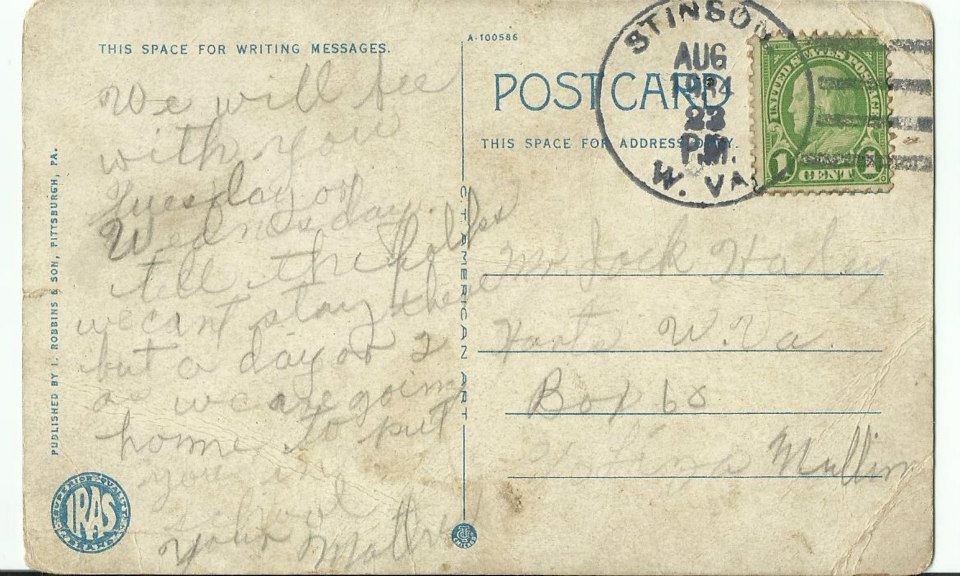
Postcard from Ella Haley in Calhoun County to Jack Haley in Harts, West Virginia, 1934

02 Wednesday Apr 2014
Posted in Ed Haley
Tags
Appalachia, Calhoun County, Ella Haley, genealogy, Great Depression, Harts, history, Jack Haley, Stinson, West Virginia
Postcard from Ella Haley in Calhoun County to Jack Haley in Harts, West Virginia, 1934
02 Wednesday Apr 2014
Posted in Ed Haley
Tags
blind, Calhoun County, Clay Hicks, Clyde Haley, Ed Haley, Ella Haley, history, Jack Haley, John Hartford, Laury Hicks, Lawrence Haley, Mona Haley, Noah Haley, Ralph Haley, Ugee Postalwait, West Virginia, writing
Ugee and I turned our attention back to the family photographs, where she spotted a picture of Ed’s son, Clyde. I told her about my visit with Clyde the previous year in California. She totally dismissed his story about Ed teaching him to drink, saying, “His dad never done no such stuff as that.” She paused for a second then said, “I went out and stopped Ed from whooping him one time. I think he’d stole some money or something. But he didn’t steal it. Noah did. I walked out and Ed had his belt off and I just took a hold of it. He said, ‘Who’s got a hold of me?’ He thought it was Ella. I said, ‘It’s me. You hit him another lick and the next lick’s mine. If you’re gonna whip him, whip the other’n.’ I said, ‘Noah’s the one was in your wallet.’ I seen Noah in it. I thought they’d sent him to get it. And Ed walked in and said, ‘Goddamn him, I ought to kill him.’ Then he told me, said, ‘Ugee, you ought to be careful with Clyde. He’s dangerous. He’ll sneak around and hurt ya.'”
Ugee had other run-ins with Noah, who was apparently one of Ella’s favorite children.
“Noah was picking on Lawrence and if he cried Noah’d say, ‘I never touched him.’ I said, ‘You do it again, I’ll whip you.’ Ella took Noah and went to Clay Hicks’ and stayed three days and when he come back he done just what I told him not to do. I never let on — I was a cooking. I said, ‘Noah, come here.’ I gave him three licks. I said, ‘I told you I’d whip you and I will.’ I looked at Ella and I said, ‘You needn’t take him and leave the country with him because I’ll follow wherever he’s at a whooping him.'”
This was interesting new information in the daily goings-on for Ed’s children. It was logical that since their parents were both blind they could get pretty wild. No doubt, Ed and Ella depended on family and friends to help raise the kids. Ugee, I noticed, had a close attachment to and interest in Ed’s children, almost as if they were her own family. She didn’t hesitate to tell how mean they could be.
“See, them kids had a hard time ’cause their dad and mother was blind and a lot of people didn’t want to bother with them,” she said. “People wanted the music of Ed and Ella but they didn’t want to put up with the family. That’s the truth of the matter. They was ornery. In other ways they wasn’t bad, either. You know, they was just children.”
Ugee seemed to think Mona was the meanest of the children.
“Mona was the orneriest young’n you ever seen in your life — to the core. She had to have all the attention. And she was pretty as a doll baby — curly-headed — just pretty as she could be. But my god, you couldn’t turn your back on her for a minute. If you was a baking a cake, she’d stick her hand in it. She could really get under your skin. I said, ‘Mona, you’re gonna keep on till I smack you.’ Ella said, ‘You don’t have to — I’ll give it to her.'”
Ugee lightly patted the air mimicking Ella.
“That’s the way she smacked — didn’t hurt them a bit. Mona would get up and look at her and laugh. Mona’d get out and go play a while, then she’d think of something to get into, like picking up chickens — ‘gonna weigh them’ — ringing their necks, throwing them down. ‘I’m weighing the chickens,’ she’d say. Killed about six or seven of them chickens. But that Ralph, he even shot hisself to see what it felt like. He’d do anything. You didn’t trust him out of your sight. He wouldn’t a cared to go out there and cut a cow’s throat or anything like that.”
I told Ugee what Mona had said about Ed being mean to her when she was growing up and she said, “Oh, I don’t think he was really mean to her. He’d fly up and cuss maybe. Now, the one they was really mean to was Clyde. Ella and Ed both was mean to Clyde.”
Wonder why?
“I’ve studied about that,” Ugee said. “Dad kept him all summer there at home to keep him from going to reform school. Now my dad woulda fought over him in a minute ’cause whatever he told him to do he minded him. And Mom, too. But I guess he was awful ornery when they were living in town. You know, kids a getting up to twelve, fourteen years old or something like that, there’s so much to get into. Now it would be awful to raise a family. I don’t remember Lawrence ever being like that. Jack and Lawrence was so good. Jack was a beautiful young man. Slender, dressy. He was a fine boy, but none of them came up with Lawrence far as I’m concerned. He was the best ole boy you ever seen. He would lead his mom and dad anyplace. I can see how careful he was. That little hand of his leading his mother ’round this mudhole — and his dad, too. I always called him my little boy. He was always better than the rest of them.”
Ugee said Lawrence always seemed bothered by the family troubles, even as a child.
01 Tuesday Apr 2014
Posted in Ed Haley
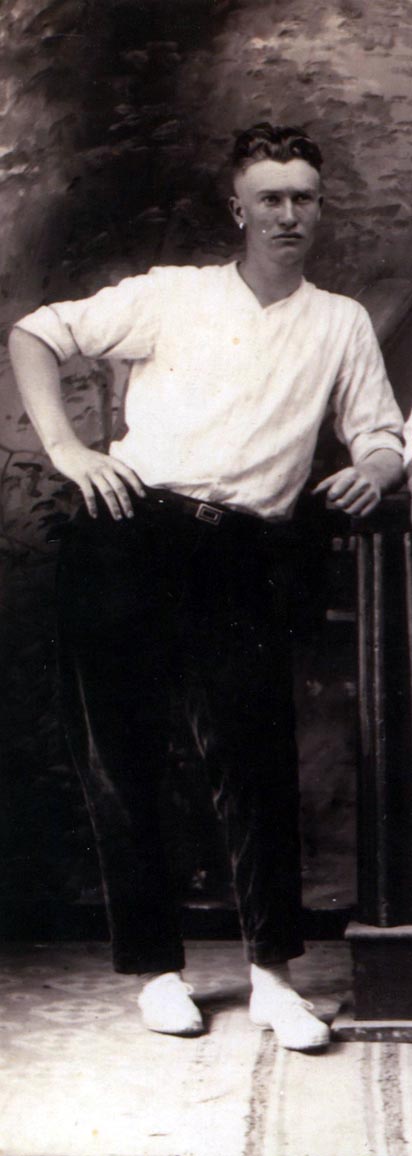
Russell Shaver of Calhoun County, West Virginia, c.1920
01 Tuesday Apr 2014
Tags
Annadeene Fraley, Beverly Haley, Calhoun County, Ed Haley, Ella Haley, fiddlers, fiddling, French Carpenter, history, John Hartford, Johnny Hager, Laury Hicks, Lawrence Haley, life, music, Pat Haley, Sol Carpenter, Ugee Postalwait, West Virginia, writing
Ugee also remembered French and Sol Carpenter coming to her father’s house. They were regarded by many as two of the best fiddlers in central West Virginia, so I had to ask, “How did your Dad and Ed regard the Carpenters?”
“There wasn’t nobody as good as Ed and Dad,” she said quickly. “They’d say, ‘Oh, you’re good,’ to the Carpenters and brag on them. Then get away from them and Ed’d say, ‘They didn’t come up with you, Laury,’ and Dad’d say, ‘They didn’t come up with you, either.'”
Ugee said a lot of fiddlers wouldn’t play in front of Ed. When they did, he would usually “listen a while, chew that tobacco and spit and wouldn’t say a thing” — then “cuss a blue streak” after they left. If the fiddler was really bad, though, or “if somebody was a playing something and they butchered it up a little bit — one of his tunes — he’d jump on his feet and stand straight up and say, ‘Goddamn! Goddamn!,'” Ugee said. “You knowed right then that there fella wasn’t playing it to suit him.” Laury would just die laughing over it and say, “Boy, he’s good ain’t he, Ed?”
I wondered if any fiddlers ever asked Ed for tips on how to play and Ugee seemed shocked. “Why, he wouldn’t a showed one how to play,” she said. “He learned music like I did — just a fooling with it.”
I asked Ugee about Johnny Hager, the banjo player she remembered coming with Ed to her father’s house when she was a small girl. I wondered if he was a good banjoist and she said, “Well, he was good for then, about like Grandpa Jones. Dad had a first cousin, Jasper McCune. Me, Dad and Jasper used to go and play music at pie suppers.” Banjos provided most of the second back then, she said. Some of the better players were Willie Smith of Ivydale and Emory Bailey of Shock. Guitars were rare.
I pulled out some of the Haley family photographs, which caused Ugee to ask about Pat Haley, who was coping with Lawrence’s death, her own poor health, and her daughter Beverly’s kidney cancer.
“Well Beverly is in a coma now,” I said. “Pat said she’ll wake up a little bit in the evening and she’ll kind of recognize them a little bit. So in other words, they’ve lost her but she’s still alive. The doctor thinks she’s got about two more weeks. Pat says, ‘We’re taking it one day at a time.’ And Annadeene Fraley, the one who introduced me to Pat, she’s got cancer.”
Ugee said she didn’t know how Pat was making it through all of the grief.
“‘Aunt Ugee,’ she calls me. She’s a fine woman. She’s a strong woman. Well, she had to be strong. She come over to this country married to Lawrence and he didn’t tell her his parents was blind until she got to New York. He said, ‘Well, I’ve got something I’ve got to tell you. My dad and mother is blind and if you want to go back I’ll pay your way back.’ She said, ‘I’ll stay.’ He went to Ed and Ella’s and Lawrence said he was starving to death for a mess of pinto beans. She said she never tasted beans. She didn’t know what they was. They cooked the beans and she tasted them and she thought they was brown mud. Said it tasted just like mud to her. Said they was just eating them beans and bragging on them and she wouldn’t touch them. They made fun of her over it.”
01 Tuesday Apr 2014
Posted in Big Harts Creek, Halcyon
Tags
Appalachia, Bud Dingess, genealogy, Halcyon, Harts Creek, history, life, Logan County, photos, U.S. South, West Virginia

Thomas “Bud” Dingess, resident of Halcyon, Logan County, WV
01 Tuesday Apr 2014
Posted in Big Harts Creek, Halcyon
Tags
Brown's Run, Chris Jackson, Crawley Creek, education, genealogy, Halcyon, Harts Creek, history, Leander Cary, Lee Dingess, Logan, Logan County, Logan Democrat, Lottie Casy, Sol Riddle, T.B. Hensley, Tommy Bryant, West Fork, West Virginia
“Rastus and His Mule,” a local correspondent at Halcyon on the West Fork of Big Harts Creek, Logan County, West Virginia, offered the following items, which the Logan Democrat printed on Thursday, March 27, 1919:
The teacher of the school at this place had an interesting entertainment on the last day of school, and a large number were present to enjoy it.
Leander Cary and family attended church on Brown’s Run Sunday.
The farmers are getting busy now.
Sol Riddle was shopping in Halcyon Thursday.
Atty. Lee A. Dingess has returned from a visit at Logan.
Tommy Bryant has moved into the Widow Jackson house.
T.B. Hensley has got up another singing school on Crawley.
We are glad to see our dear, old springtime again.
Miss Chris Jackson was the guest of Lottie Casy Friday.
31 Monday Mar 2014
Posted in Ed Haley, Women's History
Tags
Appalachia, Calhoun County, culture, history, life, Minnie Hicks, photos, Russell Shaver, West Virginia

Minnie Hicks (right) with her son, Russell Shaver, Calhoun County, WV, c.1912
31 Monday Mar 2014
Posted in African American History, Ed Haley, Music
Tags
Appalachia, Big Bear Fork, Black Bill, Bone Ratliff, Brown Hicks, Calhoun County, genealogy, Glenville, Harold Postalwait, Harvey Hicks, history, Jake Catlip, John Hartford, Laury Hicks, Little Bear Fork, Minnie Hicks, music, Sadie Hicks, Shock, Stumptown, Ugee Postalwait, West Virginia, writing
I asked Ugee if there were any black musicians in Calhoun County and she said she remembered some living around Big Bear Fork and Little Bear Fork.
“That’s in between Stumptown and Shock. They was two families lived out there: Jake Catlip and Bone Ratliff. They were black people. Lived out there in the country. First ones I ever seen. They called and wanted Dad to come to Bear Fork. Well, this boy had a guitar there. Maybe he was eight years old. They called him ‘Black Bill’ later. Dad said, ‘I can’t play it but I’ll show you something.’ Dad tuned it up and showed him three chords. Said, ‘Now learn that and come up and we’ll play music some day.'”
Ugee said she met Black Bill a little later.
“Well, when I was carrying Harold before Harold was born, I walked up the road and was going up to Dad’s and Mom’s and down there at what they call Hog Run there was a pile of rock there by the side the road and a paw paw tree,” she said. “And up jumped that black boy with a guitar on his back — liked to scared me to death. He said, ‘Lady, could you tell me where Dr. L.A. Hicks lives?’ I just pointed up to the house and said, ‘That house right there.’ I couldn’t speak I got scared so bad. Well, he just started out running. I was so weak I had to sit down. Got up there and here was that boy that Dad had showed how to chord. Now, you ought to heard him play. They kept him around there for a month. Well, the boys liked to hear him play the guitar. That’s where I got that ‘Down the road, down the road. Everybody going off down the road. Down the road, far as I can see. All the pretty girls look alike to me.’ Dad said to him, ‘Bill, you made a good guitar player but you can’t play with a fiddle. Now, let my daughter show you how to play the guitar with a fiddle.'”
Ugee’s meeting with Black Bill made a real impression on her.
“I’m not the type to get scared bad but that scared me: just come around a corner and there sat a black man — jump right out like that,” she said. “Now, I was only seven months along with Harold and when he was born he was so blue I thought I had ‘marked’ him with Black Bill. You know, you hear people ‘marking’ their kids? I raised up and they had him up to show me and I said, ‘Oh my god, I marked him to Black Bill.’ Mom said, ‘He’s not marked. He’s just blue.’ Me and Black Bill had many a laugh over it.”
I asked Ugee what happened to Black Bill and she said, “Brown Hicks was down sick and he went there and helped them out and everything. He stayed there one whole winter with them. Someone told me that he took up with Brown Hicks’ wife, Sadie. They lived together, I guess, over there toward Glenville and she had one kid by him. My brother Harvey seen the kid. Harvey said Sadie’s boy was ‘just a Black Bill made over.’ I don’t know what ever become of him after that. I never heard no more about him.”
31 Monday Mar 2014
Posted in Ed Haley
Tags
blind, Childers & Childers, culture, Ella Haley, history, Kentucky, life, photos

Childers & Childers: The Blind Man’s Store
31 Monday Mar 2014
Posted in Big Harts Creek, Whirlwind
Tags
Alex Tomblin, Baltimore, Bill Davis, Buck Fork, Camp Lee, Crit Mullins, Dalton School, Dave Bryant, education, Eli Workman, genealogy, Harts Creek, history, Holden, Isaac Collins, James Mullins, John Dalton, Kern Carter, life, Logan County, Logan Democrat, Maryland, Mollie Conley, Moses Tomblin, Olive Stollard, Omar, Peter Dalton, Peter Hensley, Peter Tomblin, Stonewall Conley, Tom Mullins, Twelve Pole Creek, W.J. Bachtel, West Virginia, Whirlwind, Will Tomblin, Williamson
“Blue Eyed Beauty,” a local correspondent at Whirlwind in Upper Hart, Logan County, West Virginia, offered the following items, which the Logan Democrat printed on Thursday, March 13, 1919:
Peter Hensley purchased a mule of Dave Bryant this week.
Moses Tomblin has purchased the grist mill of James Mullins.
John Dalton had a house raising on Thursday.
Peter Dalton, who spent a week home on furlough from Camp Lee, returned to that place Friday.
Will Tomblin has moved from his farm on Twelvepole to Omar. His mother-in-law will occupy the farm.
Peter Tomblin has purchased the Eli Workman farm and will remove to it in the near future. We understand that Bill Davis will occupy the property vacated by Mr. Tomblin.
W.J. Bachtel began teaching the Dalton school on Monday, but was able to continue but two days on account of sickness.
Tom Mullins and brother, Crit, have moved from Twelvepole to Buckfork.
It is reported that Isaac Collins will set up in the mercantile business.
Miss Kern Carter is visiting with her brother at Williamson.
Alex Tomblin is visiting on Hart’s Creek.
We hear that Mrs. Olive Stollard, an English woman, of Baltimore, Md., who was a former resident of Holden, was at Stonewall Conley’s the first of the week for the purpose of taking Miss Mollie Conley home with her. A grandson of Mrs. Stollard’s married a sister of Miss Mollie.
30 Sunday Mar 2014
Posted in Ed Haley, John Hartford
Tags
Appalachia, art, Calhoun County, fiddlers, fiddling, history, John Hartford, Laury Hicks, Minnie Hicks, music, Ugee Postalwait, West Virginia
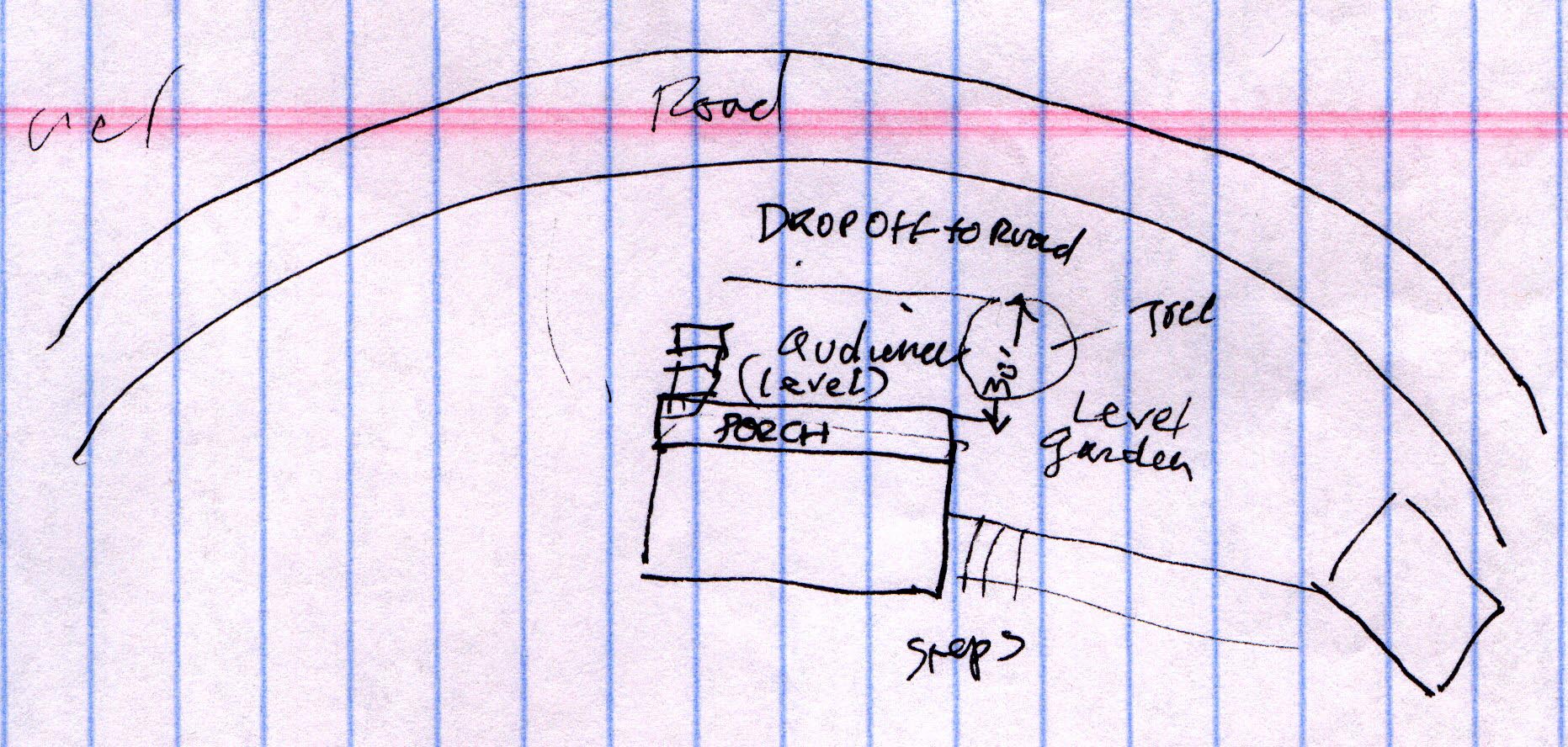
John Hartford’s sketch of the Laury Hicks home in Calhoun County, WV, 1996
30 Sunday Mar 2014
Tags
Appalachia, Calhoun County, Cincinnati, Ed Haley, fiddlers, fiddling, Grand Ole Opry, Great Depression, Harold Postalwait, history, John Hartford, Laury Hicks, Minnie Hicks, music, Nashville, Ohio, Ugee Postalwait, West Virginia, Wilson Douglas, writing
I said, “Now when they played, would they play at the same time?”
“Oh yeah,” Ugee said. “Sometimes they played at the same time. Then one time maybe one would be a playing and the other would be a listening. Say, ‘Oh, you pulled that bow the wrong way.’ ‘Now that didn’t sound right to me. Go back over that again.’ They’d sit maybe not for ten minutes but for hours at a time when I was a growing up. Trying to out-beat the other. Which could make the best runs and which could do this. They never was mad at each other or anything like that, but they’d argue about it. ‘I know I beat you on it.’ ‘Well, you put that run in it at the wrong place.’ But Ed Haley is the only man I ever heard in my life second the fiddle. Dad’d play the fiddle and he’d second his with the fiddle. Like if you’re playing the ‘fine,’ why he might be playing the bass. That’s the prettiest stuff ever you heard. I heard Dad try to do it but Dad never got that good on it.”
I asked her if Ed ever played “Flannery’s Dream” and she said, “Oh, yeah. I’ve heard that.”
When I played “Wild Hog in the Red Brush”, she said Ed definitely played it, although she didn’t remember it having that title.
Just before I played another tune, Ugee said, “This is my birthday gift. My birthday’s the 19th. I’ll be 88 years old. Oh, I do pretty good, I reckon, for the shape I’m in. I remember pretty good but I’ve got trouble on this here voice box.”
“You remember pretty good, like your mother,” Harold said. “She was a hundred years old and she remembered when every kid was borned in that part of the country.”
Ugee said, “Mom delivered over five hundred children. She knowed every one of them and their name.”
Harold said, “And where they come from and up what hollow she had to walk and everything else. She never forgot nothing, that woman.”
Ugee said, “I don’t want to be that old. It’s all right if you can walk and get around. But if you’re down sick in the nursing home, let the good Lord take me away. I don’t wanna be there. My dad had leukemia and cancer of the stomach when he died. And it’s hard to see someone suffer like that.”
I told Ugee what Wilson Douglas had said about people gathering at her father’s home and listening to music on the porch and she said, “Sure, you ought to have seen my home. We had one porch run plumb across the front of the house. Ed and Dad just sat right along behind the railing.”
She pointed to the picture of John Hicks’ house and said, “Our house was even bigger than that. It was plank. But I remember when they all come over there and they’d gang around on that porch. Everybody. When Ed Haley was in the country, they come from miles around to our house. Word would get out that Ed was there or Ed was gonna be there a certain day.”
Inspired by Ugee’s memories, I got some paper from Harold and tried to sketch the Laury Hicks place. Ugee said things like, “It didn’t have no fireplace — we had gas then. And over on this end the steps went plumb down the hill to the road. That’s after they put the paved road down there, you see. Our house sat almost in a curve. Garage is down there at the road.”
I said, “So people gathered in front of the porch to hear all the music?” and Harold said, “They didn’t have much room. The yard only went out there maybe thirty or forty feet and then it dropped off down to the road. A pretty steep bluff — fifteen-, eighteen-, twenty-foot drop. On this side of the house was the garden spot and out the other end the yard didn’t go very far.”
Were there shade trees around the house?
“Yeah, three or four big oak trees over to one side and then we had apple trees on the other side,” Ugee said.
I asked if the crowds came at day or night or only on weekends and Ugee said, “They’d come through the day and Dad and Ed would play music all day and half the night. Weekends, why, it was always a big crowd. I’ve studied about them so much, about how good a friends Ed and Dad was. And always was that way. And they’d have the most fun together.”
Ugee said Ed never put a cup out for money.
“I never seen him put a cup out in my life. Maybe they’d be somebody to come around and put a cigar box to the side and everybody would go through and put money in it. Course when he was playing in the city — Cincinnati or some place like that — why he’d make quite a bit of money there. Whenever he played them religious songs, the hair’d stand on your neck. You’d look at two blind people sitting and singing.”
I interrupted, “Did he play Cincinnati a lot?”
Ugee said, “He played Cincinnati a lot. He went to Cincinnati to make records one time, too. That’d a been in the thirties. He fell out with them. They wanted to pick the tunes. Ain’t nobody picked tunes for Ed — Ed picked his own tunes. When he found out what they was trying to hook him on, he quit right then. Ed went down to Nashville once. I don’t know that he went to the Grand Ole Opry but he went to Nashville. When he found out what they done, he didn’t have no use for that.”
30 Sunday Mar 2014
Posted in Harts, Lincoln County Feud, Women's History
Tags
Al Brumfield Cemetery, Appalachia, crime, feud, genealogy, Harts, Hollene Brumfield, Lincoln County, photos, U.S. South, West Virginia

Hollena (Dingess) Brumfield, a major character in the Lincoln County Feud, is buried at Harts, Lincoln County, WV
30 Sunday Mar 2014
Posted in Poetry
Tags
Appalachia, love, poems, poetry, writing
A Time to Love
(Anniversary)
Though I did not think it possible,
I feel myself growing fond of someone.
It is a scary feeling —
One of uncertainty and curiosity.
I can feel myself ebbing toward you.
Is it time to love?
Though our eyes seldom behold each other,
Though we never have brushed lips or hands,
I can feel me loving you.
You are the girl I have dreamed of.
I have wanted you for years.
Nothing can change that.
I can not make these feelings go away.
I could conceal them longer
But I do not wish to do that.
I have wanted you for so long.
I know that it is time to love.
Do not be frightened or uncomfortable.
It is not the occasion for such negativity.
Frolic in the meadows God has created for us.
Laugh with the joy that you will finally know contentment.
I will make you happy.
I will make you love.
Have you ever truly?
O’ it is time to love.
The Spririt is everywhere around me.
It is our time to love.
Bless me with an opportunity to prove myself.
“Shew forth thy loving kindness in the morning.”
It is morning.
It’s our morning.
Let us grip hands
And love each other throughout the days.
Our sun will shine a little brighter, I think.
BRK
May 7, 1991
30 Sunday Mar 2014
Posted in Big Harts Creek, Whirlwind
Tags
Appalachia, Crockett Farley, Dorcas Farley, genealogy, Harts Creek, history, life, Logan County, U.S. South, West Virginia

Thomas “Crockett” Farley and Dorcas (Kelley) Farley, Harts Creek, Logan County, WV
30 Sunday Mar 2014
Posted in Big Harts Creek, Whirlwind
Tags
Brown's Run, Buck Fork, Charles Curry, Crockett Farley, Dicie Bryant, genealogy, George Hensley, Hall School, Harts Creek, history, Island Creek, John T. Workman, Logan County, Logan Democrat, Luke Curry, Mont Bryant, Queens Ridge, Sam Adkins, Samuel Tomblin, Twelve Pole Creek, West Virginia, Whirlwind, William Carter
“Blue Eyed Beauty,” a local correspondent at Whirlwind in Upper Hart, Logan County, West Virginia, offered the following items, which the Logan Democrat printed on Thursday, March 6, 1919:
The Rev. Sam Adkins preached at the Hall school house on Twelvepole Sunday.
Mon Bryant of Queensridge visited with relatives in this community the first of the week.
Wm. Carter quit work on Island Creek Friday on account of ill health.
The Revs. Chas. Curry and George Hensley held religious services Sunday at Brown’s Run.
Samuel Tomblin drove a fine hog to Island Creek and sold it Wednesday.
Crockett Farley hauled a load of merchandise for James Mullins Wednesday.
Mrs. Dicie Bryant and _____ were both on the sick list for a few days this week.
John T. Workman, mention of whose illness was made in our last week’s issue, was removed from his home on Buckfork to the home of his father-in-law, Luke Curry.
29 Saturday Mar 2014
Tags
Appalachia, Calhoun County, culture, genealogy, history, Laury Hicks, life, Minnie Hicks, photos, U.S. South, West Virginia
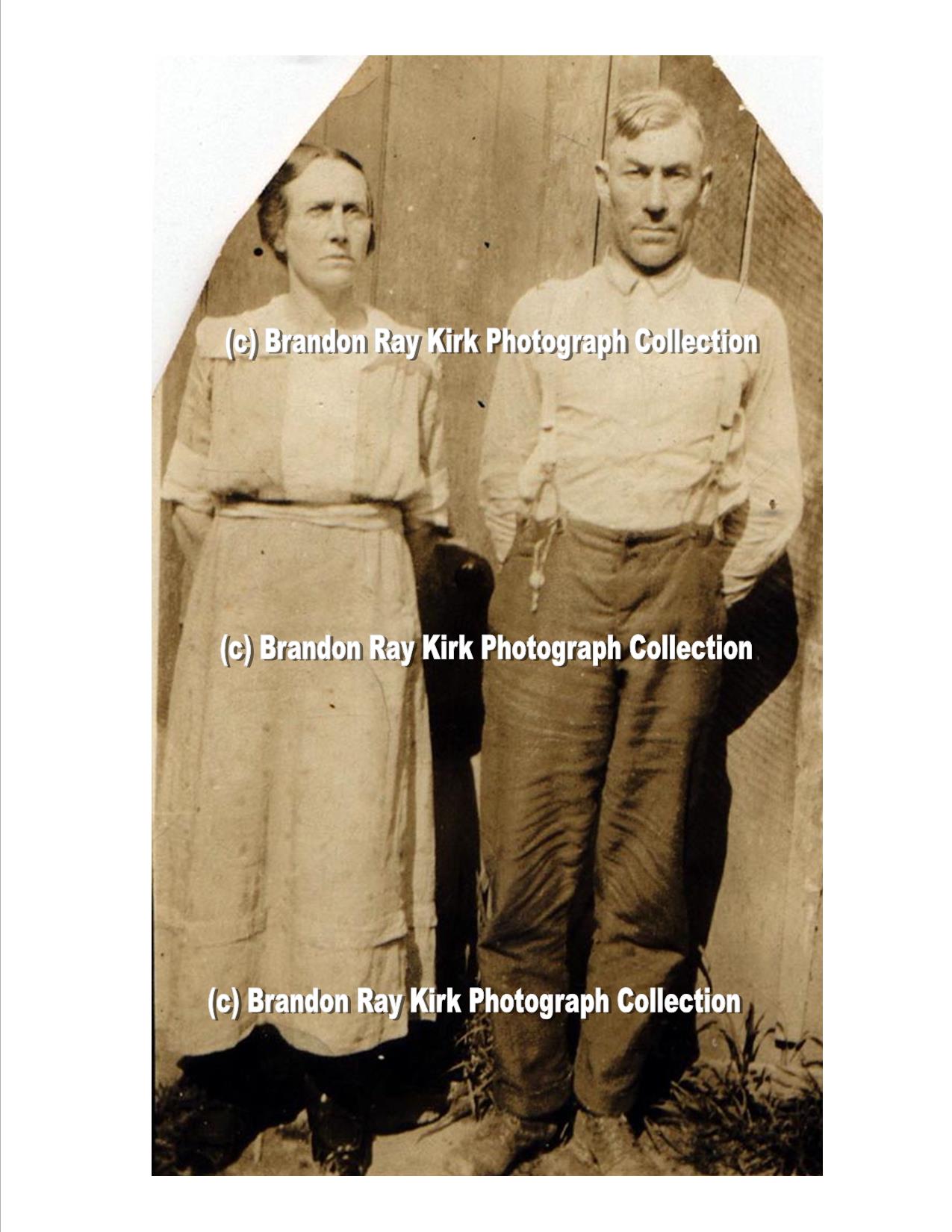
Minnie and Lawrence Hicks, Calhoun County, West Virginia
29 Saturday Mar 2014
Tags
Ab Moss, Alabama, Calhoun County, Calhoun County Blues, Carey Smith, Catlettsburg, Ed Haley, Ella Haley, Euler, fiddlers, fiddling, guitar, Harold Postalwait, Hell Among the Yearlings, history, Homer Moss, John Hartford, Laury Hicks, music, Rogersville, Ugee Postalwait, West Virginia, writing
I took my fiddle out of the case and played for Ugee. A few tunes later, she said she liked my bow hold.
“Him and Dad both held the bow down there on the end,” she said. “Dad and Ed neither one never had no use for anyone that took hold of the bow way up toward the middle. They didn’t like that at all. And Ed and Dad neither one didn’t like for someone to put their fiddle down against their chest.”
Ugee paused, then said, “You’re with the fiddle like I was with the guitar after I got it. I set and fooled with it all the time — any time I had time away from dishes or anything, I’d set on the porch and play that guitar. I wanted to learn it and nobody to learn me and I learned it myself. I done the same thing with the banjo. Of course, Dad could thump the banjo some and play it a little bit. But when I got that guitar and changed over to it, then I wanted to learn that guitar.”
When I played “Yellow Barber” for Ugee she got choked up and said, “That sounds so good, John. You don’t know how good that sounds. I’ve been thinking about my dad and them all morning. I’d just have given anything if we’d had tapes of Dad.”
I told her that I’d been researching some tunes I suspected of being in Ed’s repertoire (many from the Lambert Collection) and she said, “Ed knew a lot of them. I’ve heard so many of his pieces, now I’m getting to where I’m forgetting a lot of pieces.”
When I played “Girl With the Blue Dress On”, she said, “I can’t get that one in my head. Some part of it sounds natural. Yeah, I’ve heard that song. There’s words to that: ‘She come down from Arkansas with a blue dress on. Prettiest girl I ever saw, she came down from Arkansas.’ Who was that old man that used to come and play that on the banjo? I believe it was Carey Smith from around Euler.”
I next played “Flying Cloud” for Ugee, who said, “Ed didn’t call it that. I can’t remember what he called it but he never called it ‘Flying Cloud’. Course Ed was pretty good to change names on you, too.”
I told her that Lawrence and I had always figured Ed’s “Catlettsburg” had another name, and she agreed.
“Well in fact he almost said he put the name on that piece ’cause they lived down there, you know,” Ugee said. “You see, most of them old fellas, if they’d hear a tune and they learnt to play it, then they’d change the name. Just like ‘Carroll County Blues’, we called it ‘Calhoun County’. Just whatever county you was a living in.”
I started playing “Calhoun County Blues”, fully aware that it was one of Ugee’s favorite tunes. She watched me quietly with an excited expression on her face.
“That’s my piece,” she said to Harold. “I could crack my heels to that.”
The next thing I knew, she rose out of her chair and started dancing.
I stopped and said, “Now, wait a minute. Don’t hurt yourself.”
She told me to go on, though.
“I didn’t think you could get your feet up that high,” Harold joked her.
Ugee said, “I was a dancer at one time. Never got tired.”
I continued playing the tune for a few minutes, then asked if Ed ever danced.
“I never seen Ed dance, but I’ll tell you what,” she said. “He could keep time with his feet. I can remember so well that foot coming down and then when he got older he’d pat his feet. He’d keep both of them going. He didn’t make a big noise with them or anything. Just give him a drink of whiskey or two and then he’d come down on that there fiddle and you ought to hear Ella then.”
I asked Ugee if Ed was pretty good at making up parts to tunes.
“Oh, yeah,” she said, not quite understanding my question. “He made up a lot of his tunes and then give them a name. And Dad would do the same. They was sitting around and they’d try different things. ‘Listen to this’ and ‘Put that note in there.’ I always did think they made up that ‘Hell Among the Yearlings’. Ab Moss lived down below us — very religious man — and he was there with his wife and Homer, the oldest boy, and Abner looked over to Ed and said, ‘That’s a pretty piece. What do you call that?’ and they said ‘Hell Among the Yearlings’. I always did think they made that up to aggravate him. Then they just cackled and laughed after they left. ‘Hell Among the Yearlings’, said, ‘That’s a pretty good name for it.’ I can see them yet a sitting on the porch laughing about it.”
29 Saturday Mar 2014
Posted in Sand Creek

Sand Creek, Lincoln County, WV, 2012
29 Saturday Mar 2014
Posted in Big Harts Creek, Halcyon
Tags
Albert Dingess, Appalachia, Crawley Creek, education, genealogy, Halcyon, Harts Creek, history, life, Logan County, Logan Democrat, Striker, West Fork, West Virginia, Will Harris
“Daddy’s Girl,” a local correspondent at Halcyon on the West Fork of Big Harts Creek, Logan County, West Virginia, offered the following items, which the Logan Democrat printed on Thursday, February 27, 1919:
We are pleased that spring will soon be here with its flowers and sunny weather.
Our singing school is progressing fine but will soon be out. The singing master says he will begin a school at Striker, on Crawley, when our school closes.
The girls and boys of Halcyon are preparing to have a good time at school Friday. They all have arranged to wear fancy dress costumes.
Will Harris is preparing to move into the house on the A. Dingess farm, where he will work this season.
A. Dingess is still very poorly.
Writings from my travels and experiences. High and fine literature is wine, and mine is only water; but everybody likes water. Mark Twain
This site is dedicated to the collection, preservation, and promotion of history and culture in Appalachia.
Genealogy and History in North Carolina and Beyond
A site about one of the most beautiful, interesting, tallented, outrageous and colorful personalities of the 20th Century
 Brandon Ray Kirk