Tags
Appalachia, Brandon Kirk, fiddlers, John Hartford, music, photos, Slim Clere, South Charleston, U.S. South, West Virginia

Here I am with Slim Clere and John Hartford at Slim’s home in South Charleston, WV, 1996

16 Friday May 2014
Tags
Appalachia, Brandon Kirk, fiddlers, John Hartford, music, photos, Slim Clere, South Charleston, U.S. South, West Virginia
Here I am with Slim Clere and John Hartford at Slim’s home in South Charleston, WV, 1996
16 Friday May 2014
Tags
Ashland, Atlanta, Bert Layne, Bill Day, Blackberry Blossom, blind, Clayton McMichen, Dill Pickle Rag, Ed Haley, Ed Morrison, Ella Haley, fiddle, fiddlers, Gary, Goodnight Waltz, Grand Ole Opry, history, Indiana, Jesse Stuart, John Carson, Kentucky, Lowe Stokes, mandolin, music, Ohio, Over the Waves, Portsmouth, Riley Puckett, Slim Clere, South Charleston, South Shore, Sweet Bunch of Daisies, Theron Hale, Vanderbilt University, Wednesday Night Waltz, West Virginia, World War I, WSM
The next day, after a few hours of sleep at Wilson’s house, Brandon and I drove to see fiddler Slim Clere in South Charleston, West Virginia. Slim was born in Ashland around the time of the First World War and knew a lot about Ed. We were parked behind his two-story house and were unloading our “gear” when he appeared out of a back door and led us inside his house (past some type of home recording studio) and up a flight of stairs. We sat down in the living room where we met his wife, a vivacious middle-aged woman who fetched several scrapbooks at Slim’s request. We flipped through the pages while Slim told us about some of his early experiences.
“I knew Jesse Stuart in 1934,” he said. “He lived at South Shore, Kentucky, across the river from Portsmouth, Ohio. He went to Vanderbilt. I believe he did play football. He used to date Theron Hale’s daughter that used to be at WSM at the Grand Ole Opry. I thought maybe he might marry her but he didn’t. Well anyway, I went away. I left my home and went to Atlanta. Well I went to Gary, Indiana, and everywhere, and worked with Bert Layne and Riley Puckett and some of those old-timers. I knew old Fiddlin’ John Carson. I never did meet Lowe Stokes. He lost an arm in a hunting accident. At one time he was a better fiddle player than McMichen. But Mac come out of it. He really could play. I patterned a lot of my style after him.”
Slim pointed to a picture of himself in his youth and said, “That’s back when I had hair and teeth.”
I was anxious to talk about Ed, so I asked Slim if he could remember the first time he ever saw him.
“I grew up knowing him,” Slim said. “He used to come down to the Ashland Park there every Sunday and sit around and fiddle for nickels and dimes on a park bench and I’d sit on there and watch him play.”
Slim said Ed Haley, Ed Morrison, and Bill Day were his primary influences during his younger days in Ashland.
“He was hot stuff,” Slim said of Haley.
He described Ed as a “loner” but said his wife was always with him.
“The old lady chorded a taterbug mandolin,” he said.
Ed played on a little yellow fiddle, which he wouldn’t let anyone “get a hold of,” and kept a cup between his legs for money. Down at his feet on the ground was his old wooden case, “made like a coffin.”
How much would you have to put in the cup to get him to play a tune?
“Didn’t matter,” Slim said.
Could he tell how much you dropped into the cup?
“He’d know just to the tee what it was,” he said. “He could tell the difference between a penny and a dime.”
Would the length of how long he played the tune depend on how much you dropped in the cup?
“No, he liked to play.”
Slim and I got our fiddles out and played a lot of tunes — or parts of tunes — back and forth for about a half an hour. I wanted to know all about Ed’s technique and repertoire. Slim said he “cradled” his fiddle against his chest (“all the old-timers used to do that”) and held the bow way out on the end with his “thumb on the underneath part of the frog.” He moved very little when playing.
“The only action he had was in that arm…and it was smooth as a top,” Slim said. “He fingered his stuff out. He didn’t bow them out. He played slow and beautiful and got the melody out of it. Now, he could play stuff like ‘Dill Pickle Rag’ where you had to cross them strings and that ‘Blackberry Blossom’ was one of his favorites. He played ‘Goodnight Waltz’, ‘Wednesday Night Waltz’. I don’t think ‘The Waltz You Saved For Me’ had been invented yet. He played ‘Over the Waves’ and ‘Sweet Bunch of Daisies’. He didn’t double-stop it, though.”
14 Wednesday May 2014
Posted in Calhoun County, Ed Haley, John Hartford, Music
Tags
Appalachia, Brandon Kirk, Calhoun County, cemeteries, Hicks Family Cemetery, history, John Hartford, Kim Johnson, Laury Hicks, music, photos, U.S. South, West Virginia, Wilson Douglas
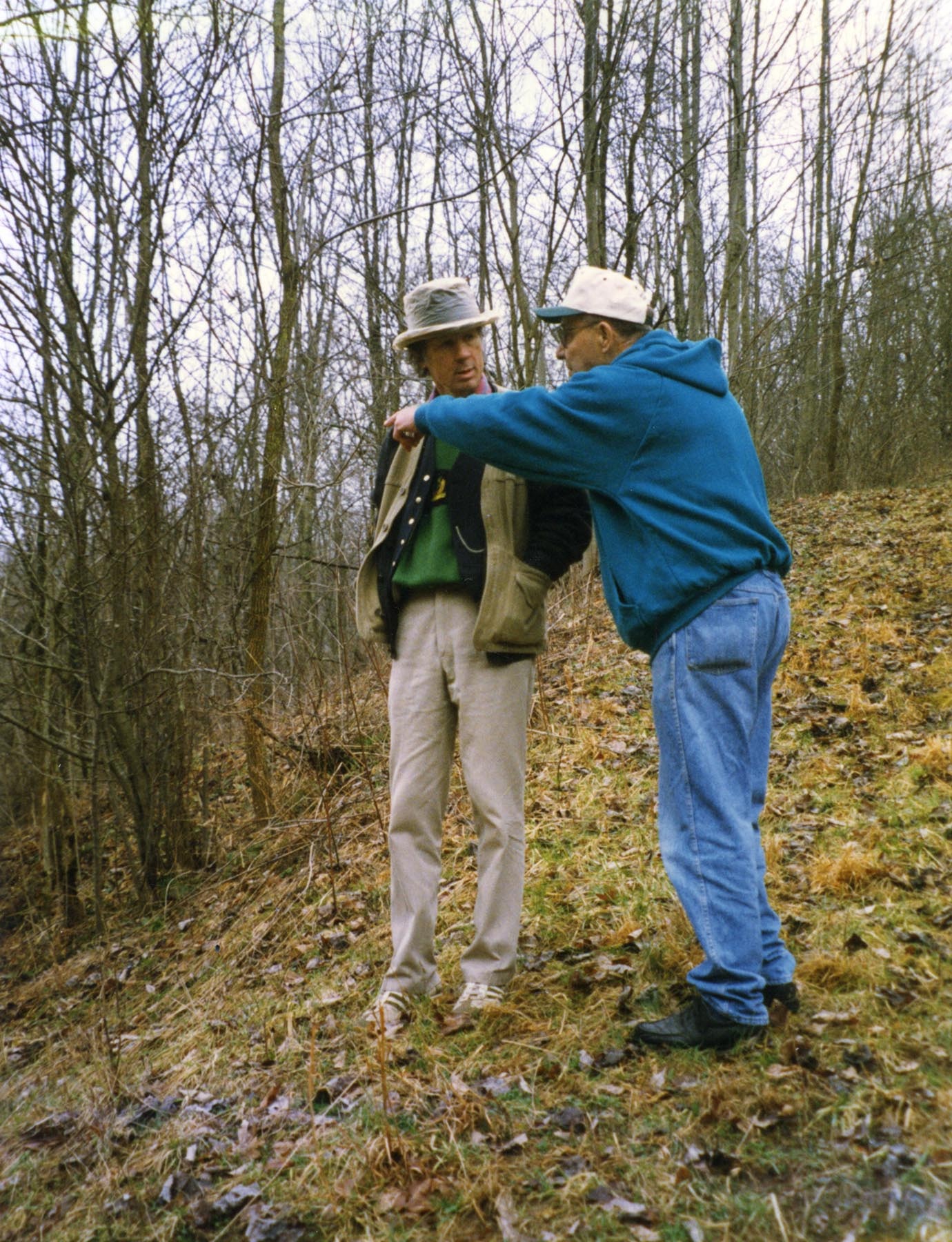
Wilson Douglas and John Hartford, Calhoun County, WV, 1996

John Hartford and I at the Laury Hicks grave, Calhoun County, WV, 1996
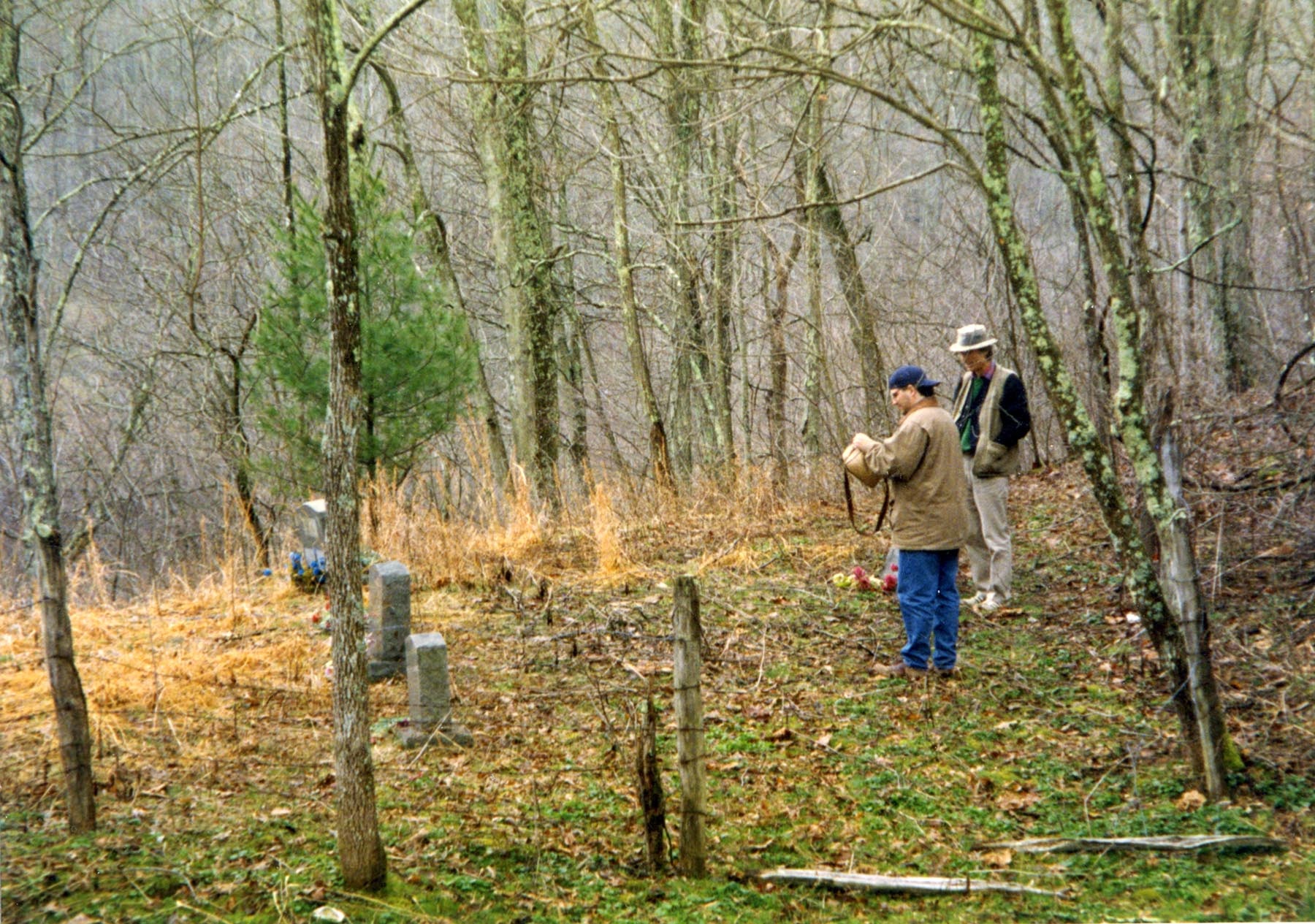
John and I at the Laury Hicks grave, Calhoun County, WV, 1996
14 Wednesday May 2014
Posted in Calhoun County, Clay County, Ed Haley, Music
Tags
Appalachia, Arnoldsburg, Ashland, banjo, Ben Friend, Bernard Postalwait, Bill Stutler, Bob Carr, Brandon Kirk, Calhoun County, Camp Chase, Charleston, civil war, Clay, Clay County, Clendenin, Ed Haley, Ed Williams, Edden Hammons, fiddlers, fiddling, history, Hog Run Hollow, Jack McElwain, John Hartford, Kentucky, Kim Johnson, Laury Hicks, Lawrence Haley, Lincoln Republican, Luther Carder, music, Pat Haley, Pisgah Bridge, Richwood, Sol Carpenter, St. Albans, Ugee Postalwait, West Virginia, William E. Chilton, Williams River, Wilson Douglas, writing
Brandon and I got a good night’s sleep at Pat Haley’s home in Ashland, then took off the next morning to see Wilson Douglas in Clendenin, West Virginia. I wanted to hear more about his memories of Ed, play some music, and go see the old Laury Hicks homeplace. Wilson met us on his porch with Kim Johnson, a banjo player. We all went inside and got settled, where Kim mentioned that Laury first invited Ed to his house after meeting him in St. Albans, near Charleston. Wilson was quick to offer new details about Ed — of a more seedy variety. He said Ed “ran around” a lot with Bernard Postalwait when he was in the area. They usually got drunk and went “women crazy” and stayed gone all night. Hicks apparently had a “wild side,” too. Wilson hinted that he was a moonshiner who sometimes left home on timber jobs…and never showed up.
We wasted little time in taking off to see some of Ed’s old stomping grounds in Clay and Calhoun Counties. There was a slight drizzle, just enough to wet everything.
Our first stop was the Hicks homeplace, which had been overtaken by weeds on my previous visit in 1994. The weeds were gone this time, so we got out of the car and maneuvered through the rotting remains of an outhouse, chicken coop, cellar base, parts of an old fence, and scattered boards — all damp and colored dark brown due to the light rain dropping down around us.
It was a far cry from the “old days” when (according to Ugee Postalwait) the family had farmed corn, wheat and cane all the way back up the mountain to the head of Hog Run Hollow. Gone were the apple and peach orchards. Gone were the gardens down by the creek (now taken in by the paved road). And, most obviously, gone was the old Hicks home, the last of four houses built on the site (the final one having been constructed in 1936).
We soon made our way up the hill to the cemetery, where Brandon took pictures. I just kind of stared at Laury’s grave — picturing Ed playing there after Laury’s death in 1937.
As we came off the hill, Wilson said Hicks was rumored to have died from “some bad cases of VD.”
Later that day, Wilson showed us Clay, the seat of government for Clay County. This was the place where Ed Haley arrived by train from Charleston enroute to the home of Laury Hicks. Lawrence Haley once told me about his father walking from Clay to Arnoldsburg, a town some thirty miles away. Brandon had found this great article titled “Old-Time Fiddlers Will Gather At Clay Saturday” from a 1921 edition of the Lincoln Republican.
Clay, W.Va., Jan. 10 — Elaborate preparations are being made in the little city of Clay for the old-time fiddlers’ contest which will be held on Saturday night, January 22. An attendance surpassing anything ever held in Clay is expected, and the hospitable citizens of this town have appointed a committee to look after the welfare of its guests. Similar contests have been held in various other sections of West Virginia this winter, but they cannot even compare to the one which will be held in Clay, it is predicted. Old-time fiddlers from far and near are coming to compete, and, if possible, carry off the honors of the evening.
Among some of the celebrated old-time fiddlers who will be here is “Jack” McElwaine of Erbacon, in Webster county. “Jack” has played the fiddle for more than fifty years, and between times has been justice of the peace, preached the gospel and practiced law. He learned to play under Saul Carpenter, the most famous old-time fiddler of them all, and who played himself out of Camp Chase during the Civil war. Another fiddler equally famous is “Edin” Hammons, who hails from the head of Wiliams river, and whose sole occupation all through life has been hunt, trap and play the fiddle. “Edin” has killed more bears, deer and played the fiddle more than any other man on Williams River.
It is said that Senator William E. Chilton and Colonel Bob Carr of Charleston have been given invitations to attend the contest and compete with these old-time fiddlers.
Several local celebrities are expected to enter the contest, and the old mountaineer fiddlers are looking forward to this part of the contest with great pleasure and saying “the city fellers will have to fiddle some to beat them.” No complete list of the fiddlers who enter the contest has been made public, but some fifteen or twenty are expected. Ben Friend, Ed Williams, Luther Carder and “Bill” Stutler, men who have been winning prizes in other contests, will be there.
People of Clay and surrounding country are looking forward to this event with great anticipation and pleasure. The last contest of the kind was held at Richwood, Thursday night of last week, and fully 200 persons were unable to get into the theater where it was held.
There are very few of the real old time fiddlers who play the old mountain tunes living today, and within a very short time there will be none left and no one to take their place. The younger generation has neither talent nor desire for this kind of music. At any rate, one can not find a young man of today who can play the fiddle in the “good old-fashioned way.”
Clay, I found, was a small shell of a town with a nice old courthouse sitting high on the hill. There was the typical arrangement of buildings: sagging old businesses hinting at lost prosperity, a small bank, dollar stores, a car dealership, a post office, and a Gino’s restaurant. No red lights and basically one two-lane thoroughfare through town. There was a hotel with the weekly newspaper office headquartered beneath where, I was told, you could go in late and help yourself to a key and then pay for your room the next morning on your way out. After passing through town and crossing the Pisgah Bridge, we spotted an old section of residences and a community church. The track bed was still visible but the railroad was long gone.
14 Wednesday May 2014
Posted in Big Ugly Creek, Music
Tags
Big Ugly Creek, fiddler, genealogy, history, Jeff Duty, Lincoln County, music, photos, U.S. South, West Virginia

Jeff Duty (1867-1949), a fiddler from Big Ugly Creek in Lincoln County, WV
13 Tuesday May 2014
Posted in Big Creek, Big Harts Creek, Big Ugly Creek, Calhoun County, Music
Tags
Akron, Arthur Smith, banjo, Bertha Bias, Big Creek, blind, Boone County, Boone County Genealogical Society, Broad Branch, Calhoun County, Chapmanville, Clay County, Dave Brumfield, Dicy Thomas, Dolly Bell, Ed Belcher, Ed Haley, Ella Haley, fiddle, fiddler, Garretts Fork, genealogy, Greenview, Harts Creek, Harvey Hicks, Hewetts Creek, history, Hubert Baisden, Irene Hager, Jeff Baisden, Jeff Duty, Jess Chambers, Johnny Hager, Kanawha County, Kansas, Kentucky, Kith and Kin, Laury Hicks, life, Little Coal River, Logan County, Lydia Johnson, Madison, Mary Baisden, Morehead, music, North Fork, Ohio, Powderly, Riland Bias, Robert Martin, Rowan County, Sampson Thomas, Simon Bias, Spruce Fork, Texas, Trace Fork, Turley Adams, Ugee Postalwait, Victoria Adams, West Virginia, Wilson Craddock, writing
After his return to West Virginia, Johnny Hager took immediate notice of the large number of musicians who lived in the head of Big Harts Creek. His first cousin, Jefferson “Jig-Toe” Baisden (1879-1970), was a dancer and banjo-picker. J. E. “Ed” Belcher (1889-1970), who played several instruments, and Robert Martin, an Arthur Smith-style fiddler, were other significant musicians in the area. Ed Haley (1885-1951), a blind fiddler from Trace Fork, particularly caught Hager’s attention. Johnny’s desire to absorb Haley’s music was understandable because, as Jess Chambers stated, “It was a badge of honor to have played with Ed Haley.” Jeff Baisden, a cousin to both men, may have introduced the pair.
Johnny could supposedly play any instrument and his trip out to Kansas allowed him to soak up a variety of western tunes and playing styles which were completely new to folks in Logan County. Both of these qualities, his diverse musical capabilities and his unique musical background, ensured that he an Ed Haley had many intense music sessions. According to Turley Adams, Johnny’s great-nephew, Hager encouraged Ed to take his show on the road and volunteered to serve as Haley’s “eyes” on such trips. This willingness to travel, coupled with his apparent competence as a musician, made Johnny a perfect sidekick to Ed. Haley and Hager were both unmarried, a convenience which allowed them to roam the country with few cares or responsibilities.
Johnny and Ed traveled to various places in West Virginia but are particularly remembered up around the Calhoun-Clay County area north of Kanawha County. Aside from being populated with rural folks similar to Hager’s neighbors in Logan and Boone Counties, the area was also endowed with a host of great musicians. Haley and Hager wintered there as young men with a fiddler named Lawrence “Laury” Hicks (1880-1937). Ugee (Hicks) Postalwait of Akron, Ohio, a daughter of Laury Hicks, said that Ed and Johnny first came and visited her father in the early 1910s. Hager was a tall, slim banjo-picker. When Ed and Johnny left Laury’s home in the spring, with Johnny leading the way, Ugee and her brother stood on the bank by the house and “hollered and cried after them.”
Most agree that Johnny’s travels with Ed Haley ended around 1914 when Haley married Ella Trumbo, a blind music instructor from Morehead in Rowan County, Kentucky. Haley’s habit of cursing and drinking also helped end the partnership. Hager did not care for it.
For the most part, Johnny spent the remainder of his life playing music while boarding with his Baisden kinfolk on the North Fork of Big Creek. Irene Hager, a daughter of Hubert E. and Mary (Pauley) Baisden, remembered Johnny playing music on her father’s front porch in the late 1920s. Her father, a banjo-picker, lived at Greenview and the Big Branch of Spruce Fork of Little Coal River in Boone County. Hubert Baisden was Johnny’s first cousin. Hager boarded with him for several weeks at a time. One of Hager’s chores at the Baisden home was to keep wood in the stove. Irene said that Johnny often talked about his early travels with Ed Haley.
Johnny Hager was a man with little roots and family, a fellow who never had a real home. Many from Harts Creek remember that Hager was simply from the “the North Fork of Big Creek.” Dave Brumfield, a great-nephew, said that Hager stayed in that vicinity with a Thomas family. No doubt, this Thomas family was headed by Sampson Thomas who married Dicy Adams, a sister-in-law to Johnny’s sister Victoria Adams. Incidentally, just over the mountain from North Fork was the Broad Branch of Big Ugly Creek where lived a fiddler named Jefferson “Jeff” Duty (born about 1877). During Hager’s stay on the North Fork, he probably visited this musician (and any others in this locality) to learn a few new licks.
Hager also stayed with Simon and Bertha (Baisden) Bias on Bias Branch in Boone County. Mrs. Bias’ grandfather, Riland Baisden, was a brother to Johnny Hager’s mother. He spent a lot of time on the Garretts Fork of Big Creek with the Barkers before leaving them to stay with Wilson Craddock’s family on Hewitts Creek in Boone County. Mr. Craddock’s widow has a necklace which Johnny gave her during his time there. Lydia (Adkins) Johnson of Powderly, Texas, recalled that Hager lived with her mother and father during her “growing up years at home” in the late 1920s and 1930s. Johnson “was born (around 1923) and raised in Boone Co. just over the hill from Chapmanville.” Hager was a hard worker and was very efficient at “old-time” carpentry jobs and such tasks as digging wells. According to Johnson: “[Johnny] was a handy man, & a fiddle player. (Sometimes) a neighbor would need him to come live with them, to build them an out house for them. He was noted for the best out houses, he earned his keep by living with & helping others.”
Lydia Johson described Johnny as “a very neat man” and Dolly Bell agreed, stating that he always kept his hair cut and his face shaved. He never wore suits and never dated women so far as any of his family knew. In Irene Hager’s words, he “was a pretty straight fellow” and Dave Brumfield said he never drank when visiting his father’s home on Harts Creek.
NOTE: Originally published in “Kith and Kin of Boone County, West Virginia” Volume XXII
Published by Boone County Genealogical Society
Madison, West Virginia, 1997
Dedicated to the late Dolly (Hager) Bell
13 Tuesday May 2014
Posted in Big Harts Creek, Ed Haley, Music, Whirlwind
Tags
Barbara Mullins, Bernie Adams, culture, Ed Haley, fiddle, fiddler, genealogy, guitar, Harts Creek, history, life, Logan County, music, photos, Trace Fork, U.S. South, West Virginia

Bernie Adams and Ed Haley with Barbara Mullins, Trace Fork of Harts Creek, Logan County, WV, c.1941
13 Tuesday May 2014
Posted in Big Harts Creek, Dingess, Spottswood, Timber
Tags
Alice Adams, Aquilla Mullins, Belle Dora Adams, Big Cash Store, Dingess, genealogy, Harts Creek, history, James Thompson, John M. Adams, John R. Slade, Joseph Baisden, Kenis Faro Adkins, Lawrence Riddle, Logan Banner, Logan County, love, Peter Mullins, Shorty Adams, Sol Baisden, Sol Riddell, Solomon Adams Sr., Spottswood, Stephen Yank Mullins, Susie Adams, timbering, West Virginia, writing
“Ayer,” a local correspondent from Spottswood in Logan County, West Virginia, offered the following items, dated September 29, 1903, which the Logan Banner printed on Friday, October 2, 1903:
Miss Belle Dora Adams, one of the wealthiest belles of Spottswood, was entertained last Sunday by Joseph Baisden, a popular young and wealthy citizen of Dingess.
Peter Mullins and L.M. Riddle, two prominent young men of this place, got left last Sunday. “Shorty” Adams and Joseph Baisden took their girls, Miss Belle Dora and Susie Adams.
Sol Adams, Sr., has bought a fine mule of Stephen Mullins.
Crops are better than farmers were expecting.
K.F. Atkins has finished his job of trucking logs on Hoover.
Spottswood is growing fast. There are three stores in the town and John M. Adams will soon complete the fourth. It is also said that Attorney Riddell will engage in the mercantile business here.
James Thompson and Sol Baisden are doing a fine business hauling logs.
Last Sunday a number of drunkards entered church during services, but were quickly led out and guarded till services were over by Peter Mullins, Joe Adams, Constable A.F. Gore and Squire Sol Adams. Squire Adams says he will have peace at church if he has to hang the rough boys.
Miss Belle Dora Adams, accompanied by Joseph Baisden, left Spottswood this morning for her school near Dingess. They are well respected and well liked young people.
Peter Mullins paid a visit to the Big Cash Store today. He found the ever-smiling clerk at the counter, glad to see him enter. He bought 15 cents worth of tobacco and was invited to come again by the owner, Miss Alice Adams.
John R. Slade is so in love with Miss Aquilla Mullins that he had to quit school on account of her presence. He couldn’t get his lessons for looking at her.
13 Tuesday May 2014
Posted in Big Sandy Valley, Lincoln County Feud, Peter Creek, Women's History
Tags
Appalachia, genealogy, Green McCoy, history, Jane McCoy, Kentucky, Mary McCoy, Peter Creek, photos, Pike County, U.S. South

Mary McCoy, daughter of Green and Ella Jane (Griffey) McCoy
13 Tuesday May 2014
Tags
Angeline Lucas, Brandon Kirk, Cain Adkins, Daisy Ross, East Lynn, Faye Smith, genealogy, Green McCoy, Harts Creek, history, John Hartford, Kenova, Lee Adams, Lincoln County, Lynza John McCoy, Mary McCoy, Spicie McCoy, Stiltner, Twelve Pole Creek, Wayne County, West Fork, West Virginia, writing
Things got kind of quiet after that. I asked Faye if we were wearing her mother out and she said, “No, I don’t think so. She sits there and… Of course, she makes quilts. She’s made twenty since the first of the year. We’ve got them stacked upstairs. She made sixty-four the year before last. Last year she only made fifty-four. I don’t know how many she’ll make this year. She makes them upstairs. She pulls herself up there — you know, a handrail.”
Brandon asked if Daisy sold her quilts and Faye said, “Yeah, she sells them. Well, she gives us kids all one every year for our birthday. I’ve probably got forty or fifty.”
I asked how much they sold for and Faye said, “Thirty dollars.”
I said, “Have you got one you’d sell me?” and Faye laughed and said, “I’ve got a dozen if you want them. As a matter of fact, she’s even got her name and the date she completed it on each quilt.”
Faye looked over at her mother and said loudly, “He wants to buy one of your quilts.”
Daisy said, “Well, they’re upstairs.”
Brandon, Faye, and I went upstairs and fished through a bunch of quilts in a bedroom. We bought several; they were great souvenirs.
Back downstairs, Daisy told us more about Green McCoy’s “other family” in Eden, Kentucky.
“He had two children by his first wife,” she said. “Mary come and seen us and we was all tickled about it. I don’t know how she found us. She’d come to Kenova and stayed with some woman and found out where we lived up there above East Lynn in Stiltner way up in the country in a hollow. And she stayed a week or two. I don’t know how long she was aiming to stay, but she’d stayed with some lady and cleaned house and she cleaned out her wardrobe and took it with her and the law came and got ‘er. We don’t know what ever happened to Mary — we never heard from her no more. She was from down in Kentucky somewhere. I was just a little girl when she come up there.”
As for Green’s other child: “They had another’n, but I don’t know whether it was a girl or a boy.”
Not long before we left, Daisy revealed a final interesting connection between Green McCoy’s family and Cain Adkins’ family. She said Green McCoy had a brother named John who came around Cain’s place on Harts Creek.
“He’d go up there when Mom and Green lived out there in one of Grandpaw’s shacks. I think he was younger than Green.”
He might have been the same John McCoy, Brandon said, who land records showed owning 526 acres on Twelve Pole in Lincoln County in 1883.
About two years after Green’s death, John had a fling with Spicie’s sister, Angeline Lucas (Boney’s widow).
“Aunt Angeline went and had a young’n by him,” Daisy said.
A little later, she married Lee Adams and had seven more children, bringing her total to fourteen.
12 Monday May 2014
Posted in Big Harts Creek, Spottswood, Women's History
Tags
Appalachia, culture, genealogy, George Mullins, Harts Creek, history, Ina Adams, life, Logan County, love, photos, Rosa Mullins, Spottswood, U.S. South, West Virginia
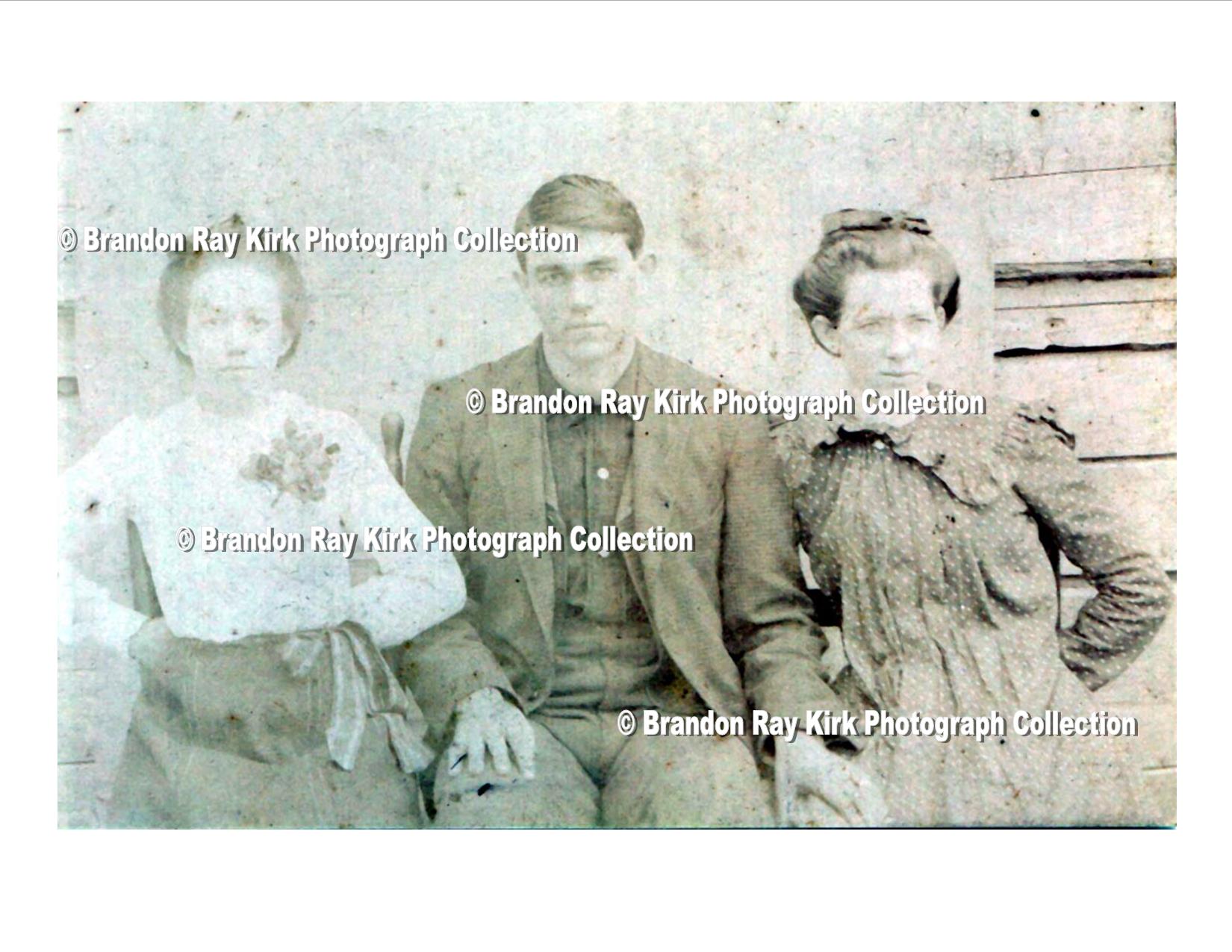
Ina Adams, George Mullins, and Rosa Adams, residents of Spottswood, Logan County, WV, c.1903
12 Monday May 2014
Posted in Big Harts Creek, Spottswood
Tags
A.Y. Browning, Alfred Buskirk, Anthony Adams, Bettie Workman, C.J. Plaster, Cole and Crane Company, education, genealogy, George Mullins, history, Joe Cranse, John Workman, Logan Banner, Logan County, Major Adams, May & Rosenthrall, Oilville, Preston Collins, Rosa Mullins, Smokehouse Fork, Sol Adams, Sol Riddell, Spottswood, timbering, Trace Fork, Twelve Pole Creek, West Virginia
“Jay,” a local correspondent from Spottswood in Logan County, West Virginia, offered the following items, dated September 14, 1903, which the Logan Banner printed on Friday, September 18, 1903:
John Workman has gone down on Twelve Pole to haul timber for the C. Crane Co.
Major Adams is buying up a nice drove of calves.
The county surveyor, Alfred Buskirk, and A.Y. Browning of Oilville are surveying at this place.
The title of Choke Neck Dude has been conferred upon a teacher who visits the Trace.
Preston Collins has erected a new dwelling house.
Miss Bettie Workman has a severe sore foot. She has not been able to come home since she commenced teaching.
It is whispered around that the wedding bells are soon to ring at Anthony Adams’. It is Miss Rosa Adams and George Mullins.
There is quite a lot of law working going on in Squire Adams’ court.
Attorney Riddell is having a good practice.
C.J. Plaster has sold his timber to Geo. Brammer.
Joe Cranse and Sol Riddell, with their genial smiles were entertaining a number of young ladies of Spottswood last Sunday.
May & Rosenthrall have commenced a logging job on head of Smokehouse. They have employed Sol Adams, J.P., to superintend their works.
12 Monday May 2014
Posted in Big Harts Creek, Music, Spottswood, Women's History
Tags
Alice Dingess, Appalachia, Harts Creek, history, Logan County, music, photos, piano, U.S. South, West Virginia
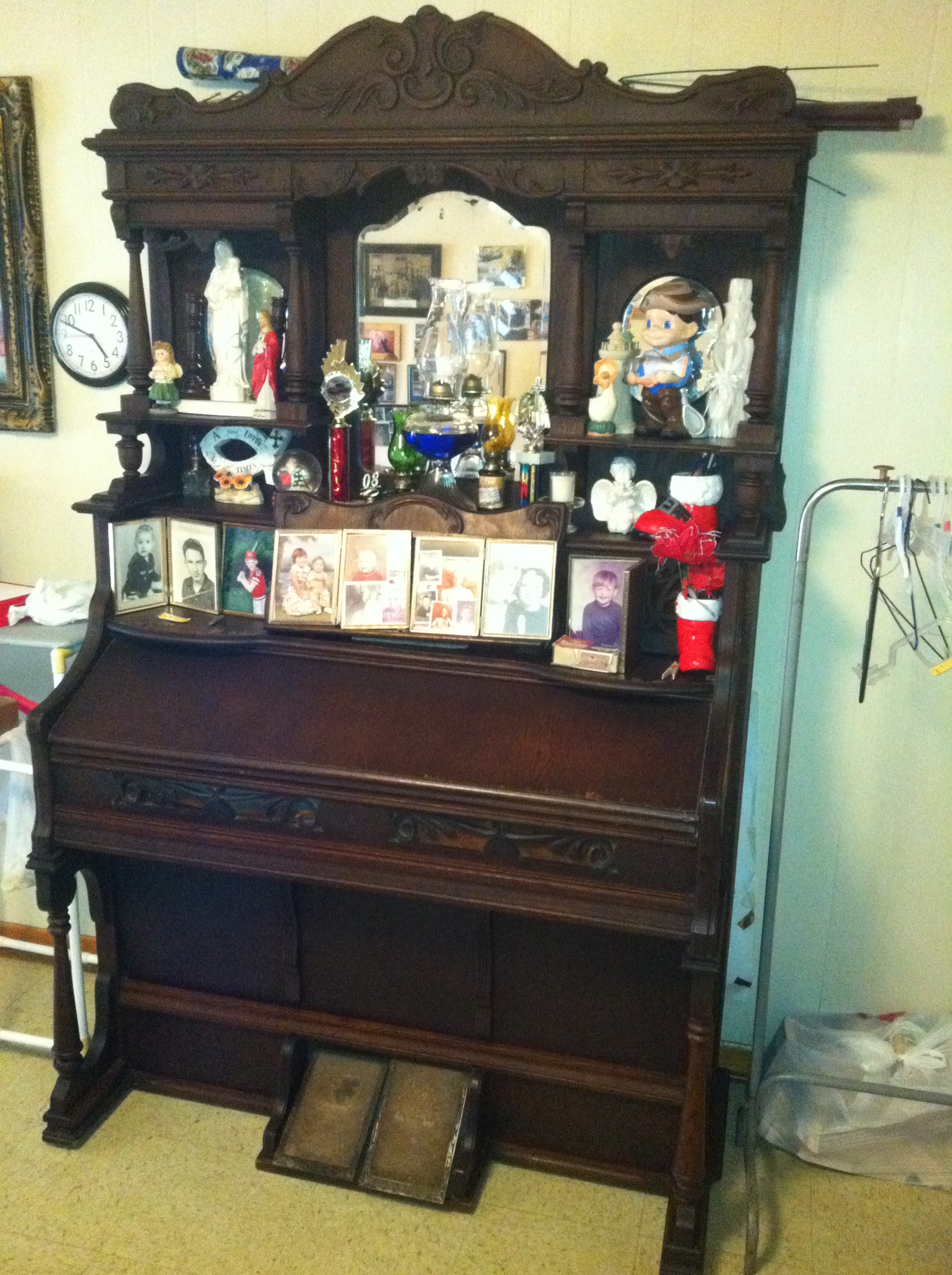
Alice (Adams) Dingess piano, Harts Creek, Logan County, WV, 2011
12 Monday May 2014
Posted in Big Creek, Big Harts Creek, Music
Tags
Aaron Hager, Anna Adams, Armilda Hager, banjo, Battle Hill Township, Big Creek, Big Ugly Creek, Boone County, Boone County Genealogical Society, Dave Brumfield, Dolly Bell, Ed Haley, Edward Hager, Eliza Hager, Geronimo Adams, Harts Creek, history, Jess Chambers, John Baisden, Johnny Canub Adams, Johnny Hager, Joseph Hager, Joseph Hager Jr., Kansas, Kith and Kin, Lincoln County, Logan County, Lola Adams, Lucinda Hager, Madison, Mag Brumfield, McPherson County, Missouri, Mud, music, Olivia Hager, Roxie Mullins, Sanders Branch, Smokehouse Fork, Victoria Adams, West Virginia, William Hager, writing
In the early 1900s, two musicians traveled as a pair throughout West Virginia and spread the influence of their musical talents to fiddlers and banjo-pickers in countless towns and hamlets. One of these men was Ed Haley, a Logan County native, who took up the fiddle after being blinded by his father as a child. The other was Little Johnny Hager who, although born in Logan County, spent a great deal of his life in Boone County.
John Washington Hager was born on December 8, 1876 to Joseph and Lucinda (Baisden) Hager, Sr. on Big Creek in Logan County, West Virginia, near the Boone County line. Johnny was the youngest sibling to Victoria Hager (1869-1942) and Aaron Hager (c.1872-c.1884). During his childhood, his parents moved from their home at the North Fork of Big Creek in Logan County to the Big Ugly Creek area. His family appeared in the 1880 Lincoln County Census. Subsequent years were difficult: Aaron Hager, Johnny’s older brother, died at the age of twelve years old. Victoria Hager married George Washington “Ticky George” Adams and moved to Big Harts Creek in Logan County. Finally, Johnny’s parents divorced due to his father’s infidelity with a local woman named Armilda Adkins. Joseph Hager soon married his mistress and fathered four more children: Edward Hager (1887), Joseph Hager, Jr. (1888-1940), Eliza Hager (1891), and Olivia Hager. Joe Hager lived in the vicinity of the old Mud Post Office near the Lincoln-Boone county line.
Remarkably, Johnny moved to Kansas with his mother, where he spent many years among Hager relatives. Just how long Johnny lived in Kansas has not been determined despite interviews with his close relatives. There is some indication that he and his mother lived in other Western states like Missouri prior to finally settling in Kansas. All the versions regarding Johnny’s stay in Kansas are given below because any one of them might be true. His niece Roxie (Adams) Mullins told that Johnny lived out West for six months. Johnny’s half-niece Dolly (Hager) Bell thought he came home from Kansas when he was twenty years old (circa 1896) or when he was aged in his twenties (circa 1896-1906). Hager’s half-great nephew Jess Chambers said that he had been told that Johnny lived in Kansas for twenty years, meaning that he would have returned to West Virginia around 1905. In the personal opinion of this author, accounts placing Johnny out West for several years seem at this time the most likely scenario simply because Johnny cannot be accounted for in the 1900 West Virginia Census. Instead, he shows up as a farm laborer in the home of a cousin, William Hager, aged 26, in Battle Hill Township, McPherson County, Kansas.
Kansas would have offered a West Virginia boy like Johnny Hager many new adventures. One can be sure that he spent a great portion of his time there working on the farm since he later described plowing fields into mile-long rows. According to family stories, he also chauffeured female cousins into town on wagon rides. Dolly Bell suggested that Hager probably learned to play the banjo while in Kansas and Jess Chambers said of Hager, “He played all his life.” Johnny was self-taught and played the old clawhammer style on the banjo.
According to tradition, Johnny’s mother died during their stay in Kansas. Roxie Mullins stated that Lucinda Hager was buried on the banks of the Wabash River, located along the borders between Illinois and Indiana. Another source said that she died in Missouri. Johnny always cried when he spoke of his mother and said that had lost “everything” when she died.
Some time after 1900, perhaps about 1905, Johnny returned to West Virginia. Although his father Joseph was still alive, Johnny never forgave him for divorcing his mother and refused to associate with him. He also refused to recognize Joseph’s children by his second wife. A story is told how Joe Hager, Johnny’s half-brother, rode to see him at John Baisden’s home on Sanders Branch. He was excited to meet the brother he had never known. When he came into the yard and yelled for him, Johnny wouldn’t even come outside.
In Johnny’s eyes, his sister Victoria Adams was all that remained of his family and he spent a great deal of time boarding at her Harts Creek residence in Logan County. During Johnny’s stay out West, Victoria had give birth to several children in a family which would grow to include Maggie “Mag” Adams (1888-1959), John C. “Johnny” Adams (1891-1965), Anna Adams (1901-1982), Geronimo Adams (c.1903), Roxie Adams (1905-1993) and Lola Adams (1911). It is likely that Johnny spun great stories for the Adams children about his experiences in Kansas. Roxie Mullins remembered him as being “funnier than a monkey,” Jess Chambers said he was a jolly fellow, and Dolly Bell remembered that he loved to joke and laugh. Dave Brumfield, a great-nephew, said that he pranked with the Brumfield children when he visited his parents’ home on the Smoke House Fork of Big Harts Creek in Logan County.
NOTE: Originally published in “Kith and Kin of Boone County, West Virginia” Volume XXII
Published by Boone County Genealogical Society
Madison, West Virginia, 1997
Dedicated to the late Dolly (Hager) Bell
11 Sunday May 2014
Posted in African American History, Logan, Women's History
Tags
Charles Dingess, culture, Fannie Dingess, history, life, Logan, Logan County, slavery, West Virginia
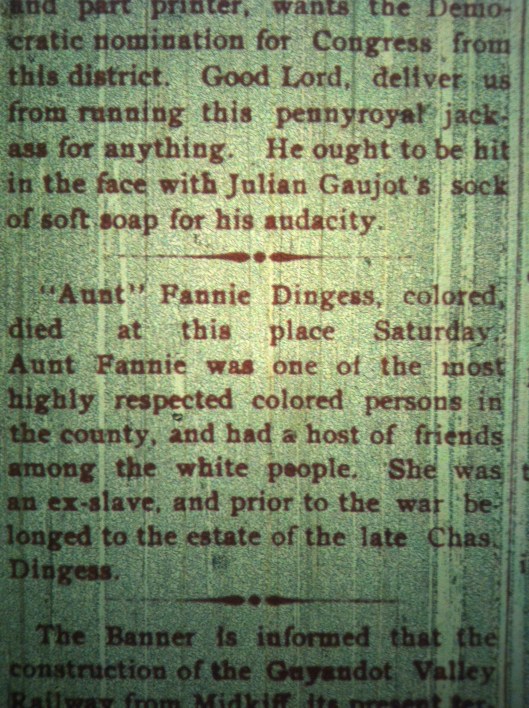
Fannie Dingess obituary, Logan County Banner, Thursday, May 15, 1902
11 Sunday May 2014
Posted in Big Harts Creek, Spottswood
Tags
Alice Adams, Belle Dora Adams, Bettie Workman, culture, education, genealogy, Grover Adams, history, Hoover Fork, Island Creek, Joe Crause, life, Logan Banner, Logan County, Palmer Stave Mill, Sol Riddell, Spottswood, W.J. Bachtel, West Virginia, Williamson
“Oliver Winters,” a local correspondent from Spottswood in Logan County, West Virginia, offered the following items, which the Logan Banner printed on Friday, August 7, 1903:
The graded school at this place, conducted by Mr. Riddell, opened Tuesday with a fine attendance.
Misses Alice and Belle Dora Adams and Bettie Workman, three of Spottswood’s belles, are attending Institute at Williamson this week.
Joe Crause, foreman for the Palmer stave mill, wearing his genial smile, was making it pleasant for certain young ladies of Spottswood last Sunday.
Grover Adams has moved into his new residence at the forks of Hoover.
Mr. W.J. Bachtel has gone to Island Creek to accept a position in the Company store. W.J. is a hustler and will be a good man for the place.
As I look out of my window a troop of merry school children are trudging past. Their faces are ruddy with the glow of health. Their spirits are running over with joy. Their will is truly the “wind’s will,” and their thoughts “are long, long thoughts.” I see an other procession with a poor boy in it who is a cripple for life. He catches the inspiration and tries to be merry and gay, but something in his manner and looks speaks plainer than words of his pitiable condition. We too often forget the destitute and suffering. Bless the school children, they are now happier than they will be when they grow older and wiser. I have digressed from my purpose, but I have to think. Hope this will not reach the waste basket.
11 Sunday May 2014
Posted in Big Harts Creek, Stiltner

Sherman McCoy, son of Green and Spicie (Adkins) McCoy
11 Sunday May 2014
Posted in Ed Haley, Lincoln County Feud, Music, Stiltner
Tags
banjo, Brights Disease, Cain Adkins, Cain Adkins Jr., Catlettsburg, Chillicothe, Columbus, crime, Daisy Ross, Ed Haley, Faye Smith, fiddlers, fiddling, genealogy, Goble Fry, Green McCoy, Green McCoy Jr., guitar, Harkins Fry, history, Indian Girl, Kenova, Kentucky, Laurel Creek, Luther McCoy, Mariah Adkins, McCoy Time Singers, Monroe Fry, music, Ohio, Oscar Osborne, Salty Dog, Sherman Luther Haley, Sherman McCoy, Spicie McCoy, Time Has Made A Change, Wayne County, WCMI, West Virginia, Winchester Adkins, writing
After the feud, Cain Adkins settled on Laurel Creek in Wayne County and never returned to Harts. Not long afterward, he began suffering from some type of lingering illness.
“Grandpaw, he played a fiddle,” Daisy said. “They had him to play the fiddle on his deathbed. Somebody came in and they wanted to hear a song and he played it for him. He said, ‘They ain’t no harm in a fiddle. If they’s any harm, it’s when no one plays it.’ I’ve heard Mom tell the last song he played, but I don’t know what it was he played. Mom said it made him feel better.”
Cain died of Brights Disease in 1896.
His widow Mariah lived many more years.
“Grandmaw was a good person — she went to church every Sunday. The last ten years she went blind and stayed with Mom. Mom waited on her.”
She died in 1931.
It took Spicie years to forgive the Brumfields for killing Green. Even after remarrying Goble Fry (her first cousin) in 1893, she was unable to cope with Green’s death and always cried when recounting the tale of his murder. For years, her bitterness kept her from joining the church.
“She felt like he hadn’t done nothing to be killed for ’cause she loved him better than anything,” Daisy said. “Before she was baptized, my brother Sherman had went off to work — him and a bunch of boys — and they was all telling what church their mother belonged to and Sherman said to Mom, ‘Mom, I had to tell them you didn’t belong to the church.’ ‘Well,’ she said, ‘I can’t forgive the Brumfields.’ He said, ‘You can’t forget it, but you got to forgive them or you’ll go to the same place where they did.’ I heard him say that. I was a young woman.”
These were apparently inspiring words, because Spicie was baptized soon afterwards and formed a gospel quartet, “The McCoy Time Singers.” Her son, Sherman McCoy, was a key member.
“Brother Sherman could play any kind of instrument, but banjo is what he played mostly,” Daisy said. “He played all kinds of pretty tunes on the banjo that wasn’t gospel. And when he was on WCMI he wanted people to write in and tell him to play the gospel music, but he had to play the one that got the most requests and he didn’t get very much requests for the gospel. But Mom and Sherman sung them gospel songs on there. They had a program on WCMI one time.”
Daisy said the only known recordings of the McCoy Time Singers had been destroyed years ago.
“They made records of their quartet singing and they peeled up. Got damp. Monroe, my brother, got some and even wrapped them in cloth and they still peeled.”
I wanted to know more about Sherman McCoy, so I got out my banjo and played a little bit for Daisy. She said he played a lot with his uncle, Winchester Adkins (one of the best fiddlers in Wayne County), and a guitar player named Oscar Osborne.
“Brother Sherman was one of the best banjo players I ever heard,” Daisy said. “I’ve heard them on television but I’ve never heard anything to beat Brother Sherman. He played a guitar and taught music lessons. He played all kinds of jigs. Did you ever play ‘The Indian Girl’? He didn’t like to play that one very much because he had to tune it different but that was the prettiest tune I ever heard on the banjo. It sounded like he had more than ten fingers.”
I asked Daisy about Sherman playing with Ed Haley and she said, “He played music with Ed Haley and they played in Catlettsburg.”
That’s all she knew about it but I wondered just how well they actually knew each other. Was it possible that Ed named his oldest child Sherman Luther Haley after Sherman McCoy? I could just picture them loafing together as young bachelors.
Daisy said Green McCoy’s other son, Green Jr., was a singing instructor. She remembered the first time he came into contact with a guitar.
“Uncle Cain, he played a guitar,” she said. “He come down one time and wanted Green to see his guitar. Green only seen that guitar one time and worked a week and got him a guitar and tuned it up and was playing on it. He was gifted.”
What happened to him?
Faye said, “Uncle Green, he hadn’t been dead but I’d say about eight or ten years. He played a guitar good.”
Daisy said Green’s son Luther plays the guitar on the radio in the Columbus-Chillicothe area.
“Uncle Green said he was absolutely the best he ever heard,” she said.
She didn’t know much about Luther or have any recordings of him but had a videocassette tape of Green Jr. picking the guitar and singing in 1975. (I couldn’t help but note that Green Jr. and Ed Haley both had sons named Luther.)
Spicie’s children by Goble Fry also were talented musicians, hinting at a musical strain in her genetics as well.
“Uncle Monroe was a Fry — that was Mom’s brother — and Harkins — they both played music,” Faye said. “But now, Uncle Monroe could play, I guess, about any type of instrument. I remember him playing ‘Salty Dog’ one time.”
Daisy really bragged on her brother Harkins Fry, a music teacher and songwriter. He wrote one gospel song called “Time Has Made A Change”, which Daisy and Faye sang for us:
Time has made a change in the old homeplace.
Many of my friends have gone away,
Some never more in this life I shall see.
Time has made a change in me.
Time has made a change in the old homeplace.
Time has made a change in each smiling face,
And I know my friends can plainly see
Time has made a change in me.
In my childhood days I was well and strong.
I could climb the hillside all day long,
But I’m not today what I used to be.
Time has made a change in me.
When I reach my home in that land so fair.
Meet my friends awaiting me over there.
Free from toil and pain I shall ever be.
Time has made a change in me.
06 Tuesday May 2014
Posted in Big Harts Creek, Lincoln County Feud, Stiltner
Tags
Angeline Lucas, Blackburn Lucas, Boney Lucas, genealogy, Harts Creek, history, Lincoln County, photos, Wayne County, West Fork, West Virginia

Blackburn Lucas, son of Mont “Boney” and Angeline (Adkins) Lucas, resident of Wayne County, WV
06 Tuesday May 2014
Posted in Barboursville, Ferrellsburg, Green Shoal, Toney
Tags
Anna Davis, Anthony Fry, Barboursville, Catherine Toney, Clerk Lucas, Cleve Fry, Foley, genealogy, George Thomas, Green Shoal, history, Huntington, Jane Lucas, Lincoln County, Lincoln Republican, Lizzie Fry, Logan County, Low Gap, Rachel Fry, Republican, Toney, Tucker Fry, Watson Lucas, Wealtha Bryant, West Virginia
“Bess,” a local correspondent from Toney in Lincoln County, West Virginia, offered the following items, which the Lincoln Republican printed on Thursday, May 2, 1912:
We are having a great deal of rain at present, to the sad disappointment of the farmers.
A number of our people attended church at Low Gap Sunday. Anthony Fry received immersion in the Christian church. May the dear Brother be faithful in his work recently begun.
Watson Lucas and bride of a few days, have gone to house keeping. We wish them all good luck through this life.
Cleve Fry, wife and children, of Foley, Logan county, were visiting their parents, Mr. and Mrs. D.C. Fry, Sunday.
Mrs. B.D. Toney was calling on friends on Green Shoals Monday.
There was a Republican rally at Low Gap on last Wednesday. The hurrah for Roosevelt was heard above all other candidates.
Clerk Lucas and George Thomas were appointed delegates to attend the convention to be held in Huntington, May 15.
Miss Wiltha Bryant, a popular young lady of Barboursville was visiting her sister, Mrs. T.B. Davis of this town.
Writings from my travels and experiences. High and fine literature is wine, and mine is only water; but everybody likes water. Mark Twain
This site is dedicated to the collection, preservation, and promotion of history and culture in Appalachia.
Genealogy and History in North Carolina and Beyond
A site about one of the most beautiful, interesting, tallented, outrageous and colorful personalities of the 20th Century
 Brandon Ray Kirk