• About

Brandon Ray Kirk

~ This site is dedicated to the collection, preservation, and promotion of history and culture in my section of Appalachia.

Brandon Ray Kirk

Category Archives: Guyandotte River

Jake Adkins Heirs Deed to Ann Davis (1908)

23 Friday Nov 2018

Posted by Brandon Ray Kirk in Ferrellsburg, Guyandotte River, Lincoln County Feud

≈ Leave a comment

Tags

Albert Adkins, Ann Davis, Appalachia, Ben Walker, Bob Adkins, Brooke Adkins, C.E. Burns, Catherine Adkins, Clementine Dingess, Douglas Branch, Ed Dingess, Ferrellsburg, Fisher B. Adkins, Floyd Enos Adkins, Guyandotte River, Harts Creek District, Henry Adkins, Jake Adkins, Lincoln County, Marshall County, notary public, Ruby Adkins, Susan Adkins, West Virginia, Yantus Walker

Tine Dingess to Ann Davis 2

Deed Book __, page ___, Lincoln County Clerk’s Office, Hamlin, WV. This property was located on or near Douglas Branch in Ferrellsburg, Lincoln County, WV.

Tine Dingess to Ann Davis 3

Deed Book __, page ___, Lincoln County Clerk’s Office, Hamlin, WV. I knew Bob Adkins, the infant referenced in this deed. He was a key source about the Lincoln County Feud.

Tine Dingess to Ann Davis 4

Deed Book __, page ___, Lincoln County Clerk’s Office, Hamlin, WV. Note who could and who could not sign their name.

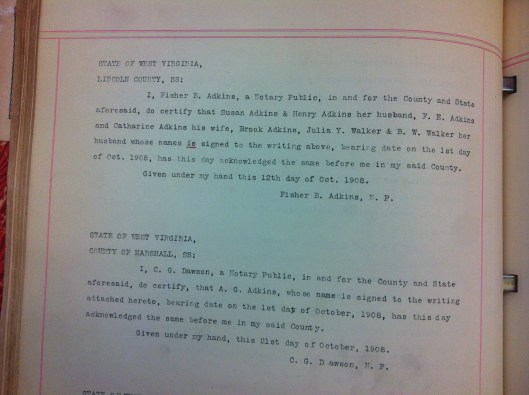
Tine Dingess to Ann Davis 5

Deed Book __, page ___, Lincoln County Clerk’s Office, Hamlin, WV. Note: Albert Adkins was incarcerated at the West Virginia State Penitentiary at the time of this deed, which is the reason for a Marshall County notary.

Samuel Zook Deed to Thomas Dunn English (1854)

06 Tuesday Nov 2018

Posted by Brandon Ray Kirk in Guyandotte River, Logan

≈ Leave a comment

Tags

Appalachia, Big Ugly Creek, genealogy, Guyandotte River, history, Lincoln County, Logan County, Mile Branch, New York, New York City, Pigeon Roost Branch, Samuel Zook, Thomas Dunn English, Virginia, West Virginia

Samuel Zook to Thomas Dunn English 1.JPG

Deed Book C, page ____, Logan County Clerk’s Office, Logan, WV. This land is located in present-day Lincoln County, WV.

Thomas Dunn English and “Ben Bolt” (1928)

06 Tuesday Nov 2018

Posted by Brandon Ray Kirk in Guyandotte River, Huntington, Logan, Poetry

≈ Leave a comment

Tags

Appalachia, Battle of Buena Vista, Ben Bolt, Charles Porter, Charleston, Edgar Allan Poe, George P. Morris, Green Gables Inn, history, Huntington, Know Nothing Party, Logan, Logan Banner, Logan Grazier, McDowell County, N.P. Willis, Nelson F. Kneass, New York Mirror, Philadelphia, poems, poetry, Rafting on the Guyan, Roy Fuller, Staunton, Thomas Dunn English, Vicie Nighbert, Wayne County, Welch, West Virginia, West Virginia Review, Wyoming Hunter

From the Logan Banner of Logan, WV, comes this bit of history concerning Thomas Dunn English and his famous poem “Ben Bolt,” which was reportedly composed in Logan:

Poem Ben Bolt Not Written In This City

Legend Concerning Thomas Dunn English Is Refuted by Roy Fuller in Magazine Article

Another forceful kick has been directed against the legend that Thomas Dunn English wrote the poem Ben Bolt under the big elms back of the former Vicie Nighbert home, now known as the Green Gables Inn.

Though all reliable investigators agree that this famous poem was written before Dr. English settled in this community, the legend survives with a strange pertinacity.

The subject is discarded in an interesting and enlightening way in the current number of the West Virginia Review by J. Roy Fuller. He has written before in a similar vein for other publications.

Fuller, a native of Wayne county, had been connected with Charleston, Huntington, and Welch papers for several years. Recently he went to New York to take an editorial position on Picture Play. On the subject “As to Ben Bolt,” he writes as follows:

If a man writes a poem a little more sentimental than any other, and then some ten years later moves to another state, it seems that the towns and counties around his new home will, years later, recall the very spot where the poem was written. Such has been the case with Ben Bolt, by Thomas Dunn English. The people of Logan county point with pride to the very tree under which the poet scribbled Ben Bolt, and time and again articles have been written in support of the legend, and people who speak of it choose to believe nothing else. Why this should be considered in the least important is amusing. But that is not all. In McDowell county, it is said, Thomas Dunn English wrote the feverish lines while at the old county seat town, now called English. A clerk in a hotel informed this writer that he knew exactly where Ben Bolt was written and offered to show him the house somewhere just over the Virginia state line.

The rare honor of being the birthplace of Ben Bolt cannot be claimed truthfully for this section at all. It was written in Philadelphia nine years before he ever came to West Virginia. There was no romantic posing over the grave of the beloved lady in the song as it has been said in Logan county. A New York editor asked English to write something for him. He insisted, and finally English mailed the verses with instructions to burn them if not satisfactory, after combining parts of two poems into one. So any weeping we do can be for our own images, and not for sympathy with the poor poet.

English was once postmaster of Logan (1857), and also a resident doctor, politician, poet and lawyer. One time he attended a convention in Staunton where he made a speech that was influential in helping to bring about the downfall of Know-Nothingism. He wrote many local poems such as Rafting on the Guyan, Logan Grazier, and Wyoming Hunter. Before coming to the south he was well known in the east and was mentioned—unfavorably—by Edgar Allan Poe in his Literati. For calling him Thomas Dunn “Brown,” English wrote a severe criticism of Poe. Some time later Poe answered him in a Philadelphia paper, and brought suit against him. Poe was awarded $225 damages for English’s sarcastic literary thrust.

It has always been a matter of chagrin to English that his Ben Bolt was the most popular of his literary works. He himself called the song “twaddle.” But the German melody, mention of old mills, school, a loved one, friendship—these things made it take hold of the heart.

He wrote Ben Bolt in 1843 after having dabbled in his professions for several years, and quite unexpectedly found himself famous. The story of the song will show how far removed it is from the cherished pastoral story told in Logan county. The story persists, however, this being one of the cases where the “moving finger writes,” etc., and nothing more can be done about it.

N.P. Willis and George P. Morris had revived the old New York Mirror. The former asked English to write a poem for the paper and suggested a sea song. English tried to write it after renewed pressure but he reported to the editors that his muse was not working. Later he drifted into reminiscence and produced four and a half stanzas of the well known song. His muse balked again, and after some thought he added the first four lines of a sea song he had started and sent the whole with a note to Willis telling him that he would send something else when he was in a better writing mood. The poem was printed with a little puff, and was signed with the author’s initial.

Later it was suggested that the poem be set to music, but several attempts failed. English composed a melody for it, but another got the start of his. In 1846 Charles Porter, manager of the Pittsburgh theatre had Nelson F. Kneass, a fine tenor, in his company. Porter told the singer that if he could find a song suitable for his voice he would cast him in The Battle of Buena Vista. An Englishman, a sort of hanger-on named Hunt, had read Ben Bolt and could recall most of it. The gaps were patched up and to this Kneass adapted a German air and sang the piece. The drama was soon dropped but the song took the country by

Source: Logan (WV) Banner, 11 December 1928

Joel Elkins Deed to Reece W. Elkins (1855)

19 Friday Oct 2018

Posted by Brandon Ray Kirk in Guyandotte River, Sand Creek

≈ Leave a comment

Tags

Appalachia, county clerk, genealogy, history, Joel Elkins, Logan County, Miles Elkins, Reece W. Elkins, Sand Island, Spencer A. Mullins, Virginia, W.I. Campbell, West Virginia, William Straton

Joel Elkins to Reece W. Elkins Deed 1.JPG

Deed Book C, page ___, Logan County Clerk’s Office, Logan, WV.

Joshua Butcher Deed to John G. Butcher (1854)

16 Tuesday Oct 2018

Posted by Brandon Ray Kirk in Crawley Creek, Guyandotte River, Timber

≈ Leave a comment

Tags

Appalachia, Crawley Creek, genealogy, Guyandotte River, history, John G. Butcher, John J. Besnoist, Joshua Butcher, justice of the peace, Logan County, Mill Branch, Sarah Butcher, Virginia, Wesley Stollings, West Virginia, William Smith, William Straton

Joshua Butcher to John G. Butcher Deed 1

Deed Book C, page ___, Logan County Clerk’s Office, Logan, WV. Note: References timber.

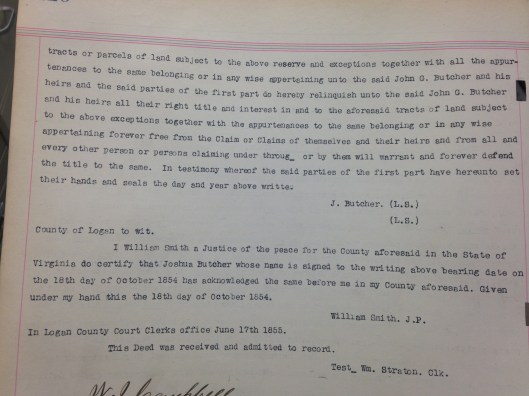
Joshua Butcher to John G. Butcher Deed 3

Deed Book C, page ___, Logan County Clerk’s Office, Logan, WV.

Origin of Place Names in Logan County, WV (1937)

12 Friday Oct 2018

Posted by Brandon Ray Kirk in Chapmanville, Coal, Gilbert, Guyandotte River, Logan, Man, Native American History

≈ Leave a comment

Tags

Appalachia, Aracoma, Barnabus, Barnabus Curry, Boling Baker, Buffalo Creek, Cham, Chapmanville, Chauncey, Chauncey Browning, coal, Crystal Block, Curry, D.E. Hue, Dehue, Dingess Run, Edward O'Toole, Gilbert Creek, Guyandotte River, history, Horse Pen Mountain, Huff Creek, Island Creek, Jim Gilbert, Litz-Smith Coal Company, Logan Banner, Logan County, Main Island Creek Coal Company, Mallory, Micco, Mountain View Inn, Native American History, Native Americans, Omar, Omar Cole, Peter Huff, Rum Creek, Sarah Ann, Sarah Ann O'Toole, Stirrat, Twisted Gun Lick, West Virginia, William Dingess, William S. Madison

From the Logan Banner of Logan, WV, comes this bit of history about Logan County place names:

Naming of Logan County Towns and Creeks Related By Logan Banner Reporter

While the first white settlers who entered the county near the middle of the 18th century had to have names for the creeks and runs in order to locate their homes, the children of these first settlers had to have names for each large settlement in order to have their mail delivered to them. Both groups used interesting methods of naming the landmarks.

Early Indian fighters who had contact with Boling Baker and his horse-thieving found little trouble naming the mountain which rises behind Mountain View Inn at the head of Island Creek. Because of the renegade’s custom of using one of the steep hollows for a corral, Captain William S. Madison, an early pioneer, named the mountain Horse Pen. Likewise, Gilbert Creek was named for Jim Gilbert, an Indian scout, who was killed in an Indian skirmish on that tributary of the Guyandotte. Near the place where he was killed there is an old salt lick which is named “Twisted Gun Lick.” The story is told that Gilbert, before he died, hit his gun barrel against a tree to keep the Indians from using it on his comrades. His friends, coming to the lick several hours later, found Gilbert scalped and the twisted firearm lying nearby.

Huff Creek was similarly named for a Peter Huff, whose scouting party was ambushed by a roving band of redskins and Huff was killed in the ensuing battle. They buried Huff on the banks of the creek near the present town of Mallory.

Buffalo Creek, however, received its name in an entirely different manner. The first settlers who hunted in the valley of the Guyandotte found buffalo herds so plentiful on this creek that they called it Buffalo Creek.

Dingess Run was named for a pioneer family of Dingesses which settled in its broad bottoms. William Dingess was the patriarchal head of the family and his children named the run in memory of him.

Island Creek received its name from the Indians who were awed by the beauty of a large creek flowing into the Guyandotte with such force as to cut an entirely separate bed, thus forming an island in the middle of the river. Old timers say that in the early days of the county Island Creek entered the Guyan river at the upper limits of Aracoma. Only during flood time did the creek meet the river at its present point.

As for the towns which have sprung up in the county since coal became king, many were named for prominent people living in them at one time or another or for pioneer families who lived in the towns when the coal companies first came in.

A unique method was used, however, in naming Micco. It received its name from the first letters of the Main Island Creek Coal Co., which formerly operated the mines there.

Omar was named for Omar Cole who was closely associated with the development of the town. The Cole family held, and still holds, extensive mining leases in the vicinity of that mining town.

Sarah Ann acquired its name from the wife of Colonel Edward O’Toole, who was manager of the coal company when the town applied to the government for a post office. The town is generally known as Crystal Block.

Barnabus received its name from Barnabus Curry, a pioneer settler whose home was near the town.

Stirrat was named for Colonel Stirrat, who was manager of the Main Island Creek Coal Company at one time.

Chauncey was named for Chauncey Browning, well-known son of a pioneer family who owned much of the land near that town. For many years the town of Chauncey was not large enough to be made a post office, but after the Litz-Smith Coal Company opened its mines there the town grew to proportions large enough to warrant a post office.

Dehue was given its name in honor of D.E. Hue, the first superintendent who operated the mines there.

Cham, a small place about two and one-half miles above Dehue, got its name from a Chambers family who lived on Rum Creek.

Chapmanville was named for the Chapmans, Curry for the Curry family and Aracoma for the famous Indian princess.

Source: Logan (WV) Banner, 25 March 1937

Rebecca McGuire Deed to Isaiah Adkins (1855)

28 Friday Sep 2018

Posted by Brandon Ray Kirk in Big Harts Creek, Guyandotte River

≈ Leave a comment

Tags

Appalachia, Archibald Elkins, county clerk, Elijah A. Gartin, genealogy, Guyandotte River, Harts Creek, Harvey Elkins, history, Isaiah Adkins, James Dalton, Lincoln County, Logan County, Peter Dingess, Rebecca McGuire, Richard Elkins, Virginia, W.I. Campbell, West Virginia, William Straton

Rebecca McGuire to Isaiah Adkins Deed 1

Deed Book C, page 423, Logan County Clerk’s Office, Logan, WV.

Rebecca McGuire to Isaiah Adkins Deed 2

Deed Book C, page 424, Logan County Clerk’s Office, Logan, WV. This property is likely located in present-day Lincoln County, WV.

Walter R. Thurmond Testimony about Labor Conditions in Logan County, WV (1921)

28 Friday Sep 2018

Posted by Brandon Ray Kirk in Coal, Guyandotte River

≈ Leave a comment

Tags

Appalachia, coal, Committee on Education and Labor, Democratic Executive Committee, deputy sheriff, Don Chafin, Guyandotte River, history, Logan Coal Operators Association, Logan County, Mine Wars, miners, sheriff, U.S. Senate, Walter R. Thurmond, West Virginia

TESTIMONY OF MR. W.R. THURMOND.

Testimony of W.R. Thurmond, given before the Committee on Education and Labor of the United States Senate, at a hearing had in the City of Washington on October 26, 1921.

The witness, having been first duly sworn by the chairman, testified as follows:

THE CHAIRMAN: Mr. Thurmond, what is your position with the coal operators?

THURMOND: President of the Logan Coal Operators Association.

C: What is that Association?

T: The Logan Coal Operators’ Association is a voluntary association composed of 66 operating companies, located in that part of Logan County lying on the waters of the Guyan River, and operating 134 mines.

C: What percentage of the miners of Logan County belong to unions?

T: Only about 5 per cent, and none of them are in that part of Logan County. I have a map here that I think will show.

C: How much has your association contributed these different years to the payment of deputy sheriffs?

T: I have the years 1920 and 1921.

C: All right, sir.

T: The reason I did not go behind that year, you have that information in the governor’s investigation of West Virginia, which I understand was available to this committee.

C: Give us those two years.

T: Last year was $46,630, and was 4.9 mills on each ton of coal mined.

C: You have a system of assessing against each ton mined?

T: No, sir. I am giving you that for this reason. The newspapers had an article purporting that the Attorney General said to this committee that there was 10 cents a ton levied on every ton of coal shipped out of Logan County for the purpose of paying deputies, and I got this on this tonnage basis to refute that.

C: Four and nine-tenths cents.

T: Mills, not cents.

C: Oh, 4 mills?

T: Yes, less than one-half cent.

C: I do not remember that he said that, but he may have said it. Did he say it the other day before this committee?

T: No, the newspapers carried an article purporting him to have said that. I do not know whether he did or not. The public got that.

MR. AVIS: That 4 mills was for last year?

T: That was for 1920.

C: Can you figure any amount according to production of coal in tons among the officials?

T: No, sir.

C: What was it this year?

T: It is $61,517 up to and including September. Now, there are three reasons why there is an increase there this year, first the population of the county is growing each year, and new operations opening up, and we have more men, and the second reason is we are paying them a little more salary than last year, and the third and principal reason is this trouble which came on, and which we anticipated.

C: There were a good many new deputies sworn in during the trouble, were there not?

T: Yes, sir.

C: Did you people pay any of those deputies?

T: We paid that sum to the regular force.

C: How did you do that? Did you give a check to the sheriff?

T: Yes. We paid it to the bank. He rendered an account. Senator Shortridge asked if that was paid to the county treasurer. We have no county treasurer. The sheriff takes charge of those duties.

C: You paid that to the bank to the credit of the sheriff?

T: Yes, sir.

C: Did you pay it all at once?

T: Monthly.

C: Monthly?

T: Yes, sir. He gave us a statement.

C: How many deputies in 1920 did this $46,000 pay for?

T: I don’t know.

C: How many did they have in that county.

T: They have 54 now. There are 54 officers. That includes the sheriff himself and the elected officers.

C: It seems to me some one told us at Logan—and yet I do not want to be certain about that—that there were 50 deputies last year paid in that way.

T: I think you asked me that question, and I think you asked, “How many deputy sheriffs did you have?”

C: That is possibly true.

T: I said approximately 50 and I think later corrected the testimony and said I understood there were 54.

C: How many were there this year?

T: That is this year.

C: That is this year?

T: That is this year, yes.

C: You mean 1920?

T: 1921.

C: I am asking about 1920. You gave us the amount of money but I want to know how many deputies were employed in that way in 1920.

T: I don’t know.

C: You do not know?

T: No, sir.

A: I understood the witness to say the 54 included all the county officers.

C: I understood him to say there were some other officers.

T: There were six justices of the peace.

C: What salaries were paid to these deputies?

T: $175 a month.

C: $175 a month?

T: Some of them, and some $150.

C: Do these deputy sheriffs act as guards for your property?

T: No, sir.

C: They act as general deputy sheriffs?

T: Yes, sir.

C: Do they serve process around the county?

T: Yes, sir.

C: And arrest men who have no connection with your company?

T: Yes, sir.

C: Are all these deputies paid $175 a month?

T: No, not all of them.

C: The sheriff would know the exact number?

T: Yes, sir. He would know about that. I know they are not all paid that.

C: How long has that system of furnishing money to pay deputy sheriffs by the coal companies continued? How long has it been in operation?

T: I can not give you the exact number of years, but I think about 8 years.

C: Do you know whether that is carried on in any other county in West Virginia?

T: I don’t know, sir. The other gentlemen can testify to that.

NOTE: In 1921, Mr. Thurmond was chairman of the Democratic Executive Committee in Logan County, WV.

Old Records Found in Bank Vault (1936)

27 Thursday Sep 2018

Posted by Brandon Ray Kirk in Big Sandy Valley, Guyandotte River, Hamlin, Huntington, Logan

≈ 3 Comments

Tags

Appalachia, Big Sandy River, Cabell County, Guyan Valley Bank, Guyandotte River, H.M. Booth, Hamlin, history, Huntington, James Barbour, Logan, Logan County, Mary Morris, Pennsylvania, Peter Dingess, Philadelphia, Richmond, Robert Brooke, Robert Morris, Robert Morris Grant, Russell County, Tug Fork, Virginia, West Virginia, William Crammond, Wythe County

Old Peter Dingess Deed LB 08.19.1936 7

320,000 Acres of Land Hereabouts Sold for Five Shillings According to Old Records Found in Old Vault

H.M. Booth, in cleaning out the vault of the old Guyan Valley Bank preparatory to moving his offices from Logan to Hamlin, uncovered a number of old documents that dated back to the time when “horse and buggy days” were a fact and not merely a political equation.

Many of these old papers, including deeds, receipts, account books and other papers of a semi-personal nature, are originals, while others are notarized copies of originals. They make interesting reading in these days of speed, radios, high prices and typewriters.

The old documents were all hand written, in clear, flowing script, the capital letters often decorated with fancy scrolls and shaded lines. Many of them were written with a quill pen.

Of particular interest is one deed, 12 ½ by 15 ½ inches, written on sheepskin. The ink has not faded, and although the skin is old and discolored, the deed is easily read. It was made in the days when Logan county was unheard of, and all this vicinity was part of Cabell county, Virginia. It seems strange, now, to think of a governor in Richmond, Virginia, parceling out land in Logan county.

The deed reads, in part: “James Barbour, Esq., Governor of the Commonwealth of Virginia: To all whom these presents shall come, Greeting: Know ye, that by virtue of a Land office Treasury warrant, No. 6126, upon the 9th day of Sept. 1780, there is granted by the said Commonwealth unto Peter Dingess, a certain Tract or Parcel of Land, containing one hundred and twelve acres, by survey, bearing date the 31st day of March, 1813, situate in the County of Cabell, joining to his own deeded land, and bounded as followeth, to-wit:”

Then follows a detailed description of the boundaries of the land, in which prominent trees and landmarks play a common part. After the description of the land, which was written in pen and ink, came the regular printed form as follows:

“In witness whereof, the said James Barbour, Esq., Governor of the Commonwealth of Virginia, hath hereunto set his Hand, and caused the Seal of the said Commonwealth to be affixed at Richmond, on the twenty-fifth day of October, in the Year of our Lord, One thousand eight hundred and fourteen, and of the Commonwealth the thirty-ninth.”

Down in the lower right hand corner of the paper can be plainly seen the signature of James Barbour, governor of Virginia at that time.

A notarized copy of another land deed was signed by Robert Brooke, Governor of Virginia in 1795, and was dated March 23 of that year. It deeded through the Land Office treasury warrants numbered from 472 to 530, inclusive, a parcel of land containing 480,000 acres, “by a survey made the 10th of September, 1794.” The land was described as being in the county of Wythe, on the Tug and Guyandotte rivers. This grant of land was known as the “Robert Morris Grant.”

Evidently, from the records, Robert Morris became involved in difficulties, for after a considerable amount of legal red tape, all duly recorded, there is a document showing where “Robert Morris and Mary, his wife, of Philadelphia, sell to William Crammond of Philadelphia as well for and in consideration of the sum of five shillings lawful money of Pennsylvania to them well and truly paid do grant bargain and sell, alien and enteoff release and confirm to the purchased 320,000 acres of land in the counties of Wythe and Russell, lying on both sides of Sandy Creek.”

Among the records of accounts paid found by Mr. Booth were numerous fees paid out for “boating freight from Huntington.” Six dollars and fifty cents is entered “for a suit of clothes,” and another entry shows where four dollars and a half were paid for two pair of shoes.

Source: Logan (WV) Banner, 19 August 1936

Lorenzo Hill Deed to Squire Toney (1856)

25 Tuesday Sep 2018

Posted by Brandon Ray Kirk in Guyandotte River

≈ Leave a comment

Tags

Appalachia, county clerk, genealogy, Guyandotte River, history, Isaac Adkins, Lincoln County, Logan County, Lorenzo D. Hill, Mile Branch, Squire Toney, Virginia, W.I. Campbell, West Virginia, William Straton

Lorenzo Hill to Squire Toney Deed 1.JPG

Deed Book C, page 488, Logan County Clerk’s Office, Logan, WV. This property is located in present-day Lincoln County, WV.

Darby K. Elkins Deed to Reese W. Elkins (1856)

12 Wednesday Sep 2018

Posted by Brandon Ray Kirk in Atenville, Guyandotte River

≈ Leave a comment

Tags

Appalachia, county clerk, Darby K. Elkins, Dry Branch, genealogy, Guyandotte River, Hezekiah Adkins, history, justice of the peace, Logan County, Reese W. Elkins, Sugar Camp Branch, Virginia, W.I. Campbell, Wayne County, West Virginia, William Straton

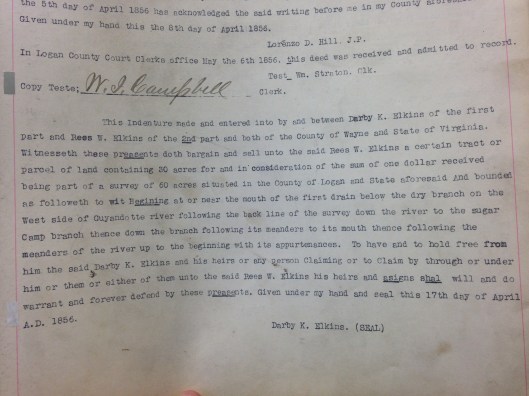
Darby K. Elkins to Reece W. Elkins Deed 1

Deed Book C, page 461, Logan County Circuit Clerk’s Office, Logan, WV. Note: This property is located near present-day Atenville, Lincoln County, WV.

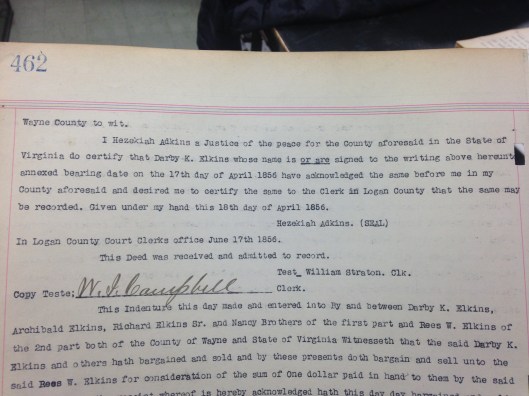
Darby K. Elkins to Reece W. Elkins Deed 2

Deed Book C, page 462, Logan County Circuit Clerk’s Office, Logan, WV

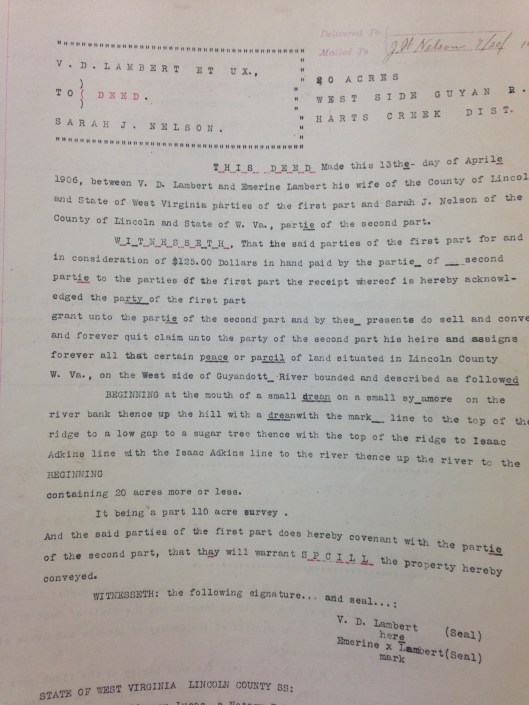
Van Donley Lambert Deed to Sarah J. Nelson (1906)

07 Friday Sep 2018

Posted by Brandon Ray Kirk in Atenville, Guyandotte River, Sand Creek

≈ Leave a comment

Tags

Appalachia, Bend of the River, Emerine Lambert, genealogy, Guyandotte River, history, Isaac Adkins, Jefferson Lucas, Lincoln County, Martha Sias, notary public, Sand Creek, Sarah J. Nelson, Van Donley Lambert, West Virginia

Van Don Lambert to Sarah Nelson 1

Deed Book ___, page ____, Lincoln County Clerk’s Office, Hamlin, WV. This property is likely located at the Bend of the River opposite Sand Creek and below Atenville.

Van Don Lambert to Sarah Nelson 2

Deed Book ___, page ____, Lincoln County Clerk’s Office, Hamlin, WV. I descend from Van Donley’s sister, Martha (Lambert) Sias.

Civil War in the Guyandotte and Big Sandy Valleys (1862)

03 Monday Sep 2018

Posted by Brandon Ray Kirk in Big Sandy Valley, Chapmanville, Civil War, Guyandotte River, Pikeville, Tazewell County

≈ Leave a comment

Tags

Abington Virginian, Appalachia, Big Sandy River, Cabell County, Chapmanville, civil war, Confederate Army, genealogy, Guyandotte River, history, John B. Floyd, John Clarkson, John Dils, John Letcher, Kanawha River, Kentucky, Levisa Fork, Lincoln County, Logan County, Ohio River, Pigeon Creek, Pike County, Pikeville, Prestonsburg, Smyth County, Tazewell County, Union Army, Virginia, Virginia State Line, Washington County, Wayne County, West Virginia

Confederate General John B. Floyd composed this letter detailing military activity in the Guyandotte and Big Sandy valleys in late 1862, which was published by the Abington Virginian on January 2, 1863.

***

OFFICIAL REPORT OF GEN. FLOYD

Headquarters Virginia State Line,

Camp Clarkson, Tazewell Co.,

December 17, 1862

His Excellencey, John Letcher,

Governor of Virginia—

SIR: After my last communication to you I prepared an expedition consisting of a strong force of Cavalry under Colonel John Clarkson, to operate against the enemy in the counties of Wayne, Cabell, &c. He set out from Chapmansville on the 14th November, in the direction of Cabell down the Guyandotte river, over a rough and difficult road. The following day he fell in with a detachment of the enemy which he quickly routed and dispersed. He continued the march until a few miles of the Ohio river, breaking up the “Home Guard” organization of the enemy, which are very numerous in all that country, and taking prisoners every day.

A strong guard of Yankee troops, acting as a guard for the Pierpont Assessor for the county of Wayne, was attacked and dispersed after a short skirmish, in which was killed and wounded some of the enemy and took a few prisoners. Col. Clarkson proceeded then, according to the previous directions given him, to the Sandy river, to attack a large and formidable organization of the enemy composed mainly of the native population, and very strong posted amidst the cliffs and forests upon the precipitous banks of that river. He succeeded in taking them by surprise completely, and after killing and wounding a number of them, took a large number of prisoners, and surprised entirely the rest of the force. This force and organization were formidable and extremely dangerous to the peace and quiet of all the country round about for many miles, the loyal people were nearly all driven from their country and all were robbed. After that, Col. Clarkson, according to previous understanding, made a junction with me at the mouth of Pigeon Creek, in Logan county, on the Kentucky border, whither I had gone with the infantry and a section of the mounted howitzer battery.

I learned from Col. Clarkson that the enemy had started a number of boats with valuable supplies, from the mouth of Sandy to a post recently established at Pikeville, a point at the head of navigation on the Louisa Fork of Sandy. These boats were in charge of a strong guard, and were intended to furnish a complete outfit for a force deemed sufficient for them, by their commander, to march upon and destroy the salt works in Smyth and Washington counties.

I determined at once to attack this train, and from its distance, being more than forty miles off, it became necessary to send mounted men. Besides this reason, I found it inconvenient to move the infantry in that direction, on account of the number of prisoners with which we were encumbered. The cavalry and mounted men were put in motion within an hour and proceeded upon the march, which was uninterrupted, day or night, until the enemy were overtaken, attacked and routed.

Our people captured ten of the enemy’s transport boats, laden with valuable supplies. A great deal of these supplies was distributed amongst the men, and much of them was brought off; but a very large amount of most valuable supplies was necessarily destroyed for want of transportation to bring them away. A train of one hundred pack mules would have brought away a very large amount of extremely valuable stores, which were committed to the fire and the river.

The night following the capture of these boats (indeed, just twelve hours after the attack upon the boats,) our forces engaged that of Col. Dils, posted in an extremely strong position on the summit of a mountain on the road leading from Prestonsburg to Pikeville. This position was taken and held without any knowledge on our part, and as the attack was made after the night, and entirely unexpected, we were taken at a great disadvantage. But our men behaved with great steadiness and resolution, received the attack and charged the enemy, driving him from his position, and dispersing them entirely. The rout was complete, and the post at Pikeville, consisting of a thousand men, was entirely broken up. The prisoners and the Union people in that neighborhood reported Colonel Dils as killed in the fight that night.

For more detailed statements of this expedition I refer you to the report of Col. Clarkson. In our operation through the country, we made a number of recruits in the counties of Cabell, Wayne, Logan, &c.

My object in this campaign was, as far as possible, to prevent the occupation by the Yankee forces, of the country between the Kanawha Valley and Kentucky border, as well as to destroy the military organization of the country under the traitor government in Wheeling. Both objects were fully attained, as long as I was able to remain in the country. The military organizations, very numerous and well appointed in every particular, were almost entirely destroyed, and the attempts to set up the spurious government were entirely failed.

I was compelled to leave the country, held by me for more than three months alone, for the want of Quartermaster’s supplies. We were without tents, or clothing, or cooking utensils, or axes; and after the inclement weather of winter set in, we could no longer remain in the field. With these stores supplied, I would have remained in that country throughout the winter months. We were able to procure food (meat and bread) in the country, nearly all of it taken from the enemy.

The campaign, from first to last, was one of hardship and privations; but they were borne without complaint by the men, who are unsurpassed in hardship, activity and capability to endure privations. They deserve great praise for their constancy and general good conduct.

The officers generally deserve commendation, but to Col. Clarkson too much credit cannot be given for his energy, activity and courage. The obstacle she encountered, of every sort, throughout these expeditions, were of the most formidable character, but they were also most gallantly surmounted.

I have the honor to be, very respectfully,

Your obedient servant,

JOHN B. FLOYD,

Maj. Gen. Commanding Va. State Line

NOTE: I bolded Gen. Floyd’s description of activity in the Guyandotte Valley that occurred between Chapmanville and the lower section of the river near present-day Huntington.

Recollections of McKinley Grimmett of Bruno, WV 1 (1984)

31 Friday Aug 2018

Posted by Brandon Ray Kirk in African American History, Coal, Dingess, Guyandotte River, Holden, Logan, Man, Timber, Wyoming County

≈ 4 Comments

Tags

African-Americans, Alva Grimmett, Appalachia, Austin Grimmett, Baileysville, Big Cub Creek, Bruno, Buffalo Creek, Christian, Cole and Crane Company, Devil Anse Hatfield, Dingess, Edith Grimmett, education, Elk Creek, Ettie Grimmett, farming, genealogy, general store, Green Perry, Guyandotte River, Guyandotte Valley, Henderson Browning, Henderson Grimmett, history, Holden, Horse Pen Mountain, Johnny Grimmett, Landsville, Lilly Grimmett, Logan, Logan County, logging, Madison Creek, Mallory, Man, McGuffey Readers, McKinley Grimmett, Mingo County, Mud Fork, Nancy Grimmett, rafting, Ralph Grimmett, Rose Grimmett, Sand Lick, Sanford Grimmett, Slater Hatfield, Tennis Hatfield, Thomas Hatfield, Tilda Hatfield, timber, timbering, Travis Grimmett, Verner, Walter Buchanan, West Virginia, whooping cough, World War I, Wyatt Belcher, Wyoming County

McKinley Grimmett was born on November 30, 1896 to Henderson and Nancy (Hatfield) Grimmett at Sand Lick, Logan County, WV. On May 14, 1916, Mr. Grimmett married a Ms. Plymale, who soon died, in Logan County. One child named Alva died on June 21, 1919 of whooping cough, aged fourteen months. His World War I draft registration card dated September 12, 1918 identifies him as having blue eyes and light-colored hair. He was employed by Mallory Coal Company at Mallory, WV. On November 13, 1919, he married Matilda “Tilda” Hatfield, daughter of Thomas Hatfield, in Logan County. He identified himself as a farmer in both of his marriage records. During the 1920s, he served as a deputy under Sheriff Tennis Hatfield.

The following interview of Mr. Grimmett was conducted at his home on July 17, 1984. In this part of the interview, he recalls his family background and early occupations. Logging and rafting in the Guyandotte Valley are featured.

***

Would you mind telling me when and where you were born?

Right here. I was born about a mile up above here. I was borned in Logan County. The post office was Christian at that time. Christian, WV. It’s changed now. They throwed Christian out – it was over here at Christian – and they throwed it out and moved it over here to Bruno. Christian went… The mines stopped over there. And that’s where I was born, right here at Bruno, Logan County. Been here all my life.

What day were you born?

November 30, 1896.

Who were your parents?

Henderson Grimmett and Nancy Hatfield Grimmett.

What kind of work did they do?

They did logging work. All they had that day and time. Mule teams and ox teams.

Where did your dad do his work?

All over Logan County.

Did he have his own farm?

Oh yeah. Yeah.

How big was his farm?

It was about 287 acres.

Can you describe his house?

Well, the house was a two-story building. But he never did get… He took the fever and he never did get the upper story, all of it completed. He died at a very early age of 74. He put him up a little store. Got ahead a little bit. Had a store here. Come down and bought this place off Walter Buchanan and he deeded his five kids the homeplace up there. And then he stayed on it from ’21 to ’29. He died 19th day of January, 1929.

Who were your mother’s parents?

Oh, Lord, I can’t… Slater Hatfield was her daddy’s name. And I don’t know my grandma. My daddy, now they both was born in Wyoming County. Baileysville or somewhere in there. I think my mother was born over there in Big Cub Creek. She was a Hatfield. I don’t know where…

How many brothers and sisters do you have?

I had three brothers and three sisters. Sanford was the oldest one. Austin and Johnny. They’re all dead. I’m the only one that’s living. All my three sisters… Lilly was the oldest one, and Rose was the next one, and Ettie was the youngest. They’re all dead. All of ‘em but me.

Were you educated in Logan County schools?

Yeah, that’s all we got. Free schools. I believe we started off about three months out of the year. Right over there where that first house is sitting – a one-room school house. All of us kids.

What was the last year of school you completed?

I believe it was about 1914, I’m not right sure. ’15.

Did you use the McGuffey Readers?

That’s all we had. And the spelling books. And in the late years, why we had a U.S. history… A small one. Most of it was just about West Virginia. It wasn’t about the whole United States. And geography, we had that. Arithmetic. That was about all we had in free schools. We had to buy them all then. They weren’t furnished.

How did you meet your wife?

She was born and raised over here at Horse Pen in Mingo County. And that’s how we met. We were just neighbors.

What was her maiden name?

She was a Hatfield, too. But now they were… There’s three or four sets of them.

Was her family related to Devil Anse Hatfield?

Well, they was some… Not very close, though, I don’t think.

Which church did you belong to?

I don’t belong to any.

Did you belong to a church when you were younger?

No, never did. If I ever would have joined, I’d have stayed with it.

Do you remember the year of your marriage?

Yeah, I sure do. November 13, 1919.

How many children do you have?

Four. We have two boys and two girls. Travis Grimmett is the oldest. And Ralph, Edith, and Nancy.

What was your wedding like?

Well, we just got married and come right home. At that time, they didn’t have such things, to tell you the truth.

Who was the preacher?

Green Perry. Rev. Green Perry on Elk Creek. Rode a horse back when I went up there to get married. A pair of mules. I rode them mules.

Where did you first live after you married?

Right about a mile above here at the old homeplace.

You have lived here all of your life?

All of our life.

Was it always this populated?

No, no. Wasn’t three or four houses on this creek at that day and time. It was farm land. It’s all growed up now. All them hills was put in corn, millets, and stuff like that. If they couldn’t get a machine to it, they cut it by hand. Some of them raised oats and some of them raised millet, corn. Raised hogs and cattle and sheep and selling ‘em.

Who owned this property back then?

Burl Christian owned this here, but I don’t know… My daddy bought his… A fellow by the name of Wyatt Belcher. Wait a minute. Browning. I can’t think of his name. He lived over here on Christian and he bidded in… It sold for back taxes and he bidded in. Henderson Browning.

What kind of work did you do after you married?

Just the same thing as I worked at before I got married. I first started out – my daddy was a boss for Cole and Crane on this river. I first started out working in the log business. I worked two years at that and then I decided… Mule team – I worked about eighteen months at that. Then in 1913 the coal company started in and I went to work in carpenter work. I helped build all of these houses down here at Landville. The superintendent, we got done, they was wanting to hire men, he give me a job keeping time for a while. And he wanted me to learn to run the drum – that’s letting coal off the hill. I learned it and about the third day I was up there, a preacher was running it, and he told me they’d just opened up and they didn’t have much coal to run off the hill, he told me, that preacher, he rolled out two cards and he said if that preacher fails to go out and work on that side track today you give him one of these cards. Well, I didn’t give him a card. But he come out that evening, the boss did. And he said, did the preacher work. And I said, no he refused. He said, I’ll fix him. He fired him. And I took the job and stayed with it four years and then I got married and then I went to work over here at Christian running a drum and I stayed there 34 years.

When you worked for Cole and Crane, did either of those men ever come up here?

Oh yeah. One of them was. Cole was. I don’t think Crane was ever here. A little slim fella.

Did you get a chance to talk to them?

No, they wouldn’t talk to us working men. They’d talk to the boss. They’d go away from us and talk to theirselves. We just got a $1.10 for ten hours. Eleven cents an hour.

What kind of a person did Cole seem to be?

Well, he knowed how the men was. They’d raft timber and go down this river to Guyandotte. Had what they called locks and dams there to catch the logs. This river was full of logs. He bought timber everywhere. Plumb at the head of it.

Did you ever ride a raft?

Oh, yeah. I went with my daddy. I wasn’t grown.

Can you describe it?

Oh, they’d raft the logs, poplar. Now they didn’t raft hardwoods. They’d sink on them. Some rafts, a big one would be 160 to 200 feet long, about 24 to 26 feet wide. Oar on each end of it. If it was a big raft, they had two men up front all the time plumb in to Guyandotte. I was the second man on it when I got to go out on it. My dad had timber and he rafted it, took it there and sold it. Took what they called dog wedges and cut little basket oaks and rafted them, stringers across ‘em, you know. Lots of people get drowned, too.

Were you ever in an accident?

No, I never was in no big one. I’ve seen about six or eight drown.

Could you describe how it happened?

Oh, if he couldn’t swim, sometimes the best swimmer drowned, you know, if he got under a lot of logs or something. According to whatever happened there with him. He could get out if there wasn’t no logs on top of him no where to hold him under, you know. If logs were on top of him, he was gone. Now about the last ones I seen drowned was two colored people. They was building a railroad from Logan to Man up Buffalo Creek. So we was working on a log gorge down there at the lower end of Landville. And there was four colored men… 1921. Had a saloon up here at Verner. They wouldn’t allow one in Logan County. And they went up there on the 21st day of December to get ‘em a load of whisky. And they come back… They’d seen white people ride these logs. Some county people would get on one log and ride it plumb to Logan, as far as you wanted to go. And they thought they could ride it. And they got on. Rode ‘em off the gorge and they was running into eddy water and they would hit the back end, it would, and the other end would swarp out and they’d pull out that way. And they got on ‘em with their whisky and everything and two of ‘em got out and two of ‘em drowned.

When you rode the raft to Guyandotte, how did you get back to Logan?

Oh, we had to walk. We’d get a train up to Dingess over here. You know where that’s at? We’d ride down up to there. And then we’d have to get off and walk across the hill there and come right straight out at the mouth of Mud Fork, Holden there, and up another little drain and down Madison Creek down here. And walk… Man alive, our feet would be so sore, I’d be up for two or three weeks I couldn’t walk, my feet would be wore out so.

NOTE: Some names may be transcribed incorrectly.

Harts Area Deed Index (1870-1910)

21 Tuesday Aug 2018

Posted by Brandon Ray Kirk in Big Harts Creek, Big Ugly Creek, Fourteen, Guyandotte River, Little Harts Creek, West Hamlin

≈ Leave a comment

Tags

A.L. Smith, Aaron Adkins, Allison Ferrell, Arisba Ferrell, Big Branch, Big Ugly Creek, Bill Duty, Blucher Lucas, Broad Branch, Climena Lucas, Elizabeth Adkins, Ellen Adkins, Evermont Ward Fry, Fourteen Mile Creek, genealogy, George W. Hill, Gilbert Topping, Guyandotte River, Harts Creek District, Heenan Smith, Henry Adkins, history, Isaiah Adkins, Jacob K. Adkins, James I. Kuhn, James Toney, John Adkins, John F. Duty, Keenan Toney, Kiahs Creek, Laurel Fork, Lena Ferrell, Limestone Creek, Lincoln County, Little Harts Creek, Lower Big Branch, Matthew Spurlock, Middle Fork, Minnie Mullins, Moses Adkins, Moses Dempsey, Mud River, N.B. Mobley, Nancy E. Fry, Overton Elkins, Parlee Hunter, Patton Thompson, Ralph Nelson, Sams Branch, Sankey Gillenwater, Sarah E. Thompson, Sarah Gillenwater, Sarah J. Nelson, Smith Ferrell, Susan Adkins, Trough Fork, U.G. Shipe, Van Donley Lambert, W.C. Smith, W.M. May, West Hamlin, West Virginia, William May

The following deed index is based on Deed Book 59 at the Lincoln County Clerk’s Office in Hamlin, WV, and relates to residents of the Harts Creek community. Most notations reflect Harts Creek citizens engaged in local land transactions; some reflect Harts Creek citizens engaged in land transactions outside of the community. These notes are meant to serve as a reference to Deed Book 59. Researchers who desire the most accurate version of this material are urged to consult the actual record book.

Aaron Adkins et ux to Moses Adkins et al     54 1/4 acres Little Harts Creek     12 March 1906     p. 481-482

Elizabeth Adkins et al to Jacob K. Adkins     1902 acres Little Harts Creek     01 September 1901     p. 272-273

Ellen Adkins to John Adkins     25 acres Lower Big Branch     22 February 1910     p. 95

Henry Adkins to Elizabeth Adkins et al     1962 acres Little Harts Creek, Fourteen Mile Creek, Trough Fork, Laurel Fork     28 June 1870     p. 269-270

Henry Adkins et ux to Ralph Nelson     20 acres Big Harts Creek     21 March 1905     p. 198-199

Isaiah Adkins et ux to John Adkins     45 acres Lower Big Branch     11 August 1906     p. 89

John Adkins Sr. et ux to K.E. Toney     30 acres mineral Big Harts Creek     27 July 1909     p. 91-92

John Adkins Sr. et ux to K.E. Toney     35 acres Big Harts Creek     25 February 1910     p. 93-94

Board of Education of Harts Creek District to John E. Fry et al     1/2 acre Big Ugly Creek     1 August 1905     p. 498

L.H. Burks et ux to Gilbert Topping     110 acres Little Harts Creek     30 March 1906     p. 5-7

Moses Dempsey to K.E. Toney     24 acres mineral Big Harts Creek     19 March 1910     p. 96-97

William Dempsey et al to Moses Dempsey     24 acres Big Branch     13 April 1908     p. 71-72

William R. Duty et ux to John F. Duty     50 acres Broad Branch     9 December 1887     p. 429-430

Allison Ferrell et ux to Sarah Gillenwater     133 acres Big Ugly Creek     26 October 1897     p. 499

Arisba Ferrell et al to Parlee Hunter     42 acres Broad Branch     15 February 1905     p. 168-169

Arrisba Ferrell et al to John F. Duty     25 acres Broad Branch     8 April 1891     p. 425-427

Lena Ferrell to Nancy E. Fry     5 acres Big Ugly     3 June 1905     p. 495

Smith Ferrell et ux to John F. Duty     55 acres Ugly Creek     5 April 1907     p. 428-429

William T. Fowler et ux to Mathew Spurlock     100 acres Sams Branch of Middle Fork of Mud River     9 January 1890     Elias Vance, JP     p. 376-377

Sarah A. Gillenwater et vir to Nancy E. Fry     133 acres Big Ugly Creek     19 February 1898     p. 496-497

George W. Hill et ux to W.M. May     30 acres Limestone Creek     3 November 1906     p. 137-138

J.I. Kuhn, attorney, to Overton Elkins     100 acres Fourteen Mile Creek     1 June 1880     p. 420-423

V.D. Lambert et ux to Sarah J. Nelson     20 acres West Side Guyan River     13 April 1906     p. 289

Blucher N. Lucas to Climena Lucas     50 acres Fourteen Mile Creek     1 July 1910     p. 308-309

N.B. Mobley to Sankey Gillenwater     50 acres Limestone Creek     15 December 1909     p. 121-122

Minnie Mullins et vir to William May     30 acres Limestone Creek     29 January 1910     p. 140-141

A.L. Smith et ux to Susan Adkins     48 acres Big Harts Creek     11 July 1907     p. 225-226

A.L. Smith et ux to Ralph Nelson     2 acres Big Harts Creek     13 April 1907     p. 204-205

Heenan Smith to W.C. Smith     75 acres Guyandotte River     15 July 1902     p. 468-470

Sarah E. Thompson et vir to E.W. Fry     150 acres Guyandotte River, Laurel Hill District     12 February 1897     p. 487-488

P.T. Thompson to U.G. Shipe et al     Lots 64-65     23 February 1909     p. 329

James Toney et ux to Gilbert Toppins     35 1/4 acres Kiahs Creek     03 January 1908     p. 7-8

NOTE: I copied all of these deeds.

Burbus C. Dial Deed to Brad Toney (1891)

14 Tuesday Aug 2018

Posted by Brandon Ray Kirk in Big Creek, Guyandotte River, Toney

≈ Leave a comment

Tags

Appalachia, Brad Toney, Burbus Dial, genealogy, Guyandotte River, Harts Creek District, history, Lincoln County, Martha Jane Dial, Spring Branch, Squire Toney, Tantroft Branch, West Virginia

B.C. Dial to Brad Toney 1

Deed Book 52, page 241, Lincoln County Clerk’s Office, Hamlin, WV.

B.C. Dial to Brad Toney 2

Deed Book 52, page 242, Lincoln County Clerk’s Office, Hamlin, WV.

Guyan Valley High School Graduates (1929-1931)

28 Saturday Jul 2018

Posted by Brandon Ray Kirk in Gill, Guyandotte River, West Hamlin

≈ Leave a comment

Tags

Alvin Franklin Watts, Appalachia, Bessie Arix, Branchland, Clyde Okra Adkins, David Keith Smith, Dennis Nathan Roy, Dorothy Beatrice Roy, Edgar Ray Midkiff, education, Ella Mae Covey, Elva Mae Adkins, Fred B. Lambert, Freda Marie McComas, Gilbert Garmon Isaac, Gill, Gilmer Odell McClellan, Glada Ellen Cyfers, Glenna Helena Midkiff, Glenna Naoma Roy, Guidna Bates, Guyan Valley High School, Guyan Valley Middle School, Helen Mary Yost, Helena Johnson, Helena Scraggs, Hilbert Harmon Isaac, history, Hubball, Huntington, Ida Lee Adkins, Irma Holton, Jennings Orlando Midkiff, Lincoln County, Mable Virginia Chapman, Marshall University, Maude Jewel Jaynes, Midkiff, Mildred Vivian Smith, Milton, Morrow Library, Olive Maude Triplett, Pleasant View, Rhoda Irene Messinger, Ruel Dial, Ruth Dewdrops Adkins, Ruth Lucas Stowers, Sarah Nelson, Sheridan, Smith, Thern Hodge, Thomas Wondel Adkins, Virginia Catherine Scites, Virginia Louise Johnson, West Hamlin, West Virginia, William Earl Bias

Fred B. Lambert, a prominent educator in the Guyandotte Valley, compiled this list of early Guyan Valley High School graduates. Guyan Valley High School was located in Pleasant View, Lincoln County, WV.

gv 1929.jpg

Guyan Valley High School, 1929. Photo credit unknown.

List of 1929 graduates

  1. Edgar Ray Midkiff     Smith, WV
  2. Jennings Orlando Midkiff     Smith, WV
  3. Gilmer Odell McClellan     Branchland, WV
  4. Olive Maude Triplett     West Hamlin, WV
  5. Dennis Nathan Roy     Hubball, WV
  6. Glenna Naoma Roy     Hubball, WV
  7. Rhoda Irene Messinger     Branchland, WV

List of 1930 graduates

  1. Clyde Okra Adkins     West Hamlin, WV
  2. Bessie Arix     Smith, WV
  3. Ruel Dial     Branchland, WV
  4. Thern Hodge     West Hamlin, WV
  5. Virginia Louese Johnson     Branchland, WV
  6. Sarah Nelson     Gill, WV
  7. Ruth Lucas Stowers     Milton, WV
  8. Elva Mae Adkins     West Hamlin, WV
  9. Dorothy Beatrice Roy     Hubball, WV
  10. David Keith Smith     West Hamlin, WV

List of 1931 graduates

  1. Ida Lee Adkins     West Hamlin, WV
  2. Ruth Dewdrops Adkins     West Hamlin, WV
  3. Thomas Wondel Adkins     Midkiff, WV
  4. Guidna Bates     Sheridan, WV
  5. William Earl Bias     West Hamlin, WV
  6. Mable Virginia Chapman     Hubball, WV
  7. Ella Mae Covey     West Hamlin, WV
  8. Glada Ellen Cyfers     Gill, WV
  9. Irma Holton      Branchland, WV
  10. Gilbert Garmon Isaac     Smith, WV
  11. Hilbert Harmon Isaac     Smith, WV
  12. Maude Jewel Jaynes     West Hamlin, WV
  13. Helena Johnson     West Hamlin, WV
  14. Freda Marie McComas     West Hamlin, WV
  15. Glenna Helena Midkiff     West Hamlin, WV
  16. Virginia Catherine Scites     Midkiff, WV
  17. Helena Scraggs     West Hamlin, WV
  18. Mildred Vivian Smith     West Hamlin, WV
  19. Alvin Franklin Watts     Branchland, WV
  20. Helen Mary Yost     West Hamlin, WV
IMG_1194.JPG

Guyan Valley Middle School, c.2017.

Source: Fred B. Lambert Papers, Special Collections Department, James E. Morrow Library, Marshall University, Huntington, WV.

Civil War Gold Coins Hidden Near Chapmanville, WV

23 Monday Jul 2018

Posted by Brandon Ray Kirk in Chapmanville, Civil War, Guyandotte River

≈ Leave a comment

Tags

Buried Treasures of the Appalachians, Chapmanville, civil war, Confederate Army, Fayette County, Guyandotte River, history, Logan County, Union Army, W.C. Jameson, West Virginia

From W.C. Jameson’s Buried Treasures of the Appalachians (1991, pp. 204-205) comes this story of buried treasure near Chapmanville, WV:

In Fayette County during the War Between the States, a contingent of Union soldiers was escorting a large payroll–a wagon full of gold coins–to a Yankee encampment in the area. As the party traveled along the winding trails through the dense woods, scouts told the commanding officer that a Confederate patrol was rapidly approaching from the east.

The Union officer ordered the escort into a full gallop in the hope of outdistancing the rebels, but after trying to elude the enemy for about five miles, it became clear that they would soon be overtaken. Anticipating a skirmish, the officer halted the wagon and ordered the canvas bags that held the Union payroll taken from the wagon and buried it a short distance from the trail. While troopers hastily dug a pit in which to hide the gold, the officer noted the surroundings in his journal. He wrote that the payroll was hidden on the west side of the Guyandotte River, near a small settlement named Chapmanville.

Once the hole was filled, the soldiers remounted and rode on. About an hour later, the Confederates overtook the Union soldiers and opened fire. The Yankees sought cover and returned fire, but they were disorganized and greatly outnumbered. The fighting lasted about two hours, and when it was over, all of the Yankee soldiers lay dead.

The rebel soldiers searched the wagon for the money and found it empty. Suspecting the gold had been buried shortly before the engagement, they retraced the Yankees’ trail for several miles, without finding the payroll.

Returning to the site of the skirmish, the Confederates stripped the Union soldiers of anything of value and left the corpses to rot in the sun. An unknown soldier took the commanding officer’s journal and he tossed it into the trunk and forgot it. In the early 1930s, someone discovered an old journal and searched unsuccessfully for the buried coins.

The directions in the journal claimed the gold was buried at a point where the old road and the Guyandotte River came within twenty yards of one another. Since the war, however, the road has been all but obliterated by the more modern thoroughfare, and the river has shifted its course.

If the Union payroll of gold coins was not uncovered by the shifting river and washed downstream, the Civil War cache is probably still lying just a few inches beneath the soil near Chapmanville.

For more information about buried treasure in Appalachia, read Mr. Jameson’s book, which can be found here: https://www.amazon.com/Buried-Treasures-Appalachians-W-C-Jameson/dp/0874831261

Elizabeth Adkins Deed to Jacob K. Adkins (1901)

23 Monday Jul 2018

Posted by Brandon Ray Kirk in Guyandotte River, Little Harts Creek

≈ Leave a comment

Tags

Appalachia, Elizabeth Adkins, Eveline Adkins, genealogy, George W. Adkins, Guyandotte River, Harts Creek District, Henry Adkins, Henry H. Adkins, history, Jacob K. Adkins, John C. Ferguson, John Sartin, L.C. Queen, Lincoln County, Little Harts Creek, Mary Adkins, Mary Louisa Tomblin, notary public, Ohio, Spencer Adkins, Wayne County, West Virginia

Elizabeth Adkins to Jacob K. Adkins 1

Deed Book 59, page 272, Lincoln County Clerk’s Office, Hamlin, WV. This deed involves the heirs of Henry and Mary “Polly” (Dalton) Adkins, Sr.

Elizabeth Adkins to Jacob K. Adkins 2

Deed Book 59, page 273, Lincoln County Clerk’s Office, Hamlin, WV.

P.H. Noyes v. Anderson Hatfield and John R. Browning (1891-1893)

17 Sunday Jun 2018

Posted by Brandon Ray Kirk in Guyandotte River, Hatfield-McCoy Feud

≈ Leave a comment

Tags

Appalachia, Charles M. Turley, Charleston, Cincinnati, circuit clerk, deputy sheriff, Devil Anse Hatfield, Guyandotte, Guyandotte River, Hatfield-McCoy Feud, Henry W. Sentz, history, J.B. Buskirk, John R. Browning, Kanawha County, lawyer, Logan County, Logan Court House, M.B. Mullins, Marion Chafin, P.H. Noyes & Company, pushboats, sheriff, steamboats, traveling salesman, W.W. Adams, West Virginia

On October 27, 1891, P.H. Noyes and Company sued Anderson Hatfield and John R. Browning relating to an 1890 debt. The following depositions provide some details about the case:

NOTICE TO TAKE DEPOSITIONS.

To Anderson Hatfield Sr. and John R. Browning. You will take notice that on the 28th day of March 1892, between the hours of 8 o’clock A.M., and 6 o’clock P.M., at the Law office of Adams and Smith’s at the City of Charleston in Kanawha County, we will proceed to take the deposition of P.H. Noyes and others to be read as evidence in behalf of ourselves in a certain suit at Law pending in the Circuit Court of Logan County, West Virginia wherein you are defendant and we are plaintiffs and if from any cause the taking of the said deposition be not commenced on that day, or if commenced and not completed on that day, the taking of the same will be adjourned and continued from day to day or from time to time, at the same place, and between the same hours, until completed.

Respectfully, P.H. Noyes & Co., By Counsel

Executed the within notice on the within named John R. Browning and Anderson Hatfield Sr. on the 2nd day of March 1892 by giving to each of them a true office copy of the same.

J.B. Buskirk, Dept. for F.M. Chafin, S.L.C.

***

DEPOSITIONS of Witnesses, taken before the undersigned authority, in and for the County of Kanawha, in the State of West Virginia pursuant to the annexed notice, at the law office of Adams & Smith at the City of Charleston W.Va on the 28 day of March 1892 between the hours of 8 o’clock A.M., and 6 o’clock P.M., of that day, to be read in evidence on behalf of the plaintiff, in a certain suit pending in the Circuit Court of Logan County West Virginia, in which suit P.H. Noyes & Company are Plaintiff and Anderson Hatfield Sr. and John R. Browning are Defendants.

Present: W.W. Adams for Plaintiff and no appearance for Defendant.

Deposition 1: Henry W. Sentz

Q: State your name, age, residence and occupation.

A: My name is Henry W. Sentz. I am 25 years old. I reside in Charleston, W.Va. and am a traveling salesman.

Q: What connection if any have you with the plaintiffs P.H. Noyes & Co.?

A: I am employed by them as a traveling salesman.

Q: Do you know anything about the matter in controversy in this suit between plaintiffs and defendants?

A: I sold him the bill of goods and he paid me in cash the sum of $400 for the residue. He executed the note upon which this suit is based. Since that time he has paid $100 on this note.

Q: Did you ever have any conversation with the defendant Anderson Hatfield in regard to the claim for which this suit is brought? If so, when and where?

A: I am not positive as to the time, but we had conversations in regard to the claim on two or three different occasions before the institution of this suit. These conversations were had at Logan Court House.

Q: State what was said by you and by him in said conversations.

A: He spoke of the debt, and when the note became due he asked for more time on it. He said if we would give him a little more time he would pay it, and I agreed to it as far as I could and explained the matter to the house. This was before the note was sent to Mr. Turley for collection. At the expiration of the time Mr. Hatfield asked should be given him on the note, I had another conversation with him. He still wanted more time, stating that he had a land deal on foot with M.B. Mullins, and said he thought it would only be a short time until the note was paid.

Q: What if anything did he say in these conversations, about the acts on which this suit was afterwards brought?

A: He said the debt was just and he wanted to pay it.

Q: When did these conversations occur?

A: The first conversation occurred about the time the note was due. The note was for three months, I think. The second conversation occurred about two months after the first. Both of these conversations occurred before the note was placed with Turley for collection.

Q: Has the house ever given Hatfield any other credit than the $100 credit above mentioned on the note?

A: Yes. At the time the goods were sold I figured up the amount of the bill. He paid at that time $400 and then sent in the note in controversy for the residue before the goods were shipped. When the goods were shipped, it was found that the amount of the note and the $400 was in excess of the amount of the bill for the goods, and credit was given on the note for this excess.

Q: What if anything did said defendant say in said conversations with reference to the condition of the goods for which this note was given? I mean their condition when he received them?

A: He said nothing.

Q: When did he first claim that the goods were damaged for which the note was given?

A: I can’t give the exact time but it was after the two conversations above mentioned, and before I had put the note for collection in C.M. Turley’s hands, that the defendant stated to me that some of the flour had been damaged, but that he did not blame P.H. Noyes & Co. for it as the goods had been a long time in transit and he did not get them home as early as he had expected to. Part of the flour had lain at Logan Court House for some time, I think in J.B. Buskirk’s stable.

Q: By what route and conveyance were these goods carried in Logan Court House?

A: They were shipped from Charleston to Guyandotte by steamboat, and from there to Logan Court House by push-boat, which is about 80 miles up Guyandotte River. The flour was shipped from Cincinnati to Guyandotte.

Q: When did you first hear of any claim on the defendant’s part and that he was entitled to an offset because said goods were damaged?

A: It was after the institution of the suit I saw the offset filed with the papers.

Q: Has the defendant made any payments on said note except the one of which you have spoken?

A: None that I know of.

Deposition 2: M.B. Mullins

Q: State your name, residence and occupation.

A: My name is M.B. Mullins, Logan County, West Virginia, Real estate dealer.

Q: Did you ever have any conversation with the defendant Anderson Hatfield in regard to the claim of P.H. Noyes & Co. v. him which is in controversy in this suit?

A: Yes.

Q: When and where?

A: I think it has been some nine months ago at Logan C.H. We first had the conversation in Buskirk’s store and then in Turley’s office.

Q: What did he say about said debt in that conversation?

A: He and I were on a trade for some land. He said he owed this debt and asked me in connection with the trade to pay it. This I agreed to do provided he could make good title to his land.

Q: At that time, who held this note for collection?

A: C.M. Turley said he had the note for collection. He is an attorney at Logan Court House. And part of the above conversation with Mr. Hatfield was had in the presence of Mr. Turley.

Q: Do you remember anything else Mr. Hatfield said to you about this debt on that occasion?

A: He asked me to write P.H. Noyes & Co. and ask them to give him a little time on this debt until this trade went through and he would pay it, and not to sue him. I did this.

Q: How long ago do you say this conversation occurred?

A: Nine months or more and I think I wrote the letter before I left Turley’s office. The date of the letter will show the date of the conversation.

Q: Did C.M. Turley take part in said conversation between you and Hatfield?

A: Yes, sir. My recollection is that Mr. Turley said he would give us time and hold up on the suit until the title to the land for which we were dealing was examined. Turley also wanted me to write P.H. Noyes & Co. so that they would understand why he had not brought suit v. Hatfield.

Q: Did Mr. Hatfield say anything about the goods Noyes & Co. had sent him being damaged or having any offset against said claim?

A: He did not at that time and I don’t remember of his having ever told me so. My recollection of his language is that he said “it is a just debt and I want to pay it.”

***

Additional notations derived from the Logan County Circuit Clerk’s Office, Logan, WV:

Law Orders Book G, p. 277 (27 October 1891): initial entry

Law Orders Book H, p. 112-113 (24 November 1892): case continued

Law Orders Book H, p. 113 (25 November 1892): jury could not decide, jury discharged

Law Orders Book H, p. 254 (28 April 1893): no notation

Law Orders Book H, p. 254 (28 April 1893): plaintiff wins $321.95 with interest

NOTE: This case does not appear to have any connection to the Hatfield-McCoy Feud.

← Older posts
Newer posts →

Feud Poll 1

If you had lived in the Harts Creek community during the 1880s, to which faction of feudists might you have given your loyalty?

Categories

  • Adkins Mill
  • African American History
  • American Revolutionary War
  • Ashland
  • Atenville
  • Banco
  • Barboursville
  • Battle of Blair Mountain
  • Beech Creek
  • Big Creek
  • Big Harts Creek
  • Big Sandy Valley
  • Big Ugly Creek
  • Boone County
  • Breeden
  • Calhoun County
  • Cemeteries
  • Chapmanville
  • Civil War
  • Clay County
  • Clothier
  • Coal
  • Cove Gap
  • Crawley Creek
  • Culture of Honor
  • Dingess
  • Dollie
  • Dunlow
  • East Lynn
  • Ed Haley
  • Eden Park
  • Enslow
  • Estep
  • Ethel
  • Ferrellsburg
  • Fourteen
  • French-Eversole Feud
  • Gilbert
  • Giles County
  • Gill
  • Green Shoal
  • Guyandotte River
  • Halcyon
  • Hamlin
  • Harts
  • Hatfield-McCoy Feud
  • Holden
  • Hungarian-American History
  • Huntington
  • Inez
  • Irish-Americans
  • Italian American History
  • Jamboree
  • Jewish History
  • John Hartford
  • Kermit
  • Kiahsville
  • Kitchen
  • Leet
  • Lincoln County Feud
  • Little Harts Creek
  • Logan
  • Man
  • Matewan
  • Meador
  • Midkiff
  • Monroe County
  • Montgomery County
  • Music
  • Native American History
  • Peach Creek
  • Pearl Adkins Diary
  • Pecks Mill
  • Peter Creek
  • Pikeville
  • Pilgrim
  • Poetry
  • Queens Ridge
  • Ranger
  • Rector
  • Roane County
  • Rowan County Feud
  • Salt Rock
  • Sand Creek
  • Shively
  • Spears
  • Sports
  • Spottswood
  • Spurlockville
  • Stiltner
  • Stone Branch
  • Tazewell County
  • Timber
  • Tom Dula
  • Toney
  • Turner-Howard Feud
  • Twelve Pole Creek
  • Uncategorized
  • Warren
  • Wayne
  • West Hamlin
  • Wewanta
  • Wharncliffe
  • Whirlwind
  • Williamson
  • Women's History
  • World War I
  • Wyoming County
  • Yantus

Feud Poll 2

Do you think Milt Haley and Green McCoy committed the ambush on Al and Hollene Brumfield in 1889?

Blogroll

  • Ancestry.com
  • Ashland (KY) Daily Independent News Article
  • Author FB page
  • Beckley (WV) Register-Herald News Article
  • Big Sandy News (KY) News Article
  • Blood in West Virginia FB
  • Blood in West Virginia order
  • Chapters TV Program
  • Facebook
  • Ghosts of Guyan
  • Herald-Dispatch News Article 1
  • Herald-Dispatch News Article 2
  • In Search of Ed Haley
  • Instagram
  • Lincoln (WV) Journal News Article
  • Lincoln (WV) Journal Thumbs Up
  • Lincoln County
  • Lincoln County Feud
  • Lincoln County Feud Lecture
  • LinkedIn
  • Logan (WV) Banner News Article
  • Lunch With Books
  • Our Overmountain Men: The Revolutionary War in Western Virginia (1775-1783)
  • Pinterest
  • Scarborough Society's Art and Lecture Series
  • Smithsonian Article
  • Spirit of Jefferson News Article
  • The Friendly Neighbor Radio Show 1
  • The Friendly Neighbor Radio Show 2
  • The Friendly Neighbor Radio Show 3
  • The Friendly Neighbor Radio Show 4
  • The New Yorker
  • The State Journal's 55 Good Things About WV
  • tumblr.
  • Twitter
  • Website
  • Weirton (WV) Daily Times Article
  • Wheeling (WV) Intelligencer News Article 1
  • Wheeling (WV) Intelligencer News Article 2
  • WOWK TV
  • Writers Can Read Open Mic Night

Feud Poll 3

Who do you think organized the ambush of Al and Hollene Brumfield in 1889?

Recent Posts

  • Logan County Jail in Logan, WV
  • Absentee Landowners of Magnolia District (1890, 1892, 1894)
  • Charles Spurlock Survey at Fourteen Mile Creek, Lincoln County, WV (1815)

Ed Haley Poll 1

What do you think caused Ed Haley to lose his sight when he was three years old?

Top Posts & Pages

  • U.B. Buskirk of Logan, WV (1893-1894)
  • Vance Homeplace and Cemetery on West Fork (2017)
  • Alice Dingess piano
  • Tice Elkins in Ferrellsburg, WV
  • Civil War Gold Coins Hidden Near Chapmanville, WV

Copyright

© Brandon Ray Kirk and brandonraykirk.wordpress.com, 1987-2023. Unauthorized use and/or duplication of this material without express and written permission from this blog’s author and/or owner is strictly prohibited. Excerpts and links may be used, provided that full and clear credit is given to Brandon Ray Kirk and brandonraykirk.wordpress.com with appropriate and specific direction to the original content.

Archives

  • February 2025
  • January 2025
  • October 2023
  • September 2023
  • December 2022
  • November 2022
  • May 2022
  • April 2022
  • February 2022
  • November 2021
  • October 2021
  • September 2021
  • June 2021
  • May 2021
  • April 2021
  • March 2021
  • February 2021
  • January 2021
  • December 2020
  • November 2020
  • October 2020
  • July 2020
  • June 2020
  • May 2020
  • April 2020
  • March 2020
  • February 2020
  • January 2020
  • December 2019
  • November 2019
  • October 2019
  • September 2019
  • August 2019
  • July 2019
  • June 2019
  • May 2019
  • April 2019
  • March 2019
  • February 2019
  • January 2019
  • December 2018
  • November 2018
  • October 2018
  • September 2018
  • August 2018
  • July 2018
  • June 2018
  • May 2018
  • April 2018
  • March 2018
  • February 2018
  • January 2018
  • December 2017
  • November 2017
  • October 2017
  • September 2017
  • August 2017
  • July 2017
  • June 2017
  • May 2017
  • April 2017
  • March 2017
  • February 2017
  • January 2017
  • December 2016
  • November 2016
  • October 2016
  • September 2016
  • August 2016
  • July 2016
  • June 2016
  • May 2016
  • April 2016
  • March 2016
  • February 2016
  • January 2016
  • December 2015
  • November 2015
  • October 2015
  • September 2015
  • August 2015
  • July 2015
  • June 2015
  • May 2015
  • April 2015
  • March 2015
  • February 2015
  • January 2015
  • December 2014
  • October 2014
  • September 2014
  • August 2014
  • July 2014
  • June 2014
  • May 2014
  • April 2014
  • March 2014
  • February 2014
  • January 2014
  • December 2013
  • November 2013
  • October 2013
  • September 2013
  • August 2013
  • July 2013
  • June 2013
  • May 2013
  • April 2013
  • March 2013
  • February 2013
  • January 2013
  • December 2012
  • November 2012

Enter your email address to follow this blog and receive notifications of new posts by email.

Join 2,925 other subscribers

Tags

Appalachia Ashland Big Creek Big Ugly Creek Blood in West Virginia Brandon Kirk Cabell County cemeteries Chapmanville Charleston civil war coal Confederate Army crime culture Ed Haley Ella Haley Ferrellsburg feud fiddler fiddling genealogy Green McCoy Guyandotte River Harts Harts Creek Hatfield-McCoy Feud history Huntington John Hartford Kentucky Lawrence Haley life Lincoln County Lincoln County Feud Logan Logan Banner Logan County Milt Haley Mingo County music Ohio photos timbering U.S. South Virginia Wayne County West Virginia Whirlwind writing

Blogs I Follow

  • OtterTales
  • Our Appalachia: A Blog Created by Students of Brandon Kirk
  • Piedmont Trails
  • Truman Capote
  • Appalachian Diaspora

BLOOD IN WEST VIRGINIA is now available for order at Amazon!

Blog at WordPress.com.

OtterTales

Writings from my travels and experiences. High and fine literature is wine, and mine is only water; but everybody likes water. Mark Twain

Our Appalachia: A Blog Created by Students of Brandon Kirk

This site is dedicated to the collection, preservation, and promotion of history and culture in Appalachia.

Piedmont Trails

Genealogy and History in North Carolina and Beyond

Truman Capote

A site about one of the most beautiful, interesting, tallented, outrageous and colorful personalities of the 20th Century

Appalachian Diaspora

  • Subscribe Subscribed
    • Brandon Ray Kirk
    • Join 787 other subscribers
    • Already have a WordPress.com account? Log in now.
    • Brandon Ray Kirk
    • Subscribe Subscribed
    • Sign up
    • Log in
    • Report this content
    • View site in Reader
    • Manage subscriptions
    • Collapse this bar
 

Loading Comments...