Cecil Brumfield
12 Thursday Jun 2014
Posted in Big Harts Creek, Shively
12 Thursday Jun 2014
Posted in Big Harts Creek, Shively
12 Thursday Jun 2014
Posted in Big Harts Creek, Ed Haley, Harts, Lincoln County Feud
Tags
Al Brumfield, Ben Adams, Bernie Adams, Brandon Kirk, Cain Adkins, Caroline Brumfield, Cecil Brumfield, Dave Dingess, Ed Haley, fiddle, French Bryant, Harriet Brumfield, Harts Creek, Henderson Dingess, history, Hollene Brumfield, Hugh Dingess, John Hartford, John W Runyon, Lillian Ray, Logan, Milt Haley, Paris Brumfield, Sallie Dingess, Smokehouse Fork, Tom Martin, writing
A little later, Brandon visited Lillian Ray, a seventy-something-year-old daughter of Cecil Brumfield who lived in a beautiful two-story house on the Smokehouse Fork of Harts Creek. Lilly, he discovered, had a lot of the old Dingess family photographs. To Brandon’s surprise, there were several thick-paged Victorian velvet-covered albums full of tintypes and a few boxes of sepia images on decorative cardboard squares. Only a few were labeled, but he recognized some of the faces: Al Brumfield, Henderson and Sallie Dingess, Hugh Dingess, Mrs. Charley Brumfield, Mrs. John Brumfield, and Dave Dingess. No doubt, there were pictures in the album of Ben Adams and Hollena Brumfield in their youth.
Before leaving, Brandon asked Lilly about Ed Haley. She said she remembered him coming to her father’s house when he lived in the old Henderson Dingess homeplace. He would just show up, leading himself with a cane, and stay for two or three days. Lilly hated to see him come because he was so hateful to the Brumfield children — “always running his mouth.” She described him as a “little short man” who “drank a lot” and told how he and Bernie Adams once borrowed a fiddle from her father and then pawned it off in Logan. The fiddle originally belonged to Tom Martin.
Not long after visiting Lilly, Brandon sent me a letter updating me on his research along with pictures of people we’d only imagined. As they turned up, I wondered if I were to go into a room with Al, Paris, Milt, Green, French, Cain, Runyon — without knowing who any of them were — which ones would I take to strictly on a personality basis? Which ones would I have a gut reaction to think, “Well, he’s a pretty fair good old boy,” or, “Boy, I don’t know about that feller there. Something’s just not right.” I mean, you walk in the room and, “That’s Al Brumfield?” No way. “That’s Cain Adkins?” Nope, I can’t believe that.
10 Tuesday Jun 2014
Posted in Big Harts Creek, Civil War
Tags
34th Battalion Virginia Cavalry, Admiral S. Fry, Appalachia, Barney Carter, Charles Browning, Charlie Adkins, civil war, Francis M. Collins, genealogy, Harts Creek, history, Josiah Browning, Levi Collins, Logan County, Moses Workman, Robert Alford, Robert Mullins, Spencer A. Mullins, U.S. South, Van Buren Mullins, William D. Elkins

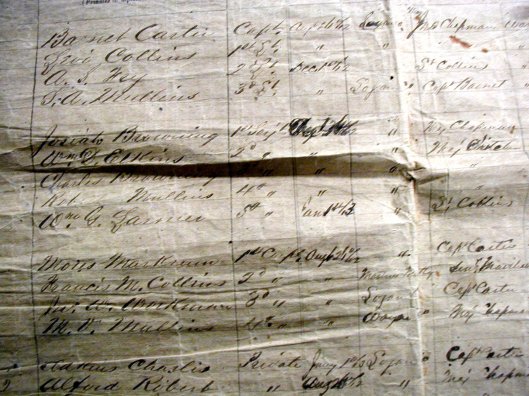
Muster Roll, Company D, 34th Battalion Virginia Cavalry (CSA)

Muster Roll, Company D, 34th Battalion Virginia Cavalry (CSA)
10 Tuesday Jun 2014
Posted in Big Harts Creek, Ed Haley, Music
Tags
Big Branch, Brandon Kirk, Cacklin Hen, Calhoun County Blues, Dood Dalton, Ed Haley, fiddler, fiddling, Garfield's Blackberry Blossom, Harts Creek, history, John Hartford, Lincoln County, music, Tootsie Tomblin, West Virginia, Wild Horse, writing
In that same time frame, Brandon re-visited Tootsie Tomblin, a daughter of Ed Haley’s friend Dood Dalton. She presented him with a reel-to-reel recording of Dood playing the fiddle around 1971. He knew this was an amazing find, somewhat comparable to finding a recording of Laury Hicks, Ed’s fiddling friend in Calhoun County.
Tootsie warned Brandon that the recording wasn’t great because her father had been very old and somewhat crippled in his left hand.
“He was playing with three fingers on his left hand ’cause his fourth finger wouldn’t bend where he’d got it mashed in the mines,” she said.
Brandon sent me a copy of the Dalton recording and when I played it I found that Dood was just what Tootsie said — a man of advanced years whose fingers were tough, stiff and scarred from years of working in the mines — using what sounded like a bow with three hairs and no rosin and a fiddle that had been refinished with floor varnish and strung up with barbed wire and with an action so high you could probably put your shoe under the strings. Still, there he was playing “Wild Horse”, “Cacklin’ Hen”, “Calhoun County Blues”, and “Garfield’s Blackberry Blossom”…and doing it so slowly, as if he were trying to communicate to me through the years that he’d been one hell of a fiddler earlier in his life. His final number was an unaccompanied vocal rendition of an old gospel tune. I came away from the recording thinking that yes, by god, Dood Dalton had been a good fiddler in his day.
06 Friday Jun 2014
Posted in Big Harts Creek, Lincoln County Feud, Timber
06 Friday Jun 2014
Posted in Big Harts Creek, Culture of Honor, Ed Haley, Lincoln County Feud
Tags
Billy Adkins, Brandon Kirk, Doug Owsley, feud, Green McCoy, John Hartford, Lincoln County, Lincoln County Feud, Milt Haley, Smithsonian, timbering, West Fork, West Virginia, writing
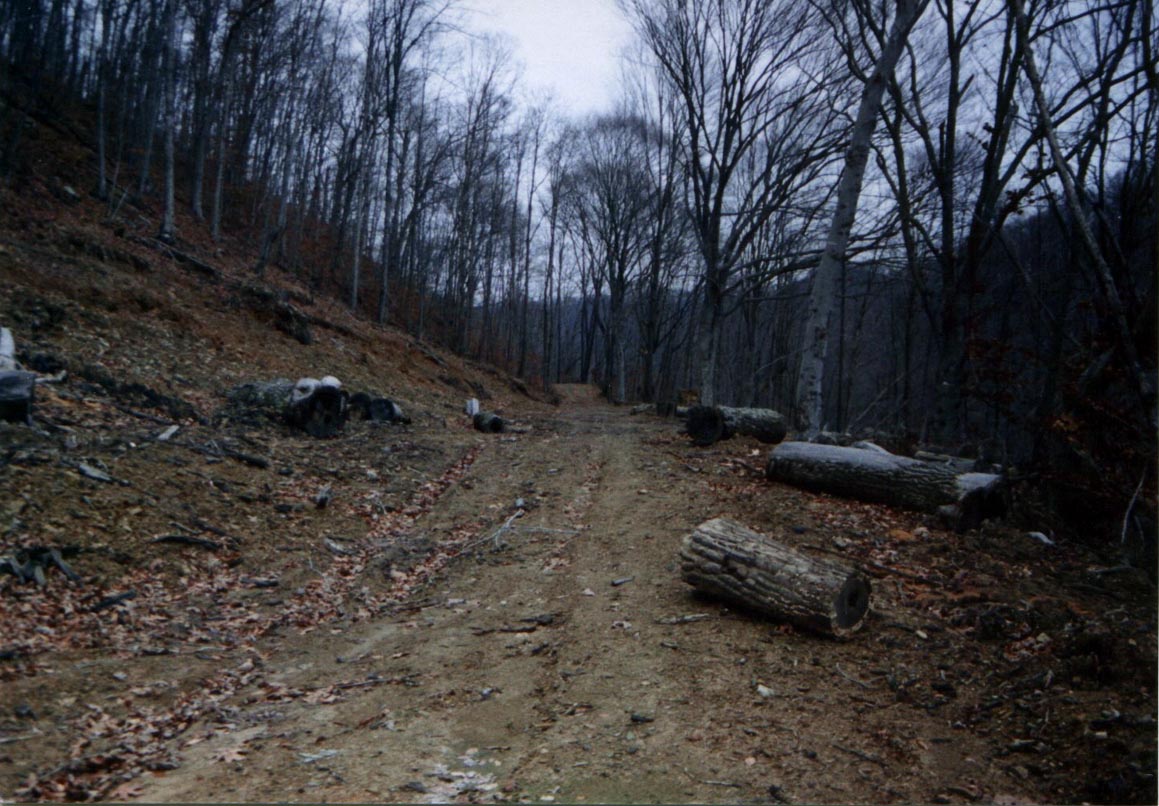
On July 4th, Brandon and Billy learned that a timber crew had been working at the Haley-McCoy grave for several days. Horrified, they raced to the site and found the ground ripped up, trees felled, and huge machinery roaring and chewing all over the mountainside. The Haley-McCoy grave was lost amidst toppled trees and fresh timber roads. Workers said the grave was okay, although property owners had not told them it was there.
When Brandon called me with this news, I told him there might be a positive outcome to the whole mess. Maybe we could now approach some people about exhuming the grave. He was all for it now.
“You know, we could try Doug Owsley at the Smithsonian,” I said. “He could tell us all kinds of things about them just by looking at their bones.”
Brandon had more of a “rescue mentality.”
“I hate to mess with their bodies,” he said. “I mean, they were real people. There’s something historical about them being there. I hate to spoil that.”
He agreed to an exhumation, though, so long as it had the support of Milt and Green’s family and so long as they would be re-buried at the site with a historical marker placed nearby to note the significance of the site and add protection from future bulldozers.
We talked more over the next few days — particularly about getting Doug Owsley, the expert forensic scientist, to conduct such a dig.
The next thing I knew, I was on the telephone with Owsley explaining my interest in Milt’s and Green’s grave. He was enthusiastic about the project but wanted more information, so Brandon gathered up some of our research and fired it off to him.
05 Thursday Jun 2014
Posted in Big Harts Creek, Ed Haley, Logan, Music
Tags
banjo, Brandon Kirk, Buck Fork, Buffalo Creek, Dixie Mullins, Donna Samson, Ed Belcher, Ed Haley, Falling Water, fiddle, fiddler, genealogy, George Mullins, guitar, Harts Creek, history, James Belcher, Logan, Logan County, Logan Theatre, Mary Belcher, music, piano, Putnam County, Rhoda Mullins, Scott District, timbering, West Virginia, writing
Not long after talking with Vergia, Brandon located Donna Samson, a daughter of Ed Belcher, in Logan, West Virginia. Belcher, we were told, was a multi-instrumentalist who played music with Ed Haley at George Mullins’ home on the Buck Fork of Harts Creek.
John Edward Belcher was born in 1886 or 1889, the son of James and Mary (Thomas) Belcher. The Belchers lived in Scott District, Putnam County, in 1900. Donna thought her father was from Buffalo Creek in Logan County. She said her family was once heavily involved in the sawmill business. As a young man, Ed played music with his brother Henry. At some point, he took music lessons and learned to read and write music. He could play the piano, banjo, guitar, and “could make a violin cry.” In the 1910s and 1920s, he played the violin in an orchestra during silent movies at the Logan Theatre. About that same time, he also operated a boarding house near the train station (likely a convenient “stopping off place” for Ed Haley when he came into Logan).
“He always kept music around his home,” Donna said.
Belcher played ragtime and loved to play “Falling Water” on the piano in his later years.
Donna said her father met her mother Rhoda Mullins (1919-1990) while at a dance in Logan. Rhoda was staying in town with her sister Dixie, who was a local schoolteacher. They were the daughters of George Mullins of Harts Creek. Her father, she added, was some thirty years older than her mother, who was his second wife.
Ed Belcher died in 1970. His death record gives his occupation as “Piano repair, tuner.”
31 Saturday May 2014
30 Friday May 2014
Posted in Big Harts Creek
30 Friday May 2014
Posted in Big Harts Creek, Culture of Honor
Tags
Allen Martin, Appalachia, Atlanta, Ben Adams, Brandon Kirk, Charley Brumfield, crime, Frank Adams, Georgia, Greasy George Adams, Harts Creek, history, Huntington Herald-Advertiser, Lawrence Haley, Logan County, moonshining, murder, Ward Brumfield, West Virginia, writing
“Greasy George” Adams, a son of Ben Adams, was apparently a notorious character on Harts Creek in the early decades of the twentieth century. Lawrence Haley had mentioned his name to me on my first trip to Ashland, while Brandon said his home was the scene of Charley and Ward Brumfield’s double murder in 1926. A 1953 article from the Huntington Herald-Advertiser titled “HARTS CREEK HOME WHERE FIVE MET DEATH NOW IS OFTEN SCENE OF PRAYER MEETINGS” had this great interview with Adams.
George Adams of Harts Creek in Logan County has his rifle on the wall now and instead of a pistol in his hand he carries a prayer book. He’s given up feuding and fighting and settled down to old-time religion at his neat farm home where five persons were killed in gun fights. Almost never does the tantalizing smell of moonshine cooking in a barrel up a mountain hollow drift down to taunt the nostrils of the man who proudly states he has made thousands of gallons and the law never chopped up one of his stills. “I put ’em high up in the hills and the law got too tired before they reached them,” he said.
THE HONKING of a brood of ducks and the whining of droves of bees busy at work at his 40 honey hives are about the only sounds which disturb the silence around his 25 acres of land today. Land which he says he was able to buy through the sale of bootleg liquor. But it was not always so at George Adams’ place. Several decades ago he recalls that when he heard a rifle singing through the hills he reckoned it was a neighbor shooting at another neighbor. Open season on humans has closed in the area since, and squirrels and rabbits are about the only targets. George Adams misses the sparsity of “shine” from the hill country he loves so well, even though he says he hasn’t touched a drop since the last killing at his home. “Dang revenooers probably don’t know how good moonshine made out of tomatoes is, or they wouldn’t go around bustin’ up all the stills in the country,” he said.
THE MOUNTAIN folk in the Harts Creek area will tell you that there’s many a home along the small stream which flows into the Guyandotte River that’s seen a shooting or a killing. But George Adams’ home is slightly above par for the area — five people have met violent deaths there. As “Greasy George,” which his neighbors call him, puts it: “No trouble for a man to get in trouble but it’s hell to get out!” And he’s a man who should know about trouble. His legs are a little wobbly now because of carrying his six foot of height and weight around for 72 years, and he gets a little short of breath when working too hard, but when he starts talking about his shooting scrapes, he has all the enthusiasm of a country boy walking a country mile to a country house to date a country girl for the first time.
“I FUST got into trouble when I was nineteen. Mail carrier undertook to kill Dad and I went after him. Somebody got him,” he said, hastily adding: “Weren’t too nice a way to treat a man who delivers letters.” George related that his Dad got shot four times in the exchange of lead and “we both went to jail.” A trial in Logan County lasted for three days and he said, “Dad nearly went broke paying off lawyers,” before a verdict of self defense was brought in. That shooting affair took place less than a mile from George’s present home but several years later his kitchen was the scene of a battle where he said “guns were going off like popcorn.” Three participants emptied their guns at each other after George said one of them knocked him down and out of the way. Three burials took place afterwards. Before George built his present frame house over a log cabin, the logs were speckled with the bullets which went wild. The house today is probably the only frame house in the nation which has a cement roof on it three inches thick. “Ran out of lumber and got concrete real cheap,” George said. “While the house is plenty warm in winter time it sure is hot in summer,” he added.
ADAMS recalls that except for getting a year in jail for fighting during the kitchen shooting affair, the only time he strayed from the Harts area was when he went on a three-year vacation in Atlanta, Ga., courtesy of the federal government. Things were peaceful at his house for a while until a relative “up and chased his wife over here,” he said. The relative, according to George, fired and hit the wife with a blast from a 16-gauge shot gun. The next and last time a shooting occurred in the old homestead, Frank Adams, George’s son, lost his life. He said the affair was due to drinking and “since then I haven’t touched a drop unless somebody put it in my food unbeknowst to me.” “My boys were singing a lot of old fool songs and I told ’em to shut up. My son got up and slapped me down. While I was knocked out somebody shot Frank.”
GEORGE SAID he had 18 children. Three are living at home with him now and the rest are in other parts of the state. He says he can’t recall all their names “but they are in the Bible.” During recent years his home which saw so much violence is now the scene of many a religious meeting. He has even constructed benches in his yard to seat the neighbors who come from miles around to hear the services. He’s not filled full of the brine and vinegar he had when he was younger and as he says: “Me and other folks have quit this tomfoolery.” But nevertheless, George remarked that he would “sorta like to git in ‘nuther shakedown if I wasn’t too old.” And on the wall overhanging his bed is his rifle. “Keep it so’s if a man keeps coming in the house at night when I say stop I can stop him,” he said.
26 Monday May 2014
Posted in Big Harts Creek, Ed Haley, Ferrellsburg, Lincoln County Feud
Tags
8th of January, Arkansas Traveler, Big Branch, Billy Adkins, Billy in the Lowground, Blackberry Blossom, Brandon Kirk, Dood Dalton, Ed Haley, Ferrellsburg, fiddling, Green McCoy, Green Shoal, Harts Creek, Henderson Dingess, history fiddle, Lop-Eared Mule, Milt Haley, Mingo County, Soldiers Joy, Ward Browning, West Fork, West Virginia, writing
A week or so later, Brandon and Billy visited Ward Browning, an older gentleman in Ferrellsburg whose wife was a descendant of Henderson Dingess. Ward said Milt Haley was from “back in the country at the head of Harts toward Mingo County.” The first year of Ed’s life, Milt dipped him repeatedly in water because someone told him it would make a baby healthy; instead, it made him go blind. Milt was hired with Green McCoy to kill the Brumfields. Later, they were captured and taken across the river from Green Shoal and kept under a dogwood bush where they were beaten through the night and then killed around daylight.
Ward said he used to see Ed Haley at Dood Dalton’s home on Big Branch in the late 1930s. Ed would stay around Dood’s place for two or three weeks at a time. He was a “star” — the best around. He and Dood sat on the porch and played for crowds of people in the yard who clapped their hands and had a good time. There was never any trouble. No one took him for granted. He sometimes made up to four dollars a day playing there in hard Depression times.
Ward said Ed carried his fiddle in a case and kept a stick to find his way in the road. He had a great personality and would tell wild stories of his exploits. He drank heavily and was “bad to fight,” but was always sober at Dood’s. Ward said he played “Billy in the Lowground”, “Lop-Eared Mule”, “Arkansas Traveler”, “Soldiers Joy”, “Blackberry Blossom”, and ‘8th of January”.
Brandon was also busy at the Haley-McCoy grave on West Fork. He seemed to be coming around on my idea to exhume Milt Haley and Green McCoy. I’d joked him relentlessly that we might do it only to find it completely empty. He was still against the idea, although his curiosity was getting the better of him.
“As I had been dwelling a lot on the Haley-McCoy grave recently, I finally decided to satisfy my curiosity to a limited extent,” he wrote. “I borrowed a metal detector and raced up to the grave on West Fork at the edge of dark to see what it would pick up (belt buckle, handcuffs, perhaps even the murder weapon). I first tested it on my keys, which I laid upon the ground. Running the detector over them caused a loud buzz. I then placed a pile of leaves over the keys and the detector still buzzed. As a last preliminary test, I laid a thick rock on top of my keys and ran the machine over it and it still registered the buzz. Content that the machine worked fairly well, I then eagerly began gliding it over the grave. Unfortunately, I picked up no real buzz. There was one spot that seemed to repeatedly register a slight buzz but nothing conclusive.”
Brandon signed his letter, “Digging Around (Almost Literally)…”
25 Sunday May 2014
Posted in Big Harts Creek
23 Friday May 2014
Posted in Big Harts Creek, Spottswood, Women's History
23 Friday May 2014
Posted in Big Harts Creek, Chapmanville, Dingess, Green Shoal, Spottswood, Timber
Tags
Augusta Bryant, Belle Dora Adams, C.J. Plaster, Chapmanville, Dicy Adams, Dingess, Doc Turner, Enel Deskins, genealogy, George Bryant, Green Jackson, Green Shoal, Harts Creek, Henderson Dingess, history, Hugh Evans, Isaac Marion Nelson, John Workman, Kentucky, Logan, Logan Banner, Logan County, Major Adams, Mingo County, Ollie Bryant, Peter Carter, Smokehouse Fork, Solomon Adams, Solomon Adams Sr., Spottswood, Sr., timbering, W.J. Bachtel, West Virginia, William Kelley, Zack Williams
“DeLay,” a correspondent from Spottswood in Logan County, West Virginia, offered the following items, dated October 12, 1903, which the Logan Banner printed on Friday, October 16, 1903:
As no one wrote to The Banner from this place last week, I will write a few items this week. Some of the correspondents from this place seem to write more to throw mud in their neighbors’ faces than to give the news of the place.
Mrs. Augusta Bryant, after an illness of some weeks died last Friday night at the home of her parents at this place. The bereaved relatives have our sympathy.
Sol Adams, Sr., made a business trip to Logan Friday.
Green Jackson of Logan was visiting friends and relatives here Sunday.
Miss Belle Dora Adams spent Saturday and Sunday with her parents at this place.
Enel Deskins of Dingess was a visitor at this place Sunday.
Rev. I.M. Nelson preached a fine sermon last Sunday in memory of Henderson Dingess at the home of the deceased.
W.J. Bachtel is on the sick list.
William Kelly and another man from Kentucky passed through the ville Sunday enroute for Greenshoals.
Jesse Carter made a business trip to Logan Friday.
Major Adams while cutting timber the other day almost cut his foot off, but we are glad to announce that he is improving fast, and we hope to see him out again soon.
C.J. Plaster sold his land to Hugh Evans for $390 and went to Dingess. On awaking one morning he discovered that he had in some way been relieved of $65. He at once swore out a warrant for Zachary Williams, who was arrested and bound over to answer an indictment.
Dr. Turner of Chapmanville has the contract to build the schoolhouse at John Workman’s for $375.
Peter Carter was in Logan on business Monday.
23 Friday May 2014
Posted in Big Harts Creek, Harts, Timber
23 Friday May 2014
Posted in Big Harts Creek, Ed Haley, Music
Tags
Andy Mullins, Ashland, banjo, Ben Adams, Bernie Adams, Bill Adkins, Brandon Kirk, Buck Fork, Claude Martin, Clyde Haley, Devil Anse Hatfield, Devil's Dream, Dingess, Drunkard's Hell, Ed Haley, Ella Haley, fiddling, George Baisden, George Mullins, Greasy George Adams, Harts, Harts Creek, Henderson Branch, history, Hoover Fork, John Frock Adams, Johnny Canub Adams, Kentucky, Lincoln County, Logan County, Mona Haley, music, Ralph Haley, Roxie Mullins, Sally Goodin, Soldiers Joy, Ticky George Adams, Trace Fork, Weddie Mullins, West Virginia, Wilson Mullins, writing
Throughout the winter 1996, Brandon kept busy interviewing folks around Harts for new Ed Haley-Milt Haley leads. In March, he wrote me about recent developments, including the death of Bill Adkins, Sr. — the old fiddler in Harts. At Bill’s wake, Brandon met Andy Mullins, who had recently moved back to Harts Creek after settling in Michigan in 1952. He was the son of Roxie Mullins.
Andy said, when he was a child, Ed Haley spent summers with his parents. Ed also stayed with George Mullins on Buck Fork, George Baisden (a banjo player) in the head of Hoover Fork, “old John Adams” on main Harts Creek, and Johnny Adams (Ticky George’s son) on Trace Fork. Ed had a big, fat belly. Sometimes, he came with his wife, a quiet woman who would eat dinner and then sing for an hour or so while playing the mandolin. Their daughter “Mona Mae” traveled with them, as did her husband, Wilson Mullins.
Andy didn’t remember much about Ed’s other children. He said Clyde stayed six months at a time on Harts Creek and “wouldn’t work a lick” and “couldn’t stay out of trouble.” He heard that Ralph used to hang upside down from a bridge in Ashland.
When Ed was young, Andy said, he supposedly played a lot of music with George Baisden. Later, he played with Bernie Adams and Claude Martin. Andy remembered that Ed didn’t saw the fiddle — he played smooth — and he was a good singer. His voice was like a bell. When he played music with Bernie and Claude, people gathered in and brought food and booze. Andy never saw Ed drunk, although he would get pretty high. Ed and Bernie were hateful. Somebody might request a tune and Ed would say, “What do you think I am, a steam engine?” — then play it five minutes later. Andy remembered Ed playing “Devil’s Dream”, “Drunkard’s Hell,” “Soldiers Joy” and “Sally Goodin”.
Andy was familiar with Ben Adams, who he said operated a mill-dam at Greasy George’s place on main Harts Creek. Ben used this dam to back the creek all the way up to Henderson Branch. Before turning it loose, he would go and tell people to get out of their homes. His nephew, “old John Adams” (a.k.a. “Long John” or “John Frock”), was the one who went to Dingess and killed the man who had shot Ed’s uncle, Weddie Mullins. Andy said the doctor had this man on a table working on him when John showed up and “wasted” him. John Frock let Ed cut his fingernails one time and he cut them up so badly that his fingers bled. (Mona had told me a similar story, except she thought that Ed had cut Devil Anse Hatfield’s nails.)
20 Tuesday May 2014
Posted in Big Harts Creek, Ed Haley, Harts, Spottswood, Whirlwind
Tags
Adams Branch, basketball, Beecher Avenue, Ben Walker, Billy Adkins, Bob Adkins, Bob Mullins Cemetery, Brumfield Avenue, Buck Fork, Bulwark Branch, Charles Brumfield, Crawley Creek Mountain, CSX Railroad, Ed Haley, Eden Park, genealogy, Guyandotte Valley, Hannah Baptist Church, Harts, Harts Creek, Harts High School, Heartland, Henderson Branch, history, Hoover Church of the General Assembly, Hoover Fork, Huntington, Ivy Branch, John Hartford, Kiahs Creek, Lambert Branch, Lincoln County, Logan County, McCloud Branch, Mingo County, Mount Era Baptist Church, Mountaineer Missionary Baptist Church, Pilgrims Rest Church, politics, Railroad Avenue, Republican, Rockhouse Fork, Route 10, Sand Creek, Smokehouse Fork, Trace Fork, Trace Old Reguarl Baptist Church, Twelve Pole Creek, Upper Trace Fork School, Ward Avenue, Wayne County, West Fork, Whirlwind, Workman Branch, writing
The community of Harts sits indiscreetly in the narrow section of the Guyandotte Valley on land that makes up the northernmost region of the Logan County coalfield and what was once “feud country.” Located some ten miles from a four-lane federal corridor linking the state capital to eastern Kentucky and fifty miles up a two-lane rural highway from Huntington, the second largest city in West Virginia, it is a settlement just on the cusp of modernization. It is a treasure trove of hidden history, quickly disappearing even in the minds of its locals, who have little if any recollection of its booming timber era or the exciting times of the railroad hey-day. It’s really the kind of place you might drive through without noticing much — or never have a reason to drive through at all.
Basically, Harts is an old timber town divided in the center by a lazy muddy river and intersected by a two-lane highway, Route 10. On the west side of the river — site of the old Brumfield business headquarters — is an empty store, a tavern-turned-church-turned-beauty shop, a garage, and a brick tabernacle. On the east side is an old brick general store, a nice video rental establishment, a state highways headquarters, an old wooden general store, a small brick post office, a fire department, a grocery store, a hardware store, a general merchandise store, a Victorian general store-turned-restaurant, and a new brick Head Start center. Running between those buildings on the east side is a track owned by CSX (formerly C&O) Railroad. Just behind the businesses are a few dozen houses of all vintages: brick, wooden, single-story, two-story… There are no street signs or traffic lights or even stop signs.
Route 10 connects Harts with the city of Huntington to the north and with the Logan coalfields to the south. From town, Big Harts Creek Road heads west up the creek to West Fork or Smokehouse Fork, while a little unnamed road diverges north past the tracks toward extinct post offices named Eden Park and Sand Creek. The four streets in town are paved but very few locals even know their proper names, which are Railroad, Beecher, Ward, and Brumfield Avenues. Just down the river is a brick house-turned-bank, a rural health clinic, a brick construction company headquarters, a new coalmine development area called Heartland, and a mechanic shop/gas station (owned incidentally by one Charles Brumfield).
Culturally, Harts might be thought of as an inconspicuous Harlequin romance and Wild West show gone wild, at least in its not-so-distant past. Many of the rabble rousers and roustabouts are long since dead. Actually, somewhat to my disappointment, a lot of the old families are gone completely from the area and no one really feuds any more. Many residents seem to work as schoolteachers or run small stores or work in the coalmines or draw government relief. People are nice and treat each other well. Most are related or at least seem to be. They watch TV or go to church or tend their yards or hunt or fish or ride four-wheelers or hop on the four-lane at Chapmanville and drive to Wal-Mart some 45 miles away. Old-timers are quick to say that Harts has a bad reputation for no reason — the only two murders within town limits occurred almost a century ago. There are no parks, museums or movie theatres — and only a few registered Republicans. It’s the kind of place where you can leave your doors unlocked at night or if you’re gone all day…and feel safe about it.
I have to admit, after several visits to Harts, I loved it. On one visit, I learned from Billy Adkins that the old Ben Walker farm was for sale…and seriously considered buying it. (I passed on the idea when I realized that my wife would never forgive me for it.) Harts, then, would remain a place to “see.” I began telling folks out on the road that it was “my Ireland.” It represented a desire on my part to get back to the kind of places where (at least in my romantic imagination) a lot of fiddle playing originated. A lot of my friends were from these kind of places. For them, when they wanted to tap into that ancestral ancient tone, they thought of Ireland, whether they were Irish or not. For me, coming from St. Louis, Harts was the closest I could ever hope to get to that. Such places are at the heart of the music I love.
Venturing up Harts Creek, the first thing you really notice is Harts High School, a forty-some-year-old two-and-a-half-story yellow brick structure near the mouth of West Fork with a gymnasium, annex building, and a baseball field, all situated on what was a prison camp during the early fifties and, a little further back in time, the upper reaches of the Al Brumfield property (and, a little further still, an Indian camp). In many ways, this school is the lifeblood of the community — at least in the lower section of the creek. In the mid-sixties, just as Harts began to turn away from its violent past, the high school basketball team won a state championship and began building a program known regionally for its successes. Today, basketball is what this community is best known for — not the murders or moonshining traditions of years past — with crooked politics maybe finishing a close second.
A little further up the creek, just below the Logan County line, a few miles past an old country store, a little restaurant, another baseball field, and a place of worship named the Cole Branch Church of Jesus Christ of the First Born. From there, the road forks left onto the Smoke House Fork of Big Harts Creek, location of the Hugh Dingess Elementary School and Dingess, Butcher, Farley and Conley country; or the road forks right into the head of Harts Creek to “Ed Haley country.” Of course, no one calls it that. People think of it as “Adams country” or “Mullins country” and really, that’s about all there ever was in that section. Ed himself is often identified with the Mullins family — his mother’s people. The adults in this part of Harts Creek vote in Logan County — not Lincoln — and send their kids on buses over Crawley Creek Mountain to Chapmanville High School. This section of the creek — where gunshots once rang out regularly and where moonshine was so readily found — is now remarkably quiet and low-key outside of the occasional marijuana bust. Unfortunately, it seems to have lost its musical tradition as well.
Trace Fork, the site of Ed Haley’s birth, is attributed by Ivy Branch in its head, Adams Branch, and Boardtree Branch toward its middle and Jonas and Dry House Branch toward its mouth. There are several small family cemeteries on Trace, with the maroon-bricked Mountaineer Missionary Baptist Church at its mouth. In previous days, the Upper Trace Fork School (now Trace Old Regular Baptist Church) sat in its headwaters, where the Logan-Lincoln-Mingo county line meets. As a matter of fact, Ivy Branch heads near Kiah’s Creek at the Wayne-Mingo County line, while Boardtree Branch heads at McCloud Branch of Twelve Pole Creek in Mingo County. Adams Branch heads at Rockhouse Fork in Lincoln County.
A little further up the main creek is Buck Fork, an extensive tributary comparable to West Fork or Smokehouse in size. It is the ancestral home of the Mullins, Bryant, and Hensley families whose names still dominate the mailbox landscape. In previous decades, it was the location of the Hensley School and Mt. Era Church. Just below Buck Fork on main Harts Creek is a large Adams family cemetery, while just above it is the equally large Bob Mullins family cemetery.
Continuing up Harts Creek is Hoover Fork, home of the Mullins, Adams, and Carter families as well as the Hoover Church of the General Assembly. Henderson Branch, home seat for Tomblins and Mullinses is the next tributary, followed by Lambert Branch (at Whirlwind) and Workman Branch. Bulwark Branch follows (populated by Carters and Workmans), trailed by Brier Branch (Smiths) and Tomblin Branch. In the headwaters of Harts Creek are Tomblins, Daltons, and Blairs, as well as the Pilgrims Rest Church and Hannah Baptist Church.
In all sections of Harts, gossip reigns supreme as a source of local entertainment. (This in spite of Bob Adkins’ warning that people should “tend to their own business.”) Maybe that’s why we hear so much about a 100-year-old murder when we ask about it and a bunch of other things we don’t ask about. Genealogy is super important. When you sit down to talk with someone, the first thing they want to know is how you fit into the community pedigree. It’s a way of squaring you up.

19 Monday May 2014
Posted in Big Harts Creek, Whirlwind
Tags
Appalachia, Democrat, Everett Adams, genealogy, Harts Creek, history, Logan County, photos, politics, U.S. South, West Virginia

Everett Adams for Logan (WV) County Clerk, 1926
16 Friday May 2014
Posted in Big Harts Creek, Spottswood, Whirlwind
16 Friday May 2014
Posted in Big Harts Creek, Spottswood
Tags
Augusta Bryant, Belle Dora Adams, Bettie Workman, Buck Fork, Buck Fork School, Frances Baisden, genealogy, Harts Creek, history, Hoover Fork, Ina Adams, Isaac Marion Nelson, John Carter, Lawrence Riddle, Logan Banner, Logan County, love, Moses Butcher, Nolan, Peter Carter, Peter Mullins, Spottswood, timbering, Weddie Mullins, West Virginia, Yantus
An unnamed local correspondent from Spottswood in Logan County, West Virginia, offered the following items, which the Logan Banner printed on Friday, October 2, 1903:
Some one insulted John Carter last Friday night by stealing his kraut tub.
Rev. I.M. Nelson preached a fine sermon Sunday at the Buck Fork schoolhouse in memory of Weddington Mullins. There was a large congregation.
Mrs. Sol Adams says she wants all the pumpkins there are on Hoover with which to make apple butter for they are fine for that.
Peter Mullins got mashed up by a log truck the other day, but has got so he can walk about the place again.
Peter Mullins is one of the greatest squirrel hunters on Hart’s creek. The crack of his repeating shotgun is often heard.
Miss Bell Dora Adams is struck on a young teacher who stays on the Buck Fork.
Mrs. French Bryant of Nolan, W. Va., is very low with fever at this place.
Moses Butcher of Yantus was a visitor at this place last week.
Prof. L.W. Riddle is a candidate for matrimony subject to the action of the ladies of Spottswood.
Miss Bettie Workman has resumed teaching after an illness of two weeks.
Miss Inez Adams, one of the belles of this place was making “goo goo” eyes at a young teacher while at church last Sunday.
Peter Carter says there is only one girl in the world for him and that is Miss Frances Baisden.
Writings from my travels and experiences. High and fine literature is wine, and mine is only water; but everybody likes water. Mark Twain
This site is dedicated to the collection, preservation, and promotion of history and culture in Appalachia.
Genealogy and History in North Carolina and Beyond
A site about one of the most beautiful, interesting, tallented, outrageous and colorful personalities of the 20th Century