Tags
Appalachia, genealogy, Harts Creek, history, Lincoln County, logging, photos, timbering, U.S. South, West Virginia

Harts Creek Timber Man, 1890-1915

23 Friday May 2014
Posted in Big Harts Creek, Harts, Timber
Tags
Appalachia, genealogy, Harts Creek, history, Lincoln County, logging, photos, timbering, U.S. South, West Virginia
Harts Creek Timber Man, 1890-1915
23 Friday May 2014
Posted in Big Harts Creek, Ed Haley, Music
Tags
Andy Mullins, Ashland, banjo, Ben Adams, Bernie Adams, Bill Adkins, Brandon Kirk, Buck Fork, Claude Martin, Clyde Haley, Devil Anse Hatfield, Devil's Dream, Dingess, Drunkard's Hell, Ed Haley, Ella Haley, fiddling, George Baisden, George Mullins, Greasy George Adams, Harts, Harts Creek, Henderson Branch, history, Hoover Fork, John Frock Adams, Johnny Canub Adams, Kentucky, Lincoln County, Logan County, Mona Haley, music, Ralph Haley, Roxie Mullins, Sally Goodin, Soldiers Joy, Ticky George Adams, Trace Fork, Weddie Mullins, West Virginia, Wilson Mullins, writing
Throughout the winter 1996, Brandon kept busy interviewing folks around Harts for new Ed Haley-Milt Haley leads. In March, he wrote me about recent developments, including the death of Bill Adkins, Sr. — the old fiddler in Harts. At Bill’s wake, Brandon met Andy Mullins, who had recently moved back to Harts Creek after settling in Michigan in 1952. He was the son of Roxie Mullins.
Andy said, when he was a child, Ed Haley spent summers with his parents. Ed also stayed with George Mullins on Buck Fork, George Baisden (a banjo player) in the head of Hoover Fork, “old John Adams” on main Harts Creek, and Johnny Adams (Ticky George’s son) on Trace Fork. Ed had a big, fat belly. Sometimes, he came with his wife, a quiet woman who would eat dinner and then sing for an hour or so while playing the mandolin. Their daughter “Mona Mae” traveled with them, as did her husband, Wilson Mullins.
Andy didn’t remember much about Ed’s other children. He said Clyde stayed six months at a time on Harts Creek and “wouldn’t work a lick” and “couldn’t stay out of trouble.” He heard that Ralph used to hang upside down from a bridge in Ashland.
When Ed was young, Andy said, he supposedly played a lot of music with George Baisden. Later, he played with Bernie Adams and Claude Martin. Andy remembered that Ed didn’t saw the fiddle — he played smooth — and he was a good singer. His voice was like a bell. When he played music with Bernie and Claude, people gathered in and brought food and booze. Andy never saw Ed drunk, although he would get pretty high. Ed and Bernie were hateful. Somebody might request a tune and Ed would say, “What do you think I am, a steam engine?” — then play it five minutes later. Andy remembered Ed playing “Devil’s Dream”, “Drunkard’s Hell,” “Soldiers Joy” and “Sally Goodin”.
Andy was familiar with Ben Adams, who he said operated a mill-dam at Greasy George’s place on main Harts Creek. Ben used this dam to back the creek all the way up to Henderson Branch. Before turning it loose, he would go and tell people to get out of their homes. His nephew, “old John Adams” (a.k.a. “Long John” or “John Frock”), was the one who went to Dingess and killed the man who had shot Ed’s uncle, Weddie Mullins. Andy said the doctor had this man on a table working on him when John showed up and “wasted” him. John Frock let Ed cut his fingernails one time and he cut them up so badly that his fingers bled. (Mona had told me a similar story, except she thought that Ed had cut Devil Anse Hatfield’s nails.)
21 Wednesday May 2014

Harts, Guyandotte River flood, 1963
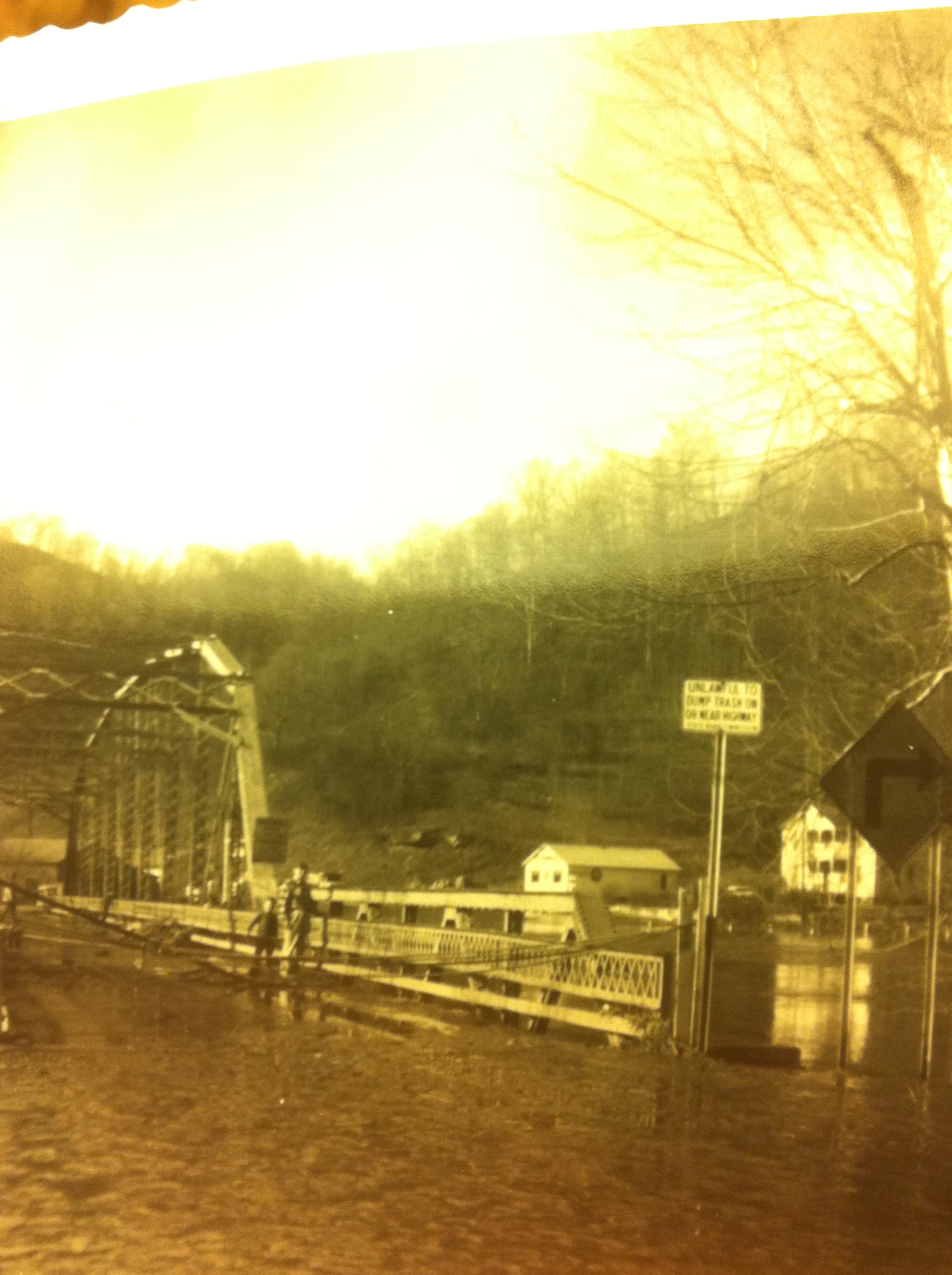
Harts, Guyandotte River flood, 1963
21 Wednesday May 2014
Posted in Ed Haley
Tags
Ashland, Billy in the Lowground, Bonaparte's Retreat, Charles Gardner, Charleston, Dallas, Done Gone, fiddling, Flatfoot Nash, French Carpenter, Georgia Slim Rutland, Gunboats Through Georgia, history, John Hartford, Kentucky, music, West Virginia, Wilson Douglas, writing
Back in Nashville, I called Wilson Douglas to thank him for being such a good host on my recent trip to West Virginia. I also had a few questions, starting with whether or not Ed played a tune called “Gunboats Through Georgia”.
“Oh, yeah,” Wilson said. “Well, they wasn’t very many, John, that he didn’t play. And he played a danged tune, him and French Carpenter, called the ‘Flatfoot Nash’.”
Wilson paused, then said, “I told you about Ed Haley commending Georgia Slim, didn’t I? He said he believed that Georgia Slim was the best fiddler on some of them there Southern tunes he ever heard. He said nobody could touch him on the ‘Billy in the Lowground’. Now, Georgia Slim — way back there in ’37, ’38 — he went and stayed with Ed Haley a lot in the wintertime.”
Wilson’s memories of Georgia Slim caused me to recall my theory that Ed was a grandfather of the Texas contest fiddling style. I hadn’t thought much about that lately so I called up Charles Gardner, an authority on Texas fiddling. Charles said Georgia Slim had influenced a lot of Texas fiddlers when he played over Dallas radio in the early 1940s. At that time, he was fresh from the Ashland-Charleston area, his playing no doubt filled with Haley and Kessinger licks. It seemed very possible to me that the unfamiliar parts he played on tunes like “Done Gone” and “Bonaparte’s Retreat” were learned from Ed or at least based on his approach.
20 Tuesday May 2014
Tags
Appalachia, genealogy, Harts, Herb Adkins, history, Lincoln County, merchant, photos, U.S. South, West Virginia
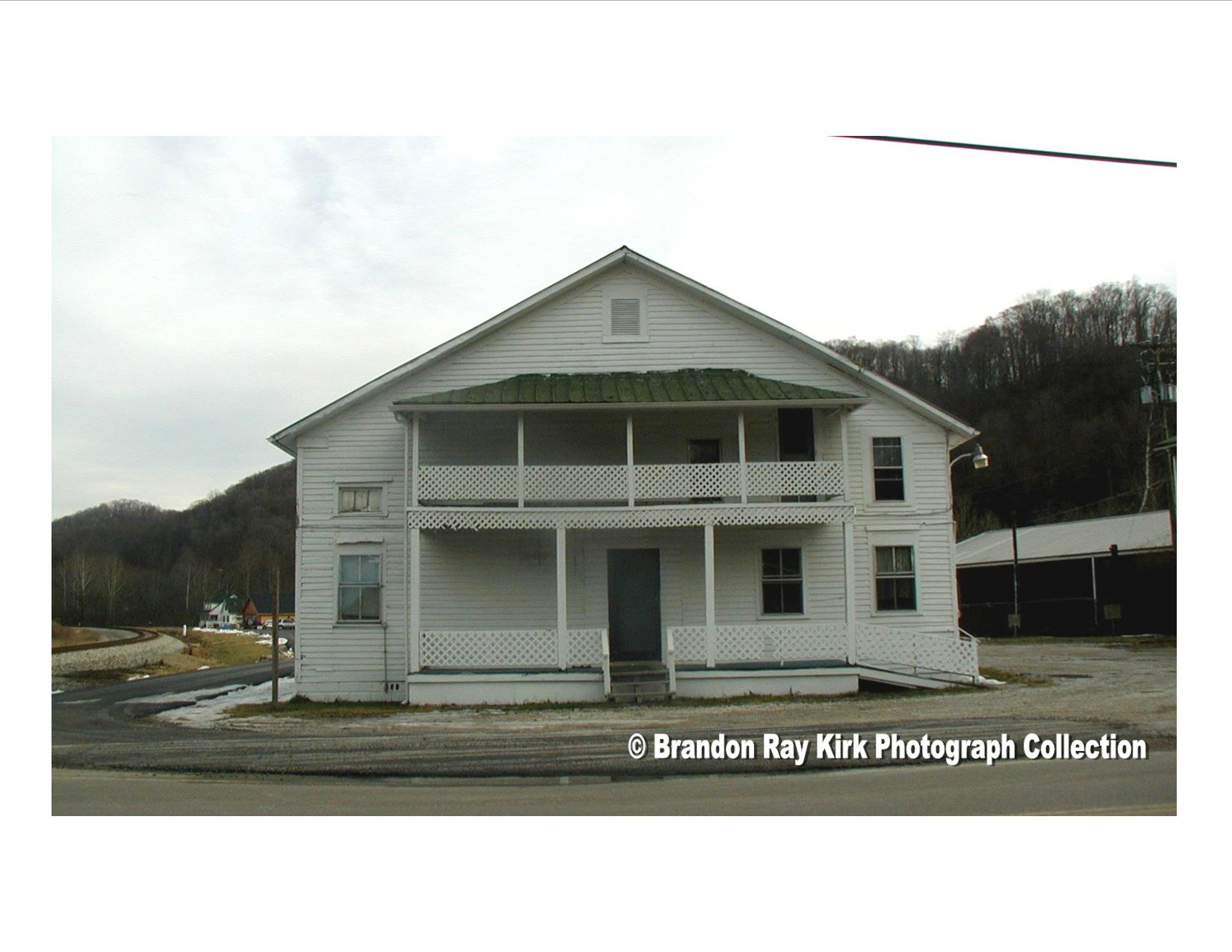
Herb Adkins store, Harts, Lincoln County, WV

Herb Adkins store, Harts, Lincoln County, WV
20 Tuesday May 2014
Posted in Big Harts Creek, Ed Haley, Harts, Spottswood, Whirlwind
Tags
Adams Branch, basketball, Beecher Avenue, Ben Walker, Billy Adkins, Bob Adkins, Bob Mullins Cemetery, Brumfield Avenue, Buck Fork, Bulwark Branch, Charles Brumfield, Crawley Creek Mountain, CSX Railroad, Ed Haley, Eden Park, genealogy, Guyandotte Valley, Hannah Baptist Church, Harts, Harts Creek, Harts High School, Heartland, Henderson Branch, history, Hoover Church of the General Assembly, Hoover Fork, Huntington, Ivy Branch, John Hartford, Kiahs Creek, Lambert Branch, Lincoln County, Logan County, McCloud Branch, Mingo County, Mount Era Baptist Church, Mountaineer Missionary Baptist Church, Pilgrims Rest Church, politics, Railroad Avenue, Republican, Rockhouse Fork, Route 10, Sand Creek, Smokehouse Fork, Trace Fork, Trace Old Reguarl Baptist Church, Twelve Pole Creek, Upper Trace Fork School, Ward Avenue, Wayne County, West Fork, Whirlwind, Workman Branch, writing
The community of Harts sits indiscreetly in the narrow section of the Guyandotte Valley on land that makes up the northernmost region of the Logan County coalfield and what was once “feud country.” Located some ten miles from a four-lane federal corridor linking the state capital to eastern Kentucky and fifty miles up a two-lane rural highway from Huntington, the second largest city in West Virginia, it is a settlement just on the cusp of modernization. It is a treasure trove of hidden history, quickly disappearing even in the minds of its locals, who have little if any recollection of its booming timber era or the exciting times of the railroad hey-day. It’s really the kind of place you might drive through without noticing much — or never have a reason to drive through at all.
Basically, Harts is an old timber town divided in the center by a lazy muddy river and intersected by a two-lane highway, Route 10. On the west side of the river — site of the old Brumfield business headquarters — is an empty store, a tavern-turned-church-turned-beauty shop, a garage, and a brick tabernacle. On the east side is an old brick general store, a nice video rental establishment, a state highways headquarters, an old wooden general store, a small brick post office, a fire department, a grocery store, a hardware store, a general merchandise store, a Victorian general store-turned-restaurant, and a new brick Head Start center. Running between those buildings on the east side is a track owned by CSX (formerly C&O) Railroad. Just behind the businesses are a few dozen houses of all vintages: brick, wooden, single-story, two-story… There are no street signs or traffic lights or even stop signs.
Route 10 connects Harts with the city of Huntington to the north and with the Logan coalfields to the south. From town, Big Harts Creek Road heads west up the creek to West Fork or Smokehouse Fork, while a little unnamed road diverges north past the tracks toward extinct post offices named Eden Park and Sand Creek. The four streets in town are paved but very few locals even know their proper names, which are Railroad, Beecher, Ward, and Brumfield Avenues. Just down the river is a brick house-turned-bank, a rural health clinic, a brick construction company headquarters, a new coalmine development area called Heartland, and a mechanic shop/gas station (owned incidentally by one Charles Brumfield).
Culturally, Harts might be thought of as an inconspicuous Harlequin romance and Wild West show gone wild, at least in its not-so-distant past. Many of the rabble rousers and roustabouts are long since dead. Actually, somewhat to my disappointment, a lot of the old families are gone completely from the area and no one really feuds any more. Many residents seem to work as schoolteachers or run small stores or work in the coalmines or draw government relief. People are nice and treat each other well. Most are related or at least seem to be. They watch TV or go to church or tend their yards or hunt or fish or ride four-wheelers or hop on the four-lane at Chapmanville and drive to Wal-Mart some 45 miles away. Old-timers are quick to say that Harts has a bad reputation for no reason — the only two murders within town limits occurred almost a century ago. There are no parks, museums or movie theatres — and only a few registered Republicans. It’s the kind of place where you can leave your doors unlocked at night or if you’re gone all day…and feel safe about it.
I have to admit, after several visits to Harts, I loved it. On one visit, I learned from Billy Adkins that the old Ben Walker farm was for sale…and seriously considered buying it. (I passed on the idea when I realized that my wife would never forgive me for it.) Harts, then, would remain a place to “see.” I began telling folks out on the road that it was “my Ireland.” It represented a desire on my part to get back to the kind of places where (at least in my romantic imagination) a lot of fiddle playing originated. A lot of my friends were from these kind of places. For them, when they wanted to tap into that ancestral ancient tone, they thought of Ireland, whether they were Irish or not. For me, coming from St. Louis, Harts was the closest I could ever hope to get to that. Such places are at the heart of the music I love.
Venturing up Harts Creek, the first thing you really notice is Harts High School, a forty-some-year-old two-and-a-half-story yellow brick structure near the mouth of West Fork with a gymnasium, annex building, and a baseball field, all situated on what was a prison camp during the early fifties and, a little further back in time, the upper reaches of the Al Brumfield property (and, a little further still, an Indian camp). In many ways, this school is the lifeblood of the community — at least in the lower section of the creek. In the mid-sixties, just as Harts began to turn away from its violent past, the high school basketball team won a state championship and began building a program known regionally for its successes. Today, basketball is what this community is best known for — not the murders or moonshining traditions of years past — with crooked politics maybe finishing a close second.
A little further up the creek, just below the Logan County line, a few miles past an old country store, a little restaurant, another baseball field, and a place of worship named the Cole Branch Church of Jesus Christ of the First Born. From there, the road forks left onto the Smoke House Fork of Big Harts Creek, location of the Hugh Dingess Elementary School and Dingess, Butcher, Farley and Conley country; or the road forks right into the head of Harts Creek to “Ed Haley country.” Of course, no one calls it that. People think of it as “Adams country” or “Mullins country” and really, that’s about all there ever was in that section. Ed himself is often identified with the Mullins family — his mother’s people. The adults in this part of Harts Creek vote in Logan County — not Lincoln — and send their kids on buses over Crawley Creek Mountain to Chapmanville High School. This section of the creek — where gunshots once rang out regularly and where moonshine was so readily found — is now remarkably quiet and low-key outside of the occasional marijuana bust. Unfortunately, it seems to have lost its musical tradition as well.
Trace Fork, the site of Ed Haley’s birth, is attributed by Ivy Branch in its head, Adams Branch, and Boardtree Branch toward its middle and Jonas and Dry House Branch toward its mouth. There are several small family cemeteries on Trace, with the maroon-bricked Mountaineer Missionary Baptist Church at its mouth. In previous days, the Upper Trace Fork School (now Trace Old Regular Baptist Church) sat in its headwaters, where the Logan-Lincoln-Mingo county line meets. As a matter of fact, Ivy Branch heads near Kiah’s Creek at the Wayne-Mingo County line, while Boardtree Branch heads at McCloud Branch of Twelve Pole Creek in Mingo County. Adams Branch heads at Rockhouse Fork in Lincoln County.
A little further up the main creek is Buck Fork, an extensive tributary comparable to West Fork or Smokehouse in size. It is the ancestral home of the Mullins, Bryant, and Hensley families whose names still dominate the mailbox landscape. In previous decades, it was the location of the Hensley School and Mt. Era Church. Just below Buck Fork on main Harts Creek is a large Adams family cemetery, while just above it is the equally large Bob Mullins family cemetery.
Continuing up Harts Creek is Hoover Fork, home of the Mullins, Adams, and Carter families as well as the Hoover Church of the General Assembly. Henderson Branch, home seat for Tomblins and Mullinses is the next tributary, followed by Lambert Branch (at Whirlwind) and Workman Branch. Bulwark Branch follows (populated by Carters and Workmans), trailed by Brier Branch (Smiths) and Tomblin Branch. In the headwaters of Harts Creek are Tomblins, Daltons, and Blairs, as well as the Pilgrims Rest Church and Hannah Baptist Church.
In all sections of Harts, gossip reigns supreme as a source of local entertainment. (This in spite of Bob Adkins’ warning that people should “tend to their own business.”) Maybe that’s why we hear so much about a 100-year-old murder when we ask about it and a bunch of other things we don’t ask about. Genealogy is super important. When you sit down to talk with someone, the first thing they want to know is how you fit into the community pedigree. It’s a way of squaring you up.
19 Monday May 2014
Posted in Big Harts Creek, Whirlwind
Tags
Appalachia, Democrat, Everett Adams, genealogy, Harts Creek, history, Logan County, photos, politics, U.S. South, West Virginia

Everett Adams for Logan (WV) County Clerk, 1926
19 Monday May 2014
Posted in Atenville, Big Ugly Creek, Ferrellsburg, Hamlin, Rector, Sand Creek, Toney
Tags
Bernie Lucas, Big Ugly Creek, Blackburn Lucas, Chris Lambert, Clerk Lucas, Democrat, Dollie Toney, Emma Watts, Etta Baisden, Ferrellsburg, genealogy, George Thomas, Hamlin, history, Homer Hager, Jerry Lambert, life, Lincoln County, Lincoln Republican, Lottie Lucas, Maggie Lucas, Maud Dial, Midkiff, Rector, S.J. Baisden, Sand Creek, Toney, Ward Baisden, Watson Lucas, West Virginia, Wib Adkins
“Bess,” a local correspondent from Toney in Lincoln County, West Virginia, offered the following items, which the Lincoln Republican printed on Thursday, June 20, 1912:
We are having very warm weather and rain is needed very much.
Misses Dollie Toney and Maggie Lucas returned home a few days ago from Hamlin, where they had been attending the normal.
Miss Emma Watts is here from Hamlin for a few days visit with Miss Toney and the Misses Lucas.
Misses Etta Baisden and Maud Dial were the guests of B.B. Lucas and family Sunday.
Mrs. S.J. Baisden is much improved in health.
Clerk Lucas bought a fine pair of mules from Ward Baisden last week, paying $390 for them.
Chris Lambert and family visited Mr. and Mrs. Jerry Lambert, of Sand Creek, Saturday and Sunday.
The democrats held their district primary last Saturday at Atenville. A large turnout is reported.
Clerk and Bernie Lucas, W. Adkins, and Homer Hager attended church at Rector Sunday. The boys say they like to go to Big Ugly.
Misses Emma Watts and Lottie Lucas were at Midkiff and other points on the G.V. Ry. last week.
Wib Adkins and Watson Lucas have Geo. H. Thomas at Ferrellsburg.
Success to the Republican and its readers.
18 Sunday May 2014
Posted in Cemeteries, Civil War, Fourteen, Wewanta
Tags
Brandon Kirk, Caleb Headley, cemeteries, Fourteen, Fourteen Mile Creek, genealogy, history, Lincoln County, photos, Sulphur Spring Fork, West Virginia
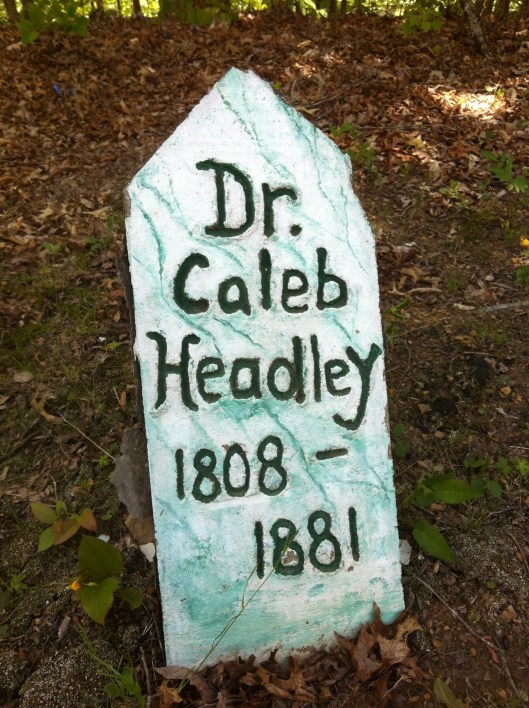
Caleb Headley grave, Sulphur Spring Fork of Fourteen Mile Creek, Lincoln County, WV, 2014
18 Sunday May 2014
Posted in Calhoun County, Civil War, Ed Haley, Music
Tags
Ashland, Atlanta, Big Ugly Creek, Birdie, blind, Boatin' Up Sandy, Catlettsburg, Chapmanville, Charleston, Cincinnati, civil war, Clark Kessinger, Coalton, Crawley Creek, Ed Haley, Ella Haley, fiddlers, fiddling, Girl With the Blue Dress On, Godby Branch School, Grantsville, Grayson, Great Depression, Green Shoal, Harts School, history, Hugh Dingess School, John Hartford, Kentucky, Lawrence Haley, Logan, Margaret Arms, Mona Haley, music, Orange Blossom Special, Pat Haley, Ralph Haley, Slim Clere, Sweet Georgia Brown, Tennessee Waggoner, The Old Lady Carried the Jug Around the Hill, Wewanta, writing
We hadn’t played long until Slim was telling me more about his background.
“I came from a line of Irish fiddlers,” he said. “My dad, his brothers, and his dad… The old man was so good on the fiddle — he was in the Civil War — my grandfather — that the soldiers all chipped in and bought him a fiddle and he didn’t have to fight. He was from Coalton on the road to Grayson out back of Ashland.”
Slim said his dad played “The Old Lady Carried the Jug Around the Hill” and “Girl With the Blue Dress On”.
Here comes the girl with the blue dress on, the blue dress on, with the blue dress on.
Everybody’s crazy about the girl with the blue dress on…
I asked him if his father played “Catlettsburg” and he said yes, although it was not the same version as what Ed played.
“My dad played it,” Slim said. “He played ‘Birdie’, ‘Tennessee Waggoner’. He got these two fingers cut when he was working at a steel mill and his fingers stayed stiff so he had to play the rest of his life with these two fingers. I don’t remember when he played with all five ’cause I was too small. He played ‘Boatin’ Up Sandy’.”
Every now and then, Slim would tell me something about Ed.
“Every Saturday Ed would go to a county courthouse someplace,” he said. “Believe it or not, he was in Grantsville one time when I was up there, sitting on the steps up there at the courthouse. I walked over, I said, ‘Ed, aren’t you out of place?’ He said, ‘You’re liable to find me anywhere.'”
I asked Slim if he ever saw Ed drunk and he said, “I don’t think I ever saw him sober. He didn’t get too high. Seemed like it give him more pep.”
I asked Slim if he remembered Sweet Georgia Brown coming to see Ed in Ashland and he said, “He was up in Ashland at one time. We called him Brownie. Well, he wasn’t around Ed too much. Ed was a close guy. He didn’t associate with a lot of people. Now, he liked me pretty well…but most fiddle players don’t like fiddle players.”
Speaking of fiddlers, Slim said he had met a lot of them during his lifetime. I wondered if he ever met any as good as Ed and he said, “Clark Kessinger was the closest. I think Clark learned from him. See when Clark made records for Brunswick — they had a studio down in Ashland — Ed wouldn’t play on it. He wouldn’t make records. Didn’t want to. He wouldn’t play over the radio. He said they wasn’t any money in that. He wanted to be somewhere somebody could throw a nickel or dime in that cup. He was very poor. He wasn’t starving to death, but — his wife was blind, too — there was no way that they could make any money. And he had a 17- or 18-year-old boy — he was a good guitar player, but he wouldn’t play with him. I don’t remember what his name was. He was ashamed of his father and mother — to get out in public. Not for any personal reasons…just the fact he could see and they couldn’t.”
Slim began talking about his own career in music, mostly his Depression-era radio work. He mentioned working with or meeting people like Bill and Charlie Monroe and Earl Scruggs and even credited himself with bringing “Orange Blossom Special” to Charleston from Atlanta in October of 1938. He kind of caught us by surprise when he spoke of having played all through the Guyandotte Valley.
“We played personal appearances up and down through there,” Slim said. “Played schools and theaters: Godby Branch School, up on Crawley Creek — one room school — and Hugh Dingess School — it was about an eight-room red brick building — Green Shoal, Wewanta. Harts School, I guess I must have played that school fifteen times. From about ’39 on up to 50-something. Everybody turned out when we played Harts. It was supposed to be the meanest place they was on the Guyan at that time. Came across Big Ugly Creek there. See, it goes from Lincoln County over into Boone. I used to broadcast down in there. I’d say, ‘All you Big Ugly girls be sure to come out and see us now.'”
I asked Slim if he played with any local musicians and he said, “No, we went in and played the show. Once in a while, we’d have amateur contests and they’d come in. Well, we’d have fiddling conventions at big high schools.”
I asked Slim if he ever saw Ed around Harts and he said, “No, not down there. Only time I ever seen Ed was around Ashland and Logan and Chapmanville. He played at the bank in Chapmanville. Chapmanville was 12 miles from Logan.”
Later that night, Brandon and I found some more family photographs in a box at Pat Haley’s. One was of Ella, while others were of Margaret Arms. Margaret was a real “mystery lady”: nobody seemed clear on her relationship to the Haley family. Lawrence Haley had remembered her as a cousin to either Ed or Ella, while Mona called her “Margaret Thomas” and said she lived in Cincinnati.
18 Sunday May 2014
Posted in Green Shoal
Tags
Appalachia, Archie Lucas, Arnold Arno Lucas, Blackburn Pood Lucas, culture, genealogy, Green Shoal, history, Jane Lucas, Lincoln County, Marcell Dave Lucas, Marie Lucas, photos, U.S. South, Watson Lucas, West Virginia
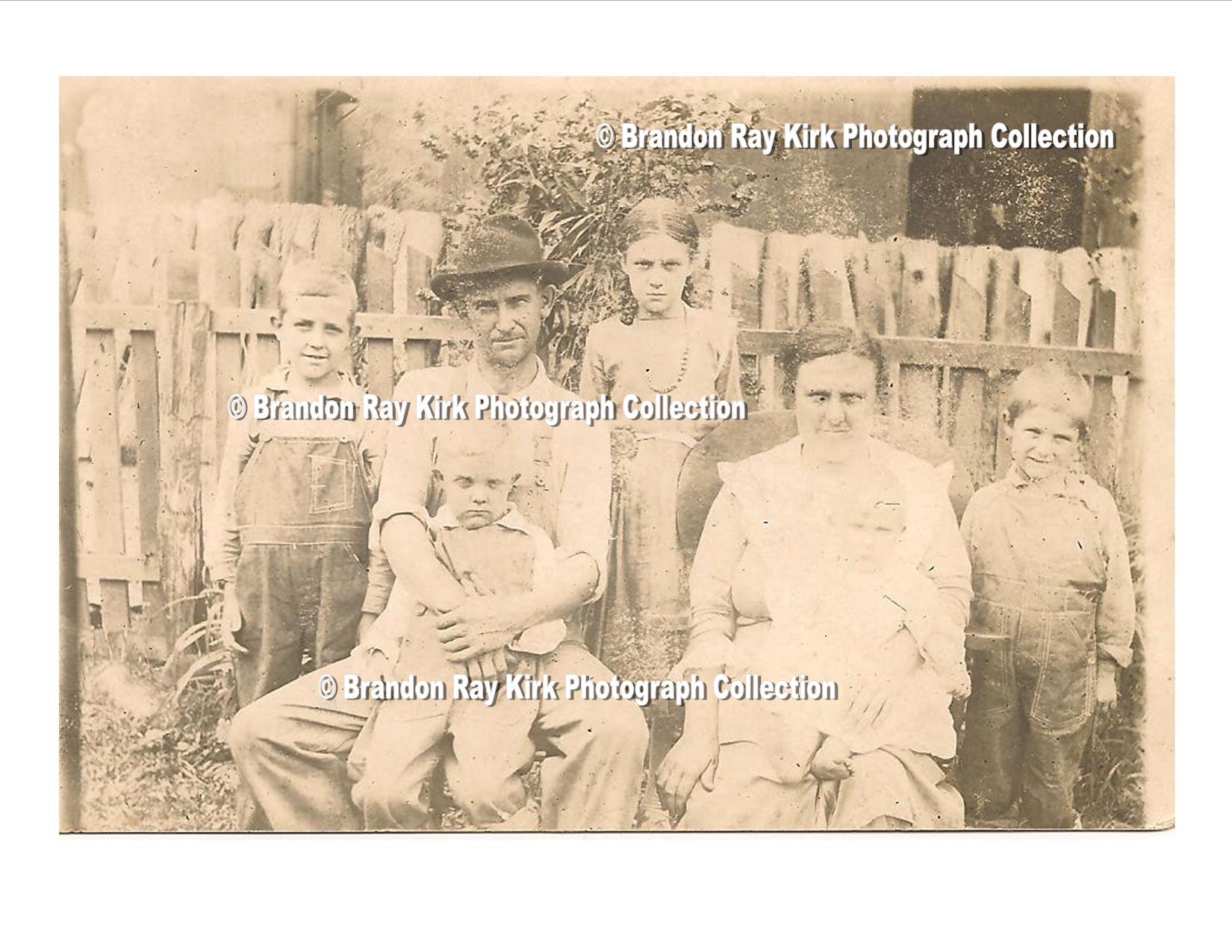
Watson Lucas family, residents of Green Shoal, Lincoln County, WV, c.1920
18 Sunday May 2014
Posted in Big Creek, Ferrellsburg, Fourteen, Leet, Sand Creek, Toney
Tags
Anna Laura Lucas, Big Creek, Blackburn Lucas, Catherine Toney, Clerk Lucas, Ed Reynolds, Elizabeth Lucas, farming, Ferrellsburg, Fourteen, genealogy, Georgia Stowers, Hazel Toney, history, Huntington, Isaac Marion Nelson, Jessie Lucas, John Sias, Leet, Lincoln County, Lincoln Republican, Low Gap United Baptist Church, Marie Lucas, Rachel Fry, Republican, Sand Creek, Sarah Workman, Susan Brumfield, Toney, Tucker Fry, W.W. Lucas, Walt Stowers, Ward Lucas, West Virginia, Wilburn Adkins
“Bess,” a local correspondent from Toney in Lincoln County, West Virginia, offered the following items, which the Lincoln Republican printed on Thursday, May 23, 1912:
The farmers are all glad to see this fine weather. They are all busy planting corn and hoeing potatoes.
Clerk Lucas attended the Republican Convention at Huntington last Wednesday and Thursday. He reports an interesting time.
D.C. Fry spent Saturday and Sunday with his family here.
Some of our people attended church at Low Gap Sunday and heard an interesting sermon delivered by Rev. Nelson.
Mr. and Mrs. B.B. Lucas had as guests Sunday J.W. Stowers and wife, of Ferrellsburg, W.W. Lucas and wife, E.W. Lucas and wife, of Big Creek, and John Sias of Fourteen.
Mrs. Sarah Workman was shopping in Ferrellsburg Saturday.
Mrs. B.D. Toney and granddaughter, Hazel, were visiting on Green Shoal Sunday.
Ed. Reynolds, a hustling republican of Leet, was in our midst Sunday.
Mrs. Rachel Fry is visiting her mother near Leet.
Wilburn Adkins, of this town, was visiting relatives near Sand Creek last week.
Little Marie Lucas is on the sick list this week.
16 Friday May 2014
Posted in Big Harts Creek, Spottswood, Whirlwind
Tags
Appalachia, genealogy, history, justice of the peace, Logan County, photos, Sol Adams, Spottswood, West Virginia

Solomon “Squire Sol” Adams, Jr. (1869-1927), a justice of the peace and resident of Spottswood, Logan County, WV
16 Friday May 2014
Posted in Big Harts Creek, Spottswood
Tags
Augusta Bryant, Belle Dora Adams, Bettie Workman, Buck Fork, Buck Fork School, Frances Baisden, genealogy, Harts Creek, history, Hoover Fork, Ina Adams, Isaac Marion Nelson, John Carter, Lawrence Riddle, Logan Banner, Logan County, love, Moses Butcher, Nolan, Peter Carter, Peter Mullins, Spottswood, timbering, Weddie Mullins, West Virginia, Yantus
An unnamed local correspondent from Spottswood in Logan County, West Virginia, offered the following items, which the Logan Banner printed on Friday, October 2, 1903:
Some one insulted John Carter last Friday night by stealing his kraut tub.
Rev. I.M. Nelson preached a fine sermon Sunday at the Buck Fork schoolhouse in memory of Weddington Mullins. There was a large congregation.
Mrs. Sol Adams says she wants all the pumpkins there are on Hoover with which to make apple butter for they are fine for that.
Peter Mullins got mashed up by a log truck the other day, but has got so he can walk about the place again.
Peter Mullins is one of the greatest squirrel hunters on Hart’s creek. The crack of his repeating shotgun is often heard.
Miss Bell Dora Adams is struck on a young teacher who stays on the Buck Fork.
Mrs. French Bryant of Nolan, W. Va., is very low with fever at this place.
Moses Butcher of Yantus was a visitor at this place last week.
Prof. L.W. Riddle is a candidate for matrimony subject to the action of the ladies of Spottswood.
Miss Bettie Workman has resumed teaching after an illness of two weeks.
Miss Inez Adams, one of the belles of this place was making “goo goo” eyes at a young teacher while at church last Sunday.
Peter Carter says there is only one girl in the world for him and that is Miss Frances Baisden.
16 Friday May 2014
Tags
Appalachia, Brandon Kirk, fiddlers, John Hartford, music, photos, Slim Clere, South Charleston, U.S. South, West Virginia

Here I am with Slim Clere and John Hartford at Slim’s home in South Charleston, WV, 1996
16 Friday May 2014
Tags
Ashland, Atlanta, Bert Layne, Bill Day, Blackberry Blossom, blind, Clayton McMichen, Dill Pickle Rag, Ed Haley, Ed Morrison, Ella Haley, fiddle, fiddlers, Gary, Goodnight Waltz, Grand Ole Opry, history, Indiana, Jesse Stuart, John Carson, Kentucky, Lowe Stokes, mandolin, music, Ohio, Over the Waves, Portsmouth, Riley Puckett, Slim Clere, South Charleston, South Shore, Sweet Bunch of Daisies, Theron Hale, Vanderbilt University, Wednesday Night Waltz, West Virginia, World War I, WSM
The next day, after a few hours of sleep at Wilson’s house, Brandon and I drove to see fiddler Slim Clere in South Charleston, West Virginia. Slim was born in Ashland around the time of the First World War and knew a lot about Ed. We were parked behind his two-story house and were unloading our “gear” when he appeared out of a back door and led us inside his house (past some type of home recording studio) and up a flight of stairs. We sat down in the living room where we met his wife, a vivacious middle-aged woman who fetched several scrapbooks at Slim’s request. We flipped through the pages while Slim told us about some of his early experiences.
“I knew Jesse Stuart in 1934,” he said. “He lived at South Shore, Kentucky, across the river from Portsmouth, Ohio. He went to Vanderbilt. I believe he did play football. He used to date Theron Hale’s daughter that used to be at WSM at the Grand Ole Opry. I thought maybe he might marry her but he didn’t. Well anyway, I went away. I left my home and went to Atlanta. Well I went to Gary, Indiana, and everywhere, and worked with Bert Layne and Riley Puckett and some of those old-timers. I knew old Fiddlin’ John Carson. I never did meet Lowe Stokes. He lost an arm in a hunting accident. At one time he was a better fiddle player than McMichen. But Mac come out of it. He really could play. I patterned a lot of my style after him.”
Slim pointed to a picture of himself in his youth and said, “That’s back when I had hair and teeth.”
I was anxious to talk about Ed, so I asked Slim if he could remember the first time he ever saw him.
“I grew up knowing him,” Slim said. “He used to come down to the Ashland Park there every Sunday and sit around and fiddle for nickels and dimes on a park bench and I’d sit on there and watch him play.”
Slim said Ed Haley, Ed Morrison, and Bill Day were his primary influences during his younger days in Ashland.
“He was hot stuff,” Slim said of Haley.
He described Ed as a “loner” but said his wife was always with him.
“The old lady chorded a taterbug mandolin,” he said.
Ed played on a little yellow fiddle, which he wouldn’t let anyone “get a hold of,” and kept a cup between his legs for money. Down at his feet on the ground was his old wooden case, “made like a coffin.”
How much would you have to put in the cup to get him to play a tune?
“Didn’t matter,” Slim said.
Could he tell how much you dropped into the cup?
“He’d know just to the tee what it was,” he said. “He could tell the difference between a penny and a dime.”
Would the length of how long he played the tune depend on how much you dropped in the cup?
“No, he liked to play.”
Slim and I got our fiddles out and played a lot of tunes — or parts of tunes — back and forth for about a half an hour. I wanted to know all about Ed’s technique and repertoire. Slim said he “cradled” his fiddle against his chest (“all the old-timers used to do that”) and held the bow way out on the end with his “thumb on the underneath part of the frog.” He moved very little when playing.
“The only action he had was in that arm…and it was smooth as a top,” Slim said. “He fingered his stuff out. He didn’t bow them out. He played slow and beautiful and got the melody out of it. Now, he could play stuff like ‘Dill Pickle Rag’ where you had to cross them strings and that ‘Blackberry Blossom’ was one of his favorites. He played ‘Goodnight Waltz’, ‘Wednesday Night Waltz’. I don’t think ‘The Waltz You Saved For Me’ had been invented yet. He played ‘Over the Waves’ and ‘Sweet Bunch of Daisies’. He didn’t double-stop it, though.”
14 Wednesday May 2014
Posted in Calhoun County, Ed Haley, John Hartford, Music
Tags
Appalachia, Brandon Kirk, Calhoun County, cemeteries, Hicks Family Cemetery, history, John Hartford, Kim Johnson, Laury Hicks, music, photos, U.S. South, West Virginia, Wilson Douglas
Wilson Douglas and John Hartford, Calhoun County, WV, 1996

John Hartford and I at the Laury Hicks grave, Calhoun County, WV, 1996
John and I at the Laury Hicks grave, Calhoun County, WV, 1996
14 Wednesday May 2014
Posted in Calhoun County, Clay County, Ed Haley, Music
Tags
Appalachia, Arnoldsburg, Ashland, banjo, Ben Friend, Bernard Postalwait, Bill Stutler, Bob Carr, Brandon Kirk, Calhoun County, Camp Chase, Charleston, civil war, Clay, Clay County, Clendenin, Ed Haley, Ed Williams, Edden Hammons, fiddlers, fiddling, history, Hog Run Hollow, Jack McElwain, John Hartford, Kentucky, Kim Johnson, Laury Hicks, Lawrence Haley, Lincoln Republican, Luther Carder, music, Pat Haley, Pisgah Bridge, Richwood, Sol Carpenter, St. Albans, Ugee Postalwait, West Virginia, William E. Chilton, Williams River, Wilson Douglas, writing
Brandon and I got a good night’s sleep at Pat Haley’s home in Ashland, then took off the next morning to see Wilson Douglas in Clendenin, West Virginia. I wanted to hear more about his memories of Ed, play some music, and go see the old Laury Hicks homeplace. Wilson met us on his porch with Kim Johnson, a banjo player. We all went inside and got settled, where Kim mentioned that Laury first invited Ed to his house after meeting him in St. Albans, near Charleston. Wilson was quick to offer new details about Ed — of a more seedy variety. He said Ed “ran around” a lot with Bernard Postalwait when he was in the area. They usually got drunk and went “women crazy” and stayed gone all night. Hicks apparently had a “wild side,” too. Wilson hinted that he was a moonshiner who sometimes left home on timber jobs…and never showed up.
We wasted little time in taking off to see some of Ed’s old stomping grounds in Clay and Calhoun Counties. There was a slight drizzle, just enough to wet everything.
Our first stop was the Hicks homeplace, which had been overtaken by weeds on my previous visit in 1994. The weeds were gone this time, so we got out of the car and maneuvered through the rotting remains of an outhouse, chicken coop, cellar base, parts of an old fence, and scattered boards — all damp and colored dark brown due to the light rain dropping down around us.
It was a far cry from the “old days” when (according to Ugee Postalwait) the family had farmed corn, wheat and cane all the way back up the mountain to the head of Hog Run Hollow. Gone were the apple and peach orchards. Gone were the gardens down by the creek (now taken in by the paved road). And, most obviously, gone was the old Hicks home, the last of four houses built on the site (the final one having been constructed in 1936).
We soon made our way up the hill to the cemetery, where Brandon took pictures. I just kind of stared at Laury’s grave — picturing Ed playing there after Laury’s death in 1937.
As we came off the hill, Wilson said Hicks was rumored to have died from “some bad cases of VD.”
Later that day, Wilson showed us Clay, the seat of government for Clay County. This was the place where Ed Haley arrived by train from Charleston enroute to the home of Laury Hicks. Lawrence Haley once told me about his father walking from Clay to Arnoldsburg, a town some thirty miles away. Brandon had found this great article titled “Old-Time Fiddlers Will Gather At Clay Saturday” from a 1921 edition of the Lincoln Republican.
Clay, W.Va., Jan. 10 — Elaborate preparations are being made in the little city of Clay for the old-time fiddlers’ contest which will be held on Saturday night, January 22. An attendance surpassing anything ever held in Clay is expected, and the hospitable citizens of this town have appointed a committee to look after the welfare of its guests. Similar contests have been held in various other sections of West Virginia this winter, but they cannot even compare to the one which will be held in Clay, it is predicted. Old-time fiddlers from far and near are coming to compete, and, if possible, carry off the honors of the evening.
Among some of the celebrated old-time fiddlers who will be here is “Jack” McElwaine of Erbacon, in Webster county. “Jack” has played the fiddle for more than fifty years, and between times has been justice of the peace, preached the gospel and practiced law. He learned to play under Saul Carpenter, the most famous old-time fiddler of them all, and who played himself out of Camp Chase during the Civil war. Another fiddler equally famous is “Edin” Hammons, who hails from the head of Wiliams river, and whose sole occupation all through life has been hunt, trap and play the fiddle. “Edin” has killed more bears, deer and played the fiddle more than any other man on Williams River.
It is said that Senator William E. Chilton and Colonel Bob Carr of Charleston have been given invitations to attend the contest and compete with these old-time fiddlers.
Several local celebrities are expected to enter the contest, and the old mountaineer fiddlers are looking forward to this part of the contest with great pleasure and saying “the city fellers will have to fiddle some to beat them.” No complete list of the fiddlers who enter the contest has been made public, but some fifteen or twenty are expected. Ben Friend, Ed Williams, Luther Carder and “Bill” Stutler, men who have been winning prizes in other contests, will be there.
People of Clay and surrounding country are looking forward to this event with great anticipation and pleasure. The last contest of the kind was held at Richwood, Thursday night of last week, and fully 200 persons were unable to get into the theater where it was held.
There are very few of the real old time fiddlers who play the old mountain tunes living today, and within a very short time there will be none left and no one to take their place. The younger generation has neither talent nor desire for this kind of music. At any rate, one can not find a young man of today who can play the fiddle in the “good old-fashioned way.”
Clay, I found, was a small shell of a town with a nice old courthouse sitting high on the hill. There was the typical arrangement of buildings: sagging old businesses hinting at lost prosperity, a small bank, dollar stores, a car dealership, a post office, and a Gino’s restaurant. No red lights and basically one two-lane thoroughfare through town. There was a hotel with the weekly newspaper office headquartered beneath where, I was told, you could go in late and help yourself to a key and then pay for your room the next morning on your way out. After passing through town and crossing the Pisgah Bridge, we spotted an old section of residences and a community church. The track bed was still visible but the railroad was long gone.
14 Wednesday May 2014
Posted in Big Ugly Creek, Music
Tags
Big Ugly Creek, fiddler, genealogy, history, Jeff Duty, Lincoln County, music, photos, U.S. South, West Virginia

Jeff Duty (1867-1949), a fiddler from Big Ugly Creek in Lincoln County, WV
13 Tuesday May 2014
Posted in Big Creek, Big Harts Creek, Big Ugly Creek, Calhoun County, Music
Tags
Akron, Arthur Smith, banjo, Bertha Bias, Big Creek, blind, Boone County, Boone County Genealogical Society, Broad Branch, Calhoun County, Chapmanville, Clay County, Dave Brumfield, Dicy Thomas, Dolly Bell, Ed Belcher, Ed Haley, Ella Haley, fiddle, fiddler, Garretts Fork, genealogy, Greenview, Harts Creek, Harvey Hicks, Hewetts Creek, history, Hubert Baisden, Irene Hager, Jeff Baisden, Jeff Duty, Jess Chambers, Johnny Hager, Kanawha County, Kansas, Kentucky, Kith and Kin, Laury Hicks, life, Little Coal River, Logan County, Lydia Johnson, Madison, Mary Baisden, Morehead, music, North Fork, Ohio, Powderly, Riland Bias, Robert Martin, Rowan County, Sampson Thomas, Simon Bias, Spruce Fork, Texas, Trace Fork, Turley Adams, Ugee Postalwait, Victoria Adams, West Virginia, Wilson Craddock, writing
After his return to West Virginia, Johnny Hager took immediate notice of the large number of musicians who lived in the head of Big Harts Creek. His first cousin, Jefferson “Jig-Toe” Baisden (1879-1970), was a dancer and banjo-picker. J. E. “Ed” Belcher (1889-1970), who played several instruments, and Robert Martin, an Arthur Smith-style fiddler, were other significant musicians in the area. Ed Haley (1885-1951), a blind fiddler from Trace Fork, particularly caught Hager’s attention. Johnny’s desire to absorb Haley’s music was understandable because, as Jess Chambers stated, “It was a badge of honor to have played with Ed Haley.” Jeff Baisden, a cousin to both men, may have introduced the pair.
Johnny could supposedly play any instrument and his trip out to Kansas allowed him to soak up a variety of western tunes and playing styles which were completely new to folks in Logan County. Both of these qualities, his diverse musical capabilities and his unique musical background, ensured that he an Ed Haley had many intense music sessions. According to Turley Adams, Johnny’s great-nephew, Hager encouraged Ed to take his show on the road and volunteered to serve as Haley’s “eyes” on such trips. This willingness to travel, coupled with his apparent competence as a musician, made Johnny a perfect sidekick to Ed. Haley and Hager were both unmarried, a convenience which allowed them to roam the country with few cares or responsibilities.
Johnny and Ed traveled to various places in West Virginia but are particularly remembered up around the Calhoun-Clay County area north of Kanawha County. Aside from being populated with rural folks similar to Hager’s neighbors in Logan and Boone Counties, the area was also endowed with a host of great musicians. Haley and Hager wintered there as young men with a fiddler named Lawrence “Laury” Hicks (1880-1937). Ugee (Hicks) Postalwait of Akron, Ohio, a daughter of Laury Hicks, said that Ed and Johnny first came and visited her father in the early 1910s. Hager was a tall, slim banjo-picker. When Ed and Johnny left Laury’s home in the spring, with Johnny leading the way, Ugee and her brother stood on the bank by the house and “hollered and cried after them.”
Most agree that Johnny’s travels with Ed Haley ended around 1914 when Haley married Ella Trumbo, a blind music instructor from Morehead in Rowan County, Kentucky. Haley’s habit of cursing and drinking also helped end the partnership. Hager did not care for it.
For the most part, Johnny spent the remainder of his life playing music while boarding with his Baisden kinfolk on the North Fork of Big Creek. Irene Hager, a daughter of Hubert E. and Mary (Pauley) Baisden, remembered Johnny playing music on her father’s front porch in the late 1920s. Her father, a banjo-picker, lived at Greenview and the Big Branch of Spruce Fork of Little Coal River in Boone County. Hubert Baisden was Johnny’s first cousin. Hager boarded with him for several weeks at a time. One of Hager’s chores at the Baisden home was to keep wood in the stove. Irene said that Johnny often talked about his early travels with Ed Haley.
Johnny Hager was a man with little roots and family, a fellow who never had a real home. Many from Harts Creek remember that Hager was simply from the “the North Fork of Big Creek.” Dave Brumfield, a great-nephew, said that Hager stayed in that vicinity with a Thomas family. No doubt, this Thomas family was headed by Sampson Thomas who married Dicy Adams, a sister-in-law to Johnny’s sister Victoria Adams. Incidentally, just over the mountain from North Fork was the Broad Branch of Big Ugly Creek where lived a fiddler named Jefferson “Jeff” Duty (born about 1877). During Hager’s stay on the North Fork, he probably visited this musician (and any others in this locality) to learn a few new licks.
Hager also stayed with Simon and Bertha (Baisden) Bias on Bias Branch in Boone County. Mrs. Bias’ grandfather, Riland Baisden, was a brother to Johnny Hager’s mother. He spent a lot of time on the Garretts Fork of Big Creek with the Barkers before leaving them to stay with Wilson Craddock’s family on Hewitts Creek in Boone County. Mr. Craddock’s widow has a necklace which Johnny gave her during his time there. Lydia (Adkins) Johnson of Powderly, Texas, recalled that Hager lived with her mother and father during her “growing up years at home” in the late 1920s and 1930s. Johnson “was born (around 1923) and raised in Boone Co. just over the hill from Chapmanville.” Hager was a hard worker and was very efficient at “old-time” carpentry jobs and such tasks as digging wells. According to Johnson: “[Johnny] was a handy man, & a fiddle player. (Sometimes) a neighbor would need him to come live with them, to build them an out house for them. He was noted for the best out houses, he earned his keep by living with & helping others.”
Lydia Johson described Johnny as “a very neat man” and Dolly Bell agreed, stating that he always kept his hair cut and his face shaved. He never wore suits and never dated women so far as any of his family knew. In Irene Hager’s words, he “was a pretty straight fellow” and Dave Brumfield said he never drank when visiting his father’s home on Harts Creek.
NOTE: Originally published in “Kith and Kin of Boone County, West Virginia” Volume XXII
Published by Boone County Genealogical Society
Madison, West Virginia, 1997
Dedicated to the late Dolly (Hager) Bell
Writings from my travels and experiences. High and fine literature is wine, and mine is only water; but everybody likes water. Mark Twain
This site is dedicated to the collection, preservation, and promotion of history and culture in Appalachia.
Genealogy and History in North Carolina and Beyond
A site about one of the most beautiful, interesting, tallented, outrageous and colorful personalities of the 20th Century
 Brandon Ray Kirk