
• About

Brandon Ray Kirk

~ This site is dedicated to the collection, preservation, and promotion of history and culture in my section of Appalachia.

Brandon Ray Kirk

Tag Archives: writing

In Search of Ed Haley 216

30 Monday Dec 2013

Posted by Brandon Ray Kirk in Big Ugly Creek, Ed Haley

≈ 3 Comments

Tags

Bill Duty, Billy Adkins, Chloe Mullins, Durg Fry, Ed Haley, fiddlers, genealogy, Green McCoy, history, Hollena Brumfield, John Wesley Berry, Jupiter Fry, Mayme Ferrell, Milt Ferrell, Milt Haley, music, writing

I asked Mayme who her father’s favorite fiddler was and she laughed and said, “I suppose my daddy’s favorite fiddler was a man named Jupiter Fry. He married my daddy’s aunt.”

Billy asked, “Was he a brother to Durg Fry?”

“Yes,” she said. “You smart people. He went to New York one time and won a fiddling contest. He used to live down the creek here on the Laurel Fork of Big Ugly. My daddy used to go around there to Uncle Jupiter’s — they didn’t have much — and they would play poker all night long with just two or three pennies. They were very, very poor. Not many people were very well off. You wouldn’t think it by looking at this dilapidated place now but we had quite a bit. All the buildings are torn down. We had plenty — enough for us. We had some money here all the time. But Uncle Jupiter was the best fiddler in the country at one time.”

I asked Mayme if Jupiter was a right- or left-handed fiddler and she said, “Oh goodness, I don’t know. I don’t remember Uncle Jupiter. I remember Durg. He played some, too. He was right-handed. Durg would play and dance while he played. He did the hoedown. He did enjoy dancing.”

I asked Mayme if she remembered hearing any talk about Milt Haley and Green McCoy and she said, “Heavens, yes. Why didn’t I listen? Daddy talked about them. There was a great deal said but I just dismissed it from my mind. I didn’t try to remember it. Did Hollene Ferguson come in there in any way? She was a real kind person. I was there a few times. Incidentally, my mother’s daddy built that house.”

What was his name?

“John Wesley Berry. He was a riverboat captain and a carpenter from Guyandotte.”

I said, “I know Hollene put people up for the night and I’ve heard that Ed Haley had gone through there and stopped off and played the fiddle.”

“Well, Ed Haley frequented the place in this area,” Mayme said. “He’s been on this creek, too.”

She wasn’t sure if her father ever met Ed but she heard him talk about him.

Brandon figured they knew each other based on some interesting genealogical connections: one of Milt Ferrell’s uncles married Money Makin’ Sol Mullins’ granddaughter, while another uncle married a sister to Chloe Mullins (Ed’s grandmother).

I got kinda excited about Mayme confirming Ed’s trips through Big Ugly.

“Well see, we knew that he’d been to see Bill Duty a lot,” I said. “And we have found that Milt Haley, his father, was actually living in Bill Duty’s household at one time.”

“Milt Haley lived with Bill Duty before Bill Duty ever moved here, when he was still down in Logan County,” Brandon said, “and we think Milt may’ve moved up this way with Bill when he moved up here.”

“Well, I think maybe he did,” Mayme said quickly. “I think maybe he did. You’re awakening some old memories. I think he lived with them.

“Was there music in Bill Duty’s household?” I asked.

“I don’t know about that,” Mayme said. “Bill Duty married my daddy’s aunt.”

“Let me ask you a question,” I said to Mayme. “In the community back when you were a little girl did most people talk about the Haley-McCoy affair, or did they try not to talk about it for fear that somebody might hurt them or something?”

“I don’t think that there was any fear of being hurt,” she said. “They were not quite as notorious as the Hatfields and McCoys were.”

Just before we left, Mayme “made” me promise to come back and play for her in the fall.

I asked her for a favor: Could I go up into the old part of her house?

“Sure,” she said, “Just be careful.”

When I opened the door from the living room leading into the original cabin, I was so overwhelmed with sights and smells of the nineteenth century that it chilled me to the bone. It was dark, except for a little light streaming through a window, and everything was dilapidated, dusty, damp — and in most cases, ruined. A lot of the furniture had just rotted or collapsed to the floor and there were piles of papers everywhere at my feet. It was as if the people living there fifty years ago had just walked out, blew out the candles and never went back. Upstairs was the same. The whole experience made such an impression on me that I later began packing a picture of Mayme’s cabin in my fiddle case and eventually used it as a graphic on one of my albums.
In Search of Ed Haley 215

27 Friday Dec 2013

Posted by Brandon Ray Kirk in Big Ugly Creek, Ed Haley

≈ Leave a comment

Tags

Big Ugly Creek, Bill Duty, Charley Brumfield, Clarence Lambert, Clinton Ferrell, Doska Adkins, Eunice Ferrell, fiddlers, fiddling, Fulton Ferrell, history, Jeff Duty, Jim Lucas, Mayme Ferrell, Milt Ferrell, Rector, writing

At Broad Branch, we found that Bill Duty’s old one-story log house was completely gone. We wanted to go to the family cemetery just across the creek and up the hill but didn’t because it was overran with giant weeds.

We were all just kinda hanging out there, crammed in the car, when Doska said, “Milt Ferrell could play a fiddle. He was a first cousin to my daddy.”

Wait a minute — another fiddler? I’d spent quite a bit of time trying to track down the names of the old fiddlers around Harts. All of a sudden, they were falling from the woodwork.

Milt Ferrell — a man related to the Dutys and with the first name of Ed’s father. I said, “Now who was he?”

“Mayme’s daddy,” Eunice said, as if that helped. “Mayme lives down there.”

“She’s bad off,” Doska added. “One of her lungs has collapsed.”

I just had to see this Mayme Ferrell, although I didn’t want to impose on her if she was in poor health.

Nonsense.

Doska and Eunice said she would love the company…and she just lived down the road.

On the way to Mayme’s someone mentioned that she lived at the old Rector Post Office, a settlement from earlier in the century. We soon turned over a little bridge and pulled up to the only structure left in “Rector proper”: Mayme’s incredible two-story log cabin. It was ancient and leaning, with an old cemetery just behind it on the hill. The whole scene was like something from a dream.

We got out of the car and walked up to a small back porch where Eunice pecked at the screen door and hollered, “Mayme? It’s Eunice.”

In no time at all, Mayme Ferrell was peeking back out at us. She was frail, half-blind and hooked to a breathing machine — and very surprised to see us all on her porch with fiddles, cameras, and notebooks.

Mayme invited us on inside where we sat down in the living room and started talking like old friends. She was well acquainted with Eunice and Doska and knew a lot about Billy and Brandon’s families. It was clear after a few minutes of interchange that her life had went beyond school teaching — she was an educated woman of the modern world, who’d spent twelve years in Los Angeles and San Francisco. She got me to play her a few tunes and the next thing I knew she was singing lyrics that she remembered from her childhood, like “Nigger looky here and nigger looky yander. The old gray goose is flirting with the gander.” Or things like: “I had a piece of pie and I had a piece of puddin’. I give it all away for to sleep with Sally Goodin.” Or this: “Old Aunt Sal, if you don’t care I’ll leave my liquor jug sitting right here. If it ain’t here when I come back we’ll raise hell in the Cumberland Gap.”

Eunice remembered “Cluck old hen, cluck and sing. Ain’t laid an egg since way last spring.” Doska said her father Jeff Duty used to play the tune.

I said to Mayme, “So your father was a fiddler? Tell me about him.”

She was immediately nostalgic.

“Daddy was named for a poet, but I don’t think his parents knew it,” she said. “John Milton Ferrell. He was a great guy. He was a wonderful person. My daddy’s people were just easy going. Most of them were musicians. My daddy, he would lead the songs in church. He was a board member for three terms and the last term he was the president of the board. They would meet over at Harts and those Brumfields — I’ll tell you what — most people were afraid to go through there. Charley Brumfield shot his daddy and killed him. His daddy was beating his mother and he made him leave, so I understand, and then when he came back — I guess he was drunk…”

Mayme looked at Brandon and said, “Those Brumfields were rough then, son. Good people. If they liked you they liked you, and if they didn’t you better leave them alone. They were ambitious people. They just got to feuding among themselves, but it wore out after a while. But my daddy was a good friend to all of them. Charley Brumfield would’ve done anything for daddy. They’d get in a poker game after they had their meeting and they’d all drink. Well daddy would come home with a pocket full of money. One time he came home drunk and he couldn’t hang his hat up. Of course, the older children laughed and I cried, but he sang, ‘Hey hey rushin’ the rabbit. Into the brush and then you’ll habit.’ Didn’t say ‘have it.’ I don’t know what they were getting in that brush. He was a very, very humble person and he was witty.”

Milt Ferrell, Mayme said, played the fiddle around election time, at weddings, at schools or on Friday at all-night dances.

“We’d have barn-raisings,” she said. “After they got the roof over the barn and put the second floor in — the floor where you put your fodder and hay — they’d have a barn dancing. They’d dance all night.”

Milt played with the fiddle under his chin, as did Jeff Duty.

Mayme cried when I played one of her father’s tunes, “Over the Waves”.

She said her father’s older brothers Clinton Ferrell and Fulton Ferrell were also fiddlers. Clint was the smoothest fiddler in the family but would only occasionally pick up Milt’s fiddle and play “Mississippi Sawyer”. Their cousin Jim Lucas was also good.

“Uncle Jim was an excellent fiddler,” she said. “He didn’t jiggle. A real smooth player.”

She didn’t recall any banjos or mandolins on Big Ugly in the old days, although her brother-in-law Clarence Lambert was a great guitarist (“as good as Chet Atkins”) who played Hawaiian music and tunes like “Guitar Rag”.

In Search of Ed Haley 214

21 Saturday Dec 2013

Posted by Brandon Ray Kirk in Big Ugly Creek, Ed Haley

≈ Leave a comment

Tags

Big Ugly Creek, Bill Duty, Billy Adkins, blind, Doska Adkins, Ed Haley, Eunice Ferrell, fiddling, Jeff Duty, John Hartford, Milt Haley, Tom Ferrell, writing

A few days later, Brandon and I left the festival and headed toward Charleston and on to Harts via Corridor G and Boone County. We reached Harts around three in the morning and parked the bus at the local Fas Chek near a fire station and bridge. Brandon’s uncle Ron Lucas, the manager of the store, had given us permission to park there. The next morning, Billy Adkins met us at the bus and we decided to see Doska Adkins, a woman of advanced age and granddaughter of Bill Duty. Maybe Doska would know about Milt Haley living with her grandfather, who had settled on nearby Big Ugly Creek.

In no time at all, Brandon, Billy and I were charging over Green Shoal Mountain talking genealogy and well on our way to Big Ugly country.

About twenty minutes later, we turned off of the main road into Fawn Hollow and began climbing a rocky driveway toward Doska’s house. We soon spotted Doska cutting brush out near her yard. She was a small-framed woman crowned with a tuft of white hair, having every bit the appearance of “the helpless old widow” — barring the machete in her hand, of course. I could tell right away that things were about to get interesting.

We followed Doska into her home, stepping quickly past a barking dog tied up on her porch. Inside, on the living room wall we spotted a mass of more than forty bushy squirrel tales hanging together in a pattern, which she said were her hunting trophies for the season. Sensing our interest in such things, she showed us a stuffed squirrel that she herself had killed, stuffed and mounted onto a small log. Before we could really ask her anything about Milt Haley, she told us all about how to pickle squirrels for later eating, then opened a desk drawer full of snake rattlers…more trophies.

It took us a few minutes to sit down and actually focus on the reason for our visit. When I told Doska about my interest in Ed’s life, she said he used to stay with her father, Jeff Duty. It didn’t take him long to get familiar with a place, she said, and he couldn’t be fooled with paper money.

“How often would he come there to stay?” I asked.

She said, “Well, I don’t know how often. If I was around, I was real little. I don’t remember him but I’ve heard Daddy talk about him.”

Brandon asked Doska, “Did your dad and Ed play music together?” and she said, “Yeah.”

We wondered what songs Jeff Duty played.

“They was one he played on the fiddle that I thought was real pretty,” Doska said. “I think he called that the ’11th of January’ and he’d play a while and then he’d pick a piece in it. Yeah, man he used to sit on the porch of an evening down yonder where I was raised and play for us.”

Brandon asked, “Was your dad considered the best fiddler up around this part?”

Doska said, “He was pretty good and he could play a banjo, too.”

I asked if her grandfather Bill Duty ever talked about Milt Haley and she said, “No, all of my grandparents was dead before I was born. See, I was born in 1917 and I never seen nary one of my grandparents. Mommy used to have a picture of my grandpaw but I don’t know what happened to it.”

Billy asked her, “Was Ed Haley any relation to you at all?”

“No, he’d just come through here — I don’t know why — and he liked to stay at my daddy’s,” she answered. “Didn’t matter who come through this country. If they’d ask to stay all night somewhere they’d say, ‘You can go to old man Duty’s and stay all night.’”

Of course, knowing what we knew about Milt and the Dutys it seemed likely that Ed came around Jeff for reasons more than his hospitality. As Bill Duty’s son and a fiddler, he would’ve been an excellent source on Milt — the father Ed never really knew.

Doska said her grandfather Duty’s home was no longer standing on Broad Branch but I wanted to see the site anyway. (It was, after all, very possibly the place where Milt settled with the Duty family in the early 1880s.) We asked Doska to accompany us but she said she looked awful; she had been cutting brush all day, she said, and wasn’t dressed to go anywhere. After a while, though, we persuaded her to go with us.

On the way to Broad Branch, Billy suggested that we stop and see 89-year-old Eunice Ferrell. Eunice had settled on the creek years ago and married a son of the Tom Ferrell mentioned in “The Lincoln County Crew”. She was a very friendly Mormon, slumped over with age. I told her I was interested in “Blind Ed Haley,” an old fiddler from Harts Creek, and she said she didn’t know about him. Her father-in-law had been a fiddler, though. She knew something about Tom’s trouble with the Butchers.

“They said they was in a card game and this man was trying to run the horse over him,” she said. “And he killed him but he got out of it.”

We told Eunice that we were going to see the old Duty place on Broad Branch if she wanted to go and she was all for it. We helped her into the car and took off.

Along the way, I stopped the car so Doska could point out her father’s home — the place where Ed used to stay. Brandon said some “hippie-types” from a big city had moved into the place several years ago.

“Michael Tierney lives there now,” Eunice said. “He’s a lawyer. Catholic man. He’s a good neighbor.”

We were having a blast.

“I’m glad I come,” Eunice said.

In Search of Ed Haley 213

20 Friday Dec 2013

Posted by Brandon Ray Kirk in Ed Haley

≈ Leave a comment

Tags

Appalachia, Calhoun County, Doc White, Ed Haley, fiddling, history, Laury Hicks, life, moonshine, music, West Virginia, Wilson Douglas, writing

The next day, Wilson Douglas and Kim Johnson came on the bus where Wilson spun another one of his great stories, this time about Ed and Doc White.

Ed was already over at Laury Hicks’, but Laury was gone somewhere. That mail carrier brought the word through that Ed wanted Doc to come over and go down there to Bear Fork and play some music for that dance. Well, Doc lived in Ivydale. He played the fiddle a little, the banjo a little. He come down there and he got me one evening. Doc said, “Now, if you’ll drive, we’ll both go. We’ll hear Ed fiddle.” I said, “All right.” So we started. It must’ve been four o’clock in the evening. It was warm, you know. It was maybe the middle of August.

We stopped over on the Calhoun County line. That’s between Calhoun and Clay. Doc said, “Stop here. I know this old lady here. We’ll get some wine.” She had a bunch of green beans and set them out along the road selling them you know in little baskets. She said, “Now Doc, I’m gonna sell them beans right there for six dollars a basket.” Doc said, “My god, I don’t want to buy them beans.” So she kept on, you know. She looked at me and winked. Said, “Now Doc, better take a couple of baskets. Well, I’m gonna rake in here and show you how nice they are.” She had a quart jar of moonshine in each one of them. She was a bootlegging and Doc said, “Yeah, by god, yeah, I’ll take two baskets.”

We got down the road a little bit, Doc he pulled them two-quart fruit jars out and throwed them baskets and green beans over the hill. I said, “Now, look, Doc. If you get too drunk and cause trouble over there, they’ll throw all of us in jail.” Time we got to Bear Fork they was all drunk but me and I was a driving. Some old man there was calling that dance and Ed Haley was fiddling some of the prettiest fiddling I ever heard, but as the evening progressed the alcohol went to working on him. He lost his coordination. And he got so high, he was a making bad notes. Doc did, too. Doc was a talking fine — his glasses way down on the end of his nose. And Doc said, “Well, we better go home.” They liked Ed. They wanted to keep him all night. He said, “I gotta go with Doc and this boy. I gotta get back over to Laury Hicks’.” We come in the next morning. He was so drunk when we got back to Hicks’ I had to lead him up the steps. That’s the way it happened, all them things over there.

In Search of Ed Haley 212

19 Thursday Dec 2013

Posted by Brandon Ray Kirk in Ed Haley

≈ 3 Comments

Tags

Billy Adkins, Cliff Top, Ed Haley, John Hartford, John W Runyon, Johnny Hager, music, Pat Haley, Steve Haley, Tim Wendt, Tom Atkins, West Virginia, writing

Late in the summer of 1995, I boarded my bus and cruised along the familiar Kentucky interstate highway system toward something called the Appalachian String Band Festival at Cliff Top, West Virginia. J.P. Fraley and Wilson Douglas assured me it was of the fastest growing festivals in the region and would be a great place to learn more about Ed Haley. Along the way I picked up Brandon Kirk, who gave me the first draft of the Haley manuscript. Somewhere around Oak Hill, we eased off of the interstate onto a ridiculously curvy road and, after what seemed like hours, we arrived at Cliff Top — a Depression era CCC camp on top of a mountain filled with buses, automobiles, tents, campers, fiddlers, concessioneers, hippies, and just about anything else a person could imagine.

There were a lot of familiar faces milling about the grounds.

Brandon busily snapped pictures and kept saying things like, “So that’s Wilson Douglas?” or “Wow, that’s J.P. Fraley?” or “Virgil Alfrey? Cool.”

I wasted little time getting out my fiddle and playing with folks. There was an “Ed Haley buzz” at the camp. People were curious about my research into his life and music. Once I started playing in jam sessions, a lot of people asked if I was using an “extra-long bow.” At first, I wondered what the hell that was all about. Then, remembering how I had been busy working on Ed’s bowing style — his use of long bow and the Scotch snap (the little “stops”), I realized that I was (like Ed) creating the illusion of a longer bow. Wilson Douglas had once said that Ed’s bow was “six inches longer than any other kind of bow.” He was been sure of it. “A boy don’t miss nothing for he’s eager to learn,” he had said.

At some point Billy Adkins showed up with his teenage son Clint bringing news of new leads. He said he had found references to a “Runyon’s Branch” in old Harts deeds and had made contact with Tom Atkins, a genealogist and great-grandson to Cain Adkins who lived in Williamson. Cain, I remembered, was Green McCoy’s father-in-law. Billy left after a few hours saying that he’d see us in Harts in a couple of days.

At dinner, I met Jess Chambers, a Boone County resident and great-nephew to Ed’s friend, Johnny Hager. Jess didn’t know much about Ed but told us some interesting stories about Johnny’s background. In the late 1880s, Johnny took his mother and left the Mud River country of Boone County and headed West. Roxie Mullins had told me about that venture in 1991. “My mother, she was a Hager, and her mother went to the Western States and died there and was buried on the banks of the Wabash River,” Roxie said. “Uncle John told us — he was with her. Said she just lived there six months till she died.” Johnny returned to West Virginia around the turn of the century, Jess said, and soon persuaded Ed to travel with his music. No doubt, Johnny brought styles and tunes back with him from the West, which may have carried over to Ed. Wilson Douglas had told me Ed played a tune called “Boot Hill” that “came from out West back in the 1880s.” There was another tune in Ed’s recorded repertoire called “Poplar   Bluff”, which I recognized as the name of a Missouri town.

Later that evening, just at the start of a fiddling contest, Pat Haley showed up with her son Steve. Pat’s leg was healing up nicely. She looked much better than when I’d seen her in March, but her spirits were down. The doctors didn’t give her daughter Beverly long to live. Brandon took to Pat right away. He hung out with her for several hours until Steve drove her back to Ashland. Steve returned later that night and hung out till daylight with Brandon and my bus driver, Tim Wendt.

In Search of Ed Haley 211

14 Saturday Dec 2013

Posted by Brandon Ray Kirk in Ed Haley

≈ Leave a comment

Tags

Appalachia, Ed Haley, fiddle, fiddling, history, John Hartford, Laury Hicks, Lawrence Haley, music, Ugee Postalwait, West Virginia, writing

After pouring over all of this new information, I called Ugee Postalwait and asked if she could sing me any more of Ed’s songs. I hadn’t been thinking much about Laury Hicks lately and it seemed like a good time to just “check in” on that facet of Ed’s story. It wasn’t long until she was spinning this story that gave me insight into Ed’s ability to take a little melody and make it into a tune.

“One time when I was a little girl, somebody went up or down the road at night a singing, ‘Blue-eyed rabbit went away, the blue-eyed rabbit went to stay. Doodledy-do, doodledy do, doodledy do do doodledy do’,” Ugee said. “So I got up and that’s all I was singing all day long. Ed said, ‘What are you trying to sing?’ I said, ‘I’m a singing ‘Doodledy Doo’.’ Dad and him said, ‘Well it’s got a name. What is it?’ I said, ‘I don’t know.’ Said, ‘Where’d you hear it?’ I said, ‘I heard it in the night.’ Said, ‘Did you dream it?’ I said, ‘No, I didn’t dream it.’ They fooled around with that piece there for weeks trying to play it. When Ed Haley and Dad got done playing that, they had all kinds of runs in that there piece. One’d be a playing it and then the other’n, then they’d bring the different runs in on that song. Someone liked it real well when Ed was a playing it and wanted to know what the name of it was. He said, ‘Well, the one that give me the name of it said it was ‘Doodledy Doo’.’ Ed just laughed and would tell Aunt Rosie about him a playing that piece.”

This story was very interesting since I was starting to formulate this improvable theory that Ed first learned to play fiddle tunes by listening to his mother whistle or hum them. As a young widow who had lost her husband in tragic circumstances, she may well have been determined to pass along some of her beloved’s music to little Ed as best as she could. Of course, he may well have begun playing before Milt’s death, even “sneaking” and playing on his fiddle when his father was out working timber. (I’d had a similar experience with an old fiddle in my grandfather’s closet as a boy.)

I asked Ugee if Ed ever talked about where he learned to play and she said, “He told me about somebody leaving an old fiddle laying around when he was a boy. I don’t remember who the man was.” I told her his father had been a fiddler and asked if maybe he’d meant “my old man left an old fiddle laying around” and she said, “Some old man left an old fiddle laying around and I just wonder if it was his dad. And he picked that up and went to see-sawing on it and he said he found out he could play the fiddle. He said that was all he was good for: to play the fiddle. That’s all he studied. I asked him if he went to school to learn to play the fiddle. He said no.”

I just couldn’t shake the image of Ed playing on Milt’s fiddle. If he hadn’t fooled with it before Milt’s death, maybe he picked it up afterwards (“it was just laying around”) and learned to play with his mother’s help. I had these images of Emma whistling or singing Milt’s tunes to him and saying, “Yeah, do that.” “Don’t do that.” I got chills thinking about the way Ed may have began learning tunes and the way I used to ask Lawrence, “Did he do this?” “Did he play this?” Or the way he would say to me, “Pop didn’t do it like that.”

In Search of Ed Haley 210

12 Thursday Dec 2013

Posted by Brandon Ray Kirk in Big Ugly Creek, Ed Haley

≈ Leave a comment

Tags

Albert Butcher, Andrew Chapman, Big Ugly Creek, Bill Duty, Cecil L. Hudgins, Hamlin, history, John W Runyon, Lincoln County, Long House, Tom Ferrell, West Virginia, William T. Butcher, writing

In the end, suspect or not, Runyon may have felt safe to comment on the feud since he was a man of the badge. If so however, he learned the error of that line of thinking once the Ferrell-Butcher trouble erupted on nearby Big Ugly Creek in January of 1890. (Its events were eventually merged with those of the Haley-McCoy trouble in the song “The Lincoln County Crew”.) The Logan newspaper covered this event:

Albert Butcher, who was shot by Tom Ferrell near Deal’s grocery in Lincoln county, Dec. 31st, died Friday morning last. The latest report we have says that Butcher and Ferrell had been drinking and playing cards all day for a pair of pants, and there was a dispute over $1.50. Butcher got the pants and got on his horse and started home, when Ferrell caught his horse by the bridle and demanded his pants or $1.50. Butcher got down off of his horse and the shooting was done immediately. One report says that Butcher attacked Ferrell with his knife and cut one of his fingers and wounded him in the breast. Another report says that Butcher only made Ferrell loose his bridles. Dr. Hudgins, of this place, was called and operated on Butcher, and it appears that the ball, which was a .38-calibre, had entered the abdomen 1/2 inch to the right and 1/2 inch below the navel, making five wounds in the intestines. The abdominal wall was opened, the fecol matter and blood worked out, the wounds in the intestines entered, and every thing done to save the life of the patient. Dr. Hudgins is a skilled surgeon, but in this case no skill could save.

Not long after Butcher’s death — and this is the part that would’ve had a sobering effect on Deputy-Sheriff John Runyon — a mob of Logan County Butchers went to retrieve Ferrell at the county jail and carry out mob justice. The Lambert Collection offered a great eyewitness account of their “raid” on Hamlin:

There was a saloon, but I can’t recall whose it was. I saw many men and two women stagger out of it while we were there [in Hamlin]. The occasion of the drunk women was when the Butcher mob came down from Big Ugly to take Tom Ferrell out of the jail and hang him for the shooting of one of the Butcher family. Tom Ferrell was just a boy about 20 yrs. of age. He had a difficulty of some kind with one of the Butchers, and to protect his own life had shot the man. Ferrell then came to Hamlin and gave himself up. The jailor Andrew Chapman locked him in a cell for safe-keeping for they realized there would be plenty of future trouble. Sure enough in a day or so the mob came riding into town. The mob was led by Capt. Butcher and two women were along. All had shiny guns on their shoulder. They rode up the street past our house to the jail that stood behind the court house, but when they got to the jail the prisoner was gone.

A Mr. Duty told me that his father then lived on Big Ugly Creek where Mr. Ferrell lived and knew all the circumstances of the killing. He heard of the Butcher plan to hang young Ferrell, so he mounted his horse and started to Hamlin to warn the jailor to protect Ferrell. He rode his horse so hard that it fell dead and he got another horse and rode it hard, but got to Hamlin before the mob did. The jailor at once turned Ferrell out and told him to run to the woods for his life. The jailor’s brother, John Chapman, lived with him and helped care for the prisoners, so he told John to go too, and to run. Word, by way of wireless, was circulated that John and Ferrell struck for the woods with John taking the lead by many yards. He was running for his life, too.

When the mob rode into town, the street was soon empty, for everybody took to cover, and stayed out of sight for the two or three days that the mob hung around. They stayed at the Long House, the other hotel in Hamlin, but it was close to the Campbell House. In fact there was just an empty lot between the two, for it was on the same side of the street.

The mob made many trips up and down the street from the hotel to the saloon and then on a little farther to the jail. They always went as soldiers with their shiny guns on their shoulders. Most of them staggered after they made their first trip to the saloon, and the men always had to keep the women from falling. They stayed so drunk. After two or three days they left as suddenly as they had come, and then John and Tom Ferrell came back to the jail. Ferrell was tried in court and found innocent by way of self defense. Mr. Duty told me that Mr. Ferrell was always in fear of his life after that. He was postmaster at Dolly in Lincoln County, but he lived a miserable life, and in constant fear. They said that Mr. Ferrell was a good and honorable man, and was not to blame for the deed that left him an unhappy man.

Surely, Runyon was horrified to witness this whole fiasco. If a mob could take over the county seat and march through town sloshed and armed with weapons, how safe was he — a mere deputy-sheriff — in isolated Harts?

In Search of Ed Haley 209

12 Thursday Dec 2013

Posted by Brandon Ray Kirk in Ed Haley

≈ Leave a comment

Tags

Al Brumfield, Appalachia, Aracoma, Ben Adams, feud, Green McCoy, Hollena Brumfield, John W Runyon, Logan County Banner, Milt Haley, Oakland House, West Virginia, writing

Thereafter, on January 9, 1890, came this powerful bit of news in soft faded print: “John Runyon, Deputy Sheriff of Lincoln county, and Benjamin Adams, of Harts Creek, registered at the Oakland House Saturday [Jan. 4]. Mr. Runyon says that every thing is quiet on Harts Creek, and thinks that the Brumfield-McCoy war is at an end.”

The implications of this tiny find were huge. First of all, John Runyon didn’t leave the Harts area for Kentucky immediately after Milt and Green’s murders, as we had been told. Secondly, he had distanced himself enough from the trouble by January of 1890 to provide the local paper a quote concerning the status of the feud. So what had happened between November 1889 when The Ceredo Advance reported the feud as having a Brumfield faction and a Runyon faction, and January 1890 when Runyon dubbed it a “Brumfield-McCoy war?” The newspapers themselves were confused because one of them said regarding the factions at work in the feud: “if two sides [it] could be said to have…”

Obviously, by January of 1890 Runyon had found a way to separate himself from the trouble, perhaps at the expense of Ben Adams. But why would he be so bold as to register at the Oakland House (a popular meeting place for timbermen) at the same time as Adams? And what was his reaction when the newspaper reported him there with “old Ben Adams”? Surely, the Brumfields and Dingesses felt their joint occupancy at the hotel was just too suspicious — as did we. No doubt, Runyon’s statement that “every thing is quiet on Harts Creek” changed immediately.

We were also fascinated by the fact that Runyon was a Lincoln County deputy-sheriff. Previously, we had only heard that Runyon was the owner of a small “grab-a-nickel” store near the mouth of Harts Creek. How did he get to be a deputy? Wouldn’t that position have been best served by someone from a large family (meaning many votes for the sheriff) and with deep roots in the area? Maybe we had underestimated Runyon. His status as a deputy-sheriff was perhaps an indicator that he had more power and was more of a threat to local businessmen and politicians like Al Brumfield than we’d figured.

Also, as an officer of the law, Runyon should have played a prominent role in settling the 1889 troubles, first in regard to Hollena and Al’s shooting, then later in regard to Milt and Green’s murder. The fact he was a local lawman and a suspect in the crime may have explained why the Brumfields resorted to using vigilante justice in handling Milt and Green. What kind of justice could they have expected from Runyon and his friends in the county seat after all, if he was an enemy or maybe even behind the hiring of Milt and Green in the first place? We wondered, did the Brumfields ask him to accompany their posse to fetch Milt and Green in Kentucky, or was he already a suspect in the crime? Obviously, there were a lot of questions along those lines.

In Search of Ed Haley 208

07 Saturday Dec 2013

Posted by Brandon Ray Kirk in Ed Haley, Hatfield-McCoy Feud, Lincoln County Feud

≈ Leave a comment

Tags

Al Brumfield, crime, Enoch Baker, George Fry, Green McCoy, Green Shoal, Harts Creek, Hatfield-McCoy Feud, history, Hollene Brumfield, Logan County Banner, Milt Haley, writing

On November 7, 1889, The Banner printed a Huntington story titled “Two More Victims To the Endless Hatfield-McCoy Feud/Prisoners Belonging to the Latter Faction Lynched.” This article was extremely difficult to read — some of its words were completely gone, which probably didn’t really matter since it was so error-ridden.

HUNTINGTON, W.VA., October 25 — Information was brought [here from] Hamlin, Lincoln County, that about midnight Friday, a mob surrounded the Lincoln County jail, took two of the prisoners, Green McCoy and Milton Haley, and hung them to a tree a short distance from the [jail]. Haley and McCoy are natives of Kentucky and are allied to the McCoy faction of outlaws [feuding] with the Hatfields generally familiar by the public. McCoy was engaged in a shooting scrape with Paris Brumfield about a year ago and about a month ago he, in company with Haley, ambushed and attempted to murder Brumfield and his wife. The shooting occurred on a Sunday and both victims [were] badly wounded, Mrs. Brumfield being shot in the breast and her husband in the leg. For a time it was thought the woman would die but she recovered. McCoy and Haley escaped to Hunto, Kentucky, [but] not before they made two more attempts at assassination in the county, in ____ of _____ man named Adkins was wounded. The would be murderers were arrested at Ben Postoffice, Martin county, Kentucky, and were confined in jail there. Friday they were locked up in Lincoln county (W.Va.) Jail, and in the absence of definite information it is supposed they were lynched by some of the Hatfield sympathizers.

It wasn’t clear if the Adkins who supposedly wounded in the above account was closely related to Cain Adkins or Fed Adkins. The place names given were also questionable, since Brandon couldn’t locate Hunto or Ben Post Office in any Kentucky map books.

The Huntington story apparently had little credibility since The Banner followed it with corrections:

The above is copied from the Enquirer, and is about as reliable as you find most reports about the Hatfield-McCoy feud.  In the first place, the prisoners Haley and McCoy were not in jail.

Secondly. — No mob ever surrounded the jail, they went into Geo. Fry’s house and took them out without any resistance from the guards.

Thirdly. — They were not hung to a tree a short distance from the jail building, but were shot at Green Shoals some 25 miles from the C.H.

Fourthly. — Haley has no connection whatsoever with the McCoys of Kentucky.

Fifthly. — Mrs. Brumfield was not shot in the breast but in the face, and her husband was not shot in the leg but in one arm.

Sixthly. — McCoy and Haley never wounded Adkins, or even shot at him.

Seventhly. — Neither the Hatfields nor the Hatfield sympathizers had anything to do with the _____ing of McCoy and Haley.

It was done by the citizens of Lincoln who sympathized with the Brumfields and Dingess and by men who do not believe in the assassination of women by way laying and shooting them as they peacefully ride along the bank.

The Hatfield-McCoy feud had nothing whatever to do with the trouble, and from present appearances it is about over. Reports that some forty men _____ are armed and preparing for battle is without foundation.

For the next month, The Banner was silent about the Haley-McCoy trouble. Then, on December 12th, it gave this brief update: “Enoch Baker, of Harts Creek, was in town Monday, and reports every thing quiet, but thinks the Brumfield-McCoy feud is liable at any time to break out afresh.”

In Search of Ed Haley 207

02 Monday Dec 2013

Posted by Brandon Ray Kirk in Ed Haley

≈ Leave a comment

Tags

Al Brumfield, Brandon Kirk, Cecil L. Hudgins, George Fry, Green McCoy, Harts Creek, Henderson Dingess, John W Runyon, Logan County Banner, Milt Haley, V R Moss, William C. Fry, writing

Toward the end of June 1995 Brandon made a trip to the Cultural Center in Charleston, West Virginia, where he spent several hours researching the story of Milt Haley’s murder using old microfilmed copies of the Logan County Banner. By examining the articles chronologically, a new perspective on the 1889 trouble emerged: the “official news accounts of the day” vs. oral tradition.

On page three of a Thursday, September 26, 1889, edition of the Banner was an article titled “Serious Shooting on Hart’s Creek, In Lincoln County” which detailed the ambush at Thompson Branch:

On last Sunday, while Mr. Allen Brumfield and his wife, who live near the mouth of Hart’s creek, in Lincoln county, were returning home from a visit to Mr. Henderson Dingess, father-in-law of Mr. Brumfield, and when about a mile and a half below Mr. Dingess, they were fired upon by some parties in ambush. Mrs. Brumfield was serious if not fatally wounded, the ball entering her right jaw near the ear and coming out near the nose, carrying away the greatest portion of the right jaw. Mr. Brumfield was shot through the right arm and another ball passed through his vest, grazing his breast. A son of Mr. Dingess, who was with them, was shot through the leg. Dr. C.L. Hudgins of this place, and Dr. V.R. Moss, of Barboursville, were sent for and Dr. Hudgins dressed the wound on Monday. We have not learned the names of the parties who were suspected of the shooting, but learn that they are being hunted for, and if found will be properly punished.

The Banner mentioned on its Thursday, October 10, 1889, society page: “John W. Runyon, of Harts Creek, and W.C. Fry, of Guyandotte, were in town Tuesday on business.” W.C. Fry was William Christian Fry, a brother to George Fry, at whose home the Haley-McCoy murders took place a few weeks later. We wondered, were he and Runyon in town together on business? And did their simultaneous trip to Logan have anything to do with George Fry’s home later being selected as the “murder house?”

The Banner first reported Milt Haley’s death in an article dated Thursday, October 31, 1889, and titled “MORE MURDERING/Two Prisoners Taken from their Guards and Shot to Pieces:”

On Thursday of last week, Green McCoy and Milton Haley, the parties charged with the shooting of Allen Brumfield and his wife, on Harts creek in Lincoln county a short time ago were [held by a group of] citizens under charge of Al Brumfield. They were brought to Chapmanville in this county and wished to remain there over night, but fearing that an effort would be made to [kill] the prisoners, citizens there would not take them in. The guards, with the prisoners under their charge, then started down the river, a portion of the guard crossing to the opposite, leaving but the officer and three guards in charge of the prisoners. About six miles below Chapmanville, the guards and prisoners stopped at George Fry’s, at Mouth of Green Shoals in Lincoln county to stay all night. About 8 o’clock a number of persons supposed to be about twenty, came to Fry’s house, and demanded the prisoners. Mr. Fry and family were told to go into the kitchen and the guard to leave the house. The mob then entered the house and began shooting. The prisoners were dragged out of the house and shot down in the yard in front of the door. Not being satisfied with putting several balls through each of the men the mob took rocks and mashed their heads all to pieces. After finishing their murderous work the crowd dispersed, leaving the neighbors to look after the dead bodies.

No effort has been made to arrest any who were engaged in the outrage, yet it is pretty generally understood who were the leaders of the gang.

More than likely, the portion of the guard “which crossed the river and left the main group,” if true, went to alert Brumfield’s friends as to where the prisoners would be held that night.

In Search of Ed Haley 205

28 Thursday Nov 2013

Posted by Brandon Ray Kirk in Ed Haley

≈ Leave a comment

Tags

Al Brumfield, Andy Thompson, Baptist Fry, Bill Brumfield, Dick Thompson, Ed Haley, George Fry, Green Shoal, history, logging, Millard Adams, Tucker Fry, writing

Brandon kept me up to date on his research by writing me incredibly detailed letters. I was becoming a fan of his writing style. In one letter, he identified the “murder house” where Green McCoy and Milt Haley were killed at Green Shoal.

“As you might recall, when we were trying to locate the George Fry home at Green Shoal, old-timers kept mentioning the homes of Tucker Fry and Baptist Fry as well. To avoid any confusion, I want to clarify so that you might keep the three names and the two houses straight. Baptist Fry was an uncle to George Fry. (His wife, Marinda, was the mother of Ben Walker, who helped bury Haley and McCoy.) Baptist’s home stood against the mountain at Fry across Route 10 where a maroon and white house stands today. When he died in 1881, it passed into the hands of his son Tucker Fry, who lived there with his wife and two children in 1889. The George Fry home — the one where Milt and Green were killed by most accounts — stood across present-day Route 10 and just upriver where Lonnie Lambert’s house is today.”

In another package, Brandon sent this scrap of information from the Doris Miller Papers at the Morrow Library in Huntington, West Virginia. “Al Brumfield — Harts,” it read. “Hollena. Logging people. — tied up logs. Kept overnight. Washed and ironed clothes. They went out and broke off tops of winter onions as they went thru garden to creek.”

Brandon also visited Dick Thompson at Thompson Branch of Harts Creek. Dick was a first cousin to Lawrence Kirk and a grandson to Bill Brumfield. He killed a man back in the early ’30s and served time in the state penitentiary. Dick welcomed Brandon into his home, which, incidentally was just down the hill from the site of the 1889 ambush of Al Brumfield.

Every six months or so, Dick said, Ed Haley and his family came to Harts by train. Not long after they arrived in Harts, somebody would haul them up the creek where they stayed all over. Everyone knew Ed, Dick said, and he “had some of the finest boys you ever seen.” He stayed with Dick’s father Andy Thompson and his grandfather Brumfield, two local moonshiners in the Cole Branch area of Harts Creek. (This was an interesting revelation, of course, because it meant that Ed, son of Milt Haley, visited with Bill, son of Paris Brumfield.)

Dick said Ed “could play anything on that fiddle” but he only remembered “Old Dan Tucker”. Ed used to tell a story about how he’d never stay at Old Dan Tucker’s again because he had to sleep in a feather bed that threw him to the floor. Dick said Ed played a lot in taverns with Bernie Adams, an excellent guitar player. Sometimes they made up to one hundred dollars a night. Ed played periodically in Dick’s tavern on Harts Creek. One night, around 1936-37, Dick closed up and took several men (including Ed) to a tavern in the head of nearby Crawley Creek. A little later, Ed got into it with Millard Adams and hit him over the head with his fiddle. (Another variation of the “fiddle over the head story…” Sol Bumgarner had told me that Ed did that to a Stollings, while Dave Brumfield implied that it happened around 1945, not in the late ’30s. Maybe Ed was just fond of using his fiddle as a weapon in fights.)

In Search of Ed Haley 204

27 Wednesday Nov 2013

Posted by Brandon Ray Kirk in Big Harts Creek, Chapmanville, Ed Haley, Harts, Music

≈ Leave a comment

Tags

Al Brumfield, Anthony Adams, Ashland, Bill's Branch, blind, Brandon Kirk, Cain Adkins, Cecil Brumfield, Chapmanville, Charley Davis, Cow Shed Inn, Crawley Creek, Dave Brumfield, Dick Thompson, Earl Brumfield, Ed Haley, Ellum's Inn, fiddler, fiddling, Fisher B. Adkins, Green McCoy, Harts Creek, Henderson Dingess, Hoover Fork, Hugh Dingess, John Brumfield, Kentucky, Lincoln County, Lincoln County Schools, Logan, Logan County, Milt Haley, music, Piney Fork, Smokehouse Fork, Trace Fork, Trace Mountain, West Fork, West Virginia, writing

A few days after visiting Earl Brumfield, Brandon dropped in on his good friends, Charley Davis and Dave Brumfield. Davis was an 88-year-old cousin to Bob and Bill Adkins. Brumfield was Davis’ son-in-law and neighbor. They lived just up Harts Creek near the high school and were familiar with Ed Haley and the story of his father, Milt. Charley said he once saw Ed in a fiddlers’ contest at the old Chapmanville High School around 1931-32. There were two other fiddlers in the contest — young men who were strangers to the area — but Ed easily won first place (a twenty-dollar gold piece). He was accompanied by his wife and a son, and there was a large crowd on hand.

Dave said Ed was mean as hell and laughed, as if it was just expected in those days. He said Ed spent most of his time drinking and playing music in all of the local dives. Sometimes, he would stop in and stay with his father, Cecil Brumfield, who lived in and later just down the road from the old Henderson Dingess place on Smoke House Fork. Dave remembered Ed playing at the Cow Shed Inn on Crawley Mountain, at Dick Thompson’s tavern on main Harts Creek and at Ellum’s Inn near Chapmanville. Supposedly, Ed wore a man out one time at a tavern on Trace Mountain.

Dave said he grew up hearing stories about Ed Haley from his mother’s people, the Adamses. Ed’s blindness was a source of fascination for locals. One time, he was sitting around with some cousins on Trace who were testing his ability to identify trees by their smell. They would put first one and then another type of limb under his nose. Dave said Ed identified oak and walnut. Then, one of his cousins stuck the hind-end of an old cat up under his nose. Ed smiled and said it was pussy willow.

Dave said he last saw Ed around 1945-46 when he came in to see his father, Cecil Brumfield. Ed had gotten drunk and broken his fiddle. Cecil loaned him his fiddle, which Ed never returned. Brumfield later learned that he had pawned it off in Logan for a few dollars to buy a train ticket to Ashland. Cecil bought his fiddle back from the shop and kept it for years.

Dave’s stories about Milt Haley were similar to what his Aunt Roxie Mullins had told me in 1991. Milt supposedly caused Ed’s blindness after getting angry and sticking him head-first into frozen water. Not long afterwards he and Green McCoy were hired by the Adamses to kill Al Brumfield over a timber dispute. After the assassination failed, the Brumfields captured Milt and Green in Kentucky. Charley said the two men were from Kentucky — “that’s why they went back there” to hide from the law after the botched ambush.

The vigilantes who captured Milt and Green planned to bring them back to Harts Creek by way of Trace Fork. But John Brumfield — Al’s brother and Dave’s grandfather — met them in the head of the branch and warned them to take another route because there was a rival mob waiting for them near the mouth of the hollow. Dave said it was later learned that Ben and Anthony Adams — two brothers who had ill feelings toward Al Brumfield — organized this mob.

The Brumfield gang, Dave and Charley agreed, quickly decided to avoid the Haley-McCoy rescue party. They crossed a mountain and came down Hoover Fork onto main Harts Creek, then went a short distance down the creek and turned up Buck Fork where they crossed the mountain to Henderson Dingess’ home on Smoke House Fork. From there, they went up Bill’s Branch, down Piney and over to Green Shoal, where Milt played “Brownlow’s Dream” — a tune Dave said (mistakenly) was the same as “Hell Up Coal Hollow”. Soon after, a mob beat Milt and Green to death and left them in the yard where chickens “picked at their brains.” After Milt and Green’s murder, Charley said locals were afraid to “give them land for their burial” because the Brumfields warned folks to leave their bodies alone.

Brandon asked about Cain Adkins, the father-in-law of Green McCoy. Charley said he had heard old-timers refer to the old “Cain Adkins place” on West Fork. In Charley’s time, it was known as the Fisher B. Adkins place. Fisher was a son-in-law to Hugh Dingess and one-time superintendent of Lincoln County Schools.

In the years following the Haley-McCoy murder, the Brumfields continued to rely on vigilante justice. Charley said they attempted to round up the Conleys after their murder of John Brumfield in 1900, but were unsuccessful.

In Search of Ed Haley 203

25 Monday Nov 2013

Posted by Brandon Ray Kirk in Ed Haley

≈ Leave a comment

Tags

Al Brumfield, Appalachia, Betty Meade, Earl Brumfield, Fed Adkins, genealogy, history, Hollena Brumfield, Jim Brumfield, life, Lincoln County, West Virginia, writing

In West Virginia, Brandon was busy interviewing local folks about Ed Haley and his father’s 1889 murder. He first dropped in on Earl Brumfield, a grandson to Al Brumfield, who lived at Barboursville, near Huntington. Earl was born in 1914 — nine years after Al’s death — and was a Depression era schoolteacher in Harts. At the time of Brandon’s visit, Earl was bed-fast and withered with age and in poor health and was barely able to speak plainly. Brandon started asking him general questions about the Brumfields.

Earl said Al Brumfield was bad to chase women throughout his marriage to Hollena. He had a mistress in a little town downriver named Betty Meade, who bore him two illegitimate children. When Hollena found out about his affair, she enlisted the help of her brother-in-law Jim Brumfield to kill the woman. Supposedly, Al knocked Jim’s gun away just before the shooting started and did it with such force that he broke his younger brother’s arm.

Earl said Al had other affairs. One time, Hollena was in the yard and saw him with a woman hid behind a log across the river. Outraged, she fetched a shotgun and shot at him every time he poked his head out from the log. This, of course, sounded like a tall tale — but it surely had a glimmer of truth in it.

Apparently, Al’s infidelity was a constant source of trouble in his marriage. Earl laughed telling about it, but it would have made for a terrible situation, especially since Hollena was a shattered beauty. Maybe Al’s infidelity was what drove Hollena to have her reported affair and love child with Fed Adkins in the early 1890s. Either way, Hollena had her revenge when Al was sick and near the end of his life. According to Earl, she often confined him to the upstairs of their house while she stayed downstairs. If he needed something or was feeling contrary, he would peck his cane on the floor to get her attention.

John Hartford’s Notecards

20 Wednesday Nov 2013

Posted by Brandon Ray Kirk in John Hartford

≈ Leave a comment

Tags

bluegrass, culture, John Hartford, life, music, Nashville, notecards, Tennessee, thoughts, writing

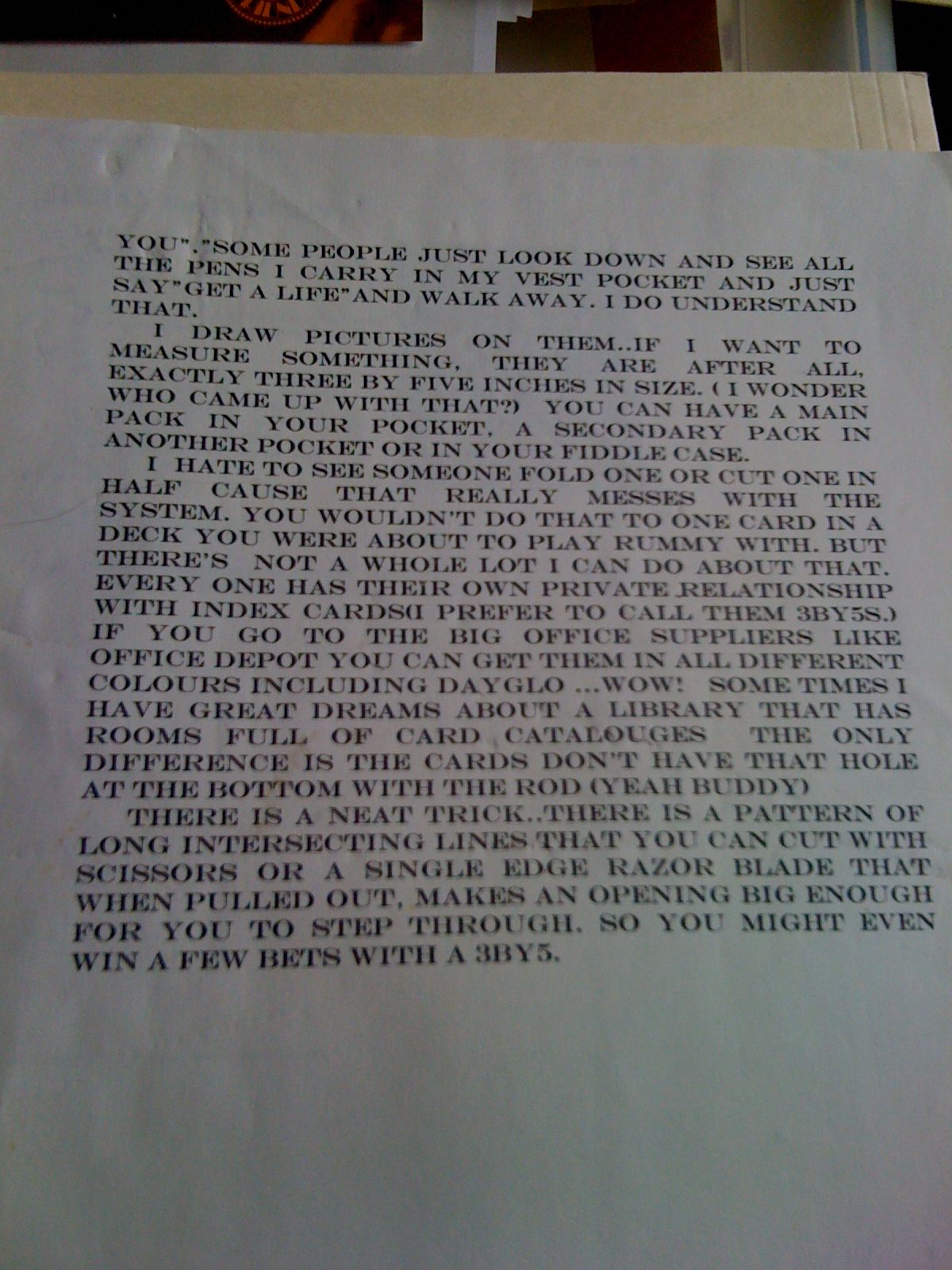
John's thoughts on notecards, page 2. Nashville, TN, c.2000.

John’s thoughts about notecards, page 2. Nashville, TN, c.2000.

In Search of Ed Haley 201

20 Wednesday Nov 2013

Posted by Brandon Ray Kirk in Ed Haley

≈ Leave a comment

Tags

Bruce Nemerov, Ed Haley, fiddling, history, John Hartford, Lee Hazen, Lynn Davis, Mark Wilson, music, Nashville, Parkersburg Landing, writing

When I got back to Nashville, I had this boxed package in the mail from Mark Wilson, the folklorist who co-produced Parkersburg Landing. Inside the box was a pile of wire recordings, looking very much like a gossamer bird’s nest, which Mark said were Lynn Davis’ recordings of Ed Haley from the forties. I had no idea why Mark had these wires, or really why he had sent them to me. Some years before, I had called him about Ed and received a cool reception, sort of like, “Why don’t you leave all of this to the real folklorists?”

I took the wire recordings to Lee Hazen, a studio engineer and friend whose life-long hobby was wire recordings, and he told me right away that they were way beyond hope. “Even if you took pieces of them and run them through and taped them and then assembled the tape?” I asked.

Nope.

He said it would require someone with enough patience to spend the rest of their life untangling them. I decided to keep them safe though and maybe someday, who knows? But wouldn’t it be awful to get them all together and discover that they were not even of Ed?

Later that spring, Bruce Nemerov notified me that he’d completed his work on Ed Haley’s recordings. I got a hold of the new copies, which included an audio log. There were several records that Bruce didn’t copy.

In Search of Ed Haley 200

19 Tuesday Nov 2013

Posted by Brandon Ray Kirk in Ed Haley, Harts

≈ Leave a comment

Tags

Abner Vance, Andrew D. Robinson, Anthony Adams, Burl Farley, Cain Adkins, Caleb Headley, Elisha Vance, Enoch Baker, Evermont Ward Brumfield, George T. Holton, Henry H. Hardesty, Imogene Haley, Jeremiah Lambert, John H. Napier, Milt Haley, Patton Thompson, Robert Mullins, writing

Cain Adkins arrived on the West Fork of Harts Creek around 1870. During the decade, he purchased a 40-acre farm from his father-in-law, Abner Vance, situated on West Fork and valued at $2.00 (and then $4.00) per acre. In 1880, according to census records, Adkins was a farmer and neighbor to Boney Lucas (his son-in-law), Elisha Vance (his brother-in-law), Abner Vance, Overton McCloud (his brother-in-law) and Marvel Vance (his brother-in-law). In 1881, Abner Vance deed him a 25-acre tract. In that same year, he was listed in land records as owning a $50 building on the 40-acre tract. The next year, the value of his 25-acre tract increased from $1.50 per acre to $2.00 per acre. In 1884, he bought 140 more acres from A.A. Low, attorney, and E. and O. Estep. One part of this, a 40-acre tract, contained a building valued at $100. It was situated between his 25-acre tract and a 185-acre 1852 grant and an 860-acre 1856 grant to Isaiah Adkins. The other 100-acre tract of land was part of the 247-acre 1856 grant to Vance.

According to the Adkins family history, Cain was a United Baptist preacher, farmer, teacher, and justice of the peace. He taught school throughout the 1870s, according to educational records. But he was best known as a preacher; his name appears frequently in county marriage books. In 1877, he married Burl Farley (a member of the future 1889 mob) and Mary Ann Dingess, sister to Hollena Brumfield. In 1884, he married Milt Haley and Emma Mullins: “Thomas M. Hauley, age 25, born Cabell County, son of B.H. Hauley and N. Muncy, married Imogene Mullins, age 15, born Logan County, daughter of J. Mullins and C. Gore, on the 22nd day of March 1884 by Canaane Adkins, Minister, at Logan, WV.”

Cain’s various occupations would have made him a real renaissance man in the community. First of all, as a country doctor, he would have been in contact with most local families. As a teacher, he would have taught many of the local children at his school. In those days, church congregations usually met in schoolhouses — as there were no church buildings — so Cain would have preached to many members of the community at his school. Again, this occupation would put him in close touch with many locals — preaching funerals, marrying people, and so forth. As a law officer, he would have had to deal with local criminal activity — which (in addition to his preaching) may have put him in direct conflict with Paris Brumfield.

In addition to Adkins, Roberts, Mullins and Fowler, John H. Napier, a 41-year-old physician, was a prominent resident at the mouth of Harts Creek. John had settled in Harts in 1879 with his young wife (a niece to Cain Adkins), five children and a nephew. He quickly took up business, although he never bought property. “Mr. Napier is a prosperous merchant in Hart Creek district, with business headquarters at the mouth of the creek,” Hardesty wrote.

By the mid-1880s, the local economy was humming along, spurred by the timber industry. In 1884, the same year that Milt Haley and Emma Haley were married, a new post office called Warren was established five miles up Harts Creek on the bank of its south side below the mouth of Smokehouse Fork. In that vicinity, which encompassed Milt Haley’s section of the community, Andrew D. Robinson was postmaster, Van B. Prince (a former schoolteacher) was a physician, Benjamin Adams was a general store operator and Joseph Williamson was a mason. Henderson Dingess (father to Hollena Brumfield) and Benjamin Hager were distillers, and Anthony Adams and Robert Mullins were blacksmiths. McCloud & Company was the major general store in the vicinity. The post office serviced three to five hundred people semi-weekly.

At that time, according to Hardesty, Jeremiah Lambert of the Bend of the River was a justice of the peace and Aaron Adkins of Little Harts Creek was a constable. Evermont W. Brumfield — a brother to Paris Brumfield — was the county jailer. Patton Thompson was a constable and a deputy-sheriff. Caleb Headley — a brother-in-law to Burl Farley — was a physician on Fourteen Mile Creek. There were ten public school buildings in the district with a student population of 334. George Thomas Holton of Fourteen was a local schoolteacher. Enoch Baker, a Nova Scotian, was busy in timber with a “lower dam” on Brown’s Run of Smokehouse Fork according to 1883 deed records.

In Search of Ed Haley 198

16 Saturday Nov 2013

Posted by Brandon Ray Kirk in Ed Haley

≈ Leave a comment

Tags

Big Ugly Creek, Bill Duty, Billy Adkins, Ed Haley, Green McCoy, history, John E. Fry, Maude Duty, Milt Haley, Tucker Fry, writing

After visiting with Ida, Billy directed us to Maude Duty, who lived on Big Ugly Creek. Born in 1905, Maude was a daughter of John E. Fry, a longtime justice-of-the-peace in the district, and a niece to Tucker Fry, one-time occupant of the “murder house.” At the time of our visit, Maude was bed-fast, physically feeble, and near death. She hadn’t seen Billy for a few years but soon remembered him and began to whisper answers to his questions concerning the murder house and her husband’s family, the Dutys. She agreed with Billy that the murder of Milt and Green had taken place at her Uncle Tucker’s house at the mouth of Green Shoal. She didn’t know anything about Milt living with Bill Duty but remembered that Ed Haley visited him fairly often on Broad Branch. She said she used to dance to his fiddling when he came to her father’s home.

It was a small but crucial bit of information indicating a strong connection between Ed, Milt, and the Duty family that went beyond the 1870 census.

In Search of Ed Haley 197

13 Wednesday Nov 2013

Posted by Brandon Ray Kirk in Ed Haley

≈ Leave a comment

Tags

Al Brumfield, Bill Brumfield, Cat Fry, Charley Brumfield, Green McCoy, Hollena Brumfield, Ida Taylor, Jim Brumfield, John Fry, Letilla Dial, Milt Haley, writing

At that point, Ida gave us her account of the Haley-McCoy murders.

“Some man that lived down there at Hart had a business and Al Brumfield had a business,” she said. “Al Brumfield, he wanted to get rid of him so he would get all the trade and so he was supposed to paid them so much to kill him. And they hid as they come out of Harts Creek, they said, one Sunday afternoon, I believe. They were hired to shoot and kill Al, but they hit the woman. She was riding on behind him on a horse. I can remember seeing her. She married again after that — a Ferguson. She wasn’t a very large woman. She died with a big hole in her cheek there where they shot her. They said they went into Kentucky and got them and they was supposed to delivered them back to the law over at Hamlin, our county seat. And they stopped down there to stay overnight. That was supposed to been the house of John Fry across the track there, I was told. That was a stop-off place. Do you know where Lonnie lives now? Well now, there’s where the log house stood.”

Ida stopped, thinking, then said, “I used to hear Dad and them talk about it. He said where their horses were tied in those fences… You know how they used to build the old log rail fences? He said they tore that place apart that night, those horses and all the shooting and everything going on. And said when they were eating supper that night — Green McCoy and Milt Haley — said one looked over to the other’n and told him, said, ‘You better eat all you want because this will be our last meal.’ Sure enough it was. Started shooting them in the bed and they was handcuffed together. I don’t know what hour it was but it was some time in the nighttime, you know, after they’d gone to bed. Now Grandma Cat was at that house that night when those men were killed. And they said when that was going on she hid up a chimney — big open fireplace. She hid up in there. It was kindly a rough time, they said.”

I asked Ida if she ever heard anyone mention the names of the vigilantes.

“Who was in the pack?” she said, laughing. “People just surmised it, I guess. I wasn’t told but my daddy, he always thought Uncle Charley — that was one of his brothers — was in on it. He was a huge man, Uncle Charley was. As well as I remember, he was real fair-complected. He finally got killed afterwards. Uncle Charley, I went to his funeral. He was a big, fat round-faced fellow and he had bullet wounds in his cheeks. Back then, the undertakers, you know, they didn’t have all that stuff to work with then.”

Brandon asked Ida if Bill Brumfield was in the gang and she said, “Uncle Bill? Now, I never did hear his name mentioned. He was accused of murdering, you know, but not them.”

Billy said, “They was about 20 or 30 of them. Wild times.”

I asked Ida if she ever saw the “murder house” and she said, “No, but my mother told me about it. At that time, she was going to school around at what they call the Toney Addition. And she said when they went out of Green Shoal that morning to school, you know, Milt and Green was laying out in the yard still handcuffed together. Mother thought they was colored people. They were beat up, I guess, and shot, you know, and blood all together — that’s the reason she thought they looked like colored people. That’s what she said. Now, she seen them. And I remember tales they’d left a little stream of blood run down through the yard. There was blood all over. I remember that very clearly, her telling us that.”

Ida said the old Fry home at the mouth of Green Shoal was torn down years ago, probably when the site was “built up” by the railroad around 1904.

In Search of Ed Haley 196

12 Tuesday Nov 2013

Posted by Brandon Ray Kirk in Ed Haley

≈ Leave a comment

Tags

Boney Lucas, Cat Fry, Charley Brumfield, crime, genealogy, history, Hollena Brumfield, Ida Taylor, Jim Brumfield, Letilla Dial, Paris Brumfield, Sarah Lucas, writing

To get to Ida’s house, we drove a short distance up Green Shoal Road, a somewhat narrow strip of pavement that snaked its way alongside the creek. We were welcomed inside by some of her family, who knew Billy and Brandon. Just inside the door, I spotted Ida sitting in a chair near a bed and a fireplace. In the initial small talk, we learned that Ida was born on Green Shoal in 1914 and had lived there all of her life. Brandon began by showing her a picture of her grandfather, Paris Brumfield. She said her father Jim Brumfield (1880-1965) had spoken of him.

“Dad said he kindly mistreated their mother,” she said. “He drinked an awful lot. The children were afraid of him. Now, I can remember Dad talking about seeing him get killed. Uncle Charley was the one killed him, his own son. I think Dad said he was about 16 years old — maybe older. Dad said he was hid up on the hill behind a foddershock when Uncle Charley shot him. Said he was laying down the drawbars and said Charley told him not to come any farther and he just kept going and he shot him in the back. He said he saw the dust jump out of his jacket. He’s told us kids that lots of times.”

Jim was practically raised by his brother Al in Harts because his mother died not too long after his father’s murder. In 1900, he was with his brother John at Chapmanville when they were attacked by the Conleys. He was stabbed and carried a piece of the knife blade in his body for the rest of his life. A little later, he fell out with his older siblings (Al, Rachel, and Charley), who he felt had “swindled” him out of some of the family property.

Brandon asked Ida if she remembered going to visit Hollena Brumfield and she said, “I never was there. Dad didn’t think much of her as a sister-in-law.”

Ida said she’d kinda been raised away from all the Brumfields around Harts.

“They used to come here, but we never was down in there too much,” she said. “The first time I was ever in Uncle Charley’s house is when I attended his funeral. And Uncle Bill’s house, I never was there at all. But I always liked him. He was here quite a bit, Uncle Bill was, you know. Spent a little time in jail for killing a man. I was afraid of him, though. He was a little guy and wore a little sandy mustache. He dodged around up in here after they found this man dead. He’d been dead quite a while and he’s supposed to got beat up at Uncle Bill’s house. I think he beat him up with an axe handle as well as I remember. They carried him back in there someplace. That’s what we were told. Billie killed Uncle Bill. Said he was drinking whiskey out of a half a gallon jar and Billie slipped around the house and shot him. They thought that was over his mother, too. They was really rough down in there.”

Ida said she heard about the Haley-McCoy killings from her mother Letilla Dial and grandmother Cat Fry (the infamous “Aunt Cat”). Ida’s mother Til was raised by Sarah Lucas, who married a Brumfield and then later a Workman. Hearing the name Lucas caused me to ask Ida if she knew anything about Boney Lucas.

“Oh, yeah,” she said. “They was raised up on the creek here. Boney Lucas — I’m not sure but I believe that was Aunt Sarah Workman’s brother. I can remember hearing her talk about Boney Lucas. Now, they were raised down here someplace in a log house.”

In Search of Ed Haley 195

11 Monday Nov 2013

Posted by Brandon Ray Kirk in Ed Haley

≈ Leave a comment

Tags

Appalachia, Bill Adkins, Dood Dalton, Doran Lambert, Ed Haley, feud, Green Shoal, Harts, history, Ida Taylor, Jim Brumfield, Tucker Fry, writing

Early the next day, Brandon and I met Billy at his home, with plans to go see the site of the “murder house” at Green Shoal. We found his father, Bill, Sr., seated in a wooden rocking chair very much “in his own world.” He’d been born in 1906, making him one of the oldest citizens living in Harts. Curious, I got my fiddle out and played a few tunes for him. The old gentleman just stared at me like I was crazy. He never said a word. Billy told him we were interested in Ed Haley’s life and he surprised us all when he said Ed used to stay with his father for two or three days at a time. Oh yeah, he said…Ed even slept in the same bed with him and his brothers, who were children at the time. Wow! Bill said Haley was a very serious guy (“not carrying on much”) and had a reputation for being “bad to fight.” He often got with a local fiddler named Dood Dalton and played all night for a house full of people at the Adkins home. Bill also remembered him playing in front of the old Adkins Store/Harts Post Office around 1916 when it faced the railroad tracks. All he could recall about Ed’s technique was that he tapped his feet and pulled a long, smooth bow.

After talking with Bill, Billy, Brandon, and I drove out of Harts Bottom onto Route 10 past the old Adkins store and on up the road to Green Shoal. At that location, standing in a little drizzle, we surveyed the possible sites of the murder house. Suddenly, an older man Brandon and Billy recognized as Doran Lambert came walking down to where we stood on the railroad tracks. A descendant of Paris Brumfield, he lived where the Tucker Fry home stood in 1889. Doran said the murders didn’t happen at Tucker’s place, as Billy thought, but at the present-day location of his father’s garage just up the river between the Guyan River and the C&O Railroad.

We asked Doran more about the Haley-McCoy killings. He said his aunt Ida Taylor, who lived just up Green Shoal, could tell us all about it. A niece to Al Brumfield, her father Jim was Paris’ youngest son. We decided right away to try and see her.

← Older posts
Newer posts →

Feud Poll 1

If you had lived in the Harts Creek community during the 1880s, to which faction of feudists might you have given your loyalty?

Categories

  • Adkins Mill
  • African American History
  • American Revolutionary War
  • Ashland
  • Atenville
  • Banco
  • Barboursville
  • Battle of Blair Mountain
  • Beech Creek
  • Big Creek
  • Big Harts Creek
  • Big Sandy Valley
  • Big Ugly Creek
  • Boone County
  • Breeden
  • Calhoun County
  • Cemeteries
  • Chapmanville
  • Civil War
  • Clay County
  • Clothier
  • Coal
  • Cove Gap
  • Crawley Creek
  • Culture of Honor
  • Dingess
  • Dollie
  • Dunlow
  • East Lynn
  • Ed Haley
  • Eden Park
  • Enslow
  • Estep
  • Ethel
  • Ferrellsburg
  • Fourteen
  • French-Eversole Feud
  • Gilbert
  • Giles County
  • Gill
  • Green Shoal
  • Guyandotte River
  • Halcyon
  • Hamlin
  • Harts
  • Hatfield-McCoy Feud
  • Holden
  • Hungarian-American History
  • Huntington
  • Inez
  • Irish-Americans
  • Italian American History
  • Jamboree
  • Jewish History
  • John Hartford
  • Kermit
  • Kiahsville
  • Kitchen
  • Leet
  • Lincoln County Feud
  • Little Harts Creek
  • Logan
  • Man
  • Matewan
  • Meador
  • Midkiff
  • Monroe County
  • Montgomery County
  • Music
  • Native American History
  • Peach Creek
  • Pearl Adkins Diary
  • Pecks Mill
  • Peter Creek
  • Pikeville
  • Pilgrim
  • Poetry
  • Queens Ridge
  • Ranger
  • Rector
  • Roane County
  • Rowan County Feud
  • Salt Rock
  • Sand Creek
  • Shively
  • Spears
  • Sports
  • Spottswood
  • Spurlockville
  • Stiltner
  • Stone Branch
  • Tazewell County
  • Timber
  • Tom Dula
  • Toney
  • Turner-Howard Feud
  • Twelve Pole Creek
  • Uncategorized
  • Warren
  • Wayne
  • West Hamlin
  • Wewanta
  • Wharncliffe
  • Whirlwind
  • Williamson
  • Women's History
  • World War I
  • Wyoming County
  • Yantus

Feud Poll 2

Do you think Milt Haley and Green McCoy committed the ambush on Al and Hollene Brumfield in 1889?

Blogroll

  • Ancestry.com
  • Ashland (KY) Daily Independent News Article
  • Author FB page
  • Beckley (WV) Register-Herald News Article
  • Big Sandy News (KY) News Article
  • Blood in West Virginia FB
  • Blood in West Virginia order
  • Chapters TV Program
  • Facebook
  • Ghosts of Guyan
  • Herald-Dispatch News Article 1
  • Herald-Dispatch News Article 2
  • In Search of Ed Haley
  • Instagram
  • Lincoln (WV) Journal News Article
  • Lincoln (WV) Journal Thumbs Up
  • Lincoln County
  • Lincoln County Feud
  • Lincoln County Feud Lecture
  • LinkedIn
  • Logan (WV) Banner News Article
  • Lunch With Books
  • Our Overmountain Men: The Revolutionary War in Western Virginia (1775-1783)
  • Pinterest
  • Scarborough Society's Art and Lecture Series
  • Smithsonian Article
  • Spirit of Jefferson News Article
  • The Friendly Neighbor Radio Show 1
  • The Friendly Neighbor Radio Show 2
  • The Friendly Neighbor Radio Show 3
  • The Friendly Neighbor Radio Show 4
  • The New Yorker
  • The State Journal's 55 Good Things About WV
  • tumblr.
  • Twitter
  • Website
  • Weirton (WV) Daily Times Article
  • Wheeling (WV) Intelligencer News Article 1
  • Wheeling (WV) Intelligencer News Article 2
  • WOWK TV
  • Writers Can Read Open Mic Night

Feud Poll 3

Who do you think organized the ambush of Al and Hollene Brumfield in 1889?

Recent Posts

  • Logan County Jail in Logan, WV
  • Absentee Landowners of Magnolia District (1890, 1892, 1894)
  • Charles Spurlock Survey at Fourteen Mile Creek, Lincoln County, WV (1815)

Ed Haley Poll 1

What do you think caused Ed Haley to lose his sight when he was three years old?

Top Posts & Pages

  • Early Coal Mines in Logan County, WV
  • Hatfield-McCoy Feud: Tom "Guerilla" Mitchell grave at Meador, WV (2019)
  • Madam Wonder Advertisement (1927)
  • Tom Dula: Ferguson, NC (2020)
  • In Search of Ed Haley 64

Copyright

© Brandon Ray Kirk and brandonraykirk.wordpress.com, 1987-2023. Unauthorized use and/or duplication of this material without express and written permission from this blog’s author and/or owner is strictly prohibited. Excerpts and links may be used, provided that full and clear credit is given to Brandon Ray Kirk and brandonraykirk.wordpress.com with appropriate and specific direction to the original content.

Archives

  • February 2025
  • January 2025
  • October 2023
  • September 2023
  • December 2022
  • November 2022
  • May 2022
  • April 2022
  • February 2022
  • November 2021
  • October 2021
  • September 2021
  • June 2021
  • May 2021
  • April 2021
  • March 2021
  • February 2021
  • January 2021
  • December 2020
  • November 2020
  • October 2020
  • July 2020
  • June 2020
  • May 2020
  • April 2020
  • March 2020
  • February 2020
  • January 2020
  • December 2019
  • November 2019
  • October 2019
  • September 2019
  • August 2019
  • July 2019
  • June 2019
  • May 2019
  • April 2019
  • March 2019
  • February 2019
  • January 2019
  • December 2018
  • November 2018
  • October 2018
  • September 2018
  • August 2018
  • July 2018
  • June 2018
  • May 2018
  • April 2018
  • March 2018
  • February 2018
  • January 2018
  • December 2017
  • November 2017
  • October 2017
  • September 2017
  • August 2017
  • July 2017
  • June 2017
  • May 2017
  • April 2017
  • March 2017
  • February 2017
  • January 2017
  • December 2016
  • November 2016
  • October 2016
  • September 2016
  • August 2016
  • July 2016
  • June 2016
  • May 2016
  • April 2016
  • March 2016
  • February 2016
  • January 2016
  • December 2015
  • November 2015
  • October 2015
  • September 2015
  • August 2015
  • July 2015
  • June 2015
  • May 2015
  • April 2015
  • March 2015
  • February 2015
  • January 2015
  • December 2014
  • October 2014
  • September 2014
  • August 2014
  • July 2014
  • June 2014
  • May 2014
  • April 2014
  • March 2014
  • February 2014
  • January 2014
  • December 2013
  • November 2013
  • October 2013
  • September 2013
  • August 2013
  • July 2013
  • June 2013
  • May 2013
  • April 2013
  • March 2013
  • February 2013
  • January 2013
  • December 2012
  • November 2012

Enter your email address to follow this blog and receive notifications of new posts by email.

Join 2,927 other subscribers

Tags

Appalachia Ashland Big Creek Big Ugly Creek Blood in West Virginia Brandon Kirk Cabell County cemeteries Chapmanville Charleston civil war coal Confederate Army crime culture Ed Haley Ella Haley Ferrellsburg feud fiddler fiddling genealogy Green McCoy Guyandotte River Harts Harts Creek Hatfield-McCoy Feud history Huntington John Hartford Kentucky Lawrence Haley life Lincoln County Lincoln County Feud Logan Logan Banner Logan County Milt Haley Mingo County music Ohio photos timbering U.S. South Virginia Wayne County West Virginia Whirlwind writing

Blogs I Follow

  • OtterTales
  • Our Appalachia: A Blog Created by Students of Brandon Kirk
  • Piedmont Trails
  • Truman Capote
  • Appalachian Diaspora

BLOOD IN WEST VIRGINIA is now available for order at Amazon!

Blog at WordPress.com.

OtterTales

Writings from my travels and experiences. High and fine literature is wine, and mine is only water; but everybody likes water. Mark Twain

Our Appalachia: A Blog Created by Students of Brandon Kirk

This site is dedicated to the collection, preservation, and promotion of history and culture in Appalachia.

Piedmont Trails

Genealogy and History in North Carolina and Beyond

Truman Capote

A site about one of the most beautiful, interesting, tallented, outrageous and colorful personalities of the 20th Century

Appalachian Diaspora

  • Subscribe Subscribed
    • Brandon Ray Kirk
    • Join 789 other subscribers
    • Already have a WordPress.com account? Log in now.
    • Brandon Ray Kirk
    • Subscribe Subscribed
    • Sign up
    • Log in
    • Report this content
    • View site in Reader
    • Manage subscriptions
    • Collapse this bar
 

Loading Comments...