
Monroe T. Fry (left), son of Spicie (Adkins) McCoy-Fry, resident of Stiltner, Wayne County, WV

03 Thursday Jul 2014
Posted in Stiltner
Monroe T. Fry (left), son of Spicie (Adkins) McCoy-Fry, resident of Stiltner, Wayne County, WV
02 Wednesday Jul 2014
Posted in Big Harts Creek, Lincoln County Feud, Timber
Tags
Ben Adams, genealogy, Harts Creek, history, Lincoln County Feud, Logan County, Pilgrims Rest Church, Trace Fork, West Virginia

Ben Adams’ baptism record, Pilgrim’s Rest United Baptist Church, Trace Fork of Harts Creek, Logan County, WV, dated April 3, 1910
02 Wednesday Jul 2014
Posted in Big Harts Creek, Ed Haley, Spottswood
Tags
Ed Haley, genealogy, Harts Creek, history, Logan County, Pilgrims Rest Church, Trace Fork, West Virginia

Ed Haley’s baptism record, Pilgrim’s Rest United Baptist Church, Spottswood, Logan County, WV, dated May 21, 1911
02 Wednesday Jul 2014
Posted in Big Sandy Valley, Inez, Lincoln County Feud, Timber, Wyoming County
Tags
Adam Runyon, Analena Porter, Aquillia Runyon, Asa Williamson, Aubrey Lee Porter, Bill Fields, Bill Porter, Brandon Kirk, Buchanan County, Buskirk and Wittenberg, Clarence Hinkle, Etta M. Porter, Ferrellsburg, genealogy, Graveyard Point, Guiniford Apney, Hatti Hinkle Apney, history, Inez, Jean Ramey, John Porter Jr., John W Runyon, John W. Porter, Kentucky, Martin County, Mary Runyon Fields, Mary Williamson, Maude Williamson, Merrill Porter, Norfolk, Point Pleasant, Rockcastle Creek, Russell Goble, Samuel W. Porter, Stafford Fork Precinct, Stidham, Virgil Ramey, Virginia, Virginia Lee Porter, Wealthy Runyon, West Virginia, writing, Wyoming County
The John W. Runyon family seems to have headed further south to try their luck elsewhere. In February 1902, Mary Runyon, her recently remarried daughter, Wealthy (Runyon) Hinkle-Fry, and her former son-in-law Clarence Hinkle were listed in Martin County deed records as residents of Buchanan County, Virginia.
John Runyon, meanwhile, soon gave up on his case in Wyoming County. A court entry dated April 2, 1902 and titled “John W. Runyon vs. Buskirk and Wittenberg” mentions how he “failed to give bond for costs as required in an order entered at a former term of the Court.” The Court ruled that “the defendants recover of the plaintiff their costs in their behalf expended in their defense herein including an attorneys fee of $10.00.” Included in this record was a list of thirty-four “Petit Jurors” who were, for some reason, to be paid “out of the County Treasury to wit” for their services in this case, some of them serving as many as nine days and being paid as much as eighteen dollars. It wasn’t clear why jurors served up to nine days, as records indicate that the court dismissed Runyon’s case before it went to trial.
After a short stay in Virginia, the Runyon family returned to Martin County and settled near the old Stidham Post Office on Rockcastle Creek, several miles north of the countyseat of Inez. On June 25, 1903, Wealthy Fry died at the age of 22 years old. Aquillia Porter died on February 20, 1910. A few months later (April 20) her husband remarried to Maude Williamson. Both of the Runyon girls were buried in the Williamson family cemetery at Stidham. Runyon’s legal problems, meanwhile, continued in Martin County as late as the 1910s.
On the bright side, John and Mary Runyon Fork purchased many acres of land around Rockhouse between 1893-1917 and sold at least 1,001 acres in that same vicinity between 1904-1932. Most of it went to their family: Sam Porter got 100 acres in 1910, 50 acres in 1917 and 35 acres in 1925. Various members of the Williamson family also bought tracts from John and Mary Runyon.
In 1920, John W. Runyon was listed in the Martin County Census as a resident of the Stafford Fork Precinct. He was a 65-year-old general laborer. His wife Mary was 55 years old. Asa G. Williamson, age 52, brother-in-law, was also in the household. Next door was the family of grandson John W. Porter, a 23-year-old farmer, with wife Etta M. (age 23). There were two children listed: Analena, age three; and Virginia Lee, age one. Aubrey Lee Porter, 22-year-old brother to John, who was also present in the home and employed as a coal miner.
John Runyon died on January 12, 1925 in Martin County. His widow spent her final years under the care of his niece, Mary (Runyon) Fields, who had been listed with the family in the 1900 Wyoming County Census. Mary was a daughter of John’s twin brother. She married Bill Fields and participated in much of the “family business” (marriage records, land transactions). Mary Runyon was still alive in 1952, when the Runyon genealogy book was assembled and was a source on the Adam Runyon family line.
Back in Ferrellsburg, Brandon called Bill Porter, an 80-year-old man in the Inez-area who was distantly connected to John Runyon’s family. He hadn’t known Runyon personally but said, “He was a well-thought of person. He followed the timber business. Everywhere he went he had bad luck. He was pretty bad to crook people.”
Mr. Porter said the Runyon place sat just above the old Stidham Post Office at Graveyard Point and told all about the Runyon descendants. He said Aubrey Porter married a Williams and raised a family of three children (including one son named Jimmy) in Columbus, Ohio. John W. Porter had two children — Merrill and John, Jr — and lived in Norfolk, Virginia. Hattie (Hinkle) Apney had two daughters: one named Guiniford, who married Russell Goble (an active member of the Inez School Board for years), and Jean, who married Virgil Ramey. Mr. Porter thought Hattie divorced her husband and moved to Point Pleasant, West Virginia, where she died.
01 Tuesday Jul 2014
Posted in Big Harts Creek, Ed Haley, Lincoln County Feud, Spottswood
Tags
Chloe Mullins, Ed Haley, genealogy, Harts Creek, history, Jackson Mullins, Lincoln County Feud, Logan County, photos, Weddie Mullins, West Virginia

Weddie Mullins, son of Jackson and Chloe (Gore) Mullins, resident of Trace Fork of Harts Creek, Logan County, WV
01 Tuesday Jul 2014
Posted in Ferrellsburg
Tags
Andrew Elkins, Arnold Bailey, Ben Walker, Cain Lucas, Charles Curry, Ferrellsburg, genealogy, George W. Hensley, Gilbert Moore, Golden Headley, Grover Gartin, history, Isaac Marion Nelson, John Bryant, Josiah Tomblin, Lincoln County, Low Gap United Baptist Church, M.F. Barker, Musco Adkins, Paris Hensley, Smith Wiley, Stonewall Hensley, Tice Elkins, West Virginia
List of Moderators for the Low Gap United Baptist Church at Low Gap, near Ferrellsburg, Lincoln County, WV:
Gilbert Moore (1898-1899)
Isaac Marion Nelson (1899)
Andrew Elkins (1899)
Isaac Marion Nelson (1900-1902)
Mathias Elkins (1903-1904)
Isaac Marion Nelson (1904)
Mathias Elkins (1904-1907)
M.F. Barker (1907-1908)
Isaac Marion Nelson (1908-1913)
Grover Gartin (1914-1915)
Benjamin W. Walker (1915-1917)
George W. Hensley (1917-1921)
Unknown (1921-1923)
Paris Hensley (1923)
John Bryant (1923)
George W. Hensley (1924-1925)
Charles Curry (1926-1927)
Stonewall Hensley (1928)
Charles Curry (1929-1931)
George W. Hensley (1931-1932)
Musco Adkins (1932)
Elcanan C. Lucas (1933-1941)
Josiah S. Tomblin (1941)
Golden Headley (1941-1942)
Arnold Bailey (1942-?)
Smith Wiley (1944-?)
01 Tuesday Jul 2014
Posted in Big Harts Creek, Civil War, Ed Haley, Lincoln County Feud
Tags
34th Battalion Virginia Cavalry, civil war, Ed Haley, genealogy, history, Jackson Mullins, Logan County, U.S. South, Vincent A. Witcher, West Virginia

Jackson Mullins military record, Company D, 34th Battalion Virginia Cavalry, 1862-1863

Jackson Mullins military record, Company D, 34th Battalion Virginia Cavalry, 1862-1863

Jackson Mullins military record, Company D, 34th Battalion Virginia Cavalry, 1862-1863
01 Tuesday Jul 2014
Posted in Lincoln County Feud, Timber, Wyoming County
Tags
A.R. Wittenberg, Anderson Beverly, Baileysville, Buskirk and Wittenberg, Clarence Hinkle, Cole and Crane Company, crime, Dr. C.W. Hall, Dr. S.A. Daniel, E.M. Seuter, genealogy, history, I.E. Christian, James Bertrand Runyon, James Ramey, John W Runyon, Kentucky, logging, Mary Runyon, Porter and Runyon, Reference Book of Wyoming County History, Samuel W. Porter, timbering, Vorheis, West Virginia, writing, Wyoming County, Wyoming Tribune
In that same time frame, John W. Runyon moved his family to Baileysville in Wyoming County, West Virginia, where he opened a business under the name of “Porter and Runyon.” He began to buy various items by credit at a store owned by Buskirk and Wittenberg, a partnership of contractors operating under the powerful Cole and Crane Company.
According to Bowman’s Reference Book of Wyoming County History (1965): “C. Crane and Co., by its contractors, Buskirk and Wittenburg, began a new era of removing timber by water. The company began building dams as soon as possible after taking over the contract.”
Buskirk and Wittenburg were often permitted to construct “roads for their convenience” and to destroy bridges for the purpose of splashing so long as they had them rebuilt. They built the only splash dam ever constructed on the Guyan River around 1903.
“The company maintained well stocked commissaries and logging camps to take care of their men,” according to the Wyoming County history. The main camp in their operation “had a commissary, blacksmith shop, business office, and post office named Vorheis, in honor of Buskirk’s daughter who had married a man named Vorheis. There were camps at Baileysville… Camps and stores were relocated from time to time as needed.” Their stores “carried a large and varied stock, including up-to-date clothing.”
Runyon’s bill at Buskirk’s and Wittenberg’s store began on May 22, 1899, when he bought a nine-dollar suit, and extended until July 17, 1900, when the store debt totaled $6,495.78. According to the bill, Runyon primarily purchased ordinary store items: bacon, beans, fruits, vegetables, coffees, tobacco, herbs, spices, silverware, kitchen utensils, nails, soap, shoes, hats, gloves, watches, candy, and various types of clothing. He also had bought a plethora of luxury items: a case of oysters, Cuban Gentlemen Cigars, several boxes of chewing gum, a box of roasted peanuts, dolls, musical instruments (including a violin), picture frames, guns, locks, turpentine, Castor Oil, clocks, fire crackers, and fishing gear.
Beginning on September 28, 1899, Runyon and Porter paid periodically on the bill (although Porter’s name was seldom mentioned specifically) and Runyon personally contributed $280.00 in January of 1900. The business folded around September 13, 1900, when Runyon made his last payment to Wittenberg and reduced his bill to $640.15.
Meanwhile, the census enumerator registered Runyon as follows: “John W. Ru[n]yon, logger, rents home, born Feb 1856 in KY, age 44, married 20 years, both parents born KY; Mary M. Ru[n]yon, born January 1861 in KY, age 39, married 20 years, mother of 1 child which is living, parents born in KY; Mary M. Ru[n]yon, born March 1889 in KY, age 11, niece, both parents born in KY.” John’s son-in-law Clarence Hinkle was listed two households away as a logger. Sam Porter was not listed in the census — perhaps well aware of the impending debt owed to Buskirk and Wittenberg. Little Mary Runyon was a daughter of John’s twin brother.
There were other legal troubles. In June of 1901, Drs. S.A. Daniel and C.W. Hall sued Runyon for a $50 debt (with interest). Apparently the doctors had rendered services to a James Ramey with the understanding that Runyon would pay his bill. When the trial took place on June 15, Runyon failed to show up. The court waited for an hour, then heard the plaintiff’s case and ruled against him. Curiously enough, Runyon appealed the decision on June 24, with funds for his appeal bond ($120) coming from the very doctors who originally sued him. In September a summons was delivered to an Anderson Beverly to appear as Runyon’s witness. On April 2, 1902 his appeal came before the court and the doctors didn’t appear even “though thrice solemnly called.” As a result, the judge ruled in Runyon’s favor and stated that he was to be paid “$5.00 for their false clamor herein” and that he “recover of the plaintiffs his costs in this behalf expended including an attorneys fee of $5.00 allowed by statute.”
By that time, Runyon was in a more serious lawsuit with Buskirk and Wittenberg over his store debt. In early July of 1901, Wittenberg sued Runyon and Porter, stating that he had not received a payment from them since September of the previous year. Wittenberg’s contacts with area politicians and influential residents had obvious legal implications. Runyon and Porter were issued a summons to appear in court on the first Monday in August to answer “A.R. Wittenberg of a plea of Trespass on the case in assumpsit damages $6,500.00.” Wittenberg’s use of the figure $6,500 referred to the original debt of $6,495.78, although records show the amount actually owed was $640.15. On the outside of this summons the following was written in poor handwriting, probably by a deputy-sheriff: “Serve[d] on the within name John W. Runyon by delivering to him an office copy of the within summon[s] in person on July 12, 1901.” A summons couldn’t be served to S.W. Porter who was “not found within my bailiwick this July 13, 1901.”
Porter was apparently not a resident of West Virginia (probably Kentucky). An affidavit of Non-Residence was filed on his behalf on August 5, 1901.
“This day I.E. Christian Personally appeared before me E.M. Seuter a Notary Public within and for said Wyoming County, West Virginia and upon oath says that S.W. Porter one of the defendants in the above styled action is a Nonresident of the State of West Virginia,” it read.
Because Wyoming County law couldn’t find him to serve a summons, an Order of Publication was issued on the first Monday in August 1901.
“At Rules held in the Clerk’s Office of the Circuit Court of Wyoming County on the first Monday in August 1901 A.R. Wittenberg vs. John W. Runyon and S.W. Porter partners trading and doing business under the firm name and style of Porter and Runyon,” it read. “The object of the above suit is to obtain a Judgment in favor of the plaintiff against the defendants for the sum of $640.15 and it appearing from an affidavit made and filed with the papers of this cause that S.W. Porter defendant in the above signed cause is a non resident of the State of West Virginia, and on motion of the plaintiff it is ordered that said defendant S.W. Porter do appear at Rules to be held in the clerk’s office of the circuit court of Wyoming County within one month after the first publication of this order and do what is necessary to protect his interest in this suit.”
Wittenberg spent five dollars and fifty cents paying for this publication, which was featured in the Wyoming Tribune from August 9th until August 30th.
It did little good. Porter was basically untouchable by Wyoming County authorities barring extradition papers.
Information at the Wyoming County Courthouse indicated that he never showed up to answer for his part in the failed business and, in so doing, crippled Runyon’s case against Wittenberg.
There is little information available on the actual trial, although records show the judge ruled against Runyon for $614.50 on September 30, 1901. Totaled near this figure was a compilation of the plaintiff’s costs ($32.81), which indicated that he was expected to pay that fee as well. Presumably, all of this debt fell on Runyon since his partner had left the state. He decided to appeal the case but as a non-property owner in Wyoming County, the owner of a failed business, and with no local contacts loyal enough to assist him, he was unable to put forth enough money to post the necessary bond. Wittenberg, meanwhile, prepared his case and hired lawyers.
30 Monday Jun 2014
Posted in Big Harts Creek, Lincoln County Feud, Stiltner, Women's History
Tags
Appalachia, Cain Adkins, genealogy, Harts Creek, history, Lena Adkins, life, Lincoln County, Mariah Adkins, photos, Stiltner, U.S. South, Wayne County, West Fork, West Virginia

Salena “Lena” Adkins Napier (1876-1939), daughter of Cain and Mariah (Vance) Adkins, resident of West Fork of Harts Creek, Lincoln County, WV
30 Monday Jun 2014
Posted in Big Harts Creek, Big Sandy Valley, Harts, Inez, Timber, Wyoming County
Tags
Adam Runyon, Adam Runyon Sr., Alden Williamson Genealogy, Aquillia Runyon, Aubrey Lee Porter, Billy Adkins, Bob Spence, Brandon Kirk, Charleston, civil war, Clarence Hinkle, Crawley Creek, Cultural Center, Ellender Williamson, Enoch Baker, Garrett and Runyon, genealogy, Harts, Hattie Hinkle, Henderson Dingess, history, Inez, Izella Porter, James Bertrand Runyon, James Muncy, John W Runyon, John W. Porter, Kentucky, Land of the Guyandot, Lawrence County, Logan County, Logan County Banner, logging, Martin County, Mary Runyon, Milt Haley, Moses Parsley, Nat's Creek, Nellie Muncy, Nova Scotia, Peach Orchard, Pigeon Creek, Pike County, Pineville, Rockcastle Creek, Runyon Genealogy, Samuel W. Porter, Stephen Williamson, timbering, Wayne, Wayne County, Wealthy Runyon, West Virginia, Wolf Creek, writing, Wyoming County
In the late summer of 1996, Brandon and Billy turned their genealogical sights on John W. Runyon, that elusive character in the 1889 story who seemed to have stirred up a lot of trouble and then escaped unharmed into Kentucky. They arranged a biographical outline after locating two family history books titled Runyon Genealogy (1955) and Alden Williamson Genealogy (1962). Then, they chased down leads at the Cultural Center in Charleston, West Virginia; the Wyoming County Courthouse at Pineville, West Virginia; the Wayne County Courthouse in Wayne, West Virginia; the Martin County Courthouse at Inez, Kentucky; and at various small public libraries in eastern Kentucky. Runyon had left quite a trail.
John W. Runyon was born in February of 1856 to Adam and Wealthy (Muncy) Runyon, Jr. in Pike County, Kentucky. He was a twin to James Bertrand Runyon and the ninth child in his family. His mother was a daughter of James Muncy — making her a sister to Nellie Muncy and an aunt to Milt Haley. In other words, John Runyon and Milt Haley were first cousins.
According to Runyon Genealogy (1955), Adam and Wealthy Runyon left Pike County around 1858 and settled on the Emily Fork of Wolf Creek in present-day Martin County. In 1860, they sold out to, of all people, Milt Haley’s older half-brother, Moses Parsley, and moved to Pigeon Creek in Logan County. John’s grandfather, Adam Runyon, Sr., had first settled on Pigeon Creek around 1811. The family was primarily pro-Union during the Civil War.
At a young age, Runyon showed promise as a timber baron.
“The first lumber industry in Logan County of any importance was started on Crawley Creek by Garrett and Runyon during the year 1876,” Bob Spence wrote in Land of the Guyandot (1978). “Garrett and Runyon deserve credit for their efforts in opening the lumber business in Logan County. They were the first to hire labor in this field. It might be of interest to note here that they originally brought trained men from Catlettsburg… In a few years, Garrett and Runyon left Logan [County], and soon Enoch Baker from Nova Scotia came to Crawley Creek to take their place.”
John may have put his timber interests on hold due to new developments within his family. According to Runyon Genealogy, his mother died around 1878 and was buried at Peach Orchard on Nat’s Creek in Lawrence County, Kentucky. His father, meanwhile, went to live with a son in Minnesota. In that same time frame, on Christmas Day, 1878, Runyon married Mary M. Williamson, daughter of Stephen and Ellender (Blevins) Williamson, in Martin County, Kentucky. He and Mary were the parents of two children: Aquillia Runyon, born 1879; and Wealthy Runyon, born 1881. John settled on or near Nat’s Creek, where his father eventually returned to live with him and was later buried at his death around 1895.
During the late 1880s, of course, Runyon moved to Harts where he surely made the acquaintance of Enoch Baker, the timber baron from Nova Scotia. An 1883 deed for Henderson Dingess referenced “Baker’s lower dam,” while Baker was mentioned in the local newspaper in 1889. “Enoch Baker, who has been at work in the County Clerk’s office and post office for several weeks, is now on Hart’s creek,” the Logan County Banner reported on September 12. Baker was still there in December, perhaps headquartered at a deluxe logging camp throughout the fall of 1889.
After the tragic events of ’89, Runyon made his way to Wayne County where he and his wife “Mary M. Runyons” were referenced in an 1892 deed. Wayne County, of course, was a border county between Lincoln County and the Tug Fork where Cain Adkins and others made their home. He was apparently trying to re-establish himself in Martin County, where his wife bought out three heirs to her late father’s farm on the Rockhouse Fork of Rockcastle Creek between 1892-1895.
In the late 1890s, John’s two daughters found husbands and began their families. On January 3, 1896, Wealthy Runyon married Clarence Hinkle at “John Runyonses” house in Martin County. She had one child named Hattie, born in 1899 in West Virginia. On March 29, 1896, Aquillia Runyon married Samuel W. Porter at Mary Runyon’s house in Martin County. They had three children: John W. Porter, born in 1897 in West Virginia; Aubrey Lee Porter, born in 1899 in Kentucky; and Izella Porter, who died young.
28 Saturday Jun 2014
Tags
Allen B. Straton, Bella Wilkinson, civil war, David Straton, genealogy, Henry Clay Ragland, history, James A. Nighbert, John B. Wilkinson, John F. Aldridge, Logan Banner, Logan County, Mary Perry, Minnie Straton, photos, U.S. South, Vicie Nighbert, West Virginia, West Virginia Legislature, William Straton, Williamson
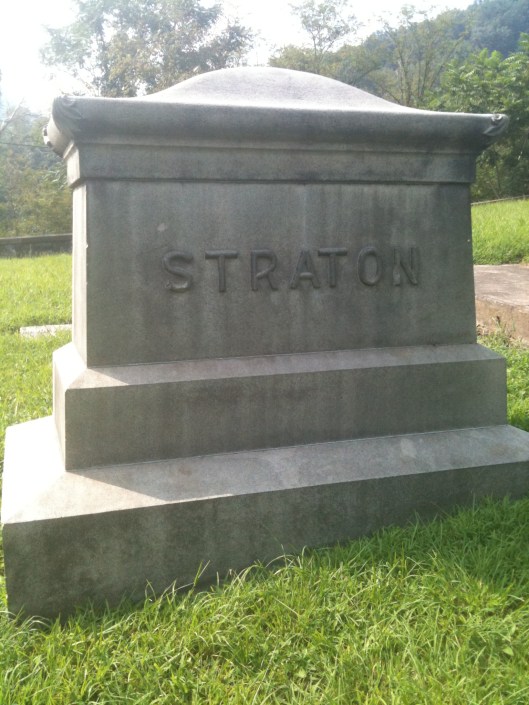
Major William Straton headstone, Logan, WV, 2010

William Straton obituary, Logan (WV) Banner, July 2, 1903
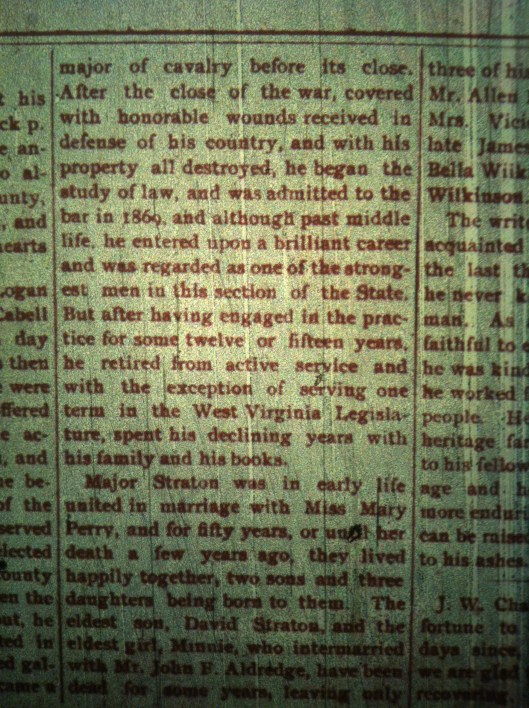
William Straton obituary, Logan (WV) Banner, July 2, 1903
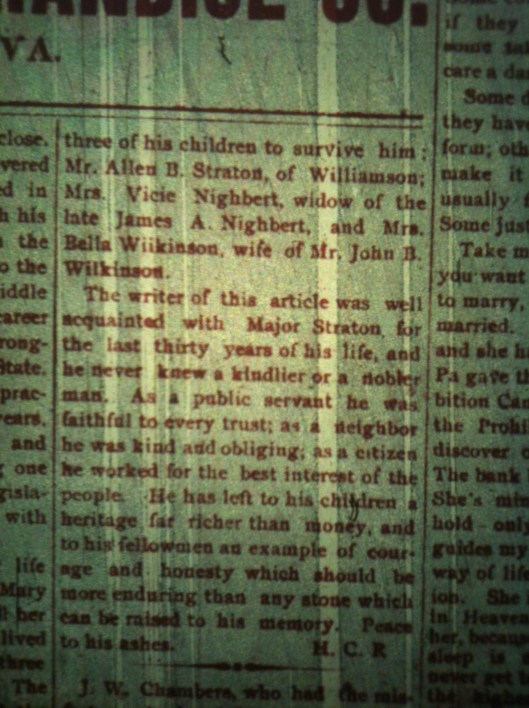
William Straton obituary, Logan (WV) Banner, July 2, 1903
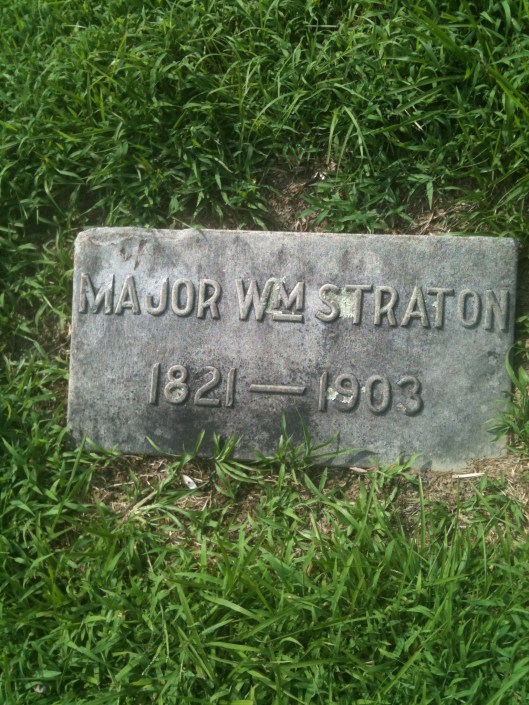
Major William Straton footstone, Logan, WV, 2010
28 Saturday Jun 2014
Posted in Lincoln County Feud, Timber
Tags
Appalachia, Blood in West Virginia, Brandon Kirk, Coal Iron and Slaves, ethnicity, feud, Harts, Historian Laureate of West Virginia, history, industrialization, Kentucky, labor, Ronald L. Lewis, timbering, Transforming the Appalachian Countryside, West Virginia, West Virginia University, writing
I proudly announce Dr. Ronald L. Lewis’ endorsement of my book, Blood in West Virginia: Brumfield v. McCoy. Dr. Lewis, professor emeritus of history at West Virginia University and Historian Laureate of West Virginia, ranks as one of Appalachia’s most distinguished and recognized historians. Best known for his award-winning book, Transforming the Appalachian Countryside (1998), an unsurpassed study of the timber industry in West Virginia, Dr. Lewis is author of five books, beginning with Coal, Iron, and Slaves (1979), as well as numerous articles. Throughout his long career in academia, he has consistently offered top-notch scholarship on the subjects of ethnicity, labor, industrialization, and social change, particularly as they apply to West Virginia and Appalachian history. While I would recommend any one of Dr. Lewis’ writings, his Transforming the Appalachian Countryside remains a personal favorite. Receiving praise from such an outstanding scholar (and personal hero) means a great deal to me.
Here is Dr. Lewis’ endorsement of Blood in West Virginia:
“The family feud is indelibly linked with Appalachia in American popular culture. As portrayed by sensationalist reporters and local color writers of the late 19th century, feuding was evidence of the genetic and/or cultural degeneracy of a people whose lack of social institutions and isolation had arrested their culture in a frontier state as American progress bypassed the region on its way westward. Appalachia was ‘a strange land with peculiar people’ and ‘a place where time stood still.’ Unfortunately, there is not a shred of evidence for this social construction of the region or the ‘hillbilly’ stereotype: that Appalachians were governed by an irrational predisposition to violence. Since the 1980s, scholars have rejected the popular-culture view of drunken hillbillies ready to shoot at the drop of a hat to protect family honor. Brandon Kirk’s Blood in West Virginia is one of the modern community studies that obliterate the stereotype; his intensive research of the Brumfield-McCoy feud that occurred in 1889-90 at Hart, West Virginia, reinforces the revisionist view that feuds occurred as the result of industrial capitalism, rather than the lack of it. Most Appalachian feuds occurred in the mountain counties of southern West Virginia and eastern Kentucky during the last two decades of the 19th century when railroad, timber, and coal development virtually transformed the region’s economy from its traditional agricultural economy into a rural-industrial one. Kirk clearly demonstrates that the Brumfield-McCoy feud was a struggle between rival factions to control the area’s economic and political development. Family ties among the feudists were incidental. Motives for the feud were, therefore, not peculiar to Appalachian culture; after all, violence for economic and political control in industrializing America was as American as apple pie. Blood in West Virginia is an exciting story well-told; fortunately, it is one that preserves the truth rather than perpetuates the stereotypes.”
28 Saturday Jun 2014
Posted in Atenville, Big Harts Creek, Civil War, Green Shoal
Tags
34th Battalion Virginia Cavalry, Admiral S. Fry, Appalachia, Barney Carter, civil war, Harts Creek, history, James M. Merritt, Levi Collins, Logan County, M.H. Waldron, Philip Hager Sr., Spencer A. Mullins, T.R. Ferrell, U.S. South, West Virginia
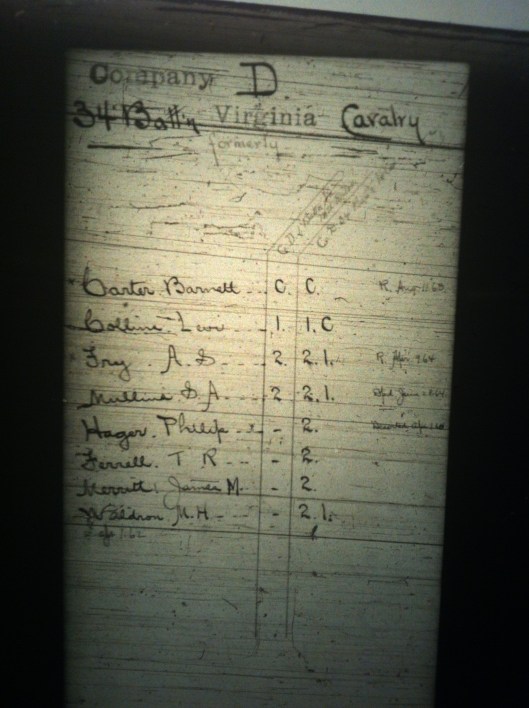
List of officers, Company D, 34th Battalion Virginia Cavalry, CSA
28 Saturday Jun 2014
Posted in Big Harts Creek, Culture of Honor, Ed Haley, Lincoln County Feud, Spottswood, Timber
Tags
accordion, Al Brumfield, Andy Mullins, banjo, Bernie Adams, Billy Adkins, Birdie, Blackberry Blossom, Brandon Kirk, Charles Conley Jr., Chinese Breakdown, Clifford Belcher, Crawley Creek Mountain, Down Yonder, Ed Belcher, Ed Haley, fiddle, fiddler, guitar, Harts, Harts Creek, history, Hollene Brumfield, Joe Adams, John Hartford, Johnny Hager, Logan, Logan County, Milt Haley, music, piano, Pop Goes the Weasel, Raggedy Ann, Soldiers Joy, Spanish Fandango, timbering, Trace Fork, West Virginia, Wirt Adams, writing
Satisfied that we’d taken up enough of Andy’s day, we drove up Trace Fork to see Wirt Adams, an older brother to Joe Adams. Wirt was busy installing a waterbed but took a break to talk with us. “Well, come on in boys, but I’ve only got a few minutes,” he seemed to say. Inside, however, after I had pulled out my fiddle and he had grabbed a mandolin, he seemed ready to hang out with us all day.
I told Wirt that I was trying to find out about Haley’s life. He said old-timers in the neighborhood used to tell stories about Ed playing for dances on Saturday nights with Johnny Hager, a banjo-picker and fiddler. Ed eventually left Harts Creek and got married but came back to stay with his cousins every summer.
Wirt said he sometimes bumped into him in local taverns:
“It was in the forties,” he said. “About ’47, ’48, ’49, ’50 — along there somewhere. We called it Belcher’s beer garden. It was a roadhouse over on Crawley Hill. Well, I just come in there from the mines and Ed was there and he heard somebody say that I was there and he said, ‘Come on over here Wirt and play one.’ I think the fella that’d been playing with him had got drunk and passed out. Well I played one or two with him and then Charley Conley and them boys come in and Charley says, ‘C’mon over here Wirt and get in with us.’ Ed said, ‘Don’t do that, you’re playing with me.’ I really wasn’t playing with him. I had my mine clothes on. I just come in there and picked up Bernie Adams’ old guitar. If you was playing they’d sit you a beer up there — no money in it. Mostly for fun, we thought. We’d gang up on Saturday night somewhere and play a little. Sometimes they’d dance.”
Wirt felt that Ed was “a good fiddler, one of the best in that time.”
I asked him about Ed’s bowing and he said, “It didn’t look like he moved it that far over the whole thing [meaning very little bow usage] but he played tunes where he did use the long stroke. But most of it was just a lot of movement but not no distance. Just hacking, I call it. Him and Johnny Hager were the only two fellas I know who done that.”
Brandon wondered about Ed’s tunes.
“Well, he played that ‘Blackberry Blossom’ — that was one of his favorites — and then he played ‘The Old Red Rooster’ and he played ‘Raggedy Ann’ and ‘Soldiers Joy’. He had one he called ‘somethin’ in the shucks’. I forget the name of it. Anyhow, it was one of the old tunes. And ‘Pop Goes the Weasel’, I’ve heard him play that.”
I asked if Ed played “Birdie” and he said, “Yeah. Now, that’s one of Charley’s favorites. ‘Chinese Breakdown’, that was one of Ed’s. ‘Down Yonder’.”
Wirt told us more about Johnny Hager and Ed Belcher.
“Johnny Hager was a banjo player but he could play the fiddle, too. He played the old ‘overhand’ [on the banjo]. He was a good second for somebody. Now Ed Belcher was a different thing altogether. He played all kinds of stuff. He played classical, he could play hillbilly. He played a piano, he played accordion, he played a banjo, he played a guitar. He was a good violin player. He tuned pianos for a living. Well, I’d call him a professional musician. They had talent shows in Logan. He’d sponsor that. He’d be like the MC and these kids would go in and play. He was a head musician. He was good. He could do ‘Spanish Fandango’ on the guitar and make it sound good. He could play all kinds of tunes. I never could play with him but then he could take the piano and make it talk, too. He was just an all-around musician.”
Brandon asked Wirt if he knew the story about how Ed came to be blind.
“Milt Haley was Ed’s dad,” Wirt said matter-of-factly. “They said his dad was kind of a mean fella and he took Ed out when he was a little kid — held him by the heels — and ducked him in the creek. He had some kind of a fever in wintertime. I’ve heard that, now. Ed never would talk about it. I never heard him mention his dad.”
Wirt had only heard “snippets” about Milt’s death.
“It was pretty wild times,” he said. “I understand the whole thing was over timberworks. These people, they’d have a splash dam on this creek and they’d get their logs and haul them in this bottom at the mouth of Trace — this was one of them. They had a splash dam and when the water got up they’d knock that dam out and that’d carry the logs down to Hart and they had a boom and them Brumfields owned the boom. They charged so much a log. Some way over that, there was some confusion. But I’ve seen Aunt Hollene. She was supposed to been riding behind old man Al Brumfield, her husband, and they shot at him and hit her.”
After Milt was caught, he made a last request.
“They said they asked him if he wanted anything and he wanted them to bring him a fiddle,” Wirt said. “He wanted to play a tune. Now this is hearsay but I’ve heard it several times. They said he played the fiddle and they hung him.”
26 Thursday Jun 2014
Posted in Barboursville, Big Creek, Big Ugly Creek, Hamlin, Leet, Timber
Tags
Albert Gill, Barboursville, Big Sulphur, Big Ugly Creek, C.C. Fry, Charles Bolin, Charles Hendrick, coal, Dixie Toney, Dr. Crockett, Dr. Henley, Ed Reynolds, Edna Hager, Elmer Ferrell, genealogy, ginseng, Hamlin, Henry D. Hatfield, history, Ida Hager, Island Creek, Jeff Duty, Jeff Miller, Jennie Toney, John B. Mullins, John Hunter, Kizzie Toney, Knights of Pythias, Leet, Lenzie Lane, Lincoln Republican, Linnie Gillenwater, Logan County, Lucy Reynolds, Madge Hager, Mary Hager, Maude Toney, Noah Adkins, Paris Bell, Pearl Hager, Philip Hager, pneumonia, Rome Lambert, Sharples, timbering, typhoid fever, West Virginia, World War I
“Observer,” a local correspondent from Leet in Lincoln County, West Virginia, offered the following items, which the Lincoln Republican printed on Thursday, March 11, 1915:
There is an alarming lot of sickness in this vicinity at present.
Mrs. John B. Toney, Mrs. Wirt Toney, Misses Dixie and Kizzie Toney, Edna Hager and Elmer Ferrell are all very ill with typhoid fever. Drs. Crockett and Henley are in constant attendance.
Philip Hager, of Hamlin, is here with his daughter, Edna, who is seriously ill with typhoid fever. Misses Madge, Pearl and Ida Hager are also here with their sister, Miss Edna.
Charles Hendrick of Barboursville, was visiting on the creek Saturday and Sunday.
John B. Mullins has gone to Island Creek, where he has employment.
Business is at a stand still here and work is scarce.
A Knights of Pythias lodge was organized at Big Creek Saturday night. Albert Gill, C.C. Fry, Lenzie Lane and Chas. Bolin, of this place were charter members.
Jeff Miller has rented Philip Hager’s farm at the mouth of Big Sulphur and is preparing for a large crop.
The European war makes flour $9.00 per barrel; coal $1.00 per ton; cuts the price of lumber in halves; doubles the price of sugar and cuts the ginseng market “clean out.” Automatic-reversible-double-action — that war.
In all the criticism of the Governor by the democratic press, we have never seen where they claim that the rates of the Light and Heating Co. ought not to have been reduced. Then if they were too high, why all this hue and cry?
Mrs. General Gillenwater is real sick, being threatened with pneumonia.
Mrs. John M. Hager has been indisposed for several days.
John Hunter has been confined to his room the past week.
The infant child of Mr. and Mrs. Ed Reynolds, born last Thursday, died Sunday.
J.B. Lambert, who is working at Sharples, Logan county, spent Saturday and Sunday with his family here.
Jeff Duty has purchased Paris Bell’s farm. Mr. Bell has purchased the Noah Adkins farm.
26 Thursday Jun 2014
Posted in Big Harts Creek, Lincoln County Feud
Tags
Ben Adams, genealogy, Harts Creek, history, Lincoln County Feud, Logan County, Mary Mullins, West Virginia

First documented account of Ben Adams as a deceased person, 05 August 1910
26 Thursday Jun 2014
Posted in Big Harts Creek, Ed Haley, Lincoln County Feud, Music
Tags
Andy Mullins, banjo, Bernie Adams, Bill Adkins, Bill Monroe, Billy Adkins, Black Sheep, blind, Bob Dingess, Brandon Kirk, Buck Fork, Claude Martin, Dingess, Dobie Mullins, Drunkard's Hell, Ed Haley, Floyd Mullins, George Baisden, George Mullins, Green McCoy, Grover Mullins, guitar, Harts Creek, history, Hollene Brumfield, John Hartford, Logan County, Maple Leaf on the Hill, measles, Michigan, Millard Thompson, Milt Haley, Mona Haley, moonshine, music, Naaman Adams, Roxie Mullins, Smokehouse Fork, Ticky George Hollow, Trace Fork, West Virginia, Williamson, Wilson Mullins, writing
From Naaman’s, we drove out of Trace and on up Harts Creek to see Andy Mullins, who Brandon had met a few months earlier at Bill Adkins’ wake. Andy had just relocated to Harts after years of living away in Michigan; he had constructed a new house in the head of Ticky George Hollow. Andy was a son to Roxie Mullins, the woman who inspired my fascination with Harts Creek. Andy, who we found sitting in his yard with his younger brother Dobie, was very friendly. He treated us as if we had known him for years.
“I was just catting when you fellas come up through there,” Andy said to us. “One of the girls lost a cat down there over the bank last night — a kitten. This morning I went down there and it was up in that rock cliff and I took its mother down there and it whooped the mother. And I took one of the kittens down there and it whooped the kitten. The old tomcat, he come down there and he whooped it. It went back up under that damn rock.”
I liked Andy right away.
We all took seats in lawn chairs in the front yard where Andy told about Ed Haley coming to see his parents every summer when he was a boy, usually with his wife. He described him as having a “big, fat belly” and weighing about 200 pounds.
“He wasn’t much taller than Dobie but he was fat,” Andy said. “I can remember his eyes more than the rest of him because his eyes was like they had a heavy puss over them or something. It was real thick-like. Not like they were clouded or anything.”
Even though Ed was blind, he could get around all over Harts Creek and even thread a needle.
Andy had heard that Milt caused Ed’s blindness.
“They said that Ed got a fever of some kind when he was a baby and Milt went out and cut a hole in the ice and stuck him under the ice in the creek to break the fever,” he said.
Andy knew very little about Milt.
“Just that Milt got killed, that was it, over shooting the old lady down at the shoal below Bob Dingess’ at the mouth of Smokehouse,” he said.
“All the old-timers that knows anything about his daddy is probably dead,” Dobie said.
Brandon said we’d heard rumors that Milt and Green were innocent of shooting Hollena Brumfield and Andy quickly answered, “That’s what my father-in-law told me.”
Changing the conversation back to Ed, Andy said, “Ed used to go up on Buck Fork to George Mullins’ to stay a lot and up to Grover Mullins’. He lived just above George’s place — the old chimney is the only thing still standing.”
He also went up in the head of Hoover to see George Baisden, a banjo-picker who’d hoboed with him in his younger days. The two of them had a lot of adventures, like the time Ed caught a train at Dingess and rode it over to Williamson to play for a dance or at a tavern. Just before they rolled into town, George pushed him off the train then jumped off himself. It made Ed so mad that George had to hide from him for the rest of the night.
I asked Andy if Ed ever told those kind of stories on himself and he said, “He told big tales, I’d call them, but I don’t remember what they were. Well, he set and talked with my grandmother and grandfather all the time he was here, and Mom. I never paid any attention to what they talked about really. I guess, man, I run these hills. I was like a goat. Hindsight is 20/20.”
Not long into our visit with Andy, he got out his guitar and showed me what he remembered about Bernie Adams’ guitar style. From there, he took off on Bill Monroe tunes, old lonesome songs, or honky-tonk music, remarking that he could only remember Ed’s tunes in “sketches.”
I asked, “Do you reckon Ed would sing anything like ‘Little Joe’?” and he said, “I don’t know. It’s awful old. I heard him sing ‘The Maple on the Hill’. He played and sang the ‘Black Sheep’.”
“He played loud, Ed did,” Dobie said.
“And sang louder,” Andy said immediately. “He’d rare back and sing, man.”
The tune he best remembered Ed singing was “The Drunkard’s Hell”.
I wanted to know the time frame of Andy’s memories.
“1944, ’45,” he said. “I was thirteen year old at that time. Now in ’46, we lived across the creek up here at Millard’s. Him and Mona Mae and Wilson — they wasn’t married at the time — went somewhere and got some homebrew and they all got pretty looped. That was up on Buck Fork some place. Ed got mad at Wilson and her about something that night and that’s the reason they didn’t play music — him and Claude Martin and Bernie Adams.”
I asked Andy about Ed’s drinking and he said, “Just whatever was there, Ed’d drink. He didn’t have to see it. He smelled it. Ed could sniff it out.”
Brandon wondered if Ed ever played at the old jockey grounds at the mouth of Buck Fork. Andy doubted it, although it sure seemed to me like the kind of place for him to go. There was moonshine everywhere and men playing maybe ten card games at once.
“They’d get drunk and run a horse right over top of you if you didn’t watch,” Andy said. “It was like a rodeo.”
The last jockey ground held at the mouth of Buck Fork was in 1948.
25 Wednesday Jun 2014
Posted in Big Harts Creek, Lincoln County Feud, Women's History
Tags
Angeline Lucas, Cain Adkins, genealogy, Harts Creek, history, Lincoln County, Lincoln County Feud, Mariah Adkins, Mary Jane Jordan, photos, Wayne County, West Virginia

Mary Jane (Adkins) Jordan and Angeline (Adkins) Lucas-Adams, daughters of Cain and Mariah (Vance) Adkins, residents of Wayne County, WV
25 Wednesday Jun 2014
Posted in Big Ugly Creek, Leet, Rector, Timber
Tags
Albert Wall, Charleston, Dr. Crockett, Edna Hager, genealogy, history, Huntington, Island Creek, John B. Mullins, Leet, Lincoln County, Lincoln Republican, Miss Doyle, Rector, Sheridan, T J Bolin, timbering, typhoid fever, Webb Terrill Gillenwater, West Virginia
“Observer,” a local correspondent from Leet in Lincoln County, West Virginia, offered the following items, which the Lincoln Republican printed on Thursday, March 18, 1915:
W.T. Gillenwaters, of Rector, was a business visitor here Tuesday.
Dr. Crockett returned from Charleston Sunday, where he had been on important business.
T.J. Bolin spent Sunday with his family in Huntington.
Albert Walls will move to Sheridan in a few days. We regret to lose Mr. Walls, as he is one of our best citizens, but wish him success in his home.
Miss Doyle, a trained nurse of Huntington, is here in charge of Miss Edna Hager, who is very low with typhoid.
John B. Mullins, who is employed on Island Creek, spent Sunday with his family near this place.
The big lumber mill at this place only runs about one-third time now. The boys here that voted for the party that put lumber practically on the free list have thoroughly repented and say they will never do so any more.
There are several cases of typhoid on the creek above here and we are informed they are no better.
25 Wednesday Jun 2014
Posted in Big Harts Creek, Culture of Honor, Ed Haley, Lincoln County Feud, Spottswood
Tags
Ben Adams, culture, feuds, Harts Creek, history, life, Lincoln County Feud, Naaman Adams, photos, Trace Fork, U.S. South, West Virginia, Winchester rifle

Naaman Adams was an excellent source of information regarding the old Adams family feuds, 1996
Writings from my travels and experiences. High and fine literature is wine, and mine is only water; but everybody likes water. Mark Twain
This site is dedicated to the collection, preservation, and promotion of history and culture in Appalachia.
Genealogy and History in North Carolina and Beyond
A site about one of the most beautiful, interesting, tallented, outrageous and colorful personalities of the 20th Century
 Brandon Ray Kirk