Tags
Appalachia, crime, culture, Floyd Farley, Harts Creek, history, life, Logan County, photos, U.S. South, West Virginia, writing

Floyd Farley, West Virginia deputy sheriff

08 Saturday Dec 2012
Posted in Culture of Honor
Tags
Appalachia, crime, culture, Floyd Farley, Harts Creek, history, life, Logan County, photos, U.S. South, West Virginia, writing
Floyd Farley, West Virginia deputy sheriff
08 Saturday Dec 2012
Posted in Culture of Honor
Tags
Appalachia, crime, culture, history, life, Logan County, photos, U.S. South, West Virginia, writers, writing
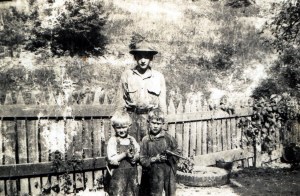
Harts Creek Children, circa 1938
08 Saturday Dec 2012
Posted in Ed Haley
Tags
Appalachia, Big Sandy River, Ceredo, Clifton Mullins, Connie Mullins, culture, Ed Haley, fiddler, genealogy, Guyandotte River, Harts, Harts Creek, Hatfield-McCoy Feud, history, Huntington, Imogene Haley, John Hartford, Johnny Hager, Kenova, Lawrence Haley, Logan County, Loretta Mullins, music, Pat Haley, Peter Mullins, Trace Fork, U.S. South, West Virginia, writing
Early the next morning, Lawrence and I boarded my Cadillac and drove out of Ashland across the Big Sandy River into West Virginia. We drove past little towns named Kenova and Ceredo on I-64 then turned off onto Route 10 just south of Huntington. For the next hour, we weaved our way on this curvy, two-lane road toward Harts, cruising past small settlements named Salt Rock, West Hamlin, Pleasant View, Branchland, Midkiff and Ranger — all situated on the Guyandotte River. Finally, after what seemed like an eternity, we saw a tiny green and white sign planted to the right of the road reading “Harts, Unincorporated.” Just past it was a beautiful two-story white home, which Lawrence quickly pointed out as the place where Ed’s mother was murdered in the Hatfield-McCoy Feud. Excited, I quickly pulled over and took a picture, then took off in a cloud of gravel and dust.
Lawrence and I turned right onto a narrow paved road and snaked our way up Harts Creek, bypassing a high school, trailers, Depression-era framed houses and newer brick homes. It was beautiful country. Cold weather was barely gone and the hillsides were a faint blush of green buds. Lawrence motioned toward the creek — which was up somewhat due to spring rains — and told again how difficult it was to get up Harts Creek in his younger days.
“Biggest part of the time, you was down in the creek bed there, if the weather was right. If it was times like this you had to take to the hillside but the road usually followed the creek bed. It seemed like it took us all day walking up here, but they didn’t have the roadway up on the side of the hill like this.”
After a ride of some fifteen minutes, we reached Trace Fork, the place where Ed Haley was born over one hundred years ago. We drove a short distance up the branch to the site of Peter Mullins’ cabin, which had burned or been torn down about fifteen years earlier. Lawrence pointed out the only remaining relics from the original farm: a lonely tree and an old smokehouse.
After taking in the sights and smells, we went to see Joe Mullins, who lived in a small white house just down the bottom. We first met Joe’s daughters, Connie and Loretta, who said Joe had gone to Chapmanville and would probably be out for most of the day. Lawrence introduced himself as “Ed Haley’s son,” which caused Connie to giggle and say, “Oh, yeah. Don’t we have a picture of him?”
Loretta said, “We got a lot of pictures.”
“The old fiddle,” Connie said. “Remember the old fiddle that used to be up there in that old house?”
What old house?
“That old smokehouse up there at the old house,” Connie said. “There was an old fiddle up in the top of it.”
There was more giggling, as if the two had just shared a secret joke.
I said to Connie, “You don’t think you could find that do you, just to see it?”
She said, “No, I doubt it.”
Loretta said, “We could probably find the picture.”
Boy that would be great.
“I don’t know about right this minute. How long are you gonna be around?”
“Long enough for you to find that picture,” I said.
The next thing I knew, Connie walked us to Uncle Peter Mullins’ old smokehouse and flung open a door. I took a few steps inside — past old furniture and piles of God-knows-what — and quickly spotted a decorative metal lid with Ed and Johnny Hager’s picture on it. In the picture, a copy of which I had first seen at Lawrence’s, Haley was slim and decked out in a suit with a derby and dark glasses. Hager stood beside him with a banjo. Lawrence said it was taken at White Sulphur Springs in eastern West Virginia.
At some point, Connie showed us a large, framed portrait of a woman she identified as Ed’s mother, Emma Jean Haley — the same picture Pat Haley had seen on her visit to Harts Creek several years ago. Connie said Lawrence could have both pictures.
07 Friday Dec 2012
Posted in Culture of Honor
Tags
Appalachia, crime, culture, Harts Creek, Henry Mullins, Logan County, photos, U.S. South, West Virginia, writing

Henry Mullins, 1890-1905
04 Tuesday Dec 2012
Posted in Ed Haley
Tags
Appalachia, Ashland, banjo, Chapmanville, Charley Gore, East Tennessee Blues, Ed Haley, Ethel, fiddle, fiddler, fiddling, Fire on the Mountain, Great Depression, Harts, Harts Creek, Hell Among the Yearlings, history, Ira Gore, John Hartford, Johnny Hager, Kentucky, Lawrence Haley, Lee Trick Gore, Liza Mullins, Logan County, Mag Gore, Mona Haley, music, Ode Curry, Peter Mullins, Stoney Ferrell, The Dying Californian, U.S. South, West Fork, West Virginia, Wild Horse
Later in the evening, Pat put me in touch with Lee “Trick” Gore, an Ashland preacher and musician who remembered Ed Haley from his childhood days on Harts Creek. We met Gore the following day at his home in what was my first meeting with someone from Ed’s birthplace. He was a polite man with a loud clear voice, somewhat thick in stature and decked out in a tie and button-up sweater.
“I understand what you’re trying to do,” Gore said right away.
It wasn’t long until he and Lawrence were in a deep discussion about the people and places in and around Harts.
“We used to spend a week or two with Aunt Liza or Uncle Peter,” Lawrence said, prompting Gore. “Most of the time we’d ride the train up there and get off at Harts. They run passenger trains up into coalfields then. We’d get off there at the mouth of Hart and walk up and it was nothing but creek. You’d ford that creek a dozen times trying to stay close to the road and the road was in the creek half the time. You had to wade the creek half the way up through there. It’d take us half the day it seemed like.”
Lawrence said his father spent some time in Chapmanville, a town upriver from Harts about nine miles.
“I remember staying in Chapmanville, too. There was a beer joint or something that Pop wanted to stop at. They was some guy in there got to down-mouthing Pop. Stoney Ferrell, that’s exactly who it was. This guy kept aggravating him and Pop just edged toward his voice, you know. Instead of carrying a blind man’s cane, Pop carried a big heavy cattle cane. He got pretty close to him and he reached out and grabbed him around the neck with that cane.”
Gore said Ed used to come see his uncle Charley Gore at Ferrellsburg, a settlement about two miles upriver from Harts.
“Uncle Charley was a fiddler,” he said. “Charley was the principal of the school and Ed stayed with him. Well, once a year he’d happen by. That was right on the heels of the Depression. I was twelve. I was just learning to play the guitar then.”
Gore looked at Lawrence and said, “Either you or Mona was leading him.”
I asked Gore what Ed looked like at that time and he said, “He just dressed ordinary. He never dressed up, but he wasn’t dirty looking or nothing like that — just old-fashioned.”
He stopped for a moment, lost in thought, then said, “He was just something else. He was far ahead of a lot of fiddlers, buddy. There wasn’t none of this grinding on that violin. When he played it, it was just as smooth in that bow hand. I know he played ‘Hell Among the Yearlings’, ‘Fire on the Mountain’ and ‘The Wild Horse’. Uncle Charley played those tunes, too. I guess he learned them from Ed Haley.”
“I wish my daddy was alive,” Gore said. “Boy, he could tell you about Ed Haley because he loved him. Uncle Charley loved him dearly. And Ed knew that he was welcome at our house and that’s where he hung his hat buddy — where he was welcome. Do you know how I think of him? I think of him as kind of a mountain poet. He sung religious songs and them old mournful mountain tunes. It seems to me like he sung a song called ‘The Dying Californian’. I can’t remember the poetry to it, but it was a mile long.”
Ed sang while fiddling it.
Gore said Ed sometimes traveled with “Little Johnny” Hager, a banjo player who used to stay weeks at a time with his family when he was a boy. Lawrence Haley had shown me a picture earlier of Ed with Johnny Hager in Webster Springs in 1914.
I asked Gore if he knew that Ed could play the banjo and he said, “Seems like I heard him play it when him and Johnny was together. No doubt he could play it.”
Gore asked Lawrence if he remembered a man his father used to play with named Ode Curry (he didn’t), then said, “Ode Curry was just a fella that played the banjo and sang and he had a big nose, as well as I remember, and it’d vibrate when he’d sing because he sung through his nose. But let me tell you something: they would give him all he could drink to play and Ode knew some of the lonesomest, heart-breaking songs you ever listened to.”
Gore got his guitar and sang several songs for me, then whistled the melody for “East Tennessee Blues” and named it as one of Haley’s tunes. He said, “That’s funny how things come back to you when you sit down and get to talking about it, and reminiscing.”
I encouraged him to “play another tune and see what it stirs up,” so he strummed and whistled out a few more melodies.
At some point, Gore’s wife said she remembered seeing Haley play at Logan Court House and in a nearby coal town named Ethel.
Just before Lawrence and I left, Gore called his 85-year-old aunt, Mag Gore, about Haley. “Mag was a singer,” he said. “She married Ira Gore, her third cousin. She couldn’t get out of the Gore family.” He spoke with her briefly on the phone, then told us: “The only thing she remembers was that her husband Ira went to town one day and Ed Haley come home with him because Ira had a little bit of that good ol’ ‘moon’ they make over on the West Fork. They was a sipping that a little bit.”
West Fork, Gore said, was a tributary of Harts Creek with its headwaters in Logan County.
02 Sunday Dec 2012
Posted in Ed Haley
Tags
2144 Greenup Avenue, Appalachia, Ashland, Ashland Cemetery, Bake Lee, Bill Bowler, Charlie Ferguson, Ed Haley, Ella Haley, fiddle, fiddler, fiddling, Freeman's Shoe Store, Ghost Riders in the Sky, guitar, history, Imogene Haley, Ironton, John Hartford, Kentucky, Lawrence Colliver, Lawrence Haley, Lazear Funeral Home, Logan County, Milt Haley, music, Noah Haley, Ohio, Over the Waves, Pat Haley, Patsy Haley, radio, Steve Haley, The Shadow, U.S. South, West Virginia, Winchester Avenue, writers, writing
I asked about Ed during that time period. Lawrence said he stayed in a little room just back of the kitchen, which was furnished with a chair, cot, wardrobe and small radio. His fiddle was always on top of the wardrobe, although he seldom played it.
“He listened to the radio quite a bit,” Lawrence said. “You surely have heard of Vaughn Monroe, his version of ‘Ghost Riders in the Sky’. Pop had a transistor radio he carried up to his ear. ‘Goddamn,’ he’d let out, ‘That’s some tune.’ Cause he felt hell was a place where you had to do something you done all your life. I never heard him try to play it but he’d listen to it and listen to it. He’d say, ‘That’s some hell, ain’t it?'”
Pat said, “Pop would shiver when he would hear ‘Ghost Riders in the Sky’. Pop heard it once or twice on that little radio he carried, and he kept his ear right to it.”
I found it strangely odd that Haley had such a high opinion of the tune — maybe he just liked the words.
The cowpokes loped on past him and he heard one call his name,
If you want to save your soul from hell a-riding on our range,
Then, cowboy, change your ways today, or with us you will ride,
A-trying to catch the devil’s herd across these endless skies.
Yippee-yi-ya, yippee-yi-yo, ghost riders in the sky.
Lawrence said Ed eventually gave up on music broadcast over the radio and started tuning in to programs like “The Shadow.”
“We had a great old big crank-up record player and we had a great old big stack of thick RCA records a quarter of an inch thick, I guess,” he said. “They played a lot of them. I guess they learned some pieces of music off of that. ‘Over the Waves’, I guess that’s been around for a hundred years. Pop was pretty good at those slow pieces, too.”
Pat said she never had a real conversation with Ed, so I guess he kind of kept to himself. She remembered him having a white, foot-long beard, which he was very proud of and combed out every day. She said she had a picture of him with Lawrence and Ella in the back yard at 2144 Greenup but couldn’t find it. It was taken in the fall of 1950, when Lawrence was called back into the service.
Around that time, Bill Bowler, a blind guitar player in town, came and asked Ed to play a gig for the grand opening of Freeman’s Shoe Store in Ironton, Ohio. It was kind of a big deal — there was some type of parade going on. Pat said, “We were so happy somebody had finally got him out because he just all of a sudden stopped playing.” Lawrence drove the two over in his brother Noah’s car, then came home. Pat said, “Larry had hardly got back and was telling his mother, ‘Yes, he sat Pop down with Bill Bowler,’ and the next thing we knew Pop came through the front door just cursing a blue streak.” Something had really upset Ed at the shoe store, but the family never did know what happened or how he made it home. Lawrence said, “He just saw that they wasn’t nothing over there for him. He didn’t tell me that I done wrong by taking him over there or anything. He just wasn’t happy, so he didn’t stay.”
Not long afterwards, Lawrence saw his dad play for the last time at Charlie Ferguson’s. He said Noah got him so drunk that he sat down on the floor and played until he fell over. I wanted Lawrence to show me how Ed was playing at Ferguson’s, which he did after joking, “Now John, I don’t want you to involve me in what my dad did.” As he sat there in the floor with my fiddle, Pat laughed and said, “Oh boy, this was a good idea.”
Pat told me about February 3, 1951, the snowy day Ed passed away at home.
“It was very, very cold. My son Stephen was born January 27th, and it was exactly a week later. Pop was in the front room listening to the radio and he came through our bedroom around three o’clock. He had my daughter Beverly on his shoulders and he took her off and he rubbed his head in her tummy and he said, ‘Mmm, you smell so good. You don’t smell like those pissy-ass babies out in the country.’ The children in the country apparently didn’t wear diapers a lot of times and we always kept rubber pants on Beverly and of course the baby powder. After my father-in-law had played with my little girl, he went through and asked my sister-in-law, ‘Patsy, when will supper be ready?’ She was fixing dinner and she said, ‘Aw shortly, Pop.’ And he said, ‘Well I’m going to take a nap.’ He had a room in the back of the house. And we had a nephew Ralph Mullins living with us. He was born in 1946, so he was about five years old. And he took little cars and he was running them up and down while Poppy was napping.”
Pat said, “And when Patsy got dinner ready, she called for Pop to come to the table. My mother-in-law got a little bit irritated because Pop didn’t come. Larry and his brother Jack had been working on a car outside and they went in to check Pop.” Lawrence said, “Mom went in and lifted up his hand and said, ‘Ed.’ Shook his hand, you know. She said, ‘I can’t get him awake. I know he’s alive. I can hear him breathe.’ Well, when she was lifting up his hand, you know, she was pumping out his last breath of air.” Pat said, “And the boys told their mother then that Pop was dead. But the whole time Ralphy had been playing with his cars, so Pop apparently did not cry out in pain. That was it. He just passed away. It was a massive coronary that took him.”
“Pop died just as peaceful a death as could be, I reckon,” Lawrence said. “He died in his sleep.”
When the Ashland newspaper ran Ed’s obituary on Sunday, February 4, 1951, it mistakenly referred to him as the “flower huckster” of Winchester Avenue. Much to the embarrassment of the family, the newspaper had confused Ed with Bake Lee, a blind man in the area who sold pencils and flowers on sidewalks. Bake usually worked the streets with his wife, Lula Lee, an old schoolmate of Ella’s who played the mandolin and French harp.
“Mr. Haley, who had been blind for 65 years, was a familiar figure on Ashland’s streets, having sold flowers in the 1400 block on Winchester Avenue for several years,” the paper partially read. “A resident of Ashland for 35 years, he was born in Logan County, W.Va., a son of Milton and Emma Mullins Haley.”
Lawrence showed me a copy of his father’s corrected obituary: “HALEY: Funeral services for James Edward Haley, 67, retired musician, who died Saturday at his home, 2144 Greenup Avenue, will be conducted at 2 p.m. tomorrow at the Lazear Funeral Home with the Rev. Lawrence Colliver officiating. Burial will be in AshlandCemetery. The body is at the funeral home.”
No one played the fiddle at Ed’s funeral.
“Had a little organ music,” Lawrence said. “I don’t reckon they was anybody he’d care for playing at his funeral.”
Pat said she heard that Ed didn’t look “natural” because the funeral home had shaved off his white beard. Ella had his favorite flower, morning glory, carved on his tombstone.
30 Friday Nov 2012
Posted in Big Harts Creek, Big Sandy Valley, Fourteen, Harts
Tags
A.L. Smith, Adkins Conspiracy Case, Albert Adkins, Arty Fleming, Bill Brumfield, Charleston Gazette, Charley Brumfield, Christian Fry, Cosby Fry, crime, Dan Cunningham, Elizabeth Fry, Elizabeth Lizzie Fleming, Elliott Northcott, Emory Mullins, Fed Adkins, Fourteen Mile Creek, Harts Creek, Henry Mullins, history, J.P. Douglas, Jake Davis, John Fleming, John H. Mullins, John Henan Fry, Kentucky, Lace Marcum, Lillie Fleming, Lincoln County, Logan County, Luraney Fleming, Man Adkins, Margaret Adkins, Pike County, Preston Fleming, Raleigh County, Robert Fleming, Rosa Mullins, Squire Dial, Thomas H. Harvey, Upper Elkhorn Creek, West Virginia, Willard Fleming, Willard Frye, William Brumfield, William Fleming, William M.O. Dawson, writers, writing, Wyoming County
Over one hundred years ago, John Fleming, a desperado twice sentenced to serve time in the West Virginia State Penitentiary, escaped from the Lincoln County jail and disappeared forever in the mountains of the Big Sandy Valley.
John P. Fleming was born in February 1868 to Preston and Arty (Mullins) Fleming at Upper Elkhorn Creek in Pike County, Kentucky. Nothing is known of his early life except that he had a daughter named Roxie by Lucy Mullins in 1887. In the late 1880s, John and his family migrated to West Virginia and settled in the Abbott Branch area of Logan County, just above Harts Creek. In 1891, his brother William married Luraney Frye, a daughter of Christian and Elizabeth (Hunter) Frye, in Logan County. In 1897, his sister Sarah married Squire Dial in Logan County. The next year, brother Robert, or Bob, married Lillie Dempsey, also in Logan County.
On December 25, 1892, Fleming murdered his uncle, John H. Mullins, at Big Creek, Logan County. Essentially, the story went like this: Mr. Mullins’ sons, Henry and Emory, were in a quarrel and Fleming intervened. The elder Mullins came to settle the matter and Fleming fled across a creek. Mullins pursued, knife in hand. At the creek, Fleming shot his uncle. He was immediately taken before Squire Garrett, who discharged him. When a new warrant was sworn out for him, he fled the county. In March of 1893, his wife attempted to meet him but became ill and died at Dunlow, Wayne County. Fleming was at her bedside when authorities arrested him. A Logan County jury found him guilty of second degree murder and Judge Thomas H. Harvey sentenced him to eighteen years in the West Virginia state penitentiary in Moundsville. In the 1900 census, he is listed there under the name of “J.P. Flemons,” inmate. Curiously, he claimed to have been married for one year.
During Fleming’s incarceration, his siblings continued to marry into local families. In 1900, brother Willard married Caroline Caldwell, a daughter of Floyd Caldwell, in Logan County. In 1902, sister Lucy married James F. Caldwell, a son of Hugh Caldwell, in Logan County. Around 1903, brother George married Minnie Tomblin.
After his release from prison, John married Sarah Elizabeth “Lizzie” Frye, a daughter of John Henan and Ida Cosby (Headley) Frye. The Fryes lived on Sulphur Springs Fork of Fourteen Mile Creek, several miles below Harts Creek. Lizzie, born around 1887, was roughly eighteen years younger than John. They may have become acquainted through John’s brother, William, who had married Lizzie’s aunt, Luraney Frye, in 1891.
“Aunt Lizzie was married to John Fleming,” said Willard Frye, an elderly resident of Frye Ridge, in a 2003 interview. “John was a mean man who packed two .45 pistols. He was a member of Charley Brumfield’s gang. He was mean to Aunt Lizzie.”
Fleming’s involvement in the Brumfield gang soon led to more prison time. In the summer of 1907, the “feudist,” as newspapers would later call him, became entangled in the peculiar “Adkins conspiracy case.”
A little earlier, in December of 1906, Margaret Adkins, Fisher B. Adkins, Floyd Enos Adkins, Albert G. Adkins and Fed Adkins — all associates in an Adkins general store business in Harts — took out a four-month loan for $600 from the Huntington National Bank. By April 1907, they had not paid any money toward the loan and asked for a four-month extension. In late June or July, Margaret Adkins, sister to Fed, filed a bankruptcy petition. On July 3, the District Court of the United States for the Southern District of West Virginia adjudged her bankrupt. J.P. Douglass (later a Speaker of the West Virginia House of Delegates) was appointed as receiver in the case and arrived in Hart to survey the business. A.L. Smith stood guard at the store.
On July 5, after the government had taken control of the merchandise in the store, a vigilante group called the Night Riders robbed the store and hid the various goods in neighbors’ homes and barns.
Following the robbery, detectives descended on Harts in an effort to unravel the details of the crime. The most famous of these detectives was Dan Cunningham, a one-time participant in the Hatfield-McCoy Feud. More recently, Mr. Cunningham had been employed by Governor William M.O. Dawson in Raleigh and Wyoming Counties. During his Harts Creek investigation, he boarded with locals and eavesdropped on conversations between suspects. Those involved in the store heist, meanwhile, used various means to suppress information. But as the pressure of the investigation bore down on locals, neighbors began to snitch on each other.
By December of 1907, the State had evidence against eleven men in what the Charleston Gazette called “the celebrated Adkins Bankruptcy Case” which “if proven by witnesses for the government, will equal any novel ever written by Victor Hugo.” Those accused — described by the Huntington Herald-Dispatch as “eleven brawny mountaineers” — were Fed Adkins, Charles Brumfield, Albert “Jake” Davis, Manville Adkins, John Fleming, Willard Fleming, Robert “Bob” Fleming, John Adkins, Albert G. Adkins, Floyd Enos Adkins and William “Bill” Brumfield. The state charged the gang with “conspiracy to defraud the government and to impede the administration of justice after the government had taken possession of Adkins store.”
U.S. District Attorney Elliott Northcott prosecuted the case, while Lace Marcum argued for the defendants. In opening remarks on December 5, according to the Herald-Dispatch, District Attorney Northcott fiercely denounced “the eleven men who have been a terror to the country surrounding the village of Hart, in Lincoln county, for the past six months. He stated in words burning with bitterness that the government expected to prove beyond any reasonable doubt that crimes that would narrow the very souls of every juror had been committed in the vicinity of Hart, and had the story been told him three weeks ago he would have thought it a piece of fiction pure and simple… He also alluded to the fact that the government would prove by witnesses who would tell of the horror that had been created in the neighborhood: houses burned, men shot down from ambush, houses with unprotected women had been shot up and the inmates terrorized until they were afraid to venture outdoors. It was a thrilling recital of the worst crimes that have taken place in this state in a decade.” According to the Herald-Dispatch, the eleven defendants “showed but little interest except to look at each other and smile when the crimes were talked of.”
In Marcum’s opening remarks on December 5, he stated that he would prove the goods found at the homes of the defendants were there several weeks before the Adkins store went bankrupt.
On December 6, Northcott questioned Rosa “Sis” Mullins, a sister to Emory and a resident of Abbotts Branch, who swore that she saw John Fleming’s brothers — Bob and Willard — go by her house the night of the robbery on their way to the Adkins store.
“Nearly every witness who testified yesterday,” the Charleston Gazette reported on December 7, “showed just how desperate these defendants are, and the testimony of Capt. Dan Cunningham unraveled a tale of horror that was realistic in every sense of the word.”
On December 7, Lace Marcum began his defense of John Fleming and the ten other Harts men. Bob Fleming, John’s brother, was the second witness called to the stand. He swore that he knew nothing of the robbery until the day after it happened and that he never saw any of the stolen goods. Willard Fleming, John’s other brother, said he stayed with Charley Brumfield the night of the robbery and saw no one armed. John, referenced in one newspaper account as being a “paroled prisoner,” testified along the same lines, as did all the defendants who were called to the stand. “The entire list of defendants swore to very near the same thing,” reported the Gazette.
For the most part, Marcum’s defense of the eleven Harts men had little chance of success considering the evidence against them. In his closing remarks, he was forced to put them at the court’s mercy by claiming that they had acted the way they did because they didn’t know any better. In the end, ten of the accused were sentenced to twelve- or eighteen-month terms in the West Virginia state penitentiary.
30 Friday Nov 2012
Posted in Ed Haley, Music, Spottswood, Warren
30 Friday Nov 2012
Posted in Ed Haley
Tags
Appalachia, blind, Ed Haley, Ella Haley, feud, fiddler, Harts Creek, Hatfield-McCoy Feud, history, Imogene Haley, Joe Mullins, John Hartford, Lawrence Haley, Liza Mullins, Logan County, Milt Haley, music, Pat Haley, Peter Mullins, Stella Mullins, Trace Fork, U.S. South, West Virginia, writing
I told Lawrence that I wanted to know about Ed Haley’s early life but he said he really wasn’t old enough to know much about his father’s younger days.
“My dad was 45 years old, I guess, when I was born,” he said. “He was born in 1883 and I was born in 1928. That was about 45 years. I know my mother was 40 years old and to the best of my knowledge my dad was five years older. She was born in ’88 and he was born in ’83.”
Lawrence said his father was born on the Trace Fork of Harts Creek in Logan County, West Virginia. He was the only child of Milt Haley and Emma Jean Mullins. Milt was partly responsible for causing Ed’s blindness, according to one story that Lawrence had heard on Harts Creek, which he reluctantly told.
“We was up there approximately seven years ago and we stopped over on Harts Creek and visited with my dad’s first cousin, Joe Mullins,” Lawrence said. “He told me that when my dad was very young — he couldn’t a been over two or three — he had the measles or some childhood disease. And when his father came in from working in the timbers that evening he didn’t like the whiny way my dad was acting. It was the dead of winter. They was ice on the creeks. So to make him more of a man and cut out his babyish crying, he took him out and held him by the feet and dropped him in a rain barrel through the ice. Now according to my cousin Joe that’s partly what caused my dad to go blind.”
What? That wasn’t in the Parkersburg Landing liner notes.
“Now, I don’t know for sure about that,” Lawrence said. “That’s hearsay. I don’t want to bad-mouth anybody — my granddad or anybody — this many years after everybody’s in the ground and forgot about.”
Lawrence said Ed’s mother Emma Jean Haley was killed not too long after the rain barrel incident. “During the end of the Hatfield-McCoy feud, other families became involved. Pop’s mother Emma Jean was down at the mouth of Harts Creek visiting some feudists — seems like they were Brownings — when two or three people came to the door looking for somebody. I don’t know his name, whether he was a McCoy or Hatfield or some other person that had allegiance to one of them. And when my grandmother opened the door, they thought that he was going to answer the door so they just shot her and killed her. Now, that’s hearsay. I heard that story and that’s all I can tell you about that.”
I asked if the house was still standing and Lawrence said, “I don’t think so. It was a big two-story house. The best I can remember, it had a double porch on the front. It was standing there when I was just a little small child.”
Pat said she’d seen a picture of Ed’s mother during a visit to Joe Mullins’ place on Harts Creek several years ago. “Joe and his wife Stella had this beautiful enlarged picture and it was framed,” she said. “It was laying in some back room up there in Joe’s house. I don’t think it was on the wall, because it was very, very dusty when she brought it in to show me. And she said, ‘This is Larry’s grandmother,’ and she made a statement to the effect of, ‘We’ve no use for it.’ This lady has since passed away, but Joe should have the picture because it’s just been a few years ago.”
Already, I could see plenty of inspiration for a musician: tragic blindness — a cruel father — a murdered mother — an orphan alone in the world.
I asked Lawrence what happened to his grandfather Milt Haley and he said, “Apparently he stayed around there. Joe told me he’s buried somewhere down on Harts Creek in a cemetery. He apparently didn’t raise his child. Uncle Peter Mullins and Aunt Liza Mullins raised my dad after his mother was killed. My dad’s mother must have been an older sister to Uncle Peter.”
Uncle Peter, Lawrence said, was nicknamed “Club-Foot Peter” because one of his feet was “turned in.” He was the father of Joe Mullins, the source for many of Lawrence’s stories. “I guess Joe is about as old as my brother, Clyde. He might be around 70 now. He was a lot younger than my dad.”
Lawrence wasn’t sure when his father left Uncle Peter’s household.
“I guess he left when he got old enough to get out and start playing music,” he said. “I would say he was sixteen, seventeen, eighteen. People’d come after him to go play music.”
30 Friday Nov 2012
Posted in Timber
Tags
Guyandotte River, Henlawson, Hewett Lumber Company, history, Logan, Logan County, Lucian Mitchell, Paris Brumfield, rafting, timbering, West Virginia, writers, writing
In the early decades of the twentieth century, Fred B. Lambert, a local historian and educator in southwestern West Virginia, interviewed Lucian Mitchell of Henlawson, Logan County, regarding his memories of the rafting industry in the Guyandotte Valley.
“I was born July 20, 1885,” Mitchell began. “I ran many rafts. I worked for the Hewett Lumber Company about 1922 for 5 years and then for Jeff Gill, who bought and sold lumber. I often went on rafts and put up at Guyandotte with the Stephenson Hotel.”
In those days, thousands of Guyan Valley logs were tied into rafts and piloted down the river by pilots to the now defunct town of Guyandotte.
“It took two days to get out from Logan,” Mitchell said. “The man on the bow of the raft didn’t have to know much. The man at the stern knew where to go, where the shoals were and how to work up to the point on a hard bend and knew the Jordan sands at the mouth of Bear Creek.
“Sometimes a raft would cork the river by bowing and swinging around in such a position as to get both ends foul. If another raft came down it was rulable to hit this raft in the middle and cut it in two pieces. Most raftsmen could swim so not many got drowned.”
Among the many turn-of-the-century pilots, Elijah Mobley of Big Creek was memorable.
“Elijah Mobley of Big Creek below Chapmansville was an eccentric river man — a pilot,” Mitchell said. “He went barefooted and bareheaded in summer and even went that way into Huntington — with his pants rolled up. He was killed by a C&O detective. He had been to Catlettsburg in the West Virginia prohibition days — three or four hoboes were with him — and he tried to bluff the detective by putting his hand in or near his pocket.”
At some point, the loggers traveling downriver stopped their rafts and boarded overnight with local residents.
“We took our lunches along and tied up at night,” Mitchell said. “I have stayed at Hubball with James Bench, with W.J. Hatfield at Ranger, with Norma Spurlock at Nine Mile and Burton Hensley at Dusenberry Dam. I stayed with a doctor who lived on the riverbank above Martha who kept about 600 to 700 game chickens. He lived some distance above the Turn Hole.”
As these trips were often made in the winter months, raftsmen had to survive the freezing cold of river travel.
“I have had fires on rafts in winter by closing small cracks between logs, but never knew of any cooking to be done,” Mitchell said.
Upon arriving in Guyandotte, timbermen were paid for their logs and usually used their money to buy liquor and raise all kinds of hell.
“I’ve seen some fancy fights in Huntington among the raftsmen,” Mitchell said. “Policemen usually didn’t interfere. Dolph Spratt of Mingo County or Paris Brumfield hit ‘Doc’ Suiter. He toned down after this.”
At the end of his interview, Mitchell recalled the time the Cole and Crane log boom broke at the mouth of the Guyandotte River.
“The Cole and Crane boom at Guyandotte broke once and came down and struck the piers of the suspension bridge and took it into the Ohio River,” he said.
28 Wednesday Nov 2012
Posted in Ed Haley
Tags
Annadeene Fraley, Appalachia, Ashland, banjo, Benny Thomasson, blind, books, Catlettsburg, Charleston, Cherry River Rag, Clark Kessinger, Cripple Creek, DC, Dunbar, Ed Haley, fiddler, fiddling, Georgia Slim Rutland, Gus Meade, Harts Creek, history, J P Fraley, John Hartford, Kentucky, Lawrence Haley, Library of Congress, life, Liza Mullins, Logan County, Marietta, music, Ohio, Ox in the Mud, Parkersburg, Parkersburg Landing, Pat Haley, Ralph Haley, Rouder Records, Sourwood Mountain, Steve Haley, Washington, West Virginia, Wilcox-Gay, writing
I spent the next two months thinking about the best way to approach Lawrence Haley. It was imperative that I made the right impression — should I call or write? Should I ease into the situation or just tell him how great I thought his father was? It was a fantastic moment — a period of time just before “contact” when I was mostly daydreaming and not nearly so swept away. In that instant, I was content to just talk with Ed Haley’s son and find out as much as I could about one of the world’s greatest fiddlers.
I finally decided to write Lawrence a letter, a perfectly natural thing to do since he was a retired postman. I had a million questions but limited myself to this:
Dear Mr. Haley,
I am deeply inspired by your father and his music. I’ve almost completely worn out the Parkersburg Landing album and have become very interested in him. I believe him to be the best as well as the most important fiddler of our time. Through his influence on Clark Kessinger and Georgia Slim who in turn influenced Benny Thomasson he could be considered the grandfather of the present Texas contest fiddling style.
I would have given anything to have heard him and seen him. I’ve read everything I can find and have talked to J.P. and Annadene Fraley at length for any little tidbit about him. I would love to meet you and hear you talk of him.
Yours very truly,
John Hartford
Because of my promise to Gus Meade, I was careful not to divulge the fact that I had heard any of Ed’s tunes not featured on Parkersburg Landing and had resolved that if I should be so lucky that Lawrence would at some future time play some of them I would act surprised.
A few days later, after getting the “go-ahead” from Annadeene Fraley by telephone, I gave Lawrence a call. He was extremely nice and seemed happy that I was interested in his father. He said he used to watch me on TV years ago.
“You’re the guy with the derby that danced and played the fiddle at the same time,” he said in a somewhat raspy voice.
I hesitantly asked about his father’s records. He said he had most of his dad’s original home recordings, as well as reel-to-reel copies made by the Library of Congress.
“I got four little seven-inch tapes here with some music on them,” he said, before reading the titles. I carefully wrote each title down, taking special note of the ones I had never heard of. Lawrence said his father sometimes named tunes after places where he played, like with “Catlettsburg”, a small river town near Ashland, or with “Parkersburg Landing”, a West Virginia city just below Marietta, Ohio.
“I don’t know where Pop gets all these names from,” Lawrence said, as if Ed were still alive to name them. “I think when my dad went somewhere and played, and if people liked what they heard, that’s the way he named them. Like that ‘Parkersburg Landing’, he was probably up in Parkersburg, West Virginia, playing and people liked it so that’s what he called it. I’m not sure how they got named but that’s what I’d say.”
There were other tunes like “Dunbar”, named for a small town near Charleston, West Virginia, and “Cherry River Rag”, named after a river in eastern West Virginia.
After reading Ed’s titles, Lawrence said, “Pop played quite a few more pieces than that, of course. It’s really hard to say how many of his records are out there that I don’t know about. Several years ago, this guy brought me one of his records with a tune on it called ‘Ox in the Mud’. He said he had wanted it on a record so bad he took Pop to one of these recording studios and had it made. Well, I traded him one of those Parkersburg Landing albums for it and I guess he was satisfied with that because he got quite a bit more music.”
Wow – the prospect of finding more Ed Haley records was exciting. I could just imagine digging through a box in some antique store along the Ohio River and finding Haley records mixed in with old Big Band orchestra albums and selling at a quarter each.
Putting such thoughts aside, I turned my mind back to Lawrence, who was actually holding Ed Haley records at that moment in Ashland, Kentucky. I asked him about the type of records and their general condition.
“The records are mostly Wilcox-Gay plastic records,” he said. “When I took them to the Library of Congress in Washington, some of them was in pretty bad shape. The hole where the spindle was, some of them was wore oblong and they had to put weights and everything else on them and they come up with a flutter in them. I allowed Rounder Records to make a copy of them because they said they was gonna put out a couple of albums.”
I said, “Well, I’ll tell you what. I’ve never heard anything like it. I’ve heard a lot of fiddling that was made on old records at that time and your dad was so far ahead of any of them it’s not funny. In the one sense, he’s an old-time musician. In the other, he’s modern. That knocked me out. He may be the heaviest musician I ever heard. His syncopation and his timing and his intonation… Because them old-timey notes, you know, you can’t hit them right on the head. You’ve got to shade them. And to shade them, you’ve got to really know if they’re in tune or not and not just anybody can do that. And boy, he is a master of it.”
I was obviously a little carried away and caught up in the moment.
Lawrence sort of laughed and said, “I know he was a good, fine fiddler. My dad held the fiddle out onto his left side right at the top of his bicep where his arm and chest met – the armpit, just about. It was more of a classical violinist’s stance than the old mountain fiddler holding it down towards his knee or close to his knee and right in front of him. I’ve seen him lean his chin over on the base of the violin at times. You know, like people trying to hold that fiddle up there on their shoulder and under their chin, they can’t get their fingers right if they don’t let go of the fiddle on the neck of it. Well, Pop didn’t have to dip the bow a lot of times. What he did, he’d rock the fiddle to that string to meet the bow, see? And that was tricky, too.”
I said, “I’ll tell you what, he’s got one of the best bow arms I’ve ever heard. He gets those notes out so clear.”
Lawrence interjected, “He used all the bow, too. A lot of people, they’ve got to saw the bow back and forth. My dad used every inch of the bow from one end to the other. He didn’t grab the bow up on the strings like a lot of fiddlers. You know, half way up the bow. He got right back on the bow where you tighten the string and his finger was on that tightening fret. His little finger was wrapped around that, more or less.”
I said, “It sounds like he long-bowed a lot, where he’d pull that bow down and get four or five notes on a bow stroke.”
“Yes he did,” Lawrence said without hesitation. “Pop would use every bit of that bow to get it.”
Discussing Ed’s bowing prompted me to think about Ed’s fiddle. I had looked at it many times in the Parkersburg Landing picture and wondered if it survived fifty years after his death.
“I’ve got the old fiddle,” Lawrence said, “but it’s really not playable. We lived at a place one time where we had an excess of moisture and it got to this old fiddle and it started coming apart. My son Steve took it and had some instrument re-builder to put it back together but they never could get it back together right so it’s lost all of its intonation. I’ve got it but it’s not really worth playing because it hasn’t got the resonance to it.”
I told Lawrence I was hoping to be back in Ashland in a few days and would love to visit him and see his father’s records.
“Well, if you come up and you can get a hold of some kind of portable tape player I don’t care to let you copy Pop’s records,” he said. “They will probably just set here till some kind of magnetism comes along and takes all the information off of them. But they’re here and I hope nothing happens to them.”
Well, this was an unexpected offer from someone who was reportedly so over-protective of his father’s music.
I asked Lawrence how old Ed was when he passed away and he said, “Let’s see. I was about 23 or 24. Right now, I’m an old man. I’ve had quite a bit of heart problems. I spent the biggest part of November in the hospital on a ventilator. I was having congestive heart failure. I guess you hear how my voice sounds. They rammed something down my vocal box between my vocal chords and I’ve never got my voice back right. Well, I’m more or less living one day at a time. I’m 63 now.”
I said, “Well, you’re exactly ten years older than I am.”
“Well, you’re getting up there, too, aren’t you? Not the young man we remember on TV,” Lawrence said.
Hoping to get more at the source of Ed’s music, I asked Lawrence if his dad talked about where he learned to play.
“Not to me, no,” he said. “I’ve heard some stories but just like all other legendary people whenever a story is told twice it’s been embellished quite a bit. One fella said to keep from starving to death my dad sat out and eat wild onions with a piece of cold cornbread that he’d take out of the kitchen of my great-aunt Liza’s house, who raised him. But that wasn’t true. I’ve heard Pop tell me personally that he’d take a salt-shaker and a big onion and something like that and a piece of cornbread and go out in the garden and get him a tomato and eat that. I’ve never heard him talk about eating wild onions.”
I had given little thought to Ed’s childhood and birthplace.
“Where he was raised it was kind of rough country up in West Virginia,” Lawrence said. “He come out of Logan County, West Virginia, out in a country called Harts Creek. We used to go up there quite often until I was about nine or ten years old because my dad would go back there. He’d go around courthouse days and play music out in the courthouse lawn for change and things and that’s the way he made his living. He’d go to fairs and any other activities that might draw a crowd where he could play music. That’s how him and my mother made their money and raised us kids.”
How many kids were there in the family?
“They was seven of us all together,” Lawrence said. “I was the youngest boy and then I had a sister younger than me. But I had one brother to die when he was in infancy so really there was only five boys and one girl they raised. They got us up one way or the other without jerking us too hard.”
I asked Lawrence if he remembered his father playing for dances.
“I remember one afternoon we walked from Morehead, Kentucky down to Farmers,” he said. “That’s four or five miles. At that time they didn’t have too good a roads through there so we walked the railroad tracks. I was just a kid. We went to these people’s house and they rolled back the rugs and things and Pop sat there and played all night until the sun come up. I don’t know when Pop made the arrangements. Just him and my mother.”
For the next minute or so, I really bragged on Ed’s music. I had listened to it for years and had a lot of emotion about it. Finally, Lawrence said, “Well, I’ve heard him make a sour note on a few of these records but I think he learned his violin real good.”
Lawrence said his father played the fiddle from the time he was a small child.
“The way I understood it, he become blind when he was a couple of years old and they couldn’t figure out what to do with my dad,” he said. “He was blind and living out on the farm and somebody made him a violin out of a cigar box and he started out from there and just self-taught hisself, I reckon. As he went along, he got a hold of old instruments, I guess, and showed some promise and somebody looked after him and saw that he got the right things any way.”
I was very interested in Haley’s early travels, particularly before he married and settled in Ashland.
“I guess by the time Pop was eighteen, nineteen years old — that’s back at the turn of the century — he was traveling all over West Virginia and eastern Tennessee and western Old Virginia and parts of Ohio and eastern Kentucky,” Lawrence said. “He went to White Sulphur Springs and Webster Springs — these places that were pretty well known as spas and health resorts. He went to the state capital around Charleston. I’ve heard Pop talk about when he’d be in Charleston. He said he’d guarantee if he was at the Capitol building or somewhere playing music, Clark Kessinger would be there a listening trying to learn his style. I think that’s the way that Clark Kessinger got his style of Ed Haley, just watching him around Charleston, West Virginia.”
I told Lawrence that Kessinger was a great fiddle player but that he wasn’t even close to his dad.
That seemed to delight Lawrence, who was quiet for a moment before saying, “I’m glad to hear somebody say that. That’s one reason I agreed to let Rounder Records make an album or two. I thought there might be somebody out there that would appreciate that type of music and want to preserve it some way or the other. Once bluegrass and country rock and all that took off the old mountain-type music that came over from England and Ireland and Scotland and some of the Dutch and Scandinavian countries has just about been lost.”
Easing into more musical dialogue, I told Lawrence about my theory that Haley was a grandfather of the modern Texas contest fiddling style.
“Well, I don’t know about all of that John,” he said, “but when he’d start a piece over — he’d play each piece about four or five times — he had a different variation. It would still be the same piece of music but it always seemed to vary some from the first run through to the second run through. Well, I’ve seen him vary the speed even. When he is getting toward the end — maybe the last run — he’ll speed up the tempo and things like that or make some different finger work. And that was some of the difficulties my brother had about making records with him. My brother played the mandolin or guitar and my mother played the mandolin some.”
Lawrence said his father’s blindness, as well as his distaste for the up-and-coming commercial music industry, hindered his willingness to record music.
“When radio first took off they tried to get my dad to make records, but he always felt he couldn’t do it because they had to cue him in as to when to start,” he said. “My brother had quite a bit of problems like that when he made those home-made records with my dad. And on top of that, my dad felt that recordings were just some way for somebody to take him. After so many records had been sold over a thousand, he might get two cents on the record or something like that. He felt like he’d rather get out on the street and play it for free among friends. I’ve come to the conclusion, Why not?”
I asked Lawrence if Ed played around the house and he said, “Yeah, he’d practice sometimes. I’ve seen him get out the fiddle and just play for himself. He’d listen to a piece of music… One that I can think of real good, but I don’t think he ever really come out and made any version of it for hisself was Vaughn Monroe’s ‘Ghost Riders in the Sky’. I think he figured the afterlife was about like Vaughn Monroe’s ‘Ghost Riders in the Sky’: what you did all your life was gonna be your hell if you didn’t do it right, if you didn’t enjoy it.”
While crediting some of Ed’s contemporaries, Lawrence seemed to regard his father as a highly gifted prodigy surrounded by mediocrity. He implied that his father humbly felt the same way, although it was an occasional source of aggravation, especially in his later years. “A lot of guys would get around Pop and aggravate him,” Lawrence said, “but I think he enjoyed music.”
I told Lawrence I would give almost anything to have seen his father play.
“Well, it’s a shame there’s no kind of video of Pop because he had an easy style of violin playing. It didn’t look strenuous to him.”
Ever conscious of genetics, I asked Lawrence if any of his family played music. He said his son Steve Haley — who lived just north of me in Hendersonville — was a former band instructor.
“He graduated from Morehead as a music major and taught high school band in Knoxville. His two daughters are taking violin lessons and are in whatever little junior symphony they have there in Hendersonville. They play semi-classical stuff.”
I asked Lawrence if Ed played any instruments aside from the fiddle and he said, “My dad was an old hammer-thumb banjo-picker like Pappy Jones. He played ‘Cripple Creek’ and ‘Sourwood Mountain’ — really just about anything he played on the fiddle. And he put just about as many notes in on the banjo as he did on the fiddle. I’m not a bragger about my dad but he was a good banjo player, too.”
This was a new twist: I hadn’t even considered that Haley might have been a multi-instrumentalist.
“I never seen Pop play a piano,” Lawrence said, “but he could set down and play a piece of music on our old pump organ. And he taught my older brother Ralph how to play the guitar. Sometimes my dad would be playing the fiddle and my brother would be trying to pick up a piece of music with him and he’d tell Ralph what chords to hit, how to change chords and all that. He could make a run between notes and my dad could, too. Yeah, Pop could play any instrument, or I guess a little bit on anything that was handy to him anyway.”
I wondered if there were any recordings of Haley playing the banjo.
“No, not a thing on the banjo. My brother Ralph, when he come out of the service — in 1946, I guess it was — he got a hold of one of these Army surplus machines that had a cutting needle on it that cut the grooves and that’s what he made all these records on. Some of them are paper with a plastic coat on them. Others are a solid plastic. But most of them are all scratched and some of the paper ones are wore completely through the plastic into the paper. I’ve tried to keep them here at home. Some parts of the records are good.”
Just before hanging up, Lawrence said, “It was kind of a surprise to us to have got your letter. Annadeene called here and told us that you’ve been trying to get a hold of us. Our daughter, when you was here, she’d just had her operation, I guess. I think they’re gonna give her some radiation treatment and we will be making some trips back up there to Ohio but we’ll try to be here if you come.”
At that point, Lawrence turned the telephone over to his wife Pat who said in a pleasant British accent, “I do invite you and whoever you’re bringing with you to stay with us overnight or whatever. I have a front bedroom with two double beds and it’s just Larry and I that live here and we appreciate you showing an interest.”
25 Sunday Nov 2012
Posted in Ed Haley
Tags
Appalachia, blind, books, Ed Haley, Ella Haley, fiddler, history, John Hartford, Kentucky, Logan County, music, Ohio, West Virginia, writers, writing
When Haley was about thirty years old, he married a blind musician named Martha Ella, from Morehead, Kentucky. “She had been educated as a piano teacher at the Louisville School for the Blind,” according to Parkersburg Landing. “They were married in 1914 and settled in Ashland, which was to be their homebase for the rest of their lives. Mrs. Haley learned to accompany Ed on the mandolin and the two traveled widely together. They would play to incoming arrivals in Ashland or take day trips to Portsmouth or Charleston. Once or twice a year Ed returned to Logan County for an extended stay since he kept many friends in the area and was always assured of a place to stay.”
I tried to imagine Haley and his wife, two blind musicians, making their way between towns during the Roaring Twenties and gloomy Depression. I could picture them walking in the darkness, feeling for those familiar spots to stop and play the music.
“It was an event of major importance when the Haleys came to visit an isolated mountain town,” according to Parkersburg Landing. “Someone would invariably offer them lodging and to take them where they needed to play. Virtually every evening a dance would be scheduled at someone’s house. Ed had great endurance and would often play continuously all night, without even pausing between sets. If someone gave him a dollar to play a special tune, he might play it for ten minutes or more. Before the depression, Ed made as much as twenty dollars a day. Tips grew leaner as times got harder but the Haleys managed to put all of their six children through school and to maintain a stable home in Ashland.”
The fact Haley traveled so frequently partially explains why he was able to play so many different fiddle styles and had such a large repertoire of tunes. “He traveled extensively in West Virginia and eastern Kentucky, ranging north to Parkersburg, east to White Sulphur Springs and south to Harlan County,” according to Parkersburg Landing. “Within this region, there existed a large variety of local styles and Ed seems to have adapted his playing to the preferences of each locale. Informants from different regions offer surprisingly different responses as to what were ‘Ed Haley’s tunes.'”
24 Saturday Nov 2012
Posted in Ed Haley
Tags
Appalachia, blind, books, crime, Ed Haley, feud, fiddler, Harts Creek, John Hartford, Logan County, music, U.S. South, West Virginia, writers, writing
It was only natural that I would want to know more about this man who had such a strong grip on me. I first turned to a brief biography written on the Parkersburg Landing album cover. Right away, his life interested me almost as much as did his music.
“James Edward Haley was born in 1883 on Hart’s Creek in Logan County, West Virginia. When he was quite young, his mother was killed in an altercation with the Hatfield and McCoy feud. He was subsequently raised by his Aunt Liza. An attack of the measles when he was three left him completely blind. He received no formal schooling [and] on occasion food was so scarce that his dinner would consist of nothing but a bunch of wild onions washed in a nearby stream.”
Like most Americans, I was somewhat familiar with the Hatfield-McCoy feud. I knew the names Devil Anse Hatfield and Randolph McCoy. I remembered hearing about some kind of trouble over a pig. But after looking through a few books about the feud, I could find no reference to any Haleys killed in it. Actually, maps showed Harts Creek – the place of Haley’s birth – situated a significant distance from feud sites. Haley was born in the Guyandotte Valley of northern Logan County, while the Hatfield-McCoy Feud occurred primarily in the Tug Fork Valley of western Logan County (now Mingo County).
I wondered about Haley’s family life. What happened to his father? How old was he when his mother was murdered? And what influences did either parent have on his life? Did he have any siblings? And who was “Aunt Liza”?
I was also fascinated by Haley’s blindness. There is a long history of blind musicians, from Turlough O’Carolan, the famous eighteenth century Irish harper, to Doc Watson, the legendary guitar player from North Carolina. Surely, the optic perception and visual hallucinations of a blind man is much more intense and interesting than what sighted people see. There’s no telling what incredible pictures Haley saw in his mind when he played music, when he was in the “zone,” seeing the colors and smelling the smells. I found it interesting that Haley, unlike most of the blind musicians I knew, had not been born blind. According to Parkersburg Landing, he lost his eyesight at the age of three. It was possible, then, that he possessed faint memories of sight. Did he remember his mother’s face? His father’s hands?
Parkersburg Landing revealed that measles caused Haley’s blindess. In the late nineteenth century, measles constituted a serious childhood disease. Its initial symptoms, as per Household Cyclopedia of General Information (1881), were “inflammatory fever, drowsiness, pain in the pit of the stomach, pain in the back. [and] vomiting.” On the third day, little red points resembling flea bites appear on the face, neck and breast. Two days later, “little round vesicles filled with a transparent fluid appear on the top of each pimple. The eruptive fever now declines. On the ninth day the pustules are perfectly formed, being round and filled with a thick, yellow matter, the head and face also swelling considerably. On the eleventh day the matter in the pustules is of a dark yellow color, the head grows less, while the feet and hands begin to swell. The secondary fever now makes its appearance. The pustules break and dry up in scabs and crusts, which at last fall off, leaving pits, which sufficiently mark the cause.”
Ed Haley likely contracted a particularly terrible case of measles, called “the confluent.” In that case, according to Household Cyclopedia, “all the symptoms are more violent from the beginning. There is delirium, preceded by great anxiety, heat, thirst, vomiting, etc. The eruption is irregular, coming out on the second day in patches, the vesicles of which are flatted in; neither does the matter they contain turn to a yellow, but to a brown color. Instead of the fever going off on the appearance of the eruption, it is increased after the fifth day, and continues throughout the complaint. The face swells in a frightful manner, so as to close the eyes; sometimes putrid symptoms prevail from the commencement.”
While there were various treatments for measles, Household Cyclopedia recommended the victim be placed “in a cool, airy room” and “lightly covered with bed clothes. Purge him moderately with salts, and give him thirty drops of laudanum every night. The diet should consist of panada, arrow-root, etc., and his drink consist of lemonade or water. If from any cause the eruption strikes in, put him into a warm bath, give a little warm wine whey, or the wine alone, and apply blisters to the feet. Obstinate vomiting is to be quieted by the effervescing draught, with the addition of a few drops of laudanum. If the eyes are much affected, it will be necessary to bathe them frequently with warm milk, and to smear the lids with some simple ointment.”
Measles can cause corneal blindness through several mechanisms, including acute vitamin A deficiency, exposure keratitis, herpes simplex keratitis, secondary infection and harmful traditional remedies. Vitamin A deficiency, a common condition today among poor people of the world, begins with night blindness. If untreated, it causes the conjunctiva, the mucous membrane lining the inner surface of the eyelids and extending over the forepart of the eyeball, to dry. Thereafter, the cornea shrivels up and becomes ulcerated. Triangular gray spots may appear on the white of the eye. Finally, total and irreversible blindness results due to inflammation and infection in the interior of the eye.
I could just picture little Ed Haley, suffering from measles, stumbling and grasping in an ever-darker world without the words to express himself. And all he may have needed to save his sight was a strong diet of liver, eggs, milk and carrots.
Writings from my travels and experiences. High and fine literature is wine, and mine is only water; but everybody likes water. Mark Twain
This site is dedicated to the collection, preservation, and promotion of history and culture in Appalachia.
Genealogy and History in North Carolina and Beyond
A site about one of the most beautiful, interesting, tallented, outrageous and colorful personalities of the 20th Century

 Brandon Ray Kirk