• About

Brandon Ray Kirk

~ This site is dedicated to the collection, preservation, and promotion of history and culture in my section of Appalachia.

Brandon Ray Kirk

Tag Archives: Kentucky

In Search of Ed Haley 114

21 Tuesday May 2013

Posted by Brandon Ray Kirk in Ed Haley

≈ 3 Comments

Tags

Barney Carter, Ed Haley, genealogy, Harts Creek, history, Jackson Mullins, Jane Mullins, Kentucky, Mathias Elkins, Peter Mullins, Pike County, Solomon Mullins, West Virginia

Ed Haley’s roots, at least on his mother’s side, originated in the high mountains of Appalachia somewhere in that wild section of country situated along the Virginia-Kentucky state line. Peter Mullins, Haley’s great-grandfather, was born around 1804 in Kentucky or, according to one source, in North Carolina. The son of a notorious counterfeiter, “Money Makin’ Sol” Mullins, and reported descendant of those mysterious people the Melungions, Peter chose for his wife Jane Mullins, a first cousin. Between 1830 and 1858, he and his wife had at least eleven children. The sixth child, Andrew Jackson Mullins, was Ed Haley’s grandfather. Peter and his wife initially lived in Pike County, Kentucky, near Clintwood, Virginia. Based on census records, the family remained in Kentucky throughout the 1830s. Family tradition, however, states that Peter relocated to Marion County, Tennessee, due to his involvement in a counterfeiting operation. Around 1841-42, he traveled north to Upper Hart in what was then Logan County, Virginia, and settled near a sister, Dicy Adams. In 1842, he bought 25 acres of land from Abijah Workman and Mekin Vance on Hoover Fork. Deed records indicate that he operated a mill on Hoover. Two years later, he acquired 50 acres on the “first lower branch” of Trace Fork.

There are no stories chronicling Peter’s life on Harts Creek, nor any photographs to reveal anything about his physical features. All we have are census records and deed records — somewhat dry but noteworthy. In the 1850 Logan County Census, he was 46 years old and had 200 dollars worth of real estate. Three years later, in 1853, he bought 40 acres of land on Hoover from John and Sarah Workman and 37 additional acres on Trace. That same year, he sold a 35-acre tract (that included a “mill built by Mullins”) and a 25-acre tract on Hoover to son-in-law Barney Carter for 400 dollars. In 1854 he bought 30 acres on the Gunnel Branch of Trace Fork and another 1/4 acre on Hoover from Carter. On this latter property, he acquired a mill and dam, referenced in the deed. Three years later, he purchased three tracts of land totaling 97 acres on Trace. In 1858 he sold land on Hoover to son-in-law Mathias Elkins for 400 dollars. The next year, he sold a small acreage on Hoover to Carter for 100 dollars. In 1860, Peter appeared in Logan County Census records as 54 years old with 1,500 dollars worth of real estate and 2,000 dollars worth of personal property. In 1869, he bought 29 acres from Elkins for 100 dollars located “10 poles above the Alfred Tombline House” on Harts Creek.

In 1870, 63-year-old Peter Mullins appeared in the Logan County Census with his wife Jane and four of their children. Within in the next few years, Jane Mullins died. In 1874, Peter remarried to the much-younger Elizabeth (Johnson) Bryant and settled on Buck Fork. That same year, he sold a tract on the Bills Branch of Trace to son-in-law William Jonas, then bought 50 acres of land on Harts Creek above Lick Branch from Carter the following year. The 1880 Logan County Census listed him as a 68-year-old farmer; his wife Elizabeth was aged 40. That same year, he sold 80 acres on Trace to son Jackson Mullins — Ed Haley’s grandfather — who simultaneously sold him 50 acres of land on Buck Fork for 600 dollars. In 1882, he bought surface rights to a 100-acre tract and a 30-acre tract on Buck Fork and a 25-acre tract on Trace. Thereafter, in 1883, he sold 35 acres to son Solomon Mullins on Buck Fork for 250 dollars and 20 acres to Mary D. Mullins on Trace Fork for 100 dollars. In 1886, he sold 30 acres to Dicy Blair on Buck Fork.

Peter died around 1888 and was buried on Buck Fork under a large stone slab. In March of 1889, just a few months before the outbreak of the Haley-McCoy trouble, his heirs sold 20 more acres of his property on Buck Fork to Dicy Blair.

In Search of Ed Haley 113

19 Sunday May 2013

Posted by Brandon Ray Kirk in Ed Haley

≈ Leave a comment

Tags

Abe Keibler, blind, Catlettsburg, Ed Haley, fiddler, Greenup, history, Kentucky, music, New Boston, Ohio, Portsmouth, writing

A few days later, I called Abe Keibler, “last of the old Keibler fiddlers” in the Portsmouth area. The Keiblers had been top fiddlers in that part of the country according to Roger Cooper.

“I didn’t play with him, but I heard him play all the time,” Abe said of Ed. “That was back in the twenties when I was a hearing him. I’m 86. I was about eighteen or nineteen year old the first time I heard him. I saw him at Greenup, the county seat of Greenup County, on Labor Days and Fourth of July. He was on the courthouse ground playing around there. I remember one time he was playing on one side of the courthouse and they was a church group started up right behind him and he just stopped right then. He said, ‘I ain’t got nothing again’ the church, but this fiddling don’t go with church.’ And he went around on the other side away from them, you know. He was a nice old fella.”

I asked Abe to describe Ed and he said, “He dressed comely like. He had to wear a suit of clothes. He wore a hat. He was blind, I guess, about all his life. He knowed your voice if he’d ever talked to you. I remember one time a doctor up there came around and asked Ed to play ‘Turkey in the Straw’ and he said, ‘Hello, Doc! I ain’t seen you in a long time.’ Yeah, he was a good old man. He had the fiddle under his chin and held the bow back down there on the end. He was all over that neck a playing. And if you asked him to play a tune – I don’t care, maybe half a dozen – he’d play what you asked for. His wife played the mandolin and sung with him. They sung a lot of them old tunes back there. ‘Big Rock Candy Mountain’ was his main tune – he sung and played it on the fiddle. He played them old-time fiddle tunes. He mostly played down in the standard and in the ‘C’. He played ‘Sally Goodin’ and all them old tunes back there. ‘Turkey in the Straw’. He played some hornpipes, like ‘Big Indian Hornpipe’ and ‘Grey Eagle’.”

I had a lot of detailed questions for Abe about things Ed might have said when he was playing on the street, but he said Ed never got time to talk much.

“When I was around him, they was a crowd there and they kept him busy,” he said. “Quick as he could play one, somebody else had one in. They just kept him a playing all the time. He’d have a big crowd around him. Over there at New Boston, he had big crowds over there. He lived in Catlettsburg but he come down to New Boston when the mill was a running full and played there on them waiting stations and a lot of them mill-men come out there and they give him lots of money. He always had a cup on the neck of his fiddle and they dropped dollars. Back there then, why, they’d just throw their money in to him – five dollars, tens, and everything – and they was big money there then. He made a lot of money back in them days.”

West Virginia Timber Contract

18 Saturday May 2013

Posted by Brandon Ray Kirk in Timber

≈ 1 Comment

Tags

Alex Burton, Bill Farley, Catlettsburg, Crawley Creek, culture, history, Kentucky, Logan County, logging, Samuel S. Vinson, timbering, Vinson Goble and Prichard, West Virginia

Bill Farley timber contract (page 1 of 3), 1882

Bill Farley timber contract (page 1 of 3), 1882

In Search of Ed Haley 112

18 Saturday May 2013

Posted by Brandon Ray Kirk in Ed Haley

≈ Leave a comment

Tags

fiddler, harmonica, history, John Harrod, John Hartford, John Lozier, Kentucky, music, Ohio, Portsmouth, South Portsmouth, U.S. South, writing

A few days later, I called John Lozier, a harpist in South Portsmouth, Kentucky. I could tell right away that he was feisty. When I mentioned Ed’s name, he said, “Ed Haley played so soft and so smooth you had to listen when he played. Well, that’s about all I can tell you ol’ buddy.”

Of course, I wanted more.

I pressed John by asking where he first saw Haley.

“Sitting on Market Street over here in Portsmouth, Ohio, playing for nickels and dimes back in the twenties or early thirties,” he said. “That’s the way he made a living. Raised five children. Then after that him and his wife separated. Now, can you imagine that?”

John seemed so sure of his memories that I asked him about Ed’s repertoire.

“John Harrod always had me to play one tune — nobody else played it,” he said. “My grandfather knew it, called ‘Portsmouth Airs’. I play all the fiddle tunes on a harp. My grandfather made fiddles and played fiddles but he never would allow me to pick it up. He’s afraid I’d drop and break the neck out of it. So when I was three years old I started playing fiddle tunes — so they tell me. I’m 85…or will be.”

I wondered what the secret was to getting that old and being as healthy as he sounded to be and he said, “Ah, boy. I work every day at something. I got a garden here. I’ve got out a hundred pounds of taters and I planted some beans and my cabbage is out and I move around a little bit every day.”

I had more questions.

Did Ed play a lot of waltzes?

“He could play anything,” John answered immediately.

Did you ever hear him sing?

“If he ever sung a song, I never knew it.”

How did he hold his fiddle?

“Very loosely,” John said, confirming Mona’s memory.

John asked me if I ever got up to his part of the country, then said, “Well, old buddy, I’m fixing to go to church and it’s good talking to ya. I live at South Portsmouth. If you’re ever up in here come around and let’s take a look at one another.”

In Search of Ed Haley 111

17 Friday May 2013

Posted by Brandon Ray Kirk in Ed Haley

≈ 2 Comments

Tags

Abe Keibler, Asa Neal, Charley Keibler, fiddle, fiddler, Germany, Henry Keibler, history, John Keibler, Kentucky, music, Portsmouth, writing

After listening to the Lozier tape, I played a 1992 interview/jam session with Abe Keibler, last of the old fiddling Keiblers in South Shore, Kentucky.

“The first Keibler to come into this area was my grandfather, Henry C. Keibler,” Abe said. “He come here when he was 21 years old from Germany. I don’t know whether he played any music or not but they was some good ones in the uncles that raised me. The fiddlers was John and Sam and Henry and Charley but Uncle John Keibler, he was the best fiddler in the whole bunch. He won contest after contest. [When he was young and learning to play a fiddle,] his dad wouldn’t let him bring it into the house. My aunt told me he didn’t want to hear him screeking around on it, you know, so he took it out in the cornfield. My grandpap said, ‘Well, them boys is into something. I’m gonna slip out there to see what they’re into.’ And he sneaked out there and the old son was a picking the banjo, and him the fiddle and some a dancing. Then he said to him, ‘Well John, you can bring your fiddle in home now.’ Then he brought it in and it didn’t bother him no more. He was playing then good.”

Abe said, “Then I had an uncle, Charley ‘Shorty’ Keibler — they said he was an awful good left-handed fiddler, but I never heard him, see. Uncle Charley died young. He’s the one bought that old fiddle that I was raised with. Uncle Charley lived over in Portsmouth. Back then, they had old saloons and my other uncle John he tried to buy [this fiddle from a man there]. But [this man, he wouldn’t sell it to John. He] told Uncle Charley, he said, ‘Now, Charley, if you want that fiddle I’ll sell it to you for ten dollars.’ Well, he bought it [from the man] and Uncle John give him the money and he kept it over the years. He wouldn’t let me touch that fiddle though ’til I was sixteen years old. He didn’t want to hear me jigging around on it. He thought you ought to already know how to play, I guess. [Uncle John], he had a stroke and he tried to tune it up one day and he couldn’t tune it. And he told his nephew, said, ‘Take that fiddle and give it to Henry.’ Uncle John died on September 6, 1932. Then in ’55, I think it was, Uncle Henry said to his sister, ‘I’m gonna give old Abraham this fiddle. Next time he comes down I’ll give it to him.’ I went down and he said, ‘There’s the fiddle. She’s yours. Now, do whatever you want with it.’ He couldn’t play much then. He was sick. Henry died in 1959.”

On the tape, someone asked Abe about the Glenn Brothers, who I had heard about in connection with Clark Kessinger.

“Abe Glenn, I was named after him,” he said. “Bob Glenn, they said he was a real fiddler. I never heard either one — that was before my time. They said he was really about as good as you could find.”

Abe also remembered Asa Neal.

“When he first come here to play, he couldn’t play a hornpipe nor nothing — just them old blues. When I was about sixteen year old, he come there to my uncle’s and he learnt to play all of these old tunes. He used a lot of slip notes but he could get them in there, boy. He learnt to be a good fiddler, ol’ Asa.”

On the tape, Abe mostly played old standards — “Sally Goodin”, “Turkey in the Straw”, “Liza Jane” — but every now and then he came out with some obscure tunes, like “Portsmouth Airs”, “Headwaters of Tygart” and “Old Coon Dog”.

In Search of Ed Haley 109

12 Sunday May 2013

Posted by Brandon Ray Kirk in Ed Haley

≈ Leave a comment

Tags

Asa Neal, Boneyfiddle District, Covington, Ed Haley, Ella Haley, fiddler, Greenup, Kentucky, Maysville, Ohio, Portsmouth, South Portsmouth, writing

               Portsmouth, Ohio — the fiddler-rich city where Ed Haley frequently played during the Depression — is now a fiddlers’ graveyard. Historically, it was settled some two hundred years ago and has been the seat of government for Scioto County since 1808. For most of its existence, Portsmouth has been an industrial town comparable to Huntington or Ashland in that section of Ohio River country, although in recent years it has focused on tourism. It is accessed by Route 52 in Ohio or, more commonly, by Route 23 from Ashland. This latter route, also known as Country Music Highway (a real “speed trap”), runs northwest across the Boyd County line past the Flatwoods exit (hometown of Billy Ray Cyrus) and to Greenup, home of the late Jesse Stuart, Eastern Kentucky’s most famous writer. At Greenup’s 124 Front Street, the former home of Doc Holbrook still stands facing the mighty Ohio River. Beyond there, for a short distance, exists a stretch of rolling hills with the mighty Ohio flowing just out of view and almost no economic development in sight. Eventually, if traveling west on Route 23, South Portsmouth presents itself. South Portsmouth is connected to its mother city of Portsmouth by a bridge over the Ohio. Portsmouth is a beautiful river town. Its Boneyfiddle district, which basically includes Front and Second Streets between Market Street and the campus of Shawnee State University, showcases Victorian era buildings with a few antique stores and cafes and a series of well-painted city historical murals on a nearby floodwall. It is depressed economically but has a strong river heritage, which seems to be nearly forgotten in Ashland and Huntington.

     Traditionally, Portsmouth has been a major stopping point for folks traveling in the Ohio Valley west to Cincinnati — whether it was loggers in Milt Haley’s day or musicians in Ed Haley’s day. Portsmouth was home to Asa Neal, a fiddler I ranked as second only to Ed Haley. Ed was very familiar with Portsmouth, as well as the nearby town of New Boston, where he played on sidewalks and in contests. Portsmouth had also been important in the life of his wife Ella, who had lived there at least twice before her marriage: at 913 10th Street and later at 1124 Gay Street (each address being in close proximity of each other).

     Traveling west from Portsmouth, after a considerable distance through the northeastern Kentucky countryside, is Maysville, a former tobacco center and home of the late Rosemary Clooney, famous actress and singer. Beyond there is Augusta, the hometown of actor George Clooney, and beyond there still is the well-known metro area of Cincinnati, including Covington.

Two Guns

11 Saturday May 2013

Posted by Brandon Ray Kirk in Culture of Honor

≈ 1 Comment

Tags

Appalachia, culture, history, Kentucky, life, photos, U.S. South

Unidentified man with guns and dog

Unidentified man with guns and dog

In Search of Ed Haley

11 Saturday May 2013

Posted by Brandon Ray Kirk in Ed Haley

≈ Leave a comment

Tags

Appalachia, Ashland, culture, genealogy, history, Jack Haley, Kentucky, Lawrence Haley, life, photos, U.S. South

Lawrence Haley and Jack Haley, Ashland, Kentucky, 1940-1953

Lawrence Haley and Jack Haley, Ashland, Kentucky, 1940-1953

In Search of Ed Haley

08 Wednesday May 2013

Posted by Brandon Ray Kirk in Ed Haley

≈ Leave a comment

Tags

Appalachia, Ashland, Bill Day, culture, fiddle, fiddler, history, Jean Thomas, Kentucky, life, music, photos, U.S. South

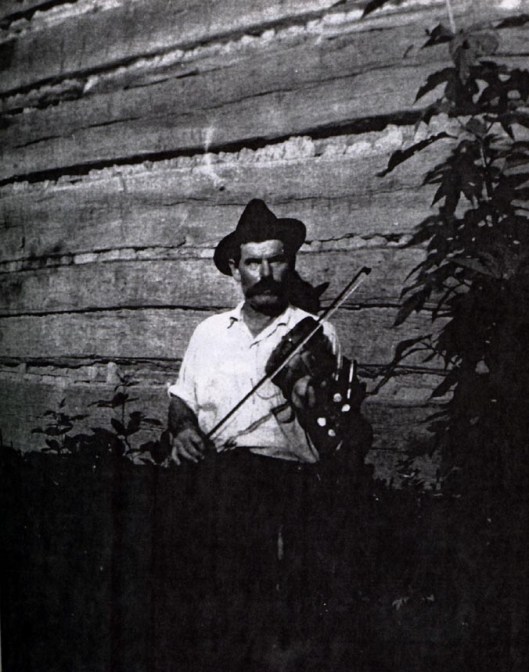
J.W. "Bill" Day, Eastern Kentucky fiddler, 1915-1935

J.W. “Bill” Day, Eastern Kentucky fiddler, 1925-1940

Ed Morrison, Fiddler

07 Tuesday May 2013

Posted by Brandon Ray Kirk in Music

≈ Leave a comment

Tags

Appalachia, Boyd County, Ed Morrison, fiddle, fiddler, genealogy, history, Kentucky, life, music, photos, U.S. South

Ed Morrison

Ed Morrison, a Boyd County, Kentucky, fiddler, c.1925. Another photo of Mr. Morrison can be found here: http://digital.library.louisville.edu/cdm/ref/collection/jthom/id/1102

In Search of Ed Haley

04 Saturday May 2013

Posted by Brandon Ray Kirk in Ed Haley

≈ Leave a comment

Tags

Appalachia, culture, Doc Holbrook, fiddler, Jenkins, Kentucky, life, medicine, music, photos, Pike County, U.S. South

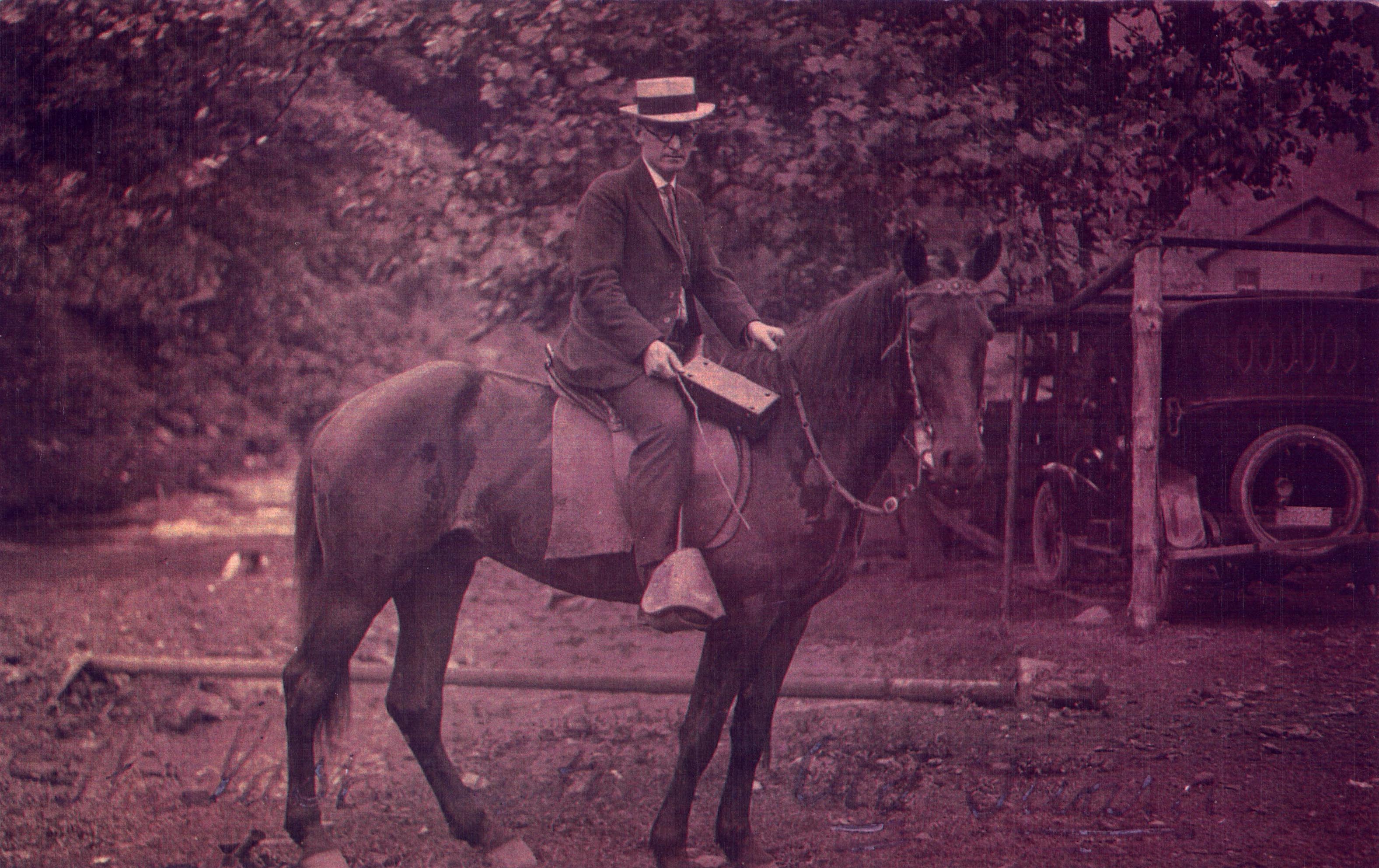
Dr. H.H. Holbrook, Jenkins, Kentucky, circa 1916

Dr. H.H. Holbrook, Jenkins, Kentucky, circa 1916

In Search of Ed Haley 102

03 Friday May 2013

Posted by Brandon Ray Kirk in Ed Haley

≈ Leave a comment

Tags

Doc Holbrook, Ed Haley, fiddle, fiddler, history, J P Fraley, John Hartford, Kentucky, Lawrence Haley, Lexington, music, Paul Holbrook, writing

     Back in Nashville, with Lawrence’s encouragement, I made contact by telephone with Paul Holbrook, a retired general practitioner living in Ashland. Paul’s father, Dr. H.H. Holbrook, had been a good friend to Ed, who once gave him a fiddle and a silver trophy cup for delivering Mona. In talking with Paul, I could tell right away that he was well-educated. He also seemed to be advanced in years; his memory was a little foggy.

     “Well, I think Dad was a friend of his,” he said. “I think he delivered maybe one of his children. Dad fiddled a little bit and he always was interested in hearing Ed play. The fact Dad liked to fiddle and learned to when he was a young boy was the attraction. Other than that, I really can’t tell you a whole lot.”

     I asked Paul if he remembered the names of any of Doc’s tunes and he said, “No, not really. If I heard them I would, but I was never interested much in it.”

     Paul told me as much as he could remember about his father’s fiddling.

     “Dad just played some for his own amusement,” he said. “He must have done most of his playing when he was a young boy or young man maybe playing at some of the country dances. He was from Lawrence County. My grandfather’s farm was between Blaine and Martha.”

     Paul said his father moved a lot after becoming a doctor.

     “Well, he was at Burdine, Kentucky, and Jenkins, Kentucky, many years ago and as far as I know that’s where he first saw Ed Haley. That was up in the coalfields of southeastern Kentucky. And he was in Louisa for a couple of years. And then we moved to Ashland here back in 1922. As far as I know, Ed was down here at that time. I remember seeing him when he and his wife used to play on the street corners back in the twenties. Dad was here for ten years and then moved to Greenup. I believe Ed was down in Greenup once and played some for Dad at home. Now, Dad had made a little recording of Ed in Greenup, Kentucky playing the fiddle on a little old machine and I think I still have the record around someplace. I don’t know what kind of shape it’s in and I’m not even sure I can find it. I can try to find it if you might be interested in it.”

     Lord have mercy.

     What about him giving your dad a silver cup or trophy?

     “I don’t ever remember seeing a cup and I don’t remember ever hearing of it,” Holbrook said.

     What about him giving your dad a fiddle?

     “Yes, Dad had one of his fiddles and my son now has it,” he said. “J.P. Fraley borrowed the old fiddle and I think he used it to make some recordings for the National Archives or someplace in Washington. He had it for a while and brought it back and my son had a friend who had a child who was taking fiddle lessons and he used it some. But I don’t really know what shape it’s in, but the last time I heard my son say anything about it he said it needed some repair.”

     Just before hanging up, Paul gave me his son’s telephone number in Lexington, Kentucky.

     “He teaches some in Lexington at the university and also at Midway College and he comes home up here about every two or three weeks,” he said.

     I asked if he was a doctor, too, and Paul said, “He’s a Ph.D. doctor. He’s not an MD.”

     This was too much: new recordings, one of Ed’s fiddles…

     I called up Paul, Jr. to ask about the fiddle. His speech reminded me a lot of his father, although his mind was quicker, not having been clouded with age. When I mentioned the fiddle, he said, “J.P. Fraley had used it for a while and gotten some blue ribbons with it, but it is in Lexington with me at the moment. It has a very low bridge — a fiddle player’s bridge. I don’t know if it came from Ed Haley in this particular case or not. It is in the case that Grandfather kept it in. It’s difficult for us to say what Grandfather might have done to it. Since Grandfather’s death, nothing has ever changed about it. Grandfather died in 1961. His fiddle playing, I would describe as casual. I don’t think Grandfather was a terribly good fiddler, but he liked to play around.”

In Search of Ed Haley 101

02 Thursday May 2013

Posted by Brandon Ray Kirk in Ed Haley

≈ Leave a comment

Tags

Ashland, Georgia Slim Rutland, history, Kentucky, Lawrence Haley, Liza Mullins, Minnie Hicks, music, Natchee the Indian, Rosie Day, Sandy Hook, writing

     A few weeks later, I met Lawrence and Pat Haley at my show in Lexington, Kentucky. Lawrence was having more health problems, but he looked pretty good. I told him to stay active — at least walk a little every day — but he said he’d walked enough as a mail carrier to fill several lifetimes. After the show, Lawrence was quick to offer his advice on my playing.

     “That piece you played there at the theatre — ‘Catlettsburg’ — that was a real good rendition to me of it,” he said. “But the only thing, John, that I could see you going wrong on is you’re not using the force that my dad used to have when he’s playing them high notes especially. You’re a little bit too light on the strings with your bow there. You gotta use a little bit more ‘umph’. I really wouldn’t know how to explain it except Pop had the perfect note for everything he played and he played it with strength. You gotta use a little bit more pressure.”

     Lawrence said, “The only time I knew he ever got beaten in a contest was down here… They used to have a big ballpark and things down at the steel mill. They called it Armco Park. And they’s having a contest and old Natchee the Indian come out there playing over his shoulder. He had the hair on his bow strung up underneath and playing it that a way and all that kind of stuff and it pleased the crowd I reckon, and he beat Pop out at the fiddling contest there. He was kinda mad that day. He talked like, ‘I’ll never enter another contest.’ To let somebody like Natchee the Indian beat him out, it kinda made him mad.”

     Lawrence said Ed did something in that contest he’d never seen him do before: stand up while playing the fiddle.

     I asked Lawrence if he remembered a lot of fiddlers visiting his father when he was young — especially the famous radio fiddler, Georgia Slim Rutland.

     “They had a couple of three recording studios here in Ashland back in the early twenties,” Lawrence said. “They was a lot of these fellas passed through Ashland, but I can’t say that I ever met any of them because Pop would get out and go on his own when I was in school a lot of times. And then in summer months, we’d take off to West Virginia or Morehead or Sandy Hook or someplace like that where my mother was from — Wrigley — and we might stay half the summer with Aunt Liza or somebody like that up on Harts Creek or Aunt Minnie. Or we might stay at home and Pop and Mom would take off somewhere, and old Rosie Day would stay with us usually — Jilson Setters’ wife.”

Image

Cricket

29 Monday Apr 2013

Tags

Appalachia, Big Sandy River, Cricket, culture, history, Johnson County, Kentucky, life, photos, steamboats, U.S. South

Cricket

Posted by Brandon Ray Kirk | Filed under Big Sandy Valley

≈ Leave a comment

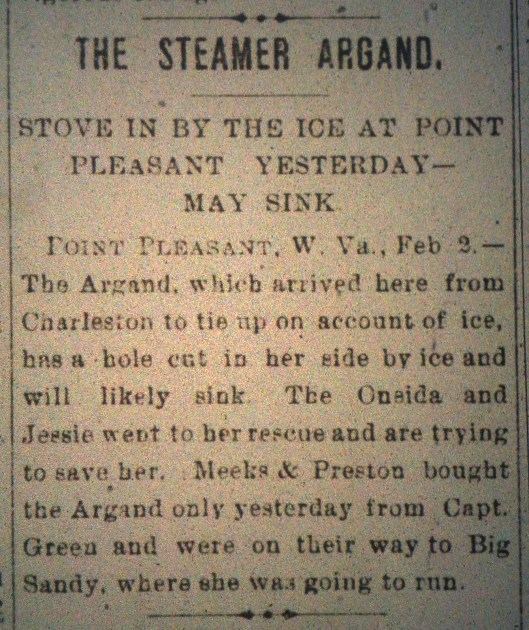
Steamboat: Argand (1900)

25 Thursday Apr 2013

Posted by Brandon Ray Kirk in Big Sandy Valley, Huntington

≈ Leave a comment

Tags

Appalachia, Argand, Big Sandy River, Charleston, culture, history, Jessie, Kentucky, Paintsville, photos, Point Pleasant, steamboats

Argand

Argand Likely to Sink HA 02.02.1900

Huntington (WV) Advertiser, 2 February 1900

In Search of Ed Haley 95

25 Thursday Apr 2013

Posted by Brandon Ray Kirk in Ed Haley

≈ Leave a comment

Tags

Asa Neal, Ashland, Ben Haley, Clark Kessinger, Clyde Haley, Kentucky, Lucian Muncy, music, Natchee the Indian, Nellie Muncy, Sam Vie, writing

I called Clyde Haley to ask him about Patsy’s genealogical information. Trying to prompt his memory, I asked, “Your grandfather’s father was named Benjamin Haley and his wife’s name was Nellie Muncy.” He said, “Muncy? Well I knew some Muncys when I was back up there, you know. They were in West Virginia. Down around Huntington and down in that area. Luce Muncy had a store and filling station, and that’s the most I can remember about them. Lucian Muncy.”

Clyde went from sketchy memories of the Muncys to asking me, “Did you ever know a guy named Clark Kessinger? He was a fiddler, too, you know.” I asked Clyde if he thought Kessinger tried to play like his dad and he said, “I don’t think so. I just come up with that name from somewhere. You know my dad used to take me out on those contests when he’d go and I remember some of those people — like Natchee the Indian. Sam Vie, he was a blind fiddler. He could play a guitar pretty good, too.”

What about Asa Neal? “Asa Neal? I think I went with my dad when we saw him one or two times. I’ll tell you somebody else that was close to our family — those Judds. They lived on the hollow where I lived, called 37th Street in Ashland, Kentucky. We didn’t know them back in those days.”

Clyde seemed to really enjoy my calls. He asked, “When are you coming this a way?” — as if I were just down the road. I told him it would be in the spring and he said, “Well, why don’t you check on me here if you come this a way and we could get us a day off and go somewhere and sit down and just talk all day? I don’t know what you’re doing with this information but I’d like to hear you say it’s going in the news some way. Maybe write a book about his history. That would make me happy. At least he would be remembered.”

Clyde paused, then said, “I’ve been all over the country in different forms and manners and ways. I’ve been a roamer all of my life, but I’ve got this damned arthritis and it’s pretty well got me pinned down.”

In Search of Ed Haley 93

22 Monday Apr 2013

Posted by Brandon Ray Kirk in Ed Haley

≈ Leave a comment

Tags

Ashland, banjo, Ella Haley, fiddle, Kentucky, Lawrence Haley, Molly O Day, Mona Haley, music, Patsy Haley, Ralph Haley, Wilson Mullins

After securing Patsy’s telephone number from Lawrence Haley, I called her up with questions about Ed’s background. Patsy said she first met Ed just after Thanksgiving in 1946 when she and Jack moved in with the family at 105 17th Street in Ashland. At the time, Mona and her husband Wilson Mullins lived there, as did Mona’s son, “little Ralph.” She was in daily contact with Pop for the next three months.

I asked if Ed drank a lot in those days. “Sir, I never saw the man drunk,” she said, in a very pronounced Cleveland accent. “I know one time he went off with his son to play for some people that were having a party and I guess he got kinda high on the horse then, but he never came home.”

Patsy said Ed never played on the street after she came into the family but would play around the house for the kids. She remembered Ed putting the fiddle on his shoulder and playing tunes like “Black Jet” and “Lightning Express”.

“Pop had one special song for me,” she said. “It was, ‘I took a fat gal by the hand the other afternoon and someone yelled out where’s the string that goes with your balloon?’’ because I was a little on the chubby side. Oh, that man could play anything. He could listen to the radio and play popular music. He played the guitar. Beautiful banjo. I don’t think he used a pick.”

Around 1948, Molly O’Day came to see Ed at his home on 45th Street in Ashland. She brought her husband and fiddling brother — and a lot of recording equipment. Everyone settled in the living room, where Ed played the fiddle, “long neck” banjo and mandolin. Patsy said it seemed like they were just “horsing around,” although there was one song that Molly wanted to hear “real bad.” She didn’t recall much else about the visit because she mostly stayed with Ella and little Ralph in the kitchen.

Patsy said Ed never told any stories but she heard from Ella how his parents were killed on Harts Creek. It was a totally different account from anything I’d heard. “Mom Haley told me that they were both murdered in the log cabin,” she said. “Now, that’s not what happened according to what everybody has been telling me from down in Kentucky.”

I asked Patsy why she thought Ella would have told her something that was apparently untrue and she said, “Well, they might’ve just not wanted me to know everything. They thought I was just one of them big city girls from Los Angeles.”

She had also heard how Ed came to be blind.

It was measles that did it — that’s what Mom Haley told me — and that they left him out in his buggy in the sun.”

In Search of Ed Haley 92

18 Thursday Apr 2013

Posted by Brandon Ray Kirk in Ed Haley

≈ Leave a comment

Tags

Clyde Haley, Ella Haley, Frank Creech, Harts Creek, Kentucky, music, Noah Mullins, Patsy Haley, Peter Mullins, Ralph Haley, Sherman Luther Haley, writing

Clyde said, “My brother Ralph, he was my dad’s favorite because Ralph was smarter than I was. He wouldn’t ever beat up on Ralph. Well, Ralph was bigger than he was. Did you ever know a guy from this part of the area named Frank Creech? Well, he was one of the bad boys around my area when I was growing up. And he come and borrowed Ralph’s guitar from my dad. Ralph had a great big Martin guitar. He’d bought it from one of those Ruffner boys, I think. He worked. But this guy Frank Creech borrowed Ralph’s guitar and took it somewhere and had a truck run over it — smashed it up. So Frank Creech come to the house and told my dad about it and my dad wasn’t saying a word about it. I was there in the house when this happened. And my mother didn’t like to hear anybody cuss. She was a Puritan about things like that. She didn’t allow any of that in her house.”

Clyde’s memories trailed off at that point, but I knew he was telling more about Ed’s attack on Frank Creech, an event which I’d first heard about while watching a Christmas video at Lawrence’s house.

Clyde said Ed and Ella argued sometimes about music.

“He’d want to play it one way and she’d want to play it the other,” he said. “But a mandolin and a fiddle are tuned up the same way — got the same pitch on the strings — but it’s a different kind of music.”

I asked him who usually won the arguments and he said, “Well she did because he’d give up on her.”

Clyde laughed, “He was mean. If he didn’t win with his talking, he’d do it with his fists to my mother.”

So Ed beat on his wife? I knew that was something Lawrence would have never told.

“He was a mean devil,” Clyde continued. “The worst I ever done him in my life, we was up on Harts Creek at Uncle Peter’s house. And he wanted to go somewhere and she didn’t want to go at that particular minute [and he started hitting her with his fists, so I got a hold of a plowpoint] and hit him in the head with it. Knocked a pretty good-sized hole in the head. Noah Mullins and the other Mullins boy Tennis chased me all over that mountain with a great big piece of a hoe-club. He never did catch me because I was pretty fast on my feet, too, running through those mountains and I could really get over the land. I was a boy then — a minor, you know — and they took us all down to Catlettsburg to the city jail and they threatened him with putting him in the penitentiary for beating on my mother that way and after that he never did beat her up too much.”

I asked Clyde if Ed did a lot of jail time and he said, “Just for minutes, like to hold him over for a few hours. Let him get sobered up a little bit. They weren’t mean to him, but they were mean to us boys, the police were. We deserved it.”

When I mentioned Ed’s oldest son, the boy who had died young, Clyde said, “He was born before I was. His name was Sherman Luther. Sherman was between me and Ralph.”

I said, “Now Ralph was your mother’s boy by somebody else.”

“Well, I didn’t know that,” Clyde said, kind of rattled. “See, you’re telling me things I don’t know and that kinda shakes me around a little bit and I don’t know what to say.”

I tried to smooth things up by saying, “Well I heard that but I wasn’t sure.”

Clyde said, “Well it seems to me like it could be, because my mother was a woman just like all the rest of the women. She had her good points about her. She was a Christian. I think that in my heart. But my dad wasn’t. He was just an ornery, old mean man. I hate to keep saying that about him because I… I hated him for a long time for the way he treated my mother and I finally got out of that hate and I got so I could talk about it to people who had business a knowing about it. I’m telling you things that I wouldn’t say to anybody else because I believe in you and I believe you’re being honest about what you’re doing. I wish it could be known widely about what he did for a living.”

Clyde promised if I’d come and see him, he’d tell me a lot more about Ed that he didn’t “dare mention over the telephone.” He said, “You know, I had a skull fracture here about a year ago and I can’t think real properly like I could if I set down. I’ve had my head broke, my brains knocked out a couple of times, and that affected me, too. If I saw you… Maybe if I could be prodded a little bit, I might could recall some things that might go good in a book.”

In the meantime, he said I should contact his sister-in-law, Patsy (Cox) Haley, who’d done some research on Ed’s family years ago.

“That was Jack’s wife,” Clyde said. “Her husband Jack, he blew up with a heart attack. You ought to get in touch with her. She can tell you more about that than any of us boys could ’cause she was a genealogist. She took that up as a hobby and she got into it and she couldn’t get out of it.”

In Search of Ed Haley 89

14 Sunday Apr 2013

Posted by Brandon Ray Kirk in Ed Haley, Music

≈ Leave a comment

Tags

Appalachia, Armco, Ashland, banjo, Billy in the Lowground, Blackberry Blossom, Brownlow's Dream, Cacklin Hen, Clyde Haley, Dill Pickle Rag, Ella Haley, fiddle, fiddler, fiddling, Flop-Eared Mule, history, John Hartford, Kentucky, music, Roy Clark

Clyde’s memories of Ed playing in contests were much more detailed than anything I had heard from the other kids.

“I’ve seen him go to contests and look like a farmer and he won every one he ever got into,” he said. “He’d go down to the Armco there in Ashland — they’d put up a bandstand up there — and when they’d have contests they had these eight or ten fiddlers up on the stage and he’d be up in all that mess. He fiddled with some of the best that there was in that country in that particular part of the time. I know he had a lot of people used to come to the house and play music with him.”

I asked Clyde what tunes Ed won contests with and he said, “Well, ‘Cacklin’ Hen’, ‘Billy in the Lowground’ and tunes like that. Not any particular ones. He could play any kind of music if he knew it. If he knew the words, he could make music like nobody you ever heard in your life. He had one tune called the ‘Flop-Eared Mule’. I remember ‘Brownlow’s Dream’, ‘Blackberry Blossom’ and ‘Dill Pickle Rag’.”

Gradually easing into specifics, I wondered if Ed held the bow in the middle or out on the end.

“It would depend on what kind of music he was playing,” Clyde said matter-of-factly. “I’ve seen him hold a fiddle bow down at the end, where the hair hooks up. Depending on the tune, the fastness of the tune, he could hold a bow anywhere he wanted to.”

Did he bow with short strokes or long strokes?

“Well, it would depend on which way he was sitting,” Clyde said. “If he was sitting on a chair with his right leg put out far… He never held the fiddle like anybody else I ever saw. He held it way low on his chest, almost down to his belt-line. My dad had long arms, you know. He was a long, thin man. We have a tendency to want to exaggerate a little bit and say he was bigger than he was, but I knew him pretty well. His hands were real thin — looked like a piano player. He could finger that fiddle like nobody you ever heard or saw.”

I asked if Ed picked the banjo and Clyde said, “Oh, yes. He was better with a banjo than he was with his fiddle. It didn’t have a thumb-string on it. I tried to learn how to play the banjo, too, but I never could do any good at it. Well, my mother bought me a fiddle in the store somewhere and she tried to get me to learn how to play the fiddle because she knew she was gonna be dead one of these days and him too and she wanted to have all that music made for posterity. My mom didn’t want me to do it, but my dad wanted me to. He called me his favorite son and said he wanted me to carry on his tradition. I tried, but I got my fingers cut off when I was a lot younger — two-thirds of my first and second fingers on my left hand — and that messed me up from noting. Ralph was the one that played with my dad a lot. He played the guitar like Roy Clark played. He had a big Martin guitar that was a double-header and he could play on both necks of it at the same time. Ralph was a good musician. He died in 1945.”

Clyde talked a lot about Ed being a drinker, which was something Lawrence kind of kept “under wraps”.

“He was a rip-snorter, don’t think he wasn’t,” he said. “You know, he could be pretty boisterous when he wanted to be. Ed Haley was a mean person — believe me he was. I loved him… He used to take me because he knew I liked to go with him. He would give me a drink every once in a while. He knew I got to liking that and he’d take me with him just about everywhere he went. I think he was the one who got me to drinking too when I was a kid and it’s the worst thing I could’ve done. Course I had no control over it then.”

I asked Clyde what Ed’s drink of choice was and he said, “Whiskey. He wasn’t a beer drinker much, or wine. He didn’t go much for that kind of stuff. He drank moonshine when he could get it, and he generally got it.”

Clyde had seen Ed drunk but said it didn’t hurt his fiddle playing.

“I think if anything, it made it better.”

In Search of Ed Haley 83

28 Thursday Mar 2013

Posted by Brandon Ray Kirk in Big Harts Creek, Ed Haley, Green Shoal, Lincoln County Feud, Spottswood

≈ 2 Comments

Tags

Alice Baisden, Appalachia, blind, Cas Baisden, Clifton Mullins, Clyde Haley, Dicy Baisden, Ed Haley, Ella Haley, Green Shoal, Harts Creek, Hazard, history, Imogene Haley, John Hartford, John Henry, Kentucky, Lawrence Haley, Lincoln County Feud, Liza McKenzie, Liza Mullins, Loretta Mullins, Mag Farley, Milt Haley, Perry County, Peter Mullins, Sol Bumgarner, Trace Fork, West Virginia

We found Bum on our way up the hollow and went to sit on his porch with his aunt, Liza McKenzie, two of his sisters, Alice and Dicy — and of course Shermie. As soon as Liza figured out who we were she looked at Lawrence and said he was just a small boy the last time she’d seen him.

“Yeah, I guess around 1940 or ’41 was the last time I come to this area,” Lawrence said.

Liza said, “Well, I lived in Kentucky about sixty years. Perry County, up in Hazard.”

I said to her, “Is that where Milt Haley was from?” and she said, “I don’t know but now Ed Haley was borned and raised right around here. When he was a boy, he got up on top of that house down there where Aunt Mag used to live — in that old two-story house — and rolled off in a box. Mother said, ‘Lord, Ed, are you hurt?’ He said, ‘No, God no. It’s give me eyesight.’ He said he jarred his eyesight back.”

I liked Liza right away.

I asked her if she had any pictures and she said, “Loretta’s mother had all the pictures of Ed Haley I ever did know. They used to have a picture down there at Loretta’s of Ed’s mother. She was a pretty woman.”

She looked at Clifton and said, “Clif, I believe your mother had a picture of Ed Haley that was made down there at the old home where he was born and raised. Down there where Aunt Mag used to live. I know they had them.”

Clifton remembered it.

“Yeah, they was sitting out in the yard,” he said. “They was together. She was in the chair and he was standing. He didn’t have no pants on.”

Clifton said, “Yeah, you’re right. They was a picture down there. But I looked; they was so many pictures in that box.”

     Box of pictures? I thought.

Before I could ask about them, Clifton said, “There’s one down there faded out. It’s in a big frame. I got it in another building.”

He told me, “I can show them to ya.”

About that time, Cas Baisden came up to the porch. Bum said he was Liza’s 83-year-old twin brother. I asked Cas if he remembered Ed and he said, “I knowed him, yeah. He was raised up here. Old man Peter lived down at the mouth of the holler and his boy lived up the road here and old man Ed’d go up there and he’d come down that road a running and jumping just like he could see and cut the awfulest shine that ever was.”

Lawrence joked, “That’s probably how Clyde got to be the way he was.”

Cas said, “Yeah, I guess Clyde took after him. Clyde went out here and got down in a well once and they had the awfulest time that ever was getting him out. Way back in top of a mountain.”

I asked Cas about the first time he ever saw Ed and he said, “It’s been many a year ago. He stayed down here, him and his wife and them. They’d play music and drink and fight and scratch with one another and them boys was so mean… He’d get so drunk he couldn’t walk.”

Bum knew that Ed was real “easy to get mad about music,” but said he could get him to play nearly anything he wanted because Ed liked him. He’d ask Ed to play something like “John Henry” and he’d say, “Are you sure that’s what you want me to play? You know, I was just thinking about playing that.” If Ed didn’t like someone Bum said he’d “goof around” and not play for them.

Things kinda tapered off after that. Nobody knew anything about Ed having any brothers. Cas had heard about Ed’s father, who he thought was named Green.

“You know, he got killed when I was a little fella, I guess,” Cas said. “His name was Green. They took him over yonder on Green Shoal, they said, and killed him. Walked him down here and up Smoke House and over and down Piney and across the river.”

I asked if Lawrence looked like Ed and Liza said, “Yes, he does. Ed was a bigger man than he is. Ed was a big man.”

But Lawrence looks like Ed in the face?

“Yeah, he looks like him all over.”

Cas said, “Ed was a taller man. I guess he takes after his mother. She’s a little short woman.”

Lawrence agreed: “Yeah, she was about five feet tall — not much bigger than Aunt Liza.”

← Older posts
Newer posts →

Feud Poll 1

If you had lived in the Harts Creek community during the 1880s, to which faction of feudists might you have given your loyalty?

Categories

  • Adkins Mill
  • African American History
  • American Revolutionary War
  • Ashland
  • Atenville
  • Banco
  • Barboursville
  • Battle of Blair Mountain
  • Beech Creek
  • Big Creek
  • Big Harts Creek
  • Big Sandy Valley
  • Big Ugly Creek
  • Boone County
  • Breeden
  • Calhoun County
  • Cemeteries
  • Chapmanville
  • Civil War
  • Clay County
  • Clothier
  • Coal
  • Cove Gap
  • Crawley Creek
  • Culture of Honor
  • Dingess
  • Dollie
  • Dunlow
  • East Lynn
  • Ed Haley
  • Eden Park
  • Enslow
  • Estep
  • Ethel
  • Ferrellsburg
  • Fourteen
  • French-Eversole Feud
  • Gilbert
  • Giles County
  • Gill
  • Green Shoal
  • Guyandotte River
  • Halcyon
  • Hamlin
  • Harts
  • Hatfield-McCoy Feud
  • Holden
  • Hungarian-American History
  • Huntington
  • Inez
  • Irish-Americans
  • Italian American History
  • Jamboree
  • Jewish History
  • John Hartford
  • Kermit
  • Kiahsville
  • Kitchen
  • Leet
  • Lincoln County Feud
  • Little Harts Creek
  • Logan
  • Man
  • Matewan
  • Meador
  • Midkiff
  • Monroe County
  • Montgomery County
  • Music
  • Native American History
  • Peach Creek
  • Pearl Adkins Diary
  • Pecks Mill
  • Peter Creek
  • Pikeville
  • Pilgrim
  • Poetry
  • Queens Ridge
  • Ranger
  • Rector
  • Roane County
  • Rowan County Feud
  • Salt Rock
  • Sand Creek
  • Shively
  • Spears
  • Sports
  • Spottswood
  • Spurlockville
  • Stiltner
  • Stone Branch
  • Tazewell County
  • Timber
  • Tom Dula
  • Toney
  • Turner-Howard Feud
  • Twelve Pole Creek
  • Uncategorized
  • Warren
  • Wayne
  • West Hamlin
  • Wewanta
  • Wharncliffe
  • Whirlwind
  • Williamson
  • Women's History
  • World War I
  • Wyoming County
  • Yantus

Feud Poll 2

Do you think Milt Haley and Green McCoy committed the ambush on Al and Hollene Brumfield in 1889?

Blogroll

  • Ancestry.com
  • Ashland (KY) Daily Independent News Article
  • Author FB page
  • Beckley (WV) Register-Herald News Article
  • Big Sandy News (KY) News Article
  • Blood in West Virginia FB
  • Blood in West Virginia order
  • Chapters TV Program
  • Facebook
  • Ghosts of Guyan
  • Herald-Dispatch News Article 1
  • Herald-Dispatch News Article 2
  • In Search of Ed Haley
  • Instagram
  • Lincoln (WV) Journal News Article
  • Lincoln (WV) Journal Thumbs Up
  • Lincoln County
  • Lincoln County Feud
  • Lincoln County Feud Lecture
  • LinkedIn
  • Logan (WV) Banner News Article
  • Lunch With Books
  • Our Overmountain Men: The Revolutionary War in Western Virginia (1775-1783)
  • Pinterest
  • Scarborough Society's Art and Lecture Series
  • Smithsonian Article
  • Spirit of Jefferson News Article
  • The Friendly Neighbor Radio Show 1
  • The Friendly Neighbor Radio Show 2
  • The Friendly Neighbor Radio Show 3
  • The Friendly Neighbor Radio Show 4
  • The New Yorker
  • The State Journal's 55 Good Things About WV
  • tumblr.
  • Twitter
  • Website
  • Weirton (WV) Daily Times Article
  • Wheeling (WV) Intelligencer News Article 1
  • Wheeling (WV) Intelligencer News Article 2
  • WOWK TV
  • Writers Can Read Open Mic Night

Feud Poll 3

Who do you think organized the ambush of Al and Hollene Brumfield in 1889?

Recent Posts

  • Logan County Jail in Logan, WV
  • Absentee Landowners of Magnolia District (1890, 1892, 1894)
  • Charles Spurlock Survey at Fourteen Mile Creek, Lincoln County, WV (1815)

Ed Haley Poll 1

What do you think caused Ed Haley to lose his sight when he was three years old?

Top Posts & Pages

  • Halcyon 4.10.1919
  • Civil War Gold Coins Hidden Near Chapmanville, WV
  • Halcyon-Yantus 12.08.1911
  • Early Coal Mines in Logan County, WV
  • Buskirk Cemetery at Buskirk, KY (2015)

Copyright

© Brandon Ray Kirk and brandonraykirk.wordpress.com, 1987-2023. Unauthorized use and/or duplication of this material without express and written permission from this blog’s author and/or owner is strictly prohibited. Excerpts and links may be used, provided that full and clear credit is given to Brandon Ray Kirk and brandonraykirk.wordpress.com with appropriate and specific direction to the original content.

Archives

  • February 2025
  • January 2025
  • October 2023
  • September 2023
  • December 2022
  • November 2022
  • May 2022
  • April 2022
  • February 2022
  • November 2021
  • October 2021
  • September 2021
  • June 2021
  • May 2021
  • April 2021
  • March 2021
  • February 2021
  • January 2021
  • December 2020
  • November 2020
  • October 2020
  • July 2020
  • June 2020
  • May 2020
  • April 2020
  • March 2020
  • February 2020
  • January 2020
  • December 2019
  • November 2019
  • October 2019
  • September 2019
  • August 2019
  • July 2019
  • June 2019
  • May 2019
  • April 2019
  • March 2019
  • February 2019
  • January 2019
  • December 2018
  • November 2018
  • October 2018
  • September 2018
  • August 2018
  • July 2018
  • June 2018
  • May 2018
  • April 2018
  • March 2018
  • February 2018
  • January 2018
  • December 2017
  • November 2017
  • October 2017
  • September 2017
  • August 2017
  • July 2017
  • June 2017
  • May 2017
  • April 2017
  • March 2017
  • February 2017
  • January 2017
  • December 2016
  • November 2016
  • October 2016
  • September 2016
  • August 2016
  • July 2016
  • June 2016
  • May 2016
  • April 2016
  • March 2016
  • February 2016
  • January 2016
  • December 2015
  • November 2015
  • October 2015
  • September 2015
  • August 2015
  • July 2015
  • June 2015
  • May 2015
  • April 2015
  • March 2015
  • February 2015
  • January 2015
  • December 2014
  • October 2014
  • September 2014
  • August 2014
  • July 2014
  • June 2014
  • May 2014
  • April 2014
  • March 2014
  • February 2014
  • January 2014
  • December 2013
  • November 2013
  • October 2013
  • September 2013
  • August 2013
  • July 2013
  • June 2013
  • May 2013
  • April 2013
  • March 2013
  • February 2013
  • January 2013
  • December 2012
  • November 2012

Enter your email address to follow this blog and receive notifications of new posts by email.

Join 2,927 other subscribers

Tags

Appalachia Ashland Big Creek Big Ugly Creek Blood in West Virginia Brandon Kirk Cabell County cemeteries Chapmanville Charleston civil war coal Confederate Army crime culture Ed Haley Ella Haley Ferrellsburg feud fiddler fiddling genealogy Green McCoy Guyandotte River Harts Harts Creek Hatfield-McCoy Feud history Huntington John Hartford Kentucky Lawrence Haley life Lincoln County Lincoln County Feud Logan Logan Banner Logan County Milt Haley Mingo County music Ohio photos timbering U.S. South Virginia Wayne County West Virginia Whirlwind writing

Blogs I Follow

  • OtterTales
  • Our Appalachia: A Blog Created by Students of Brandon Kirk
  • Piedmont Trails
  • Truman Capote
  • Appalachian Diaspora

BLOOD IN WEST VIRGINIA is now available for order at Amazon!

Blog at WordPress.com.

OtterTales

Writings from my travels and experiences. High and fine literature is wine, and mine is only water; but everybody likes water. Mark Twain

Our Appalachia: A Blog Created by Students of Brandon Kirk

This site is dedicated to the collection, preservation, and promotion of history and culture in Appalachia.

Piedmont Trails

Genealogy and History in North Carolina and Beyond

Truman Capote

A site about one of the most beautiful, interesting, tallented, outrageous and colorful personalities of the 20th Century

Appalachian Diaspora

  • Subscribe Subscribed
    • Brandon Ray Kirk
    • Join 789 other subscribers
    • Already have a WordPress.com account? Log in now.
    • Brandon Ray Kirk
    • Subscribe Subscribed
    • Sign up
    • Log in
    • Report this content
    • View site in Reader
    • Manage subscriptions
    • Collapse this bar
 

Loading Comments...