• About

Brandon Ray Kirk

~ This site is dedicated to the collection, preservation, and promotion of history and culture in my section of Appalachia.

Brandon Ray Kirk

Tag Archives: John Hartford

In Search of Ed Haley 225

15 Wednesday Jan 2014

Posted by Brandon Ray Kirk in Big Harts Creek, Ed Haley, Whirlwind

≈ 2 Comments

Tags

Billy Adkins, Creed Conley, Ed Haley, fiddling, Harts Creek, history, John Hartford, Logan, Minnie Smith, Sherman Smith, Sol Adams, West Virginia, Whirlwind, writing

After lunch, Billy suggested that we go see Sherman and Minnie Smith, who lived a little further up the creek at the old Whirlwind Post Office. Minnie was the granddaughter of Solomon Adams and a great-granddaughter to Anthony Adams. Her father was a nephew to Melvin Kirk, who helped bury Milt and Green.

We soon pulled up to an incredible two-story log home with a remodeled front. We first spoke with Minnie’s husband Sherman who was busy dismantling a chimney labeled “S.A. 1875.” Minnie came out of the house, recognized Billy and started talking to us like we were neighbors. We raved over her log house for several minutes, which caused her to tell us how her grandfather Sol Adams had built it of yellow poplar in 1869. We later discovered that he was born in that year.

We gathered in chairs and sofas in a dimly lit living room with a low ceiling, while Sherman stood nearby in a doorway leading into the kitchen. We told them about my interest in Ed Haley, which caused Sherman to tell about seeing him in Logan when he was a boy. He said Ed was usually by himself but sometimes had a banjo-picker with him.

“Ed Haley used to play here when I was a girl,” Minnie said, adding that she was born in 1933. According to Minnie, Ed played for dances in the Workman home. Her parents would clear all of the furniture out of the living room and an adjacent room on Saturday. Ed came before the dance started and was fed properly, then as people started showing up he was “set up” on a stool in the doorway between the two cleared rooms. From there, he could entertain two rooms of people instead of just one. Minnie remembered him playing tunes like “Blind Man Stackolee” and “Fire on the Mountain”. Creed Conley was usually the caller and would have people dancing so wildly that they’d bump heads. Most were drunk. Minnie said someone passed a hat around for Ed’s pay toward the end of the dance.

In Search of Ed Haley 224

14 Tuesday Jan 2014

Posted by Brandon Ray Kirk in Ed Haley

≈ Leave a comment

Tags

Al Brumfield, Alifair Adams, Anthony Adams, Ben Adams, Billy Adkins, Brandon Kirk, Ernest Adams, Ewell Mullins, George Mullins, Greasy George Adams, Harts Creek, history, Jay Queen, Joe Adams, John Hartford, Lewis Maynard, Mag Farley, Major Adams, Milt Haley, Mountaineer Missionary Baptist Church, Peter Mullins, rafting, writing

I asked Joe if he ever heard any stories about Milt being a fiddle player and he said, “They was having a square dance up there at Peter’s once and I heard them a talking about his father playing the fiddle but that was all. They never said what he played or how much or nothing about it. They just said he was a musician. I’ve heard talk of him but I didn’t know him personally. I know about the trouble they had up here. I heard them talking about that up at George Greasy’s. Said they followed them over yonder at Green Shoal or someplace somebody said and killed them. I heard my dad a talking about that.”

Brandon mentioned that Milt and Green had supposedly been hired by Ben Adams to kill Al Brumfield, which caused Joe to say, “Well, I don’t know whether it was Ben Adams or… Well, Al and Ben were both head strong, let’s put it that way. I don’t know what was wrong with the families back then, but they seemed like they wanted to fight each other. They didn’t want to fight no strangers. They was all fighting through each other all the time. They’d burn each other’s barn and shoot their mules and cows in the field and everything on earth. All of them first cousins. I said, ‘That don’t make no sense to me.’ But back then if somebody needed something, it didn’t matter how mean they were, people’d go help them. If somebody was sick, people’d go sit up with them.”

Talking about the old Adamses around Harts Creek caused Joe to reminisce about his grandparents, Solomon and Anthony Adams.

“Grandpaw Anthony was from Hazard, Kentucky. He cut timber and built splash dams through here. Them old Adamses — Anthony, Ben, Sol — they’d float logs down to Hart and raft them to Huntington. I heard them tell about them Robinsons down there helping them raft them. Grandpaw Anthony, he didn’t let nobody put nothing on him. Them old fellas, 90-percent of them carried a pistol all the time. Most of them had ten or twelve children. Grandpaw Anthony, he acquired that place in the Forks of Hoover and he traded that place in Hoover for this place out here. He built a little house right out here on thirty-five acres in 1908. He ran a store at one time, too. They sold riggings, shoes, groceries, plow stocks, shovels…

“I can’t remember my grandpaw Sol nor his wife Dicy nor my Grandpaw Anthony but I can remember my Grandmaw Alifair well. She was from Missouri. She’d stay a while with us and she’d go up George Mullins’ and stay a while and she’d go down to Aunt Alice’s and stay a while. All the women smoked them old stone pipes and they wore them big gingham aprons that had two big pockets on them and they carried their tobacco and pipe and stuff in their pocket. They always had these old-time fireplaces and she’d go out in the chip-yard where they made ties and stuff and she’d pick her up a bunch of splinters and she’d sit them up in the chimney corner to light her pipe with and you’d better not bother them either.”

Joe’s father was Major Adams (1885-1944), the youngest son of Anthony Adams. He was a hammer-style banjoist.

“My daddy had a .32 Smith & Wesson with a shoulder holster with red leather and he kept that a hanging on the head of the bed,” Joe said. “They had these old iron beds with big, high headboards and stuff on them. And he kept that a hanging on the head of the bed all the time fully loaded in the belt and we knowed better than to tip it. Now, you might hang something up like that and a child take it down and shoot your brains out with it.”

Joe said Trace Fork had changed quite a bit since his childhood days. In the thirties, Ewell Mullins, Ed’s first cousin, had a store on the creek, as did Ernest Adams and Joe Mullins and Lewis Maynard. At one time, there were four stores on the creek; today, there are none. In 1938, the same year that electricity arrived on Trace, the Mountaineer Missionary Baptist Church was constructed at the mouth of the creek. Now an impressive brick building, it was originally a 24′ X 20′ structure. Prior to its construction, people met at Anthony Adams’ store or at the lower Trace Fork School. Joe said he bought the creek’s first television set from Jay Queen’s Bluegrass Hardware in Chapmanville in 1955. The roads were paved on Trace about that time.

Joe said we might find out more about Ed from Ewell Mullins’ daughter, Mag Farley. Billy said she ran a store just up Harts Creek near a fire department and playground. We found Mag working behind the checkout counter. She was a granddaughter to Uncle Peter but didn’t look very much like him. She got a little excited when we showed her pictures of her family but became suspiciously quiet when we inquired about Emma Haley. All we could get out of her was that Ed’s mother never remarried after Milt’s death and died around Harts. Maybe that was so, but we felt there might be more to her story; Mag’s version was almost too dull. We gathered back toward a cooler where we talked and ate bologna sandwiches and potato chips.

Murder Table Sketch 2

08 Wednesday Jan 2014

Posted by Brandon Ray Kirk in Ed Haley

≈ Leave a comment

Tags

art, Billy Adkins, crime, Don Morris, drawing, George Fry, history, John Hartford, murder

John Hartford's Sketch of the "Murder Table," 1995.

John Hartford’s Sketch of the “Murder Table,” 1995.

Murder Table Sketch 1

07 Tuesday Jan 2014

Posted by Brandon Ray Kirk in Ed Haley

≈ Leave a comment

Tags

art, crime, Don Morris, drawing, history, John Hartford, murder, photos

John Hartford's Sketch of the Murder Table, 1995.

John Hartford’s Sketch of the “Murder Table,” 1995.

In Search of Ed Haley 214

21 Saturday Dec 2013

Posted by Brandon Ray Kirk in Big Ugly Creek, Ed Haley

≈ Leave a comment

Tags

Big Ugly Creek, Bill Duty, Billy Adkins, blind, Doska Adkins, Ed Haley, Eunice Ferrell, fiddling, Jeff Duty, John Hartford, Milt Haley, Tom Ferrell, writing

A few days later, Brandon and I left the festival and headed toward Charleston and on to Harts via Corridor G and Boone County. We reached Harts around three in the morning and parked the bus at the local Fas Chek near a fire station and bridge. Brandon’s uncle Ron Lucas, the manager of the store, had given us permission to park there. The next morning, Billy Adkins met us at the bus and we decided to see Doska Adkins, a woman of advanced age and granddaughter of Bill Duty. Maybe Doska would know about Milt Haley living with her grandfather, who had settled on nearby Big Ugly Creek.

In no time at all, Brandon, Billy and I were charging over Green Shoal Mountain talking genealogy and well on our way to Big Ugly country.

About twenty minutes later, we turned off of the main road into Fawn Hollow and began climbing a rocky driveway toward Doska’s house. We soon spotted Doska cutting brush out near her yard. She was a small-framed woman crowned with a tuft of white hair, having every bit the appearance of “the helpless old widow” — barring the machete in her hand, of course. I could tell right away that things were about to get interesting.

We followed Doska into her home, stepping quickly past a barking dog tied up on her porch. Inside, on the living room wall we spotted a mass of more than forty bushy squirrel tales hanging together in a pattern, which she said were her hunting trophies for the season. Sensing our interest in such things, she showed us a stuffed squirrel that she herself had killed, stuffed and mounted onto a small log. Before we could really ask her anything about Milt Haley, she told us all about how to pickle squirrels for later eating, then opened a desk drawer full of snake rattlers…more trophies.

It took us a few minutes to sit down and actually focus on the reason for our visit. When I told Doska about my interest in Ed’s life, she said he used to stay with her father, Jeff Duty. It didn’t take him long to get familiar with a place, she said, and he couldn’t be fooled with paper money.

“How often would he come there to stay?” I asked.

She said, “Well, I don’t know how often. If I was around, I was real little. I don’t remember him but I’ve heard Daddy talk about him.”

Brandon asked Doska, “Did your dad and Ed play music together?” and she said, “Yeah.”

We wondered what songs Jeff Duty played.

“They was one he played on the fiddle that I thought was real pretty,” Doska said. “I think he called that the ’11th of January’ and he’d play a while and then he’d pick a piece in it. Yeah, man he used to sit on the porch of an evening down yonder where I was raised and play for us.”

Brandon asked, “Was your dad considered the best fiddler up around this part?”

Doska said, “He was pretty good and he could play a banjo, too.”

I asked if her grandfather Bill Duty ever talked about Milt Haley and she said, “No, all of my grandparents was dead before I was born. See, I was born in 1917 and I never seen nary one of my grandparents. Mommy used to have a picture of my grandpaw but I don’t know what happened to it.”

Billy asked her, “Was Ed Haley any relation to you at all?”

“No, he’d just come through here — I don’t know why — and he liked to stay at my daddy’s,” she answered. “Didn’t matter who come through this country. If they’d ask to stay all night somewhere they’d say, ‘You can go to old man Duty’s and stay all night.’”

Of course, knowing what we knew about Milt and the Dutys it seemed likely that Ed came around Jeff for reasons more than his hospitality. As Bill Duty’s son and a fiddler, he would’ve been an excellent source on Milt — the father Ed never really knew.

Doska said her grandfather Duty’s home was no longer standing on Broad Branch but I wanted to see the site anyway. (It was, after all, very possibly the place where Milt settled with the Duty family in the early 1880s.) We asked Doska to accompany us but she said she looked awful; she had been cutting brush all day, she said, and wasn’t dressed to go anywhere. After a while, though, we persuaded her to go with us.

On the way to Broad Branch, Billy suggested that we stop and see 89-year-old Eunice Ferrell. Eunice had settled on the creek years ago and married a son of the Tom Ferrell mentioned in “The Lincoln County Crew”. She was a very friendly Mormon, slumped over with age. I told her I was interested in “Blind Ed Haley,” an old fiddler from Harts Creek, and she said she didn’t know about him. Her father-in-law had been a fiddler, though. She knew something about Tom’s trouble with the Butchers.

“They said they was in a card game and this man was trying to run the horse over him,” she said. “And he killed him but he got out of it.”

We told Eunice that we were going to see the old Duty place on Broad Branch if she wanted to go and she was all for it. We helped her into the car and took off.

Along the way, I stopped the car so Doska could point out her father’s home — the place where Ed used to stay. Brandon said some “hippie-types” from a big city had moved into the place several years ago.

“Michael Tierney lives there now,” Eunice said. “He’s a lawyer. Catholic man. He’s a good neighbor.”

We were having a blast.

“I’m glad I come,” Eunice said.

In Search of Ed Haley 212

19 Thursday Dec 2013

Posted by Brandon Ray Kirk in Ed Haley

≈ 3 Comments

Tags

Billy Adkins, Cliff Top, Ed Haley, John Hartford, John W Runyon, Johnny Hager, music, Pat Haley, Steve Haley, Tim Wendt, Tom Atkins, West Virginia, writing

Late in the summer of 1995, I boarded my bus and cruised along the familiar Kentucky interstate highway system toward something called the Appalachian String Band Festival at Cliff Top, West Virginia. J.P. Fraley and Wilson Douglas assured me it was of the fastest growing festivals in the region and would be a great place to learn more about Ed Haley. Along the way I picked up Brandon Kirk, who gave me the first draft of the Haley manuscript. Somewhere around Oak Hill, we eased off of the interstate onto a ridiculously curvy road and, after what seemed like hours, we arrived at Cliff Top — a Depression era CCC camp on top of a mountain filled with buses, automobiles, tents, campers, fiddlers, concessioneers, hippies, and just about anything else a person could imagine.

There were a lot of familiar faces milling about the grounds.

Brandon busily snapped pictures and kept saying things like, “So that’s Wilson Douglas?” or “Wow, that’s J.P. Fraley?” or “Virgil Alfrey? Cool.”

I wasted little time getting out my fiddle and playing with folks. There was an “Ed Haley buzz” at the camp. People were curious about my research into his life and music. Once I started playing in jam sessions, a lot of people asked if I was using an “extra-long bow.” At first, I wondered what the hell that was all about. Then, remembering how I had been busy working on Ed’s bowing style — his use of long bow and the Scotch snap (the little “stops”), I realized that I was (like Ed) creating the illusion of a longer bow. Wilson Douglas had once said that Ed’s bow was “six inches longer than any other kind of bow.” He was been sure of it. “A boy don’t miss nothing for he’s eager to learn,” he had said.

At some point Billy Adkins showed up with his teenage son Clint bringing news of new leads. He said he had found references to a “Runyon’s Branch” in old Harts deeds and had made contact with Tom Atkins, a genealogist and great-grandson to Cain Adkins who lived in Williamson. Cain, I remembered, was Green McCoy’s father-in-law. Billy left after a few hours saying that he’d see us in Harts in a couple of days.

At dinner, I met Jess Chambers, a Boone County resident and great-nephew to Ed’s friend, Johnny Hager. Jess didn’t know much about Ed but told us some interesting stories about Johnny’s background. In the late 1880s, Johnny took his mother and left the Mud River country of Boone County and headed West. Roxie Mullins had told me about that venture in 1991. “My mother, she was a Hager, and her mother went to the Western States and died there and was buried on the banks of the Wabash River,” Roxie said. “Uncle John told us — he was with her. Said she just lived there six months till she died.” Johnny returned to West Virginia around the turn of the century, Jess said, and soon persuaded Ed to travel with his music. No doubt, Johnny brought styles and tunes back with him from the West, which may have carried over to Ed. Wilson Douglas had told me Ed played a tune called “Boot Hill” that “came from out West back in the 1880s.” There was another tune in Ed’s recorded repertoire called “Poplar   Bluff”, which I recognized as the name of a Missouri town.

Later that evening, just at the start of a fiddling contest, Pat Haley showed up with her son Steve. Pat’s leg was healing up nicely. She looked much better than when I’d seen her in March, but her spirits were down. The doctors didn’t give her daughter Beverly long to live. Brandon took to Pat right away. He hung out with her for several hours until Steve drove her back to Ashland. Steve returned later that night and hung out till daylight with Brandon and my bus driver, Tim Wendt.

In Search of Ed Haley 211

14 Saturday Dec 2013

Posted by Brandon Ray Kirk in Ed Haley

≈ Leave a comment

Tags

Appalachia, Ed Haley, fiddle, fiddling, history, John Hartford, Laury Hicks, Lawrence Haley, music, Ugee Postalwait, West Virginia, writing

After pouring over all of this new information, I called Ugee Postalwait and asked if she could sing me any more of Ed’s songs. I hadn’t been thinking much about Laury Hicks lately and it seemed like a good time to just “check in” on that facet of Ed’s story. It wasn’t long until she was spinning this story that gave me insight into Ed’s ability to take a little melody and make it into a tune.

“One time when I was a little girl, somebody went up or down the road at night a singing, ‘Blue-eyed rabbit went away, the blue-eyed rabbit went to stay. Doodledy-do, doodledy do, doodledy do do doodledy do’,” Ugee said. “So I got up and that’s all I was singing all day long. Ed said, ‘What are you trying to sing?’ I said, ‘I’m a singing ‘Doodledy Doo’.’ Dad and him said, ‘Well it’s got a name. What is it?’ I said, ‘I don’t know.’ Said, ‘Where’d you hear it?’ I said, ‘I heard it in the night.’ Said, ‘Did you dream it?’ I said, ‘No, I didn’t dream it.’ They fooled around with that piece there for weeks trying to play it. When Ed Haley and Dad got done playing that, they had all kinds of runs in that there piece. One’d be a playing it and then the other’n, then they’d bring the different runs in on that song. Someone liked it real well when Ed was a playing it and wanted to know what the name of it was. He said, ‘Well, the one that give me the name of it said it was ‘Doodledy Doo’.’ Ed just laughed and would tell Aunt Rosie about him a playing that piece.”

This story was very interesting since I was starting to formulate this improvable theory that Ed first learned to play fiddle tunes by listening to his mother whistle or hum them. As a young widow who had lost her husband in tragic circumstances, she may well have been determined to pass along some of her beloved’s music to little Ed as best as she could. Of course, he may well have begun playing before Milt’s death, even “sneaking” and playing on his fiddle when his father was out working timber. (I’d had a similar experience with an old fiddle in my grandfather’s closet as a boy.)

I asked Ugee if Ed ever talked about where he learned to play and she said, “He told me about somebody leaving an old fiddle laying around when he was a boy. I don’t remember who the man was.” I told her his father had been a fiddler and asked if maybe he’d meant “my old man left an old fiddle laying around” and she said, “Some old man left an old fiddle laying around and I just wonder if it was his dad. And he picked that up and went to see-sawing on it and he said he found out he could play the fiddle. He said that was all he was good for: to play the fiddle. That’s all he studied. I asked him if he went to school to learn to play the fiddle. He said no.”

I just couldn’t shake the image of Ed playing on Milt’s fiddle. If he hadn’t fooled with it before Milt’s death, maybe he picked it up afterwards (“it was just laying around”) and learned to play with his mother’s help. I had these images of Emma whistling or singing Milt’s tunes to him and saying, “Yeah, do that.” “Don’t do that.” I got chills thinking about the way Ed may have began learning tunes and the way I used to ask Lawrence, “Did he do this?” “Did he play this?” Or the way he would say to me, “Pop didn’t do it like that.”

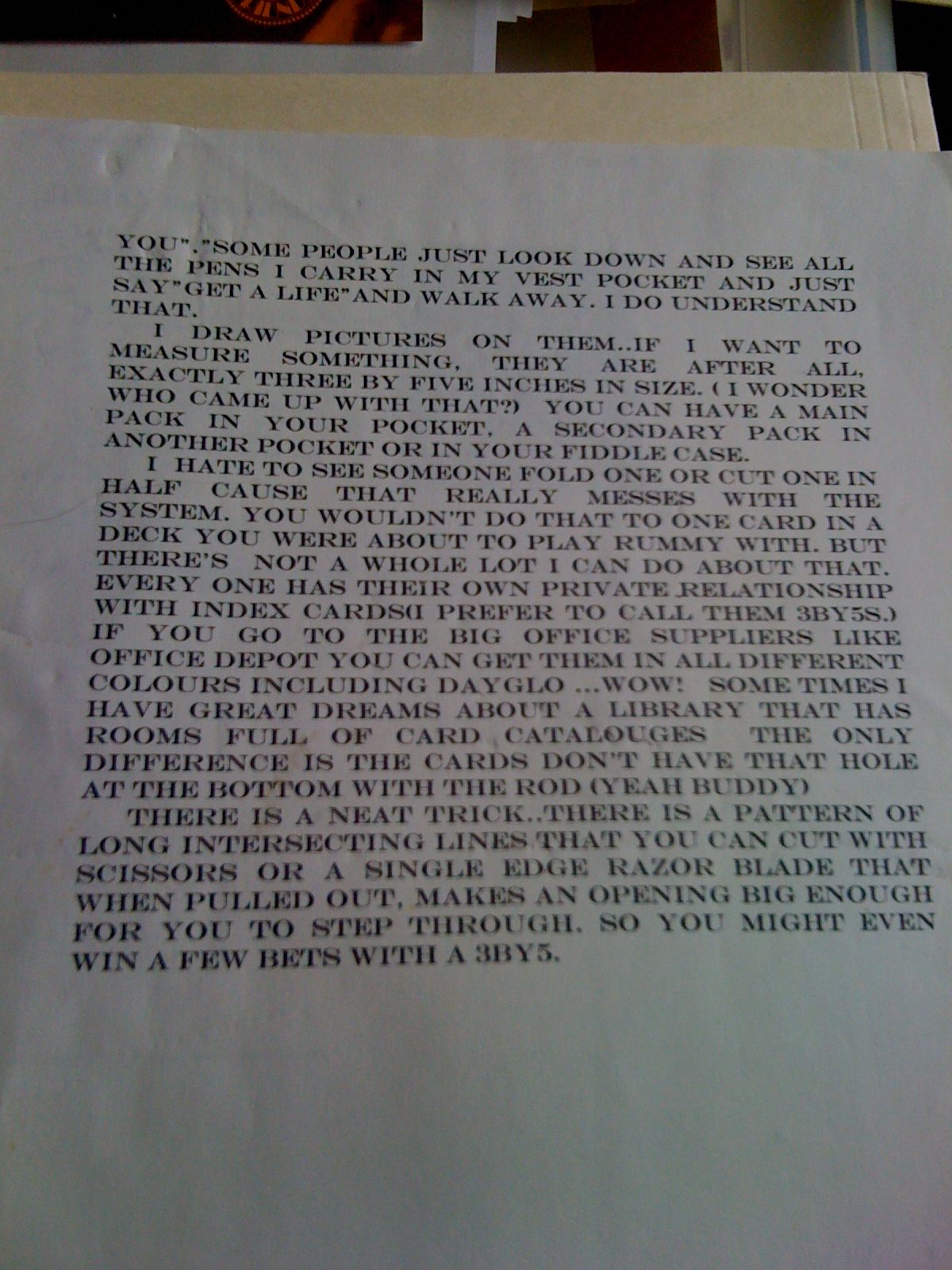
John Hartford’s Notecards

20 Wednesday Nov 2013

Posted by Brandon Ray Kirk in John Hartford

≈ Leave a comment

Tags

bluegrass, culture, John Hartford, life, music, Nashville, notecards, Tennessee, thoughts, writing

John's thoughts on notecards, page 2. Nashville, TN, c.2000.

John’s thoughts about notecards, page 2. Nashville, TN, c.2000.

In Search of Ed Haley 201

20 Wednesday Nov 2013

Posted by Brandon Ray Kirk in Ed Haley

≈ Leave a comment

Tags

Bruce Nemerov, Ed Haley, fiddling, history, John Hartford, Lee Hazen, Lynn Davis, Mark Wilson, music, Nashville, Parkersburg Landing, writing

When I got back to Nashville, I had this boxed package in the mail from Mark Wilson, the folklorist who co-produced Parkersburg Landing. Inside the box was a pile of wire recordings, looking very much like a gossamer bird’s nest, which Mark said were Lynn Davis’ recordings of Ed Haley from the forties. I had no idea why Mark had these wires, or really why he had sent them to me. Some years before, I had called him about Ed and received a cool reception, sort of like, “Why don’t you leave all of this to the real folklorists?”

I took the wire recordings to Lee Hazen, a studio engineer and friend whose life-long hobby was wire recordings, and he told me right away that they were way beyond hope. “Even if you took pieces of them and run them through and taped them and then assembled the tape?” I asked.

Nope.

He said it would require someone with enough patience to spend the rest of their life untangling them. I decided to keep them safe though and maybe someday, who knows? But wouldn’t it be awful to get them all together and discover that they were not even of Ed?

Later that spring, Bruce Nemerov notified me that he’d completed his work on Ed Haley’s recordings. I got a hold of the new copies, which included an audio log. There were several records that Bruce didn’t copy.

In Search of Ed Haley 194

11 Monday Nov 2013

Posted by Brandon Ray Kirk in Ed Haley

≈ Leave a comment

Tags

Big Ugly Creek, Bill Duty, Billy Adkins, Brandon Kirk, genealogy, Harts, history, Imogene Haley, John Hartford, Maude Duty, Milt Haley, Solomon Mullins, writing

I asked Billy about Bill Duty. We had found Milt living with Duty’s family in an 1870 Logan County census and knew from reading an interview with his son in the Lambert Collection that his family settled on Big Ugly Creek in the early 1880s. Billy turned us loose with his Duty notebook, where we soon located his notes on the family of “William Marshall Duty” (1838-c.1910). He said the family originally came to the area looking for work in timber. In 1900 and 1910, Bill Duty lived on the Broad Branch of Big Ugly Creek. We could find no apparent “blood connection” between him and Milt Haley but his wife Emma Ferrell was a great-granddaughter of Money Makin’ Sol Mullins (Ed’s great-great-grandfather). It was a seemingly distant family connection that might have played a part in Milt’s choice of Emma Mullins for a wife. Billy said we should talk with Maude Duty, a widow of one of Bill Duty’s grandsons, for more information along those lines.

That night, after hours of watching Billy and Brandon shuffle through genealogy books, census records and notebooks filled with handwriting, I realized just how difficult it would be to familiarize myself with all the characters and family relationships in the story of Milt Haley’s death. While I had little chance to memorize them, I made the effort to at least document them because they seemed to help explain a lot about Milt’s story. There were other things, of course, to mix into the blend, such as grudges, hatreds, and dislikes.

There was another important reason for documenting the genealogy: knowing how people were connected to each other helped me to objectively weigh in any slant in their stories (whether intentional or not). For instance, if I were talking to a nephew of “Uncle Al Brumfield,” I would probably get a somewhat complimentary account of his character; but if I were talking to someone whose family had feuded with him, comments might be less than flattering. It seemed obvious, then, that who I talked to, their genealogical connection to who they spoke of, where I talked to them, in whose company I talked to them, and what exactly they said (or didn’t say) were all important to note.

In Search of Ed Haley 186

26 Saturday Oct 2013

Posted by Brandon Ray Kirk in Ed Haley

≈ Leave a comment

Tags

Al Brumfield, Brandon Kirk, Dingess, feud, Harts Creek, history, John Hartford, Lawrence Kirk, Tug River, Twelve Pole Creek, Weddie Mullins, West Virginia, writing

The next day, Lawrence’s son drove the four of us over to Inez, a small settlement on the Tug River and the seat of government for Martin County, Kentucky. According to written history, Milt and Green were captured and jailed there in 1889. We made our way to the courthouse, which was surrounded by a few interesting buildings where Brandon darted inside to seek out some record of Milt and Green’s incarceration. Unfortunately, many such records had been lost in an 1892 fire. (It’s said there’s nothing more convenient than a good courthouse fire.)

Just before we left town, Lawrence said, “Well, straight east from here at this courthouse about eight miles across the river is the mouth of Jenny’s Creek on the West Virginia side. That’s approximately the way they traveled with these people when they left Kentucky. They went up Jenny’s Creek out the head of Jenny’s Creek into Twelve Pole and out of Twelve Pole down Henderson Branch into Big Harts Creek. It’s a direct route through there. We’re goin’ to be traveling approximately that. We’re going to be going around some places on account of the road but we’ll come back to the mouth of Jenny’s Creek over there.”

As we crossed the Tug into Kermit, Lawrence said, “I don’t know how far they would travel in a day by horseback through these trails on these mountains but they would travel a long ways. I think they did it in a day from up here at Kermit. Yeah, they’d do it in a day.”

Lawrence directed us up Marrowbone Creek and over to the little town of Dingess on Twelve Pole Creek. He said the posse never came through there with Milt and Green but it was the closest we could get to their trail due to the layout of current roads. Dingess, I remembered, was the place where Ed Haley’s uncle Weddie Mullins was murdered in a shoot-out at the turn of the century. The little town was reportedly named after a brother-in-law of Al Brumfield.

The next big thrill was navigating cautiously along a gravel road and entering Harts Creek at the head of Henderson Branch. We followed that branch to its mouth then went on down the main creek past Hoover, Buck Fork, and Trace Fork before turning up Smoke House Fork. Lawrence guided us past Hugh Dingess Elementary School to the site of Hugh Dingess’ old home at the mouth of Bill’s Branch. He said the posse took Milt and Green up Bill’s Branch, over the mountain, and down Piney Creek. They followed Piney to its mouth, then went up West Fork to Workman Fork. From Workman Fork, they crossed the mountain to the Guyandotte River. We were only able to drive part of this latter leg of the trip.

In Search of Ed Haley 185

21 Monday Oct 2013

Posted by Brandon Ray Kirk in Culture of Honor, Ed Haley

≈ Leave a comment

Tags

Bill Brumfield, Bob Adkins, Brandon Kirk, Charley Brumfield, crime, Eustace Ferguson, Harts, history, Hollene Brumfield, John Hartford, Lincoln County, Paris Brumfield, Wesley Ferguson, West Virginia, writing

In thinking about the old Brumfields, Bob mentioned the name of Paris Brumfield, the patriarch of the clan. Brandon quickly pulled out Paris’ picture and reached it to Bob saying, “He was my great-great-great-grandfather.” Paris, we knew, was murdered by his son Charley in 1891.

“Son, he was a mean old man, I’ll tell you that,” Bob said, turning the picture upside down in his hands and slowly studying it under a magnifying glass. “He’d kill anybody. He beat up on Charley’s mother and she went down to Charley’s for protection. He went down to get his wife. He got up to the top of that fence and Charles told him, ‘You beat up on Mother the last time. You’re not coming in here.’ Paris said, ‘Ah, you wouldn’t shoot your own father.’ Drunk, you know. And Charley said, ‘You step your foot over that fence, I will.’ Directly he started in and that there ended it, son. Charley killed him right there.”

I said, “Now there was another Brumfield father-son murder later on. Who was that?”

“Ah, that was Charley’s brother,” Bob said. “Bill Brumfield, up on Big Hart. He’s a mean old devil. He ought to been killed. He had a way… He never shot anybody. He’d beat them to death with a club. He’d hold a gun on them and make them walk up to him and then take a club and beat their brains out. He come down there to Hart to get drunk once in a while and he’d run everything away from there. And Hollene set on that front porch of that little old store she had out there with that pistol in her apron and she cussed him. He knew she had that gun — he wouldn’t open his mouth to her. It was his sister-in-law, you know. He just set there and chewed his tobacco and spit out in the street. She’d tell him how mean he was, you know. But his own son killed him. He was beating up on his mother and you can’t do that if you got a son around somewhere. I don’t give a damn who you are, they’re gonna kill ya. He didn’t miss a thing there, that boy didn’t. I don’t think they did anything with him about it.”

This Bill Brumfield, I remembered, was Brandon’s great-great grandfather. As Bob spoke of his departed ancestor, I noticed how Brandon just sat there without taking any offense, as some might want to do. Gathering the information seemed more important than family pride — at least for the moment. Brandon asked Bob if he remembered anything about Charley and Ward Brumfield’s murder in 1926.

“What they got into was very foolish,” Bob said. “Charley would come up there — and Ward was his nephew — and they’d ride up into the head of Harts Creek and get them some whisky and they’d drink. They went up around them Adamses — they was kin to the Dingesses and Brumfields — and bought them a bottle of whisky from this guy and they got his wife to cook them a chicken dinner. She cooked them up a nice chicken dinner and, of course, they drank that liquor and was pretty dern high, I expect. They was sitting there eating and they was a damn fella… Who was that killed them? They’s so dern many of them a shooting and a banging around among each other that I couldn’t keep track of them. He was just kind of a straggler.”

Bob thought for a moment then said, “Eustace Ferguson. Now, Eustace Ferguson was a brother to Hollene’s second husband, Wesley. They had asked him to go with them and he caught an old mule or something and followed them. He was mad at them ’cause he didn’t like the Dingesses and Brumfields anyway. He followed them up there and they was eating dinner. He come in there and told them if they had anything to say they better say it ’cause he was gonna kill them. And Charley raised out of there and he said, ‘Well, by god, I’d just as soon die here as anywhere,’ and he started shooting and they just shot the devil out of each other. And he killed Charley and Ward and Charley shot him but he got somebody to get him to the doctor before the Brumfields got up there ’cause he knew them Brumfields would kill him if they got up there in time. He begged them not to report it till he had time to get to Chapmanville to get into the hand of the law. And those people wasn’t too friendly to the Brumfields and they kept it hid for about an hour or two before they reported that.”

I asked Bob if there were any dances around Harts in his younger days and he said, “Not in my time. They had a few dances ’round here and yonder but I was too young to go.”

Were there any dances at Al and Hollena Brumfield’s store?

“I don’t think so. They wasn’t the dancing type. I never was around her too much. Sometimes I’d be there and play with her grandchildren, Tom and Ed Brumfield. They were about my age.”

In Search of Ed Haley 181

14 Monday Oct 2013

Posted by Brandon Ray Kirk in Big Sandy Valley, Big Ugly Creek, Ed Haley

≈ Leave a comment

Tags

Appalachia, Big Ugly Creek, Bill Duty, civil war, Fred B. Lambert, genealogy, history, Jeff Duty, John Hartford, Milt Haley, Tom Ferrell, Tug River, writing

We next looked at Logan County census records, where Milt Haley appeared in 1870 as “T. Milton Haley,” aged 13, living with a Bill Duty on Rich Creek in the Tug Valley. Duty’s home in Hardee District was relatively far away from the Harts area. Ten years later, in 1880, there was no trace of Milt or Duty anywhere in West Virginia, indicating that they may have lived outside the state at that time.

Had they moved together across the Tug into Kentucky?

We got back in the Lambert Collection for help…and found a circa-1934 interview with Jeff Duty, Bill Duty’s son.

At the time of the interview, Jeff was living at Dollie, a now extinct post office on Big Ugly Creek just upriver and over Green Shoal Mountain from Harts. He didn’t mention Milt Haley but gave a great account of his family story:

Grandfathers both came from Russell County, Virginia. Grandfather Geo. Duty came to Pigeon Creek in what is now Mingo County, before the Civil War. Grandfather James Ferrell settled on Big Creek, Logan County before the Civil War. Grandmother Duty was a Jackson and Grandmother Ferrell was a Fields.

Father was born in what is now Mingo County, and volunteered in 1861 as a Confederate. My father, William Duty, was in Gettysburg and Fort Donelson battles. They fought here seven days and seven nights. He was twice wounded. Father Wm. Duty lived in Mingo until fifty-one years ago, when he moved to Big Ugly, Lincoln County [around 1883]. When we moved to Big Ugly there were only three houses from Broad Branch, which is about one-half the length of Big Ugly to the head of Big Ugly, and now there are about two hundred. Big Ugly is nineteen miles long. There were plenty of deer, wild cats, coons, &c. when my father came. Wolves were here for about fifteen years after we came. Tom Ferrell killed the last deer killed about here about forty-five years ago.

My father was a rather big farmer for this part of the country, raising 1,000 bushels of corn a year, and always raising wheat. He had the first “chaff Piler” threshing machine brought in. It took about twelve horses to pull it. When it came on the first trip, my mother had about twenty geese in the yard, and when they heard it they took to the woods and did not come back for three or four days. My father had six children: John lived on Broad Branch, Lincoln County; Jeff here at Dollie; Phidelia Vernatter-Chapman lives in Boone County; Annie Steele lives in Logan County; George lives within three miles of Hurricane, Putnam County; Martha lives in Logan; she married Queen. My father, Wm. Duty, was the man who rode a $150.00 horse to death to save Tom Ferrell, who was in jail, in Hamlin, about 1889, for killing a man named Butcher, from a mob of Butcher relatives. Tom Ferrell is my cousin.

I am sixty-seven. I have eleven children, of whom three are dead: Alva, Lula, Stonewall, Solomon, Vernonda, Thos. Jefferson, Lee, Musco, Ira, Doska, Maggie. Mrs. Duty was Betty Pauley; her people came from Virginia. “Tiger Bill” Pauley was her father.

In Search of Ed Haley 178

29 Sunday Sep 2013

Posted by Brandon Ray Kirk in Ed Haley

≈ Leave a comment

Tags

Al Brumfield, Boney Lucas, Brandon Kirk, George Fry, George W. Ferrell, Green McCoy, Henderson Dingess, history, Hollene Brumfield, John Hartford, John W Runyon, Milt Haley, Paris Brumfield, The Lincoln County Crew, writing

After a few hours of digesting this material, I met Brandon Kirk in the hall near the copier. Brandon, a neatly groomed young man wearing a tie, was freighted down with satchels. We introduced ourselves and were soon in the study room where Brandon started fishing through his bags and pulling out letters, notebooks, folders and photo albums. Within a few minutes, the table was covered. It was as if someone had walked up with a giant garbage bag full of papers and dumped it all out in front of me.

One of the first things Brandon showed me was a small account of Milt Haley’s murder titled “The Brumfield-McCoy Feud”, which was originally published in a 1926 edition of Lambert’s Llorrac.

The Brumfield-McCoy Feud took place in the month of September, about 1888, some three miles up Hart’s Creek. Hollena Brumfield and her husband, Allen Brumfield, had been visiting Henderson Dingess, father of Mrs. Brumfield, one Sunday and were about two miles below Mr. Dingess’ on their way home. Green McCoy and Milt Haley laid in wait for them. Mr. and Mrs. Brumfield were riding down the creek, Mrs. Brumfield being on the same horse behind her husband. McCoy and Haley began shooting at them, one bullet striking Mr. Brumfield in the arm, and the other tearing away a portion of Mrs. Brumfield’s face, disfiguring her for life. Mr. Brumfield jumped from his horse and ran, and in that way escaped further injury. McCoy afterwards told that they were bribed by John Runyons with a barrel of flour and a side of bacon to McCoy, and twenty-five dollars in money to [Haley]. The murderers escaped into Kentucky but were captured a little later and brought back. Allen Brumfield supplemented the reward offered by the state with one of his own.

It seems the cause of the trouble was bad feeling between John Runyons and Al Brumfield. Runyons had a store and saloon at the mouth of Hart’s Creek. Brumfield had a store on Guyan River about a fourth of a mile below Hart, on the south side of the Guyan and sold whiskey on a houseboat. John Dingess [Mrs. Brumfield’s brother] was a bartender.

McCoy and Haley were brought back and kept over night at the house of George Fry. The next morning a number of men, presumably Brumfield’s friends came in, and the two prisoners were shot and killed.

Along with the above article was another version of “The Lincoln County Crew”, which gave George (and not Tom) Ferrell as the author.

Come all young men and ladies, come fathers, mothers, too;

I’ll relate to you the history of the Lincoln County crew.

Concerning bloody rows, and many a thieving deed,

Dear friend, pray lend attention to these few lines I say.

It was in the month of August all on a very fine day;

Allen Brumfield he got wounded they say by Milt Haley.

But Brumfield couldn’t believe it, nor hardly thought it so;

He said it was McCoy who shot that fatal blow.

They shot and killed Boney Lucas, a sober and innocent man,

And left his wife and children, to do the best they can.

They wounded Rufus Stowers, although his life was saved;

And he seemed to shun the grog shop, since he stood so near his grave.

Allen Brumfield he recovered, some weeks and months had past;

It was at the house of George Fry, these men they met at last.

Green McCoy and Milt Haley, about the yard did walk;

They seemed to be uneasy and no one wished to talk.

And then they went into the house, and sat down by the fire,

And little did they think, dear friends, they had met their final hour.

The sting of death was near them, _________________________

A few words passed between them concerning a row before.

The people some got frightened, began to rush out of the room;

When a ball from some one’s pistol laid the prisoners in the tomb.

Their friends then gathered ’round them, their wives to weep and wail;

Tom Ferrell was arrested, and soon confined to jail.

The butchers talked of lynching him, but that was all the fear;

And when the day of trial came, Tom Ferrell he came clear.

And then poor Paris Brumfield, relation to the rest,

He got three balls shot through him, they went straight through his breast.

The death of these few men have caused great trouble in our land;

Men to leave their wives and children to do the best they can.

Lincoln County’s still at war, they never, never cease;

Oh, could I only, only see my land once more in peace.

I composed this as a warning, a warning to all men;

Your pistols will cause trouble, on that you may depend.

In the bottom of the whiskey glass, the lurking devil dwells;

It burns the hearts of those who drink, and sends their soul to hell.

In Search of Ed Haley 170

16 Monday Sep 2013

Posted by Brandon Ray Kirk in Ed Haley

≈ Leave a comment

Tags

Ashland, blind, Ed Haley, Ella Haley, Farmers, immigration, Jim Brown, John Hartford, Kentucky, Lawrence Haley, Morehead, Pat Haley, writing

Early in March 1995, I fired up the Cadillac and drove the familiar road toward Ashland, Kentucky. After several hours of travel, I entered Rowan County — the place of Ella’s birth — and took the Farmers exit off of I-64. I wanted to get a closer look at Farmers, it being a place where Ella had lived, where Ralph was supposedly conceived, and where Lawrence remembered Ed playing for a dance. At one time, Farmers was the county’s largest town with 1,000 people. At the time of my visit, it was a small settlement, easily eclipsed by nearby Morehead.

A little later, I made my way into Morehead, a small college town with a curvy downtown business district and with most of its historical buildings torn down. It was somewhat disappointing. Triplett Creek, the Trumbo section of town, was dull and uninspiring. Small modern apartments replaced Ella’s old home place. Scenes of the Martin-Tolliver feud were long gone, removed to make way for a new road. At the college library, I found some interesting local history but nothing really pertaining to Ed and Ella’s story.

That evening, I arrived at Pat Haley’s home in Ashland. Pat was really down about Lawrence’s death and the progression of her daughter’s cancer. It was sad to be there – especially in the kitchen where Lawrence and I had spent so much time hashing out Ed’s music. Pat’s grandchildren were around frequently – especially David’s three daughters – but there was a great void in the house. I imagine it was a hundred-fold for Pat.

“We met August 14th, 1948, and he came back to America on November 5th,” she said of Lawrence. “We wrote to each other and I never saw him again until he came back to England and we met on Valentine’s Day, 1949. We married ten days later. I was almost eighteen. He was 21. I was staying with my sister in Hertfordshire, which is just on the outskirts of London. Larry came back to America in May, when he got out of the service. That’s when he told his mother he was married. Although she was writing to me, she didn’t know we were married. And she told him, ‘I suppose there’s a baby on the way.’ And he told her yes.

“I left England September 28th, 1949 on a Danish ship with a Polish crew. I was seven and a half months pregnant. It was a terrible experience. I went into false labor on the way over. The doctor was Polish and I never did understand a word the man said except ‘Haley.’ Had Beverly been born on that ship she could have claimed nationality to any country because we were in international waters. I got in this country on October 6th after eight days of choppy water. Larry met me in New York. We come past Staten Island and Ellis Island. I couldn’t see Larry on the dock but bless his heart he didn’t know he had to get a docking pass. He was stuck up at the barrier and here were all these people getting off the ship. And there was Larry in civilian clothes. It was the first time I’d seen Larry in civilian clothes. And one of the immigration officers said, ‘Why, he’s just a little boy.’

“We spent ten days in New York. Part of my luggage was lost and we were having some problem with some papers Larry should have gotten done. I didn’t know his parents were blind until we were in New York. I asked Larry what his mother thought of the pictures that he had given her of him and I, and he said, ‘She hasn’t seen them.’ And I said, ‘Why not?’ and he said, ‘She can’t see them. She’s blind.’ And I said, ‘Well, what did your dad think of them?’ And he said, ‘He’s blind, too.’

“We stayed in New York till October 16th. Just before we left, we had enough to buy a Spam sandwich and two apples in the bus station. He gave me the sandwich. It took us 24 hours to get from New York to Ashland. I got deathly sick on that bus ride. It was twist and turn over those mountains. It was about midnight when we got into Ashland and we had three cents in our pocket. Jack thought we would be there in the afternoon so he and Jim Brown had gone to the bus station and looked for us. They were drinking. Well, when we didn’t show up — I think it was between six and eight o’clock — they went back to the house. The bus station was located at 13th Street between Winchester and Carter Avenue. His parents lived at 1040 Greenup Avenue. So we walked and carried our suitcases and I had high heels on. We walked about six blocks — three down and three across.”

In Search of Ed Haley 169

10 Tuesday Sep 2013

Posted by Brandon Ray Kirk in Ed Haley

≈ 3 Comments

Tags

Alva Greene, Brandon Kirk, Ed Haley, fiddling, Fred B. Lambert, Huntington, J P Fraley, John Hartford, Kentucky, Lawrence Kirk, music, Pat Haley, writing

Not long after talking with Patsy, while on a trip through Kentucky, I visited J.P. Fraley. I had Ed’s fiddle with me, which excited J.P. greatly. He fiddled Haley’s version of “Granny Will Your Dog Bite?” as best as he could remember it and said Ed used to sing:

Granny, will your dog bite, dog bite, dog bite?

Granny will your dog bite?  “No, child, no.”

Granny will your dog bite, dog bite, dog bite?

“Johnny cut his biter off a long time ago.”

He said Ed also used to play “Hunky Dory”.

Between tunes, J.P. talked about how Haley was the top fiddler in his section of Kentucky. “Daddy and Alva Greene and Doctor Sparks and Frank Clay, Drew Crockett — reputable fiddlers, I called them — ever chance they got, they’d go listen to Ed Haley. He was the yardstick of the fiddlers in this whole area.”

J.P. said, “I’ve kept something for years, buddy. I’ve got a fiddle bridge of Ed Haley’s. I don’t know what it’s made out of.”

Apparently, when he borrowed the Haley fiddle from the Holbrooks years ago, he had kept a little memento before returning it.

In the next couple of weeks, I finalized plans for another “Ed Haley trip.” Pat Haley said I could stay at her place in Ashland, while Lawrence Kirk said I was welcome to stay with him in West Virginia. I called Brandon Kirk, the Harts genealogist, and arranged to meet him at the Morrow Library in Huntington. There he said we would have a lot of genealogical material at our fingertips, as well as all the room we needed to sort through our books and old photographs. I was very interested in the Lambert Collection, which he said was full of local historical information.

In Search of Ed Haley 164

04 Wednesday Sep 2013

Posted by Brandon Ray Kirk in Ed Haley

≈ 1 Comment

Tags

Ashland, fiddling, genealogy, Jack Haley, John Hartford, Kentucky, Lawrence Haley, Morehead, music, Pat Haley, Patsy Haley, Ralph Haley, Scott Haley

A few days later, I was in Ashland at Pat Haley’s house, where the Haley clan had gathered in for Lawrence’s funeral. All of Lawrence’s kids were there, of course (Beverly, Steve and David), as was Clyde and Mona. I also spotted Noah, who introduced me to his son, James Edward Haley (Ed’s namesake). Pat made a point to introduce me to Patsy Haley and her son Scott, who were in from Cleveland. A little later, I played Ed’s fiddle for Lawrence’s service and it sounded so good that I seriously considered making it my main fiddle on stage. I quickly slipped into “the zone” and it was the first time I seemed to experience (as crazy as it may seem) the sensation of Ed and Lawrence both whispering in my ear, guiding me along, looking over my shoulder, and saying things like, “Easy now, don’t play so many notes.” “Yeah, try that and see if it works.” “You’re getting too far away from the melody.”

After the funeral, I returned to Pat’s and played for the family in the kitchen. I wasn’t really sure what to expect. I mean, with Lawrence gone it would have been really easy for the Haleys to say, “Thanks for showing an interest in Pop, now see ya later,” but instead they took me into their fold — with Pat leading the way.

There were a few new stories. For instance, Patsy’s son Scott Haley told me about “catching” his father Jack in private moments playing a fiddle right along with Ed’s records. I was excited to hear that and could easily imagine that Jack was the child who had inherited Ed’s talent for the fiddle. But when I asked Pat and Steve about it they gave Scott’s claim little credence. They said Jack might have tried to play with the records but he couldn’t really play anything. They fancied Scott’s memory to be a lot like the one they had of Lawrence, who occasionally strung up Ed’s fiddle (backwards because he was left-handed) and attempted to play along with the records. I never forgot the possibility, though, that Jack Haley could play the fiddle, which seemed to irritate Pat.

Before I left Ashland, Pat gave me Ed’s records. She said she wanted me to keep them because I would “know what to do with them.”

“I have a real love-hate relationship with those records,” Steve said jokingly. “When we were kids we had to tip-toe through the house to keep from scratching them.”

Pat also loaned me Ella’s postcards and explained why Lawrence hadn’t wanted me to see them on my first visit roughly four years earlier. Apparently, they alluded to the fact that Ella had conceived Ralph not by a previous marriage — but out of wedlock. Pat said Ella was boarding with a Mr. Payne and giving piano lessons to his five-year-old daughter in Farmers, Kentucky, when she became pregnant. Mr. Payne promptly returned her to her family in nearby Morehead.

In Search of Ed Haley 163

03 Tuesday Sep 2013

Posted by Brandon Ray Kirk in Ed Haley

≈ Leave a comment

Tags

Appalachia, Ashland, Cincinnati, Ed Haley, fiddle, history, John Hartford, Lawrence Haley, life, music, Nashville, Portsmouth, U.S. South

Once I returned to Nashville, I called Lawrence Haley, who was in the mood to reminisce.

“Me and Pop hitch-hiked to Cincinnati out of Portsmouth a time or two,” he said. “We took old 52. And we’d had about three rides to get there.”

I asked him if Ed took his fiddle on those trips and he said, “Yeah, if he thought he was gonna be in a little bit other than country settings, he would put it in the case. But most of the time, he’d just carry it in his hand, tucked under his arm, maybe, with the bow in his hand.”

I wondered if Ed packed any extra bags on the road and Lawrence said, “Mostly just the clothes on his back, unless he was going on an extended trip — then he’d pack him a suitcase. He’d, of course, fill it up about a third with his homemade tobacco. His own cure — apple or peach or something. He’d take him some of that with him and off he’d go.”

Lawrence Haley passed away on February 3, 1995, the 44th anniversary of his father’s death.

In Search of Ed Haley 161

28 Wednesday Aug 2013

Posted by Brandon Ray Kirk in Ed Haley

≈ 2 Comments

Tags

Ashland, Calhoun County, Ed Haley, Ella Haley, history, John Hartford, Kentucky, Laury Hicks, Manuel Martin, music, Ugee Postalwait, West Virginia, writing

After hanging up with Pat, I called Ugee Postalwait — Laury Hicks’ daughter in Akron, Ohio — to tell her about getting the picture of Ed from Maxine McClain. Ugee was full of energy. Her memory was obviously working in overdrive.

“I used to know all of them,” she said of the old musicians in her part of the country. “They was all to our house. They’d come from miles around to hear Dad play, especially when Ed was in the country. Maybe they’d stay two or three days at our house. I’d get up of a morning to look see who was in the house asleep and who all I was gonna have to cook breakfast for, when I was a girl growing up. The young men would sleep in the boys’ room and they’d sleep in the floor. Then they’d sleep four crossways in the bed, too. As I get old, I get to thinking about all of them and wonder how in the world my dad ever fed them all. I been a cooking ever since I was nine years old for workhands and people like that. One morning — I never will forget I wasn’t very old, then — got up and got breakfast. We’d had cabbage the day before for supper. A big pot of cabbage. And Ed and Ella was there. I never put cabbage on the table for breakfast. Ed looked at me and he said, ‘Ugee, what did you do with that cabbage last night?’ I said, ‘It’s in there.’ ‘Well why didn’t you put it on the table for breakfast?’ I said, ‘Well who eats cabbage for breakfast?’ He said, ‘I do.’ Now I never seen anyone eat such a mess of cabbage for breakfast. Him and Ella did. Ella said, ‘Oh, we always eat the same thing we had for supper.’ I never will forget that. From that time on, whatever was left over from supper, I’d warm it up, you know, and fix it for their breakfast ’cause they would eat it. They liked cabbage or kraut.”

Ugee really laughed telling about that, then started in with another tale.

“One time they was some Baileys there and I believe they was some of them McClain boys, and I was peeling tomatoes for supper — you know, slicing them and putting them on the plate — and I had a plate on one end [of the table] and one on the other end. And Manuel Martin was there too, and Commodore Cole. And I looked in both places and them tomatoes was gone. ‘What in the world? Some of them’s come in and hid my tomatoes.’ I looked out and Ed was standing there sitting on the walk — I never will forget — a laughing, and he said, ‘Wait till she finds out.’ I said, ‘Ed did you get them tomatoes in there?’ He said, ‘We ate every one of them.’ I said, ‘If I could find the plate, I’d break it over your head.’ That Commodore Cole, he said, ‘You wouldn’t dare do that.’ Ed said, ‘Don’t dare her too much, Commodore. I know her.’ And they was a eating them tomatoes as fast as I was a peeling them. Them ornery birds, I never will forget that.”

“The last time I ever seen Ed was at his house,” Ugee said. “He looked at me and he said, ‘Ugee, can you still make a rhubarb pie?’ I said, ‘Why lord yes, I reckon I can. Why?’ He said, ‘Well, I want a rhubarb pie.’ And I made four and I never seen no such eating as he done that evening, him and Ella, on them rhubarb pies while they was hot — with milk cream over them. I can see them yet. I went down to Ashland, Kentucky. They lived on 45th Street.”

In Search of Ed Haley 160

27 Tuesday Aug 2013

Posted by Brandon Ray Kirk in Ed Haley

≈ Leave a comment

Tags

Clyde Haley, family, feud, history, John Hartford, Lawrence Haley, Lawrence Kirk, life, Milt Haley, Mona Haley, Pat Haley, Tug River, writing

A few weeks later, I called Lawrence Kirk, whose ancestors had played various roles in the story of Milt Haley’s death. I hadn’t spoken with him for several months. We talked more about Milt Haley’s murder.

“Back in the old days, these people’d get into trouble here and they’d run backwards and forwards across that Tug River,” he said. “That was the state line and the law didn’t bother them. If you crossed the state line, you was safe. But they got the papers out and went over there and got Haley and McCoy. Inez is where they went to and got them. Yes, sir. They either came up Jenny’s Creek or Marrowbone Creek. See, they had horse trails all through these woods back in them days. They come right across Twelve Pole and down Henderson up there in the head of main Hart. Come right down and up what they call the Bill Branch — some people calls it the Hugh Dingess Branch — right down Piney Fork. It’s a straight shoot through there. I’ll tell you what. Come up sometime when you’ve got a day or two and we can drive right through there.”

Boy, that sure sounded good to me.

In the meantime, Pat kept me up on everything. She said Mona was helping her look after Lawrence and had even spent the night. Clyde had come in for Christmas.

“They had a red hat on him and a great big sign across the front which said ‘Clyde.’ They had a pair of pants that was rolled over about three times tops, the shoes was way too big, and, I mean, it was sad. The hat was red, his sweater was blue, and his shoes was white. Mona said they got half-way home from Cincinnati, and he was just talking away, you know, about things that had happened in their past, and then he began looking out the window and all of a sudden he turned around and he said, ‘Who in the hell are you?’ And she thought, ‘Uh, oh, it’s gonna be good.’ Larry was very happy to see him.”

← Older posts
Newer posts →

Feud Poll 1

If you had lived in the Harts Creek community during the 1880s, to which faction of feudists might you have given your loyalty?

Categories

  • Adkins Mill
  • African American History
  • American Revolutionary War
  • Ashland
  • Atenville
  • Banco
  • Barboursville
  • Battle of Blair Mountain
  • Beech Creek
  • Big Creek
  • Big Harts Creek
  • Big Sandy Valley
  • Big Ugly Creek
  • Boone County
  • Breeden
  • Calhoun County
  • Cemeteries
  • Chapmanville
  • Civil War
  • Clay County
  • Clothier
  • Coal
  • Cove Gap
  • Crawley Creek
  • Culture of Honor
  • Dingess
  • Dollie
  • Dunlow
  • East Lynn
  • Ed Haley
  • Eden Park
  • Enslow
  • Estep
  • Ethel
  • Ferrellsburg
  • Fourteen
  • French-Eversole Feud
  • Gilbert
  • Giles County
  • Gill
  • Green Shoal
  • Guyandotte River
  • Halcyon
  • Hamlin
  • Harts
  • Hatfield-McCoy Feud
  • Holden
  • Hungarian-American History
  • Huntington
  • Inez
  • Irish-Americans
  • Italian American History
  • Jamboree
  • Jewish History
  • John Hartford
  • Kermit
  • Kiahsville
  • Kitchen
  • Leet
  • Lincoln County Feud
  • Little Harts Creek
  • Logan
  • Man
  • Matewan
  • Meador
  • Midkiff
  • Monroe County
  • Montgomery County
  • Music
  • Native American History
  • Peach Creek
  • Pearl Adkins Diary
  • Pecks Mill
  • Peter Creek
  • Pikeville
  • Pilgrim
  • Poetry
  • Queens Ridge
  • Ranger
  • Rector
  • Roane County
  • Rowan County Feud
  • Salt Rock
  • Sand Creek
  • Shively
  • Spears
  • Sports
  • Spottswood
  • Spurlockville
  • Stiltner
  • Stone Branch
  • Tazewell County
  • Timber
  • Tom Dula
  • Toney
  • Turner-Howard Feud
  • Twelve Pole Creek
  • Uncategorized
  • Warren
  • Wayne
  • West Hamlin
  • Wewanta
  • Wharncliffe
  • Whirlwind
  • Williamson
  • Women's History
  • World War I
  • Wyoming County
  • Yantus

Feud Poll 2

Do you think Milt Haley and Green McCoy committed the ambush on Al and Hollene Brumfield in 1889?

Blogroll

  • Ancestry.com
  • Ashland (KY) Daily Independent News Article
  • Author FB page
  • Beckley (WV) Register-Herald News Article
  • Big Sandy News (KY) News Article
  • Blood in West Virginia FB
  • Blood in West Virginia order
  • Chapters TV Program
  • Facebook
  • Ghosts of Guyan
  • Herald-Dispatch News Article 1
  • Herald-Dispatch News Article 2
  • In Search of Ed Haley
  • Instagram
  • Lincoln (WV) Journal News Article
  • Lincoln (WV) Journal Thumbs Up
  • Lincoln County
  • Lincoln County Feud
  • Lincoln County Feud Lecture
  • LinkedIn
  • Logan (WV) Banner News Article
  • Lunch With Books
  • Our Overmountain Men: The Revolutionary War in Western Virginia (1775-1783)
  • Pinterest
  • Scarborough Society's Art and Lecture Series
  • Smithsonian Article
  • Spirit of Jefferson News Article
  • The Friendly Neighbor Radio Show 1
  • The Friendly Neighbor Radio Show 2
  • The Friendly Neighbor Radio Show 3
  • The Friendly Neighbor Radio Show 4
  • The New Yorker
  • The State Journal's 55 Good Things About WV
  • tumblr.
  • Twitter
  • Website
  • Weirton (WV) Daily Times Article
  • Wheeling (WV) Intelligencer News Article 1
  • Wheeling (WV) Intelligencer News Article 2
  • WOWK TV
  • Writers Can Read Open Mic Night

Feud Poll 3

Who do you think organized the ambush of Al and Hollene Brumfield in 1889?

Recent Posts

  • Logan County Jail in Logan, WV
  • Absentee Landowners of Magnolia District (1890, 1892, 1894)
  • Charles Spurlock Survey at Fourteen Mile Creek, Lincoln County, WV (1815)

Ed Haley Poll 1

What do you think caused Ed Haley to lose his sight when he was three years old?

Top Posts & Pages

  • U.B. Buskirk of Logan, WV (1893-1894)
  • Vance Homeplace and Cemetery on West Fork (2017)
  • Tice Elkins in Ferrellsburg, WV
  • Early Anglo Settlers of Logan, WV (1937)
  • Alice Dingess piano

Copyright

© Brandon Ray Kirk and brandonraykirk.wordpress.com, 1987-2023. Unauthorized use and/or duplication of this material without express and written permission from this blog’s author and/or owner is strictly prohibited. Excerpts and links may be used, provided that full and clear credit is given to Brandon Ray Kirk and brandonraykirk.wordpress.com with appropriate and specific direction to the original content.

Archives

  • February 2025
  • January 2025
  • October 2023
  • September 2023
  • December 2022
  • November 2022
  • May 2022
  • April 2022
  • February 2022
  • November 2021
  • October 2021
  • September 2021
  • June 2021
  • May 2021
  • April 2021
  • March 2021
  • February 2021
  • January 2021
  • December 2020
  • November 2020
  • October 2020
  • July 2020
  • June 2020
  • May 2020
  • April 2020
  • March 2020
  • February 2020
  • January 2020
  • December 2019
  • November 2019
  • October 2019
  • September 2019
  • August 2019
  • July 2019
  • June 2019
  • May 2019
  • April 2019
  • March 2019
  • February 2019
  • January 2019
  • December 2018
  • November 2018
  • October 2018
  • September 2018
  • August 2018
  • July 2018
  • June 2018
  • May 2018
  • April 2018
  • March 2018
  • February 2018
  • January 2018
  • December 2017
  • November 2017
  • October 2017
  • September 2017
  • August 2017
  • July 2017
  • June 2017
  • May 2017
  • April 2017
  • March 2017
  • February 2017
  • January 2017
  • December 2016
  • November 2016
  • October 2016
  • September 2016
  • August 2016
  • July 2016
  • June 2016
  • May 2016
  • April 2016
  • March 2016
  • February 2016
  • January 2016
  • December 2015
  • November 2015
  • October 2015
  • September 2015
  • August 2015
  • July 2015
  • June 2015
  • May 2015
  • April 2015
  • March 2015
  • February 2015
  • January 2015
  • December 2014
  • October 2014
  • September 2014
  • August 2014
  • July 2014
  • June 2014
  • May 2014
  • April 2014
  • March 2014
  • February 2014
  • January 2014
  • December 2013
  • November 2013
  • October 2013
  • September 2013
  • August 2013
  • July 2013
  • June 2013
  • May 2013
  • April 2013
  • March 2013
  • February 2013
  • January 2013
  • December 2012
  • November 2012

Enter your email address to follow this blog and receive notifications of new posts by email.

Join 2,925 other subscribers

Tags

Appalachia Ashland Big Creek Big Ugly Creek Blood in West Virginia Brandon Kirk Cabell County cemeteries Chapmanville Charleston civil war coal Confederate Army crime culture Ed Haley Ella Haley Ferrellsburg feud fiddler fiddling genealogy Green McCoy Guyandotte River Harts Harts Creek Hatfield-McCoy Feud history Huntington John Hartford Kentucky Lawrence Haley life Lincoln County Lincoln County Feud Logan Logan Banner Logan County Milt Haley Mingo County music Ohio photos timbering U.S. South Virginia Wayne County West Virginia Whirlwind writing

Blogs I Follow

  • OtterTales
  • Our Appalachia: A Blog Created by Students of Brandon Kirk
  • Piedmont Trails
  • Truman Capote
  • Appalachian Diaspora

BLOOD IN WEST VIRGINIA is now available for order at Amazon!

Blog at WordPress.com.

OtterTales

Writings from my travels and experiences. High and fine literature is wine, and mine is only water; but everybody likes water. Mark Twain

Our Appalachia: A Blog Created by Students of Brandon Kirk

This site is dedicated to the collection, preservation, and promotion of history and culture in Appalachia.

Piedmont Trails

Genealogy and History in North Carolina and Beyond

Truman Capote

A site about one of the most beautiful, interesting, tallented, outrageous and colorful personalities of the 20th Century

Appalachian Diaspora

  • Subscribe Subscribed
    • Brandon Ray Kirk
    • Join 787 other subscribers
    • Already have a WordPress.com account? Log in now.
    • Brandon Ray Kirk
    • Subscribe Subscribed
    • Sign up
    • Log in
    • Report this content
    • View site in Reader
    • Manage subscriptions
    • Collapse this bar
 

Loading Comments...