Tags
Appalachia, Bob Hatfield, Cabell County, Edward S. Doolittle, Elias Hatfield, genealogy, history, Huntington, Huntington Advertiser, Kentucky, Mingo County, Pike County, W.O. Walton, West Virginia

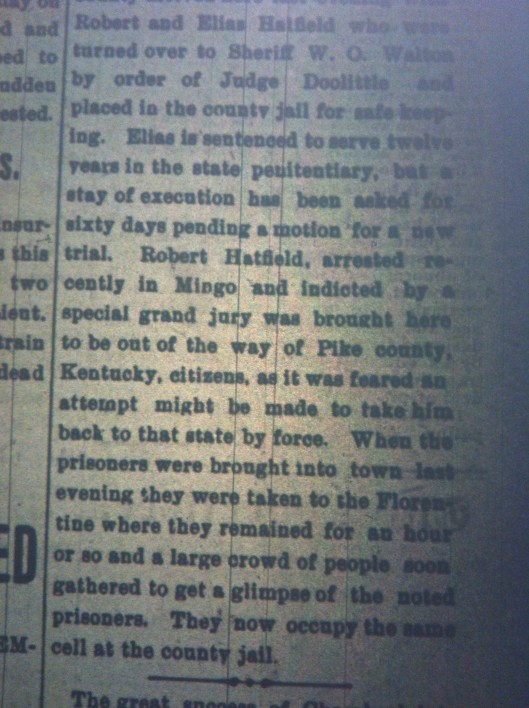
Huntington (WV) Advertiser, 22 September 1899.

22 Wednesday Mar 2017
Posted in Hatfield-McCoy Feud, Huntington, Wharncliffe
Tags
Appalachia, Bob Hatfield, Cabell County, Edward S. Doolittle, Elias Hatfield, genealogy, history, Huntington, Huntington Advertiser, Kentucky, Mingo County, Pike County, W.O. Walton, West Virginia
Huntington (WV) Advertiser, 22 September 1899.
14 Tuesday Mar 2017
Posted in Logan
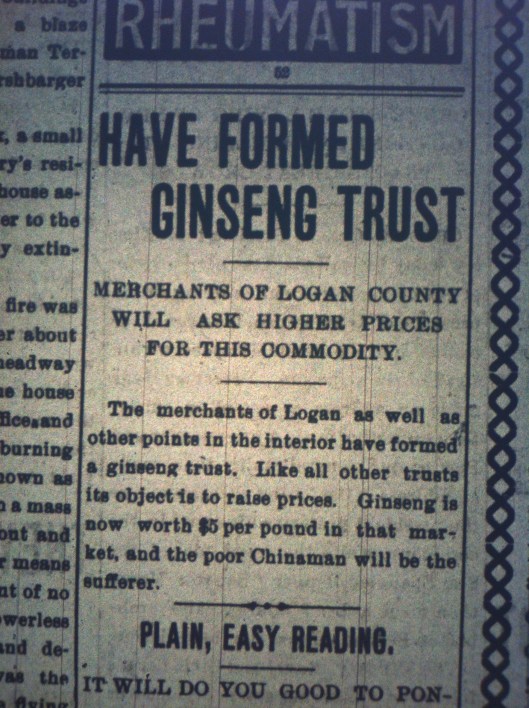
Huntington (WV) Advertiser, 9 October 1899.
13 Monday Mar 2017
Posted in French-Eversole Feud
Tags
Appalachia, feud, feuds, French-Eversole Feud, genealogy, Georgia May, Hindman, history, Huntington, Huntington Advertiser, Kentucky, Knott County, Perry County, Robert Samuel May, West Virginia
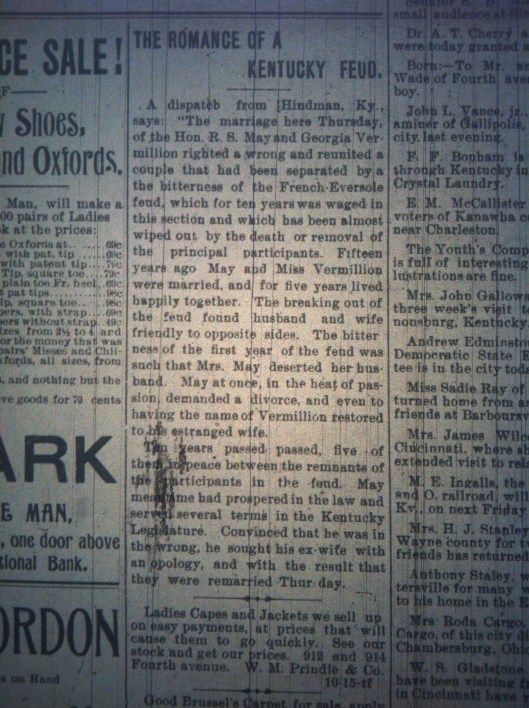
Huntington (WV) Advertiser, 21 October 1896. You can find more about this couple here: https://www.findagrave.com/cgi-bin/fg.cgi?page=gr&GRid=104436409
07 Tuesday Mar 2017
Posted in Culture of Honor, Hatfield-McCoy Feud, Wharncliffe
Tags
Appalachia, Bob Hatfield, Cap Hatfield, crime, Devil Anse Hatfield, feud, feuds, genealogy, Gray, Hatfield-McCoy Feud, history, Huntington Advertiser, John L. Dingess, Kentucky, Logan County, Mingo County, murder, Norfolk and Western Railroad, West Virginia, Wharncliffe

Huntington (WV) Advertiser, 12 September 1899.
This story reads: “The posse of citizens which left Gray on the N. & W. yesterday for the purpose of raiding the fort and homes of the Hatfields met with fairly good success, and the most remarkable feature is the fact that no blood was shed. They captured Anse Hatfield, his son Bob, and son-in-law John Dingess at Wharncliffe. The posse hid themselves in a baggage car of an N. & W. train and took the entire party by surprise. When Bob Hatfield put the U.S. mail on the train, two Winchesters were thrust in his face and as his hands were up he was commanded to keep them up under penalty of death. The party then went to Bob’s house which is located on the side of the hill and finding ‘Devil Anse’ asleep his capture was easy. The old fellow who has led his clan for fifteen years against all enemies and authorities seemed much surprised when he awoke and noticed that he was surrounded by men with Winchesters. His faithful Winchesters of the past were then in the hands of the posse. The notorious ‘Cap’ Hatfield was in another room of the house, but at first sight of the posse approaching he escaped into a nearby cornfield and made his way to the mountains in safety. Dingess was located in a nearby saloon operated by Bob Hatfield and he was also taken into custody with but little trouble. The members of the posse of course feel much elated over the captures. All the prisoners were placed in the Williamson jail at a late hour last night and there is much speculation throughout Mingo as to what the outcome will be. It is believed by many that the intention is purely to have them removed to Kentucky, as there are no indictments of any serious nature against any of those captured yesterday in West Virginia. All are wanted in Kentucky however for their complicity in the McCoy murders of years ago. There are a large number of the Hatfields still in the mountains of Mingo and Logan, and whether the posse will continue pushing on until all are captured is not known here today.”
05 Sunday Mar 2017
Posted in Huntington
Tags
Appalachia, Cabell County, crime, history, Huntington, Huntington Advertiser, Huntington Detective Agency, J.A. Rau, J.W. Valentine, Scott Turner, T.S. Scanlon, West Virginia, William Bowden
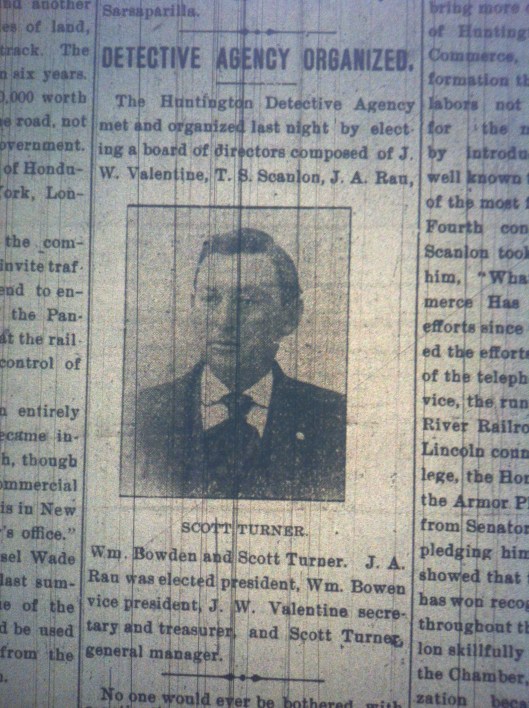
Huntington (WV) Advertiser, 8 February 1898.
05 Sunday Mar 2017
Posted in Barboursville, Guyandotte River
Tags
Appalachia, Barboursville, C&O Railroad, Cabell County, Fred B. Lambert, Guyandot Valley Railroad, history, Huntington, Huntington Advertiser, Marshall University, Virgil Bostic, West Virginia

Virgil Bostic Section Crew, GVRR. Photo from Fred B. Lambert Papers, Special Collections Department, James E. Morrow Library, Marshall University, Huntington, WV.

“The railroad contractors have the pile driver at work above here [Barboursville] and are getting ready to construct the trestles along the line,” said the Huntington Advertiser on April 19, 1900.

“Men are working day and night on the river above here [Barboursville] putting in coffer dams for the railroad bridge,” said the Huntington Advertiser on April 21, 1900.

“Contractor Allen has put on a night force above here where the foundation for the piers for the Guyandot Valley Railway bridge are being constructed,” said the Huntington Advertiser on May 9, 1900. “One of the river abutments will be completed tomorrow.” On May 16, it added this: “Work on the trestle over the ‘Big Gut’ just above here [Barboursville] will commence this week. This is the first trestle on the line of the Guyandot Valley requires considerable timber.”
04 Saturday Mar 2017
Posted in Culture of Honor, Wyoming County
Tags
Appalachia, crime, history, Huntington Advertiser, Lee Ford, Mary Martha Ford, West Virginia, Wyoming County
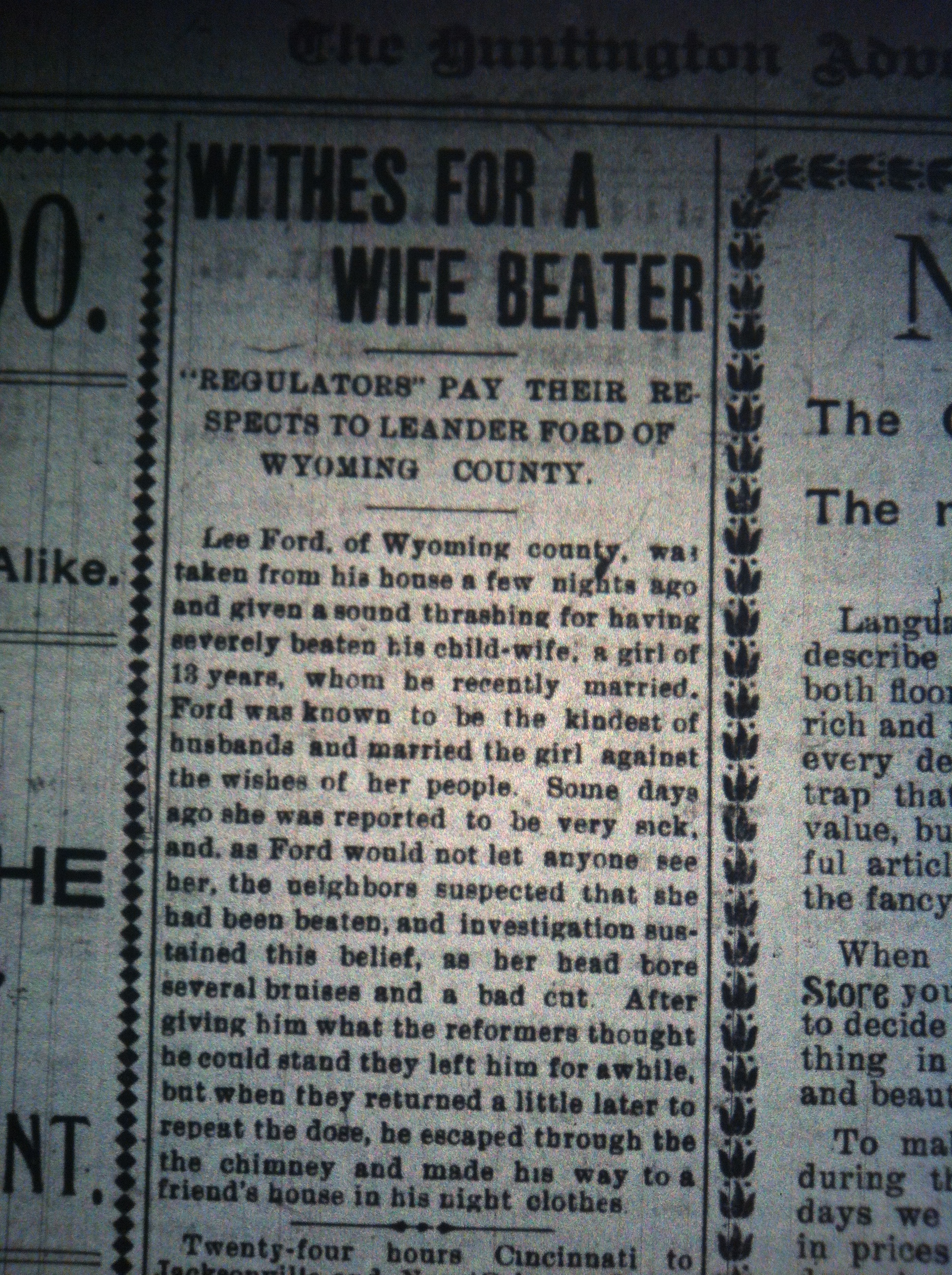
Huntington (WV) Advertiser, 17 December 1900. You can see Mr. Ford’s marriage record here: http://www.wvculture.org/vrr/va_view2.aspx?FilmNumber=594769&ImageNumber=136 or here: http://www.wvculture.org/vrr/va_view2.aspx?FilmNumber=594769&ImageNumber=135
22 Wednesday Feb 2017
Posted in African American History, Barboursville
Tags
Appalachia, Barboursville, Cabell County, Clarence Dean, genealogy, Gertrude Dean, Harvey Dean, history, Huntington, Huntington Advertiser, Patsy Dean, slavery, West Virginia

Patsy Dean Obituary, Huntington (WV) Advertiser, 29 March 1899. According to the 1870 Cabell County Census, Patsy was born about 1837. The census enumerator identified her as a mulatto. Based on the 1880 Cabell County Census, Patsy was born about 1840 and was the mother of three children: Harvey Dean (born about 1873), Gertrude Dean (born about 1875), and Clarence Dean (born about 1878). The census enumerator identified her as black.
18 Wednesday Jan 2017
Posted in Civil War, Huntington
Tags
actress, Albert Gallatin Jenkins, Alberta Gallatin Jenkins, Appalachia, Cabell County, Columbia, Davis Theatre, Green Bottom, history, Huntington, Huntington Advertiser, J.B. Bowlin, Joseph Jefferson, Mrs. Fiske, Nell Gwynne, Paraguay, Richard Mansfield, St. Louis, T.W. Keene, theater, Uruguay, Virginia Jenkins, West Virginia
Alberta Gallatin Jenkins (1861-1948) was a famous stage actress born at Green Bottom in present-day Cabell County, West Virginia. She was the daughter of Confederate general Albert Gallatin Jenkins. For more on her biography, follow this link: https://en.wikipedia.org/wiki/Alberta_Gallatin
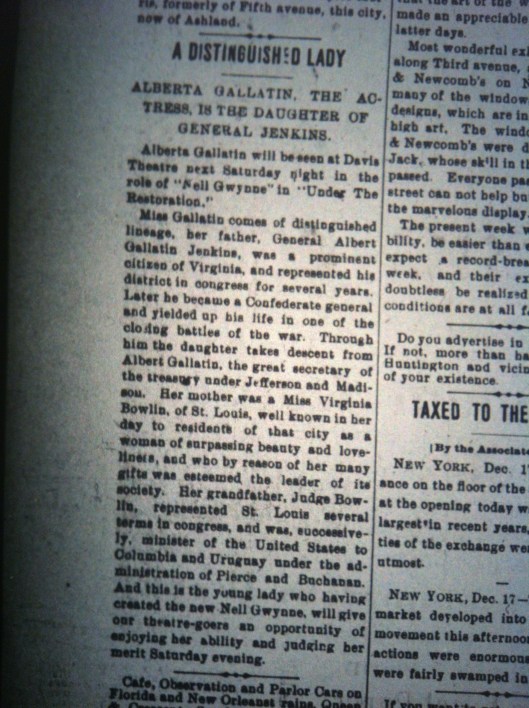
Huntington (WV) Advertiser, 17 December 1900.

Huntington (WV) Advertiser, 20 December 1900. Additional information here: https://warnerssafeblog.wordpress.com/category/alberta-gallatin-1861-1948/

Huntington (WV) Advertiser, December 20, 1900.
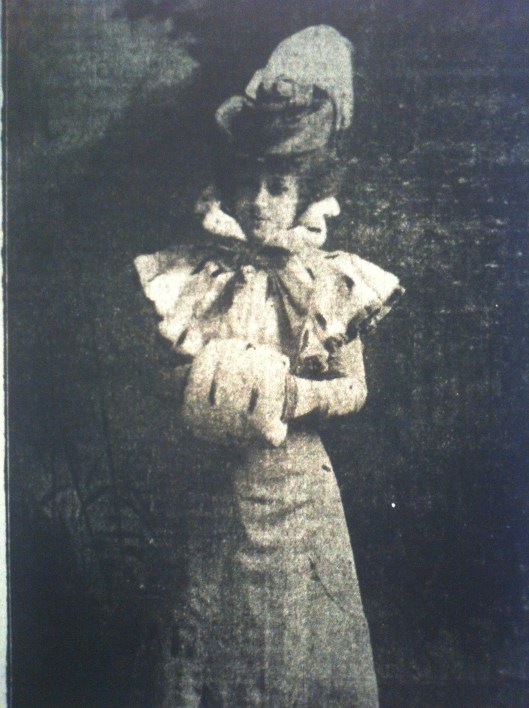
Huntington (WV) Advertiser, 21 December 1900.
18 Wednesday Jan 2017
Posted in Huntington
Tags
Appalachia, George W. Atkinson, governors, history, Huntington, Huntington Advertiser, New York Sun, political cartoons, politics, Republican Party, trusts, West Virginia

“Gov. Atkinson and the Trust Octopus,” Huntington (WV) Advertiser, 19 September 1899. For more on Gov. Atkinson, follow this link: http://www.wvencyclopedia.org/articles/308
30 Sunday Oct 2016
Posted in Huntington
Tags
Annie Oakley, Appalachia, Buffalo Bill, Cabell County, Fifth Royal Irish Lancers, Fifth U.S. Artillery, First Imperial Cuirassiers, George Armstrong Custer, history, Huntington, Huntington Advertiser, Johnny Baker, Mexican Reserve Vaqueros, Rough Riders, Sixth U.S. Cavalry, Tenth Cossacks of the Caucasus, Vicente Orapaso, West Virginia

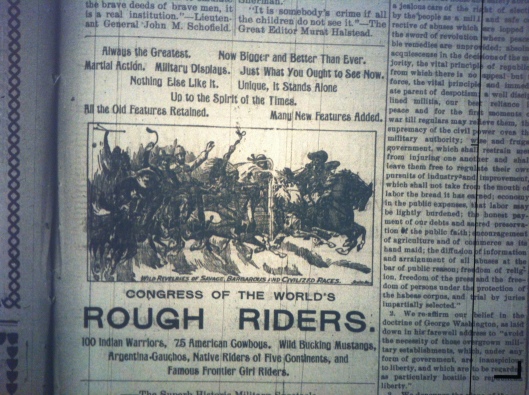


Huntington (WV) Advertiser, 1 October 1898.
18 Sunday Sep 2016
Posted in African American History, Coal, Native American History
Tags
Adirondack Mountains, Allegheny Mountains, Appalachia, Blue Ridge Mountains, Chattanooga, Chattanooga Times, Cherokee, Choctaw, culture, history, Huntington, Huntington Advertiser, indentured servants, Native Americans, New York, North Carolina, Pennsylvania, slavery, Tennessee, Virginia, West Virginia
On July 15, 1896, the Huntington Advertiser of Huntington, West Virginia, printed a story titled “The Poor Whites: Origin of a Distinct Class Living in the South.” Subtitled “The ‘Cracker of the Hills’ is the Direct Descendant of the ‘Sold Passengers’ Who Came to This Country in the Seventeenth Century,” the story initially appeared in the Chattanooga Times of Chattanooga, Tennessee. And here it is:
The notion that the poor white element of the southern Appalachian region is identical with the poor people generally over the country is an error, and an error of enough importance to call for correction. The poor white of the south has some kinfolk in the Adirondack region of New York and the Blue and Alleghany [sic] mountains of Pennsylvania, but he has few relatives any place else about the Mason-Dixon line. The states of New York and Pennsylvania were slave states until the early part of this century.
This poor white mountaineer descends direct from those immigrants who came over in the early days of the colonies; from 1620 to about or some time after the Revolutionary war period, as “sold passengers.” They sold their services for a time sufficient to enable them to work out their passage money. They were sold, articled to masters, in the colonies for their board and fixed wage, and thus they earned the cost of their migration.
The laws under which they were articled were severe, as severe as apprentice laws in those days. The “sold passenger” virtually became the slave of the purchaser of his labor. He could be whipped if he did not do the task set [before] him, and woe to the unlucky wight [sic] if he ran away. He was sure to be caught and cruelly punished.
And though he was usually a descendant of the lowest grade of humanity on the British islands, he still had enough of the Anglo-Saxon spirit about him to make him an unsatisfactory chattel.
From 1620 forward–the year when the Dutch landed the first cargo of African slaves on the continent–the “sold passenger” was fast replaced by negroes, who took more naturally and amiably to the slave life.
The poor white naturally came to cherish a bitter hatred for the blacks that were preferred over him. He already hated his domineering white master. When he was free to go, he put as many miles as his means and his safety from Indian murderers permitted between himself and those he hated and hoped he might never see again. In that early time the mountain region was not even surveyed, let alone owned by individual proprietors.
The English, Scotch, Irish and continental immigrant who had some means sat down on the rich valleys, river bottoms and rolling savannahs, and the poor white was made welcome to the foothills and mountain plateaus.
These descendants of the British villain of the feudal era grew and multiplied, became almost as distinct a people from the lords of the lowlands as the Scotch highlander was, as related to his lowland neighbor, in the sixteenth and seventeenth centuries.
The stir of the period since the close of our civil war has made somewhat indistinct the line that separates the mountaineer from the plainsman of the south, especially in the foothills and at points where the two have intermingled in traffic, in the schoolhouse and church, and especially where the poor whites have been employed at mining, iron making, etc. But go into the mountains far enough and you will find the types as clear cut as it was 100 years ago, with its inimitable drawling speech and curious dialect, its sallow complexion, lanky frame, lazy habits and immorality–all as distinctly marked as they were when hundreds of these people found Cherokee wives in Georgia and Tennessee in the early part of the century and bleached most of the copper out of the skin of the Choctaw as well as out of the Cherokee.
It is a pity that some competent anthropological historian has not traced the annals of this interesting and distinctive section of our population, and made record of it in the interest of science, no less than in the interest of the proper education and elevation of the mountain people. It has become, especially in the Piedmont section of the south, a most important labor element. The cotton mill labor by thousands comes from the “Cracker of the Hills,” and it is destined o become a great power, that labor population, social and political.
The redemption of the poor white began when slavery went down in blood and destruction, and it has gone on faster and traveled further than some of us think.
13 Tuesday Sep 2016
Posted in Civil War, Huntington
Tags
Appalachia, civil war, history, hunting, Huntington, Huntington Advertiser, West Virginia, whisky
“The cold weather of a few days ago reminded me of a little adventure that I had while soldiering,” said a well known business man. “It was on New Years day 1863, and we camped at the foot of a West Virginia mountain. The snow was several inches deep and the cold was intense. There wasn’t much discipline, and as we were allowed to hunt some, I took my gun and started up the mountain side. I had gone half a mile probably, when I stopped at the foot of a tree. My hands were nearly frozen and I leaned my gun against the tree and commenced rubbing my hands together to warm them, when suddenly I heard the brush cracking and turning I beheld a huge bear coming in my direction. It was on its hind legs with its huge paws outstretched and its jaws open and I could almost feel its warm breath on my cheek. Recovering from my fright I sprang up and caught a limb of a tree, drawing myself up out of the way just in time to avoid the embrace of the huge beast. My heart thumped so it shook my whole body. The bear cantered around the tree, sniffling at my gun, which still stood leaning against it. I shouted until I was hoarse, hoping to attract some of the soldiers in camp, but to no avail. I fixed myself as comfortably as possible in the branches of the tree, and watched the bear, believing that he would soon tire and leave. The cold was terrific. My whole body was benumbed, and I wondered how much longer I could endure the cold before I would tumble out of the tree to be devoured by the bear. Suddenly a bright thought struck me, and descending to the lower branch I took a bottle of whisky from my pocket and began pouring a thin stream down into the barrel of my gun. The whisky striking the cold gun barrel froze and in a few moments there was a solid streak of frozen whisky reaching from the gun clear up to the bottle that I held in my hand. Taking hold of the whisky icicle, I carefully drew the gun up, hand over hand, until it was in my grasp. Then taking careful aim, I sent a bullet crashing into a vital spot of the bear, and it rolled down the mountain side dead. I hurriedly descended and found my way back to camp nearly frozen. Some people may tell you that whisky won’t freeze, but then it did in this instance, for it was the coldest day I ever experienced. Get a pension? Why certainly for I have never fully thawed out since that terrible freezing I got while clinging to that tree.”
Source: “Get A Pension Now,” Huntington (WV) Advertiser, 16 February 1899.
13 Tuesday Sep 2016
Posted in Culture of Honor, Hatfield-McCoy Feud
Tags
Appalachia, Elias Hatfield, George W. Atkinson, history, Huntington, Huntington Advertiser, Mingo County, West Virginia

Huntington (WV) Advertiser, 11 July 1899.
15 Friday Jul 2016
Posted in Big Harts Creek, Lincoln County Feud, Warren
Tags
Charleston, genealogy, Harts Creek, history, Hoover Fork, Huntington, Huntington Advertiser, Lincoln County Feud, Logan, Pat Napier, Union Army, Van B. Prince, West Virginia
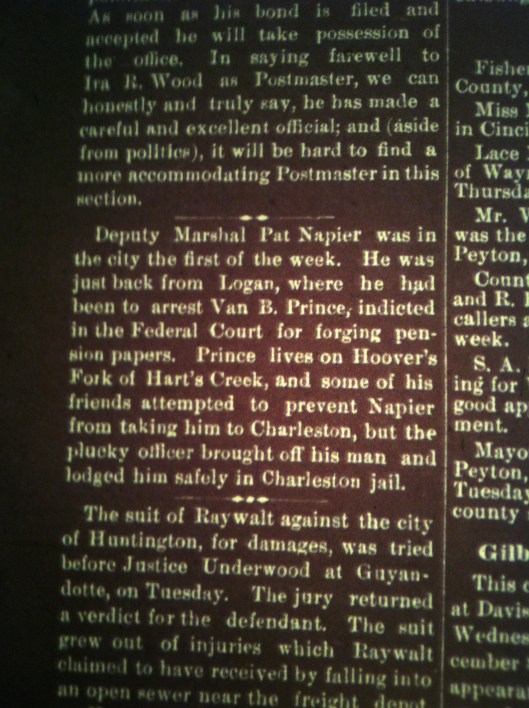
Van B. Prince Arrested, Huntington (WV) Advertiser, 04 December 1886. Mr. Prince was the primary preacher of Upper Hart during the Lincoln County Feud.
13 Saturday Feb 2016
Posted in Huntington, Timber
Tags
A. Rice, Appalachia, Cabell County, Central City, D.P. Jones, Huntington Advertiser, J. Mooney, Lincoln County, Logan County, Ohio River, Sliger Lumber Company, T.P. Bowers, Thomas Sliger, timber, timbering, U.B. Buskirk, West Virginia, Wyoming County

Huntington (WV) Advertiser, 23 September 1895

Huntington (WV) Advertiser, 23 September 1895

Huntington (WV) Advertiser, 23 September 1895
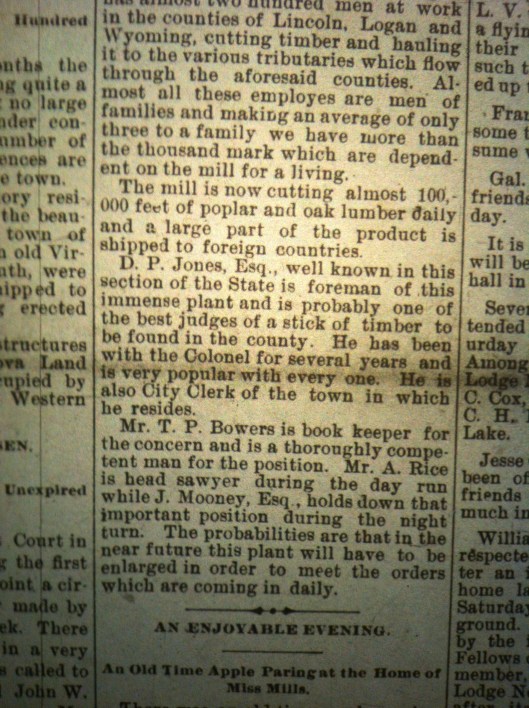
Huntington (WV) Advertiser, 23 September 1895
04 Sunday Oct 2015
Posted in African American History
Tags
A Romance of Coon Hollow, Davis Theater, Gallick's Book Store, history, Huntington, Huntington Advertiser, play, theater, West Virginia
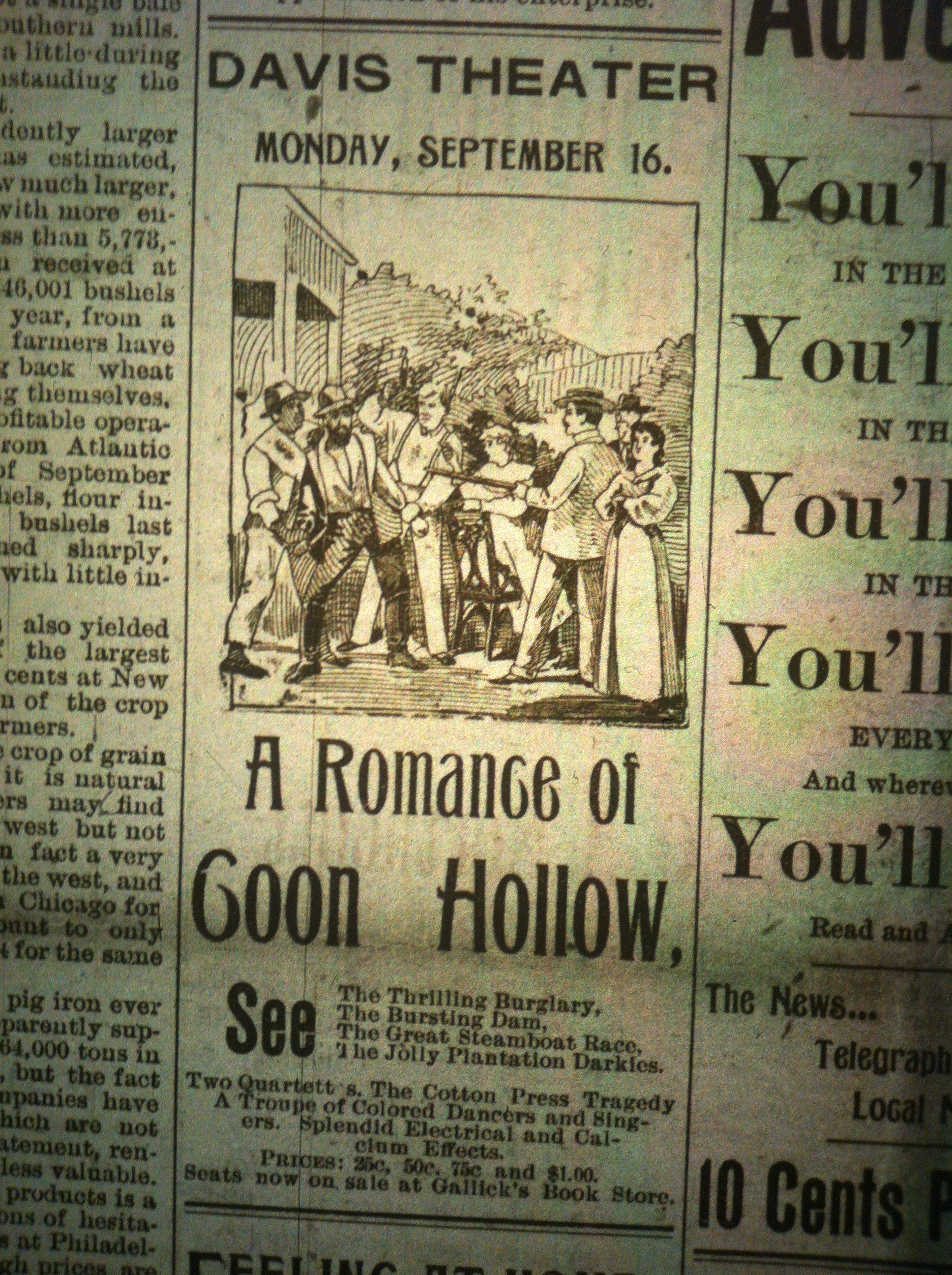
“A Romance of Coon Hollow,” Huntington (WV) Advertiser, 14 September 1895
16 Wednesday Jul 2014
Posted in Big Sandy Valley, Culture of Honor, Hatfield-McCoy Feud
Tags
Appalachia, Big Sandy River, blood poisoning, crime, Frank Phillips, genealogy, Hatfield-McCoy Feud, history, Huntington Advertiser, Kentucky, Mingo County, Pike County, Sheriff Keadle, U.S. South, West Virginia, Williamson
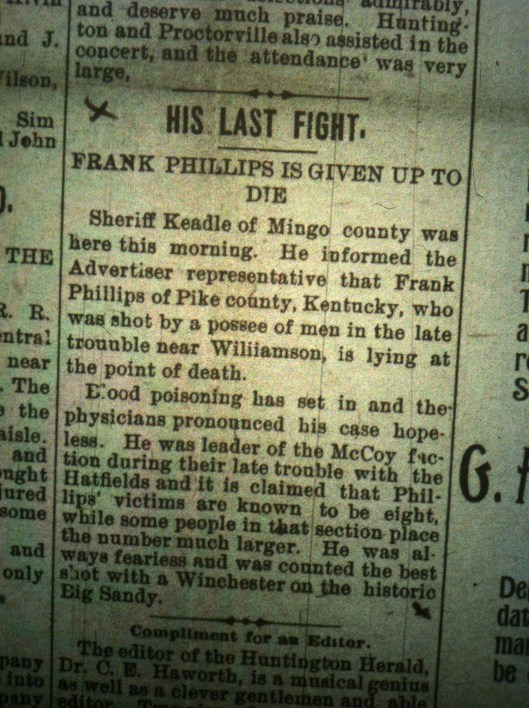
“His Last Fight: Frank Phillips is Given Up to Die,” Huntington (WV) Advertiser, 28 September 1895
22 Sunday Jun 2014
Posted in Harts
Tags
Al Brumfield, genealogy, Harts, Harts Creek District, history, Huntington, Huntington Advertiser, Lincoln County, West Virginia
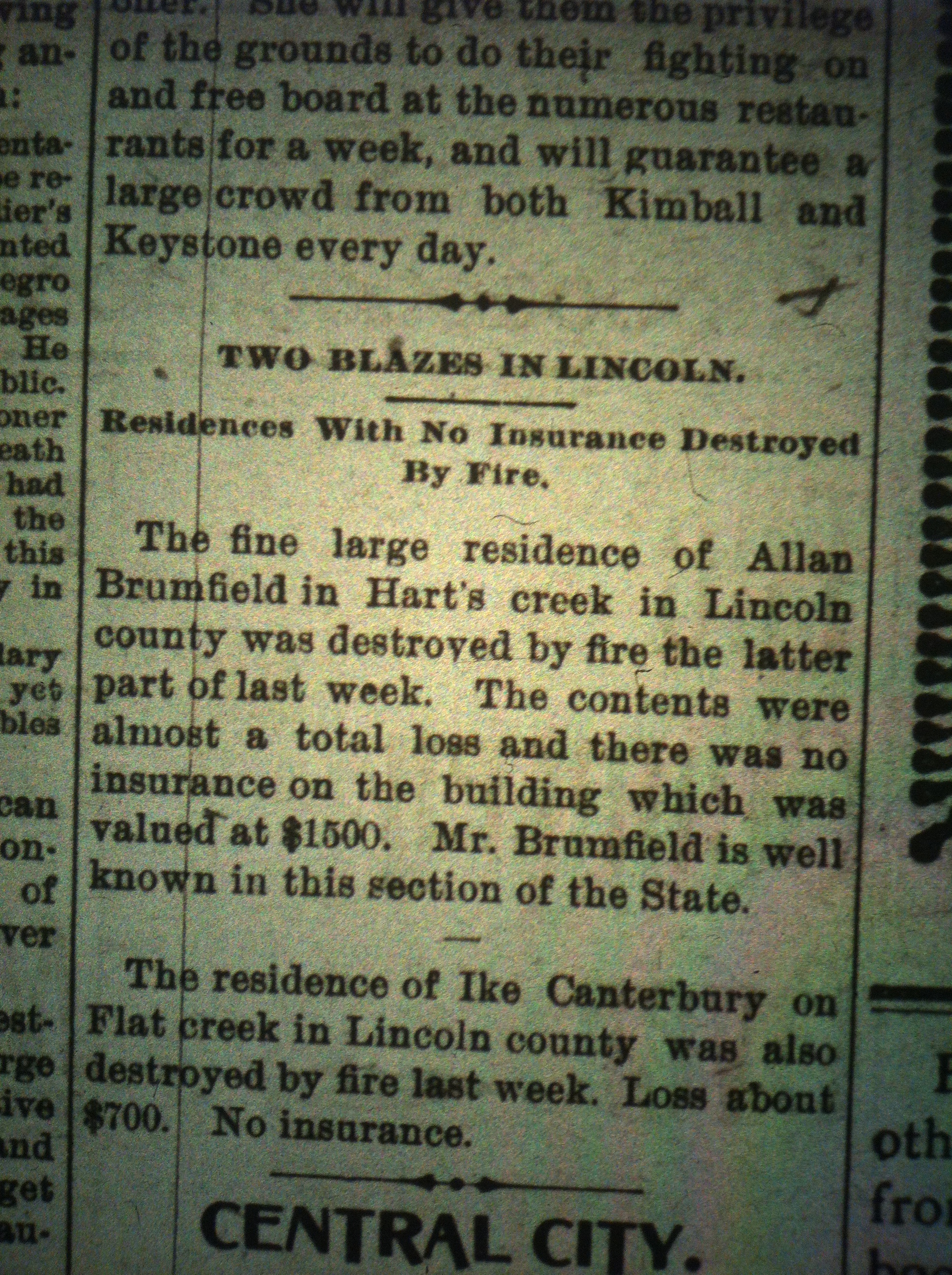
Huntington (WV) Advertiser, October 28, 1895
08 Tuesday Apr 2014
Posted in Ed Haley, Lincoln County Feud
Tags
Angeline Lucas, banjo, Boney Lucas, Brandon Kirk, Cain Adkins, Daisy Ross, Eustace Gibson, Faye Smith, fiddler, Green McCoy, guitar, Harts, Harts Creek, history, Huntington Advertiser, John McCoy, Kenova, Lincoln County, Milt Haley, Oscar Osborne, Paris Brumfield, Sherman Boyd, Sherman McCoy, Spicie McCoy, Tug Valley, West Fork, West Virginia, Winchester Adkins, writing
Meanwhile, as I churned up new details about Ed Haley, Brandon was busy chasing down leads on the Milt Haley story in West Virginia. One crisp December day he visited Daisy Ross, the aged daughter of Spicy McCoy, who lived in a nice two-story house at Kenova, a pretty little town just west of Huntington. It was Brandon’s first face-to-face contact with Green McCoy’s descendants and he was anxious to hear more about their side of the tale. Daisy was white-headed and a little hard-of-hearing — but full of information about Green’s family. Her daughter Faye played hostess during Brandon’s visit.
Daisy said Green McCoy was originally from the Tug Fork area. He came to Harts playing music with his brother, John McCoy. He always kept his hair combed and wore a neatly trimmed mustache. Spicy used to have a tintype picture of him with Milt Haley. He and Milt met each other in the Tug Valley.
Daisy said her grandfather Cain Adkins was a country doctor. He was gone frequently doctoring and was usually paid with dried apples or chickens. He feuded a lot with the Brumfields, who killed his son-in-law, Boney Lucas. Boney’s widow Angeline was pretty wild: she had two illegitimate children after Boney’s death. One child belonged to a man named Sherman Boyd and the other belonged to John McCoy — Green’s brother.
When Green McCoy came to Harts, Cain discouraged Spicy from marrying him because he was divorced from a woman living in Kentucky. Spicy didn’t believe the family talk of “another woman” and married him anyway. She and Green rented one of the little houses on Cain’s farm. Green made his living playing music and he was often gone for several days at a time. When he came home, Spicy, ever the faithful wife, ran out of the house to hug him and he would playfully run around the yard for a while before letting her “catch” him. Daisy had no idea where Green went on his trips because he never told her mother. Spicy didn’t really care: she always said she would “swim the briny ocean for him.”
Brandon showed Daisy an 1888 newspaper article he had recently found, documenting Cain’s trouble with Paris Brumfield.
“Paris Brumfield was indicted for felony in five different cases by the grand jury of Lincoln county at its last term,” according to the Huntington Advertiser on June 23, 1888. “He fled the county, not being able to give bail, which was fixed by the Court at $5,000. Brumfield’s latest act of violence was his murderous assault upon Cain Adkins, a staunch Democrat, one of THE ADVERTISER’S most esteemed subscribers. The last act was the straw that broke the camel’s back, and the county became too hot for Paris. Gibson & Michi have been retained by Brumfield’s friends to defend him when brought to trial.”
Daisy blamed Green’s murder on the Brumfields. She said Green once got into a fight with Paris Brumfield and “pulled his eyeballs out and let them pop back like rubber bands.” Brumfield had to wear a blindfold for a while afterward.
After Green’s death, Cain Adkins and his son Winchester fled Harts, probably on horses. Winchester was one of the best local fiddlers in his day. He mostly played with his nephew Sherman McCoy (banjo) and Oscar Osborne (guitar).
Writings from my travels and experiences. High and fine literature is wine, and mine is only water; but everybody likes water. Mark Twain
This site is dedicated to the collection, preservation, and promotion of history and culture in Appalachia.
Genealogy and History in North Carolina and Beyond
A site about one of the most beautiful, interesting, tallented, outrageous and colorful personalities of the 20th Century
 Brandon Ray Kirk