• About

Brandon Ray Kirk

~ This site is dedicated to the collection, preservation, and promotion of history and culture in my section of Appalachia.

Brandon Ray Kirk

Tag Archives: Harts Creek

Fleeting Years

07 Friday Dec 2012

Posted by Brandon Ray Kirk in Pearl Adkins Diary

≈ Leave a comment

Tags

Appalachia, culture, Harts Creek, history, inspiration, life, love, Pearl Adkins, thoughts, U.S. South, West Virginia, writers, writing

     The latter portion of Pearl’s second diary closes with a cluster of entries dated from February until June for an unknown year. Thereafter is a smattering of monthly entries.

     “No sadder or lonelier day ever passed over my old head,” Pearl wrote on February 7. “It will long be remembered by me. I never have hardly suffered as I did to day. My very heart was breaking. My yearning for what I knew not.”

     Pearl was obviously inspired to write by some misfortune, although she never specified the source of her troubles.

     “Oh God, what I suffered last night,” she continued the following day. “I cried till I couldn’t cry. No one seemed to notice my sorrow. Physical pain would be better than this some times.”

     Pearl’s happiness was at an all time low.

     “If I could have courage to go through with what I think of doing so often,” she wrote. “It’s a terrible thing to think of doing but I can’t. That would be far better than to suffer for maybe years on this old world of pain and woe. Lord help me to overcome my weakness of courage. Make me, dear Jesus, have something to want to live for. Oh Lord, help me to bear my troubles.”

     It seems, based on the above entry, that Pearl was perhaps contemplating suicide at that point in her life.

     “What a storm is brewing,” she wrote later in February. “The wind is roaring in the trees on top of the hill. The storm is on. The rain is pouring but the tempest out side is not much greater than the tempest in my breast. The storm is over. It is the beginning and ending of everything. Now, if I could only walk, my cup of happiness would be running over.”

     “Oh, the troubled sleep I had last night,” she wrote the following day, on a Wednesday. “The snow is falling so fast and the ground is covered every where. The beautiful snow. This reminded me of a day some years ago, those short fleeing years for me. I was just a kid then and with a kid’s thoughts my future was beautifully paved then but that was short lived.”

     “Today I was sitting alone in the kitchen by the stove with the odor of soup beans going up my nose,” Pearl next wrote in an undated entry. “Mama’s voice floats in on my hearing, singing ‘Shady Grove’ to the baby. Cora is over at Inez’s in bed a groaning with her side. Marg’s wanting a new hat. All of these things is passing through my jumbled up brain. I only wish my good old Friend would come for a talk to me so much. I can’t think.”

West Virginia Fiddler 1

07 Friday Dec 2012

Posted by Brandon Ray Kirk in Music

≈ Leave a comment

Tags

Appalachia, Bill Adkins, culture, fiddler, Harts Creek, history, life, Lincoln County, music, photos, West Virginia

Bill Adkins, West Virginia fiddler

Bill Adkins, West Virginia fiddler

Pearl’s Last Request

06 Thursday Dec 2012

Posted by Brandon Ray Kirk in Pearl Adkins Diary

≈ Leave a comment

Tags

Appalachia, culture, Harts Creek, history, inspiration, life, love, Pearl Adkins, thoughts, U.S. South, West Virginia, writers, writing

     In August 1925, Pearl’s diary resumed, at first with a small upbeat entry.

     “Pearl and I all alone talking our secrets,” wrote sister-in-law Inez Adkins on the evening of August 3. “Best friends on earth.”

     Following this happy note, Pearl’s writings turned depressingly morbid.

     “My last request,” she wrote on August 14. “I don’t feel that I shall be here so very long at the longest. Friends or relatives, when I die, I want to be buried anywhere where the rest of the family is buried. I want a white casket (a coffin will do). Cover it with white satin if you can’t get white. Any other nice white good will do but I would rather have it satin. I want a white shadow lace dress with a narrow white ribbon — not more than four of them. I want a light blue princess slip. If you can’t get the lace dress, get a georgetta crepe. If you can’t get crepe, get white satin. Put two rows of lace up the front and small bows of ribbon up the front too, or you can have streamers at the neck. Get them as near as you can if you are able to buy them. Buy what I said. Buy as near to it as you can. Comb my hair like I wear it in life. Powder me first a little bit. Remember Pearl.”

     Then came one of the more powerful entries in the entire diary.

     “No, there is not the slightest hope I shall ever be any better than I am now. It is not a pleasant prospect. It is just the thought of it at times that makes me worse. There is days and weeks at a time I don’t want to see any one. My sister tells me it is more my temper than my misfortune that afflicts me and perhaps she is right. I hate people because they expect me to see a blessing direct from God. In fact I am nothing more than a miserable clod on the face of the earth. I wish I could have a house all to myself where I could do as I please. None of them don’t seem to understand me or my way and I need some one to stay with me that could really understand me.”

     “We could live an ideal existence,” Pearl continued, shifting the direction of her thoughts toward the object of her affections. “Nothing would please me better. I am sort of death’s head at home. I’m nothing but an annoyance and a burden to mother. I expect they would be glad if I could make a change like that. I could never be with out you. I don’t know how I ever did get along with out you as long as I did. It seems to me my life must have been cruelly empty. I love you very dearly — you have done more for me than talked with me. I think you have very near saved my soul for I was becoming very hard and bitter when you came. God has surely sent us to each other. You must think that my deformety is all I have to bear.”

     “When God made the cripple he made the mistake of implanting in the poor deformed breast a heart like that which other people have — a heart to love,” Pearl wrote. “Hush, that is something that ought to be buried as deeply from sight as the heart itself. I am a fool to even give it a breath of air to feed upon. Does one think there is no design in that? Do you believe that I shut myself in these four walls because I despise all the world for its strength and beauty? I am not quite as bad as that. Perhaps it is my physical condition that makes me so very weak…; but I can not endure to look upon his face, to hear him speak in his kindly tone to me to know that the only feeling in his soul is pity; and but for that I should be less to him than the very dirt beneath his feet. Oh God! Do you think there is nothing in such suffering as mine? Can you see no further into it than the mere pain that rocks my wretched body? I can tell you it is ghostly. I cannot bear even to look into his face because I know that I shall see there the pitying smile that has grown hideous to me. To know that it can never be different! That I must be like an accursed log until I die, arousing nothing more than pity in the breast of any one. I should at least have the memories of the past — happiness to feed my empty heart. I could look back and say, ‘I was happy then.’ Oh it would be so much! So much! My life.”

So Close

04 Tuesday Dec 2012

Posted by Brandon Ray Kirk in Pearl Adkins Diary

≈ Leave a comment

Tags

Appalachia, books, culture, Harts Creek, inspiration, life, love, Pearl Adkins, poetry, thoughts, U.S. South, West Virginia, writers, writing

     The second volume of Pearl’s diary is filled with entries that specify a month but not a year. Chronologically, it appears a hopeless case, however there are two main clusters of writing periods, from February to March and from February to June. It’s not clear if these are overlapping time frames or if they refer to spring months for different years.

     The bulk of the material seems to take place in 1925.

     Volume 2 begins on January 30, 1925 when Pearl wrote this: “My heart is just as heavy as on that sad day. I’ve lost almost all interest in life.”

     Her dissatisfaction with life more than likely had something to do with her inability to find a companion, which she blamed on her handicap.

     “Sunday morning dawned cold and blue,” she wrote in February. “I had a feeling he was coming. I had not long to wait for he came real early. To my surprise he came in and set down so near me that I could have kicked him with my foot. He got up for some thing and when he set down again he set down on a bed that my chair was tilted back again. He was so clost that time his knee was against my knee. If he had only knew how I loved him and how his nearness caused my heart to beat wildly, he might not have set so clost to me and caused me to suffer untold misery. He got up to spit and motioned for a girl that was there to get in his place. Of course, I would have much rather for my darling boy to sit there as her but I couldn’t stand it no longer. I was afraid Cora would come in and see my confused look and guess the cause of my blushed face. As I have said she didn’t like him. Probably would talk about him. I would rather for them all to talk about him than her for she can say such hurtful things. No body likes to hear some one they love talked about. I love him and I can’t help it. Oh Lord, grant my earnest prayer. Cause him, oh Lord, to love me as I love him.”

     The mysterious object of Pearl’s affection was clearly the primary motive for her taking up a pencil and recording her thoughts.

     “Sunday morning all gone but just mother, Inez and me,” Pearl wrote in March. “I was primping up a little. I had one shoe on and one off when some one knocked at the door. Inez jumped to open it and who should it be but my sweet dream boy who came in smiling so happily and as always sit down facing me again and what causes him to sit down facing me always so clost too I can’t tell. It all happens just as if I had planned it out with him but a higher power rules our feeling. It must be the Lord’s will. I should love [name omitted] but he never speaks to me no more than if I wasn’t in miles of him but I would rather that than pity from my dear for I couldn’t stand it. Well, he didn’t stay long.”

     “News of a joyous nature but not satisfying,” Pearl wrote later in March, “but it will be after while. Every little drought is sweetened by… Aw, I don’t know what.”

     “Diary dear, you are the only thing I can tell my days and sorrows to,” Pearl wrote even later in March, “but it has been some time since I have told you any thing much of interest.”

     In the subsequent months of early summer, Pearl took a break from her diary-keeping, preferring instead to scribble down various items of interest.

     “The happier persons are those who don’t have much sense and don’t seem to know it,” Pearl wrote.

     Poems followed.

     “If to me your heart is true, send me back my bow of blue. If of me you sometimes think, send me back my bow of pink. If for me your love is dead, send me back my bow of red. If you do not wish me back, then send this bow of black.”

In Search of Ed Haley 17

04 Tuesday Dec 2012

Posted by Brandon Ray Kirk in Ed Haley

≈ Leave a comment

Tags

Appalachia, Ashland, banjo, Chapmanville, Charley Gore, East Tennessee Blues, Ed Haley, Ethel, fiddle, fiddler, fiddling, Fire on the Mountain, Great Depression, Harts, Harts Creek, Hell Among the Yearlings, history, Ira Gore, John Hartford, Johnny Hager, Kentucky, Lawrence Haley, Lee Trick Gore, Liza Mullins, Logan County, Mag Gore, Mona Haley, music, Ode Curry, Peter Mullins, Stoney Ferrell, The Dying Californian, U.S. South, West Fork, West Virginia, Wild Horse

Later in the evening, Pat put me in touch with Lee “Trick” Gore, an Ashland preacher and musician who remembered Ed Haley from his childhood days on Harts Creek. We met Gore the following day at his home in what was my first meeting with someone from Ed’s birthplace. He was a polite man with a loud clear voice, somewhat thick in stature and decked out in a tie and button-up sweater.

“I understand what you’re trying to do,” Gore said right away.

It wasn’t long until he and Lawrence were in a deep discussion about the people and places in and around Harts.

“We used to spend a week or two with Aunt Liza or Uncle Peter,” Lawrence said, prompting Gore. “Most of the time we’d ride the train up there and get off at Harts. They run passenger trains up into coalfields then. We’d get off there at the mouth of Hart and walk up and it was nothing but creek. You’d ford that creek a dozen times trying to stay close to the road and the road was in the creek half the time. You had to wade the creek half the way up through there. It’d take us half the day it seemed like.”

Lawrence said his father spent some time in Chapmanville, a town upriver from Harts about nine miles.

“I remember staying in Chapmanville, too. There was a beer joint or something that Pop wanted to stop at. They was some guy in there got to down-mouthing Pop. Stoney Ferrell, that’s exactly who it was. This guy kept aggravating him and Pop just edged toward his voice, you know. Instead of carrying a blind man’s cane, Pop carried a big heavy cattle cane. He got pretty close to him and he reached out and grabbed him around the neck with that cane.”

Gore said Ed used to come see his uncle Charley Gore at Ferrellsburg, a settlement about two miles upriver from Harts.

“Uncle Charley was a fiddler,” he said. “Charley was the principal of the school and Ed stayed with him. Well, once a year he’d happen by. That was right on the heels of the Depression. I was twelve. I was just learning to play the guitar then.”

Gore looked at Lawrence and said, “Either you or Mona was leading him.”

I asked Gore what Ed looked like at that time and he said, “He just dressed ordinary. He never dressed up, but he wasn’t dirty looking or nothing like that — just old-fashioned.”

He stopped for a moment, lost in thought, then said, “He was just something else. He was far ahead of a lot of fiddlers, buddy. There wasn’t none of this grinding on that violin. When he played it, it was just as smooth in that bow hand. I know he played ‘Hell Among the Yearlings’, ‘Fire on the Mountain’ and ‘The Wild Horse’. Uncle Charley played those tunes, too. I guess he learned them from Ed Haley.”

“I wish my daddy was alive,” Gore said. “Boy, he could tell you about Ed Haley because he loved him. Uncle Charley loved him dearly. And Ed knew that he was welcome at our house and that’s where he hung his hat buddy — where he was welcome. Do you know how I think of him? I think of him as kind of a mountain poet. He sung religious songs and them old mournful mountain tunes. It seems to me like he sung a song called ‘The Dying Californian’. I can’t remember the poetry to it, but it was a mile long.”

Ed sang while fiddling it.

Gore said Ed sometimes traveled with “Little Johnny” Hager, a banjo player who used to stay weeks at a time with his family when he was a boy. Lawrence Haley had shown me a picture earlier of Ed with Johnny Hager in Webster Springs in 1914.

I asked Gore if he knew that Ed could play the banjo and he said, “Seems like I heard him play it when him and Johnny was together. No doubt he could play it.”

Gore asked Lawrence if he remembered a man his father used to play with named Ode Curry (he didn’t), then said, “Ode Curry was just a fella that played the banjo and sang and he had a big nose, as well as I remember, and it’d vibrate when he’d sing because he sung through his nose. But let me tell you something: they would give him all he could drink to play and Ode knew some of the lonesomest, heart-breaking songs you ever listened to.”

Gore got his guitar and sang several songs for me, then whistled the melody for “East Tennessee Blues” and named it as one of Haley’s tunes. He said, “That’s funny how things come back to you when you sit down and get to talking about it, and reminiscing.”

I encouraged him to “play another tune and see what it stirs up,” so he strummed and whistled out a few more melodies.

At some point, Gore’s wife said she remembered seeing Haley play at Logan Court House and in a nearby coal town named Ethel.

Just before Lawrence and I left, Gore called his 85-year-old aunt, Mag Gore, about Haley. “Mag was a singer,” he said. “She married Ira Gore, her third cousin. She couldn’t get out of the Gore family.” He spoke with her briefly on the phone, then told us: “The only thing she remembers was that her husband Ira went to town one day and Ed Haley come home with him because Ira had a little bit of that good ol’ ‘moon’ they make over on the West Fork. They was a sipping that a little bit.”

West Fork, Gore said, was a tributary of Harts Creek with its headwaters in Logan County.

Dinner

03 Monday Dec 2012

Posted by Brandon Ray Kirk in Pearl Adkins Diary

≈ 1 Comment

Tags

Appalachia, Harts Creek, history, inspiration, life, love, Pearl Adkins, thoughts, U.S. South, West Virginia, writers, writing

     “I got up with a bad tooth ache,” Pearl wrote in August or September, probably in 1924. “Mother got a good dinner and I could feel that he was coming but you see I couldn’t tell. They were all gone but Inez and Watson for Watson is married now. Inez and I are very good chums but I can’t tell her this secret of him, for she don’t like him to very well no how. If she was to know I’m in love with him, she would get real angry and maybe tell Cora and mother. Cora just hates him and she would say things that hurt my very heart, so I had better keep it a secret from all. Mother wouldn’t say any thing but I would feel so ashamed to be where he is at if she knew I love him. Such a thing never entered her mind that I might love some body. If she ever thought of such a thing she never said any thing about it. To go back to my story. As I said, Mother had a good dinner but he never came till evening but he did look good in his blue suit but he never stayed long to my sorrow. Oh my tooth did hurt and so did my heart.”

     “Me and Inez have kept house,” Pearl wrote early in November. “They all have been gone all day but the children. I have a tooth ache again. My jaw is all swollen up. Oh Lord, my tooth and jaw. Won’t I be pretty when he comes for I feel he is coming. I do hate to look like this for he won’t think I’m pretty I know — but I do love him so much.”

     “He came last night and stayed all night,” Pearl wrote the following day. “It was after supper. We were all sitting around the fire. I was sitting on the bed. He came in and set down beside me just as if he knew I wanted him to. Of course I wanted him to but I blushed to the roots of my hair to have him so near me. None of them ever dreamed I loved him and I don’t guess he did either. I guess God led him to come and to sit down beside me for God alone knew how much I loved him.”

     “Thank God my prayer has been answered,” Pearl wrote on Tuesday, November 11. “I see him now coming. Oh Lord, just a glimpse that was all. My sorrow is too deep for me ever to tell. I have loved you dear so long that you shall never know it by me telling it. The wound you have caused on my heart is always about to heal, but if I live and get till I can’t walk I’ll get even with you.”

     “All is over and for ever,” Pearl wrote on Wednesday. “Prayers are answered to some extent,” she wrote the following day. “Friday evening is the same.”

     “It is a rainy and dreary day,” Pearl wrote on Saturday morning, November 15. “Oh, how heavy the fog is hanging over the field but it isn’t as heavy as my heart.”

     “He was passing by and Cora ran to the door and invited him in,” Pearl wrote in December. “She didn’t know how much it pleased me for her to ask him in for I couldn’t do it myself. It seemed that she should like every one but the one I loved. Well, I hope she will like him better in the future for I hate to love some one they all hate but that’s what I’ve done but I can’t help it. I loved him before I knew it. We don’t love or hate as we will but we love as divine power makes us love.”

Alone

02 Sunday Dec 2012

Posted by Brandon Ray Kirk in Pearl Adkins Diary

≈ Leave a comment

Tags

Appalachia, Harts Creek, history, inspiration, life, love, Pearl Adkins, thoughts, U.S. South, West Virginia, writers, writing

     The latter part of Pearl’s first diary is filled with vaguely dated entries spanning from January until July, probably for the year of 1924. Early entries for her second diary seem to fill the summer and fall months of that same time period. Subsequent entries, dated in November and recorded in the first diary, are clearly for 1924.

     “Oh dear, it seems that my dreams are coming true,” she wrote one Sunday morning in January. “Aw, how my heart beats with joy to look from my window and see the one I love with all my heart coming after what had happened. Oh, the day is fleeting. Now, it’s gone and he has gone with it. My heart is gone, too.”

     “He’s here again,” Pearl wrote on a Saturday and Sunday in March. “It makes my lonely life a few sparks brighter to have him near me if I can’t be nothing more to him.”

     “April is here with its birds and its flowers but they don’t make my burdens any lighter,” she wrote the following month. “If any thing, a little heavy to bear.”

     “It is raining this morning,” Pearl wrote on a Sunday in May, “making the day dark and dreary for me. I guess my heart is just as heavy as the rainy air. I am alone and thinking of the one that’s dearer to me than my own life.”

     “Shadows of the night is gathering dear,” Adkins wrote on a July Saturday. “Alone am I thinking of you. My love will never die for you. It’s all true that I love you. You are my sole thought. If something awful happens I will love you still more fondly for my heart yearns for your presence now while the darkness is gathering fast just as my thoughts are still forming my love still deeper for you. Aw, it’s raining. That don’t make me love you any less for I have loved you for months — might have slipped into years. I’m not saying how many years it has been. I think my love is of too long a standing for me ever to forget now. I’ve tried to but all in vain.”

     “Things are just the same as ever,” Adkins wrote later in July. “God grant my prayer that I may see him, my darling, in my sweet dreams. Aw, but he’s nothing more to me than a dream. How my heart yearns for just one look on his handsome face and to hear his sweet voice. I barely see these lines for tears is gathering so fast. Just ready to fall any minute. Jesus, blessed Jesus, stand by me now. Make him love me, oh Lord. Aw, it’s all sad, and the saddest of it all is what it might have been if I only could have walked. Oh God, grant that I may enjoy the pleasures of life that the other girls enjoy. My life has been only one long dark empty dream. Oh, Lord, will my life always be like this? If I could only have died when but a baby. Now, if I had some one to talk to but like always I’m alone. No one cares for me. No one but mother. The rest seeks each others’ company and leaves me alone. Oh God, help me to bear it all. My heart is almost breaking now. Aw, I can’t write any more for my tears are falling on my paper, Shucks, this is all nonsense but I can’t help it.”

     Later in the summer, Inez Adkins, a friend and sister-in-law to Pearl, made a couple of entries.

     “This sad and lonesome evening finds us alone and together thinking of the past,” wrote Inez on Friday, July 11, 1924, “and God bless Margret, Edward and Wetzel at our feet playing.”

Timber

02 Sunday Dec 2012

Posted by Brandon Ray Kirk in Timber

≈ Leave a comment

Tags

Appalachia, Harts Creek, history, photos, timbering, West Virginia

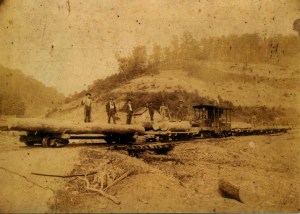
West Virginia timber scene, undated

West Virginia timber scene, 1890-1915

What happened to John Fleming? 3

02 Sunday Dec 2012

Posted by Brandon Ray Kirk in Big Harts Creek

≈ 6 Comments

Tags

Appalachia, crime, feud, Harts Creek, history, Jacob D Smith, John Fleming, Lincoln County, Virginia, West Virginia, Wise, writers, writing

On February 28, 1912, I.J. Beverly, sheriff of Wise County, Virginia, wrote Jacob D. Smith, assistant prosecuting attorney in Lincoln County, West Virginia, to inform him that John Fleming — a fugitive on the run — was living in a nearby town called Glamorgan and using the alias of George Fleming. The letter read as follows:

Wise, Va., March 7th

           Prosecuting Attorney Lincoln county, Hamlin, W.Va.

           Have John Fleming in custody. He agrees to come without requisition if I will bring him but refuses to go with your officer. I will bring him if you will pay all expenses and Two Fifty per day. Answer.

            I.J. Beverly

            Sheriff Wise County

On March 8, Smith received Sheriff Beverly’s letter. Three days later, he left Hamlin, seat of government for Lincoln County, for Richmond, Virginia as an agent to secure requisition papers from Virginia Governor W.H. Mann. A little later, he hired G.A. Lenz, a C&O special agent in Huntington, West Virginia, to accompany him to Wise County as a guard. By March 16, Smith and Lenz had delivered Fleming to the Lincoln County jail. On March 30, Fleming’s bail was set at $2,000.

Early in May, the following witnesses were called to appear before the Circuit Court in the State v. John Fleming, scheduled for June 4: Caleb D. Headley, Lewis Cass Gartin, Andrew Sias, Paris Brumfield, Tilden Gartin, W.A. Adkins, M.E. Nelson, Joe Gartin, Tilman Adkins, John Gartin, Grover Gartin, E.C. Lucas (Sr.), Jeff Lucas, Alvin Sias, Harrison Neace, Bob Fleming, Bud Workman, Jessie Adkins, Lewis Lucas, Ben Noe, Levi Rakes, Flora Lucas, Thomas Sias, Samp Davis, Lona Neace, Albert Neace, George Fleming, Robert Adkins, T.B. Hatfield, Peter Mullins, Ike Fry, William Adkins, Floyd Mullins, Harlan Mullins, Mary Burns, Lula Burns, Jane Moore, Zack Neace, Bill Neace, Abe Noe, Floyd Workman, Wiley Lucas, Dr. Jenks Adkins and Little Cane Lucas.

Days later, John Fleming escaped from the county jail using tools given to him by his brother, Willard. A warrant was issued for the arrest of Willard and placed in the hands of Boyd S. Hicks. According to records maintained at the Lincoln County Circuit Clerk’s Office: “Whereas Burnie Smith has this the 4 day of June 1912 made complaint upon oath before M.D. Hilbert, Justice of said county that one John Fleming was confined in the Lincoln county Jail, being so confined to answer to a charge of shooting with the attempt to kill Caleb Headley, and while in said Jail as a prisoner awaiting trial on said charge, one Willard Fleming did on or about the 10 day of May 1912 willfully and feloniously give and cause to be given the said John Fleming prisoner as aforesaid certain saws, chisels, and other implements for use of said John Fleming in effecting escape from said Jail, and by means of which said saws and other implements he the said John Fleming did saw the bars in said Jail and make his escape there from.” On June 5, Willard Fleming, Matthew C. Farley, Lewis Maynard and Zac Williamson posted Fleming’s $1000 bond.

In an effort to re-arrest Fleming, the Lincoln County Circuit Court issued capias warrants for him on October 29, 1913, December 21, 1914 and March 29, 1915. Fleming was no where to be found.

With John out of the way, his former wife, Lizzie Fry, felt safe enough to remarry. On November 8, 1915, she married Boss Keith. It’s not clear if she had ever married Charley McCoy, the man whose cuckling of Fleming had prompted the ’09 shootout.

In the years following Fleming’s escape, surprising details surfaced about his role in the shootout at Fourteen. “The Fryes and Headleys were blamed for Grandpa Hariff’s death,” said one local man in a 2003 interview, “but an old Frye woman sent word on her deathbed who killed him. She said it was his first cousin, John Fleming.”

Meanwhile, the court continued to issue capias warrants for Fleming on November 14, 1916, February 16, 1917, April 11, 1919, April 5, 1921, April 19, 1922 and December 29, 1922.

Finally, on March 26, 1923, according to Law Order Book 17 at the Lincoln County Courthouse, prosecuting attorney Jacob D. Smith, “with the assent of the court says that he will not further prosecute the defendant John Flemmings, of the Felony of which he now stands charged in this Court. It is therefore considered by the court that the defendant John Flemmings be acquitted, discharged and go thereof without delay.”

By that time, Fleming was probably dead.

“John Fleming went back to Virginia with someone,” said Willard Frye, a nephew to Lizzie, in a 2003 interview. “He got off his horse at a stream to get a drink of water and when he bent down at the stream this man shot him in the back of the head.”

More dreams

02 Sunday Dec 2012

Posted by Brandon Ray Kirk in Pearl Adkins Diary

≈ Leave a comment

Tags

Appalachia, culture, dreams, Harts Creek, history, inspiration, life, Lincoln County, love, Pearl Adkins, superstitions, thoughts, West Virginia

     “I had a dream last night,” Pearl wrote in July. “I dreamed he came here and I thought several were here too. They were enjoying their selfs but he didn’t have any thing to say and I thought he was the saddest looking boy I ever seen. He was sitting by the door.”

     “I dreamed he was here again,” she continued in a later entry. “He was sad. That time he was handling a pistol some how. I think he was just as sad in my dream as he told me he was. I think them two dreams has a meaning and what it is I don’t know.”

     “October is bright blue weather,” Pearl wrote a few months later, “but I could enjoy it if it wasn’t for this sad old heart of mine. But it will rejoice some day by and by. It’s sad so sad for me. I have thought for many many days I would get my one desire but all hopes have fled. But I pray on and on. My prayers have been for those sweet moments when the wonder of your love was fully known. I seem to feel your loving strong arms again and then — I miss you so my darling!”

Pearl Adkins Diary

01 Saturday Dec 2012

Posted by Brandon Ray Kirk in Pearl Adkins Diary

≈ Leave a comment

Tags

Appalachia, Harts Creek, history, inspiration, life, Pearl Adkins, photos, thoughts, U.S. South, West Virginia, writers, writing

Pearl Adkins, circa 1918

Pearl Adkins, circa 1918

Romance

01 Saturday Dec 2012

Posted by Brandon Ray Kirk in Pearl Adkins Diary

≈ Leave a comment

Tags

Appalachia, Harts Creek, history, inspiration, life, love, Pearl Adkins, thoughts, U.S. South, West Virginia, writers, writing

     At that time, Pearl’s head was full of dreams. Based on entries in her diary, she had become fixated on a local beau who made occasional visits to the Adkins home.

     “It’s been a many sad and dreary days since I had last seen him,” Pearl wrote on February 6, 1922. “I almost count the hours and minutes of his absence. So why worry? Life is what we make it. Oh dear, when shall I see you again?”

     “Oh, you are here,” she wrote later that day. “As I looked up from my work I gazed straight into the kindest eyes I’d ever seen — deep and unfathomable like a well of clear, pure water where my famished soul might drink. His clear sweet voice broke the spell, and I dropped my gaze while the hot blood burned over my neck and cheeks. It has the same affect now as I write this as when it happened. It causes my heart to beat wildly and my hand to tremble so I can’t work at my sewing.”

     The following day, Pearl’s thoughts drifted away from romance and more toward her handicap.

     “A day remembered by me if by no other,” she wrote on February 7, “but no one remembers me or my lonely life. Shut up here a helpless cripple for all this time.”

     Four days later, on February 11, Pearl was stirred to write again about the object of her affection.

     “Oh, I wish I could see my darling boy this evening. It seems that every one comes — all but the one I love.”

     “Now alone in my little hut,” she wrote on the 12th, “but my thoughts and dreams has wondered to one in a far distant country.”

     “He has completely gone out of my presence but not out of my mind,” Adkins wrote on March 14. “He is always with me in my day dreams. He will never be mine but nothing can prevent my loving him forever and ever. I see him now as I last saw him as he stood gazing out the window at the mist and rain. Aw, how he looked and looked as if he was grieving about some thing. He made a sad picture. It makes me cry when alone and to imagine him standing there. Oh God, that could I shut that out of my mind my life wouldn’t be so lonely. I don’t see what makes me always think of him when I know he cares nothing for me. All there is left for me to do is hope and pray for his love.”

     On March 29, Pearl wrote, “Oh, what a sweet dream I had last night and I feel that it’s coming to pass. Why shouldn’t it come to pass? Haven’t I suffered long enough?”

What happened to John Fleming? 2

01 Saturday Dec 2012

Posted by Brandon Ray Kirk in Big Harts Creek, Culture of Honor, Fourteen

≈ Leave a comment

Tags

Adkins Conspiracy Case, Appalachia, Bill Brumfield, Charley Brumfield, feud, Harts Creek, history, John Fleming, John Henan Fry, U.S. South, West Virginia, writers, writing

While John Fleming was away serving a term of imprisonment at the West Virginia state penitentiary, his wife Lizzie returned home to live with her father, John Henan Fry, at Fourteen. “Aunt Lizzie ran away from John and came home to Fourteen,” said Willard Frye, nephew to Lizzie, in a 2003 interview. She secured a divorce from Fleming and began an affair with Charley McCoy, a man who newspapers later dubbed a “bitter enemy” to Fleming. Fleming didn’t take the news well. He swore that he would have her back after his release.

On Saturday, March 13, 1909, Fleming was freed from prison. On his way home from Moundsville, he made preparations to recapture Lizzie from McCoy. “When John Fleming returned home from the penitentiary, on his way back, at Huntington, he proceeded to supply himself with the necessary guns and ammunition to start a young war in Harts Creek district,” reported the Lincoln Republican of Hamlin, West Virginia. “It is said he stated to parties on the G.V. train that he would go to John Henan Fry’s home, where his former wife was staying and have her or kill every man on Fourteen.”

“When the intrepid John got back to his native haunts,” reported the Republican, “he got his brother Bob Fleming and together they proceeded to the home of their cousin, Herf Fleming, who was a merchant and a very good citizen and persuaded him to go with them to go to the home of John Henan Fry on their desperate mission.”

Hariff, born illigitimately in August 1878 to Lucinda Fleming, was a first cousin to John and Bob. He had settled in West Virginia around the same time as the other Flemings where, in 1896, he married Delphia Workman. In the summer of 1899, after killing a local bully in self-defense, he had moved with his wife and children to Clintwood, Virginia. Not long before cousin John’s release from prison, however, Hariff had returned to Harts Creek. At the time of John’s visit, he lived at Workman Fork with his family.

“The good wife of Herif’s — Delphia by name, pursued her husband with tears in her eyes to stay at home saying that Bob and John had just been in trouble and was going to get into it again,” reported the Republican. “But as vengeance rankled in the bosom of John for the man who wooed and won his wife in his absence to the pen, he plead with his relatives and companions to pursue their journey.”

Hariff told his worrying wife that he would use the trip downriver as an opportunity to get back a yoke of cattle he sold to a man on Ten Mile Creek.

Before making the trip to Fourteen, Fleming reunited with his familiar confederates, including Charley and Bill Brumfield. These men, like Fleming, had only lately been released from prison for their role in the Adkins conspiracy case. All together, they constituted some of the more mischievous outlaws in the community — men who newspapers claimed had “terrorized Harts Creek.”

“John sent word that he was coming to get his wife, but Aunt Lizzie’s family sent word back to not try it,” said Mr. Frye.”They came with the Charley Brumfield gang.”

The Fry clan was ready for them.

“My dad was there,” said Mr. Frye. “He was Aunt Lizzie’s brother. His brothers were there, too. Uncle Caleb and Albert and Anthony. Poppy was 19 years old. The Fryes and Headleys and Neaces gathered in ambush in barns and behind trees.”

Upon reaching the vicinity of the Frye home, “John Fleming called for his former wife” to leave with him, the Republican reported, “which she refused to do whereupon the trouble started, and John Henan Fry, who was a small, weakly man, started down the branch at about a 2-40 gait.”

At that juncture, someone began firing.

“The guns became much in evidence,” reported the Republican, “and a general shooting affray took place. Herf Fleming was killed by a bullet from a Winchester said to have been fired by Charley McCoy the new lover of the recent Mrs. Fleming who had secreted himself on the hillside in the woodland near the home of his lady lover. He shot into the bunch and shot John Fleming through the arm, and then it is said, sought safety in flight.

“It is useless to state that Mrs. John Henan Fry and children were scared so Mrs. Fry went under the bed after her husband had run off and left the home; but she had a son there and a young man by the name of Caleb Headley who went out at the rear door of the little home and came out to see the result of the battle whereupon John Fleming leveled his pistol on them and maliciously attempted to murder these two unarmed and helpless boys, his aim was so accurate that he cut a lock of hair from Caleb Headley’s head.”

This Caleb Headley was the 19-year-old nephew to John Henan Fry.

“The former Mrs. Fleming,” wrote the Republican, “seeing that she had no further protection against this desperate criminal capitulated, not for any love or affection she had for him but by being put in fear of her life, started to leave with him, and after going a short distance, being stung from his wounds, and remembering his cousin, Herf Fleming having been killed, sent her back to see after him; and she returned to the bullet riddled little home to tell her mother and brothers and sisters that the battle was over for the present, at least.”

“Grandpa Hariff was shot through the shoulder and down through the stomach,” said one grandson, in a 2003 interview. “He lived a while. A little child, maybe named John, came and told Grandma Delph about it. Samp Davis took a wagon with a mattress and bedsprings on it to get him. Ene Adkins and Bud Workman went too. Grandma killed a chicken to make Grandpa a dinner but he was already dead when the wagon got there for him.”

Regional newspapers carried the story. On March 17, 1909, the Marion Daily Mirror of Marion, Ohio, offered a piece titled “Desperate Men Shot.” That same day, the Times Dispatch of Richmond, Virginia printed a story titled: “Shot From Ambush: Members of Feud Gang in West Virginia Waylaid.” On March 20, the Watchman and Southron of Sumter, South Carolina gave one account (“Feudist Shot from Ambush.”) On April 16, the Times Dispatch reported this: “FREELING, Va., April 15 — Hariff Bryant, formerly of this county, was killed on Hart’s Creek, in Logan county, W.Va., according to a late dispatch. He was engaged in an altercation with one John McCoy, a member of the old Hatfield-McCoy feud, when the latter fired the fatal shot. Bryant was about thirty years old and married.”

By that time, county authorities had initiated proceedings against the belligerent parties.

“The next grand jury after the shooting John Fleming was indicted and charged with the shooting at Caleb Headley with intent to kill, and Chas. McCoy was indicted and charged with the murder of Herf Fleming,” the Republican reported.

Unfortunately, many participants in the case had fled West Virginia to avoid possible legal entanglements.

“Poppy and Jesse Headley went to Virginia for a while,” said Mr. Frye. “There were no indictments brought against them.”

John Fleming was also gone. It was later learned that he left West Virginia and traveled to Florida, North Carolina, South Carolina and Tennessee. A capias was issued for him on January 4, 1910, March 16, 1910, March 30, 1910, June 30, 1910, October 8, 1910, January 9, 1911 and February 8, 1912.

“Grandma Delph put out a reward of $500 or $1,000,” said a Fleming descendant.

Dreams

01 Saturday Dec 2012

Posted by Brandon Ray Kirk in Pearl Adkins Diary

≈ Leave a comment

Tags

Appalachia, culture, dreams, Harts Creek, history, life, Pearl Adkins, superstitions, thoughts, U.S. South, West Virginia, writers, writing

     The opening fourteen pages of Pearl’s first volume consist of short poems and sayings written by Pearl and her sister, Cora.

     “You may meet with many faces gliding down life’s merry stream,” Cora wrote to Pearl, “but remember my dear sister you are always in my dreams.”

     Following such light-hearted entries was a superstitious passage of unknown origin dealing with dreams.

     “Dreams come to pass when the moon is so many days old,” Pearl wrote. “Within 24 hours of a new moon, what is dreamt on will be fortunate and pleasing to the dreamer. On the third day, whatever is dreamed will prove true. On the fifth, the dreams will be tolerably successful. On the 6th day, the dream will not immediately come to pass. 7 do not tell your dreams for much depends on concealing them. On the 8th day the dreams will come to pass. The 9th differs very little from the 8th. On the 12th the dreams are rather fortunate. On the 13th the dreams will prove true in a very short time. On the 20th the dreams are true. On the 26th day the dreams are certain. 27th day is very favorable for dreams.”

     On a tiny scrap of paper inserted in that section of the diary was written the word “clairvoyant.”

What happened to John Fleming? 1

30 Friday Nov 2012

Posted by Brandon Ray Kirk in Big Harts Creek, Big Sandy Valley, Fourteen, Harts

≈ Leave a comment

Tags

A.L. Smith, Adkins Conspiracy Case, Albert Adkins, Arty Fleming, Bill Brumfield, Charleston Gazette, Charley Brumfield, Christian Fry, Cosby Fry, crime, Dan Cunningham, Elizabeth Fry, Elizabeth Lizzie Fleming, Elliott Northcott, Emory Mullins, Fed Adkins, Fourteen Mile Creek, Harts Creek, Henry Mullins, history, J.P. Douglas, Jake Davis, John Fleming, John H. Mullins, John Henan Fry, Kentucky, Lace Marcum, Lillie Fleming, Lincoln County, Logan County, Luraney Fleming, Man Adkins, Margaret Adkins, Pike County, Preston Fleming, Raleigh County, Robert Fleming, Rosa Mullins, Squire Dial, Thomas H. Harvey, Upper Elkhorn Creek, West Virginia, Willard Fleming, Willard Frye, William Brumfield, William Fleming, William M.O. Dawson, writers, writing, Wyoming County

Over one hundred years ago, John Fleming, a desperado twice sentenced to serve time in the West Virginia State Penitentiary, escaped from the Lincoln County jail and disappeared forever in the mountains of the Big Sandy Valley.

John P. Fleming was born in February 1868 to Preston and Arty (Mullins) Fleming at Upper Elkhorn Creek in Pike County, Kentucky. Nothing is known of his early life except that he had a daughter named Roxie by Lucy Mullins in 1887. In the late 1880s, John and his family migrated to West Virginia and settled in the Abbott Branch area of Logan County, just above Harts Creek. In 1891, his brother William married Luraney Frye, a daughter of Christian and Elizabeth (Hunter) Frye, in Logan County. In 1897, his sister Sarah married Squire Dial in Logan County. The next year, brother Robert, or Bob, married Lillie Dempsey, also in Logan County.

On December 25, 1892, Fleming murdered his uncle, John H. Mullins, at Big Creek, Logan County. Essentially, the story went like this: Mr. Mullins’ sons, Henry and Emory, were in a quarrel and Fleming intervened. The elder Mullins came to settle the matter and Fleming fled across a creek. Mullins pursued, knife in hand. At the creek, Fleming shot his uncle. He was immediately taken before Squire Garrett, who discharged him. When a new warrant was sworn out for him, he fled the county. In March of 1893, his wife attempted to meet him but became ill and died at Dunlow, Wayne County. Fleming was at her bedside when authorities arrested him. A Logan County jury found him guilty of second degree murder and Judge Thomas H. Harvey sentenced him to eighteen years in the West Virginia state penitentiary in Moundsville. In the 1900 census, he is listed there under the name of “J.P. Flemons,” inmate. Curiously, he claimed to have been married for one year.

During Fleming’s incarceration, his siblings continued to marry into local families. In 1900, brother Willard married Caroline Caldwell, a daughter of Floyd Caldwell, in Logan County. In 1902, sister Lucy married James F. Caldwell, a son of Hugh Caldwell, in Logan County. Around 1903, brother George married Minnie Tomblin.

After his release from prison, John married Sarah Elizabeth “Lizzie” Frye, a daughter of John Henan and Ida Cosby (Headley) Frye. The Fryes lived on Sulphur Springs Fork of Fourteen Mile Creek, several miles below Harts Creek. Lizzie, born around 1887, was roughly eighteen years younger than John. They may have become acquainted through John’s brother, William, who had married Lizzie’s aunt, Luraney Frye, in 1891.

“Aunt Lizzie was married to John Fleming,” said Willard Frye, an elderly resident of Frye Ridge, in a 2003 interview. “John was a mean man who packed two .45 pistols. He was a member of Charley Brumfield’s gang. He was mean to Aunt Lizzie.”

Fleming’s involvement in the Brumfield gang soon led to more prison time. In the summer of 1907, the “feudist,” as newspapers would later call him, became entangled in the peculiar “Adkins conspiracy case.”

A little earlier, in December of 1906, Margaret Adkins, Fisher B. Adkins, Floyd Enos Adkins, Albert G. Adkins and Fed Adkins — all associates in an Adkins general store business in Harts — took out a four-month loan for $600 from the Huntington National Bank. By April 1907, they had not paid any money toward the loan and asked for a four-month extension. In late June or July, Margaret Adkins, sister to Fed, filed a bankruptcy petition. On July 3, the District Court of the United States for the Southern District of West Virginia adjudged her bankrupt. J.P. Douglass (later a Speaker of the West Virginia House of Delegates) was appointed as receiver in the case and arrived in Hart to survey the business. A.L. Smith stood guard at the store.

On July 5, after the government had taken control of the merchandise in the store, a vigilante group called the Night Riders robbed the store and hid the various goods in neighbors’ homes and barns.

Following the robbery, detectives descended on Harts in an effort to unravel the details of the crime. The most famous of these detectives was Dan Cunningham, a one-time participant in the Hatfield-McCoy Feud. More recently, Mr. Cunningham had been employed by Governor William M.O. Dawson in Raleigh and Wyoming Counties. During his Harts Creek investigation, he boarded with locals and eavesdropped on conversations between suspects. Those involved in the store heist, meanwhile, used various means to suppress information. But as the pressure of the investigation bore down on locals, neighbors began to snitch on each other.

By December of 1907, the State had evidence against eleven men in what the Charleston Gazette called “the celebrated Adkins Bankruptcy Case” which “if proven by witnesses for the government, will equal any novel ever written by Victor Hugo.” Those accused — described by the Huntington Herald-Dispatch as “eleven brawny mountaineers” — were Fed Adkins, Charles Brumfield, Albert “Jake” Davis, Manville Adkins, John Fleming, Willard Fleming, Robert “Bob” Fleming, John Adkins, Albert G. Adkins, Floyd Enos Adkins and William “Bill” Brumfield. The state charged the gang with “conspiracy to defraud the government and to impede the administration of justice after the government had taken possession of Adkins store.”

U.S. District Attorney Elliott Northcott prosecuted the case, while Lace Marcum argued for the defendants. In opening remarks on December 5, according to the Herald-Dispatch, District Attorney Northcott fiercely denounced “the eleven men who have been a terror to the country surrounding the village of Hart, in Lincoln county, for the past six months. He stated in words burning with bitterness that the government expected to prove beyond any reasonable doubt that crimes that would narrow the very souls of every juror had been committed in the vicinity of Hart, and had the story been told him three weeks ago he would have thought it a piece of fiction pure and simple… He also alluded to the fact that the government would prove by witnesses who would tell of the horror that had been created in the neighborhood: houses burned, men shot down from ambush, houses with unprotected women had been shot up and the inmates terrorized until they were afraid to venture outdoors. It was a thrilling recital of the worst crimes that have taken place in this state in a decade.” According to the Herald-Dispatch, the eleven defendants “showed but little interest except to look at each other and smile when the crimes were talked of.”

In Marcum’s opening remarks on December 5, he stated that he would prove the goods found at the homes of the defendants were there several weeks before the Adkins store went bankrupt.

On December 6, Northcott questioned Rosa “Sis” Mullins, a sister to Emory and a resident of Abbotts Branch, who swore that she saw John Fleming’s brothers — Bob and Willard — go by her house the night of the robbery on their way to the Adkins store.

“Nearly every witness who testified yesterday,” the Charleston Gazette reported on December 7, “showed just how desperate these defendants are, and the testimony of Capt. Dan Cunningham unraveled a tale of horror that was realistic in every sense of the word.”

On December 7, Lace Marcum began his defense of John Fleming and the ten other Harts men. Bob Fleming, John’s brother, was the second witness called to the stand. He swore that he knew nothing of the robbery until the day after it happened and that he never saw any of the stolen goods. Willard Fleming, John’s other brother, said he stayed with Charley Brumfield the night of the robbery and saw no one armed. John, referenced in one newspaper account as being a “paroled prisoner,” testified along the same lines, as did all the defendants who were called to the stand. “The entire list of defendants swore to very near the same thing,” reported the Gazette.

For the most part, Marcum’s defense of the eleven Harts men had little chance of success considering the evidence against them. In his closing remarks, he was forced to put them at the court’s mercy by claiming that they had acted the way they did because they didn’t know any better. In the end, ten of the accused were sentenced to twelve- or eighteen-month terms in the West Virginia state penitentiary.

Ed Haley (c.1889)

30 Friday Nov 2012

Posted by Brandon Ray Kirk in Ed Haley, Music, Spottswood, Warren

≈ Leave a comment

Tags

Appalachia, blind, Ed Haley, fiddler, Harts Creek, John Hartford, Logan County, music, Ollie Farley, photos, Spottswood, U.S. South, Warren, West Virginia

ed-haley-copyright-photo

In Search of Ed Haley 12

30 Friday Nov 2012

Posted by Brandon Ray Kirk in Ed Haley

≈ Leave a comment

Tags

Appalachia, blind, Ed Haley, Ella Haley, feud, fiddler, Harts Creek, Hatfield-McCoy Feud, history, Imogene Haley, Joe Mullins, John Hartford, Lawrence Haley, Liza Mullins, Logan County, Milt Haley, music, Pat Haley, Peter Mullins, Stella Mullins, Trace Fork, U.S. South, West Virginia, writing

I told Lawrence that I wanted to know about Ed Haley’s early life but he said he really wasn’t old enough to know much about his father’s younger days.

“My dad was 45 years old, I guess, when I was born,” he said. “He was born in 1883 and I was born in 1928. That was about 45 years. I know my mother was 40 years old and to the best of my knowledge my dad was five years older. She was born in ’88 and he was born in ’83.”

Lawrence said his father was born on the Trace Fork of Harts Creek in Logan County, West Virginia. He was the only child of Milt Haley and Emma Jean Mullins. Milt was partly responsible for causing Ed’s blindness, according to one story that Lawrence had heard on Harts Creek, which he reluctantly told.

“We was up there approximately seven years ago and we stopped over on Harts Creek and visited with my dad’s first cousin, Joe Mullins,” Lawrence said. “He told me that when my dad was very young — he couldn’t a been over two or three — he had the measles or some childhood disease. And when his father came in from working in the timbers that evening he didn’t like the whiny way my dad was acting. It was the dead of winter. They was ice on the creeks. So to make him more of a man and cut out his babyish crying, he took him out and held him by the feet and dropped him in a rain barrel through the ice.  Now according to my cousin Joe that’s partly what caused my dad to go blind.”

What? That wasn’t in the Parkersburg Landing liner notes.

“Now, I don’t know for sure about that,” Lawrence said. “That’s hearsay. I don’t want to bad-mouth anybody — my granddad or anybody — this many years after everybody’s in the ground and forgot about.”

Lawrence said Ed’s mother Emma Jean Haley was killed not too long after the rain barrel incident. “During the end of the Hatfield-McCoy feud, other families became involved. Pop’s mother Emma Jean was down at the mouth of Harts Creek visiting some feudists — seems like they were Brownings — when two or three people came to the door looking for somebody. I don’t know his name, whether he was a McCoy or Hatfield or some other person that had allegiance to one of them. And when my grandmother opened the door, they thought that he was going to answer the door so they just shot her and killed her. Now, that’s hearsay. I heard that story and that’s all I can tell you about that.”

I asked if the house was still standing and Lawrence said, “I don’t think so. It was a big two-story house. The best I can remember, it had a double porch on the front. It was standing there when I was just a little small child.”

Pat said she’d seen a picture of Ed’s mother during a visit to Joe Mullins’ place on Harts Creek several years ago. “Joe and his wife Stella had this beautiful enlarged picture and it was framed,” she said. “It was laying in some back room up there in Joe’s house. I don’t think it was on the wall, because it was very, very dusty when she brought it in to show me. And she said, ‘This is Larry’s grandmother,’ and she made a statement to the effect of, ‘We’ve no use for it.’ This lady has since passed away, but Joe should have the picture because it’s just been a few years ago.”

Already, I could see plenty of inspiration for a musician: tragic blindness — a cruel father — a murdered mother — an orphan alone in the world.

I asked Lawrence what happened to his grandfather Milt Haley and he said, “Apparently he stayed around there. Joe told me he’s buried somewhere down on Harts Creek in a cemetery. He apparently didn’t raise his child. Uncle Peter Mullins and Aunt Liza Mullins raised my dad after his mother was killed. My dad’s mother must have been an older sister to Uncle Peter.”

Uncle Peter, Lawrence said, was nicknamed “Club-Foot Peter” because one of his feet was “turned in.” He was the father of Joe Mullins, the source for many of Lawrence’s stories. “I guess Joe is about as old as my brother, Clyde. He might be around 70 now. He was a lot younger than my dad.”

Lawrence wasn’t sure when his father left Uncle Peter’s household.

“I guess he left when he got old enough to get out and start playing music,” he said. “I would say he was sixteen, seventeen, eighteen. People’d come after him to go play music.”

In Search of Ed Haley 11

29 Thursday Nov 2012

Posted by Brandon Ray Kirk in Ed Haley

≈ Leave a comment

Tags

Akron, Appalachia, Asa Neal, Ashland, books, Calhoun County, Catlettsburg, Clay County, Clyde Haley, Columbus, Doc Holbrook, Doc White, Ed Haley, Ella Haley, feud, fiddle, fiddler, fiddlers, fiddling, Greasy George Adams, Greenup, Greenup County, Harts Creek, Ivydale, J P Fraley, Jack Haley, John Hartford, Kentucky, Laury Hicks, Lawrence Haley, Minnie Hicks, music, Noah Haley, Ohio, Over the Waves, Parkersburg Landing, Pat Haley, Ralph Haley, Sanitary Dairy, Ugee Postalwait, West Virginia, writing

Eight days later, I was with Lawrence Haley in Ashland looking at Ed Haley’s fiddle and holding old family photographs while he talked as if he’d just seen his father the day before. Pat was gone for the day, so it was just Lawrence and I, talking carefully in the kitchen with funeral home silence in the background. Lawrence — or Larry, as his wife called him — was a short, stocky man with thinning hair and a very straightforward manner. I could tell that he was a no-nonsense kind of guy and that it would serve me best to walk on pins and needles for a while. I also had the impression that in talking with me he hoped to correct some of the errors in the Parkersburg Landing liner notes. He was very careful with his words. Occasionally one of the Haley grandchildren would come in and sit nearby as quiet as a mouse before leaving to play in the yard.

In the initial small talk, I looked over Ed Haley’s fiddle, which appeared to be of an inexpensive Czech variety. It was stained brown and was without strings and a bridge. According to Lawrence, his father acquired it during the early 1940s. He confirmed that it was the one used to make the home recordings featured on Parkersburg Landing but was not the one pictured on Parkersburg Landing. He said Ed used “regular old steel strings — no cat-gut at all” and remembered that he always kept his fiddle on an old “pump-type” organ at home. He had the bridge somewhere around the house in a drawer, which he promised to find.

“If you ever find that bridge, we ought to rig that thing up and put some strings on it,” I said.

Lawrence reached me Ed’s bow, which he said was the same one he used the last ten years of his life. “He just used the same bow,” he said. “Whenever he got another fiddle, he’d change the bow.” I looked it over and noticed that it was as heavy as a log.

I started questioning Lawrence slowly with important but seemingly mundane questions about Ed’s music. I wondered if Ed knew what key he was playing in and Lawrence said, “Sure. Well, when my brother Ralph first started playing, Pop’d tell him which key to change to in a piece of music. He’d just lean over to Ralph and tell him.”

I asked Lawrence if he remembered the names of Ed’s favorite fiddle players and he said, “I couldn’t tell you, John. He’s mentioned a few fiddle players but I couldn’t tell you their name now.” Lawrence said he didn’t even remember many of Ed’s local fiddling buddies because he was a kid “wanting to get out and do something else.”

“I don’t even remember Doc White as far as that goes,” he said. “But I remember Laury Hicks up in Calhoun County, which is the next county right against Clay County there.”

I had read about Haley’s friendship with fiddler Laury Hicks on Parkersburg Landing. Hicks was a veterinarian in Calhoun County, West Virginia.

“One of Ed’s lifelong friends was an Ivydale physician named Laury Hicks,” it read. “Shortly before he died, Hicks requested that he be able to hear Ed Haley one more time. Ed arrived too late and it is said that he played over Laury’s grave for hours into the night.”

I asked about Asa Neal, the great Portsmouth fiddler. “Yeah, Asa Neal,” Lawrence said. “I’ve heard my dad talk about him. But I never seen the guy to my knowledge.”

He seemed to know the most about a local physician and casual fiddler named Doc Holbrook, whose name J.P. Fraley had mentioned to me. “They was long-time friends,” Lawrence said. “Doc Holbrook was a physician that practiced medicine in the county seat of Greenup County, which is also named Greenup. He was a fiddle buff and apparently a pretty good one because my dad wouldn’t a fooled with him if he hadn’t showed a lot of promise in playing the violin.”

This was a little confusing. Ed apparently had several doctor friends: Doctor Laury Hicks, Doc White and Doc Holbrook.

“They tell a tale about how Pop would come down to Greenup County and he’d go to where Doctor Holbrook had his practice. He had it in part of his home — had a riverfront home there. When Dad would go over to visit Doctor Holbrook, regardless of how many patients Doctor Holbrook had in his office, he’d shut his office up — he might have a half a dozen patients sitting out there — and him and Pop’d go in and play the fiddle half the day. That’s hear-say, but that’s what they tell me.”

I really liked that image.

Lawrence said his father made a recording for Doc one time, which he assumed was in the hands of Holbrook family descendants.

“Doctor Holbrook wanted this particular piece of music called ‘Over the Waves’ and he bundled my dad and mother up one day and, since there was no recording studios around this area, he took them to Columbus, Ohio where they had a good soundproof recording studio and had them make this piece of music. Now, whether they was other pieces of music made at the same time, I really don’t know. There probably was.”

In addition to giving Doc records, Ed also gave him a fiddle. “Pop had a real good copy of a Stradivarius, and it had a real good mellow tone and a real good solid deep resonance to it,” Lawrence said. “I think it was the one that he give to Doc Holbrook.” Lawrence said it was also still in the Holbrook family. “Doc had a son who had an office down at the Second National Bank Building and he inherited that fiddle,” he said. “J.P. Fraley was supposed to’ve taken that fiddle to the Smithsonian or at some kind of a centennial or something. But that was Pop’s fiddle.”

I asked Lawrence if his father had perfect pitch.

“Yes,” he said. “He never used a pitch pipe or anything. He tuned the fiddle by ear. One of his fiddles, I think had that little tuner on that high key. I never seen one on every string, though. It took him maybe four or five thumps on his strings to get them in tune. You know, them keys would get awful dry and squeaky in their pegs — in their holes — and they’d strip a lot of times and if it was a real dry season or something and it wasn’t holding in tune, he’d blow moist breath on them pegs to get them to hold in place.”

Lawrence had no idea where Ed got any of his tunes, except for one song.

“My dad and mother used to say they played a certain piece of music they heard from this old fella by the name of Greasy George. I won’t say his last name. Greasy George had apparently stolen a pig from somebody and had put it in a small pen close to the house. And two or three days later, he was sitting on the porch playing the fiddle and he saw the sheriff coming up the drive and he began to play a piece of music my dad plays. I don’t know the name of it, except that it went something like this: ‘Shove that hog’s foot further in the bed, further in the bed, further in the bed. Shove that hog’s foot further in the bed. Katy, can’t you understand me now?’ And his purpose in singing those words was trying to get his wife to hide that pig under a blanket, I think. Or that’s what my dad and mother inferred to me — that he wanted his wife to hide that pig somewhere. Mom was telling me about it.”

I asked Lawrence how Ed met his mother.

“I really don’t know,” he said. “Pop was either in Catlettsburg or somewhere around here close. My grandfather on my mother’s side, he moved from Morehead up here to Ashland. People followed work wherever they could get it. My granddad was an old timber man, I guess. They mighta been some work around here for him. In fact, I’m pretty sure at the time my dad met my mother, my grandfather was working at an old stave mill over here — where they make barrel staves. I guess Pop was playing and somebody heard him and told my mother that she ought to come hear him play. Somebody thought that my mother — which was supposed to be a trained musician — they wanted her to hear this old fiddle player. And they got them together that-a-way, I guess. Just a chance-type meeting. They got together and raised a family.”

Lawrence tried to describe the extent of Pop’s travels, a crucial detail in ascertaining the extent of his influence as he was primarily a non-recording, non-radio fiddler. “His travels, as far as being too enormously wide, was restricted to about a three state area, I guess. But apparently his influence got around eventually. Like you say, he might be the granddaddy of Texas style contest music. Far be it from me to dispute it. I really think if he’d been around during the sixties when old-time fiddling was coming back and everybody was wanting to hear this fiddle music, I think he could’ve been worth something. I think he could’ve made a little bit of money at that time. And he might not’ve wanted to do that, see. He didn’t want to do it back in the twenties when they was making recordings around.”

I said, “Well, he’d been on the street. He knew what was going on out there. That’s where life is lived.”

Lawrence said, “Well, that’s why he always steered away from these commercial record companies. The way I feel about my dad, if somebody wants to learn about his music or play it, maybe it might not be completely forgotten. I don’t want to make a dime out of it. If there’s any money anywhere to be made out of it that might come to Pop, turn it over to the Foundation for the Blind. I don’t want to make anything off of my dad. He brought me into this world and raised me up and I’ve had a pretty good life.”

I asked Lawrence what Ed did when he was sitting around home and he said, “He liked to chew tobacco. He’d take this old twist — Stader’s twist, they called it — and he’d take his pocketknife and cut that up and put it down in his pocket. It was picked right off a farm. In fact, that picture of him on the front of that album, I think he had a chew of tobacco in his mouth then. He always carried a vegetable can with him to spit in. Mom never did like it but it was just almost a part of him when he was around the house, except when he’d get out on the porch — then he’d spit out in the yard.”

Lawrence said his dad liked to play music on the porch.

“We lived down on 17th Street and he’d get out on the front porch with that banjo or fiddle and he’d sit on the front porch and play. He’d cross his legs and sit up on the banister where he could spit easy or he’d just sit down with a banjo and play it.”

Lawrence had no clue what happened to Ed’s banjo. “It was one of those things that left when I was in the service, I guess. And Mom’s mandolin disappeared. The accordion my mother had, she let Aunt Minnie have it because Aunt Minnie played the organ some and she wanted to try that accordion. They took it up there and she left it up there for Aunt Minnie and then the house burnt down. It was not a very expensive accordion.”

Aunt Minnie, Lawrence said, was Laury Hicks’ widow in Calhoun County, West Virginia. Lawrence mentioned that I should get in touch with their daughter, Ugee (Hicks) Postalwait, in Akron, Ohio. “I guess she must be close to 81 or 82,” he said. “She was a young woman when I was just a kid. She would dance around Pop when he played and while he was noting the fiddle she’d be up there hitting them strings that he was noting. It had a real nice little ring to it. She heard him like these people hear you right now. She heard him live, danced around it and played on it and everything else. She said all that scratch on the records didn’t sound like Ed Haley. It’s not the same.” I said I would call Ugee when I got back to Nashville.

Lawrence told me a little about his childhood trips to Harts Creek — the place of Ed’s birth. “Most of the time we’d ride the train up there and get off at Harts and then maybe walk and it seemed to me like it took us half the day to get up Harts Creek. You’d ford that creek half a dozen times and the road was in the creek half time time.”

I asked him if Ed carried his fiddle all the way up there and he said, “Most of the time he carried the fiddle. I’ve seen him carry nothing but a fiddle — not even a case a lot of times. He’d carry it out in the open.” He said Ed never played it or thumped on it while walking — “he’d tuck it under his arm and go.” What if it rained? “That’s another thing,” he said. “I can’t remember any instance like that, but I imagine he’s had instances like that. But I know he has went around with a fiddle with no case — just a fiddle and a bow. Same way with Mom. She didn’t have a case for her mandolin.”

At that point, Lawrence showed me several family photographs, including a wonderful picture of his family just before his birth in 1928.

“I was born just a year before the Depression hit,” he said. “They was two of us just babies when the Depression started. Ralph, Clyde, Noah and Jack were stepped from five to fifteen. A lot of times it was skimpy eating and at other times it was pretty good. We never starved or anything. We’d go down to an old dairy just below us called Sanitary Dairy and get a big lard bucket full of buttermilk for a dime, and I could take a piece of cornbread and a glass of buttermilk and make a meal out of it. I’ve done that a lot. I’ve taken ten cents when Mom could scrape up a dime and us kids would all walk downtown to one of them ten-cent movies and stay all day and be starving to death when we came home and there wouldn’t be nothing but cold cornbread and pinto beans or something like that. That’s the way our life went, during the Depression anyway.”

There was another remarkable photo of Ed and his family just after the Depression started. “Everybody can tell you about hard times in the Depression,” Lawrence said. “I know in my second summer Mom said she fed me fresh corn and I took the trots and liked to wasted away from diarrhea. That was about 1930. We made it anyway.”

As Lawrence showed me a few family pictures, his wife Pat showed up with a few of her “bingo buddies.” Pat was a very polite English lady with dark hair and a small frame who wore large glasses. We said our “hellos” and I played a few tunes.

Once the guests left, I spoke more about Ed Haley with Pat and Lawrence in the kitchen. With Pat’s presence, Lawrence’s demeanor was a little different. I could tell that he wanted to present his dad to me in just such a way and he almost openly resented any input from Pat. There was a slight tension in the air. At one point, Lawrence said to Pat, “Go ahead Pat. You tell it. You know more about it than I do.” Pat took it all in stride. She just wanted to be helpful. In any case, Lawrence gave me the impression — and this was very important — that if I did or said anything to his disfavor I would be more than welcome to hit the road. Ironically, and contrary to what I had heard, he seemed more over-protective of his father’s story than his music. Needless to say, it took me a while to get up enough nerve to pull out my tape recorder and record his memories.

In Search of Ed Haley 10

28 Wednesday Nov 2012

Posted by Brandon Ray Kirk in Ed Haley

≈ Leave a comment

Tags

Annadeene Fraley, Appalachia, Ashland, banjo, Benny Thomasson, blind, books, Catlettsburg, Charleston, Cherry River Rag, Clark Kessinger, Cripple Creek, DC, Dunbar, Ed Haley, fiddler, fiddling, Georgia Slim Rutland, Gus Meade, Harts Creek, history, J P Fraley, John Hartford, Kentucky, Lawrence Haley, Library of Congress, life, Liza Mullins, Logan County, Marietta, music, Ohio, Ox in the Mud, Parkersburg, Parkersburg Landing, Pat Haley, Ralph Haley, Rouder Records, Sourwood Mountain, Steve Haley, Washington, West Virginia, Wilcox-Gay, writing

I spent the next two months thinking about the best way to approach Lawrence Haley. It was imperative that I made the right impression — should I call or write? Should I ease into the situation or just tell him how great I thought his father was? It was a fantastic moment — a period of time just before “contact” when I was mostly daydreaming and not nearly so swept away. In that instant, I was content to just talk with Ed Haley’s son and find out as much as I could about one of the world’s greatest fiddlers.

I finally decided to write Lawrence a letter, a perfectly natural thing to do since he was a retired postman. I had a million questions but limited myself to this:

Dear Mr. Haley,

 I am deeply inspired by your father and his music. I’ve almost completely worn out the Parkersburg Landing album and have become very interested in him. I believe him to be the best as well as the most important fiddler of our time. Through his influence on Clark Kessinger and Georgia Slim who in turn influenced Benny Thomasson he could be considered the grandfather of the present Texas contest fiddling style.

 I would have given anything to have heard him and seen him. I’ve read everything I can find and have talked to J.P. and Annadene Fraley at length for any little tidbit about him. I would love to meet you and hear you talk of him.

Yours very truly,

John Hartford

Because of my promise to Gus Meade, I was careful not to divulge the fact that I had heard any of Ed’s tunes not featured on Parkersburg Landing and had resolved that if I should be so lucky that Lawrence would at some future time play some of them I would act surprised.

A few days later, after getting the “go-ahead” from Annadeene Fraley by telephone, I gave Lawrence a call. He was extremely nice and seemed happy that I was interested in his father. He said he used to watch me on TV years ago.

“You’re the guy with the derby that danced and played the fiddle at the same time,” he said in a somewhat raspy voice.

I hesitantly asked about his father’s records. He said he had most of his dad’s original home recordings, as well as reel-to-reel copies made by the Library of Congress.

“I got four little seven-inch tapes here with some music on them,” he said, before reading the titles. I carefully wrote each title down, taking special note of the ones I had never heard of. Lawrence said his father sometimes named tunes after places where he played, like with “Catlettsburg”, a small river town near Ashland, or with “Parkersburg Landing”, a West Virginia city just below Marietta, Ohio.

“I don’t know where Pop gets all these names from,” Lawrence said, as if Ed were still alive to name them. “I think when my dad went somewhere and played, and if people liked what they heard, that’s the way he named them. Like that ‘Parkersburg Landing’, he was probably up in Parkersburg, West Virginia, playing and people liked it so that’s what he called it. I’m not sure how they got named but that’s what I’d say.”

There were other tunes like “Dunbar”, named for a small town near Charleston, West Virginia, and “Cherry River Rag”, named after a river in eastern West Virginia.

After reading Ed’s titles, Lawrence said, “Pop played quite a few more pieces than that, of course. It’s really hard to say how many of his records are out there that I don’t know about. Several years ago, this guy brought me one of his records with a tune on it called ‘Ox in the Mud’. He said he had wanted it on a record so bad he took Pop to one of these recording studios and had it made. Well, I traded him one of those Parkersburg Landing albums for it and I guess he was satisfied with that because he got quite a bit more music.”

Wow – the prospect of finding more Ed Haley records was exciting. I could just imagine digging through a box in some antique store along the Ohio River and finding Haley records mixed in with old Big Band orchestra albums and selling at a quarter each.

Putting such thoughts aside, I turned my mind back to Lawrence, who was actually holding Ed Haley records at that moment in Ashland, Kentucky. I asked him about the type of records and their general condition.

“The records are mostly Wilcox-Gay plastic records,” he said. “When I took them to the Library of Congress in Washington, some of them was in pretty bad shape. The hole where the spindle was, some of them was wore oblong and they had to put weights and everything else on them and they come up with a flutter in them. I allowed Rounder Records to make a copy of them because they said they was gonna put out a couple of albums.”

I said, “Well, I’ll tell you what. I’ve never heard anything like it. I’ve heard a lot of fiddling that was made on old records at that time and your dad was so far ahead of any of them it’s not funny. In the one sense, he’s an old-time musician. In the other, he’s modern. That knocked me out. He may be the heaviest musician I ever heard. His syncopation and his timing and his intonation… Because them old-timey notes, you know, you can’t hit them right on the head. You’ve got to shade them. And to shade them, you’ve got to really know if they’re in tune or not and not just anybody can do that. And boy, he is a master of it.”

I was obviously a little carried away and caught up in the moment.

Lawrence sort of laughed and said, “I know he was a good, fine fiddler. My dad held the fiddle out onto his left side right at the top of his bicep where his arm and chest met – the armpit, just about. It was more of a classical violinist’s stance than the old mountain fiddler holding it down towards his knee or close to his knee and right in front of him. I’ve seen him lean his chin over on the base of the violin at times. You know, like people trying to hold that fiddle up there on their shoulder and under their chin, they can’t get their fingers right if they don’t let go of the fiddle on the neck of it. Well, Pop didn’t have to dip the bow a lot of times. What he did, he’d rock the fiddle to that string to meet the bow, see? And that was tricky, too.”

I said, “I’ll tell you what, he’s got one of the best bow arms I’ve ever heard. He gets those notes out so clear.”

Lawrence interjected, “He used all the bow, too. A lot of people, they’ve got to saw the bow back and forth. My dad used every inch of the bow from one end to the other. He didn’t grab the bow up on the strings like a lot of fiddlers. You know, half way up the bow. He got right back on the bow where you tighten the string and his finger was on that tightening fret. His little finger was wrapped around that, more or less.”

I said, “It sounds like he long-bowed a lot, where he’d pull that bow down and get four or five notes on a bow stroke.”

“Yes he did,” Lawrence said without hesitation. “Pop would use every bit of that bow to get it.”

Discussing Ed’s bowing prompted me to think about Ed’s fiddle. I had looked at it many times in the Parkersburg Landing picture and wondered if it survived fifty years after his death.

“I’ve got the old fiddle,” Lawrence said, “but it’s really not playable. We lived at a place one time where we had an excess of moisture and it got to this old fiddle and it started coming apart. My son Steve took it and had some instrument re-builder to put it back together but they never could get it back together right so it’s lost all of its intonation. I’ve got it but it’s not really worth playing because it hasn’t got the resonance to it.”

I told Lawrence I was hoping to be back in Ashland in a few days and would love to visit him and see his father’s records.

“Well, if you come up and you can get a hold of some kind of portable tape player I don’t care to let you copy Pop’s records,” he said. “They will probably just set here till some kind of magnetism comes along and takes all the information off of them. But they’re here and I hope nothing happens to them.”

Well, this was an unexpected offer from someone who was reportedly so over-protective of his father’s music.

I asked Lawrence how old Ed was when he passed away and he said, “Let’s see. I was about 23 or 24. Right now, I’m an old man. I’ve had quite a bit of heart problems. I spent the biggest part of November in the hospital on a ventilator. I was having congestive heart failure. I guess you hear how my voice sounds. They rammed something down my vocal box between my vocal chords and I’ve never got my voice back right. Well, I’m more or less living one day at a time. I’m 63 now.”

I said, “Well, you’re exactly ten years older than I am.”

“Well, you’re getting up there, too, aren’t you? Not the young man we remember on TV,” Lawrence said.

Hoping to get more at the source of Ed’s music, I asked Lawrence if his dad talked about where he learned to play.

“Not to me, no,” he said. “I’ve heard some stories but just like all other legendary people whenever a story is told twice it’s been embellished quite a bit. One fella said to keep from starving to death my dad sat out and eat wild onions with a piece of cold cornbread that he’d take out of the kitchen of my great-aunt Liza’s house, who raised him. But that wasn’t true. I’ve heard Pop tell me personally that he’d take a salt-shaker and a big onion and something like that and a piece of cornbread and go out in the garden and get him a tomato and eat that. I’ve never heard him talk about eating wild onions.”

I had given little thought to Ed’s childhood and birthplace.

“Where he was raised it was kind of rough country up in West Virginia,” Lawrence said. “He come out of Logan County, West Virginia, out in a country called Harts Creek. We used to go up there quite often until I was about nine or ten years old because my dad would go back there. He’d go around courthouse days and play music out in the courthouse lawn for change and things and that’s the way he made his living. He’d go to fairs and any other activities that might draw a crowd where he could play music. That’s how him and my mother made their money and raised us kids.”

How many kids were there in the family?

“They was seven of us all together,” Lawrence said. “I was the youngest boy and then I had a sister younger than me. But I had one brother to die when he was in infancy so really there was only five boys and one girl they raised. They got us up one way or the other without jerking us too hard.”

I asked Lawrence if he remembered his father playing for dances.

“I remember one afternoon we walked from Morehead, Kentucky down to Farmers,” he said. “That’s four or five miles. At that time they didn’t have too good a roads through there so we walked the railroad tracks. I was just a kid. We went to these people’s house and they rolled back the rugs and things and Pop sat there and played all night until the sun come up. I don’t know when Pop made the arrangements. Just him and my mother.”

For the next minute or so, I really bragged on Ed’s music. I had listened to it for years and had a lot of emotion about it. Finally, Lawrence said, “Well, I’ve heard him make a sour note on a few of these records but I think he learned his violin real good.”

Lawrence said his father played the fiddle from the time he was a small child.

“The way I understood it, he become blind when he was a couple of years old and they couldn’t figure out what to do with my dad,” he said. “He was blind and living out on the farm and somebody made him a violin out of a cigar box and he started out from there and just self-taught hisself, I reckon. As he went along, he got a hold of old instruments, I guess, and showed some promise and somebody looked after him and saw that he got the right things any way.”

I was very interested in Haley’s early travels, particularly before he married and settled in Ashland.

“I guess by the time Pop was eighteen, nineteen years old — that’s back at the turn of the century — he was traveling all over West Virginia and eastern Tennessee and western Old Virginia and parts of Ohio and eastern Kentucky,” Lawrence said. “He went to White Sulphur Springs and Webster Springs — these places that were pretty well known as spas and health resorts. He went to the state capital around Charleston. I’ve heard Pop talk about when he’d be in Charleston. He said he’d guarantee if he was at the Capitol building or somewhere playing music, Clark Kessinger would be there a listening trying to learn his style. I think that’s the way that Clark Kessinger got his style of Ed Haley, just watching him around Charleston, West Virginia.”

I told Lawrence that Kessinger was a great fiddle player but that he wasn’t even close to his dad.

That seemed to delight Lawrence, who was quiet for a moment before saying, “I’m glad to hear somebody say that. That’s one reason I agreed to let Rounder Records make an album or two. I thought there might be somebody out there that would appreciate that type of music and want to preserve it some way or the other. Once bluegrass and country rock and all that took off the old mountain-type music that came over from England and Ireland and Scotland and some of the Dutch and Scandinavian countries has just about been lost.”

Easing into more musical dialogue, I told Lawrence about my theory that Haley was a grandfather of the modern Texas contest fiddling style.

“Well, I don’t know about all of that John,” he said, “but when he’d start a piece over — he’d play each piece about four or five times — he had a different variation. It would still be the same piece of music but it always seemed to vary some from the first run through to the second run through. Well, I’ve seen him vary the speed even. When he is getting toward the end — maybe the last run — he’ll speed up the tempo and things like that or make some different finger work. And that was some of the difficulties my brother had about making records with him. My brother played the mandolin or guitar and my mother played the mandolin some.”

Lawrence said his father’s blindness, as well as his distaste for the up-and-coming commercial music industry, hindered his willingness to record music.

“When radio first took off they tried to get my dad to make records, but he always felt he couldn’t do it because they had to cue him in as to when to start,” he said. “My brother had quite a bit of problems like that when he made those home-made records with my dad. And on top of that, my dad felt that recordings were just some way for somebody to take him. After so many records had been sold over a thousand, he might get two cents on the record or something like that. He felt like he’d rather get out on the street and play it for free among friends. I’ve come to the conclusion, Why not?”

I asked Lawrence if Ed played around the house and he said, “Yeah, he’d practice sometimes. I’ve seen him get out the fiddle and just play for himself. He’d listen to a piece of music… One that I can think of real good, but I don’t think he ever really come out and made any version of it for hisself was Vaughn Monroe’s ‘Ghost Riders in the Sky’. I think he figured the afterlife was about like Vaughn Monroe’s ‘Ghost Riders in the Sky’: what you did all your life was gonna be your hell if you didn’t do it right, if you didn’t enjoy it.”

While crediting some of Ed’s contemporaries, Lawrence seemed to regard his father as a highly gifted prodigy surrounded by mediocrity. He implied that his father humbly felt the same way, although it was an occasional source of aggravation, especially in his later years. “A lot of guys would get around Pop and aggravate him,” Lawrence said, “but I think he enjoyed music.”

I told Lawrence I would give almost anything to have seen his father play.

“Well, it’s a shame there’s no kind of video of Pop because he had an easy style of violin playing. It didn’t look strenuous to him.”

Ever conscious of genetics, I asked Lawrence if any of his family played music. He said his son Steve Haley — who lived just north of me in Hendersonville — was a former band instructor.

“He graduated from Morehead as a music major and taught high school band in Knoxville. His two daughters are taking violin lessons and are in whatever little junior symphony they have there in Hendersonville. They play semi-classical stuff.”

I asked Lawrence if Ed played any instruments aside from the fiddle and he said, “My dad was an old hammer-thumb banjo-picker like Pappy Jones. He played ‘Cripple Creek’ and ‘Sourwood Mountain’ — really just about anything he played on the fiddle. And he put just about as many notes in on the banjo as he did on the fiddle. I’m not a bragger about my dad but he was a good banjo player, too.”

This was a new twist: I hadn’t even considered that Haley might have been a multi-instrumentalist.

“I never seen Pop play a piano,” Lawrence said, “but he could set down and play a piece of music on our old pump organ. And he taught my older brother Ralph how to play the guitar. Sometimes my dad would be playing the fiddle and my brother would be trying to pick up a piece of music with him and he’d tell Ralph what chords to hit, how to change chords and all that. He could make a run between notes and my dad could, too. Yeah, Pop could play any instrument, or I guess a little bit on anything that was handy to him anyway.”

I wondered if there were any recordings of Haley playing the banjo.

“No, not a thing on the banjo. My brother Ralph, when he come out of the service — in 1946, I guess it was — he got a hold of one of these Army surplus machines that had a cutting needle on it that cut the grooves and that’s what he made all these records on. Some of them are paper with a plastic coat on them. Others are a solid plastic. But most of them are all scratched and some of the paper ones are wore completely through the plastic into the paper. I’ve tried to keep them here at home. Some parts of the records are good.”

Just before hanging up, Lawrence said, “It was kind of a surprise to us to have got your letter. Annadeene called here and told us that you’ve been trying to get a hold of us. Our daughter, when you was here, she’d just had her operation, I guess. I think they’re gonna give her some radiation treatment and we will be making some trips back up there to Ohio but we’ll try to be here if you come.”

At that point, Lawrence turned the telephone over to his wife Pat who said in a pleasant British accent, “I do invite you and whoever you’re bringing with you to stay with us overnight or whatever. I have a front bedroom with two double beds and it’s just Larry and I that live here and we appreciate you showing an interest.”

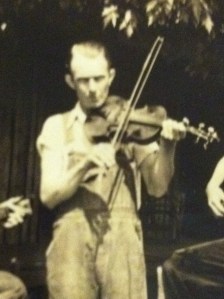
In Search of Ed Haley 2

24 Saturday Nov 2012

Posted by Brandon Ray Kirk in Ed Haley

≈ Leave a comment

Tags

Appalachia, blind, books, crime, Ed Haley, feud, fiddler, Harts Creek, John Hartford, Logan County, music, U.S. South, West Virginia, writers, writing

     It was only natural that I would want to know more about this man who had such a strong grip on me. I first turned to a brief biography written on the Parkersburg Landing album cover. Right away, his life interested me almost as much as did his music.

     “James Edward Haley was born in 1883 on Hart’s Creek in Logan County, West Virginia. When he was quite young, his mother was killed in an altercation with the Hatfield and McCoy feud. He was subsequently raised by his Aunt Liza. An attack of the measles when he was three left him completely blind. He received no formal schooling [and] on occasion food was so scarce that his dinner would consist of nothing but a bunch of wild onions washed in a nearby stream.”

     Like most Americans, I was somewhat familiar with the Hatfield-McCoy feud. I knew the names Devil Anse Hatfield and Randolph McCoy. I remembered hearing about some kind of trouble over a pig. But after looking through a few books about the feud, I could find no reference to any Haleys killed in it. Actually, maps showed Harts Creek – the place of Haley’s birth – situated a significant distance from feud sites. Haley was born in the Guyandotte Valley of northern Logan County, while the Hatfield-McCoy Feud occurred primarily in the Tug Fork Valley of western Logan County (now Mingo County).

     I wondered about Haley’s family life. What happened to his father? How old was he when his mother was murdered? And what influences did either parent have on his life? Did he have any siblings? And who was “Aunt Liza”?

     I was also fascinated by Haley’s blindness. There is a long history of blind musicians, from Turlough O’Carolan, the famous eighteenth century Irish harper, to Doc Watson, the legendary guitar player from North Carolina. Surely, the optic perception and visual hallucinations of a blind man is much more intense and interesting than what sighted people see. There’s no telling what incredible pictures Haley saw in his mind when he played music, when he was in the “zone,” seeing the colors and smelling the smells. I found it interesting that Haley, unlike most of the blind musicians I knew, had not been born blind. According to Parkersburg Landing, he lost his eyesight at the age of three. It was possible, then, that he possessed faint memories of sight. Did he remember his mother’s face? His father’s hands?

     Parkersburg Landing revealed that measles caused Haley’s blindess. In the late nineteenth century, measles constituted a serious childhood disease. Its initial symptoms, as per Household Cyclopedia of General Information (1881), were “inflammatory fever, drowsiness, pain in the pit of the stomach, pain in the back. [and] vomiting.” On the third day, little red points resembling flea bites appear on the face, neck and breast. Two days later, “little round vesicles filled with a transparent fluid appear on the top of each pimple. The eruptive fever now declines. On the ninth day the pustules are perfectly formed, being round and filled with a thick, yellow matter, the head and face also swelling considerably. On the eleventh day the matter in the pustules is of a dark yellow color, the head grows less, while the feet and hands begin to swell. The secondary fever now makes its appearance. The pustules break and dry up in scabs and crusts, which at last fall off, leaving pits, which sufficiently mark the cause.”

     Ed Haley likely contracted a particularly terrible case of measles, called “the confluent.” In that case, according to Household Cyclopedia, “all the symptoms are more violent from the beginning. There is delirium, preceded by great anxiety, heat, thirst, vomiting, etc. The eruption is irregular, coming out on the second day in patches, the vesicles of which are flatted in; neither does the matter they contain turn to a yellow, but to a brown color. Instead of the fever going off on the appearance of the eruption, it is increased after the fifth day, and continues throughout the complaint. The face swells in a frightful manner, so as to close the eyes; sometimes putrid symptoms prevail from the commencement.”

     While there were various treatments for measles, Household Cyclopedia recommended the victim be placed “in a cool, airy room” and “lightly covered with bed clothes. Purge him moderately with salts, and give him thirty drops of laudanum every night. The diet should consist of panada, arrow-root, etc., and his drink consist of lemonade or water. If from any cause the eruption strikes in, put him into a warm bath, give a little warm wine whey, or the wine alone, and apply blisters to the feet. Obstinate vomiting is to be quieted by the effervescing draught, with the addition of a few drops of laudanum. If the eyes are much affected, it will be necessary to bathe them frequently with warm milk, and to smear the lids with some simple ointment.”

     Measles can cause corneal blindness through several mechanisms, including acute vitamin A deficiency, exposure keratitis, herpes simplex keratitis, secondary infection and harmful traditional remedies. Vitamin A deficiency, a common condition today among poor people of the world, begins with night blindness. If untreated, it causes the conjunctiva, the mucous membrane lining the inner surface of the eyelids and extending over the forepart of the eyeball, to dry. Thereafter, the cornea shrivels up and becomes ulcerated. Triangular gray spots may appear on the white of the eye. Finally, total and irreversible blindness results due to inflammation and infection in the interior of the eye.

     I could just picture little Ed Haley, suffering from measles, stumbling and grasping in an ever-darker world without the words to express himself. And all he may have needed to save his sight was a strong diet of liver, eggs, milk and carrots.

Newer posts →

Feud Poll 1

If you had lived in the Harts Creek community during the 1880s, to which faction of feudists might you have given your loyalty?

Categories

  • Adkins Mill
  • African American History
  • American Revolutionary War
  • Ashland
  • Atenville
  • Banco
  • Barboursville
  • Battle of Blair Mountain
  • Beech Creek
  • Big Creek
  • Big Harts Creek
  • Big Sandy Valley
  • Big Ugly Creek
  • Boone County
  • Breeden
  • Calhoun County
  • Cemeteries
  • Chapmanville
  • Civil War
  • Clay County
  • Clothier
  • Coal
  • Cove Gap
  • Crawley Creek
  • Culture of Honor
  • Dingess
  • Dollie
  • Dunlow
  • East Lynn
  • Ed Haley
  • Eden Park
  • Enslow
  • Estep
  • Ethel
  • Ferrellsburg
  • Fourteen
  • French-Eversole Feud
  • Gilbert
  • Giles County
  • Gill
  • Green Shoal
  • Guyandotte River
  • Halcyon
  • Hamlin
  • Harts
  • Hatfield-McCoy Feud
  • Holden
  • Hungarian-American History
  • Huntington
  • Inez
  • Irish-Americans
  • Italian American History
  • Jamboree
  • Jewish History
  • John Hartford
  • Kermit
  • Kiahsville
  • Kitchen
  • Leet
  • Lincoln County Feud
  • Little Harts Creek
  • Logan
  • Man
  • Matewan
  • Meador
  • Midkiff
  • Monroe County
  • Montgomery County
  • Music
  • Native American History
  • Peach Creek
  • Pearl Adkins Diary
  • Pecks Mill
  • Peter Creek
  • Pikeville
  • Pilgrim
  • Poetry
  • Queens Ridge
  • Ranger
  • Rector
  • Roane County
  • Rowan County Feud
  • Salt Rock
  • Sand Creek
  • Shively
  • Spears
  • Sports
  • Spottswood
  • Spurlockville
  • Stiltner
  • Stone Branch
  • Tazewell County
  • Timber
  • Tom Dula
  • Toney
  • Turner-Howard Feud
  • Twelve Pole Creek
  • Uncategorized
  • Warren
  • Wayne
  • West Hamlin
  • Wewanta
  • Wharncliffe
  • Whirlwind
  • Williamson
  • Women's History
  • World War I
  • Wyoming County
  • Yantus

Feud Poll 2

Do you think Milt Haley and Green McCoy committed the ambush on Al and Hollene Brumfield in 1889?

Blogroll

  • Ancestry.com
  • Ashland (KY) Daily Independent News Article
  • Author FB page
  • Beckley (WV) Register-Herald News Article
  • Big Sandy News (KY) News Article
  • Blood in West Virginia FB
  • Blood in West Virginia order
  • Chapters TV Program
  • Facebook
  • Ghosts of Guyan
  • Herald-Dispatch News Article 1
  • Herald-Dispatch News Article 2
  • In Search of Ed Haley
  • Instagram
  • Lincoln (WV) Journal News Article
  • Lincoln (WV) Journal Thumbs Up
  • Lincoln County
  • Lincoln County Feud
  • Lincoln County Feud Lecture
  • LinkedIn
  • Logan (WV) Banner News Article
  • Lunch With Books
  • Our Overmountain Men: The Revolutionary War in Western Virginia (1775-1783)
  • Pinterest
  • Scarborough Society's Art and Lecture Series
  • Smithsonian Article
  • Spirit of Jefferson News Article
  • The Friendly Neighbor Radio Show 1
  • The Friendly Neighbor Radio Show 2
  • The Friendly Neighbor Radio Show 3
  • The Friendly Neighbor Radio Show 4
  • The New Yorker
  • The State Journal's 55 Good Things About WV
  • tumblr.
  • Twitter
  • Website
  • Weirton (WV) Daily Times Article
  • Wheeling (WV) Intelligencer News Article 1
  • Wheeling (WV) Intelligencer News Article 2
  • WOWK TV
  • Writers Can Read Open Mic Night

Feud Poll 3

Who do you think organized the ambush of Al and Hollene Brumfield in 1889?

Recent Posts

  • Logan County Jail in Logan, WV
  • Absentee Landowners of Magnolia District (1890, 1892, 1894)
  • Charles Spurlock Survey at Fourteen Mile Creek, Lincoln County, WV (1815)

Ed Haley Poll 1

What do you think caused Ed Haley to lose his sight when he was three years old?

Top Posts & Pages

  • Civil War Gold Coins Hidden Near Chapmanville, WV
  • Adkins-Davis Family Cemetery (2011)
  • Harts News 05.29.1925
  • African-American Schools in Logan County, WV (1927)
  • Tom Chafin Recalls Story of Ellison Hatfield's Killing (1989)

Copyright

© Brandon Ray Kirk and brandonraykirk.wordpress.com, 1987-2023. Unauthorized use and/or duplication of this material without express and written permission from this blog’s author and/or owner is strictly prohibited. Excerpts and links may be used, provided that full and clear credit is given to Brandon Ray Kirk and brandonraykirk.wordpress.com with appropriate and specific direction to the original content.

Archives

  • February 2025
  • January 2025
  • October 2023
  • September 2023
  • December 2022
  • November 2022
  • May 2022
  • April 2022
  • February 2022
  • November 2021
  • October 2021
  • September 2021
  • June 2021
  • May 2021
  • April 2021
  • March 2021
  • February 2021
  • January 2021
  • December 2020
  • November 2020
  • October 2020
  • July 2020
  • June 2020
  • May 2020
  • April 2020
  • March 2020
  • February 2020
  • January 2020
  • December 2019
  • November 2019
  • October 2019
  • September 2019
  • August 2019
  • July 2019
  • June 2019
  • May 2019
  • April 2019
  • March 2019
  • February 2019
  • January 2019
  • December 2018
  • November 2018
  • October 2018
  • September 2018
  • August 2018
  • July 2018
  • June 2018
  • May 2018
  • April 2018
  • March 2018
  • February 2018
  • January 2018
  • December 2017
  • November 2017
  • October 2017
  • September 2017
  • August 2017
  • July 2017
  • June 2017
  • May 2017
  • April 2017
  • March 2017
  • February 2017
  • January 2017
  • December 2016
  • November 2016
  • October 2016
  • September 2016
  • August 2016
  • July 2016
  • June 2016
  • May 2016
  • April 2016
  • March 2016
  • February 2016
  • January 2016
  • December 2015
  • November 2015
  • October 2015
  • September 2015
  • August 2015
  • July 2015
  • June 2015
  • May 2015
  • April 2015
  • March 2015
  • February 2015
  • January 2015
  • December 2014
  • October 2014
  • September 2014
  • August 2014
  • July 2014
  • June 2014
  • May 2014
  • April 2014
  • March 2014
  • February 2014
  • January 2014
  • December 2013
  • November 2013
  • October 2013
  • September 2013
  • August 2013
  • July 2013
  • June 2013
  • May 2013
  • April 2013
  • March 2013
  • February 2013
  • January 2013
  • December 2012
  • November 2012

Enter your email address to follow this blog and receive notifications of new posts by email.

Join 2,927 other subscribers

Tags

Appalachia Ashland Big Creek Big Ugly Creek Blood in West Virginia Brandon Kirk Cabell County cemeteries Chapmanville Charleston civil war coal Confederate Army crime culture Ed Haley Ella Haley Ferrellsburg feud fiddler fiddling genealogy Green McCoy Guyandotte River Harts Harts Creek Hatfield-McCoy Feud history Huntington John Hartford Kentucky Lawrence Haley life Lincoln County Lincoln County Feud Logan Logan Banner Logan County Milt Haley Mingo County music Ohio photos timbering U.S. South Virginia Wayne County West Virginia Whirlwind writing

Blogs I Follow

  • OtterTales
  • Our Appalachia: A Blog Created by Students of Brandon Kirk
  • Piedmont Trails
  • Truman Capote
  • Appalachian Diaspora

BLOOD IN WEST VIRGINIA is now available for order at Amazon!

Blog at WordPress.com.

OtterTales

Writings from my travels and experiences. High and fine literature is wine, and mine is only water; but everybody likes water. Mark Twain

Our Appalachia: A Blog Created by Students of Brandon Kirk

This site is dedicated to the collection, preservation, and promotion of history and culture in Appalachia.

Piedmont Trails

Genealogy and History in North Carolina and Beyond

Truman Capote

A site about one of the most beautiful, interesting, tallented, outrageous and colorful personalities of the 20th Century

Appalachian Diaspora

  • Subscribe Subscribed
    • Brandon Ray Kirk
    • Join 789 other subscribers
    • Already have a WordPress.com account? Log in now.
    • Brandon Ray Kirk
    • Subscribe Subscribed
    • Sign up
    • Log in
    • Report this content
    • View site in Reader
    • Manage subscriptions
    • Collapse this bar
 

Loading Comments...