• About

Brandon Ray Kirk

~ This site is dedicated to the collection, preservation, and promotion of history and culture in my section of Appalachia.

Brandon Ray Kirk

Tag Archives: Harts Creek

Captain Barney Carter

11 Monday Nov 2013

Posted by Brandon Ray Kirk in Big Harts Creek, Civil War, Whirlwind

≈ Leave a comment

Tags

34th Battalion Virginia Cavalry, Appalachia, Barney Carter, civil war, genealogy, Harts Creek, history, Hoover Fork, Logan County, photos, West Virginia

barnett_carter

Capt. Barney Carter (1821-1902), resident of Hoover Fork of Big Harts Creek, Logan County, West Virginia, served as captain of Company D, 34th Battalion Virginia Cavalry.


In Search of Ed Haley 186

26 Saturday Oct 2013

Posted by Brandon Ray Kirk in Ed Haley

≈ Leave a comment

Tags

Al Brumfield, Brandon Kirk, Dingess, feud, Harts Creek, history, John Hartford, Lawrence Kirk, Tug River, Twelve Pole Creek, Weddie Mullins, West Virginia, writing

The next day, Lawrence’s son drove the four of us over to Inez, a small settlement on the Tug River and the seat of government for Martin County, Kentucky. According to written history, Milt and Green were captured and jailed there in 1889. We made our way to the courthouse, which was surrounded by a few interesting buildings where Brandon darted inside to seek out some record of Milt and Green’s incarceration. Unfortunately, many such records had been lost in an 1892 fire. (It’s said there’s nothing more convenient than a good courthouse fire.)

Just before we left town, Lawrence said, “Well, straight east from here at this courthouse about eight miles across the river is the mouth of Jenny’s Creek on the West Virginia side. That’s approximately the way they traveled with these people when they left Kentucky. They went up Jenny’s Creek out the head of Jenny’s Creek into Twelve Pole and out of Twelve Pole down Henderson Branch into Big Harts Creek. It’s a direct route through there. We’re goin’ to be traveling approximately that. We’re going to be going around some places on account of the road but we’ll come back to the mouth of Jenny’s Creek over there.”

As we crossed the Tug into Kermit, Lawrence said, “I don’t know how far they would travel in a day by horseback through these trails on these mountains but they would travel a long ways. I think they did it in a day from up here at Kermit. Yeah, they’d do it in a day.”

Lawrence directed us up Marrowbone Creek and over to the little town of Dingess on Twelve Pole Creek. He said the posse never came through there with Milt and Green but it was the closest we could get to their trail due to the layout of current roads. Dingess, I remembered, was the place where Ed Haley’s uncle Weddie Mullins was murdered in a shoot-out at the turn of the century. The little town was reportedly named after a brother-in-law of Al Brumfield.

The next big thrill was navigating cautiously along a gravel road and entering Harts Creek at the head of Henderson Branch. We followed that branch to its mouth then went on down the main creek past Hoover, Buck Fork, and Trace Fork before turning up Smoke House Fork. Lawrence guided us past Hugh Dingess Elementary School to the site of Hugh Dingess’ old home at the mouth of Bill’s Branch. He said the posse took Milt and Green up Bill’s Branch, over the mountain, and down Piney Creek. They followed Piney to its mouth, then went up West Fork to Workman Fork. From Workman Fork, they crossed the mountain to the Guyandotte River. We were only able to drive part of this latter leg of the trip.

In Search of Ed Haley 180

09 Wednesday Oct 2013

Posted by Brandon Ray Kirk in Ed Haley

≈ 2 Comments

Tags

Al Brumfield, Appalachia, Brandon Kirk, feud, Green McCoy, Harts, Harts Creek, Henderson Dingess, Hollene Brumfield, James V. Henderson, John W Runyon, Milt Haley, Wild Bill, writing

Having satisfied my thirst for Brumfield family history, Brandon pulled out some great newspaper articles pertaining to the 1889 troubles. He began with one from the Ceredo Advance dated Wednesday, October 2, 1889, and titled “Disappointed Love Leads to a Desperate Double Crime in Lincoln County:”

HUNTINGTON, W.Va.  September 27 – Word has just reached here of a sensational crime on Big Hart’s creek, in Lincoln county, 90 miles up the Guyandotte River. Al Brumfield, a newly married man, and his bride had spent the day with his wife’s parents some distance up the creek. Just at dusk, on their return, and when near their home, they were fired upon by a man who sprang from the bushes by the road-side. Mrs. Brumfield was shot in the head and fell to the ground unconscious. Her husband was shot in the right lung but managed to crawl to a neighbor’s for assistance.

The nearest physician, twenty-five miles distant, was summoned, but arrived too late to render the woman any assistance and she died in a few hours. The latest information is that Brumfield is also dying. He claims he recognized the assassin, but refuses to say who it was. It is the belief of the neighborhood that a suitor of Mrs. Brumfield, who failed to win her, is the assassin.

The article was full of errors but its implication of a single “assassin” with a personal attachment to Hollena Brumfield was interesting.

On Wednesday, October 9, 1889, Ceredo Advance ran a letter from “WILD BILL,” written on September 27. Wild Bill gave his address as Warren, West Virginia — a now extinct post office on Harts Creek below the mouth of Smoke House Fork.

ED. ADVANCE: — As you have had no communication from this place for some time I will give you a few items. There have been several cases of flux in this vicinity and two or three deaths. Farmers are busy saving fodder and cutting up corn. Our neighborhood was thrown into a state of confusion last Sunday evening about 3 o’clock. One mile from this place some low down villain attempted to assassinate Mr. Brumfield and wife. They had been on a visit to Mrs. Brumfield’s father, Mr. Henderson Dingess, and as they returned home they were shot from the brush, one ball striking Mrs. Brumfield just in front of the right ear and ranging around the cheek bone and striking her nose producing a serious but not fatal wound, and one ball striking Mr. Brumfield in the right arm below the elbow producing only a flesh wound. They were cared for and dressed by Drs. Moss, of Cabell county, and Hudgins, of Logan county. They will recover. Mr. Brumfield is a prominent merchant living at Hart, W.Va., and is a good citizen, highly esteemed by his neighbors. His wife is a noble and kind-hearted lady and beloved by all her acquaintances. They have a large train of friends who sympathize with them in their distress. The object of the attempted murder is believed to be robbery. The good and law-abiding citizens should unite and rid the earth of such miserable miscreants.

Based on this September 27 letter, written a week after the ambush at Thompson Branch, there were two theories regarding the motive for the crime: one, it was done by a jealous suitor; two, it was an attempted robbery.  In either case, this second article again referred to the attacker in the singular sense…sort of.

By October 24, locals had deduced Haley and McCoy’s guilt, captured them in Kentucky and murdered them at Green Shoal. WILD BILL was apparently unaware about this latter act because on October 25 he again sent a letter to the Ceredo Advance (printed on November 6).

ED. ADVANCE – Mr. Allen Brumfield, who was shot in the arm near this place about a month ago, has got about well. His wife, who was shot at the same time, is improving very slowly, but she will get well. The perpetrators of the awful crime — Milton Haley and Green McCoy — have been arrested. Haley did the shooting and McCoy is accused of being an accomplice, but the latter will be released by turning state’s evidence against Haley. The law should be enforced against such persons to the utmost extent. Our neighborhood is in a state of intense excitement and may terminate in a deadly feud between two parties…

[Since the above was written a mob took Haley and McCoy from the officers and killed them. — ED]

God only knows what our country will come to, as the deadly Winchester is fast becoming the ruling factor in our land.

Well just who was this WILD BILL? He seems to have access to a lot of information regarding the growing feud on Harts Creek. Maybe it was “Detective Wild Bill,” who history records as a participant in the Hatfield-McCoy Feud in the nearby Tug Valley.

A story featured in the Ceredo Advance titled “A Visit to the Lincoln County Battle Field” and dated Wednesday, November 13, 1889, was most interesting:

Mr. J.V. Henderson, editor of the Charleston Nonpareil, was in this city today [Nov. 7], having just returned from the scene of the recent trouble in Lincoln county. He went to get a full description of the places and the causes which led to the trouble for the metropolitan dailies. Mr. Henderson went into the house where Green McCoy and Milton Haley were murdered, and made a map of the house and its surroundings. He also made a map of the Hart’s Creek country, giving the location of each faction — the Brumfields and the Runyons. While going up Hart’s Creek he was met by two men acting as pickets, armed with Winchester rifles, who asked him where he was going and what was his business. Mr. Henderson told them that he was a newspaper man and wanted to get information regarding the trouble in that vicinity. They told him that they would give him one hour to get off the creek and leave the country.

Mr. Henderson took the hint and left at once. He says he learns that both factions are heavily armed and are expecting an attack at any time. Each side has pickets out ready to give the alarm in the event of hostile movements by the other side. The road up Hart’s Creek is blockaded, and travelers through that region avoid the place.

Unfortunately, few issues of the aforementioned Charleston Nonpareil survive in libraries today. Brandon later located copies of the Nonpareil for February and May of 1889 and February and June of 1890 — the times just prior to and just after the trouble — but none for the fall of 1889, which would have maybe mapped the murder site and the location of the feudists’ homes. There was one interesting development: according to The Cabell County Record, Mr. J.V. Henderson, “one of the best known figures in West Virginia newspaper work,” died at the Spencer insane asylum in 1898 at the ripe age of 43.

Appalachian Woman Chopping Wood

29 Sunday Sep 2013

Posted by Brandon Ray Kirk in Big Harts Creek, Women's History

≈ Leave a comment

Tags

Appalachia, culture, Harts Creek, history, life, Liza McKenzie, Logan County, photos, U.S. South, West Virginia

Harts Creek woman, circa 1940s

Big Harts Creek, Logan County, West Virginia, circa 1940s

In Search of Ed Haley 168

08 Sunday Sep 2013

Posted by Brandon Ray Kirk in Ed Haley

≈ Leave a comment

Tags

Allie Trumbo, Cincinnati, Ed Haley, Ella Haley, Harts Creek, history, Imogene Haley, Liza Mullins, Mona Haley, Patsy Haley, Ralph Haley, West Virginia, writing

After getting familiar with the postcards, I called Patsy Haley to see if she could tell me any more about Ella’s young life with Ralph.

“Ralph was about five years old when Mom married Ed Haley,” Patsy said. “Ralph is not by Ed Haley. I figure that Mom and Pop must’ve got married about the end of the teens.”

I asked Patsy if Ed was very close to Allie Trumbo, who often wrote to Ella in her younger days.

“They weren’t really close or anything like that,” she said. “My husband and I moved to Cincinnati and that’s when I got acquainted with Allie and his wife. In fact, we lived right across the street from them. They really didn’t talk too much. Allie used to tell me about their father Mr. Trumbo auctioning off land and selling it for a dollar ’cause he owned quite a bit of land by that college. I think Mom had a falling out with him. Mom used to go and stay with them, like on weekends, when she’d go to Cincinnati to work. Allie had called her ‘Penny Ella’ ’cause when she paid them for staying with them she always paid them with change ’cause that’s what Mom got from selling her newspapers.”

Was Allie a musician?

“No, not that I know of,” Patsy said. “He was a fine pool player.”

Patsy didn’t remember Ralph making the records.

“No, that was just before I come in the family,” she said. “I don’t think he did any more recordings after I came into the family. You know, Mom had divorced when I come in the family and they never got remarried. But he lived in the house because the kids wanted him there. Now I can remember when I first came in the family and Mona and I talked, she was quite afraid of her father when she was a little girl because I guess he must’ve been mean. And he musta been abusive and mean to Mom or she wouldn’t a divorced him. But he was a sweet old guy when I knew him. I never ever saw Pop drunk or drinking. But I do remember one time — it was at the holidays — and Noah took his father and went up to Ferguson’s I believe for Pop to play music for them. Well, he kept them out all night ’cause I guess he got pretty loaded. But I never ever saw Pop drink. Now Pat said she had, but I never had.”

I updated Patsy on some of the things I’d found out about Ed’s past on Harts Creek and asked if she knew anything about his mother.

“He really didn’t talk about her too much,” she said. “Only thing that I understood — and he didn’t tell me this — Mom told me — that she was killed when the father was killed. There was never no bad feelings about his parents, either one.”

Patsy said she learned more about Ed’s parents on a trip to Harts in 1947.

“We went up to Harts Creek because Pop had gone up there and we went to get him back,” she said. “That was the first time I met Aunt Liza.”

Aunt Liza said Milt came from “the other side of the mountain,” and that he and his wife were buried up behind their old log cabin on Trace Fork.

“I can remember Aunt Liza pointing to where they were buried,” she said. “When she pointed up, she pointed over towards where the log cabin was.”

In Search of Ed Haley 148

11 Sunday Aug 2013

Posted by Brandon Ray Kirk in Ed Haley

≈ Leave a comment

Tags

Clay County, Ed Haley, Ella Haley, fiddling, Harts Creek, history, Kentucky School for the Blind, Lawrence Haley, Liza Mullins, Minnie Hicks, music, West Virginia, writing

Ella provided most of the family entertainment.

“Pop never tried to sing any songs to us,” Lawrence said. “Mom sang songs. She had one she called ‘The Coo Coo’s Nest’. A lot of religious songs, little nonsense songs and rhymes, like ‘The Watermelon’. She had a principal, I guess, or the headmaster of the school — Dr. Huntington, or something like that — he’d come into the class and he’d have a reading session with them. Read them a story and he would read all the parts in different voices. And my Mom kinda got to using inflections a lot more than any of us would. Like, she used to read us Robin Hood from her Braille magazine.”

I wondered if Ed ever entertained the kids with stories.

“Ah, maybe a ghost story or two,” Lawrence said. “He’s telling one time about somebody a riding a… I guess it was a story he heard when he was a kid, too. Somebody was coming down Trace Fork from somewhere riding a horse way up above where Aunt Liza and them lived. Said they began to hear this rattling kind of sound, this guy did. And they said he began to speed up his horse a little bit, and this rattling kept getting louder and louder and he’s a going faster and faster. Said all at once this thing jumped right up on the horse behind him and locked its arms up around him and just stayed with him forever it seemed like. And just all at once got off. Pop could tell stories like that, now. Those stories kinda filled our lonely days, too. That was the thing that they did back in them days, I guess, was tell stories, but Aunt Liza never told any stories like that, or Uncle Peter didn’t.”

I asked Lawrence if Ed “worked on” tunes at home and he said, “Well, yeah, he’d kinda play the general outline and then maybe start working on some of the real, I guess, it would be the depth of a piece of music that he wanted to put in there. Depth or body to it. He’d add to it. But mostly he might just hear a piece of music and maybe just hit every fifth or sixth note or something just to get an outline of how he wanted to play it.”

I don’t think Lawrence realized what an important and sophisticated piece of musical insight that was. What he meant by saying that Ed hit “every fifth or six note” was that he was coming down on the big accent notes that made up the “spine” of the tune. I later wondered if Lawrence’s statement was based on observations or genetic memory or both.

I asked him about Ed playing for dances, but he said those memories had left his mind years ago.

“I was walking from Clay over to Clay Junction there that one night and there was nothing but the moon — it was a full moon — but it was a hazy… It had a big ring around the moon. It was the first time I ever noticed that. Now I can’t remember where we came from, but I know that they had their instruments with them. I guess we’s a gonna go back up on Stinson up there to Aunt Minnie’s. I think this was after the time of Laury’s death, so I guess we’s heading back that way. And if we could get to Clay Junction there, we’s supposed to get a ride or something, I think. Like I say, I can’t remember what kind of function we’d come from, and what we did after that. My recollection of that was walking down this highway — a dark night, except for a hazy, ringed moon. Now that hazy ringed moon kept that in my mind all these years. The rest of it I don’t know. So there’s a lot of stuff that you forget and you never remember.”

Whirlwind Post Office

11 Sunday Aug 2013

Posted by Brandon Ray Kirk in Big Harts Creek, Whirlwind

≈ 3 Comments

Tags

Appalachia, Chapmanville, Dingess, Ernestine Tomblin, Guyandotte River, Harts Creek, history, James Mullins, Kirk, Lawrence Riddle, Lindsey Blair, Logan, Logan County, McCloud Post Office, Mingo County, Moses Tomblin, Pearl Lowe, Shirley Smith, Shively, Sol Riddle, Tema Workman, Verdunville, Verlie Smith, W.J. Carle, West Virginia, Whirlwind, writing, Zama

Between 1909 and 1952, Whirlwind Post Office served the postal needs for residents of Upper Hart. What follows is an attempt to reconstruct a history of its postmasters and its locations. All information is based on official post office records located in Washington, DC.

In 1908, Lawrence W. Riddle petitioned the Postmaster General for the creation of a post office called “Zama” in the Upper Hart section of Logan County, West Virginia. This proposed post office would be situated twenty feet west of Harts Creek, three miles west of the Norfolk & Southern Railway, six miles northwest of McCloud Post Office, seven miles south of the town of Dingess in Mingo County, and eight miles east of the Guyandotte River. The total population to be supplied with mail would be 200 persons. In January 1909, the First Assistant Postmaster General responded in a letter that marked out the proposed name of this post office, “Zama,” and replaced it with “Whirlwind.”

Early postmasters at Whirlwind included: Lawrence W. Riddle (March 31, 1910, appointed; April 25, 1910, commissioned; May 16, 1910, took possession), Moses Tomblin (February 13, 1911, appointed), Sol Riddle (May 7, 1913, order; May 25, 1911, appointed; June 12, 1911, commissioned; June 30, 1911, took possession), and James Mullins (April 30, 1914, confirmed; May 19, 1914, commission signed and mailed; May 23, 1914, assumed charge). On June 26, 1925, Mr. Mullins requested to change the site of the post office to a spot 600 feet southwest of its current location.

Lindsey Blair next served as postmaster (April 28, 1938, confirmed; May 6, 1938, commission signed and mailed; May 11, 1938, assumed charge; resigned without prejudice). On July 15, 1938, Mr. Blair requested to relocate the post office to a spot 1652 feet east of its present location.

Shirley Smith replaced Mr. Blair (October 22 or 23, 1940, assumed charge; October 26, 1940, appointed acting postmaster). In a letter dated October 1940, Smith requested a relocation of the post office. The new post office location would be 5/10th of a mile southeast from the old location, 100 feet west of Harts Creek, nine miles southwest of Dingess, ten miles north of Harts, twelve miles southeast of Verdunville, and fourteen miles from Logan. Ms. Smith asked that the post office be relocated “so I can take care of it at my own home.” Twenty-eight patrons resided within a one-mile radius. Postmasters in this era include: Shirley Smith (December 5, 1940, confirmed; December 27, 1940, commission signed and mailed; December 31, 1940, took possession; January 1, 1941, assumed charge; resigned without prejudice) and Pearl Lowe (July 11 or 12, 1941, assumed charge).

In a letter dated August 19, 1941, Pearl Lowe wrote the Postmaster General requesting that Whirlwind Post Office relocate to a new site. The proposed location would be one mile north of its present location, about forty feet west of Harts Creek, two miles southwest of a county line, nine miles southwest from Dingess, nine miles south of Verdunville, ten miles from the Guyandotte River, and ten miles from Chapmanville. This location was approved and became effective as of September 18, 1941.

Pearl Lowe served as the only postmaster at this location: (September 19, 1941, appointed acting postmaster; November 5, 1941, appointed postmaster; January 2, 1942, commission signed and mailed; January 22 or 23, 1942, assumed charge). On April 14, 1942, Mrs. Lowe requested that the post office be relocated to a new site 1500 feet east of the present location. Shortly thereafter, on July 6, she requested that it be relocated to a site 1/8 mile away. This new spot would be 300 feet east of Harts Creek, nine miles southwest of Dingess, eleven miles northeast of Harts, and twelve miles southeast of Verdunville. On April 8, 1944, Ms. Lowe requested the site be moved 1/2 mile to the east. This latter site became effective May 1, 1944.

On July 15, 1944, someone (the paperwork does not specify who) requested that the post office be relocated 1/4 mile south of the old post office, about forty feet east of Harts Creek, two miles from Mingo County, nine miles southwest of Dingess, ten miles north of Harts, eleven miles south of Verdunville, thirteen miles east of the Guyandotte River, and thirteen miles northeast of Chapmanville.

Tema Workman took possession of the Whirlwind Post Office on February 28, 1947 and was “appointed” on March 12, 1947. On April 22, 1947, Ms. Workman requested that the post office be relocated to a site one mile north of the old location. The new post office would be 1/2 miles from Mingo County, 7 1/2 miles south of Dingess, 8 1/10 miles northeast of Shively, 9 1/2 miles north of Harts, and 10 8/10 miles southeast of Verdunville. This letter cites another name which the community was then known: Bulwark.

Subsequent postmasters included: Tema Workman (June 16, 1947, confirmed; July 11, 1947, commission signed and mailed; September 30, 1947, took possession; October 1, 1947, assumed charge; removed) and Verlie Smith (November 5, 1947, assumed charge; November 5, 1949, took possession; November 15, 1949, appointed).

On November 16, 1949, W.J. Carle, Post Office Inspector, wrote a letter requesting the post office be moved to a site one mile southeast. The new location would be situated two miles from Mingo County, 6 1/2 miles east of Shively, 8 1/2 miles north of Harts, ten miles south of Dingess, and fourteen miles west of Kirk.

Ernestine Tomblin served as the final postmaster at Whirlwind (March 31, 1951, assumed charge; April 17, 1951, appointed).

Whirlwind Post Office was discontinued on January 5, 1952, effective January 31, 1952, “mail to Harts.” Documents cite the post office as “unnecessary.” An investigation determined “reestablishment unnecessary” on May 1, 1953.

In Search of Ed Haley 147

09 Friday Aug 2013

Posted by Brandon Ray Kirk in Ed Haley

≈ Leave a comment

Tags

Appalachia, Blue Goose, Brandon Kirk, Ed Haley, Harts Creek, history, Imogene Haley, Joe Mullins, Kentucky, Lawrence Haley, Noah Haley, Wrigley, writing

Throughout the summer of 1994, Lawrence Haley and I spoke frequently on the telephone. I was excited about some of the information I’d been getting in the mail from Brandon Kirk, the Harts genealogist. Lawrence seemed curious about it too, since Ed’s family background was something he’d never known a lot about.

“I don’t know that much about it, because you know how ignorant I was about the whole affair when I first went up there with you,” he said. “I didn’t know a heck of a lot about my dad’s people or anything. I seen their faces and heard them talked about, but I wouldn’t know them if I’d walk nose to nose with some of them. We never probably asked a lot of the questions we should have asked of Mom and Pop while they were still alive. I know my mother would have told me a heck of a lot more. They wasn’t no reason why I shouldn’t have asked her questions. It was just one of those things you accept, I guess, and don’t question.”

Lawrence paused, then said, “So we didn’t find out a lot about the history of our families. I really didn’t know that much about my mother’s people, either. I know she had some people out in Wrigley, Kentucky. We used to go up there every now and then. Go to a little self-contained train — back in them days, it was just a one-car thing; they called it the ‘Blue Goose’ — and it run on a little ol’ track up into Elliott County, and up through there. And that’s about all I knew. That’s the place where I found the ‘milk well.’ I thought this gal was bringing that milk right up out of the milk well in the yard. And I told Mom about it and she said, ‘Well, that’s the way they keep the milk cool. They stick it in a bucket or something — a lard bucket — and put the lid on it, stick it down in the well, and let it cool like that.’ Anyway, that’s the reason that I guess we just accepted things as children mostly, because they weren’t like that. We accepted it as, ‘That’s life.'”

Lawrence and I got on the subject of Ed’s mother, which led us into a whole variety of topics. I asked if he knew what year she was supposed to’ve been killed and he said, “I really couldn’t tell you that, John. If it happened that way, I imagine they’d been something in The Logan Banner or The Huntington Herald-Dispatch.”

Lawrence said he wasn’t even sure where he got the story of her death.

“No, I never heard Pop talk about it,” he said. “I don’t know where it came from. I don’t know who told who and how it got started. Between me and Mona and Jack and Patsy and Noah, I guess. Noah didn’t seem like he showed as much interest in things like that as… I know whenever he’d go up there he’d get homesick. He didn’t like it up there too much. I remember there used to be a paw paw patch we’d all go down to where Trace and Harts join there. We’d go down there and cut slips of that paw paw — eat the paw paws when they’s in season — and make whistles out of them, you know. They had a slick bark. You could skin off a chunk of bark at the right time of the year and then you’d take and plug each end of that bark and make you a nice little whistle out of it. Then take the bark and plaid it into whips and things. Just something to occupy a kid’s time that didn’t have a heck of a lot to do. We invented a lot of things like that. I guess Joe showed us a lot of that stuff.”

In Search of Ed Haley 146

08 Thursday Aug 2013

Posted by Brandon Ray Kirk in Ed Haley

≈ Leave a comment

Tags

Burbus Toney, Cain Adkins, Caleb Headley, civil war, education, Elias Adkins, Green Shoal, Harts Creek, history, Philip Hager, Thomas H. Buckley, West Virginia, writing

In 1855 Green Shoal became the first post office in the Harts area, with Burbus C. Toney acting as postmaster. At that time, the Kiah’s Creek United Baptist Church in nearby Wayne County served the religious needs of the community. Politically, the area was overwhelmingly Democratic and aligned itself with the South during the War Between the States. One study of veterans places the percentage of Harts-area Confederate veterans at 90 percent. Locals were more concerned with states’ rights than slavery; there were fewer than thirty slaves in the entire area just prior to the war. Likewise, in 1890, there were only seven Union veterans living in Harts; most had arrived after the war.

In the late 1860s, Harts residents continued their efforts to improve educational opportunities for young people by constructing a school on the West Fork of Harts Creek.

“The school started in 1865 in an old hunter’s cabin,” said Kile Topping. “The teacher had to take guns with him to school because there were wild animals in the woods. All the students studied out loud and listened to the squirrels jump off of trees on to the top of the cabin. There was no floor in the school and students would stump their toes on briers.”

In 1867 Lincoln County was formed from Cabell County and, within two years, had pulled the lower section of Harts Creek within its boundaries from Logan County and Wayne County. The formation of this new county bisected the community of Harts into halves: those who lived on the upper part of the creek — such as Jackson Mullins — were in the Chapmanville District of Logan County and those who lived along the lower portion of the creek — such as Al Brumfield — were in the Harts Creek District of Lincoln County.

Within a short time, the people of Harts were caught in the industrial wave overtaking the nation. The arrival of the timber industry changed the community forever from a stereotypical mountain agricultural-oriented place to one of small-scale commerce. Settlements with impressive store buildings and homes formed along the riverbank and at the mouth of local creeks. New people moved into the area from eastern Kentucky looking for work in timber, helping to change the genealogical make-up of the community. Flatboats, pushboats, small steamboats, ferry boats, and rafting were all themes from this era.

Things were looking up in terms of education as well. “Harts Creek Township has never had a fair opportunity to place her schools in good condition,” wrote county superintendent James Alford in 1871. “A portion of this township formerly belonged to Logan county, and a portion to Wayne county, and school affairs became considerably confused in making this township. But the citizens are manifesting great interest in their schools, and will no doubt, at no distant day, have their schools in full operation; and, with the assistance of competent teachers, make great improvement in the youth of the township.” It was worse in Logan County: “Chapmansville Township, in which I reside, has had no schools taught in it until the last year,” wrote county superintendent C.S. Stone. “The opposers of the free schools fought the thing back until last year, when the cause of education gained the ascendancy.”

In 1871, Harts area teachers were Canaan Adkins, Stephen Lambert, and William T. Fowler, and (likely) Elisha W. Vance and J.W. Gartin. All had No. 5 Certificates (the lowest) except for Lambert, who had a 4. Teachers listed in educational directories for the following year were: Caleb Headlee, Thomas P. Moore, Isaac Nelson, Henry Spears, V.B. Prince and (possibly) Elias Adkins, Philip Hager and J.B. Pullen. Moore, Prince and Spears had a No. 4 Certificate, while Nelson had a 5 and Headlee had “no grade on certificate.”

The county superintendent was full of compliments for the Harts area in his 1872 report. “Hart’s creek has also built two school houses this year,” wrote Superintendent J.W. Holt. “The buildings are of logs, but are really neatly and substantially gotten up, and reflect credit upon the contractors and the township. This township is exhibiting a very commendable spirit upon the subject of education, and in the course of another year will have her school affairs in good working order.” Attendance was low in the region. In 1872, Superintendent C.S. Stone of Logan County wrote: “It appears that the mass of the people do not take hold of the thing right; they do not appreciate properly the great benefit of a general education. They generally admit that schools are the thing they want, and that public schools are the only means that will diffuse a general education, but there is something in its operative influences not altogether right.”

In the late 1870s, an agitated superintendent Marion Vickers wrote of the educational situation: “There is a great irregularity in the attendance of our children. Is not this non-attendance too large for an enlightenend community? How can the children of our country receive the many benefits of our school system, unless they are sent to school. Should not parents consider that they are depriving their children of that which will be of more benefit to them than anything else within their power to give? While passing around and seeing so many naturally intelligent youths growing up in ignorance, with almost every possible opportunity offered for improvement, I am almost ready to say: ‘Give us a compulsory system of education.'” In that time frame, 1877-1878, the Harts teachers were: John Gore, T.H. Buckley and Canaan Adkins and (maybe) Henry Shelton. Buckley and Adkins had No. 2 Certificates.”

In Search of Ed Haley 145

30 Tuesday Jul 2013

Posted by Brandon Ray Kirk in Ed Haley

≈ 3 Comments

Tags

Appalachia, Elias Adkins, Harts Creek, history, Isaac Adkins, John H. Brumfield, Joseph Adams, Logan County, Peter Mullins, slavery, Thomas Dunn English, timbering, writing

Within a few years, by 1827, there were more settlers: Elias Adkins at Fowler Branch on the Guyandotte River, Moses Brown at Brown’s Branch of Guyan River and Marvel Elkins on Piney Creek of West Fork. Within three years, Isaac Adkins was at Harts and John Brumfield (father of Paris) was at the mouth of Ugly Creek. The Adkins brothers — Isaac and Elias — were the only slave owners in the section. They bought land at the mouth of Harts Creek in 1833.

In the early 1830s, Joseph Fry, John Lucas, and John Fry moved to the Harts area. Joseph Fry lived at Ugly Creek; John Fry, a War of 1812 veteran, lived at the mouth of Green Shoal; and John Lucas, a Baptist preacher, lived near Big Creek. With the arrival of these and other men, a school was organized to meet the educational needs of local children. “The first school was taught in a log cabin one mile above the mouth of Big Harts creek about the year 1832,” writes Hardesty. “The first house for educational purposes was built near the mouth of Big Harts creek in 1834. It was a five-cornered building, one side being occupied by the ever-present huge fire place.”

In the mid-1830s, Joseph Adams and Peter Mullins — both great-grandfathers to Ed Haley — arrived in the headwaters of Harts Creek. In 1838, Adams was granted 100 acres between the Forks of Harts Creek and the Rockhouse Branch. He became the patriarch of most Adamses in Harts, including Anthony and Ben Adams — key players in the Haley-McCoy trouble. In the early 1840s, Mullins was granted land on Hoover Fork and Trace Fork. He was a grandfather to Emma Haley.

At that time, in 1840, there were roughly 23 families in Harts. In the head of Harts Creek were Stephen Lambert, Moses Workman, Alexander Tomblin, and James Tomblin. Henry Conley and William Thompson were somewhere on the creek. Richard Elkins was at Thompson Branch and Isaac Adkins, Jr. was at Big Branch. Abner Vance was on West Fork. Isaac Adkins, Sr. and James Toney were at Harts. Moses Brown and Archibald Elkins were just below there. Harvey Elkins and Price Lucas were on or near Little Harts Creek. Above Harts was Elias Adkins and Squire Toney. At Ugly Creek were John Brumfield, Joseph Fry, and John Rowe. Charles Lucas and John Fry were at Green Shoal. John Dolen was somewhere in the area.

At that early date, folks were beginning to explore timber as a means of industry. “Isaac Elkins built the first saw mill in 1847 or 1848,” Hardesty writes. “It was constructed on the old sash-saw plan, and had a capacity for cutting from 800 to 1,000 feet per day.” To assist in the transport of timber and coal from the valley, locks and dams were constructed in the lower section of the Guyan and steamboats made a brief appearance in the valley during the 1850s, although they did not travel so far upriver as to reach Harts. There was some excitement, too, when Thomas Dunn English — a famous Northeastern writer — arrived in nearby Logan (then called Aracoma) and became mayor.

In Search of Ed Haley 144

29 Monday Jul 2013

Posted by Brandon Ray Kirk in Ed Haley

≈ Leave a comment

Tags

Appalachia, Ed Haley, Guyandotte River, Harts Creek, history, James White, Joseph Gore, Logan County, Richard Elkins, Stephen Hart, West Virginia, William West, writing

As far as can be ascertained, Harts — the place of Ed Haley’s birth — first appeared in written history as “Heart Creek” on a John Wood map sketched some time between 1809 and 1824. Reportedly, the creek was named for Stephen Hart — an early settler — or perhaps for his father, who was reportedly scalped by Indians at the mouth of Little Harts Creek. Stephen Hart first appeared in Logan County records in the late 1830s, settling on Crawley Creek, near Harts. Some claim that he lived at the mouth of Harts Creek on a hill in a rock cave, while others say he lived in Dock Bottom near the mouth of Smoke House Fork. More than likely, he had shanties constructed along various creeks at different times used for hunting camps. All historians agree that the Smoke House Fork of Harts Creek was so named because it contained Hart’s smoke house.

“At the forks of Hart’s Creek, where Henderson Dingess now lives, Stephen Hart had a cabin,” writes Henry Clay Ragland in his 1896 Logan County history. “He cared nothing for the soil, but put in his time hunting the deer which were so abundant on the creek. On the left-hand fork, a short distance from his cabin, he built a house in which to cure his venison, in order to take it to the settlement whenever an opportunity would offer itself.”

According to written record, the first settler of present-day Harts was Richard Elkins, a hunter, farmer and ginseng digger. Elkins migrated to the mouth of the creek from “The Islands of Guyandotte” (Logan) in 1809 or 1815, some fifteen years after the last Indian had roamed the valley. At that time, Harts Creek was in Cabell County, Virginia. Jacob Stollings, who was granted 185 acres in the lower section of the creek by the State of Virginia in 1812, soon joined Elkins. Other neighbors along the Guyan River were William W. Brumfield, who lived at the mouth of Ugly Creek, and Squire Toney, who lived in the bottoms above Douglas Branch. Brumfield was the grandfather of Paris Brumfield.

“At the coming of white men, this region was a wilderness inhabited only by wild animals,” wrote Fred B. Lambert, an early local historian. “There was a buffalo trail extending in the general direction from the Guyan Valley to Mud River and buffalo passed up the valleys in the summer. Wild game was plentiful — deer, turkey, bear and also such animals as panthers, wild cats, and wolves. The otter and beaver were found on Guyan River at an early day. Wild hogs roamed the woods. At times in the early morning the air would be darkened by pigeons. There were elk in this region, but they were exterminated as early as 1815.”

During the later teens, Peter Dingess, Garland Conley, Charles Spurlock, Abner Vance, and Richard Vance settled in the vicinity of Harts Creek. These men were the ancestors of many persons involved in the Milt Haley story.

“The first settlers to find homes in Hart’s District were from the counties of northern Virginia,” according to Kile Topping, an early historian. “Many of these settlers belonged to the hardy class of hunters and ginseng diggers, who later gave up this occupation to become timbermen. They came here from Virginia through the mountains on foot, or down the Kanawha Valley in covered wagons. Some came in push boats from nearby counties and Ohio. Most of the traveling was done on horseback. There was no salt here and the old settlers dug their ‘seng’ and carried it on horses to the Salt Licks of the great Kanawha River, where they exchanged it for salt and other merchandise.”

During the early 1820s, there were minor improvements locally. James White built the first grist mill around 1821. “It was a small tub-wheel mill, water being the propelling power,” according to Hardesty’s History of Lincoln County, West Virginia (c.1884). In 1823, a Methodist minister named William West preached the first sermon in Harts (and became the namesake for West Fork). In 1824, Harts was incorporated into the new county of Logan. By that time, William Thompson lived in the head of West Fork, Isham Tomblin lived on Harts Creek, Joseph Gore (Ed Haley’s great-great-grandfather) lived on West Fork and Isaac Brown lived across the Guyandotte River from Green Shoal. Moses Workman and John Abbott were perhaps in the area as well, the latter located near Isaac Brown.

In Search of Ed Haley

03 Monday Jun 2013

Posted by Brandon Ray Kirk in Ed Haley

≈ Leave a comment

Tags

Appalachia, Bertha Mullins, culture, Ewell Mullins, genealogy, Harts Creek, history, life, Logan County, photos, West Virginia

Bertha (Adams) Mullins family, Harts Creek, Logan County, West Virginia, 1925-1940

Bertha (Adams) Mullins and siblings, Harts Creek, Logan County, West Virginia, 1920s

In Search of of Ed Haley 123

03 Monday Jun 2013

Posted by Brandon Ray Kirk in Ed Haley

≈ Leave a comment

Tags

Appalachia, Calhoun County, Ed Haley, Harts Creek, history, John Hartford, Josie Cline, Laury Hicks, Logan County, music, West Virginia, Wilson Douglas, writing

     I spent the spring of 1994 triangulating the many different versions I had heard of Ed Haley’s life and trying to make some sense of the direction of my research. There were so many avenues to explore: Ed’s background and the story of his father’s death on Harts Creek; Ed’s family and professional life in Ashland; Ed’s experience in places like Portsmouth or Calhoun County… Really, I seemed to only be scraping the tip of the iceberg — and it appeared to be a large one at that. It was amazing to consider how much I might learn about someone who I had first read about as being “a misty legend.” Almost daily, some little scrap of information came in.

     I called Wilson Douglas several times with very specific questions in mind. I asked him if Ed played a lot in the second and third position and he said, “Oh, yeah, he did a lot of that. Well, you know it’s like this, John. When he wanted to show off he would play in the standard position then he would let loose and get down the violin neck — way down — and play down there a while. He’d do a lot of that where he had competition, you know, and more or less to show off. That is, if somebody provoked him that’s the way he would do. I don’t know how he did it, but you wouldn’t detect any change, any hesitation, any loss of time, or nothing like that. But the man was a genius, they’s no question about it. He played the fiddle so many different ways, you had to listen close to tell what he was a doing.”

     I asked Wilson if he knew anything about Ed’s personal history.

     “No, not too much,” he said. “You know, he had the measles when he was two or three years old and that put him blind. He told me, ‘Wilson, where I was born and raised there on Harts Creek in Logan County, we almost starved to death.’ Said, ‘All we had was greens and green onions to eat of a summer and practically nothing of a winter.’ He said, ‘Now you know what the Depression is.’ I said, ‘Yeah.’ He said, ‘Well that was a picnic to what I was raised on .'”

     I said to Wilson, “Well, let me tell you a little bit about Ed’s background and see if that rings any bells. His daddy was lynched.”

     “Right,” he interrupted. “They was mean people. They were mean, violent people.”

     I asked if Ed ever talked about his father.

     “Not too much,” he said. “He didn’t want you to ask him too many questions about a thing like that, you know? He did mention one thing to me one time — said something about his dad, but he didn’t comment much, you know. Not enough to make any sense of it. Ed Haley wouldn’t tell you too much. You had to be in his confidence strongly before he’d tell you much of anything.”

     When I mentioned my theory about Josie Cline being Ed’s half-sister, Wilson said, “Well, I heard him telling Laury Hicks that he had a sister, but he didn’t say his ‘half.’ He said his sister.”

In Search of Ed Haley

31 Friday May 2013

Posted by Brandon Ray Kirk in Ed Haley

≈ Leave a comment

Tags

Appalachia, culture, folk medicine, Harts Creek, history, life, Logan County, photos, U.S. South, West Virginia

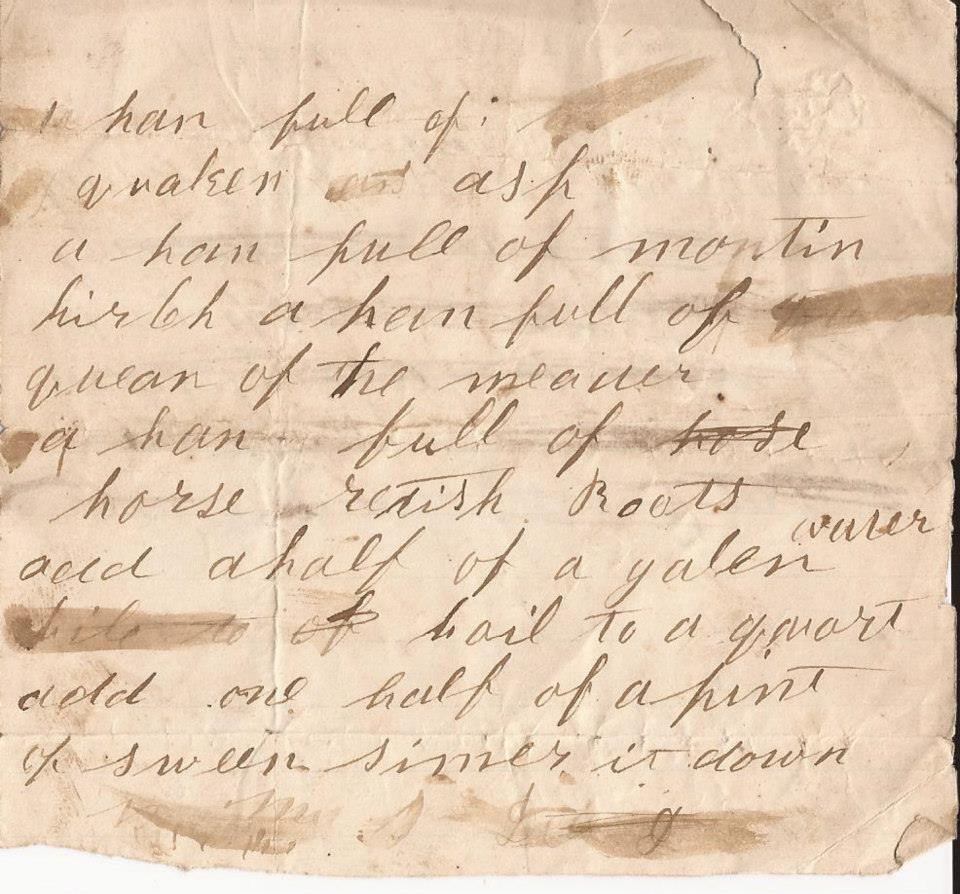
Old Mullins herbal remedy, Harts Creek, Logan County, West Virginia

Old Mullins herbal remedy, Harts Creek, Logan County, West Virginia

In Search of Ed Haley

28 Tuesday May 2013

Posted by Brandon Ray Kirk in Ed Haley

≈ 1 Comment

Tags

culture, Ewell Mullins, genealogy, Harts Creek, history, life, Logan County, photos, West Virginia

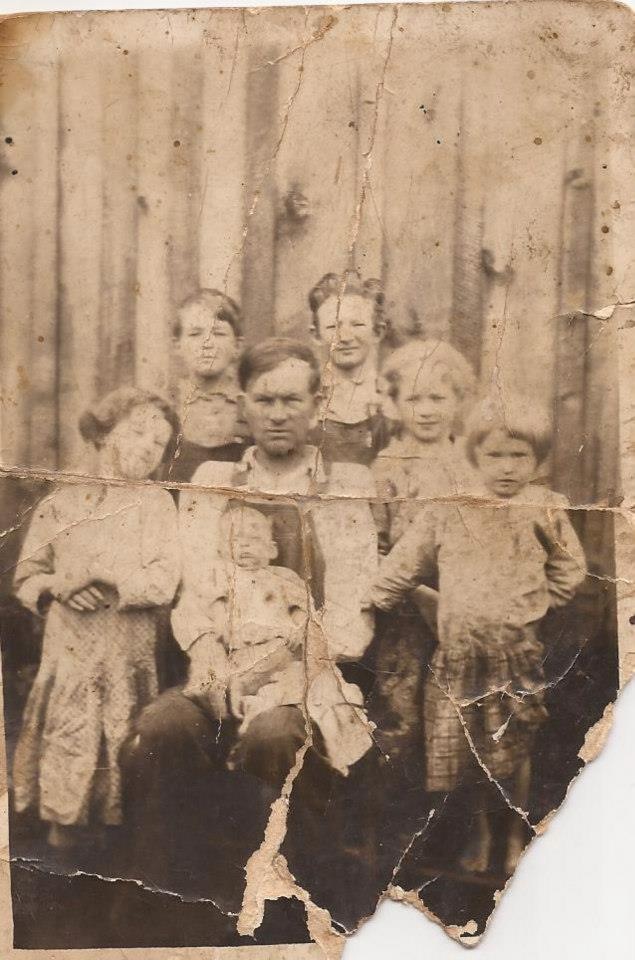
Ewell Mullins family, Harts Creek, Logan County, West Virginia, circa 1928

Ewell Mullins family, Harts Creek, Logan County, West Virginia, circa 1928

Rifle 2

26 Sunday May 2013

Posted by Brandon Ray Kirk in Culture of Honor

≈ Leave a comment

Tags

Appalachia, culture, Harts Creek, history, life, Logan County, Mason Adams, photos, U.S. South, West Virginia

Harts Creek child, 1916-1920

Harts Creek child, 1916-1920

In Search of Ed Haley 115

23 Thursday May 2013

Posted by Brandon Ray Kirk in Big Harts Creek, Ed Haley, Spottswood, Warren, Whirlwind

≈ Leave a comment

Tags

Andrew Jackson, Ben Adams, Bill Abbott, Bob Mullins Cemetery, Buck Fork, Chloe Mullins, civil war, Confederate Army, Dicy Adams, Ed Haley, Elizabeth Mullins, Enoch Baker, genealogy, Harts Creek, Henderson Dingess, history, Hollene Brumfield, Imogene Haley, Imogene Mullins, Jackson Mullins, Jane Mullins, Jeremiah Lambert, John Frock Adams, John Gore, John Q. Adams, Joseph Adams, Kentucky, Logan County, Margaret Gore, Mathias Elkins, Peter Mullins, Riland Baisden, Spencer A. Mullins, Tennessee, Ticky George Adams, timbering, Trace Fork, Turley Adams, Van Buren Mullins, Weddie Mullins, Weddington Mullins, West Virginia, writing

Ed Haley’s grandfather, Andrew Jackson Mullins, was born about 1843 to Peter and Jane (Mullins) Mullins. Jackson, as he was called, was named in honor of President Andrew Jackson, that early American icon. Like many folks in those days, Peter and Jane Mullins appear to have been caught up in the Jackson mystique. They even named one son Van Buren, after his vice president. Jackson Mullins was the first child born to Peter following the family exodus from Kentucky or Tennessee to Logan County, (West) Virginia. The 1850 Logan County Census listed him as seven years old. In 1860, he was eighteen. During the Civil War, Jackson served in the Confederate army. Brothers Weddington and Van Buren served as Confederates. In the late 1860s, Jackson married the slightly older Chloe Ann (Gore) Adams, a widow. Chloe had been born around 1840 to John and Margaret (Dingess) Gore, pioneer residents of Harts Creek. She had first married John Quincy “Bad John” Adams, a first cousin to Jackson, with whom she had four children: Dicy (born 1857), Joseph (born May 1858), John C. “Frock” (born c. 1861) and George Washington “Ticky George” (born 15 Jul 1864). She and Jackson had three children: Imogene Mullins (born c.1868), Peter Mullins (born May 1870), and Weddington Mullins (born April 10, 1872). Jackson and Chloe are thought to have lived on Trace Fork, perhaps at the present-day site of the Turley Adams home where they certainly lived in later years.

What little is known of Jackson Mullins — the man who partially raised Ed Haley — comes through deed records and census records. On February 13, 1869, his uncle Spencer A. Mullins wrote him a note that read: “Mr. A.J. Mullins and wife: you will pleas Come down and git your Deed for the Buck fork Land. I will not pay the taxes any longer.” In 1869 he purchased 200 acres of land on the creek from Riland Baisden. The next year he was listed in the 1870 census as 27 years old with 700 dollars worth of real estate and 200 dollars worth of personal property. His daughter — Ed Haley’s mother — first appeared in that record as “Em. Jane Mullins,” age two.  An April 1871, Justice Jeremiah Lambert provided a receipt to him for $2.80 “in the cost of the peace warrant in favor [of] him against Benjamin Adams.” An 1871 Logan County tax receipt listed A.J. Mullins as a resident of “Hearts Creek.” On February 28, 1877, the Logan County Court appointed him as “Surveyor of Roads in Precinct No. 76 in place of Weddington Mullins for the time of two years commencing April 1, 1877.” On December 17, 1877, the Logan County Clerk provided a receipt to him for recording a deed from Henderson Dingess and wife (parents to Hollene Brumfield). An 1878 tax receipt shows him in charge of six tracts totaling 244 acres under the ownership of “John Adams Heirs.”

The 1880 Logan County Census listed Jackson as 37 years old, while his wife was 40. Children in the household were John C. Adams (aged eighteen), George Adams (aged 15), “Emagane Mullins” (aged 12), Peter Mullins (aged 9), and Weddington Mullins (aged 6). That same year, Jackson sold five tracts of land totaling over 200 acres to brother-in-law Mathias Elkins for 3,000 dollars. He also sold 50 or so acres on Buck Fork to his father Peter and stepmother Elizabeth for 600 dollars. In February 1881, the Logan County Court reappointed him to relieve his brother Weddington as Surveyor of Public Roads for Precinct No. 76 “commencing April 1st, 1881.” That same year, he secured land from the John Q. Adams estate and bought 100 acres on Trace Fork from A.A. Low, attorney. On August 7, 1883, Enoch Baker, a timber boss on Harts Creek,  provided a receipt to him for fifteen dollars “in payment for a Stove.” In 1886, Jackson deeded 37 tracts on Trace Fork to stepsons Joseph and John Adams. On April 2, 1888, he signed a promissory note agreeing to pay William Abbott $41.75 plus interest within a year. Because he was illiterate, he signed the note with an “X.”

In March 1891, Jackson and Chloe Mullins deeded their property on Trace Fork to their three children: Imogene Haley, Peter Mullins, and Weddie Mullins.

In the 1900 Logan County Census, Jackson gave his birth date as March of 1845, while Chloe gave hers as July 1834. Ed Haley first appears in the 1900 Logan County Census as “James E. Haley, born August 1885,” and living in their home. His birth date of 1885 was two years later than what was given by the Haley family records. By 1910, Jackson lived with son Peter Mullins, while Chloe was in the home of Weddie Mullins’ widow, Mag. Ed was absent from the census entirely, indicating that he was gone from Harts by that time. A few years later, in 1915, Jackson Mullins died and was buried in an unmarked grave at the Bob Mullins Cemetery on main Harts Creek. His widow died in 1919.

Ella Haley postcard (1934)

21 Tuesday May 2013

Posted by Brandon Ray Kirk in Big Harts Creek, Calhoun County, Ed Haley

≈ Leave a comment

Tags

Appalachia, blind, Ella Haley, genealogy, Harts Creek, history, Jack Haley, life, Liza Mullins, photos, Stinson, West Virginia

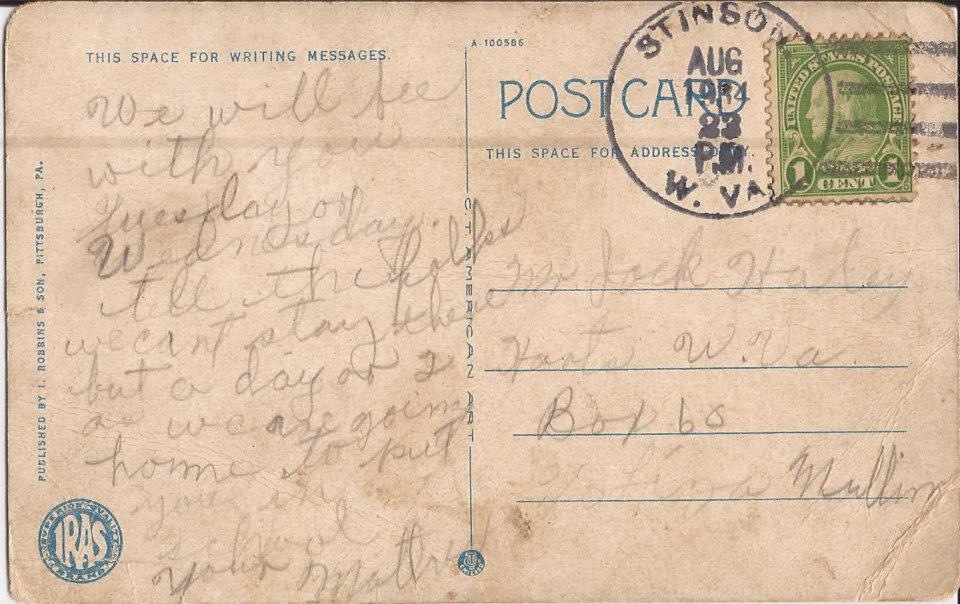
Postcard from Ella Haley to Jack Haley, 1934

Postcard from Ella Haley to Jack Haley, August 1934

In Search of Ed Haley 114

21 Tuesday May 2013

Posted by Brandon Ray Kirk in Ed Haley

≈ 3 Comments

Tags

Barney Carter, Ed Haley, genealogy, Harts Creek, history, Jackson Mullins, Jane Mullins, Kentucky, Mathias Elkins, Peter Mullins, Pike County, Solomon Mullins, West Virginia

Ed Haley’s roots, at least on his mother’s side, originated in the high mountains of Appalachia somewhere in that wild section of country situated along the Virginia-Kentucky state line. Peter Mullins, Haley’s great-grandfather, was born around 1804 in Kentucky or, according to one source, in North Carolina. The son of a notorious counterfeiter, “Money Makin’ Sol” Mullins, and reported descendant of those mysterious people the Melungions, Peter chose for his wife Jane Mullins, a first cousin. Between 1830 and 1858, he and his wife had at least eleven children. The sixth child, Andrew Jackson Mullins, was Ed Haley’s grandfather. Peter and his wife initially lived in Pike County, Kentucky, near Clintwood, Virginia. Based on census records, the family remained in Kentucky throughout the 1830s. Family tradition, however, states that Peter relocated to Marion County, Tennessee, due to his involvement in a counterfeiting operation. Around 1841-42, he traveled north to Upper Hart in what was then Logan County, Virginia, and settled near a sister, Dicy Adams. In 1842, he bought 25 acres of land from Abijah Workman and Mekin Vance on Hoover Fork. Deed records indicate that he operated a mill on Hoover. Two years later, he acquired 50 acres on the “first lower branch” of Trace Fork.

There are no stories chronicling Peter’s life on Harts Creek, nor any photographs to reveal anything about his physical features. All we have are census records and deed records — somewhat dry but noteworthy. In the 1850 Logan County Census, he was 46 years old and had 200 dollars worth of real estate. Three years later, in 1853, he bought 40 acres of land on Hoover from John and Sarah Workman and 37 additional acres on Trace. That same year, he sold a 35-acre tract (that included a “mill built by Mullins”) and a 25-acre tract on Hoover to son-in-law Barney Carter for 400 dollars. In 1854 he bought 30 acres on the Gunnel Branch of Trace Fork and another 1/4 acre on Hoover from Carter. On this latter property, he acquired a mill and dam, referenced in the deed. Three years later, he purchased three tracts of land totaling 97 acres on Trace. In 1858 he sold land on Hoover to son-in-law Mathias Elkins for 400 dollars. The next year, he sold a small acreage on Hoover to Carter for 100 dollars. In 1860, Peter appeared in Logan County Census records as 54 years old with 1,500 dollars worth of real estate and 2,000 dollars worth of personal property. In 1869, he bought 29 acres from Elkins for 100 dollars located “10 poles above the Alfred Tombline House” on Harts Creek.

In 1870, 63-year-old Peter Mullins appeared in the Logan County Census with his wife Jane and four of their children. Within in the next few years, Jane Mullins died. In 1874, Peter remarried to the much-younger Elizabeth (Johnson) Bryant and settled on Buck Fork. That same year, he sold a tract on the Bills Branch of Trace to son-in-law William Jonas, then bought 50 acres of land on Harts Creek above Lick Branch from Carter the following year. The 1880 Logan County Census listed him as a 68-year-old farmer; his wife Elizabeth was aged 40. That same year, he sold 80 acres on Trace to son Jackson Mullins — Ed Haley’s grandfather — who simultaneously sold him 50 acres of land on Buck Fork for 600 dollars. In 1882, he bought surface rights to a 100-acre tract and a 30-acre tract on Buck Fork and a 25-acre tract on Trace. Thereafter, in 1883, he sold 35 acres to son Solomon Mullins on Buck Fork for 250 dollars and 20 acres to Mary D. Mullins on Trace Fork for 100 dollars. In 1886, he sold 30 acres to Dicy Blair on Buck Fork.

Peter died around 1888 and was buried on Buck Fork under a large stone slab. In March of 1889, just a few months before the outbreak of the Haley-McCoy trouble, his heirs sold 20 more acres of his property on Buck Fork to Dicy Blair.

Harts Creek Banjo Player (1940s)

19 Sunday May 2013

Posted by Brandon Ray Kirk in Music

≈ Leave a comment

Tags

Appalachia, banjo, Cush Adams, Harts Creek, history, Logan County, music, photos, U.S. South, West Virginia

Shermie Baisden with banjo

Baisden family members, Trace Fork of Big Harts Creek, Logan County, West Virginia, 1940s.

← Older posts
Newer posts →

Feud Poll 1

If you had lived in the Harts Creek community during the 1880s, to which faction of feudists might you have given your loyalty?

Categories

  • Adkins Mill
  • African American History
  • American Revolutionary War
  • Ashland
  • Atenville
  • Banco
  • Barboursville
  • Battle of Blair Mountain
  • Beech Creek
  • Big Creek
  • Big Harts Creek
  • Big Sandy Valley
  • Big Ugly Creek
  • Boone County
  • Breeden
  • Calhoun County
  • Cemeteries
  • Chapmanville
  • Civil War
  • Clay County
  • Clothier
  • Coal
  • Cove Gap
  • Crawley Creek
  • Culture of Honor
  • Dingess
  • Dollie
  • Dunlow
  • East Lynn
  • Ed Haley
  • Eden Park
  • Enslow
  • Estep
  • Ethel
  • Ferrellsburg
  • Fourteen
  • French-Eversole Feud
  • Gilbert
  • Giles County
  • Gill
  • Green Shoal
  • Guyandotte River
  • Halcyon
  • Hamlin
  • Harts
  • Hatfield-McCoy Feud
  • Holden
  • Hungarian-American History
  • Huntington
  • Inez
  • Irish-Americans
  • Italian American History
  • Jamboree
  • Jewish History
  • John Hartford
  • Kermit
  • Kiahsville
  • Kitchen
  • Leet
  • Lincoln County Feud
  • Little Harts Creek
  • Logan
  • Man
  • Matewan
  • Meador
  • Midkiff
  • Monroe County
  • Montgomery County
  • Music
  • Native American History
  • Peach Creek
  • Pearl Adkins Diary
  • Pecks Mill
  • Peter Creek
  • Pikeville
  • Pilgrim
  • Poetry
  • Queens Ridge
  • Ranger
  • Rector
  • Roane County
  • Rowan County Feud
  • Salt Rock
  • Sand Creek
  • Shively
  • Spears
  • Sports
  • Spottswood
  • Spurlockville
  • Stiltner
  • Stone Branch
  • Tazewell County
  • Timber
  • Tom Dula
  • Toney
  • Turner-Howard Feud
  • Twelve Pole Creek
  • Uncategorized
  • Warren
  • Wayne
  • West Hamlin
  • Wewanta
  • Wharncliffe
  • Whirlwind
  • Williamson
  • Women's History
  • World War I
  • Wyoming County
  • Yantus

Feud Poll 2

Do you think Milt Haley and Green McCoy committed the ambush on Al and Hollene Brumfield in 1889?

Blogroll

  • Ancestry.com
  • Ashland (KY) Daily Independent News Article
  • Author FB page
  • Beckley (WV) Register-Herald News Article
  • Big Sandy News (KY) News Article
  • Blood in West Virginia FB
  • Blood in West Virginia order
  • Chapters TV Program
  • Facebook
  • Ghosts of Guyan
  • Herald-Dispatch News Article 1
  • Herald-Dispatch News Article 2
  • In Search of Ed Haley
  • Instagram
  • Lincoln (WV) Journal News Article
  • Lincoln (WV) Journal Thumbs Up
  • Lincoln County
  • Lincoln County Feud
  • Lincoln County Feud Lecture
  • LinkedIn
  • Logan (WV) Banner News Article
  • Lunch With Books
  • Our Overmountain Men: The Revolutionary War in Western Virginia (1775-1783)
  • Pinterest
  • Scarborough Society's Art and Lecture Series
  • Smithsonian Article
  • Spirit of Jefferson News Article
  • The Friendly Neighbor Radio Show 1
  • The Friendly Neighbor Radio Show 2
  • The Friendly Neighbor Radio Show 3
  • The Friendly Neighbor Radio Show 4
  • The New Yorker
  • The State Journal's 55 Good Things About WV
  • tumblr.
  • Twitter
  • Website
  • Weirton (WV) Daily Times Article
  • Wheeling (WV) Intelligencer News Article 1
  • Wheeling (WV) Intelligencer News Article 2
  • WOWK TV
  • Writers Can Read Open Mic Night

Feud Poll 3

Who do you think organized the ambush of Al and Hollene Brumfield in 1889?

Recent Posts

  • Logan County Jail in Logan, WV
  • Absentee Landowners of Magnolia District (1890, 1892, 1894)
  • Charles Spurlock Survey at Fourteen Mile Creek, Lincoln County, WV (1815)

Ed Haley Poll 1

What do you think caused Ed Haley to lose his sight when he was three years old?

Top Posts & Pages

  • Tom Dula: Trial and Hanging in Statesville, NC (2020)
  • Logan County Jail in Logan, WV
  • Civil War Gold Coins Hidden Near Chapmanville, WV
  • Levisa Hatfield (1927-1929)
  • Confederate Reunions in Logan County, WV (1911-1914)

Copyright

© Brandon Ray Kirk and brandonraykirk.wordpress.com, 1987-2023. Unauthorized use and/or duplication of this material without express and written permission from this blog’s author and/or owner is strictly prohibited. Excerpts and links may be used, provided that full and clear credit is given to Brandon Ray Kirk and brandonraykirk.wordpress.com with appropriate and specific direction to the original content.

Archives

  • February 2025
  • January 2025
  • October 2023
  • September 2023
  • December 2022
  • November 2022
  • May 2022
  • April 2022
  • February 2022
  • November 2021
  • October 2021
  • September 2021
  • June 2021
  • May 2021
  • April 2021
  • March 2021
  • February 2021
  • January 2021
  • December 2020
  • November 2020
  • October 2020
  • July 2020
  • June 2020
  • May 2020
  • April 2020
  • March 2020
  • February 2020
  • January 2020
  • December 2019
  • November 2019
  • October 2019
  • September 2019
  • August 2019
  • July 2019
  • June 2019
  • May 2019
  • April 2019
  • March 2019
  • February 2019
  • January 2019
  • December 2018
  • November 2018
  • October 2018
  • September 2018
  • August 2018
  • July 2018
  • June 2018
  • May 2018
  • April 2018
  • March 2018
  • February 2018
  • January 2018
  • December 2017
  • November 2017
  • October 2017
  • September 2017
  • August 2017
  • July 2017
  • June 2017
  • May 2017
  • April 2017
  • March 2017
  • February 2017
  • January 2017
  • December 2016
  • November 2016
  • October 2016
  • September 2016
  • August 2016
  • July 2016
  • June 2016
  • May 2016
  • April 2016
  • March 2016
  • February 2016
  • January 2016
  • December 2015
  • November 2015
  • October 2015
  • September 2015
  • August 2015
  • July 2015
  • June 2015
  • May 2015
  • April 2015
  • March 2015
  • February 2015
  • January 2015
  • December 2014
  • October 2014
  • September 2014
  • August 2014
  • July 2014
  • June 2014
  • May 2014
  • April 2014
  • March 2014
  • February 2014
  • January 2014
  • December 2013
  • November 2013
  • October 2013
  • September 2013
  • August 2013
  • July 2013
  • June 2013
  • May 2013
  • April 2013
  • March 2013
  • February 2013
  • January 2013
  • December 2012
  • November 2012

Enter your email address to follow this blog and receive notifications of new posts by email.

Join 2,927 other subscribers

Tags

Appalachia Ashland Big Creek Big Ugly Creek Blood in West Virginia Brandon Kirk Cabell County cemeteries Chapmanville Charleston civil war coal Confederate Army crime culture Ed Haley Ella Haley Ferrellsburg feud fiddler fiddling genealogy Green McCoy Guyandotte River Harts Harts Creek Hatfield-McCoy Feud history Huntington John Hartford Kentucky Lawrence Haley life Lincoln County Lincoln County Feud Logan Logan Banner Logan County Milt Haley Mingo County music Ohio photos timbering U.S. South Virginia Wayne County West Virginia Whirlwind writing

Blogs I Follow

  • OtterTales
  • Our Appalachia: A Blog Created by Students of Brandon Kirk
  • Piedmont Trails
  • Truman Capote
  • Appalachian Diaspora

BLOOD IN WEST VIRGINIA is now available for order at Amazon!

Blog at WordPress.com.

OtterTales

Writings from my travels and experiences. High and fine literature is wine, and mine is only water; but everybody likes water. Mark Twain

Our Appalachia: A Blog Created by Students of Brandon Kirk

This site is dedicated to the collection, preservation, and promotion of history and culture in Appalachia.

Piedmont Trails

Genealogy and History in North Carolina and Beyond

Truman Capote

A site about one of the most beautiful, interesting, tallented, outrageous and colorful personalities of the 20th Century

Appalachian Diaspora

  • Subscribe Subscribed
    • Brandon Ray Kirk
    • Join 789 other subscribers
    • Already have a WordPress.com account? Log in now.
    • Brandon Ray Kirk
    • Subscribe Subscribed
    • Sign up
    • Log in
    • Report this content
    • View site in Reader
    • Manage subscriptions
    • Collapse this bar
 

Loading Comments...