Tags
Appalachia, culture, genealogy, Harts Creek, history, life, Logan County, Peter Mullins, photos, West Virginia

Peter Mullins with unknown woman, circa 1890s

05 Wednesday Feb 2014
Posted in Big Harts Creek, Ed Haley
Tags
Appalachia, culture, genealogy, Harts Creek, history, life, Logan County, Peter Mullins, photos, West Virginia
Peter Mullins with unknown woman, circa 1890s
05 Wednesday Feb 2014
Posted in Big Harts Creek, Ed Haley, Whirlwind
Tags
Callohill McCloud, Ed Haley, Frank Adams, George Adams, Grover Adams, Harts Creek, history, J.P. Douglas, Lincoln Republican, Lindsey Blair, moonshining, Perris Hensley, Peter Jonas, Peter Mullins, Reece Dalton, Sol Adams, Sol Riddell, W.J. Bachtel, West Virginia, Whirlwind, William Farley, William Tomblin, writing
In that same year, 1912, according to a state business directory, there were a variety of folks with business interests in Whirlwind, West Virginia. Sol Riddell was the postmaster, a lawyer, and part owner of a general store named Mullins & Riddell. Peter Mullins was a carpenter, D. Adams was an apiarist, Grover Adams dealt in ginseng, Sol Adams was a miller and lumber dealer, W.J. Bachtel was a teacher, Reece Dalton dealt in livestock and M. Tomblin was a teamster. Reverend Perris Hensley and Reverend William Tomblin were area preachers.
Between 1916-1918, roughly the time Ed Haley left Harts Creek for Ashland, Kentucky, many of these same folks were listed in business directories for Whirlwind. James Mullins was postmaster in 1916, as well as the local general store operator and photographer. William Farley was a mail dealer. In 1918, Frank Adams was a mail carrier. Sol Adams operated a saw mill. Lindsey Blair was a watchmaker. Callahill McCloud dealt in poultry. C.M. Mullins dealt in ginseng. J.M. Mullins operated a flour mill.
By that time, Peter Mullins served as a sort of surrogate father to Ed Haley. It was Uncle Peter who had given Ed a cornstalk fiddle when he was a young boy and who kept him for years. As Ed became a young man who frequently left Harts with his music, Uncle Peter toiled on Trace Fork as a farmer and occasional timberman. He was perhaps best known for his moonshining, an art form with a long history in his pedigree. In January of 1919, he appeared in The Lincoln Republican in an article titled “Four Moonshiners Caught in Raid.”
A constable and owner of a general store was one of the four men arrested Saturday night in Harts Creek district and taken to Huntington Sunday for arraignment before United States Commissioner J.P. Douglas on a charge of illegally manufacturing liquor. The men were found on Trace Fork of Harts creek.
Peter Mullins is the constable and owns a general store on Harts creek. He is known as ‘Shooting Pete’ and is now in the Cabell county jail in default of bond. In his store were found 900 pounds of meal and 209 pounds of flour. Sol Adams, Peter Jonas and George Adams, the other three arrested, gave bond. All are held to the grand jury at the April term of federal court. At the home of Geo. Adams, were found 200 pounds of meal, 100 pounds of light brown sugar, 200 pounds of bran or ships stuff and one barrel of mash, made up, which Adams said was for his hogs. He had one hog, according to the men on the raid. The arrests were made on Saturday by G.C. Rutheford and Hartley Ferguson, deputy marshals; H.D. Sims and G.L. Hannan, of the internal revenue department; M.E. Ketchem, Frank Adkins and W.F. Porter of the state prohibition commissioner’s force.
27 Monday Jan 2014
Posted in Big Harts Creek, Ed Haley
Tags
Appalachia, culture, Ed Haley, Ewell Mullins, genealogy, Harts Creek, history, Logan County, photos, West Virginia
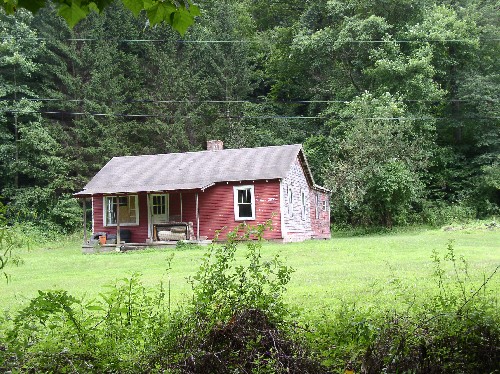
Ewell Mullins residence (part of the old Ed Haley property), Trace Fork of Harts Creek, Logan County, WV, 2006
24 Friday Jan 2014
Posted in Big Harts Creek, Culture of Honor, Harts, Lincoln County Feud, Timber
Tags
Al Brumfield, Appalachia, Brandon Kirk, crime, feud, Green McCoy, Harts Creek, history, logging, Milt Haley, Pelican Publishing Company, photos, timbering, true crime, West Virginia, writers, writing

In June of 2014, Pelican Publishing Company will release my book detailing the true story of the Lincoln County feud.
24 Friday Jan 2014
Posted in Ed Haley
Tags
Andrew D. Robinson, Ben Adams, Boney Lucas, Chloe Mullins, Ed Haley, Harts Creek, Henderson Dingess, history, Imogene Haley, Jackson Mullins, Logan County Banner, logging, McCloud & Company, Paris Brumfield, Peter Mullins, timbering, Turley Adams, Van Prince, Warren, Weddie Mullins, West Virginia, writing
Ed Haley was born in 1885 at Warren, a small post office established the previous year five miles up Harts Creek just below the mouth of Smoke House Fork. It was a place of 300 to 500 people chiefly led in its daily affairs by Henderson Dingess, Andrew Robinson, Anthony Adams, Ben Adams, and Burl Farley — all connected genealogically through the Adams family. At Warren, in 1884, the primary business was a general store called McCloud & Company. Henderson Dingess, father to Hollena and the patriarch of the clan, was a distiller and storekeeper. Ben Adams, a brother-in-law to Dingess, was a general store operator. Andrew Robinson was the local postmaster. Van Prince was a physician, perhaps assisting in Ed Haley’s birth or in the treatment of his measles.
Henderson Dingess, a prominent personality from that era, was the son of pioneer parents, born in 1829 to John and Chloe (Farley) Dingess. His wife, Sarah Adams (1833-1920), was a daughter of Joseph and Dicie (Mullins) Adams, who settled on Harts Creek from Floyd County, Kentucky, in the late 1830s. Henderson and Sarah lived in a two-story log house on land partly granted to him by the Commonwealth of Virginia in 1856. There, at the mouth of Hog Pen Branch, they raised eleven children, many of whom were active in the 1889 troubles. In the late 1880s, roughly the time of Milt Haley’s murder, Henderson and Sarah owned a 93-acre tract of land on Smoke House with a building valued at $100. They also owned an additional 350 acres on main Harts Creek and a 44-acre tract on nearby Crawley Creek worth $6.00 per acre with a $20 building on it.
At that time, Harts was caught up in the regional timber boom. According to The Logan County Banner, an estimated one million dollars worth of timber went out of the area in 1889. Perhaps prompted by this capitalistic invasion of the local economy, violence became the norm in Harts. Beginning with Paris Brumfield’s murder of Boney Lucas “over logs” in the early 1880s, there were at least six area killings before the turn of the century. (The Brumfields were involved in four of them and the Dingesses in three.) It was an era when Harts lost its innocence and began to earn the rough reputation it still carries today.
More than likely, following the horrific events of 1889, little Ed Haley and his mother lived for a brief time with Jackson and Chloe Mullins on Trace Fork. This changed a little later when, in 1891, Jackson and Chloe began to deed property to their three children. On March 18, they deeded their homestead to son Peter for 25 dollars. Deed records specify the property as a 20-acre tract of land, which began somewhere around the mouth of Trace and continued up to the Jackson Mullins Branch (basically the present-day Turley Adams property). The following day, Jackson and Chloe deeded another 20-acre tract to son Weddie Mullins for 25 dollars. This tract basically included everything from Jackson Mullins Branch to Jonas Branch.
On March 19, 1891, Jackson and Chloe deeded Imogene Haley 20 acres of land on Trace Fork for 25 dollars. In the property index, Imogene’s surname was spelled as “Hauley”, while the deed referred to her as “Immagin A. Haley.” Her land began at Jonas Branch and continued on up the creek. In the original deed, it was described as follows:
Beginning at the mouth of William Jonas branch thence up the Branch with the center of the branch to a _______ tree on the right hand side of the Branch as you go up the branch near a Chestnut that ________ on the left side of said branch thence acrosf the fields to some willow bushes at the front of the hill thence up the point with the center of the point to the brow of the Mountain thence with the brow of the Mountain to Mary Mullins line thence down the mountain to a bush thence a strate line crosfing the creek to a ash thence up the hill to the back line of the parties of the first part thence down the creek with the line of the said opposite the mouth of William Jonas branch thence down the hill a strate line to the Beginning supposed to contain 20 acres more or less.
An 1891 tax book listed “Emigene Hawley’s” property as being worth $2.00 per acre and having a total worth of $40. Records do not indicate if there was a house or building located on the property. In any case, Emma died soon after: an 1892 tax book lists her property under the name of “Immogen Hailey heirs”, which would have been Ed Haley. More than likely, seven-year-old Ed remained living in the home of his grandparents, Jackson and Chloe, for several more years.
At that time, Logan County was in the middle of a timber boom, which gave employment to Ed’s family on Trace Fork. “Some of the finest timber in the State is found in Logan county,” writes The Mountain State: A Description of the Natural Resources of West Virginia (1893). “Magnificent forests of oak, poplar, ash, lynn, maples, beech, birch, pines, hickory and other varieties still cover the greater part of the county in their primitive state. For thirty years timber men have been at work, destroying the forests and still in all this time not over a fourth of the timber has been removed. As an estimate of the value of the timber still standing in Logan county, three million dollars will not be far amise.”
17 Friday Jan 2014
Posted in Big Harts Creek, Lincoln County Feud
Tags
Appalachia, culture, Dave Dingess, feud, Harts Creek, history, life, Logan County, photos, West Virginia

Dave Dingess, resident of Smoke House Fork of Big Harts Creek, Logan County, WV, 1890s
16 Thursday Jan 2014
Posted in Big Harts Creek, Ed Haley
Tags
Alice Dingess, Andy Thompson, Bill Brumfield, Billy Adkins, blind, Bob Dingess, Ed Haley, Ella Haley, Ferrellsburg, fiddling, Harts, Harts Creek, history, John Hartford, Wash Farley, writing
Billy recommended that we visit Bob Dingess, a man of advanced age who was related to and personally remembered almost everyone in Ed’s story. His father was Dave Dingess, a younger brother to Hollena Brumfield, while his mother was a daughter to Anthony Adams. His first wife was a daughter to Charley Brumfield, while his current wife was Robert Martin’s niece. Bob was a close cousin to Bob Adkins and Joe Adams, as well as many of the Brumfields. He was a fine old man — a retired schoolteacher and elementary principal — who could probably tell us more about Harts Creek history than any one alive.
We drove to Bob’s small white house, which sat just below the mouth of Smoke House on Big Harts Creek, and knocked at his back door, where a nurse met us. She knew Billy and invited us inside, through the kitchen and into a dark stuffy living room. There, we met Bob and his wife. Bob was bundled up in a light black jacket, oblivious to the enormous August heat. A somewhat tall man, he had an alertness to his movements that was surprising and enviable. He was very friendly. We all sat down on couches to talk about Ed Haley. I was sure that Bob’s heater was running; in no time at all, my sinuses were ready to explode.
When Billy told him that we were interested in finding out about Ed Haley, he said, “You have to give me a little time on this. My memory jumps on me. I’m no spring chicken and I have to think.”
But it was obvious that his mind was sharp as a tack when he started telling about his memories of Ed.
“Now Ed Haley, he left here after so long,” Bob said. “He went to Kentucky and he married there. He had a blind woman and she played the mandolin and he played the violin and they had a lot of the meanest boys you ever saw. I first saw him in 1918, during the First World War. Well on Saturday I’d go to Ferrellsburg to haul groceries. That’s the only way to get them. No bridge at Hart. And bless your heart, here that man and them four children come off’n that train, and that old woman, and I got a wagon load of groceries and set them on it and them boys fought and that old man he just slapped and knocked and kicked among them. And the old man, he wouldn’t tell them nothing — he was blind — and she couldn’t tell them nothing, either. And I finally got them up here at the house, and when I got them there Mom made me unload the wagon and says, ‘Get ’em away from here.’ And we took them up yonder to old man John Adams’ then, and let them go. They stayed a month up there.”
I asked how Ed dressed.
“Well, he was all right now, boys,” Bob said. “Don’t worry about him. He took care of everything. He’d laugh and talk, too. You’d think he could see. After you’d get him located and get him in the house, you know, he could get up and walk about through the house.”
Bob didn’t think Ed was the best fiddler he ever heard.
“Nah,” he said. “He couldn’t play this fancy music like Bill Monroe and them played. The old-time fiddle, he was good…old-time music. ‘Comin’ Around the Mountain’. He had a dozen songs.”
Bob said Ed used to play at the old pie suppers on Harts Creek.
“See, I was born in ’04, and I went to these frolics where they had pie suppers and socials and all these gals gathered and these men,” he said. “About every weekend the girls’d go to one home and they’d kill chickens and bake cakes and bake pies and everything and they’d auctioneer them off. If you had a pretty girl, buddy you’d better have a little pocketbook because somebody’s gonna eat with her and knock you out. Mother always give me a little money and I’d just pick me out one and get her. Yeah, planned all week, the girls would. We did that once a week unless they was some special occasion. We’d start at Bill Brumfield’s down yonder. From Bill’s, we’d come to Andy Thompson’s, come from Andy Thompson we went to Rockhouse to Uncle Wash Farley’s. Uncle Sol over here, he wouldn’t let them have it but just once in a while. Mom would let them have it about every three or four months up here. But on up the hollow up yonder it was a regular thing. Them days is gone, though. You couldn’t have that now. No fighting, no quarreling, everybody got along happy.”
I wanted to know more about Ed.
“Ed Haley, here’s what they’d do,” Bob said. “They’d put him and her on a mule and he’d be in front and she’d ride astraddle behind and hold him. And somebody else’d have to carry their musical instruments, see? And when they got them up there then they had to lead them and get them in the house and get them located. And somebody’d slip around and give him a big shot of liquor and her and they’d say, ‘All right, old-man, let ‘er go.’ ‘Big Rock Candy Mountain’, boy here she’d go. He’d sing it. He was a good singer. And his old woman, she didn’t look like she was very much, but she was a singer. She was a little woman, blind. But she’d sing right with him. Yeah, ‘Turkey in the Straw’. Ah, that ‘Grapevine twist,’ man, ‘circle eight and all get straight.’ Ah man, them girls had them old rubber-heeled shoes and they’d pop that floor. It was an all-night affair. He’d play a while, then he’d rest a while, then he’d start again. Along about midnight, they’d drink that liquor in them half a gallon jugs. You know, I was a boy and I wasn’t allowed to drink too much but now them old-timers they would drink that liquor. ‘Bout one o’clock, she’d start again, and when the chickens was a crowing and daylight was coming still they were on the floor. They would lay all day and sleep.”
15 Wednesday Jan 2014
Posted in Big Harts Creek, Ed Haley, Whirlwind
Tags
Billy Adkins, Creed Conley, Ed Haley, fiddling, Harts Creek, history, John Hartford, Logan, Minnie Smith, Sherman Smith, Sol Adams, West Virginia, Whirlwind, writing
After lunch, Billy suggested that we go see Sherman and Minnie Smith, who lived a little further up the creek at the old Whirlwind Post Office. Minnie was the granddaughter of Solomon Adams and a great-granddaughter to Anthony Adams. Her father was a nephew to Melvin Kirk, who helped bury Milt and Green.
We soon pulled up to an incredible two-story log home with a remodeled front. We first spoke with Minnie’s husband Sherman who was busy dismantling a chimney labeled “S.A. 1875.” Minnie came out of the house, recognized Billy and started talking to us like we were neighbors. We raved over her log house for several minutes, which caused her to tell us how her grandfather Sol Adams had built it of yellow poplar in 1869. We later discovered that he was born in that year.
We gathered in chairs and sofas in a dimly lit living room with a low ceiling, while Sherman stood nearby in a doorway leading into the kitchen. We told them about my interest in Ed Haley, which caused Sherman to tell about seeing him in Logan when he was a boy. He said Ed was usually by himself but sometimes had a banjo-picker with him.
“Ed Haley used to play here when I was a girl,” Minnie said, adding that she was born in 1933. According to Minnie, Ed played for dances in the Workman home. Her parents would clear all of the furniture out of the living room and an adjacent room on Saturday. Ed came before the dance started and was fed properly, then as people started showing up he was “set up” on a stool in the doorway between the two cleared rooms. From there, he could entertain two rooms of people instead of just one. Minnie remembered him playing tunes like “Blind Man Stackolee” and “Fire on the Mountain”. Creed Conley was usually the caller and would have people dancing so wildly that they’d bump heads. Most were drunk. Minnie said someone passed a hat around for Ed’s pay toward the end of the dance.
14 Tuesday Jan 2014
Posted in Big Harts Creek, Ed Haley, Lincoln County Feud
Tags
Anthony Adams, Appalachia, culture, feud, genealogy, Harts Creek, history, life, Logan County, photos, West Virginia
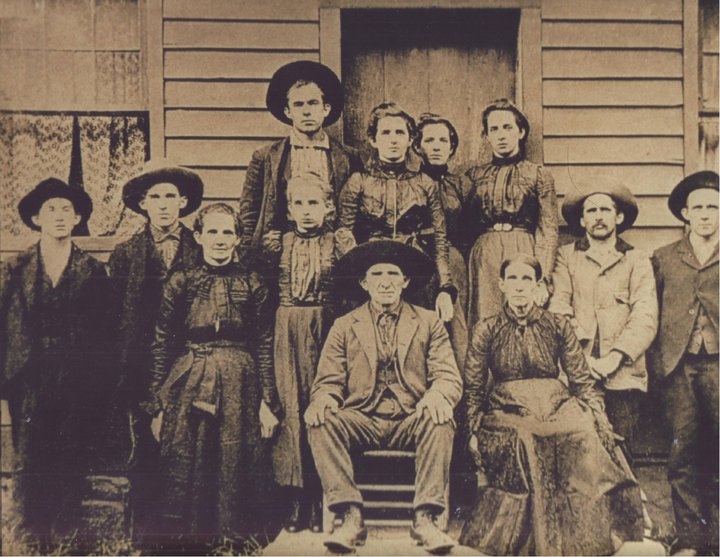
Anthony Adams family, Harts Creek, Logan County, West Virginia, 1890
14 Tuesday Jan 2014
Posted in Ed Haley
Tags
Al Brumfield, Alifair Adams, Anthony Adams, Ben Adams, Billy Adkins, Brandon Kirk, Ernest Adams, Ewell Mullins, George Mullins, Greasy George Adams, Harts Creek, history, Jay Queen, Joe Adams, John Hartford, Lewis Maynard, Mag Farley, Major Adams, Milt Haley, Mountaineer Missionary Baptist Church, Peter Mullins, rafting, writing
I asked Joe if he ever heard any stories about Milt being a fiddle player and he said, “They was having a square dance up there at Peter’s once and I heard them a talking about his father playing the fiddle but that was all. They never said what he played or how much or nothing about it. They just said he was a musician. I’ve heard talk of him but I didn’t know him personally. I know about the trouble they had up here. I heard them talking about that up at George Greasy’s. Said they followed them over yonder at Green Shoal or someplace somebody said and killed them. I heard my dad a talking about that.”
Brandon mentioned that Milt and Green had supposedly been hired by Ben Adams to kill Al Brumfield, which caused Joe to say, “Well, I don’t know whether it was Ben Adams or… Well, Al and Ben were both head strong, let’s put it that way. I don’t know what was wrong with the families back then, but they seemed like they wanted to fight each other. They didn’t want to fight no strangers. They was all fighting through each other all the time. They’d burn each other’s barn and shoot their mules and cows in the field and everything on earth. All of them first cousins. I said, ‘That don’t make no sense to me.’ But back then if somebody needed something, it didn’t matter how mean they were, people’d go help them. If somebody was sick, people’d go sit up with them.”
Talking about the old Adamses around Harts Creek caused Joe to reminisce about his grandparents, Solomon and Anthony Adams.
“Grandpaw Anthony was from Hazard, Kentucky. He cut timber and built splash dams through here. Them old Adamses — Anthony, Ben, Sol — they’d float logs down to Hart and raft them to Huntington. I heard them tell about them Robinsons down there helping them raft them. Grandpaw Anthony, he didn’t let nobody put nothing on him. Them old fellas, 90-percent of them carried a pistol all the time. Most of them had ten or twelve children. Grandpaw Anthony, he acquired that place in the Forks of Hoover and he traded that place in Hoover for this place out here. He built a little house right out here on thirty-five acres in 1908. He ran a store at one time, too. They sold riggings, shoes, groceries, plow stocks, shovels…
“I can’t remember my grandpaw Sol nor his wife Dicy nor my Grandpaw Anthony but I can remember my Grandmaw Alifair well. She was from Missouri. She’d stay a while with us and she’d go up George Mullins’ and stay a while and she’d go down to Aunt Alice’s and stay a while. All the women smoked them old stone pipes and they wore them big gingham aprons that had two big pockets on them and they carried their tobacco and pipe and stuff in their pocket. They always had these old-time fireplaces and she’d go out in the chip-yard where they made ties and stuff and she’d pick her up a bunch of splinters and she’d sit them up in the chimney corner to light her pipe with and you’d better not bother them either.”
Joe’s father was Major Adams (1885-1944), the youngest son of Anthony Adams. He was a hammer-style banjoist.
“My daddy had a .32 Smith & Wesson with a shoulder holster with red leather and he kept that a hanging on the head of the bed,” Joe said. “They had these old iron beds with big, high headboards and stuff on them. And he kept that a hanging on the head of the bed all the time fully loaded in the belt and we knowed better than to tip it. Now, you might hang something up like that and a child take it down and shoot your brains out with it.”
Joe said Trace Fork had changed quite a bit since his childhood days. In the thirties, Ewell Mullins, Ed’s first cousin, had a store on the creek, as did Ernest Adams and Joe Mullins and Lewis Maynard. At one time, there were four stores on the creek; today, there are none. In 1938, the same year that electricity arrived on Trace, the Mountaineer Missionary Baptist Church was constructed at the mouth of the creek. Now an impressive brick building, it was originally a 24′ X 20′ structure. Prior to its construction, people met at Anthony Adams’ store or at the lower Trace Fork School. Joe said he bought the creek’s first television set from Jay Queen’s Bluegrass Hardware in Chapmanville in 1955. The roads were paved on Trace about that time.
Joe said we might find out more about Ed from Ewell Mullins’ daughter, Mag Farley. Billy said she ran a store just up Harts Creek near a fire department and playground. We found Mag working behind the checkout counter. She was a granddaughter to Uncle Peter but didn’t look very much like him. She got a little excited when we showed her pictures of her family but became suspiciously quiet when we inquired about Emma Haley. All we could get out of her was that Ed’s mother never remarried after Milt’s death and died around Harts. Maybe that was so, but we felt there might be more to her story; Mag’s version was almost too dull. We gathered back toward a cooler where we talked and ate bologna sandwiches and potato chips.
13 Monday Jan 2014
Posted in Big Harts Creek, Ed Haley
Tags
Appalachia, culture, Great Depression, Harts Creek, history, life, Liza Mullins, Logan County, Peter Mullins, photos, West Virginia

Peter Mullins family, Trace Fork of Big Harts Creek, Logan County, WV, 1940s
11 Saturday Jan 2014
Posted in Ed Haley
Tags
Cary Mullins, Ed Belcher, Ed Haley, fiddle, fiddling, Harts Creek, history, Joe Adams, Logan County, music, Noah Mullins, West Virginia, writing
When I pressed Joe for specific details about Ed’s technique he said, “He’d play up on the bow about four or five inches, but he played the full stroke with the bow all the time. He didn’t jiggle it.”
I asked if he always sat down when he played and Joe said, “I’ve seen him sitting down and standing up both. They said he danced, but I never did see him dance none. He pat his foot when he played. You’d never hardly know he was patting it. He just patted one foot. He had that chin rest…”
“So Ed put the fiddle up under his chin?” I interrupted.
“He put it up under his chin and played,” Joe confirmed. “Ed Belcher, he played with it under his chin, too. Now Robert Martin, sometimes he’d have it under his chin, sometimes he’d have it down here on his chest.”
Brandon asked if Ed packed his fiddle in a case and Joe said, “Yeah, he had a case. If it was raining or something, I’ve seen him with it under his coat. He had two or three bows. I’ve seen him take the bow loose… He took the end of it loose and put it under the string and played some kind of a tune. They was just one tune he played like that. I believe it was some kind of a religious song. I don’t know how he done it.”
I asked Joe if Ed sang any and he said, “I heard him sing a little bit one or two times on one or two tunes. He’d play a verse and then he’d sing a little bit but not much. Seems to me like that his wife sung a little bit with him on some of them but they didn’t do too much singing. He’d play a little bit, then sing a little bit. They was just a few tunes that he done like that. He didn’t play none of this modern music or nothing like that. He played old-time tunes, like ‘The Arkansas Traveler’. He’d play that and some of them boys’d be sitting off someplace and talking about the big rock in the field and all about the feller digging the taters out and that old sow rooting them out. Ed would play the music and they’d put that in. They’re all dead now, them boys that used to do that. Noah Mullins and my brother Howard and Burl Mullins and Cary and them.”
Joe’s memories seemed to stretch back fondly to that time.
“Yeah, it was all right,” he said. “Every time I played with him he played ‘Lady of the Lake’. Real old tunes.”
Joe said Ed played “Love Somebody”, “Birdie”, “Brownlow’s Dream”, “Hell Up Coal Hollow”, “Hell Among the Yearlings”, “Wild Hog in the Red Brush”, and “Jenny’s Creek”. He also played “Mockingbird” with “everything in it.”
“He’d make the bird holler and everything else,” Joe said.
I asked Joe if Ed played a tune for a long time and he said, “Well, some of his tunes he played a long time and some of them were just short and sweet. He put a lot extra in them sometimes. It went along with it but if you didn’t know him pretty well and watch what you was doing you’d get off. It just come natural for me to follow him because he played good time.”
10 Friday Jan 2014
Posted in Ed Haley
Tags
Appalachia, Arthur Smith, banjo, Ed Belcher, Ed Haley, fiddlers, George Mullins, Geronie Adams, Grand Ole Opry, Harts Creek, history, Joe Adams, Johnny Hager, Logan County, music, Robert Martin, West Virginia, writing
I wondered if people around Trace listened to the radio, especially the Grand Ole Opry, in the early days.
“They was a few radios,” Joe said. “We had one here. We ordered it from a company called Jim Brown. It had five batteries. And like Jerry Clower said, you’d take them and set them in front of the fire and get them hot and then plug them in, they’d play. They was kindly hard to get — they didn’t cost much. I think they was about ten or twelve dollars for all of them. But Robert Martin had one on top of that hill and my brother had one on Twelve Pole, and on Saturday night when the Grand Ole Opry come on, it was a sight to watch these people a going. It come in good and clear. Robert learned a lot of Arthur Smith tunes off the radio. Yeah, Arthur Smith come down there at Branchland and stayed a week with him and I was talking to Robert after he left and he said, ‘I wish you boys’d come down.’ I said, ‘Well, if you’d a let us know, we woulda come.'”
Brandon said to Joe, “I remember you were telling me last time I talked to you that you thought Robert Martin was about the best around.”
Joe said, “In the modern music. Now, in the old-time music, you’d take Ed Haley and Johnny Hager and Ed Belcher. Ed Belcher, he stayed at George Mullins’ and he was like my brother: he was an all around musician. He could tune a piano and play it, he could play an organ. He could play anything he picked up. I never did hear him play a banjo but he could play anything on the fiddle or guitar. He’d note the guitar all the time. He played like these fellers play on Nashville. They was several people around here had banjos and played. Geronie Adams — Ticky George’s boy — he played a banjo a little bit. And they was a fella — Johnny Johnson — played with Robert Martin out on that hill. He was from someplace in Kentucky.”
I asked Joe what kind of banjo style Johnny Hager played.
“He played the old…,” he started. “They’s some of them calls it the ‘overhand’ and some of them call it just ‘plunking’ the banjo. They was several people played like that. Bob Dingess down here, he played that a way a little bit. My dad, he played the banjo and he played that.”
I asked Joe how Ed dressed in the early forties.
“Well, he wore dress pants most of the time,” he said. “He wore mostly colored shirts — blue or green or just any color. Work shirts. Most of the time he wore suspenders with them. And had buttons sewed on them to buttom them with. Buttons on the inside. Mostly he wore slippers. They was a lace-up slipper. Three laces. He could tie his shoes just as good as you could tie yorn. He wasn’t a big man — he was a little small man. About 5’4″, 5’5″.”
Brandon asked what Ed was like when he wasn’t playing and Joe said, “Well, he’d just sit around and talk and tell tales about first one thing and then another. They’d just talk about how hard they was raised and how they come up.”
Did the ladies like him?
Joe said, “They all liked him but they wasn’t girlfriends. If he went into a place to play, they’d all come around and hug him and talk to him.”
08 Wednesday Jan 2014
Posted in Ed Haley
Tags
Billy Adkins, crime, Ed Haley, fiddlers, fiddling, George Mullins, Harts Creek, history, Joe Adams, Johnny Hager, music, Peter Mullins, Robert Martin, Ticky George Adams, writing
The next day, Billy and Brandon suggested that we visit 70-year-old Joe Adams on Trace Fork. Joe had all the right genealogical connections to know about many of the major characters in Ed and Milt’s story. According to Billy’s records, both of Joe’s grandfathers were brothers to Ben Adams, a key player in the 1889 feud. Joe’s grandmother was a Mullins, while the other was a half-sister to Burl Farley. (Burl Farley of course was in the Brumfield mob and even “gave the order to shoot” Milt and Green, according to some sources.) Brandon reminded me that he had talked with Joe earlier in the summer and heard him speak about having played music with Ed in his younger days.
As we pulled up to Joe’s nice house at the mouth of Trace, he and his wife met us at the end of their driveway. Joe, I noticed right away, looked a lot like Kenny Baker and was dressed in work clothes, indicating that he was probably in the middle of some project (a garden, working under a truck hood…). When we got out of the car, Mrs. Adams laughed and jokingly said, “Billy, is that you? What are you a doing up here?” Billy told them who I was and the reason for our visit and Joe basically said, “Well, come up to the porch and I’ll tell you boys all I can.” We gathered in chairs and swings under Joe’s carport where the conversation just took off. Joe was born in 1925.
I asked Joe when he first played with Ed and he said, “I’d say that was around ’40 up to ’43. It was before I went in the Army. We was down there at old man Peter Mullins’ — just out in the yard up there. They had a big old porch and they had a bunch of seats out under a bunch of big apple trees and stuff. Big shade. Had a swing out there. And I said, ‘How about bringing your fiddle out and playing a few tunes?’ And he told one of them boys — I forgot which one it was — said, ‘Go in there and bring my fiddle out here.’ He didn’t have it in a case that day but they brought it out and he played ‘Red Wing’ and he played ‘Soldiers Joy’ and he played ‘The Arkansas Traveler’ and he said, ‘Well, I’m tired now,’ and he just laid the fiddle down and we just quit. Sat around and talked a few minutes. He had some of them boys take it back and put it back in the house when he got through playing it. He took good care of his fiddle.”
“Now after I come out of the Army in ’46 and it seems to me like I seen Ed once after that and he left here and I never did see him anymore,” Joe said.
Brandon asked Joe where he remembered Ed staying on Harts Creek.
“I remember him staying up there with old man Peter and Liza and he stayed there off and on for years,” he said. “His wife and some of the children were there. Aunt Rosie married George Mullins on Buck Fork — he stayed up there a lot, too. Johnny Hager stayed with Ticky George Adams — old man George and Vic — that lived up in that holler up here at this store. Greasy George lived across the creek. And old man Ed, he’d go up there.”
What about Johnny Hager?
“Johnny Hager, he played a fiddle, too,” Joe said. “He didn’t play much. Just once in a while maybe he’d pick it up and play one tune. I had an older brother that’s dead, Howard — he played with them a lot. He played a fiddle, a guitar, mandolin, accordion, anything. He played anything he picked up. And we played around here for years.”
Joe said, “I played with a man lived right up in the head of this creek — I don’t know whether you ever heard tell of him — Robert Martin. He lived on top of the hill back there. Him and John Martin was the only two houses back there. He was a good fiddler. Robert played like ‘Lady of the Lake’ and ‘Blackberry Blossom’ and ‘Sugar Tree Stomp’. He had one he said he made it hisself and he made it for old man Will Farley — he called ‘Possom Creek’.”
Robert Martin left Harts, Joe said, after his brother John was murdered at Big Branch.
“You may have heard something about that,” he elaborated. “When they got in that trouble and his brother got killed down here at Big Branch they claimed that Robert cut him, but I don’t think so. I think it was somebody else. And he moved down here at Branchland and me and my brother’d go down there and play with him. He lived on that riverbank and he’d come out there and play with the fiddle till the bow got plum wet and he’d take it in and hang it up and go get another one. We played lots of times till three or four o’clock in the morning with him and then we’d come back to the house.”
12 Thursday Dec 2013
Posted in Big Harts Creek
Tags
Appalachia, culture, Great Depression, Harts Creek, history, life, Logan County, photos, West Virginia

Children of Upper Hart during the Great Depression, Logan County, West Virginia.
07 Saturday Dec 2013
Posted in Ed Haley, Hatfield-McCoy Feud, Lincoln County Feud
Tags
Al Brumfield, crime, Enoch Baker, George Fry, Green McCoy, Green Shoal, Harts Creek, Hatfield-McCoy Feud, history, Hollene Brumfield, Logan County Banner, Milt Haley, writing
On November 7, 1889, The Banner printed a Huntington story titled “Two More Victims To the Endless Hatfield-McCoy Feud/Prisoners Belonging to the Latter Faction Lynched.” This article was extremely difficult to read — some of its words were completely gone, which probably didn’t really matter since it was so error-ridden.
HUNTINGTON, W.VA., October 25 — Information was brought [here from] Hamlin, Lincoln County, that about midnight Friday, a mob surrounded the Lincoln County jail, took two of the prisoners, Green McCoy and Milton Haley, and hung them to a tree a short distance from the [jail]. Haley and McCoy are natives of Kentucky and are allied to the McCoy faction of outlaws [feuding] with the Hatfields generally familiar by the public. McCoy was engaged in a shooting scrape with Paris Brumfield about a year ago and about a month ago he, in company with Haley, ambushed and attempted to murder Brumfield and his wife. The shooting occurred on a Sunday and both victims [were] badly wounded, Mrs. Brumfield being shot in the breast and her husband in the leg. For a time it was thought the woman would die but she recovered. McCoy and Haley escaped to Hunto, Kentucky, [but] not before they made two more attempts at assassination in the county, in ____ of _____ man named Adkins was wounded. The would be murderers were arrested at Ben Postoffice, Martin county, Kentucky, and were confined in jail there. Friday they were locked up in Lincoln county (W.Va.) Jail, and in the absence of definite information it is supposed they were lynched by some of the Hatfield sympathizers.
It wasn’t clear if the Adkins who supposedly wounded in the above account was closely related to Cain Adkins or Fed Adkins. The place names given were also questionable, since Brandon couldn’t locate Hunto or Ben Post Office in any Kentucky map books.
The Huntington story apparently had little credibility since The Banner followed it with corrections:
The above is copied from the Enquirer, and is about as reliable as you find most reports about the Hatfield-McCoy feud. In the first place, the prisoners Haley and McCoy were not in jail.
Secondly. — No mob ever surrounded the jail, they went into Geo. Fry’s house and took them out without any resistance from the guards.
Thirdly. — They were not hung to a tree a short distance from the jail building, but were shot at Green Shoals some 25 miles from the C.H.
Fourthly. — Haley has no connection whatsoever with the McCoys of Kentucky.
Fifthly. — Mrs. Brumfield was not shot in the breast but in the face, and her husband was not shot in the leg but in one arm.
Sixthly. — McCoy and Haley never wounded Adkins, or even shot at him.
Seventhly. — Neither the Hatfields nor the Hatfield sympathizers had anything to do with the _____ing of McCoy and Haley.
It was done by the citizens of Lincoln who sympathized with the Brumfields and Dingess and by men who do not believe in the assassination of women by way laying and shooting them as they peacefully ride along the bank.
The Hatfield-McCoy feud had nothing whatever to do with the trouble, and from present appearances it is about over. Reports that some forty men _____ are armed and preparing for battle is without foundation.
For the next month, The Banner was silent about the Haley-McCoy trouble. Then, on December 12th, it gave this brief update: “Enoch Baker, of Harts Creek, was in town Monday, and reports every thing quiet, but thinks the Brumfield-McCoy feud is liable at any time to break out afresh.”
02 Monday Dec 2013
Posted in Ed Haley
Tags
Al Brumfield, Brandon Kirk, Cecil L. Hudgins, George Fry, Green McCoy, Harts Creek, Henderson Dingess, John W Runyon, Logan County Banner, Milt Haley, V R Moss, William C. Fry, writing
Toward the end of June 1995 Brandon made a trip to the Cultural Center in Charleston, West Virginia, where he spent several hours researching the story of Milt Haley’s murder using old microfilmed copies of the Logan County Banner. By examining the articles chronologically, a new perspective on the 1889 trouble emerged: the “official news accounts of the day” vs. oral tradition.
On page three of a Thursday, September 26, 1889, edition of the Banner was an article titled “Serious Shooting on Hart’s Creek, In Lincoln County” which detailed the ambush at Thompson Branch:
On last Sunday, while Mr. Allen Brumfield and his wife, who live near the mouth of Hart’s creek, in Lincoln county, were returning home from a visit to Mr. Henderson Dingess, father-in-law of Mr. Brumfield, and when about a mile and a half below Mr. Dingess, they were fired upon by some parties in ambush. Mrs. Brumfield was serious if not fatally wounded, the ball entering her right jaw near the ear and coming out near the nose, carrying away the greatest portion of the right jaw. Mr. Brumfield was shot through the right arm and another ball passed through his vest, grazing his breast. A son of Mr. Dingess, who was with them, was shot through the leg. Dr. C.L. Hudgins of this place, and Dr. V.R. Moss, of Barboursville, were sent for and Dr. Hudgins dressed the wound on Monday. We have not learned the names of the parties who were suspected of the shooting, but learn that they are being hunted for, and if found will be properly punished.
The Banner mentioned on its Thursday, October 10, 1889, society page: “John W. Runyon, of Harts Creek, and W.C. Fry, of Guyandotte, were in town Tuesday on business.” W.C. Fry was William Christian Fry, a brother to George Fry, at whose home the Haley-McCoy murders took place a few weeks later. We wondered, were he and Runyon in town together on business? And did their simultaneous trip to Logan have anything to do with George Fry’s home later being selected as the “murder house?”
The Banner first reported Milt Haley’s death in an article dated Thursday, October 31, 1889, and titled “MORE MURDERING/Two Prisoners Taken from their Guards and Shot to Pieces:”
On Thursday of last week, Green McCoy and Milton Haley, the parties charged with the shooting of Allen Brumfield and his wife, on Harts creek in Lincoln county a short time ago were [held by a group of] citizens under charge of Al Brumfield. They were brought to Chapmanville in this county and wished to remain there over night, but fearing that an effort would be made to [kill] the prisoners, citizens there would not take them in. The guards, with the prisoners under their charge, then started down the river, a portion of the guard crossing to the opposite, leaving but the officer and three guards in charge of the prisoners. About six miles below Chapmanville, the guards and prisoners stopped at George Fry’s, at Mouth of Green Shoals in Lincoln county to stay all night. About 8 o’clock a number of persons supposed to be about twenty, came to Fry’s house, and demanded the prisoners. Mr. Fry and family were told to go into the kitchen and the guard to leave the house. The mob then entered the house and began shooting. The prisoners were dragged out of the house and shot down in the yard in front of the door. Not being satisfied with putting several balls through each of the men the mob took rocks and mashed their heads all to pieces. After finishing their murderous work the crowd dispersed, leaving the neighbors to look after the dead bodies.
No effort has been made to arrest any who were engaged in the outrage, yet it is pretty generally understood who were the leaders of the gang.
More than likely, the portion of the guard “which crossed the river and left the main group,” if true, went to alert Brumfield’s friends as to where the prisoners would be held that night.
29 Friday Nov 2013
Posted in Big Harts Creek, Ed Haley, Lincoln County Feud, Timber
Tags
Al Brumfield, Allen Martin, Andrew D. Robinson, Andrew Robinson, Anthony Adams, Appalachia, Ben Adams, Ben Robinson, Boardtree Branch, Chloe Gore, Chloe Mullins, crime, David Robinson, Dicy Adams, Elizabeth Abbott, genealogy, general store, Greasy George Adams, Green McCoy, Harts Creek, Harvey Adams, Henderson Dingess, history, Hollena Brumfield, Hugh Dingess, Jackson Mullins, John Frock Adams, John M. Adams, John Robinson, Joseph Adams, Joseph Robinson, Lincoln County Feud, Logan County, Logan County Banner, Lucinda Brumfield, May Adams, Meekin Branch, Milt Haley, Peter Carter, Rhoda Robinson, Sallie Dingess, Solomon Adams, Spicie McCoy, Susan Abbott, Ticky George Adams, timber, Trace Fork, Victoria Dingess, Viola Dingess, West Virginia, Wilson Abbott
Ben Adams — the man who supposedly hired Milt Haley and Green McCoy to assassinate Al Brumfield — was born in 1855 to Joseph and Dicy (Mullins) Adams on Big Harts Creek in Logan County, (West) Virginia. His older sister Sarah married Henderson Dingess and was the mother of Hollena Brumfield, Hugh Dingess and several others. He was a first cousin to Jackson Mullins, Milt Haley’s father-in-law, and a brother-in-law to Chloe Mullins, Milt’s mother-in-law, by her first marriage to John Adams.
In 1870, 17-year-old Ben lived at home with his mother, where he worked as a farmer. He was illiterate, according to census records. His neighbors were Andrew Robinson and Henderson Dingess, both of whom had married his sisters (Rhoda J. and Sally). In the next year, according to tradition, he fathered an illegitimate child, William Adams, who was born to Lucinda Brumfield (niece of Paris).
In 1873, Ben married Victoria Dingess. Victoria was born in 1856 and was a first cousin to Hollena Brumfield and Hugh Dingess. The marriage made for an interesting genealogical connection: Ben was already Hugh’s uncle; now he was also his brother-in-law, as Hugh was married to Victoria’s sister, Viola (his first cousin). Ben’s daughter Sally, who was named after Hollena’s mother, later married a cousin of Spicie McCoy, Green’s wife. For all practical purposes then, Ben Adams was genealogically connected to all sides of the feud — making it a true intra-family feud from his perspective.
For the first decade or so of his marriage, Ben lived with his mother on family property, although he did acquire land and open a general store business. In 1880, he was listed in the Lincoln County Census with his mother Dicy, aged 63, and family. He was 26 years old, Victory was 23, Sally was six, son Charlie was four, daughter Patsy A. was two, and son Anthony was a few months old. George Greaar, age 20, was a boarder. In 1881, he purchased 25 acres on the Meekin Branch of Trace Fork. Three years later, he was listed in a business directory as the proprietor of a general store. At that same time, his brother-in-law and neighbor Henderson Dingess was a distiller.
Later in the decade, Ben fathered three more children: George “Greasy” (1885), Harvey (1886), and May (1889). In 1889, the time of Milt Haley’s ambush of Al Brumfield, Adams owned 260 acres on the Boardtree Branch of Trace Fork valued at $1.00 per acre in Logan County.
Anthony Adams — Ben’s brother and ally in the 1889 troubles — was a prominent timberman on Harts Creek. Anthony had been born in 1849 and was the husband of Pricie Alifair Chapman, Burl Farley’s half-sister. In 1884, Adams was listed in a business directory as a blacksmith. In 1889, he owned two 50-acre tracts of land, one valued at $3.50 per acre with a $30 building on it, the other valued at $2.00 per acre. By that time, he had three sons of fighting age who may have participated in the feud: Solomon Adams (born 1869), Horatio “Rush” Adams (born 1871), and Wayne Adams (born 1874), as well as a son-in-law, Harrrison Blair (born c.1867).
A quick examination of the Adams genealogy gives a clue as to Ben’s other 1889 allies. First there was brother “Bad John” Adams. Adams was deceased at the time of the Haley-McCoy incident, but he had been married to Chloe Gore — mother of Emma Jean (Mullins) Haley. He had three sons of fighting age in 1889: Joseph Adams (born 1859), John Frock Adams (born 1861), and Ticky George Adams (born 1865)…as well as son-in-law Sampson Thomas.
Rhoda J. Robinson was a sister to the three Adams brothers. She had several children who may have allied with Ben: David Robinson (born 1860), Ben Robinson (born 1866), John R. Robinson (born 1868), and Joseph Robinson (born 1870). There was also brother Solomon Adams, who may have offered his loyalty to Ben, along with sons John M. Adams (born 1869) and Benjamin Adams (born 1867), and sons-in-law David Robinson and Peter Carter (c.1873).
As for Ben himself, he stayed busy with timber after the feud. According to an 1896 article from the Logan County Banner: “Benj. Adams, of Hart, is hauling some fine poplar from trace fork.” In 1901, he married Venila Susan Abbott, a daughter of Wilson and Elizabeth (Workman) Abbott, and had at least eight more children (born between 1901 and 1921). Not long after his remarriage, he was accused of murdering a local postman named Jim Allen Martin — and nearly went bankrupt paying for his legal defense. He died in 1910 and was buried on the hill near the mouth of Trace Fork.
27 Wednesday Nov 2013
Posted in Big Harts Creek, Chapmanville, Ed Haley, Harts, Music
Tags
Al Brumfield, Anthony Adams, Ashland, Bill's Branch, blind, Brandon Kirk, Cain Adkins, Cecil Brumfield, Chapmanville, Charley Davis, Cow Shed Inn, Crawley Creek, Dave Brumfield, Dick Thompson, Earl Brumfield, Ed Haley, Ellum's Inn, fiddler, fiddling, Fisher B. Adkins, Green McCoy, Harts Creek, Henderson Dingess, Hoover Fork, Hugh Dingess, John Brumfield, Kentucky, Lincoln County, Lincoln County Schools, Logan, Logan County, Milt Haley, music, Piney Fork, Smokehouse Fork, Trace Fork, Trace Mountain, West Fork, West Virginia, writing
A few days after visiting Earl Brumfield, Brandon dropped in on his good friends, Charley Davis and Dave Brumfield. Davis was an 88-year-old cousin to Bob and Bill Adkins. Brumfield was Davis’ son-in-law and neighbor. They lived just up Harts Creek near the high school and were familiar with Ed Haley and the story of his father, Milt. Charley said he once saw Ed in a fiddlers’ contest at the old Chapmanville High School around 1931-32. There were two other fiddlers in the contest — young men who were strangers to the area — but Ed easily won first place (a twenty-dollar gold piece). He was accompanied by his wife and a son, and there was a large crowd on hand.
Dave said Ed was mean as hell and laughed, as if it was just expected in those days. He said Ed spent most of his time drinking and playing music in all of the local dives. Sometimes, he would stop in and stay with his father, Cecil Brumfield, who lived in and later just down the road from the old Henderson Dingess place on Smoke House Fork. Dave remembered Ed playing at the Cow Shed Inn on Crawley Mountain, at Dick Thompson’s tavern on main Harts Creek and at Ellum’s Inn near Chapmanville. Supposedly, Ed wore a man out one time at a tavern on Trace Mountain.
Dave said he grew up hearing stories about Ed Haley from his mother’s people, the Adamses. Ed’s blindness was a source of fascination for locals. One time, he was sitting around with some cousins on Trace who were testing his ability to identify trees by their smell. They would put first one and then another type of limb under his nose. Dave said Ed identified oak and walnut. Then, one of his cousins stuck the hind-end of an old cat up under his nose. Ed smiled and said it was pussy willow.
Dave said he last saw Ed around 1945-46 when he came in to see his father, Cecil Brumfield. Ed had gotten drunk and broken his fiddle. Cecil loaned him his fiddle, which Ed never returned. Brumfield later learned that he had pawned it off in Logan for a few dollars to buy a train ticket to Ashland. Cecil bought his fiddle back from the shop and kept it for years.
Dave’s stories about Milt Haley were similar to what his Aunt Roxie Mullins had told me in 1991. Milt supposedly caused Ed’s blindness after getting angry and sticking him head-first into frozen water. Not long afterwards he and Green McCoy were hired by the Adamses to kill Al Brumfield over a timber dispute. After the assassination failed, the Brumfields captured Milt and Green in Kentucky. Charley said the two men were from Kentucky — “that’s why they went back there” to hide from the law after the botched ambush.
The vigilantes who captured Milt and Green planned to bring them back to Harts Creek by way of Trace Fork. But John Brumfield — Al’s brother and Dave’s grandfather — met them in the head of the branch and warned them to take another route because there was a rival mob waiting for them near the mouth of the hollow. Dave said it was later learned that Ben and Anthony Adams — two brothers who had ill feelings toward Al Brumfield — organized this mob.
The Brumfield gang, Dave and Charley agreed, quickly decided to avoid the Haley-McCoy rescue party. They crossed a mountain and came down Hoover Fork onto main Harts Creek, then went a short distance down the creek and turned up Buck Fork where they crossed the mountain to Henderson Dingess’ home on Smoke House Fork. From there, they went up Bill’s Branch, down Piney and over to Green Shoal, where Milt played “Brownlow’s Dream” — a tune Dave said (mistakenly) was the same as “Hell Up Coal Hollow”. Soon after, a mob beat Milt and Green to death and left them in the yard where chickens “picked at their brains.” After Milt and Green’s murder, Charley said locals were afraid to “give them land for their burial” because the Brumfields warned folks to leave their bodies alone.
Brandon asked about Cain Adkins, the father-in-law of Green McCoy. Charley said he had heard old-timers refer to the old “Cain Adkins place” on West Fork. In Charley’s time, it was known as the Fisher B. Adkins place. Fisher was a son-in-law to Hugh Dingess and one-time superintendent of Lincoln County Schools.
In the years following the Haley-McCoy murder, the Brumfields continued to rely on vigilante justice. Charley said they attempted to round up the Conleys after their murder of John Brumfield in 1900, but were unsuccessful.
18 Monday Nov 2013
Posted in Chapmanville, Civil War, Ed Haley, Green Shoal, Guyandotte River, Harts
Tags
Admiral S. Fry, Andrew D. Robinson, Andrew Robinson, Appalachia, Big Branch, Bill Fowler, Chapmanville, Confederate Army, Dicy Roberts, Elias Adkins, Francis Fork, G.S. Fry, general store, Green Shoal, Harts, Harts Creek, Harts Creek District, Henry H. Hardesty, Henry S. Godby, history, Hollena Brumfield, Isham Roberts, Jack Johnson, James P. Mullins, Joseph Workman, Marsh Fork, Martha Jane Brumfield, merchant, Milt Haley, Paris Brumfield, Sallie Dingess, Sand Lick Run, teacher, Thomas H. Buckley, timber, West Fork
The town of Harts — originally named Hart’s Creek — was established at the mouth of Big Harts Creek in the summer or fall of 1870 when Henry S. Godby, a peg-legged Confederate veteran from Chapmanville, petitioned the government for the creation of a post office called “Hart’s Creek.” At that time, Green Shoal was the most thriving spot in the Harts section of the Guyandotte River. A.S. Fry was its chief businessman and postmaster. Godby’s effort to establish Harts as a postal town was a short-lived venture. By 1876, Green Shoal still reigned supreme in local affairs. According to a business directory, it could boast a gristmill, free school and a Baptist and Methodist church. T.H. Buckley and G.S. Fry were physicians, while Joseph Workman was a clergyman.
Around that time, in 1876, Bill Fowler — a local general storekeeper — petitioned the government for the creation of a “Hearts Creek” post office and established his business headquarters at Harts. Fowler had migrated to the area in 1847 and married a daughter of Elias Adkins, an early settler. After a short stint as a schoolteacher in 1871, Fowler was by 1876 a general storekeeper and owner of some 30 acres of land on the Marsh Fork of West Fork. In March of 1877, he became postmaster of “Hearts Creek;” he was also a saloon keeper according to oral tradition. As his business interest generated profits (primarily in timber), he extended his land holdings. In 1878, he purchased 75 acres on the Guyan River from Abner Vance, valued at $5.00 per acre. The following year, he added a 90-acre tract to his estate on the west side of the Guyan River, valued at $3.25 per acre, which he purchased from brothers-in-law, Aaron and Enos Adkins.
Throughout the period, Fowler was unquestionably the chief businessman in Harts. Curiously, Andrew D. Robinson replaced him as postmaster of Hearts Creek in 1879. Robinson was a Union veteran and former township clerk, justice of the peace, and secretary of the district board of education. He was a brother-in-law to Ben Adams, as well as Sallie Dingess (Hollena Brumfield’s mother). In 1881, Robinson shortened the name of the Hearts Creek post office to “Hart.”
The Green Shoal area, meanwhile, fell into a state of decline as a local economic center. A.S. Fry gave up his postmaster position in 1878. He maintained his local business interests well into the next decade, then turned them over to his son George and left to pursue a hotel business in Guyandotte, a town situated at the mouth of the river in Cabell County. The Green Shoal post office was discontinued in 1879.
By 1880 — roughly the time that Milt Haley came to Harts from “over the mountain” — Harts reigned supreme as the hub of local business affairs. In that year, according to census records, the population of the Harts Creek District was 1,116. There were 1,095 white residents, fifteen blacks and six mulattos. 93-percent of locals were born in Virginia or West Virginia, while six percent were born in Kentucky. Most men worked at farming, although A.S. Fry and Paris Brumfield both had stores. In 1882-1883, Brumfield was listed in a state business directory as a distiller.
At that time, Bill Fowler was the undisputed kingpin of the local business scene. According to Hardesty’s History of Lincoln County, published around 1884, Fowler owned 200 acres of land at the mouth of Harts Creek and 254 acres on Mud River. He also owned 200 acres on Sand Lick Run, a branch of Francis Fork, based on land records at the Lincoln County Courthouse. “That situated on Hart creek produces well,” Hardesty wrote, “and has a good orchard and a part is heavily timbered with oak, poplar and pine; coal and iron ore are quite abundant.” Fowler was the father of four small children, recently born to his second wife.
There were other notable business folks in the neighborhood, namely Isham Roberts, who operated a store near Fowler on the Guyandotte River. He was the son of Dicy Roberts and the stepson of Jack Johnson, a local farmer. In the early 1880s, he married Martha Jane Brumfield, a daughter of Paris Brumfield, and opened a store on rental property at the mouth of Harts Creek. By 1884, when Hardesty wrote his history of the county, he referred to Roberts as “a prosperous young merchant in Hart Creek district, having his headquarters on Guyan river, at the mouth of Big Hart creek. His prices are the most reasonable and the business very extensive.” Roberts was the postmaster at Harts from 1883 until 1884, when Dr. T.H. Buckley replaced him.
James P. Mullins, who operated a general store building above Roberts at Big Branch, was also a budding merchant. By 1882, Mullins was the owner of a $200 storebuilding situated on a 203-acre tract of land. Over the next few years, he added another 55 acres on lower Harts Creek and 150 acres on Francis Fork (this latter tract likely acquired for timbering purposes). Hardesty referred to Mullins as being “of good business qualifications and prosperously engaged in merchandising, with business headquarters on Hart creek, one and one-half miles from its mouth.” In that year, Mullins purchased an additional 93 acres on Harts Creek. One year later, the value of his store building increased by $100, hinting at his growing prosperity.
Writings from my travels and experiences. High and fine literature is wine, and mine is only water; but everybody likes water. Mark Twain
This site is dedicated to the collection, preservation, and promotion of history and culture in Appalachia.
Genealogy and History in North Carolina and Beyond
A site about one of the most beautiful, interesting, tallented, outrageous and colorful personalities of the 20th Century
 Brandon Ray Kirk