Ben Walker grave (2015)
06 Monday Apr 2015
Posted in Ferrellsburg, Lincoln County Feud
06 Monday Apr 2015
Posted in Ferrellsburg, Lincoln County Feud
29 Sunday Mar 2015
Posted in Big Harts Creek, Lincoln County Feud
Tags
Appalachia, Blood in West Virginia, Brandon Ray Kirk, cemeteries, Edwards Park, genealogy, Green McCoy, Haley-McCoy grave, Harts Creek, history, Lincoln County, Milt Haley, photos, Smithsonian magazine, U.S. South, West Fork, West Virginia
29 Sunday Mar 2015
Posted in Big Harts Creek, Harts, Lincoln County Feud
31 Sunday Aug 2014
Posted in Ed Haley, John Hartford, Music
Tags
Arthur Smith, banjo, Ben Walker, Benny Martin, Bernie Adams, Billy Adkins, blind, Brandon Kirk, Buddy Emmons, Clayton McMichen, Doug Owsley, Durham, Ed Haley, fiddlers, fiddling, Green McCoy, Haley-McCoy grave, Harts, history, Imogene Haley, Indiana, Jeffersonville, John Hartford, Johnny Hager, Lawrence Haley, Mark O'Connor, Matt Combs, Melvin Kirk, Michael Cleveland, Milt Haley, Mona Haley, music, Nashville, North Carolina, Smithsonian, Snake Chapman, Tennessee, Texas Shorty, Ugee Postalwait, Webster Springs, West Virginia, Wilson Douglas, writing
When Ed first went out into the neighborhood with his dad’s fiddle and armed with his melodies (as interpreted by his mother) I think he probably caused not a small sensation amongst family and neighbors and his ear being as great as it was I think he picked up an incredible amount of other music really fast. I think he played with a lot of ornaments when he was a teenager and up into maybe even his thirties. Snake Chapman and Ugee Postalwait have alluded to this. Snake said the dining room recordings just didn’t sound as old-timey as he remembered Ed playing and Ugee said she remembered him and her dad talking about the little melodies between the notes. Of course Ed had to have been through a lot of subtle changes in style since that time. I think in later years he stripped a lot of the ornaments out of his fiddling in order to appeal to the Arthur Smith-Clayton McMitchen crowd who loved the radio style that was so much in vogue at that time. This might have helped make a little more money on the street. People have always liked to hear someone play and sound just like what they hear on the radio or a record. But I think if someone had asked Ed if he had done that consciously that he would have denied it and if he was in a bad mood they might have even had a fight on their hands.
I keep having this idea of Ed imitating other instruments on the fiddle because I’ve tried it myself and wouldn’t it be something that some of these great parts was really an imitation of John Hager’s banjo playing. I’d love to know where that passage is or whether it even exists.
It’s obvious that when Ed had good firm second that wouldn’t slow down for anything, he really leaned back on the beat and got in that little pocket where so many great musicians like to be. Ella and Mona really held up a good solid beat, but I’ll bet Ed was hard on them — a real taskmaster. It’s all in that rhythm section. Wilson Douglas told me one time that Ed always told him to play it real lazy. Texas Shorty, Benny Martin, and Buddy Emmons refer to it as holding on to the note as long as you can before you start the next one. This is an important part of Ed’s feel and sound and it really comes through on the dining room recordings. I get it by playing as slow as I can against a beat I hope is not gonna move, and then I swing the notes with a dotted note feel — a real lilt if I can get it — and just drag on the beat as hard as I can ’cause I know it’s not gonna slow down. I’d love to know just when Ed figured that out or if it was always there. I always think of Ed in his younger years playing on top of the beat or even ahead of it like I did when I was young and full of piss and vinegar. Actually when you’re playing alone you do hafta pretty well stay on top of the beat to hold the time or at least set it, cause you are the beat but you have to keep from rushing which we will tend do when we get to hard passages in order to get them over with. We’ll not do that no more. Mark O’Connor told me one time that while he is playing a tune he’ll play on top of and behind the beat on purpose. He described playing behind it as letting the beat drag you along…almost like water skiing. Oh, to have known what Ed and John Hager or Bernie Adams sounded like together.
I think Ed worked on his fiddling probably daily most of his life so it is fair to say that it was changing all the time. This would explain the varying descriptions of his playing that have come down. I’m sure they’re probably all accurate. Lawrence, Ugee, and Mona always said Ed played with great smooth long bow strokes and Snake Chapman always was adamant about him playing with short single strokes and Slim Clere said the same thing — that he bowed out everything — no bow slurs. Of course, in the dining room sessions you can hear both ways. It’s amazing how well Ed did without the feedback of working with a tape recorder. What an incredible ear he had. As far as I know, the only time he probably heard himself played back was the recordings we have. I hope there are others out there but I’ve come to doubt it.
Brandon and I have always had a gut feeling that if we’d dug down into the hillside a little further at Milt and Green’s grave we might have found something. We only went down five feet and then we were defeated by the rain. What if we had gone down the requisite six feet? What if, like the probe, Owsley had misjudged the bottom of the grave shaft due to the mud and water? What if it hadn’t rained and muddied up the work area? If Melvin Kirk and Ben Walker went so far as to bury the men in a deep grave, why not assume they would have gone for the standard six feet grave traditionally dug? In the following weeks, old timers around Harts kept telling Brandon and Billy, “If they didn’t dig at least six feet, it’s no wonder they didn’t find anything.” We didn’t want to question the professionalism of experts like the Smithsonian forensic team or seem like we wanted to find Milt and Green so badly that we couldn’t accept the concept that they were gone…but what if? The explanation that Doug Owsley gave us about the coal seam and underground stream made a lot of sense. Needless to say we were really disappointed. I had started to rationalize that not finding anything might indicate that they were buried in the nude and just thrown in the hole with no box or winding sheet or anything.
I was in Durham, North Carolina, the other day and I saw a fiddler on the street and I automatically found myself thinking of Ed. I didn’t have to fill in or rearrange much in my imagination to see him there playing on the street — even though this man was standing up, and played nothing like him. Of course when Ed was younger he probably stood up to play all the time like in the Webster Springs picture…dapper and wearing his derby. I always seem to picture Ed sitting down. Another great thrill for me is a young blind fiddler from Jeffersonville, Indiana, named Michael Cleveland who when he plays I can see Ed at nineteen. He stands up so straight he almost looks like he’s gonna fall over backward the way Lawrence said his dad did. When he plays I can’t take my eyes off of him thinking of Ed. Now my friend Matt Combs, who has done a lot of the transcriptions for this book, sits with me and plays Ed’s notes off of the paper, and I play off the top of my head, so in that sense it’s like playing with him.
I guess it’s time to just leave this alone and get back to my study of the fiddle. Maybe get geared up for “Volume Two.” I spend long hours here at the dining room table with my tape recorder and I can hear Lawrence and feel Ed as I try and play my way back into the past. I find that the study of Ed’s music leads me to the study of all music and the way it’s played.
25 Monday Aug 2014
Posted in Big Harts Creek, John Hartford, Lincoln County Feud
25 Monday Aug 2014
Tags
archaeology, Bill Bryant, Bill Mccoy, Billy Adkins, Brandon Kirk, Brownlow's Dream, Cheryl Bryant, Chip Clark, Dale Brown, David Haley, Doug Owsley, Green McCoy, Haley-McCoy grave, Harts Fas Chek, Jimmy McCoy, Joanna Wilson, John Hartford, John Imlay, Lara Lamarre, Lawrence Kirk, Malcolm Richardson, Milt Haley, New York City, Rebecca Redmond, Smithsonian, State Historic Preservation Office, Steve Haley, Ted Park, Ted Timreck
Sometime during the next few months, we decided that the grave exhumation would take place on May 6, 1998. I rolled into the Harts Fas Chek parking lot on the 4th and hung out with Brandon and Billy until after midnight. Steve and David Haley showed up the next day, as did Jimmy and Bill McCoy and their families. It wasn’t long until Doug Owsley arrived with his crew. His team consisted of four people: Malcolm Richardson, (his former boss and) the field supervisor; John Imlay and Dale Brown, chief excavators; and Rebecca Redmond, recorder. Along to chronicle the event was Chip Clark, a professional photographer; Ted Timreck, a video documentary specialist from New York City; and Ted Park, a writer for Smithsonian magazine.
I knew right away that these guys meant business.
We all went up to the grave that evening, but “the dig” didn’t start until early the next morning.
The weather was perfect and the hillside became alive with people. In addition to myself, the Haleys, the McCoys, Brandon, and Owsley’s crew, there was Billy Adkins, Lawrence Kirk, Bill and Cheryl Bryant (the property owners), and Lara Lamarre and Joanna Wilson of the State Historic Preservation Office.
Most of the day was filled with probing, scraping, talking and then — well — more probing, scraping and talking. Within an hour, the diggers verified that it was a single-shaft grave. As the day progressed, it became obvious that the grave was deeper than the estimated two feet.
Actually, it seemed to just keep “going,” causing us realize that the probes had been a bit deceiving.
At some point, Owsley’s diggers bumped into a coal seam, which had a small underground stream beneath it. Rich said the stream was a bad find because it had probably deteriorated Milt and Green’s bodies in its seasonal cycle of drying up and trickling over the last hundred or so years. He still felt, however, that teeth and certain larger bones might be preserved.
Just before nightfall, Rich said it would be best to stop working and cover the hole because it was supposed to rain sometime in the next few hours. Owsley mentioned that we were only inches away from the shaft floor…only inches — and he was sure of it this time. We were all too excited to go to bed, so we gathered around a big fire up by the grave. The Smithsonian folks requested that I play some fiddle tunes. I played “Brownlow’s Dream” and joked to Brandon that it might help “raise” Milt out of the ground. All jokes aside: it was a little spooky up there, in spite of the twenty or so people clustered around the fire. I remember shining my flashlight up the hill toward the grave every now and then just to make sure…
After about a half an hour, rain began to sprinkle on our gathering. We filed off of the hill and settled in to bed in Harts. Brandon and three of his buddies pitched a tent near the grave and spent the night as “guards.” All were descendants of major participants in the 1889 feud: either mobsters or members of the burial party. The rain soon dissipated, creating a starry night, and left them gathered around a fire and talking about the feud that claimed the lives of Milt and Green. It was an incredible night of stories. So many things had come full circle. For Brandon, it was overwhelming to just think about how he had earlier stood at Milt’s and Green’s grave surrounded by many descendants of the feudists. Expectations and anticipation was at a high water mark. Such was the excitement that Brandon and his friends didn’t go to sleep until around 5 a.m. when a heavy rain forced them into their tent.
Unfortunately, the rain came down in buckets during the early hours of the morning and created horrible working conditions for the forensic team. Their crude covering over the grave was no match for the rain, which whipped in from all angles. Most horribly, the rain caused the underground stream to gush forth and fill the bottom of the grave shaft completely.
After only a few frustrating hours of digging through clay, mud, and several inches of water, Owsley concluded that the crew had reached the bottom of the grave. They had not located a single bone, tooth, belt buckle or bullet fragment.
Even when Brandon fetched a cheap metal detector, the diggers couldn’t come up with anything.
Milt and Green were gone.

23 Saturday Aug 2014
Posted in Big Harts Creek, Culture of Honor, Ed Haley, Harts, Lincoln County Feud
Tags
Appalachia, archaeology, Brandon Kirk, Haley-McCoy grave, history, John Hartford, Lincoln County, Malcolm Richardson, Smithsonian Institution, West Fork, West Virginia
Just before Christmas, Brandon and I received a letter from Rich, at the Smithsonian, which provided us with some preliminary information on the gravesite:
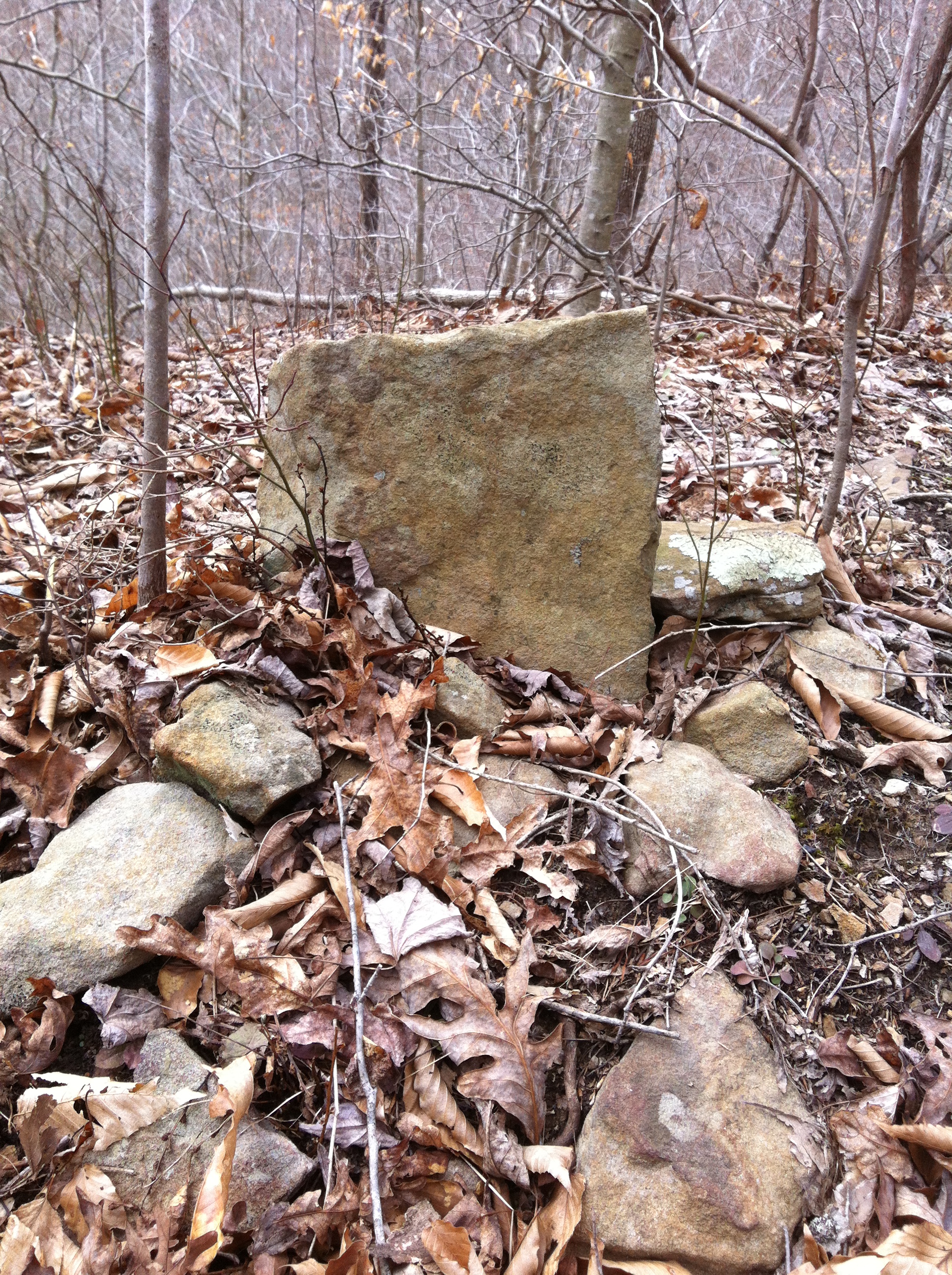
The burial surface is a large shallow depression in the soil located on a steep slope. The depression is approximately one foot deep. The western side of the burial depression, presumably the head, is marked by two small rock cairns that feature natural upright stone slabs projecting from the tops. The opposite end (foot) is marked by two small rock cairns.
The burial appears to be shallow when probing in the deepest part of the depression, with the burial shaft floor located at a depth of approximately 2 feet.
The shaft is of sufficient size to have accommodated two persons lying side-by-side. It is very shallow, but this may have been due to haste during excavation of the burial pit, or it could have resulted from termination of the efforts of the grave diggers when they encountered the underlying siltstone strata.
Two items that could effect bone preservation were noted: oak trees are in the vicinity of the burial, and the tannin from these leaves can elevate the acid content of the soil; and the presence of some white clay also indicates soil acidity. However, the burial is on a steep slope and located high up near the brow of the ridge. The slope and wind action at that elevation could retard a significant accumulation of leaves. The slope also prevents any significant amount of water from collecting in the burial depression.
The remoteness of the burial site will make it necessary to complete the disinterment in a single day or else provide overnight guards.
20 Wednesday Aug 2014
Posted in Big Harts Creek, Culture of Honor, Harts, Lincoln County Feud, Timber
Tags
Appalachia, archaeology, Brandon Kirk, Haley-McCoy grave, Harts Creek, history, John Hartford, John Imlay, Lincoln County, Lincoln County Feud, logging, Malcolm Richardson, photos, Smithsonian Institution, Steve Haley, timbering, West Fork, West Virginia

John Hartford and Steve Haley at the Haley-McCoy grave, West Fork of Harts Creek, Lincoln County, WV, 1997

John Hartford and Steve Haley with the Smithsonian crew, West Fork of Harts Creek, Lincoln County, WV, 1997
20 Wednesday Aug 2014
Posted in Big Harts Creek, Culture of Honor, Ed Haley, Harts, Lincoln County Feud
Tags
Brandon Kirk, Ed Haley, feud, Green McCoy, Haley-McCoy grave, John Hartford, John Imlay, Lawrence Kirk, Lincoln County Feud, Low Gap, Malcolm Richardson, Melvin Kirk, Milt Haley, Smithsonian, Steve Haley, Walker Family Cemetery, writing
The following morning, Brandon and I met Steve Haley at the bus. Not long afterwards, two men drove up in a white SUV and eased out toward us. The Smithsonian forensic crew had arrived. They were dressed ordinary and casually, except for very “official-looking” black caps adorned with golden seals. The driver, a large man with a rough voice and commanding presence, introduced himself as Malcolm Richardson – or “Rich,” as he preferred to be called. The other fellow, younger than Rich, tall and seemingly jolly, was John Imlay. We almost immediately piled into their vehicle and headed for the grave.
Upon reaching the logging road at Low Gap, Rich decided not to use it to drive up to the grave. Instead, we parked just off the hill near the Walker Family Cemetery and headed up the hill on foot. We were barely there when Lawrence Kirk, who’d shown me the gravesite back in 1993, popped out of the bushes. He’d preferred to “rough it” up the hill, somehow making it up the slope and through the brush in a pair of dress shoes, offering his assistance with any questions Richardson and Imlay might have about the site. It was neat having Lawrence there since his grandfather Melvin Kirk had helped bury Milt and Green in 1889. Steve Haley’s presence also was noteworthy in that it marked the first time, so far as we knew, that any of Ed’s family had ever been to the site. (We don’t know if Ed went there.)
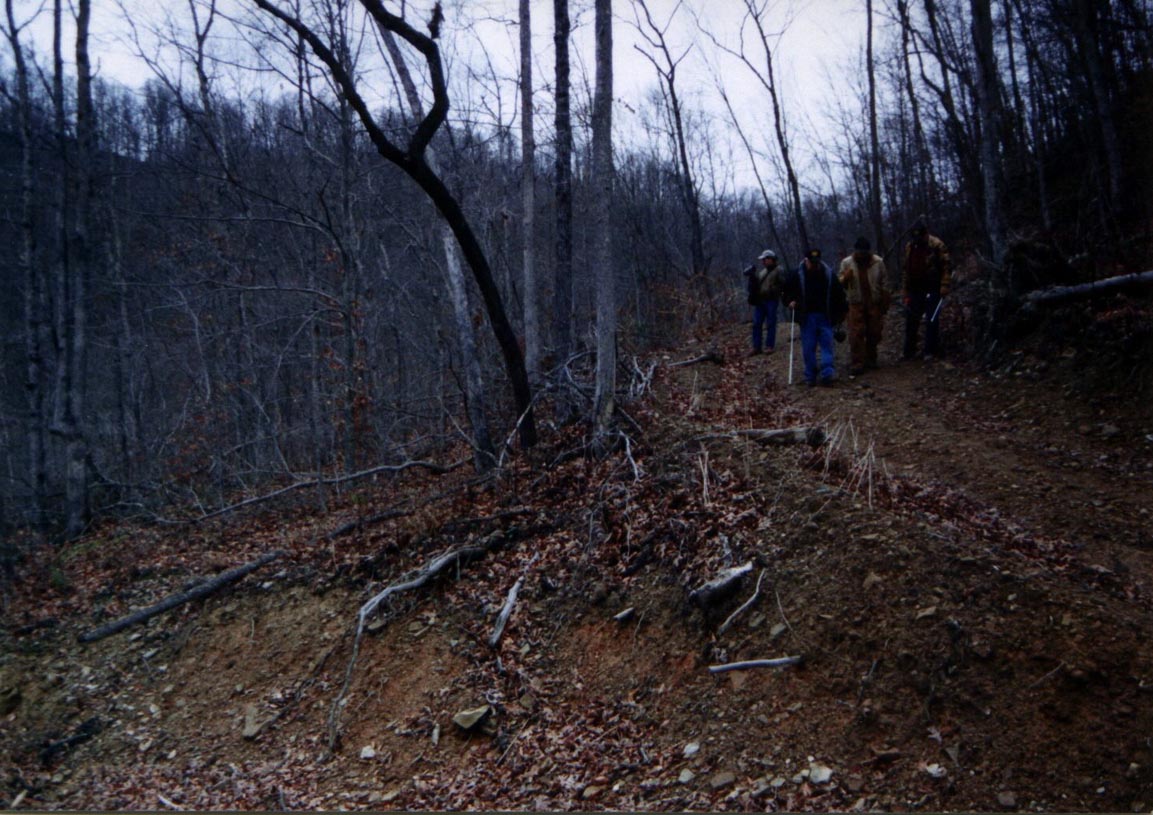
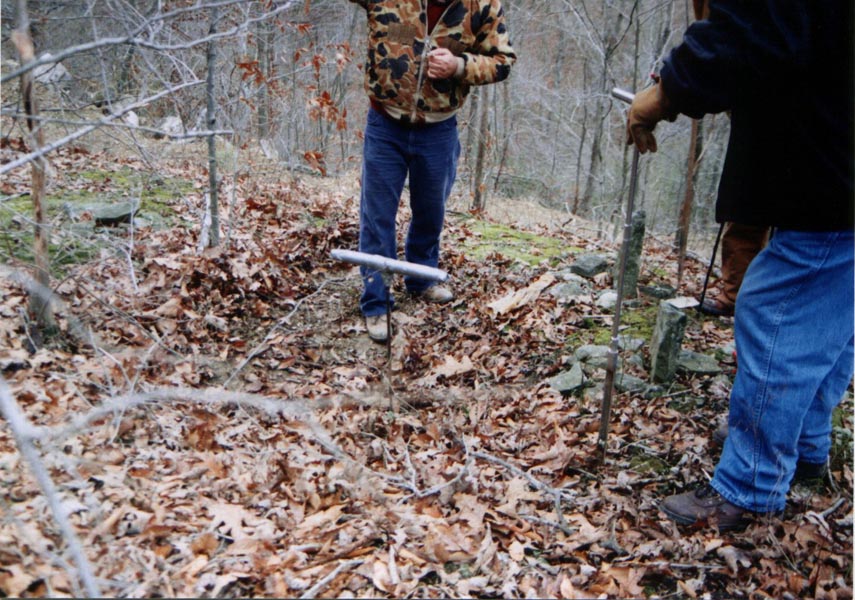
As we watched Rich and Imlay probe their metal rods into the grave, we clung to their every word — every theory, question and comment. I guess it would be fair to say that we were hoping for some kind of “breakthrough revelation” from their probing…but the whole thing was over in about thirty minutes. Still, we were all electrified with excitement. For the rest of the day, we talked about every minute detail of our “probing experience:” the rods, how they worked, what they revealed and so forth. Then came all of the wild theories about what was actually down in the grave. We could hardly wait until spring.
07 Thursday Aug 2014
Posted in Big Harts Creek, Lincoln County Feud
06 Wednesday Aug 2014
Posted in Ed Haley, John Hartford, Lincoln County Feud, Music
Tags
Ashland, Brandon Kirk, Clyde Haley, Doug Owsley, Ed Haley, fiddle, Green McCoy, Haley-McCoy grave, Harts, Harts Fas Chek, Jimmy Johnson Bring Your Jug Around the Hill, Jimmy McCoy, John Hartford, Kentucky, mandolin, Milt Haley, Mona Haley, Noah Haley, Pat Haley, Salt River, Shove That Hog's Foot, Ugee Postalwait, West Virginia, writing
After the contest, we all gathered at Pat Haley’s. The dining room table was crammed with food and the refrigerator was stuffed with every conceivable drink. People filled the downstairs rooms, many even spilling out onto the front and back porches. Once the kitchen was cleared, I got my fiddle and planted myself in a hard-back chair near Clyde and Noah. I immediately gave Mona a mandolin I’d brought so she could second me with those haunting “Ella chords.” Ugee perched nearby us in a chair where she hollered out the names of tunes and lyrics and even danced when she got too excited. We kept the music going, while Pat served up the food.
There were some new musical developments, little comments here and there that were important to know. When I played “Salt River”, for instance, Mona said it was the same tune as “Shove That Hog’s Foot”. She sang:
Shove that hog’s foot further in the bed,
Further in the bed, further in the bed.
Shove that hog’s foot further in the bed,
Katy, won’t you listen to me now?
Ugee said Ed had a way of making his fiddle sound like moonshine pouring from a jug when he played “Jimmy Johnson Bring Your Jug Around the Hill”. It took me a while to figure out what she meant by that.
As music filled the kitchen, Brandon was busy with Jimmy McCoy in the TV room. Jimmy knew very little about Green’s death, although he’d heard that the Brumfields killed him because they were jealous of his music. At some point, we got Jimmy to sit for pictures with all of Ed’s grandsons, mimicking the Milt and Green picture. Everyone did it, even those who weren’t really sure why they were sitting with a stranger crossing their legs and gripping invisible jacket cuffs.
I headed back to Nasvhille the next day but Brandon went to Harts with Jimmy, where he and Billy Adkins showed him the local sites…including the Haley-McCoy grave. Brandon figured it was the first time any of the McCoys had been to the grave in at least 45 years.
A month or so later, Brandon received a letter from Doug Owsley regarding the exhumation of the Haley-McCoy grave.
“Thanks for the McCoy family permissions for the excavations at the Haley/McCoy Burial Site,” it partly read. “I think that it will be advisable for me to make a short trip to West Virginia in advance of the arrival of the field crew to meet you and Mr. Hartford and to make a quick survey of the site area.”
A few letters and telephone calls later, we learned from Owsley that he wouldn’t be able to make the preliminary trip to Harts. However, he was sending two associates, who we were to meet at the Harts Fas Chek.
13 Friday Jun 2014
Posted in Big Harts Creek, Ed Haley, Lincoln County Feud, Timber
Tags
Appalachia, Billy Adkins, Brandon Kirk, Green McCoy, Haley-McCoy grave, Harts Creek, Harts Fas Chek, history, Lincoln County, Low Gap, Milt Haley, West Fork, West Virginia, writing
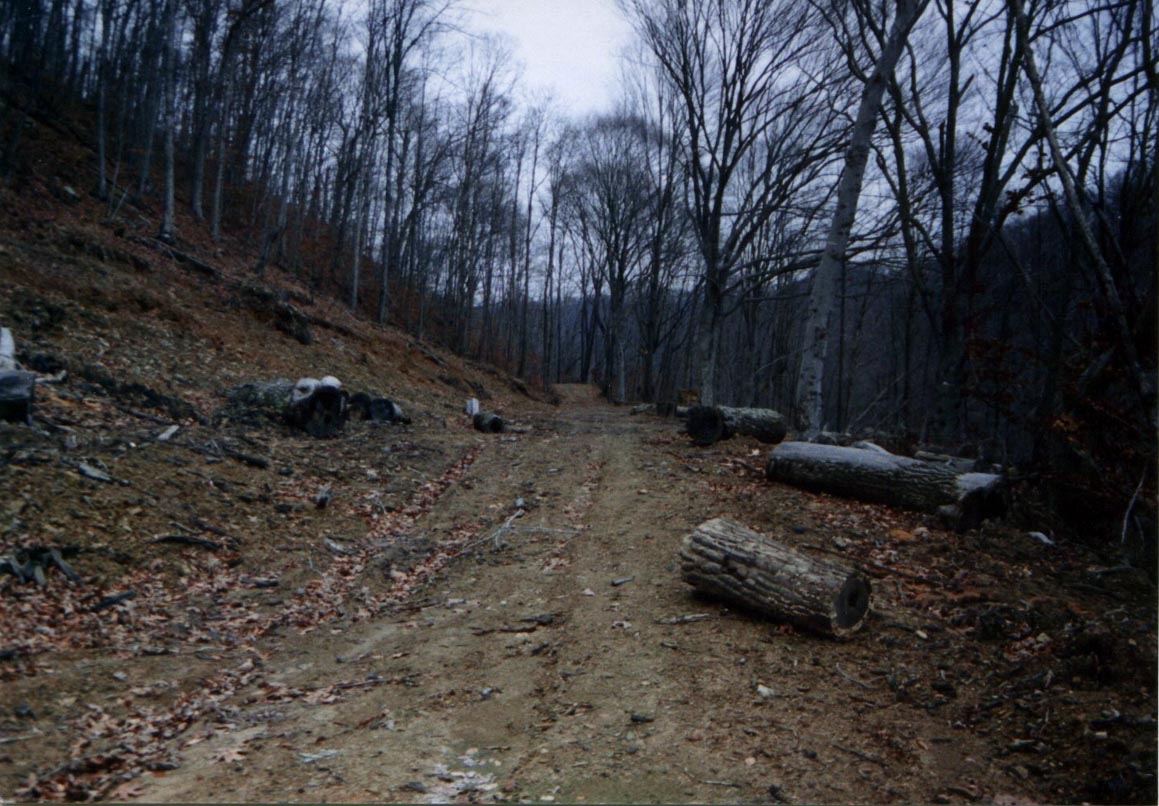
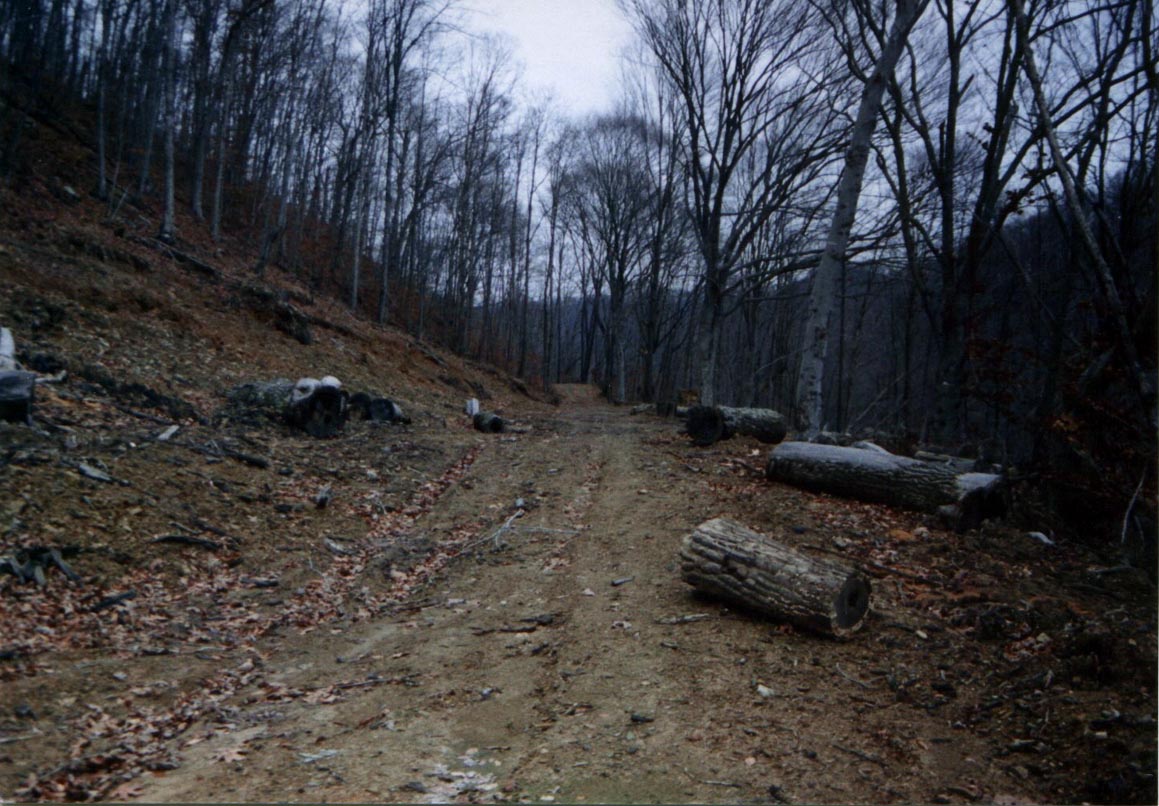
In the mid-summer heat of July, I pulled into the Harts Fas Chek parking lot on my bus with the Haley-McCoy grave bearing strongly on my mind. Early the next morning, Billy, Brandon, and I drove over to Presto’s Garden and made our way up the hillside toward Milt’s grave, cringing at the destruction wrought by bulldozers. The land was scarred and brush was everywhere. There was a wide road recently forged into the side of the mountain, which seemed to be sliding gently down the hillside like thick tears or even blood from the earth’s gaping wounds. It led right up to the grave. There was a bulldozer trail leading down below the grave to a pile of scrap wood, a trail cutting beside the grave leading on up into the hollow, and the entire Low Gap side of the grave area was scraped bare. Nearby, a dozer whirred and rumbled, tossing logs in neatly stacked piles. Somehow the grave was safe from destruction, but this special place was violated after one hundred and seven years of peace and solitude.
06 Friday Jun 2014
Posted in Big Harts Creek, Lincoln County Feud, Timber
Writings from my travels and experiences. High and fine literature is wine, and mine is only water; but everybody likes water. Mark Twain
This site is dedicated to the collection, preservation, and promotion of history and culture in Appalachia.
Genealogy and History in North Carolina and Beyond
A site about one of the most beautiful, interesting, tallented, outrageous and colorful personalities of the 20th Century