Tags
Appalachia, Cabell County, crime, history, Huntington, Huntington Advertiser, Huntington Detective Agency, J.A. Rau, J.W. Valentine, Scott Turner, T.S. Scanlon, West Virginia, William Bowden
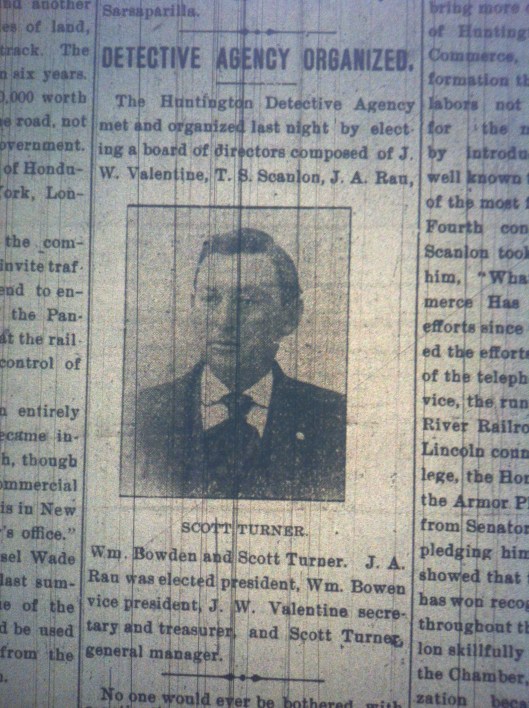
Huntington (WV) Advertiser, 8 February 1898.

05 Sunday Mar 2017
Posted in Huntington
Tags
Appalachia, Cabell County, crime, history, Huntington, Huntington Advertiser, Huntington Detective Agency, J.A. Rau, J.W. Valentine, Scott Turner, T.S. Scanlon, West Virginia, William Bowden
Huntington (WV) Advertiser, 8 February 1898.
05 Sunday Mar 2017
Posted in Barboursville, Guyandotte River
Tags
Appalachia, Barboursville, C&O Railroad, Cabell County, Fred B. Lambert, Guyandot Valley Railroad, history, Huntington, Huntington Advertiser, Marshall University, Virgil Bostic, West Virginia

Virgil Bostic Section Crew, GVRR. Photo from Fred B. Lambert Papers, Special Collections Department, James E. Morrow Library, Marshall University, Huntington, WV.

“The railroad contractors have the pile driver at work above here [Barboursville] and are getting ready to construct the trestles along the line,” said the Huntington Advertiser on April 19, 1900.

“Men are working day and night on the river above here [Barboursville] putting in coffer dams for the railroad bridge,” said the Huntington Advertiser on April 21, 1900.

“Contractor Allen has put on a night force above here where the foundation for the piers for the Guyandot Valley Railway bridge are being constructed,” said the Huntington Advertiser on May 9, 1900. “One of the river abutments will be completed tomorrow.” On May 16, it added this: “Work on the trestle over the ‘Big Gut’ just above here [Barboursville] will commence this week. This is the first trestle on the line of the Guyandot Valley requires considerable timber.”
02 Thursday Mar 2017
Posted in Huntington
Tags
antiques, Appalachia, architecture, Cabell County, Central City, history, Huntington, photos, West Virginia

Central City Historic Antique District in Huntington, WV. April 2016. For more information, follow this link: http://www.oldcentralcity.org/
02 Thursday Mar 2017
Posted in Fourteen
Tags
Andrew Elkins, Appalachia, Cabell County, Elizabeth Elkins, farming, Fourteen, Fourteen Mile Creek, genealogy, George Thomas Holton, Henry H. Hardesty, history, James Holton, Lincoln County, Linville Marion Holton, Margaret Holton, Minnie Holton, teacher, West Virginia, Yantus Holton
From “Hardesty’s History of Lincoln County, West Virginia,” published by H.H. Hardesty, we find this entry for George Thomas Holton, who resided at Fourteen in Lincoln County, West Virginia:
Was born in Cabell county, (now) West Virginia, February 11, 1847, and came to Lincoln county in 1872. His parents, James and Margaret (Cooper) Holton, were here when the county was organized. In Lincoln county, December 23, 1878, the Rev. W.A. Snodgrass united in marriage George Thomas Holton and Yantus Elkins. She was born in Logan county, West Virginia, June 16, 1860, and her parents, Andrew and Elizabeth (Elkins) Elkins, were residents of Lincoln county at the time of its organization. Mr. and Mrs. Holton have been blessed with two children: Minnie, born October 26, 1879, died August 29, 1882; Lenville Marion, born July 22, 1881. George Thomas Holton is a school teacher and a farmer in Hart Creek district, and receives his mail at Fourteen, Lincoln county, West Virginia.
Source: The West Virginia Encyclopedia, Vol. 7 (Richwood, WV: Jim Comstock, 1974), p. 135.
22 Wednesday Feb 2017
Posted in African American History, Barboursville
Tags
Appalachia, Barboursville, Cabell County, Clarence Dean, genealogy, Gertrude Dean, Harvey Dean, history, Huntington, Huntington Advertiser, Patsy Dean, slavery, West Virginia

Patsy Dean Obituary, Huntington (WV) Advertiser, 29 March 1899. According to the 1870 Cabell County Census, Patsy was born about 1837. The census enumerator identified her as a mulatto. Based on the 1880 Cabell County Census, Patsy was born about 1840 and was the mother of three children: Harvey Dean (born about 1873), Gertrude Dean (born about 1875), and Clarence Dean (born about 1878). The census enumerator identified her as black.
22 Wednesday Feb 2017
Posted in Civil War, Giles County, Green Shoal
Tags
Abbotts Branch, Anthony Fry, Appalachia, Boone County, Cabell County, Caroline Fry, Catherine Fry, Christian Fry, Cora A. Fry, Druzilla Abbott, Elizabeth Fry, Elizabeth Hunter, Emily Lucas, farming, Fourteen Mile Creek, genealogy, Giles County, Green Shoal, Hardin Fry, Harts Creek District, Henry H. Hardesty, history, John Fry, John Henan Fry, Julia A. Fry, Kanawha County, Lincoln County, Lurana Fry, Mary A. Fry, Robert Hunter, Sulphur Spring Fork, timber, Virginia, West Virginia
From “Hardesty’s History of Lincoln County, West Virginia,” published by H.H. Hardesty, we find this entry for Christian T. Fry, who resided at Hart in Lincoln County, West Virginia:
One of the farming population of Hart Creek district, was born in Cabell county, West Virginia, in 1824, and he is a son of John and Catherine (Snodgrass) Fry, natives of Giles county, Virginia. Mr. Fry chose for a help-meet Elizabeth Hunter, and in Boone county, West Virginia, in 1849, they were married. Their children number eight, born as follows: Julia A., April 26, 1850; Anthony, November 1853; Caroline, December 1856; Mary A., August 1859; John H., September 1861; Cora A., September 1864; Hardin, June 15, 1867; Lurana, July 1871. Mrs. Fry was born in Kanawha county in 1835, and her parents are Robert and Elizabeth (Tayler) Hunter, who reside in Boone county. Christian T. Fry is a prosperous farmer in Hart Creek district, owning 300 acres of good farming land, situated on Browns branch. The land has good improvements, a fine orchard, and a part is heavily timbered with pine, poplar and oak. There is mineral, coal and iron ore in abundance. Mr. Fry’s post office address is Hart, Lincoln county, West Virginia.
Source: The West Virginia Encyclopedia, Vol. 7 (Richwood, WV: Jim Comstock, 1974), p. 134.
NOTE: Christian Thomas “Jack” Fry is my great-great-great-grandfather. I descend through his son, John Henan Fry, who settled on Sulphur Spring Fork of Fourteen Mile Creek. I also descend from two of Christian Fry’s sisters, Emily (Fry) Lucas and Druzilla (Fry) Abbott.
NOTE: The Browns Branch referenced in this history is now called Abbotts Branch.
18 Saturday Feb 2017
Posted in Cemeteries, Huntington, Lincoln County Feud
Tags
Appalachia, Cabell County, Hamlin, history, Huntington, Lincoln County, Lincoln County Feud, Milt Haley, Spring Hill Cemetery, Thomas H. Harvey, West Virginia
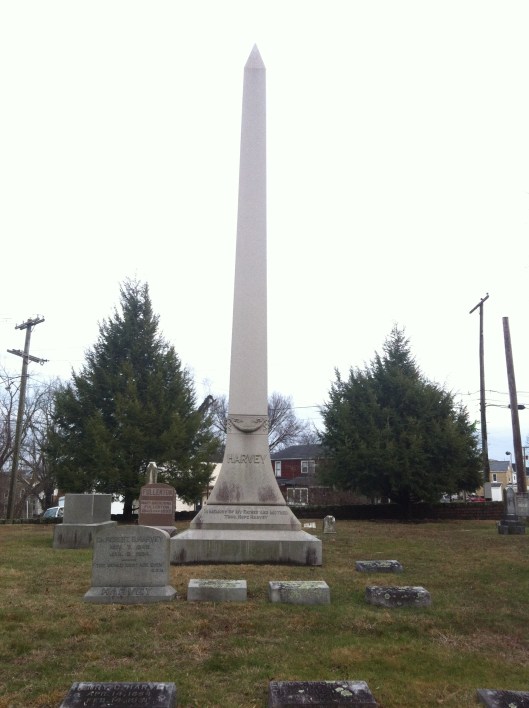
Judge Thomas H. Harvey grave at Spring Hill Cemetery in Huntington, WV. 16 January 2017.
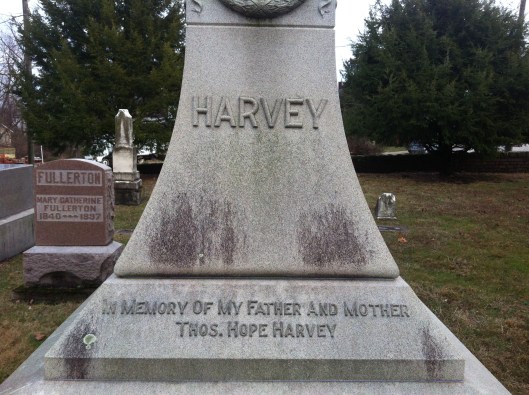
Judge Harvey, who oversaw legal matters for the 8th Judicial Circuit from 1889 until 1897, presided over the Haley-McCoy murder trial in August of 1890. 16 January 2017.
18 Saturday Feb 2017
Posted in Chapmanville, Civil War, Harts
Tags
Appalachia, Battle of Kanawha Gap, Benjamin F. Fowler, Bettie Fowler, Bill Fowler, Burning Spring Hollow, Cabell County, Chapmanville, civil war, Confederate Army, Effie Fowler, Elizabeth Adkins, Elizabeth Fowler, genealogy, George W. Fowler, Guyandotte River, Harts Creek, Harts Creek District, Henry H. Hardesty, history, John B. Adkins, Kanawha County, Lincoln County, Martha A. Fowler, Mary Ann Fowler, Mud River, Thomas Fowler, West Virginia, Zattoo Fowler
From “Hardesty’s History of Lincoln County, West Virginia,” published by H.H. Hardesty, we find this entry for William T. Fowler, who resided at Hart in Lincoln County, West Virginia:
Is a merchant, miller and farmer in Harts Creek district, with business headquarters on Guyan river at the mouth of that creek. He was born in Kanawha county, (now) West Virginia, at the mouth of Burning Spring Hollow, June 29, 1825, and his parents, Thomas and Elizabeth (Gillispie) Fowler, are both now deceased. William T. Fowler has been twice married, his first wife Polly Emerine, left him three children, born as follows: Zattoo D., March 28, 1851; Polly A., December 25, 1853; William E., September 15, 1856. In Cabell county, West Virginia, June 10, 1871, W.T. Fowler and Martha A. Adkins were united wedlock, and the children born of this union are: Bettie, May 6, 1875; Effie, June 10, 1876; Benjamin F., December 15, 1878; George W., June 30, 1880. Mrs. Fowler is a native of Cabell county, born December 15, 1839, and her parents are John B. and Elizabeth (Childers) Adkins. Her mother still resides in that county; her father died April 1876. Mr. Fowler enlisted in the Civil War in 1862, serving on the Confederate side, and was a participant in the Chapmansville battle. William T. Fowler settled in Lincoln county in 1847, and now owns 200 acres of land at the mouth of Big Hart creek, and 254 acres on Mud river. That situated on Hart creek produces well, and has a good orchard and a part is heavily timbered with oak, poplar and pine; coal and iron ore are quite abundant. The land on Mud river is heavily timbered. Address, Hart, Lincoln county, West Virginia.
Source: The West Virginia Encyclopedia, Vol. 7 (Richwood, WV: Jim Comstock, 1974), p. 134.
18 Wednesday Jan 2017
Posted in Civil War, Huntington
Tags
actress, Albert Gallatin Jenkins, Alberta Gallatin Jenkins, Appalachia, Cabell County, Columbia, Davis Theatre, Green Bottom, history, Huntington, Huntington Advertiser, J.B. Bowlin, Joseph Jefferson, Mrs. Fiske, Nell Gwynne, Paraguay, Richard Mansfield, St. Louis, T.W. Keene, theater, Uruguay, Virginia Jenkins, West Virginia
Alberta Gallatin Jenkins (1861-1948) was a famous stage actress born at Green Bottom in present-day Cabell County, West Virginia. She was the daughter of Confederate general Albert Gallatin Jenkins. For more on her biography, follow this link: https://en.wikipedia.org/wiki/Alberta_Gallatin
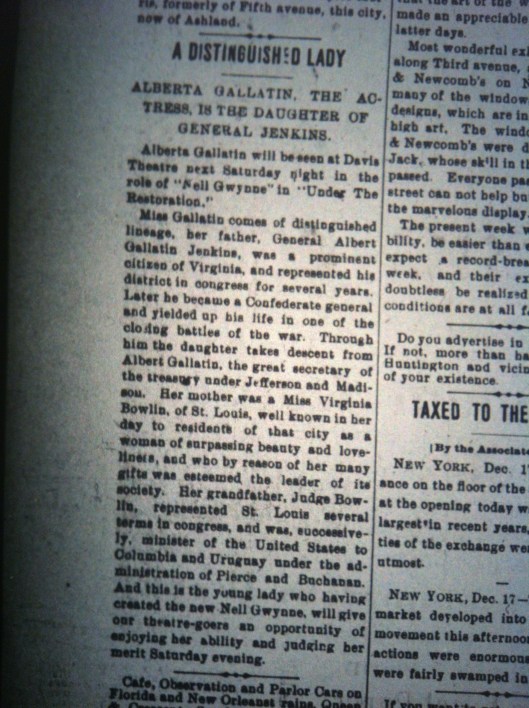
Huntington (WV) Advertiser, 17 December 1900.

Huntington (WV) Advertiser, 20 December 1900. Additional information here: https://warnerssafeblog.wordpress.com/category/alberta-gallatin-1861-1948/

Huntington (WV) Advertiser, December 20, 1900.
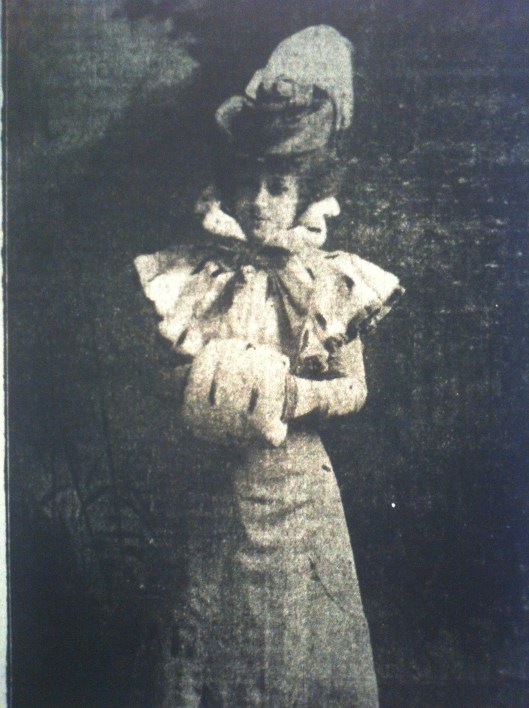
Huntington (WV) Advertiser, 21 December 1900.
13 Friday Jan 2017
Posted in Huntington
Tags
Appalachia, Buckskin Bill, Cabell County, Crigler's Famous Cowboy Band, Harry Crigler, history, Huntington, West Virginia, Wild West Show

Buckskin Bill’s Wild West arrives in Huntington, WV!
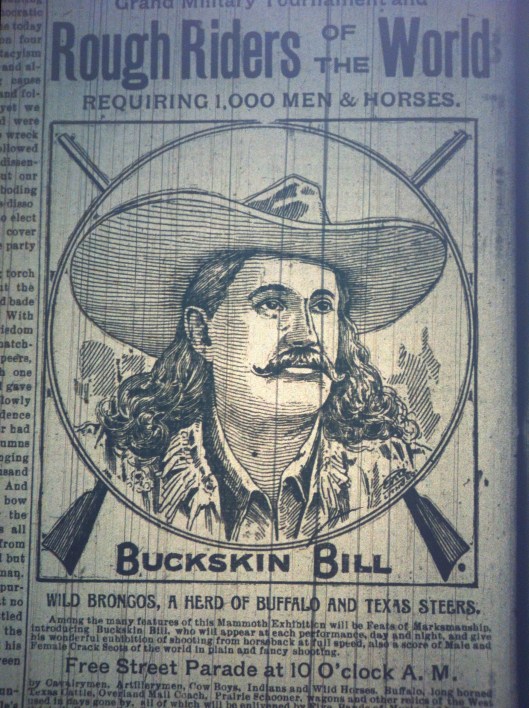
Buckskin Bill

Source: Huntington (WV) Advertiser, 6 July 1900.
30 Sunday Oct 2016
Posted in Huntington
Tags
Annie Oakley, Appalachia, Buffalo Bill, Cabell County, Fifth Royal Irish Lancers, Fifth U.S. Artillery, First Imperial Cuirassiers, George Armstrong Custer, history, Huntington, Huntington Advertiser, Johnny Baker, Mexican Reserve Vaqueros, Rough Riders, Sixth U.S. Cavalry, Tenth Cossacks of the Caucasus, Vicente Orapaso, West Virginia

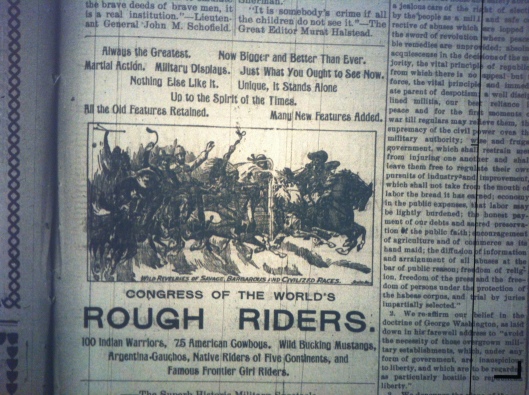


Huntington (WV) Advertiser, 1 October 1898.
30 Friday Sep 2016
Posted in Huntington, Lincoln County Feud
Tags
Appalachia, author, Blood in West Virginia, books, Brandon Kirk, Cabell County, history, Huntington, Ohio River Festival of Books, Pelican Publishing Company, West Virginia
Here we are selling books and meeting folks at the Ohio River Festival of Books in Huntington, WV. We are located at Pullman Plaza Hotel (second floor) on Friday, September 30, from 5 p.m. until 9 p.m., and Saturday, October 1, from 10 a.m. until 5 p.m. If you’re local, come and see us!

28 Wednesday Sep 2016
Posted in Big Creek, Big Harts Creek, Big Ugly Creek, Ferrellsburg, Harts, Toney
Tags
Aaron Adkins, Abijah Workman, Abner Vance, Andrew Robinson, Appalachia, Becky Workman, Cabell County, Calohill McCloud, Catherine Fry, Charles Adkins, Crispin Stone, Darby K. Elkins, Dolly Stollings, Elias Adkins, Elizabeth Dial, Gordon Lilly, Harts Creek, Harvey Elkins, Henderson Drake, Henry Adkins, Henry Conley, Henry Spears, Hezekiah Adkins, history, Isaiah Adkins, Jake Adkins, James Butcher, James Ferrell, James Lilly, James M. Berry, James Thompson, James Toney, John Chapman, John Elkins, John Godby, John Gore, Joshua Butcher, justice of the peace, Levi Collins, Logan County, Lorenzo Dow Hill, Lydia Eveline Mullins, Mary Workman, Meekin Vance, Noah Hainer, Obediah Workman, Reese W. Elkins, Richard Elkins, Robert Lilly, Robert Lilly Jr., Robet Lilly, Samuel Vanatter, Sarah Jane Dial, Spencer A. Mullins, Squire Toney, Stephen Lambert, Virginia, Wesley Stollings, West Virginia, William Lilly, William Smith, William Spears, William Thompson
Between 1847 and 1869, the following men served as justices of the peace in the Harts Creek community, then a part of Logan County, Virginia. The primary source for this material is Deed Book D, which is located at the Logan County Clerk’s Office in Logan, WV. Material is arranged based on the grantor’s name as given in the deed, the grantee’s name as given in the deed, and the date of the deed. Some of the deeds are partially destroyed, obscuring dates. This list is a work in progress and will be updated periodically. Many thanks to the county clerks and their employees who have always been so helpful to my research these past twenty-five years.
Elias Adkins (Logan County), 1847, 1850
Deed: James Thompson to John Godby 23 August 1847
Deed: Wesley and Dolly Stollings to Abner Vance 15 April 1850
Crispin S. Stone (Logan County), 1847, 1849, 1852, 1854, 1859, 1865
Deed: James Thompson to John Godby 23 August 1847
Deed: Henry Conley and William Thompson to John Godby 4 September 1849
Deed: Levi Collins to Noah Haner 2 March 1852
Deed: Robert Lilly to William Lilly 22 December 1854
Deed: Robert Lilly to Robert Lilly, Jr. 1 March 1859
Deed: Isaiah Adkins to Lydia Eveline Mullins 8 July 1859
Deed: Robert Lilly to Mary Workman 28 February 1865
Deed: Robert Lilly to Gordon Lilly 1 March 1865
Deed: Robert Lilly and James Lilly 26 March 1865
Joshua Butcher (Logan County), 1849
Deed: Henry Conley and William Thompson to John Godby 4 September 1849
Spencer A. Mullins (Logan County), 1853-1855
Deed: Richard Elkins to James Toney 5 March 1853
Deed: Price Lucas to Henry Adkins 7 October 1853
Deed: Richard Elkins to Isaac Adkins 27 December 1853
Deed: Enos “Jake” Adkins to Henry Adkins 12 April 1854
Deed: Squire Toney to Burbus C. Toney 14 October 1854
Deed: Darby K. Elkins to John W. Sartain 30 October 1854
Deed: Harvey Elkins to Isaiah Adkins 10 March 1855
Deed: Elizabeth Adkins et al to Charles and Isaiah Adkins 02 October 1855
Deed: Joel Elkins to Reece W. Elkins 17 November 1855
William Smith (?? County), 1853-1854
Deed: Baptist Fry to Charles Lucas 18 April 1853
Deed: Levi Collins to Anderson Barker 21 June 1853
Deed: Burbus C. Toney to Squire Toney 14 October 1854
Deed: John Workman to James Browning 17 November 1854
Lorenzo Dow Hill (Logan County), 1854-1856, 1858-1861, 1869
Deed: Burbus C. Toney to Squire Toney 14 October 1854
Deed: John Workman to James Browning 17 November 1854
Quit Claim Deed: Elias Adkins to Enos Adkins 18 August 1855
Deed: John Fry to Admiral S. Fry 26 January 1856
Deed: Robert Lilly to Gordon F. Lilly 8 April 1856
Deed: Rees W. Elkins to Elias Adkins 18 October 1856
Deed: Robert Lilly to James Lilly 16 April 1858
Deed: Meekin Vance to Andrew Robinson 31 March 1859
Deed: John and Catherine Fry to Aaron Adkins 11 February 1860
Summons: William T. Clark and Henry P. Gartin 28 February 1861
Commissioners Record Book No. 1, p. 122: January 1869
James Ferrell (Logan County), 1854-1858, 1860
Deed: Squire Toney to Burbus C. Toney 14 October 1854
Deed: Elizabeth Adkins et al to Spencer A. Mullins 07 February 1855
Deed: Squire Toney to Sarah Jane Dial 25 November 1855
Deed: Squire Toney to Sarah Jane Dial and Elizabeth Dial 20 May 1856
Deed: Squire Toney to Lorenzo D. Hill 24 January 1857
Deed: William Smith to James Lilly 17 February 1858
Summons: James M. Berry 18 February 1860
Hezekiah Adkins (Logan County), 1856
Deed: Darby K. Elkins et al to Rees W. Elkins 18 April 1856
John Chapman (Cabell County), 1856
Deed: Spencer A. Mullins to John Chapman 18 December 1856
Stephen Lambert (Logan County) 1856-1860, 1865
Deed: Rees W. Elkins to Elias Adkins 18 October 1856
Deed: Obediah Workman to Nighbert and Clarke 25 August 1857
Deed: Charles and Isaiah Adkins to John Elkins 24 November 1858
Deed: Meekin Vance to Andrew Robinson 31 March 1859
Deed: Isaiah Adkins to Lydia Eveline Mullins 8 July 1859
Deed: Obediah and Becky Workman to ____ Dempsey 28 September 1859
Deed: Henry Adkins to Aaron Adkins 31 March 1860
Summons: Jeremiah Lambert 3 September 1860
Deed: Abijah Workman to Calahill Daniel McCloud 12 January 1865
Samuel Varnater (Logan County), 1865
Deed: Abijah Workman to Calahill Daniel McCloud 12 January 1865
Henderson Drake (Cabell County), 1865
Deed: Henry Spears to William Spears 6 December 1865
John Gore (Logan County), 1868
Commissioners Record Book No. 1, p. 112: November 1868
23 Friday Sep 2016
Posted in Salt Rock
Tags
Appalachia, Bulahann Church, Cabell County, Enon Church, From Youth to Old Age, Grant District, Guyandotte Valley, history, J.D. Carter, John A. Petit, John J. Perry, John J. Rowsey, Lincoln County, preacher, Salt Rock, Susannah Church, Thomas H. Perry, timbering, Tylers Creek, Union District, West Virginia, Zoar Church
About 1910, Rev. Thomas H. Perry reflected on his long life, most of which was spent in the vicinity of Tylers Creek in Cabell County, West Virginia. In this excerpt from his autobiography, Mr. Perry recalled his early days as a preacher in the Guyandotte Valley.
After I had preached my first sermon, I then preached in the school houses in the most isolated places. I had two reasons for this: first, I thought I would meet with less intelligence; and second, that they heard so little preaching, but to my surprise the people would come for miles to my meetings, and I would wonder why they came. Do they come through evil curiosity, or do they come from a sense of duty? I would pray to the Lord, down deep in my heart and soul that He would help me at this hour to preach His word with such power that these people, who have come here this day through vain curiosity, that they may be made to feel the weight of their sins, but if they have come for the good of the soul that they may go away from this place feeling it was good to be at church to-day. The hardest struggles I had in my work was from the time I entered the church to the beginning of the sermon. The presence of strangers and noted people generally embarrassed me to some extent until after I had announced my subject and read my text. After that I did not notice them anymore than others. I never tried to change my voice from the natural or make it appear I was educated, but put my whole soul and heart in my subject with the hope that somebody might be saved to-day.
About the time I began to preach there were three other young men who entered the ministry, J.D. Carter, John J. Perry and John A. Petit. These young men lived on Tyler’s creek. John J. Perry was the founder of Susannah church, one of the good churches of Grant district. He was killed by falling timber, near Salt Rock, in 1884. John A. Petit was the founder of Bulahann church in Union district. This church was named in honor of my mother, because of the interest my father and John J. Perry took in its organization. Bro. Petit was a fine preacher and had a great many friends. He was pastor of a good church in Ohio. He died, I believe, in 1885. Bro. Carter was the founder of Zoar church, another good church in Grant district. He was a large man of fine personal appearance. His ability as a preacher was second to none in this end of the state. He died in 1906. Knowing these three men as I did, I considered them the three greatest lights that ever went out from Enon church.
Many time I have put corn in my saddle-pockets and rode up the Guyan valley as far as I could by eleven o’clock, and in good weather I would meet from fifty to seventy-five people at a school house. Some of the men were bare-footed, and had their guns and a poke of salt with them and some of the old women would smoke their pipes while I was preaching to them. The men said to me, “we came prepared to salt our cattle and kill a mess of squirrels as we go home.” Sometimes on my way home I would think a people that had so little regard for the Sabbath and not enough respect for a preacher to feed his horse were not worthy of the gospel; and then I would think if nobody will preach to them they will never do any better, and as Christ had said: “Preach His gospel to every creature,” and as Paul had said: “Woe is me if I preach not the gospel.” I felt I could not live, or that great calamity would come to me if I did not preach the gospel.”
About this time I was going to school at Salt Rock. A Mr. John J. Rowsey, a very noted teacher was our instructor that year. Some of the old men tried to discourage me by saying if God had called me to preach I did not have to go to school to learn how. But I felt the need of a better education and knew that some of my appointments did not pay me one dollar a year and I was hard pressed financially. These things would discourage me very much. I saw at once there was a race to be run and a battle to be fought in this life, and I remembered that the Bible said the race is not to the swift, nor the battle to the strong, but to them that put their trust in the Lord. I believed every word in the Bible was the word of God, I could not treat it with indifference. I was determined to preach all I could and go to school all I could, and raise my finance all I could, and as to those people that go to church with their guns and those that sit and smoke during preaching, I have a great love for them as well as others; for their souls are as precious in God’s sight as the souls of the rich and most refined.
Source: From Youth to Old Age by T.H. Perry, Chapter 10, p. 25-27.
18 Sunday Sep 2016
Posted in Civil War
Tags
Appalachia, Battle of Big Ugly Creek, Big Ugly Creek, Cabell County, Chapmanville, civil war, Confederate Army, From Youth to Old Age, Guyandotte River, Hamilton Fry, history, Kentucky, Lincoln County, Logan County, Mason County, Prestonsburg, Six Mile Creek, T.E. Ball, Thomas H. Perry, Union Army, Virginia, Wayne County, West Virginia, William Jefferson
About 1910, Rev. Thomas H. Perry reflected on his long life, most of which was spent in the vicinity of Tylers Creek in Cabell County, West Virginia. In this excerpt from his autobiography, Mr. Perry recalled his participation in Civil War skirmishes at the Forks of Ugly and Six Mile Creek in present-day Lincoln County, WV, and military activity around Prestonsburg, Kentucky:
In 1862 my company was ordered to move from Chapmansville down the Guyan river. About three o’clock that day we ran into a company of Federal soldiers at the forks of Big Ugly creek, and as neither company was expecting trouble at this time, we were not ready for the fight, but our captain ordered his men in line, and we marched around the hillside, fronting the creek, and the Federals formed a line up the creek, fronting us. Here we tried our bravery for a few minutes, but as we had the advantage of some timber, the Federals broke ranks and went into the woods, except ten or twelve that lay flat upon the ground, and we captured them, and all the rations the company had, such as coffee and sugar, which was a treat for us in that country. About this time another company came up and followed the Federals into the woods. I never knew what became of them until after the war. Mr. T.E. Ball, of Mason county, told me after the war that he was a member of that company of Federals, and he was in the fight at the forks of Big Ugly, and that he was in the closest place that day of any time during the war. he said he was certain there were more than fifty shots fired at him as he ran through the field, and of the eighty-four men in his company, there was not a man that returned with his gun, and but few that had hats or shoes, for they were scattered in the woods and every man looked out for himself. The next day, we had six men in the advance guard. I was one of them, and as we turned the point at the mouth of Six Mile creek, six miles above the falls of Guyan river, we ran into a squad of seven Federal soldiers, who fired into us and killed William Jefferson, one of our bravest soldiers.
The next day we crossed the river at the falls of the Guyan and went through Wayne county into Kentucky. Here we were fired into every day and night for about three weeks. It was December and we had some very cold weather. Several times I have seen men and horses lying on the side of the road frozen so stiff they could not travel.
We had about fifteen hundred men with us at that time. We had several hundred prisoners and a great deal of army supplies that we had captured, and the cold weather and the Federals and so many bushwhackers to contend with, that we had no rest day or night. Just below Prestonsburg we captured seven flat boats that were loaded with army supplies, such as clothing and food, and many of us needed both, but we paid dearly for them, for many of our men on both sides lost their lives in this fight. For two hours and thirty minutes they poured the hot lead into each other as fast as they could. The battle lines of both armies extended from the river to the top of the mountain. I was on top of the mountain when the Federals broke rank. Our major ordered his men to go down both battle lines and gather up the dead and wounded and take them to the foot of the mountain.
I went down the Federal battle line in front of our men, and when I saw the dead and wounded and the guns and blood and clothing that was scattered from the top to the bottom of that mountain, I was perfectly disgusted with war. About half way down this line we found their major; he was shot through the heart. He was a nice looking gentleman; he had a long black beard. Our men seemed to have great respect for his body, because he was an officer, and gave special directions for his burial. Some of the prisoners cried aloud like children, while others cursed and said they were see every rebel in hell before he would cry. Just how many men we had killed and wounded in this fight I never knew. Some of our wounded we took with us, and some was so badly wounded we left them in private homes. From this places we turned to the south for winter quarters. My company was the rear guard that night. We thought the rear guard would suffer more than any other part of the army, but to our surprise after we had gone a few miles above Prestonsburg we heard considerable shooting and disturbance in our front about two miles from us. It was a very dark night, and when my company came up to about where we thought the shooting was, we heard horses and men groaning. After we had gone about two miles farther, we went into camp until morning. That morning one man told me one of our men that was killed last night lived in Parkersburg. The great question with us at this time was, can we ever get back to Dixie with our cattle, goods and prisoners? The Federals were above us and below us.
Source: From Youth to Old Age by T.H. Perry, Chapter 7, p. 18-20.
Note: As of 1862, Lincoln County did not exist and the surrounding area remained a part of Virginia. Big Ugly Creek was then located in Logan County and Six Mile Creek was located in Cabell County.
Note: The “forks of Ugly” references the mouth of Laurel Fork, at or near the old Hamilton Fry homeplace.
13 Tuesday Sep 2016
Posted in Barboursville, Civil War, Hamlin
Tags
1st Regiment Virginia State Line, Abbs Valley, Ball Gap, Barboursville, Big Sandy River, Cabell County, civil war, Clint Lovette, Coal River, Confederate Army, G.W. Hackworth, Guyandotte, Guyandotte River, Hamlin, history, J.C. Reynolds, John B. Floyd, Kanawha River, Levisa Fork, Mud River, Mud River Bridge, Ohio, Proctorville, Thomas H. Perry, Tug Fork, Tylers Creek, Van Sanford, Virginia, West Virginia
About 1910, Rev. Thomas H. Perry reflected on his long life, most of which was spent in the vicinity of Tylers Creek in Cabell County, West Virginia. In this excerpt from his autobiography, Mr. Perry recalled the early years of the Civil War in his locale:
Immediately after our first defeat we began to plan for another exit to Dixie, as so few of our men made their escape to Dixie after being fired into at the falls of Guyan, for we knew now for a certainty that we must go south and be a soldier or go north a prisoner; for the Federals were going through the country picking up men and sending them away as far as they could. This last plan was for us to meet at Ball Gap, on Mud river, early in the morning, and a company of armed men would meet us there to guard us out to Dixie. Early that morning I met thirty or forty young men at the Ball Gap. We appointed G.W. Hackworth as our leader, and we moved on Mud river, and the young men came to us all along the way, and when we arrived six miles above Hamlin, we had from one to two hundred men in our company. From there we crossed the mountain to the Guyan valley, and then up the river and over the mountains and through the woods for ten days and nights, and we found ourselves in Aps [sic] valley, Virginia. Here we organized a military company* by electing G.W. Hackworth, captain; Van Sanford, J.C. Reynolds and Clint Lovette, lieutenants. No one knows but myself the feelings I had the day I took the oath to support the constitution of the Southern Confederate States of America and to discharge my duty as a soldier. As they swore me they handed me a bible. I remembered that this is the book that I had been preparing myself to preach, and it says: “Thou shalt not kill,” and it gave me trouble as long as I was a soldier.
We drilled at this place two or three weeks, and had eighty-four men in our company, and they generally used us as scouts, operating from the Kanawha river westward, down into Kentucky and eastern Tennessee. There would be times that we would not see our regiment for two months, and then again we would be with them every day for two months. The Federals were trying to make their way up Coal river, Guyan river, Tug river, and the Levisa fork of Big Sandy river, in Kentucky. Their idea was to destroy the New river bridge and the King salt works. General Floyd had a brigade of soldiers somewhere about the headwaters of these rivers; sometimes he would send large scouting parties down these rivers and drive out everything before them. Sometimes when we would be driving them down one river they would be moving up some other river. I have crossed the mountains between these rivers so many times and was shot at by men in the brush and suffered from hunger and cold so many times that it makes me think of war as the darkest days of my life. At one time I went three days and nights without one bite to eat; in many places we had to live on the country that we were in, and the soldiers in front would get all the citizens had to eat, and the rear guard suffered for food; we did not have battles like Lee and Grant, but to many of our poor boys the battle to them was as great as that of Gettysburg or Cold Harbor was to some of them.
At one time my company and some other company was ordered to Cabell county, and we came to Mud river bridge and went into camp for eight or ten days at this place. During our stay in this camp we had no trouble in getting food for our horses and soldiers for the Reeces and Morris and Guinns and Kilgores and others who lived in this neighborhood had an abundance of this world’s goods at that time. One morning our captain said he wanted eight volunteers who would go afoot for three or four days; he had no trouble in getting the eight men; I was one of that number; Lieutenant Lovette was in command, and at noon that day we ate dinner near Barboursville, and at night we were in Guyandotte. Several times the next day we would stand along the river front and see the Federal soldiers in Proctorville. In the middle of that afternoon we started back for Mud river bridge, and the next day our command broke camp, and we started for Dixie. Why these eight men were sent to Guyandotte I never knew, and why General Floyd sent such large scouting parties to Mason, Cabell and Wayne counties, as he did at this time, I never knew, unless it was to give protection to those who were desirous of going south with their families and chattels, which a great many did, and stayed until after the war.
Source: From Youth to Old Age by T.H. Perry, Chapter 6, p. 16-18. Note: As of 1862, Cabell County remained a part of Virginia and Lincoln County did not exist.
*Company F, 1st Regiment Virginia State Line
10 Saturday Sep 2016
Posted in Barboursville, Civil War, Salt Rock, West Hamlin
Tags
Appalachia, Barboursville, Bear Creek, Cabell County, civil war, Confederate Army, Enon Church, Falls of Guyan, genealogy, George Rogers, Guyandotte River, history, Lincoln County, Mud River, Salt Rock, South Carolina, Thomas H. Perry, Tylers Creek, Union Army, Virginia, West Virginia, William R. Brumfield
About 1910, Rev. Thomas H. Perry reflected on his long life, most of which was spent in the vicinity of Tylers Creek in Cabell County, West Virginia. In this excerpt from his autobiography, Mr. Perry recalled the early years of the Civil War in his locale:
In November, 1860, South Carolina seceded from the Union. That was more than a sign of war; it was a declaration of war. Soon afterwards six other southern states seceded, and a little later three other states followed suit, and last of all, in May, 1861, Virginia seceded.
My father said he had worked, prayed, voted for the Union, but he thought he owed his allegiance first to the state and then to the general government. However, he advised us boys to stay at home, as there are many things involved in this war and its hard to say what the outcome will be. One Sunday, in 1861, many of our young people were at Enon church, and at that time the union army was at Barboursville, ten miles away. While we were at church a man came on horseback in great speed with his hat off, and when he got to the church he cried out: “Get to the mountains; the Federals are on their way to Tyler’s creek, and are destroying everything before them.”
We all ran to the woods in great haste, and remained there until the next day, except the women and the children, who returned home that evening; the old men advised the women and children to stay at home, as they did not believe the soldiers would do them any harm. But several young men from this first scare, joined the Confederate army, but I stayed at home and dodged the soldiers until the spring of 1862. During this time I thought of going north and going to school, and then I would think if I went north they would force me to join the army and I would have to fight my own people, and I could not do that. I thought if I was in the south I could not go to school; they would force me in the army and I knew I could not stay at home. So I decided as there was no neutral ground for me I would go to Dixie. At this time the Federals were scouting the country in every direction which made it difficult to go, but we set a time to meet in a low gap east of Joseph Johnson’s, a half-way place between Guyan and Mud rivers. That night we filled that gap more than full of men and horses. It was a dark night and we never knew how many men we had present, but think there were two or three hundred. We were suspicious of traitors among us that night. We did our work quickly, appointed a captain and mapped out our way for that night’s march. The way was down Tyler’s creek to the Salt Rock and then up the Guyan river. About midnight our captain said: “Gentlemen, follow me,” and as we slowly moved out of that gap it was whispered, “we do not know whose hands we are in , as there are so many more here tonight than we expected, and so many strangers.”
When we came to where my father lived on Tyler’s creek, I asked George Rogers, a man of our company to wait with me until I could go to the barn and get my horse, for I had left my horse in the barn until we were ready to march. This delayed me about twenty minutes. Mr. Rogers and I thought we would soon overtake our men, but when we came to a bridle path that led to the mouth of Bear Creek, much nearer than by way of Salt Rock, it was so dark we could not see the track of a horse, and as we did not know which way our men had gone we were much perplexed and lost some time at this point, but decided to go the nearer way, and when we came within one mile and a-half of the falls of Guyan, we heard considerable shooting in our direction, and as our men were twenty-five or thirty minutes in the advance of us, the shooting must have been at our men, and as our men were not armed the shooting was all from one side and it may be that half of our men are killed. we stopped and decided that we would wait for daylight. We hitched our horses about fifty yards from the road and lay down under a beech tree that stood about twenty-five yards from the road, and we went into a doze. Suddenly, in front of us, there was a moving army and we could not tell whether they were going up or down the road until the rear guard passed, and then we knew they were going down the road. While they were passing, I said: “George, these are our men.” George said: “Be still, say nothing.”
When morning came, Mr. Lucas, a man living in that neighborhood, said to us: “The men that have just passed down the road killed Mr. Brumfield and had fired into a body of unarmed men at the falls just before day, this morning.” We understood the rest and at noon that day we were back again at my father’s house.
Source: From Youth to Old Age by T.H. Perry, Chapter 5, p. 14-16. Note: As of 1862, Cabell County remained a part of Virginia and Lincoln County did not exist.
05 Monday Sep 2016
Posted in Salt Rock, West Hamlin
Tags
alcohol, Appalachia, Cabell County, Democratic Party, education, Election of 1856, Enon Church, Falls of Guyan, From Youth to Old Age, history, James Buchanan, John C. Fremont, Lincoln County, politics, Republican Party, Salt Rock, Saton Rowsey, schools, Thomas H. Perry, Tylers Creek, West Virginia
About 1910, Rev. Thomas H. Perry reflected on his long life, most of which was spent in the vicinity of Tylers Creek in Cabell County, West Virginia. In this excerpt from his autobiography, Mr. Perry recalled the 1856 presidential election as it occurred near the Falls of Guyan and his early education:
When I was eleven years old I went to my first election; in 1856. James Buckhanan [sic], democrat, and John C. Fremont, republican, were the candidates for president, and as I could not vote, I did not take much interest in politics. I wanted to see how and what they did at elections.
The election was held in a store building, two miles below the falls of the Guyan river, now Lincoln county. The first thing I noticed was a barrel of whiskey standing upon a large tree, the head of the barrel being out, and large tin cups were hanging on nails that were driven into the side of the barrel. The whiskey was free for everybody and strange to say, but one out of that three or four hundred men who drank that whiskey that day, was drunk, and he thought he would die, and he began to beg the people to pray for him. Some said: “Let him died; a man that would make a dog out of himself and get drunk because the whiskey was free, was not fit to live.” But one man said: “I will pray for him.” He kneeled by the side of the drunk man and shut his eyes and raised his hand. I thought I never heard such a prayer in all my life as that man offered for the drunk man. It made me tremble to see the drunk man and hear the other men pray. During the prayer I resolved that I would never get drunk, which vow I have kept to this day. I never saw but few drunkards in my boyhood days. They were considered a low class of people, and ruled out of society. In those days the surplus peaches and apples were made into brandy, and as you could buy pure whiskey for twenty-five cents per gallon by the barrel, it was so cheap and plentiful the people did not have such a craving for it. In my neighborhood it was generally used in moderation. It was not the great evil of the day as it is now. The great evil of intemperance, in my opinion can only be overcome by freedom and moral suasion.
As I do not want to lose sight of the election: I went to the end of the store house where there was a window and a voter came to the window and took his hat off and gave his name to commissioners of the election. Commencing at the head of the ticket, one of the judges asked the voter who he would vote for, clear through the ticket. So we all knew who the voter voted for, from one end of the ticket to the other. I like that way of voting as there are less frauds in elections held that way than there are with the secret ballot. I think it was in 1856 a Mr. Howard made up a large school and taught it in Enon church. Mr. Howard had a great name as a teacher and the young people came for miles to this school.
The commissioners contracted with Mr. Howard to teach in this school the poor children of the district. This did not please some of our young people. They said this would be going to school with paupers, but when they found that the law of Virginia required the teacher who received the free school fund to teaching reading, writing, arithmetic, English, grammar, geography, state and U.S. history and the elements of physical science, and such other higher branches as the school might direct, they saw if Mr. Howard could teach all these branches he was a good scholar and they said nothing more.
Mr. Saton Rowsey was our next teacher. He was said to be a hustling teacher. In my ten years schooling before the war I had seven teachers, in the three years after the war, three teachers–ten in all. Dr. Bias taught the last school I attended. He was about twenty years old and I was about thirty. He was considered a fine instructor. He is now practicing medicine in the west. I always felt that pupils should have the greatest respect for their teachers.
Source: From Youth to Old Age by T.H. Perry, Chapter 3, p. 11-12. Note: At the time of the 1856 presidential election, Cabell County yet remained a part of Virginia.
31 Sunday Jul 2016
Tags
Annie Robertson, Appalachia, Border Rangers, Cabell County, California, civil war, Confederate Army, E.S.B. Robertson, George L. Robertson, gold rush, Guyandotte, history, John Edwin Robertson, Logan, Logan County, Lottie Robertson, merchant, Okey K. Hayslip, timber, W.B. Miles, West Virginia

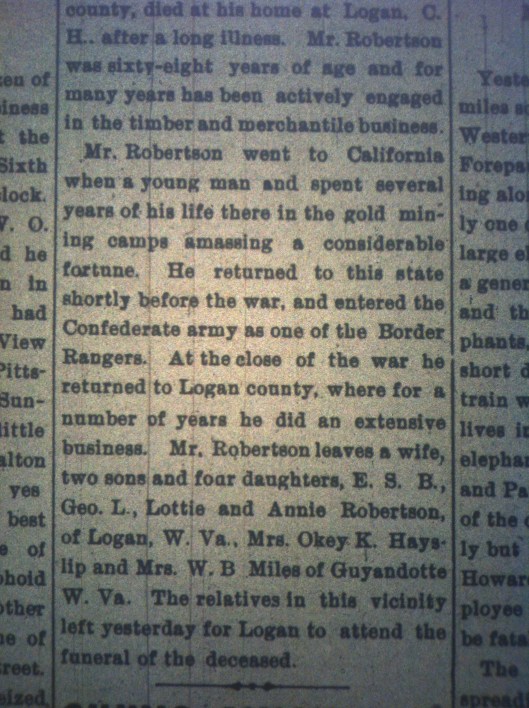
Huntington Advertiser, 26 September 1898.
13 Saturday Feb 2016
Posted in Huntington, Timber
Tags
A. Rice, Appalachia, Cabell County, Central City, D.P. Jones, Huntington Advertiser, J. Mooney, Lincoln County, Logan County, Ohio River, Sliger Lumber Company, T.P. Bowers, Thomas Sliger, timber, timbering, U.B. Buskirk, West Virginia, Wyoming County

Huntington (WV) Advertiser, 23 September 1895

Huntington (WV) Advertiser, 23 September 1895

Huntington (WV) Advertiser, 23 September 1895
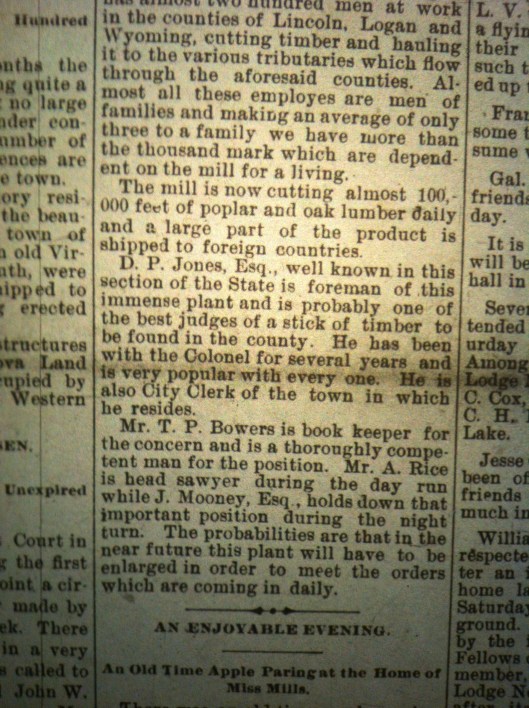
Huntington (WV) Advertiser, 23 September 1895
Writings from my travels and experiences. High and fine literature is wine, and mine is only water; but everybody likes water. Mark Twain
This site is dedicated to the collection, preservation, and promotion of history and culture in Appalachia.
Genealogy and History in North Carolina and Beyond
A site about one of the most beautiful, interesting, tallented, outrageous and colorful personalities of the 20th Century
 Brandon Ray Kirk