• About

Brandon Ray Kirk

~ This site is dedicated to the collection, preservation, and promotion of history and culture in my section of Appalachia.

Brandon Ray Kirk

Tag Archives: Aracoma

Banco News 10.08.1926

05 Thursday Apr 2018

Posted by Brandon Ray Kirk in Banco, Battle of Blair Mountain, Big Creek, Harts, Huntington, Logan, Timber

≈ Leave a comment

Tags

Anna Duty, Appalachia, Aracoma, Arnold Thomas, Banco, Battle of Blair Mountain, Big Creek, Ed Stone Branch, Eva Ellis, Fannie Brumfield, genealogy, Gladys Ferrell, Harts, Hassell Vance, Henlawson, history, Huntington, J.A. Stone, J.W. Thomas, L.P. Swentzel, Logan, Logan County, McClintock Field Company, Peach Creek, Robert Varney, timber, timbering, Trace Fork, West Virginia

An unknown correspondent from Banco on Big Creek in Logan County, West Virginia, offered the following items, which the Logan Banner printed on October 8, 1926:

Everyone is very busy in Banco at this writing.

Everything sure is lively around this town as there are three sawmills on the Ed Stone Branch.

L.P. Swentzel of Huntington who is working for the McClintock Field Company was calling in Banco last week.

Mr. and Mrs. J.A. Stone of Blair were calling in our town one day this week.

Wonder if Hassell Vance likes taffy? We believe he does as he has been visiting the taffy mill real often.

Miss Fannie Brumfield of Trace Fork left for her home at Harts Saturday accompanied by her grandmother.

Miss Eva Ellis of Ellis Fork was a business caller in Banco last Tuesday.

Miss Gladys Ferrell and two sisters of Henlawson are visiting relatives on Ed Stone Branch this week.

J.W. Thomas and son Arnold returned from a peddling tour at Peach Creek, Logan and Aracoma.

Wonder which H.F.L. likes best: the North Pole or the ‘ville?

Mrs. Anna Duty and small daughter returned from Logan where she has been visiting her daughter, Mrs. Robert Varney.

George T. Swain to Write Logan County History (1927)

04 Sunday Mar 2018

Posted by Brandon Ray Kirk in Battle of Blair Mountain, Coal, Hatfield-McCoy Feud, Logan, Native American History

≈ Leave a comment

Tags

Appalachia, Aracoma, books, coal, feuds, genealogy, George T. Swain, Hatfield-McCoy Feud, history, Kingsport, Logan, Logan Banner, Mine Wars, Native American History, Native Americans, Tennessee, West Virginia, Woodland Press

From the Logan Banner of Logan, WV, comes this item about George T. Swain’s effort to write a history of Logan County dated May 27, 1927:

New Logan County History is Written

G.T. Swain, the Author, Says It May Be Ready For Distribution In 60 Days.

Announcement was made yesterday by G.T. Swain that his manuscript, on which he has been working for the past several years, of a complete history of Logan county, is practically completed and he plans to leave here within the next ten days for Kingsport, Tenn., where he will place it in the hands of a publisher.

It is understood the book will be published with cloth binding, the cover title to be printed in gold letters, and the work will cover approximately 400 pages. It will give traditions and legends of the tribe of Indians that inhabited this valley, details of the invasion and battle here when Aracoma was killed, the early life of the pioneers and who they were, as well as incidents occurring here during the early years.

It will contain a full history of the Hatfield-McCoy feud which occurred partly on Logan soil and a full and complete account of the mine war. Organizations of the coal companies that developed the valley will be given in full and even the names of the first white male and female child born in the valley will be recorded.

In addition to the historical data which have been obtained after laborious work the book will contain biographical sketches and pictures of approximately fifty prominent men who helped in the development of the great Guyan valley coal field. The completed book is expected to be ready for distribution within 60 days.

NOTE: To order a reprint of Swain’s history book, go here: http://www.woodlandpress.com/book/local-history/history-logan-county-west-virginia

NOTE: It’s very important for local newspapers to promote works by historians/writers!

Herbert’s Greater Shows Carnival Visits Logan, WV (1917)

25 Monday Dec 2017

Posted by Brandon Ray Kirk in Logan

≈ Leave a comment

Tags

Appalachia, Aracoma, carnival, coyote, Fritz Gerber, Herbert's Greater Shows, history, Japanese Theatre, Joseph Herbert, K.F. Deskins, Logan, Logan County, Logan Democrat, minstrels, Second Virginia Regiment, West Virginia

In May of 1917, Herbert’s Greater Shows carnival visited Logan, WV, and generated several items of news in the Logan Democrat:

GOOD CARNIVAL HERE

The Herbert’s Greater Shows that have been exhibiting here for two weeks are very good, in fact high class shows.

Mr. Joseph Herbert has a reputation all over the country, excelled by no other showman, for carrying clean and up to date amusements.

The Silodrome, the feature attraction is one of the most sensational exhibitions ever witnessed by anyone. The rider, Mr. Fritz Gerber, the man with an iron nerve, is always entirely at the mercy of chance, rides the perpendicular wall with great ease and with his noted smile he always puts great thrill into the hearts of all who pay the Silodrome a visit.

The minstrels, Japanese Theatre are very good. These shows especially are equal to any of the big ones. No gambling devices are operated.

Source: Logan (WV) Democrat, 17 May 1917.

***

WANTED TO JOIN CARNIVAL

A young girl, about 15 years old, tried to hide from her father in a sewer near the power house Tuesday evening so as to run away with the carnival people. People living in the vicinity secured the help of some of those going to the circus and the young lady was induced to surrender to parental authority. When last seen, father and daughter were heading over the hill and from the faint echo of their words it was evident that the rod would not be spared when the woodshed was reached.

Source: Logan (WV) Democrat, 17 May 1917.

***

WILD ANIMAL KILLED

Soldier Shoots Coyote that Escaped From Carnival Thursday Morning

The first coyote to fall a victim of the white man’s rifle in Logan since the days when the dusty Indian maid, Aracoma, romped the hills hereabouts fell last Thursday to the accurate aim of Private Miller of the Second Virginia regiment at the power house.

The coyote belonged to Herbert’s Greater Shows. The animal escaped from his keepers and fled toward Logan. At the Power house a large pig, belonging to K.F. Deskins, suddenly appeared in the path of the coyote. The coyote decided to forego the bright lights of Logan temporarily to feast on $15 a hundred pork and in a few minutes was feasting on the fat of the land.

The pig’s squeals attracted the attention of Private Miller, who wears a medal for sharpshooting. He fired twice at a range of 100 yards and both shots took effect. The coyote keeled over dead.

Source: Logan (WV) Democrat, 24 May 1917.

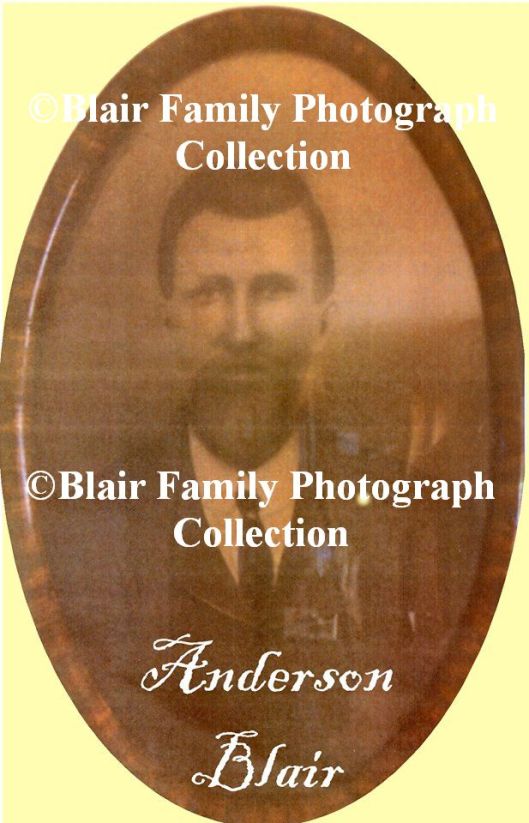
Anderson Blair

29 Sunday Oct 2017

Posted by Brandon Ray Kirk in Big Harts Creek, Cemeteries, Civil War, Lincoln County Feud, Pecks Mill, Warren, Whirlwind

≈ 2 Comments

Tags

10th Kentucky Cavalry, Anderson Blair, Appalachia, Aracoma, Barbara Kovach Morris, cemeteries, Chapmanville District, civil war, Confederate Army, Dingess Cemetery, Harts Creek, history, John Blair, John S. Blair, Logan, Logan County, Logan County Banner, Pecks Mill, photos, Polly Blair, Pop Dingess, Tommy Isaacs, Upper Hart, West Virginia

Anderson Blair copyright

Anderson Blair, son of John S. and Polly (Baisden) Blair. Photo posted online by Barbara Kovach Morris.

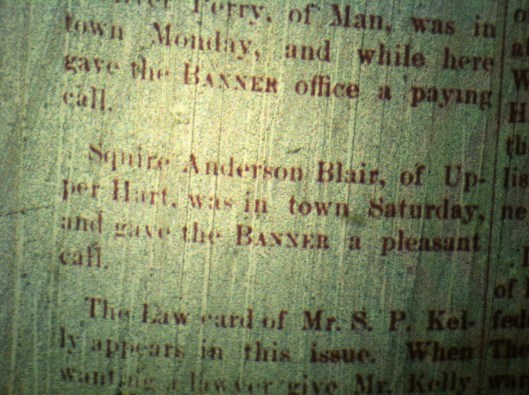
Squire Anderson Blair LCB 01.09.1890 2

Logan County Banner (Logan, WV), 9 January 1890. During the Lincoln County Feud, Anderson Blair was a justice of the peace in Chapmanville District, Logan County, WV. His district included Upper Hart.

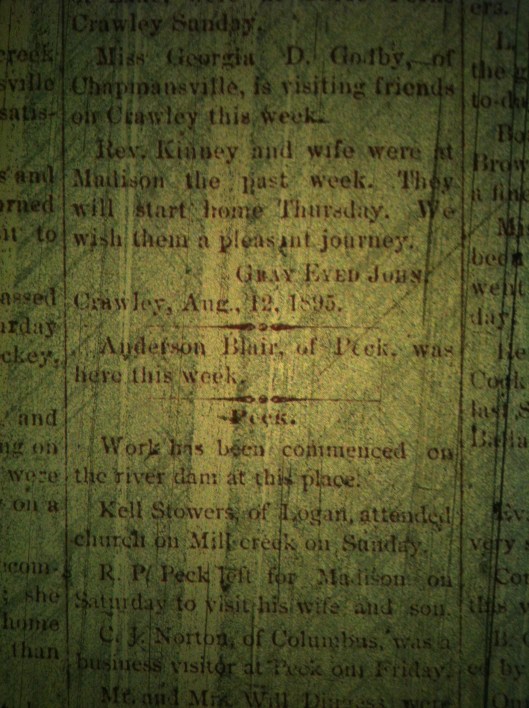
Anderson Blair LCB 08.14.1895

Logan County Banner (Logan, WV), 14 August 1895.

Anderson Blair death LCB 4.17.02

Logan County Banner (Logan, WV), 17 April 1902.

Anderson Blair grave

Dingess Cemetery, Pecks Mill, Logan County, WV. June 2016. John Blair and Tommy Isaacs installed the military headstone in May of 2014.

Busy Bee Restaurant in Logan, WV (1913)

27 Friday Oct 2017

Posted by Brandon Ray Kirk in African American History, Logan

≈ Leave a comment

Tags

Appalachia, Aracoma, Busy Bee, history, Logan, Logan Banner, Logan County, Straton Street, West Virginia

Busy Bee Advertisement LB 01.10.1913.JPG

Logan (WV) Banner, 10 January 1913.

“Ben Bolt” Not Written in Logan (1926)

15 Saturday Jul 2017

Posted by Brandon Ray Kirk in Logan

≈ Leave a comment

Tags

Alice Lawson, Aracoma, assistant postmaster, Ben Bolt, Charleston Gazette, Edgar Allan Poe, George T. Swain, George Washington, Guyandotte River, history, Karl Myers, Logan, Logan Banner, Logan County, logging, mayor, New York Mirror, Pennsylvania, poems, poetry, postmaster, rafting, Rafting on the Guyandotte, Savage Grant, St. Albans, Thomas Dunn English, timbering, Vicie Nighbert, Walt Whitman, West Virginia, writers

Thomas Dunn English (1819-1902) was a Pennsylvania-born writer who lived briefly in present-day Logan, WV, before the Civil War. At one time, many Loganites believed he wrote his famous work titled “Ben Bolt” while a resident of Logan, then called Aracoma. For more information about his biography, follow this link: https://www.wvencyclopedia.org/articles/2205

The following story appeared in the Logan Banner on November 23, 1926:

“Logan gains quite a bit of notoriety from the fact that the song ‘Ben Bolt’ was written here,” said G.T. Swain in his short history of Logan county, published in 1916. Dr. English wrote “Ben Bolt” for the New York Mirror about 10 years before he ever came to Logan. So here explodeth another nice literary myth–if a myth concerning “Ben Bolt” may be called a literary one. They even tell how Dr. English laid aside his law and medicine practice, his novel writing, and his duties as assistant postmaster and politician and dreamily to go to the shades of certain elm trees overlooking the Guyandotte and there wrote the poem to a sweetheart of other days. The truth is that English wrote the poem while in the east at the request of “The Mirror” and while trying to compose a sea song he suddenly hit upon the sentimental mood and dashed it off, tacking the first four lines of the sea song-in-the-making onto the one in question. He sent it to the editor and told him the story and remarked that if it was not worth using to burn it. It was always a matter of chagrin to Dr. English that it was the best received piece he ever wrote and his prestige in congress was largely due to his fame from the song.

“For information relating to Dr. English we are indebted to Mrs. Vicie Nighbert, who gave us the information as told to her by her mother, and to Mr. Bryan [who] was personally acquainted [with English, now in his] 80th year and living at present in Straton street,” said Mr. Swain. “Mr. Bryan was personally acquainted with Dr. English, having at one time been postmaster of the town and employed Dr. English as assistant postmaster.”

English was mayor of Logan, according to Swain, in 1852. Mr. Swain said that Dr. English suddenly disappeared while living in Logan and showed up again with a woman and two children. Dr. English announced at the time that he had married a widow but rumors around the Logan chimney corners had it that the versatile gentleman had added that of wife stealing to his accomplishments. He did not permit the woman to visit or receive but a few friends “and she always carried a look of apprehension.” It is known that English, by act of the general assembly, had the names of the children changed to his own.

Although the whole thing is not worth refuting or proving, English did not write his “Ben Bolt” as told in Logan county. Mrs. Nighbert told the author of this historical sketch that “Dr. English used to often visit the large elm trees that stood by the bank of the Guyandotte near the woman’s residence. It was beneath the shade of the elm that stands today by the railroad bridge that he composed the song ‘Ben Bolt.'” Dr. English was a frequent visitor to the home of the Lawson’s, but the story to the effect that this song was dedicated to Alice Lawson is only imaginary for there was at that time none of the Lawson children bearing the name of Alice, nor were any of the girls at that time large enough to attract the attention of Dr. English.

The “Ben Bolt” myth is comparable to the story around Charleston that Poe wrote some of his works at St. Albans. Poe was never at St. Albans. It is like that pet tradition of the Huntington D.A.R. that George Washington surveyed lands in the Savage grant, the first grants involving the present site of Huntington.

Dr. English wrote a thousand rimes and jingles and couplets but no poems. “Ben Bolt” is a spurt of sentimentality of which the author was ashamed. Its popularity began when the German air was adapted to it, and has lived only on the strength of the music which is a sort the folk will not forget.

BEN BOLT

Don’t you remember sweet Alice, Ben Bolt…

Sweet Alice whose hair was so brown.

Who wept with delight when you gave her a smile.

And trembled with fear at your frown?

In the old churchyard in the valley, Ben Bolt.

In a corner obscure and alone,

They have fitted a slab of the granite so grey,

And Alice lies under the stone.

And so forth. English was at a loss how to open the verses when he hit upon the idea of tacking the first four lines of a sea song he was trying to compose for Willis, editor of “The Mirror,” and his last lines reflect the influence of the idea:

Your presence a blessing, your friendship a truth.

Ben Bolt, of the salt sea gale.

English wrote “Rafting on the Guyandotte” and two other “poems” while waiting on the return of a friend he was visiting, taking about an hour to [write] the poem. The opening to his poem is:

Who at danger never laughed,

Let him ride upon a raft

Down Guyan, when from the drains

Pours the flood from many rains,

And a stream no plummet gauges

In a furious freshet rages

With a strange and rapturous fear

Rushing water he will hear;

Woods and cliffsides darting by,

These shall terribly glad his eye.

He shall find his life blood leaping

Feel his brain with frenzy swell;

Faster with the current’s sweeping;

Hear his voice in sudden yell…

And so on for a 100 lines or more he describes the thrills of rafting. It would be interesting to have the collectors of West Virginia verse to rise up [illegible] now and tell exactly their reaction to this “beautiful verse” and why they like it, or why they attach importance to the scribbling pastimes of Dr. English, politician, physician, and lawyer.

Although he went to congress on “Ben Bolt,” there is no legitimate claims to list him as a West Virginia poet. Karl Myers writes much better verse than English ever achieved. A sixth grade pupil of native brightness a notch or two above his classmates can write pages of rhymes as good as the rafting poem. It is the sort of rhyme that is easier to do than not to do, once you establish the swing of it. Youngsters have been known to turn in history examination papers done in rhyme as good as this. But West Virginia is so anxious to claim some poets. Why this should worry the state is a mystery, for European critics say that the whole of America has produced but a poet and a half… Edgar Allan Poe the poet and Walt Whitman the half poet. So why should we feel sensitive about it?

Source: Charleston Gazette via the Logan Banner, 23 November 1926.

William Straton Deposition (1890)

04 Sunday Jun 2017

Posted by Brandon Ray Kirk in Civil War, Logan

≈ 3 Comments

Tags

Appalachia, Aracoma, Ashland, civil war, clerk, George E. Bryan, history, Island Creek, Joseph A. Dempsey, Kentucky, lawyer, Logan, Logan County, Ralph Steel, Stuart Wood, Tazewell County, Virginia, West Virginia, William Straton

On October 7, 1890, William Straton, former clerk of Logan County, (West) Virginia, provided a deposition in a timber lawsuit. His deposition includes valuable recollections of his life during the Civil War and of the destruction of Logan County’s courthouse and records. So here it is:

Then came William Straton, another witness introduced by the plaintiff, being of lawful age and being by me first duly sworn deposes and says in answer to the following questions:

State your age, residence, and occupation?

I am 69 years old, and live at Logan Court House, W.Va., and am a lawyer.

State if you know who was clerk of the County Court of this County from 1861 to 1865?

I was the clerk during that time.

Did you have any deputy in said office during that time? If so, who?

I had a deputy, George E. Bryan. I might have some other deputy but if I did I have forgot all about it.

Which stayed in the office and attended to the business during that time, and especially in 1862, you or your said deputy George E. Bryan?

I was about the office myself very little during the year 1862, or any other time during the war. My deputy George E. Bryan stayed about here and about home more than I did, and during all of that time there was but little business done in the office anyway. It appears to me that it was in the winter 1862 and 1863 that they burned the Court House and clerk’s office.

What become of the records of marriages kept in said office in 1862?

There were some books such as deed books and order books carried to Ralph Steel’s on Island creek in the summer of 1861 and put there for safe keeping. But I don’t think the record of marriages was taken there but was left in the clerk’s office with most of the books and papers belonging to said office. I was not here at the time but the common understanding  afterwards was that all the books and papers were burned.

State if you know whether the said George E. Bryan is dead or living and if living where is he at this time?

The last I knew of him he was living at Ashland, Ky. I have never heard of his death.

Cross Examined.

Where did you live during the latter part of 1862 and the year 1863?

I lived at Logan Court House.

Where did your family live during that time?

Here.

When was it you speak of taking your family from here to Tazewell Co., Virginia?

I took my family, I think it was, in November 1862 as refugees to the County of Tazewell.

How long did your family remain there?

Until the fall of 1865.

And further this deponent saith not.

Source: Stuart Wood v. Joseph A. Dempsey (1889), Logan County Circuit Clerk’s Office, Logan, WV.

Native American Skeleton Found in Logan, WV (1893)

03 Monday Apr 2017

Posted by Brandon Ray Kirk in Civil War, Logan, Native American History, Wyoming County

≈ 2 Comments

Tags

Appalachia, Aracoma, archaeology, civil war, G.W. Lawson, history, Julia Altizer, Lincoln County, Logan, Logan County Banner, Logan Court House, Mouth of Sycamore, Native American History, Native Americans, Oceana, Stone Coal, West Virginia, Wyoming County

Indian body found LCB 08.10.1893.JPG

Logan County Banner (Logan, WV), 10 August 1893. At the time of this story, Logan was known as Aracoma or Logan Court House.

Dr. Sidney B. Lawson

01 Saturday Apr 2017

Posted by Brandon Ray Kirk in Big Sandy Valley, Logan

≈ 2 Comments

Tags

50 Years A Mountain-Country Doctor, Appalachia, Aracoma, Chloe Ann Lawson, genealogy, George W. Lawson, history, Lebanon, Lebanon Medical College, Logan, Logan County Banner, medicine, merchant, Mouth of Sycamore, Ohio, physician, Sidney B. Lawson, West Virginia

Sidney B. Lawson 11

Dr. Sidney B. Lawson, son of Dr. George W. and Chloe Ann (Robertson) Lawson. Dr. Lawson (1867-1953) began practicing medicine in Aracoma (Logan) in 1894. For more information about his life, read his autobiography: Fifty Years A Mountain-Country Doctor (self-published, Logan, WV: 1941).

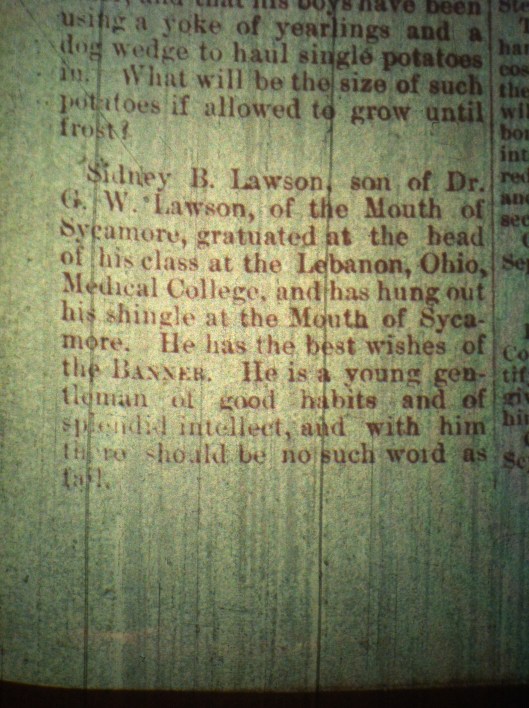
Sidney B. Lawson LCB 09.18.1890

Logan County Banner (Logan, WV), 18 September 1890.

Sidney B. Lawson LCB 12.18.1890

Logan County Banner (Logan, WV), 18 December 1890.

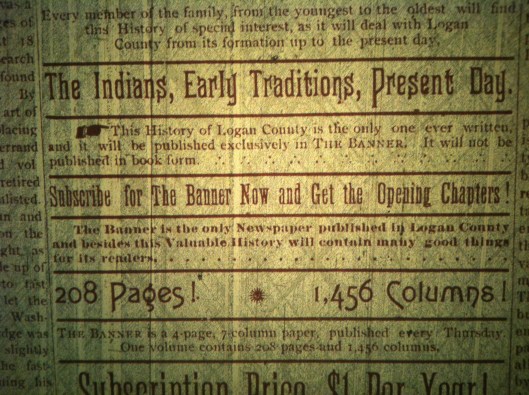
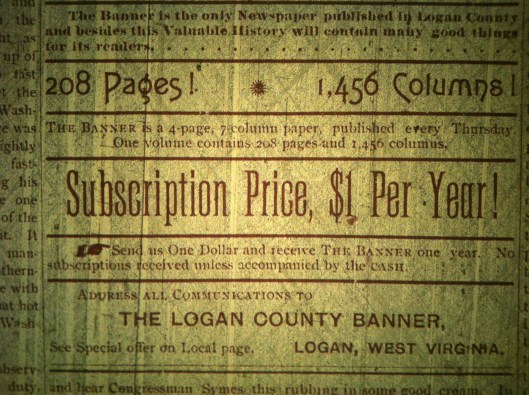
Ragland’s History of Logan County (1895)

30 Wednesday Mar 2016

Posted by Brandon Ray Kirk in Logan

≈ Leave a comment

Tags

Appalachia, Aracoma, genealogy, Henry Clay Ragland, history, Logan County, Logan County Banner, West Virginia

Ragland's History LCB 12.11.1895 1

Ragland’s History of Logan County, Logan County (WV) Banner, 11 December 1895.

Ragland's History LCB 12.11.1895 2

Ragland’s History of Logan County, Logan County (WV) Banner, 11 December 1895.

Ragland's History LCB 12.11.1895 3

Ragland’s History of Logan County, Logan County (WV) Banner, 11 December 1895.

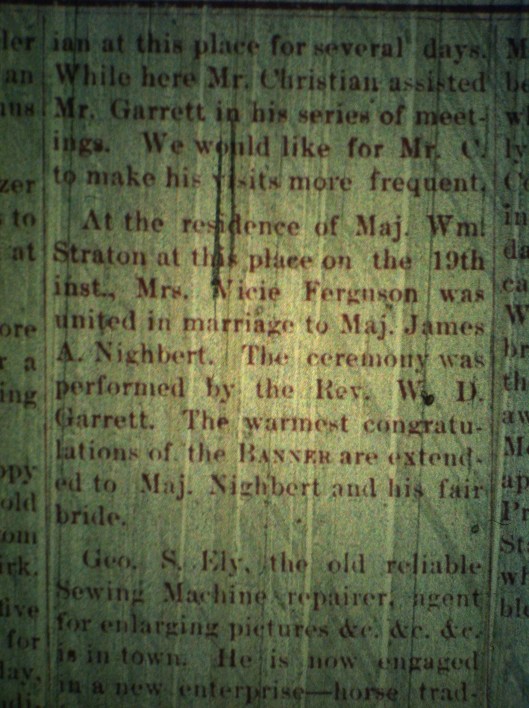
Major Nighbert marries (1889)

13 Thursday Aug 2015

Posted by Brandon Ray Kirk in Logan

≈ Leave a comment

Tags

Appalachia, Aracoma, Dyke Garrett, genealogy, history, James A. Nighbert, Logan, Logan County, Logan County Banner, U.S. South, Vicie Nighbert, West Virginia, William Straton

Major Nighbert marries LCB 12.26.1889

Logan County Banner, Logan, WV, 26 December 1889


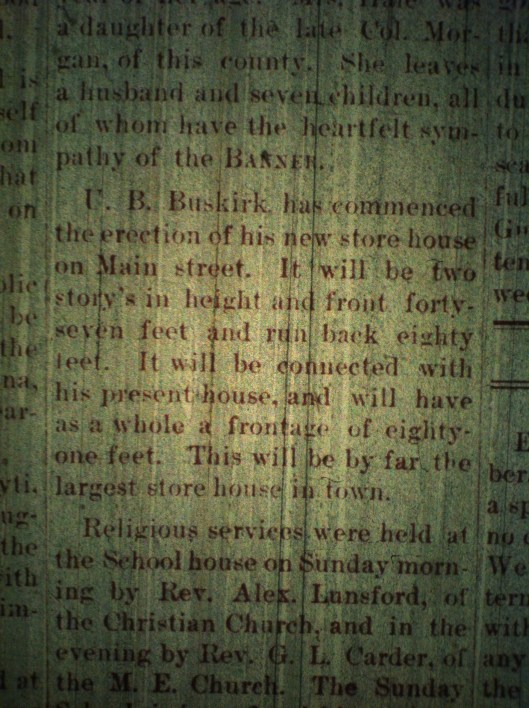
U.B. Buskirk store in Logan, WV (1889)

12 Wednesday Aug 2015

Posted by Brandon Ray Kirk in Logan

≈ Leave a comment

Tags

Appalachia, Aracoma, history, life, Logan, Logan County, Logan County Banner, Main Street, merchant, U.S. South, Urias Buskirk, West Virginia

U.B. Buskirk store LCB 12.19.1889

Logan County Banner, Logan, WV, 19 December 1889


Warren Post Office (1890)

15 Wednesday Apr 2015

Posted by Brandon Ray Kirk in Big Harts Creek, Warren

≈ Leave a comment

Tags

A.B. Lowe, Aracoma, Cabell County, Harts Creek, history, Huntington, Island Creek, Lincoln County, Logan County, Logan County Banner, mail, Mud Fork, post offices, Trace Fork, Twelve Pole Creek, Warren Post Office, Wayne, Wayne County, West Virginia

This brief editorial regarding Warren Post Office appeared in the 6 March 1890 issue of the Logan County Banner, printed in Logan, WV.

“Warren, in Lincoln county, from which all the people on Harts Creek and upper Twelve Pole receive their mail, is eighteen miles from this place, but it takes us a full week to get a letter from that place. A letter arriving to this place from Warren has to go by Brownstown, thence by the C. & O. Ry. to Huntington, thence by Wayne C.H., and thence to Warren, a distance of two hundred miles. The route from Wayne C.H. to Warren should be extended up Harts Creek and Twelve Pole and then down the Mud Fork of Island Creek to this place, with new offices at the Mouth of the Trace Fork of Harts Creek and at or near A.B. Lowe’s on Twelve Pole.”

Dr. Cecil L. Hudgins leaves Aracoma, WV (1890)

15 Sunday Mar 2015

Posted by Brandon Ray Kirk in Lincoln County Feud, Logan

≈ Leave a comment

Tags

Appalachia, Aracoma, Blood in West Virginia, Cecil L. Hudgins, doctor, genealogy, history, Hollene Brumfield, Lincoln County Feud, Logan County, Ohio, Portsmouth, West Virginia

Doc Hudgins moves LCB 09.25.1890 1

Dr. Cecil L. Hudgins leaves Aracoma, Logan County (WV) Banner, 25 September 1890. Doc Hudgins treated the wound of Hollena Brumfield in September 1889.

Thomas Dunn English obituary (1902)

25 Thursday Dec 2014

Posted by Brandon Ray Kirk in Logan

≈ Leave a comment

Tags

Appalachia, Aracoma, author, Ben Bolt, Henry Clay Ragland, history, lawyer, Logan, Logan County, Logan County Banner, New Jersey, Newark, physician, poet, statesman, Thomas Dunn English, West Virginia, writer

Thomas Dunn English obit LCB 3.13.02

Thomas Dunn English obituary, Logan County (WV) Banner, 13 March 1902

In Search of Ed Haley 335

13 Sunday Jul 2014

Posted by Brandon Ray Kirk in African American History, Ed Haley, Music

≈ Leave a comment

Tags

accordion, Aracoma, Ashland, Bill Bowler, Clayton White, Ed Haley, Ella Haley, history, Kentucky, Kiss Me Quick, Lawrence Haley, Logan, Lula Lee, Man of Constant Sorrow, Manuel Martin, Mona Haley, music, Nora Martin, Old Man Duff, Pat Haley, Soutwood Mountain, West Virginia, writing

Meanwhile, as Brandon flushed out more information about the 1889 feud, I was on the phone with Ed’s daughter, Mona Hager. In no time, she was singing “Old Man Duff”, one of Ed’s songs:

Old Man Duff was so doggone tough

That they called him dynamite.

On a mattress filled with broken glass

He rested well each night.

He combed his hair with a garden rake

And he ate his vittles raw.

He picked his teeth with a horseshoe nail

And he shaved his beard with a saw.

Old Man Duff was mighty tough

And rough as a man could be.

He had hair on his chest

And he wore no vest a

And he looked like a chimpanzee.

Old Man Duff had a daughter fair

But she died a poor old maid.

Lots of men woulda courted her

But they were all afraid.

Once old Duff seen a fella with her.

You could hear him rave and shout:

He’d put his hand down the poor man’s throat

And he’d turn him inside out.

Old Man Duff was mighty rough

And tough as a man could be.

He ate iron nails and the bones of whales

And he drank gasoline for tea.

Old Man Duff lived a thousand years

And he died and went below.

And when old Satan looked at him

He smiled and said, “Hello.”

Now the fire was mighty hot

When they put old Duff in there,

But he layed right down and he went to sleep

And it never singed a hair.

Old Man Duff was mighty rough

And tough as a man could be.

He had hair on his chest

And he wore no vest

And he looked like a chimpanzee.

Mona also remembered Ed singing “Man of Constant Sorrow”. She said Ed sometimes sang “little ditties” like with “Sourwood Mountain”. Ella did the same thing to “Kiss Me Quick”.

Kiss me quick, kiss me runnin’.

Kiss me quick ’cause my daddy’s comin’.

Love my wife, love my baby.

Love my biscuits sopped in gravy.

Ed never called square dances but would “blurt out some of the square dance reel” while fiddling.

I told Mona that I was still very interested in the source of Ed’s music.

“Pop was around a lot of blacks, you know, up in the coalfields up in West Virginia,” she said. “I even had a black nanny up there. She babysat me sometimes for Mom and Pop. Now that was at Manuel and Nora Martin’s house on the hill there at Aracoma [near Logan]. And Pop took me up to an old color lady’s bootleg joint one time somewhere up in West Virginia. And I know he was around a lot of blacks and I know that he learned some of the black’s music. They had a lot of blind friends that made music on the street, too, and one of them was Clayton White. He played an accordion. He walked up from 15th to 16th and back, you know.”

I asked Mona how many musicians were playing on the streets of Ashland in Ed’s time and she said, “Well, there was Pop and Mom, and there was Bill Bowler, and then there was a lady named Lula Lee. Now she was an illiterate woman and a lot of people got my mom and her mixed up. Mom was a cultured lady.”

I asked Mona if she thought her mother’s education rubbed off on Ed over the years and she said, “Oh, yeah. He only got uncultured when he was drinking. He talked well educated but of course he wasn’t. He was a very intelligent man.”

Mona seemed surprised when I told her that Ed could supposedly quote the Bible.

I asked her more about Ed’s and Ella’s relationship in later years and she said, “You know about me bringing him back from Logan back to Mom after they were divorced? Well, I was up there and I persuaded Pop to come home with me and I brought Pop home and he had one of those long change purses that snapped together and he had that in his pocket. And when we got home, he sit down and he was talking to Mom and he said, ‘Ella, I’ve got this plumb full of half-dollars and if you’ll let me sit by your fire this winter, I’ll give them all to you.’ I’m glad I took him home. That was when we lived on Greenup. He stayed with her until he died. Eventually Mom stayed with Lawrence and Patricia. She didn’t do any good after Pop died. She lost her friends. She didn’t have anybody to talk to.”

So after their divorce, they had a good relationship?

“They had a better relationship than they did before the divorce,” Mona said.

Aracoma, 1899

18 Wednesday Jun 2014

Posted by Brandon Ray Kirk in Logan

≈ Leave a comment

Tags

Appalachia, Aracoma, history, Logan County, Logan County Banner, temperance, U.S. South, Victorian Age, West Virginia

"What We Would Like to See in Aracoma," Logan County (WV) Banner, September 28, 1899

“What We Would Like to See in Aracoma,” Logan County (WV) Banner, September 28, 1899

In Search of Ed Haley 209

12 Thursday Dec 2013

Posted by Brandon Ray Kirk in Ed Haley

≈ Leave a comment

Tags

Al Brumfield, Appalachia, Aracoma, Ben Adams, feud, Green McCoy, Hollena Brumfield, John W Runyon, Logan County Banner, Milt Haley, Oakland House, West Virginia, writing

Thereafter, on January 9, 1890, came this powerful bit of news in soft faded print: “John Runyon, Deputy Sheriff of Lincoln county, and Benjamin Adams, of Harts Creek, registered at the Oakland House Saturday [Jan. 4]. Mr. Runyon says that every thing is quiet on Harts Creek, and thinks that the Brumfield-McCoy war is at an end.”

The implications of this tiny find were huge. First of all, John Runyon didn’t leave the Harts area for Kentucky immediately after Milt and Green’s murders, as we had been told. Secondly, he had distanced himself enough from the trouble by January of 1890 to provide the local paper a quote concerning the status of the feud. So what had happened between November 1889 when The Ceredo Advance reported the feud as having a Brumfield faction and a Runyon faction, and January 1890 when Runyon dubbed it a “Brumfield-McCoy war?” The newspapers themselves were confused because one of them said regarding the factions at work in the feud: “if two sides [it] could be said to have…”

Obviously, by January of 1890 Runyon had found a way to separate himself from the trouble, perhaps at the expense of Ben Adams. But why would he be so bold as to register at the Oakland House (a popular meeting place for timbermen) at the same time as Adams? And what was his reaction when the newspaper reported him there with “old Ben Adams”? Surely, the Brumfields and Dingesses felt their joint occupancy at the hotel was just too suspicious — as did we. No doubt, Runyon’s statement that “every thing is quiet on Harts Creek” changed immediately.

We were also fascinated by the fact that Runyon was a Lincoln County deputy-sheriff. Previously, we had only heard that Runyon was the owner of a small “grab-a-nickel” store near the mouth of Harts Creek. How did he get to be a deputy? Wouldn’t that position have been best served by someone from a large family (meaning many votes for the sheriff) and with deep roots in the area? Maybe we had underestimated Runyon. His status as a deputy-sheriff was perhaps an indicator that he had more power and was more of a threat to local businessmen and politicians like Al Brumfield than we’d figured.

Also, as an officer of the law, Runyon should have played a prominent role in settling the 1889 troubles, first in regard to Hollena and Al’s shooting, then later in regard to Milt and Green’s murder. The fact he was a local lawman and a suspect in the crime may have explained why the Brumfields resorted to using vigilante justice in handling Milt and Green. What kind of justice could they have expected from Runyon and his friends in the county seat after all, if he was an enemy or maybe even behind the hiring of Milt and Green in the first place? We wondered, did the Brumfields ask him to accompany their posse to fetch Milt and Green in Kentucky, or was he already a suspect in the crime? Obviously, there were a lot of questions along those lines.

Aracoma

29 Monday Jul 2013

Posted by Brandon Ray Kirk in Logan

≈ Leave a comment

Tags

Appalachia, Aracoma, history, life, Logan County, photos, West Virginia

Aracoma, otherwise known as Logan Court House, circa 1885

Aracoma, otherwise known as Logan Court House, circa 1885

In Search of Ed Haley 73

26 Tuesday Feb 2013

Posted by Brandon Ray Kirk in African American History, Big Harts Creek, Ed Haley, Hatfield-McCoy Feud, Logan, Music, Sports

≈ Leave a comment

Tags

Appalachia, Aracoma, Big Foot, blind, Blues, Clyde Haley, Come Take A Trip in My Airship, Coney Island, Devil Anse Hatfield, Done Got the 'Chines in My Mind, Ed Haley, Ella Haley, fiddler, Fox Cod Knob, Franklin Roosevelt, Harts Creek, Hester Mullins, Hiram Dempsey, history, Island Queen, Jack Dempsey, John Hartford, Lawrence Haley, Logan, Logan County, Mona Haley, music, mystery, Noah Haley, Nora Martin, Pink Mullins, steamboats, Trace Fork, Turkey in the Straw, West Virginia

Mona’s memories were really pouring out, about a variety of things. I asked her what Ed was like and she said, “Noah is a lot like Pop in a way. He always liked the outdoors, Pop did. He’d get out and sleep on the porch at night. He could peel an apple without breaking the skin. There was an old man up on Harts Creek and I’m almost sure that his name was Devil Anse Hatfield and Pop trimmed his fingernails out on his porch with his pocketknife. Aw, he could trim my nails or yours or anybody’s.”

Ed was good at predicting the future.

“Pop said machines was gonna take over man’s work and we was gonna go to the moon one day,” Mona said. She figured he wrote the song “Come Take A Trip in My Airship” because it sounded like his kind of foresight.

Mona said she remembered some of Ed’s stories but warned me that I wouldn’t want to hear them.

Of course, I did.

I asked her if they were off-color and she said, “Well, not really, but he was kind of an off-color guy. I can’t really remember any of the tales about him. What was that one about him dreaming he was on Fox Cod Knob and dragging a big log chain and he fell over a big cliff and when he come to hisself he was standing on his head on a chicken coop with his legs locked around a clothes line?”

What?

“He told some weird stories sometimes — ghost stories and things that I can’t remember,” she continued. “He told that story about Big Foot up in the hills of Harts Creek. A wild banshee. Pop talked about it. Clyde said he saw a Big Foot.”

Lawrence said, “It was up in the head of the Trace Fork of Harts Creek somewhere. Pop was on the back of this horse behind somebody. They was coming down through there and all at once something jumped up on back of the horse behind him and it was just rattling chains all the way down through there and the more that chain rattled the faster that horse would go. They absolutely run that horse almost to death getting away from it.”

I asked about Ed’s travels. Mona said her parents walked and hitchhiked a lot. Along the way, Ella sang to occupy the kids. Lawrence remembered buses and trains, where Ed sometimes played the fiddle for a little extra money from passengers. I asked if he ever talked about playing on any boats and Mona said, “No, but I know they did because I was with them on the ISLAND QUEEN that was going back and forth to Coney Island. Up by the calliope on the top deck.”

Mona said Ed always set up in towns near a movie theatre so the kids could watch movies.

“Every time he played he drawed a crowd,” she said. “He was loud and he was good. I never seen him play any that he didn’t have a crowd around him — anywhere.”

Ed was “all business” but would talk to people if they came up to him.

“One time we went in a beer joint up in Logan, West Virginia, that sat by the railroad tracks,” she said. “They played over at the courthouse and we walked over there. Pop wanted to get a beer while I ate supper. It was back when Roosevelt was president I reckon and he got in an argument with some guy about President Roosevelt. That was his favorite fella, you know. This guy started a fight with him and he backed off and walked away. Pop just let the man walk the length of his cane, hooked it around his neck, brought him back and beat him nearly to death. He was strong. He was dangerous if he ever got a hold of you, if he was mad at you. He always carried a pocketknife and it was sharp as a razor. He whittled on that knife — I mean, sharpened it every day.”

“Everybody liked Pop — everybody that I ever knew,” Mona said. “He had some pretty high people as friends.”

In Logan County, Ed visited Pink and Hester Mullins on Mud Fork and Rosie Day’s daughter Nora Martin in Aracoma. Mona said Ed was also friends with a famous boxer in town whose father played the fiddle, but she couldn’t remember his name. I later learned from Lawrence that it was Jack Dempsey, the heavyweight champion of the world from 1919-1926. Dempsey wrote in his biography that his father had fiddled “Turkey in the Straw” so much that all the children thought it was the National Anthem.

Ed mixed freely with some of the colored folks in Logan, and sometimes even left Mona at a “bootleg joint” operated by a black lady named Tootsie. She and Lawrence both felt Ed absorbed a lot of the Blues from the blacks in the coalfields. Mona sang one of her father’s songs — which I had never heard — to make the point:

Done got the [ma]chines in my mind, Lord, Lord.

Done got the ‘chines in my mind.

‘Chines in my mind and I can’t make a dime.

Done got the ‘chines in my mind.


My old gal got mad at me.

I never did her any harm.

‘Chines in my mind and I can’t make a dime.

Done got the ‘chines in my mind.

Newer posts →

Feud Poll 1

If you had lived in the Harts Creek community during the 1880s, to which faction of feudists might you have given your loyalty?

Categories

  • Adkins Mill
  • African American History
  • American Revolutionary War
  • Ashland
  • Atenville
  • Banco
  • Barboursville
  • Battle of Blair Mountain
  • Beech Creek
  • Big Creek
  • Big Harts Creek
  • Big Sandy Valley
  • Big Ugly Creek
  • Boone County
  • Breeden
  • Calhoun County
  • Cemeteries
  • Chapmanville
  • Civil War
  • Clay County
  • Clothier
  • Coal
  • Cove Gap
  • Crawley Creek
  • Culture of Honor
  • Dingess
  • Dollie
  • Dunlow
  • East Lynn
  • Ed Haley
  • Eden Park
  • Enslow
  • Estep
  • Ethel
  • Ferrellsburg
  • Fourteen
  • French-Eversole Feud
  • Gilbert
  • Giles County
  • Gill
  • Green Shoal
  • Guyandotte River
  • Halcyon
  • Hamlin
  • Harts
  • Hatfield-McCoy Feud
  • Holden
  • Hungarian-American History
  • Huntington
  • Inez
  • Irish-Americans
  • Italian American History
  • Jamboree
  • Jewish History
  • John Hartford
  • Kermit
  • Kiahsville
  • Kitchen
  • Leet
  • Lincoln County Feud
  • Little Harts Creek
  • Logan
  • Man
  • Matewan
  • Meador
  • Midkiff
  • Monroe County
  • Montgomery County
  • Music
  • Native American History
  • Peach Creek
  • Pearl Adkins Diary
  • Pecks Mill
  • Peter Creek
  • Pikeville
  • Pilgrim
  • Poetry
  • Queens Ridge
  • Ranger
  • Rector
  • Roane County
  • Rowan County Feud
  • Salt Rock
  • Sand Creek
  • Shively
  • Spears
  • Sports
  • Spottswood
  • Spurlockville
  • Stiltner
  • Stone Branch
  • Tazewell County
  • Timber
  • Tom Dula
  • Toney
  • Turner-Howard Feud
  • Twelve Pole Creek
  • Uncategorized
  • Warren
  • Wayne
  • West Hamlin
  • Wewanta
  • Wharncliffe
  • Whirlwind
  • Williamson
  • Women's History
  • World War I
  • Wyoming County
  • Yantus

Feud Poll 2

Do you think Milt Haley and Green McCoy committed the ambush on Al and Hollene Brumfield in 1889?

Blogroll

  • Ancestry.com
  • Ashland (KY) Daily Independent News Article
  • Author FB page
  • Beckley (WV) Register-Herald News Article
  • Big Sandy News (KY) News Article
  • Blood in West Virginia FB
  • Blood in West Virginia order
  • Chapters TV Program
  • Facebook
  • Ghosts of Guyan
  • Herald-Dispatch News Article 1
  • Herald-Dispatch News Article 2
  • In Search of Ed Haley
  • Instagram
  • Lincoln (WV) Journal News Article
  • Lincoln (WV) Journal Thumbs Up
  • Lincoln County
  • Lincoln County Feud
  • Lincoln County Feud Lecture
  • LinkedIn
  • Logan (WV) Banner News Article
  • Lunch With Books
  • Our Overmountain Men: The Revolutionary War in Western Virginia (1775-1783)
  • Pinterest
  • Scarborough Society's Art and Lecture Series
  • Smithsonian Article
  • Spirit of Jefferson News Article
  • The Friendly Neighbor Radio Show 1
  • The Friendly Neighbor Radio Show 2
  • The Friendly Neighbor Radio Show 3
  • The Friendly Neighbor Radio Show 4
  • The New Yorker
  • The State Journal's 55 Good Things About WV
  • tumblr.
  • Twitter
  • Website
  • Weirton (WV) Daily Times Article
  • Wheeling (WV) Intelligencer News Article 1
  • Wheeling (WV) Intelligencer News Article 2
  • WOWK TV
  • Writers Can Read Open Mic Night

Feud Poll 3

Who do you think organized the ambush of Al and Hollene Brumfield in 1889?

Recent Posts

  • Logan County Jail in Logan, WV
  • Absentee Landowners of Magnolia District (1890, 1892, 1894)
  • Charles Spurlock Survey at Fourteen Mile Creek, Lincoln County, WV (1815)

Ed Haley Poll 1

What do you think caused Ed Haley to lose his sight when he was three years old?

Top Posts & Pages

  • U.B. Buskirk of Logan, WV (1893-1894)
  • Vance Homeplace and Cemetery on West Fork (2017)
  • Tice Elkins in Ferrellsburg, WV
  • Alice Dingess piano
  • John Hartford's home

Copyright

© Brandon Ray Kirk and brandonraykirk.wordpress.com, 1987-2023. Unauthorized use and/or duplication of this material without express and written permission from this blog’s author and/or owner is strictly prohibited. Excerpts and links may be used, provided that full and clear credit is given to Brandon Ray Kirk and brandonraykirk.wordpress.com with appropriate and specific direction to the original content.

Archives

  • February 2025
  • January 2025
  • October 2023
  • September 2023
  • December 2022
  • November 2022
  • May 2022
  • April 2022
  • February 2022
  • November 2021
  • October 2021
  • September 2021
  • June 2021
  • May 2021
  • April 2021
  • March 2021
  • February 2021
  • January 2021
  • December 2020
  • November 2020
  • October 2020
  • July 2020
  • June 2020
  • May 2020
  • April 2020
  • March 2020
  • February 2020
  • January 2020
  • December 2019
  • November 2019
  • October 2019
  • September 2019
  • August 2019
  • July 2019
  • June 2019
  • May 2019
  • April 2019
  • March 2019
  • February 2019
  • January 2019
  • December 2018
  • November 2018
  • October 2018
  • September 2018
  • August 2018
  • July 2018
  • June 2018
  • May 2018
  • April 2018
  • March 2018
  • February 2018
  • January 2018
  • December 2017
  • November 2017
  • October 2017
  • September 2017
  • August 2017
  • July 2017
  • June 2017
  • May 2017
  • April 2017
  • March 2017
  • February 2017
  • January 2017
  • December 2016
  • November 2016
  • October 2016
  • September 2016
  • August 2016
  • July 2016
  • June 2016
  • May 2016
  • April 2016
  • March 2016
  • February 2016
  • January 2016
  • December 2015
  • November 2015
  • October 2015
  • September 2015
  • August 2015
  • July 2015
  • June 2015
  • May 2015
  • April 2015
  • March 2015
  • February 2015
  • January 2015
  • December 2014
  • October 2014
  • September 2014
  • August 2014
  • July 2014
  • June 2014
  • May 2014
  • April 2014
  • March 2014
  • February 2014
  • January 2014
  • December 2013
  • November 2013
  • October 2013
  • September 2013
  • August 2013
  • July 2013
  • June 2013
  • May 2013
  • April 2013
  • March 2013
  • February 2013
  • January 2013
  • December 2012
  • November 2012

Enter your email address to follow this blog and receive notifications of new posts by email.

Join 2,925 other subscribers

Tags

Appalachia Ashland Big Creek Big Ugly Creek Blood in West Virginia Brandon Kirk Cabell County cemeteries Chapmanville Charleston civil war coal Confederate Army crime culture Ed Haley Ella Haley Ferrellsburg feud fiddler fiddling genealogy Green McCoy Guyandotte River Harts Harts Creek Hatfield-McCoy Feud history Huntington John Hartford Kentucky Lawrence Haley life Lincoln County Lincoln County Feud Logan Logan Banner Logan County Milt Haley Mingo County music Ohio photos timbering U.S. South Virginia Wayne County West Virginia Whirlwind writing

Blogs I Follow

  • OtterTales
  • Our Appalachia: A Blog Created by Students of Brandon Kirk
  • Piedmont Trails
  • Truman Capote
  • Appalachian Diaspora

BLOOD IN WEST VIRGINIA is now available for order at Amazon!

Blog at WordPress.com.

OtterTales

Writings from my travels and experiences. High and fine literature is wine, and mine is only water; but everybody likes water. Mark Twain

Our Appalachia: A Blog Created by Students of Brandon Kirk

This site is dedicated to the collection, preservation, and promotion of history and culture in Appalachia.

Piedmont Trails

Genealogy and History in North Carolina and Beyond

Truman Capote

A site about one of the most beautiful, interesting, tallented, outrageous and colorful personalities of the 20th Century

Appalachian Diaspora

  • Subscribe Subscribed
    • Brandon Ray Kirk
    • Join 787 other subscribers
    • Already have a WordPress.com account? Log in now.
    • Brandon Ray Kirk
    • Subscribe Subscribed
    • Sign up
    • Log in
    • Report this content
    • View site in Reader
    • Manage subscriptions
    • Collapse this bar
 

Loading Comments...