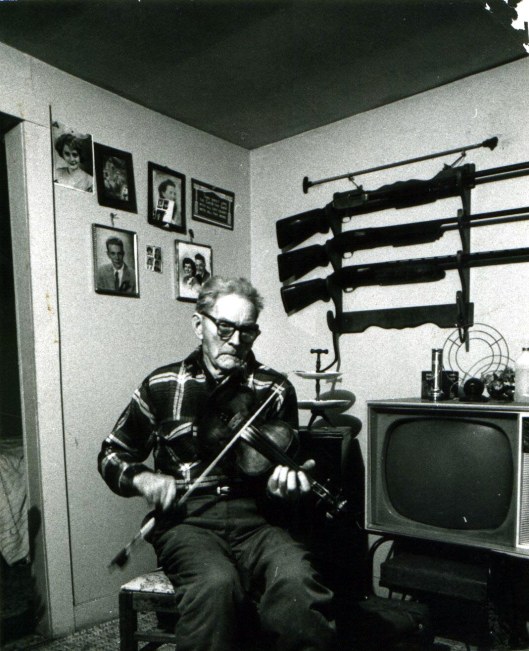
Ward Jarvis, fiddler from Braxton County, WV.

28 Thursday Mar 2013
Ward Jarvis, fiddler from Braxton County, WV.
28 Thursday Mar 2013
Posted in Big Harts Creek, Ed Haley, Green Shoal, Lincoln County Feud, Spottswood
Tags
Alice Baisden, Appalachia, blind, Cas Baisden, Clifton Mullins, Clyde Haley, Dicy Baisden, Ed Haley, Ella Haley, Green Shoal, Harts Creek, Hazard, history, Imogene Haley, John Hartford, John Henry, Kentucky, Lawrence Haley, Lincoln County Feud, Liza McKenzie, Liza Mullins, Loretta Mullins, Mag Farley, Milt Haley, Perry County, Peter Mullins, Sol Bumgarner, Trace Fork, West Virginia
We found Bum on our way up the hollow and went to sit on his porch with his aunt, Liza McKenzie, two of his sisters, Alice and Dicy — and of course Shermie. As soon as Liza figured out who we were she looked at Lawrence and said he was just a small boy the last time she’d seen him.
“Yeah, I guess around 1940 or ’41 was the last time I come to this area,” Lawrence said.
Liza said, “Well, I lived in Kentucky about sixty years. Perry County, up in Hazard.”
I said to her, “Is that where Milt Haley was from?” and she said, “I don’t know but now Ed Haley was borned and raised right around here. When he was a boy, he got up on top of that house down there where Aunt Mag used to live — in that old two-story house — and rolled off in a box. Mother said, ‘Lord, Ed, are you hurt?’ He said, ‘No, God no. It’s give me eyesight.’ He said he jarred his eyesight back.”
I liked Liza right away.
I asked her if she had any pictures and she said, “Loretta’s mother had all the pictures of Ed Haley I ever did know. They used to have a picture down there at Loretta’s of Ed’s mother. She was a pretty woman.”
She looked at Clifton and said, “Clif, I believe your mother had a picture of Ed Haley that was made down there at the old home where he was born and raised. Down there where Aunt Mag used to live. I know they had them.”
Clifton remembered it.
“Yeah, they was sitting out in the yard,” he said. “They was together. She was in the chair and he was standing. He didn’t have no pants on.”
Clifton said, “Yeah, you’re right. They was a picture down there. But I looked; they was so many pictures in that box.”
Box of pictures? I thought.
Before I could ask about them, Clifton said, “There’s one down there faded out. It’s in a big frame. I got it in another building.”
He told me, “I can show them to ya.”
About that time, Cas Baisden came up to the porch. Bum said he was Liza’s 83-year-old twin brother. I asked Cas if he remembered Ed and he said, “I knowed him, yeah. He was raised up here. Old man Peter lived down at the mouth of the holler and his boy lived up the road here and old man Ed’d go up there and he’d come down that road a running and jumping just like he could see and cut the awfulest shine that ever was.”
Lawrence joked, “That’s probably how Clyde got to be the way he was.”
Cas said, “Yeah, I guess Clyde took after him. Clyde went out here and got down in a well once and they had the awfulest time that ever was getting him out. Way back in top of a mountain.”
I asked Cas about the first time he ever saw Ed and he said, “It’s been many a year ago. He stayed down here, him and his wife and them. They’d play music and drink and fight and scratch with one another and them boys was so mean… He’d get so drunk he couldn’t walk.”
Bum knew that Ed was real “easy to get mad about music,” but said he could get him to play nearly anything he wanted because Ed liked him. He’d ask Ed to play something like “John Henry” and he’d say, “Are you sure that’s what you want me to play? You know, I was just thinking about playing that.” If Ed didn’t like someone Bum said he’d “goof around” and not play for them.
Things kinda tapered off after that. Nobody knew anything about Ed having any brothers. Cas had heard about Ed’s father, who he thought was named Green.
“You know, he got killed when I was a little fella, I guess,” Cas said. “His name was Green. They took him over yonder on Green Shoal, they said, and killed him. Walked him down here and up Smoke House and over and down Piney and across the river.”
I asked if Lawrence looked like Ed and Liza said, “Yes, he does. Ed was a bigger man than he is. Ed was a big man.”
But Lawrence looks like Ed in the face?
“Yeah, he looks like him all over.”
Cas said, “Ed was a taller man. I guess he takes after his mother. She’s a little short woman.”
Lawrence agreed: “Yeah, she was about five feet tall — not much bigger than Aunt Liza.”
26 Tuesday Mar 2013
Posted in Big Harts Creek, Ed Haley, John Hartford, Lincoln County Feud, Spottswood
Tags
Appalachia, culture, Ed Haley, genealogy, Harts Creek, history, John Hartford, life, Logan County, photos, Sol Bumgarner, Trace Fork, U.S. South, West Virginia

Sol Bumgarner, a key source of information about Ed Haley and the history of Trace Fork of Harts Creek, Logan County, WV, 1993
26 Tuesday Mar 2013
Posted in Big Harts Creek, Ed Haley, John Hartford, Music, Spottswood
Tags
Appalachia, Clifton Mullins, Connie Mullins, Crawley Mountain, Ed Haley, Enslow Baisden, fiddle, Harts Creek, history, Joe Mullins, John Hartford, Lawrence Haley, Logan County, Loretta Mullins, Peter Mullins, Sol Bumgarner, Trace Fork, Turley Adams, West Virginia
I told Turley that Lawrence and I needed to visit Joe Mullins, who had been gone during our last trip to Harts Creek. Turley completely deflated us: Joe, he said, had recently suffered a stroke. He now lived with his daughter Connie Mullins in a trailer just up the creek. Turley pointed the way. Driving a short distance, Lawrence and I parked our car by the creek and walked over a little narrow bridge where an army of barking dogs greeted us. At the porch, Connie introduced us to her brother, Clifton. We stepped on inside and found Joe seated in a wheelchair, surrounded by more dogs. His mind — or at least his ability to communicate a great deal — was all but gone due to the lingering effects of his stroke. Lawrence sat next to him with his hand on his arm. Almost in tears over Joe’s condition, he tried to rekindle Joe’s memories by saying, “I’m Ed Haley’s boy.”
I hung out with Joe’s kids — Connie, Clifton and Loretta. While all were reasonably young, Clifton and Connie had Parkinson’s Disease.
“They’s four of us got it,” Clifton said. “They said it runs through the family some way another. Musta come down the tree somewhere.”
I asked him how old he was.
“38,” he said.
Clifton had just moved back to Harts.
“I got hurt in Michigan and Daddy was sick so I said, ‘Well, it’s a good chance for me to go help my daddy and my sisters.'”
Clifton’s sisters said he was the one who found Ed’s smashed fiddle years ago in the rafters of Uncle Peter’s old smokehouse.
“I was up in there — we was playing around one day — and it fell out on me,” he said. “And I just looked at it and I said, ‘Well, I’ll try to glue it together.’ I started gluing it and it wouldn’t glue so I dumped it into the creek. I didn’t know whose it was. I was about eight but all the pieces wasn’t there to it. When it hit that guy it just splintered everywhere.”
Clifton suggested that we visit Bum and his family just up the hollow. Two years earlier, Bum had told originally Lawrence and I how he had witnessed Ed smash the fiddle over a man’s head while at a tavern on Crawley Mountain. Bum lived only a short distance from Joe’s trailer, up the hollow past Uncle Peter’s old homeplace, in a house situated near Enslow Baisden’s log cabin.
18 Monday Mar 2013
Posted in Clay County, Ed Haley, Music
Tags
Appalachia, Clay County, culture, fiddler, French Carpenter, history, music, photos, West Virginia
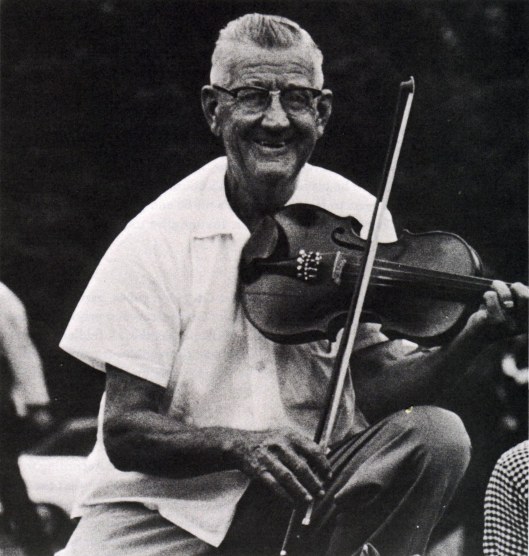
French Carpenter, fiddler in Clay County, WV.
15 Friday Mar 2013
Tags
Al Brumfield, Appalachia, feud, Harts Creek, Hollene Brumfield, John Hartford, Lawrence Haley, Lawrence Kirk, Peter Mullins, timbering, West Virginia, writers, writing
Mr. Kirk hopped in the car with Lawrence Haley and I and guided us to “Presto’s garden,” a small corn patch located just off of the hill from the Haley-McCoy grave. It was late afternoon: the air was clear and the remains of the sun slanted through the trees on the hillside. Lawrence Haley chose to stay at the garden due to his heart condition, but I made the steep climb toward the grave with Mr. Kirk just behind me. A few minutes later, we stopped at an indentation — a round shallow crater about seven feet in diameter. It had a little pile of stones on each end and was just as Bob Adkins had said it would be. We walked back and forth studying the “bowl” and the markers and I took some pictures.
At the bottom of the hill, we got back in the car and rode up Low Gap Road to the site of Milt Haley’s murder. On the way, I told Mr. Kirk what we’d heard about Ed’s mother Emma Jean Mullins being shot in the face.
“See, I hadn’t heard that part of it,” he said. “Well now, you know them Adamses and Mullinses up there on Hart married back and forth for generations. That’s quite possible. Of course, them Brumfields and them Adamses had trouble over that log boom they had had there at the mouth of Hart. It’d catch water and hold it back like a dam. They’d float them logs all out of Harts Creek back in yonder, then when the backwater come up in the spring of the year they’d make them into a raft and float them out of here and take them to the town of Guyandotte. That’s the market. They claimed the Brumfields got to sawing the ends of them logs off and re-branding them. I don’t know what the extent of their trouble was but they had some misunderstanding over that lumber and then Runyon and whiskey got involved in it down on that houseboat where they’s selling whiskey. All of them drinking, you know. They’d all go down there and get drunk and talk this shit up, you know, and get it started, get it going, down there where the booze was. Things were getting out of hand. Whiskey’s destroyed an awful lot of people in this country. A lot of my relatives.”
Mr. Kirk said, “They’s supposed to killed them at daylight or immediately after daylight. The story that I’ve heard on it has been that they were both knocked in the head with the flat side of a double-bit axe. Killed them separately. Hit them right in the top of the head there. And I’ve heard people say they was shot up you know, and some said they were chopped up with an axe. But my grandmother, she was awful critical of the Brumfields and their conduct. She was an Adkins — part Dingess. Bill Brumfield’s widow. By her being pretty critical of them, I feel like she handed me what she had as being true. But now they was organized into kind of a posse. She said they called theirselves ‘The Night Riders.’ Vigilante group. Operated all the time at night. They were pretty sneaking in what they did.”
They must’ve had some serious shortcomings, because Mr. Kirk said they “tried to organize themselves into the Klan, but the Klan wouldn’t have them.”
After surveying the site of Milt’s murder, we drove down to the mouth of Harts Creek where Mr. Kirk pointed out the site of the recently burned Al Brumfield house.
“Except being a landmark, it wasn’t worth much,” he said. “They used to have a meal-house out there to ground meal for people. Had a store in here. That’s Al Brumfield and Aunt Hollene. He was in his fifties when he died of typhoid fever. Watson Adkins later bought his house and lived there. Had a store over here for years. Now, Runyon had a boat down yonder — great big boat — barge built in there and had a store in it. He run poker games. Selling whiskey. Had a few groceries in there. Al and his bunch trying to do the same thing over here.”
All during our ride with Mr. Kirk, he kept pointing out spots where murders had taken place. As we made our way back up West Fork, I asked him why there’d been so many killings around Harts Creek. He didn’t hesitate in saying, “Whiskey. Whiskey’s caused it. This section of country up through here — this West Fork section — has had a few killings. It wasn’t as bad as back yonder. Whiskey involved in every bit of that.”
Lawrence Haley agreed that whiskey was the primary cause of trouble in the old days, even mentioning how one of Uncle Peter Mullins’ boys once killed a “revenue man” around Trace Fork. He said it “it took just about everything Uncle Peter had to keep him out of jail.”
Mr. Kirk said, “Is that the one they called ‘Reel-Footed’ Peter? Ewell’s daddy?”
Lawrence confirmed that it was — and that it was his great-uncle — and Mr. Kirk said, “I can remember old man Peter. I believe it was his right foot that was curled in. Man, he’d work in the woods, draw a team…”
10 Sunday Mar 2013
Posted in Music
Tags
Appalachia, banjo, culture, fiddle, fiddler, history, life, music, photos, Telmage Godfrey, U.S. South, West Virginia, William Bertie Lester, Wyoming County

Telmage Godfrey and William Bertie Lester of Wyoming County, 1922
10 Sunday Mar 2013
Posted in Culture of Honor, Whirlwind
Tags
Appalachia, culture, genealogy, Harts Creek, history, Logan County, photos, U.S. South, West Virginia, Whirlwind

Couple from Whirlwind, West Virginia, 1890-1915
06 Wednesday Mar 2013
Posted in Ashland, Cemeteries, Ed Haley, Music
Tags
Allie Trumbo, Appalachia, Ashland, Ashland Cemetery, Bath Avenue, Boyd County, Calvary Episcopal Church, Cincinnati, Cleveland, Clyde Haley, Ed Haley, Ella Haley, Francis M. Cooper, genealogy, history, Huntington, Jack Haley, John Hartford, Kentucky, Lawrence Haley, Lezear Funeral Home, Michigan, Minnie Hicks, Mona Haley, Morehead, Noah Haley, Ohio, Patsy Haley, South Point, William Trumbo
After Ed’s death, Ella lived with Lawrence and his family in Ashland. Every Thursday, she went to Cincinnati where she sold newspapers until Saturday. On Saturday nights, Lawrence would meet her at the bus station in Ashland and bring her home. She and Lawrence would then go into her bedroom where she would empty out her bounty from special slips Aunt Minnie had sewn into her bodice and count her money. It was somewhat of a humbling job for Ella; her own brother Allie Trumbo would call her “Penny Elly” and tease her for taking in pennies and nickels at Cincinnati. The whole experience came to a humiliating end when she “wet” on herself at the bus depot one afternoon. Apparently, no one would help her to a bathroom.
Pat said Ella took to her bed shortly afterwards and didn’t live much longer.
The day after Thanksgiving in 1954, Ella died of a stroke while staying with Jack and Patsy in Cleveland. Lawrence showed me her obituary from a Huntington newspaper:
HALEY – Funeral services for Mrs. Martha Haley, 66, 4916 Bath Avenue, who died Friday night at the home of a son, Allen Haley, at Cleveland, O., will be held today at 3:30 P.M., at the Lezear Funeral Home by the Very Rev. Francis M. Cooper, rector of the Calvary Episcopal Church. Burial will be in Ashland Cemetery. The body is at the funeral home.
Mrs. Haley suffered a stroke while visiting her son. She was born July 14, 1888, at Morehead, Ky., a daughter of Mr. and Mrs. William Trumbo.
Surviving are three other sons, Lawrence Haley, Ashland, Noah E. Haley, Cleveland, and Clyde F. Haley, Michigan; one daughter, Mrs. Mona Mae Smith, South Point, O.; a brother, Allie Trumbo, Cincinnati; and nine grandchildren.
Sensing that Ella’s death might be a sensitive subject, I just kind of left it at that.
04 Monday Mar 2013
Posted in Big Harts Creek, Ed Haley, Music
Tags
Appalachia, banjo, Boone County, Ed Haley, fiddler, genealogy, history, Johnny Hager, Logan County, music, photos, U.S. South, West Virginia
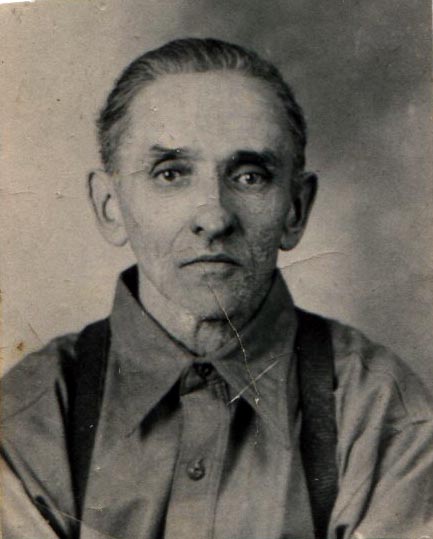
Johnny Hager (1876-1955), a banjo player and fiddler who lived in Boone County, West Virginia
04 Monday Mar 2013
Tags
Appalachia, banjo, Big Rock Candy Mountain, bowing, Calhoun County Blues, Carroll County Blues, Ed Haley, fiddler, fiddling, Ghost Riders in the Sky, Hell Among the Yearlings, history, John Hartford, Mona Haley, music, Pretty Polly, Soutwood Mountain, Sweet Betsy from Pike, Ugee Postalwait
Talking about Ed’s records caused me to ask Mona about his technique and tunes. She said her father was a long bower – that he used “one end of the bow to the other,” except on songs requiring short, quick strokes. Interestingly, she had no recollection of him ever “rocking” the fiddle while playing (as is so fondly remembered by some eyewitnesses) and said he patted his foot softly in half-time (never picking up his whole foot and stomping). He didn’t keep a chin rest on his fiddle because “it got in his way.”
Mona said Ed knew “millions” of pieces, including “Hell Among the Yearlings” (her favorite), “Big Rock Candy Mountain” and “Sourwood Mountain”. She recognized “Carroll County Blues” (what Ugee Postalwait called “Calhoun County Blues”) as a Haley tune when I played it for her. She said Ed played “Pretty Polly” and “Sweet Betsy from Pike” drop-thumb style on the banjo (no fingerpicks). He loved “Ghost Riders in the Sky” — which he never could learn — and would say of the tune, “Lord god almighty, would you listen to that?” When Ed thought about or heard a tune he liked, Mona said he would pat his hands together.
26 Tuesday Feb 2013
Posted in Timber
Tags
Appalachia, culture, history, life, logging, photos, timbering, U.S. South, West Virginia
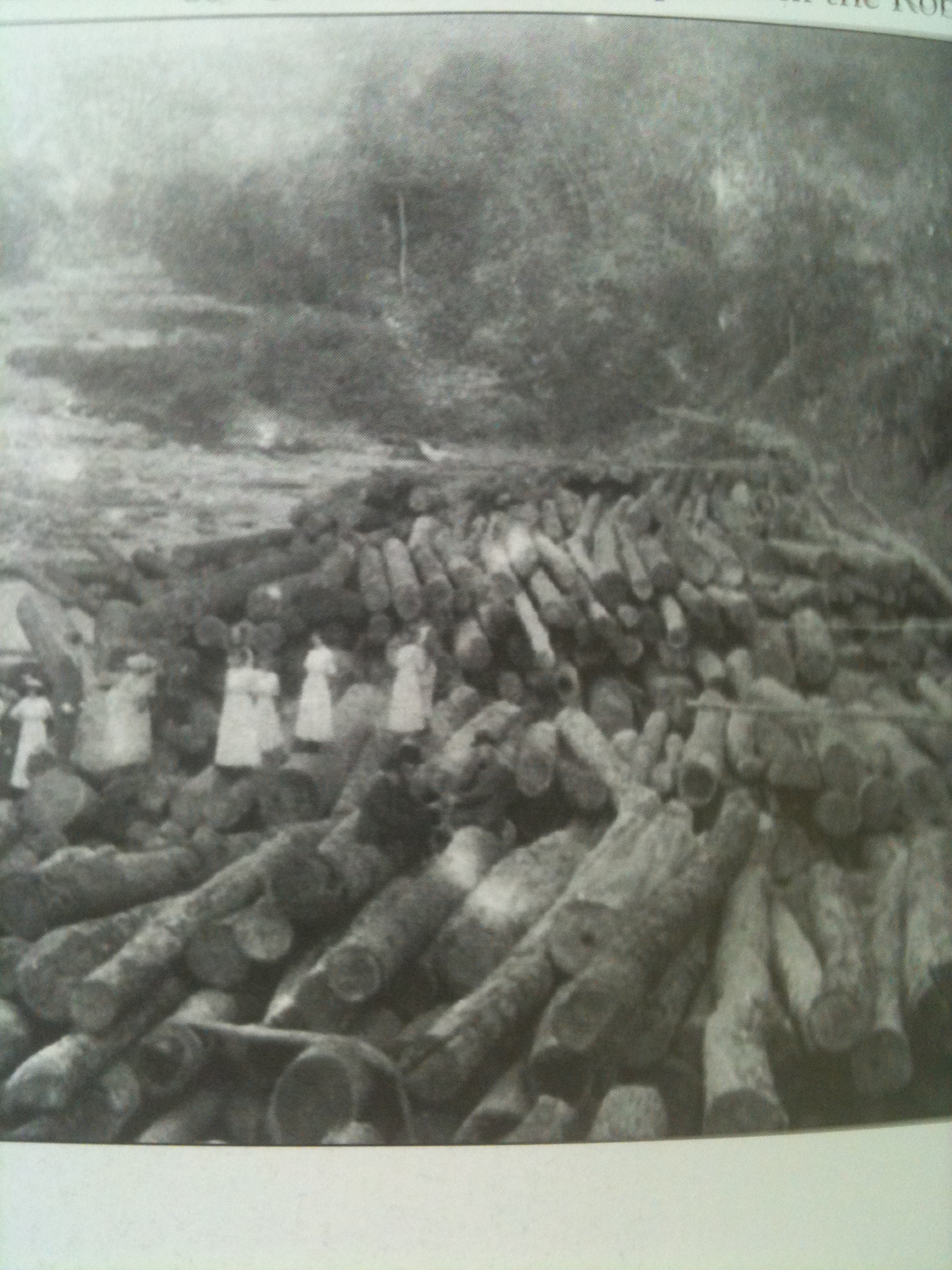
1885-1920
26 Tuesday Feb 2013
Posted in African American History, Big Harts Creek, Ed Haley, Hatfield-McCoy Feud, Logan, Music, Sports
Tags
Appalachia, Aracoma, Big Foot, blind, Blues, Clyde Haley, Come Take A Trip in My Airship, Coney Island, Devil Anse Hatfield, Done Got the 'Chines in My Mind, Ed Haley, Ella Haley, fiddler, Fox Cod Knob, Franklin Roosevelt, Harts Creek, Hester Mullins, Hiram Dempsey, history, Island Queen, Jack Dempsey, John Hartford, Lawrence Haley, Logan, Logan County, Mona Haley, music, mystery, Noah Haley, Nora Martin, Pink Mullins, steamboats, Trace Fork, Turkey in the Straw, West Virginia
Mona’s memories were really pouring out, about a variety of things. I asked her what Ed was like and she said, “Noah is a lot like Pop in a way. He always liked the outdoors, Pop did. He’d get out and sleep on the porch at night. He could peel an apple without breaking the skin. There was an old man up on Harts Creek and I’m almost sure that his name was Devil Anse Hatfield and Pop trimmed his fingernails out on his porch with his pocketknife. Aw, he could trim my nails or yours or anybody’s.”
Ed was good at predicting the future.
“Pop said machines was gonna take over man’s work and we was gonna go to the moon one day,” Mona said. She figured he wrote the song “Come Take A Trip in My Airship” because it sounded like his kind of foresight.
Mona said she remembered some of Ed’s stories but warned me that I wouldn’t want to hear them.
Of course, I did.
I asked her if they were off-color and she said, “Well, not really, but he was kind of an off-color guy. I can’t really remember any of the tales about him. What was that one about him dreaming he was on Fox Cod Knob and dragging a big log chain and he fell over a big cliff and when he come to hisself he was standing on his head on a chicken coop with his legs locked around a clothes line?”
What?
“He told some weird stories sometimes — ghost stories and things that I can’t remember,” she continued. “He told that story about Big Foot up in the hills of Harts Creek. A wild banshee. Pop talked about it. Clyde said he saw a Big Foot.”
Lawrence said, “It was up in the head of the Trace Fork of Harts Creek somewhere. Pop was on the back of this horse behind somebody. They was coming down through there and all at once something jumped up on back of the horse behind him and it was just rattling chains all the way down through there and the more that chain rattled the faster that horse would go. They absolutely run that horse almost to death getting away from it.”
I asked about Ed’s travels. Mona said her parents walked and hitchhiked a lot. Along the way, Ella sang to occupy the kids. Lawrence remembered buses and trains, where Ed sometimes played the fiddle for a little extra money from passengers. I asked if he ever talked about playing on any boats and Mona said, “No, but I know they did because I was with them on the ISLAND QUEEN that was going back and forth to Coney Island. Up by the calliope on the top deck.”
Mona said Ed always set up in towns near a movie theatre so the kids could watch movies.
“Every time he played he drawed a crowd,” she said. “He was loud and he was good. I never seen him play any that he didn’t have a crowd around him — anywhere.”
Ed was “all business” but would talk to people if they came up to him.
“One time we went in a beer joint up in Logan, West Virginia, that sat by the railroad tracks,” she said. “They played over at the courthouse and we walked over there. Pop wanted to get a beer while I ate supper. It was back when Roosevelt was president I reckon and he got in an argument with some guy about President Roosevelt. That was his favorite fella, you know. This guy started a fight with him and he backed off and walked away. Pop just let the man walk the length of his cane, hooked it around his neck, brought him back and beat him nearly to death. He was strong. He was dangerous if he ever got a hold of you, if he was mad at you. He always carried a pocketknife and it was sharp as a razor. He whittled on that knife — I mean, sharpened it every day.”
“Everybody liked Pop — everybody that I ever knew,” Mona said. “He had some pretty high people as friends.”
In Logan County, Ed visited Pink and Hester Mullins on Mud Fork and Rosie Day’s daughter Nora Martin in Aracoma. Mona said Ed was also friends with a famous boxer in town whose father played the fiddle, but she couldn’t remember his name. I later learned from Lawrence that it was Jack Dempsey, the heavyweight champion of the world from 1919-1926. Dempsey wrote in his biography that his father had fiddled “Turkey in the Straw” so much that all the children thought it was the National Anthem.
Ed mixed freely with some of the colored folks in Logan, and sometimes even left Mona at a “bootleg joint” operated by a black lady named Tootsie. She and Lawrence both felt Ed absorbed a lot of the Blues from the blacks in the coalfields. Mona sang one of her father’s songs — which I had never heard — to make the point:
Done got the [ma]chines in my mind, Lord, Lord.
Done got the ‘chines in my mind.
‘Chines in my mind and I can’t make a dime.
Done got the ‘chines in my mind.
My old gal got mad at me.
I never did her any harm.
‘Chines in my mind and I can’t make a dime.
Done got the ‘chines in my mind.
24 Sunday Feb 2013
Posted in Music
Tags
Appalachia, banjo, culture, history, music, photos, U.S. South, West Virginia, William Bertie Lester, Wyoming County
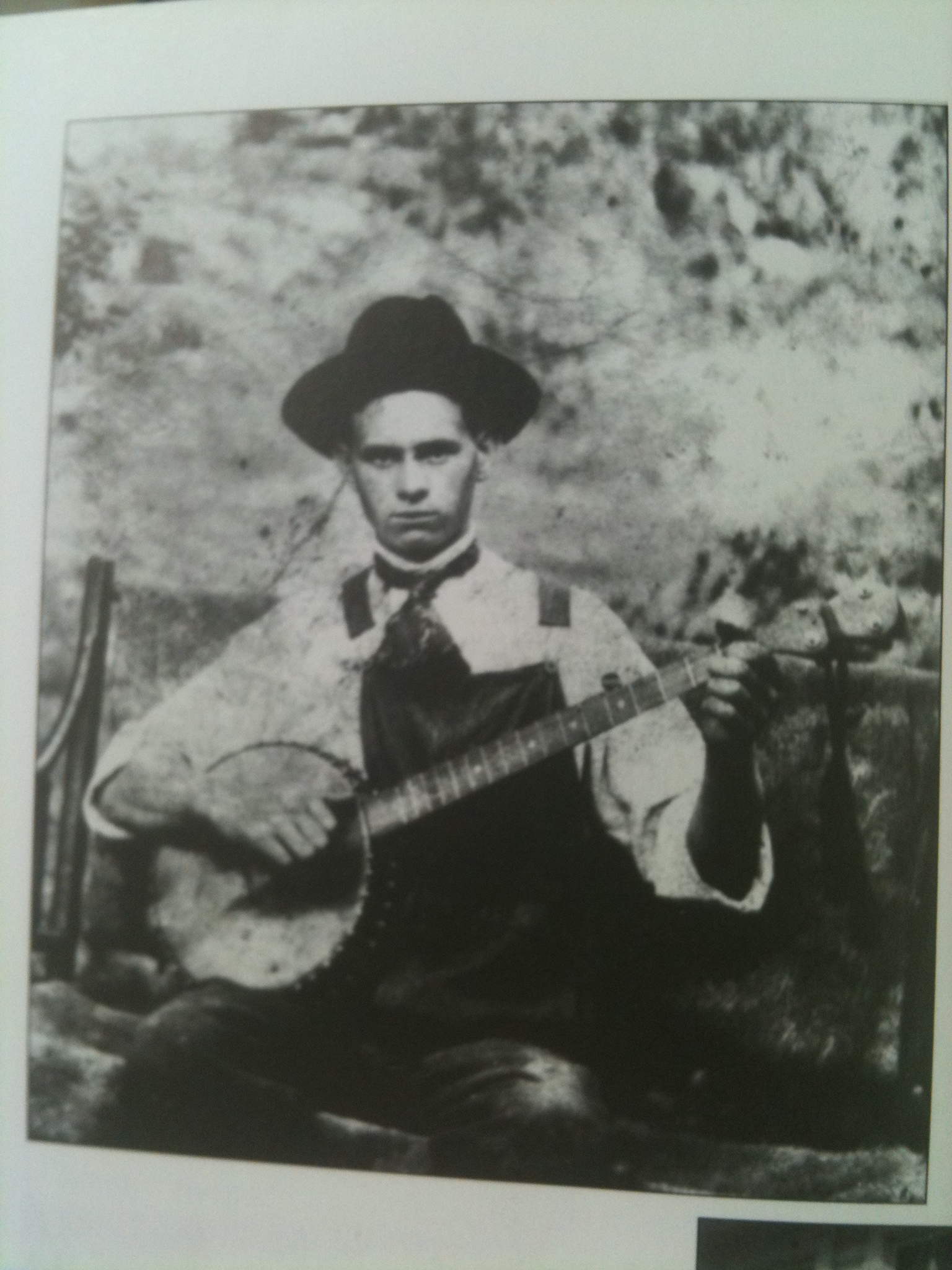
William Bertie Lester, Wyoming County, 1900-1925
21 Thursday Feb 2013
Posted in Ed Haley, Women's History
Tags
Appalachia, blind, Ella Haley, genealogy, history, Kentucky, Lexington, photos, U.S. South

Ella Trumbo postcard, c.1910
21 Thursday Feb 2013
Posted in Ed Haley
Tags
Appalachia, Ashland, banjo, Bonaparte's Retreat, Ed Haley, fiddler, history, John Hartford, Kentucky, Lawrence Haley, music, Pat Haley, Red Apple Rag, U.S. South, writing
That night, I played some of Ed’s tunes for Lawrence in his kitchen. In spite of the great story opening up about Milt Haley, I didn’t lose sight of the music and my quest to understand it. As I played, Lawrence was brutally honest.
“Notice how you’re using a fourth of the bow?” he said. “Pop played all over it.”
“Did you hear a few real strong driving notes in that and then some really weak ones that didn’t hardly get out?” he asked.
“Pretty good — but never just like my dad,” he stated flatly.
The closest I came to gaining his approval was when I played “Bonaparte’s Retreat”.
“You got a pretty good version of that,” he said. “Nothing too wrong with that.”
“Your cannons sounded very good,” Pat added politely.
When I played Ed’s “Red Apple Rag”, Lawrence said there was one part — what I call the “House of David Blues” part — that didn’t belong in the song, even though I knew Ed had played it there in the home recordings. He remembered his father playing “House of David Blues” as a separate tune and singing:
Bring it on down to my house honey,
Ain’t nobody home but me.
Bring it on down to my house honey,
I need the company.
Now a nickel is a nickel
And a dime’s a dime.
You show me yours and I’ll show you mine.
Bring it on down to my house honey,
Ain’t nobody home but me.
I asked again about Haley’s banjo and Pat said she remembered that it was still around when she first came to Ashland in the late 1940s. She thought it belonged to Ella, but Lawrence said, “No, Mom played what they call a banjo-mandolin. It wasn’t too many years that I remember her playing one. Pop probably had a banjo. He’d just as soon sit down and play the banjo a lot of times. Or he’d play the guitar a lot. He played it like he did the fiddle. He’d make runs and everything else. He could sit down and play a organ or piano if he wanted to. I’ve seen him sit down on that old pump organ we had and he’d start pumping and he’d just play it for a while.”
I wondered if Ed’s talent as, or even fondness for, being a multi-instrumentalist had been somewhat overstated. It seemed a little odd that, among the hundreds of home recordings, there was not one single sample of him playing anything but the fiddle. Of course, I didn’t bring this up to Lawrence because I totally believed him. Besides, he seemed a little cranky.
Pat said she remembered Ed playing something about “going down the Mississippi” and Lawrence said it was the “Battle of New Orleans”.
“Pop used to play that a long time ago,” he said. “That and ‘Soldier’s Joy’ and all those old pieces like that. ‘Arkansas Traveler’ and ‘Mississippi Sawyer’.”
19 Tuesday Feb 2013
Posted in Civil War, Clay County, Music
Tags
Appalachia, civil war, Clay County, fiddle, fiddler, fiddling, genealogy, history, Kim Johnson, Marshall Cottrell, music, photos, West Virginia

Marshall Cottrell, Fiddle Player and Confederate Veteran from Clay County, WV. Photo courtesy of Kim Johnson.
18 Monday Feb 2013
Posted in Big Harts Creek, Culture of Honor
Tags
Appalachia, Charlie McCoy, crime, Frank Fleming, genealogy, Harts Creek, history, John Fleming, John Henan Fry, life, Lincoln County, U.S. South, West Virginia, writing

Newspaper article, 1909
18 Monday Feb 2013
Posted in Breeden, Ed Haley, Guyandotte River, Hamlin, Harts, John Hartford, Lincoln County Feud
Tags
Al Brumfield, Appalachia, Bob Adkins, Breeden, Cincinnati, crime, feud, feuds, Green McCoy, Guyandotte River, Harts Creek, Henderson Dingess, history, Hollene Brumfield, John Dingess, John Hartford, John W Runyon, Kentucky, Lincoln County Feud, Milt Haley, Norfolk and Western Railroad, Thompson Branch, Tug River, Twelve Pole Creek, West Virginia
Wow. So what about Al Brumfield, the guy who got into the feud with Milt?
“Well, he was a little more tamer fellow than old Paris but he was kind of a rough character — mean as a snake,” Bob said. “All those Brumfields were, you know. They was a tough outfit, all of them was.”
Al and his wife Hollena lived in a large white house at the mouth of Harts Creek, which Bob said had recently burned. They had a store and log boom nearby and kept a boat tied up at the riverbank for easy access across the Guyandotte. Things were going great for them until John Runyon (who Bob called “the root of all evil”) moved in from Kentucky.
“That fellow Runyon, he had a saloon and a store right across the creek there at the mouth of Harts, you know — a shebang,” Bob said. “And Aunt Hollene and Al Brumfield, they had a big store over there on the other side of the creek, over on the lower side of the creek. They was competitors in a way, you know. This fellow Runyon hired these two thugs to kill them, so as to get rid of their competition. And he hired Milt Haley and Green McCoy to kill them. They got a side of bacon and a can of lard and five dollars to do that…each. And these fellows, Milt Haley and Green McCoy, were two characters. I don’t know why they ever took a chance on that. Them boys got into that before they knew what they was into. Them Brumfields was mean as the devil up there.”
Bob spun out the details of Milt and Green’s ambush of Al Brumfield.
“Every Sunday, Al and Hollene would get on their horse and they’d ride up to the Forks of Big Hart about ten miles to visit her father. He was old Henderson Dingess, my great-grandfather. Al had a fine riding horse and he’d get on the horse and she’d ride behind him, see? And they’d been up there on a pretty summer day, and they’d done had dinner with her father.”
Haley and McCoy, meanwhile, laid in wait for them in a sinkhole at Thompson Branch with a .30/.30 Winchester.
“And Al and Hollene came along about three or four o’clock in the evening and those thugs laywaid them on the side of the hill up there as they came back down Harts Creek. They shot at Al’s head. That horse jumped and that bullet missed his head and hit Hollene right in the face right there and the bullet knocked her teeth out and came out this side here. It knocked her off of the horse.”
Al was carried on down the creek by his horse, which “sprang and run” so Milt and Green came off the hill toward his wife.
“They aimed to shoot Aunt Hollene again — and she a laying there in the road, her eyes full of blood. She couldn’t see hardly who it was. But she begged them not to shoot her anymore, because she figured they’d already killed her. She told them she was dying and begged them out of it.”
At that point, Al came back up along the creek bed shooting toward them “and they got scared and they run.”
Bob said, “Well, the Brumfields didn’t know who it was so they watched all around to see who it was. They watched Runyon like a hawk but he changed his name and walked right off. He left his store, his saloon and his family and went back to Kentucky. They hunted for years for him but they never did find him. He never poked his head around there anymore, not even to contact his family.”
Milt and Green also disappeared from the neighborhood — which caused locals to assume that they were guilty of some role in the trouble.
“And these two guys just left their family and went into Kentucky and just deserted their families,” Bob said. “Then they knew who it was. And they started looking for them.”
Al Brumfield put out a $3,000 reward for their capture. Detectives were told to search in river towns, as both men had run rafts out of the Guyan River.
A detective caught Green McCoy first in a Cincinnati restaurant. He identified him by noticing a nick in one of his ears. Just before apprehending him, the detective walked up and said, “I think you’re the man I’m looking for.” Once caught, Green gave the whereabouts of Milt, who was found working a butter churn on a steamboat at the river. Both men were jailed. Al Brumfield was informed of their capture by letter.
Brumfield organized two of his brothers-in-law and perhaps one of his brothers into a posse and rode to the rendezvous point (presumably in the vicinity of Cincinnati). He posed as a sheriff, paid the reward, took possession of the two men, then headed across eastern Kentucky and up the Tug River to Williamson. He and his gang rode a train on the N&W across Twelve Pole to Breeden, where they crossed the mountain and spent a night at the home of John Dingess, Hollena’s brother. Dingess ran a large country store and saloon, Bob said, but “nothing exciting happened around there.”
15 Friday Feb 2013
Posted in Big Harts Creek, Ed Haley, Hamlin, Harts, Huntington, Lincoln County Feud
Tags
Al Brumfield, Appalachia, Bob Adkins, Charleston, Charley Brumfield, crime, Emma Jane Hager, genealogy, Goldenseal, Griffithsville, Hamlin, Harts, Harts Creek, history, Hollena Brumfield, Huntington, Imogene Haley, John Hartford, Lawrence Haley, Lincoln County, Lincoln County Feud, Milt Haley, Paris Brumfield, Philip Hager, West Hamlin, West Virginia
The next day, Lawrence and I decided to go see 89-year-old Bob Adkins in Hamlin, West Virginia. In a recent Goldenseal article, Bob had given his biography, including his family’s connection to the story of Milt’s murder. Since reading his narrative, I’d been anxious to ask him about Milt, as well as to confirm or disprove my suspicion that his father’s first wife Emma Jane Hager was the same person as Ed’s mother.
To get to Bob’s house, we took Route 10 out of Huntington to Lincoln County. We turned off onto Route 3 just inside the county line at West Hamlin, then drove on for about ten minutes, crossed a hill and cruised into Hamlin — Lincoln County’s seat of government. Bob Adkins’ nice two-story house sat just past a block of small struggling businesses and through the only red light in town. We found Bob out back relaxing on a patio near a flower garden in full bloom.
After all the introductions, I mentioned my theory about Ed’s mother, which Bob shot out of the water right away. He was positive that Emma Jane Hager was not the same person as Emma Haley.
“No, Emma Jane Hager was old man Philip Hager’s daughter,” Bob said. “Dad got her from Griffithsville, 10 miles toward Charleston. Dad come down there and stole her.”
Bob knew all about Milt’s death but stressed that what he knew about it was hear-say, that he didn’t want to get sued and that we couldn’t take his word as gospel because there was “so dern many of ’em a shootin’ and a bangin’ around amongst each other” in Harts that he sometimes got his stories confused. Maybe Bob did have a foggy memory, as he claimed, but I found him to be a walking — or rather, sitting — encyclopedia of Harts Creek murders.
“I was born and raised up there until I was nineteen years old, but I was never afraid,” Bob said. “I walked all hours of the night and everything and do as I please, but I always tended to my business, you know. Kin to most of them. I never bothered nobody. Nobody never bothered me, but that doesn’t say they wouldn’t shoot you. Well, all you had to do was tend to your own business.”
Bob eased into the story of Milt’s death by giving Lawrence and I some background on the Brumfields. He knew a lot about them because Hollena Brumfield, the woman Milt supposedly shot, was his mother’s aunt and “about half way raised her.” She was a Dingess prior to marrying Al Brumfield.
“Now those Dingesses up there, I never knew of them to bother anybody much,” Bob said of his kinfolk. “Some of the older ones shot and banged around a little bit. But look out for them Brumfields. They was into it all the time. If they couldn’t get anybody else to shoot, they’d shoot theirselves — their own people.”
Al Brumfield’s father Paris was the most notorious of the old Brumfields.
“Well, one thing, he killed an old pack peddler up there at Hart, took his stuff and threw him in the river,” Bob said of the Brumfield patriarch. “And he killed another man, too. I forget the other fellow’s name. Son, he was a mean old man, I’ll tell you that. Why, he’d kill anybody. He lived about three quarters of a mile from the mouth of the creek down the river there in at the end of a bottom, see?”
Bob kind of chuckled.
“Yeah, killed that old pack peddler,” he said. “That’s what they said he did. I don’t know. He was a mean old devil. And boy, he’d killed two men.”
I wanted to know more about the Brumfields since they seemed to have been so wrapped up in the story of Milt Haley.
“What happened to Paris Brumfield?” I found myself asking.
“I tell you, old Paris, he got what was coming to him,” Bob said. “He was as mean as a snake and he would beat up on his wife every time he got drunk. And Paris’ wife got loose from him and she came down to her son Charley’s for protection. Charley was a grown man and was married and had a family and he lived down the road a quarter of a mile. Charley told her to come on in the house and there’d be nobody to bother her there and he told her to stay back in the room and he would take care of it. Old Paris, he was drunk and he didn’t get exactly where she was and he finally figured out where she was and old Paris come down there to get his wife. When he come down, Charley, his son, was setting on the porch with a Winchester across his lap. A Winchester is a high-powered gun, you know? And that day and time, they had steps that came up on this side of the fence and a platform at the top of the fence and you walked across the platform and down the steps again. That kept the gates shut so that the cattle and stuff couldn’t come into the yard. Well, he got up on that fence and Charley was setting on the porch with that Winchester. He said, ‘Now, Paw don’t you step across that fence. If you step across that fence, I’m going to kill you.’ And Paris quarreled and he fussed and he cussed and he carried on. That was his wife and if he wanted to whip her, he could whip her. He could do as he pleased. He was going to take his wife home. Charley said, ‘Now, Paw. You have beat up on my mother your last time. You’re not going to bother Mother anymore. If you cross that step, I am going to kill you.’ And he kept that up for a good little while there. ‘Ah, you wouldn’t shoot your own father.’ Drunk, you know? And Charley said, ‘You step your foot over that fence, I will.’ Paris was a little shaky of it even if he was drunk. Well, after a while he said, ‘I am coming to get her,’ and when he stepped over that fence, old Charley shot him dead as a doornail.”
You mean he killed his own father?
“His own father,” Bob said. “He killed him. That got rid of that old rascal. And that ended that story. They never did even get indicted for that or nothing. Everybody kept their mouth shut and nobody didn’t blame Charley for it because old Paris had beat up on his mother, you know? Everyone was glad to get rid of him.”
Writings from my travels and experiences. High and fine literature is wine, and mine is only water; but everybody likes water. Mark Twain
This site is dedicated to the collection, preservation, and promotion of history and culture in Appalachia.
Genealogy and History in North Carolina and Beyond
A site about one of the most beautiful, interesting, tallented, outrageous and colorful personalities of the 20th Century

