Tags
Appalachia, culture, genealogy, Harts Creek, history, Lawrence Haley, life, Liza Mullins, Logan County, photos, U.S. South, West Virginia

Lawrence Haley and Liza Mullins, Trace Fork of Harts Creek, Logan County, West Virginia, 1950s

02 Thursday May 2013
Posted in Ed Haley
Tags
Appalachia, culture, genealogy, Harts Creek, history, Lawrence Haley, life, Liza Mullins, Logan County, photos, U.S. South, West Virginia
Lawrence Haley and Liza Mullins, Trace Fork of Harts Creek, Logan County, West Virginia, 1950s
29 Monday Apr 2013
Tags
Appalachia, Big Sandy River, Cricket, culture, history, Johnson County, Kentucky, life, photos, steamboats, U.S. South

Posted by Brandon Ray Kirk | Filed under Big Sandy Valley
29 Monday Apr 2013
Posted in Ed Haley
Tags
Appalachia, Calhoun County, fiddler, history, music, U.S. South, West Virginia, Wilson Douglas, World War II, writing
I played a little for Wilson over the telephone to see what he thought of my bow stroke and he said, “You’ve got a lot of nice bow technique there. Now, that’s very close to Haley. Now, he plays a longer bow, but now you’re right on it as well as I remember. That’s the first time I’ve been reminded of him since ’55. You know, he died in ’55.” Hearing that made me feel good about my Scotch snap theory regarding Ed’s bowing, which I had been wearing out at home, although I noted that Wilson was off four years on Ed’s death date.
Wilson said Ed played for dances all over Calhoun County.
“Now when he got in a square dance where they was wound up, he played ‘Pigeon on the Gate’. That was a odd fiddle tune. He said it came out of Missouri somewhere. He’d play all night, you know. I believe he had more endurance at a dance than I used to have when I was younger. I’ve been around him when he would play for hours and never play the same tune twice, unless it was requested by somebody. But now what amazed me, he would play all night and maybe not play the same tune twice. And he told me, he said, ‘I know over a thousand fiddle tunes’.”
I wondered if Ed drank at those dances, as Mona had said he was wont to do.
“Now, if anybody had any alcoholic beverages around them places, they always kept that hid until after the fiddling session was over,” Wilson said. “If Haley took one drink of liquor, he could not play a bit. He would sort of get a chip on his shoulder and then he’d become violent, too. However, I could understand that. The man was blind and maybe he would go through a depressing stage.”
Ed was deeply depressed during World War II, Wilson said, because his sons were away in the fighting.
“We would go over to this place to hear him fiddle and he would not play one bit till I informed him what all Hitler was a doing, what the U.S. was doing, where all they were invading.”
Wilson’s memories of Ed’s family were limited.
“I saw one of his boys one time and I didn’t talk to him too much. He didn’t seem interested in music.”
I asked Wilson if Ed ever told any stories and he said, “Na, he wouldn’t tell you nothing or he wouldn’t show ya nothing. He was real touchy, you know. You had to be careful not to punch the wrong buttons. He did not have the patience to show you anything on the violin. He wouldn’t show you where to slow up and show you no notes. He just wanted you to listen and think about it. He said a man ought to comprehend a tune and if he heard it a few times he ought to start at the outer edge of it and then finally it will dawn on you what to do. He said, ‘If you’re determined enough, you’ll finally get it.’ And in them days, you know, there was no tape recorders, so you just had to hear it over and over and do the best you could. I kind of believe his theory: I think fiddle playing is a gift and if you ain’t got a little of the gift, I don’t think you’ll get it.”
28 Sunday Apr 2013
Posted in Ed Haley
Tags
Appalachia, Harts Creek, history, life, Logan County, Peter Mullins, photos, U.S. South, West Virginia, writing

Ed Haley Property Tax Note, Trace Fork of Harts Creek, Logan County, West Virginia, 1915
28 Sunday Apr 2013
Posted in Ed Haley
Tags
Appalachia, Calhoun County, Doc White, fiddler, French Carpenter, history, Ivydale, Laury Hicks, music, West Virginia, Wilson Douglas, writing
After some thought, I called Wilson Douglas, whose voice sounded “robotic,” like someone singing through an electric shaver. He said he had to talk through one of those little buzz boxes because he had lost his vocal chords to throat cancer several years ago. I asked him what he remembered about Ed coming to Laury Hicks’ house and he repeated a lot of what I had already read.
“Well now that’s a pretty long story,” Wilson began. “I knew him way back in ’38, ’39. As you know, he was a resident of Ashland, Kentucky, and he was born in Logan County, West Virginia. Well, he would come up to Ivydale, West Virginia, by train and then he would ride over on up into Calhoun County with the mail carrier. And he would get a ride with somebody over to Laury Hicks’, like with an old gentleman who used to be a country doctor, Dr. White. And while he was up in Calhoun County and Clay County, we’d go ever night — if we could get there anyway — and he’d play that fiddle about four or five hours at a time. Well, he’d go back to Ashland and stay a couple of months. I guess he was playing somewhere around in Kentucky. And then along in the fall he’d come back and maybe stay a month and then he’d catch the train to Logan County.”
I asked Wilson if he played a lot with Ed and he said, “Oh, well. No, I didn’t play a lot with him. I was just beginning to fiddle, you know, and he was my idol of a fiddler player. He mostly inspired me to fiddle, him and David French Carpenter of Clay County, West Virginia. I’m going to tell you, that there album [Parkersburg Landing] don’t give him credit.”
I asked Wilson if he remembered any of Ed’s tunes and he said, “Oh god, he played all the old tunes. Well, as you know, they all played the ‘Billy in the Lowground’, the ‘Tennessee Wagner’. I play one of Haley’s tunes: he called it the ‘Morning Flower’. Played in the key of A. I’ll have to think. Well, as you know, he called the ‘Stony Point’, the ‘Gilroy’. I learned that off of him. You know, all these tunes has got four or five different titles. And I played a little bit of his ‘Devil’s Dream’. He would play that to get warmed up.”
Did you ever hear him play “Blackberry Blossom”? I asked.
“Oh, by god yeah,” he said. “I remember him playing that. You know, Ed Haley told me he could hear a tune twice and play it, and I believe it.”
I said to Wilson, “Now, Ed Haley improvised a lot, didn’t he? Like take a tune and play it different kinda ways.”
“Well, he could play it about any way,” he said. “I’ll tell you what. He’d do a lot of that to show his skill, I think, but when you settled him down he didn’t vary the bow from one time to another. Now where they’s a gang of fiddlers around, you know, a little distant to him, trading tunes and messing around, he would show them up. I don’t think he did it just to be smart: he did it to show them that he could do it, you know. And what I liked about him: if he heard somebody play a tune, they’d say, ‘Well now Ed, am I getting it?’ And he’d say, ‘No, you’re not getting it.’ And if you were to get it, he’d say, ‘Yeah, that’s good enough. Drop it. Don’t try to do it no better than that.’ I liked that. He went straight to the point, and he told it like it was. If a fiddler got to fiddling too fast, he’d say, ‘Well, you’re losing the soul.’ Oh, he’d just cuss. Only tune to my knowledge that he really played fast was ‘Forked Deer’.”
I asked Wilson what he remembered about Ed’s bowing and he said, “Now, he played a long straight bow, but he put in the bow whatever the tune required. Every tune requires a different bow technique, as you know. Oh God, he played a long shuffle bow. I always thought he had the longest fiddle bow I’d ever seen. You know, he could tell if a fiddler was playing the short bow. He’d say, ‘Well son, don’t hold your bow up in the middle. Catch back on the frog of the bow. By god, you need to have bow if you’re gonna play that kind of music.'”
I asked Wilson if he thought Vassar Clements’ bowing was anything like Ed’s and he said, “No, no. By god, no. No, not in my book. Now, you know everybody’s entitled to his own opinion.”
Did Ed play with a tight or loose bow?
“He played a half-tight bow. He didn’t want any bouncing or want any wobbling.”
27 Saturday Apr 2013
Posted in Clay County, Ed Haley, Music
Tags
Appalachia, Clay County, culture, fiddle, fiddler, history, life, music, photos, U.S. South, West Virginia, Wilson Douglas
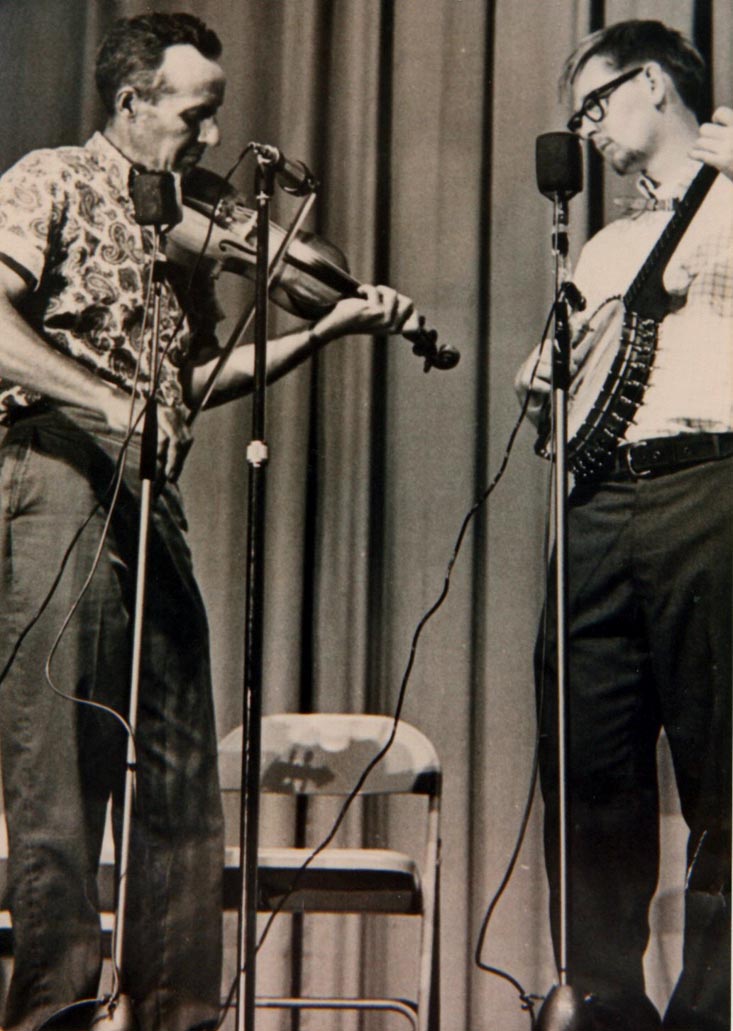
Wilson Douglas, West Virginia fiddler
27 Saturday Apr 2013
Posted in Timber
Tags
Appalachia, culture, genealogy, Lafayette Maynard, life, Lincoln County, Milton Maynard, photos, timbering, U.S. South, West Virginia, Winferd Lucas
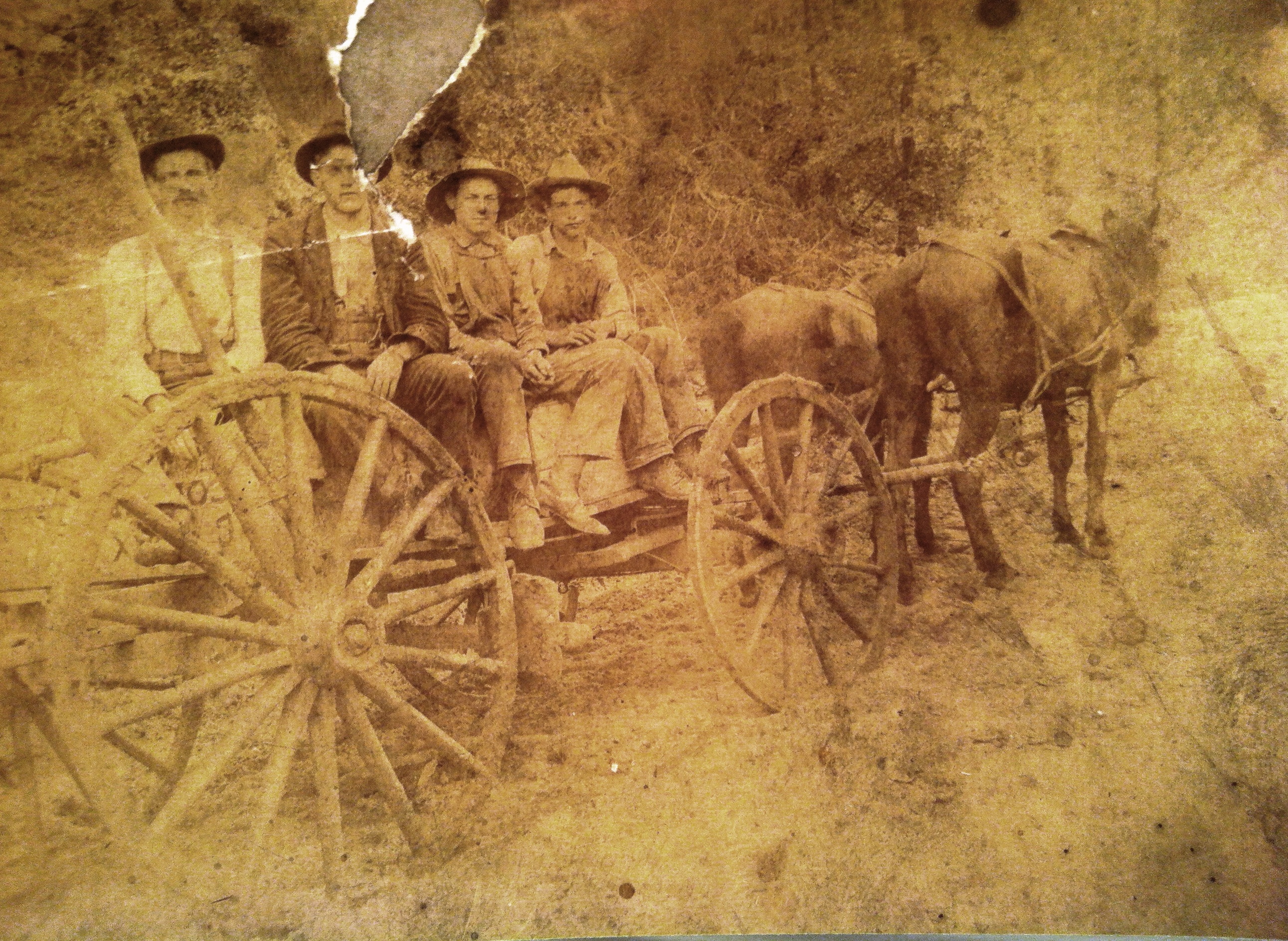
Milton Maynard, Winferd Lucas, Lafayette Maynard, and unknown man, of Lincoln County, 1905-1928
27 Saturday Apr 2013
Posted in Ed Haley, John Hartford, Music
Tags
Appalachia, Catlettsburg, Clyde Haley, Ed Haley, Ella Haley, fiddle, fiddlers, fiddling, Harts Creek, history, Irish lilt, Kenova, Kermit, Kevin Burke, Lawrence Haley, music, Nashville, Noah Mullins, Norfolk and Western Railroad, Patsy Haley, snap bowing, West Virginia, Williamson, writing
Nestled in Nashville, I worked obsessively on Ed Haley’s music. First, I made a real effort to transcribe it note for note and break it down “under the microscope.” Initially, I had tried to play it generally the way he did while keeping its spirit — with my own twists, of course, which is nearly impossible not to do. This time, though, I wanted to study it as you might a fabulous book — break it down, look at it mechanically… I made a huge discovery regarding Ed’s bowing during that time. With Lawrence’s help via telephone conversations, I deduced that Ed used what Scotch fiddlers call “snap bowing,” which is when you separate notes by applying pressure (“little stops”) with the bow — not by changing its direction. Of course, Ed didn’t use those patterns exclusively and mixed them with more conventional strokes.
I also spent a lot of time listening to Ed’s recordings and playing my versions of his songs into a tape recorder. One of the first things I figured out was that he used what fiddler Kevin Burke calls the “Irish lilt” to give his music a “dotted note feel.” It would be like playing a tune in triplets with the middle note taken out.
I also discovered that Lawrence was right about Ed not playing so many notes; instead, he created the illusion of doing so by phrasing his tunes in a way that gave them a nice “crooked” flavor.
Throughout these discoveries, Lawrence continued his role as my brutally honest fiddle teacher. His comments were surprisingly musical for someone who kept reminding me that he didn’t even play anything. When I played “Yellow Barber” for him over the telephone, he said, “That sounded right except when you get down to that low end, you’re doing a little skipping in there and it seemed to me like Pop played that a little bit smoother. Like he had a roll to his… And I noticed you had a few jumping notes in there that really I don’t remember hearing. Maybe you can hear them. Other than that, it sounded great to me.”
Lawrence seemed pleased with my playing of Ed’s “Catlettsburg”.
“That was good, John,” he said. “That was really good.”
I told him I didn’t know how Ed was able to get up into second position on that tune with the fiddle sitting at his shoulder.
“I always thought that he kinda controlled the violin with his thumb and the meaty part of his hand between his finger and thumb,” Lawrence said. “He could relax that up and down the neck of the violin or he could tighten that and he could still have the flexibility of his fingers, plus that give him the ability to rock that violin body underneath the bow, too.”
I was trying that and eventually got to where I could will my fingers into third position still holding the fiddle at my shoulder, which if you have to play for a long time is sure easier on the neck of the player.
I told Lawrence about talking with Clyde, especially about his memories of Ed mistreating him as a child.
“I don’t know, maybe my dad was mean to him when he was a young’n,” Lawrence said. “But I can’t remember my dad ever laying a hand on me to hurt me. I musta been a rowdy little kid ’cause it seemed like whenever Pop’d pick me up he’d call me ‘muddy duck’ because I was always dirty, I reckon, whenever he’d get a hold of me. He’d just rub my head or something like that and call me his ‘muddy duck.’ I don’t know where Clyde got his story from.”
Lawrence agreed that his dad sometimes abused his mother, although he placed a lot of blame for their marital problems on her.
“Well, he could be temperamental with my mother at times, but I think she was temperamental, too. I think my mother’s people had higher tempers than Dad’s people did. They seemed to be kinda quiet people. Noah Mullins was supposed to killed a revenuer up there at Harts. They waylaid a revenuer and they laid it on Noah, but Noah Mullins always seemed to me like just as quiet and as calm a fella as could be. But I had some of my uncles on my mother’s side, they were a little bit of a temperamental type of people. So I’d put some of the blame on my mother for her treatment of my dad. You know, a woman can upset a man and whip him quicker with words than he can whip her with his fists.”
I totally agreed, then asked Lawrence if he knew anything about the Muncys from Patsy’s genealogy.
“We’d ride the Norfork and Western train up from Kenova and stop at Kermit and stay there with Muncy people,” he said. “They lived in an apartment up over their store and filling station-type thing and they had one of them small monkeys. I went up there one day and got right at the top of the steps and was playing with that monkey and I musta made it mad and it made a rush at me and I musta jumped back and I went to the bottom of them steps. That made me remember it more than anything else. I can’t even remember that Pop played music while he was there for them. They mighta just talked. We used to stop there maybe and stay all night and Pop and Mom and me would go on to Williamson and they’d play at courthouse days or something there. Pop musta had people up in there, but he never said anything to me about it.”
25 Thursday Apr 2013
Posted in Big Sandy Valley, Huntington
Tags
Appalachia, Argand, Big Sandy River, Charleston, culture, history, Jessie, Kentucky, Paintsville, photos, Point Pleasant, steamboats

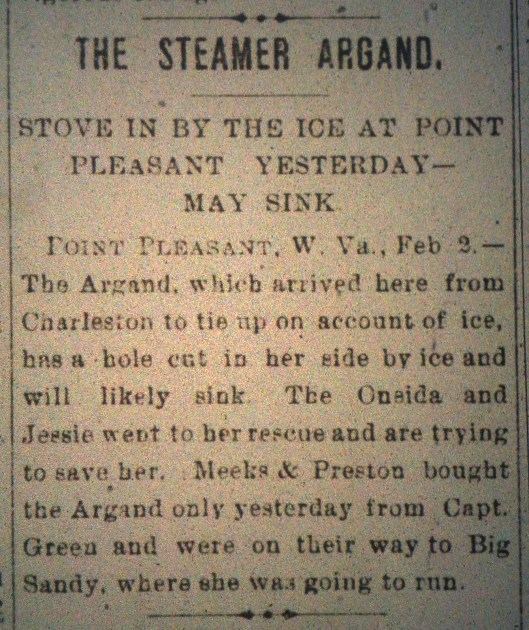
Huntington (WV) Advertiser, 2 February 1900
24 Wednesday Apr 2013
24 Wednesday Apr 2013
Tags
Appalachia, Ben Haley, Chloe Mullins, Cleveland, Clyde Haley, Ed Haley, Ella Haley, genealogy, history, Imogene Haley, Jack Haley, Jackson Mullins, Janet Haley, Laura Belle Trumbo, Lawrence Haley, Margaret Ryan, Milt Haley, Mona Haley, music, Nellie Muncy, Noah Haley, Pat Haley, Patsy Haley, Ralph Payne, Sherman Luther Haley, William Trumbo, Wilson Mullins
Not too long after talking with Patsy, her son Scott sent me a copy of Ed’s genealogy, most of which came directly from Ed and Ella. “James Edward Haley was born in August and was the son of Milt and Imogene (Mullins) Haley,” the notes began. “He died February 4, 1951 in Ashland, KY. He married Martha Ella Trumbo, a daughter of William A. and Laura Belle (Whitt) Payne Trumbo. She was born July 14, 1888 and died November 26, 1954 in Cleveland, OH. At the time of their marriage, Ella had one child from a previous relationship: Ralph A. Payne who married Margaret Ryan and who died on May 22, 1947.”
Patsy listed Milt Haley’s parents as Benjamin Haley and Nellie Muncy, and Emma Jean (Imogene) Haley’s parents as Andrew Jackson Mullins and Chloe Ann Gore.
There was detailed information on Ed and Ella’s children.
“Sherman Luther Haley, the oldest, died as an infant. Clyde Frederick Haley was born on June 13, 1921 and never married. Noah Earl Haley was born on October 26, 1922 and married Janet J. Fried in September of 1951. Allie Jackson Haley was born on April 6, 1924. He married Patsy J. Cox on October 25, 1946 and died on March 23, 1982. Lawrence Alfred Haley was born on January 8, 1928. He married Patricia M. Hulse in February of 1949. Monnie May Haley was born on May 5, 1930 and married in 1945 to Wilson Mullins.”
22 Monday Apr 2013
Posted in Music
Tags
Appalachia, banjo, culture, genealogy, Harts Creek, history, life, Logan County, music, photos, Stella Mullins, U.S. South, West Virginia

Stella Baisden Mullins, a resident of Trace Fork of Harts Creek, Logan County, West Virginia, 1930-1955
17 Wednesday Apr 2013
Posted in Music
Tags
Andy Mullins, Appalachia, culture, Dobie Mullins, genealogy, history, life, Logan County, music, photos, U.S. South, West Virginia

Mullins family of Harts Creek, Logan County, 1935-1955
16 Tuesday Apr 2013
Posted in Big Harts Creek, Ed Haley, Lincoln County Feud, Music
Tags
Appalachia, Clyde Haley, Ewell Mullins, fiddler, Harts Creek, Harts Mountain, history, Hollene Brumfield, John Hartford, Liza Mullins, Logan County, Milt Haley, music, Peter Mullins, West Virginia, Zack Williams
I asked Clyde if Ed ever talked about his early life on Harts Creek and he said, “He didn’t talk to us kids too much. My dad’s folks were from all around Logan County, West Virginia. I didn’t know who they were. I remember his Aunt Liza and Uncle Peter Mullins. ‘Club-Footed Peter’ Mullins, they called him, and ‘Reel-Footed Peter’ Mullins. That was his uncle. I remember them because I was the one that went with him when he went up that way. As a matter of fact, I went up there one time and stayed just for a whole year.”
I said, “Your grandfather Milt Haley was involved in an attempted murder…” before being cut off. “Yeah, Hollene Brumfield. I know about that. I know things about it, because I’ve been up there. He killed this guy and in the process of trying to kill this guy, he shot Hollene Brumfield in the face and mutilated her pretty bad. It was a accident. Hollene was riding behind her husband on a horse down Harts Creek. He missed him and shot Hollene — killed her. That’s the way I always got the story from my dad.”
Clyde seemed to have Milt’s story down better than any of Ed’s other kids, so I pressed him for more details about Harts Creek. I asked him about the musicians in that vicinity and he said, “They didn’t play the kind of music my dad played. There was one old fiddler up there, lived up in the head of Harts Creek. Not off on one of the branches — right straight up Harts Creek past Ewell Mullins’ store. This guy’s name was Zack Williams. Him and my dad used to fiddle together. Never went out on big sprees or anything like that, but he’d go up to Zack Williams’ house up on the top of the mountain — head of Harts Mountain — and they’d make music up there. Zack was a pretty good fiddle player.”
14 Sunday Apr 2013
Tags
Appalachia, Armco, Ashland, banjo, Billy in the Lowground, Blackberry Blossom, Brownlow's Dream, Cacklin Hen, Clyde Haley, Dill Pickle Rag, Ella Haley, fiddle, fiddler, fiddling, Flop-Eared Mule, history, John Hartford, Kentucky, music, Roy Clark
Clyde’s memories of Ed playing in contests were much more detailed than anything I had heard from the other kids.
“I’ve seen him go to contests and look like a farmer and he won every one he ever got into,” he said. “He’d go down to the Armco there in Ashland — they’d put up a bandstand up there — and when they’d have contests they had these eight or ten fiddlers up on the stage and he’d be up in all that mess. He fiddled with some of the best that there was in that country in that particular part of the time. I know he had a lot of people used to come to the house and play music with him.”
I asked Clyde what tunes Ed won contests with and he said, “Well, ‘Cacklin’ Hen’, ‘Billy in the Lowground’ and tunes like that. Not any particular ones. He could play any kind of music if he knew it. If he knew the words, he could make music like nobody you ever heard in your life. He had one tune called the ‘Flop-Eared Mule’. I remember ‘Brownlow’s Dream’, ‘Blackberry Blossom’ and ‘Dill Pickle Rag’.”
Gradually easing into specifics, I wondered if Ed held the bow in the middle or out on the end.
“It would depend on what kind of music he was playing,” Clyde said matter-of-factly. “I’ve seen him hold a fiddle bow down at the end, where the hair hooks up. Depending on the tune, the fastness of the tune, he could hold a bow anywhere he wanted to.”
Did he bow with short strokes or long strokes?
“Well, it would depend on which way he was sitting,” Clyde said. “If he was sitting on a chair with his right leg put out far… He never held the fiddle like anybody else I ever saw. He held it way low on his chest, almost down to his belt-line. My dad had long arms, you know. He was a long, thin man. We have a tendency to want to exaggerate a little bit and say he was bigger than he was, but I knew him pretty well. His hands were real thin — looked like a piano player. He could finger that fiddle like nobody you ever heard or saw.”
I asked if Ed picked the banjo and Clyde said, “Oh, yes. He was better with a banjo than he was with his fiddle. It didn’t have a thumb-string on it. I tried to learn how to play the banjo, too, but I never could do any good at it. Well, my mother bought me a fiddle in the store somewhere and she tried to get me to learn how to play the fiddle because she knew she was gonna be dead one of these days and him too and she wanted to have all that music made for posterity. My mom didn’t want me to do it, but my dad wanted me to. He called me his favorite son and said he wanted me to carry on his tradition. I tried, but I got my fingers cut off when I was a lot younger — two-thirds of my first and second fingers on my left hand — and that messed me up from noting. Ralph was the one that played with my dad a lot. He played the guitar like Roy Clark played. He had a big Martin guitar that was a double-header and he could play on both necks of it at the same time. Ralph was a good musician. He died in 1945.”
Clyde talked a lot about Ed being a drinker, which was something Lawrence kind of kept “under wraps”.
“He was a rip-snorter, don’t think he wasn’t,” he said. “You know, he could be pretty boisterous when he wanted to be. Ed Haley was a mean person — believe me he was. I loved him… He used to take me because he knew I liked to go with him. He would give me a drink every once in a while. He knew I got to liking that and he’d take me with him just about everywhere he went. I think he was the one who got me to drinking too when I was a kid and it’s the worst thing I could’ve done. Course I had no control over it then.”
I asked Clyde what Ed’s drink of choice was and he said, “Whiskey. He wasn’t a beer drinker much, or wine. He didn’t go much for that kind of stuff. He drank moonshine when he could get it, and he generally got it.”
Clyde had seen Ed drunk but said it didn’t hurt his fiddle playing.
“I think if anything, it made it better.”
12 Friday Apr 2013
Posted in Clay County, Music
Tags
Appalachia, Clay County, fiddle, fiddler, fiddling, history, Kim Johnson, music, photos, West Virginia, Wilson Douglas

Wilson Douglas, fiddler, Clay County, WV, 1930s. Courtesy of Kim Johnson.
04 Thursday Apr 2013
Posted in Big Harts Creek, Ed Haley, John Hartford, Spottswood
Tags
Appalachia, art, genealogy, Harts Creek, history, Jackson Mullins, John Hartford, Logan County, Milt Haley, Turley Adams, West Virginia
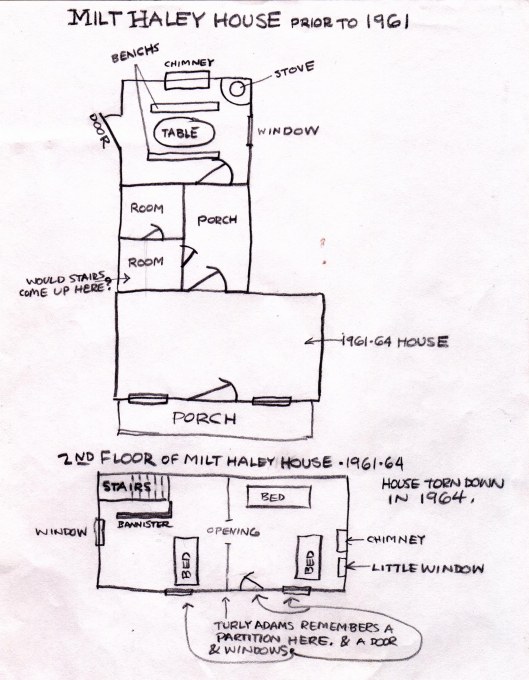
Jackson Mullins Home, Sketch by John Hartford, 1993
04 Thursday Apr 2013
Posted in Big Harts Creek, Ed Haley, Harts, John Hartford
Tags
Appalachia, Bill Mullins, Chloe Mullins, Ed Haley, Imogene Haley, Jackson Mullins, Joe Mullins, John Hartford, Lawrence Haley, Liza McKenzie, Nashville, Peter Mullins, photos, Turley Adams, Violet Adams, West Virginia
I returned to Nashville talking not so much about new musical developments but rambling on to my wife about murders and the people I’d met in Harts. I spent a lot of time studying over Joe’s photographs, especially the faded family group shot. One of the boys in the picture was propped inside a young woman’s arms and appeared very much to be blind. Was it Ed and his mother? Unfortunately, since the woman was almost completely faded away I couldn’t make a positive identification of her, even when I compared it to the photo of Emma Jean found by Lawrence and I on our first trip to Harts.
There was another interesting development: when I removed the picture of Bill and Peter Mullins from its frame, another equally large picture of the “old couple” kind of popped out from behind it. That made three pictures of those folks and it sure seemed logical to me that Joe Mullins would’ve had three pictures of his grandparents — meaning Ed’s grandparents — and not of an uncle and an aunt.
I sent copies of Joe’s old pictures to Turley and Violet Adams to see if they could show them around for identification. A few weeks later, we spoke over the telephone and they said Liza McKenzie had fingered Ed as the child to the right in the faded group picture. She also said the old folks in the back row were Jackson Mullins and his wife, Chloe.
04 Thursday Apr 2013
Posted in Harts, Pearl Adkins Diary
Tags
Appalachia, Fed Adkins, genealogy, Harts, history, life, Lincoln County, Pearl Adkins, photos, West Virginia
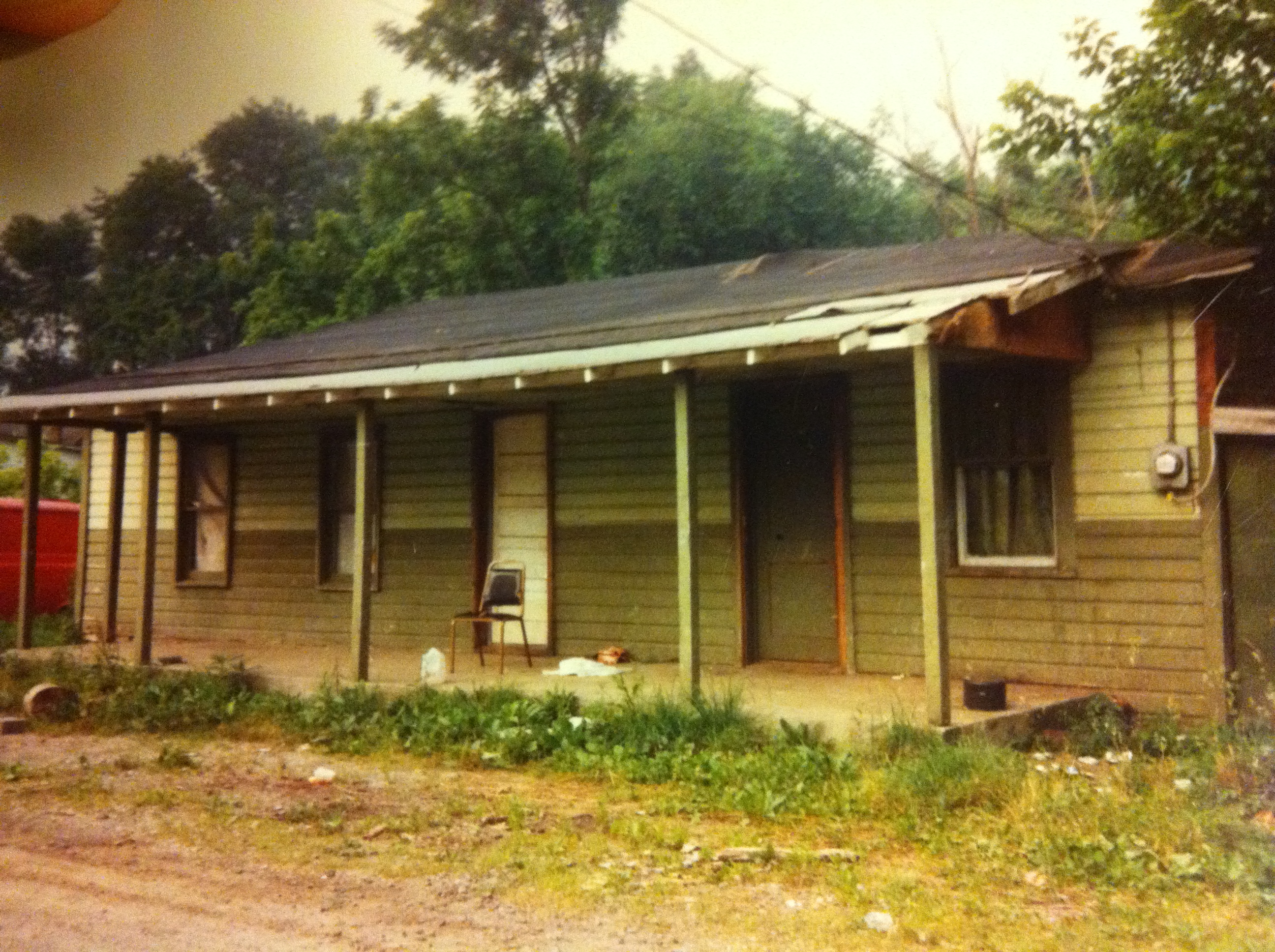
P.B. “Fed” Adkins home in Harts, Lincoln County, WV, 1980s
01 Monday Apr 2013
Posted in Big Harts Creek, Ed Haley, Spottswood
Tags
Appalachia, Bill Mullins, Harts Creek, history, Logan County, Peter Mullins, photos, West Virginia

Bill Mullins and Peter Mullins, 1900-1910. Courtesy of Joe Mullins.
Writings from my travels and experiences. High and fine literature is wine, and mine is only water; but everybody likes water. Mark Twain
This site is dedicated to the collection, preservation, and promotion of history and culture in Appalachia.
Genealogy and History in North Carolina and Beyond
A site about one of the most beautiful, interesting, tallented, outrageous and colorful personalities of the 20th Century


