Tags
Appalachia, culture, family, genealogy, history, Kentucky, life, Morehead, music, photos, Ralph Haley, U.S. South

Ralph Haley, 1915-1920

01 Tuesday Jan 2013
Posted in Ed Haley
Tags
Appalachia, culture, family, genealogy, history, Kentucky, life, Morehead, music, photos, Ralph Haley, U.S. South
Ralph Haley, 1915-1920
01 Tuesday Jan 2013
Posted in Big Harts Creek, Culture of Honor, Halcyon
Tags
Appalachia, Buck Mullins, crime, Dennie Workman, Doc Workman, Flora Workman, Gene Wilson Dingess, Harlen Mullins, Harts Creek, history, Lloyd Farley, Logan, Logan County, Martha Workman, murder, mystery, Thomas B. Workman, true crime, U.S. South, Weddie Mullins, West Fork, West Virginia, Workman Fork, World War I, writing
Doc Workman was born on January 20, 1893 at Halcyon in Logan County, West Virginia. His parents were Thomas B. and Martha (Hill) Workman. Doc served in the First World War. According to his draft registration record, he was blue-eyed, had dark brown hair and was of medium build. “I think he got gased over there and he just barely made it,” said Gene Wilson Dingess, a close relative and namesake, in a 2004 interview. “They were in foxholes most of the time.” A decorated veteran and prisoner of war, Mr. Workman spoke little of his war experience after returning home. “He never told big tales about his service,” Dingess said. “If you asked him about it, he’d answer you in about thirty seconds and then change the subject.”
In 1919, Doc married Flora Mullins, the pretty red-haired daughter of Harlen Mullins, a local farmer. For many years, the couple enjoyed a happy marriage. By the early 1930s however, according to neighborhood gossip, both began affairs. Doc, who some called “Slick” because of his charms with women, reportedly courted a sister-in-law, while Flora reportedly sparked a Dingess. The family remained intact until at least 1940. Some time thereafter, Doc and Flora separated and eventually divorced. Mr. Workman built himself a small dwelling house just below his wife where he lived with a stepson, Dennie. Around that time, perhaps in related events, a few homes were burned in the neighborhood.
A 1942 draft registration record described Dock as six-feet tall, 178 pounds, of ruddy complexion, with gray hair and blue eyes. In the opinion of most people on Workman Fork, he made for a good neighbor. Lloyd Farley, a son-in-law, in a 2005 interview, said, “Doc was a fine fellow. He was hard to get to know but he would give you the shirt off of his back.” Mr. Dingess also had fond memories of the old gentleman. “We stopped there at Doc’s every day after school to see him,” he said. “He had candy and marshmallows and he always offered us a dollar to let him bust an egg between our eyes.” Dingess recalled that Doc was an excellent marksman. “Doc kept a loaded gun just inside his door to shoot foxes when they got after his chickens,” Dingess said. “He could shoot a fox from 100 yards away.”
In his last days, Doc received a pension for his service in the Great War and began to carry a significant amount of cash on his person. “He drew a veteran’s pension,” said Mr. Farley. “He often packed one-thousand dollars on him.” Not long before his murder, he loaned fifty dollars to his brother-in-law, Buck Mullins, who then lived in Logan. (Mullins soon repaid the loan.) Neighbors spoke of Dock’s money, of his pension… Family members cautioned him against keeping so much cash on hand, afraid that someone might rob him. Adding fuel to the fire of neighborhood gossip, Doc occasionally disappeared from the creek. “Doc would go out of here and be gone for a month at a time when I was young,” Dingess said. “We never did know why he left.” Just a few weeks before the murder, his son Dennie moved away to find a job. “Dennie had just left to work away from here two or three weeks when Dock was killed,” Dingess said. About one week before the killing, according to Farley, Weddie Mullins, Doc’s former brother-in-law, caught him with his arm around his wife’s waist. He told him that he “better not do it again.”
31 Monday Dec 2012
Posted in Ed Haley
Tags
Appalachia, culture, Ella Haley, genealogy, history, Kentucky, life, Morehead, music, photos, U.S. South

Ella Trumbo Haley, 1908-1920
31 Monday Dec 2012
Posted in Ed Haley
Tags
Al Brumfield, Ed Haley, feud, fiddle, George Fry, Green McCoy, history, John Hartford, Kennie Lamb, Lincoln County Crew, Milt Haley, music, Paris Brumfield, Stephen Green, writing
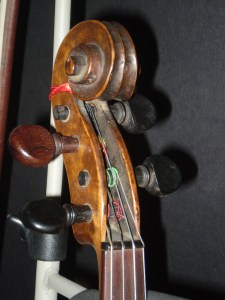
When I arrived back in Nashville, I set about lining up Ed’s fiddle as close as I could to how he would have wanted it. I had John Hedgcoth make a duplicate bridge, then strung it all up so that if he were to walk in the room it would suit him. After about a week, though, the neck started pulling up. I loosened the strings and called Kennie Lamb, a violin expert and craftsman in Baton Rouge, Louisiana. Kennie picked the fiddle up in Nashville and hand-carried it back to Louisiana for minimal restoration.
A few weeks later, I received a letter from him:
John,
The Markings in Red Corrspond to the Haley Bridge. The only exception being that the D string on the Original Bridge has two notches very close together. I have Marked a D notch in Red but the unmarked D notch will line up with one of the Original notches so you can take your choice on where you believe Mr. Haley Kept the D String.
I have noticed one other interesting thing: Mr. Haley “or Some one” has played this fiddle with the bridge set Almost 1/2 inch to the rear of where it should be set. NOTe: the Markin[g]s where the feet of the bridge once stood. The bridge was in this position for Many a year: Before the neck was out of Alignment and probably before the damage and subsequent repair to the back button the Original bridge may have been tall enough to sustain the rearward Position. The Old Gentleman may have positioned it to the rear in Order to lower the strings or being blind he may not have known exactly where the bridge was supposed to stand. Of course the fiddle would off note badly in the Position but I have seen many such “And Worse” Positions. I hope I have Accomplished what you wanted.
Around the time Kennie’s letter arrived in the mail, Stephen Green, an archivist at the Appalachian Center Sound Archive in Berea, Kentucky, sent me a Summer 1986 article from a West Virginia magazine called Goldenseal. It told all about Milt Haley’s murder and was based on a song called “The Lincoln County Crew”, as sung by Irma Butcher of Bear Creek in northwestern Lincoln County. The song was very similar to Cox’s “A West Virginia Feud-Song”.
Butcher first heard her version around 1910 from fiddler Keenan Hunter, a friend to her banjo-picking father, Press Blankenship. In 1978, she played it for Michael M. Meador at the Vandalia Gathering, West Virginia’s annual statewide folk festival in Charleston.
Come all dear friends and people, come fathers, mothers too;
I’ll relate to you the story of the Lincoln County Crew;
Concerning bloody rowing and many a thieving deed;
Come friends and lend attention, remember how it reads.
‘Twas in the month of August, all on a very fine day,
Al Brumfield he was wounded, they say by Milt Haley;
The people did not believe it, nor hardly think it so,
They say it was McCoy that struck the fatal blow.
They shot and killed Boney Lucas, a sober and innocent man,
Who leaves a wife and children to do the best they can;
They wounded poor Oak Stowers, although his life was saved,
He meant to shun the drug shop, that stood so near his grave.
Allen Brumfield he recovered, in some months to come to pass,
And at the house of George Frye, those men they met at last;
Green McCoy and Milt Haley about the yard did walk,
They seemed to be uneasy and no one wished to talk.
They went into the house and sat down by the fire,
But little did they think, dear friends, they’d met their final hour;
The sting of death was near them when a mob rushed in at the door,
And a few words passed between them concerning the row before.
The people all got frightened and rushed clear out of the room,
When a ball from some man’s pistol lay the prisoners in their tomb;
Their friends had gathered ’round them, their wives did weep and wail,
Tom Ferrell was arrested and soon confined in jail.
Confined in jail at Hamlin to stay there for awhile,
In the hands of Andrew Chapman to bravely stand his trial;
But many talked of lynching him, but that was just a fear,
For when the trial day came on, Tom Ferrell, he came out clear.
I suppose this is a warning, a warning to all men;
Your pistols will cause trouble, on this you can depend;
In the bottom of a whiskey glass, a lurking devil dwells;
And burns the breast of those who drink, and sends their souls to hell.
31 Monday Dec 2012
Posted in Harts, Pearl Adkins Diary, Women's History
Tags
Appalachia, culture, Ed Zane Adkins, life, Lincoln County, Pearl Adkins, photos, Rinda Adkins, U.S. South, West Virginia, writers, writing
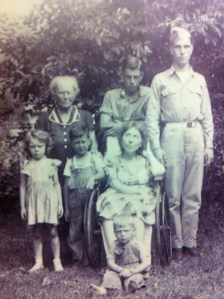
Pearl Adkins (center), 1940s
31 Monday Dec 2012
Posted in Big Harts Creek, Culture of Honor
Tags
Appalachia, crime, Doc Workman, Ferrellsburg, Flora Workman, genealogy, Harts Creek, history, life, Logan Banner, Logan County, murder, mystery, Ray Watts, Roma Elkins, Simpkins Cemetery, true crime, U.S. South, West Fork, West Virginia, Workman Fork, World War I, writing
Fifty-six years ago, someone shot Wilson “Doc” Workman in cold blood at the front door of his little frame house on Harts Creek. Today, his unsolved murder is largely forgotten.
“Workman, 63, was found dead by his estranged wife, Mrs. Flora Workman, at 6 a.m. Friday at his home on Workman Fork of the West Fork of Harts Creek in Logan County,” the Logan Banner reported on Monday, April 23, 1956. “The victim died as a result of a stomach wound inflicted by a 20-gauge single barrel shotgun which was found lying across his left leg.”
Doc Workman was a man in the twilight of his life. By all accounts, he was a well-liked resident of the community. He was a quiet farmer, a former timberman, a veteran of the Great War and the father of nine children.
“Daddy and Mommy sure liked him,” said the late Roma Elkins, a native of nearby Ferrellsburg, in a 2004 interview. “He’d bring us a big water bucket full of eggs and wouldn’t let us pay him for them.”
Initially, Logan County sheriff Ray Watts and state law enforcement officers suspected robbery as the motive for Workman’s murder.
“Reports said Workman had been known to carry large sums of money around on his person and was believed to have between $400 and $500 at the time of his death,” the Banner reported. “Only a few dollars was found in the home after the shooting.”
On Sunday, April 22, Workman’s funeral was held at his home on Workman Fork. The service began at 2 p.m. and concluded with the burial at Simpkins Cemetery on West Fork.
On Monday, the Banner ran Workman’s obituary on its front page, listing his wife, nine children, four brothers and three sisters, most of whom lived in Logan County.
29 Saturday Dec 2012
Posted in Music
Tags
Appalachia, culture, Ferrellsburg, guitar, history, Jap Mullins, life, Lincoln County, music, photos, U.S. South, West Virginia
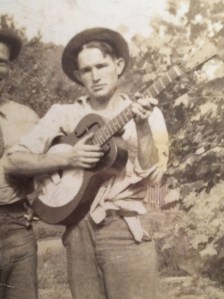
Jap Mullins of Ferrellsburg, 1936-1945
29 Saturday Dec 2012
Posted in Harts, Pearl Adkins Diary, Women's History
Tags
Appalachia, Cora Adkins, history, inspiration, life, Lincoln County, love, Pearl Adkins, U.S. South, West Virginia, writers, writing
“My dear, dear dream boy came one evening,” Pearl wrote in May or June. “He stayed all night. After supper I was sitting on the porch. Cora was out there. My heart dearest came and sit down at my feet. He talked to Cora of first one thing then another. He changed the subject all at once and asked Cora if the doctors thought there was any chance for me ever to walk. I don’t remember the talk for I felt slighted and hurt. To think he would sit at my feet and then ask some one else about my walking powers, if there was any chance of me ever.
“Well, I spent another sleepless night for he slept in the next room. I can now see him as I write next morning at the breakfast table. I looked across the table straight into those clear but sad eyes — those eyes which sent the blood over my neck and face to burn my fevered brain. He is gone and left a heavier heart and a sadder face behind him than was there when he came. I don’t guess he ever thought of the joy he brings to a sad and lonely woman when he comes or even dreamed of such a thing that I loved him. Well, I don’t care if he ever knows. I love him just the same.”
29 Saturday Dec 2012
Posted in Ed Haley
Tags
Appalachia, blind, culture, Ed Haley, Ella Haley, fiddler, fiddling, history, life, music, photos, U.S. South

Ella and Ed Haley, 1925-1945
29 Saturday Dec 2012
Posted in Ed Haley
Tags
Doc Holbrook, Ed Haley, fiddle, history, J P Fraley, John Hartford, Kentucky, Laury Hicks, Lawrence Haley, Maysville, music, Sherman Luther Haley, Ugee Postalwait, Wilson Douglas, writing
I met Lawrence a few weeks later at the Fraley Family Festival near Grayson, Kentucky. He gave me Ed’s newly located bridge and I showed him Ed’s fiddle — pointing out all of the things I had discovered about it. I specifically pointed out a “V-shape” pattern worn into the varnish on its back toward its bottom. At its top were what appeared to be “sweat marks” where Ed rotated the fiddle and slid his fingers up to get notes in second and third position (which contradicted what Snake Chapman had said about him rarely getting out of first position except when, every once in a while a finger would sneak and grab a note or two from the upper positions). As we talked about such things, J.P. Fraley showed up along with Nancy McClellan, a local folklorist.
After some small talk, I played “Half Past Four” for Lawrence on his dad’s fiddle.
“Where he got a name like that, I don’t know,” he said. “I think, though, it was possibly when my oldest brother Sherman Luther Haley was born. My mother went into labor about 4:30 in the morning. He was named after one of Mom’s brothers. It was the one that died.”
I said, “Now, I’m not totally used to these Black Diamond strings and I’m not playing it note for note the way Ed did. I’m just scratching the surface.”
Lawrence said, “I know. Them old records are hard to hear.”
“There is so much on them records you wouldn’t believe what’s in there,” I said. “Just all kinds of little things. Like his notes, he gets certain long notes and they’re like words. Some of them are moans. And he uses certain little tones.”
Lawrence said, “I notice a lot of you guys, it looks like it’s really hard work for you to do this. Pop never had a bit of trouble playing a fiddle. It wasn’t work to him. If he enjoyed the group he was with, you could absolutely hear it in his music. If he had good accompaniment, he’d stay all day.”
“I’m also curious about that bridge because I think he might have played with a little bit lower action than what I’ve got here,” I said.
Lawrence said, “Yeah, a little bit lower. You could look at that bridge I brought you.”
I said, “Yeah, I’ve already had it on and looked at it. The thing that’s interesting about that is if you look at that bridge, that bridge has been handled a lot because he would feel of it and that’s why all that finger grease is on it. I can just see him. What I may do, I may try that on but what I might do is carve a duplicate of that because sometimes when they get old, they’ll crack.”
Nancy McClellan asked Lawrence, “Were there other fiddlers in the family?” and he said, “No, I couldn’t play. I was left-handed and when I was a little tiny fella I nicked the whole end of this finger off and I didn’t have any meat on the end of it and that hindered me from picking a violin, see. I couldn’t work up a callus on it. Bone’s right underneath it.”
You know, I’d never really thought much about that — the fact none of the Haley children played the fiddle. Ralph, of course, was a guitar player — but he wasn’t actually Ed’s son. It was only natural that the kids — no matter how intense their exposure or no matter their possible distaste — would at some point pick up a fiddle and at least try it. This had been Lawrence’s confession — and his reason for not carrying it any further.
J.P. played a little on Ed’s fiddle and commented on the Black Diamond strings. “Have these strings been on there all that time?”
“No,” I said.
“Where’d you find them?”
I said, “I’ve got a friend that used to carry them and he had a couple of sets and he gave them to me.”
J.P. said, “I can remember when they was a quarter. Wonder what those fiddlers would have done if they’d had access to the strings and stuff that we can get now?”
There was a little pause then J.P. said, “Remember I was telling you about a tune called ‘Maysville’? It had to do with Maysville, Kentucky. I don’t know where the people in Elliott County learned it. They was a tobacco house down there and those people had to wagon tobacco from back in Elliott County plumb to Maysville to sell it.”
Lawrence said, “Pop played a lot of pieces named after…”
J.P. interrupted, “Now he played ‘Maysville’.”
Lawrence continued, “He played a piece of music that I really liked that he called ‘Catlettsburg’.”
Lawrence said to J.P., who still held Ed’s fiddle, “That isn’t as fine a fiddle as you played that used to belong to my dad that the Holbrooks got.”
J.P. said, “Paul’s got it. Well, what he done… That’s a good fiddle, too. He let me have it. I told him if he ever wanted it back… It was in the awfulest shape that ever was. But I had it fixed up. Not embellished now. Just restored. And suddenly Dr. Holbrook’s daughter was gonna take violin lessons. They took it. There’s something else he told me. See, I didn’t know the old Dr. Holbrook…”
Lawrence said, “He’s the one delivered me.”
J.P. said, “His son Paul — our doctor — told me that old man Holbrook went to fiddling, too. Well, Paul said that he supposedly took Ed and Ella to Columbus to do a record.”
Lawrence said, “That was that ‘Over the Waves’, I think. Big aluminum record.”
J.P. said, “It was the closest thing to a commercial record that Ed ever made.”
Lawrence spoke some about his father’s travels.
“Pop didn’t get all the way down into Old Virginia, I don’t think. He made it to Beckley and Bluefield and places like that. I can remember walking from Morehead to Farmers right down the railroad track. They went down there to somebody’s house to play — I was just a kid then — and seemed to me like they played all night.”
Nancy McClellan said, “Well, that’s what Wilson Douglas said happened up there in Calhoun County, West Virginia. He said a fiddler named Laury Hicks would ask for ‘The Black-Eyed Susan’ and said Laury Hicks would sit there and cry while Ed Haley played.”
I told about my recent visit with Laury’s daughter Ugee Postalwait and Lawrence said, “When Pop come around and they was playing, she’d get fiddle sticks and she’d just clog around Pop’s fiddle and every time he’d note it she beat the sticks on that. Dance right around him.”
27 Thursday Dec 2012
Posted in Music
Tags
Appalachia, culture, guitar, Harts Creek, history, Joe Adams, life, Logan County, music, photos, U.S. South, West Virginia

Joe Adams of Harts Creek, 1945-1955
27 Thursday Dec 2012
Posted in Big Harts Creek, Ed Haley, Spottswood
Tags
Appalachia, culture, genealogy, Harts Creek, history, Lawrence Haley, life, Liza Mullins, Logan County, photos, U.S. South, West Virginia

Lawrence Haley with Aunt Liza on Harts Creek, 1950-1953
27 Thursday Dec 2012
Posted in Ed Haley
Tags
Ed Haley, fiddle, Harts Creek, history, John Hartford, John Hedgecoth, Lawrence Haley, Logan County, music, Nashville, Noah Mullins, Steve Haley, U.S. South, West Virginia, writing
When I got back in Nashville, I ranted and raved over Haley’s fiddle before taking it downtown to John Hedgecoth, an instrument repairman. John and I went over its every detail. We fitted a bridge to it and put Black Diamond strings on it (the brand Haley supposedly used), then I brought it home and played on it for about two weeks. I focused on learning Ed’s version of a fabulous tune called “Half Past Four”.
“It just sounds like a dream,” I said to Lawrence when I called him. “You play on it real light and it’s got that sound in it.”
“Well, that’s great, John,” he said.
“Now I had to put a chin rest on it and I am using a shoulder rest with it because that’s what I’m used to and I had to put tuners on it because I like to keep it in tune,” I said.
“Okay. Well, that’s all right,” Lawrence laughed.
I said, “I tell you what’s interesting about it. It looks like at one time the back had been taken off and re-glued.”
Lawrence said, “Yeah, it got damp and the glue came loose on it and I guess that back warped or something. I don’t think it was completely off. Well, my son Steve had somebody down there in Nashville to repair it but that bridge — that thing looked real odd to me. I had an old bridge here. It’s in a drawer around here somewhere, I’d say, and I’ll look for it. I never really got it strung up since then. I just figured, well, there’s enough glue on that old fiddle that it ain’t gonna sound right anyway. If you use too much glue, you’re gonna lose a lot of the resonance in the wood.”
I said, “Now, it also looks like at one time the neck was broken out of it and reglued.”
Lawrence said, “Well now, it was not in the best of shape when Steve snuck it out of here. He took it out and had it repaired for me for a Christmas present. I just figured it’s gonna lay around here and just deteriorate again, maybe draw dampness some way or it’ll fall apart anyway. I just thought since you showed so much interest in it I’ll just let you have it.”
I said, “Well, I sure appreciate that. One of the things… The fingerboard, when you look at it straight on, lays over to the right in a funny kind of an angle.”
Lawrence said, “Yeah, that’s what I figured. I don’t remember it being like that. That fingerboard, it looked to me like it had some wear on it where my dad had fingered it so much. It looked like it had slight indentations from his fingers. I didn’t know whether it would fret right.”
I said, “And also, the sound post is an inch back from where it ought to be.” I wasn’t sure if Ed had kept it there or not; I felt it likely that it had fallen over in the decades after his death and been misplaced by some half-wit repairman.
I got Ed’s fiddle and played “Half Past Four” for Lawrence, who said, somewhat amused, “You’re trying to play one of his pieces. Sounds pretty good. Well, maybe some time down the line you’ll get that ‘Cacklin’ Hen’ down. It’s just working at it. And that fiddle does sound good from over the phone.”
I said, “It’s got a little overtone in it that none of these other fiddles have and when I go back and listen to those tapes I hear that overtone in there.”
Lawrence said, “Maybe you got a prize there. I don’t know. I think everybody agrees that you should have it. Steve seems to know more about you than what we do. I don’t know how he does but he’s a musician too, you know. He taught high school band for a while and he plays in a jazz band some. Plays the trumpet. His wife’s a musician. She’s a church organist — used to be. Two of the children… One of them’s in some kind of Nashville junior symphony. Plays the cello. The other plays the violin.”
I told Lawrence I wanted to be sure and go back to Harts Creek in the fall and find out more about his dad’s early years there.
“All right,” he said. “We’ll go back up there. I don’t think anybody up there, once they find out who you are will have any objections. One of my second cousins, Noah Mullins, he killed one of the revenuers that come up through there and that give Harts Creek a bad name, I guess. Those days are gone. I believe the second time up there everybody’d be glad to see you and talk to you like they were this last time. They won’t be any problem about that. People are a little suspicious if they don’t know who you are. But if they know you got a purpose and reason for being up there that isn’t detrimental to their causes they ain’t gonna jump you or anything or give you problems.”
27 Thursday Dec 2012
Posted in Ed Haley
Tags
Appalachia, culture, Ed Haley, Harts Creek, history, John Hartford, Lawrence Haley, life, Logan County, music, photos, Roxie Mullins, West Virginia, writing

Lawrence Haley (right) with Roxie Mullins and Family, 1991
27 Thursday Dec 2012
Tags
Black Sheep, David Haley, Ed Haley, fiddle, fiddling, history, John Hartford, Lawrence Haley, music, Nashville, Ohio, St. Clairsville, Steve Haley, writing
In Nashville, I spent several months working with Ed’s music and calling Lawrence Haley with questions and comments. I continued to study every intricate detail of Ed’s fiddling — supplementing it with recently learned facts about his life as well as devoting some attention to his songs. When I called Lawrence with questions about new “discoveries,” he said my visit to Ashland had inspired one of his granddaughters to take up the fiddle. I was very curious about that because of my belief in genetic memory. Who knew what secrets she had locked away inside her DNA? I told him I would bring her one of my fiddles the next time I saw him.
A few months later, I met Lawrence and his family at my show in St. Clairsville, Ohio. It was the first time Lawrence had seen me play on stage and I was ridiculously nervous. He listened intently from backstage and kept his criticisms to a minimum. He said his father played a lot faster than I did and really bragged on how Pop played the fiddle while singing, like with the tune “Black Sheep.”
In a quiet country town not very far away
There lived a rich and aging man whose hair was few and gray.
He had three sons, his only ones, Jack and Tom was sly.
Ted was honest as could be and could not tell a lie.
When we gathered on the bus, I gave Lawrence’s granddaughter one of my fiddles.
“Well I have something to give you, too,” Lawrence said before making a quick trip to his car. He returned with Ed’s fiddle, which he reached to me and said, “We brought something for you. We’re not using it and we know you would appreciate it and know its value.”
I carefully turned Ed Haley’s fiddle over in my hands.
It was a tremendously emotional experience.
“Are you sure you want to do this?” I asked.
Lawrence said he had talked about it with his sons Steve and David and every one agreed it was the right thing to do.
“I discussed it with the kids here,” he said. “David, he kind of showed a little bit of objection but I told him, ‘Well, John’s gonna bring a fiddle up here to Andrea. I just may as well turn loose of this one because it’s just gonna lay here and deteriorate. Why not let John have this one?’ He agreed to it. If anybody would’ve had any objections I think Steve would because his girls are both string instrumentalists. But they didn’t seem to mind too much so you got it and we won’t worry about it anymore.”
I immediately took Ed’s fiddle to my bedroom on the bus, put it in a case and laid it on the bed for safety.
26 Wednesday Dec 2012
Posted in Music
Tags
Appalachia, culture, Ed Zane Adkins, genealogy, guitar, history, life, Lincoln County, music, photos, U.S. South, Watson Adkins Jr., West Virginia
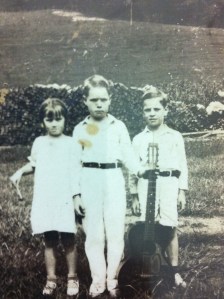
Adkins Family in Harts, about 1932
26 Wednesday Dec 2012
Posted in Harts, Pearl Adkins Diary, Women's History
Tags
Appalachia, Cora Adkins, culture, Dr. Guthrie, Fed Adkins, history, inspiration, life, Lincoln County, Pearl Adkins, thoughts, U.S. South, West Virginia, writing
“Well, it seems that after all I might have a chance to get well,” Pearl happily wrote the following May. “Cora went to Huntington to Dr. Guthrie and told him my history. He said it was a strange case — that he couldn’t tell whether there could be any thing done with me without he could see me. He told her a certain time a board of doctors met at his hospital and, if they would bring me down there when they met, it would be a good chance to have my case studied. And among so many doctors some ought to learn what was the matter with my back. They took me under examination for three days. They took Xray pictures but all of it didn’t bring to light the cause of my troubles. Doctor Guthrie told Papa he could on the third day evening take me home and he was going to study a while longer on my case. The doctor told me to come home and whistle, sing and be a happy girl that he might have good news for me in a few days.
“I came home but I wasn’t happy, but prayed to the Heavenly Father has I never prayed before. I prayed to him to give the doctor’s knowledge to learn the cause of my troubles so they could doctor me and by the help of God I would get so I could walk. I prayed with all the knowledge the Lord give me to pray with, but my prayers were in vain. At last, my verdict was read. It read me a cripple for life. Oh that terrible news. I remember the morning I received the news. It was such a bright sunny morning and to receive such news on such a bright day I would just about as soon it would have been my death sentence for it wouldn’t have been much worse to think of leading a life so hapless as mine. Oh God, I don’t know how I ever went through that day with such sorrow as mine, for all hopes of happiness were blotted out forever. Dr. Guthrie went so far as to advise Papa not to spend any more money for he didn’t think there was any use to while I was as well off as I was, for some doctors would experiment on me. Where they might do me good they could do me a lot of harm. While it was bad, it wouldn’t be any thing to compare with a wracking body of pain. While I don’t hurt, let me be, he said. That all seems like a dream now. I only wish to my Lord above it had been a dream.”
26 Wednesday Dec 2012
Posted in Ed Haley
26 Wednesday Dec 2012
Posted in Ed Haley
Tags
Appalachia, blind, Calhoun County, Ed Haley, Ella Haley, Harts Creek, history, John Hartford, Kentucky, Lawrence Haley, Milt Haley, music, Ugee Postalwait, West Virginia, writing
The next thing I knew, Ugee was up at the stove cooking a big meal and singing “Maggie and Albert” — Haley’s version of “Frankie and Johnny”. When she was finished, she said, “Now that’s some old songs. Ed played them and when he played them, you’d be glad to sit and listen to them, too. And he patted his foot.”
During dinner, Ugee told me about her own musical experience.
“I started off on the five-string banjo then graduated myself to the guitar,” she said. “The first guitar that I ever seen, Howard Alexander brought it in the country. He’d been over to his mother-in-law’s around Rosedale and when he come back he brought a guitar. Howard didn’t play the guitar or banjo either. He come down and said, ‘Ugee, I brought you something. A guitar.’ And I said, ‘Well, I never tuned one of them things.’ I suppose I’d been playing the banjo about three or four years. Dad said, ‘Well, you tune the banjo. Go ahead and tune it up there.’ Howard said, ‘Aw, just keep it as long as you want to. I’m in no hurry fer it.’ He’d traded something for it. I forget what it was. I went to fooling with that guitar, you know, picking around with it, this that and another, running a knife down it. Well, I tuned it up like a banjo. First thing you know I found me a chord, and then Dad come in with a mandolin.”
“We went to play music around at the schoolhouse and places like that for pie suppers and cake walks,” Ugee said of herself and her father. “My dad thought there wasn’t nobody in the world like me. Nobody could do like I could. We went to a place and played for a schoolhouse and the teacher down there… He was a Glenville graduate — you know, went to college and everything — thought he knew it all. He said, ‘Mr. Hicks, play ‘Soldiers Joy’. So Dad played it for him. Just as soon as he got done playing it, he said, ‘Mr. Hicks, play ‘Soldiers Joy’. Dad played it for him again. I think he played it about five times. By that time, Dad was getting tired of it. And he come there and said, ‘Mr. Hicks would you please play ‘Soldiers Joy’? Dad said, ‘Hell, I’ve played it for you five times and you didn’t know it when you heard it.’ Made Dad mad. Every once in a while, me and Dad’d be a sitting playing, practicing, you know, and I’d look over, I’d say, ‘Dad, would you please play ‘Soldiers Joy’?’ He said, ‘I’ll mash you in the mouth.'”
Ugee said, “One time, a teacher taught at our school and he made me mad the way he treated me in school. He was having a doing going on at his school and Dad said, ‘I’m supposed to play at the White Oak School.’ And I went to the White Oak School. Well, me and Dad went over and I decided I wasn’t gonna play any music. When I sat down, the teacher said, ‘Oh, I’m so proud you come to play, Ugee,’ and just going on. I just reached down with my finger on that guitar and I broke that string. Dad reached down in his pocket and pulled out another one and said, ‘Now put that on and don’t you do that again, either.’ I never will forget it as long as I live. Jasper McCune was playing the five-string banjo. He was Dad’s first cousin. He said, ‘Why don’t you do that again, Ugee? Laury’ll slap your ears, too.'”
After supper, I asked Ugee what she knew about Ed’s blindness.
“They said Ed went blind when he was three or four years old. He had the measles. Well, he was sick and had a high fever. I don’t know whether you ever knowed it or not but the gypsies used to come around in the country and he had a high fever and they told his dad and them to take him down to the creek and throw him in the cold water and that would break the fever on him and he’d never have a fever again. And that’s what he done and it put him blind. But you know measles will put you blind because I almost went blind too when I had the measles. I was about twelve years old. And that’s what Ed said that put him blind. I asked him, I said, ‘Was you born blind?’ He wasn’t.”
Ugee said Ed occasionally talked about his father — a growing source of interest for me — although she didn’t remember much about it.
“I think his dad was a pretty mean man, the way he talked. And the way I understood him to say his mother got killed by some of them Hatfields and McCoys or some of them when that feud was going on. But I believe he said his dad was a pretty mean man. I don’t know what he meant by that. I never did hear what happened to his dad. I never heard him say about that. I believe he said he was raised by a aunt.”
I told Ugee about Lawrence and I going to Harts Creek and she said, “Lawrence, he was little all the way around. He thought an awful lot of his dad and mother. Larry’s the only one that turned out real good. Noah, he gambles and I don’t know what all. And Clyde, he’s been in a little bit of everything. Mona’s been the same way. Poor old Larry, he’s looked after all of them. He don’t care whether he hears from them or not because every time he hears from them it’s money or have to help them out or get them out of something. Jack died. Jack was a nice looking man, too. He was taller than Lawrence. He was a nice boy like Larry.”
I asked Ugee if she thought maybe some of Ed’s kids took after his father Milt, who she called “a pretty bad feller.” She said, “I have an idea they did. And I heard Ed say one time that Ella had some awful mean people on her side. He said Noah was turned just exactly like his mother’s people. They was a lot of mean people down there in Kentucky. Lot of murdering and lot of killing.”
25 Tuesday Dec 2012
Tags
banjo, Banjo News Letter, bluegrass, fiddler, Fiddler Magazine, history, John Hartford, magazines, Mississippi River, music, Nashville, photos, Tennessee, Tennessee Folklore Society, The Devil's Box, U.S. South
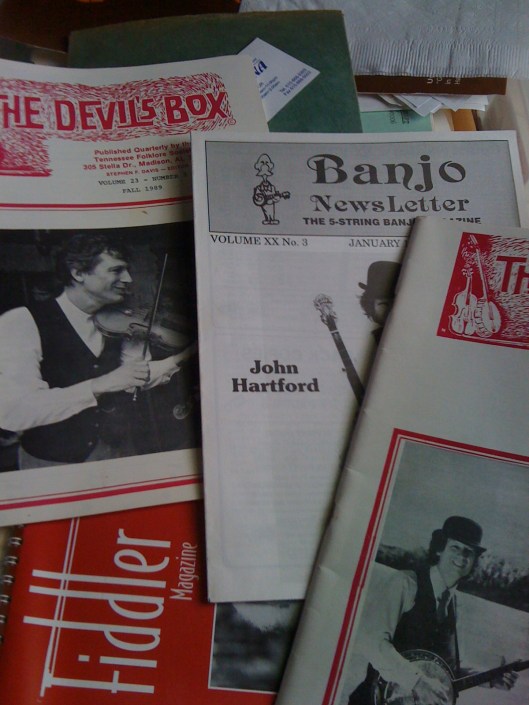
Posted by Brandon Ray Kirk | Filed under John Hartford, Music
Writings from my travels and experiences. High and fine literature is wine, and mine is only water; but everybody likes water. Mark Twain
This site is dedicated to the collection, preservation, and promotion of history and culture in Appalachia.
Genealogy and History in North Carolina and Beyond
A site about one of the most beautiful, interesting, tallented, outrageous and colorful personalities of the 20th Century
 Brandon Ray Kirk