• About

Brandon Ray Kirk

~ This site is dedicated to the collection, preservation, and promotion of history and culture in my section of Appalachia.

Brandon Ray Kirk

Category Archives: Coal

Guyandotte Division of C. & O. Railroad (1917)

16 Tuesday Jan 2018

Posted by Brandon Ray Kirk in Coal, Huntington, Logan

≈ Leave a comment

Tags

Allegheny District, Appalachia, assistant superintendent, C&O Railroad, C.S. Falconer, Clifton Forge, Clifton Forge Division, division engineer, E.M. Withrow, F.D. Beall, general manager, Greenbrier District, Greenbrier Division, Guyan Division, Guyandotte District, H.A. Davis, H.E. Webb, Handley, Hinton, Hinton Division, history, Huntington, Huntington Division, J.P. Stevens, J.W. Haynes, Logan, Logan Democrat, New River District, R.W. Mumford, Richmond, road foreman of engines, Ronceverte, superintendent, train master, Virginia, W.L. Glass, W.T. Lipscomb, West Virginia

From the Logan Democrat, of Logan, WV, comes this bit of history about the C & O railroad in the Guyandotte Valley:

NEW GUYAN DIVISION

C. & O. Railroad From Huntington To This City Is Detached From Former Organization

The C. & O. has detached the Guyan Valley district from the Huntington division and created it as a separate division under Superintendent H.E. Webb, formerly of Huntington. A number of other changes are made on the C. & O., which are announced in the following official order:

Richmond, Va., April 30, 1917.

Effective May 1, 1917:

The eastern general division is extended to Hinton, W.Va., and the line Clifton Forge to Hinton, including all branches (Greenbrier district excepted) will be attached to the Clifton Forge division.

The Greenbrier district will be known as the Greenbrier division.

The Hinton division will consist of the line Hinton to Handley, including branches.

The Guyandotte district is detached from the Huntington division, and will be known as the Guyandotte division.

Due to rearrangement of the general divisions and divisions, the following appointments are effective May 1, 1917:

Mr. C.S. Falconer, assistant superintendent, Allegheny district and its branches, Clifton Forge division, Hinton, W.Va.

Mr. F.D. Beall, division engineer, Clifton Forge division, Clifton Forge, Va.

Mr. J.W. Haynes, superintendent Greenbrier division, Ronceverte, West Va.

Mr. H.E. Webb, superintendent, Guyandotte division, Logan, W.Va.

Mr. H.A. Davis, train master, of Guyandotte division, Logan, W.Va.

Mr. R.W. Mumford, division engineer, Guyandotte division, Logan, W.Va.

Mr. W.T. Lipscomb, train master, New River district, Hinton, W.Va.

Mr. W.L. Glass, road foreman of engines, New River district, Hinton, W.Va.

Mr. E.M. Withrow, road foreman of engines, Allegheny district and Greenbrier division, Hinton, W.Va.

J.P. Stevens,

General Manager

Source: Logan (WV) Democrat, 3 May 1917.

Black Hawk Mine (1916)

14 Sunday Jan 2018

Posted by Brandon Ray Kirk in Big Creek, Coal

≈ Leave a comment

Tags

Appalachia, Big Creek, Black Hawk Mines, coal, history, Lincoln Mines, Logan County, Logan Democrat, West Virginia

Black Hawk Mine Ad LD 12.14.1916.JPG

Logan (WV) Democrat, 14 December 1916.

Strange Miners Cannot Get Hired in Logan County, WV (1913)

02 Tuesday Jan 2018

Posted by Brandon Ray Kirk in Boone County, Coal, Logan

≈ Leave a comment

Tags

Appalachia, Boone County, coal, Guyandotte River, history, Island Creek, Logan, Logan Banner, Logan County, Mine Wars, Ramage, Spruce River Coal Company, U.S. Coal & Oil Company, United Mine Workers of America, West Virginia

From the Logan Banner of Logan, WV, comes this commentary about coal miners and union agitation dated March 21, 1913:

STRANGE MINERS cannot get work at all in the principal Logan County mines, it is said, and even in the smaller mines an applicant has to run the gauntlet of a series of “family-history-cross-examination-questions” that would stagger a Philadelphia lawyer, before one gets a job–and then like as not get turned down because he is not of Logan county. The precaution is fully warranted. The United Mine Workers hope to control the Guyan Valley field, if they ever DO–and THEY  NEVER WILL–by first “organizing” the smaller, isolated mines by “smuggling in” an agitator or two now and then and finally, with one “grand sweep” capture the big works. If the labor leaders actually KNEW certain conditions and “inside workings” now effective, even in the small works, half so well as they THINK they know them, they’d give up as a bad job their idea of “organizing” Logan county, and go to honest work shoveling coal for a living themselves. During the past year, more than one “undesirable miner” has been shipped “bag and baggage” out of the valley because he let his agitation fever break out too strong, prematurely, spoiling his little game. In another column will be found a news item of the shut-down of the Ramage works of the Spruce River Coal Co. We predict that some of Logan’s mines will turn off their power and “look out” their employees before they will let the United Mine Workers conduct their business for them. So far as the corporation’s finances are concerned, the U.S. Coal & Oil Co. can shut down all of its Island Creek mines, burn its tipples and dump its cars into Guyan river. And that’s what would best suit the competitive coal operators of other States! Likewise the miners’ union agitators and leaders! But there’s another side of the story–the miner and his family need the work in the coal-bank, the merchant needs some of the money he earns, Logan county needs its merchants and the outside world needs West Virginia coal–the BEST that “old mother earth” ever produced!

John Jacob Cornwell, WV Governor-Elect (1916)

02 Tuesday Jan 2018

Posted by Brandon Ray Kirk in African American History, Coal, Matewan

≈ Leave a comment

Tags

coal, governor, history, John Jacob Cornwell, Logan Democrat, Mine Wars, politics, West Virginia, World War I

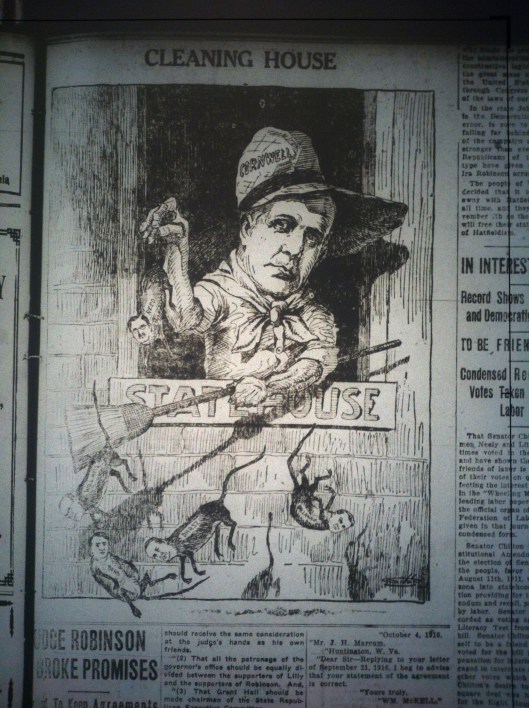
Cornwell Political Cartoon LD 10.26.1916

Logan (WV) Democrat, 16 October 1916. Narrowly elected in 1916, Mr. Cornwell served as the fifteenth governor of West Virginia (1917-1921).

Cornwell Image LD 11.09.1916

Logan (WV) Democrat, 9 November 1916. Mr. Cornwell served as governor during World War I.

Fore more history about Governor Cornwell, visit this site: https://www.wvencyclopedia.org/articles/1604

Coal Company Set to Build New Town in Logan County, WV (1927)

25 Monday Dec 2017

Posted by Brandon Ray Kirk in Coal

≈ Leave a comment

Tags

Appalachia, C&O Railroad, coal, Guyandotte River, Herald-Dispatch, history, Holden, Holden No. 22, Island Creek Coal Company, J.D. Francis, Logan County, Omar, Peytona Lumber Company, Tug Fork, West Virginia, Wiatt Smith, Y.M.C.A.

From a 1927 story printed in the Logan Banner of Logan, WV, comes this interesting bit of history about Holden No. 22:

Island Creek Co. Plans Building of New Town

Contracts Will Be Let Within 30 Days For Houses, Highways and Also Tipple For Largest Mine In West Virginia, Says Vice President–May Spend $2,000,000.

Within the next year there will arise in one of the remote and hitherto inaccessible regions of Logan county, a new town. It will have a population approximating 2,000. It will have a Y.M.C.A., a community church, modern homes, paved streets, its own water system, electric lights–in fact, all of the modern conveniences. It will be connected by hard road with Logan, Holden and the great world beyond the mountains. At present, it has not even a name, writes Wiatt Smith for the Huntington Herald-Dispatch.

The new town is to arise at operation No. 22 of the Island Creek Coal Company.

Within the next 30 days, J.D. Francis, vice-president of the Island Creek Co., said Tuesday, contracts will be let for the erection of tipples, the building of houses, the paving of streets and the hard surfacing of seven miles of road which will connect the new community with Holden.

Operation No. 22 will represent when completed an additional investment on the part of Island Creek, ranging well beyond a million dollars, perhaps reaching two million, though Mr. Francis refused to hazard an estimate of definite figures.

For a number of months preparations for the opening of a new mine, which will be the largest in southern West Virginia, have been going forward. The two 400 foot shafts which will serve the mine are now nearly complete. The Chesapeake & Ohio is rapidly completing the four mile extension of the Pine creek branch which will provide an outlet for the coal produced. The Island Creek company is completing three miles of siding. Pete Minotti, the contractor, has finished grading the road from Holden to the mine.

By October, it is expected, the road will be surfaced, the town well under way and the great mine in operation. Output at the beginning will be small, as the number of workmen will be necessarily limited until the underground workings have been expanded by the removal of coal. The area to be worked is underlaid, experts say, with 50 or 60 million tons and the mining of the coal will, under normal conditions, require 50 years.

Work at the mine site in advance of the completion of the railroads has been made possible, Mr. Francis explained, by the use of the tram road of the Peytona Lumber company over which many thousands of tons of sand, gravel and supplies have been shipped. The completion of the railroad is awaited for the installation of the bulkier machinery and equipment.

The new rail extension will connect with the Chesapeake & Ohio’s Logan division main lines via Omar. The contact of the operative officials and the workers with the Island Creek center at Holden will be by means of the hard road, the construction of which, in itself represents something like an engineering adventure. For some three miles it follows the ridge that marks the crest of the watershed between the valleys of Guyandotte and Tug Rivers. Then it drops sharply to follow mountain side, hollow and creek valley to the mine operation.

Persons who have traveled the now graded road say that at points on the ridge it affords magnificent views which compare favorably with the most famous in the state. The road was graded and will be hard surfaced entirely at the expense of the coal company, which, in the preparations for its new development has followed the policy adopted many years ago when, upon the opening of its original operations, it established in Holden a mining community which was pointed out as a model throughout the United States.

Island Creek operation No. 22 will be the fifth shaft mine in West Virginia.

Source: Logan (WV) Banner, 25 March 1927.

C&O Railroad Bridge at Island Creek in Logan, WV (1913)

22 Friday Dec 2017

Posted by Brandon Ray Kirk in Coal, Logan

≈ Leave a comment

Tags

Appalachia, C&O Railroad, history, Island Creek, Logan, Logan Banner, photos, West Virginia

Island Creek Bridge Photo LB 05.09.1913.JPG

Logan (WV) Banner, 9 May 1913.

Christmas in Logan, WV (1916)

22 Friday Dec 2017

Posted by Brandon Ray Kirk in Coal, Logan

≈ Leave a comment

Tags

Appalachia, Christmas, coal, Guyan Drug Store, history, Holden, Logan, Logan County, Logan County Light & Power Company, Logan Democrat, New Year's Day, Santa Claus, U.S. Coal & Oil Company, West Virginia, World War I

From the Logan Democrat of Logan, WV, come these stories of Christmas in 1916:

Santa image LD 12.14.1916

Logan (WV) Democrat, 14 December 1916.

COMMUNITY CHRISTMAS TREE AND CEREMONIES ON SATURDAY NIGHT

On Saturday night, at 6:30 o’clock Logan will hold its first formal community celebration of Christmas through the medium of a community Christmas tree with the attendant distribution of substantial gifts to the elders, and toys and goodies to all the children, in keeping with the true spirit of the season.

The proposition has been launched and carried out by a number of prominent ladies of the city, whose efforts to make the event a huge success will undoubtedly be crowned with the deserved result. The plans are elaborate and extensive, and provide for the supplying of every needy and worthy family within reach of a good supply of necessaries, including groceries and clothing, and the presentation to each and every child in the city with candy and a toy. The household gifts will be distributed through the medium of tickets distributed by the ladies committee, which has been busily at work for the past week or ten days. The work is entirely non-denominational, and the event will take place rain or shine. If the weather is clear the tree will be placed on the courthouse lawn, and if inclement it will have a place on the courthouse porch.

It is understood that the Chamber of Commerce and other prominent civic and church organizations are lending their hearty approval and substantial support to the matter, and that sufficient funds have been obtained to meet the requirements, aided by the liberal donations of merchandise by the local merchants.

The household gifts will be distributed in baskets, while the children will receive theirs in tidy little bags, two hundred or more of which have been provided. Upwards of $200 has already been expended for supplies and necessities, and it is assured that there will be plenty to go round.

The tree will be brilliantly lighted and ornately decorated, the lighting effects being supplied by the Logan County Light & Power company. Arrangements are now underway to maintain the tree in all its splendor until New Year’s, and to have it lighted up every night during that period.

The committee in charge of the work is desirous that no one be alighted or overlooked, and to this end solicits the assistance of all in the community in seeking out families who are deserving of help at this time and reporting such cases to the Guyan Drug store as soon as possible so that ample provision may be made for all.

The basket offerings will consist of groceries, a good cut of meat and other table necessities, while shoes, clothing, hats, etc., will be given to those in need of such articles.

The presents for the little folks will be given to each and every child who presents himself or herself at that proper time.

Source: Logan (WV) Democrat, 21 December 1916.

***

CHRISTMAS SPIRIT HOLDS SWAY IN LOGAN

The Christmas season is now virtually upon us; the season when it is customary for every one to be trembling with job, and minds to soar to greater heights; the season when the one thought, good will, is paramount in the minds of all; when trials and sorrows are cast to the four winds, and only the good deeds of life are given a place in human interest.

Grievances and differences are forgotten and nothing is remembered save that someone did you a good turn and made your life a little happier at least for a time. Or perhaps you think of the kind word or action that you had passed along to someone else less fortunate than yourself, and it is with pleasure that you recollect in joy that was manifested in the face of someone that you helped.

But a shudder comes when you think of the terrible havoc with which Europe has been fraught; where men have been taking and giving a life for a life; where the hearts of women have been torn asunder; where the cruel pangs of hunger have driven children to an early grave; where aged m others and fathers have been bereft of all comfort and dragged down to the nethermost depths of despair, where lands have been devastated, and cities have been robbed of all their beauty by the greedy mouths of the cannon.

And your thoughts turn to the thousands of mothers in that war stricken land; the mothers who were so happy before the terrible slaughter of men commenced; the mothers left alone pining for their loved ones; the mothers in the gray and dusk of the dawn where the shadows are turning into spectres, grim, wan, ghastly and fearful. And you think of them as the mothers of men; men who fought and died for freedom.

A feeling of sadness comes over you as you think of the joy that might have been theirs; of the gay and happy times that they too might have had at Christmas, all of which has been blasted by the terrible scourge of warfare. And perhaps you utter a prayer of thankfulness that you can enjoy to the full that Merry Christmas. But perhaps you may not pause to think that there are some near you who cannot join in that happiness that may be yours.

You forget about the little boys and girls whose parents are at war, not war against nations, but war against adversity and calamity. They are struggling against great odds, and reinforcements are required immediately to assist them to struggle in the heights, surmount the barriers and give to their children a Merry Christmas.

They have told their children tales of Santa Claus; of the many treasures stored away in his mansion in the skies; of his yearly visit to the children; of the many toys he brings them, and the joy that he unloads at every household, and they told these tales when the sun was shining down upon them in all its glory and brilliance; when all seemed bright and there was not thought of the coming winter, with its chilly blasts and the snowstorms was in their minds.

But winter has sent a warning and is stalking forth in all sternness. They do not feel sorry now that they told the children such tales, because they made the children happy, but they know now that a hard struggle is ahead of them and that the long looked for visit of Santa Claus may not materialize.

They cannot steel themselves to break the news to the children. They were sure that when Christmas came Santa Claus would not forget the little ones but that was before misfortune struck them, and they now bow their heads in sorrow.

These are the people that must be thought of during our Christmastide, and every effort made and plans turned to bring them a full measure of the gladness and cheer of the festive season. The community Christmas tree will be a wonderful blessing to the whole community, radiating wholeheartedly and generously upon all alike its spirit of good cheer. A little individual effort on the part of everyone will cap the climax of making this Christmas a memorable and happy one to all within reach.

Source: Logan (WV) Democrat, 21 December 1916.

***

Community Tree Was Big Feature of Christmas

The community celebration held in this city on last Saturday night was one of the biggest events of a charitable nature Logan has ever seen, and the spirit of good cheer and the material benefits derive therefrom will have an uplifting influence upon the entire section for a long time to come.

The good influence exerted by the affair cannot be overestimated, and the results obtained were highly satisfactory to those in charge of the work. A large number of baskets of groceries were distributed, and shoes and clothing were given to all who could be found who were in need of such articles. The kiddies of the city were all provided for with candy, fruit and nuts, and on the whole the event was a notable one, and it is quite likely that it will become an annual fixture in the future years.

Source: Logan (WV) Democrat, 28 December 1916.

***

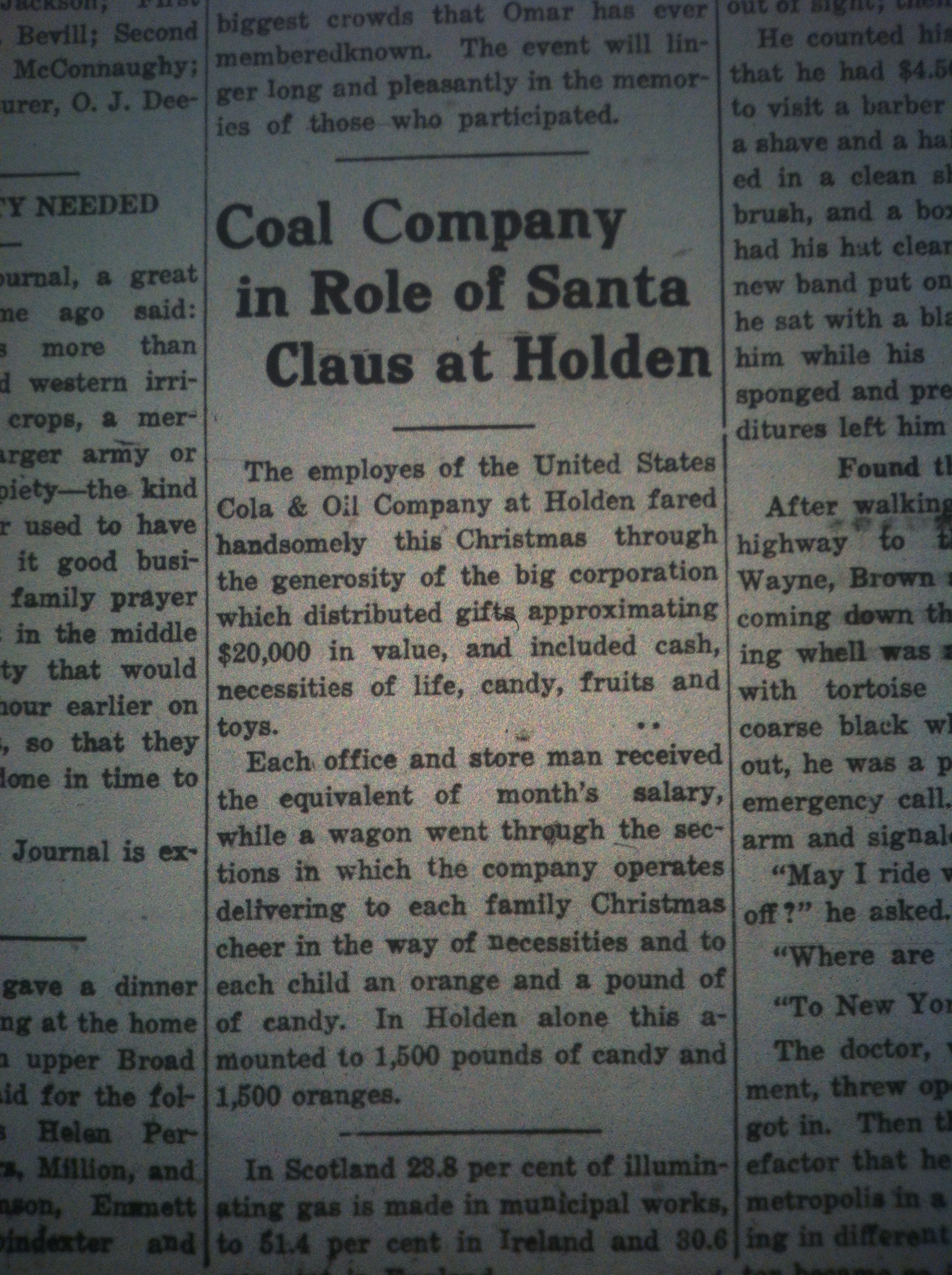
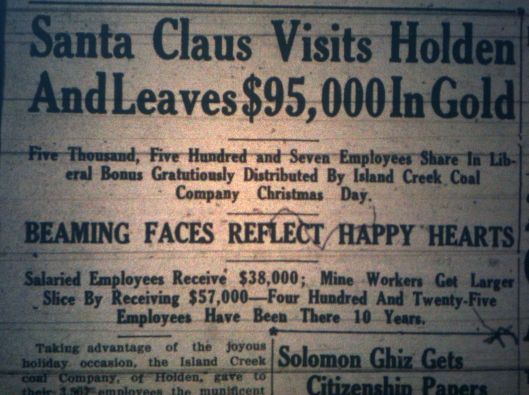
Coal Company Plays Role of Santa LD 12.28.1916.JPG

Logan (WV) Democrat, 28 December 1916.


Miners Earn What They Get and Get What They Earn (1913)

06 Wednesday Dec 2017

Posted by Brandon Ray Kirk in Coal, Logan

≈ Leave a comment

Tags

Appalachia, coal, history, Logan, Logan Banner, Logan County, U.S. Coal & Coke Company, West Virginia

From the Logan Banner, of Logan, WV, comes this editorial dated 3 October 1913:

Miners Earn What They Get and Get What They Earn

We do not and never have denied the right of laboring men to organize and unionize. They have the natural and legal right to do so. In most trades and callings they ought to do so. But a lot of honest, toiling, contented men, who receive full pay for every hour’s work, should be left free to pursue their work, undisturbed by agitators and trouble makers–and so long as an organization proves a menace and a curse to those it already embraces, it will certainly be left alone by those who think and see and read and know. The miner’s life may not be one of perfect peace; whose life is? But the miners of this section seem to have sense enough to rather bear the ills they have than fly to others that they know not of.

The operators here pay their men better wages than any other class of workers receive, as an average. They house the men well. Men are encouraged to raise gardens and reduce the cost of living. Take the U.S. Coal & Coke Co. for example: Employees are contented, live well, work hard and receive good pay: this company, perhaps by reason of its vast backing and newer workings, has a vast host of satisfied, contented workers. They earn what they get and get what they earn. Any person can go and talk and see; in fact, yearly we and others are invited to visit and inspect their homes and gardens and workings. Other companies are in like condition; operators and men seem to understand each other and the men receive a fair deal. Anyone can come here and see for one’s self.

Life and History of Mother Jones (1913)

31 Tuesday Oct 2017

Posted by Brandon Ray Kirk in Coal

≈ 2 Comments

Tags

Appalachia, Boomer, Chicago, coal, Cork, Fred Bobbin, history, Ireland, Kansas City, Logan, Logan Banner, Maine, Mary Harris, Mother Jones, Mucklow, New England, Omaha, Oyster Bay, Philadelphia, Pittsburgh, San Francisco, Teddy Roosevelt, West Virginia

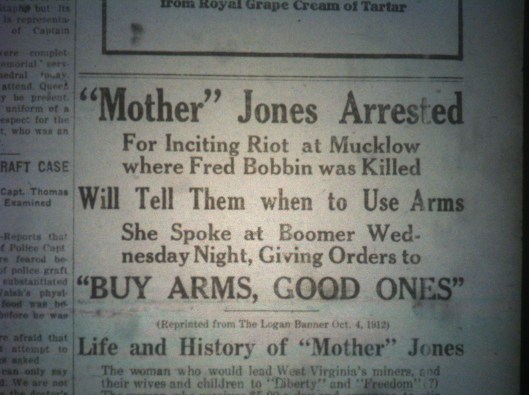
Mother Jones Arrested LB 02.14.1913 1.JPG

From the Logan Banner of Logan, WV, comes this story dated February 14, 1913:

Life and History of “Mother” Jones

The woman who would lead West Virginia’s miners, and their wives and children to “Liberty” and “Freedom” (?) The woman who receives $5.00 a day and expenses to stir up strife among “unorganized” laborers.

Mary Harris, born in Cork, Ireland, 60 years ago, of respectable parentage and good antecedents; brought to New England at an early age, people settled in Maine; educated in common schools, taught a country school for several years. Married a prosperous farmer, and when widowed immediately allied herself with a labor movement then attracting attention in the East, claiming she wanted to elevate the laboring classes, educationally and socially. She began to associate with labor leaders and reformers at the time of the A.R.U. strike of 1894, since when she has kept pretty busy stirring things up. Has a record of never advocating peace nor arbitration, but being for strife and war. Was particularly prominent in the Pittsburg strike of 1895, Miners’ strike of ’97, Central Penn strike ’99 and ’00, the Coal strike in Philadelphia. During the latter strike she placed herself at the head of one hundred men, women and children and started with them on a march to Oyster Bay to interview President Roosevelt and demand his intervention in behalf of the strikers. She held daily meetings along the route, solicited subscriptions for the maintenance of her party, and finally land at Oyster Bay with a handful of her followers, but she did not see the President and the expedition ended there.

That is the record, so far as the labor movement is concerned, of the woman known from Maine to California as “Mother” Jones, labor agitator and leader. “Mother” Jones who is always to the front when there is strife, with her battle cry: “We’d rather fight than work,” “Mother” Jones who gets $5.00 per day and expenses so long as there is trouble brewing; who, since 1900 has received a salary from the mine workers’ organization, and who is said to be worth any five men as an agitator. But down in the —– office there is another record, one that reaches back to 1891, when “Mother” Jones was a well-known character, not only in the “red-light” district of Denver, but in Omaha, Kansas City, Chicago, and far-off San Francisco. That record covers many pages, but a few FACTS are all that are necessary to show the character of this petticoated reformer. They say of her:

A vulgar, heartless, vicious creature, with a fiery temper and a cold-blooded brutality rare even in the slums. An inmate of Jennie… [cropped]

***

Now what do you think of “Mother” Jones? The Banner printed her history four months ago–the only paper in the U.S. that dared print it. The Banner for first news.

History of Coal (1927)

29 Sunday Oct 2017

Posted by Brandon Ray Kirk in American Revolutionary War, Coal

≈ Leave a comment

Tags

Antoine de la Mothe Cadillac, Appalachia, Chicago Journal of Commerce, coal, Coalport, history, Illinois, Illinois River, Indiana, John Fremont, Logan, Logan Banner, Logan County, Malcolm MacFarlane, Montana, New Orleans, New York Central Lines, Ohio, Ohio River, Ottawa, Pomeroy, Pomeroy Bend, Richmond, Robert de La Salle, Virginia, West Virginia, Wyoming

From the Logan Banner of Logan, WV, comes this story dated April 5, 1927:

The greatest antiquity of the Aryan race historically established runs back to from four to five thousand years ago. The language of the Aryans was Sanskrit, and from this language comes the word coal, from the original word “jual” meaning “to burn.” In the Bible coal or coals means the embers of charred or reddened burnt or burning wood. Our present day bituminous and anthracite coal was unknown to the ancients, at least as a fuel, says the Chicago Journal of Commerce.

The general fuel inspector of the New York Central Lines, Malcolm MacFarlane, has been doing research work in the history of bituminous and anthracite coal. While it seems probable that coal came into limited use in the Iron Age about 1000 B.C. the earliest authentic record show that it was used in Greece in 300 B.C. In England it was in use in A.D. 852. Mr. MacFarlane says: “Our ancestors of that day were very suspicious of this new fuel, with heavy black smoke and pungent odors. Fears prevailed that the public health was affected, and so widespread did these become that the English King prohibited the mining of coal entirely. The same condition obtained in France, and it was the middle of the thirteenth century before coal came into general use in Paris.”

First coal discovery in this country came from the town of Ottawa on the Illinois River in 1679, with mining operations beginning seventy years later twelve miles above Richmond, Va. Coal was in general use there twenty-five years later in 1775, and was used in making guns for the patriot army of the Revolutionary War. Later, coal showings were found along the Ohio River in Ohio, Indiana, and Illinois. In the Northwest, General Fremont reported coal in Wyoming in 1843. In 1879 coal was uncovered in Montana. In the Pomeroy Bend, coal had been mined for more than a hundred years. A coal bank was opened there in 1819. In 1808 at Coalport in the above bend of the river attempts were made to export coal, but were unsuccessful. In 1832 a thousand bushels of Pomeroy coal was shipped in ___ on a flatboat to New Orleans. The field has been a great producer ever since.

Anthracite was discovered in America in 1763, but was not burned ____ to a ____ until 1803.

[cropped]

ever up to that time been placed under the governorship of one man.

Cadillac and LaSalle were both possessed of that spirit which fights against seemingly insurmountable odds. They were leaders. Both visioned the establishment of a vast empire in the West. Their achievements formed the backbone of American development. They were dreamers, and then, with never-ending zeal, strove to realize their dreams.

LaSalle was more the restless discoverer, constantly venturing into some new hazardous undertaking. Cadillac was the colonizer, with a practical and commercial mind. His business and trading ability made the settlement at Detroit a financial success.

Source: “New Data on the History of Coal is Uncovered by MacFarlane, Research Worker,” Logan (WV) Banner, 5 April 1927.

Note: For more information about Pomeroy coal, follow this link: http://archiver.rootsweb.ancestry.com/th/read/OHMEIGS/2006-07/1152225240

President Harding’s Proclamation Relating to Blair Mountain (1921)

22 Sunday Oct 2017

Posted by Brandon Ray Kirk in Battle of Blair Mountain, Coal

≈ Leave a comment

Tags

Appalachia, Battle of Blair Mountain, Blair Mountain, Brandon Kirk, coal, Greg Kirk, Harding Home, Harding Tomb, history, Logan County, Marion, Ohio, photos, Warren G. Harding, West Virginia

The full text of President Harding’s proclamation, calling upon members of the armed bands threatening invasion of Logan county, to disperse and go to their homes follows:

IMG_3670

Harding Tomb, Marion, OH, June 2016. For more on the Harding Tomb, follow this link: https://www.hardinghome.org/harding-memorial/

WHEREAS, The governor of the state of West Virginia has represented that domestic violence exists in said state which the authorities of said state are unable to suppress; and,

WHEREAS, It is provided in the Constitution of the United States that the United States shall protect each state in this union, on application of the legislature, or of the executive when the legislature cannot be convened, against domestic violence; and,

WHEREAS, By the law of the United States, in pursuance of the above, it is provided that in all cases of insurrection in any state or of obstruction to the laws thereof it shall be lawful for the President of the United States on application of the legislature of such state or of the executive, when the legislature cannot be convened, to call forth the militia of any other state or states or to employ such part of the militia of any other state or states or to employ such part of the land and naval forces of the United states as shall be judged necessary for the purpose of suppressing such insurrection and causing the laws to be duly executed; and,

WHEREAS, The legislature of the state of West Virginia is not in session and cannot be convened in time to meet the present emergency, and the executive of said state under Section 4, of Article 4, of the Constitution of the United States and the laws passed in pursuance thereof, has made the application to me in the premises for such part of the military forces of the United States as may be necessary and adequate to protect the state of West Virginia and the citizens thereof against domestic violence and to enforce the due execution of the laws; and,

WHEREAS, It is requested that whenever it may be necessary, in the judgment of the President, to use military forces of the United States for the purpose aforesaid, he shall forthwith by proclamation command such insurgents to disperse and retire peaceably to their respective homes within a limited time;

NOW, THEREFORE, I, Warren G. Harding, President of the United States, do hereby make proclamation and I do hereby command all persons engaged in said unlawful and insurrectionary proceedings to disperse and retire peaceably to their respective abodes on or before 12 o’clock noon of the first day of September, 1921, and hereafter abandon said combinations and submit themselves to the laws and constituted authorities of said state;

AND, I invoke the aid and cooperation of all good citizens thereof to uphold the laws and preserve the public peace.

In witness whereof, I have hereunto set my hand and caused the seal of the United States to be affixed.

Done at the city of Washington, this thirtieth day of August, in the year of our Lord, Nineteen Hundred and Twenty-one, and the independence of the United States the One Hundred and Forty-sixth.

Source: “Text of President’s Proclamation Directing Armed Band to Disperse,” Logan (WV) Banner, 2 September 1921.

IMG_7355.JPG

My cousin Greg was the ultimate companion for a tour of the Harding Home and Harding Tomb! Marion, OH. June 2016. For more on the home, follow this link: https://www.hardinghome.org/

Chapmanville News 07.23.1926

21 Saturday Oct 2017

Posted by Brandon Ray Kirk in Chapmanville, Coal

≈ Leave a comment

Tags

Appalachia, board of education, Cemetery Ridge, Chapmanville, Chapmanville Mountain, coal, county clerk, Crooked Creek, Democratic Party, Dr. Ferrell, genealogy, history, Joe Buskirk, L.B. York, Logan Banner, Logan County, O.F. Ferrell, Republican Party, Sons of Rest, West Virginia

An unknown correspondent from Chapmanville in Logan County, West Virginia, offered the following items, which the Logan Banner printed on July 23, 1926:

Joe Buskirk, candidate for county clerk, was looking up Republicans here this week.

Doctor Ferrell gave a wiener roast Friday evening on Cemetery Ridge. It is said one man danced until his shirt was wet with sweat, something that had not happened to him before for five years.

This being the only Democratic district in Logan county, we have a surplus of candidates for members of the Board of Education. The Democrats hate to lose clear out.

Both the Vickers and Tompkins mines have started again, practically everybody is at work.

A number of our young folks went a hiking before breakfast Sunday morning, and cooked breakfast on Chapmanville mountain. It is rumored that some of the boys got treed.

L.B. York is suffering from some strange malady. Doctor Ferrell thinks it is a back set on the sun shine.

...refused to lick stamps for the public.

Quite a lot of our people attended the Sunday School Convention at Crooked Creek last Sunday.

O.F. Ferrell has purchased a fine fox hound. He is a Virginia trail burner.

On Saturday evening the Sons of Rest will award the following prizes to those present: Fattest man, Gold headed cane; Biggest liar, Plug of Brown’s Mule tobacco; Best looking man, Manicuring set. The names of the winners will be given next week.


Mollie Drake: “The Florence Nightingale of Blair Mountain” (1921)

20 Friday Oct 2017

Posted by Brandon Ray Kirk in Battle of Blair Mountain, Coal, Huntington, Logan, Women's History

≈ Leave a comment

Tags

Allen B. Dingess, Alleyne Dye, Appalachia, Ashland, Battle of Blair Mountain, Cabell County, Caroline Dingess, Cattaraugus County, Ceredo, coal, Democratic Party, genealogy, Hannah Mitchell, Henry Street Settlement, history, Huntington, Illinois, Kentucky, Leo Frank Drake, Logan, Logan Banner, Logan County, Mollie Drake, New York, Republican Party, Springfield, Wayne County, West Virginia

Mollie (Dingess) Drake, daughter of Allen B. Dingess and Caroline (Jackson) Dingess, was born on June 30, 1881 in Logan County, WV. She was the wife of Leo Frank Drake, a salesman. She appears in the 1910 Wayne County Census (Ceredo District). Hannah Mitchell profiled her life in the Logan Banner of Logan, WV, on December 30, 1921. Her husband died in 1925. In 1930, Mollie lived at Springfield, IL. In 1940, she made her home in Cattaraugus County, NY. Mrs. Drake died on July 7, 1958 at a nursing home in Huntington, WV.

Mollie Dingess Drake Photo.jpg

It would be easy enough to make a melodramatic start and give her some such extravagant title as “The Angel of the Hills” or “The Mother of the Mines” or “The Florence Nightingale of Blair Mountain.” But if you did and Molly Dingess Drake found it out she might laugh and she might make some sharp remark, but most certainly she would not be pleased.

How she escaped the “war correspondents” who were rushed to the front to cover West Virginia’s recent mine war is more than I can say, for the story is still told of how Molly, like “Sheridan twenty miles away,” when the armed miners were marching on Logan, made all haste not toward safety, as she might very wisely have done, but back to where the bullets were flying.

Her narrowest escape from the feature pages of newspapers was several years ago–two, in fact–when, a woman of some two score years, she was graduated from high school with her sixteen-year-old daughter. That graduation and the attendant high school diploma were in no sense honorary affairs given out of respect for Molly Dingess Drake. They had been earned by this very determined, ambitious woman of the hills after four years of high school work, in which she had enrolled along with her daughter and for which she had attended classes faithfully and with classmates half her age.

On pay day Mrs. Drake is a welfare worker for one of the coal companies operating in the Logan field. Having finished her high school course, she did not go on to college with her daughter. And, as she puts it, one of the coal producers “knew she wouldn’t sit at home and knit and crochet.” So he offered her the job of visiting nurses among the employees of his company. In this job Mollie mothers a large family. It is composed of men and women much older than she and of the children of these older children. True to the mother-type anywhere, she makes their individual troubles, their health, their happiness, a very personal matter.

There was the young Spaniard who lay in the hospital after a severe accident. No friends or relatives rallied to his bedside, and the doctors and nurses could not understand him when he moaned out a word or two in his native tongue. Mollie Drake scoured the hills for an interpreter and found one. She also dug up a cousin of the unfortunate boy. Moreover she made the lives of nurses and doctors miserable until the lad was out of danger, sometimes calling at the hospital late at night to see how the boy was getting on. Was not this foreign born lad one of her children?

It was not the Mollie Dingess Drake, ready to face danger along with other brave women of Logan county when armed miners were marching upon their homes, that interested me most, as you may have guessed already. The World War is too recent proof that American women are not afraid to risk their lives for a cause. It is Mollie Drake and the work of her hands when peace broods over her native hills that make her a woman among women.

Mrs. Drake is a mountain woman herself. She knows the desires, the needs and the hopes of the women and children who live in her hills; in a double sense she is working among her own people.

No serious-minded killjoy is Mrs. Drake, but a large motherly woman with a great capacity for fun and for seeing the human side of things.

It is a common statement among traveling salesmen that they live in a Pullman; Mollie Drake might say she lives in a day coach. Her headquarters are in Logan, and much of her time is spent in riding to and from the little mining towns along the branch lines out of Logan.

Her trips are taken to visit the homes of miners, and no place is too remote for her to visit. Her energy in tramping about and the speed with which she walks over the hills is enough to make a younger woman gasp for breath and all but beg for quarter. That from one who knows.

We started out of Logan one morning on the 10 o’clock train.

Before the train started we were part of the social gathering which greets the all-too-few passenger trains that come into Logan. Mollie Dingess knew everybody.

Arrived at the mining center, our first visit was to the schoolhouse, a substantial two-story building, in front of which were all the latest playground devices for amusing the modern child. The teachers were young and efficient in their schoolroom manners. In Logan county the schools have the advantage of extra good teachers because after the school board has voted what it can afford for salaries the coal companies make up the deficit needed to attract the best.

It was then I learned of Mrs. Drake’s unusual high school career.

“You know I have a high school education,” she remarked as we left the school and strode (at least Mrs. Drake strode) along the dirt road.

“As a girl I went to school till I was thirteen. In the teens I took up nursing and later was married. But I always wanted more education. Sometimes it is the persons who are denied education appreciate it most. Well, when my daughter was ready for high school I decided that I would get my high school education too–not by following her studies at home (I knew that wouldn’t do), but by enrolling in high school with her.

“Some of my friends thought it was an absurd idea. They said I could enroll in college for special courses or take correspondence courses. But the idea of my going to school right along with my daughter and the other young people seemed queer to them. I suppose it was unusual. But what I wanted was a regular education. So I enrolled and went through the four years of high school and was graduated in the same class with my daughter.”

“And how did your daughter feel about it?”

“Oh, she had her young friends and took part in school activities just the same.” Again the twinkle behind the glasses. “It may be that she studied harder than she would have.” I had no doubt of that.

“She is in college now,” continued Mrs. Drake. “When her grades aren’t has high as I think they ought to be she sends them to her father, but a man can’t keep such things secret, and I always find out. She knows I haven’t much patience with students who don’t keep up their grades.

“My daughter is going to be a physician. She didn’t make up her mind until after she entered college. I was rather anxious to know what she would choose. After she started studying biology she was so interested that she decided to go on and study medicine.”

It occurred to me that Mollie Drake was a feminist. I wondered if she had ever been a suffrage worker.

“No,” she answered. “I’ve always been a Democrat, though. My husband says I am what is called ‘a mean Democrat.'”

She paused and then laughed. “I made one rule when I was married. You see, Mr. Drake is a Republican. Well, I told him that if I married him he must keep just one rule. I knew our marriage would be a success if he did. And of course I promised to keep it too. The rule was that we should never talk politics. We never have and we’ve been very happy.

“Of course I voted at the last election, and much good it did so far as the Presidency was concerned. But someway I didn’t care so much for the voting. I’m old-fashioned in many ways. I was brought up in a strict way and I don’t like to hear about folks playing cards on Sunday. I suppose it isn’t wicked, but I can’t get over my bringing-up. And I never take a needle in my hand on a Sunday, only when I just have to mend something, that I don’t feel kind of guilty.”

Our conversation had been interspersed with visits to various miners’ homes, mostly where there were babies. Mrs. Drake’s philosophy had been punctuated by advice on babies and friendly comment upon the little interests of the women we visited. If we weren’t inspecting a baby we were talking with some elderly woman over a fence about her latest “misery.”

As we climbed the trails I was tired, but Mrs. Drake seemed as energetic as when the day began.

“I like the work,” she said, “but I want to study more. Last summer I took a course in New York, and I’d like to go back there for a second at the Henry Street Settlement. I want to study languages, too. There are so many things I want to do.”

Some day I have not a doubt she will do these things she wants to do. In the meantime I think of her in connection with the verse: “Whatsoever thy hand findeth to do.”

Source: “The Florence Nightingale of Blair Mountain,” Logan (WV) Banner, 30 December 1921.

Notes:

To see Mrs. Drake’s photo and entry at Find-A-Grave, follow this link: https://www.findagrave.com/cgi-bin/fg.cgi?page=gr&GRid=20145994

Mrs. Drake’s daughter, Alleyne Howell Dye, died of suicide in Ashland, KY, in 1944. For her death record, follow this link: https://www.familysearch.org/ark:/61903/3:1:3Q9M-C9YV-H7M5-H

To see Mrs. Dye’s photo and entry at Find-A-Grave, follow this link: https://www.findagrave.com/cgi-bin/fg.cgi?page=gr&GRid=20146072

 

Whipple, WV (2015)

02 Monday Oct 2017

Posted by Brandon Ray Kirk in African American History, Coal

≈ Leave a comment

Tags

Appalachia, Brandon Kirk, Carlisle, coal, Fayette County, Gentrytown, history, National Register of Historic Places, Oakwood, photos, Scarbro, West Virginia, Whipple, Whipple Company Store, Wingrove

IMG_5319

Whipple Company Store, Whipple, WV. 29 July 2015.

IMG_5320

Whipple Company Store, the “hub of the coal camp,” was built about 1900 and closed in 1957.

IMG_5317

The Whipple Company Store is listed on the National Register of Historic Places. 29 July 2015.

IMG_5316

Today, the Whipple Company Store is a museum. For more info, follow this link: http://www.whipplecompanystore.com/

IMG_5324

You can find more history for Whipple right here: http://www.wvexp.com/index.php/Whipple,_West_Virginia

IMG_5321

Map of Whipple and surrounding area. 29 July 2015.

IMG_5323

Coal brought more ethnic and cultural DIVERSITY to southern West Virginia.


Generosity of Island Creek Coal Company (1926)

19 Tuesday Sep 2017

Posted by Brandon Ray Kirk in Coal

≈ Leave a comment

Tags

Appalachia, Christmas, coal, history, Holden, Island Creek Coal Company, Logan County, West Virginia

Island Creek Coal Company Generosity LB 12.31.1926.JPG

Logan (WV) Banner, 31 December 1926.

Stone Mountain Coal Company Headhouse is Burned in Matewan, WV (1921)

16 Saturday Sep 2017

Posted by Brandon Ray Kirk in Big Sandy Valley, Coal, Matewan

≈ Leave a comment

Tags

Appalachia, Blackberry City, coal, crime, deputy sheriff, fire marshal, history, John Hall, Kentucky, Logan Banner, M.C. Kindleberger, Matewan, Mingo County, P.J. Smith, Stone Mountain Coal Company, Tom Davis, Tug Fork, War Eagle, West Virginia, West Virginia Federationist, Williamson

From the Logan Banner of Logan, WV, we find the following story dated 27 May 1921:

The headhouse of the Stone Mountain Coal Company at Matewan, in the heart of the Tug river battle zone, on the West Virginia-Kentucky border, was burned early today, reports received by Major Tom Davis, acting adjutant general on Governor Morgan’s staff, stated.

P.J. Smith, superintendent of the company in Williamson said until he makes an investigation, he could not estimate the amount of damage. The minimum loss, he added, would not probably be less than $25,000.

M.C. Kindleberger, deputy state fire marshal, here to investigate the recent firing of the headhouse at War Eagle, departed for Matewan immediately. Two automobiles containing members of the state constabulary accompanied him. He said he would report to Major Davis.

The Stone Mountain mine has been abandoned by the miners recently, said Superintendent Smith.

Although Chief Deputy Sheriff John Hall gave out the statement that he had made a personal inspection of the fighting area as far east as Blackberry City, and everything was quiet, and that sniping had ceased, the emergency defense organization composed of former service men and other citizens was said by Captain Brockus, of the state police, to be growing. Seventy-two rifles were issued late Saturday night and more have been ordered. In all, said Captain Brockus, several hundred men are under arms prepared for another outbreak. An organization today issued an order temporarily discontinuing the publication of the West Virginia Federationist, a labor paper.

An incident connected with the recent shooting along the Tug river is the reluctance of taxi-cab drivers to take their passengers east of Williamson. Their invariable call at the railroad station to prospective fares is discontinuing.

Source: “Headhouse in Mingo is Burned,” Logan (WV) Banner, 27 May 1921.

To see a coal company headhouse photograph, follow this link: http://wvhistoryonview.org/catalog/wvulibraries:14752

Food in the Logan Coal Fields (1921)

11 Monday Sep 2017

Posted by Brandon Ray Kirk in Barboursville, Coal, Holden, Huntington, Logan

≈ Leave a comment

Tags

Appalachia, Barboursville, coal, history, Holden, Huntington, Logan, Logan Banner, Logan County, Omar, West Virginia

From the Logan Banner of Logan, WV, we find this story about food conditions in the Logan coal fields, dated 9 December 1921:

Seasonal fruits and fresh vegetables brighten the menu of the Logan field miner and his family just as they do the average householder in the larger cities. Visitors have noted with surprise that this is true–that even the most isolated mining communities, cut off from civilization by rugged mountains and difficult creek beds, have their fresh strawberries in season and make quite as much of an event of the canning period as do their northern neighbors.

But what the average visitor cannot know, unless he delves with unusual energy, is the cost in money and time which it means to have such products brought to the miner’s table from the produce centers of the country.

In the first place, many of the mines in the field live five, ten, fifteen and even twenty miles from the town of Logan. The roads in many cases are almost impassible. In others, there are no roads at all. It is common occurrence to use the creek bed as a thoroughfare. A rather hazardous feat, it appears to the visitors on his first trip, but he soon grows accustomed to this. At first he is inclined to cling tight to his seat as the motor truck plows through the shallow water over well rounded stones. The drivers think nothing of fording innumerable creeks. They have lost all solicitude for their tires. In fact, many of them aver that the tires last quite as long as they do on hard-paved roads and point to examples in the form of weather-beaten casing to prove that the usual 10,000 mile guarantee is not at all impossible of achievement in this difficult territory.

Sloshing along through creeks, alternating with mud roads which would bring a rattle to the finest car built they consider the trips to the mines with foodstuffs a mere routine. That it is more than routine, however, is graphically revealed by the wrecks along the roadside–broken-down trucks and motor cars, buggies and wagons.

The road to Holden, four miles from Logan, is a mud road most of the way, featured by innumerable sharp turns. That leading to the mine town of Omar covers nine miles of the most diversified transportation. In that nine miles one single creek must be forded eleven times, and often instead of crossing directly, motor trucks are forced to plow through the water for a considerable distance.

Some sixth sense apparently tells the driver where the “water road” lies, for to the casual observer one part of the creek is as good as another. All he can see is water and, beneath, a solid bed of white boulders. Time has worn them smooth. Sliding down the mud road into the creek bed the driver unerringly picks out the right route. It is as if he carried a sextant, for never, however many times he makes the trip, does he deviate in his course a yard.

Yet despite these difficulties in transportation it is comparatively cheap to get to any mine property in the Logan field. For a dollar, any of the buses operating from Logan, meeting all trains, will carry one to Omar, nine miles of difficult driving, while others take passengers 15 and 20 miles up the creeks for a slightly higher charge. For foodstuffs the cost is proportionately low. Drivers charge 25 to 42 cents per 100 pounds for first class freight to a point within 20 miles of Logan–and take every chance in the world of a breakdown. It is this low haulage charge which enables so many independent and company stores at the mines to meet the prices of retailers in large cities, and it is the dependability of this method of motor transportation which enables them to carry fresh fruits and vegetables in season to tickle the palates of the miners and their numerous progeny. Anyone who imagines that sow-belly and beans constitute the main diet of the miner has never seen the adequate stocks of merchandise kept by mining community establishments.

If there were not enough difficulties in the path of transportation of foods to the mines, the trip from the outside to Logan would provide enough more. Logan is unfortunate in that there are no through freight rates to it. Huntington, the State’s natural distributing point by reason of railroad facilities, does not figure in the traffic to Logan. Merchandise destined for this field must be reshipped at Barboursville, a junction point near Huntington, and this adds a freight charge of from 30 to 40 cents per 100 pounds. Adding this to the cost of haulage by truck to the mines, the differential in favor of the consumers in large cities mounts up. Yet, with all these barriers, prices in the mine towns are low–the result of keen competition and of quantity buying.

Source: “Camps Have the Best of Food: Despite Shipping Obstacles Miners Have Same Food as Their City Neighbors,” Logan (WV) Banner, 9 December 1921.

Sid Hatfield Shot to Death (1921)

07 Thursday Sep 2017

Posted by Brandon Ray Kirk in Coal

≈ Leave a comment

Tags

Appalachia, Buster Pence, C.E. Lively, C.J. Van Fleet, Charleston, Charley Guthrie, deputy sheriff, Ed Chambers, G.L. Counts, Greenbrier County, H.H. Lucas, history, Matewan, McDowell County, Mercer County, Mingo County, Robert Day, Sid Hatfield, Welch, West Virginia, William Salter, Williamson

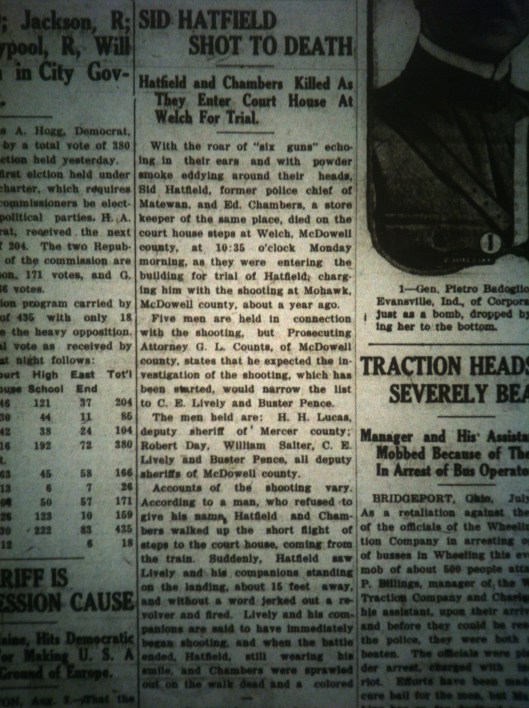
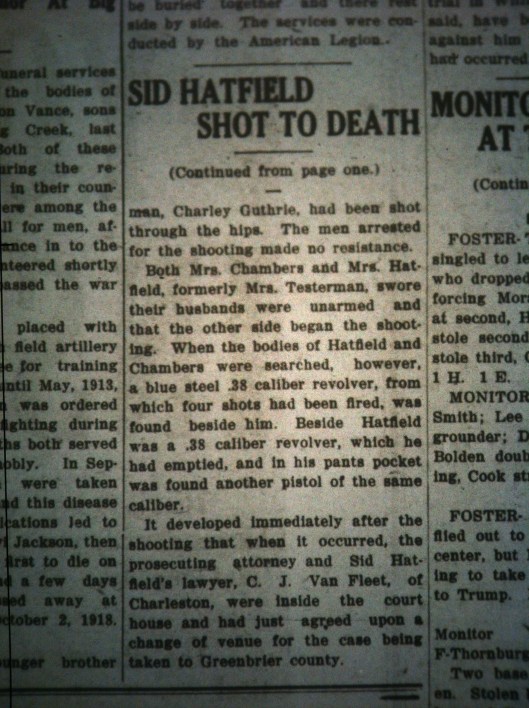
Sid Hatfield Shot to Death LB 08.05.1921 1Sid Hatfield Shot to Death LB 08.05.1921 4Sid Hatfield Shot to Death LB 08.05.1921 5

Sid Hatfield Shot to Death LB 08.05.1921 6

Logan (WV) Banner, 5 August 1921.

Booze-Drinking Mule in Mingo County, WV (1927)

03 Sunday Sep 2017

Posted by Brandon Ray Kirk in Coal

≈ Leave a comment

Tags

Appalachia, coal, East Williamson, history, Logan Banner, Mingo County, moonshine, Pigeon Creek, Waugh's Camp, Wayne County News, West Virginia, William Ann Coal Company

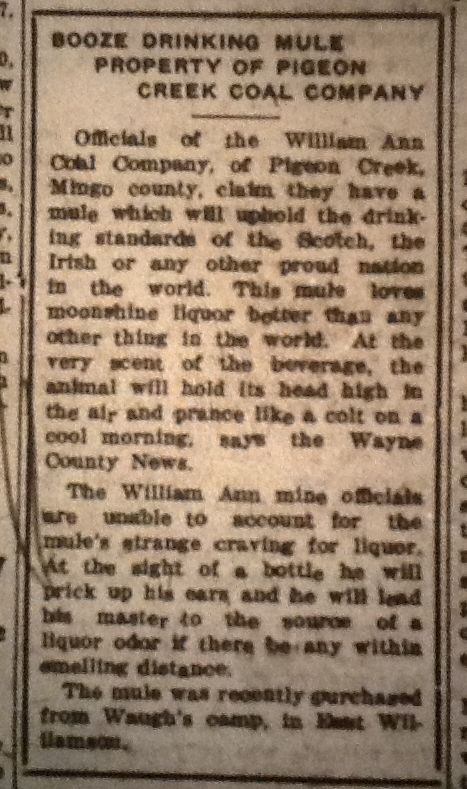
Booze Drinking Mule LB 03.25.1927

Logan (WV) Banner, 25 March 1927.

Orville, WV (2017)

01 Friday Sep 2017

Posted by Brandon Ray Kirk in Coal

≈ Leave a comment

Tags

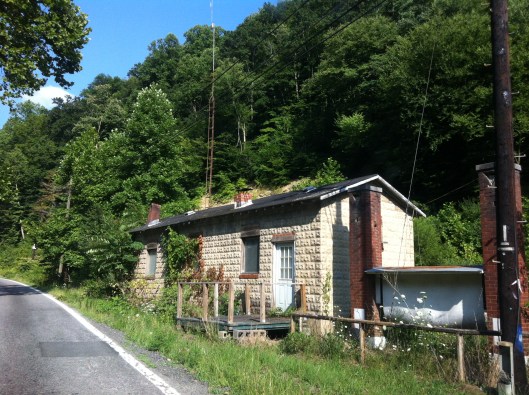
Appalachia, architecture, history, Logan County, Orville, photos, Rum Creek, West Virginia

IMG_7105.JPG

Going up Rum Creek, Logan County, WV. 19 July 2017

← Older posts
Newer posts →

Feud Poll 1

If you had lived in the Harts Creek community during the 1880s, to which faction of feudists might you have given your loyalty?

Categories

  • Adkins Mill
  • African American History
  • American Revolutionary War
  • Ashland
  • Atenville
  • Banco
  • Barboursville
  • Battle of Blair Mountain
  • Beech Creek
  • Big Creek
  • Big Harts Creek
  • Big Sandy Valley
  • Big Ugly Creek
  • Boone County
  • Breeden
  • Calhoun County
  • Cemeteries
  • Chapmanville
  • Civil War
  • Clay County
  • Clothier
  • Coal
  • Cove Gap
  • Crawley Creek
  • Culture of Honor
  • Dingess
  • Dollie
  • Dunlow
  • East Lynn
  • Ed Haley
  • Eden Park
  • Enslow
  • Estep
  • Ethel
  • Ferrellsburg
  • Fourteen
  • French-Eversole Feud
  • Gilbert
  • Giles County
  • Gill
  • Green Shoal
  • Guyandotte River
  • Halcyon
  • Hamlin
  • Harts
  • Hatfield-McCoy Feud
  • Holden
  • Hungarian-American History
  • Huntington
  • Inez
  • Irish-Americans
  • Italian American History
  • Jamboree
  • Jewish History
  • John Hartford
  • Kermit
  • Kiahsville
  • Kitchen
  • Leet
  • Lincoln County Feud
  • Little Harts Creek
  • Logan
  • Man
  • Matewan
  • Meador
  • Midkiff
  • Monroe County
  • Montgomery County
  • Music
  • Native American History
  • Peach Creek
  • Pearl Adkins Diary
  • Pecks Mill
  • Peter Creek
  • Pikeville
  • Pilgrim
  • Poetry
  • Queens Ridge
  • Ranger
  • Rector
  • Roane County
  • Rowan County Feud
  • Salt Rock
  • Sand Creek
  • Shively
  • Spears
  • Sports
  • Spottswood
  • Spurlockville
  • Stiltner
  • Stone Branch
  • Tazewell County
  • Timber
  • Tom Dula
  • Toney
  • Turner-Howard Feud
  • Twelve Pole Creek
  • Uncategorized
  • Warren
  • Wayne
  • West Hamlin
  • Wewanta
  • Wharncliffe
  • Whirlwind
  • Williamson
  • Women's History
  • World War I
  • Wyoming County
  • Yantus

Feud Poll 2

Do you think Milt Haley and Green McCoy committed the ambush on Al and Hollene Brumfield in 1889?

Blogroll

  • Ancestry.com
  • Ashland (KY) Daily Independent News Article
  • Author FB page
  • Beckley (WV) Register-Herald News Article
  • Big Sandy News (KY) News Article
  • Blood in West Virginia FB
  • Blood in West Virginia order
  • Chapters TV Program
  • Facebook
  • Ghosts of Guyan
  • Herald-Dispatch News Article 1
  • Herald-Dispatch News Article 2
  • In Search of Ed Haley
  • Instagram
  • Lincoln (WV) Journal News Article
  • Lincoln (WV) Journal Thumbs Up
  • Lincoln County
  • Lincoln County Feud
  • Lincoln County Feud Lecture
  • LinkedIn
  • Logan (WV) Banner News Article
  • Lunch With Books
  • Our Overmountain Men: The Revolutionary War in Western Virginia (1775-1783)
  • Pinterest
  • Scarborough Society's Art and Lecture Series
  • Smithsonian Article
  • Spirit of Jefferson News Article
  • The Friendly Neighbor Radio Show 1
  • The Friendly Neighbor Radio Show 2
  • The Friendly Neighbor Radio Show 3
  • The Friendly Neighbor Radio Show 4
  • The New Yorker
  • The State Journal's 55 Good Things About WV
  • tumblr.
  • Twitter
  • Website
  • Weirton (WV) Daily Times Article
  • Wheeling (WV) Intelligencer News Article 1
  • Wheeling (WV) Intelligencer News Article 2
  • WOWK TV
  • Writers Can Read Open Mic Night

Feud Poll 3

Who do you think organized the ambush of Al and Hollene Brumfield in 1889?

Recent Posts

  • Logan County Jail in Logan, WV
  • Absentee Landowners of Magnolia District (1890, 1892, 1894)
  • Charles Spurlock Survey at Fourteen Mile Creek, Lincoln County, WV (1815)

Ed Haley Poll 1

What do you think caused Ed Haley to lose his sight when he was three years old?

Top Posts & Pages

  • Halcyon 4.10.1919
  • Civil War Gold Coins Hidden Near Chapmanville, WV
  • Halcyon-Yantus 12.08.1911
  • Ran'l McCoy's Final Months (1914)
  • Blood in West Virginia: Brumfield v. McCoy (2014)

Copyright

© Brandon Ray Kirk and brandonraykirk.wordpress.com, 1987-2023. Unauthorized use and/or duplication of this material without express and written permission from this blog’s author and/or owner is strictly prohibited. Excerpts and links may be used, provided that full and clear credit is given to Brandon Ray Kirk and brandonraykirk.wordpress.com with appropriate and specific direction to the original content.

Archives

  • February 2025
  • January 2025
  • October 2023
  • September 2023
  • December 2022
  • November 2022
  • May 2022
  • April 2022
  • February 2022
  • November 2021
  • October 2021
  • September 2021
  • June 2021
  • May 2021
  • April 2021
  • March 2021
  • February 2021
  • January 2021
  • December 2020
  • November 2020
  • October 2020
  • July 2020
  • June 2020
  • May 2020
  • April 2020
  • March 2020
  • February 2020
  • January 2020
  • December 2019
  • November 2019
  • October 2019
  • September 2019
  • August 2019
  • July 2019
  • June 2019
  • May 2019
  • April 2019
  • March 2019
  • February 2019
  • January 2019
  • December 2018
  • November 2018
  • October 2018
  • September 2018
  • August 2018
  • July 2018
  • June 2018
  • May 2018
  • April 2018
  • March 2018
  • February 2018
  • January 2018
  • December 2017
  • November 2017
  • October 2017
  • September 2017
  • August 2017
  • July 2017
  • June 2017
  • May 2017
  • April 2017
  • March 2017
  • February 2017
  • January 2017
  • December 2016
  • November 2016
  • October 2016
  • September 2016
  • August 2016
  • July 2016
  • June 2016
  • May 2016
  • April 2016
  • March 2016
  • February 2016
  • January 2016
  • December 2015
  • November 2015
  • October 2015
  • September 2015
  • August 2015
  • July 2015
  • June 2015
  • May 2015
  • April 2015
  • March 2015
  • February 2015
  • January 2015
  • December 2014
  • October 2014
  • September 2014
  • August 2014
  • July 2014
  • June 2014
  • May 2014
  • April 2014
  • March 2014
  • February 2014
  • January 2014
  • December 2013
  • November 2013
  • October 2013
  • September 2013
  • August 2013
  • July 2013
  • June 2013
  • May 2013
  • April 2013
  • March 2013
  • February 2013
  • January 2013
  • December 2012
  • November 2012

Enter your email address to follow this blog and receive notifications of new posts by email.

Join 2,927 other subscribers

Tags

Appalachia Ashland Big Creek Big Ugly Creek Blood in West Virginia Brandon Kirk Cabell County cemeteries Chapmanville Charleston civil war coal Confederate Army crime culture Ed Haley Ella Haley Ferrellsburg feud fiddler fiddling genealogy Green McCoy Guyandotte River Harts Harts Creek Hatfield-McCoy Feud history Huntington John Hartford Kentucky Lawrence Haley life Lincoln County Lincoln County Feud Logan Logan Banner Logan County Milt Haley Mingo County music Ohio photos timbering U.S. South Virginia Wayne County West Virginia Whirlwind writing

Blogs I Follow

  • OtterTales
  • Our Appalachia: A Blog Created by Students of Brandon Kirk
  • Piedmont Trails
  • Truman Capote
  • Appalachian Diaspora

BLOOD IN WEST VIRGINIA is now available for order at Amazon!

Blog at WordPress.com.

OtterTales

Writings from my travels and experiences. High and fine literature is wine, and mine is only water; but everybody likes water. Mark Twain

Our Appalachia: A Blog Created by Students of Brandon Kirk

This site is dedicated to the collection, preservation, and promotion of history and culture in Appalachia.

Piedmont Trails

Genealogy and History in North Carolina and Beyond

Truman Capote

A site about one of the most beautiful, interesting, tallented, outrageous and colorful personalities of the 20th Century

Appalachian Diaspora

  • Subscribe Subscribed
    • Brandon Ray Kirk
    • Join 789 other subscribers
    • Already have a WordPress.com account? Log in now.
    • Brandon Ray Kirk
    • Subscribe Subscribed
    • Sign up
    • Log in
    • Report this content
    • View site in Reader
    • Manage subscriptions
    • Collapse this bar
 

Loading Comments...