Tags
Appalachia, crime, culture, Doc Workman, genealogy, Harts Creek, history, Logan County, murder, mystery, photos, true crime, U.S. South, West Fork, West Virginia, Workman Fork

Wilson “Doc” Workman Home, about 2002

16 Wednesday Jan 2013
Posted in Big Harts Creek, Culture of Honor, Halcyon
Tags
Appalachia, crime, culture, Doc Workman, genealogy, Harts Creek, history, Logan County, murder, mystery, photos, true crime, U.S. South, West Fork, West Virginia, Workman Fork
Wilson “Doc” Workman Home, about 2002
14 Monday Jan 2013
Posted in Big Harts Creek, Halcyon
Tags
Appalachia, Doc Workman, Harts Creek, history, Logan County, photos, U.S. South, West Fork, West Virginia, Workman Fork, World War I

Wilson “Doc” Workman, veteran of the First World War, resident of Workman Fork of West Fork of Harts Creek, Logan County, WV
03 Thursday Jan 2013
Posted in Big Harts Creek, Culture of Honor
Tags
Abbotts Branch, Appalachia, Ben Workman, Buster Stollings, crime, Doc Workman, Flora Workman, Gene Wilson Dingess, Harlen Mullins, Harts Creek, history, Logan County, murder, mystery, true crime, U.S. South, Weddie Mullins, West Virginia, Workman Fork, writers, writing
In the early morning hours of April 20, 1956, someone shot Doc Workman in the abdomen with a 20-gauge shotgun as he stood at the doorway to his little house on Workman Fork. “I heard the shot fired that killed him,” said Gene Wilson Dingess, a neighbor, in a 2004 interview. “It was way up in the morning. My sister Mildred and Mommy heard it, too. No one thought anything about it. People roamed all hours of the night with guns and shot rabbits and possoms.”
Upon learning the true nature of the incident, residents of Workman Fork reacted with shock and surprise. Nothing like this had ever happened on Workman Fork. Located somewhat remotely in the headwaters of Harts Creek, the fork constituted one of the most peaceful sections of the community. Moonshining was quite common, but murder? Doc’s killing — any killing — was unprecedented on Workman Fork. People were horrified.
Most everyone agreed that Doc knew the identity of his killer. “Doc knew the person at his door,” Dingess said. “He answered the door in his pajamas.” The killer’s choice of weaponry was a source of great interest. First of all, the 20-gauge shotgun used to commit the murder reportely belonged to Mr. Workman himself. Secondly, a 20-gauge shotgun was the type of low-powered firearm that a teenager or woman (or an old man) might use at close range, say, within 30-40 yards. And, oddly, it was left lying across Workman’s leg presumably without fingerprints. “It looked like someone had been standing by his door where they stood and plotted,” said the late late Roma Elkins in a 2004 interview.
One of the initial suspects in the murder was Doc’s former wife, Flora Lilly. Police also questioned Doc’s former brother-in-law, Weddie Mullins, a son of Harlen Mullins. Buster Stollings, who boarded with Flora, was another suspect. Other suspects were two men named Jake and Bill who were out that night riding mules and stealing corn. Apparently locals were so incensed by the tragedy that they investigated the matter themselves. Early the morning of the murder, one eyewitness saw two young men, dubbed as “Frank” and “Jesse” here to hide their true identities, run by as she milked cows on Abbott’s Branch. “Ben Workman said he saw tracks from a woman in high-heeled shoes leading from the mouth of Workman Fork up to the mouth of Long Branch,” Dingess said. “Now who would’ve wore high heels on this creek back then?”
Today, so many years later, it appears that two young men dubbed as “Frank” and “Jesse” were involved in the murder. Although suspects at the time of the killing, they were never questioned by authorities. Jesse’s own mother believed him to be the killer. “When Jesse come in at the house that morning he had a whole roll of money as big as your fist,” his mother later said. “Him and Wed Mullins was in on that killing together.” Reportedly, Frank was haunted by the murder years later when he was on his deathbed. “My uncle went up to Logan and Frank was in the hospital about to die,” Dingess said. “There was a preacher there and Frank said he couldn’t get forgiveness because he’d helped kill a man.”
01 Tuesday Jan 2013
Posted in Big Harts Creek, Culture of Honor, Halcyon
Tags
Appalachia, Buck Mullins, crime, Dennie Workman, Doc Workman, Flora Workman, Gene Wilson Dingess, Harlen Mullins, Harts Creek, history, Lloyd Farley, Logan, Logan County, Martha Workman, murder, mystery, Thomas B. Workman, true crime, U.S. South, Weddie Mullins, West Fork, West Virginia, Workman Fork, World War I, writing
Doc Workman was born on January 20, 1893 at Halcyon in Logan County, West Virginia. His parents were Thomas B. and Martha (Hill) Workman. Doc served in the First World War. According to his draft registration record, he was blue-eyed, had dark brown hair and was of medium build. “I think he got gased over there and he just barely made it,” said Gene Wilson Dingess, a close relative and namesake, in a 2004 interview. “They were in foxholes most of the time.” A decorated veteran and prisoner of war, Mr. Workman spoke little of his war experience after returning home. “He never told big tales about his service,” Dingess said. “If you asked him about it, he’d answer you in about thirty seconds and then change the subject.”
In 1919, Doc married Flora Mullins, the pretty red-haired daughter of Harlen Mullins, a local farmer. For many years, the couple enjoyed a happy marriage. By the early 1930s however, according to neighborhood gossip, both began affairs. Doc, who some called “Slick” because of his charms with women, reportedly courted a sister-in-law, while Flora reportedly sparked a Dingess. The family remained intact until at least 1940. Some time thereafter, Doc and Flora separated and eventually divorced. Mr. Workman built himself a small dwelling house just below his wife where he lived with a stepson, Dennie. Around that time, perhaps in related events, a few homes were burned in the neighborhood.
A 1942 draft registration record described Dock as six-feet tall, 178 pounds, of ruddy complexion, with gray hair and blue eyes. In the opinion of most people on Workman Fork, he made for a good neighbor. Lloyd Farley, a son-in-law, in a 2005 interview, said, “Doc was a fine fellow. He was hard to get to know but he would give you the shirt off of his back.” Mr. Dingess also had fond memories of the old gentleman. “We stopped there at Doc’s every day after school to see him,” he said. “He had candy and marshmallows and he always offered us a dollar to let him bust an egg between our eyes.” Dingess recalled that Doc was an excellent marksman. “Doc kept a loaded gun just inside his door to shoot foxes when they got after his chickens,” Dingess said. “He could shoot a fox from 100 yards away.”
In his last days, Doc received a pension for his service in the Great War and began to carry a significant amount of cash on his person. “He drew a veteran’s pension,” said Mr. Farley. “He often packed one-thousand dollars on him.” Not long before his murder, he loaned fifty dollars to his brother-in-law, Buck Mullins, who then lived in Logan. (Mullins soon repaid the loan.) Neighbors spoke of Dock’s money, of his pension… Family members cautioned him against keeping so much cash on hand, afraid that someone might rob him. Adding fuel to the fire of neighborhood gossip, Doc occasionally disappeared from the creek. “Doc would go out of here and be gone for a month at a time when I was young,” Dingess said. “We never did know why he left.” Just a few weeks before the murder, his son Dennie moved away to find a job. “Dennie had just left to work away from here two or three weeks when Dock was killed,” Dingess said. About one week before the killing, according to Farley, Weddie Mullins, Doc’s former brother-in-law, caught him with his arm around his wife’s waist. He told him that he “better not do it again.”
31 Monday Dec 2012
Posted in Big Harts Creek, Culture of Honor
Tags
Appalachia, crime, Doc Workman, Ferrellsburg, Flora Workman, genealogy, Harts Creek, history, life, Logan Banner, Logan County, murder, mystery, Ray Watts, Roma Elkins, Simpkins Cemetery, true crime, U.S. South, West Fork, West Virginia, Workman Fork, World War I, writing
Fifty-six years ago, someone shot Wilson “Doc” Workman in cold blood at the front door of his little frame house on Harts Creek. Today, his unsolved murder is largely forgotten.
“Workman, 63, was found dead by his estranged wife, Mrs. Flora Workman, at 6 a.m. Friday at his home on Workman Fork of the West Fork of Harts Creek in Logan County,” the Logan Banner reported on Monday, April 23, 1956. “The victim died as a result of a stomach wound inflicted by a 20-gauge single barrel shotgun which was found lying across his left leg.”
Doc Workman was a man in the twilight of his life. By all accounts, he was a well-liked resident of the community. He was a quiet farmer, a former timberman, a veteran of the Great War and the father of nine children.
“Daddy and Mommy sure liked him,” said the late Roma Elkins, a native of nearby Ferrellsburg, in a 2004 interview. “He’d bring us a big water bucket full of eggs and wouldn’t let us pay him for them.”
Initially, Logan County sheriff Ray Watts and state law enforcement officers suspected robbery as the motive for Workman’s murder.
“Reports said Workman had been known to carry large sums of money around on his person and was believed to have between $400 and $500 at the time of his death,” the Banner reported. “Only a few dollars was found in the home after the shooting.”
On Sunday, April 22, Workman’s funeral was held at his home on Workman Fork. The service began at 2 p.m. and concluded with the burial at Simpkins Cemetery on West Fork.
On Monday, the Banner ran Workman’s obituary on its front page, listing his wife, nine children, four brothers and three sisters, most of whom lived in Logan County.
27 Thursday Dec 2012
Posted in Big Harts Creek, Ed Haley, Spottswood
Tags
Appalachia, culture, genealogy, Harts Creek, history, Lawrence Haley, life, Liza Mullins, Logan County, photos, U.S. South, West Virginia

Lawrence Haley with Aunt Liza on Harts Creek, 1950-1953
25 Tuesday Dec 2012
Posted in Big Harts Creek, Music
Tags
Appalachia, banjo, culture, Harts Creek, history, Joe Mullins, life, Logan County, music, photos, West Virginia
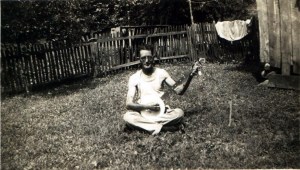
Joe Mullins, 1950-1968
11 Tuesday Dec 2012
Posted in Big Harts Creek, Ed Haley, Music, Spottswood
Tags
Appalachia, Clyde Haley, Ed Haley, Ella Haley, Enslow Baisden, Harts Creek, history, John Hartford, Lawrence Haley, Logan County, music, Ralph Payne, Robert Martin, Sol Bumgarner, West Virginia
In talking with Enslow and Bum, Lawrence and I were able to piece together some of Ed’s family connections on Harts Creek. Everyone seemed to know about the Mullinses — Ed’s mother’s people — but drew a blank when it came to his father. Enslow remembered his kids well, hinting at their mischief.
“I don’t know whether you remember, them boys — I don’t know whether it was Clyde or who — put them three-inch firecrackers in Ed’s coat pockets and shot them off.”
Lawrence said, “That must’ve been Ralph. They’d do that to each other.”
“They used to come in here a whole lot and get out and get in a fight,” Bum said. “They’d fight with each other.”
I was slowly getting this picture of Ed’s children running wild on Harts Creek — or anywhere else for that matter — so long as they kept at a safe distance from their parents. If true, it may have severely crippled Ed and Ella’s ability as traveling musicians to find people willing to give them room and board. Then Enslow told a horrible story about one of the kids getting stuck in a well.
“They just had a cement tile for a well out there at Robert Martin’s and one of them kids went down in it and he couldn’t get back up out of it,” he said. “He wedged his feet and his arms going down in it. Got down there, couldn’t get out. They had to rescue him out of that well.”
I asked Bum what Ed did when his kids started fighting or getting into mischief and he said, “He’d tell them to quit. They’d pretty well quit whenever he told them to, too.”
10 Monday Dec 2012
Posted in Big Harts Creek, Ed Haley, Music, Spottswood
Tags
Appalachia, Ashland, blind, Cleveland, Ed Haley, Ella Haley, Enslow Baisden, fiddler, fiddlers, fiddling, Harts Creek, Hell Up Coal Hollow, history, Huntington, Jack Haley, Jeff Baisden, John Hartford, John Martin, Kentucky, Las Vegas, Lawrence Haley, Liza Mullins, Logan County, Milt Haley, music, Nevada, Noah Mullins, Ohio, Oklahoma, Peter Mullins, Robert Martin, Sherman Baisden, Sol Bumgarner, Trace Fork, Turley Adams, U.S. South, West Virginia, writing
After visiting with Turley and Joe’s girls, Bum guided Lawrence and I up a nearby hollow to see his uncle Enslow Baisden. Enslow lived in a newly built single story log cabin. He said he’d gone blind recently due to sugar and cataracts. At Enslow’s, we met “Shermie”, who Lawrence indicated was the “funny boy” that chased the Haley women off of Aunt Liza’s porch in 1951.
“A lot of times I wouldn’t have no company if it wasn’t for him,” Enslow said of Shermie, who was epileptic. Shermie wasted little time in pulling out a few cards from the pocket of his overalls and sputtering toward me, even reaching for my fiddle case. I knew right then I was surrounded by “good people”: they had kept Shermie under their care all of these years as a valued member of the family in lieu of institutionalization.
When I mentioned Ed Haley’s name, Enslow said, “I was young but I can remember him all the time a coming. They was some Martins lived on top of a mountain out here — Robert Martin and John — and they fiddled all the time, and he’d go out there and fiddle with them. I don’t know how he walked from up this creek and out on that mountain and him blind, for I can’t find my way through the house.”
Enslow said he didn’t know much about Ed because he left Harts during the early years of the Depression.
“See, I lost all time, about everything nearly. I left here in ’35 and went up to the northern part of the state here and then went out in Las Vegas, Nevada, a while. Then, when I come out, I went in the Army in April of ’41. I stayed in there four and a half years and got married out in Oklahoma and we never did come back but just on visits. And Ed, he died in ’51.”
Enslow’s recounting of his travels was sort of an interesting revelation since it reminded me that these folks on Harts Creek — like many mountain people — were not as isolated as some may think. Ed Haley himself left the creek and traveled widely with his music just after the turn of the century, while Lawrence and his siblings had lived in Ashland and Cleveland and served overseas in the armed forces. Several of the people I had met on Harts Creek had been to faraway places and lived in big cities but chose at some point to return to the grounds of their ancestors.
I asked Enslow how old he was the first time he saw Haley and he said, “Oh man I was about nine or ten years old. He all the time played that fiddle. He used to come down here to old man Peter Mullins’ and Liza Mullins’. I guess they was real close kin to him. And Ed’s daddy’s name was Milt Haley. I don’t know whether Lawrence knowed that or not.”
Lawrence said, “Yeah, I knew that. But I understood from the way Aunt Liza told me, he came from over the mountain and I think that she was talking about from up around Williamson or over in that area. My dad, he was born right down here below Uncle Peter’s, where Turley’s at now, in the old house.”
Lawrence’s mentioning of “the old house” really got Enslow going. He remembered it well.
“There used to be an old log house there he was born in and they had a chimney outside on that old house down there — just an old rock chimney. Dad all the time talked about it. He said Ed got him one of them little old homemade sleds, you know, and he got him a ladder and put it on top of that house. And he got right up by that chimney and then when he come off’n there on that sled he knocked the rocks off with him.”
What? Why would he have done such a thing?
“I’ve always heard my dad tell it,” Enslow said. “Said that rock just barely did miss him.”
I wasn’t sure what to make of such a story but before I could really ask anything about it Enslow was off on another tale.
“Dad said one time they sent Ed down there to get some milk or butter or something. When Ed got out there on his way back he got in a briar patch. Dad took a notion to have some fun out of Ed. They had an old horse they called Fred. Dad got to stomping and snickering like that old horse and Ed said, ‘Old Fred, don’t you come here, now. Don’t you come here, Fred.’ Dad said he kept stomping and Ed throwed that stuff at him and tore hisself all to pieces in them briars.”
I asked Enslow to describe Haley and he said, “Well, he just always dressed pretty nice. He was a big man, too. They used to buy him these plugs of tobacco and these guys would get this beech bark and whittle it out about the size of a plug of tobacco and let Ed have that bark and they’d take his tobacco. If he ever got a hold of you, though, he’d eat you up, see. They said you couldn’t get loose from him.”
Apparently, Ed and his wife were so self-sufficient that locals sometimes forgot they were blind. Enslow told a great story about Ella and Aunt Liza, who were sitting by a lamp together one night. “Well, Mrs. Haley, I’m going to bed,” Liza said. “Well, just blow out the light,” Ella answered. “I’m going to read a while.” Liza said, “How’re you going to read in the dark?” Ella said, “Well, I can’t see no way.”
Enslow’s mentioning of Aunt Liza conjured up a great memory from Lawrence.
“Uncle Peter liked to wore me to death one time. Me and my brother Jack went with him up there behind his house and he had a old team of oxen we was snaking logs out of a hollow with. These oxen got hot. One of them got in the creek trying to cool off. Well, Uncle Peter couldn’t get him to move, so he went over underneath a tree and sat down. Well, me and my brother Jack was a cutting up, you know. He was teasing me. I was younger than he was. And I picked up a big rock and throwed it at him and hit Uncle Peter right where it hurts. And he got up. I knowed I could outrun him. My brother — I looked at him — he took off. And I was afraid to move. Uncle Peter come up there. I thought, ‘Well, I’m dead meat.’ It looked like he pulled down a half a tree and got a hold of me and he didn’t let go until he wore that limb out.”
I asked Enslow about Ed Haley’s music.
“I used to hear him play all them old tunes,” he said. “He’d sit and play for hours and hours at a time, him and her.”
Enslow motioned toward Lawrence, saying, “His mother played a mandolin and had a thing on that sat on her shoulders there and had a harp and played them both at the same time.”
He leaned back a little, reflecting, “Yeah, he played all the old music. He’d make up songs. Be sitting around and just directly he’d write a song. Like ‘Hell Up Coal Hollow’ and two or three more he made up that way. You’d come up and say, ‘What was that Ed?’ He’d just tell them what it was.”
Enslow and Bum said Haley made “Hell Up Coal Holler” and named it for Cole Branch, a tributary of Harts Creek. I didn’t know if Ed was the source of that story but I later learned that “Hell Up Coal Hollow” (at least the title) actually predated Haley’s lifetime. As I was gradually learning, Ed wasn’t preoccupied with historical accuracy and was good at creating temporary titles and weaving stories based on coincidence.
Enslow said, “Ed had some kind of saying he always said when he played on the radio down there about ‘carbide acid and acifidity gum’ or something.”
Lawrence said he’d never heard anything about his father playing on the radio but Enslow seemed sure of it.
“He played on the radio down there at Ashland or Huntington or somewheres way back there. I’m pretty sure they said he did.”
I wondered what acifidity gum was and no one knew, although Lawrence had heard Ed talk about it. (We later learned it was an old folk remedy for treating asthma.) Enslow said Uncle Peter asked Ed about it one time and he said, “Well, you have to get a little comedy with the music.”
Wow — so Ed told jokes?
Enslow said, “I guess to draw their attention or something.”
I asked Enslow if he’d ever heard Ed play for a dance and he said, “Well, I used to go to lots of things he played for, but I can’t remember now. They’d go out there on that mountain and play all night at Robert and John Martin’s. They’d be maybe two hundred people out there. Robert Martin all the time played the fiddle and I don’t know whether John played or not.”
Enslow thought Ed and Robert played their fiddles “together,” but Bum added, “Bob played a little different than Ed did. He played newer stuff.”
Enslow thought for a moment, then said, “Yeah, my dad, he used to play the banjo all the time, him and his nephew. They used to play for dances way back years ago.”
What was his name?
“Jeff Baisden.”
Bum said, “I was telling him about Grandpaw taking them two little sticks and beating on the fiddle for Ed.”
Someone said, “He’s the one had the big old feet and he’d get up and dance and play the banjo.”
Enslow said, “They called him ‘Jig-Toe’ Baisden. He wore a twelve or thirteen shoe and he’d get up on his toes and dance. And Noah Mullins, Uncle Peter’s son, he could flat dance. He’d get on his heels and dance all over. He called their square dance about all the time.”
09 Sunday Dec 2012
Posted in Big Harts Creek, Ed Haley, Spottswood
Tags
Appalachia, Ashland, Ashland Cemetery, Buck Fork, Clifford Belcher, Connie Woods, Dingess, Ed Belcher, Ed Haley, Ella Haley, fiddle, fiddler, fiddling, genealogy, George Greasy Adams, guitar, Harts Creek, history, Hoover Fork, Jackson Mullins, Jeff Baisden, John Frock Adams, John Hartford, Johnny Hager, Kentucky, Lawrence Haley, Liza Mullins, Logan, Logan County, Maynard's Store, music, Nashville, Peach Creek, Peter Mullins, Ralph Haley, Sol Bumgarner, square dances, Trace Fork, Turley Adams, Violet Mullins, Weddie Mullins, West Virginia
At some point, Connie showed up with a small entourage of women toting some of Joe Mullins’ old pictures. My eyes immediately went to a large, framed photograph of two serious mustachioed men. Turley said one was Weddie Mullins — his grandfather on “both sides” of the family tree — while the other was Ed Haley’s Uncle Peter Mullins. Both men were brothers. Turley said his grandfather Weddie — Ed’s uncle — was murdered at the little town of Dingess just after the turn of the century.
Lawrence said, “Mom and Pop used to play at Dingess — just a little community over in MingoCounty.”
That got us back on the subject of Ed, although most of the commentary was choppy and mixed between looking at photographs. One of the girls said, “We’ve heard talk of Ed all our lives.” Another made the unusual remark, “He could see lightning. Some way he could feel it or something and tell it was hitting.” Someone said Ella could tell the difference between the Haley children by their smell.
Turley, who had been fairly quiet throughout our visit, said to Lawrence, “Bernie Adams used to play a lot of music with your dad.”
Violet said, “Bernie’s the one took him in the chicken house for the toilet. They stayed all night up at our house. Robert Martin and Bernie and Ed and them played music all night. I can remember it. I was just a little girl. Mother said Ed played many a time where she was raised up over in the head of Francis Creek.”
Lawrence said, “You know, these different places like Hoover and places like that don’t ring a bell to me. I can remember going down here to the end of Trace, and maybe down to Smoke House, and up to George Adams’ who lived on up this way, and up to that store — Maynard’s Store — and buying candy, but that’s about the limit of my travel, except coming up from the mouth of Harts.”
Basically, the next half-hour or so was a giant “get to know everybody session” — mostly between Lawrence and the locals. I sort of hung back a little, taking it all in, while Lawrence spoke of and listened to stories about his father. There was a glow about his face that had been absent in Ashland.
At one juncture, he told Connie how her grandparents, Peter and Liza Mullins, raised his father.
“Oh, really?” she said. “I didn’t know that. Now I remember Granny. They wanted me to stay all night with her and I was always afraid she’d die in her sleep or something. That’s terrible.”
She asked Lawrence if he remembered Uncle Jeff — “he was Granny’s brother and he was kinda slow.”
Violet said, “He liked to go to all these dinner meetings they’d have out in the country. He’d walk for miles and miles.”
Connie asked Lawrence if Ed ever played at Logan — the seat of government for Logan County — and he said, “Yeah, he used to play around Logan quite a bit and Peach Creek. He’d play up there during court days especially. Back in them days, the town would load up. I’ve been there with him during those times. The old courthouse, I think it faced toward the river. One side of it was on Stratton Street.”
Connie asked where Ed was buried and Lawrence said, “He’s buried in the Ashland Cemetery in Ashland. Mom’s buried in the same cemetery but not with him. By the time my mother died — she died three years after Pop — they’d filled that section up.”
I’d never really thought about that. Ed and his wife were not buried together, the kind of seemingly minor detail tossed out randomly that took on somewhat of a greater meaning at a later date. I made a note to myself right then that I would visit Ed’s grave in Ashland before heading back to Nashville.
Violet wondered about Lawrence’s older brother, Clyde.
“Clyde’s out in Stockton, California,” he said. “He’s what I call the black sheep of the family. Never married. He just followed the sun for work. When it was summertime, he’d go north; when it was wintertime, he’d go south.”
Just then, an old man called Bum showed up at Turley’s. Bum remembered Ed and his family well. He asked Lawrence about the Haleys. It was hard to focus on their conversation — everyone in the room seemed to be talking at once — but I heard Bum mention something about how Lawrence’s brother Ralph used to hang from tree limbs by his “sticky toes” and would “do anything.”
“That’s exactly how he got killed,” Lawrence said. “He was hanging by his toes and he was gonna let go with his toes and flip over and land on his feet but he didn’t make it. He was just active like that. See, Ralph danced around these carnivals and fairs and places.”
A few minutes later, things quieted down a little. I moved over near Bum to ask him about Haley. His answers seemed to come through his nose more than his mouth and were usually followed by a little chuckle. He was great. Bum said he was 67 years old and first saw “Uncle Ed” in the thirties.
“He lived down in Ashland and he’d come up pretty often,” Bum said. “People come from everywhere to listen at him play whenever they’d have them big dances and stuff. He’d play half the night. Yeah, I’ve been right there.”
I asked Bum about Ed’s tunes and he said, “Ah, he played so many… There was one religious tune he’d put the bow under the fiddle, and the hair, he’d turn it right over and slip his fiddle between it, and play that. I forgot what it was.”
Bum told me all about the old dances.
“They used to have a big working,” he said. “About every family on this creek and Harts Creek down here, they’d all gather up and hoe one man’s field out and then move to the next one. And they’d all go to each other’s farms that way and help each other, and when they got done one man would have a big dance. They’d have a dance on Saturday night. They’d have them at just about every home, mostly at Uncle Peter’s up here, in the house. Like one room in there, they’d gather everything up and take it outside and they’d have a dance in there, and when they got through they’d put the furniture all back in. Anybody that wanted to come was invited. They’d have food right in the house. There were usually three or four around to call the reel: ‘Dosy doe and here she comes and there she goes.'”
“It’d just be Uncle Ed and John Hager playing?” I asked.
“Well, Ed mostly,” Bum said. “Uncle Johnny, he played some with him. Uncle Ed, he played by himself most all of these dances. Mrs. Haley played with him a lot. She played the mandolin, guitar or accordion.”
“Did Johnny Hager play the banjo about like Grandpa Jones?” Turley asked Bum.
“Yeah, over-handed they call it,” Bum said. “Molly O’Day, she played that way. My grandpaw would whittle out two little sticks and he’d sit and beat on them strings and Ed a playing the fiddle.”
“Ed played with Ed Belcher,” Turley said.
“Yeah, I’ve heard Pop talk about Ed Belcher,” Lawrence said.
Now who was Ed Belcher?
“He played the guitar,” Bum said. “He could play the piano, too. They’d get together at times and play together. They’d go up Buck Fork.”
Bum said he last saw Ed Haley “over here on that mountain yonder” at Clifford Belcher’s beer joint.
“He’d go down there and play and people’d give him beer and stuff. That’s about all he wanted. I run into him over there one night. I said, ‘Uncle Ed, where you been?’ He said, ‘I ain’t been no where but right here. I come up here to sit around and play music a while.’ I bought him a beer and he sat there and played music. Well, a Conley boy run in and went to playing and thought he was better than Ed and everything. Ed finally told that boy, said, ‘Why don’t you quit playing that music? You can’t play. You’re cutting my music up too much.’ That boy come back at him, you know, and aimed to fight him. He said, ‘Shut up, old man. You don’t know what you’re a talking about.’ I was standing there and I told him, I said, ‘Now listen. If you jump on that man, you’ll have me to fight and him both.’ And Ed took his fiddle and hit that feller right down over the head with it and busted that fiddle all to pieces.”
Lawrence laughed.
Turley said Ed Haley was high-tempered, as well as strong, and hinted at his mean streak.
“Dad said Peter had a dog that Ed couldn’t get along with at all. Ed told Uncle Johnny, ‘You get me close to him and I’ll hit him in the mouth. I’ll knock him out.’ And he said Ed hit that dog and killed him with his fist. Hit him in the ear and killed him. That’s what my daddy told.”
Bum was very familiar with Ed Haley’s family on Trace. He said Uncle Peter Mullins was “pretty bad to get out and get drunk and get into it with people.” He knew all about Ed’s uncle Weddie Mullins’ murder at an election in Dingess. “There used to be a train come in there and they’d bring flour and stuff over there and people’d go over there to Dingess and get it,” he said. “They’d take wagons and go through these hills, like up Henderson and all them places and they got into it over there.” Bum wasn’t sure who shot Weddie but knew that his killer survived the fracas. Once the news reached Harts Creek, John Adams got a pistol from Jackson Mullins and rode to Dingess where he found Weddie’s killer laid up in a bed clinging to life. Someone told him the guy probably wouldn’t make it so (like something out of a Hollywood Western) he pulled out a .38 pistol and said, “I know he won’t,” and shot him in cold blood.
I wasn’t exactly sure who any of these people were — Jackson Mullins, John Adams — but I had the impression that they were some relation to Ed Haley. At that juncture, I just let the tape recorder roll and tried to take notes and absorb everything, figuring that what seemed like unimportant details would perhaps later develop into major items of interest.
07 Friday Dec 2012
Posted in Big Harts Creek, Ed Haley, Spottswood, Whirlwind
Tags
Appalachia, Ashland, Harts Creek, history, Jack Haley, Joe Mullins, John Hartford, Kentucky, Lawrence Haley, Liza Mullins, Liza Napier, music, Pat Haley, Sherman Baisden, Stella Mullins, U.S. South, West Virginia
Later that night, Lawrence, Pat and I talked more at the kitchen table. For reasons I cannot remember — but possibly because I was so determined to get at the root of the music — our conversation kept returning to the subject of Ed’s childhood and birthplace in West Virginia.
Pat said she first went to Harts Creek with Lawrence, Jack and Jack’s wife Patsy in the summer of 1951. Noah and his wife Janet also made the trip.
“We went up in Jack’s Packard,” she said. “Three in the front and three in the back, plus Beverly and two babies. It was a horrible ride and it was at night and all the way up there the boys was telling us what to expect. They was telling us that you better be careful because going up to Harts like that at night — strangers — they could shoot you in a minute. They told us there was a headless horseman that rode up and down that hollow and a screaming banshee and they told us if the creek was up we’d have to walk it. Patsy and I was scared to death.”
I asked about Aunt Liza, the lady who raised Ed.
“When we went up there the first time, Aunt Liza was living in the old log homeplace,” Pat said. “Aunt Liza, Little Liza, Joe and Stella lived there.”
Aunt Liza was Ed’s aunt, Lawrence said, while Joe was his first cousin. Joe was married to Stella and was a close relative to Little Liza.
The Haley trip was a real experience for Pat and her sisters-in-law.
“When we went up there, Joe had a couple of kids,” Pat said. “One was about two maybe and it was wearing a little gown and had this beautiful blonde curly hair. I picked it up and said, ‘Oh, what a beautiful girl you are,’ but when I raised it up I saw that it didn’t have a diaper on and was a little boy. Aunt Liza said Stella had just had a baby the day before and was ‘feeling puny.’ That was a new word to me. Oh, we asked to see the baby and they said it was in the bed. Well, we couldn’t find that baby because it was down in the feather bed. And what surprised us was that Stella was up and about.”
Pat remembered the trip fondly.
“They were very down-to-earth people and I’m assuming that very little had changed from the time Pop grew up there,” she said. “It was like the cowboy movies where they cooked on those wood stoves and the way they served it at that great, big wooden table. Little Liza and Aunt Liza cooked us a meal. The food was good.”
Pat said she and the rest of the Haley wives probably made a big impression on Aunt Liza and company as well.
“We were outside on the porch and Aunt Liza said she’d never seen anybody dressed like us,” she said, laughing. “I guess we looked like painted jezebels. We had make-up on and modern hairdos. Janet was wearing a white blouse and a black skirt. I had a short-sleeved yellow dress on. Patsy’s was blue. Patsy used to wear a lot of make-up, always painted her fingernails. Janet didn’t wear too much make-up but she always dressed nice. She loved to wear those silk blouses, and they tied at the neck. I think something else that fascinated them: we weren’t smoking a pipe. Aunt Liza smoked a pipe.”
At one point, Pat said she was standing outside with the girls when this “funny boy” came up and scared them nearly to death. “We were outside when this boy came up through the yard making funny noises,” she said. “He got so excited — moreso than when we saw him — and touched Janet’s shoulder and she screamed bloody murder. Poor old Aunt Liza didn’t know what happened. And of course, Jack and Larry thought it was the funniest thing they’d ever heard.”
Pat made another trip to Harts a short time later with Jack and Lawrence.
“Jack took a movie camera and filmed everybody,” she said. “It seems like Jack took some pictures inside the cabin but I’m not sure. I know he was taking pictures outside of Aunt Liza and Little Liza and Liza’s daughter. I believe they thought he was just taking pictures. When he got back to Cleveland, he had the film developed.”
Later, in 1956, Pat made another trip to Harts Creek with Lawrence, Jack and Patsy. At that time, Joe Mullins was living in the old log cabin and Aunt Liza had moved into her daughter’s home just down the creek. Next door was an old log home covered in dilapidated paneling, which was supposedly built by Ed’s father, Milt Haley.
“And then when we went back the third time, Jack had brought the film from the previous visit,” Pat said. “I can almost hear him now saying, ‘Now Aunt Liza, I’ve got something I want you to see.’ They put a sheet over a mirror that was on the side wall and when the movie started Aunt Liza got real excited and started pointing toward Little Liza and saying, ‘There’s you. That’s me.’ You could see their lips moving in the movie but there wasn’t any sound. And Little Liza got excited too.”
A highlight of the trip occurred when Pat found herself in a conversation with Aunt Liza. “I suppose listening to Aunt Liza and Little Liza and me trying to talk was like a foreign language. Old Aunt Liza was telling me all about her property and I’m talking to her and I’m thinking she is talking about land but she isn’t. She’s talking cattle, dogs, and the oxen. And Little Liza was talking about her daughter going to school. And we got on the subject of the meals and what did she take for lunch. ‘Oh,’ she said, ‘she takes her lunch in the lard bucket and she put biscuits and cornbread and different things in it.’ And I asked her about her husband and she said, ‘We’re not certified,’ and I wasn’t really sure what that meant so I said, ‘Oh, Lawrence and I aren’t, either.'” On the way home, Lawrence asked her if she knew what she’d meant to say because Little Liza had meant that she and the girl’s father weren’t married.
Lawrence could tell that I was really interested in his father’s birthplace so he asked me if I would like to see it. I said I would love to — and was more than happy to provide the car and gasoline for such a trip.
02 Sunday Dec 2012
Posted in Big Harts Creek
Tags
Appalachia, crime, feud, Harts Creek, history, Jacob D Smith, John Fleming, Lincoln County, Virginia, West Virginia, Wise, writers, writing
On February 28, 1912, I.J. Beverly, sheriff of Wise County, Virginia, wrote Jacob D. Smith, assistant prosecuting attorney in Lincoln County, West Virginia, to inform him that John Fleming — a fugitive on the run — was living in a nearby town called Glamorgan and using the alias of George Fleming. The letter read as follows:
Wise, Va., March 7th
Prosecuting Attorney Lincoln county, Hamlin, W.Va.
Have John Fleming in custody. He agrees to come without requisition if I will bring him but refuses to go with your officer. I will bring him if you will pay all expenses and Two Fifty per day. Answer.
I.J. Beverly
Sheriff Wise County
On March 8, Smith received Sheriff Beverly’s letter. Three days later, he left Hamlin, seat of government for Lincoln County, for Richmond, Virginia as an agent to secure requisition papers from Virginia Governor W.H. Mann. A little later, he hired G.A. Lenz, a C&O special agent in Huntington, West Virginia, to accompany him to Wise County as a guard. By March 16, Smith and Lenz had delivered Fleming to the Lincoln County jail. On March 30, Fleming’s bail was set at $2,000.
Early in May, the following witnesses were called to appear before the Circuit Court in the State v. John Fleming, scheduled for June 4: Caleb D. Headley, Lewis Cass Gartin, Andrew Sias, Paris Brumfield, Tilden Gartin, W.A. Adkins, M.E. Nelson, Joe Gartin, Tilman Adkins, John Gartin, Grover Gartin, E.C. Lucas (Sr.), Jeff Lucas, Alvin Sias, Harrison Neace, Bob Fleming, Bud Workman, Jessie Adkins, Lewis Lucas, Ben Noe, Levi Rakes, Flora Lucas, Thomas Sias, Samp Davis, Lona Neace, Albert Neace, George Fleming, Robert Adkins, T.B. Hatfield, Peter Mullins, Ike Fry, William Adkins, Floyd Mullins, Harlan Mullins, Mary Burns, Lula Burns, Jane Moore, Zack Neace, Bill Neace, Abe Noe, Floyd Workman, Wiley Lucas, Dr. Jenks Adkins and Little Cane Lucas.
Days later, John Fleming escaped from the county jail using tools given to him by his brother, Willard. A warrant was issued for the arrest of Willard and placed in the hands of Boyd S. Hicks. According to records maintained at the Lincoln County Circuit Clerk’s Office: “Whereas Burnie Smith has this the 4 day of June 1912 made complaint upon oath before M.D. Hilbert, Justice of said county that one John Fleming was confined in the Lincoln county Jail, being so confined to answer to a charge of shooting with the attempt to kill Caleb Headley, and while in said Jail as a prisoner awaiting trial on said charge, one Willard Fleming did on or about the 10 day of May 1912 willfully and feloniously give and cause to be given the said John Fleming prisoner as aforesaid certain saws, chisels, and other implements for use of said John Fleming in effecting escape from said Jail, and by means of which said saws and other implements he the said John Fleming did saw the bars in said Jail and make his escape there from.” On June 5, Willard Fleming, Matthew C. Farley, Lewis Maynard and Zac Williamson posted Fleming’s $1000 bond.
In an effort to re-arrest Fleming, the Lincoln County Circuit Court issued capias warrants for him on October 29, 1913, December 21, 1914 and March 29, 1915. Fleming was no where to be found.
With John out of the way, his former wife, Lizzie Fry, felt safe enough to remarry. On November 8, 1915, she married Boss Keith. It’s not clear if she had ever married Charley McCoy, the man whose cuckling of Fleming had prompted the ’09 shootout.
In the years following Fleming’s escape, surprising details surfaced about his role in the shootout at Fourteen. “The Fryes and Headleys were blamed for Grandpa Hariff’s death,” said one local man in a 2003 interview, “but an old Frye woman sent word on her deathbed who killed him. She said it was his first cousin, John Fleming.”
Meanwhile, the court continued to issue capias warrants for Fleming on November 14, 1916, February 16, 1917, April 11, 1919, April 5, 1921, April 19, 1922 and December 29, 1922.
Finally, on March 26, 1923, according to Law Order Book 17 at the Lincoln County Courthouse, prosecuting attorney Jacob D. Smith, “with the assent of the court says that he will not further prosecute the defendant John Flemmings, of the Felony of which he now stands charged in this Court. It is therefore considered by the court that the defendant John Flemmings be acquitted, discharged and go thereof without delay.”
By that time, Fleming was probably dead.
“John Fleming went back to Virginia with someone,” said Willard Frye, a nephew to Lizzie, in a 2003 interview. “He got off his horse at a stream to get a drink of water and when he bent down at the stream this man shot him in the back of the head.”
01 Saturday Dec 2012
Posted in Big Harts Creek, Culture of Honor, Fourteen
Tags
Adkins Conspiracy Case, Appalachia, Bill Brumfield, Charley Brumfield, feud, Harts Creek, history, John Fleming, John Henan Fry, U.S. South, West Virginia, writers, writing
While John Fleming was away serving a term of imprisonment at the West Virginia state penitentiary, his wife Lizzie returned home to live with her father, John Henan Fry, at Fourteen. “Aunt Lizzie ran away from John and came home to Fourteen,” said Willard Frye, nephew to Lizzie, in a 2003 interview. She secured a divorce from Fleming and began an affair with Charley McCoy, a man who newspapers later dubbed a “bitter enemy” to Fleming. Fleming didn’t take the news well. He swore that he would have her back after his release.
On Saturday, March 13, 1909, Fleming was freed from prison. On his way home from Moundsville, he made preparations to recapture Lizzie from McCoy. “When John Fleming returned home from the penitentiary, on his way back, at Huntington, he proceeded to supply himself with the necessary guns and ammunition to start a young war in Harts Creek district,” reported the Lincoln Republican of Hamlin, West Virginia. “It is said he stated to parties on the G.V. train that he would go to John Henan Fry’s home, where his former wife was staying and have her or kill every man on Fourteen.”
“When the intrepid John got back to his native haunts,” reported the Republican, “he got his brother Bob Fleming and together they proceeded to the home of their cousin, Herf Fleming, who was a merchant and a very good citizen and persuaded him to go with them to go to the home of John Henan Fry on their desperate mission.”
Hariff, born illigitimately in August 1878 to Lucinda Fleming, was a first cousin to John and Bob. He had settled in West Virginia around the same time as the other Flemings where, in 1896, he married Delphia Workman. In the summer of 1899, after killing a local bully in self-defense, he had moved with his wife and children to Clintwood, Virginia. Not long before cousin John’s release from prison, however, Hariff had returned to Harts Creek. At the time of John’s visit, he lived at Workman Fork with his family.
“The good wife of Herif’s — Delphia by name, pursued her husband with tears in her eyes to stay at home saying that Bob and John had just been in trouble and was going to get into it again,” reported the Republican. “But as vengeance rankled in the bosom of John for the man who wooed and won his wife in his absence to the pen, he plead with his relatives and companions to pursue their journey.”
Hariff told his worrying wife that he would use the trip downriver as an opportunity to get back a yoke of cattle he sold to a man on Ten Mile Creek.
Before making the trip to Fourteen, Fleming reunited with his familiar confederates, including Charley and Bill Brumfield. These men, like Fleming, had only lately been released from prison for their role in the Adkins conspiracy case. All together, they constituted some of the more mischievous outlaws in the community — men who newspapers claimed had “terrorized Harts Creek.”
“John sent word that he was coming to get his wife, but Aunt Lizzie’s family sent word back to not try it,” said Mr. Frye.”They came with the Charley Brumfield gang.”
The Fry clan was ready for them.
“My dad was there,” said Mr. Frye. “He was Aunt Lizzie’s brother. His brothers were there, too. Uncle Caleb and Albert and Anthony. Poppy was 19 years old. The Fryes and Headleys and Neaces gathered in ambush in barns and behind trees.”
Upon reaching the vicinity of the Frye home, “John Fleming called for his former wife” to leave with him, the Republican reported, “which she refused to do whereupon the trouble started, and John Henan Fry, who was a small, weakly man, started down the branch at about a 2-40 gait.”
At that juncture, someone began firing.
“The guns became much in evidence,” reported the Republican, “and a general shooting affray took place. Herf Fleming was killed by a bullet from a Winchester said to have been fired by Charley McCoy the new lover of the recent Mrs. Fleming who had secreted himself on the hillside in the woodland near the home of his lady lover. He shot into the bunch and shot John Fleming through the arm, and then it is said, sought safety in flight.
“It is useless to state that Mrs. John Henan Fry and children were scared so Mrs. Fry went under the bed after her husband had run off and left the home; but she had a son there and a young man by the name of Caleb Headley who went out at the rear door of the little home and came out to see the result of the battle whereupon John Fleming leveled his pistol on them and maliciously attempted to murder these two unarmed and helpless boys, his aim was so accurate that he cut a lock of hair from Caleb Headley’s head.”
This Caleb Headley was the 19-year-old nephew to John Henan Fry.
“The former Mrs. Fleming,” wrote the Republican, “seeing that she had no further protection against this desperate criminal capitulated, not for any love or affection she had for him but by being put in fear of her life, started to leave with him, and after going a short distance, being stung from his wounds, and remembering his cousin, Herf Fleming having been killed, sent her back to see after him; and she returned to the bullet riddled little home to tell her mother and brothers and sisters that the battle was over for the present, at least.”
“Grandpa Hariff was shot through the shoulder and down through the stomach,” said one grandson, in a 2003 interview. “He lived a while. A little child, maybe named John, came and told Grandma Delph about it. Samp Davis took a wagon with a mattress and bedsprings on it to get him. Ene Adkins and Bud Workman went too. Grandma killed a chicken to make Grandpa a dinner but he was already dead when the wagon got there for him.”
Regional newspapers carried the story. On March 17, 1909, the Marion Daily Mirror of Marion, Ohio, offered a piece titled “Desperate Men Shot.” That same day, the Times Dispatch of Richmond, Virginia printed a story titled: “Shot From Ambush: Members of Feud Gang in West Virginia Waylaid.” On March 20, the Watchman and Southron of Sumter, South Carolina gave one account (“Feudist Shot from Ambush.”) On April 16, the Times Dispatch reported this: “FREELING, Va., April 15 — Hariff Bryant, formerly of this county, was killed on Hart’s Creek, in Logan county, W.Va., according to a late dispatch. He was engaged in an altercation with one John McCoy, a member of the old Hatfield-McCoy feud, when the latter fired the fatal shot. Bryant was about thirty years old and married.”
By that time, county authorities had initiated proceedings against the belligerent parties.
“The next grand jury after the shooting John Fleming was indicted and charged with the shooting at Caleb Headley with intent to kill, and Chas. McCoy was indicted and charged with the murder of Herf Fleming,” the Republican reported.
Unfortunately, many participants in the case had fled West Virginia to avoid possible legal entanglements.
“Poppy and Jesse Headley went to Virginia for a while,” said Mr. Frye. “There were no indictments brought against them.”
John Fleming was also gone. It was later learned that he left West Virginia and traveled to Florida, North Carolina, South Carolina and Tennessee. A capias was issued for him on January 4, 1910, March 16, 1910, March 30, 1910, June 30, 1910, October 8, 1910, January 9, 1911 and February 8, 1912.
“Grandma Delph put out a reward of $500 or $1,000,” said a Fleming descendant.
30 Friday Nov 2012
Posted in Big Harts Creek, Big Sandy Valley, Fourteen, Harts
Tags
A.L. Smith, Adkins Conspiracy Case, Albert Adkins, Arty Fleming, Bill Brumfield, Charleston Gazette, Charley Brumfield, Christian Fry, Cosby Fry, crime, Dan Cunningham, Elizabeth Fry, Elizabeth Lizzie Fleming, Elliott Northcott, Emory Mullins, Fed Adkins, Fourteen Mile Creek, Harts Creek, Henry Mullins, history, J.P. Douglas, Jake Davis, John Fleming, John H. Mullins, John Henan Fry, Kentucky, Lace Marcum, Lillie Fleming, Lincoln County, Logan County, Luraney Fleming, Man Adkins, Margaret Adkins, Pike County, Preston Fleming, Raleigh County, Robert Fleming, Rosa Mullins, Squire Dial, Thomas H. Harvey, Upper Elkhorn Creek, West Virginia, Willard Fleming, Willard Frye, William Brumfield, William Fleming, William M.O. Dawson, writers, writing, Wyoming County
Over one hundred years ago, John Fleming, a desperado twice sentenced to serve time in the West Virginia State Penitentiary, escaped from the Lincoln County jail and disappeared forever in the mountains of the Big Sandy Valley.
John P. Fleming was born in February 1868 to Preston and Arty (Mullins) Fleming at Upper Elkhorn Creek in Pike County, Kentucky. Nothing is known of his early life except that he had a daughter named Roxie by Lucy Mullins in 1887. In the late 1880s, John and his family migrated to West Virginia and settled in the Abbott Branch area of Logan County, just above Harts Creek. In 1891, his brother William married Luraney Frye, a daughter of Christian and Elizabeth (Hunter) Frye, in Logan County. In 1897, his sister Sarah married Squire Dial in Logan County. The next year, brother Robert, or Bob, married Lillie Dempsey, also in Logan County.
On December 25, 1892, Fleming murdered his uncle, John H. Mullins, at Big Creek, Logan County. Essentially, the story went like this: Mr. Mullins’ sons, Henry and Emory, were in a quarrel and Fleming intervened. The elder Mullins came to settle the matter and Fleming fled across a creek. Mullins pursued, knife in hand. At the creek, Fleming shot his uncle. He was immediately taken before Squire Garrett, who discharged him. When a new warrant was sworn out for him, he fled the county. In March of 1893, his wife attempted to meet him but became ill and died at Dunlow, Wayne County. Fleming was at her bedside when authorities arrested him. A Logan County jury found him guilty of second degree murder and Judge Thomas H. Harvey sentenced him to eighteen years in the West Virginia state penitentiary in Moundsville. In the 1900 census, he is listed there under the name of “J.P. Flemons,” inmate. Curiously, he claimed to have been married for one year.
During Fleming’s incarceration, his siblings continued to marry into local families. In 1900, brother Willard married Caroline Caldwell, a daughter of Floyd Caldwell, in Logan County. In 1902, sister Lucy married James F. Caldwell, a son of Hugh Caldwell, in Logan County. Around 1903, brother George married Minnie Tomblin.
After his release from prison, John married Sarah Elizabeth “Lizzie” Frye, a daughter of John Henan and Ida Cosby (Headley) Frye. The Fryes lived on Sulphur Springs Fork of Fourteen Mile Creek, several miles below Harts Creek. Lizzie, born around 1887, was roughly eighteen years younger than John. They may have become acquainted through John’s brother, William, who had married Lizzie’s aunt, Luraney Frye, in 1891.
“Aunt Lizzie was married to John Fleming,” said Willard Frye, an elderly resident of Frye Ridge, in a 2003 interview. “John was a mean man who packed two .45 pistols. He was a member of Charley Brumfield’s gang. He was mean to Aunt Lizzie.”
Fleming’s involvement in the Brumfield gang soon led to more prison time. In the summer of 1907, the “feudist,” as newspapers would later call him, became entangled in the peculiar “Adkins conspiracy case.”
A little earlier, in December of 1906, Margaret Adkins, Fisher B. Adkins, Floyd Enos Adkins, Albert G. Adkins and Fed Adkins — all associates in an Adkins general store business in Harts — took out a four-month loan for $600 from the Huntington National Bank. By April 1907, they had not paid any money toward the loan and asked for a four-month extension. In late June or July, Margaret Adkins, sister to Fed, filed a bankruptcy petition. On July 3, the District Court of the United States for the Southern District of West Virginia adjudged her bankrupt. J.P. Douglass (later a Speaker of the West Virginia House of Delegates) was appointed as receiver in the case and arrived in Hart to survey the business. A.L. Smith stood guard at the store.
On July 5, after the government had taken control of the merchandise in the store, a vigilante group called the Night Riders robbed the store and hid the various goods in neighbors’ homes and barns.
Following the robbery, detectives descended on Harts in an effort to unravel the details of the crime. The most famous of these detectives was Dan Cunningham, a one-time participant in the Hatfield-McCoy Feud. More recently, Mr. Cunningham had been employed by Governor William M.O. Dawson in Raleigh and Wyoming Counties. During his Harts Creek investigation, he boarded with locals and eavesdropped on conversations between suspects. Those involved in the store heist, meanwhile, used various means to suppress information. But as the pressure of the investigation bore down on locals, neighbors began to snitch on each other.
By December of 1907, the State had evidence against eleven men in what the Charleston Gazette called “the celebrated Adkins Bankruptcy Case” which “if proven by witnesses for the government, will equal any novel ever written by Victor Hugo.” Those accused — described by the Huntington Herald-Dispatch as “eleven brawny mountaineers” — were Fed Adkins, Charles Brumfield, Albert “Jake” Davis, Manville Adkins, John Fleming, Willard Fleming, Robert “Bob” Fleming, John Adkins, Albert G. Adkins, Floyd Enos Adkins and William “Bill” Brumfield. The state charged the gang with “conspiracy to defraud the government and to impede the administration of justice after the government had taken possession of Adkins store.”
U.S. District Attorney Elliott Northcott prosecuted the case, while Lace Marcum argued for the defendants. In opening remarks on December 5, according to the Herald-Dispatch, District Attorney Northcott fiercely denounced “the eleven men who have been a terror to the country surrounding the village of Hart, in Lincoln county, for the past six months. He stated in words burning with bitterness that the government expected to prove beyond any reasonable doubt that crimes that would narrow the very souls of every juror had been committed in the vicinity of Hart, and had the story been told him three weeks ago he would have thought it a piece of fiction pure and simple… He also alluded to the fact that the government would prove by witnesses who would tell of the horror that had been created in the neighborhood: houses burned, men shot down from ambush, houses with unprotected women had been shot up and the inmates terrorized until they were afraid to venture outdoors. It was a thrilling recital of the worst crimes that have taken place in this state in a decade.” According to the Herald-Dispatch, the eleven defendants “showed but little interest except to look at each other and smile when the crimes were talked of.”
In Marcum’s opening remarks on December 5, he stated that he would prove the goods found at the homes of the defendants were there several weeks before the Adkins store went bankrupt.
On December 6, Northcott questioned Rosa “Sis” Mullins, a sister to Emory and a resident of Abbotts Branch, who swore that she saw John Fleming’s brothers — Bob and Willard — go by her house the night of the robbery on their way to the Adkins store.
“Nearly every witness who testified yesterday,” the Charleston Gazette reported on December 7, “showed just how desperate these defendants are, and the testimony of Capt. Dan Cunningham unraveled a tale of horror that was realistic in every sense of the word.”
On December 7, Lace Marcum began his defense of John Fleming and the ten other Harts men. Bob Fleming, John’s brother, was the second witness called to the stand. He swore that he knew nothing of the robbery until the day after it happened and that he never saw any of the stolen goods. Willard Fleming, John’s other brother, said he stayed with Charley Brumfield the night of the robbery and saw no one armed. John, referenced in one newspaper account as being a “paroled prisoner,” testified along the same lines, as did all the defendants who were called to the stand. “The entire list of defendants swore to very near the same thing,” reported the Gazette.
For the most part, Marcum’s defense of the eleven Harts men had little chance of success considering the evidence against them. In his closing remarks, he was forced to put them at the court’s mercy by claiming that they had acted the way they did because they didn’t know any better. In the end, ten of the accused were sentenced to twelve- or eighteen-month terms in the West Virginia state penitentiary.
Writings from my travels and experiences. High and fine literature is wine, and mine is only water; but everybody likes water. Mark Twain
This site is dedicated to the collection, preservation, and promotion of history and culture in Appalachia.
Genealogy and History in North Carolina and Beyond
A site about one of the most beautiful, interesting, tallented, outrageous and colorful personalities of the 20th Century
 Brandon Ray Kirk