• About

Brandon Ray Kirk

~ This site is dedicated to the collection, preservation, and promotion of history and culture in my section of Appalachia.

Brandon Ray Kirk

Monthly Archives: December 2012

In Search of Ed Haley 17

04 Tuesday Dec 2012

Posted by Brandon Ray Kirk in Ed Haley

≈ Leave a comment

Tags

Appalachia, Ashland, banjo, Chapmanville, Charley Gore, East Tennessee Blues, Ed Haley, Ethel, fiddle, fiddler, fiddling, Fire on the Mountain, Great Depression, Harts, Harts Creek, Hell Among the Yearlings, history, Ira Gore, John Hartford, Johnny Hager, Kentucky, Lawrence Haley, Lee Trick Gore, Liza Mullins, Logan County, Mag Gore, Mona Haley, music, Ode Curry, Peter Mullins, Stoney Ferrell, The Dying Californian, U.S. South, West Fork, West Virginia, Wild Horse

Later in the evening, Pat put me in touch with Lee “Trick” Gore, an Ashland preacher and musician who remembered Ed Haley from his childhood days on Harts Creek. We met Gore the following day at his home in what was my first meeting with someone from Ed’s birthplace. He was a polite man with a loud clear voice, somewhat thick in stature and decked out in a tie and button-up sweater.

“I understand what you’re trying to do,” Gore said right away.

It wasn’t long until he and Lawrence were in a deep discussion about the people and places in and around Harts.

“We used to spend a week or two with Aunt Liza or Uncle Peter,” Lawrence said, prompting Gore. “Most of the time we’d ride the train up there and get off at Harts. They run passenger trains up into coalfields then. We’d get off there at the mouth of Hart and walk up and it was nothing but creek. You’d ford that creek a dozen times trying to stay close to the road and the road was in the creek half the time. You had to wade the creek half the way up through there. It’d take us half the day it seemed like.”

Lawrence said his father spent some time in Chapmanville, a town upriver from Harts about nine miles.

“I remember staying in Chapmanville, too. There was a beer joint or something that Pop wanted to stop at. They was some guy in there got to down-mouthing Pop. Stoney Ferrell, that’s exactly who it was. This guy kept aggravating him and Pop just edged toward his voice, you know. Instead of carrying a blind man’s cane, Pop carried a big heavy cattle cane. He got pretty close to him and he reached out and grabbed him around the neck with that cane.”

Gore said Ed used to come see his uncle Charley Gore at Ferrellsburg, a settlement about two miles upriver from Harts.

“Uncle Charley was a fiddler,” he said. “Charley was the principal of the school and Ed stayed with him. Well, once a year he’d happen by. That was right on the heels of the Depression. I was twelve. I was just learning to play the guitar then.”

Gore looked at Lawrence and said, “Either you or Mona was leading him.”

I asked Gore what Ed looked like at that time and he said, “He just dressed ordinary. He never dressed up, but he wasn’t dirty looking or nothing like that — just old-fashioned.”

He stopped for a moment, lost in thought, then said, “He was just something else. He was far ahead of a lot of fiddlers, buddy. There wasn’t none of this grinding on that violin. When he played it, it was just as smooth in that bow hand. I know he played ‘Hell Among the Yearlings’, ‘Fire on the Mountain’ and ‘The Wild Horse’. Uncle Charley played those tunes, too. I guess he learned them from Ed Haley.”

“I wish my daddy was alive,” Gore said. “Boy, he could tell you about Ed Haley because he loved him. Uncle Charley loved him dearly. And Ed knew that he was welcome at our house and that’s where he hung his hat buddy — where he was welcome. Do you know how I think of him? I think of him as kind of a mountain poet. He sung religious songs and them old mournful mountain tunes. It seems to me like he sung a song called ‘The Dying Californian’. I can’t remember the poetry to it, but it was a mile long.”

Ed sang while fiddling it.

Gore said Ed sometimes traveled with “Little Johnny” Hager, a banjo player who used to stay weeks at a time with his family when he was a boy. Lawrence Haley had shown me a picture earlier of Ed with Johnny Hager in Webster Springs in 1914.

I asked Gore if he knew that Ed could play the banjo and he said, “Seems like I heard him play it when him and Johnny was together. No doubt he could play it.”

Gore asked Lawrence if he remembered a man his father used to play with named Ode Curry (he didn’t), then said, “Ode Curry was just a fella that played the banjo and sang and he had a big nose, as well as I remember, and it’d vibrate when he’d sing because he sung through his nose. But let me tell you something: they would give him all he could drink to play and Ode knew some of the lonesomest, heart-breaking songs you ever listened to.”

Gore got his guitar and sang several songs for me, then whistled the melody for “East Tennessee Blues” and named it as one of Haley’s tunes. He said, “That’s funny how things come back to you when you sit down and get to talking about it, and reminiscing.”

I encouraged him to “play another tune and see what it stirs up,” so he strummed and whistled out a few more melodies.

At some point, Gore’s wife said she remembered seeing Haley play at Logan Court House and in a nearby coal town named Ethel.

Just before Lawrence and I left, Gore called his 85-year-old aunt, Mag Gore, about Haley. “Mag was a singer,” he said. “She married Ira Gore, her third cousin. She couldn’t get out of the Gore family.” He spoke with her briefly on the phone, then told us: “The only thing she remembers was that her husband Ira went to town one day and Ed Haley come home with him because Ira had a little bit of that good ol’ ‘moon’ they make over on the West Fork. They was a sipping that a little bit.”

West Fork, Gore said, was a tributary of Harts Creek with its headwaters in Logan County.

Ed Haley family

04 Tuesday Dec 2012

Posted by Brandon Ray Kirk in Ed Haley

≈ Leave a comment

Tags

Appalachia, Ashland, blind, Clyde Haley, culture, Ed Haley, Ella Haley, fiddler, Great Depression, history, Jack Haley, Kentucky, Lawrence Haley, life, music, Noah Haley, photos, Ralph Haley, U.S. South

Ed Haley family, circa 1929

Ed Haley family, circa 1929

In Search of Ed Haley 16

03 Monday Dec 2012

Posted by Brandon Ray Kirk in Ed Haley

≈ Leave a comment

Tags

Appalachia, Arkansas Traveler, Ashland, Battle of New Orleans, Beautiful Ohio, Birdie, blind, culture, Down Yonder, Dry and Dusty, Ed Haley, fiddler, fiddling, Fire on the Mountain, Flop-Eared Rule, genetic memory, Goin' Up the River, history, John Hartford, Kentucky, Lawrence Haley, Midnight Serenade, Mississippi Sawyer, music, Sally Will You Marry Me, Soldiers Joy, U.S. South, Wagner, Whispering Hope

Hoping to stir Lawrence’s memory further, I got my fiddle out and played some tunes. He said Ed played something like my version of “Dry and Dusty”. He whistled a tune his dad played that resembled “Goin’ Up the River”. I asked him how many of Pop’s tunes he could name from memory and he called out several titles (many of them not among the records): “Mississippi Sawyer”, “Arkansas Traveler”, “Soldier’s Joy”, “Down Yonder”, “Midnight Serenade”, “Beautiful Ohio”, “Sally Will You Marry Me”, “Battle of New Orleans”, “Flop-Eared Mule”, “Wagner”, “Fire on the Mountain”, “Birdie” and “Whispering Hope”.

At some point, I asked him if there was anything in my fiddling that reminded him of his father and he said rather dryly that I sounded pretty good but, if I really wanted the truth, I didn’t play at all like him. Not even a little bit. My bowing was all wrong, he said, and I played way too many notes.

I really wanted to pick his brain about Ed’s technique, so I spent an hour just playing and asking, “Well, did he do this?” or “How about this?” He’d just shake his head no and tell me the difference between what I was doing and what Ed did. At times, I tried to triangulate the answer by asking the same questions in many different ways. It was somewhat frustrating for Lawrence. He kept pointing out that he had never been a musician and would never really be able to describe how his dad played.

I disagreed, though, based on my belief in what I call “genetic memory” — that we inherit our ancestors’ memories in our DNA or in our body’s chemicals somehow. Little commonplace clues and reminders can jar this knowledge loose or make it pop out like deja-vu. It made perfect sense to me that in addition to all of Lawrence’s conscious memory of Ed playing the fiddle, he might also have a genetic memory of it. I told him how I thought he had a lot of secrets locked away back in his mind that he didn’t even know he had and that with the right signals and clues maybe we could access that information. He had an “okay, whatever” attitude about the whole thing.

Lawrence and I mostly discussed Ed’s bowing. He said Pop held the bow at its very end and sometimes used so much of it (“one end to the other”) that it appeared as if he might “draw it right off and shove the tip end of it under the strings.” He “used every bit of that bow,” except when he wanted to “put a little force or drive into it or a slur” — then he “might work the bow.” Lawrence said, “Not many people can get that kind of music and do it at the speed and the purity that my dad played. I don’t think he was trying to make a big show of it. He was just trying to play the music and get it done.” Lawrence figured that his dad had to use his imagination in developing his style of bowing, since he “couldn’t see anybody else’s bow.”

Dinner

03 Monday Dec 2012

Posted by Brandon Ray Kirk in Pearl Adkins Diary

≈ 1 Comment

Tags

Appalachia, Harts Creek, history, inspiration, life, love, Pearl Adkins, thoughts, U.S. South, West Virginia, writers, writing

     “I got up with a bad tooth ache,” Pearl wrote in August or September, probably in 1924. “Mother got a good dinner and I could feel that he was coming but you see I couldn’t tell. They were all gone but Inez and Watson for Watson is married now. Inez and I are very good chums but I can’t tell her this secret of him, for she don’t like him to very well no how. If she was to know I’m in love with him, she would get real angry and maybe tell Cora and mother. Cora just hates him and she would say things that hurt my very heart, so I had better keep it a secret from all. Mother wouldn’t say any thing but I would feel so ashamed to be where he is at if she knew I love him. Such a thing never entered her mind that I might love some body. If she ever thought of such a thing she never said any thing about it. To go back to my story. As I said, Mother had a good dinner but he never came till evening but he did look good in his blue suit but he never stayed long to my sorrow. Oh my tooth did hurt and so did my heart.”

     “Me and Inez have kept house,” Pearl wrote early in November. “They all have been gone all day but the children. I have a tooth ache again. My jaw is all swollen up. Oh Lord, my tooth and jaw. Won’t I be pretty when he comes for I feel he is coming. I do hate to look like this for he won’t think I’m pretty I know — but I do love him so much.”

     “He came last night and stayed all night,” Pearl wrote the following day. “It was after supper. We were all sitting around the fire. I was sitting on the bed. He came in and set down beside me just as if he knew I wanted him to. Of course I wanted him to but I blushed to the roots of my hair to have him so near me. None of them ever dreamed I loved him and I don’t guess he did either. I guess God led him to come and to sit down beside me for God alone knew how much I loved him.”

     “Thank God my prayer has been answered,” Pearl wrote on Tuesday, November 11. “I see him now coming. Oh Lord, just a glimpse that was all. My sorrow is too deep for me ever to tell. I have loved you dear so long that you shall never know it by me telling it. The wound you have caused on my heart is always about to heal, but if I live and get till I can’t walk I’ll get even with you.”

     “All is over and for ever,” Pearl wrote on Wednesday. “Prayers are answered to some extent,” she wrote the following day. “Friday evening is the same.”

     “It is a rainy and dreary day,” Pearl wrote on Saturday morning, November 15. “Oh, how heavy the fog is hanging over the field but it isn’t as heavy as my heart.”

     “He was passing by and Cora ran to the door and invited him in,” Pearl wrote in December. “She didn’t know how much it pleased me for her to ask him in for I couldn’t do it myself. It seemed that she should like every one but the one I loved. Well, I hope she will like him better in the future for I hate to love some one they all hate but that’s what I’ve done but I can’t help it. I loved him before I knew it. We don’t love or hate as we will but we love as divine power makes us love.”

In Search of Ed Haley 15

03 Monday Dec 2012

Posted by Brandon Ray Kirk in Ed Haley

≈ 1 Comment

Tags

Appalachia, Ashland, Bill Day, Blind Frailey, Bonaparte's Retreat, Clyde Haley, Ed Haley, Ella Haley, fiddler, fiddling, history, Ironton, Jack Haley, Jesse Stuart, John Hartford, Kentucky, Lawrence Haley, Library of Congress, life, Mona Haley, music, Noah Haley, Ohio, Pat Haley, U.S. South, Washington's March

Pat said, “My mother-in-law used to worry about Pop — whether Pop would go to heaven, because Pop would curse and I guess Pop was a rough man when he was growing up.” Lawrence added, “A drinker and a swarper, I guess.” Pat went on: “My father-in-law used to wear these big Yank work clothes — the dark green and navy blue, he liked those — and I would tell him, ‘Pop, time to change your clothes.’ Pop had been dead, I guess, about two years and one night I had a dream. And I saw my father-in-law on this cloud and he had an almost brand new set of big Yank work clothes on. He was chewing his tobacco and he had his pipe, and he said, ‘Patricia, I don’t have to worry about it anymore. I can chew my tobacco all I want and spit anywhere I want.’ I got up and my mother-in-law got up and I said, ‘Mom, you don’t have to worry about Pop anymore. I had a dream about him.'”

Hearing this caused me to think about how Jesse Stuart, the famous Kentucky writer, wrote about Haley — who he called “Blind Frailey” — playing in Heaven.

This is a fiddler when he gets to Heaven

As people say “Blind” Frailey’s sure to do —

He’d go up to the golden gates of Heaven,

“Blind” Frailey would, and fiddle his way right thru.

He’d fiddle all round God’s children with harps,

“Blind” Frailey doesn’t know the flats and sharps,

But all God’s children will throw down their harps

And listen to a blind man fiddling thru.

“Blind” Frailey will fiddle on the golden street

Till dancers will forget they are in Heaven,

And they’ll be swept away on dancing feet

And dance all over golden streets of Heaven.

“Blind” Frailey will fiddle for the dancers there

Up where the Lord sits in his golden chair,

He will sit down to jolly fiddling there.

 And if one Plum Grove man has gone to Heaven

And if he hears this fiddle by a chance,

He will call out the angels here in Heaven;

The sweet fair maids here all white-robed in Heaven,

And they’ll renew again the old square dance —

The old Kentucky mountain “Waltz the Hall” — 

The most Kentuckian of all dance calls —

The Lord will sit in his high golden chair

And watch “Blind” Frailey from Kentucky there,

The Lord will sit wistfully a-looking on

But the Lord will never say a word at all,

Not when he sees his angels “Waltz the Hall — “

And when he hears Frailey from Kentucky there

He will sit back and laugh from his golden chair.

And if “Blind” Frailey finds rest in Heaven

And if the Plum Grove folks knew it back here,

I’m sure these folks would try harder for Heaven

To follow the “Blind” Frailey fiddler there —

They love to dance to his magic fiddle —

They could dance all the night and all the day —

And if they would become light spirits in Heaven

And get all the thirst and hunger away

Their light spirits then could dance till Doomsday —

There’s danger that they would forget to pray —

But when “Blind” Frailey starts sawing his fiddle

Only he stops long enough to resin his bow —

When he does this, spry dancers will jig a little —

Jig on till Frailey says: “Boys, let ‘er go!”

I wondered if Ed was a religious man.

“A lot of preachers, he was with them like he was the record companies,” Lawrence said. “He took about half of what they said as truth. But he believed in a heaven and hell, I’m pretty sure, because his hell was if he had to play music with people like Bill Day or some other half-assed musician. And that would be his hell, and that’s the way he felt about it.”

Not long after Ed’s death, Ella divided their home recordings among the kids.  Lawrence showed me his share — some were aluminum-based, while others were paper-based. Most had been scratched. Others were warped or had the disc holes entirely off center. But in spite of their poor condition, I could tell that Lawrence had faithfully guarded them with a passion and a stubborn resolve that his dad’s music would survive. (Back in the fifties or sixties, he’d refused a $5,000 offer for them by a Gospel singer from Nashville.) His dedication seemed to stem from a deep love for Ed and Ella, as well as an unyielding pride in their music. When I told him that Ed was a musical genius, he wasn’t surprised or flattered — it was something he already knew. He took it all in stride. If I started bragging on Ed too much, he joked about how I never did see his “mean side.”

Lawrence didn’t know much about the circumstances surrounding Ed’s records, because they were made during his years in the Air Force.

“I was in the service, and they give me what they thought I’d like. They mighta duplicated some of the same records they gave me and gave them to some of the other children. Like ‘Old Sledge’, maybe one of my other brothers or somebody liked that piece of music, so they’d make one for me and one for them. Maybe a fifth of those were duplicated.”

Most of the records featured Ella on the accordion or singing.

“Mom would sing things like ‘Me and my wife and an old yellow dog, we crossed the creek on an old hollow log.’ She would come up with that mostly. Maybe one little thing like that through the whole tune.”

In addition to Haley’s home recordings, Lawrence showed me the four reel-to-reel tapes of his dad’s music, which the Library of Congress had made for him in the early 1970s.

I asked him about the other kids’ records and he said, for starters, his brother Clyde sold his to “a guy by the name of Brickey that run a store down on 12th Street and Winchester. Pop used to go around and play with Brickey — sit around the store with him and play music. I think this guy was from out in Carter County originally. But Clyde sold him all of his records, just for enough money for him to take off on one of his wild jaunts. He’d start out and take off and be gone two or three years at a time.”

Lawrence didn’t think any of the Brickeys were still around Ashland.

“I think this old gentleman died. I got some of the records back from him, but I know he didn’t turn loose of all of them.”

Lawrence’s sister Mona lost her records when she got behind on her rent.

“I know my sister, she lived over in Ironton, and she got in back on her rent some way and moved out. She took one of them ‘midnight flights’ you know, and didn’t take this trunk — she had a big trunk — and all those records was in that and where they went to from there nobody knows.” Pat said, “She never could get the trunk. The woman later told her that she discarded it. We also know for a fact that my sister-in-law trashed a bunch of the records because she was angry at her husband and threw them at him.”

Oh Lord.

Lawrence’s brother Jack apparently lost most of his records, too.

“Jack and his family, they probably just wore a lot of theirs out and discarded them,” Lawrence said. “They didn’t take care of them right. They just played them to death, I guess.” Pat agreed, “Jack said they didn’t take care of them. They let the kids play with them.”

Noah, Lawrence’s older brother, lost his records when his ex-wife threw them at him in various arguments.

Lawrence sorta dismissed their destruction.

“They went. We all had our share of them — just one of the gifts that Mom and Pop gave us.”

As our conversation turned away from Ed’s life and toward his music, Lawrence almost immediately mentioned his father’s version of “Bonaparte’s Retreat”.

“Well, they call the first part of it ‘Washington’s March’,” he said. “My dad would tune the low string way down and you could hear the real fast march, like the men marching at a pretty good pace, and all at once he’d lift that bow up and hit that low string and it’d sound like a cannon booming. And he’d go into this real fast finger-work that had to do with the troops moving out of Russia as fast as they could and then there’d be a small section that was slow, like it was a sad, sad situation for these French soldiers coming back out of Russia. You can picture it, I guess. A bunch of soldiers coming out with their shoulders stooped and rags around their feet and just barely able to move. Pop would play part of that real slow like a funeral dirge and then he’d go back to the fast march with the cannons booming.”

Parkersburg Landing

02 Sunday Dec 2012

Posted by Brandon Ray Kirk in Ed Haley

≈ Leave a comment

Tags

Appalachia, Ashland, Ed Haley, fiddler, history, John Hartford, Kentucky, Lawrence Haley, music, photos, U.S. South, writers, writing

Lawrence Haley, 1991

Lawrence Haley, 1991

Alone

02 Sunday Dec 2012

Posted by Brandon Ray Kirk in Pearl Adkins Diary

≈ Leave a comment

Tags

Appalachia, Harts Creek, history, inspiration, life, love, Pearl Adkins, thoughts, U.S. South, West Virginia, writers, writing

     The latter part of Pearl’s first diary is filled with vaguely dated entries spanning from January until July, probably for the year of 1924. Early entries for her second diary seem to fill the summer and fall months of that same time period. Subsequent entries, dated in November and recorded in the first diary, are clearly for 1924.

     “Oh dear, it seems that my dreams are coming true,” she wrote one Sunday morning in January. “Aw, how my heart beats with joy to look from my window and see the one I love with all my heart coming after what had happened. Oh, the day is fleeting. Now, it’s gone and he has gone with it. My heart is gone, too.”

     “He’s here again,” Pearl wrote on a Saturday and Sunday in March. “It makes my lonely life a few sparks brighter to have him near me if I can’t be nothing more to him.”

     “April is here with its birds and its flowers but they don’t make my burdens any lighter,” she wrote the following month. “If any thing, a little heavy to bear.”

     “It is raining this morning,” Pearl wrote on a Sunday in May, “making the day dark and dreary for me. I guess my heart is just as heavy as the rainy air. I am alone and thinking of the one that’s dearer to me than my own life.”

     “Shadows of the night is gathering dear,” Adkins wrote on a July Saturday. “Alone am I thinking of you. My love will never die for you. It’s all true that I love you. You are my sole thought. If something awful happens I will love you still more fondly for my heart yearns for your presence now while the darkness is gathering fast just as my thoughts are still forming my love still deeper for you. Aw, it’s raining. That don’t make me love you any less for I have loved you for months — might have slipped into years. I’m not saying how many years it has been. I think my love is of too long a standing for me ever to forget now. I’ve tried to but all in vain.”

     “Things are just the same as ever,” Adkins wrote later in July. “God grant my prayer that I may see him, my darling, in my sweet dreams. Aw, but he’s nothing more to me than a dream. How my heart yearns for just one look on his handsome face and to hear his sweet voice. I barely see these lines for tears is gathering so fast. Just ready to fall any minute. Jesus, blessed Jesus, stand by me now. Make him love me, oh Lord. Aw, it’s all sad, and the saddest of it all is what it might have been if I only could have walked. Oh God, grant that I may enjoy the pleasures of life that the other girls enjoy. My life has been only one long dark empty dream. Oh, Lord, will my life always be like this? If I could only have died when but a baby. Now, if I had some one to talk to but like always I’m alone. No one cares for me. No one but mother. The rest seeks each others’ company and leaves me alone. Oh God, help me to bear it all. My heart is almost breaking now. Aw, I can’t write any more for my tears are falling on my paper, Shucks, this is all nonsense but I can’t help it.”

     Later in the summer, Inez Adkins, a friend and sister-in-law to Pearl, made a couple of entries.

     “This sad and lonesome evening finds us alone and together thinking of the past,” wrote Inez on Friday, July 11, 1924, “and God bless Margret, Edward and Wetzel at our feet playing.”

Timber

02 Sunday Dec 2012

Posted by Brandon Ray Kirk in Timber

≈ Leave a comment

Tags

Appalachia, Harts Creek, history, photos, timbering, West Virginia

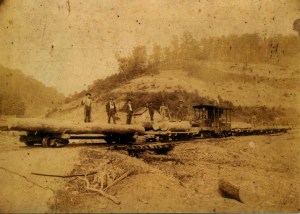
West Virginia timber scene, undated

West Virginia timber scene, 1890-1915

What happened to John Fleming? 3

02 Sunday Dec 2012

Posted by Brandon Ray Kirk in Big Harts Creek

≈ 6 Comments

Tags

Appalachia, crime, feud, Harts Creek, history, Jacob D Smith, John Fleming, Lincoln County, Virginia, West Virginia, Wise, writers, writing

On February 28, 1912, I.J. Beverly, sheriff of Wise County, Virginia, wrote Jacob D. Smith, assistant prosecuting attorney in Lincoln County, West Virginia, to inform him that John Fleming — a fugitive on the run — was living in a nearby town called Glamorgan and using the alias of George Fleming. The letter read as follows:

Wise, Va., March 7th

           Prosecuting Attorney Lincoln county, Hamlin, W.Va.

           Have John Fleming in custody. He agrees to come without requisition if I will bring him but refuses to go with your officer. I will bring him if you will pay all expenses and Two Fifty per day. Answer.

            I.J. Beverly

            Sheriff Wise County

On March 8, Smith received Sheriff Beverly’s letter. Three days later, he left Hamlin, seat of government for Lincoln County, for Richmond, Virginia as an agent to secure requisition papers from Virginia Governor W.H. Mann. A little later, he hired G.A. Lenz, a C&O special agent in Huntington, West Virginia, to accompany him to Wise County as a guard. By March 16, Smith and Lenz had delivered Fleming to the Lincoln County jail. On March 30, Fleming’s bail was set at $2,000.

Early in May, the following witnesses were called to appear before the Circuit Court in the State v. John Fleming, scheduled for June 4: Caleb D. Headley, Lewis Cass Gartin, Andrew Sias, Paris Brumfield, Tilden Gartin, W.A. Adkins, M.E. Nelson, Joe Gartin, Tilman Adkins, John Gartin, Grover Gartin, E.C. Lucas (Sr.), Jeff Lucas, Alvin Sias, Harrison Neace, Bob Fleming, Bud Workman, Jessie Adkins, Lewis Lucas, Ben Noe, Levi Rakes, Flora Lucas, Thomas Sias, Samp Davis, Lona Neace, Albert Neace, George Fleming, Robert Adkins, T.B. Hatfield, Peter Mullins, Ike Fry, William Adkins, Floyd Mullins, Harlan Mullins, Mary Burns, Lula Burns, Jane Moore, Zack Neace, Bill Neace, Abe Noe, Floyd Workman, Wiley Lucas, Dr. Jenks Adkins and Little Cane Lucas.

Days later, John Fleming escaped from the county jail using tools given to him by his brother, Willard. A warrant was issued for the arrest of Willard and placed in the hands of Boyd S. Hicks. According to records maintained at the Lincoln County Circuit Clerk’s Office: “Whereas Burnie Smith has this the 4 day of June 1912 made complaint upon oath before M.D. Hilbert, Justice of said county that one John Fleming was confined in the Lincoln county Jail, being so confined to answer to a charge of shooting with the attempt to kill Caleb Headley, and while in said Jail as a prisoner awaiting trial on said charge, one Willard Fleming did on or about the 10 day of May 1912 willfully and feloniously give and cause to be given the said John Fleming prisoner as aforesaid certain saws, chisels, and other implements for use of said John Fleming in effecting escape from said Jail, and by means of which said saws and other implements he the said John Fleming did saw the bars in said Jail and make his escape there from.” On June 5, Willard Fleming, Matthew C. Farley, Lewis Maynard and Zac Williamson posted Fleming’s $1000 bond.

In an effort to re-arrest Fleming, the Lincoln County Circuit Court issued capias warrants for him on October 29, 1913, December 21, 1914 and March 29, 1915. Fleming was no where to be found.

With John out of the way, his former wife, Lizzie Fry, felt safe enough to remarry. On November 8, 1915, she married Boss Keith. It’s not clear if she had ever married Charley McCoy, the man whose cuckling of Fleming had prompted the ’09 shootout.

In the years following Fleming’s escape, surprising details surfaced about his role in the shootout at Fourteen. “The Fryes and Headleys were blamed for Grandpa Hariff’s death,” said one local man in a 2003 interview, “but an old Frye woman sent word on her deathbed who killed him. She said it was his first cousin, John Fleming.”

Meanwhile, the court continued to issue capias warrants for Fleming on November 14, 1916, February 16, 1917, April 11, 1919, April 5, 1921, April 19, 1922 and December 29, 1922.

Finally, on March 26, 1923, according to Law Order Book 17 at the Lincoln County Courthouse, prosecuting attorney Jacob D. Smith, “with the assent of the court says that he will not further prosecute the defendant John Flemmings, of the Felony of which he now stands charged in this Court. It is therefore considered by the court that the defendant John Flemmings be acquitted, discharged and go thereof without delay.”

By that time, Fleming was probably dead.

“John Fleming went back to Virginia with someone,” said Willard Frye, a nephew to Lizzie, in a 2003 interview. “He got off his horse at a stream to get a drink of water and when he bent down at the stream this man shot him in the back of the head.”

In Search of Ed Haley 14

02 Sunday Dec 2012

Posted by Brandon Ray Kirk in Ed Haley

≈ 2 Comments

Tags

2144 Greenup Avenue, Appalachia, Ashland, Ashland Cemetery, Bake Lee, Bill Bowler, Charlie Ferguson, Ed Haley, Ella Haley, fiddle, fiddler, fiddling, Freeman's Shoe Store, Ghost Riders in the Sky, guitar, history, Imogene Haley, Ironton, John Hartford, Kentucky, Lawrence Colliver, Lawrence Haley, Lazear Funeral Home, Logan County, Milt Haley, music, Noah Haley, Ohio, Over the Waves, Pat Haley, Patsy Haley, radio, Steve Haley, The Shadow, U.S. South, West Virginia, Winchester Avenue, writers, writing

I asked about Ed during that time period. Lawrence said he stayed in a little room just back of the kitchen, which was furnished with a chair, cot, wardrobe and small radio. His fiddle was always on top of the wardrobe, although he seldom played it.

“He listened to the radio quite a bit,” Lawrence said. “You surely have heard of Vaughn Monroe, his version of ‘Ghost Riders in the Sky’. Pop had a transistor radio he carried up to his ear. ‘Goddamn,’ he’d let out, ‘That’s some tune.’ Cause he felt hell was a place where you had to do something you done all your life. I never heard him try to play it but he’d listen to it and listen to it. He’d say, ‘That’s some hell, ain’t it?'”

Pat said, “Pop would shiver when he would hear ‘Ghost Riders in the Sky’. Pop heard it once or twice on that little radio he carried, and he kept his ear right to it.”

I found it strangely odd that Haley had such a high opinion of the tune — maybe he just liked the words.

The cowpokes loped on past him and he heard one call his name,

If you want to save your soul from hell a-riding on our range,

Then, cowboy, change your ways today, or with us you will ride,

A-trying to catch the devil’s herd across these endless skies.

Yippee-yi-ya, yippee-yi-yo, ghost riders in the sky.

Lawrence said Ed eventually gave up on music broadcast over the radio and started tuning in to programs like “The Shadow.”

“We had a great old big crank-up record player and we had a great old big stack of thick RCA records a quarter of an inch thick, I guess,” he said. “They played a lot of them. I guess they learned some pieces of music off of that. ‘Over the Waves’, I guess that’s been around for a hundred years. Pop was pretty good at those slow pieces, too.”

Pat said she never had a real conversation with Ed, so I guess he kind of kept to himself. She remembered him having a white, foot-long beard, which he was very proud of and combed out every day. She said she had a picture of him with Lawrence and Ella in the back yard at 2144 Greenup but couldn’t find it. It was taken in the fall of 1950, when Lawrence was called back into the service.

Around that time, Bill Bowler, a blind guitar player in town, came and asked Ed to play a gig for the grand opening of Freeman’s Shoe Store in Ironton, Ohio. It was kind of a big deal — there was some type of parade going on. Pat said, “We were so happy somebody had finally got him out because he just all of a sudden stopped playing.” Lawrence drove the two over in his brother Noah’s car, then came home. Pat said, “Larry had hardly got back and was telling his mother, ‘Yes, he sat Pop down with Bill Bowler,’ and the next thing we knew Pop came through the front door just cursing a blue streak.” Something had really upset Ed at the shoe store, but the family never did know what happened or how he made it home. Lawrence said, “He just saw that they wasn’t nothing over there for him. He didn’t tell me that I done wrong by taking him over there or anything. He just wasn’t happy, so he didn’t stay.”

Not long afterwards, Lawrence saw his dad play for the last time at Charlie Ferguson’s. He said Noah got him so drunk that he sat down on the floor and played until he fell over. I wanted Lawrence to show me how Ed was playing at Ferguson’s, which he did after joking, “Now John, I don’t want you to involve me in what my dad did.” As he sat there in the floor with my fiddle, Pat laughed and said, “Oh boy, this was a good idea.”

Pat told me about February 3, 1951, the snowy day Ed passed away at home.

“It was very, very cold. My son Stephen was born January 27th, and it was exactly a week later. Pop was in the front room listening to the radio and he came through our bedroom around three o’clock. He had my daughter Beverly on his shoulders and he took her off and he rubbed his head in her tummy and he said, ‘Mmm, you smell so good. You don’t smell like those pissy-ass babies out in the country.’ The children in the country apparently didn’t wear diapers a lot of times and we always kept rubber pants on Beverly and of course the baby powder. After my father-in-law had played with my little girl, he went through and asked my sister-in-law, ‘Patsy, when will supper be ready?’ She was fixing dinner and she said, ‘Aw shortly, Pop.’ And he said, ‘Well I’m going to take a nap.’ He had a room in the back of the house. And we had a nephew Ralph Mullins living with us. He was born in 1946, so he was about five years old. And he took little cars and he was running them up and down while Poppy was napping.”

Pat said, “And when Patsy got dinner ready, she called for Pop to come to the table. My mother-in-law got a little bit irritated because Pop didn’t come. Larry and his brother Jack had been working on a car outside and they went in to check Pop.” Lawrence said, “Mom went in and lifted up his hand and said, ‘Ed.’ Shook his hand, you know. She said, ‘I can’t get him awake. I know he’s alive. I can hear him breathe.’ Well, when she was lifting up his hand, you know, she was pumping out his last breath of air.” Pat said, “And the boys told their mother then that Pop was dead. But the whole time Ralphy had been playing with his cars, so Pop apparently did not cry out in pain. That was it. He just passed away. It was a massive coronary that took him.”

“Pop died just as peaceful a death as could be, I reckon,” Lawrence said. “He died in his sleep.”

When the Ashland newspaper ran Ed’s obituary on Sunday, February 4, 1951, it mistakenly referred to him as the “flower huckster” of Winchester Avenue. Much to the embarrassment of the family, the newspaper had confused Ed with Bake Lee, a blind man in the area who sold pencils and flowers on sidewalks. Bake usually worked the streets with his wife, Lula Lee, an old schoolmate of Ella’s who played the mandolin and French harp.

“Mr. Haley, who had been blind for 65 years, was a familiar figure on Ashland’s streets, having sold flowers in the 1400 block on Winchester Avenue for several years,” the paper partially read. “A resident of Ashland for 35 years, he was born in Logan County, W.Va., a son of Milton and Emma Mullins Haley.”

Lawrence showed me a copy of his father’s corrected obituary: “HALEY: Funeral services for James Edward Haley, 67, retired musician, who died Saturday at his home, 2144 Greenup Avenue, will be conducted at 2 p.m. tomorrow at the Lazear Funeral Home with the Rev. Lawrence Colliver officiating. Burial will be in AshlandCemetery. The body is at the funeral home.”

No one played the fiddle at Ed’s funeral.

“Had a little organ music,” Lawrence said. “I don’t reckon they was anybody he’d care for playing at his funeral.”

Pat said she heard that Ed didn’t look “natural” because the funeral home had shaved off his white beard. Ella had his favorite flower, morning glory, carved on his tombstone.

More dreams

02 Sunday Dec 2012

Posted by Brandon Ray Kirk in Pearl Adkins Diary

≈ Leave a comment

Tags

Appalachia, culture, dreams, Harts Creek, history, inspiration, life, Lincoln County, love, Pearl Adkins, superstitions, thoughts, West Virginia

     “I had a dream last night,” Pearl wrote in July. “I dreamed he came here and I thought several were here too. They were enjoying their selfs but he didn’t have any thing to say and I thought he was the saddest looking boy I ever seen. He was sitting by the door.”

     “I dreamed he was here again,” she continued in a later entry. “He was sad. That time he was handling a pistol some how. I think he was just as sad in my dream as he told me he was. I think them two dreams has a meaning and what it is I don’t know.”

     “October is bright blue weather,” Pearl wrote a few months later, “but I could enjoy it if it wasn’t for this sad old heart of mine. But it will rejoice some day by and by. It’s sad so sad for me. I have thought for many many days I would get my one desire but all hopes have fled. But I pray on and on. My prayers have been for those sweet moments when the wonder of your love was fully known. I seem to feel your loving strong arms again and then — I miss you so my darling!”

Parkersburg Landing

02 Sunday Dec 2012

Posted by Brandon Ray Kirk in Ed Haley

≈ Leave a comment

Tags

Appalachia, blind, culture, Ed Haley, Ella Haley, fiddler, history, John Hartford, Kentucky, music, photos, U.S. South, writers, writing

Ed Haley and family, circa 1927

Ed Haley and family, circa 1927

Pearl Adkins Diary

01 Saturday Dec 2012

Posted by Brandon Ray Kirk in Pearl Adkins Diary

≈ Leave a comment

Tags

Appalachia, Harts Creek, history, inspiration, life, Pearl Adkins, photos, thoughts, U.S. South, West Virginia, writers, writing

Pearl Adkins, circa 1918

Pearl Adkins, circa 1918

Romance

01 Saturday Dec 2012

Posted by Brandon Ray Kirk in Pearl Adkins Diary

≈ Leave a comment

Tags

Appalachia, Harts Creek, history, inspiration, life, love, Pearl Adkins, thoughts, U.S. South, West Virginia, writers, writing

     At that time, Pearl’s head was full of dreams. Based on entries in her diary, she had become fixated on a local beau who made occasional visits to the Adkins home.

     “It’s been a many sad and dreary days since I had last seen him,” Pearl wrote on February 6, 1922. “I almost count the hours and minutes of his absence. So why worry? Life is what we make it. Oh dear, when shall I see you again?”

     “Oh, you are here,” she wrote later that day. “As I looked up from my work I gazed straight into the kindest eyes I’d ever seen — deep and unfathomable like a well of clear, pure water where my famished soul might drink. His clear sweet voice broke the spell, and I dropped my gaze while the hot blood burned over my neck and cheeks. It has the same affect now as I write this as when it happened. It causes my heart to beat wildly and my hand to tremble so I can’t work at my sewing.”

     The following day, Pearl’s thoughts drifted away from romance and more toward her handicap.

     “A day remembered by me if by no other,” she wrote on February 7, “but no one remembers me or my lonely life. Shut up here a helpless cripple for all this time.”

     Four days later, on February 11, Pearl was stirred to write again about the object of her affection.

     “Oh, I wish I could see my darling boy this evening. It seems that every one comes — all but the one I love.”

     “Now alone in my little hut,” she wrote on the 12th, “but my thoughts and dreams has wondered to one in a far distant country.”

     “He has completely gone out of my presence but not out of my mind,” Adkins wrote on March 14. “He is always with me in my day dreams. He will never be mine but nothing can prevent my loving him forever and ever. I see him now as I last saw him as he stood gazing out the window at the mist and rain. Aw, how he looked and looked as if he was grieving about some thing. He made a sad picture. It makes me cry when alone and to imagine him standing there. Oh God, that could I shut that out of my mind my life wouldn’t be so lonely. I don’t see what makes me always think of him when I know he cares nothing for me. All there is left for me to do is hope and pray for his love.”

     On March 29, Pearl wrote, “Oh, what a sweet dream I had last night and I feel that it’s coming to pass. Why shouldn’t it come to pass? Haven’t I suffered long enough?”

What happened to John Fleming? 2

01 Saturday Dec 2012

Posted by Brandon Ray Kirk in Big Harts Creek, Culture of Honor, Fourteen

≈ Leave a comment

Tags

Adkins Conspiracy Case, Appalachia, Bill Brumfield, Charley Brumfield, feud, Harts Creek, history, John Fleming, John Henan Fry, U.S. South, West Virginia, writers, writing

While John Fleming was away serving a term of imprisonment at the West Virginia state penitentiary, his wife Lizzie returned home to live with her father, John Henan Fry, at Fourteen. “Aunt Lizzie ran away from John and came home to Fourteen,” said Willard Frye, nephew to Lizzie, in a 2003 interview. She secured a divorce from Fleming and began an affair with Charley McCoy, a man who newspapers later dubbed a “bitter enemy” to Fleming. Fleming didn’t take the news well. He swore that he would have her back after his release.

On Saturday, March 13, 1909, Fleming was freed from prison. On his way home from Moundsville, he made preparations to recapture Lizzie from McCoy. “When John Fleming returned home from the penitentiary, on his way back, at Huntington, he proceeded to supply himself with the necessary guns and ammunition to start a young war in Harts Creek district,” reported the Lincoln Republican of Hamlin, West Virginia. “It is said he stated to parties on the G.V. train that he would go to John Henan Fry’s home, where his former wife was staying and have her or kill every man on Fourteen.”

“When the intrepid John got back to his native haunts,” reported the Republican, “he got his brother Bob Fleming and together they proceeded to the home of their cousin, Herf Fleming, who was a merchant and a very good citizen and persuaded him to go with them to go to the home of John Henan Fry on their desperate mission.”

Hariff, born illigitimately in August 1878 to Lucinda Fleming, was a first cousin to John and Bob. He had settled in West Virginia around the same time as the other Flemings where, in 1896, he married Delphia Workman. In the summer of 1899, after killing a local bully in self-defense, he had moved with his wife and children to Clintwood, Virginia. Not long before cousin John’s release from prison, however, Hariff had returned to Harts Creek. At the time of John’s visit, he lived at Workman Fork with his family.

“The good wife of Herif’s — Delphia by name, pursued her husband with tears in her eyes to stay at home saying that Bob and John had just been in trouble and was going to get into it again,” reported the Republican. “But as vengeance rankled in the bosom of John for the man who wooed and won his wife in his absence to the pen, he plead with his relatives and companions to pursue their journey.”

Hariff told his worrying wife that he would use the trip downriver as an opportunity to get back a yoke of cattle he sold to a man on Ten Mile Creek.

Before making the trip to Fourteen, Fleming reunited with his familiar confederates, including Charley and Bill Brumfield. These men, like Fleming, had only lately been released from prison for their role in the Adkins conspiracy case. All together, they constituted some of the more mischievous outlaws in the community — men who newspapers claimed had “terrorized Harts Creek.”

“John sent word that he was coming to get his wife, but Aunt Lizzie’s family sent word back to not try it,” said Mr. Frye.”They came with the Charley Brumfield gang.”

The Fry clan was ready for them.

“My dad was there,” said Mr. Frye. “He was Aunt Lizzie’s brother. His brothers were there, too. Uncle Caleb and Albert and Anthony. Poppy was 19 years old. The Fryes and Headleys and Neaces gathered in ambush in barns and behind trees.”

Upon reaching the vicinity of the Frye home, “John Fleming called for his former wife” to leave with him, the Republican reported, “which she refused to do whereupon the trouble started, and John Henan Fry, who was a small, weakly man, started down the branch at about a 2-40 gait.”

At that juncture, someone began firing.

“The guns became much in evidence,” reported the Republican, “and a general shooting affray took place. Herf Fleming was killed by a bullet from a Winchester said to have been fired by Charley McCoy the new lover of the recent Mrs. Fleming who had secreted himself on the hillside in the woodland near the home of his lady lover. He shot into the bunch and shot John Fleming through the arm, and then it is said, sought safety in flight.

“It is useless to state that Mrs. John Henan Fry and children were scared so Mrs. Fry went under the bed after her husband had run off and left the home; but she had a son there and a young man by the name of Caleb Headley who went out at the rear door of the little home and came out to see the result of the battle whereupon John Fleming leveled his pistol on them and maliciously attempted to murder these two unarmed and helpless boys, his aim was so accurate that he cut a lock of hair from Caleb Headley’s head.”

This Caleb Headley was the 19-year-old nephew to John Henan Fry.

“The former Mrs. Fleming,” wrote the Republican, “seeing that she had no further protection against this desperate criminal capitulated, not for any love or affection she had for him but by being put in fear of her life, started to leave with him, and after going a short distance, being stung from his wounds, and remembering his cousin, Herf Fleming having been killed, sent her back to see after him; and she returned to the bullet riddled little home to tell her mother and brothers and sisters that the battle was over for the present, at least.”

“Grandpa Hariff was shot through the shoulder and down through the stomach,” said one grandson, in a 2003 interview. “He lived a while. A little child, maybe named John, came and told Grandma Delph about it. Samp Davis took a wagon with a mattress and bedsprings on it to get him. Ene Adkins and Bud Workman went too. Grandma killed a chicken to make Grandpa a dinner but he was already dead when the wagon got there for him.”

Regional newspapers carried the story. On March 17, 1909, the Marion Daily Mirror of Marion, Ohio, offered a piece titled “Desperate Men Shot.” That same day, the Times Dispatch of Richmond, Virginia printed a story titled: “Shot From Ambush: Members of Feud Gang in West Virginia Waylaid.” On March 20, the Watchman and Southron of Sumter, South Carolina gave one account (“Feudist Shot from Ambush.”) On April 16, the Times Dispatch reported this: “FREELING, Va., April 15 — Hariff Bryant, formerly of this county, was killed on Hart’s Creek, in Logan county, W.Va., according to a late dispatch. He was engaged in an altercation with one John McCoy, a member of the old Hatfield-McCoy feud, when the latter fired the fatal shot. Bryant was about thirty years old and married.”

By that time, county authorities had initiated proceedings against the belligerent parties.

“The next grand jury after the shooting John Fleming was indicted and charged with the shooting at Caleb Headley with intent to kill, and Chas. McCoy was indicted and charged with the murder of Herf Fleming,” the Republican reported.

Unfortunately, many participants in the case had fled West Virginia to avoid possible legal entanglements.

“Poppy and Jesse Headley went to Virginia for a while,” said Mr. Frye. “There were no indictments brought against them.”

John Fleming was also gone. It was later learned that he left West Virginia and traveled to Florida, North Carolina, South Carolina and Tennessee. A capias was issued for him on January 4, 1910, March 16, 1910, March 30, 1910, June 30, 1910, October 8, 1910, January 9, 1911 and February 8, 1912.

“Grandma Delph put out a reward of $500 or $1,000,” said a Fleming descendant.

Dreams

01 Saturday Dec 2012

Posted by Brandon Ray Kirk in Pearl Adkins Diary

≈ Leave a comment

Tags

Appalachia, culture, dreams, Harts Creek, history, life, Pearl Adkins, superstitions, thoughts, U.S. South, West Virginia, writers, writing

     The opening fourteen pages of Pearl’s first volume consist of short poems and sayings written by Pearl and her sister, Cora.

     “You may meet with many faces gliding down life’s merry stream,” Cora wrote to Pearl, “but remember my dear sister you are always in my dreams.”

     Following such light-hearted entries was a superstitious passage of unknown origin dealing with dreams.

     “Dreams come to pass when the moon is so many days old,” Pearl wrote. “Within 24 hours of a new moon, what is dreamt on will be fortunate and pleasing to the dreamer. On the third day, whatever is dreamed will prove true. On the fifth, the dreams will be tolerably successful. On the 6th day, the dream will not immediately come to pass. 7 do not tell your dreams for much depends on concealing them. On the 8th day the dreams will come to pass. The 9th differs very little from the 8th. On the 12th the dreams are rather fortunate. On the 13th the dreams will prove true in a very short time. On the 20th the dreams are true. On the 26th day the dreams are certain. 27th day is very favorable for dreams.”

     On a tiny scrap of paper inserted in that section of the diary was written the word “clairvoyant.”

Parkersburg Landing

01 Saturday Dec 2012

Posted by Brandon Ray Kirk in Ed Haley

≈ Leave a comment

Tags

Appalachia, Ashland, blind, Ed Haley, Ella Haley, fiddler, history, John Hartford, Kentucky, music, U.S. South, writers, writing

Ella, Ralph and Ed Haley, about 1920

Ella, Ralph and Ed Haley, about 1920

Parkersburg Landing 14

01 Saturday Dec 2012

Posted by Brandon Ray Kirk in Ed Haley

≈ Leave a comment

Tags

Appalachia, Ashland, blind, Ed Haley, Ella Haley, fiddler, history, John Hartford, Kentucky, Lawrence Haley, music, Pat Haley, U.S. South, writers, writing

     Lawrence seemed to think of his parents as traveling musicians leading exciting lives — always on the go meeting new people and covering a rather large geographical area. I wondered what affect such a lifestyle had on the Haley children.

     “You’ve got to remember, we didn’t start going with them — or I didn’t — until I was about seven years old, and that had to be in the summertime,” Lawrence said. “Sometimes I’d go with my mother, sometimes I’d go with my dad and my mother, sometimes my dad would take off somewhere on his own. If some of his old friends or something come around and said, ‘Ed, I want you to go with me,’ he’d be gone a week maybe somewhere. And they’d go off and play here or there.”

     I asked if Ella ever got aggravated when Ed took off and Lawrence said, “I don’t think so. You know, two blind people like that trying to raise kids, I guess Mom felt that she could just stay home with her children and be a housewife. She done her own cooking and sometimes Rosie’d be around. I call her Aunt Rosie, but she was no kin to me, see? She was a big old strong stout woman — just raw-boned. Rosie married Bill Day. I guess she met Bill Day by being down here with Mom and Pop.”

     Bill Day, I knew from talking with Annadeene Fraley, was Jean Thomas’ second choice to role-play Jilson Setters — after Haley. He once lived a house away from the Haleys on Halbert Avenue (now Blackburn Avenue). I wanted to get Lawrence’s spin on the Ed Haley-Bill Day relationship.

     “He was a left-handed fiddler and he was a ‘Mississippi sawyer,’ I guess,” Lawrence said. “Well, at one time they lived about a quarter a mile of us, I guess. But he was the one that Jean Thomas picked for Jilson Setters. See, this Jean Thomas was supposed to take Bill Day over and play before the Queen of England or something. I don’t think that ever happened.”

     Pat said, “I know I’ve heard Larry’s mother tell that Bill Day was supposed to have gone to England and played for the king and queen. And my mother-in-law said, ‘That’s impossible for them to have gone there and back in that short of time.’ When I came over in 1949, it was eight and a half days on the ocean, so it would have taken seventeen back when he went.” Lawrence laughed, “He seemed to think he went there but I think she took him out on a trip down the river somewhere and back.”

     That was a really funny image but I told Lawrence that Bill’s trip overseas was pretty well documented.

     “Really, Pop didn’t have much for Bill Day,” he said flatly.

     As I suspicioned, Haley didn’t think much of Thomas, either, and didn’t tell her “no” politely when she offered him the part of Jilson Setters. Pat told me about meeting her years later, long after Pop’s death.

     “Larry and I went out there to see if we could bring the cub scouts through her McGuffey School. She was very nice to start with and then when Larry told her who he was and who his father was she didn’t want any part of him and she told him in no uncertain terms that Pop was a drunk and a blasphemer. She was very rude to Larry and Larry was very upset about it. He stormed out and told her to go to hell. He was deeply hurt by that. I was embarrassed.”

     Lawrence said he had few memories of his father toward the end of his life because he enlisted in the Air Force in 1946 and was stationed away from the family for about three years. At that time, Ed was almost completely bald and “stretched back” a lot and shook his hands, probably due to heart problems.

     “Every time I’d come home on leave or something, I’d get a fifth of whisky and me and him would sit there and drink whiskey and he’d play the fiddle for us,” Lawrence said. “I’d get him to cross-tune down that bass string and he’d play such pieces as ‘Old Sledge’ and ‘Bonaparte’s Retreat’ and ‘Lost Indian’ for me. And a lot of other pieces.”

     So Ed would take a drink?

     “Yeah,” Lawrence said. “Of course, my mother didn’t like Pop to drink, but I always tried to see that he didn’t drink too much — if I didn’t drink too much myself.”

     “Uh oh,” I thought, well aware that drinking is one of the chief occupational hazards of a fiddler.

     Between swigs of Jim Beam, Ed told Lawrence that music never stopped, that it went on forever into outer space. He even talked about Armageddon and had “visions of the hereafter.”

     Lawrence said he was stationed in England when he met Pat. By the fall of 1949, Lawrence and Pat were married and renting a two-story home at 1040 Greenup Avenue in Ashland. Lawrence’s older brother Jack lived upstairs with his wife Patsy and paying a rent of forty-five dollars per month, while Ed and Ella lived downstairs with a grandson, Ralph Mullins, paying fifty dollars a month rent.

     “Downstairs was a very small bedroom on the left as you went through the front door,” Pat said. “That was Pop’s. He had a little table in there where he kept his Prince Albert tobacco and he kept a Prince Albert tobacco can for a spittoon and his bed was like an Army cot. Mom and Ralph’s bedroom was at the end of the hall. And on the right, there was the living room and then there was the dining room. The bathroom was off of the dining room and then from the dining room you went straight into the kitchen. They were large rooms with high ceilings. Linoleum on the floor. Mom and Pop were big on radios. The Victrola was in the living room. Pop used to listen to the radio in the living room. He would run that dial up and down and cup his ear up to it when he couldn’t get what he wanted on it and cuss like the devil. But Mom had one in the dining room and she had a little one in her room. You could go to the upstairs through the kitchen or you could go upstairs through the hall. Jack and Patsy had a living room, kitchen, bedroom, and bathroom upstairs and Larry and I had a bedroom. It’s a used car lot now.”

     Not long after Lawrence and Pat moved in at 1040 Greenup, Jack and Patsy moved to a little cottage on a farm outside of town. “When they moved from 1040 Greenup, Mom could not afford the rent for upstairs and down,” Pat said, so the family soon moved to 2144 Greenup. At that time Ed received sixteen dollars a month for a blind pension, while Ella received nine. Lawrence drew twenty dollars a week from the Air Force and was attending watch-making school.

     “Mom was also going to Cincinnati to sell newspapers and pencils,” Pat said. “She’d ride the bus on Thursday and stay till Saturday with her brother Allie. If they had a falling out, she’d stay with Sissy. I can’t ever remember her taking an instrument with her. Larry would pick her up at the bus depot on Saturday night. Sometimes we would drive to Cincinnati and get her. If we picked her up, she always gave us money for gas. If we went to Uncle Allie’s in Cincinnati and they fixed us supper, Mom always paid them for it. But when they got back to the house, Mom and Larry would always go to her room and there he would count the money. And that was always their secret.”

     At 2144 Greenup — today the site of a mental health center — the Haleys rented the downstairs of a place.

     “When we moved up the street to 2144 the rent was forty-five dollars a month for the downstairs,” Pat said. “There was the front room, then we had the middle room, the dining room, Mom’s room was off of the dining room, and then through the dining room you went into the kitchen and Pop’s room was off the left from the kitchen. Mom had it fixed pretty nice. She didn’t have end tables with lamps — anything like that. They didn’t need anything they would stumble over. Their furnishings were very plain. I remember the winter of 1950 was very bad and Patsy was pregnant, so Jack and Pat came in from the farm and moved in with us. They turned the front room into a bedroom for Pat and Jack.”

Introduction (July 2002)

01 Saturday Dec 2012

Posted by Brandon Ray Kirk in Harts, Pearl Adkins Diary, Women's History

≈ Leave a comment

Tags

Adkins Conspiracy Case, Appalachia, Beecher Avenue, Billy Adkins, Custer McCann, Fed Adkins, Ferrellsburg, Guyandotte River, Harts, history, Isaac Adkins Branch, Lincoln County, Pearl Adkins, polio, Rinda Adkins, Sand Creek, U.S. South, Watson Adkins, West Virginia, writers, writing

Some years ago, I located a diary kept by Pearl Adkins, a physically handicapped and romantically frustrated intellect. A life-long resident of Harts, West Virginia, Pearl was born on August 1, 1904 to Fed and Rinda (Davis) Adkins. At the time of her birth, her parents resided in a two-story plank house situated at the mouth of Isaac Adkins Branch on Guyandotte River. Her father’s involvement in the famous Adkins conspiracy case of 1907 and subsequent incarceration in the West Virginia state penitentiary and loss of property disrupted her childhood and prompted a move. In 1908, the family relocated to a rental dwelling situated above the Adkins store, just back of the original homeplace. Between 1914 and 1916, Pearl and her family lived elsewhere in Hart Bottom. Thereafter, they resided at Sand Creek (1916-1921), then Ferrellsburg — a community above Hart. At this latter location, the Adkins clan briefly operated a store.

“I knew Pearl real well,” said Custer McCann, an 83-year-old retired schoolteacher and Harts resident in June 2002. “I worked for her brother Watson Adkins and stayed around there a lot. She was Watson’s half-sister. She was highly intelligent and she read widely. I’d say she was self-educated. She was a very kind-hearted person. I never did hear her say a bad word about any one.”

Polio crippled Pearl at a young age.

“I’ve always heard my sister Inez [Pearl’s friend and sister-in-law] say that Pearl walked until she was twelve years old,” said McCann. “She had a sick spell and never got over that. But her mother did a real job taking care of her. When she got out of bed, they’d put her in a wheelchair. She had no control with her legs at all.”

According to the genealogy notebooks of nephew Billy Adkins of Harts, “Pearl was five feet, one inch tall and had brown hair and blue eyes. She was a very intelligent woman. She read a lot. She was a very wise woman and counseled people. She was a good listener.”

Pearl’s three volume diary appears to chronicle thoughts and events from January 30, 1922 until May 6, 1928, although it is full of undated or vaguely dated entries. At the time of her writing, Pearl was a young woman approximately eighteen to twenty-four years old still living at home with her parents. The family resided on Beecher Avenue in a small single-story house situated on property owned by Watson Adkins.

Johnny Hager and Ed Haley

01 Saturday Dec 2012

Posted by Brandon Ray Kirk in Ed Haley

≈ Leave a comment

Tags

Appalachia, culture, Ed Haley, fiddler, history, John Hartford, Johnny Hager, life, music, photos, U.S. South, West Virginia

Johnny Hager and Ed Haley, about 1914

Johnny Hager and Ed Haley, about 1914

← Older posts
Newer posts →

Feud Poll 1

If you had lived in the Harts Creek community during the 1880s, to which faction of feudists might you have given your loyalty?

Categories

  • Adkins Mill
  • African American History
  • American Revolutionary War
  • Ashland
  • Atenville
  • Banco
  • Barboursville
  • Battle of Blair Mountain
  • Beech Creek
  • Big Creek
  • Big Harts Creek
  • Big Sandy Valley
  • Big Ugly Creek
  • Boone County
  • Breeden
  • Calhoun County
  • Cemeteries
  • Chapmanville
  • Civil War
  • Clay County
  • Clothier
  • Coal
  • Cove Gap
  • Crawley Creek
  • Culture of Honor
  • Dingess
  • Dollie
  • Dunlow
  • East Lynn
  • Ed Haley
  • Eden Park
  • Enslow
  • Estep
  • Ethel
  • Ferrellsburg
  • Fourteen
  • French-Eversole Feud
  • Gilbert
  • Giles County
  • Gill
  • Green Shoal
  • Guyandotte River
  • Halcyon
  • Hamlin
  • Harts
  • Hatfield-McCoy Feud
  • Holden
  • Hungarian-American History
  • Huntington
  • Inez
  • Irish-Americans
  • Italian American History
  • Jamboree
  • Jewish History
  • John Hartford
  • Kermit
  • Kiahsville
  • Kitchen
  • Leet
  • Lincoln County Feud
  • Little Harts Creek
  • Logan
  • Man
  • Matewan
  • Meador
  • Midkiff
  • Monroe County
  • Montgomery County
  • Music
  • Native American History
  • Peach Creek
  • Pearl Adkins Diary
  • Pecks Mill
  • Peter Creek
  • Pikeville
  • Pilgrim
  • Poetry
  • Queens Ridge
  • Ranger
  • Rector
  • Roane County
  • Rowan County Feud
  • Salt Rock
  • Sand Creek
  • Shively
  • Spears
  • Sports
  • Spottswood
  • Spurlockville
  • Stiltner
  • Stone Branch
  • Tazewell County
  • Timber
  • Tom Dula
  • Toney
  • Turner-Howard Feud
  • Twelve Pole Creek
  • Uncategorized
  • Warren
  • Wayne
  • West Hamlin
  • Wewanta
  • Wharncliffe
  • Whirlwind
  • Williamson
  • Women's History
  • World War I
  • Wyoming County
  • Yantus

Feud Poll 2

Do you think Milt Haley and Green McCoy committed the ambush on Al and Hollene Brumfield in 1889?

Blogroll

  • Ancestry.com
  • Ashland (KY) Daily Independent News Article
  • Author FB page
  • Beckley (WV) Register-Herald News Article
  • Big Sandy News (KY) News Article
  • Blood in West Virginia FB
  • Blood in West Virginia order
  • Chapters TV Program
  • Facebook
  • Ghosts of Guyan
  • Herald-Dispatch News Article 1
  • Herald-Dispatch News Article 2
  • In Search of Ed Haley
  • Instagram
  • Lincoln (WV) Journal News Article
  • Lincoln (WV) Journal Thumbs Up
  • Lincoln County
  • Lincoln County Feud
  • Lincoln County Feud Lecture
  • LinkedIn
  • Logan (WV) Banner News Article
  • Lunch With Books
  • Our Overmountain Men: The Revolutionary War in Western Virginia (1775-1783)
  • Pinterest
  • Scarborough Society's Art and Lecture Series
  • Smithsonian Article
  • Spirit of Jefferson News Article
  • The Friendly Neighbor Radio Show 1
  • The Friendly Neighbor Radio Show 2
  • The Friendly Neighbor Radio Show 3
  • The Friendly Neighbor Radio Show 4
  • The New Yorker
  • The State Journal's 55 Good Things About WV
  • tumblr.
  • Twitter
  • Website
  • Weirton (WV) Daily Times Article
  • Wheeling (WV) Intelligencer News Article 1
  • Wheeling (WV) Intelligencer News Article 2
  • WOWK TV
  • Writers Can Read Open Mic Night

Feud Poll 3

Who do you think organized the ambush of Al and Hollene Brumfield in 1889?

Recent Posts

  • Logan County Jail in Logan, WV
  • Absentee Landowners of Magnolia District (1890, 1892, 1894)
  • Charles Spurlock Survey at Fourteen Mile Creek, Lincoln County, WV (1815)

Ed Haley Poll 1

What do you think caused Ed Haley to lose his sight when he was three years old?

Top Posts & Pages

  • New Year's Raid (1888): Randolph McCoy's Testimony
  • Civil War Gold Coins Hidden Near Chapmanville, WV
  • Feudist Jim McCoy (1929)
  • Paw Paw Incident: Dan Whitt Deposition (1889)
  • Paw Paw Incident: W.S. Ferrell Deposition (1889)

Copyright

© Brandon Ray Kirk and brandonraykirk.wordpress.com, 1987-2023. Unauthorized use and/or duplication of this material without express and written permission from this blog’s author and/or owner is strictly prohibited. Excerpts and links may be used, provided that full and clear credit is given to Brandon Ray Kirk and brandonraykirk.wordpress.com with appropriate and specific direction to the original content.

Archives

  • February 2025
  • January 2025
  • October 2023
  • September 2023
  • December 2022
  • November 2022
  • May 2022
  • April 2022
  • February 2022
  • November 2021
  • October 2021
  • September 2021
  • June 2021
  • May 2021
  • April 2021
  • March 2021
  • February 2021
  • January 2021
  • December 2020
  • November 2020
  • October 2020
  • July 2020
  • June 2020
  • May 2020
  • April 2020
  • March 2020
  • February 2020
  • January 2020
  • December 2019
  • November 2019
  • October 2019
  • September 2019
  • August 2019
  • July 2019
  • June 2019
  • May 2019
  • April 2019
  • March 2019
  • February 2019
  • January 2019
  • December 2018
  • November 2018
  • October 2018
  • September 2018
  • August 2018
  • July 2018
  • June 2018
  • May 2018
  • April 2018
  • March 2018
  • February 2018
  • January 2018
  • December 2017
  • November 2017
  • October 2017
  • September 2017
  • August 2017
  • July 2017
  • June 2017
  • May 2017
  • April 2017
  • March 2017
  • February 2017
  • January 2017
  • December 2016
  • November 2016
  • October 2016
  • September 2016
  • August 2016
  • July 2016
  • June 2016
  • May 2016
  • April 2016
  • March 2016
  • February 2016
  • January 2016
  • December 2015
  • November 2015
  • October 2015
  • September 2015
  • August 2015
  • July 2015
  • June 2015
  • May 2015
  • April 2015
  • March 2015
  • February 2015
  • January 2015
  • December 2014
  • October 2014
  • September 2014
  • August 2014
  • July 2014
  • June 2014
  • May 2014
  • April 2014
  • March 2014
  • February 2014
  • January 2014
  • December 2013
  • November 2013
  • October 2013
  • September 2013
  • August 2013
  • July 2013
  • June 2013
  • May 2013
  • April 2013
  • March 2013
  • February 2013
  • January 2013
  • December 2012
  • November 2012

Enter your email address to follow this blog and receive notifications of new posts by email.

Join 2,925 other subscribers

Tags

Appalachia Ashland Big Creek Big Ugly Creek Blood in West Virginia Brandon Kirk Cabell County cemeteries Chapmanville Charleston civil war coal Confederate Army crime culture Ed Haley Ella Haley Ferrellsburg feud fiddler fiddling genealogy Green McCoy Guyandotte River Harts Harts Creek Hatfield-McCoy Feud history Huntington John Hartford Kentucky Lawrence Haley life Lincoln County Lincoln County Feud Logan Logan Banner Logan County Milt Haley Mingo County music Ohio photos timbering U.S. South Virginia Wayne County West Virginia Whirlwind writing

Blogs I Follow

  • OtterTales
  • Our Appalachia: A Blog Created by Students of Brandon Kirk
  • Piedmont Trails
  • Truman Capote
  • Appalachian Diaspora

BLOOD IN WEST VIRGINIA is now available for order at Amazon!

Blog at WordPress.com.

OtterTales

Writings from my travels and experiences. High and fine literature is wine, and mine is only water; but everybody likes water. Mark Twain

Our Appalachia: A Blog Created by Students of Brandon Kirk

This site is dedicated to the collection, preservation, and promotion of history and culture in Appalachia.

Piedmont Trails

Genealogy and History in North Carolina and Beyond

Truman Capote

A site about one of the most beautiful, interesting, tallented, outrageous and colorful personalities of the 20th Century

Appalachian Diaspora

  • Subscribe Subscribed
    • Brandon Ray Kirk
    • Join 787 other subscribers
    • Already have a WordPress.com account? Log in now.
    • Brandon Ray Kirk
    • Subscribe Subscribed
    • Sign up
    • Log in
    • Report this content
    • View site in Reader
    • Manage subscriptions
    • Collapse this bar
 

Loading Comments...