• About

Brandon Ray Kirk

~ This site is dedicated to the collection, preservation, and promotion of history and culture in my section of Appalachia.

Brandon Ray Kirk

Tag Archives: Virginia

Hezekiah Adkins (1759-1842)

04 Tuesday Jul 2017

Posted by Brandon Ray Kirk in Cemeteries, Giles County, Harts, Native American History

≈ 8 Comments

Tags

American Revolution, Appalachia, Beech Fork, Beech Fork State Park, Billy Adkins, Brandon Kirk, cemeteries, Continental Line, genealogy, Giles County, Harts, Hezekiah Adkins, Hezekiah Adkins Cemetery, history, Isaac Adkins, John Lucas, Lincoln County, Missionary Baptist, Molly Adkins, Montgomery County, Native Americans, New River, photos, preacher, Revolutionary War, Ronnie Adkins, tourism, Virginia, Wayne County, West Virginia, Winslow

IMG_6407

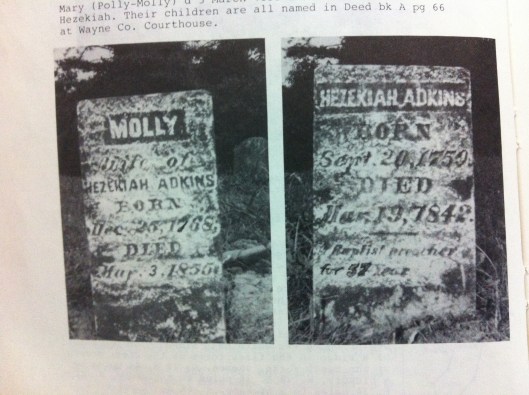
In 1990, Ronnie Adkins published THE definitive Adkins genealogy book. A great many researchers appreciated his work on Hezekiah Adkins’ line of the family. Hezekiah Adkins was born in 1759 in Virginia, served in the American Revolutionary War, moved from Giles County, Virginia, to present-day Wayne County, West Virginia, about 1810, and died in 1842. His grave markers are yet visible at Winslow on Beech Fork in Wayne County, WV. If you visit the grave site, you will find Hezekiah Adkins buried on the left and his wife Mary “Molly” buried on the right (unlike in this photo). Any Adkins researcher owes a great debt to Ronnie Adkins and his book. THANK YOU, RONNIE.

IMG_2228

Here is a photo of my good friend and mentor Billy Adkins visiting the grave site in 1991. Years ago, Billy assisted Ronnie in gathering information about members of the Adkins family who settled in the Harts area of Lincoln County, WV.

IMG_6301

Here is Hezekiah’s grave as it appears today (left). His wife Molly is buried to the right.

IMG_6299

Hezekiah Adkins is my paternal great-great-great-great-great-great-grandfather through his son, Isaac Adkins (1790-1854).

IMG_6300

Here is Molly Adkins’ grave as it appears today. She is my great-great-great-great-great-great-grandmother.

IMG_6303

Hezekiah Adkins has a nice military marker positioned at his feet.

IMG_6338

I recently visited Hezekiah Adkins’ grave. 30 June 2017.

IMG_6336

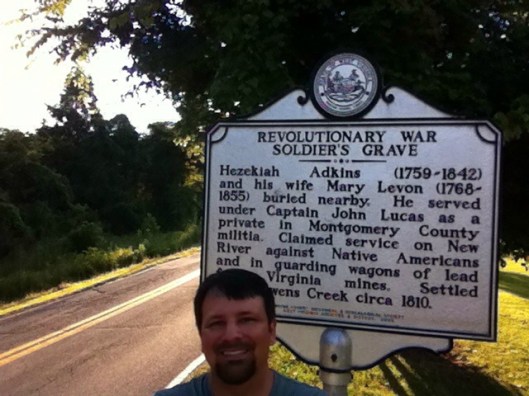
A short distance from the cemetery, beside of the highway, is this great historical marker commemorating Hezekiah Adkins’ service in the Revolutionary War. Beech Fork State Park is less than five minutes away. 30 June 2017.

Whiffs from Whirlwind (1914)

26 Monday Jun 2017

Posted by Brandon Ray Kirk in Big Harts Creek, Logan, Shively, Whirlwind

≈ Leave a comment

Tags

Appalachia, Barnabus, Bob Mullins, Charles W. Mullins, Crockett Farley, Danville, genealogy, Georgia Mullins, history, Inez Maggard, John Carter, John M. Workman, Julia Mullins, Kentucky, Logan, Logan Banner, Logan County, McVeigh, Peter Mullins, Rowdy, Shively, Solomon Adams Sr., Thomas Carter, Virginia, Welch, West Virginia, Whirlwind, Whirlwind Mercantile Company, William Workman

J.M., a correspondent from Whirlwind in Logan County, West Virginia, offered the following items, which the Logan Banner printed on April 24, 1914:

People of this locality have begun farming.

John M. Workman, of McVeigh, Ky., is visiting his brother, Wm. at this place.

Peter Mullins returned to his work at Barnabus Monday.

Miss Inez Maggard is very ill at this writing. The cause of her sickness was an operation performed at a Welch hospital.

John Carter and wife, of Rowdy, were visiting friends at Whirlwind on Tuesday last.

M. Tomblin, a noted tobacco salesman of Danville, Va., passed through here Sunday.

Miss Georgia Mullins, of Shively, were shopping here Monday.

Thomas Carter transacted business at this place Monday.

Mrs. Robert Mullins was visiting friends here Tuesday.

Crockett Farley is hauling goods for the Whirlwind Mercantile Co.

Mrs. Peter Mullins called on Mrs. Georgia Mullins the first of the week.

Miss Julia Mullins was shopping at this place Tuesday.

Sol Adams, Sr. made a business trip to Logan one day last week.

C.W. Mullins called at Whirlwind Tuesday.

William Straton Deposition (1890)

04 Sunday Jun 2017

Posted by Brandon Ray Kirk in Civil War, Logan

≈ 3 Comments

Tags

Appalachia, Aracoma, Ashland, civil war, clerk, George E. Bryan, history, Island Creek, Joseph A. Dempsey, Kentucky, lawyer, Logan, Logan County, Ralph Steel, Stuart Wood, Tazewell County, Virginia, West Virginia, William Straton

On October 7, 1890, William Straton, former clerk of Logan County, (West) Virginia, provided a deposition in a timber lawsuit. His deposition includes valuable recollections of his life during the Civil War and of the destruction of Logan County’s courthouse and records. So here it is:

Then came William Straton, another witness introduced by the plaintiff, being of lawful age and being by me first duly sworn deposes and says in answer to the following questions:

State your age, residence, and occupation?

I am 69 years old, and live at Logan Court House, W.Va., and am a lawyer.

State if you know who was clerk of the County Court of this County from 1861 to 1865?

I was the clerk during that time.

Did you have any deputy in said office during that time? If so, who?

I had a deputy, George E. Bryan. I might have some other deputy but if I did I have forgot all about it.

Which stayed in the office and attended to the business during that time, and especially in 1862, you or your said deputy George E. Bryan?

I was about the office myself very little during the year 1862, or any other time during the war. My deputy George E. Bryan stayed about here and about home more than I did, and during all of that time there was but little business done in the office anyway. It appears to me that it was in the winter 1862 and 1863 that they burned the Court House and clerk’s office.

What become of the records of marriages kept in said office in 1862?

There were some books such as deed books and order books carried to Ralph Steel’s on Island creek in the summer of 1861 and put there for safe keeping. But I don’t think the record of marriages was taken there but was left in the clerk’s office with most of the books and papers belonging to said office. I was not here at the time but the common understanding  afterwards was that all the books and papers were burned.

State if you know whether the said George E. Bryan is dead or living and if living where is he at this time?

The last I knew of him he was living at Ashland, Ky. I have never heard of his death.

Cross Examined.

Where did you live during the latter part of 1862 and the year 1863?

I lived at Logan Court House.

Where did your family live during that time?

Here.

When was it you speak of taking your family from here to Tazewell Co., Virginia?

I took my family, I think it was, in November 1862 as refugees to the County of Tazewell.

How long did your family remain there?

Until the fall of 1865.

And further this deponent saith not.

Source: Stuart Wood v. Joseph A. Dempsey (1889), Logan County Circuit Clerk’s Office, Logan, WV.

John Edwin Peck Grave at Pecks Mill, WV (2017)

25 Thursday May 2017

Posted by Brandon Ray Kirk in Cemeteries, Civil War, Logan, Pecks Mill

≈ 4 Comments

Tags

Appalachia, Blacksburg, Brandon Kirk, cemeteries, civil war, Confederate Army, Edge Hill, genealogy, history, J.E. Peck, Logan, Logan County, Mary C. Peck, Peck Family Cemetery, Pecks Mill, photos, Phyllis Kirk, Virginia, West Virginia

BK at J.E. Peck grave

J.E. Peck grave, Pecks Mill, Logan County, WV (2017). Photo by Mom.

Chapmanville News 05.28.1926

25 Thursday May 2017

Posted by Brandon Ray Kirk in Chapmanville, Logan

≈ Leave a comment

Tags

Appalachia, Chapmanville, Fannie Brown, genealogy, history, Homer Langdon, Inez Barker, Logan, Logan Banner, Logan County, sheriff, Susie Carper, Tolie Ferrell, Virginia, West Virginia

An unknown local correspondent from Chapmanville in Logan County, West Virginia, offered the following items, which the Logan Banner printed on May 28, 1926:

Everybody seems to enjoy farming at present.

Rev. Reedy of Logan gave an interesting sermon both Sunday morning and afternoon at the Christian church. A large crowd assembled.

Rev. Dunagan who has been conducting a meeting at the Holiness church for the past week brought the meeting to a close Monday evening after delivering a sermon for men.

Miss Susie Carper seems to enjoy visiting friends at Big Creek. Wonder what the attraction is anyway?

Miss Tolie Ferrell of Logan spent Sunday here with her parents.

Inez Barker is spending this week in Chapmanville.

Prof. Snidow is leaving for Virginia Wednesday afternoon where he will spend his vacation and then return this coming school term.

There was a little excitement Sunday evening when Mr. Butcher, our sheriff, went into the crowd who were drinking too much.

Miss Fannie Brown and her new friend attended church Sunday night.

Mr. Homer Langdon of Logan spent Sunday here with his mother, Mrs. Langdon.

Brook and Bill sure were having a good time Saturday, judging from the noise.

Daily Happenings: Bias and “that straw hat;” Mabel and her milk pail; Arnold and his lonesome look; Robert and his sweater; Tom looking for Grace. Christian church.

Albert M. Adkins

27 Thursday Apr 2017

Posted by Brandon Ray Kirk in Civil War, Fourteen, Ranger

≈ Leave a comment

Tags

Albert M. Adkins, Appalachia, civil war, coal, Confederate Army, Cosby J. Adkins, Fourteen, Fourteen Mile Creek, genealogy, Henry H. Hardesty, history, Jeremiah Lambert, Laurel Hill District, Lewis Adkins, Lincoln County, Melcina Adkins, Sarah Lambert, Tazewell County, timbering, Virginia, West Virginia

From “Hardesty’s History of Lincoln County, West Virginia,” published by H.H. Hardesty, we find this entry for Albert M. Adkins, who resided at Fourteen in Lincoln County, West Virginia:

At the age of eighteen, enlisted in the late war, in 1862, and bravely did he fight for Virginia and her rights. He served in the Confederate army, was taken prisoner and held ten months. Mr. Adkins was born in what is now Lincoln county, West Virginia, August 27, 1844. His parents are Lewis and Melcina (Hunter) Adkins. In Lincoln county in 1868, Albert M. Adkins wedded Cosby J. Lambert, who was born in Tazewell county, Virginia, in 1843, and whose parents, Jeremiah and Sarah (Hedrick) Lambert, settled in Lincoln county in 1856. A.M. Adkins is one of the farming population in Laurel Hill district, dealing to some extent in lumber, and is the possessor of 400 acres of land, situated on Fourteen-mile creek. A portion of the land is cultivated, and the rest is heavily timbered with oak, poplar, pine, and walnut, and coal and iron ore are found in abundance. Any mail for Albert M. Adkins may be addressed to Fourteen, Lincoln county, West Virginia.

Source: The West Virginia Encyclopedia, Vol. 7 (Richwood, WV: Jim Comstock, 1974), p. 138.

Rufus Stowers

18 Tuesday Apr 2017

Posted by Brandon Ray Kirk in Hamlin, Lincoln County Feud

≈ 5 Comments

Tags

Appalachia, Bland County, Carroll District, commissioner of revenue, constable, Emma Eva Christina Stowers, farming, genealogy, George Washington Stowers, Hamlin, Henry H. Hardesty, Hiram H. Lambert, history, James Addison Stowers, Lincoln County, Lincoln County Feud, Luella Ann Stowers, Martha Rebecca Alice Stowers, Mary Priscilla Stowers, Matilda Jane Stowers, music, Paris Brumfield, Priscilla E. Lambert, Rebecca Stowers, Rufus Stowers, Sarah Elizabeth Stowers, Scary Creek, Tazewell County, The Lincoln County Crew, timber, United Baptist Church, Virginia, War of 1812, West Virginia, William Larkin Stowers, William Stowers

From “Hardesty’s History of Lincoln County, West Virginia,” published by H.H. Hardesty, we find this entry for Rufus Stowers, who resided at Hamlin in Lincoln County, West Virginia:

Son of William Larkin and Rebecca (Lambert) Stowers, was born in Tazewell county, Virginia, January 26, 1842, and settled in Lincoln county in 1872. His father died in Tazewell county in 1857, and his mother in 1856. Mr. Stowers taught school thirteen years, but is now a farmer in Carroll district, owning about 127 acres of land on Scary creek, seven miles southeast from Hamlin. The farm is in good condition, containing a large orchard of apple, pear and peach trees, and a portion of it is heavily timbered with poplar, sugar, maple, beech, hickory, and walnut. In Tazewell county, August 16, 1859, Rufus Stowers was united in wedlock with Sarah Elizabeth Lambert. She is a daughter of Hiram H. and Priscilla E. (Lambert) Lambert, and she was born in Tazewell county, April 26, 1844. October 28, 1882, Mrs. Stowers died, leaving a husband and six children to mourn her loss. She was the mother of seven children, one deceased, who were born as follows: George Washington, September 8, 1860; Matilda Jane, March 29, 1862; Mary Priscilla, August 14, 1864; Martha Rebecca Alice, August 9, 1871; Emma Eva Christina, October 7, 1875; James Addison, March 8, 1877, died July 5, 1878; Luella Ann, April 16, 1879. Mr. Stowers is a member of the United Baptist Church; his wife was a member of the same church at the time of her death. William Stowers, father of Rufus, was a soldier in the war of 1812. Rufus Stowers was at one time constable and commissioner of revenue in Bland county, Virginia. Any mail for him may be addressed to Hamlin, Lincoln county, West Virginia.

Source: The West Virginia Encyclopedia, Vol. 7 (Richwood, WV: Jim Comstock, 1974), p. 117.

NOTE: During the Lincoln County Feud, Paris Brumfield accidentally shot Mr. Stowers. Mr. Stowers appears in the song, “The Lincoln County Crew.”

John Milton Dingess

14 Friday Apr 2017

Posted by Brandon Ray Kirk in Hamlin

≈ 1 Comment

Tags

Appalachia, Carroll District, coal, genealogy, George Edgar Dingess, Hamlin, Henry H. Hardesty, history, Jerusha Alice Dingess, John Milton Dingess, Lincoln County, Logan County, Mary Ann Dingess, Mary Dingess, Mary McDonald, Matilda Dingess, Matilda Jane Dingess, Methodist Episcopal Church, Middle Fork, Mud River, Peter Dingess, Peter Scott Dingess, Pulaski County, Richard McDonald, Union District, Virginia, West Virginia

From “Hardesty’s History of Lincoln County, West Virginia,” published by H.H. Hardesty, we find this entry for John Milton Dingess, who resided at Hamlin in Lincoln County, West Virginia:

Son of Peter and Mary (Stone) Dingess, was born in Logan county, (now) West Virginia, November 3, 1822, and came to Lincoln county in 1853. In Logan county, December 25, 1845, John M. Dingess and Matilda, daughter of Richard and Mary (Ingram) McDonald, were united in the holy bonds of wedlock. She was born in Pulaski county, Virginia, August 3, 1823. The record of the five children of Mr. and Mrs. Dingess is: Peter Scott, born August 31, 1847, resides in Union district, Lincoln county; Mary Ann, February 4, 1851, at home; Jerusha Alice, November 12, 1852, lives in Carroll district, Lincoln county; Matilda Jane, September 25, 1856, died May 19, 1858; George Edgar, April 3, 1858, died April 29, 1858. Mrs. Dingess and her two daughters are members of the Methodist Episcopal Church. John M. Dingess owns a farm of 150 acres, located on the Middle fork of Mud river, four miles east of Hamlin. There is a young orchard on the farm, and plenty of coal and iron ore to be found. Address Mr. Dingess at Hamlin, Lincoln county, West Virginia.

Source: The West Virginia Encyclopedia, Vol. 7 (Richwood, WV: Jim Comstock, 1974), p. 111.

Evermont Ward Brumfield

09 Sunday Apr 2017

Posted by Brandon Ray Kirk in Civil War, Hamlin

≈ Leave a comment

Tags

3rd West Virginia Volunteer Cavalry, Appalachia, Bear Creek, Bunker Hill, Carroll District, civil war, deputy sheriff, Evermont Ward Brumfield, genealogy, Hamlin, Henry H. Hardesty, history, Irena Johnson, jailer, John H. Brumfield, Junea Lilly Brumfield, Laury Brumfield, Lincoln County, Maud Eske Brumfield, Methodist Episcopal Church, Mount Crawford, Paris Brumfield, Perry Johnson, Piedmont, Rachel Brumfield, Rudes Hill, Sheridan District, Spicy Brumfield, Union Army, Virginia, West Virginia, William Randolph Brumfield, Winchester

From “Hardesty’s History of Lincoln County, West Virginia,” published by H.H. Hardesty, we find this entry for Evermont Ward Brumfield, who resided at Hamlin in Lincoln County, West Virginia:

Is a native of Lincoln county, born July 15, 1841, and he is a son of John H. and Rachel (Haskins) Brumfield. In Lincoln county, February 14, 1867, E.W. Brumfield was joined in marriage with Laury Johnson, born in Lincoln county, October 22, 1843, and is a daughter of Perry and Irena (Gilkinson) Johnson. The children born to Mr. and Mrs. Brumfield are: Junea Lilly, May 14, 1868; Spicy, October 1, 1871; Maud Eske, April 24, 1881; all at home. Mr. Brumfield served in the Federal army during the Civil War, in Company G, 3rd West Virginia Volunteer Cavalry. He enlisted November 15, 1863, and served until the close of the war, and was a participant in the following battles: Winchester, Piedmont, Mount Crawford, Rudes Hill, and Bunker Hill. One brother of E.W. Brumfield, William Randolph, was killed in the late war. Mr. and Mrs. Brumfield joined the Methodist Episcopal Church July 16, 1869, in which Mr. Brumfield has been class leader. His grandfathers were among the earliest settlers of Lincoln county. E.W. Brumfield owns about 105 acres of fine farming land in Sheridan district, on Bear creek, four miles northwest of Hamlin; the land is well cultivated, and has upon it a large orchard of apple, peach, plum and cherry trees. Beside tilling the soil, in Carroll district, the subject of this sketch is jailer and deputy sheriff of Lincoln county, which office he has held two years. Direct mail to Hamlin, Lincoln county, West Virginia.

Source: The West Virginia Encyclopedia, Vol. 7 (Richwood, WV: Jim Comstock, 1974), p. 108-109.

NOTE: Paris Brumfield, brother to E.W. Brumfield, is my great-great-great-grandfather.

Grundy, Virginia (2017)

27 Monday Mar 2017

Posted by Brandon Ray Kirk in Lincoln County Feud

≈ Leave a comment

Tags

Appalachia, Blood in West Virginia, Brandon Kirk, Buchanan County, genealogy, Grundy, history, James P. Mullins, Kentucky, Lincoln County Feud, Louisa Jane Mullins, Maysville, photos, Phyllis Kirk, The Evening Bulletin, Virginia

BK at Buchanan County Courthouse

On 9 November 1889, The Evening Bulletin of Maysville, Kentucky, referenced Louisa J. (Collins) Mullins as a key participant of the Lincoln County Feud. Years earlier, in 1872, L.J. had married James P. Mullins in Buchanan County, Virginia. I recently visited Grundy, the county seat of Buchanan County. Photo by Mom. 25 March 2017. https://www.newspapers.com/clip/7839482/elizabeth_louise_mullins_hatfield_1889/


Patton Thompson

24 Friday Mar 2017

Posted by Brandon Ray Kirk in Big Harts Creek, Civil War, Green Shoal

≈ Leave a comment

Tags

34th Battalion Virginia Cavalry, Abbotts Branch, Appalachia, Branson Tomblin, Chloe Thompson, constable, David Thompson, Delana Thompson, deputy sheriff, Feriba Tomblin, genealogy, Green Shoal, Guyandotte River, Harts, Harts Creek, Henry H. Hardesty, history, Jenks Thompson, John F. Thompson, Lincoln County, Logan County, Margaret Thompson, Martha J. Thompson, Mary A. Thompson, North Carolina, Patsy Thompson, Patton Thompson, Susan Kirk, Susan Thompson, Tazewell County, Virginia, West Virginia, William Thompson

From “Hardesty’s History of Lincoln County, West Virginia,” published by H.H. Hardesty, we find this entry for Patton Thompson, who resided near Green Shoal in Lincoln County, West Virginia:

Patton Thompson and Delana Tomblin were united in the holy bonds of matrimony in Logan county, (now) West Virginia, October 1, 1845, and they have been blessed with nine children, born as follows: William, August 24, 1846; John F., March 11, 1849, died in 1858; Martha J., September 3, 1851; Chloe, January 24, 1854, died in 1864; Margaret, July 27, 1856; David, December 4, 1858; Albert G., September 10, 1861; Mary A., May 15, 1864; Susan, June 15, 1868. Mrs. Thompson was born in Tazewell county, Virginia, in 1826, and her parents are Branson and Feriba (Lewis) Tomblin, natives of North Carolina. Patton Thompson is a native of Logan county, born May 28, 1834, and his parents, William and Patsy (Wilkins) Thompson, came to this county in 1823. Mr. Thompson owns 100 acres of farming land on Guyan river, and 300 acres in Logan county on Hart creek. The land produces well and is highly cultivated. Patton Thompson is deputy sheriff of Lincoln county, and is also constable of Hart Creek district. He is a man of considerable means and ability, is tilling the soil in this district, and receives his mail at Hart, Lincoln county, West Virginia.

Source: The West Virginia Encyclopedia, Vol. 7 (Richwood, WV: Jim Comstock, 1974), p. 138.

NOTE: Most likely, when this history was compiled about 1883, Patton Thompson lived at what has been called “the Baisden farm” on the Guyandotte River above present-day Abbotts Branch near the Logan County line.

NOTE: Patton Thompson, a veteran of Company D, 34th Battalion Virginia Cavalry, is my great-great-great-grandfather. I descend from his daughter, Susan (Thompson) Kirk.

Andrew Lewis Sias

22 Wednesday Mar 2017

Posted by Brandon Ray Kirk in Civil War, Fourteen

≈ Leave a comment

Tags

22nd Virginia Infantry, Albert Gallatin Jenkins, Andrew Lewis Sias, Appalachia, Charlotte Sias, civil war, coal, Confederate Army, Delilah Jane Sias, East Cavalry Battlefield, East Fork, Fourteen, Fourteen Mile Creek, genealogy, Gettysburg, Harts Creek District, Henry H. Hardesty, Henry H. Sias, history, James Sias, Jeremiah Sias, John Lucas, Lena L. Sias, Lincoln County, Martha Ellen Sias, Mary Etta Sias, Maryland, Mercer County, Point Lookout, Rebecca Sias, Tazewell County, timber, Vincent A. Witcher, Virginia, West Virginia

From “Hardesty’s History of Lincoln County, West Virginia,” published by H.H. Hardesty, we find this entry for Andrew Lewis Sias, who resided at Fourteen in Lincoln County, West Virginia:

Andrew Lewis Sias is one of the farming population of Hart Creek district, Lincoln county, and owns 87 ½ acres of land on the East fork of Fourteen Mile creek, 45 acres well cultivated, the rest heavily timbered, and coal, iron ore and building stone are to be found on the farm. Mr. Sias was born in Mercer county, (now) West Virginia, May 28, 1842, and was married in Lincoln county February 10, 1867, to Martha Ellen Lambert, the Rev. John Lucas officiating clergyman. The children of this union were born as follows: Jeremiah, November 25, 1868; Delilah Jane, March 1, 1870; Henry C., September 5, 1872; Lena L., March 8, 1874; Charlotte, November 5, 1876; Mary Etta, April 25, 1880. The parents of Andrew Sias, James and Rebecca (Adkins) Sias, have resided in Lincoln county since its organization. Mrs. Andrew Sias was born in Tazewell county, Virginia, April 12, 1848, and her parents, Jeremiah and Sarah (Hedrick) Lambert, were residing here before the county was organized. Andrew Lewis Sias enlisted in the late war, in Company G, 22nd Virginia Volunteer Infantry, commanded by Colonel Clawhammer Witcher, in General A.J. Jenkins’ brigade. Mr. Sias was wounded in the battle of Gettysburg on the third day of the fight, and was left in the hands of the enemy, taken to Point Lookout, Maryland, held eight months and four days, suffering untold injuries. When the word of exchange came Mr. Sias went back to his company, his arm still in a sling, and participated in several engagements, though he could use a revolver only with his left hand, and he would have suffered for something to eat had it not been for the kindness of two good soldiers. Andrew Lewis Sias settled in Lincoln county in 1867, and receives his mail at Fourteen, Lincoln county, West Virginia.

Source: The West Virginia Encyclopedia, Vol. 7 (Richwood, WV: Jim Comstock, 1974), p. 137-138.

NOTE: Lewis Sias is my great-great-great-grandfather.

James P. Mullins

04 Saturday Mar 2017

Posted by Brandon Ray Kirk in Big Harts Creek, Boone County, Harts, Lincoln County Feud

≈ 2 Comments

Tags

Albert Mullins, Appalachia, Big Branch, Boone County, Buchanan County, Dicy Collins, Dorcas Mullins, genealogy, Harts, Harts Creek, Henry H. Hardesty, history, Isham Collins, James A. Mullins, James P. Mullins, Kentucky, Lincoln County, Louisa Jane Mullins, Mary J. Mullins, merchant, Minnie B. Mullins, Victoria Mullins, Virginia, West Virginia

From “Hardesty’s History of Lincoln County, West Virginia,” published by H.H. Hardesty, we find this entry for James P. Mullins, who resided at Big Branch of Harts Creek in Lincoln County, West Virginia:

Came to Lincoln county in 1877, and now owns 250 acres of fine farming land on Hart creek. The farm has good improvements, and a large orchard. Mr. Mullins was born in Kentucky in 1848, and he is a son of James P. and Dorcas (Mullins) Mullins, residents of Boone county, West Virginia. Elizabeth J., daughter of Isham and Dicy (Johnson) Collins, was born in Kentucky, October 5, 1855, and in Buchanan county, Virginia, May 25, 1872, she became the wife of James P. Mullins. Five children are the result of their union: Mary J., born October 5, 1873; Victoria, April 23, 1876; Albert, July 18, 1877; Minnie B., July 1, 1879; James A., November 13, 1883. Mr. Mullins is a man of good business qualifications, and is prosperously engaged in merchandising, with business headquarters on Hart creek, one and one-half miles from its mouth. He may be addressed at Hart, Lincoln county, West Virginia.

Source: The West Virginia Encyclopedia, Vol. 7 (Richwood, WV: Jim Comstock, 1974), p. 136.

Caleb Headley

28 Tuesday Feb 2017

Posted by Brandon Ray Kirk in Civil War, Fourteen, Wewanta

≈ Leave a comment

Tags

Anthony Headley, Appalachia, Ballard Headley, Benjamin F. Headley, Caleb D. Headley, Caleb Headley, Caleb S. Headley, Catlettsburg, Christian Church, civil war, commissioner of revenue, Elisha Headley, Elizabeth J. Headley, Elizabeth Jane Farley, Fourteen, Fourteen Mile Creek, genealogy, George W. Headley, Guyandotte River, Henry H. Hardesty, history, Ida Cosby Fry, Johnny Headley, justice of the peace, Kentucky, Lincoln County, Logan County, Margaret Headley, Methodist Church, Nancy Headley, Pennsylvania, physician, Sarah A. Headley, Sarah Headley, Sulphur Spring Fork, Thomas Headley, Thomas J. Headley, Union Army, Virginia, West Virginia, Wetzel County, Will Headley, William Farley

From “Hardesty’s History of Lincoln County, West Virginia,” published by H.H. Hardesty, we find this entry for Caleb Headley, who resided at Fourteen in Lincoln County, West Virginia:

Has for nearly fifty years been a practicing physician. He was born in Pennsylvania in 1808, and his parents Thomas and Sarah (Asher) Headley, are both deceased. Caleb Headley has been twice married, his first wife, Nancy Wright, a Pennsylvanian, left him eight children: Elizabeth J., born June 2, 1829; Thomas J., November 23, 18931; Sarah A., December 8, 1833; Caleb S., March 30, 1838; George W., May 21, 1839; Benjamin F., May 31, 1841; Anthony, June 3, 1844; Elisha, born August 1, 1850. Mr. Headley was again married in Catlettsburg, Kentucky, to Sarah A. Farley, and the children of this union number six, born as follows: John T., April 20, 1867; Ida C., March 23, 1869; Caleb D., February 22, 1872; William F., August 25, 1875; Margaret, March 28, 1878; Ballard C., April 14, 1880. Mrs. Headley was born in Logan county, (now) West Virginia, May 26, 1849, and her parents, William and Elizabeth Jane (Clark) Farley, settled in Lincoln county in 1844. Caleb Headley came to Lincoln county in 1866, and is now a prosperous farmer, owning 600 acres of good land on Fourteen-mile creek, a portion of which is heavily timbered with oak, poplar and pine; coal and iron ore in abundance. There is a fine sulphur spring upon the land, on the creek three miles from Guyan river, which has been visited by people from many parts of the United States, and it is pronounced of excellent medicinal quality by all. Dr. Headley was commissioner of revenue one term, and was justice of the peace sixteen years in Wetzel county, West Virginia. He was in the late war, and ranked as captain of a company. Dr. Headley was a member of the Methodist Church for forty years, but on coming to Lincoln county, there was no church of that denomination, and he united with the Christian Church. His father was also a physician for many years. Direct mail to Fourteen, Lincoln county, West Virginia.

Source: The West Virginia Encyclopedia, Vol. 7 (Richwood, WV: Jim Comstock, 1974), p. 135.

Note: Caleb Headley is my great-great-great-grandfather through his daughter, Ida Cosby (Headley) Fry.

Isaac G. Gartin

28 Tuesday Feb 2017

Posted by Brandon Ray Kirk in Atenville, Civil War, Fourteen, Little Harts Creek

≈ 2 Comments

Tags

Appalachia, civil war, Confederate Army, Elijah Gartin, Eliza Ann Gartin, Elizabeth Agnes Gartin, Elizabeth Margaret Gartin, farming, Fourteen, genealogy, Greenbrier County, Harry Patterson Gartin, Harts Creek District, Henry H. Hardesty, history, Isaac Gartin, James A. Gartin, James Toney, Josephus Workman, justice of the peace, Kanawha County, Lincoln County, Little Harts Creek, Logan, Martha Frances Gartin, Mary Gartin, Meadow Bluffs, Monroe County, Nancy Caroline Gartin, Nancy Toney, Susan Jane Gartin, Virginia, West Virginia

From “Hardesty’s History of Lincoln County, West Virginia,” published by H.H. Hardesty, we find this entry for Isaac Griffith Gartin, who resided at Little Harts Creek in Lincoln County, West Virginia:

Was born in Monroe county, (now) West Virginia, February 3, 1832, and settled in Lincoln county in 1864. His parents are Elijah Alexander and Mary (Carper) Gartin, who settled here in 1850. August 28, 1856, in Logan county, (now) West Virginia, the Rev. J. Workman joined in wedlock Isaac G. Gartin and Elizabeth Margaret Toney. She was born in Kanawha county, (now) West Virginia, October 15, 1835, and she is a daughter of James and Nancy (Gillispie) Toney, who came to this county in 1843. Mr. and Mrs. Gartin have been blessed with six children: Eliza Ann, born October 3, 1857, married and residing in Lincoln county; James Alexander, September 12, 1860, married and lives in this county; Susan Jane, June 22, 1864; Nancy Caroline, September 12, 1867; Elizabeth Agnes, February 18, 1872; Martha Frances, March 11,1 876. Isaac Gartin was justice of the peace for four years in Hart Creek district, and secretary of the board of education six years, also a member of that board for a number of years. Mr. Gartin volunteered in the State line troops of Virginia, and served eight months, when it was thought best to abandon the brigade to which he belonged, and he came home. They were afterward ordered to meet an officer in Logan C.H., who would muster them into the regular service, but this failed, and Mr. Gartin again returned to his home. Harry P., a brother of Isaac G., a volunteer in the Confederate army, was taken sick and died at Meadow Bluffs, Greenbrier county, after one year’s service. Isaac Griffith Gartin owns a fine farm at the head of Little Hart creek, and the land produces well in grain as well as fruit, and it contains iron ore and fine building stone. Address, Fourteen, Lincoln county, West Virginia.

Source: The West Virginia Encyclopedia, Vol. 7 (Richwood, WV: Jim Comstock, 1974), p. 134-135.

Christian T. Fry

22 Wednesday Feb 2017

Posted by Brandon Ray Kirk in Civil War, Giles County, Green Shoal

≈ Leave a comment

Tags

Abbotts Branch, Anthony Fry, Appalachia, Boone County, Cabell County, Caroline Fry, Catherine Fry, Christian Fry, Cora A. Fry, Druzilla Abbott, Elizabeth Fry, Elizabeth Hunter, Emily Lucas, farming, Fourteen Mile Creek, genealogy, Giles County, Green Shoal, Hardin Fry, Harts Creek District, Henry H. Hardesty, history, John Fry, John Henan Fry, Julia A. Fry, Kanawha County, Lincoln County, Lurana Fry, Mary A. Fry, Robert Hunter, Sulphur Spring Fork, timber, Virginia, West Virginia

From “Hardesty’s History of Lincoln County, West Virginia,” published by H.H. Hardesty, we find this entry for Christian T. Fry, who resided at Hart in Lincoln County, West Virginia:

One of the farming population of Hart Creek district, was born in Cabell county, West Virginia, in 1824, and he is a son of John and Catherine (Snodgrass) Fry, natives of Giles county, Virginia. Mr. Fry chose for a help-meet Elizabeth Hunter, and in Boone county, West Virginia, in 1849, they were married. Their children number eight, born as follows: Julia A., April 26, 1850; Anthony, November 1853; Caroline, December 1856; Mary A., August 1859; John H., September 1861; Cora A., September 1864; Hardin, June 15, 1867; Lurana, July 1871. Mrs. Fry was  born in Kanawha county in 1835, and her parents are Robert and Elizabeth (Tayler) Hunter, who reside in Boone county. Christian T. Fry is a prosperous farmer in Hart Creek district, owning 300 acres of good farming land, situated on Browns branch. The land has good improvements, a fine orchard, and a part is heavily timbered with pine, poplar and oak. There is mineral, coal and iron ore in abundance. Mr. Fry’s post office address is Hart, Lincoln county, West Virginia.

Source: The West Virginia Encyclopedia, Vol. 7 (Richwood, WV: Jim Comstock, 1974), p. 134.

NOTE: Christian Thomas “Jack” Fry is my great-great-great-grandfather. I descend through his son, John Henan Fry, who settled on Sulphur Spring Fork of Fourteen Mile Creek. I also descend from two of Christian Fry’s sisters, Emily (Fry) Lucas and Druzilla (Fry) Abbott.

NOTE: The Browns Branch referenced in this history is now called Abbotts Branch.

Harts Creek Area Justices of the Peace (1847-1869)

28 Wednesday Sep 2016

Posted by Brandon Ray Kirk in Big Creek, Big Harts Creek, Big Ugly Creek, Ferrellsburg, Harts, Toney

≈ Leave a comment

Tags

Aaron Adkins, Abijah Workman, Abner Vance, Andrew Robinson, Appalachia, Becky Workman, Cabell County, Calohill McCloud, Catherine Fry, Charles Adkins, Crispin Stone, Darby K. Elkins, Dolly Stollings, Elias Adkins, Elizabeth Dial, Gordon Lilly, Harts Creek, Harvey Elkins, Henderson Drake, Henry Adkins, Henry Conley, Henry Spears, Hezekiah Adkins, history, Isaiah Adkins, Jake Adkins, James Butcher, James Ferrell, James Lilly, James M. Berry, James Thompson, James Toney, John Chapman, John Elkins, John Godby, John Gore, Joshua Butcher, justice of the peace, Levi Collins, Logan County, Lorenzo Dow Hill, Lydia Eveline Mullins, Mary Workman, Meekin Vance, Noah Hainer, Obediah Workman, Reese W. Elkins, Richard Elkins, Robert Lilly, Robert Lilly Jr., Robet Lilly, Samuel Vanatter, Sarah Jane Dial, Spencer A. Mullins, Squire Toney, Stephen Lambert, Virginia, Wesley Stollings, West Virginia, William Lilly, William Smith, William Spears, William Thompson

Between 1847 and 1869, the following men served as justices of the peace in the Harts Creek community, then a part of Logan County, Virginia. The primary source for this material is Deed Book D, which is located at the Logan County Clerk’s Office in Logan, WV. Material is arranged based on the grantor’s name as given in the deed, the grantee’s name as given in the deed, and the date of the deed. Some of the deeds are partially destroyed, obscuring dates. This list is a work in progress and will be updated periodically. Many thanks to the county clerks and their employees who have always been so helpful to my research these past twenty-five years.

Elias Adkins (Logan County), 1847, 1850

Deed: James Thompson to John Godby     23 August 1847

Deed: Wesley and Dolly Stollings to Abner Vance     15 April 1850

Crispin S. Stone (Logan County), 1847, 1849, 1852, 1854, 1859, 1865

Deed: James Thompson to John Godby     23 August 1847

Deed: Henry Conley and William Thompson to John Godby     4 September 1849

Deed: Levi Collins to Noah Haner     2 March 1852

Deed: Robert Lilly to William Lilly     22 December 1854

Deed: Robert Lilly to Robert Lilly, Jr.     1 March 1859

Deed: Isaiah Adkins to Lydia Eveline Mullins     8 July 1859

Deed: Robert Lilly to Mary Workman     28 February 1865

Deed: Robert Lilly to Gordon Lilly     1 March 1865

Deed: Robert Lilly and James Lilly     26 March 1865

Joshua Butcher (Logan County), 1849

Deed: Henry Conley and William Thompson to John Godby     4 September 1849

Spencer A. Mullins (Logan County), 1853-1855

Deed: Richard Elkins to James Toney     5 March 1853

Deed: Price Lucas to Henry Adkins     7 October 1853

Deed: Richard Elkins to Isaac Adkins     27 December 1853

Deed: Enos “Jake” Adkins to Henry Adkins     12 April 1854

Deed: Squire Toney to Burbus C. Toney     14 October 1854

Deed: Darby K. Elkins to John W. Sartain     30 October 1854

Deed: Harvey Elkins to Isaiah Adkins     10 March 1855

Deed: Elizabeth Adkins et al to Charles and Isaiah Adkins     02 October 1855

Deed: Joel Elkins to Reece W. Elkins     17 November 1855

William Smith (?? County), 1853-1854

Deed: Baptist Fry to Charles Lucas     18 April 1853

Deed: Levi Collins to Anderson Barker     21 June 1853

Deed: Burbus C. Toney to Squire Toney     14 October 1854

Deed: John Workman to  James Browning     17 November 1854

Lorenzo Dow Hill (Logan County), 1854-1856, 1858-1861, 1869

Deed: Burbus C. Toney to Squire Toney     14 October 1854

Deed: John Workman to James Browning     17 November 1854

Quit Claim Deed: Elias Adkins to Enos Adkins     18 August 1855

Deed: John Fry to Admiral S. Fry     26 January 1856

Deed: Robert Lilly to Gordon F. Lilly     8 April 1856

Deed: Rees W. Elkins to Elias Adkins     18 October 1856

Deed: Robert Lilly to James Lilly     16 April 1858

Deed: Meekin Vance to Andrew Robinson     31 March 1859

Deed: John and Catherine Fry to Aaron Adkins     11 February 1860

Summons: William T. Clark and Henry P. Gartin     28 February 1861

Commissioners Record Book No. 1, p. 122: January 1869

James Ferrell (Logan County), 1854-1858, 1860

Deed: Squire Toney to Burbus C. Toney     14 October 1854

Deed: Elizabeth Adkins et al to Spencer A. Mullins     07 February 1855

Deed: Squire Toney to Sarah Jane Dial     25 November 1855

Deed: Squire Toney to Sarah Jane Dial and Elizabeth Dial     20 May 1856

Deed: Squire Toney to Lorenzo D. Hill     24 January 1857

Deed: William Smith to James Lilly     17 February 1858

Summons: James M. Berry     18 February 1860

Hezekiah Adkins (Logan County), 1856

Deed: Darby K. Elkins et al to Rees W. Elkins     18 April 1856

John Chapman (Cabell County), 1856

Deed: Spencer A. Mullins to John Chapman     18 December 1856

Stephen Lambert (Logan County) 1856-1860, 1865

Deed: Rees W. Elkins to Elias Adkins     18 October 1856

Deed: Obediah Workman to Nighbert and Clarke     25 August 1857

Deed: Charles and Isaiah Adkins to John Elkins     24 November 1858

Deed: Meekin Vance to Andrew Robinson     31 March 1859

Deed: Isaiah Adkins to Lydia Eveline Mullins     8 July 1859

Deed: Obediah and Becky Workman to ____ Dempsey     28 September 1859

Deed: Henry Adkins to Aaron Adkins     31 March 1860

Summons: Jeremiah Lambert     3 September 1860

Deed: Abijah Workman to Calahill Daniel McCloud     12 January 1865

Samuel Varnater (Logan County), 1865

Deed: Abijah Workman to Calahill Daniel McCloud     12 January 1865

Henderson Drake (Cabell County), 1865

Deed: Henry Spears to William Spears     6 December 1865

John Gore (Logan County), 1868

Commissioners Record Book No. 1, p. 112: November 1868

Recollections of the Civil War in Eastern Kentucky and Southwestern Virginia (1862)

20 Tuesday Sep 2016

Posted by Brandon Ray Kirk in African American History, Civil War

≈ Leave a comment

Tags

Appalachia, civil war, Confederate Army, Cumberland Mountains, David Stuart Hounshell, E.H. Perry, From Youth to Old Age, history, James Stephens, John B. Floyd, Kentucky, King Salt Works, Louis Bledsoe, Prestonsburg, slavery, Thomas H. Perry, Virginia

About 1910, Rev. Thomas H. Perry reflected on his long life, most of which was spent in the vicinity of Tylers Creek in Cabell County, West Virginia. In this excerpt from his autobiography, Mr. Perry recalled his participation in Civil War activity in eastern Kentucky and southwest Virginia.

After the night fight, above Prestonsburg, we knew the Federals were above us and we would have to fight if we ever got back to Dixie. The cold weather and deep snow and timber across the road and Federals to contend with, we moved very slowly. One morning we stopped, as I thought for breakfast, and as I was almost frozen I rejoiced because I thought we will all get warm and some beef, as I saw one man shoot down a cow. But just at that time the Federals run in our pickets and began shooting at us, but I was so hungry I ran to the cow and cut two or three pounds out of the hind-quarter and took it with me. We ran about one mile and there we saw Colonel Hounshal’s regiment in battle line, who held the Federals off us until we could get our breakfast. I took my beef without salt and put it on the end of my ramrod and held it to the fire and cooked an ate it, and it was good.

The next day my company was the rear guard and it was reported to the captain that the Federals had got between us and our command. The captain said: “Men, we will have to fight or we will be taken prisoners.” There was a preacher with us that day. He said: “Captain, I did not intend to fight, but rather than be a prisoner I will fight. Give me a gun.” When I saw him shoulder his gun, it did me good. I thought if a preacher could fight it was not bad for me to fight, as I was only a prospective preacher.

One very cold night I was detailed on the outer picket post, the orderly said: “You can not have fire as they are likely to slip upon you and shoot you.” I said to the orderly: “I cannot stand it without fire.” I thought I would freeze to death. The orderly said: “I cannot excuse you.” Just at that time Louis Bledsoe said to the orderly he could stand more cold than Perry could and he would go in my place and I could go in his place some other time. Never did I forget the kindness Mr. Bledsoe showed me that night.

When we were within fifteen miles of the Cumberland mountains, our army cattle, prisoners and all we had was on one creek; that creek led to the main road across the mountains into Dixie. On either side of this creek, the mountains were high and very rough and covered with snow. The Federals cut timber across the creek above us, and had a strong army below us, and held us here three days and would have captured us and all we had if General Floyd had not come with his artillery and drove the Federals away from the head of the creek, and let us out. The first night after we crossed the mountain into Dixie, E.H. Perry, one of my brothers came to my captain’s tent and said: “Captain, are my brothers all here?” He said: “Yes.” Then my brother exclaimed: “Thank the Lord for that.” Never will I forget the tone of my brother’s voice that night for he knew we had been gone for forty-one days, and it was by the hardest work that we landed back in Dixie.

Once more after this we went into winter quarters near the King Salt works, and they sent me to a farm house to nurse three sick soldiers. We had a large nice room, well furnished and the landlord was rich and good to us. He and his good wife would help me in waiting on the sick; he furnished us with everything we could ask for to eat. We stayed there more than three months. I saw in the beginning that I would not have much to do, and as I had the money and there was a book store at that place, I bought a complete set of school books and studied them hard that winter and it did me good. It helped me to keep down the roughness of a soldier’s life, and also to educate. Along the back yard there was a row of one-story brick buildings in which the negroes lived. Some nights I would go and hear them tell ghost stories, and they knew how to tell them for they had seen a great many ghosts. I deny superstition, but I noticed when these negroes had told me some of the most fearful ghost stories, if it was a very dark night I would ask some of them to go apart of the way home with me.

Mr. James Stephens, one of my patients, died; the other two got well. We left that place about the first of May. I saw then that the south could not gain her independence, and I told these negroes I thought they would soon be free and advised them to learn to read and write. I talked with a good many old men in the south about the war. They said they should have raised the “Old Flag” and contended for the constitution, and as for slavery, they said it was dying out in the south anyway.

Source: From Youth to Old Age by T.H. Perry, Chapter 8, p. 20-22.

Poor Whites (1896)

18 Sunday Sep 2016

Posted by Brandon Ray Kirk in African American History, Coal, Native American History

≈ Leave a comment

Tags

Adirondack Mountains, Allegheny Mountains, Appalachia, Blue Ridge Mountains, Chattanooga, Chattanooga Times, Cherokee, Choctaw, culture, history, Huntington, Huntington Advertiser, indentured servants, Native Americans, New York, North Carolina, Pennsylvania, slavery, Tennessee, Virginia, West Virginia

On July 15, 1896, the Huntington Advertiser of Huntington, West Virginia, printed a story titled “The Poor Whites: Origin of a Distinct Class Living in the South.” Subtitled “The ‘Cracker of the Hills’ is the Direct Descendant of the ‘Sold Passengers’ Who Came to This Country in the Seventeenth Century,” the story initially appeared in the Chattanooga Times of Chattanooga, Tennessee. And here it is:

The notion that the poor white element of the southern Appalachian region is identical with the poor people generally over the country is an error, and an error of enough importance to call for correction. The poor white of the south has some kinfolk in the Adirondack region of New York and the Blue and Alleghany [sic] mountains of Pennsylvania, but he has few relatives any place else about the Mason-Dixon line. The states of New York and Pennsylvania were slave states until the early part of this century.

This poor white mountaineer descends direct from those immigrants who came over in the early days of the colonies; from 1620 to about or some time after the Revolutionary war period, as “sold passengers.” They sold their services for a time sufficient to enable them to work out their passage money. They were sold, articled to masters, in the colonies for their board and fixed wage, and thus they earned the cost of their migration.

The laws under which they were articled were severe, as severe as apprentice laws in those days. The “sold passenger” virtually became the slave of the purchaser of his labor. He could be whipped if he did not do the task set [before] him, and woe to the unlucky wight [sic] if he ran away. He was sure to be caught and cruelly punished.

And though he was usually a descendant of the lowest grade of humanity on the British islands, he still had enough of the Anglo-Saxon spirit about him to make him an unsatisfactory chattel.

From 1620 forward–the year when the Dutch landed the first cargo of African slaves on the continent–the “sold passenger” was fast replaced by negroes, who took more naturally and amiably to the slave life.

The poor white naturally came to cherish a bitter hatred for the blacks that were preferred over him. He already hated his domineering white master. When he was free to go, he put as many miles as his means and his safety from Indian murderers permitted between himself and those he hated and hoped he might never see again. In that early time the mountain region was not even surveyed, let alone owned by individual proprietors.

The English, Scotch, Irish and continental immigrant who had some means sat down on the rich valleys, river bottoms and rolling savannahs, and the poor white was made welcome to the foothills and mountain plateaus.

These descendants of the British villain of the feudal era grew and multiplied, became almost as distinct a people from the lords of the lowlands as the Scotch highlander was, as related to his lowland neighbor, in the sixteenth and seventeenth centuries.

The stir of the period since the close of our civil war has made somewhat indistinct the line that separates the mountaineer from the plainsman of the south, especially in the foothills and at points where the two have intermingled in traffic, in the schoolhouse and church, and especially where the poor whites have been employed at mining, iron making, etc. But go into the mountains far enough and you will find the types as clear cut as it was 100 years ago, with its inimitable drawling speech and curious dialect, its sallow complexion, lanky frame, lazy habits and immorality–all as distinctly marked as they were when hundreds of these people found Cherokee wives in Georgia and Tennessee in the early part of the century and bleached most of the copper out of the skin of the Choctaw as well as out of the Cherokee.

It is a pity that some competent anthropological historian has not traced the annals of this interesting and distinctive section of our population, and made record of it in the interest of science, no less than in the interest of the proper education and elevation of the mountain people. It has become, especially in the Piedmont section of the south, a most important labor element. The cotton mill labor by thousands comes from the “Cracker of the Hills,” and it is destined o become a great power, that labor population, social and political.

The redemption of the poor white began when slavery went down in blood and destruction, and it has gone on faster and traveled further than some of us think.

Recollections of the Civil War at Big Ugly and Six Mile Creeks in WV and Prestonsburg, KY (1862)

18 Sunday Sep 2016

Posted by Brandon Ray Kirk in Civil War

≈ Leave a comment

Tags

Appalachia, Battle of Big Ugly Creek, Big Ugly Creek, Cabell County, Chapmanville, civil war, Confederate Army, From Youth to Old Age, Guyandotte River, Hamilton Fry, history, Kentucky, Lincoln County, Logan County, Mason County, Prestonsburg, Six Mile Creek, T.E. Ball, Thomas H. Perry, Union Army, Virginia, Wayne County, West Virginia, William Jefferson

About 1910, Rev. Thomas H. Perry reflected on his long life, most of which was spent in the vicinity of Tylers Creek in Cabell County, West Virginia. In this excerpt from his autobiography, Mr. Perry recalled his participation in Civil War skirmishes at the Forks of Ugly and Six Mile Creek in present-day Lincoln County, WV, and military activity around Prestonsburg, Kentucky:

In 1862 my company was ordered to move from Chapmansville down the Guyan river. About three o’clock that day we ran into a company of Federal soldiers at the forks of Big Ugly creek, and as neither company was expecting trouble at this time, we were not ready for the fight, but our captain ordered his men in line, and we marched around the hillside, fronting the creek, and the Federals formed a line up the creek, fronting us. Here we tried our bravery for a few minutes, but as we had the advantage of some timber, the Federals broke ranks and went into the woods, except ten or twelve that lay flat upon the ground, and we captured them, and all the rations the company had, such as coffee and sugar, which was a treat for us in that country. About this time another company came up and followed the Federals into the woods. I never knew what became of them until after the war. Mr. T.E. Ball, of Mason county, told me after the war that he was a member of that company of Federals, and he was in the fight at the forks of Big Ugly, and that he was in the closest place that day of any time during the war. he said he was certain there were more than fifty shots fired at him as he ran through the field, and of the eighty-four men in his company, there was not a man that returned with his gun, and but few that had hats or shoes, for they were scattered in the woods and every man looked out for himself. The next day, we had six men in the advance guard. I was one of them, and as we turned the point at the mouth of Six Mile creek, six miles above the falls of Guyan river, we ran into a squad of seven Federal soldiers, who fired into us and killed William Jefferson, one of our bravest soldiers.

The next day we crossed the river at the falls of the Guyan and went through Wayne county into Kentucky. Here we were fired into every day and night for about three weeks. It was December and we had some very cold weather. Several times I have seen men and horses lying on the side of the road frozen so stiff they could not travel.

We had about fifteen hundred men with us at that time. We had several hundred prisoners and a great deal of army supplies that we had captured, and the cold weather and the Federals and so many bushwhackers to contend with, that we had no rest day or night. Just below Prestonsburg we captured seven flat boats that were loaded with army supplies, such as clothing and food, and many of us needed both, but we paid dearly for them, for many of our men on both sides lost their lives in this fight. For two hours and thirty minutes they poured the hot lead into each other as fast as they could. The battle lines of both armies extended from the river to the top of the mountain. I was on top of the mountain when the Federals broke rank. Our major ordered his men to go down both battle lines and gather up the dead and wounded and take them to the foot of the mountain.

I went down the Federal battle line in front of our men, and when I saw the dead and wounded and the guns and blood and clothing that was scattered from the top to the bottom of that mountain, I was perfectly disgusted with war. About half way down this line we found their major; he was shot through the heart. He was a nice looking gentleman; he had a long black beard. Our men seemed to have great respect for his body, because he was an officer, and gave special directions for his burial. Some of the prisoners cried aloud like children, while others cursed and said they were see every rebel in hell before he would cry. Just how many men we had killed and wounded in this fight I never knew. Some of our wounded we took with us, and some was so badly wounded we left them in private homes. From this places we turned to the south for winter quarters. My company was the rear guard that night. We thought the rear guard would suffer more than any other part of the army, but to our surprise after we had gone a few miles above Prestonsburg we heard considerable shooting and disturbance in our front about two miles from us. It was a very dark night, and when my company came up to about where we thought the shooting was, we heard horses and men groaning. After we had gone about two miles farther, we went into camp until morning. That morning one man told me one of our men that was killed last night lived in Parkersburg. The great question with us at this time was, can we ever get back to Dixie with our cattle, goods and prisoners? The Federals were above us and below us.

Source: From Youth to Old Age by T.H. Perry, Chapter 7, p. 18-20.

Note: As of 1862, Lincoln County did not exist and the surrounding area remained a part of Virginia. Big Ugly Creek was then located in Logan County and Six Mile Creek was located in Cabell County.

Note: The “forks of Ugly” references the mouth of Laurel Fork, at or near the old Hamilton Fry homeplace.

← Older posts
Newer posts →

Feud Poll 1

If you had lived in the Harts Creek community during the 1880s, to which faction of feudists might you have given your loyalty?

Categories

  • Adkins Mill
  • African American History
  • American Revolutionary War
  • Ashland
  • Atenville
  • Banco
  • Barboursville
  • Battle of Blair Mountain
  • Beech Creek
  • Big Creek
  • Big Harts Creek
  • Big Sandy Valley
  • Big Ugly Creek
  • Boone County
  • Breeden
  • Calhoun County
  • Cemeteries
  • Chapmanville
  • Civil War
  • Clay County
  • Clothier
  • Coal
  • Cove Gap
  • Crawley Creek
  • Culture of Honor
  • Dingess
  • Dollie
  • Dunlow
  • East Lynn
  • Ed Haley
  • Eden Park
  • Enslow
  • Estep
  • Ethel
  • Ferrellsburg
  • Fourteen
  • French-Eversole Feud
  • Gilbert
  • Giles County
  • Gill
  • Green Shoal
  • Guyandotte River
  • Halcyon
  • Hamlin
  • Harts
  • Hatfield-McCoy Feud
  • Holden
  • Hungarian-American History
  • Huntington
  • Inez
  • Irish-Americans
  • Italian American History
  • Jamboree
  • Jewish History
  • John Hartford
  • Kermit
  • Kiahsville
  • Kitchen
  • Leet
  • Lincoln County Feud
  • Little Harts Creek
  • Logan
  • Man
  • Matewan
  • Meador
  • Midkiff
  • Monroe County
  • Montgomery County
  • Music
  • Native American History
  • Peach Creek
  • Pearl Adkins Diary
  • Pecks Mill
  • Peter Creek
  • Pikeville
  • Pilgrim
  • Poetry
  • Queens Ridge
  • Ranger
  • Rector
  • Roane County
  • Rowan County Feud
  • Salt Rock
  • Sand Creek
  • Shively
  • Spears
  • Sports
  • Spottswood
  • Spurlockville
  • Stiltner
  • Stone Branch
  • Tazewell County
  • Timber
  • Tom Dula
  • Toney
  • Turner-Howard Feud
  • Twelve Pole Creek
  • Uncategorized
  • Warren
  • Wayne
  • West Hamlin
  • Wewanta
  • Wharncliffe
  • Whirlwind
  • Williamson
  • Women's History
  • World War I
  • Wyoming County
  • Yantus

Feud Poll 2

Do you think Milt Haley and Green McCoy committed the ambush on Al and Hollene Brumfield in 1889?

Blogroll

  • Ancestry.com
  • Ashland (KY) Daily Independent News Article
  • Author FB page
  • Beckley (WV) Register-Herald News Article
  • Big Sandy News (KY) News Article
  • Blood in West Virginia FB
  • Blood in West Virginia order
  • Chapters TV Program
  • Facebook
  • Ghosts of Guyan
  • Herald-Dispatch News Article 1
  • Herald-Dispatch News Article 2
  • In Search of Ed Haley
  • Instagram
  • Lincoln (WV) Journal News Article
  • Lincoln (WV) Journal Thumbs Up
  • Lincoln County
  • Lincoln County Feud
  • Lincoln County Feud Lecture
  • LinkedIn
  • Logan (WV) Banner News Article
  • Lunch With Books
  • Our Overmountain Men: The Revolutionary War in Western Virginia (1775-1783)
  • Pinterest
  • Scarborough Society's Art and Lecture Series
  • Smithsonian Article
  • Spirit of Jefferson News Article
  • The Friendly Neighbor Radio Show 1
  • The Friendly Neighbor Radio Show 2
  • The Friendly Neighbor Radio Show 3
  • The Friendly Neighbor Radio Show 4
  • The New Yorker
  • The State Journal's 55 Good Things About WV
  • tumblr.
  • Twitter
  • Website
  • Weirton (WV) Daily Times Article
  • Wheeling (WV) Intelligencer News Article 1
  • Wheeling (WV) Intelligencer News Article 2
  • WOWK TV
  • Writers Can Read Open Mic Night

Feud Poll 3

Who do you think organized the ambush of Al and Hollene Brumfield in 1889?

Recent Posts

  • Logan County Jail in Logan, WV
  • Absentee Landowners of Magnolia District (1890, 1892, 1894)
  • Charles Spurlock Survey at Fourteen Mile Creek, Lincoln County, WV (1815)

Ed Haley Poll 1

What do you think caused Ed Haley to lose his sight when he was three years old?

Top Posts & Pages

  • Halcyon 4.10.1919
  • Civil War Gold Coins Hidden Near Chapmanville, WV
  • Halcyon-Yantus 12.08.1911
  • Ran'l McCoy's Final Months (1914)
  • Yantus 10.20.1911

Copyright

© Brandon Ray Kirk and brandonraykirk.wordpress.com, 1987-2023. Unauthorized use and/or duplication of this material without express and written permission from this blog’s author and/or owner is strictly prohibited. Excerpts and links may be used, provided that full and clear credit is given to Brandon Ray Kirk and brandonraykirk.wordpress.com with appropriate and specific direction to the original content.

Archives

  • February 2025
  • January 2025
  • October 2023
  • September 2023
  • December 2022
  • November 2022
  • May 2022
  • April 2022
  • February 2022
  • November 2021
  • October 2021
  • September 2021
  • June 2021
  • May 2021
  • April 2021
  • March 2021
  • February 2021
  • January 2021
  • December 2020
  • November 2020
  • October 2020
  • July 2020
  • June 2020
  • May 2020
  • April 2020
  • March 2020
  • February 2020
  • January 2020
  • December 2019
  • November 2019
  • October 2019
  • September 2019
  • August 2019
  • July 2019
  • June 2019
  • May 2019
  • April 2019
  • March 2019
  • February 2019
  • January 2019
  • December 2018
  • November 2018
  • October 2018
  • September 2018
  • August 2018
  • July 2018
  • June 2018
  • May 2018
  • April 2018
  • March 2018
  • February 2018
  • January 2018
  • December 2017
  • November 2017
  • October 2017
  • September 2017
  • August 2017
  • July 2017
  • June 2017
  • May 2017
  • April 2017
  • March 2017
  • February 2017
  • January 2017
  • December 2016
  • November 2016
  • October 2016
  • September 2016
  • August 2016
  • July 2016
  • June 2016
  • May 2016
  • April 2016
  • March 2016
  • February 2016
  • January 2016
  • December 2015
  • November 2015
  • October 2015
  • September 2015
  • August 2015
  • July 2015
  • June 2015
  • May 2015
  • April 2015
  • March 2015
  • February 2015
  • January 2015
  • December 2014
  • October 2014
  • September 2014
  • August 2014
  • July 2014
  • June 2014
  • May 2014
  • April 2014
  • March 2014
  • February 2014
  • January 2014
  • December 2013
  • November 2013
  • October 2013
  • September 2013
  • August 2013
  • July 2013
  • June 2013
  • May 2013
  • April 2013
  • March 2013
  • February 2013
  • January 2013
  • December 2012
  • November 2012

Enter your email address to follow this blog and receive notifications of new posts by email.

Join 2,927 other subscribers

Tags

Appalachia Ashland Big Creek Big Ugly Creek Blood in West Virginia Brandon Kirk Cabell County cemeteries Chapmanville Charleston civil war coal Confederate Army crime culture Ed Haley Ella Haley Ferrellsburg feud fiddler fiddling genealogy Green McCoy Guyandotte River Harts Harts Creek Hatfield-McCoy Feud history Huntington John Hartford Kentucky Lawrence Haley life Lincoln County Lincoln County Feud Logan Logan Banner Logan County Milt Haley Mingo County music Ohio photos timbering U.S. South Virginia Wayne County West Virginia Whirlwind writing

Blogs I Follow

  • OtterTales
  • Our Appalachia: A Blog Created by Students of Brandon Kirk
  • Piedmont Trails
  • Truman Capote
  • Appalachian Diaspora

BLOOD IN WEST VIRGINIA is now available for order at Amazon!

Blog at WordPress.com.

OtterTales

Writings from my travels and experiences. High and fine literature is wine, and mine is only water; but everybody likes water. Mark Twain

Our Appalachia: A Blog Created by Students of Brandon Kirk

This site is dedicated to the collection, preservation, and promotion of history and culture in Appalachia.

Piedmont Trails

Genealogy and History in North Carolina and Beyond

Truman Capote

A site about one of the most beautiful, interesting, tallented, outrageous and colorful personalities of the 20th Century

Appalachian Diaspora

  • Subscribe Subscribed
    • Brandon Ray Kirk
    • Join 789 other subscribers
    • Already have a WordPress.com account? Log in now.
    • Brandon Ray Kirk
    • Subscribe Subscribed
    • Sign up
    • Log in
    • Report this content
    • View site in Reader
    • Manage subscriptions
    • Collapse this bar
 

Loading Comments...