• About

Brandon Ray Kirk

~ This site is dedicated to the collection, preservation, and promotion of history and culture in my section of Appalachia.

Brandon Ray Kirk

Tag Archives: Turley Adams

Boone County’s “Little Johnny” Hager 2

13 Tuesday May 2014

Posted by Brandon Ray Kirk in Big Creek, Big Harts Creek, Big Ugly Creek, Calhoun County, Music

≈ Leave a comment

Tags

Akron, Arthur Smith, banjo, Bertha Bias, Big Creek, blind, Boone County, Boone County Genealogical Society, Broad Branch, Calhoun County, Chapmanville, Clay County, Dave Brumfield, Dicy Thomas, Dolly Bell, Ed Belcher, Ed Haley, Ella Haley, fiddle, fiddler, Garretts Fork, genealogy, Greenview, Harts Creek, Harvey Hicks, Hewetts Creek, history, Hubert Baisden, Irene Hager, Jeff Baisden, Jeff Duty, Jess Chambers, Johnny Hager, Kanawha County, Kansas, Kentucky, Kith and Kin, Laury Hicks, life, Little Coal River, Logan County, Lydia Johnson, Madison, Mary Baisden, Morehead, music, North Fork, Ohio, Powderly, Riland Bias, Robert Martin, Rowan County, Sampson Thomas, Simon Bias, Spruce Fork, Texas, Trace Fork, Turley Adams, Ugee Postalwait, Victoria Adams, West Virginia, Wilson Craddock, writing

After his return to West Virginia, Johnny Hager took immediate notice of the large number of musicians who lived in the head of Big Harts Creek. His first cousin, Jefferson “Jig-Toe” Baisden (1879-1970), was a dancer and banjo-picker. J. E. “Ed” Belcher (1889-1970), who played several instruments, and Robert Martin, an Arthur Smith-style fiddler, were other significant musicians in the area. Ed Haley (1885-1951), a blind fiddler from Trace Fork, particularly caught Hager’s attention. Johnny’s desire to absorb Haley’s music was understandable because, as Jess Chambers stated, “It was a badge of honor to have played with Ed Haley.” Jeff Baisden, a cousin to both men, may have introduced the pair.

Johnny could supposedly play any instrument and his trip out to Kansas allowed him to soak up a variety of western tunes and playing styles which were completely new to folks in Logan County. Both of these qualities, his diverse musical capabilities and his unique musical background, ensured that he an Ed Haley had many intense music sessions. According to Turley Adams, Johnny’s great-nephew, Hager encouraged Ed to take his show on the road and volunteered to serve as Haley’s “eyes” on such trips. This willingness to travel, coupled with his apparent competence as a musician, made Johnny a perfect sidekick to Ed. Haley and Hager were both unmarried, a convenience which allowed them to roam the country with few cares or responsibilities.

Johnny and Ed traveled to various places in West Virginia but are particularly remembered up around the Calhoun-Clay County area north of Kanawha County. Aside from being populated with rural folks similar to Hager’s neighbors in Logan and Boone Counties, the area was also endowed with a host of great musicians. Haley and Hager wintered there as young men with a fiddler named Lawrence “Laury” Hicks (1880-1937). Ugee (Hicks) Postalwait of Akron, Ohio, a daughter of Laury Hicks, said that Ed and Johnny first came and visited her father in the early 1910s. Hager was a tall, slim banjo-picker. When Ed and Johnny left Laury’s home in the spring, with Johnny leading the way, Ugee and her brother stood on the bank by the house and “hollered and cried after them.”

Most agree that Johnny’s travels with Ed Haley ended around 1914 when Haley married Ella Trumbo, a blind music instructor from Morehead in Rowan County, Kentucky. Haley’s habit of cursing and drinking also helped end the partnership. Hager did not care for it.

For the most part, Johnny spent the remainder of his life playing music while boarding with his Baisden kinfolk on the North Fork of Big Creek. Irene Hager, a daughter of Hubert E. and Mary (Pauley) Baisden, remembered Johnny playing music on her father’s front porch in the late 1920s. Her father, a banjo-picker, lived at Greenview and the Big Branch of Spruce Fork of Little Coal River in Boone County. Hubert Baisden was Johnny’s first cousin. Hager boarded with him for several weeks at a time. One of Hager’s chores at the Baisden home was to keep wood in the stove. Irene said that Johnny often talked about his early travels with Ed Haley.

Johnny Hager was a man with little roots and family, a fellow who never had a real home. Many from Harts Creek remember that Hager was simply from the “the North Fork of Big Creek.” Dave Brumfield, a great-nephew, said that Hager stayed in that vicinity with a Thomas family. No doubt, this Thomas family was headed by Sampson Thomas who married Dicy Adams, a sister-in-law to Johnny’s sister Victoria Adams. Incidentally, just over the mountain from North Fork was the Broad Branch of Big Ugly Creek where lived a fiddler named Jefferson “Jeff” Duty (born about 1877). During Hager’s stay on the North Fork, he probably visited this musician (and any others in this locality) to learn a few new licks.

Hager also stayed with Simon and Bertha (Baisden) Bias on Bias Branch in Boone County. Mrs. Bias’ grandfather, Riland Baisden, was a brother to Johnny Hager’s mother. He spent a lot of time on the Garretts Fork of Big Creek with the Barkers before leaving them to stay with Wilson Craddock’s family on Hewitts Creek in Boone County. Mr. Craddock’s widow has a necklace which Johnny gave her during his time there. Lydia (Adkins) Johnson of Powderly, Texas, recalled that Hager lived with her mother and father during her “growing up years at home” in the late 1920s and 1930s. Johnson “was born (around 1923) and raised in Boone Co. just over the hill from Chapmanville.” Hager was a hard worker and was very efficient at “old-time” carpentry jobs and such tasks as digging wells. According to Johnson: “[Johnny] was a handy man, & a fiddle player. (Sometimes) a neighbor would need him to come live with them, to build them an out house for them. He was noted for the best out houses, he earned his keep by living with & helping others.”

Lydia Johson described Johnny as “a very neat man” and Dolly Bell agreed, stating that he always kept his hair cut and his face shaved. He never wore suits and never dated women so far as any of his family knew. In Irene Hager’s words, he “was a pretty straight fellow” and Dave Brumfield said he never drank when visiting his father’s home on Harts Creek.

NOTE: Originally published in “Kith and Kin of Boone County, West Virginia” Volume XXII

Published by Boone County Genealogical Society

Madison, West Virginia, 1997

Dedicated to the late Dolly (Hager) Bell
In Search of Ed Haley 269

17 Monday Mar 2014

Posted by Brandon Ray Kirk in Big Harts Creek, Culture of Honor, Ed Haley, Lincoln County Feud, Little Harts Creek

≈ 1 Comment

Tags

Ben Adams, Billy Adkins, Bob Mullins Cemetery, Brandon Kirk, Cat Fry, Chapmanville, Eunice Mullins, Ewell Mullins, Greasy George Adams, Green McCoy, Harts Creek, Hell Up Coal Hollow, history, Hugh Dingess, Imogene Haley, John Frock Adams, John Hartford, Johnny Hager, Little Harts Creek, Louie Mullins, Milt Haley, Oris Vance, Peter Mullins, Sherman McCoy, Sol Bumgarner, Spicie McCoy, Ticky George Adams, Turley Adams, writing

Back in the car, I mentioned to Brandon and Billy that we hadn’t made any real progress on learning what happened to Emma Haley. Billy suggested trying to locate her grave in the old Bob Mullins Cemetery at the mouth of Ticky George Hollow on Harts Creek. He said it was one of the largest and oldest cemeteries in the area. I told him that I was all but sure that Emma was buried in one of the “lost” graves on the hill behind Turley Adams’ house but wouldn’t mind checking it out anyway.

We drove out of Smoke House and up main Harts Creek to the Bob Mullins Cemetery, which was huge and very visible from the road. We parked the car and walked up a steep bank into a large number of gravestones. Some were modern and easily legible but most were of the eroded sandstone vintage with faded writing or completely unmarked. I located one stone with crude writing which read “E MULL BOR 69 FEB ?8 DEC 1 OCT 1899.” It could have easily been Emma Haley — who was born around 1868 and died before 1900. However, Brandon read it as “E MULL19 SEP 188?-1? OCT 1891.” We couldn’t agree on the markings well enough to satisfy ourselves.

As we stood at the “E MULL” grave, Brandon pointed across Harts Creek.

“Greasy George lived over there where that yellow house is,” he said.

He then pointed across Ticky George Hollow to Louie Mullins’ house, saying, “That’s where ‘John Frock’ Adams lived.”

John Frock was Ed Haley’s uncle and a suspect in the Al Brumfield ambush at Thompson Branch.

“Ticky George lived on up in the hollow,” Brandon said.

We walked down the hill to speak with Louie but learned from his wife Eunice Mullins that he’d passed away several years ago. Eunice was a daughter of Greasy George Adams. She said Ed used to play music at her father’s home. She also confirmed that Ewell Mullins, her father-in-law, bought Ed’s property on Trace. He lived there for years and was a storekeeper before moving to the site of her present home, where he operated yet another store. Ed played a few times at this latter location before it was torn down around 1950.

From Eunice’s, we went to Trace Fork to take a closer look at Ed’s old property. Along the way, as we drove by Uncle Peter’s place, we bumped into Sol Bumgarner walking near the road. He invited us up to his house, where we hung out for about half an hour on the porch. I played a few fiddle tunes and asked about people like Uncle Peter, Ben Adams, and Johnny Hager.

Bum said Uncle Peter Mullins lived at the present-day location of a tree and swing near the mouth of the hollow in a home that was part-log. Ben Adams, he said, lived further up Trace and hauled timber out of the creek with six yoke of cattle. He remembered Ed’s friend Johnny Hager standing on his hands and walking all over Trace.

I reminded Bum of an earlier story he told about Ed splintering his fiddle over someone’s head at Belcher’s tavern on Crawley Creek. He really liked that story — which he re-told — before mentioning that Ed composed the tune “Hell Up Coal Hollow” and named it after the Cole Branch of Harts Creek. Cole Branch, Brandon said, was the home of his great-great-grandfather Bill Brumfield who kept the hollow exciting around the turn of the century.

After an hour or so on Trace Fork, we decided to see Oris Vance, an old gentleman on Little Harts Creek who Billy said was knowledgeable about early events in Harts. We drove out of Harts Creek to Route 10, then turned a few minutes later onto Little Harts Creek Road. As we progressed up the creek on a narrow paved road past trailers, chicken coops, and old garages, I noticed how the place quickly opened up into some beautiful scenery with nice two-story brick homes.

In the head of Little Harts Creek, near the Wayne County line, we found Oris walking around outside in his yard. He was a slender, somewhat tall fellow, well-dressed, and obviously intelligent. His grandfather Moses Toney was a brother-in-law to Paris Brumfield. Toney and his family had fled the mouth of Harts Creek due to Brumfield sometime before the 1889 feud.

Oris told us the basic story of Milt Haley’s and Green McCoy’s murders as we knew it up to their incarceration at Green Shoal. He said Hugh Dingess, a grandson to the “old” Hugh Dingess, was his source for the tale. At Green Shoal, one of the prisoners begged the Brumfield gang not to kill him so that he could see his children, but the mob gave no mercy and blew Milt’s and Green’s brains out.

“Cat Fry looked out of a window in the top of the house and saw out into the yard,” Oris said, apparently referencing her view of their grisly corpses.

Oris said he saw Green McCoy’s widow at a singing convention in Chapmanville in the early ’30s. She was an alto singer in a gospel quartet with her guitar-playing son. When Oris saw her, she was sitting with songbooks in her lap near a hotdog sale across the road from the old high school.

In Search of Ed Haley 231

24 Friday Jan 2014

Posted by Brandon Ray Kirk in Ed Haley

≈ Leave a comment

Tags

Andrew D. Robinson, Ben Adams, Boney Lucas, Chloe Mullins, Ed Haley, Harts Creek, Henderson Dingess, history, Imogene Haley, Jackson Mullins, Logan County Banner, logging, McCloud & Company, Paris Brumfield, Peter Mullins, timbering, Turley Adams, Van Prince, Warren, Weddie Mullins, West Virginia, writing

Ed Haley was born in 1885 at Warren, a small post office established the previous year five miles up Harts Creek just below the mouth of Smoke House Fork. It was a place of 300 to 500 people chiefly led in its daily affairs by Henderson Dingess, Andrew Robinson, Anthony Adams, Ben Adams, and Burl Farley — all connected genealogically through the Adams family. At Warren, in 1884, the primary business was a general store called McCloud & Company. Henderson Dingess, father to Hollena and the patriarch of the clan, was a distiller and storekeeper. Ben Adams, a brother-in-law to Dingess, was a general store operator. Andrew Robinson was the local postmaster. Van Prince was a physician, perhaps assisting in Ed Haley’s birth or in the treatment of his measles.

Henderson Dingess, a prominent personality from that era, was the son of pioneer parents, born in 1829 to John and Chloe (Farley) Dingess. His wife, Sarah Adams (1833-1920), was a daughter of Joseph and Dicie (Mullins) Adams, who settled on Harts Creek from Floyd County, Kentucky, in the late 1830s. Henderson and Sarah lived in a two-story log house on land partly granted to him by the Commonwealth of Virginia in 1856. There, at the mouth of Hog Pen Branch, they raised eleven children, many of whom were active in the 1889 troubles. In the late 1880s, roughly the time of Milt Haley’s murder, Henderson and Sarah owned a 93-acre tract of land on Smoke House with a building valued at $100. They also owned an additional 350 acres on main Harts Creek and a 44-acre tract on nearby Crawley Creek worth $6.00 per acre with a $20 building on it.

At that time, Harts was caught up in the regional timber boom. According to The Logan County Banner, an estimated one million dollars worth of timber went out of the area in 1889. Perhaps prompted by this capitalistic invasion of the local economy, violence became the norm in Harts. Beginning with Paris Brumfield’s murder of Boney Lucas “over logs” in the early 1880s, there were at least six area killings before the turn of the century. (The Brumfields were involved in four of them and the Dingesses in three.) It was an era when Harts lost its innocence and began to earn the rough reputation it still carries today.

More than likely, following the horrific events of 1889, little Ed Haley and his mother lived for a brief time with Jackson and Chloe Mullins on Trace Fork. This changed a little later when, in 1891, Jackson and Chloe began to deed property to their three children. On March 18, they deeded their homestead to son Peter for 25 dollars. Deed records specify the property as a 20-acre tract of land, which began somewhere around the mouth of Trace and continued up to the Jackson Mullins Branch (basically the present-day Turley Adams property). The following day, Jackson and Chloe deeded another 20-acre tract to son Weddie Mullins for 25 dollars. This tract basically included everything from Jackson Mullins Branch to Jonas Branch.

On March 19, 1891, Jackson and Chloe deeded Imogene Haley 20 acres of land on Trace Fork for 25 dollars. In the property index, Imogene’s surname was spelled as “Hauley”, while the deed referred to her as “Immagin A. Haley.” Her land began at Jonas Branch and continued on up the creek. In the original deed, it was described as follows:

Beginning at the mouth of William Jonas branch thence up the Branch with the center of the branch to a _______ tree on the right hand side of the Branch as you go up the branch near a Chestnut that ________ on the left side of said branch thence acrosf the fields to some willow bushes at the front of the hill thence up the point with the center of the point to the brow of the Mountain thence with the brow of the Mountain to Mary Mullins line thence down the mountain to a bush thence a strate line crosfing the creek to a ash thence up the hill to the back line of the parties of the first part thence down the creek with the line of the said opposite the mouth of William Jonas branch thence down the hill a strate line to the Beginning supposed to contain 20 acres more or less.

An 1891 tax book listed “Emigene Hawley’s” property as being worth $2.00 per acre and having a total worth of $40. Records do not indicate if there was a house or building located on the property. In any case, Emma died soon after: an 1892 tax book lists her property under the name of “Immogen Hailey heirs”, which would have been Ed Haley. More than likely, seven-year-old Ed remained living in the home of his grandparents, Jackson and Chloe, for several more years.

At that time, Logan County was in the middle of a timber boom, which gave employment to Ed’s family on Trace Fork. “Some of the finest timber in the State is found in Logan county,” writes The Mountain State: A Description of the Natural Resources of West Virginia (1893). “Magnificent forests of oak, poplar, ash, lynn, maples, beech, birch, pines, hickory and other varieties still cover the greater part of the county in their primitive state. For thirty years timber men have been at work, destroying the forests and still in all this time not over a fourth of the timber has been removed. As an estimate of the value of the timber still standing in Logan county, three million dollars will not be far amise.”

In Search of Ed Haley 115

23 Thursday May 2013

Posted by Brandon Ray Kirk in Big Harts Creek, Ed Haley, Spottswood, Warren, Whirlwind

≈ Leave a comment

Tags

Andrew Jackson, Ben Adams, Bill Abbott, Bob Mullins Cemetery, Buck Fork, Chloe Mullins, civil war, Confederate Army, Dicy Adams, Ed Haley, Elizabeth Mullins, Enoch Baker, genealogy, Harts Creek, Henderson Dingess, history, Hollene Brumfield, Imogene Haley, Imogene Mullins, Jackson Mullins, Jane Mullins, Jeremiah Lambert, John Frock Adams, John Gore, John Q. Adams, Joseph Adams, Kentucky, Logan County, Margaret Gore, Mathias Elkins, Peter Mullins, Riland Baisden, Spencer A. Mullins, Tennessee, Ticky George Adams, timbering, Trace Fork, Turley Adams, Van Buren Mullins, Weddie Mullins, Weddington Mullins, West Virginia, writing

Ed Haley’s grandfather, Andrew Jackson Mullins, was born about 1843 to Peter and Jane (Mullins) Mullins. Jackson, as he was called, was named in honor of President Andrew Jackson, that early American icon. Like many folks in those days, Peter and Jane Mullins appear to have been caught up in the Jackson mystique. They even named one son Van Buren, after his vice president. Jackson Mullins was the first child born to Peter following the family exodus from Kentucky or Tennessee to Logan County, (West) Virginia. The 1850 Logan County Census listed him as seven years old. In 1860, he was eighteen. During the Civil War, Jackson served in the Confederate army. Brothers Weddington and Van Buren served as Confederates. In the late 1860s, Jackson married the slightly older Chloe Ann (Gore) Adams, a widow. Chloe had been born around 1840 to John and Margaret (Dingess) Gore, pioneer residents of Harts Creek. She had first married John Quincy “Bad John” Adams, a first cousin to Jackson, with whom she had four children: Dicy (born 1857), Joseph (born May 1858), John C. “Frock” (born c. 1861) and George Washington “Ticky George” (born 15 Jul 1864). She and Jackson had three children: Imogene Mullins (born c.1868), Peter Mullins (born May 1870), and Weddington Mullins (born April 10, 1872). Jackson and Chloe are thought to have lived on Trace Fork, perhaps at the present-day site of the Turley Adams home where they certainly lived in later years.

What little is known of Jackson Mullins — the man who partially raised Ed Haley — comes through deed records and census records. On February 13, 1869, his uncle Spencer A. Mullins wrote him a note that read: “Mr. A.J. Mullins and wife: you will pleas Come down and git your Deed for the Buck fork Land. I will not pay the taxes any longer.” In 1869 he purchased 200 acres of land on the creek from Riland Baisden. The next year he was listed in the 1870 census as 27 years old with 700 dollars worth of real estate and 200 dollars worth of personal property. His daughter — Ed Haley’s mother — first appeared in that record as “Em. Jane Mullins,” age two.  An April 1871, Justice Jeremiah Lambert provided a receipt to him for $2.80 “in the cost of the peace warrant in favor [of] him against Benjamin Adams.” An 1871 Logan County tax receipt listed A.J. Mullins as a resident of “Hearts Creek.” On February 28, 1877, the Logan County Court appointed him as “Surveyor of Roads in Precinct No. 76 in place of Weddington Mullins for the time of two years commencing April 1, 1877.” On December 17, 1877, the Logan County Clerk provided a receipt to him for recording a deed from Henderson Dingess and wife (parents to Hollene Brumfield). An 1878 tax receipt shows him in charge of six tracts totaling 244 acres under the ownership of “John Adams Heirs.”

The 1880 Logan County Census listed Jackson as 37 years old, while his wife was 40. Children in the household were John C. Adams (aged eighteen), George Adams (aged 15), “Emagane Mullins” (aged 12), Peter Mullins (aged 9), and Weddington Mullins (aged 6). That same year, Jackson sold five tracts of land totaling over 200 acres to brother-in-law Mathias Elkins for 3,000 dollars. He also sold 50 or so acres on Buck Fork to his father Peter and stepmother Elizabeth for 600 dollars. In February 1881, the Logan County Court reappointed him to relieve his brother Weddington as Surveyor of Public Roads for Precinct No. 76 “commencing April 1st, 1881.” That same year, he secured land from the John Q. Adams estate and bought 100 acres on Trace Fork from A.A. Low, attorney. On August 7, 1883, Enoch Baker, a timber boss on Harts Creek,  provided a receipt to him for fifteen dollars “in payment for a Stove.” In 1886, Jackson deeded 37 tracts on Trace Fork to stepsons Joseph and John Adams. On April 2, 1888, he signed a promissory note agreeing to pay William Abbott $41.75 plus interest within a year. Because he was illiterate, he signed the note with an “X.”

In March 1891, Jackson and Chloe Mullins deeded their property on Trace Fork to their three children: Imogene Haley, Peter Mullins, and Weddie Mullins.

In the 1900 Logan County Census, Jackson gave his birth date as March of 1845, while Chloe gave hers as July 1834. Ed Haley first appears in the 1900 Logan County Census as “James E. Haley, born August 1885,” and living in their home. His birth date of 1885 was two years later than what was given by the Haley family records. By 1910, Jackson lived with son Peter Mullins, while Chloe was in the home of Weddie Mullins’ widow, Mag. Ed was absent from the census entirely, indicating that he was gone from Harts by that time. A few years later, in 1915, Jackson Mullins died and was buried in an unmarked grave at the Bob Mullins Cemetery on main Harts Creek. His widow died in 1919.

Jackson Mullins Home, Drawn by John Hartford (1993)

04 Thursday Apr 2013

Posted by Brandon Ray Kirk in Big Harts Creek, Ed Haley, John Hartford, Spottswood

≈ Leave a comment

Tags

Appalachia, art, genealogy, Harts Creek, history, Jackson Mullins, John Hartford, Logan County, Milt Haley, Turley Adams, West Virginia

Jackson Mullins Cabin Floorplan 1

Jackson Mullins Home, Sketch by John Hartford, 1993

In Search of Ed Haley 85

04 Thursday Apr 2013

Posted by Brandon Ray Kirk in Big Harts Creek, Ed Haley, Harts, John Hartford

≈ Leave a comment

Tags

Appalachia, Bill Mullins, Chloe Mullins, Ed Haley, Imogene Haley, Jackson Mullins, Joe Mullins, John Hartford, Lawrence Haley, Liza McKenzie, Nashville, Peter Mullins, photos, Turley Adams, Violet Adams, West Virginia

I returned to Nashville talking not so much about new musical developments but rambling on to my wife about murders and the people I’d met in Harts. I spent a lot of time studying over Joe’s photographs, especially the faded family group shot. One of the boys in the picture was propped inside a young woman’s arms and appeared very much to be blind. Was it Ed and his mother? Unfortunately, since the woman was almost completely faded away I couldn’t make a positive identification of her, even when I compared it to the photo of Emma Jean found by Lawrence and I on our first trip to Harts.

There was another interesting development: when I removed the picture of Bill and Peter Mullins from its frame, another equally large picture of the “old couple” kind of popped out from behind it. That made three pictures of those folks and it sure seemed logical to me that Joe Mullins would’ve had three pictures of his grandparents — meaning Ed’s grandparents — and not of an uncle and an aunt.

I sent copies of Joe’s old pictures to Turley and Violet Adams to see if they could show them around for identification. A few weeks later, we spoke over the telephone and they said Liza McKenzie had fingered Ed as the child to the right in the faded group picture. She also said the old folks in the back row were Jackson Mullins and his wife, Chloe.

In Search of Ed Haley 84

01 Monday Apr 2013

Posted by Brandon Ray Kirk in Ed Haley

≈ 2 Comments

Tags

Clifton Mullins, Harts Creek, Jackson Mullins, John Hartford, Lawrence Haley, Liza Mullins, Logan County, Milt Haley, Peter Mullins, Turley Adams, Weddie Mullins, West Virginia, writing

     Lawrence, Clifton, and I headed back down to Joe’s in order to see more of his pictures. We first looked in a smokehouse near Joe’s trailer. As Clifton took hold of the door, he proudly mentioned that it had come from Uncle Peter’s old log home. Almost as soon as I stepped inside, just back of an ancient spinning wheel, piles of rotting furniture and bags of god-knows-what, I spotted the large framed photograph of Bill and Peter Mullins — two very serious young men with thick mustaches. Thinking that the picture showed Peter and his brother Weddie, Clifton began to tell of Weddie’s death.

     “They went over to Dingess and they got into a fight about an election or something and one of them got shot over there and they brought him back across the mountain, you know, on the horses. Weddie, he got killed.”

     Nearby this picture was a faded one of equal size featuring what appeared to be a whole family of people. My first inclination was to assume it was the Jackson Mullins family, maybe even showing Milt Haley and Ed somewhere in the shadows.

     Clifton said we were welcome to borrow the two large pictures. He then fetched a box from which we borrowed 22 small photographs. Satisfied, we headed down to Turley’s for his input on their identification.

     Turley was very interested in the large photo of what we thought was Weddie and Peter Mullins, since Weddie was his grandfather.

     “They shot and wounded a constable or sheriff or something another over at Dingess,” he said. “John Dillon was the sheriff over there, or deputy-sheriff. He killed Weddie, and Peter, he got away. Peter come home and Uncle John went back over there and Peter went with him but he didn’t go in, I don’t think. He went in, said this guy was laying there dying, said he asked him how he was. They said, ‘Well, seems to me like he’s a dying.’ Said he just pulled a gun there and shot him and said, ‘He’s dead now.'”

     I was most interested in the large faded photo of what I presumed to be the Jackson Mullins family. The picture showed a very old couple, who I figured to be Jackson and Chloe, Ed’s grandparents. There was another smaller picture of the couple, which we had borrowed from Joe’s box. Turley, though, didn’t think it was Jackson and Chloe Mullins.

     “I can tell you who I think that is,” he said. “Lude and Van Mullins.”

     Van Mullins, he said, was a brother to Peter’s wife Liza.

     “So Aunt Liza was a Mullins before she married Peter Mullins?” I asked.

     “Yeah, I guess so,” Turley said, as if he’d never thought of it before.

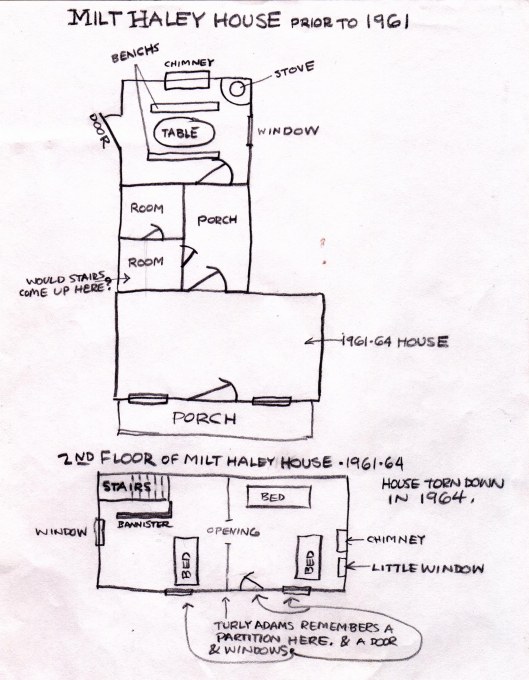
     After looking at more of Joe’s pictures, I asked Turley about the location of the old Milt Haley house. He said it used to sit at the site of his present-day home.

     “When I was a little boy I could remember it,” he said. “They was a big old log house front and they was a big long porch. And they had guest rooms. And then the kitchen was back there. Had a big chimney in it. And then they had that porch and everything back through there. Had that big kitchen in it and big fireplace. They could just put a big kettle in there and make a whole big kettle of stuff.”

     It resembled the old Stonewall Workman home, Turley said, although I had no idea what that meant.

     “The year I was six years old is when they remodeled that house — seven,” he said. “I remember after they took a part of it off the top, made it a story and a half.”

     I drew out a floor plan of “The Milt Haley House” based on Turley’s memories.

In Search of Ed Haley 82

26 Tuesday Mar 2013

Posted by Brandon Ray Kirk in Big Harts Creek, Ed Haley, John Hartford, Music, Spottswood

≈ Leave a comment

Tags

Appalachia, Clifton Mullins, Connie Mullins, Crawley Mountain, Ed Haley, Enslow Baisden, fiddle, Harts Creek, history, Joe Mullins, John Hartford, Lawrence Haley, Logan County, Loretta Mullins, Peter Mullins, Sol Bumgarner, Trace Fork, Turley Adams, West Virginia

I told Turley that Lawrence and I needed to visit Joe Mullins, who had been gone during our last trip to Harts Creek. Turley completely deflated us: Joe, he said, had recently suffered a stroke. He now lived with his daughter Connie Mullins in a trailer just up the creek. Turley pointed the way. Driving a short distance, Lawrence and I parked our car by the creek and walked over a little narrow bridge where an army of barking dogs greeted us. At the porch, Connie introduced us to her brother, Clifton. We stepped on inside and found Joe seated in a wheelchair, surrounded by more dogs. His mind — or at least his ability to communicate a great deal — was all but gone due to the lingering effects of his stroke. Lawrence sat next to him with his hand on his arm. Almost in tears over Joe’s condition, he tried to rekindle Joe’s memories by saying, “I’m Ed Haley’s boy.”

I hung out with Joe’s kids — Connie, Clifton and Loretta. While all were reasonably young, Clifton and Connie had Parkinson’s Disease.

“They’s four of us got it,” Clifton said. “They said it runs through the family some way another. Musta come down the tree somewhere.”

I asked him how old he was.

“38,” he said.

Clifton had just moved back to Harts.

“I got hurt in Michigan and Daddy was sick so I said, ‘Well, it’s a good chance for me to go help my daddy and my sisters.'”

Clifton’s sisters said he was the one who found Ed’s smashed fiddle years ago in the rafters of Uncle Peter’s old smokehouse.

“I was up in there — we was playing around one day — and it fell out on me,” he said. “And I just looked at it and I said, ‘Well, I’ll try to glue it together.’ I started gluing it and it wouldn’t glue so I dumped it into the creek. I didn’t know whose it was. I was about eight but all the pieces wasn’t there to it. When it hit that guy it just splintered everywhere.”

Clifton suggested that we visit Bum and his family just up the hollow. Two years earlier, Bum had told originally Lawrence and I how he had witnessed Ed smash the fiddle over a man’s head while at a tavern on Crawley Mountain. Bum lived only a short distance from Joe’s trailer, up the hollow past Uncle Peter’s old homeplace, in a house situated near Enslow Baisden’s log cabin.

In Search of Ed Haley 81

20 Wednesday Mar 2013

Posted by Brandon Ray Kirk in Big Harts Creek, Cemeteries, Ed Haley, John Hartford, Music, Spottswood

≈ 1 Comment

Tags

accordion, Bernie Adams, blind, Clifford Belcher, Ed Belcher, Ed Haley, Ewell Mullins, fiddle, guitar, harmonica, history, Hoover Fork, Inez, John Adams, John Hartford, Johnny Adams, Johnny Hager, Kentucky, Liza Mullins, Milt Haley, music, Peter Mullins, Robert Martin, Turley Adams, Violet Adams, West Fork

Satisfied with our stop on West Fork, Lawrence and I said our farewells to the Kirks and went to see Turley and Violet Adams on Trace Fork. After some small talk about new developments, Turley told us about his uncle Johnny Hager and father Johnny C. Adams traveling with Ed in the early days. He said Uncle Johnny was the one who got Haley to take his music on the road, while his father just traveled around with them.

“They left here playing music together,” Turley said. “My father just helped them take care of their musical instruments — carried it around and stuff — but they done the music. He would sing with somebody but he never did sing by hisself. And Ed Belcher, I think, played with them then. He could play anything but played a guitar mostly.”

So where all did they travel to?

“They played up at Logan on the radio at one time,” Turley said. “They had a program on up there, Ed Belcher did. Oh man, that’s been back in the thirties. Maybe ’36, ’35. I was just a little bitty boy. I just heard these tales — I don’t know them for sure.”

I asked about Johnny Hager.

“I was just a great old big boy the last time I seen Johnny Hager,” Turley said. “He came to our house, stayed around a little while and left. He was kindly a small fella. My dad was, too. Ed would make two of ary one of them. He was a great big feller, Ed was. Now Ewell Mullins, they was all buddies. Now Johnny Hager and Ed could play music. I heard an old guy on television one day talking about how him and Ed used to play in front of a church somewhere together. Yeah, he called him ‘Blind Fiddling Ed Haley.’ Said he’s just a real good friend to him. But he lives in Inez, Kentucky, that feller does.”

I said, “Well, isn’t Inez where Milt is supposed to be from?”

Turley said, “Milt, now my dad just could remember him. He said he was a hard-working fellow and when he’d come in home he’d just tell them boys, ‘Right now, we got to have a fight and get everything settled and we’ll be all right.’ They liked to fight. I guess that was Ed and he had how many more — two more?”

I said, “You mean Ed had brothers?” and Turley said, “I think he did. I believe my dad said he had a brother and one of them got in a fight one time and he bit Milt’s ear off right in the yard right down there. Now, they was Milt’s boys. I guess Ed is Milt’s boy, ain’t he?”

Lawrence said he’d never heard of his father ever having any brothers or sisters, but it sure was a strange coincidence that we heard a story about “Milt’s ear” right after hearing Bob Adkins’ account of Green and “the nick.” Maybe Milt had the nick — which would’ve reversed their roles in Bob’s story of their final days.

So Ed had brothers?

“Far as I know, they was two or three more of them from the tales they told, you know,” Turley said. “Uncle Peter and Aunt Liza used to tell it. Said every time they come home — Milt and them boys — said he’d just fight with all of them at one time. Have a good time. Say, ‘Now we’re friends.’ Back then, that’s what they believed in.”

This was a major development.

“I just heard these tales,” Turley said. “I don’t know how true they are. About Milt coming home and say, ‘Now, we’ll straighten ‘er out right now and we won’t have no more problems while I’m here.’ That’s the way he run his family, you know. That old woman said, ‘I’ll agree to that. That’s the way it ought to be done.’ I don’t guess she could do anything with them boys.”

Hoping for clues about Ed’s “brothers,” I asked if any of the old gravestones in the cemetery behind Turley’s had any writing on them. Unfortunately, Violet said all the markers had rolled down the hill in recent years and the land had leveled out to where it didn’t even resemble a cemetery. All she knew about the cemetery was that there was a “big grave” in it at one time that belonged to a woman with the last name of Priest (she was the only person buried there who her mother-in-law had actually known).

Turley said he last heard Ed play the fiddle at Clifford Belcher’s tavern on Harts Creek where he played for money and drinks. Violet remembered him playing music all night at her father’s home on Hoover Fork with Robert Martin (her great-uncle) and Bernie Adams. She described Bernie as a “real skinny” bachelor who sang “a little bit but not much” and who “was a real good guitar player, but he never would hardly play.”

“He’d get to drinking and he’d play but if he wasn’t drinking he wouldn’t play,” she said.

Turley said Bernie could also play the banjo, harmonica, fiddle and accordion.

In Search of Ed Haley 28

13 Thursday Dec 2012

Posted by Brandon Ray Kirk in Ed Haley

≈ Leave a comment

Tags

Appalachia, blind, Cecil Brumfield, Chloe Mullins, Cleveland, Clyde Haley, Ed Haley, fiddler, Harts Creek, history, Jack Haley, John Hartford, Lawrence Haley, Liza Mullins, Logan County, Mona Haley, music, Noah Haley, Ohio, Peter Mullins, Ralph Haley, Roxie Mullins, Turley Adams, U.S. South, West Virginia, writing

Roxie seemed very interested in Ed Haley’s kids, saying, “I know now they was Mona and Clyde and Ralph and Jack.”

Lawrence said he was the “baby boy” and Roxie realized for the first time that he was Ed’s son…not me. She got real tickled and said, “I believe you was about four or five years old when you was at my house.”

He told her, “May have been, ’cause I came up here until I was about nine years old. Just about every summer, it seemed like, we come up here.”

Roxie wanted to know about the others.

Lawrence said, “Clyde is still living. He lives in California. When he quit running the country, he settled down in California.”

As for the other boys: “Jack worked as a millwright at a steel mill in Cleveland.  Noah’s in Cleveland, too. They both went up there after they come out of the service. Had a depressed time just after the war. Jack worked for a while here but that little factory closed up so about a year and a half later he went to Cleveland and got on at a steel mill up there as an electrician and worked his way up as a millwright. They say he went into work that day and he punched his card, then he had to walk to his workplace — which was a pretty good ways away — and he hadn’t even got out of the time-clock building, and he just fell over dead. Massive coronary or something.”

Roxie thought Ralph had hung himself, but Lawrence said, “No, he was out picnicking and was kinda grandstanding. You know he could take a run-a-go and do a flip-flop and land on his feet — that kind of stuff. Well, somebody was gonna take a picture of him, and he got up on this tree limb and hooked his toes over it and he was hanging straight down from his toes and he was gonna let go and flip over and land on his feet before he hit the ground. But he didn’t make it: he hit the back of his head and broke his neck. He thought he was still a young man, you know.”

Roxie’s memories of Ed went pretty far back into his life — even before his marriage. She tried to describe him for me.

“He dressed nice. Man, Ed was as clean as a pin — wore nice, clean clothes. To be a blind man, he kept hisself just as clean as a pin. I never did see him dirty. Kept his hair combed pretty and neat. Ed’s eyes looked awful bad — he wore glasses over them. We never did talk much with him. He was kindly strange to us. You see, us girls was kindly shy. We weren’t used to him. He always had a big bunch of men around him. We just listened. He wasn’t no crazy fellow, I wanna tell you that. He was smart in the Bible. He told us all about the wars, Armageddon and stuff, and about these bombs.”

I asked Roxie if she remembered the first time she saw Haley play the fiddle. She said, “Oh, I don’t know. I guess I was about eighteen years old when Ed and Uncle John played at our house. Then they left here and went off, you know, to stay awhile. They’d come back every now and then. Uncle John played a banjo and Ed played the fiddle. Boy, they could really play.”

I asked if Ed sang back then.

“Yeah, he sung,” she said. “Now, he asked Cecil… He said, ‘Cecil, I’d like to ask you something, but I don’t want you to get mad.’ He said, ‘I would like to know if you know the song about John Brumfield?’ And Cecil said, ‘Yes. I’d like to hear you.’ And Ed said, ‘All right.’ Ed played it for him. And Cecil’s daddy was the one they killed, but Cecil liked Ed. He knowed they’s just all drunk, you know, just like people now a getting dope and a killing each other.”

Roxie’s mind rolled back through the years, leaving Lawrence and I to just sit there listening to her stories. Each passing moment sent chills up the back of my neck. It was apparent that she’d known Ed very well.

“He stayed with us a whole lot, Ed did. Off and on, he stayed with Grandma and Uncle Peter and them. Grandma lived down there where Turley lives now. And they had a sheep in that field, you know? Ed kept going from Grandma’s house up to Uncle Peter’s and Aunt Liza’s house. They told him, they said, ‘Ed, that ram’s a going to kill you.’ He said, ‘No.’ He said, ‘I’ll take care of that ram.’ One day he started up through there and that ram went to bellering, you know, and run at him and butted him and he catched him by the head and slung him. He said, ‘If you don’t stay away from there, I’ll get my knife out and cut your head off.'”

Roxie laughed remembering the stories.

“Lord, he told all kinds of tales on hisself,” she said. “You woulda laughed till you woulda died if you’d heard him telling tales on hisself. He told about being at Uncle Peter’s and they was having a dance up at Jeff Baisden’s and he said he took a notion to go along in the night. He’d slept till about 9 or 10 o’clock in the night. Uncle Peter had a garden and a barn and had a lot of cattle laying out around that barn. And he went out there, he said, to that barn and aimed to climb up over a big high fence and jump out when he jumped out right astraddle of a steer. And said that thing jumped up and him on it backwards and took up that holler a flying, and said he hung right on to him till he got to the waterfall and said when he got to the waterfall, he fell off. Said he was drowning when he went on up there, and said they said, ‘Ed, what are you doing so wet?’ He said he said, ‘Well,’ said he’s riding and got in the water and couldn’t see it. He would’t tell them about the steer.”

Roxie implied that Ed took any mishaps or practical jokes in stride.

“Lord, he told all kind of tales on hisself, honey. They cut trees and put him in logs and would start him at the top of the hill and roll him into the bottom and bump to bump to bump to bump, you know, and man just skinned him all over. They played all kinds of tricks on him. Why, he’d just laughed till he died about it. He didn’t care.”

In Search of Ed Haley 25

10 Monday Dec 2012

Posted by Brandon Ray Kirk in Big Harts Creek, Ed Haley, Music, Spottswood

≈ Leave a comment

Tags

Appalachia, Ashland, blind, Cleveland, Ed Haley, Ella Haley, Enslow Baisden, fiddler, fiddlers, fiddling, Harts Creek, Hell Up Coal Hollow, history, Huntington, Jack Haley, Jeff Baisden, John Hartford, John Martin, Kentucky, Las Vegas, Lawrence Haley, Liza Mullins, Logan County, Milt Haley, music, Nevada, Noah Mullins, Ohio, Oklahoma, Peter Mullins, Robert Martin, Sherman Baisden, Sol Bumgarner, Trace Fork, Turley Adams, U.S. South, West Virginia, writing

After visiting with Turley and Joe’s girls, Bum guided Lawrence and I up a nearby hollow to see his uncle Enslow Baisden. Enslow lived in a newly built single story log cabin. He said he’d gone blind recently due to sugar and cataracts. At Enslow’s, we met “Shermie”, who Lawrence indicated was the “funny boy” that chased the Haley women off of Aunt Liza’s porch in 1951.

“A lot of times I wouldn’t have no company if it wasn’t for him,” Enslow said of Shermie, who was epileptic. Shermie wasted little time in pulling out a few cards from the pocket of his overalls and sputtering toward me, even reaching for my fiddle case. I knew right then I was surrounded by “good people”: they had kept Shermie under their care all of these years as a valued member of the family in lieu of institutionalization.

When I mentioned Ed Haley’s name, Enslow said, “I was young but I can remember him all the time a coming. They was some Martins lived on top of a mountain out here — Robert Martin and John — and they fiddled all the time, and he’d go out there and fiddle with them. I don’t know how he walked from up this creek and out on that mountain and him blind, for I can’t find my way through the house.”

Enslow said he didn’t know much about Ed because he left Harts during the early years of the Depression.

“See, I lost all time, about everything nearly. I left here in ’35 and went up to the northern part of the state here and then went out in Las Vegas, Nevada, a while. Then, when I come out, I went in the Army in April of ’41. I stayed in there four and a half years and got married out in Oklahoma and we never did come back but just on visits. And Ed, he died in ’51.”

Enslow’s recounting of his travels was sort of an interesting revelation since it reminded me that these folks on Harts Creek — like many mountain people — were not as isolated as some may think. Ed Haley himself left the creek and traveled widely with his music just after the turn of the century, while Lawrence and his siblings had lived in Ashland and Cleveland and served overseas in the armed forces. Several of the people I had met on Harts Creek had been to faraway places and lived in big cities but chose at some point to return to the grounds of their ancestors.

I asked Enslow how old he was the first time he saw Haley and he said, “Oh man I was about nine or ten years old. He all the time played that fiddle. He used to come down here to old man Peter Mullins’ and Liza Mullins’. I guess they was real close kin to him. And Ed’s daddy’s name was Milt Haley. I don’t know whether Lawrence knowed that or not.”

Lawrence said, “Yeah, I knew that. But I understood from the way Aunt Liza told me, he came from over the mountain and I think that she was talking about from up around Williamson or over in that area. My dad, he was born right down here below Uncle Peter’s, where Turley’s at now, in the old house.”

Lawrence’s mentioning of “the old house” really got Enslow going. He remembered it well.

“There used to be an old log house there he was born in and they had a chimney outside on that old house down there — just an old rock chimney. Dad all the time talked about it. He said Ed got him one of them little old homemade sleds, you know, and he got him a ladder and put it on top of that house. And he got right up by that chimney and then when he come off’n there on that sled he knocked the rocks off with him.”

What? Why would he have done such a thing?

“I’ve always heard my dad tell it,” Enslow said. “Said that rock just barely did miss him.”

I wasn’t sure what to make of such a story but before I could really ask anything about it Enslow was off on another tale.

“Dad said one time they sent Ed down there to get some milk or butter or something. When Ed got out there on his way back he got in a briar patch. Dad took a notion to have some fun out of Ed. They had an old horse they called Fred. Dad got to stomping and snickering like that old horse and Ed said, ‘Old Fred, don’t you come here, now. Don’t you come here, Fred.’ Dad said he kept stomping and Ed throwed that stuff at him and tore hisself all to pieces in them briars.”

I asked Enslow to describe Haley and he said, “Well, he just always dressed pretty nice. He was a big man, too. They used to buy him these plugs of tobacco and these guys would get this beech bark and whittle it out about the size of a plug of tobacco and let Ed have that bark and they’d take his tobacco. If he ever got a hold of you, though, he’d eat you up, see. They said you couldn’t get loose from him.”

Apparently, Ed and his wife were so self-sufficient that locals sometimes forgot they were blind. Enslow told a great story about Ella and Aunt Liza, who were sitting by a lamp together one night. “Well, Mrs. Haley, I’m going to bed,” Liza said. “Well, just blow out the light,” Ella answered. “I’m going to read a while.” Liza said, “How’re you going to read in the dark?” Ella said, “Well, I can’t see no way.”

Enslow’s mentioning of Aunt Liza conjured up a great memory from Lawrence.

“Uncle Peter liked to wore me to death one time. Me and my brother Jack went with him up there behind his house and he had a old team of oxen we was snaking logs out of a hollow with. These oxen got hot. One of them got in the creek trying to cool off. Well, Uncle Peter couldn’t get him to move, so he went over underneath a tree and sat down. Well, me and my brother Jack was a cutting up, you know. He was teasing me. I was younger than he was. And I picked up a big rock and throwed it at him and hit Uncle Peter right where it hurts. And he got up. I knowed I could outrun him. My brother — I looked at him — he took off. And I was afraid to move. Uncle Peter come up there. I thought, ‘Well, I’m dead meat.’ It looked like he pulled down a half a tree and got a hold of me and he didn’t let go until he wore that limb out.”

I asked Enslow about Ed Haley’s music.

“I used to hear him play all them old tunes,” he said. “He’d sit and play for hours and hours at a time, him and her.”

Enslow motioned toward Lawrence, saying, “His mother played a mandolin and had a thing on that sat on her shoulders there and had a harp and played them both at the same time.”

He leaned back a little, reflecting, “Yeah, he played all the old music. He’d make up songs. Be sitting around and just directly he’d write a song. Like ‘Hell Up Coal Hollow’ and two or three more he made up that way. You’d come up and say, ‘What was that Ed?’ He’d just tell them what it was.”

Enslow and Bum said Haley made “Hell Up Coal Holler” and named it for Cole Branch, a tributary of Harts Creek. I didn’t know if Ed was the source of that story but I later learned that “Hell Up Coal Hollow” (at least the title) actually predated Haley’s lifetime. As I was gradually learning, Ed wasn’t preoccupied with historical accuracy and was good at creating temporary titles and weaving stories based on coincidence.

Enslow said, “Ed had some kind of saying he always said when he played on the radio down there about ‘carbide acid and acifidity gum’ or something.”

Lawrence said he’d never heard anything about his father playing on the radio but Enslow seemed sure of it.

“He played on the radio down there at Ashland or Huntington or somewheres way back there. I’m pretty sure they said he did.”

I wondered what acifidity gum was and no one knew, although Lawrence had heard Ed talk about it. (We later learned it was an old folk remedy for treating asthma.) Enslow said Uncle Peter asked Ed about it one time and he said, “Well, you have to get a little comedy with the music.”

Wow — so Ed told jokes?

Enslow said, “I guess to draw their attention or something.”

I asked Enslow if he’d ever heard Ed play for a dance and he said, “Well, I used to go to lots of things he played for, but I can’t remember now. They’d go out there on that mountain and play all night at Robert and John Martin’s. They’d be maybe two hundred people out there. Robert Martin all the time played the fiddle and I don’t know whether John played or not.”

Enslow thought Ed and Robert played their fiddles “together,” but Bum added, “Bob played a little different than Ed did. He played newer stuff.”

Enslow thought for a moment, then said, “Yeah, my dad, he used to play the banjo all the time, him and his nephew. They used to play for dances way back years ago.”

What was his name?

“Jeff Baisden.”

Bum said, “I was telling him about Grandpaw taking them two little sticks and beating on the fiddle for Ed.”

Someone said, “He’s the one had the big old feet and he’d get up and dance and play the banjo.”

Enslow said, “They called him ‘Jig-Toe’ Baisden. He wore a twelve or thirteen shoe and he’d get up on his toes and dance. And Noah Mullins, Uncle Peter’s son, he could flat dance. He’d get on his heels and dance all over. He called their square dance about all the time.”

In Search of Ed Haley 24

09 Sunday Dec 2012

Posted by Brandon Ray Kirk in Big Harts Creek, Ed Haley, Spottswood

≈ Leave a comment

Tags

Appalachia, Ashland, Ashland Cemetery, Buck Fork, Clifford Belcher, Connie Woods, Dingess, Ed Belcher, Ed Haley, Ella Haley, fiddle, fiddler, fiddling, genealogy, George Greasy Adams, guitar, Harts Creek, history, Hoover Fork, Jackson Mullins, Jeff Baisden, John Frock Adams, John Hartford, Johnny Hager, Kentucky, Lawrence Haley, Liza Mullins, Logan, Logan County, Maynard's Store, music, Nashville, Peach Creek, Peter Mullins, Ralph Haley, Sol Bumgarner, square dances, Trace Fork, Turley Adams, Violet Mullins, Weddie Mullins, West Virginia

At some point, Connie showed up with a small entourage of women toting some of Joe Mullins’ old pictures. My eyes immediately went to a large, framed photograph of two serious mustachioed men. Turley said one was Weddie Mullins — his grandfather on “both sides” of the family tree — while the other was Ed Haley’s Uncle Peter Mullins. Both men were brothers. Turley said his grandfather Weddie — Ed’s uncle — was murdered at the little town of Dingess just after the turn of the century.

Lawrence said, “Mom and Pop used to play at Dingess — just a little community over in MingoCounty.”

That got us back on the subject of Ed, although most of the commentary was choppy and mixed between looking at photographs. One of the girls said, “We’ve heard talk of Ed all our lives.” Another made the unusual remark, “He could see lightning. Some way he could feel it or something and tell it was hitting.” Someone said Ella could tell the difference between the Haley children by their smell.

Turley, who had been fairly quiet throughout our visit, said to Lawrence, “Bernie Adams used to play a lot of music with your dad.”

Violet said, “Bernie’s the one took him in the chicken house for the toilet. They stayed all night up at our house. Robert Martin and Bernie and Ed and them played music all night. I can remember it. I was just a little girl. Mother said Ed played many a time where she was raised up over in the head of Francis Creek.”

Lawrence said, “You know, these different places like Hoover and places like that don’t ring a bell to me. I can remember going down here to the end of Trace, and maybe down to Smoke House, and up to George Adams’ who lived on up this way, and up to that store — Maynard’s Store — and buying candy, but that’s about the limit of my travel, except coming up from the mouth of Harts.”

Basically, the next half-hour or so was a giant “get to know everybody session” — mostly between Lawrence and the locals. I sort of hung back a little, taking it all in, while Lawrence spoke of and listened to stories about his father. There was a glow about his face that had been absent in Ashland.

At one juncture, he told Connie how her grandparents, Peter and Liza Mullins, raised his father.

“Oh, really?” she said. “I didn’t know that. Now I remember Granny. They wanted me to stay all night with her and I was always afraid she’d die in her sleep or something. That’s terrible.”

She asked Lawrence if he remembered Uncle Jeff — “he was Granny’s brother and he was kinda slow.”

Violet said, “He liked to go to all these dinner meetings they’d have out in the country. He’d walk for miles and miles.”

Connie asked Lawrence if Ed ever played at Logan — the seat of government for Logan County — and he said, “Yeah, he used to play around Logan quite a bit and Peach Creek. He’d play up there during court days especially. Back in them days, the town would load up. I’ve been there with him during those times. The old courthouse, I think it faced toward the river. One side of it was on Stratton Street.”

Connie asked where Ed was buried and Lawrence said, “He’s buried in the Ashland Cemetery in Ashland. Mom’s buried in the same cemetery but not with him. By the time my mother died — she died three years after Pop — they’d filled that section up.”

I’d never really thought about that. Ed and his wife were not buried together, the kind of seemingly minor detail tossed out randomly that took on somewhat of a greater meaning at a later date. I made a note to myself right then that I would visit Ed’s grave in Ashland before heading back to Nashville.

Violet wondered about Lawrence’s older brother, Clyde.

“Clyde’s out in Stockton, California,” he said. “He’s what I call the black sheep of the family. Never married. He just followed the sun for work. When it was summertime, he’d go north; when it was wintertime, he’d go south.”

Just then, an old man called Bum showed up at Turley’s. Bum remembered Ed and his family well. He asked Lawrence about the Haleys. It was hard to focus on their conversation — everyone in the room seemed to be talking at once — but I heard Bum mention something about how Lawrence’s brother Ralph used to hang from tree limbs by his “sticky toes” and would “do anything.”

“That’s exactly how he got killed,” Lawrence said. “He was hanging by his toes and he was gonna let go with his toes and flip over and land on his feet but he didn’t make it. He was just active like that. See, Ralph danced around these carnivals and fairs and places.”

A few minutes later, things quieted down a little. I moved over near Bum to ask him about Haley. His answers seemed to come through his nose more than his mouth and were usually followed by a little chuckle. He was great. Bum said he was 67 years old and first saw “Uncle Ed” in the thirties.

“He lived down in Ashland and he’d come up pretty often,” Bum said. “People come from everywhere to listen at him play whenever they’d have them big dances and stuff. He’d play half the night. Yeah, I’ve been right there.”

I asked Bum about Ed’s tunes and he said, “Ah, he played so many… There was one religious tune he’d put the bow under the fiddle, and the hair, he’d turn it right over and slip his fiddle between it, and play that. I forgot what it was.”

Bum told me all about the old dances.

“They used to have a big working,” he said. “About every family on this creek and Harts Creek down here, they’d all gather up and hoe one man’s field out and then move to the next one. And they’d all go to each other’s farms that way and help each other, and when they got done one man would have a big dance. They’d have a dance on Saturday night. They’d have them at just about every home, mostly at Uncle Peter’s up here, in the house. Like one room in there, they’d gather everything up and take it outside and they’d have a dance in there, and when they got through they’d put the furniture all back in. Anybody that wanted to come was invited. They’d have food right in the house. There were usually three or four around to call the reel: ‘Dosy doe and here she comes and there she goes.'”

“It’d just be Uncle Ed and John Hager playing?” I asked.

“Well, Ed mostly,” Bum said. “Uncle Johnny, he played some with him. Uncle Ed, he played by himself most all of these dances. Mrs. Haley played with him a lot. She played the mandolin, guitar or accordion.”

“Did Johnny Hager play the banjo about like Grandpa Jones?” Turley asked Bum.

“Yeah, over-handed they call it,” Bum said. “Molly O’Day, she played that way. My grandpaw would whittle out two little sticks and he’d sit and beat on them strings and Ed a playing the fiddle.”

“Ed played with Ed Belcher,” Turley said.

“Yeah, I’ve heard Pop talk about Ed Belcher,” Lawrence said.

Now who was Ed Belcher?

“He played the guitar,” Bum said. “He could play the piano, too. They’d get together at times and play together. They’d go up Buck Fork.”

Bum said he last saw Ed Haley “over here on that mountain yonder” at Clifford Belcher’s beer joint.

“He’d go down there and play and people’d give him beer and stuff. That’s about all he wanted. I run into him over there one night. I said, ‘Uncle Ed, where you been?’ He said, ‘I ain’t been no where but right here. I come up here to sit around and play music a while.’ I bought him a beer and he sat there and played music. Well, a Conley boy run in and went to playing and thought he was better than Ed and everything. Ed finally told that boy, said, ‘Why don’t you quit playing that music? You can’t play. You’re cutting my music up too much.’ That boy come back at him, you know, and aimed to fight him. He said, ‘Shut up, old man. You don’t know what you’re a talking about.’ I was standing there and I told him, I said, ‘Now listen. If you jump on that man, you’ll have me to fight and him both.’ And Ed took his fiddle and hit that feller right down over the head with it and busted that fiddle all to pieces.”

Lawrence laughed.

Turley said Ed Haley was high-tempered, as well as strong, and hinted at his mean streak.

“Dad said Peter had a dog that Ed couldn’t get along with at all. Ed told Uncle Johnny, ‘You get me close to him and I’ll hit him in the mouth. I’ll knock him out.’ And he said Ed hit that dog and killed him with his fist. Hit him in the ear and killed him. That’s what my daddy told.”

Bum was very familiar with Ed Haley’s family on Trace. He said Uncle Peter Mullins was “pretty bad to get out and get drunk and get into it with people.” He knew all about Ed’s uncle Weddie Mullins’ murder at an election in Dingess. “There used to be a train come in there and they’d bring flour and stuff over there and people’d go over there to Dingess and get it,” he said. “They’d take wagons and go through these hills, like up Henderson and all them places and they got into it over there.” Bum wasn’t sure who shot Weddie but knew that his killer survived the fracas. Once the news reached Harts Creek, John Adams got a pistol from Jackson Mullins and rode to Dingess where he found Weddie’s killer laid up in a bed clinging to life. Someone told him the guy probably wouldn’t make it so (like something out of a Hollywood Western) he pulled out a .38 pistol and said, “I know he won’t,” and shot him in cold blood.

I wasn’t exactly sure who any of these people were — Jackson Mullins, John Adams — but I had the impression that they were some relation to Ed Haley. At that juncture, I just let the tape recorder roll and tried to take notes and absorb everything, figuring that what seemed like unimportant details would perhaps later develop into major items of interest.

In Search of Ed Haley 23

09 Sunday Dec 2012

Posted by Brandon Ray Kirk in Ed Haley, Spottswood

≈ Leave a comment

Tags

Adeline Adkins, Appalachia, blind, Buck Fork, Connie Woods, Ed Haley, George W. Adams, Harts Creek, history, Jack Mullins, Joe Mullins, John Hartford, Johnny Hager, Lawrence Haley, life, Logan County, Louie Mullins, Milt Haley, music, Peter Mullins, Roxie Mullins, Trace Fork, Turley Adams, U.S. South, Victoria Adams, Violet Adams, West Virginia, Yellow Leg Spaulding

Connie suggested we go see her neighbor Turley Adams, who lived just down the creek near the mouth of a branch. She pointed toward a man working in his yard a few hundred yards away at his one-story white home. That’s Turley? We took off right away. As we approached the place, Lawrence mentioned that Turley lived at the same approximate location of Milt Haley’s old cabin. While the cabin was long gone, I noticed the front yard still had the same beautiful roll to it I had seen in an old picture at Lawrence’s house. I tried to imagine how the cabin would have looked in Ed Haley’s day.

Turley met us near the porch, where Lawrence introduced us and told our reason for visiting him. Turley was immediately friendly and, in his gruff voice, invited us inside. At first, our conversation went pretty slow. Then Lawrence said, “I never did get much about my granddad, Milton Haley. Joe said he’s buried down here somewhere in a graveyard and I thought maybe he was talking about down at the mouth of Trace somewhere.”

Turley’s wife Violet said there was an old cemetery just back of their house, although it had been in terrible condition for many years.

“Well now, they was some graves out there. Turley’s mom told me that some of them were Mullinses and some of them were Haleys. They was some babies and then they was some older people. All unmarked. They was sort of in a row and they was rocks up to them but by the time I married Turley they’d rolled down the hill so you couldn’t tell where the graves really were.”

Oh god. I could just imagine someone finding a Milt Haley tombstone (probably no more than a rock with “MH” carved on it) lying at the foot of the hill and just tossing it in the creek.

“Well one grave we could tell pretty well where it was at, the others we couldn’t,” Violet said. “It had all growed up so we started cutting the bushes and keeping it mowed and cleaned up but we still don’t know where the graves are.”

We walked outside briefly to survey the site.

“They’s eleven graves,” Turley said. “I used to help Uncle Jack Mullins keep them cleaned up a little bit.”

Was this little embankment with a sunken spot the final resting place of Ed Haley’s parents?

Back inside, Turley said he remembered Ed, which seemed to please Lawrence somewhat. He told this story about a local girl who danced to Ed’s music.

“When I was in high school, Ed was around my house and he said, ‘I’d like to fiddle for somebody to dance.’ And I asked this girl, Adeline Adkins from around here on Buck Fork, if she could dance and she said, ‘I can dance to anything.’ She danced three or four tunes and my dad come in. Ed said, ‘By god, John, she’s just like Yellow Leg Spaulding. She can hit ever thing I do on this fiddle. And Dad said that they was a guy that used to go with them and dance that he called Yellow Leg Spaulding.”

“Well I didn’t know whether we’d even find anybody up here now, except Joe,” Lawrence said. “I thought I’d come up and see if I could find him, maybe introduce John to somebody that could give us some information on my dad. I know they couldn’t be very many people old enough to probably appreciate his music.”

“He come to my mom and dad’s house one time and played music all night,” Violet said. “Robert Martin was with him. I guess they’d been drinking or whatever because they was gonna take him out to the toilet and instead of taking him to the toilet they took him into the chicken house. They didn’t pay no attention to what they was doing. But they played all night. I never will forget.”

I had never really considered the possibility that Ed’s cousins and neighbors played jokes on him. I saw him as this great musician — an elevated status that may not have been shared by many of his contemporaries. All of a sudden, I was flooded with images of this little blind orphan — alone in the world — victimized mercilessly throughout his childhood. How did he take it? And how would Lawrence react to hearing these kind of stories? In quick time, I had this latter question answered. Lawrence immediately countered Violet’s story about the outhouse with a tale that cast his father in a more triumphant light.

“Joe said when Pop was just a little kid he got to the point to where he could travel from this house over to Uncle Peter’s,” Lawrence said. “Uncle Peter kept cattle in the field out here or something — a bull or two. Well, the boys teased him. You know, he’d get about half way across that field and then they’d go to snorting like a bull — scare him — and then stand way back and laugh at him. Pop took that for a while and finally found a pistol over here at the old house and he went across the field and they started doing that to him. Well, he just pulled that pistol and, where that sound was coming from, he started shooting that pistol. I guess that broke that little game up.”

Lawrence was obviously determined to guard his father’s legacy, which was a perfectly legitimate thing to do.

Violet got out a few albums filled with old photographs of Ed’s kinfolk from up and down the creek, which stirred Lawrence’s memories.

“Seemed to me like we walked down here to Trace to go up the hill there and there was a store down there,” he said.

Violet said, “Turley’s dad run a store around on Hart at one time and Ewell Mullins had a store up here.”

Lawrence remembered Ewell’s store. “Yeah, he had a store up here, I know that. And then they was one on up and over the hill there where you could go and buy a nickel’s worth of brown sugar. We’d get one of them little penny-paper pokes full of brown sugar and we thought we was having a big time.”

Lawrence’s mind was starting to click in high gear. “I heard Pop talk about how he’d ride a horse up the hollow going up through there,” he said.

Lawrence asked Turley if he knew anything about a George Adams. Turley said his grandfather was named George Washington Adams but he went by the nickname of “Ticky George” to distinguish him from a cousin, “Greasy George.” Ticky George spent most of his life in the woods hunting for ginseng where he apparently acquired a great number of ticks.

“He didn’t have good mind,” Violet said later. “He just knowed enough to get by.”

Turley said his grandmother Adams was a sister to Ed’s friend, Johnny Hager.

“Well, there’s how Johnny Hager came into this,” Lawrence said.

Turley didn’t know much about his genealogy but said his aunt Roxie Mullins could tell us the “whole history” of the Hagers.

“She lives around there above Louie on Harts Creek there,” he said.

Louie Mullins was a grandson to Uncle Peter, making him a third cousin to Lawrence (at least by our count).

This was sort of a confusing moment. Names of people I’d never heard of were popping into the conversation and converging upon one another in seemingly irrelevant connections.

It was great.

There was an unmatchable poetry in it: Turley, Yellow Leg Spaulding, Ticky George… I mean nobody could make this kind of stuff up.

Feud Poll 1

If you had lived in the Harts Creek community during the 1880s, to which faction of feudists might you have given your loyalty?

Categories

  • Adkins Mill
  • African American History
  • American Revolutionary War
  • Ashland
  • Atenville
  • Banco
  • Barboursville
  • Battle of Blair Mountain
  • Beech Creek
  • Big Creek
  • Big Harts Creek
  • Big Sandy Valley
  • Big Ugly Creek
  • Boone County
  • Breeden
  • Calhoun County
  • Cemeteries
  • Chapmanville
  • Civil War
  • Clay County
  • Clothier
  • Coal
  • Cove Gap
  • Crawley Creek
  • Culture of Honor
  • Dingess
  • Dollie
  • Dunlow
  • East Lynn
  • Ed Haley
  • Eden Park
  • Enslow
  • Estep
  • Ethel
  • Ferrellsburg
  • Fourteen
  • French-Eversole Feud
  • Gilbert
  • Giles County
  • Gill
  • Green Shoal
  • Guyandotte River
  • Halcyon
  • Hamlin
  • Harts
  • Hatfield-McCoy Feud
  • Holden
  • Hungarian-American History
  • Huntington
  • Inez
  • Irish-Americans
  • Italian American History
  • Jamboree
  • Jewish History
  • John Hartford
  • Kermit
  • Kiahsville
  • Kitchen
  • Leet
  • Lincoln County Feud
  • Little Harts Creek
  • Logan
  • Man
  • Matewan
  • Meador
  • Midkiff
  • Monroe County
  • Montgomery County
  • Music
  • Native American History
  • Peach Creek
  • Pearl Adkins Diary
  • Pecks Mill
  • Peter Creek
  • Pikeville
  • Pilgrim
  • Poetry
  • Queens Ridge
  • Ranger
  • Rector
  • Roane County
  • Rowan County Feud
  • Salt Rock
  • Sand Creek
  • Shively
  • Spears
  • Sports
  • Spottswood
  • Spurlockville
  • Stiltner
  • Stone Branch
  • Tazewell County
  • Timber
  • Tom Dula
  • Toney
  • Turner-Howard Feud
  • Twelve Pole Creek
  • Uncategorized
  • Warren
  • Wayne
  • West Hamlin
  • Wewanta
  • Wharncliffe
  • Whirlwind
  • Williamson
  • Women's History
  • World War I
  • Wyoming County
  • Yantus

Feud Poll 2

Do you think Milt Haley and Green McCoy committed the ambush on Al and Hollene Brumfield in 1889?

Blogroll

  • Ancestry.com
  • Ashland (KY) Daily Independent News Article
  • Author FB page
  • Beckley (WV) Register-Herald News Article
  • Big Sandy News (KY) News Article
  • Blood in West Virginia FB
  • Blood in West Virginia order
  • Chapters TV Program
  • Facebook
  • Ghosts of Guyan
  • Herald-Dispatch News Article 1
  • Herald-Dispatch News Article 2
  • In Search of Ed Haley
  • Instagram
  • Lincoln (WV) Journal News Article
  • Lincoln (WV) Journal Thumbs Up
  • Lincoln County
  • Lincoln County Feud
  • Lincoln County Feud Lecture
  • LinkedIn
  • Logan (WV) Banner News Article
  • Lunch With Books
  • Our Overmountain Men: The Revolutionary War in Western Virginia (1775-1783)
  • Pinterest
  • Scarborough Society's Art and Lecture Series
  • Smithsonian Article
  • Spirit of Jefferson News Article
  • The Friendly Neighbor Radio Show 1
  • The Friendly Neighbor Radio Show 2
  • The Friendly Neighbor Radio Show 3
  • The Friendly Neighbor Radio Show 4
  • The New Yorker
  • The State Journal's 55 Good Things About WV
  • tumblr.
  • Twitter
  • Website
  • Weirton (WV) Daily Times Article
  • Wheeling (WV) Intelligencer News Article 1
  • Wheeling (WV) Intelligencer News Article 2
  • WOWK TV
  • Writers Can Read Open Mic Night

Feud Poll 3

Who do you think organized the ambush of Al and Hollene Brumfield in 1889?

Recent Posts

  • Logan County Jail in Logan, WV
  • Absentee Landowners of Magnolia District (1890, 1892, 1894)
  • Charles Spurlock Survey at Fourteen Mile Creek, Lincoln County, WV (1815)

Ed Haley Poll 1

What do you think caused Ed Haley to lose his sight when he was three years old?

Top Posts & Pages

  • About
  • Perry A. Cline Deed to Anderson Hatfield (1877)
  • Civil War Hanging in Logan County, WV (1937)
  • Ran'l McCoy's Final Months (1914)
  • Hatfield-McCoy Feud Prisoners (1889-1890)

Copyright

© Brandon Ray Kirk and brandonraykirk.wordpress.com, 1987-2023. Unauthorized use and/or duplication of this material without express and written permission from this blog’s author and/or owner is strictly prohibited. Excerpts and links may be used, provided that full and clear credit is given to Brandon Ray Kirk and brandonraykirk.wordpress.com with appropriate and specific direction to the original content.

Archives

  • February 2025
  • January 2025
  • October 2023
  • September 2023
  • December 2022
  • November 2022
  • May 2022
  • April 2022
  • February 2022
  • November 2021
  • October 2021
  • September 2021
  • June 2021
  • May 2021
  • April 2021
  • March 2021
  • February 2021
  • January 2021
  • December 2020
  • November 2020
  • October 2020
  • July 2020
  • June 2020
  • May 2020
  • April 2020
  • March 2020
  • February 2020
  • January 2020
  • December 2019
  • November 2019
  • October 2019
  • September 2019
  • August 2019
  • July 2019
  • June 2019
  • May 2019
  • April 2019
  • March 2019
  • February 2019
  • January 2019
  • December 2018
  • November 2018
  • October 2018
  • September 2018
  • August 2018
  • July 2018
  • June 2018
  • May 2018
  • April 2018
  • March 2018
  • February 2018
  • January 2018
  • December 2017
  • November 2017
  • October 2017
  • September 2017
  • August 2017
  • July 2017
  • June 2017
  • May 2017
  • April 2017
  • March 2017
  • February 2017
  • January 2017
  • December 2016
  • November 2016
  • October 2016
  • September 2016
  • August 2016
  • July 2016
  • June 2016
  • May 2016
  • April 2016
  • March 2016
  • February 2016
  • January 2016
  • December 2015
  • November 2015
  • October 2015
  • September 2015
  • August 2015
  • July 2015
  • June 2015
  • May 2015
  • April 2015
  • March 2015
  • February 2015
  • January 2015
  • December 2014
  • October 2014
  • September 2014
  • August 2014
  • July 2014
  • June 2014
  • May 2014
  • April 2014
  • March 2014
  • February 2014
  • January 2014
  • December 2013
  • November 2013
  • October 2013
  • September 2013
  • August 2013
  • July 2013
  • June 2013
  • May 2013
  • April 2013
  • March 2013
  • February 2013
  • January 2013
  • December 2012
  • November 2012

Enter your email address to follow this blog and receive notifications of new posts by email.

Join 2,925 other subscribers

Tags

Appalachia Ashland Big Creek Big Ugly Creek Blood in West Virginia Brandon Kirk Cabell County cemeteries Chapmanville Charleston civil war coal Confederate Army crime culture Ed Haley Ella Haley Ferrellsburg feud fiddler fiddling genealogy Green McCoy Guyandotte River Harts Harts Creek Hatfield-McCoy Feud history Huntington John Hartford Kentucky Lawrence Haley life Lincoln County Lincoln County Feud Logan Logan Banner Logan County Milt Haley Mingo County music Ohio photos timbering U.S. South Virginia Wayne County West Virginia Whirlwind writing

Blogs I Follow

  • OtterTales
  • Our Appalachia: A Blog Created by Students of Brandon Kirk
  • Piedmont Trails
  • Truman Capote
  • Appalachian Diaspora

BLOOD IN WEST VIRGINIA is now available for order at Amazon!

Blog at WordPress.com.

OtterTales

Writings from my travels and experiences. High and fine literature is wine, and mine is only water; but everybody likes water. Mark Twain

Our Appalachia: A Blog Created by Students of Brandon Kirk

This site is dedicated to the collection, preservation, and promotion of history and culture in Appalachia.

Piedmont Trails

Genealogy and History in North Carolina and Beyond

Truman Capote

A site about one of the most beautiful, interesting, tallented, outrageous and colorful personalities of the 20th Century

Appalachian Diaspora

  • Subscribe Subscribed
    • Brandon Ray Kirk
    • Join 787 other subscribers
    • Already have a WordPress.com account? Log in now.
    • Brandon Ray Kirk
    • Subscribe Subscribed
    • Sign up
    • Log in
    • Report this content
    • View site in Reader
    • Manage subscriptions
    • Collapse this bar
 

Loading Comments...