• About

Brandon Ray Kirk

~ This site is dedicated to the collection, preservation, and promotion of history and culture in my section of Appalachia.

Brandon Ray Kirk

Tag Archives: timbering

In Search of Ed Haley 187

28 Monday Oct 2013

Posted by Brandon Ray Kirk in Ed Haley

≈ Leave a comment

Tags

Al Brumfield, Ben Adams, Charley Brumfield, feud, Green McCoy, Harts, Hollene Brumfield, Jane Thompson, John W Runyon, Mae Brumfield, Milt Haley, timbering, writing

After a brief rest at Mr. Kirk’s, Brandon and I drove to see Mae Brumfield at her little yellow house just up the creek from the bridge at Harts. Mae was one of Brandon’s special friends, a woman of advanced years and closely connected to the Brumfield family. As a girl, she was a close friend to Charley Brumfield’s daughters. Later, she married Tom Brumfield, one of Al’s grandsons, and settled near his widow — “Granny Hollene” — at the mouth of Harts Creek. Just back of her house was the former site of the old Brumfield log boom, as well as the spot where Paris Brumfield killed Boney Lucas.

Mae welcomed us inside as soon as she saw Brandon. She was very thin and frail — a wisp of a woman — but she seemed to be very independent and self-sufficient. Her house was tidy and there were several crafty-type dolls in sight as evidence of her fondness for crocheting and knitting. Almost right away, Brandon asked her about Hollena Brumfield — the woman supposedly shot by Milt Haley.

“Granny Hollene?” Mae said. “Why, I’ve combed that old gray head many a time. I loved her better than anything. She wasn’t afraid of nothing. She’d cuss you all to pieces if you done something to her but she was a good person. Everybody was welcome at her table. She didn’t turn nobody away. You know that hole was in her face where those men shot her. It never was worked on. They didn’t have plastic surgery like they do now. And after all that, a sawmill blew up and broke her leg. That was why she was crippled. And she still run everything on.”

Mae told us what she knew about Al Brumfield.

“I’ve heard Grandpa talk about him. Grandpa liked him. Al Brumfield, my grandpa said, was an awful smart man. He told me he was a good-looking man. He was sort of blonde-headed and had blue eyes. People said he could take a dollar and turn it into a hundred in no time. Al Brumfield today woulda been a millionaire. He owned up to Margaret Adkins’ farm where the Ramseys used to live around there. Back this way, he owned all that property over in yonder where the Chapmans lived. He owned up this creek to Big Branch, all back this way, all them bottoms up through yonder and where I live and clear on down to Ike Fry Branch — maybe to Atenville. He had sold that to Charley, I think, his brother.”

We asked about Al’s trouble with Milt Haley and Green McCoy.

“People timbered then for a living, you know,” she said. “Well, Al put that dam in across the creek here or on down there somewhere — a boom. These people drifted their timber down here when they come a raise to they could get it out. Al went to the government and got a charter to put this dam in and caught the timber. He’d catch the logs and charge people so much for catching their timber. I don’t know whether it was ten cents or a quarter. It wasn’t very much. They’d come down here then and raft them and then run them on down to Huntington and sell them. That’s what the startation was, I think, of this killing. A lot of these men up the creek, you know, they was like today. They was prejudice in families and jealousy and he was building up good, you know. Had plenty. And they didn’t want to pay that toll. And they didn’t like him. They was the ones that hired this Haley and Green McCoy.”

Brandon asked Mae who specifically hired Milt and Green and she said, “I think it was Adamses. Now I won’t tell you for sure. Old Ben Adams was one. They didn’t like him. They called him ‘Old Ben Adams.’ He lived way up this creek somewhere. Them Adamses shot at Al’s gang up here somewhere back in the beginning about this timber. I think they tried to kill him out then. That’s why they wanted rid of him was on account of him catching timber and they was enemies. But Adams wouldn’t do it hisself — he hired these two men — and that’s what caused it, so I understood.”

So John Runyon wasn’t the one who hired them?

“No, I believe he owned the mouth of this creek, didn’t he, and Al bought it from him? He’s the man that owned the store… I don’t know how much of this land he owned — just the mouth of this creek, I’ve heard them say. I guess Al bought all this other property.”

At the ambush, Hollena hollered for Al to run because she knew he was the target of the men shooting at them. Al retreated for a short time before coming back up the creek firing a pistol toward his would-be assassins, but was unable to hit them due to heavy growth on the trees. Milt and Green fled into the woods, at which time “old Jane Thompson” came to Hollena and “got her up.”
In Search of Ed Haley 183

16 Wednesday Oct 2013

Posted by Brandon Ray Kirk in Ed Haley, Timber

≈ Leave a comment

Tags

Appalachia, Cabell County, Doc Suiter, Dolph Spratt, fiddlers, Fred B. Lambert, Guyandotte River, history, John Thomas Moore, logging, Lucian Mitchell, Paris Brumfield, Thomas Dunn English, timbering, W.M. Carter, writing

The weather was also a problem for loggers, who often plied the river in freezing temperatures.

“I was on the water that cold Saturday, about 1900,” W.M. Carter of Ferrellsburg told Fred B. Lambert, regional historian. “People froze to death, finger and toe nails froze off, but we went on.”

Some loggers built fires on their rafts to battle the cold.

“I have had fires on a raft in winter by throwing sand between close logs,” Mitchell said.

For warmth and a little light-hearted comfort, the loggers drank whiskey along the way. A resident of the Salt Rock area told Lambert about hearing “a hundred men passing his home, one night, about 1896” who “were gloriously drunk and filled the air with such cursing and yelling as one hears not more than once in a lifetime.” Johnson’s Representative Men of Cabell County, West Virginia (1929) said “they were often so boisterous that children playing along the banks ran away in fright as they heard these raftsmen sweeping by, yelling and swearing lustily. Yet, they were only a lot of mountaineers taking their trips as high adventure.”

In addition to their whiskey, loggers also used music to alleviate the hardship of their trip. They always had one or two fiddlers with them who sometimes played on the ride downriver. Thomas Dunn English’s poem “Rafting on the Guyandot” hinted at that part of the journey with the line: “Where’s the fiddle? Boys, be gay!” The fiddles were brought out again after dark, when loggers were camped at various points on the riverbank, in the yard of inns or at houses along their route where people made a business of caring for them. Raftsmen spent their evening eating packed lunches (or fresh, home-cooked meals if they were lucky), drinking, dancing, then sleeping it all off in preparation for the next day.

I could just picture Milt Haley playing the fiddle under the stars and lifting the spirits of burly men who were gathered around their campfires.

“If no bad luck overtook them, they could make the whole journey to Guyandotte in one or two days,” according to The Llorrac.

At that location, their timber was caught in a boom, then examined by measuring crews, who paid them based on the quality and usability (per cubic foot) of each log.

“Here they were delivered to sawmills or run into the Ohio where they were gathered into ‘fleets’ containing many rafts,” Lambert wrote. “They were sold to lumber dealers in Cincinnati, Louisville, Jeffersonville, Indiana, or other cities, and floated down the river.”

Having rid themselves of their timber, the loggers found vacant hotel rooms or boarding houses in the town of Guyandotte and set about the business of “having a good time.” Locals had no choice but to surrender to them and prepare for the worst.

Ferrell’s Centennial Program put it thusly: “When the timbermen had anchored their rafts, the good people of the town anchored themselves at home.”

The whole scene was as exciting and dangerous as any thing in the Wild West. There were a lot of horrible atrocities, like when John T. Moore was burned to death after some loggers renting the upstairs of his large house caught the whole place on fire.

“I’ve seen some fancy fights in Huntington among the raftsmen,” Lucian Mitchell said. “Policemen usually didn’t interfere. Dolph Spratt of Mingo County or Paris Brumfield hit Doc Suiter. He toned down after that.”

After several days of hell-raising, loggers bought a final half-gallon of the best whiskey and made plans to return home. Most made their way back upriver on borrowed or rented horses and mules — or less dramatically by walking. (To get to Harts by foot was a six or seven day trip.)

“They often went in crowds of twenty-five to fifty,” Lambert wrote.

It was rare for them to return home sober, and when they did, it often warranted special attention by local newspapers.

“We note with satisfaction that the raftsmen all returned home safely,” one reported, “and we are pleased to say that the absence of drunkedness among them on this trip was indeed gratifying.”

In Search of Ed Haley 182

15 Tuesday Oct 2013

Posted by Brandon Ray Kirk in Ed Haley, Timber

≈ Leave a comment

Tags

Appalachia, Carol Caraco, Fred B. Lambert, history, Logan County, logging, Lucian Mitchell, Milt Haley, rafting, timbering, West Virginia, writing

Milt Haley, by all accounts, made his living as a timber man. He was probably lured “over the mountain” from the Tug River section by the timber industry that evolved in the Guyandotte Valley following the Civil War. It certainly played a role in his death. Really, for all practical purposes, logging was imbedded in the life fabric of every person living around Harts Creek in 1889…including little Ed Haley, who grew up in the era when timbering and steamboats gave way to coal and the railroad.

“Almost from the very beginning of history in this region, logs have been rafted on the Guyandotte and floated to Cincinnati and even to more distant markets,” according to Fred B. Lambert’s The Llorrac (1926). “In autumn, men with saws and axes went into the woods and cut down the trees. At first, the trees were so plentiful that they could be cut and rolled directly into the stream. In some cases, the bark was peeled from the logs and they were allowed to slide down the mountain side. But gradually the timber along the shore became scarce, and timbermen were compelled to go farther and farther into the hills or up the creeks, until now most of the virgin timber has been cut, and they are beginning on the second growth and, in some places, even on the third.”

The logging season began with the construction of logging camps “during the late winter and early spring months before the spring rains began to swell the creeks and rivers,” according to River Cities Monthly.

The men who came into these camps for work “were men in every sense of the word, and their beards of many days growth betrayed the fact that razors as well as some one to use them were quite scarce…,” Lambert wrote. They worked silently but would “yell like wild men” if something “unusual” happened. They were “master hands at swearing” and often fought amongst themselves, be it for sport or in fits of rage. Because of their wild nature, a foreman was often hired to regulate their activity. At night, they slept on bundles in crude log cabins. If the camp was large enough, a mess hall was constructed and a cook was hired to serve them bacon, beans, bread, coffee “or whatever may be brought into the camp from the surrounding country.”

According to Carol Caraco’s The Big Sandy (1979), loggers marked their timber by branding it with their initials. After branding their logs, they got them out of the hollow and to the river, usually by use of horse or oxen and cant hooks. Another often-used method involved splash dams. “When thousands of logs accumulated behind the timber and stone splash dam, a key wedge would be removed and the timber spewed forth,” Caraco wrote. As the logs made their way down the creek, many were jammed or land-locked along the bank.

At the mouth of creeks and rivers were “taker-ups” and booms. “The taker-ups were free-lance agents who caught and held unrafted logs until the owners appeared,” according to Caraco. “When their charge for this service proved excessive, the legislature standardized fees. Other times loose logs were stopped by a boom, a dam of huge poplar logs reinforced by a giant chain stretched across the stream.”

This boom concept, as well as questions about branding, were apparently at the heart of the 1889 troubles.

According to The Llorrac, “After the logs were all in the river, they were arranged into a raft and held in position by hickory pins driven through the small tiepoles. Later they were made more secure by the use of iron ‘chain dogs.’ Three men were required to build a raft; one to sight or place the logs, one to carry poles, and one to drive pins or chaindogs. They received a dollar a day each and it took about a day. The rafting was done in the fall and winter so as to be ready to go out on the first ‘log-tide’ of spring or early summer. An experienced raftsman always knew when it was safe to go. And well he did, for below him were the treacherous falls and shoals and eddies ready, without a moment’s notice, to hurl him to a terrible death. When the day came for the trip and the oarsmen decided that the river was at safe ‘log tide,’ the great ropes were loosened, the men took their places, the raft slowly moved into the current, and the wild ride was on.”

Based on Lambert’s notes, rafts moved at speeds of eight or nine miles per hour in convoys of fifty or more.

“There was an oarsmen at the bow’ and another behind, directing, with their strokes, every movement of the raft,” he wrote. “No one who has ever been near the river when rafts were passing, can fail to have heard the strange calls of the raftsmen to each other as they rounded the bends of the river or passed through dangerous chutes or rapids.”

“The man on the bow didn’t have to know much,” according to Lucian Mitchell, an old rafter who spoke with Lambert. “The man at the stern knew where to go, where the shoals were, and how to work up to the point on a hard bend and knew the Jordan sands at the mouth of Bear Creek. Sometimes a raft would cork the river by bowing and swing around in such a position as to get both ends afoul. If another raft came down it was rulable to hit this raft in the middle and cut it in two pieces.”

“This was a thrilling time,” The Llorrac claimed. “The front oar was often broken, leaving the raft unmanageable and, in the language of the raftsmen, it sometimes ‘swarped’ or turned completely around and even went to pieces. Let no one minimize the danger. If by accident, a man lost his balance and fell into the water, he was generally carried at once by the eddies to the bottom of the river; or, he drifted under the raft and was seen no more until his body was found, drifting far below, after many days or even months. In case they escaped these dangers they were still subject to sunken logs or great stones.”

Lucian Mitchell of Logan County downplayed the drowning aspect, saying, “Not many drowned. Most could swim.”

U.B. Buskirk: West Virginia Timber Boss 2

30 Monday Sep 2013

Posted by Brandon Ray Kirk in Logan, Timber

≈ 1 Comment

Tags

Betty Shoals, Cincinnati, Cole and Crane Company, Dave Straton, Dr. Bedford Moss, Fred B. Lambert, genealogy, Henry Clay Ragland, Hinchman House, history, John Thomas Moore, Kentucky, Logan, Louisville, Pecks Mill, rafting, Roughs of Guyan, Standard Mercantile Store, timbering, Urias Buskirk, West Virginia, writing

The Peter Morgan affair, as well as subsequent related events, had a profound impact on young U.B. Buskirk, who would become Logan’s wealthiest citizen in future years, but he chose not to divulge any information about it to Fred B. Lambert, regional historian. Instead, he discussed another murder involving Dave Straton, the son of Maj. William Straton of Logan.

“Once in 1870 or 1871, 200 or 300 rafters came to Barboursville. All got drunk. There was no room in the hotels. There were many fights and a wild time generally. Scott Lusher and Dave Straton were fighting in the street. Then John Thomas Moore was killed by Dave Straton. John Thomas Moore owned the Burnet House, a two-story building, and kept a hotel and bar room. It was near the Flour Mill at the corner of Water Street and Main Street (exactly where the First Methodist Church now stands). He had rented the upstairs for a dance.”

After 1870, Urias and Louisa Buskirk divorced and young U.B. went to stay with Dr. Bedford Moss in Barboursville.

“My parents fell out and Dr. Moss of Barboursville wanted a boy so I went to live with him,” Buskirk said. “This was about 1874 (September). I remember Henry Poteet, the Thornburgs, Baileys. John Wigal was my teacher. I went there April 1874.”

Throughout the 1870s, then, Buskirk lived in Dr. Moss’ home and received a Cabell County education. His father spent the decade in and out of court over the Morgan murder, while his mother married twice: first to Thomas Buchanan, a Civil War veteran, in 1874 and then to Henry Clay Ragland, future editor of the Logan County Banner, in 1878.

In 1880, young U.B. Buskirk left Dr. Moss and returned to Logan County.

“I left there on July 2, 1880 and came back to Logan,” he said.

After his return to Logan, Buskirk took a teaching position at Pigeon Creek for one year, then used the money he saved to pursue a life in business. His father, a local businessman, may have encouraged this venture.

“In 1881 I was a merchant at Logan,” he said. “I worked at this for 25 years. I bought deer skins, even bear skins, ginseng, etc.”

By the early 1890s, Buskirk was Logan’s wealthiest citizen, with business interests in timber, coal, and real estate. In 1892, he opened the Standard Mercantile Store (later the Guyan Mercantile Company). He served on the town council and built a livery on Hudgins Street. In 1896, he began construction of a mansion at 404 Cole Street.

“I first engaged in timbering, pushing timber into the river, for C. Crane and Co., about 1897,” he told Lambert. “They bought only portable timber. They had three double band mills in Cincinnati. They were in business 25 or 30 years before that.”

In his interview with Lambert, Buskirk showed a real familiarity with the timber industry — particularly its rafting era — as it existed in the Guyandotte Valley in the late 1800s. He sprinkled his stories with memories of people and geography.

“Rafting was rarely done beyond the mouth of Little Huff, just up above Ep Justice’s,” he said. “Most of the Justice family came to Logan. Ben lived on Main Island Creek. He moved to Huntington and died there.”

The upper Guyan Valley was difficult to navigate on rafts because of two geographical features, namely the “Roughs” and the “Betty Shoals.”

“The ‘Roughs of Guyan’ extended 14 miles from the mouth of Gilbert Creek to the forks of the river as the junction of the Clear Fork and the Guyan,” Buskirk said. “The Betty Shoals were just below the mouth of Gilbert Creek. A preacher Fontaine drowned there. His body was recovered.”

Peck’s Mill was a familiar site to raftsmen as they plied their way downriver toward the timber market in Guyandotte and Huntington.

“Peck’s Mill was built by Mr. White in the late ’60s and sold to J.E. Peck Sr. and Ed Peck,” Buskirk said. “R.W. Peck Sr. was sheriff in 1880.”

Logan County rafstmen heading toward the Ohio River usually made it to the Harts area of southern Lincoln County on their first day of travel.

“At the end of the first day’s run, raftsmen put up at Big Ugly, seven miles below Harts Creek — on the right going down,” Buskirk said. “Rafts ran 8-9 miles per hour coming down and reached Logan in 2-3 hours.”

A little further downriver, near West Hamlin, was the “Falls of Guyan,” an actual waterfall and hindrance to river traffic.

“The Falls were dangerous but were removed, as was Dusenberry Dam,” Buskirk said. “The Jordan Sands shifted. Men sometimes had to cut through the sands here and elsewhere to get pushboats through them.”

Upon reaching the town of Guyandotte, loggers sold their rafts and took their money to local saloons and hotels.

“Mrs. Carroll at Guyandotte kept 3-4 businessmen but not raftsmen,” Buskirk said.

Unfortunately, Fred Lambert’s interview ends on that note, leaving no personal record of his later life. Actually, his interview stops at the very moment when Buskirk was at a high point in his personal, economic, and political life. This makes sense considering that Lambert was probably most interested in his genealogy and connections to the timber industry, not his biography.

As a result, we must rely on local historians to briefly conclude the man’s life story.

At the end of 1897, Buskirk completed construction of a mansion at 404 Cole Street in Logan — known in later years as the Hinchman House — then promptly went to Cincinnati and married Frances “Fantine” Humphrey.

Mr. and Mrs. Buskirk settled in their Logan mansion, where they had three children: Voorheis (Buskirk) McNab, born January 2, 1899, Dr. Joseph Randolph Buskirk, born July 30, 1900, and Dr. James Humphrey Buskirk.

On May 15, 1909, Buskirk sold his home in Logan to Ettie Robinson (the wife of former sheriff and councilman, S.B. Robinson) and moved to Cincinnati. He kept in touch with his friends in Logan and died a wealthy man on March 14, 1956 at the age of 94 in Louisville, Kentucky.

West Virginia Timber Scene

21 Saturday Sep 2013

Posted by Brandon Ray Kirk in Harts, Timber

≈ 1 Comment

Tags

Appalachia, Clyde Holton, culture, genealogy, Harts, history, life, Lincoln County, photos, timbering, U.S. South, Ward Brumfield, West Virginia

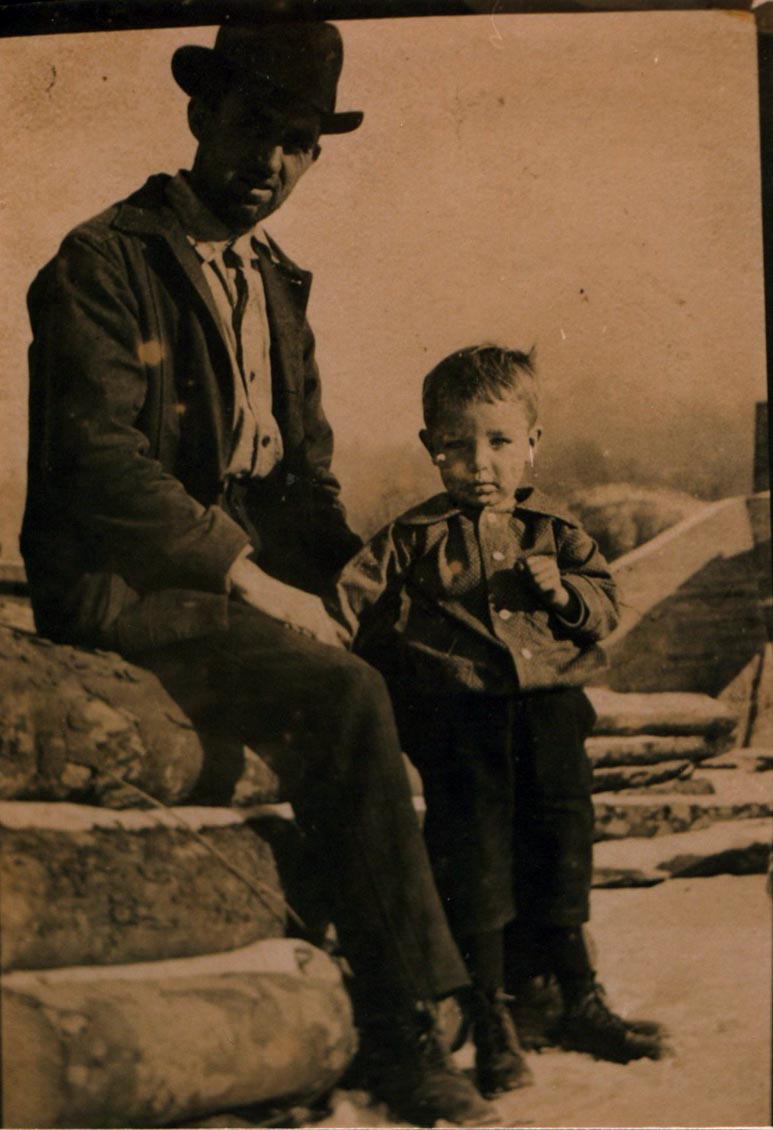
Deputy Sheriff Ward Brumfield with nephew Clyde Holton, taken in Harts, West Virginia, 1915-1920

Deputy Sheriff Ward Brumfield with nephew Clyde Holton, taken in Harts, West Virginia, 1918-1920

Leet, West Virginia

18 Wednesday Sep 2013

Posted by Brandon Ray Kirk in Big Ugly Creek, Timber

≈ Leave a comment

Tags

Appalachia, Big Ugly Creek, culture, genealogy, history, Leet, life, Lincoln County, photos, timbering, West Virginia

Leet, West Virginia, 1905-1920

Leet, West Virginia, 1905-1920

B. Johnson & Son

17 Tuesday Sep 2013

Posted by Brandon Ray Kirk in Big Ugly Creek, Timber

≈ Leave a comment

Tags

B Johnson & Son, Big Ugly Creek, D P Crockett, Henderson Davis, history, Jesse Hobbs, Joe Dodson, Lester Defibaugh, Sam Peyton, Stewart May, T J Bolin, timbering, West Virginia

One hundred years ago, one of the largest tie and timber firms in the nation came to Big Ugly Creek and changed it forever.

Around 1907, B. Johnson & Son of Richmond, Ind. bought several tracts of land on Big Ugly and soon established an extensive tie and lumber business.

B. Johnson & Son was headquartered at Leet, a lumber center at the mouth of Laurel Fork. It built a huge saw mill on large rocks. Nearby was a pond where logs were cleaned before sawing. There was also a row of houses called Stringtown.

T.J. Bolin of Huntington was superintendent of 250 men who worked at the mill. D.P. Crockett was the company doctor, while Jesse Hobbs was the saw filer.

Within a few years, B. Johnson & Son constructed a narrow gauge of railroad called the Guyan, Big Ugly & Coal River Railway (GBU & CRR), which extended ten miles from Gill, at the mouth of Big Ugly, to the head of Laurel Fork.

“There was a small train that used to run up and down this creek,” said the late Adam Adkins of Leet. “My wife’s father used to run it.”

B. Johnson & Son was big news in its hey-day. The county newspaper reported its weekly doings. noting especially when workers were hurt or killed.

“Joe Dodson, 25 years of age, and unmarried who was employed at the logging camp of Stewart May at the B. Johnson and Son’s works on Big Ugly Creek, was so terribly injured Saturday evening that he died the following morning,” according to the Lincoln Republican on November 3, 1910. “Dodson had a team of cattle pulling a heavy log and the latter in some way slipped in the snow that had just fallen and caught Dodson, knocking him down. The log was dragged over his left side and leg, mutilating the flesh of the member in a horrible manner and producing the fatal internal injuries.”

In the summer of 1911, B. Johnson & Son was occupied with extending the GBU & CRR into the head of Big Ugly. B. Spears was in charge of the project.

“The G.B.U. & C.R.R. is completed to Rector Postoffice,” the Republican reported on October 12, 1911.

Meanwhile, the mill experienced periodic setbacks.

“The big saw mill of the Johnson Tie Co. has shut down for a few days, the drive belt having given away,” the Republican noted in a less dramatic story on October 12.

That winter, work slowed down on the railroad, as it only extended one mile beyond Rector by December.

At that time, there was a change in the accounting staff at B. Johnson & Son.

“Lester Defibaugh, who has been the efficient bookkeeper at the B. Johnson & Son’s plant here for over a year has tendered his resignation to accept a place in a business house at Lynn, Indiana,” the Republican reported on December 21. “Henderson Davis, who has been keeping books on Upton, is here to take Defibaugh’s place.”

During the Christmas season of 1911, according to newspaper reports, B. Johnson & Son gave its employees a four-day holiday to spend time with family.

Work on the railroad continued at a snail’s pace.

“The new branch of the Guyan, Big Ugly and Coal River Railway has reached a point near the Big Sulphur Spring up Big Ugly,” according to the Republican. “The work is progressing very slowly now.”

By the following summer, things were in full swing at B. Johnson & Son.

“There are now ten logging jobs at the B. Johnson & Son timber shop above here but they have not yet succeeded in keeping the mill at Leet running every day,” the Republican reported on July 25. “Quite a force of men are in these camps.”

The railroad extension was nearing completion.

“The Big Ugly railroad has been extended three miles above this place and work is progressing nicely. The road will be built one mile further.”

Then, early one August morning, just as things were really chugging along, a terrible fire destroyed the mill at B. Johnson & Son.

“A very disastrous fire broke out about 6 o’clock Saturday morning at the big saw mill of B. Johnson and Son,” the Republican reported on Thursday, August 22. “Sam Peyton, the night watchman, was getting ready to go off duty when he noticed a tiny blaze shooting up from a point midway in the mill. He ran tot he place and prepared to get the fire apparatus about the plant in working order but the fire spread so rapidly over the inflammable stuff about the establishment that Peyton pulled the alarm whistle and then fled from the approaching blaze.”

Thereafter, Superintendent Bolin organized 100 men — the “Bucket Brigade” — to fight the fire using water from the nearby creek.

“Superintendent Bolin got a force of a hundred men to save the valuable lumber on the yard adjacent to the mill and covering some acres. The several ‘Dinky engines’ threw water on the blaze and this with a bucket brigade of scores of men worked for two hours and were finally successful in getting the conflagration under control.”

According to the Republican, Superintendent Bolin had no idea of the loss but speculated that it was near $20,000.

“The mill, one of the largest in this section, is a total loss. $2,000 worth of saws were virtually destroyed and nothing about the mill was saved.”

Fortunately, B. Johnson & Son carried insurance on the property. The company hired Bill Bench of Huntington to rebuild the mill.

In subsequent months, there were minor setbacks for B. Johnson & Son, such as the New Year’s Day train wreck.

“On New Year day the dinky engine, No. 618, on Big Ugly wrecked and had to have engine No. 944 to pull her back on the track,” the Republican reported. “No damage was done.”

By January of 1913, work was completed on the new sawmill, prompting the Republican to happily write, “The big band mill belonging to B. Johnson & Son has gone sawing. The new machinery works fine. The log train will get down to business in a short time as the new mill will whittle lots of logs.”

In that same month, Dr. Skelton replaced Dr. Crockett as the company doctor.

Around 1917, B. Johnson & Son left Big Ugly.

“I was still a little girl when the mill pulled out,” said the late Lula Adkins of Leet. “They tore down the houses at Stringtown and just left here.”

In Search of Ed Haley 145

30 Tuesday Jul 2013

Posted by Brandon Ray Kirk in Ed Haley

≈ 3 Comments

Tags

Appalachia, Elias Adkins, Harts Creek, history, Isaac Adkins, John H. Brumfield, Joseph Adams, Logan County, Peter Mullins, slavery, Thomas Dunn English, timbering, writing

Within a few years, by 1827, there were more settlers: Elias Adkins at Fowler Branch on the Guyandotte River, Moses Brown at Brown’s Branch of Guyan River and Marvel Elkins on Piney Creek of West Fork. Within three years, Isaac Adkins was at Harts and John Brumfield (father of Paris) was at the mouth of Ugly Creek. The Adkins brothers — Isaac and Elias — were the only slave owners in the section. They bought land at the mouth of Harts Creek in 1833.

In the early 1830s, Joseph Fry, John Lucas, and John Fry moved to the Harts area. Joseph Fry lived at Ugly Creek; John Fry, a War of 1812 veteran, lived at the mouth of Green Shoal; and John Lucas, a Baptist preacher, lived near Big Creek. With the arrival of these and other men, a school was organized to meet the educational needs of local children. “The first school was taught in a log cabin one mile above the mouth of Big Harts creek about the year 1832,” writes Hardesty. “The first house for educational purposes was built near the mouth of Big Harts creek in 1834. It was a five-cornered building, one side being occupied by the ever-present huge fire place.”

In the mid-1830s, Joseph Adams and Peter Mullins — both great-grandfathers to Ed Haley — arrived in the headwaters of Harts Creek. In 1838, Adams was granted 100 acres between the Forks of Harts Creek and the Rockhouse Branch. He became the patriarch of most Adamses in Harts, including Anthony and Ben Adams — key players in the Haley-McCoy trouble. In the early 1840s, Mullins was granted land on Hoover Fork and Trace Fork. He was a grandfather to Emma Haley.

At that time, in 1840, there were roughly 23 families in Harts. In the head of Harts Creek were Stephen Lambert, Moses Workman, Alexander Tomblin, and James Tomblin. Henry Conley and William Thompson were somewhere on the creek. Richard Elkins was at Thompson Branch and Isaac Adkins, Jr. was at Big Branch. Abner Vance was on West Fork. Isaac Adkins, Sr. and James Toney were at Harts. Moses Brown and Archibald Elkins were just below there. Harvey Elkins and Price Lucas were on or near Little Harts Creek. Above Harts was Elias Adkins and Squire Toney. At Ugly Creek were John Brumfield, Joseph Fry, and John Rowe. Charles Lucas and John Fry were at Green Shoal. John Dolen was somewhere in the area.

At that early date, folks were beginning to explore timber as a means of industry. “Isaac Elkins built the first saw mill in 1847 or 1848,” Hardesty writes. “It was constructed on the old sash-saw plan, and had a capacity for cutting from 800 to 1,000 feet per day.” To assist in the transport of timber and coal from the valley, locks and dams were constructed in the lower section of the Guyan and steamboats made a brief appearance in the valley during the 1850s, although they did not travel so far upriver as to reach Harts. There was some excitement, too, when Thomas Dunn English — a famous Northeastern writer — arrived in nearby Logan (then called Aracoma) and became mayor.

Rafting Scene

26 Sunday May 2013

Posted by Brandon Ray Kirk in Big Sandy Valley, Timber

≈ Leave a comment

Tags

Appalachia, Catlettsburg, culture, history, Kentucky, life, logging, photos, steamboats, timbering, U.S. South

Six steamboats with log rafts, Catlettsburg, Kentucky, 1901

Six steamboats with log rafts, Catlettsburg, Kentucky, 1901

In Search of Ed Haley 115

23 Thursday May 2013

Posted by Brandon Ray Kirk in Big Harts Creek, Ed Haley, Spottswood, Warren, Whirlwind

≈ Leave a comment

Tags

Andrew Jackson, Ben Adams, Bill Abbott, Bob Mullins Cemetery, Buck Fork, Chloe Mullins, civil war, Confederate Army, Dicy Adams, Ed Haley, Elizabeth Mullins, Enoch Baker, genealogy, Harts Creek, Henderson Dingess, history, Hollene Brumfield, Imogene Haley, Imogene Mullins, Jackson Mullins, Jane Mullins, Jeremiah Lambert, John Frock Adams, John Gore, John Q. Adams, Joseph Adams, Kentucky, Logan County, Margaret Gore, Mathias Elkins, Peter Mullins, Riland Baisden, Spencer A. Mullins, Tennessee, Ticky George Adams, timbering, Trace Fork, Turley Adams, Van Buren Mullins, Weddie Mullins, Weddington Mullins, West Virginia, writing

Ed Haley’s grandfather, Andrew Jackson Mullins, was born about 1843 to Peter and Jane (Mullins) Mullins. Jackson, as he was called, was named in honor of President Andrew Jackson, that early American icon. Like many folks in those days, Peter and Jane Mullins appear to have been caught up in the Jackson mystique. They even named one son Van Buren, after his vice president. Jackson Mullins was the first child born to Peter following the family exodus from Kentucky or Tennessee to Logan County, (West) Virginia. The 1850 Logan County Census listed him as seven years old. In 1860, he was eighteen. During the Civil War, Jackson served in the Confederate army. Brothers Weddington and Van Buren served as Confederates. In the late 1860s, Jackson married the slightly older Chloe Ann (Gore) Adams, a widow. Chloe had been born around 1840 to John and Margaret (Dingess) Gore, pioneer residents of Harts Creek. She had first married John Quincy “Bad John” Adams, a first cousin to Jackson, with whom she had four children: Dicy (born 1857), Joseph (born May 1858), John C. “Frock” (born c. 1861) and George Washington “Ticky George” (born 15 Jul 1864). She and Jackson had three children: Imogene Mullins (born c.1868), Peter Mullins (born May 1870), and Weddington Mullins (born April 10, 1872). Jackson and Chloe are thought to have lived on Trace Fork, perhaps at the present-day site of the Turley Adams home where they certainly lived in later years.

What little is known of Jackson Mullins — the man who partially raised Ed Haley — comes through deed records and census records. On February 13, 1869, his uncle Spencer A. Mullins wrote him a note that read: “Mr. A.J. Mullins and wife: you will pleas Come down and git your Deed for the Buck fork Land. I will not pay the taxes any longer.” In 1869 he purchased 200 acres of land on the creek from Riland Baisden. The next year he was listed in the 1870 census as 27 years old with 700 dollars worth of real estate and 200 dollars worth of personal property. His daughter — Ed Haley’s mother — first appeared in that record as “Em. Jane Mullins,” age two.  An April 1871, Justice Jeremiah Lambert provided a receipt to him for $2.80 “in the cost of the peace warrant in favor [of] him against Benjamin Adams.” An 1871 Logan County tax receipt listed A.J. Mullins as a resident of “Hearts Creek.” On February 28, 1877, the Logan County Court appointed him as “Surveyor of Roads in Precinct No. 76 in place of Weddington Mullins for the time of two years commencing April 1, 1877.” On December 17, 1877, the Logan County Clerk provided a receipt to him for recording a deed from Henderson Dingess and wife (parents to Hollene Brumfield). An 1878 tax receipt shows him in charge of six tracts totaling 244 acres under the ownership of “John Adams Heirs.”

The 1880 Logan County Census listed Jackson as 37 years old, while his wife was 40. Children in the household were John C. Adams (aged eighteen), George Adams (aged 15), “Emagane Mullins” (aged 12), Peter Mullins (aged 9), and Weddington Mullins (aged 6). That same year, Jackson sold five tracts of land totaling over 200 acres to brother-in-law Mathias Elkins for 3,000 dollars. He also sold 50 or so acres on Buck Fork to his father Peter and stepmother Elizabeth for 600 dollars. In February 1881, the Logan County Court reappointed him to relieve his brother Weddington as Surveyor of Public Roads for Precinct No. 76 “commencing April 1st, 1881.” That same year, he secured land from the John Q. Adams estate and bought 100 acres on Trace Fork from A.A. Low, attorney. On August 7, 1883, Enoch Baker, a timber boss on Harts Creek,  provided a receipt to him for fifteen dollars “in payment for a Stove.” In 1886, Jackson deeded 37 tracts on Trace Fork to stepsons Joseph and John Adams. On April 2, 1888, he signed a promissory note agreeing to pay William Abbott $41.75 plus interest within a year. Because he was illiterate, he signed the note with an “X.”

In March 1891, Jackson and Chloe Mullins deeded their property on Trace Fork to their three children: Imogene Haley, Peter Mullins, and Weddie Mullins.

In the 1900 Logan County Census, Jackson gave his birth date as March of 1845, while Chloe gave hers as July 1834. Ed Haley first appears in the 1900 Logan County Census as “James E. Haley, born August 1885,” and living in their home. His birth date of 1885 was two years later than what was given by the Haley family records. By 1910, Jackson lived with son Peter Mullins, while Chloe was in the home of Weddie Mullins’ widow, Mag. Ed was absent from the census entirely, indicating that he was gone from Harts by that time. A few years later, in 1915, Jackson Mullins died and was buried in an unmarked grave at the Bob Mullins Cemetery on main Harts Creek. His widow died in 1919.

Low Gap Timber Scene

19 Sunday May 2013

Posted by Brandon Ray Kirk in Timber

≈ 2 Comments

Tags

Appalachia, culture, Ferrellsburg, genealogy, life, Lincoln County, logging, Low Gap, Pat Kirk, photos, timbering, U.S. South, West Virginia

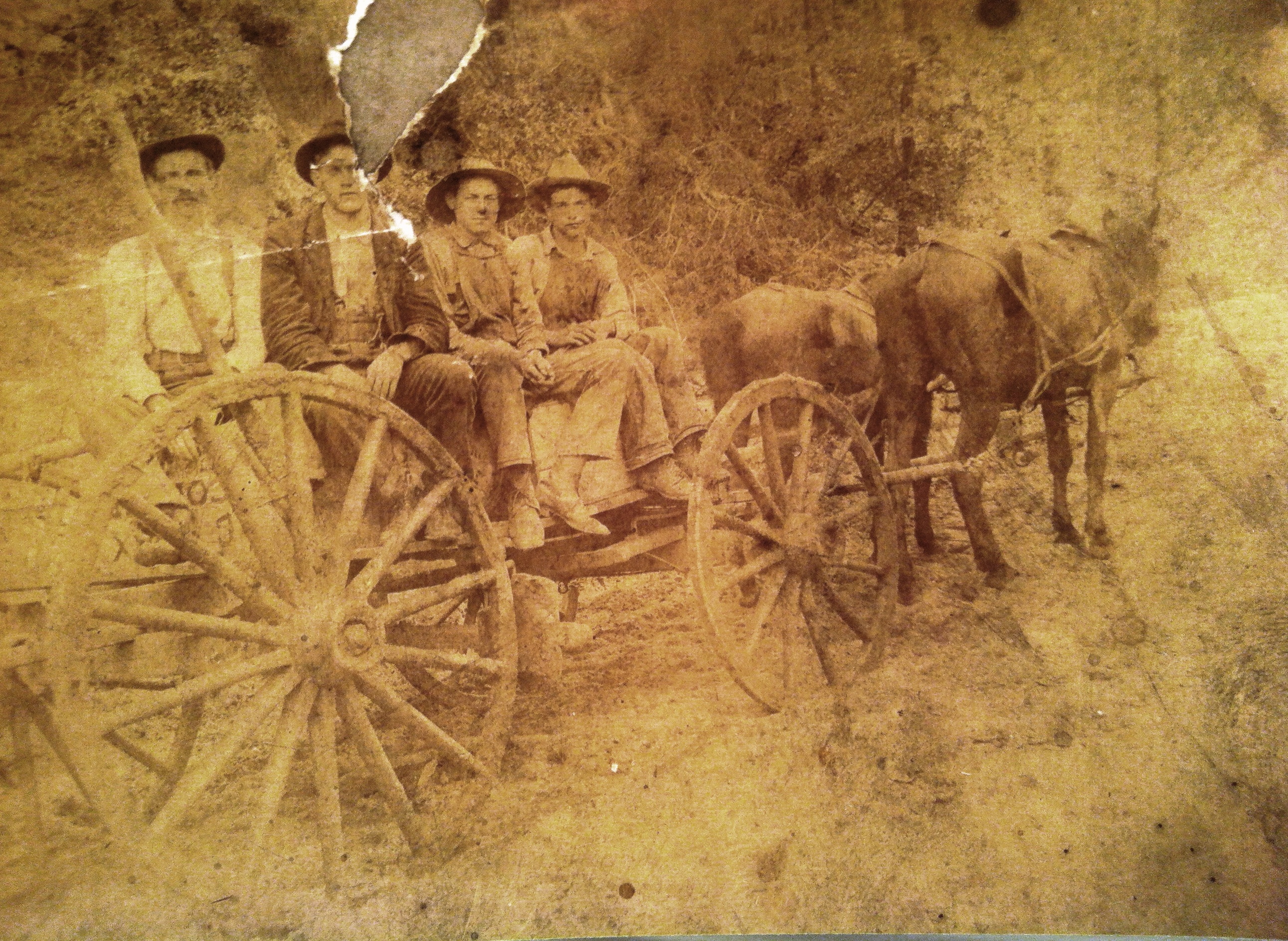
Pat Kirk hauling timber, Low Gap, Lincoln County, West Virginia, 1908-1920

Pat Kirk hauling timber, Low Gap (near Ferrellsburg), Lincoln County, West Virginia, 1908-1920

West Virginia Timber Contract

18 Saturday May 2013

Posted by Brandon Ray Kirk in Timber

≈ 1 Comment

Tags

Alex Burton, Bill Farley, Catlettsburg, Crawley Creek, culture, history, Kentucky, Logan County, logging, Samuel S. Vinson, timbering, Vinson Goble and Prichard, West Virginia

Bill Farley timber contract (page 1 of 3), 1882

Bill Farley timber contract (page 1 of 3), 1882

West Virginia Timber Scene

27 Saturday Apr 2013

Posted by Brandon Ray Kirk in Timber

≈ Leave a comment

Tags

Appalachia, culture, genealogy, Lafayette Maynard, life, Lincoln County, Milton Maynard, photos, timbering, U.S. South, West Virginia, Winferd Lucas

West Virginia Timber Scene

Milton Maynard, Winferd Lucas, Lafayette Maynard, and unknown man, of Lincoln County, 1905-1928

In Search of Ed Haley 86

07 Sunday Apr 2013

Posted by Brandon Ray Kirk in Ed Haley

≈ 2 Comments

Tags

Brandon Kirk, Charles Wolfe, Green McCoy, Harts Creek, history, Huntington, John Hartford, Lawrence Haley, Marshall University, Milt Haley, timbering, West Virginia, writing

Around that same time, I called Brandon Kirk, a great-nephew to Lawrence Kirk. Brandon was into genealogy and local history; for the past several years, he had been heavily researching the Brumfields. A college student and library assistant at Marshall University in Huntington, West Virginia, he spent his weekends at Harts interviewing neighbors, gathering up old photographs and documenting cemeteries. He said his family had told him about my recent trip to Harts; he was eager to make contact and compare notes on the story of Al Brumfield’s trouble with Milt Haley, especially since I represented a “non-Brumfield, non-Harts Creek” perspective.

After my initial call, Brandon sent me detailed letters in giant manila envelopes full of information about the Brumfields, the death of Milt Haley and the Adams and Mullins families on Harts Creek. It went a long way in explaining who some of the people were in the stories Lawrence and I had been hearing. It was clear that Brandon had a lot of information to offer. He knew all the genealogies, geography, and chronology that we’d been lacking to completely understand the story of Milt Haley and Ed’s connection to Harts Creek.

At the time of the Haley-McCoy murders, according to Brandon, Harts was in the midst of a timber boom. It was a tumultuous time: a whole new economic system had descended on locals who’d previously been primarily small farmers. Competition and the desire to accumulate wealth and status had created a lot of jealousy among and within local families. This new way of life was made worse by the arrival of “new faces” in town, many of whom were transients from Kentucky looking for work. Brandon figured that Milt Haley and Green McCoy were among these immigrants, as their family names were absent from the old records around Harts Creek. In his estimation, Milt and Green may have been like so many of the new arrivals: outlaws trying to escape a seedy past in a somewhat isolated but moderately booming town. He cited at least one such example in his own family tree.

As for the Haley-McCoy murders, Brandon and I seemed to have traced down roughly the same versions of the story. He said it was just one of many murder stories in Harts’ past that had caught his interest — and only one of several involving his ancestors. As a result, he had neglected to hunt down many possible leads regarding it. It was one of probably a hundred incredible stories pertaining to Harts.

I told Brandon about my recent trip, how I had gone to Milt and Green’s grave with Lawrence Kirk. He said he had never been to the grave but had heard that Milt and Green were buried together in a single hole. I wondered why they were buried together and he suggested that if they were handcuffed together at the time of the murders maybe it was a practical decision; or maybe their mutilated bodies warranted a “rushed job.” There may have also been a customary aspect to the burial: in 1882, during the Hatfield-McCoy feud, three of Randolph McCoy’s sons were buried together after their single-night execution.

Around that time, I compiled Xerox versions of my notes on Ed’s life and sent it to Lawrence Haley and Dr. Wolfe. Dr. Wolfe showed his copy to Judy McCollough of the University of Illinois Press who immediately called and told me that I had a book in the works and that she wanted to print it. It was the first time I had really thought about my research regarding Ed Haley as anything more than an obsession to totally immerse myself in his life. I told her that it wasn’t a book yet, but if it was gonna be there was a tremendous amount of work that needed to be done.

In Search of Ed Haley 80

15 Friday Mar 2013

Posted by Brandon Ray Kirk in Ed Haley

≈ 1 Comment

Tags

Al Brumfield, Appalachia, feud, Harts Creek, Hollene Brumfield, John Hartford, Lawrence Haley, Lawrence Kirk, Peter Mullins, timbering, West Virginia, writers, writing

     Mr. Kirk hopped in the car with Lawrence Haley and I and guided us to “Presto’s garden,” a small corn patch located just off of the hill from the Haley-McCoy grave. It was late afternoon: the air was clear and the remains of the sun slanted through the trees on the hillside. Lawrence Haley chose to stay at the garden due to his heart condition, but I made the steep climb toward the grave with Mr. Kirk just behind me. A few minutes later, we stopped at an indentation — a round shallow crater about seven feet in diameter. It had a little pile of stones on each end and was just as Bob Adkins had said it would be. We walked back and forth studying the “bowl” and the markers and I took some pictures.

     At the bottom of the hill, we got back in the car and rode up Low Gap Road to the site of Milt Haley’s murder. On the way, I told Mr. Kirk what we’d heard about Ed’s mother Emma Jean Mullins being shot in the face.

     “See, I hadn’t heard that part of it,” he said. “Well now, you know them Adamses and Mullinses up there on Hart married back and forth for generations. That’s quite possible. Of course, them Brumfields and them Adamses had trouble over that log boom they had had there at the mouth of Hart. It’d catch water and hold it back like a dam. They’d float them logs all out of Harts Creek back in yonder, then when the backwater come up in the spring of the year they’d make them into a raft and float them out of here and take them to the town of Guyandotte. That’s the market. They claimed the Brumfields got to sawing the ends of them logs off and re-branding them. I don’t know what the extent of their trouble was but they had some misunderstanding over that lumber and then Runyon and whiskey got involved in it down on that houseboat where they’s selling whiskey. All of them drinking, you know. They’d all go down there and get drunk and talk this shit up, you know, and get it started, get it going, down there where the booze was. Things were getting out of hand. Whiskey’s destroyed an awful lot of people in this country. A lot of my relatives.”

     Mr. Kirk said, “They’s supposed to killed them at daylight or immediately after daylight. The story that I’ve heard on it has been that they were both knocked in the head with the flat side of a double-bit axe. Killed them separately. Hit them right in the top of the head there. And I’ve heard people say they was shot up you know, and some said they were chopped up with an axe. But my grandmother, she was awful critical of the Brumfields and their conduct. She was an Adkins — part Dingess. Bill Brumfield’s widow. By her being pretty critical of them, I feel like she handed me what she had as being true. But now they was organized into kind of a posse. She said they called theirselves ‘The Night Riders.’ Vigilante group. Operated all the time at night. They were pretty sneaking in what they did.”

     They must’ve had some serious shortcomings, because Mr. Kirk said they “tried to organize themselves into the Klan, but the Klan wouldn’t have them.”

     After surveying the site of Milt’s murder, we drove down to the mouth of Harts Creek where Mr. Kirk pointed out the site of the recently burned Al Brumfield house.

     “Except being a landmark, it wasn’t worth much,” he said. “They used to have a meal-house out there to ground meal for people. Had a store in here. That’s Al Brumfield and Aunt Hollene. He was in his fifties when he died of typhoid fever. Watson Adkins later bought his house and lived there. Had a store over here for years. Now, Runyon had a boat down yonder — great big boat — barge built in there and had a store in it. He run poker games. Selling whiskey. Had a few groceries in there. Al and his bunch trying to do the same thing over here.”

     All during our ride with Mr. Kirk, he kept pointing out spots where murders had taken place. As we made our way back up West Fork, I asked him why there’d been so many killings around Harts Creek. He didn’t hesitate in saying, “Whiskey. Whiskey’s caused it. This section of country up through here — this West Fork section — has had a few killings. It wasn’t as bad as back yonder. Whiskey involved in every bit of that.”

     Lawrence Haley agreed that whiskey was the primary cause of trouble in the old days, even mentioning how one of Uncle Peter Mullins’ boys once killed a “revenue man” around Trace Fork. He said it “it took just about everything Uncle Peter had to keep him out of jail.”

     Mr. Kirk said, “Is that the one they called ‘Reel-Footed’ Peter? Ewell’s daddy?”

     Lawrence confirmed that it was — and that it was his great-uncle — and Mr. Kirk said, “I can remember old man Peter. I believe it was his right foot that was curled in. Man, he’d work in the woods, draw a team…”

In Search of Ed Haley 79

10 Sunday Mar 2013

Posted by Brandon Ray Kirk in Ed Haley

≈ Leave a comment

Tags

Al Brumfield, Ben Walker, Burl Farley, feud, French Bryant, Green McCoy, Hollene Brumfield, Lawrence Kirk, Melvin Kirk, Milt Haley, Stella Abbott, timbering, Victor Shelton, writing

Mr. Kirk had heard a lot about Milt Haley’s trouble with the Brumfields. His version of events, along with that of Roxie Mullins, Bob Adkins and the Goldenseal article, comprised the bulk of what I knew of Milt’s death.

“I feel like that I’ve got pretty much the base of what happened, but there’ve been add-ons and deletions and so on along the way,” he said. “It was a tragic thing.”

The whole trouble had nothing to do with John Runyon, as we’d previously heard.

“The real thing behind it, them Adamses over in yonder and the Brumfields, they got into it over the timber,” Mr. Kirk said. “What they’d do, them people’d cut that big timber and put it in them creeks. Then they’d get spring floods and float them out. Brumfield had what they called a boom in down there to catch that timber. Then they’d make them into rafts and raft them down the river to the town of Guyandotte. There was a log market there. And Al got to stealing their logs.”

That was an interesting new development in the story, I thought. I mean, maybe Al Brumfield wasn’t completely innocent in the trouble. And maybe Milt was, in the eyes of at least some locals, justified in ambushing him.

“Word of mouth that’s come down to me from my mother and grandmother, some of the Adamses was supposed to hired McCoy and Haley to shoot Aunt Hollene, old man Al Brumfield’s wife. I remember her well. She had a hole in her jaw there. When she’d eat or talk, spit would work up in it. Or if she would eat candy or something, you could see the candy. She was a tough old lady. She’d been blowed up in a sawmill and had a short leg — walked with a cane. Cussed like a sailor every time she made a step. But they shot her.”

Now where did this shooting take place?

“The shooting was supposed to took place up on Big Hart there at the mouth of Thompson Branch,” Mr. Kirk said. “They was coming down the creek. They’d been up there visiting Hollene’s parents. She was one of them Dingesses from up there.”

Mr. Kirk said Al was shot in the arm and fell from his horse, while his wife was shot in the face.

Surprisingly, there were rumors of Milt and Green’s innocence, but Mr. Kirk “never did hear that expounded on.”

“I’ve heard it said a time or two, ‘Well, I doubt them being the ones that did it.’ I never would get into a discussion ’cause — not that it mattered either way to me in one sense — but I was convinced that they did it.”

Once Milt and Green were captured in Kentucky, a lynch mob formed in Harts consisting of Hugh Dingess (Hollena’s brother), French Bryant and several Brumfields. They joined up with Victor Shelton, a local lawman.

“You see, old man Victor Shelton was a constable or JP down here and he was a friend to them Brumfields,” Mr. Kirk said. “He went over there to Kentucky with them and they turned them over to Victor Shelton. When he come back across the river into West Virginia he just turned them over to the Brumfields and he come on back. They had horse roads all through these mountains and creeks everywhere. He probably left them over in there around Twelve Pole somewhere and went on back down in here around Ranger someplace where he lived. But that’s the way they got in charge of them.”

After taking possession of Milt and Green, the mob re-crossed the Tug River at the present-day town of Kermit in Mingo County and went up Jenny’s Creek (or possibly Marrowbone Creek) to Twelve Pole Creek. They entered Harts Creek at the head of Henderson Branch and made their way to Hugh Dingess’ home on Smoke House. At that location, they ate a big meal and spent the night. The next day, they headed up Bill’s Branch and crossed a mountain onto Piney Creek. They rode down Piney to the West Fork (just above Iris Williams’ home), went a short distance up Workman Fork, turned up Frank Fleming Hollow and dropped down off of the ridge to a home near the Guyandotte River. (Mr. Kirk was very adamant about this home being on the west side of the river, not at the mouth of Green Shoal where Bob Adkins had said.) By that time, “Dealer Dave” Dingess, Charley Brumfield, Burl Farley, Will Adkins and “Black John” Adkins had joined the gang.

At this home, the mob questioned Milt and Green separately and tried to secure a confession. As one was led out the door, he hollered to his friend, “Don’t tell ’em a damn thing!” — but his partner told it all, thus deciding their guilt in the eyes of the mob. (Based on what we’d heard from Bob Adkins, I figured that it was Green McCoy who made the confession.)

A host of young local ladies, including Stella Abbott, cooked a chicken supper as Milt and Green’s last meal. Either Milt or Green (undoubtedly an emotional wreck) said he wasn’t hungry, so his partner replied, “Eat, drink, and be merry for tomorrow ye may die.” Supposedly, a Brumfield nearby them then said, “Eat, drink, and be merry for tomorrow ye shall die.”

Mr. Kirk said French Bryant supposedly killed Milt and Green, although he’d also heard that Burl Farley, a timber boss from Harts Creek who was connected to the Dingess family, “gave the order” to shoot them.

“Old man French Bryant was a big old mountaineer-type fellow,” Mr. Kirk said. “Rough talking, grouchy. Most people liked him pretty good. French Bryant was married three times, I reckon. Yeah, that old man, I went to his funeral. He’s buried right at the head of Piney there.”

There was a lot of confusion over the murders. Word was spread through the community that Haley and McCoy were killed by a mob who’d taken them from the Brumfield posse. Mr. Kirk dismissed that notion, saying, “The ones who got them in Kentucky were the ones who killed them.” He was certainly a good source for that statement considering his family connection to the Brumfields.

Lawrence and I hung onto Mr. Kirk’s every word as he described Milt Haley’s burial, which he said occurred the day following the murders.

“The next morning, Melvin Kirk, who was my father’s father, and several other people — I don’t know who else — went with Ben Walker and got them either in a sled or an old wagon and hauled them around there,” he said. “My grandfather helped them take them around there and clean them up. Back then they didn’t take them to a funeral home — they just wrapped them and made a rough burial preparation. I think they made a coffin for them and buried them on the old man Walker’s property. Of course, there was a preacher at the burial because old man Ben Walker was an ordained preacher. He’s the one that married my father and mother in 1911.”

Mr. Kirk turned our attention toward a mountain across the creek.

“See that gap yonder in the hill? Right over there, they call that the Walker Branch. That’s where old man Ben Walker lived. He was an old preacher. He owned all of this land in here. You can go right over there and turn right and go up that side of the river right over to where they were killed.”

I asked Mr. Kirk whose decision it was to bury Milt and Green at that location and he said, “The old man Ben Walker decided where to put them. I never did go to their grave. A lot of people thinks it’s down in the lower end of that garden. There are some graves down there, but that’s not it.”

He wasn’t sure why they chose to bury them in a single grave.

“I guess it was just maybe the work involved. I think they’ve been quite a little bit of that done here where there was multiple deaths. Whenever I was young, my daddy and I would ride down that creek. He’d tell me, ‘Right up on that hill is where Haley and McCoy’s buried.’ He called his daddy ‘Paw.’ Said, ‘Paw and Ben Walker took them up there and buried them.’ Just got a rock for a marker.”

Old Logging Scene

26 Tuesday Feb 2013

Posted by Brandon Ray Kirk in Timber

≈ Leave a comment

Tags

Appalachia, culture, history, life, logging, photos, timbering, U.S. South, West Virginia

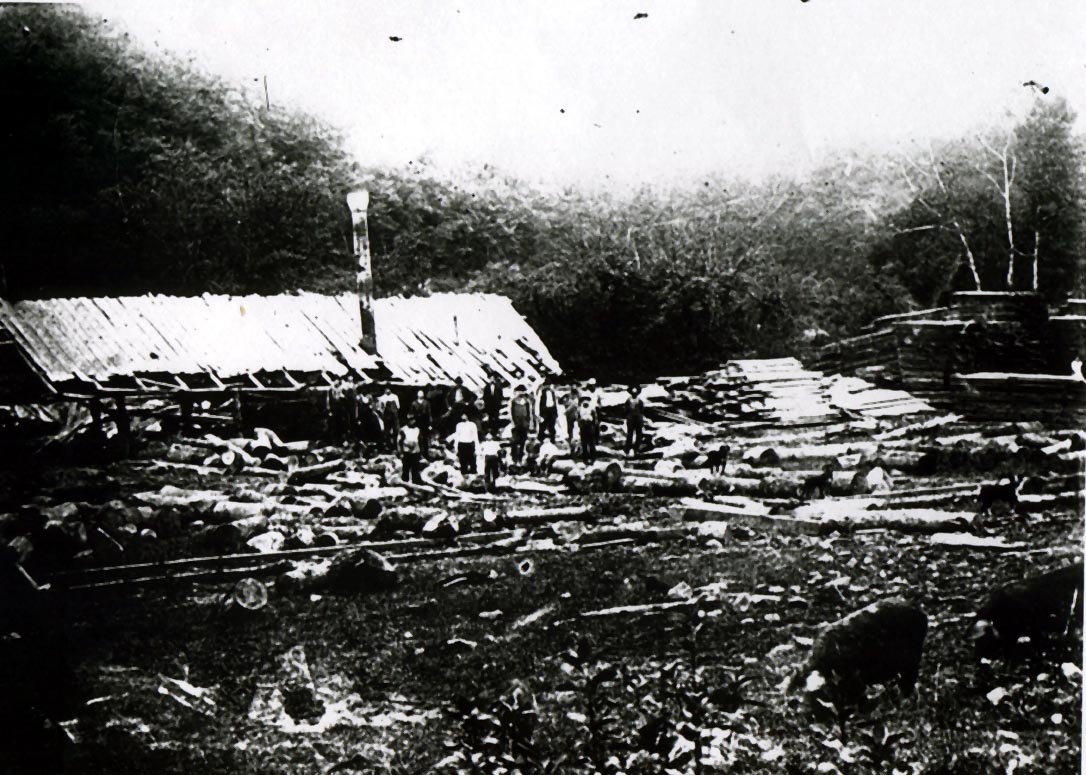
1885-1920

1885-1920

Timber

05 Saturday Jan 2013

Posted by Brandon Ray Kirk in Timber

≈ Leave a comment

Tags

Appalachia, culture, history, life, Lincoln County, logging, photos, timbering, U.S. South, West Hamlin, West Virginia

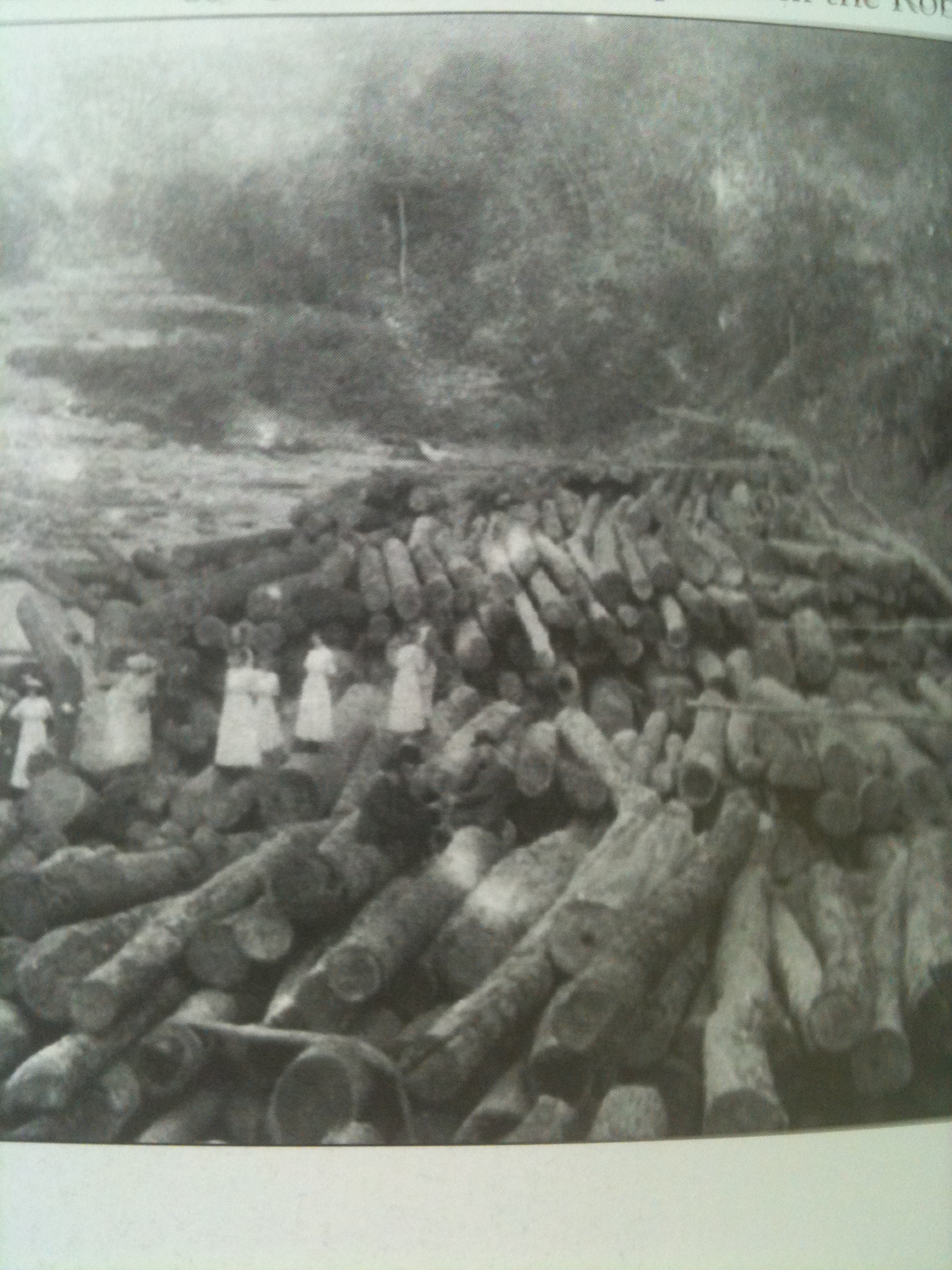
Lincoln County Sawmill, 1895-1920

West Virginia Sawmill, 1895-1920

Timber

02 Wednesday Jan 2013

Posted by Brandon Ray Kirk in Timber

≈ Leave a comment

Tags

Appalachia, culture, history, Huntington, life, logging, photos, timbering, U.S. South, West Virginia

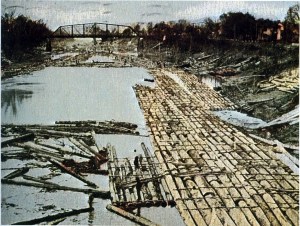
Log Rafts at Huntington, West Virginia, 1895-1905

Log Rafts at Huntington, West Virginia, 1895-1905

Timber

14 Friday Dec 2012

Posted by Brandon Ray Kirk in Timber

≈ Leave a comment

Tags

Appalachia, culture, history, life, photos, timbering, U.S. South

Appalachian Mill-Dam, 1890-1915

Appalachian Mill-Dam, 1890-1915

← Older posts
Newer posts →

Feud Poll 1

If you had lived in the Harts Creek community during the 1880s, to which faction of feudists might you have given your loyalty?

Categories

  • Adkins Mill
  • African American History
  • American Revolutionary War
  • Ashland
  • Atenville
  • Banco
  • Barboursville
  • Battle of Blair Mountain
  • Beech Creek
  • Big Creek
  • Big Harts Creek
  • Big Sandy Valley
  • Big Ugly Creek
  • Boone County
  • Breeden
  • Calhoun County
  • Cemeteries
  • Chapmanville
  • Civil War
  • Clay County
  • Clothier
  • Coal
  • Cove Gap
  • Crawley Creek
  • Culture of Honor
  • Dingess
  • Dollie
  • Dunlow
  • East Lynn
  • Ed Haley
  • Eden Park
  • Enslow
  • Estep
  • Ethel
  • Ferrellsburg
  • Fourteen
  • French-Eversole Feud
  • Gilbert
  • Giles County
  • Gill
  • Green Shoal
  • Guyandotte River
  • Halcyon
  • Hamlin
  • Harts
  • Hatfield-McCoy Feud
  • Holden
  • Hungarian-American History
  • Huntington
  • Inez
  • Irish-Americans
  • Italian American History
  • Jamboree
  • Jewish History
  • John Hartford
  • Kermit
  • Kiahsville
  • Kitchen
  • Leet
  • Lincoln County Feud
  • Little Harts Creek
  • Logan
  • Man
  • Matewan
  • Meador
  • Midkiff
  • Monroe County
  • Montgomery County
  • Music
  • Native American History
  • Peach Creek
  • Pearl Adkins Diary
  • Pecks Mill
  • Peter Creek
  • Pikeville
  • Pilgrim
  • Poetry
  • Queens Ridge
  • Ranger
  • Rector
  • Roane County
  • Rowan County Feud
  • Salt Rock
  • Sand Creek
  • Shively
  • Spears
  • Sports
  • Spottswood
  • Spurlockville
  • Stiltner
  • Stone Branch
  • Tazewell County
  • Timber
  • Tom Dula
  • Toney
  • Turner-Howard Feud
  • Twelve Pole Creek
  • Uncategorized
  • Warren
  • Wayne
  • West Hamlin
  • Wewanta
  • Wharncliffe
  • Whirlwind
  • Williamson
  • Women's History
  • World War I
  • Wyoming County
  • Yantus

Feud Poll 2

Do you think Milt Haley and Green McCoy committed the ambush on Al and Hollene Brumfield in 1889?

Blogroll

  • Ancestry.com
  • Ashland (KY) Daily Independent News Article
  • Author FB page
  • Beckley (WV) Register-Herald News Article
  • Big Sandy News (KY) News Article
  • Blood in West Virginia FB
  • Blood in West Virginia order
  • Chapters TV Program
  • Facebook
  • Ghosts of Guyan
  • Herald-Dispatch News Article 1
  • Herald-Dispatch News Article 2
  • In Search of Ed Haley
  • Instagram
  • Lincoln (WV) Journal News Article
  • Lincoln (WV) Journal Thumbs Up
  • Lincoln County
  • Lincoln County Feud
  • Lincoln County Feud Lecture
  • LinkedIn
  • Logan (WV) Banner News Article
  • Lunch With Books
  • Our Overmountain Men: The Revolutionary War in Western Virginia (1775-1783)
  • Pinterest
  • Scarborough Society's Art and Lecture Series
  • Smithsonian Article
  • Spirit of Jefferson News Article
  • The Friendly Neighbor Radio Show 1
  • The Friendly Neighbor Radio Show 2
  • The Friendly Neighbor Radio Show 3
  • The Friendly Neighbor Radio Show 4
  • The New Yorker
  • The State Journal's 55 Good Things About WV
  • tumblr.
  • Twitter
  • Website
  • Weirton (WV) Daily Times Article
  • Wheeling (WV) Intelligencer News Article 1
  • Wheeling (WV) Intelligencer News Article 2
  • WOWK TV
  • Writers Can Read Open Mic Night

Feud Poll 3

Who do you think organized the ambush of Al and Hollene Brumfield in 1889?

Recent Posts

  • Logan County Jail in Logan, WV
  • Absentee Landowners of Magnolia District (1890, 1892, 1894)
  • Charles Spurlock Survey at Fourteen Mile Creek, Lincoln County, WV (1815)

Ed Haley Poll 1

What do you think caused Ed Haley to lose his sight when he was three years old?

Top Posts & Pages

  • Early Schools of Logan County, WV (1916)
  • Jack Dempsey’s Broadway Restaurant Location in New York City (2019)
  • Cotton Production in Antebellum Pike County, KY
  • Blood in West Virginia
  • Anthony Lawson founds Lawsonville

Copyright

© Brandon Ray Kirk and brandonraykirk.wordpress.com, 1987-2023. Unauthorized use and/or duplication of this material without express and written permission from this blog’s author and/or owner is strictly prohibited. Excerpts and links may be used, provided that full and clear credit is given to Brandon Ray Kirk and brandonraykirk.wordpress.com with appropriate and specific direction to the original content.

Archives

  • February 2025
  • January 2025
  • October 2023
  • September 2023
  • December 2022
  • November 2022
  • May 2022
  • April 2022
  • February 2022
  • November 2021
  • October 2021
  • September 2021
  • June 2021
  • May 2021
  • April 2021
  • March 2021
  • February 2021
  • January 2021
  • December 2020
  • November 2020
  • October 2020
  • July 2020
  • June 2020
  • May 2020
  • April 2020
  • March 2020
  • February 2020
  • January 2020
  • December 2019
  • November 2019
  • October 2019
  • September 2019
  • August 2019
  • July 2019
  • June 2019
  • May 2019
  • April 2019
  • March 2019
  • February 2019
  • January 2019
  • December 2018
  • November 2018
  • October 2018
  • September 2018
  • August 2018
  • July 2018
  • June 2018
  • May 2018
  • April 2018
  • March 2018
  • February 2018
  • January 2018
  • December 2017
  • November 2017
  • October 2017
  • September 2017
  • August 2017
  • July 2017
  • June 2017
  • May 2017
  • April 2017
  • March 2017
  • February 2017
  • January 2017
  • December 2016
  • November 2016
  • October 2016
  • September 2016
  • August 2016
  • July 2016
  • June 2016
  • May 2016
  • April 2016
  • March 2016
  • February 2016
  • January 2016
  • December 2015
  • November 2015
  • October 2015
  • September 2015
  • August 2015
  • July 2015
  • June 2015
  • May 2015
  • April 2015
  • March 2015
  • February 2015
  • January 2015
  • December 2014
  • October 2014
  • September 2014
  • August 2014
  • July 2014
  • June 2014
  • May 2014
  • April 2014
  • March 2014
  • February 2014
  • January 2014
  • December 2013
  • November 2013
  • October 2013
  • September 2013
  • August 2013
  • July 2013
  • June 2013
  • May 2013
  • April 2013
  • March 2013
  • February 2013
  • January 2013
  • December 2012
  • November 2012

Enter your email address to follow this blog and receive notifications of new posts by email.

Join 2,927 other subscribers

Tags

Appalachia Ashland Big Creek Big Ugly Creek Blood in West Virginia Brandon Kirk Cabell County cemeteries Chapmanville Charleston civil war coal Confederate Army crime culture Ed Haley Ella Haley Ferrellsburg feud fiddler fiddling genealogy Green McCoy Guyandotte River Harts Harts Creek Hatfield-McCoy Feud history Huntington John Hartford Kentucky Lawrence Haley life Lincoln County Lincoln County Feud Logan Logan Banner Logan County Milt Haley Mingo County music Ohio photos timbering U.S. South Virginia Wayne County West Virginia Whirlwind writing

Blogs I Follow

  • OtterTales
  • Our Appalachia: A Blog Created by Students of Brandon Kirk
  • Piedmont Trails
  • Truman Capote
  • Appalachian Diaspora

BLOOD IN WEST VIRGINIA is now available for order at Amazon!

Blog at WordPress.com.

OtterTales

Writings from my travels and experiences. High and fine literature is wine, and mine is only water; but everybody likes water. Mark Twain

Our Appalachia: A Blog Created by Students of Brandon Kirk

This site is dedicated to the collection, preservation, and promotion of history and culture in Appalachia.

Piedmont Trails

Genealogy and History in North Carolina and Beyond

Truman Capote

A site about one of the most beautiful, interesting, tallented, outrageous and colorful personalities of the 20th Century

Appalachian Diaspora

  • Subscribe Subscribed
    • Brandon Ray Kirk
    • Join 789 other subscribers
    • Already have a WordPress.com account? Log in now.
    • Brandon Ray Kirk
    • Subscribe Subscribed
    • Sign up
    • Log in
    • Report this content
    • View site in Reader
    • Manage subscriptions
    • Collapse this bar
 

Loading Comments...