• About

Brandon Ray Kirk

~ This site is dedicated to the collection, preservation, and promotion of history and culture in my section of Appalachia.

Brandon Ray Kirk

Tag Archives: sheriff

Democratic Party Intimidation in Logan County, WV (1924)

18 Thursday Oct 2018

Posted by Brandon Ray Kirk in Coal

≈ Leave a comment

Tags

Buck Adams, Burl Farley, Democratic Party, deputy sheriff, Don Chafin, history, Ira P. Hager, Jack Meadows, Joe Hatfield, John Cooley, John T. Gore, Logan County, Orville Hall, politics, Republican Party, Roy Adams, sheriff, Switzer, Switzer Collier Company, Tennis Hatfield, U.S. Commissioner, Wash Farley, West Virginia, Wilburn Adams

Political history for Logan County, West Virginia, during the 1920s was particularly eventful; it included the latter years of Sheriff Don Chafin’s rule, the Mine Wars (“armed march”), Republican Party ascendancy, and the rise of Republican sheriffs Tennis and Joe Hatfield. What follows are selected primary source documents relating to this period:

UNITED STATES OF AMERICA

SOUTHERN DISTRICT OF WEST VIRGINIA,

HUNTINGTON DIVISION

Before the undersigned authority this day personally came Orville Hall, who after being by me first duly sworn, deposes and says that he is sixteen years of age, resides at Switzer, Logan County, and is employed by the Switzer Collier Company, at Switzer.

That on the 5th day of November, 1924, after affiant had voted for the Republican Party in the election held November 4th, 1924, affiant was coming up the road, having come out of the mines, and I was walking. John Cooley was riding a mule, which mule we had been using in the mines. After we had gone some distance, Jack Meadows, Deputy Sheriff came along in a car and commenced shooting at the lower end of the camp of the Switzer Collier Company. He was shooting toward the ground. Buck Adams, Deputy Sheriff, was in the car with Jack Meadows, and another man or two that we did not know. They first shot at a point about the middle of the camp, having fired several shots. I got back out of the road, as far as I could, to let them pass in the car, and they shot right below me, and Jack Meadows took some shells out of his gun and threw them out in front of me and laughed, and he went on up the road, with the pistol in his hand, the car still running. They shot within about two feet of the mule. Two men shooting at the same time. Buck Adams and Jack Meadows were both shooting. The mule became frightened and John held on and was not thrown off; it was about four o’clock when this happened.

Orville Hall

Taken, subscribed and sworn to before this the 8th day of November, 1924.

Ira P. Hager

United States Commissioner as aforesaid.

***

UNITED STATES OF AMERICA

SOUTHERN DISTRICT OF WEST VIRGINIA,

HUNTINGTON DIVISION

BEFORE THE UNDERSIGNED authority, Ira P. Hager, a United States Commissioner in and for said District, personally appeared this day Wilburn Adams, who after being first duly sworn says that he run his car on election day, and hauled Republican voters to the election; that he was approached by John T. Gore, a Deputy Sheriff, while on the election ground, and the said Gore said to this affiant, “You did not go into the election to win, but you went into the election for contrariness, and we are going to set on you.”

I am informed by my son, Burl Farley, Wash Farley and Roy Adams that the said Deputy John T. Gore is threatening to do me bodily injury, or “beat me to death.” I being sick at the time he made these threats, which threats have been made since the election.

Wilburn Adams

Taken, subscribed and sworn to before me this the 8th day of November, 1924.

Ira P. Hager

United States Commissioner as aforesaid.

NOTE: Wilburn Adams and Deputy Sheriff Anthony “Buck” Adams were brothers. Wilburn married a sister to my great-great-grandmother.

Don Chafin (1927)

07 Sunday Oct 2018

Posted by Brandon Ray Kirk in Coal, Logan

≈ Leave a comment

Tags

Ammar Brothers, Appalachia, Bell Department Store, Democratic Party, Don Chafin, history, Logan Banner, Logan County, Logan Jewelry Company, Logan Jewelry Store, Nate Rosensweig, New Eagle Restaurant, Nick Savas, sheriff, Stratton Street, West Virginia

The Logan Banner of Logan, WV, offered these items relating to former sheriff Don Chafin in 1927:

Don Chafin In Another Realty Deal

Announcement was made today by Don Chafin of the disposal of more of his Logan property, following the sale of his oil and gas business and service stations consummated last week. The deal just closed disposes of two business buildings on Stratton street, one the three-story brick block occupied by the Bell Department Store, the other the adjoining one-story brick structure containing two store rooms, one occupied by the Logan Jewelry Company, the other by the Army and Navy Store of Nate Rosensweig. The consideration of the two sales is about $127,000. New owners of the properties are Nick Savis, of the New Eagle Restaurant, and Ammar Brothers. The Bell Department Store will continue to occupy the ground floor of the three-story building in its present location under the existing ten-year lease, while the Logan Jewelry Company and the Army and Navy Store will remain in their rooms in the other building until their present leases expire, at least.

Source: Logan (WV) Banner, 23 August 1927

***

DON CHAFIN WILL NOT BE A CANDIDATE FOR SHERIFF NEXT YEAR

Former Sheriff Decides Family and Business Need Him More Than Politics

STATEMENT IS FINAL ONE

Will Take No Active Part In Primaries; Asks That Insistence Cease

Under no circumstances will Don Chafin, former sheriff and recognized Democratic leader, be a candidate for sheriff at the next election. This was the text of a statement made to a Banner reporter this morning.

“Please tell my friends in both parties that my several business interests prevent me from making the race,” added Mr. Chafin. “I appreciate the many kind offers of support, and I know every person who has approached me is sincere in wanting me back in political action, but my family and business interests require my entire time, and I would not be fair to either if I neglected them to make the fight that would be necessary.”

Asked if he would take active part in the support of the Democratic candidate, the former sheriff said, “I will make no active campaign for any one in the primaries, but successful party nominees may expect my untiring support for their successful election in November, provided they are of the proper material.”

Mr. Chafin also wanted it made plain that his friends would be doing him quite a favor if, after this statement is made, they will take it as his final word, and make no further insistence. “It really takes up much of my time and distracts me from my work to have so many callers each day insisting I make the race,” he said.

This announcement of Mr. Chafin’s will cause more surprise from those who felt he positively would make the race at the proper time. No Democratic announcements for sheriff have been mentioned outright, each waiting to see what Don had in mind. This settled now, it is expected the field will be immediately flooded with the many who have looked with longing eyes on that important office.

Source: Logan (WV) Banner, 23 December 1927

Sheriff Joe Hatfield (1928-1929)

06 Saturday Oct 2018

Posted by Brandon Ray Kirk in African American History, Hatfield-McCoy Feud, Logan

≈ Leave a comment

Tags

African-Americans, Appalachia, Devil Anse Hatfield, genealogy, history, Joe Hatfield, Logan, Logan Banner, Logan County, politics, Republican Party, sheriff

Joe D. Hatfield LB 05.25.1928 3.JPG

Republican Joe Hatfield, son of Anse Hatfield. Logan (WV) Banner, 25 May 1928.

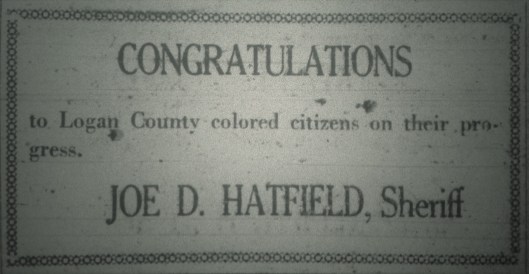
Joe Hatfield Congratulates Colored People LB 04.16.1929.JPG

Logan (WV) Banner, 16 April 1929.

Walter R. Thurmond Testimony about Labor Conditions in Logan County, WV (1921)

28 Friday Sep 2018

Posted by Brandon Ray Kirk in Coal, Guyandotte River

≈ Leave a comment

Tags

Appalachia, coal, Committee on Education and Labor, Democratic Executive Committee, deputy sheriff, Don Chafin, Guyandotte River, history, Logan Coal Operators Association, Logan County, Mine Wars, miners, sheriff, U.S. Senate, Walter R. Thurmond, West Virginia

TESTIMONY OF MR. W.R. THURMOND.

Testimony of W.R. Thurmond, given before the Committee on Education and Labor of the United States Senate, at a hearing had in the City of Washington on October 26, 1921.

The witness, having been first duly sworn by the chairman, testified as follows:

THE CHAIRMAN: Mr. Thurmond, what is your position with the coal operators?

THURMOND: President of the Logan Coal Operators Association.

C: What is that Association?

T: The Logan Coal Operators’ Association is a voluntary association composed of 66 operating companies, located in that part of Logan County lying on the waters of the Guyan River, and operating 134 mines.

C: What percentage of the miners of Logan County belong to unions?

T: Only about 5 per cent, and none of them are in that part of Logan County. I have a map here that I think will show.

C: How much has your association contributed these different years to the payment of deputy sheriffs?

T: I have the years 1920 and 1921.

C: All right, sir.

T: The reason I did not go behind that year, you have that information in the governor’s investigation of West Virginia, which I understand was available to this committee.

C: Give us those two years.

T: Last year was $46,630, and was 4.9 mills on each ton of coal mined.

C: You have a system of assessing against each ton mined?

T: No, sir. I am giving you that for this reason. The newspapers had an article purporting that the Attorney General said to this committee that there was 10 cents a ton levied on every ton of coal shipped out of Logan County for the purpose of paying deputies, and I got this on this tonnage basis to refute that.

C: Four and nine-tenths cents.

T: Mills, not cents.

C: Oh, 4 mills?

T: Yes, less than one-half cent.

C: I do not remember that he said that, but he may have said it. Did he say it the other day before this committee?

T: No, the newspapers carried an article purporting him to have said that. I do not know whether he did or not. The public got that.

MR. AVIS: That 4 mills was for last year?

T: That was for 1920.

C: Can you figure any amount according to production of coal in tons among the officials?

T: No, sir.

C: What was it this year?

T: It is $61,517 up to and including September. Now, there are three reasons why there is an increase there this year, first the population of the county is growing each year, and new operations opening up, and we have more men, and the second reason is we are paying them a little more salary than last year, and the third and principal reason is this trouble which came on, and which we anticipated.

C: There were a good many new deputies sworn in during the trouble, were there not?

T: Yes, sir.

C: Did you people pay any of those deputies?

T: We paid that sum to the regular force.

C: How did you do that? Did you give a check to the sheriff?

T: Yes. We paid it to the bank. He rendered an account. Senator Shortridge asked if that was paid to the county treasurer. We have no county treasurer. The sheriff takes charge of those duties.

C: You paid that to the bank to the credit of the sheriff?

T: Yes, sir.

C: Did you pay it all at once?

T: Monthly.

C: Monthly?

T: Yes, sir. He gave us a statement.

C: How many deputies in 1920 did this $46,000 pay for?

T: I don’t know.

C: How many did they have in that county.

T: They have 54 now. There are 54 officers. That includes the sheriff himself and the elected officers.

C: It seems to me some one told us at Logan—and yet I do not want to be certain about that—that there were 50 deputies last year paid in that way.

T: I think you asked me that question, and I think you asked, “How many deputy sheriffs did you have?”

C: That is possibly true.

T: I said approximately 50 and I think later corrected the testimony and said I understood there were 54.

C: How many were there this year?

T: That is this year.

C: That is this year?

T: That is this year, yes.

C: You mean 1920?

T: 1921.

C: I am asking about 1920. You gave us the amount of money but I want to know how many deputies were employed in that way in 1920.

T: I don’t know.

C: You do not know?

T: No, sir.

A: I understood the witness to say the 54 included all the county officers.

C: I understood him to say there were some other officers.

T: There were six justices of the peace.

C: What salaries were paid to these deputies?

T: $175 a month.

C: $175 a month?

T: Some of them, and some $150.

C: Do these deputy sheriffs act as guards for your property?

T: No, sir.

C: They act as general deputy sheriffs?

T: Yes, sir.

C: Do they serve process around the county?

T: Yes, sir.

C: And arrest men who have no connection with your company?

T: Yes, sir.

C: Are all these deputies paid $175 a month?

T: No, not all of them.

C: The sheriff would know the exact number?

T: Yes, sir. He would know about that. I know they are not all paid that.

C: How long has that system of furnishing money to pay deputy sheriffs by the coal companies continued? How long has it been in operation?

T: I can not give you the exact number of years, but I think about 8 years.

C: Do you know whether that is carried on in any other county in West Virginia?

T: I don’t know, sir. The other gentlemen can testify to that.

NOTE: In 1921, Mr. Thurmond was chairman of the Democratic Executive Committee in Logan County, WV.

Sociologist Jerome Davis Letter about Labor Conditions in Logan County, WV (1923)

25 Tuesday Sep 2018

Posted by Brandon Ray Kirk in Battle of Blair Mountain, Coal, Logan

≈ Leave a comment

Tags

American Sociological Society, Appalachia, coal, Colorado, Dartmouth College, deputy sheriff, Don Chafin, Edgar Combs, Edward F. Moore, H.W. Houston, Hanover, history, Industrial Management, Jerome Davis, Logan, Logan County, Macmillan Company, New Hampshire, notary public, Pennsylvania, sheriff, United Mine Workers of America, West Virginia

State v. Edgar Combs

Affidavit

Filed in open Court

Oct. 15, 1923

***

The American Sociological Society

Dartmouth College

Hanover, N.H.

August 1, 1923

As a teacher in Dartmouth College I have been called on to make several investigations into conditions in coal mining regions in Colorado and Pennsylvania. One of my studies was published by the Macmillan Company and another by Industrial Management. I have never been connected in any way with a labor union and believe that my testimony is impartial.

I have recently been to West Virginia for the purpose of studying conditions in the coal industry there. I was in the state for a total of about a month during June and July of this year. For the major part of this time I was in Logan County or in the surrounding counties.

I found it extremely difficult to secure affidavits from coal miners and others because they stated they were afraid of Don Chaffin and his Deputy Sheriffs. It seemed to be the general consensus of opinion that any person connected with the United Mine Workers of America would not knowingly be permitted to remain in the county and might be subjected to violence. I counted the names of over two hundred deputy sheriffs in the court records of the county and Don Chaffin informed me that the unions had so far been successfully kept out of the district.

Whether justified or not, operators and officials with whom I talked in Logan seemed to feel especial bitterness against H.W. Houston, Attorney of the United Mine Workers of America. It seems to me probable that necessary witnesses for the defense would be reluctant to testify fully and freely, and that they might actually be afraid to attend court for any considerable time. I know that there are a large number of responsible citizens of Logan County who share this belief, although they may not be willing to testify publicly for the reasons given above.

Jerome Davis

Taken, subscribed and sworn to before me this first day of July, 1923.

My commission expires on the 17th day of Feb 1928.

Edward F. Moore, Notary Public

***

For more about Jerome Davis, follow these links:

https://en.wikipedia.org/wiki/Jerome_Davis_(sociologist)

http://archiveswest.orbiscascade.org/ark:/80444/xv87313

https://fdrlibrary.org/documents/356632/390886/findingaid_davis_jerome.pdf/d0d4b6dd-6e43-4263-8167-789da6b972dc

Aracoma Memorial in Logan, WV (1936)

22 Saturday Sep 2018

Posted by Brandon Ray Kirk in American Revolutionary War, Logan, Native American History

≈ Leave a comment

Tags

American Revolution, Appalachia, Aracoma, Aracoma Hotel, Bluestone River, Boling Baker, C.A. Davis, Cornstalk, Daughters of the American Revolution, Edwin Goodwin, Elmer McDonald, Harris Funeral Home, history, Jimmy Browning, Logan, Logan Banner, Logan County, Lyle Burdette, M.R. Atkinson, Montgomery County, Native American History, Native Americans, photos, sheriff, Virginia, W.C. Turley, West Virginia

IMG_3735

Aracoma Memorial at the Logan Courthouse, Logan, WV. 18 May 2017.

Princess Aracoma Memorial Given to the Public by D.A.R. Chapter is Formally Unveiled and Dedicated

The monument to Princess Aracoma was dedicated yesterday afternoon by the local chapter of the D.A.R. which bears her name, with a brief ceremony in which the romantic history of the chief of the first tribe known to have settled in this vicinity was reviewed.

The dedication service took place at 4:30 o’clock at the northeast corner of the courthouse, and was opened with an assembly bugle call by Boy Scout Edwin Goodwin. Rev. M.R. Atkinson led in prayer and Jimmy Browning gave the salute to the flag.

Mrs. S. Elmer McDonald, regent of Aracoma chapter, presided, saying, “We have gathered here to honor Princess Aracoma, an Indian princess who with her tribe first settled in this valley.”

W.C. Turley, whom Mrs. McDonald introduced as the descendant of one of the oldest families of the county gave a talk reviewing the traditional settling of the Indians in this vicinity.

“I think it striking evidence of patriotism for your Princess Aracoma chapter to place this monument in memory of Princess Aracoma,” he said.

Mr. Turley said that Princess Aracoma was born somewhere between 1740 and 1745, the daughter of Cornstalk, chief of the Shawnee Indians, who was killed in the first land battle of the Revolution.

“When the princess was a young girl she interceded in behalf of Boling Baker, a white soldier who had deserted from the British army and had been captured by her tribe. Through her plea his life was spared and he was initiated into the tribe.

“According to the Indian custom, when Princess Aracoma became of age she was given a portion of the tribe to settle under her leadership in new hunting grounds, and chose the island first settled in this territory. Shortly after settling in their new home, the Princess and Boling Baker were married at a large ceremony attended by Cornstalk and other chiefs.

“The tribe lived happily and prospered until, in 1776, a plague struck them taking many of their members including all of the children of the princess and her white husband.

“Baker, seeking to replenish the goods of the tribe went with some scouts to a settlement on the Bluestone river, where, posing as an escaped captive, he gained the confidence of the settlers. Then one night he led his scouts in a raid on the camp, stealing their horses and provisions.

“The sheriff of Montgomery county, of which Logan was then a part, designated Col. Breckenridge and Gen. Madison to lead a force of 90 men to seek revenge on the Indians. In the ensuing battle, which took place near where the power plant now stands, Princess Aracoma was killed.

“According to tradition, she was buried somewhere in the vicinity where the Aracoma Hotel and Harris Funeral Home now stand. Skeletons and Indian burial pieces were unearthed when the excavation for these buildings was made.”

At the close of Mr. Turley’s address, the monument was unveiled by Mrs. Lyle Burdette and Mrs. C.A. Davis.

Source: Logan (WV) Banner, 28 October 1936.

NOTE: This article incorrectly references the Battle of Point Pleasant as part of the American Revolutionary War.

Recollections of McKinley Grimmett of Bruno, WV 4 (1984)

07 Friday Sep 2018

Posted by Brandon Ray Kirk in Coal, Hatfield-McCoy Feud, Italian American History, World War I, Wyoming County

≈ Leave a comment

Tags

Accoville, Appalachia, Bill Mosely, Bruno, Buffalo Creek, Burl Christian, Cap Hatfield, coal, crime, Cub Creek, Democratic Party, deputy sheriff, Devil Anse Hatfield, Don Chafin, Elech Luster, Elech Steven, Elk Creek, genealogy, Harve Grimmett, Henderson Grimmett, history, influenza, Italian-Americans, Joe Browning, Joe Hatfield, justice of the peace, Logan County, Logan Lumber Company, Mallory, Mallory Coal Company, Matilda Hatfield, McKinley Grimmett, Nancy Grimmett, Phil Elkins, Sand Lick, Scott Browning, sheriff, Spice Creek, Tennis Hatfield, Thomas Hatfield, Watt Elkins, West Virginia, World War I, Wyatt Belcher, Wyoming County

McKinley Grimmett was born on November 30, 1896 to Henderson and Nancy (Hatfield) Grimmett at Sand Lick, Logan County, WV. On May 14, 1916, Mr. Grimmett married a Ms. Plymale, who soon died, in Logan County. One child named Alva died on June 21, 1919 of whooping cough, aged fourteen months. His World War I draft registration card dated September 12, 1918 identifies him as having blue eyes and light-colored hair. He was employed by Mallory Coal Company at Mallory, WV. On November 13, 1919, he married Matilda “Tilda” Hatfield, daughter of Thomas Hatfield, in Logan County. He identified himself as a farmer in both of his marriage records. During the 1920s, he served as a deputy under Sheriff Tennis Hatfield.

The following interview of Mr. Grimmett was conducted at his home on July 17, 1984. In this part of the interview, he recalls his occupations. The post-World War I flu pandemic, early Bruno residents, timbering, the Hatfields, politics, and crime are featured.

***

Do you remember the flu that came along after World War I?

Oh yeah, I’ve seen ‘em up here in my graveyard bury as high as three or four in one day. Buried a man and his wife and kid all in one day there. It was bad. I was running a drum at Mallory for the company. I went there well that morning and at 10 o’clock they hauled me back in a jo-wagon. I couldn’t walk with the flu. I was down for four days and the mine didn’t run. I got over it awful quick. The doctor come… Dr. Shrewsbury, used to be at Mallory. Next day was Saturday and Sunday and he told me to stay off for Monday. And he said he’d send after me. Come and get me, bring me back in the evening. All he wanted me to do was run the drum. Not get hot or anything. I got over mine. My sister come there to see me. She had seven kids. She come there and took it. And all her kids come to see her and they all took it. And her husband come to see about them and he took it. And her husband couldn’t talk plain. Keenan Walls was her husband. He called onions “inghams.” My mother would say, Keenan, what do you want to eat today? They fried them. She’d fry them onions. He said, I don’t know hardly unless you fry me some more inghams. Yeah, they’s about 250 graves in that graveyard of mine.

Tape stops.

There’s a lot of people up this creek. Used to be there wasn’t about six families when I was a boy growing up. Wyatt Belcher lived down below the mouth of the creek. And Burl Christian lived up here a little ways. And Watt Elkins lived over there. And my daddy lived next. And my daddy’s brother Harve Grimmett lived next. Phil Elkins lived next. Now in the head of the creek where this backland was, that was before McDonalds got a hold of it. They lived on it, built log houses and everything else. I couldn’t tell you who all… Mountses there. I made several caskets. I made my mother’s coffin. I bought my daddy a steel coffin and I had to take some straw out of it. He was a pretty good sized man like myself. They both had the flu. And she had a lot of chickens here. I lived up at the old homeplace and they lived here. She wanted to know where that straw come from. I told her the truth about it. I told her I had to take it out of Daddy’s casket. It was a little too tight on him and I wouldn’t put him away that way. And said, Kin—she called me Kin, my nickname—said, whenever I die I want you to make my casket. She’d seen me make so many, you know. She wanted me to do that. And so I made it. I went to Logan and I bought the handles. It cost me $105 dollars. Looked like silver. And I bought plush stuff and lined it and everything. And I went down here to this planing mill and I bought the first class lumber. Didn’t have a knot in it. Logan Lumber Company run it then. And I made it. Oh, I’ve made oodles of ‘em. I made the old man Joe Browning’s in Spice Creek up here one time… And he’d sawed beech lumber now for me to make that casket out of. And old man Scott Browning, I got him to help me. And I bet you he weighed about 300 pound. And that beech lumber was 22 inches wide and I still had to put a slab on each side up at his hips down about four inches wide on each side. They couldn’t get enough men around that to lift it. I don’t see how they ever got it down in the grave. I didn’t go to the grave with ‘em. I made the casket and that was all.

Would you rather work with timber or coal?

Well, it’s according to what kind you do with lumber. I believe I would rather work in the mines because I’ve always had a good job in the mines. I worked 44 years and two months around the mines and I never was laid off. Born and raised here in Logan County. Never been in jail. Never been arrested. Never been sued. I never bothered nobody’s business only my own. I’ve been honest with everybody.

Were you ever politically active?

Yeah, I was, whenever them Hatfields was in there. They’d make you, whether you wanted to or not. Tennis and Joe and all of them. You get in that bunch of Hatfields at that day and time you couldn’t get away from ‘em. They’d claim me as their cousin all the time, ‘cause I was half-Hatfield myself. I don’t reckon my mother was any relation to any of them. She didn’t know nothing about them. She was from Wyoming County up on Big Cub Creek, you know. Now she heard lots of talk about Devil Anse and Cap and all of them. She was afraid for me to be with them all the time.

Did you like politics?

Yeah, I liked it pretty good.

Did you ever run for office?

Yeah, I run for JP one time. ’52. Bill Mosely run against me. And I beat Bill over here at his office precinct but he beat me up at Buffalo. Yeah, I run for JP one time. I never did run any more.

Who has impressed you the most in politics?

I reckon Tennis has been the one. Now Joe is a man that was still kind of sulky like. He didn’t seem like that he appreciated what you’d done or something like that. Either that or he thought hisself a little bit higher than you was. Something like that. I don’t know. I couldn’t figure him out. But Cap now, he’d cuss them out and everything else.

Do you remember the ’32 election?

Oh yeah. I remember. Why, coal companies, they went in with the Democrats and they fired us off of the deputy force. The coal companies put us on as guards. And we stayed that way for about three months. And Democrats come in and they cut that law out. And we went on back to work and that didn’t change nothing. I tell you, it was a sight whenever Chafin was in there. Lord, they killed people and everything. Up Buffalo at Accoville, they was building a railroad up through there. Well, that day and time they built camps for their men to stay in and they rode horses, the bosses did, ride him right out on the job. And they’d get up in the morning, Elech Steven and Elech R. Luster was the two bosses—one was superintendent, one was boss—and they’d go around, one had a ball bat and a hole drilled through it and a strap of leather in it and it was a small ball bat now and if them colored people or hunkies and Italians wasn’t up they’d knock the window lights out and then nail the window up instead of buying them a window and putting it back in. And they killed them two, the hunkies and Italians. They come out on ‘em and shot ‘em both and killed ‘em. About eight of them. Well, they killed three of ‘em before they got out of sight, the Americans did, up Accoville Hollow there. And the rest of ‘em come through and they shot one right over the Huff Knob and he rolled plumb from the top of that ridge down just like a dog bouncin’ plumb into the river. That made four of ‘em they got. Then they got two more up here on Elk Creek. Then they got two more up at Spice. Made the eight. Well, they killed them all. And they brought them—I was up there at the store at Elk Creek whenever they brought them two Italians down there… Now, this old raw bacon. Slabs that come that wide and be that long, grease would be running out. And they would cut them off raw meat and throw it to them like throwing it to a dog and they’d eat it.

NOTE: Some names may be transcribed incorrectly.

Recollections of McKinley Grimmett of Bruno, WV 3 (1984)

06 Thursday Sep 2018

Posted by Brandon Ray Kirk in Coal, Hatfield-McCoy Feud, Logan, Timber, World War I

≈ Leave a comment

Tags

Appalachia, assessor, blacksmith, Bruno, Burl Stotts, California, Cap Hatfield, Christian, Christmas, coal, Devil Anse Hatfield, drum runner, Edith Grimmett, Elba Hatfield, Elk Creek, Ellison Toler, genealogy, Harvey Ferguson, Harvey Howes, Hatfield-McCoy Feud, Henderson Grimmett, history, Huff Creek, J.G. Hunter, Joe Hatfield, Johnny Davis, justice of the peace, Logan, Logan County, Mallory, Mallory Coal Company, Matilda Hatfield, McKinley Grimmett, mining, Nancy Grimmett, Osey Richey, politics, pushboats, rafting, Ralph Grimmett, Rum Creek, Sand Lick, sheriff, Smoke House Restaurant, Tennis Hatfield, Thomas Hatfield, timber, West Virginia, whooping cough, Willis Hatfield, World War I

McKinley Grimmett was born on November 30, 1896 to Henderson and Nancy (Hatfield) Grimmett at Sand Lick, Logan County, WV. On May 14, 1916, Mr. Grimmett married a Ms. Plymale, who soon died, in Logan County. One child named Alva died on June 21, 1919 of whooping cough, aged fourteen months. His World War I draft registration card dated September 12, 1918 identifies him as having blue eyes and light-colored hair. He was employed by Mallory Coal Company at Mallory, WV. On November 13, 1919, he married Matilda “Tilda” Hatfield, daughter of Thomas Hatfield, in Logan County. He identified himself as a farmer in both of his marriage records. During the 1920s, he served as a deputy under Sheriff Tennis Hatfield.

The following interview of Mr. Grimmett was conducted at his home on July 17, 1984. In this part of the interview, he recalls his occupations. Tennis Hatfield, Cap Hatfield, Joe Hatfield, Willis Hatfield, pushboats, Logan, World War I, coal, and blacksmithing are featured.

***

What about Tennis and Joe Hatfield?

But now they come out, they paid all their debts and everything and stuff like that. They was honest, as far as I know. I think both of ‘em went broke, they was so good to the people. They had all kinds of things… Tennis had a five thousand dollar ring and he pawned it to the First National Bank and somebody got the ring. I don’t know who did. Tennis didn’t get it back. They both lost everything they had. And not just only them. Osey Richey, he was assessor and J.G. Hunter was assessor, and they lost all they had. People just, after they got elected and everything, thought that they had to furnish ‘em whether they had it or whether they didn’t.

Tennis and Joe were too young to participate in the Hatfield-McCoy Feud.

Oh yeah. That happened before I got big enough, Cap and them. Cap was chief deputy, though, while I was on. I can remember some of it. Just hear-says. I don’t know nothing about it. Ellison Toler was related to them someway and he stayed at my daddy’s and they kept him up for killing somebody over there at Welch and they hung him there at Welch yard on a tree. I remember getting into my daddy’s papers and reading the letters after I was just learning in school about such stuff like that. And I thought that was the awfulest thing ever was, writing to him and telling about it.

What changed in the county for the Hatfields between the feud and the 1920s?

Mostly, they died out to tell you the truth. Joe and Tennis died out and nobody else had guts enough to take it, you see? Now, Willis, he was the youngest brother. Elba, now he was JP and after he got out as JP he pulled out and went to California. And Willis, he died here about a year ago up on Rum Creek. And Tennis and Joe both died. And that was all of ‘em. All of the old people. Harvey Howes married their sister, and they’re all dead.

Did you ever talk to Cap or Willis?

Oh yeah. Willis, they’d hang after me all the time. They knowed I was half-Hatfield, you know. Tennis and Joe would, too. They was awful good to me ever way. Now Cap, I never – Cap just had one word for a person. If he wanted to talk with you, he’d say, well let’s talk a while, and if he didn’t, he’d say, get the hell away from here. That was the way Cap was. Devil Anse, he used to kill a beef and roast it every Christmas, you know. I’ve went there and eat with him a lot. They tell me they wouldn’t know that place now. They’ve cleaned the graveyard up, you know. I ain’t been up there in… Be five years in January since I got down and I ain’t been away … Only one takes me anyplace is my daughter Edith and Ralph and Edith’s working all the time and Ralph’s all the time busy and Ralph takes me to the doctor every month and Edith took me to the store back and forth and Ralph took me last Saturday.

How has Downtown Logan changed since you were young?

Oh, it’s changed a big lot. Built more buildings in it and everything. Used to be you had about three or four policeman and that was it. Now I can remember back whenever they had a wooden courthouse. A boxed building. I was just a big boy then. Daddy followed rafting and pushboating. You know what pushboating is? Well, they had a big long boat. He had two. And one of ‘em was about eight feet wide and about 46 feet long. Other one was about twelve feet wide. And they had to catch water to get that big boat. And sixteen foot wide. And they’d take a pair of mules or horses, whichever they had, and they’d go to Logan and buy groceries. He had a store and he boated most of his stuff. They’d kill hogs and take chickens and catch fish and take it down to Logan and sell it and they’d bring groceries back.

And they’d make these trips how often?

He went every week. It would take two days to make it, very best. You had from daylight to dark.

Tell me more about your work history.

Well I was a blacksmith. Worked in electric force. They knew I was going to fire. Harvey Ferguson was superintendent. Johnny Davis was general manager. They knowed how old I was. They knowed I was going to retire. I left Christian over here. They shut down. Johnny Davis offered me a job and offered me a job and I wouldn’t take it. I met him right at the foot of the hill. He was a boss over some Elk Creek mine. Well, I went and worked about six months lacking two days for Burl Stotts over there in Campbell’s Creek, built a tipple he fell off of and got killed. I come back and Johnny had come in home that week and Johnny and Harvey Ferguson had been up here and they wanted me to come around there and talk with them on Saturday night. I went around there. They said Johnny said he wanted me to come back up and work for him. I said, well you won’t give me enough. He said, how much you getting? I told him. He said, well I’ll give you three dollars on the day more. I said, well I’ll do it. The rates was 24 dollars. Union then. He give me 27 dollars. I wasn’t getting 24 and going over there and paying board, you know. So I said, well I’ll go back over there and work next week and pay my board up. I wouldn’t walk right off the job from him. He was a good fellow. And he was good to me. And he liked me and everything. And he give me all he could give me. They said they appreciated that, Davis and Harvey Ferguson both. That I’d do a thing like that. So I went back and worked that week and paid my board and come back and went up there and stayed with him fourteen years and retired. In November 30, 1962.

Do you remember anything about your last day?

No, they give me a pair of gloves and Johnny told me that he was going to put a ten dollar gold piece in my envelope. And he did.

What about World War I?

Well I was called… I was drum runner. The superintendent come down in the drum house where I was at. The superintendent said I see you are called for service. I said, Yeah, two more weeks will be my last. You better get somebody in here and let me learn him while I can. He said, we were studying about that. Do you want to go? I said, no I don’t want to go but I guess I’ll have to go. Kaiser was his name. He said, We’ll see what we can do about it. I’ll let you know and I’ll keep you posted at all times. Well, that was on Monday morning, I believe it was. On Saturday evening, I had to work six days a week, Saturday evening he wanted me to come over to his office. That was around on Huff Creek, at Mallory 1. And I went over there. He said, I think I’ve got you retired. He said, We’ve got to have coal men as well as army men. Just don’t say anything about it to none of the boys. You’ll not have to go. And that was all of it. I never did have to go. But I registered five different times for the service. Last time I registered, they took everybody. They didn’t get too old—I registered them all. And the company put me in a little old room beside the store and furnished my eatings for that day paid me for my day’s work and the government never did pay me a cent for none of it. Five different times. Now at first start I had to take them, I had to keep a tally of how many registered, had to take them to Logan and send them out, call in to Washington and tell them how many I registered and everything. Now the last time, I didn’t have to do that. A man come and got ‘em the next day.

Who taught you how to blacksmith?

Oh, I taught myself. My daddy used to shoe horses and I used to help him in the shop. That’s the hardest job ever I got in, shoeing horses or mules. Dangerous job, too. I’ve had them kick me plumb over top of… At that time you had belluses you blow. They’d kick me plumb over top of them belluses. Almost kill me sometimes.

Were there any blacksmith shops around Logan when you were a boy?

Oh yeah. There was plenty of them. There in Logan there was a big one. A fellow named White was the blacksmith down there. Boy, he’d whip a mule. He kept big old hickory poles in there and a mule or horse that didn’t hold still or anything he’d throw its leg down and grab one of them poles—I’ve been in there and watched him—and he’d beat that mule… I swear, I’d be uneasy about it. Think he was going to kill it. It would just quiver like a leaf.

Where was his shop?

Right where the courthouse sits now. There was a wooden courthouse. Box building. Two-story high. And his blacksmith shop was right on down the street. I’d say it wasn’t quite down to the Smoke House. Not quite down that far. Over on the right hand side. It was a big old boxed building and a shed to it. He’d get dirty coal. He was too tight to buy the coal or something. And he’d have enough smoke go all over that town. Yeah, I remember all about that.

NOTE: Some names may be transcribed incorrectly.

Recollections of McKinley Grimmett of Bruno, WV 2 (1984)

03 Monday Sep 2018

Posted by Brandon Ray Kirk in Battle of Blair Mountain, Coal, Italian American History, Logan, Man

≈ Leave a comment

Tags

Alva Grimmett, Appalachia, Barnabus, Blair Mountain, Bruno, Buffalo Creek, Cabin Creek, Campbell's Creek, carpenter, Charleston, Christian, coal, Democratic Party, deputy sheriff, Don Chafin, drum runner, Ed Goodman, Emmett Scaggs, George McClintock, Great Depression, Hatfield Bottom, Henderson Grimmett, history, Joe Hatfield, John Chafin, Kanawha County, Kistler, Landsville, Logan County, Mallory, Mallory Coal Company, Matilda Hatfield, McKinley Grimmett, moonshining, Nancy Grimmett, prosecuting attorney, Republican Party, Sand Lick, sheriff, Superintendent of Schools, Tennis Hatfield, Thomas Hatfield, United Mine Workers of America, West Virginia, Wild Goose Saloon

McKinley Grimmett was born on November 30, 1896 to Henderson and Nancy (Hatfield) Grimmett at Sand Lick, Logan County, WV. On May 14, 1916, Mr. Grimmett married a Ms. Plymale, who soon died, in Logan County. One child named Alva died on June 21, 1919 of whooping cough, aged fourteen months. His World War I draft registration card dated September 12, 1918 identifies him as having blue eyes and light-colored hair. He was employed by Mallory Coal Company at Mallory, WV. On November 13, 1919, he married Matilda “Tilda” Hatfield, daughter of Thomas Hatfield, in Logan County. He identified himself as a farmer in both of his marriage records. During the 1920s, he served as a deputy under Sheriff Tennis Hatfield.

The following interview of Mr. Grimmett was conducted at his home on July 17, 1984. In this part of the interview, he recalls his occupations. Coal, Don Chafin, Tennis Hatfield, unionization, and the Great Depression are featured.

***

Did you ever go to work in the mines?

Oh yeah. I’ve been… That’s what I done over here for 44 years and two months, in and around the mines.

Who hired you?

Yeah, a fellow by the name of Frazier down here at Logan. Superintendent. Not at Logan. Landsville. I stayed there four years, pretty nigh of five years. Then I quit down there and I come to Christian and I stayed up here. A fellow by the name of Harry Venebale hired me over here, the superintendent. And I stayed with him 34 years. Wouldn’t let nobody else hold a lever but me. Drum runner. I’d run as high as 35 railroad cars a day off of that hill. I’ve done it many a day.

Did you do other jobs?

Oh yeah. Days the mines didn’t work I was the carpenter boss. That is, I was overseer over ‘em all. After the union come in, why I wouldn’t take it as a boss. They just run me as a leader, you know. At that time, I’d either have to go in as a boss or get off the union, you know. And I knowed the union was the best for me and I stayed with the union.

Did you have any role in organizing the union?

Oh yeah. I had a big… They wouldn’t let us organize on their property. We had to go across an island over there in the river and have our meeting to organize.

Is it true that local men had the union organized and were waiting for Washington to allow it?

Yeah, that’s about right. We got it. No, they come from Cabin Creek and Kanawha County and Campbell’s Creek over there and tried to organize us. Don Chafin was the high sheriff. He got so much ton per coal and everything. And we couldn’t do a thing because he had every child, woman, and everything else on his side to block us every way. They come to Blair Mountain and had fights. Killed several people, too. Both sides. But I never was in it. I was running a drum and they never did ask me to go. But they paid ‘em. They did go from over there. And went from around here, too. To fight against them, you know. And there was several of them got killed up Dingess Run there. I’ve been at the place where one fellow, sink hole he was in. There was four of them got killed: deputy sheriffs. George Gore and a fellow by the name of Mitchem. I don’t know the other two. I’ve forgot ‘em now. George Gore and Mitchem. But I know where they was at and everything there.

Can you describe Don Chafin?

I’m not too familiar with him now. But he controlled Logan County all the time. Whatever he said, why they had to do or they’d get around you and beat you to death or something like that, throw you in the river, tie your hands behind you – stuff like that.

Were you a Chafin deputy?

I worked for Tennis Hatfield and Joe.

How did Tennis hire you?

Well, Emmett Scaggs run against him. And the County Court was Democratic and they give it all to Emmett. Tennis carried it up to the high court and he won it. About that time, that’s when it was, 1922 I believe it was, last part of 1922, well Emmett, he was a well-educated fellow, he had been the superintendent of schools and everything, he turns around and registers and turned to be a Republican, well then they appointed him prosecuting attorney. You understand? Give him a job. Now the Democrats didn’t do that—Tennis and all of them did. It made a full change around whenever Tennis was elected. The County Court had been Democratic all the time and it turned over, changed hands, and make a Republican County Court. Just like they’ve got now, it’s all Democratic. And a Republican couldn’t get nothing. I’ve seen John Chafin and Hi beat an Italian man. He had two ducks carrying them. Had to wade the river. They fired him over there at Christian. Had to ride horses that day and time. Didn’t have no cars. And they jumped off their horses after they overtook him and they beat him until he couldn’t walk. My dad had a store down at the mouth of the creek and he went and got him and got him up to the store and his ducks got loose. And Mother got the ducks and she raised all kinds of ducks from ‘em. But I haven’t seen that man from that day to this. He’s dead now. But they liked to beat him to death. Now Henry Allen was another one. They barred him from the union. He was a big organizer when it first started. And he got to playing crooked work and they put him out of the union. And he’d done something or other to the party. And they beat him around there at Kistler so hard – the creek was up. Buffalo was a big creek any way. They throwed him up there at Ben Gall’s store in the creek and he washed down there at Kistler and lodged up behind the middle pier at the railroad track. Some men run in and helped him out. I forget who it was. I didn’t see that go off but that’s what happened. Well, he come up here, Henry did, to where I was walking and wanted me to get him a job. Well, I told him I would talk to the boss. A fellow by the name of George Kore. George Kore give him a job working for Tony Lumber Company, helping build houses, you know. He worked about three days and why George fired him and wouldn’t have nothing more to do with him. Henry’s dead now. That’s the last I knowed of him.

Do you remember the names of any early union organizers?

I never did meet ‘em. I tell you they kept me busy all the time as a repair man and drum runner, and days that the mines didn’t run I had to do repair work on the houses and tipples and stuff. Them organizers was, one of ‘em was a fellow by the name of Hall. I’ve seen him but I forget his first name. He had an office over there in Charleston. He was president of the union then. Don Chafin went over there and aimed to tell him what to do and he shot Don. It put Don in the hospital for a long time. After he got out there, Don Chafin and Tennis Hatfield had been in to the Wild Goose business selling bootlegging moonshine whisky up at Hatfield Bottom [in Barnabus]. And they fell out. And Tennis, he goes before the federal grand jury. I forget who the judge was. I knowed him. [George McClintock] And Tennis indicted him and sent him to the pen for four years. But they never did do nothing to Hall for shooting him over there in the miners’ office. But he never did go back in it anymore.

You remember when the mines began to mechanize?

Oh, yeah. I was in there then. I worked up til ’62.

How did the mines change?

Well, they loaded by the car that day and time when they first started. Then they got conveyors in. And they cut the coal and they throwed it on them conveyors by hand. And they built belt-lines from here all across the river, just as far as you wanted to, you know. Had different offsets in it and different motors pulling the belt line. And it come out into a big tipple and dumped into a tipple and then I took it from that. I run it 2100 feet down the incline over there on two monitors on three rails. Now you figure that out. Ten tons to each monitor Now they come up there to the middle way place and they put four rails, you understand? And then one monitor passed the other one at that middle place. All the time. They had a big drum. The drum was twelve foot in diameter and fourteen foot long that way. Built out of gum. Six by six gum. Rope was inch and a quarter.

Was there much bitterness among people when mechanization started?

Oh, no. They was all for it. They was everything was settled. Whatever the union said, they had to do at that time. It was all loaded by the ton by the car. There wasn’t no weighing or nothing like that ‘til they got the union. Then they had to put scales in, you know, and weigh these cars of coal and they had to pay so much a ton. Why, there was people over there at Christian – I never will forget it. Ed Goodman was his name. He’d be broke every week. He’d never load over four or five cars. Just 35 cents a car and a car would hold about four tons, five. And they was starving him to death. He’d come in there on paydays and I’d come in. I was always the last man getting off the hill. He was wanting on dollar scrip. He’d come over and whisper to me and tell me they wouldn’t let him have a one dollar scrip. And I’d vouch for him. Sometimes I’d pull my pay envelope out—they put your money in a pay envelope, you know—and I’ve pull out my pay envelope and give him a dollar and that would do him until Monday. He had a big family. They all weren’t home at that time. He managed. And then when the union come in, they had to treat him the way they did the rest of them.

Did you maintain steady work during the Great Depression?

Yeah. I’ve always had work. I get awful good Social Security. I study all the time – they worked me too much. I actually couldn’t stand it hardly. They’d work me Sunday and every other day. But now I never got no big money at that time. I started off at four dollars a day and I ended up with two hundred and fifty dollars a month. I stayed on that way for 19 years. They wouldn’t give me a raise. I asked ‘em for more money. Miners got a raise, you know. They said no, he couldn’t give it. Was going broke. I said well if you won’t give it I’ll be leaving you first of the month. And he didn’t think I would. Day before I was supposed to quit I sent my toolbox off the hill and everything. They had a man-car there that they rode backwards and forwards that people rode up and down the hill in. That night the man said if I would stay he would split the difference with me. Give me half. Give me twenty-five dollars. I said no I won’t do it. I’ve made you a fortune here. So he wouldn’t come up to fifty dollars and I wouldn’t come off it. Next day they had a wreck. A fella was running… I was sitting here. And they wasn’t no timber around there and I could see the monitors from here. And he wrecked and I never seen such dust in all of my life. And I got in my car and went over there. And they tore one up so bad they had to buy a new one. A monitor. That cost ‘em some money, too.

NOTE: Some names may be transcribed incorrectly.

Don Chafin Returns to Logan, WV (1926)

14 Tuesday Aug 2018

Posted by Brandon Ray Kirk in Coal, Huntington, Logan

≈ Leave a comment

Tags

Appalachia, Atlanta, Barnabus, Blue Goose Saloon, Democratic Party, Don Chafin, genealogy, history, Huntington, Logan, Logan Banner, Logan County, Mine Wars, Mingo Republican, sheriff, Tennis Hatfield, Wallace Chafin, West Virginia, Williamson

From the Logan Banner of Logan, WV, come these small items relating to former Logan County Sheriff Don Chafin, a prominent figure in the Mine Wars:

Chafin’s Petition For Parole Now In Hands of Sargeant

Attorney General Sergeant has placed the application for parole of former sheriff Don Chafin “on file,” indicating that it has been shelved temporarily according to reports received here.

It is understood, however, that the federal pardon board, sitting at Atlanta prison has recommended Chafin for parole.

Source: Logan (WV) Banner, 11 June 1926.

***

Don Chafin Freed From Prison Is Due Here on Wednesday

Don Chafin, former Logan county sheriff, received his parole from the federal penitentiary at Atlanta this morning at 10 o’clock, according to word received here at noon by Wallace Chafin.

The last obstacle for his parole was removed several days ago when an indictment against him in the federal court at Huntington was nollied.

Chafin left Atlanta immediately upon his release and is expected to arrive in Logan Wednesday night.

Source: Logan (WV) Banner, 24 August 1926.

***

Ex-Sheriff Chafin Returns to Logan Friday From Prison

“Don” Greeted At Station By Many Friends As He Comes Back on Federal Parole.

Don Chafin, former sheriff of Logan county, returned Friday to Logan from the federal penitentiary at Atlanta, after serving eight months of a two-year sentence imposed by Judge McClintic in federal court for violation of the prohibition act.

The former sheriff was paroled after months of strenuous work in his behalf by relatives and friends who contended his conviction was largely political.

A large number of friends met Chafin at the station in Logan on his arrival. At his request there was no demonstration here to greet him. Plans to meet him with a brass band, which had been widely broadcast, were abandoned at his request.

The former sheriff gained weight during his absence and arrived here looking well and hearty. He has consistently refused to make any statement to the press since his release at Atlanta. His only public statement in Logan for the newspaper was as follows:

“I have nothing to say for publication. All I ask is to let and be let alone.”

Source: Logan (WV) Banner, 31 August 1926.

***

Don Chafin Visits Williamson Friends In Trip On Tuesday

Don Chafin, ex-sheriff of Logan county, motored to Williamson last Tuesday morning and spent the greater part of the day here visiting friends. His visit was entirely social, says the Mingo Republican.

He stated that he was in the best of health and was glad to get back with his family and friends.

On the eve of the general election held in 1924, Chafin was indicted and tried in the Federal court at Huntington upon a conspiracy to violate the prohibition law. He had been a dominant figure in Democratic politics for many years, having held respectively the offices of assessor, county clerk and sheriff, to which latter office he was elected twice. He was sheriff of the county during the time of the armed march and gained national prominence because of his stand for law and order. He was a delegate to the Democratic National Convention held in New York City in July 1924.

It was alleged at the trial that the presiding judge was prejudiced against Chafin and several affidavits were filed to prove this. However, the judge did not permit the affidavits to be filed and the case proceeded to trial resulting in the conviction of Chafin. The principal witness against him was Tennis Hatfield, the present sheriff of Logan county, who gained the office by virtue of a decision of the Supreme Court.

The most damaging evidence introduced against Chafin was an alleged receipt which Hatfield testified Chafin had given him showing the payment of a certain sum of money which was supposed to represent the proceeds derived from operation of the once famous Blue Goose Saloon at Barnabus. Chafin alleged this paper to be a forgery and applied for a pardon on this ground.

Pending the application for pardon the Parole Board recommended Chafin’s parole and while Judge McClintic strenuously opposed it the pardon was approved by the Attorney General on Tuesday August 24, and Chafin arrived in Logan on Friday, Sept. 3. He was greeted at Huntington by several hundred of his friends and when he arrived in Logan an enthusiastic reception by friends in his home county.

It was first planned to stage a monstrous celebration but after Chafin learned of this he requested that this not be done and said that he wanted his home-coming to be of a quiet nature and to be received informally by his friends.

Throughout all of his trouble his friends proved their loyalty to him and steadfastly maintained his innocence. Many of those who met him here Tuesday have known him since boyhood.

He expressed to his friends here the intention of devoting his time to his private business. He has many large and various interests which will require constant attention and most of his time. He returned to Logan Tuesday afternoon.

Source: Logan (WV) Banner, 10 September 1926.

P.H. Noyes v. Anderson Hatfield and John R. Browning (1891-1893)

17 Sunday Jun 2018

Posted by Brandon Ray Kirk in Guyandotte River, Hatfield-McCoy Feud

≈ Leave a comment

Tags

Appalachia, Charles M. Turley, Charleston, Cincinnati, circuit clerk, deputy sheriff, Devil Anse Hatfield, Guyandotte, Guyandotte River, Hatfield-McCoy Feud, Henry W. Sentz, history, J.B. Buskirk, John R. Browning, Kanawha County, lawyer, Logan County, Logan Court House, M.B. Mullins, Marion Chafin, P.H. Noyes & Company, pushboats, sheriff, steamboats, traveling salesman, W.W. Adams, West Virginia

On October 27, 1891, P.H. Noyes and Company sued Anderson Hatfield and John R. Browning relating to an 1890 debt. The following depositions provide some details about the case:

NOTICE TO TAKE DEPOSITIONS.

To Anderson Hatfield Sr. and John R. Browning. You will take notice that on the 28th day of March 1892, between the hours of 8 o’clock A.M., and 6 o’clock P.M., at the Law office of Adams and Smith’s at the City of Charleston in Kanawha County, we will proceed to take the deposition of P.H. Noyes and others to be read as evidence in behalf of ourselves in a certain suit at Law pending in the Circuit Court of Logan County, West Virginia wherein you are defendant and we are plaintiffs and if from any cause the taking of the said deposition be not commenced on that day, or if commenced and not completed on that day, the taking of the same will be adjourned and continued from day to day or from time to time, at the same place, and between the same hours, until completed.

Respectfully, P.H. Noyes & Co., By Counsel

Executed the within notice on the within named John R. Browning and Anderson Hatfield Sr. on the 2nd day of March 1892 by giving to each of them a true office copy of the same.

J.B. Buskirk, Dept. for F.M. Chafin, S.L.C.

***

DEPOSITIONS of Witnesses, taken before the undersigned authority, in and for the County of Kanawha, in the State of West Virginia pursuant to the annexed notice, at the law office of Adams & Smith at the City of Charleston W.Va on the 28 day of March 1892 between the hours of 8 o’clock A.M., and 6 o’clock P.M., of that day, to be read in evidence on behalf of the plaintiff, in a certain suit pending in the Circuit Court of Logan County West Virginia, in which suit P.H. Noyes & Company are Plaintiff and Anderson Hatfield Sr. and John R. Browning are Defendants.

Present: W.W. Adams for Plaintiff and no appearance for Defendant.

Deposition 1: Henry W. Sentz

Q: State your name, age, residence and occupation.

A: My name is Henry W. Sentz. I am 25 years old. I reside in Charleston, W.Va. and am a traveling salesman.

Q: What connection if any have you with the plaintiffs P.H. Noyes & Co.?

A: I am employed by them as a traveling salesman.

Q: Do you know anything about the matter in controversy in this suit between plaintiffs and defendants?

A: I sold him the bill of goods and he paid me in cash the sum of $400 for the residue. He executed the note upon which this suit is based. Since that time he has paid $100 on this note.

Q: Did you ever have any conversation with the defendant Anderson Hatfield in regard to the claim for which this suit is brought? If so, when and where?

A: I am not positive as to the time, but we had conversations in regard to the claim on two or three different occasions before the institution of this suit. These conversations were had at Logan Court House.

Q: State what was said by you and by him in said conversations.

A: He spoke of the debt, and when the note became due he asked for more time on it. He said if we would give him a little more time he would pay it, and I agreed to it as far as I could and explained the matter to the house. This was before the note was sent to Mr. Turley for collection. At the expiration of the time Mr. Hatfield asked should be given him on the note, I had another conversation with him. He still wanted more time, stating that he had a land deal on foot with M.B. Mullins, and said he thought it would only be a short time until the note was paid.

Q: What if anything did he say in these conversations, about the acts on which this suit was afterwards brought?

A: He said the debt was just and he wanted to pay it.

Q: When did these conversations occur?

A: The first conversation occurred about the time the note was due. The note was for three months, I think. The second conversation occurred about two months after the first. Both of these conversations occurred before the note was placed with Turley for collection.

Q: Has the house ever given Hatfield any other credit than the $100 credit above mentioned on the note?

A: Yes. At the time the goods were sold I figured up the amount of the bill. He paid at that time $400 and then sent in the note in controversy for the residue before the goods were shipped. When the goods were shipped, it was found that the amount of the note and the $400 was in excess of the amount of the bill for the goods, and credit was given on the note for this excess.

Q: What if anything did said defendant say in said conversations with reference to the condition of the goods for which this note was given? I mean their condition when he received them?

A: He said nothing.

Q: When did he first claim that the goods were damaged for which the note was given?

A: I can’t give the exact time but it was after the two conversations above mentioned, and before I had put the note for collection in C.M. Turley’s hands, that the defendant stated to me that some of the flour had been damaged, but that he did not blame P.H. Noyes & Co. for it as the goods had been a long time in transit and he did not get them home as early as he had expected to. Part of the flour had lain at Logan Court House for some time, I think in J.B. Buskirk’s stable.

Q: By what route and conveyance were these goods carried in Logan Court House?

A: They were shipped from Charleston to Guyandotte by steamboat, and from there to Logan Court House by push-boat, which is about 80 miles up Guyandotte River. The flour was shipped from Cincinnati to Guyandotte.

Q: When did you first hear of any claim on the defendant’s part and that he was entitled to an offset because said goods were damaged?

A: It was after the institution of the suit I saw the offset filed with the papers.

Q: Has the defendant made any payments on said note except the one of which you have spoken?

A: None that I know of.

Deposition 2: M.B. Mullins

Q: State your name, residence and occupation.

A: My name is M.B. Mullins, Logan County, West Virginia, Real estate dealer.

Q: Did you ever have any conversation with the defendant Anderson Hatfield in regard to the claim of P.H. Noyes & Co. v. him which is in controversy in this suit?

A: Yes.

Q: When and where?

A: I think it has been some nine months ago at Logan C.H. We first had the conversation in Buskirk’s store and then in Turley’s office.

Q: What did he say about said debt in that conversation?

A: He and I were on a trade for some land. He said he owed this debt and asked me in connection with the trade to pay it. This I agreed to do provided he could make good title to his land.

Q: At that time, who held this note for collection?

A: C.M. Turley said he had the note for collection. He is an attorney at Logan Court House. And part of the above conversation with Mr. Hatfield was had in the presence of Mr. Turley.

Q: Do you remember anything else Mr. Hatfield said to you about this debt on that occasion?

A: He asked me to write P.H. Noyes & Co. and ask them to give him a little time on this debt until this trade went through and he would pay it, and not to sue him. I did this.

Q: How long ago do you say this conversation occurred?

A: Nine months or more and I think I wrote the letter before I left Turley’s office. The date of the letter will show the date of the conversation.

Q: Did C.M. Turley take part in said conversation between you and Hatfield?

A: Yes, sir. My recollection is that Mr. Turley said he would give us time and hold up on the suit until the title to the land for which we were dealing was examined. Turley also wanted me to write P.H. Noyes & Co. so that they would understand why he had not brought suit v. Hatfield.

Q: Did Mr. Hatfield say anything about the goods Noyes & Co. had sent him being damaged or having any offset against said claim?

A: He did not at that time and I don’t remember of his having ever told me so. My recollection of his language is that he said “it is a just debt and I want to pay it.”

***

Additional notations derived from the Logan County Circuit Clerk’s Office, Logan, WV:

Law Orders Book G, p. 277 (27 October 1891): initial entry

Law Orders Book H, p. 112-113 (24 November 1892): case continued

Law Orders Book H, p. 113 (25 November 1892): jury could not decide, jury discharged

Law Orders Book H, p. 254 (28 April 1893): no notation

Law Orders Book H, p. 254 (28 April 1893): plaintiff wins $321.95 with interest

NOTE: This case does not appear to have any connection to the Hatfield-McCoy Feud.

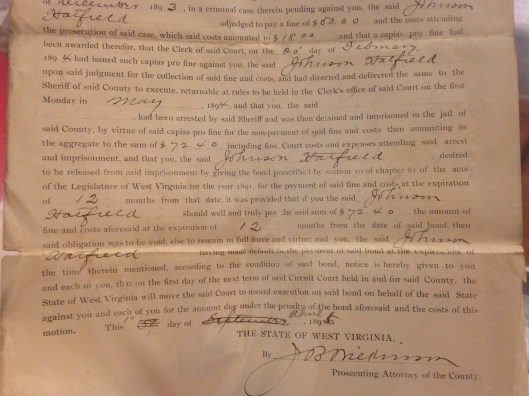
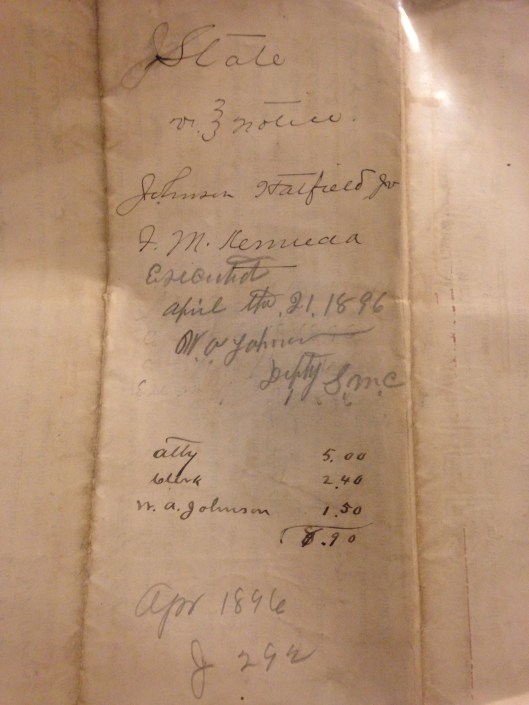
Johnson Hatfield Capias and Bonds (1893-1896)

31 Thursday May 2018

Posted by Brandon Ray Kirk in Hatfield-McCoy Feud, Logan

≈ Leave a comment

Tags

Appalachia, C.H. Gore, county clerk, deputy sheriff, Eli Gore, F.M. Kenneda, genealogy, Hatfield-McCoy Feud, history, John B. Wilkinson, Johnson Hatfield, Logan County, prosecuting attorney, sheriff, T.C. Whited, Thomas Griffith, W.A. Johnson, W.C. Browning, West Virginia

Johnson Hatfield 1894 1

Capias for Johnson Hatfield for commission of a misdemeanor, 20 February 1894.

Johnson Hatfield 1894 2

Capias, 20 February 1894. Arrested and jailed 24 April 1894.

Johnson Hatfield 1894 3

Johnson Hatfield 1894 4

Bond for $200 by Johnson Hatfield and F.M. Kenneda, 24 April 1894.

Johnson Hatfield 1894 5

Johnson Hatfield, Jr. signature (1894). Note: This crime and arrest was most likely not related whatsoever to the Hatfield-McCoy Feud.

Johnson Hatfield 1895 1

Johnson Hatfield 1895 2

Bond for $200 by Johnson Hatfield and W.C. Browning, 5 September 1895.

Johnson Hatfield 1895 3.JPG

Bond executed, 9 October 1895.

Johnson Hatfield 1895 4

Johnson Hatfield 1895 5

Bond for $200 by Johnson Hatfield and F.M. Kenneda, 1 April 1896.

Johnson Hatfield 1895 6

Bond executed, 21 April 1896.

World War I Draft Registration in Logan County, WV (1917)

29 Sunday Apr 2018

Posted by Brandon Ray Kirk in Battle of Blair Mountain, Big Creek, Big Harts Creek, Chapmanville, Halcyon, Holden, Logan, Man, Pecks Mill, Shively, Stone Branch, Whirlwind, World War I, Yantus

≈ Leave a comment

Tags

A.M. Hall, A.P. Loyd, Amherstdale, Anderson McCloud, Andrew Jordan, Appalachia, Arthur Townsend, Barnabas, Battle of Blair Mountain, Big Creek, Bilton Browning, Black Sanders, Bruce White, C.C. Chambers, C.E. Lamp, C.G. Miller, C.H. Baisden, Cam Pridemore, Cecil Mounts, Chapmanville, Charles Conley, county clerk, Craneco, Curry, Democratic Party, Dow Chambers, Earl Summers, Ed Haner, Ed Mapper, Ed Riffe, Elmer Gore, Elmer McDonald, Emmett Scaggs, Ethel, Everett Buchannon, Everett Dingess, F.D. Stollings, Foley, Frank Frye, Frank Hurst, Frank Hutchinson, Frank Perry, French Dingess, G.F. Collins, G.K. Mills, genealogy, George Baldwin, Guy Pauley, health officer, Henlawson, Henry Lawson, history, Holden, Jack Mason, John Amburgey, John B. Wilkinson Jr., John Claypool, John Hill, John J. Cornwell, Lake, Laredo, Logan, Logan County, Logan Democrat, Lorenzo Dow Chambers, Lot Murphy, M.B. Taylor, M.F. Waring, Man, Manbar, Marshal Gore, Melvin Conley, Melvin White, Millard Perry, Monaville, Mt. Gay, Omar, Pecks Mill, Pitts Branch, Queens Ridge, R.E. Lowe, R.W. Buskirk, Republican Party, Robert Hill, Robert Peck, Robert Straton, Rolfe, Rum Creek, Sam Scott, Sharples, sheriff, Shively, Sidney B. Lawson, Stone Branch, Thomas Hensley, U.S. Army, Vinson Ferrell, W.B. Phipps, W.E. Perry, W.P. Vance, West Virginia, Wilkinson, William Lewis, Willis Parsons, Woodrow Wilson, World War I, Yolyn

From the Logan Democrat of Logan, WV, comes this story titled “Sheriff Hurst and Registrars Ready to Enroll,” dated May 24, 1917:

SHERIFF HURST AND REGISTRARS READY TO ENROLL

Final Preparations are Made to Classify Men of Military Age In Logan County

Sheriff Hurst Wednesday gave final instructions to his sixty odd registrars who will enroll all men between the ages of 21 and 30, for military service as ordered by proclamations of President Wilson and Governor Cornwell for June 5, which will be a legal holiday in West Virginia as in other states.

On June 5, all male citizens are required to go to their regular voting places between the hours of 7 a.m. and 9 p.m. and fill out a blank similar to the one printed in today’s Democrat. The governor has requested that all other public business be suspended on that day and that patriotic parades of school children be held. He also asks all owners of automobiles to help transport to the voting places men of military age and that every assistance possible be given the officers who will make the registration.

To Telegraph Result

As soon as the registration in Logan county is completed, the result will be telegraphed to Washington and then the machinery will be set in motion to select those who will be included in the first call for 500,000 men who will begin training in September. A board will sit in Logan who will select the available men to enter the first army. An absolute, fair and impartial administration of the law is insured as the local board will be directly responsible to the federal authorities and subject to stern penalties should any favoritism be shown. The state officers have nothing whatever to do with the army after the work of selection is completed. Those who will form the local conscription board are:

Sheriff Frank P. Hurst

Clerk, County Court, C.G. Miller

County Health Officer, Dr. S.B. Lawson

Robert Peck, (R.)

Elmer McDonald, (D)

The president in his proclamation ordered all men, 21 to 30 years old, excepting those already enlisted, shall voluntarily present themselves at the places to be designated for registration on June 5. Other main features of his orders follow:

Men away from home may register by mail.

Penalty for refusing to register; up to a year imprisonment.

All federal, state, county, city and village officers are liable for service for registration and draft.

Any person making a false statement to evade service or any official aiding in such an attempt, will be punished by a year’s imprisonment through civil authorities or by military court martial.

Persons ill or who will be absent from home should get registration blanks from the city clerk, if they are in towns of more than 30,000 inhabitants and from the county clerk, if they are in towns of less than 30,000 inhabitants.

Explains Necessity

The main parts of the president’s proclamation in which he explained the necessity for conscription follow:

“We are arrayed against a power that would impose its will upon the world by force.

“The man in the factories or who tills the soil is no less a part of any army than the man beneath the battle-flags.

“We must shape and train for war, not an army, but a nation.

“The sharpshooter must march and the machinist must remain at his levers.”

The whole nation must be a team in which each man shall play the part for which he is best fitted.

“It is not conscription of the unwilling but a selection from a nation which has volunteered in mass.”

Sheriff Hurst has volunteered to do his part of the work in registration without cost to the federal government. The other registrars will do the same. No trouble is expected in enrolling the entire military population of the country.

Registrar’s List

The list of registrars and enrollment places for Logan county follow:

Everett Dingess and Thomas Hensley, Queens Ridge.

Melvin Conley and Charles Conley, Shively.

Cam Pridemore and French Dingess, Pitts Branch.

Vinson Ferrell and Ans McCloud, Chapmanville.

R.E. Lowe, Stone Branch.

G.F. Collins, Big Creek.

W.B. Phipps, Chapmanville.

Ed. Haner, Curry.

Marshal Gore and Frank Frye, Sharples.

Black Sanders and George Baldwin, Lake.

Henry Lawson and John Hill, Henlawson.

J.B. Wilkinson, Jr., and M.B. Taylor, Logan.

L.D. Chambers and Frank Perry, Rolfe.

Cecil Mounts and C.H. Baisden, Mt. Gay.

Willis Parsons and W.P. Vance, Holden.

R.W. Buskirk and William Lewis, Omar.

Melvin White and Robert Hill, Pecks Mill.

Elmer Gore, Ethel.

A.M. Hall, Ethel.

Arthur Townsend, Holden.

C.E. Lamp, Holden.

C.C. Chambers and Robert Straton, Logan.

A.P. Loyd and G.K. Mills, Holden.

Sam Scott and Bruce White, Monaville.

Dr. Smoot and Guy Pauley, Blair.

Lot Murphy, Mt. Gay.

Ed. Mapper, Wilkinson.

F.D. Stollings and John Claypool, Foley.

Millard Perry, Everett Buchannon, Emmett Scaggs and Dr. Thornberry, Man.

John Amburgey and W.E. Perry, Amherstdale.

Earl Summers and Frank Hutchinson, Manbar.

M.F. Waring, Laredo.

Ed. Riffe, Craneco.

Andrew Jordan and Bilton Browning, Barnabas.

Dow Chambers, Yolyn.

Jack Mason, Rum Creek.

WWI Registration Card LD 05.24.1917 6.JPG

Logan (WV) Democrat, 24 May 1917.

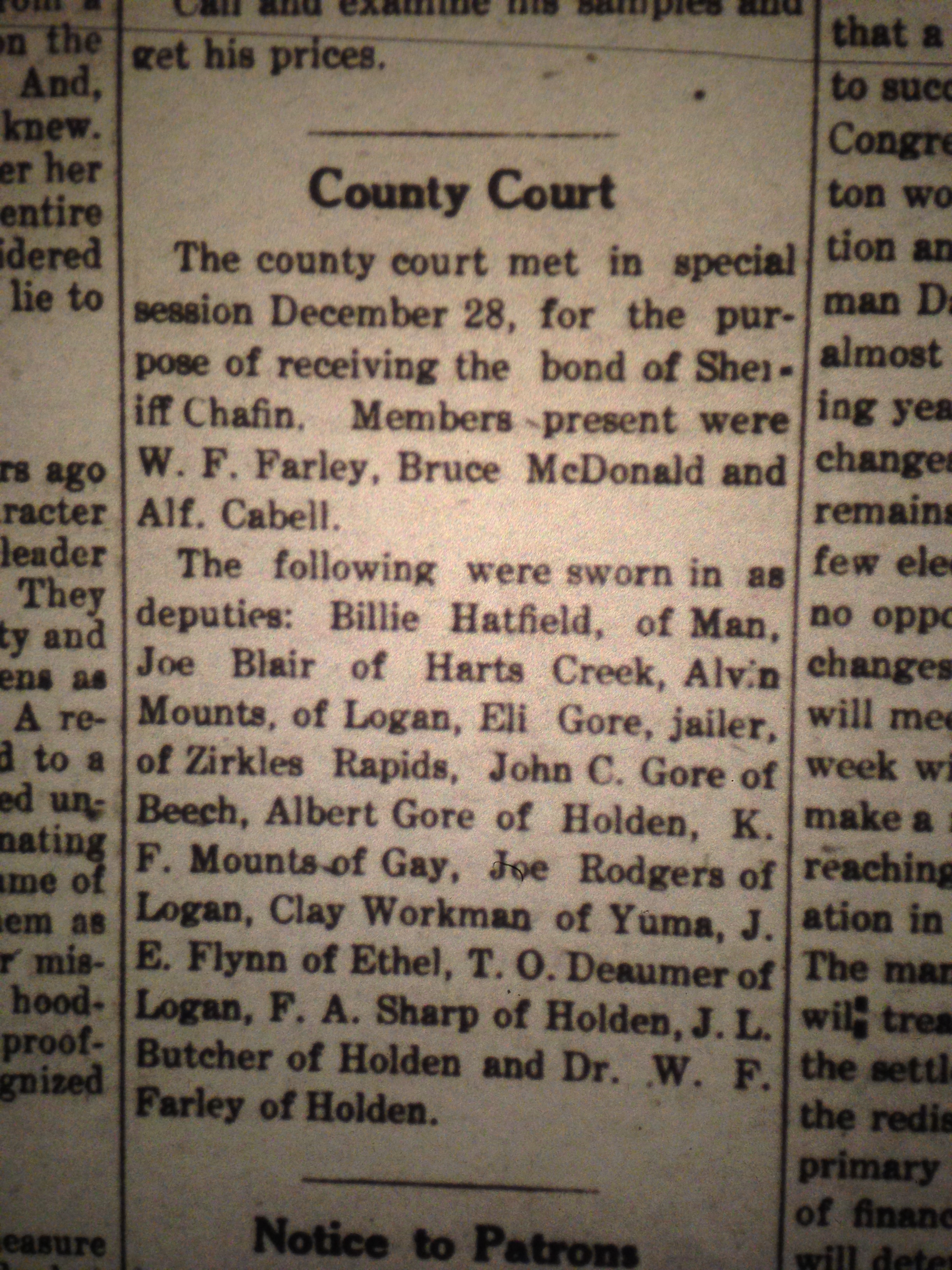
Don Chafin’s Deputies (1913)

18 Sunday Feb 2018

Posted by Brandon Ray Kirk in Big Harts Creek, Logan, Man

≈ Leave a comment

Tags

Albert Gore, Alfred Cabell, Alvin Mounts, Appalachia, Beech, Billie Hatfield, Bruce McDonald, Clay Workman, deputy sheriff, Don Chafin, Eli Gore, Ethel, F.A. Sharp, genealogy, Harts Creek, history, Holden, J.E. Flynn, J.L. Butcher, jailer, Joe Blair, Joe Rodgers, John C. Gore, K.F. Mounts, Logan, Logan County, Logan Democrat, Man, Mt. Gay, sheriff, T.O. Deaumer, W.F. Farley, West Virginia, Yuma, Zirkles Rapids

Chafin's Deputies LD 01.02.1913.JPG

Logan (WV) Democrat, 2 January 1913.

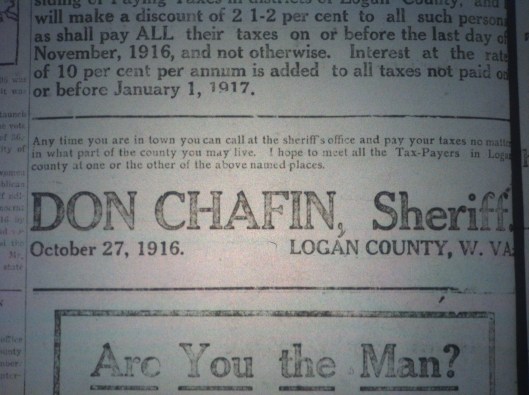
Sheriff Don Chafin Advertisement (1916)

08 Monday Jan 2018

Posted by Brandon Ray Kirk in Logan

≈ Leave a comment

Tags

Appalachia, Don Chafin, genealogy, history, Logan, Logan County, Logan Democrat, sheriff, West Virginia

Sheriff Don Chafin Ad LD 11.23.1916.JPG

Logan (WV) Democrat, 23 November 1916.

Rowan County Feud Letter (1887)

08 Monday Jan 2018

Posted by Brandon Ray Kirk in Culture of Honor, Rowan County Feud

≈ 1 Comment

Tags

Appalachia, Cabell County, Cook Humphrey, Craig Tolliver, Democratic Party, history, Huntington, Huntington Advertiser, John Martin, Kentucky, Morehead, politics, Republican Party, Rowan County, Rowan County Feud, sheriff, Solomon Bradley, West Virginia

From the Huntington Advertiser of Huntington, WV, dated July 2, 1887 comes this letter about the Rowan County Feud:

The Rowan County War.

Editor Advertiser:

The writer is not surprised that your paper of last week fell into the current of popular opinion and denounced the Toliver gang, of Morehead, Kentucky, as the guilty ones in the celebrated feud which has caused the killing of about thirteen persons. Later advices appear at least to throw doubt on the subject of who is really to blame. Let us see. Here is the Cincinnati Enquirer’s account of the origin of the trouble, taken from that journal of the 23d inst.:

“The beginning of the trouble dates from the August election of 1884, when Cook Humphrey, a Republican, was elected sheriff by a trifling majority. He was a young, spare-built man, fresh from the country, and unsophisticated in appearance and manner. Craig Toliver, at the head of a party of friends, declared that Humphrey should not serve as sheriff. On the evening of the election a row occurred. Pistols were drawn and used, and Solomon Bradley (Democrat), a friend of Toliver’s, was shot and killed. The killing was charged against John Martin, and Toliver swore to be avenged. Subsequently Floyd Toliver and Martin got into a fight and the former (Toliver, Democrat) was killed on the street. From this time it may be said that the Martin (Republican) and Toliver (Democrat) factions were organized in deadly array, both sides determined never to yield, one to the other.”

The analysis of the above is, that the Republicans, having carried the election, became more or less insolent towards the opposition, who were correspondingly depressed and sore over their defeat, and gave utterance to their disappointment, and Craig Toliver used a very foolish expression to the effect that the Republican sheriff elect should not be installed. It is probable that this was accompanied by charges of fraudulent voting on the part of the Republicans–at any rate it was not such an offense as to justify Martin, Republican, in shooting Sol. Bradley, a partisan of Toliver’s. Subsequently Floyd Toliver denounced Martin for having killed Bradley without sufficient provocation and in an unmanly way, and was himself shot by Martin on the instant. So that a war of extermination seems to have been inaugurated by the Martins and their Republican following, against the Bradleys and Tolivers and their Democratic following, and signalized by the cold blooded murder of two of the latter. If this is true, and the record seems to bear it out as true, then the Tolivers were simply defending themselves and their households and party friends against the tumultuous murder of the Martins and their Republican following.

The subsequent getting possession of the person of John Martin (already a double murderer) and his killing at the hands of the Tolivers, whose brother and friend he had slain, was in the nature of retribution, and justified by the circumstances. Later, killings on both sides followed from the hot blooded feud which these had aroused, and while some of them appear to have been barbarous in the extreme, yet they legitimately came of a war of extermination such as had been initiated by the Martins and responded to, and not by the Tolivers and their friends.

A prominent citizen of Cabell Co., now sojourning near the scene of the disorder, in Rowan County, says:

“I suppose the dispatches have told you the war news; how 300 Republicans succeeded in killing four Democrats; but the war has only begun. I hear, to-day, that the Democrats are organizing a company near —— to put down the mob at Morehead who did the killing. He is more than sanguine who thinks the trouble ended.”

Our fellow-citizen, on the ground in Kentucky, evidently thinks the late killing of the three Tolivers unjustified by the facts as they are known to him. Let us wait for the facts.

BEN.


Tennis Hatfield (1926)

02 Saturday Dec 2017

Posted by Brandon Ray Kirk in Hatfield-McCoy Feud

≈ Leave a comment

Tags

Appalachia, genealogy, history, Logan Banner, Logan County, photos, politics, Republican Party, sheriff, Tennis Hatfield, West Virginia

Tennis Hatfield Photo LB 10.08.1926 2.JPG

Logan (WV) Banner, 8 October 1926.

Republicans Driven from Logan County by Gunmen (1914)

01 Friday Dec 2017

Posted by Brandon Ray Kirk in African American History, Logan

≈ Leave a comment

Tags

African-Americans, Appalachia, coal, Con Chafin, crime, Democratic Party, deputy sheriff, Don Chafin, E.T. England, guitar, Guyandotte River, Herald-Dispatch, history, Huntington, Ira P. Hager, John B. Wilkinson, Ku Klux Klan, lawyers, Logan, Logan Banner, Logan County, mine guards, O.J. Deegan, politics, prosecuting attorney, Republican Party, sheriff, timbering, W.C. Lawrence Jr., West Virginia

From the Herald-Dispatch of Huntington, WV, comes this story printed by the Logan Banner of Logan, WV, dated October 30, 1914:

Republican Voters Driven from Co. by Gunmen

Deputy Sheriffs, Acting as Mine Guards, Are the Law and Enforcement Thereof.

Many Believe Martial Law Will be Sequel to Rule of Thugs.

Democratic schemes for the intimidation of Republican voters, for the prevention of a Republican victory in the state next Tuesday, whether by fair means or foul, have reached their climax in Logan county. If there is a place in West Virginia where lawlessness has succeeded law and order, where the persons chosen to enforce the law have initiated a system of rule by force and intimidation, a rule by force of clubs and pistols, a rule by thugs and gunmen, that place is Logan county.

A thorough investigation of conditions in Logan county today proves that the Ku Klux Klan in the south were mere pikers. There are men in Logan county who could beat them blindfolded.

The man, woman or child who would enjoy life–aye, who are willing to accept life or pass through Logan county, must be careful not to cross the paths of Sheriff Don Chafin and his force of about two hundred armed deputies.

And it can be truthfully said that the paths of these men extend to every nook and corner of the county. And several newly-made graves along the banks of the Guyandotte river and its tributaries shows who is the law and the enforcement thereof.

Several men have been shot, two negroes fatally, others have been clubbed and driven out of the county, women and children have been forced to flee clad only in their night-clothes, upon order of the Chafin deputies.

And all this because some Republicans desired to be registered in order that they might cast their votes for the Republican candidates next Tuesday.

Logan county is about to throw off the yoke of Democracy. The coal and lumber industries are rapidly being developed, and, as is always the case in progressive communities, the Republicans are making large gains.

If the voters of Logan county are allowed to cast their ballots as they desire, and those ballots are counted as cast, the Republican candidates will be elected.

If the conspiracy which has been formed by and in the interest of the Democrats is allowed to be carried out, the Democrats will continue in control of the county, the enforcement of law will be a mere joke and there will be probably a score added to the newly made graves along Old Guyan after next Tuesday.

Opinions vary as to what the outcome will be. Some believe that only martial law will prove a solution. Others are of the opinion that conditions will grow gradually worse and that the enforcement of law and order in Logan county will be a subject for investigation by the next legislature which convenes in January. Most certainly, if the threats of the Democrats are carried out, the Republicans are driven from the polls next Tuesday, the legislature will be asked to make a sweeping investigation and their findings will reveal conditions incredible in a civilized state.

Don Chafin is high sheriff of Logan county. His cousin, Con Chafin is prosecuting attorney. All the county officials are Democrats. Circuit Judge Wilkinson is a Democrat, though a man who wants the law enforced.

Sheriff Chafin, it is estimated, has about two hundred deputies. When he was elected, a part of his platform was that he would drive out the Baldwin mine guards from Logan county. No Baldwin men are known to be in this county now but these deputy sheriffs are known as mine guards. All of them are supposed to be armed with pistols, black-jacks and the usual weapons of gunmen. But few of them are licensed to carry such weapons and there is no trouble to find evidence that they have these weapons in violation of the law. Some of them are known to be ex-convicts and as such would not be licensed to carry revolvers, etc.

They shoot, club, slug and thug at will. But they are not arrested and imprisoned. For they are the law and the enforcement thereof.

Events of the past few weeks show the effectiveness of this organization of deputies and the way in which they operate. When the registrars were on their rounds registering the voters some of the deputies were on hand and even the Democratic registrars were afraid not to obey their orders. To go back further, they were on hand at the Democratic primaries and the Democratic nominees were the men of their choice and of that of their chief.

The Democratic registrars refused to register many Republicans, especially among the colored voters. When the county commissioners met to canvass the registration, four Republican lawyers State Senator E.T. England, Ira P. Hager, W.C. Lawrence, Jr., and O.J. Deegan, the latter being Republican county chairman, took the lead to see that Republicans entitled to vote were registered. One hundred colored voters were brought into Logan for examination and registration.

Threats have been made by deputies against the journeying of negroes to the court house, there to demand their rights, and the republican leaders realized there was danger.

The work before the county court was slow, as the democratic leaders challenged every step of the republicans. But eleven men were passed upon the first day, five of whom were registered, six turned down. That night the apparent cause for delay came. A colored family lived at Monitor, a mile from the court house. It was supposed that some of the negroes awaiting registration were there. This gave the conspirators a chance and the gunmen got busy.

Soon after dark a band of armed men raided the house, shot out the windows, fired bullets into bodies of two colored men, beat up others and drove a woman and child into the hills without giving them time to dress. The raiders said they were looking for “strange niggers.” As the result of that raid one colored man lies in an unmarked grave on the hillside and another is likely to join him soon. No “strange niggers” were in that house.

A colored man owned a cleaning and pressing establishment within a couple of squares of the court house. His windows were demolished and his place of business next morning looked as though a German siege gun had been turned on it.

A score of colored men awaiting registration were quartered for the night in the office of Senator England, and adjoining offices. About 11:30 o’clock at night some of the negroes were awakened by noises in the hallways and a sensation of not being able to breathe. They rushed to the windows and threw them open, but met with a shower of stones from the outside.

Piled on Senator England’s desk can be seen the stones hurled with force as is shown by the scars on the walls. Some of the stones were thrown from the court house steps.

No arrests were made. A grand jury was in session and Judge Wilkinson instructed the jurors to ferret out the dastardly assault and bring the miscreants to justice. But not an indictment resulted. It is no mystery in Logan as to who committed the deed. Any citizen not afraid to talk, and they are few, will name half a dozen deputy sheriffs as being in the party.

A telephone exchange girl next door to where some of the negroes were attacked made an outcry and was told that she would not be hurt if she kept still. She knows who told her to keep quiet, but would hardly give his name, probably not if she faced a jail sentence for contempt of court. It is not safe to talk in Logan county. “Don’t mention my name,” is what they all say when discussing the outrages.

A short distance from Logan is a construction camp. A large crowd of deputies raided the camp. One negro was playing the guitar and singing. No “strange niggers” were found there, but the one negro sang his last song. He, too, lies in an unmarked grave along the banks of Old Guyan. “Resisting arrest” was the excuse given.

Such depredations naturally drove many colored voters away and they will not vote.

Though threats have been made against the life of Senator England and his followers, they are putting up a game fight. By agreement the county court was to hold a night session to get through with the registration. England was later notified that nothing further would be done that night but the work would be taken up the next day he was amazed to find the court was no longer sitting. He went before Judge Wilkinson, mandamused the county court to sit again, and got ninety-eight colored voters registered.

The democrats were beaten in that game. “What’s the difference,” said a deputy when the court reconvened. “We will get them election day.” It has been openly boasted by the democrats that in many precincts the republicans, especially the colored voters, will not be allowed at the polls next Tuesday.

The sheriff and his deputies form an organization with unlimited power. Every little town or village, every public works, has the deputies. By intimidation and force in most instances and by favors in others, these deputies can run things to suit themselves. Infractions of the law by supporters of the organization can easily be overlooked, while on the other hand, the slightest technical violation can be punished to the full extent of the law.

The high-handed way in which the Democratic county organization is running things has caused a ruction in the Democratic ranks and many of them will quietly vote the Republican ticket. Many members of the old-time militant Democracy, some of them ex-Confederate soldiers, have assured the Republican leaders that they can no longer approve the Democratic methods employed in Logan County and will record their votes against it.

Vote for Don Chafin (1912)

08 Wednesday Nov 2017

Posted by Brandon Ray Kirk in Logan

≈ Leave a comment

Tags

Appalachia, Democratic Party, Don Chafin, history, Logan County, Logan Democrat, politics, sheriff, West Virginia

Vote for Don Chafin LD 10.31.1912 2.JPG

Logan (WV) Democrat, 31 October 1912.

Republicans in Logan County, WV

03 Friday Nov 2017

Posted by Brandon Ray Kirk in Chapmanville, Logan

≈ Leave a comment

Tags

A.A. Lilly, A.D. Cook, A.J. Fowler, A.L. Sansom, Amherstdale, Appalachia, assessor, B.A. Browning, B.L. Holland, Bernadine B. Ridenour, board of education, Bruce White, C.V. White, Chapmanville, Charleston, Christian, circuit clerk, county clerk, county commissioner, Curry, Edward Cooper, Edward S. Doolittle, Evart Campbell, Fayette County, Ferrell-Cook Republican Club, G.R. Claypool, George Godby, H.C. Burgess, Henry D. Hatfield, Henry Godby Jr., history, House of Delegates, Hugh Ike Shott, Huntington, Huntington Advertiser, I.M. Conley, Ira P. Hager, J.C. Elkins, J.D. Copley, J.M. Mitchell Jr., J.W. Hinchman, James Jeffrey, John M. Perry, John Perry, justice of the peace, lawyer, Logan, Logan Banner, Logan County, Logan County Banner, Logan District, Lon Walls, Mike F. Matheny, Naaman Jackson, O.J. Deegan, Pat Riffe, prosecuting attorney, R.F. Mitchell, Republican Party, Richard Kirk, S.A. Ferrell, sheriff, T.C. Whited, Thomas B. Hensley, Thomas Wilson, Triadelphia District, Union Army, W.A. Brazie, W.C. Lawrence, W.P. Neekamp, Wayne County, West Virginia

From various regional newspapers come these stories about the Republican Party in Logan County, West Virginia:

***

Republicans of Logan

Endorses the Candidacy of Judge Doolittle for Supreme Judge

The Logan county republican convention was held last week. Instructions were given for Gaines for Congress, and the candidacy of Judge Doolittle, of this city was endorsed for Supreme court judge.

Source: Huntington (WV) Advertiser, 30 April 1900.

***

The Republican Ticket

The Republicans, at their convention on Saturday, nominated a full county ticket.

The nominee for House of Delegates, Pat Riffe, is a native of the county and an old Union soldier.

W.A. Brazie, the nominee for County Clerk, is a native of Fayette and came here about twelve years ago, and worked in this office about ten years. He is well known in the county, and is well fitted for the position for which he is named.

J.D. Copley, the nominee for Circuit Clerk, is a native of Wayne, …

Source: Logan County Banner (Logan, WV), 2 October 1902.

***

Logan Republican Municipal Ticket LD 03.30.1911 1.JPG

Logan (WV) Democrat, 30 March 1911.

***

Republican Convention in Logan LB 07.10.1914 1.JPG

Logan (WV) Banner, 10 July 1914.

Republican Convention in Logan LB 07.10.1914 2.JPG

Logan (WV) Banner, 10 July 1914.

***

Republican County Ticket.

Member of the Legislature–Naaman Jackson, of Logan.

County Clerk–John Perry, of Logan.

Circuit Clerk–J.M. Mitchell, Jr., of Curry.

County Superintendent of Schools–R.F. Mitchell, of Christian.

Member of the County Court–A.D. Cook, of Triadelphia District.

W.C. Lawrence, for the Committee on Nominations, reported the following selection for members of the County Central Committee of the Republican Committee of Logan County.

For Logan District, Bruce White, I.M. Conley, James Jeffrey, T.C. Whited and W.C. Lawrence.

For Triadelphia District, H.C. Burgess and Lon Walls.

For Chapmanville District, A.J. Fowler and T.B. Hensley.

Hon. O.J. Deegan was selected County Chairman and Hon. Ira P. Hager as County Secretary and Treasurer, both promising young attorneys of Logan.

Source: Logan (WV) Banner, 17 July 1914.

***

Primary Results LD 06.29.1916 3.JPG

Logan (WV) Democrat, 29 June 1916.


Republican Campaign Opening Ad LB 10.05.1926.JPG

Logan (WV) Banner, 5 October 1926.

***

Republicans Organize Club At Chapmanville

Republicans met at Chapmanville Friday night and organized a campaign club and named it the Ferrell-Cook Republican club. Praise was sounded for local and national Republican administrations for the tax reductions that have been made. The following officers were elected: S.A. Ferrell, chairman; Evart Campbell, secretary; A.L. Sansom, treasurer. Another meeting of the club was called for 7 o’clock tonight.

Source: Logan (WV) Banner, 19 October 1926.

← Older posts
Newer posts →

Feud Poll 1

If you had lived in the Harts Creek community during the 1880s, to which faction of feudists might you have given your loyalty?

Categories

  • Adkins Mill
  • African American History
  • American Revolutionary War
  • Ashland
  • Atenville
  • Banco
  • Barboursville
  • Battle of Blair Mountain
  • Beech Creek
  • Big Creek
  • Big Harts Creek
  • Big Sandy Valley
  • Big Ugly Creek
  • Boone County
  • Breeden
  • Calhoun County
  • Cemeteries
  • Chapmanville
  • Civil War
  • Clay County
  • Clothier
  • Coal
  • Cove Gap
  • Crawley Creek
  • Culture of Honor
  • Dingess
  • Dollie
  • Dunlow
  • East Lynn
  • Ed Haley
  • Eden Park
  • Enslow
  • Estep
  • Ethel
  • Ferrellsburg
  • Fourteen
  • French-Eversole Feud
  • Gilbert
  • Giles County
  • Gill
  • Green Shoal
  • Guyandotte River
  • Halcyon
  • Hamlin
  • Harts
  • Hatfield-McCoy Feud
  • Holden
  • Hungarian-American History
  • Huntington
  • Inez
  • Irish-Americans
  • Italian American History
  • Jamboree
  • Jewish History
  • John Hartford
  • Kermit
  • Kiahsville
  • Kitchen
  • Leet
  • Lincoln County Feud
  • Little Harts Creek
  • Logan
  • Man
  • Matewan
  • Meador
  • Midkiff
  • Monroe County
  • Montgomery County
  • Music
  • Native American History
  • Peach Creek
  • Pearl Adkins Diary
  • Pecks Mill
  • Peter Creek
  • Pikeville
  • Pilgrim
  • Poetry
  • Queens Ridge
  • Ranger
  • Rector
  • Roane County
  • Rowan County Feud
  • Salt Rock
  • Sand Creek
  • Shively
  • Spears
  • Sports
  • Spottswood
  • Spurlockville
  • Stiltner
  • Stone Branch
  • Tazewell County
  • Timber
  • Tom Dula
  • Toney
  • Turner-Howard Feud
  • Twelve Pole Creek
  • Uncategorized
  • Warren
  • Wayne
  • West Hamlin
  • Wewanta
  • Wharncliffe
  • Whirlwind
  • Williamson
  • Women's History
  • World War I
  • Wyoming County
  • Yantus

Feud Poll 2

Do you think Milt Haley and Green McCoy committed the ambush on Al and Hollene Brumfield in 1889?

Blogroll

  • Ancestry.com
  • Ashland (KY) Daily Independent News Article
  • Author FB page
  • Beckley (WV) Register-Herald News Article
  • Big Sandy News (KY) News Article
  • Blood in West Virginia FB
  • Blood in West Virginia order
  • Chapters TV Program
  • Facebook
  • Ghosts of Guyan
  • Herald-Dispatch News Article 1
  • Herald-Dispatch News Article 2
  • In Search of Ed Haley
  • Instagram
  • Lincoln (WV) Journal News Article
  • Lincoln (WV) Journal Thumbs Up
  • Lincoln County
  • Lincoln County Feud
  • Lincoln County Feud Lecture
  • LinkedIn
  • Logan (WV) Banner News Article
  • Lunch With Books
  • Our Overmountain Men: The Revolutionary War in Western Virginia (1775-1783)
  • Pinterest
  • Scarborough Society's Art and Lecture Series
  • Smithsonian Article
  • Spirit of Jefferson News Article
  • The Friendly Neighbor Radio Show 1
  • The Friendly Neighbor Radio Show 2
  • The Friendly Neighbor Radio Show 3
  • The Friendly Neighbor Radio Show 4
  • The New Yorker
  • The State Journal's 55 Good Things About WV
  • tumblr.
  • Twitter
  • Website
  • Weirton (WV) Daily Times Article
  • Wheeling (WV) Intelligencer News Article 1
  • Wheeling (WV) Intelligencer News Article 2
  • WOWK TV
  • Writers Can Read Open Mic Night

Feud Poll 3

Who do you think organized the ambush of Al and Hollene Brumfield in 1889?

Recent Posts

  • Logan County Jail in Logan, WV
  • Absentee Landowners of Magnolia District (1890, 1892, 1894)
  • Charles Spurlock Survey at Fourteen Mile Creek, Lincoln County, WV (1815)

Ed Haley Poll 1

What do you think caused Ed Haley to lose his sight when he was three years old?

Top Posts & Pages

  • Painting: Hatfield-McCoy Feud (2021)
  • Sliger Lumber Company (1895)
  • Stone Mountain Coal Company Headhouse is Burned in Matewan, WV (1921)
  • In Search of Ed Haley 114
  • Alice Adams

Copyright

© Brandon Ray Kirk and brandonraykirk.wordpress.com, 1987-2023. Unauthorized use and/or duplication of this material without express and written permission from this blog’s author and/or owner is strictly prohibited. Excerpts and links may be used, provided that full and clear credit is given to Brandon Ray Kirk and brandonraykirk.wordpress.com with appropriate and specific direction to the original content.

Archives

  • February 2025
  • January 2025
  • October 2023
  • September 2023
  • December 2022
  • November 2022
  • May 2022
  • April 2022
  • February 2022
  • November 2021
  • October 2021
  • September 2021
  • June 2021
  • May 2021
  • April 2021
  • March 2021
  • February 2021
  • January 2021
  • December 2020
  • November 2020
  • October 2020
  • July 2020
  • June 2020
  • May 2020
  • April 2020
  • March 2020
  • February 2020
  • January 2020
  • December 2019
  • November 2019
  • October 2019
  • September 2019
  • August 2019
  • July 2019
  • June 2019
  • May 2019
  • April 2019
  • March 2019
  • February 2019
  • January 2019
  • December 2018
  • November 2018
  • October 2018
  • September 2018
  • August 2018
  • July 2018
  • June 2018
  • May 2018
  • April 2018
  • March 2018
  • February 2018
  • January 2018
  • December 2017
  • November 2017
  • October 2017
  • September 2017
  • August 2017
  • July 2017
  • June 2017
  • May 2017
  • April 2017
  • March 2017
  • February 2017
  • January 2017
  • December 2016
  • November 2016
  • October 2016
  • September 2016
  • August 2016
  • July 2016
  • June 2016
  • May 2016
  • April 2016
  • March 2016
  • February 2016
  • January 2016
  • December 2015
  • November 2015
  • October 2015
  • September 2015
  • August 2015
  • July 2015
  • June 2015
  • May 2015
  • April 2015
  • March 2015
  • February 2015
  • January 2015
  • December 2014
  • October 2014
  • September 2014
  • August 2014
  • July 2014
  • June 2014
  • May 2014
  • April 2014
  • March 2014
  • February 2014
  • January 2014
  • December 2013
  • November 2013
  • October 2013
  • September 2013
  • August 2013
  • July 2013
  • June 2013
  • May 2013
  • April 2013
  • March 2013
  • February 2013
  • January 2013
  • December 2012
  • November 2012

Enter your email address to follow this blog and receive notifications of new posts by email.

Join 2,925 other subscribers

Tags

Appalachia Ashland Big Creek Big Ugly Creek Blood in West Virginia Brandon Kirk Cabell County cemeteries Chapmanville Charleston civil war coal Confederate Army crime culture Ed Haley Ella Haley Ferrellsburg feud fiddler fiddling genealogy Green McCoy Guyandotte River Harts Harts Creek Hatfield-McCoy Feud history Huntington John Hartford Kentucky Lawrence Haley life Lincoln County Lincoln County Feud Logan Logan Banner Logan County Milt Haley Mingo County music Ohio photos timbering U.S. South Virginia Wayne County West Virginia Whirlwind writing

Blogs I Follow

  • OtterTales
  • Our Appalachia: A Blog Created by Students of Brandon Kirk
  • Piedmont Trails
  • Truman Capote
  • Appalachian Diaspora

BLOOD IN WEST VIRGINIA is now available for order at Amazon!

Blog at WordPress.com.

OtterTales

Writings from my travels and experiences. High and fine literature is wine, and mine is only water; but everybody likes water. Mark Twain

Our Appalachia: A Blog Created by Students of Brandon Kirk

This site is dedicated to the collection, preservation, and promotion of history and culture in Appalachia.

Piedmont Trails

Genealogy and History in North Carolina and Beyond

Truman Capote

A site about one of the most beautiful, interesting, tallented, outrageous and colorful personalities of the 20th Century

Appalachian Diaspora

  • Subscribe Subscribed
    • Brandon Ray Kirk
    • Join 787 other subscribers
    • Already have a WordPress.com account? Log in now.
    • Brandon Ray Kirk
    • Subscribe Subscribed
    • Sign up
    • Log in
    • Report this content
    • View site in Reader
    • Manage subscriptions
    • Collapse this bar
 

Loading Comments...