• About

Brandon Ray Kirk

~ This site is dedicated to the collection, preservation, and promotion of history and culture in my section of Appalachia.

Brandon Ray Kirk

Tag Archives: Peter Mullins

In Search of Ed Haley 223

13 Monday Jan 2014

Posted by Brandon Ray Kirk in Ed Haley

≈ Leave a comment

Tags

Alice Dingess, Clifford Belcher, Ed Haley, Ewell Mullins, Frank Farley, Geronie Adams, Great Depression, history, Jeff Mullins, Joe Adams, Logan, moonshine, Peter Mullins, Sewell Adams, Tennis Mullins, Ticky George Adams, Virgil Farley, Will Farley, writing

After talking for some time about Ed’s music, our conversation drifted toward his family on Harts Creek.

“Old man Peter Mullins, everybody called him ‘Reel-foot Peter’ cause he had his foot cut off here and had a special shoe made,” Joe said, referencing Ed’s uncle. “He walked kindly on his heel. He worked on log jobs but he couldn’t do much. He gathered ginseng. He made most of his money on moonshine. He hauled it up to Black Bottom in Logan and sold it. He liked to drink. They drunk moonshine most of the time. They were good old people.”

Now would Ed drink a lot with Uncle Peter when he was around Harts?

“Old man Ed every now and then he’d take a few drinks of it,” Joe said. “I’ve seen him pretty high. It didn’t take much of that moonshine to get in your hair. I’ve seen it just as clear as a crystal. You could look through the bottle just like looking right on in a looking glass and you could shake it and about seven beads’d pop up there on top of it and they’d just roll around and around. And you couldn’t smell it. I’ve seen some that you’d look at and it’d look like muddy water and you could smell it through the bottles. But they made good whiskey. They generally made it out of chop or corn and if they’d double it back and use good clear water it was good. You could just turn it up and it wouldn’t take your breath.”

Brandon asked what Ed was like when he was “feeling high” and Joe said, “He seemed like he was in a good mood about all the time. When I was around him I never did hear him say nothing out of the way to nobody. Old man Ed, he was a fine old man but he got over here at a beer garden. Clifford Belcher had a beer garden on this mountain — it was the meanest place that ever was — and he was over there playing one night and they was a big bunch of them a playing cards and the law come in to arrest them all. Some of them boys jumped out the window. And Ed got into it with somebody in there and they said that fellow said something and Ed just come over and took that fiddle by the neck and busted it all to pieces over that fellow’s head. I don’t know what he said to him but I come along there after it happened. They arrested a whole bunch of them fellows and put them in a cattle truck, the state police did, and took them to jail. They was about fifteen or twenty of them. They was Geronie Adams and Virgil Farley and Frank Farley. They loaded them up and hauled them to Logan and them fellows a cussing. They said, ‘You just might as well keep quiet. You’re going to jail.’ I think they took Ed to jail, too.”

Brandon said he’d heard several old-timers talk about how people used to play jokes on Ed when he was at Trace and Joe agreed.

“They played all kinds of tricks on him,” he said. “They was an old man stayed up here, old man Jeff Mullins. He was Peter’s wife’s brother. They called him dumb, but now he wasn’t as dumb as they thought he was. He stayed up there when Ed and them was up there and they was all the time playing pranks on Ed and him. Tennis Mullins, Ewell’s boy, he was big and fat and he run the store all the time. He was all the time fooling with Ed and old man Jeff.”

I asked how Ed took it when people joked with him and Joe said, “He was good about it. He never got mad. I know up there one time they was out there at old man Peter’s where they was a bridge there and they was a bunch of trees there. And old man Ewell Mullins, he was all the time fooling with Ed. He told Ed, he said, ‘We’ll climb a tree here to the top and let them cut it down.’ Well, Ed couldn’t see. Ewell, he climbed up the first limb about ten feet high and said, ‘Cut ‘er down boys!’ He jumped off about the time it started to fall. And Ed climbed right in the top of it. I bet he was forty feet up there. And they cut it and it fell and skinned him all over and liked to killed him. Ewell never would tell him though that he was just up a little bit on the tree.”

Joe said he also remembered Ed’s uncle Ticky George Adams.

“The old man as far as I know he never did work on no public works of no kind or draw no release or nothing,” he said. “He kept his family… He went from house to house — and everybody raised all kind of stuff and had cattle and plenty of milk and butter and eggs and everything — and every place he stopped they give him something. He had a little pole on his back with a sack on it. You’d see him a going bent over just kindly in a long run. He’d go up Trace and go through the head of Trace. And old man George would go around that a way and come down Rockhouse by Will Farley’s and back up through my Uncle Sewell’s and Aunt Alice’s down here. Everybody’d give him something. They’d give him a stick of butter or give him some milk or give him some meat or give him some eggs or something another. That’s the way he raised his family. Those Hoover times was hard.”
In Search of Ed Haley 220

08 Wednesday Jan 2014

Posted by Brandon Ray Kirk in Ed Haley

≈ Leave a comment

Tags

Billy Adkins, crime, Ed Haley, fiddlers, fiddling, George Mullins, Harts Creek, history, Joe Adams, Johnny Hager, music, Peter Mullins, Robert Martin, Ticky George Adams, writing

The next day, Billy and Brandon suggested that we visit 70-year-old Joe Adams on Trace Fork. Joe had all the right genealogical connections to know about many of the major characters in Ed and Milt’s story. According to Billy’s records, both of Joe’s grandfathers were brothers to Ben Adams, a key player in the 1889 feud. Joe’s grandmother was a Mullins, while the other was a half-sister to Burl Farley. (Burl Farley of course was in the Brumfield mob and even “gave the order to shoot” Milt and Green, according to some sources.) Brandon reminded me that he had talked with Joe earlier in the summer and heard him speak about having played music with Ed in his younger days.

As we pulled up to Joe’s nice house at the mouth of Trace, he and his wife met us at the end of their driveway. Joe, I noticed right away, looked a lot like Kenny Baker and was dressed in work clothes, indicating that he was probably in the middle of some project (a garden, working under a truck hood…). When we got out of the car, Mrs. Adams laughed and jokingly said, “Billy, is that you? What are you a doing up here?” Billy told them who I was and the reason for our visit and Joe basically said, “Well, come up to the porch and I’ll tell you boys all I can.” We gathered in chairs and swings under Joe’s carport where the conversation just took off. Joe was born in 1925.

I asked Joe when he first played with Ed and he said, “I’d say that was around ’40 up to ’43. It was before I went in the Army. We was down there at old man Peter Mullins’ — just out in the yard up there. They had a big old porch and they had a bunch of seats out under a bunch of big apple trees and stuff. Big shade. Had a swing out there. And I said, ‘How about bringing your fiddle out and playing a few tunes?’ And he told one of them boys — I forgot which one it was — said, ‘Go in there and bring my fiddle out here.’ He didn’t have it in a case that day but they brought it out and he played ‘Red Wing’ and he played ‘Soldiers Joy’ and he played ‘The Arkansas Traveler’ and he said, ‘Well, I’m tired now,’ and he just laid the fiddle down and we just quit. Sat around and talked a few minutes. He had some of them boys take it back and put it back in the house when he got through playing it. He took good care of his fiddle.”

“Now after I come out of the Army in ’46 and it seems to me like I seen Ed once after that and he left here and I never did see him anymore,” Joe said.

Brandon asked Joe where he remembered Ed staying on Harts Creek.

“I remember him staying up there with old man Peter and Liza and he stayed there off and on for years,” he said. “His wife and some of the children were there. Aunt Rosie married George Mullins on Buck Fork — he stayed up there a lot, too. Johnny Hager stayed with Ticky George Adams — old man George and Vic — that lived up in that holler up here at this store. Greasy George lived across the creek. And old man Ed, he’d go up there.”

What about Johnny Hager?

“Johnny Hager, he played a fiddle, too,” Joe said. “He didn’t play much. Just once in a while maybe he’d pick it up and play one tune. I had an older brother that’s dead, Howard — he played with them a lot. He played a fiddle, a guitar, mandolin, accordion, anything. He played anything he picked up. And we played around here for years.”

Joe said, “I played with a man lived right up in the head of this creek — I don’t know whether you ever heard tell of him — Robert Martin. He lived on top of the hill back there. Him and John Martin was the only two houses back there. He was a good fiddler. Robert played like ‘Lady of the Lake’ and ‘Blackberry Blossom’ and ‘Sugar Tree Stomp’. He had one he said he made it hisself and he made it for old man Will Farley — he called ‘Possom Creek’.”

Robert Martin left Harts, Joe said, after his brother John was murdered at Big Branch.

“You may have heard something about that,” he elaborated. “When they got in that trouble and his brother got killed down here at Big Branch they claimed that Robert cut him, but I don’t think so. I think it was somebody else. And he moved down here at Branchland and me and my brother’d go down there and play with him. He lived on that riverbank and he’d come out there and play with the fiddle till the bow got plum wet and he’d take it in and hang it up and go get another one. We played lots of times till three or four o’clock in the morning with him and then we’d come back to the house.”

In Search of Ed Haley 219

07 Tuesday Jan 2014

Posted by Brandon Ray Kirk in Ed Haley, Green Shoal, Harts, Lincoln County Feud, Music, Toney

≈ Leave a comment

Tags

Appalachia, banjo, Bell Morris, Billy Adkins, Brandon Kirk, Bud Workman, Bumble Bee, Charley Davis, crime, Dave Dick, Don Morris, Ed Haley, Greasy George Adams, Green McCoy, Green Shoal, Harts, history, Hollena Brumfield, Hollene Brumfield, Hugh Dingess, Irvin Workman, Milt Haley, Peter Mullins, Ranger, Route 10, Toney, writing

Back at Billy’s, the subject of the “murder table” came up again. Supposedly, the table upon which Milt and Green had eaten their last meal somehow eventually ended up in the possession of Billy’s family. He suggested visiting his aunt Don Morris, who as a child had eaten from the table many times. Taking the cue, we loaded in the car and drove up Route 10 to Don’s house. Don lived at Toney, a small residential settlement just upriver from Green Shoal.

Don was a pleasant lady — very eager to help — and was aged probably in her seventies. After all the introductions, I asked her about the table. She said her grandfather Irvin Workman must have gotten it soon after the 1889 troubles. “He had it way back when he was raising his family,” Don said. “Then my dad, Bud Workman, when he moved out with my mother, they took the table with them.”

I asked, “Who told you that table was the Haley-McCoy table?” and she said, “My dad. It was in his father’s house before it was in his.”

“And you said that people would come by to see it?” I asked. “Who would come to see it?”

Don said, “I imagine it was relatives of the people that was involved in it.”

Don seemed to remember the table well, so I asked her for some paper so I could try to sketch it based on her memories. I started out asking about the length of the table, the style of its legs, and so forth…estimating everything by comparing it to Don’s current table. It was like doing a police sketch. After I had a rough drawing of the table, I asked her about the size and angle of the bullet holes.

Satisfied, I asked Don if she’d heard anything about Milt and Green’s death.

“It was pretty complicated,” she said. “Well, they got those men in and fed them. They knew they was gonna kill them all the time and they let them eat first. I can’t remember too much about the actual thing, because they didn’t talk too much about it in the family. Grandpa did sometimes. Well, I understood they shot them around the table after they ate. But it was execution style. Now, I couldn’t swear to it.”

Don figured the only light in the room was a kerosene lamp in the middle of the table. There was a story, Brandon said, that Hugh Dingess “shot out the lights” just before the murders — which presumably meant this lamp. While this may have occurred (perhaps so no one could witness the subsequent murders and thus testify in a future trial), it seemed unlikely. I mean, the room was probably really crowded if only half the people supposedly there were actually there and shooting in the room would have seemed dangerous. Of course, shooting a kerosene lamp could have set the whole house on fire.

“Well, I have heard they did, and I’ve heard they didn’t, so I couldn’t say which is true,” Don said of the lights. “I don’t think they could have without burning down the table.”

Brandon asked, “Was one of the men supposed to have played music before they killed him?” and she said, “He sang, didn’t he? It seems to me he played the banjo and sang a song. I guess they thought since they was going out anyway they might as well go out in style.”

I said, “Now, I heard that the wives went down there to try to plead for their lives and they turned them away. Have you ever heard that?”

Don answered, “Yes, I’ve heard that, but whether or not it’s true I’m not sure. My husband’s mother Bell Morris was related to the McCoys.”

I said, “Just for the record, what happened to that old house?” and she said, “I bet it burned.”

Don wondered why I was so interested in Milt Haley and I explained that I was researching the story of his son, Ed Haley, of which he was a very important part. I asked if she ever heard Ed play and she said, “I’m not sure, seems that maybe I did a long time ago. I think Haley played with Dave Dick. Dave played banjo. He was blind.” Brandon said Charley Davis had described Dick as a “pretty good” banjo-picker who mostly played “little ditties” like “Bumble Bee”. He lived downriver around Ranger but stayed in Harts for a week or so at a time with different families, sometimes playing for dances. Kids used to imitate him by bumping into things.

After mentioning Ed’s name to Don our conversation dwindled off to me asking if she knew people like Peter Mullins, Greasy George, or Hollena Brumfield. She gave answers like, “Well, I used to know a Peter Mullins. His foot was turned back. I remember watching him go up the hill there at the house.” As for Hollena Brumfield: “I knew one down here at this big old house at Hart. They put in a restaurant and you know it didn’t do too well. She said, ‘We got hotdogs on ice.’ Yeah, I knew those people.”

Harts Creek Home

31 Tuesday Dec 2013

Posted by Brandon Ray Kirk in Big Harts Creek, Ed Haley

≈ Leave a comment

Tags

Appalachia, culture, history, Jackson Mullins, Joe Mullins, life, Logan County, Peter Mullins, photos, West Virginia

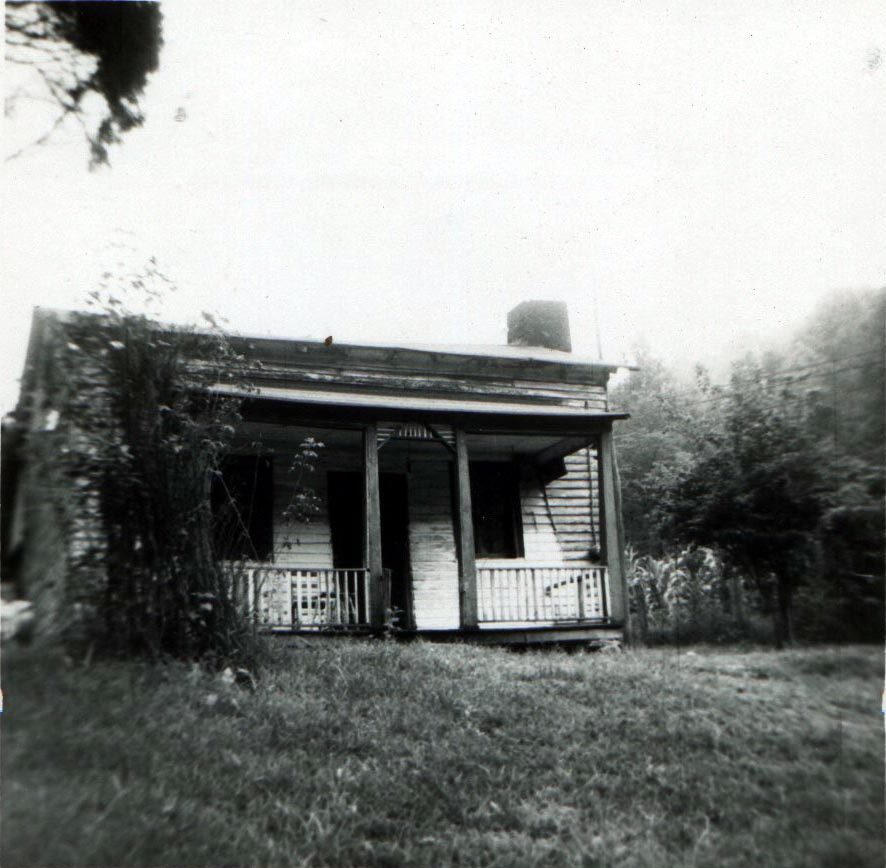
Mullins Homeplace, Trace Fork of Big Harts Creek, Logan County, WV, 1945-1950.

Mullins Homeplace, Trace Fork of Big Harts Creek, Logan County, WV, 1945-1950.

In Search of Ed Haley 145

30 Tuesday Jul 2013

Posted by Brandon Ray Kirk in Ed Haley

≈ 3 Comments

Tags

Appalachia, Elias Adkins, Harts Creek, history, Isaac Adkins, John H. Brumfield, Joseph Adams, Logan County, Peter Mullins, slavery, Thomas Dunn English, timbering, writing

Within a few years, by 1827, there were more settlers: Elias Adkins at Fowler Branch on the Guyandotte River, Moses Brown at Brown’s Branch of Guyan River and Marvel Elkins on Piney Creek of West Fork. Within three years, Isaac Adkins was at Harts and John Brumfield (father of Paris) was at the mouth of Ugly Creek. The Adkins brothers — Isaac and Elias — were the only slave owners in the section. They bought land at the mouth of Harts Creek in 1833.

In the early 1830s, Joseph Fry, John Lucas, and John Fry moved to the Harts area. Joseph Fry lived at Ugly Creek; John Fry, a War of 1812 veteran, lived at the mouth of Green Shoal; and John Lucas, a Baptist preacher, lived near Big Creek. With the arrival of these and other men, a school was organized to meet the educational needs of local children. “The first school was taught in a log cabin one mile above the mouth of Big Harts creek about the year 1832,” writes Hardesty. “The first house for educational purposes was built near the mouth of Big Harts creek in 1834. It was a five-cornered building, one side being occupied by the ever-present huge fire place.”

In the mid-1830s, Joseph Adams and Peter Mullins — both great-grandfathers to Ed Haley — arrived in the headwaters of Harts Creek. In 1838, Adams was granted 100 acres between the Forks of Harts Creek and the Rockhouse Branch. He became the patriarch of most Adamses in Harts, including Anthony and Ben Adams — key players in the Haley-McCoy trouble. In the early 1840s, Mullins was granted land on Hoover Fork and Trace Fork. He was a grandfather to Emma Haley.

At that time, in 1840, there were roughly 23 families in Harts. In the head of Harts Creek were Stephen Lambert, Moses Workman, Alexander Tomblin, and James Tomblin. Henry Conley and William Thompson were somewhere on the creek. Richard Elkins was at Thompson Branch and Isaac Adkins, Jr. was at Big Branch. Abner Vance was on West Fork. Isaac Adkins, Sr. and James Toney were at Harts. Moses Brown and Archibald Elkins were just below there. Harvey Elkins and Price Lucas were on or near Little Harts Creek. Above Harts was Elias Adkins and Squire Toney. At Ugly Creek were John Brumfield, Joseph Fry, and John Rowe. Charles Lucas and John Fry were at Green Shoal. John Dolen was somewhere in the area.

At that early date, folks were beginning to explore timber as a means of industry. “Isaac Elkins built the first saw mill in 1847 or 1848,” Hardesty writes. “It was constructed on the old sash-saw plan, and had a capacity for cutting from 800 to 1,000 feet per day.” To assist in the transport of timber and coal from the valley, locks and dams were constructed in the lower section of the Guyan and steamboats made a brief appearance in the valley during the 1850s, although they did not travel so far upriver as to reach Harts. There was some excitement, too, when Thomas Dunn English — a famous Northeastern writer — arrived in nearby Logan (then called Aracoma) and became mayor.

In Search of Ed Haley 133

23 Sunday Jun 2013

Posted by Brandon Ray Kirk in Ed Haley

≈ 1 Comment

Tags

Ashland, Clyde Haley, Ella Haley, history, Jack Haley, Lawrence Haley, life, Mona Haley, music, Noah Haley, Pat Haley, Peter Mullins, Ralph Haley

Later in the day, Pat told me more about the Haley family when we were away from Lawrence.

“I only knew Larry three months before we were married,” she said. “I knew he had a sister that he didn’t like to talk about. He talked mainly about his brother Ralph and Jack. I had no idea that Clyde was in San Quentin. And about a week before Beverly was born, I was ironing at 1040 Greenup and his face was looking at me through the window and I screamed bloody murder. Clyde’s got a funny laugh and he laughed. He didn’t know me. Larry was gone taking a class at the time. And Clyde came in and all of his luggage had EDWARDS on it. It was stolen and he was giving things away out of it. Then Larry told me about Clyde — that he was scitzofrenic. But he was a very intelligent man. I guess he did a lot of reading. He had a brain and he could work it, too, when he wanted to. He could always find a job when nobody else could. Then Noah came home from the service that Christmas. Beverly was about three weeks, four weeks old. And Noah came in his uniform and from the very beginning him and I disliked each other. I don’t know why. I irritated him and he irritated me. And then we moved right after that to 2144 Greenup Avenue.”

Pat said Ella — who she called “Mom” — was great, that she was very emotional with her children.

“Mom always regretted leaving the kids somewhere when she and Pop were off playing music together,” she said. “Larry’s told me that Noah didn’t like it at Harts and he would go down to the mouth of the hollow a ways from where Uncle Peter and Aunt Liza lived and he would sit and cry wanting his mother to come back. Where Larry and Jack could play — and half the time I would assume Clyde was in trouble — Noah would cry for his momma. It must have been very heart-wrenching for her. And I know she hated to leave Larry because even Mona will tell you: he was her favorite. She loved her boy Ralph more than anything and Larry came next.”

What about Ed? How did he treat the children?

“I’m sure Pop had genuine feelings for his kids but he didn’t know how to express it,” Pat said. “I remember Larry telling me about Pop rocking him because he had such terrible ear-aches and Pop took him to the doctor to get ear medicine and then when he took him home he rocked him. And that’s the only memory of his dad showing him any love. And Mona doesn’t have anything like that.”

How did Ed treat you?

“Pop was always very nice to me,” Pat said. “The only problem Pop and I had was his chewing tobacco and spitting it around toilets. And he was kinda dirty. The boys would have to make him bath. But my mother-in-law, she was always sad the way Mona behaved and the sad part is she never got to see Mona settle down. And Mona regrets that now, too. But Mom had three sons that had been good to her — that was Ralph, Jack, and Lawrence. Noah was never bad to Mom — he thought the world of his Mom — but Noah was much like Pop: he didn’t know how to express his feelings.”

Pat told me a little more about Clyde’s deviancies at the end of Ed’s life.

“Mom had this radio in her bedroom and this Electrolux sweeper and Clyde came through my bedroom, got that sweeper, and took Mom’s radio and was picked up on Greenup Avenue at 3 o’clock in the morning trying to sell those things,” she said. “That must have been the week before his daddy died because he was in jail when his daddy died and we could not get him out of jail to attend his daddy’s funeral.”

Later when Ella was sick in bed Clyde stole money from beneath her pillow.

“He was in prison in Michigan when his mother died,” Pat said. “And Larry tried to get him home for that but he would’ve had to’ve paid the way for two guards to bring him home and he just couldn’t afford it. And he was in Michigan for quite some time.”

In Search of Ed Haley 115

23 Thursday May 2013

Posted by Brandon Ray Kirk in Big Harts Creek, Ed Haley, Spottswood, Warren, Whirlwind

≈ Leave a comment

Tags

Andrew Jackson, Ben Adams, Bill Abbott, Bob Mullins Cemetery, Buck Fork, Chloe Mullins, civil war, Confederate Army, Dicy Adams, Ed Haley, Elizabeth Mullins, Enoch Baker, genealogy, Harts Creek, Henderson Dingess, history, Hollene Brumfield, Imogene Haley, Imogene Mullins, Jackson Mullins, Jane Mullins, Jeremiah Lambert, John Frock Adams, John Gore, John Q. Adams, Joseph Adams, Kentucky, Logan County, Margaret Gore, Mathias Elkins, Peter Mullins, Riland Baisden, Spencer A. Mullins, Tennessee, Ticky George Adams, timbering, Trace Fork, Turley Adams, Van Buren Mullins, Weddie Mullins, Weddington Mullins, West Virginia, writing

Ed Haley’s grandfather, Andrew Jackson Mullins, was born about 1843 to Peter and Jane (Mullins) Mullins. Jackson, as he was called, was named in honor of President Andrew Jackson, that early American icon. Like many folks in those days, Peter and Jane Mullins appear to have been caught up in the Jackson mystique. They even named one son Van Buren, after his vice president. Jackson Mullins was the first child born to Peter following the family exodus from Kentucky or Tennessee to Logan County, (West) Virginia. The 1850 Logan County Census listed him as seven years old. In 1860, he was eighteen. During the Civil War, Jackson served in the Confederate army. Brothers Weddington and Van Buren served as Confederates. In the late 1860s, Jackson married the slightly older Chloe Ann (Gore) Adams, a widow. Chloe had been born around 1840 to John and Margaret (Dingess) Gore, pioneer residents of Harts Creek. She had first married John Quincy “Bad John” Adams, a first cousin to Jackson, with whom she had four children: Dicy (born 1857), Joseph (born May 1858), John C. “Frock” (born c. 1861) and George Washington “Ticky George” (born 15 Jul 1864). She and Jackson had three children: Imogene Mullins (born c.1868), Peter Mullins (born May 1870), and Weddington Mullins (born April 10, 1872). Jackson and Chloe are thought to have lived on Trace Fork, perhaps at the present-day site of the Turley Adams home where they certainly lived in later years.

What little is known of Jackson Mullins — the man who partially raised Ed Haley — comes through deed records and census records. On February 13, 1869, his uncle Spencer A. Mullins wrote him a note that read: “Mr. A.J. Mullins and wife: you will pleas Come down and git your Deed for the Buck fork Land. I will not pay the taxes any longer.” In 1869 he purchased 200 acres of land on the creek from Riland Baisden. The next year he was listed in the 1870 census as 27 years old with 700 dollars worth of real estate and 200 dollars worth of personal property. His daughter — Ed Haley’s mother — first appeared in that record as “Em. Jane Mullins,” age two.  An April 1871, Justice Jeremiah Lambert provided a receipt to him for $2.80 “in the cost of the peace warrant in favor [of] him against Benjamin Adams.” An 1871 Logan County tax receipt listed A.J. Mullins as a resident of “Hearts Creek.” On February 28, 1877, the Logan County Court appointed him as “Surveyor of Roads in Precinct No. 76 in place of Weddington Mullins for the time of two years commencing April 1, 1877.” On December 17, 1877, the Logan County Clerk provided a receipt to him for recording a deed from Henderson Dingess and wife (parents to Hollene Brumfield). An 1878 tax receipt shows him in charge of six tracts totaling 244 acres under the ownership of “John Adams Heirs.”

The 1880 Logan County Census listed Jackson as 37 years old, while his wife was 40. Children in the household were John C. Adams (aged eighteen), George Adams (aged 15), “Emagane Mullins” (aged 12), Peter Mullins (aged 9), and Weddington Mullins (aged 6). That same year, Jackson sold five tracts of land totaling over 200 acres to brother-in-law Mathias Elkins for 3,000 dollars. He also sold 50 or so acres on Buck Fork to his father Peter and stepmother Elizabeth for 600 dollars. In February 1881, the Logan County Court reappointed him to relieve his brother Weddington as Surveyor of Public Roads for Precinct No. 76 “commencing April 1st, 1881.” That same year, he secured land from the John Q. Adams estate and bought 100 acres on Trace Fork from A.A. Low, attorney. On August 7, 1883, Enoch Baker, a timber boss on Harts Creek,  provided a receipt to him for fifteen dollars “in payment for a Stove.” In 1886, Jackson deeded 37 tracts on Trace Fork to stepsons Joseph and John Adams. On April 2, 1888, he signed a promissory note agreeing to pay William Abbott $41.75 plus interest within a year. Because he was illiterate, he signed the note with an “X.”

In March 1891, Jackson and Chloe Mullins deeded their property on Trace Fork to their three children: Imogene Haley, Peter Mullins, and Weddie Mullins.

In the 1900 Logan County Census, Jackson gave his birth date as March of 1845, while Chloe gave hers as July 1834. Ed Haley first appears in the 1900 Logan County Census as “James E. Haley, born August 1885,” and living in their home. His birth date of 1885 was two years later than what was given by the Haley family records. By 1910, Jackson lived with son Peter Mullins, while Chloe was in the home of Weddie Mullins’ widow, Mag. Ed was absent from the census entirely, indicating that he was gone from Harts by that time. A few years later, in 1915, Jackson Mullins died and was buried in an unmarked grave at the Bob Mullins Cemetery on main Harts Creek. His widow died in 1919.

In Search of Ed Haley 114

21 Tuesday May 2013

Posted by Brandon Ray Kirk in Ed Haley

≈ 3 Comments

Tags

Barney Carter, Ed Haley, genealogy, Harts Creek, history, Jackson Mullins, Jane Mullins, Kentucky, Mathias Elkins, Peter Mullins, Pike County, Solomon Mullins, West Virginia

Ed Haley’s roots, at least on his mother’s side, originated in the high mountains of Appalachia somewhere in that wild section of country situated along the Virginia-Kentucky state line. Peter Mullins, Haley’s great-grandfather, was born around 1804 in Kentucky or, according to one source, in North Carolina. The son of a notorious counterfeiter, “Money Makin’ Sol” Mullins, and reported descendant of those mysterious people the Melungions, Peter chose for his wife Jane Mullins, a first cousin. Between 1830 and 1858, he and his wife had at least eleven children. The sixth child, Andrew Jackson Mullins, was Ed Haley’s grandfather. Peter and his wife initially lived in Pike County, Kentucky, near Clintwood, Virginia. Based on census records, the family remained in Kentucky throughout the 1830s. Family tradition, however, states that Peter relocated to Marion County, Tennessee, due to his involvement in a counterfeiting operation. Around 1841-42, he traveled north to Upper Hart in what was then Logan County, Virginia, and settled near a sister, Dicy Adams. In 1842, he bought 25 acres of land from Abijah Workman and Mekin Vance on Hoover Fork. Deed records indicate that he operated a mill on Hoover. Two years later, he acquired 50 acres on the “first lower branch” of Trace Fork.

There are no stories chronicling Peter’s life on Harts Creek, nor any photographs to reveal anything about his physical features. All we have are census records and deed records — somewhat dry but noteworthy. In the 1850 Logan County Census, he was 46 years old and had 200 dollars worth of real estate. Three years later, in 1853, he bought 40 acres of land on Hoover from John and Sarah Workman and 37 additional acres on Trace. That same year, he sold a 35-acre tract (that included a “mill built by Mullins”) and a 25-acre tract on Hoover to son-in-law Barney Carter for 400 dollars. In 1854 he bought 30 acres on the Gunnel Branch of Trace Fork and another 1/4 acre on Hoover from Carter. On this latter property, he acquired a mill and dam, referenced in the deed. Three years later, he purchased three tracts of land totaling 97 acres on Trace. In 1858 he sold land on Hoover to son-in-law Mathias Elkins for 400 dollars. The next year, he sold a small acreage on Hoover to Carter for 100 dollars. In 1860, Peter appeared in Logan County Census records as 54 years old with 1,500 dollars worth of real estate and 2,000 dollars worth of personal property. In 1869, he bought 29 acres from Elkins for 100 dollars located “10 poles above the Alfred Tombline House” on Harts Creek.

In 1870, 63-year-old Peter Mullins appeared in the Logan County Census with his wife Jane and four of their children. Within in the next few years, Jane Mullins died. In 1874, Peter remarried to the much-younger Elizabeth (Johnson) Bryant and settled on Buck Fork. That same year, he sold a tract on the Bills Branch of Trace to son-in-law William Jonas, then bought 50 acres of land on Harts Creek above Lick Branch from Carter the following year. The 1880 Logan County Census listed him as a 68-year-old farmer; his wife Elizabeth was aged 40. That same year, he sold 80 acres on Trace to son Jackson Mullins — Ed Haley’s grandfather — who simultaneously sold him 50 acres of land on Buck Fork for 600 dollars. In 1882, he bought surface rights to a 100-acre tract and a 30-acre tract on Buck Fork and a 25-acre tract on Trace. Thereafter, in 1883, he sold 35 acres to son Solomon Mullins on Buck Fork for 250 dollars and 20 acres to Mary D. Mullins on Trace Fork for 100 dollars. In 1886, he sold 30 acres to Dicy Blair on Buck Fork.

Peter died around 1888 and was buried on Buck Fork under a large stone slab. In March of 1889, just a few months before the outbreak of the Haley-McCoy trouble, his heirs sold 20 more acres of his property on Buck Fork to Dicy Blair.

In Search of Ed Haley

28 Sunday Apr 2013

Posted by Brandon Ray Kirk in Ed Haley

≈ Leave a comment

Tags

Appalachia, Harts Creek, history, life, Logan County, Peter Mullins, photos, U.S. South, West Virginia, writing

Ed Haley Note, 1915

Ed Haley Property Tax Note, Trace Fork of Harts Creek, Logan County, West Virginia, 1915

In Search of Ed Haley 92

18 Thursday Apr 2013

Posted by Brandon Ray Kirk in Ed Haley

≈ Leave a comment

Tags

Clyde Haley, Ella Haley, Frank Creech, Harts Creek, Kentucky, music, Noah Mullins, Patsy Haley, Peter Mullins, Ralph Haley, Sherman Luther Haley, writing

Clyde said, “My brother Ralph, he was my dad’s favorite because Ralph was smarter than I was. He wouldn’t ever beat up on Ralph. Well, Ralph was bigger than he was. Did you ever know a guy from this part of the area named Frank Creech? Well, he was one of the bad boys around my area when I was growing up. And he come and borrowed Ralph’s guitar from my dad. Ralph had a great big Martin guitar. He’d bought it from one of those Ruffner boys, I think. He worked. But this guy Frank Creech borrowed Ralph’s guitar and took it somewhere and had a truck run over it — smashed it up. So Frank Creech come to the house and told my dad about it and my dad wasn’t saying a word about it. I was there in the house when this happened. And my mother didn’t like to hear anybody cuss. She was a Puritan about things like that. She didn’t allow any of that in her house.”

Clyde’s memories trailed off at that point, but I knew he was telling more about Ed’s attack on Frank Creech, an event which I’d first heard about while watching a Christmas video at Lawrence’s house.

Clyde said Ed and Ella argued sometimes about music.

“He’d want to play it one way and she’d want to play it the other,” he said. “But a mandolin and a fiddle are tuned up the same way — got the same pitch on the strings — but it’s a different kind of music.”

I asked him who usually won the arguments and he said, “Well she did because he’d give up on her.”

Clyde laughed, “He was mean. If he didn’t win with his talking, he’d do it with his fists to my mother.”

So Ed beat on his wife? I knew that was something Lawrence would have never told.

“He was a mean devil,” Clyde continued. “The worst I ever done him in my life, we was up on Harts Creek at Uncle Peter’s house. And he wanted to go somewhere and she didn’t want to go at that particular minute [and he started hitting her with his fists, so I got a hold of a plowpoint] and hit him in the head with it. Knocked a pretty good-sized hole in the head. Noah Mullins and the other Mullins boy Tennis chased me all over that mountain with a great big piece of a hoe-club. He never did catch me because I was pretty fast on my feet, too, running through those mountains and I could really get over the land. I was a boy then — a minor, you know — and they took us all down to Catlettsburg to the city jail and they threatened him with putting him in the penitentiary for beating on my mother that way and after that he never did beat her up too much.”

I asked Clyde if Ed did a lot of jail time and he said, “Just for minutes, like to hold him over for a few hours. Let him get sobered up a little bit. They weren’t mean to him, but they were mean to us boys, the police were. We deserved it.”

When I mentioned Ed’s oldest son, the boy who had died young, Clyde said, “He was born before I was. His name was Sherman Luther. Sherman was between me and Ralph.”

I said, “Now Ralph was your mother’s boy by somebody else.”

“Well, I didn’t know that,” Clyde said, kind of rattled. “See, you’re telling me things I don’t know and that kinda shakes me around a little bit and I don’t know what to say.”

I tried to smooth things up by saying, “Well I heard that but I wasn’t sure.”

Clyde said, “Well it seems to me like it could be, because my mother was a woman just like all the rest of the women. She had her good points about her. She was a Christian. I think that in my heart. But my dad wasn’t. He was just an ornery, old mean man. I hate to keep saying that about him because I… I hated him for a long time for the way he treated my mother and I finally got out of that hate and I got so I could talk about it to people who had business a knowing about it. I’m telling you things that I wouldn’t say to anybody else because I believe in you and I believe you’re being honest about what you’re doing. I wish it could be known widely about what he did for a living.”

Clyde promised if I’d come and see him, he’d tell me a lot more about Ed that he didn’t “dare mention over the telephone.” He said, “You know, I had a skull fracture here about a year ago and I can’t think real properly like I could if I set down. I’ve had my head broke, my brains knocked out a couple of times, and that affected me, too. If I saw you… Maybe if I could be prodded a little bit, I might could recall some things that might go good in a book.”

In the meantime, he said I should contact his sister-in-law, Patsy (Cox) Haley, who’d done some research on Ed’s family years ago.

“That was Jack’s wife,” Clyde said. “Her husband Jack, he blew up with a heart attack. You ought to get in touch with her. She can tell you more about that than any of us boys could ’cause she was a genealogist. She took that up as a hobby and she got into it and she couldn’t get out of it.”

In Search of Ed Haley 90

16 Tuesday Apr 2013

Posted by Brandon Ray Kirk in Big Harts Creek, Ed Haley, Lincoln County Feud, Music

≈ Leave a comment

Tags

Appalachia, Clyde Haley, Ewell Mullins, fiddler, Harts Creek, Harts Mountain, history, Hollene Brumfield, John Hartford, Liza Mullins, Logan County, Milt Haley, music, Peter Mullins, West Virginia, Zack Williams

I asked Clyde if Ed ever talked about his early life on Harts Creek and he said, “He didn’t talk to us kids too much. My dad’s folks were from all around Logan County, West Virginia. I didn’t know who they were. I remember his Aunt Liza and Uncle Peter Mullins. ‘Club-Footed Peter’ Mullins, they called him, and ‘Reel-Footed Peter’ Mullins. That was his uncle. I remember them because I was the one that went with him when he went up that way. As a matter of fact, I went up there one time and stayed just for a whole year.”

I said, “Your grandfather Milt Haley was involved in an attempted murder…” before being cut off. “Yeah, Hollene Brumfield. I know about that. I know things about it, because I’ve been up there. He killed this guy and in the process of trying to kill this guy, he shot Hollene Brumfield in the face and mutilated her pretty bad. It was a accident. Hollene was riding behind her husband on a horse down Harts Creek. He missed him and shot Hollene — killed her. That’s the way I always got the story from my dad.”

Clyde seemed to have Milt’s story down better than any of Ed’s other kids, so I pressed him for more details about Harts Creek. I asked him about the musicians in that vicinity and he said, “They didn’t play the kind of music my dad played. There was one old fiddler up there, lived up in the head of Harts Creek. Not off on one of the branches — right straight up Harts Creek past Ewell Mullins’ store. This guy’s name was Zack Williams. Him and my dad used to fiddle together. Never went out on big sprees or anything like that, but he’d go up to Zack Williams’ house up on the top of the mountain — head of Harts Mountain — and they’d make music up there. Zack was a pretty good fiddle player.”

In Search of Ed Haley 85

04 Thursday Apr 2013

Posted by Brandon Ray Kirk in Big Harts Creek, Ed Haley, Harts, John Hartford

≈ Leave a comment

Tags

Appalachia, Bill Mullins, Chloe Mullins, Ed Haley, Imogene Haley, Jackson Mullins, Joe Mullins, John Hartford, Lawrence Haley, Liza McKenzie, Nashville, Peter Mullins, photos, Turley Adams, Violet Adams, West Virginia

I returned to Nashville talking not so much about new musical developments but rambling on to my wife about murders and the people I’d met in Harts. I spent a lot of time studying over Joe’s photographs, especially the faded family group shot. One of the boys in the picture was propped inside a young woman’s arms and appeared very much to be blind. Was it Ed and his mother? Unfortunately, since the woman was almost completely faded away I couldn’t make a positive identification of her, even when I compared it to the photo of Emma Jean found by Lawrence and I on our first trip to Harts.

There was another interesting development: when I removed the picture of Bill and Peter Mullins from its frame, another equally large picture of the “old couple” kind of popped out from behind it. That made three pictures of those folks and it sure seemed logical to me that Joe Mullins would’ve had three pictures of his grandparents — meaning Ed’s grandparents — and not of an uncle and an aunt.

I sent copies of Joe’s old pictures to Turley and Violet Adams to see if they could show them around for identification. A few weeks later, we spoke over the telephone and they said Liza McKenzie had fingered Ed as the child to the right in the faded group picture. She also said the old folks in the back row were Jackson Mullins and his wife, Chloe.

Bill and Peter Mullins (c.1900)

01 Monday Apr 2013

Posted by Brandon Ray Kirk in Big Harts Creek, Ed Haley, Spottswood

≈ Leave a comment

Tags

Appalachia, Bill Mullins, Harts Creek, history, Logan County, Peter Mullins, photos, West Virginia

Bill Mullins and Peter Mullins (right)

Bill Mullins and Peter Mullins, 1900-1910. Courtesy of Joe Mullins.

In Search of Ed Haley 84

01 Monday Apr 2013

Posted by Brandon Ray Kirk in Ed Haley

≈ 2 Comments

Tags

Clifton Mullins, Harts Creek, Jackson Mullins, John Hartford, Lawrence Haley, Liza Mullins, Logan County, Milt Haley, Peter Mullins, Turley Adams, Weddie Mullins, West Virginia, writing

     Lawrence, Clifton, and I headed back down to Joe’s in order to see more of his pictures. We first looked in a smokehouse near Joe’s trailer. As Clifton took hold of the door, he proudly mentioned that it had come from Uncle Peter’s old log home. Almost as soon as I stepped inside, just back of an ancient spinning wheel, piles of rotting furniture and bags of god-knows-what, I spotted the large framed photograph of Bill and Peter Mullins — two very serious young men with thick mustaches. Thinking that the picture showed Peter and his brother Weddie, Clifton began to tell of Weddie’s death.

     “They went over to Dingess and they got into a fight about an election or something and one of them got shot over there and they brought him back across the mountain, you know, on the horses. Weddie, he got killed.”

     Nearby this picture was a faded one of equal size featuring what appeared to be a whole family of people. My first inclination was to assume it was the Jackson Mullins family, maybe even showing Milt Haley and Ed somewhere in the shadows.

     Clifton said we were welcome to borrow the two large pictures. He then fetched a box from which we borrowed 22 small photographs. Satisfied, we headed down to Turley’s for his input on their identification.

     Turley was very interested in the large photo of what we thought was Weddie and Peter Mullins, since Weddie was his grandfather.

     “They shot and wounded a constable or sheriff or something another over at Dingess,” he said. “John Dillon was the sheriff over there, or deputy-sheriff. He killed Weddie, and Peter, he got away. Peter come home and Uncle John went back over there and Peter went with him but he didn’t go in, I don’t think. He went in, said this guy was laying there dying, said he asked him how he was. They said, ‘Well, seems to me like he’s a dying.’ Said he just pulled a gun there and shot him and said, ‘He’s dead now.'”

     I was most interested in the large faded photo of what I presumed to be the Jackson Mullins family. The picture showed a very old couple, who I figured to be Jackson and Chloe, Ed’s grandparents. There was another smaller picture of the couple, which we had borrowed from Joe’s box. Turley, though, didn’t think it was Jackson and Chloe Mullins.

     “I can tell you who I think that is,” he said. “Lude and Van Mullins.”

     Van Mullins, he said, was a brother to Peter’s wife Liza.

     “So Aunt Liza was a Mullins before she married Peter Mullins?” I asked.

     “Yeah, I guess so,” Turley said, as if he’d never thought of it before.

     After looking at more of Joe’s pictures, I asked Turley about the location of the old Milt Haley house. He said it used to sit at the site of his present-day home.

     “When I was a little boy I could remember it,” he said. “They was a big old log house front and they was a big long porch. And they had guest rooms. And then the kitchen was back there. Had a big chimney in it. And then they had that porch and everything back through there. Had that big kitchen in it and big fireplace. They could just put a big kettle in there and make a whole big kettle of stuff.”

     It resembled the old Stonewall Workman home, Turley said, although I had no idea what that meant.

     “The year I was six years old is when they remodeled that house — seven,” he said. “I remember after they took a part of it off the top, made it a story and a half.”

     I drew out a floor plan of “The Milt Haley House” based on Turley’s memories.

In Search of Ed Haley 83

28 Thursday Mar 2013

Posted by Brandon Ray Kirk in Big Harts Creek, Ed Haley, Green Shoal, Lincoln County Feud, Spottswood

≈ 2 Comments

Tags

Alice Baisden, Appalachia, blind, Cas Baisden, Clifton Mullins, Clyde Haley, Dicy Baisden, Ed Haley, Ella Haley, Green Shoal, Harts Creek, Hazard, history, Imogene Haley, John Hartford, John Henry, Kentucky, Lawrence Haley, Lincoln County Feud, Liza McKenzie, Liza Mullins, Loretta Mullins, Mag Farley, Milt Haley, Perry County, Peter Mullins, Sol Bumgarner, Trace Fork, West Virginia

We found Bum on our way up the hollow and went to sit on his porch with his aunt, Liza McKenzie, two of his sisters, Alice and Dicy — and of course Shermie. As soon as Liza figured out who we were she looked at Lawrence and said he was just a small boy the last time she’d seen him.

“Yeah, I guess around 1940 or ’41 was the last time I come to this area,” Lawrence said.

Liza said, “Well, I lived in Kentucky about sixty years. Perry County, up in Hazard.”

I said to her, “Is that where Milt Haley was from?” and she said, “I don’t know but now Ed Haley was borned and raised right around here. When he was a boy, he got up on top of that house down there where Aunt Mag used to live — in that old two-story house — and rolled off in a box. Mother said, ‘Lord, Ed, are you hurt?’ He said, ‘No, God no. It’s give me eyesight.’ He said he jarred his eyesight back.”

I liked Liza right away.

I asked her if she had any pictures and she said, “Loretta’s mother had all the pictures of Ed Haley I ever did know. They used to have a picture down there at Loretta’s of Ed’s mother. She was a pretty woman.”

She looked at Clifton and said, “Clif, I believe your mother had a picture of Ed Haley that was made down there at the old home where he was born and raised. Down there where Aunt Mag used to live. I know they had them.”

Clifton remembered it.

“Yeah, they was sitting out in the yard,” he said. “They was together. She was in the chair and he was standing. He didn’t have no pants on.”

Clifton said, “Yeah, you’re right. They was a picture down there. But I looked; they was so many pictures in that box.”

     Box of pictures? I thought.

Before I could ask about them, Clifton said, “There’s one down there faded out. It’s in a big frame. I got it in another building.”

He told me, “I can show them to ya.”

About that time, Cas Baisden came up to the porch. Bum said he was Liza’s 83-year-old twin brother. I asked Cas if he remembered Ed and he said, “I knowed him, yeah. He was raised up here. Old man Peter lived down at the mouth of the holler and his boy lived up the road here and old man Ed’d go up there and he’d come down that road a running and jumping just like he could see and cut the awfulest shine that ever was.”

Lawrence joked, “That’s probably how Clyde got to be the way he was.”

Cas said, “Yeah, I guess Clyde took after him. Clyde went out here and got down in a well once and they had the awfulest time that ever was getting him out. Way back in top of a mountain.”

I asked Cas about the first time he ever saw Ed and he said, “It’s been many a year ago. He stayed down here, him and his wife and them. They’d play music and drink and fight and scratch with one another and them boys was so mean… He’d get so drunk he couldn’t walk.”

Bum knew that Ed was real “easy to get mad about music,” but said he could get him to play nearly anything he wanted because Ed liked him. He’d ask Ed to play something like “John Henry” and he’d say, “Are you sure that’s what you want me to play? You know, I was just thinking about playing that.” If Ed didn’t like someone Bum said he’d “goof around” and not play for them.

Things kinda tapered off after that. Nobody knew anything about Ed having any brothers. Cas had heard about Ed’s father, who he thought was named Green.

“You know, he got killed when I was a little fella, I guess,” Cas said. “His name was Green. They took him over yonder on Green Shoal, they said, and killed him. Walked him down here and up Smoke House and over and down Piney and across the river.”

I asked if Lawrence looked like Ed and Liza said, “Yes, he does. Ed was a bigger man than he is. Ed was a big man.”

But Lawrence looks like Ed in the face?

“Yeah, he looks like him all over.”

Cas said, “Ed was a taller man. I guess he takes after his mother. She’s a little short woman.”

Lawrence agreed: “Yeah, she was about five feet tall — not much bigger than Aunt Liza.”

In Search of Ed Haley 82

26 Tuesday Mar 2013

Posted by Brandon Ray Kirk in Big Harts Creek, Ed Haley, John Hartford, Music, Spottswood

≈ Leave a comment

Tags

Appalachia, Clifton Mullins, Connie Mullins, Crawley Mountain, Ed Haley, Enslow Baisden, fiddle, Harts Creek, history, Joe Mullins, John Hartford, Lawrence Haley, Logan County, Loretta Mullins, Peter Mullins, Sol Bumgarner, Trace Fork, Turley Adams, West Virginia

I told Turley that Lawrence and I needed to visit Joe Mullins, who had been gone during our last trip to Harts Creek. Turley completely deflated us: Joe, he said, had recently suffered a stroke. He now lived with his daughter Connie Mullins in a trailer just up the creek. Turley pointed the way. Driving a short distance, Lawrence and I parked our car by the creek and walked over a little narrow bridge where an army of barking dogs greeted us. At the porch, Connie introduced us to her brother, Clifton. We stepped on inside and found Joe seated in a wheelchair, surrounded by more dogs. His mind — or at least his ability to communicate a great deal — was all but gone due to the lingering effects of his stroke. Lawrence sat next to him with his hand on his arm. Almost in tears over Joe’s condition, he tried to rekindle Joe’s memories by saying, “I’m Ed Haley’s boy.”

I hung out with Joe’s kids — Connie, Clifton and Loretta. While all were reasonably young, Clifton and Connie had Parkinson’s Disease.

“They’s four of us got it,” Clifton said. “They said it runs through the family some way another. Musta come down the tree somewhere.”

I asked him how old he was.

“38,” he said.

Clifton had just moved back to Harts.

“I got hurt in Michigan and Daddy was sick so I said, ‘Well, it’s a good chance for me to go help my daddy and my sisters.'”

Clifton’s sisters said he was the one who found Ed’s smashed fiddle years ago in the rafters of Uncle Peter’s old smokehouse.

“I was up in there — we was playing around one day — and it fell out on me,” he said. “And I just looked at it and I said, ‘Well, I’ll try to glue it together.’ I started gluing it and it wouldn’t glue so I dumped it into the creek. I didn’t know whose it was. I was about eight but all the pieces wasn’t there to it. When it hit that guy it just splintered everywhere.”

Clifton suggested that we visit Bum and his family just up the hollow. Two years earlier, Bum had told originally Lawrence and I how he had witnessed Ed smash the fiddle over a man’s head while at a tavern on Crawley Mountain. Bum lived only a short distance from Joe’s trailer, up the hollow past Uncle Peter’s old homeplace, in a house situated near Enslow Baisden’s log cabin.

In Search of Ed Haley 81

20 Wednesday Mar 2013

Posted by Brandon Ray Kirk in Big Harts Creek, Cemeteries, Ed Haley, John Hartford, Music, Spottswood

≈ 1 Comment

Tags

accordion, Bernie Adams, blind, Clifford Belcher, Ed Belcher, Ed Haley, Ewell Mullins, fiddle, guitar, harmonica, history, Hoover Fork, Inez, John Adams, John Hartford, Johnny Adams, Johnny Hager, Kentucky, Liza Mullins, Milt Haley, music, Peter Mullins, Robert Martin, Turley Adams, Violet Adams, West Fork

Satisfied with our stop on West Fork, Lawrence and I said our farewells to the Kirks and went to see Turley and Violet Adams on Trace Fork. After some small talk about new developments, Turley told us about his uncle Johnny Hager and father Johnny C. Adams traveling with Ed in the early days. He said Uncle Johnny was the one who got Haley to take his music on the road, while his father just traveled around with them.

“They left here playing music together,” Turley said. “My father just helped them take care of their musical instruments — carried it around and stuff — but they done the music. He would sing with somebody but he never did sing by hisself. And Ed Belcher, I think, played with them then. He could play anything but played a guitar mostly.”

So where all did they travel to?

“They played up at Logan on the radio at one time,” Turley said. “They had a program on up there, Ed Belcher did. Oh man, that’s been back in the thirties. Maybe ’36, ’35. I was just a little bitty boy. I just heard these tales — I don’t know them for sure.”

I asked about Johnny Hager.

“I was just a great old big boy the last time I seen Johnny Hager,” Turley said. “He came to our house, stayed around a little while and left. He was kindly a small fella. My dad was, too. Ed would make two of ary one of them. He was a great big feller, Ed was. Now Ewell Mullins, they was all buddies. Now Johnny Hager and Ed could play music. I heard an old guy on television one day talking about how him and Ed used to play in front of a church somewhere together. Yeah, he called him ‘Blind Fiddling Ed Haley.’ Said he’s just a real good friend to him. But he lives in Inez, Kentucky, that feller does.”

I said, “Well, isn’t Inez where Milt is supposed to be from?”

Turley said, “Milt, now my dad just could remember him. He said he was a hard-working fellow and when he’d come in home he’d just tell them boys, ‘Right now, we got to have a fight and get everything settled and we’ll be all right.’ They liked to fight. I guess that was Ed and he had how many more — two more?”

I said, “You mean Ed had brothers?” and Turley said, “I think he did. I believe my dad said he had a brother and one of them got in a fight one time and he bit Milt’s ear off right in the yard right down there. Now, they was Milt’s boys. I guess Ed is Milt’s boy, ain’t he?”

Lawrence said he’d never heard of his father ever having any brothers or sisters, but it sure was a strange coincidence that we heard a story about “Milt’s ear” right after hearing Bob Adkins’ account of Green and “the nick.” Maybe Milt had the nick — which would’ve reversed their roles in Bob’s story of their final days.

So Ed had brothers?

“Far as I know, they was two or three more of them from the tales they told, you know,” Turley said. “Uncle Peter and Aunt Liza used to tell it. Said every time they come home — Milt and them boys — said he’d just fight with all of them at one time. Have a good time. Say, ‘Now we’re friends.’ Back then, that’s what they believed in.”

This was a major development.

“I just heard these tales,” Turley said. “I don’t know how true they are. About Milt coming home and say, ‘Now, we’ll straighten ‘er out right now and we won’t have no more problems while I’m here.’ That’s the way he run his family, you know. That old woman said, ‘I’ll agree to that. That’s the way it ought to be done.’ I don’t guess she could do anything with them boys.”

Hoping for clues about Ed’s “brothers,” I asked if any of the old gravestones in the cemetery behind Turley’s had any writing on them. Unfortunately, Violet said all the markers had rolled down the hill in recent years and the land had leveled out to where it didn’t even resemble a cemetery. All she knew about the cemetery was that there was a “big grave” in it at one time that belonged to a woman with the last name of Priest (she was the only person buried there who her mother-in-law had actually known).

Turley said he last heard Ed play the fiddle at Clifford Belcher’s tavern on Harts Creek where he played for money and drinks. Violet remembered him playing music all night at her father’s home on Hoover Fork with Robert Martin (her great-uncle) and Bernie Adams. She described Bernie as a “real skinny” bachelor who sang “a little bit but not much” and who “was a real good guitar player, but he never would hardly play.”

“He’d get to drinking and he’d play but if he wasn’t drinking he wouldn’t play,” she said.

Turley said Bernie could also play the banjo, harmonica, fiddle and accordion.

In Search of Ed Haley 80

15 Friday Mar 2013

Posted by Brandon Ray Kirk in Ed Haley

≈ 1 Comment

Tags

Al Brumfield, Appalachia, feud, Harts Creek, Hollene Brumfield, John Hartford, Lawrence Haley, Lawrence Kirk, Peter Mullins, timbering, West Virginia, writers, writing

     Mr. Kirk hopped in the car with Lawrence Haley and I and guided us to “Presto’s garden,” a small corn patch located just off of the hill from the Haley-McCoy grave. It was late afternoon: the air was clear and the remains of the sun slanted through the trees on the hillside. Lawrence Haley chose to stay at the garden due to his heart condition, but I made the steep climb toward the grave with Mr. Kirk just behind me. A few minutes later, we stopped at an indentation — a round shallow crater about seven feet in diameter. It had a little pile of stones on each end and was just as Bob Adkins had said it would be. We walked back and forth studying the “bowl” and the markers and I took some pictures.

     At the bottom of the hill, we got back in the car and rode up Low Gap Road to the site of Milt Haley’s murder. On the way, I told Mr. Kirk what we’d heard about Ed’s mother Emma Jean Mullins being shot in the face.

     “See, I hadn’t heard that part of it,” he said. “Well now, you know them Adamses and Mullinses up there on Hart married back and forth for generations. That’s quite possible. Of course, them Brumfields and them Adamses had trouble over that log boom they had had there at the mouth of Hart. It’d catch water and hold it back like a dam. They’d float them logs all out of Harts Creek back in yonder, then when the backwater come up in the spring of the year they’d make them into a raft and float them out of here and take them to the town of Guyandotte. That’s the market. They claimed the Brumfields got to sawing the ends of them logs off and re-branding them. I don’t know what the extent of their trouble was but they had some misunderstanding over that lumber and then Runyon and whiskey got involved in it down on that houseboat where they’s selling whiskey. All of them drinking, you know. They’d all go down there and get drunk and talk this shit up, you know, and get it started, get it going, down there where the booze was. Things were getting out of hand. Whiskey’s destroyed an awful lot of people in this country. A lot of my relatives.”

     Mr. Kirk said, “They’s supposed to killed them at daylight or immediately after daylight. The story that I’ve heard on it has been that they were both knocked in the head with the flat side of a double-bit axe. Killed them separately. Hit them right in the top of the head there. And I’ve heard people say they was shot up you know, and some said they were chopped up with an axe. But my grandmother, she was awful critical of the Brumfields and their conduct. She was an Adkins — part Dingess. Bill Brumfield’s widow. By her being pretty critical of them, I feel like she handed me what she had as being true. But now they was organized into kind of a posse. She said they called theirselves ‘The Night Riders.’ Vigilante group. Operated all the time at night. They were pretty sneaking in what they did.”

     They must’ve had some serious shortcomings, because Mr. Kirk said they “tried to organize themselves into the Klan, but the Klan wouldn’t have them.”

     After surveying the site of Milt’s murder, we drove down to the mouth of Harts Creek where Mr. Kirk pointed out the site of the recently burned Al Brumfield house.

     “Except being a landmark, it wasn’t worth much,” he said. “They used to have a meal-house out there to ground meal for people. Had a store in here. That’s Al Brumfield and Aunt Hollene. He was in his fifties when he died of typhoid fever. Watson Adkins later bought his house and lived there. Had a store over here for years. Now, Runyon had a boat down yonder — great big boat — barge built in there and had a store in it. He run poker games. Selling whiskey. Had a few groceries in there. Al and his bunch trying to do the same thing over here.”

     All during our ride with Mr. Kirk, he kept pointing out spots where murders had taken place. As we made our way back up West Fork, I asked him why there’d been so many killings around Harts Creek. He didn’t hesitate in saying, “Whiskey. Whiskey’s caused it. This section of country up through here — this West Fork section — has had a few killings. It wasn’t as bad as back yonder. Whiskey involved in every bit of that.”

     Lawrence Haley agreed that whiskey was the primary cause of trouble in the old days, even mentioning how one of Uncle Peter Mullins’ boys once killed a “revenue man” around Trace Fork. He said it “it took just about everything Uncle Peter had to keep him out of jail.”

     Mr. Kirk said, “Is that the one they called ‘Reel-Footed’ Peter? Ewell’s daddy?”

     Lawrence confirmed that it was — and that it was his great-uncle — and Mr. Kirk said, “I can remember old man Peter. I believe it was his right foot that was curled in. Man, he’d work in the woods, draw a team…”

In Search of Ed Haley 72

24 Sunday Feb 2013

Posted by Brandon Ray Kirk in Ed Haley

≈ Leave a comment

Tags

blind, Clyde Haley, Ed Haley, Ella Haley, fiddle, fiddler, Great Depression, Green McCoy, Harts Creek, history, Imogene Haley, Lawrence Haley, Milt Haley, Mona Haley, music, Noah Haley, Peter Mullins, writing

We all met up with Mona later in the day. She acted surprised that I was even interested in seeing her again, joking, “I’m good for something, aren’t I?” She was extremely talkative and almost immediately took over the conversation in a way that gave me the impression she really knew a great deal about Ed and Ella’s music. It was quite a different presentation than my first meeting with her.

“See my brothers don’t know about music like I know about music,” she said right away. “They know the tunes and they know the keys and stuff, but I don’t think they listened like I did. I paid attention to Pop’s music because I love music. I always loved music.”

She told Lawrence, “You don’t have the ear for it like I do.”

It was the first time I had heard someone be so candid with Lawrence. He seemed a little put off by it, muttering, “Probably not.”

We told Mona about talking with Bob Adkins and she said, “Pop’s mother was supposed to had the whole side of her face blown away. Now whether she was killed or not, I don’t know. That happened on Harts Creek and that’s what made Milt Haley get in with Green McCoy ’cause one of the Hatfields shot my dad’s mother’s face away. Side of her face. Well now, that’s how I understood it. But I’ve heard it said about that sinkhole that fills up with blood where that Milt Haley and Green McCoy was beat to death — buried in the same grave — and every time it rains, the grave fills up with blood.”

Noah said of Milt, “Well, ain’t he the guy that shot the person that shot Pop’s mom in the face? I thought Pop’s dad shot and killed the guy that shot his mother in the face.”

Mona wasn’t sure about that but said, “I know that Pop said that if he could see, he would get the guy that hurt his mother. Shot her. Her name was Emma Jean.”

Mona was sure the measles had caused her father to go blind, not Milt or ice water.

“No,” she said emphatically, “Ice water wouldn’t make you go blind. He had the measles.”

She said Ed started playing the fiddle when he was small and never talked about learning from anyone.

“Did you know that he started out on a cornstalk homemade fiddle?” she asked me. “I heard that his uncle or somebody up in the hills made him a cornstalk fiddle. Musta been Uncle Peter, I don’t know. Uncle Peter was a crippled man. His foot was turned backwards.”

Noah said, “He was a mean one, too.”

Mona knew little else about Ed’s life on Harts Creek.

“I don’t know if I told you about him talking about… As a young boy he was sitting on one of those log fences that goes this way — zig-zag, I call it — and it was a bull pasture inside. And he always carried a pistol with him. For what, I don’t know. It was a bull pasture fence he was sitting on and he was playing his little cornstalk fiddle and somebody come back behind him and was playing a joke on him by acting like a bull — you know, making noises like a bull. So Pop pulled that pistol out and shot and missed him by about an inch.”

Mona was quick to mention Ella, pointing out that “she figures in a lot of this, too.” I agreed, of course, but hadn’t been able to find out much about her from Lawrence, who seemed to keep his memories of her to himself. Every time Pat brought her name up, he said things like, “John doesn’t want to hear about Mom — he wants to know about Pop.” He always said it in a straightforward way that I knew to basically avoid the subject, as did Pat.

Mona said her parents met when Ella came to one of Ed’s “concerts”.

“I remember a lot of things about Mom,” she said. “Me and Mom was close. She walked around to feel if there was dirt on the floor — to see if it was clean — and if it wasn’t heads would roll. And she could cook. I remember back, I guess, during the Depression, her making lard cans full of soup so she could feed the neighbors and she had big bread pans full of cornbread for the dogs. And she could type as good as any typist.”

Mona looked at Lawrence and said, “Remember that whistle she had for us? It was like a calliope whistle. It was plastic or tin or something. And every one of us had a different tune. Each one of us knew our tunes. Different note.”

Mona’s pride in Ed and Ella seemed a little more on-the-surface than what I had detected with Lawrence.

“If there was a movie made, then there should’ve been one made about that — two blind people raising kids,” she said. “I’m just in awe of them and how they took care of all of us kids. They kept food and they kept shelter for us and we never went hungry. And they kept clothes on us. And I just don’t know how they done it. We always had a stable home. They always kept us occupied. We’d sit around in the wintertime and they’d give us soda crackers and apples and tell us to take a bite of one of them and then try to say a tongue twister.”

Mona said, “And we’re all reasonably intelligent,” although she jokingly pointed out that there were “some rogues in the family.”

Noah smiled and said, “I don’t know but one rogue.”

Mona knew exactly who he meant, so she told me, “That’s my other brother Clyde he’s talking about. He’s a rogue, but he’s all right.”

She said she was probably the real rogue of the family.

“Mom was real strict with me, but I was pretty head-strong,” she said. “I was rougher than all the boys put together, I reckon. At least that’s what they told me.”

In Search of Ed Haley 54

20 Sunday Jan 2013

Posted by Brandon Ray Kirk in Ed Haley

≈ Leave a comment

Tags

Appalachia, Ashland, Big Sandy River, Bill Bowler, blind, Cabell County, Ed Haley, Ella Haley, Field Furniture Store, Gibson's Furniture Store, Green McCoy, guitar, Harts Creek, history, Ironton, John Hartford, Kentucky, Lawrence County, Lawrence Haley, life, Logan, Milt Haley, Mona Haley, music, Noah Haley, Ohio, Paintsville, Peter Mullins, Portsmouth, Ralph Haley, Route 23, Route 60, Russell, South Point, West Virginia, writing

Lawrence said we could go see Mona if Noah would show us the way. Apparently, Lawrence didn’t know where his own sister lived. Noah agreed to guide us there, but drove a separate car so he could leave right away. He and Mona weren’t getting along. On the way, I said to Lawrence, “Now this sister is the youngest one?” and he said, “Yeah, she’s the baby.” I said, “She’s the only sister you have, and her name is?” “Mona,” he finished. “M-O-N-A. That wasn’t what she was intended to be named. Mother intended her to be named after old Doc Holbrook’s wife — her name was Monnie.”

Mona was staying with her daughter in nearby Ironton, Ohio. At the door, before Lawrence could tell her who I was or the reason for our visit, she looked right at me and said, “Well I know you. I’ve seen you on television.” It was an instant connection. I noticed that she had a high forehead just like her father.

We went on out in the yard where she showed a little surprise that Noah had led us to her house.

“He’s mad at me,” she said before sighing, “I feel sorry for poor old Noah. So lonely. Has to buy his friendship.” Right away, she dispelled our hopes that she had any of Ed’s records.

“No, I don’t have any,” she said. “I let my part of the records get away from me. I lost mine in my travels. I left them somewhere and never did get them back. It was around ’56. I went back to get them and the lady — Dorothy Bates — had moved. And I think she’s dead. I was living here in Ironton.”

Mona seemed a little emotionless — her voice was hollow, distant, as if her mind was a million miles away. She didn’t seem to show much remorse about losing her father’s records — “I’m sorry that I did, but you know hindsight’s 20/20.”

I asked her if Ed ever talked about his father or mother and she said, “He talked about his dad getting killed. He said that he was in the Hatfield-McCoy feud and he got killed with Green McCoy. He was a friend to the McCoys, I guess. And that’s all I can tell you about that. And he never talked about his mother at all.” Mona had no idea who Ed’s mother was and knew nothing about her connection with Uncle Peter Mullins on Harts Creek. She didn’t even remember what year her father died, saying, “My memory is failing me. I was married and living at South Point.”

I noticed again how much Mona looked like her dad.

I asked her if she ever had any long talks with him and she said, “My mother and I were very close but we didn’t talk much about my dad. I’ll tell you, I loved my dad but I didn’t like him very much because he was mean.”

She laughed and said to Lawrence, “Wasn’t he?”

“Yeah, if you struck him the wrong way,” Lawrence admitted. “He never was mean to me. I can’t even remember Pop whipping me.”

Mona insisted, “He wasn’t ever mean to me either but he was mean to Mom.”

I asked her what Ed did to her mother and Lawrence said (somewhat agitated), “He was a little bit mean to Mom. He’d fight with her sometimes and we’d have to stop things like that.”

It got a little quiet — a whole new facet of Ed’s life had just opened up to me.

“Maybe I shouldn’t have said that,” Mona said, “but that’s how I feel. I sympathize with him now but he was a mean man.”

Lawrence tried to smooth it over by saying, “I put that down, part of it, to frustration with his condition. Really, I do.”

Sensing Lawrence’s dislike of the topic, I got the conversation directed back toward Ed’s music. He and Mona remembered Pop playing frequently on the streets of Ashland at Gibson’s Furniture Store, Field Furniture Store (later Sears) on 17th and Winchester and at the Ashland (later Second) National Bank on 16th and Winchester. It made sense that Ed often played on Winchester Avenue, the main east-west thoroughfare through town, currently merged with Route 60 and Route 23. I asked if Ralph ever played with Ed and Ella on the street and Mona said no — that he only played with them at home. Bill Bowler, a blind guitarist, was the person she remembered playing with her father on the street.

“He wasn’t very good,” Mona said. “When they’d get ready to set down and make music Pop would have to tune up his guitar for him.”

Ed hung around Ashland through the winter, Lawrence said, then took off around February. There was not a particular place he went first; it just depended on his mood. Mona said he was in Greenup County, Kentucky, often.

“He played in front of the courthouse there,” she said. “I’ve seen them have that whole front of the courthouse with people standing around dancing.”

She and Lawrence also remembered Pop playing in Portsmouth, Ohio; Cabell County, West Virginia; Logan, West Virginia; Lawrence County, Kentucky; Paintsville, Kentucky; and “all up and down the Big Sandy River.”

“They’d play around railroad YMCAs, too,” Lawrence said. “They had one in Ashland, one in Russell. And down on the N&W they had a big railroad YMCA in Portsmouth — New Boston, I guess. And there was a big steel mill at New Boston. Mom used to play there more than Pop, I guess. Mom used to play at the main gate.”

Mona and Lawrence gave me a great idea of how Ed dressed when on the road. She said he wore “moleskin pants and a long-sleeve shirt — sometimes a top coat when it was cold.” Lawrence said his dad always buttoned his shirt “all the way to the top button” but never wore a tie and mostly wore blue pants. For shoes, he preferred some type of slipper, although he sometimes wore “high top patent leather shoes” — what I call “old man comfort shoes.” Mona said he always donned a hat, whether it was a Panama hat, straw hat or felt hat. He also packed his fiddle in a “black, leather-covered case” — never in a paper sack as Lawrence remembered. “No,” she stressed, seeming amused at the idea of Ed having anything other than a case. Lawrence disagreed, clearly recalling to the contrary — “Buddy, I have.” He said Ed seldom had his fiddle in a case when he went through the country, usually just tucking it under his arm. “Same way with Mom. She didn’t have a case for her mandolin a lot of times. I guess that’s the reason he wore out so many, reckon?”

← Older posts
Newer posts →

Feud Poll 1

If you had lived in the Harts Creek community during the 1880s, to which faction of feudists might you have given your loyalty?

Categories

  • Adkins Mill
  • African American History
  • American Revolutionary War
  • Ashland
  • Atenville
  • Banco
  • Barboursville
  • Battle of Blair Mountain
  • Beech Creek
  • Big Creek
  • Big Harts Creek
  • Big Sandy Valley
  • Big Ugly Creek
  • Boone County
  • Breeden
  • Calhoun County
  • Cemeteries
  • Chapmanville
  • Civil War
  • Clay County
  • Clothier
  • Coal
  • Cove Gap
  • Crawley Creek
  • Culture of Honor
  • Dingess
  • Dollie
  • Dunlow
  • East Lynn
  • Ed Haley
  • Eden Park
  • Enslow
  • Estep
  • Ethel
  • Ferrellsburg
  • Fourteen
  • French-Eversole Feud
  • Gilbert
  • Giles County
  • Gill
  • Green Shoal
  • Guyandotte River
  • Halcyon
  • Hamlin
  • Harts
  • Hatfield-McCoy Feud
  • Holden
  • Hungarian-American History
  • Huntington
  • Inez
  • Irish-Americans
  • Italian American History
  • Jamboree
  • Jewish History
  • John Hartford
  • Kermit
  • Kiahsville
  • Kitchen
  • Leet
  • Lincoln County Feud
  • Little Harts Creek
  • Logan
  • Man
  • Matewan
  • Meador
  • Midkiff
  • Monroe County
  • Montgomery County
  • Music
  • Native American History
  • Peach Creek
  • Pearl Adkins Diary
  • Pecks Mill
  • Peter Creek
  • Pikeville
  • Pilgrim
  • Poetry
  • Queens Ridge
  • Ranger
  • Rector
  • Roane County
  • Rowan County Feud
  • Salt Rock
  • Sand Creek
  • Shively
  • Spears
  • Sports
  • Spottswood
  • Spurlockville
  • Stiltner
  • Stone Branch
  • Tazewell County
  • Timber
  • Tom Dula
  • Toney
  • Turner-Howard Feud
  • Twelve Pole Creek
  • Uncategorized
  • Warren
  • Wayne
  • West Hamlin
  • Wewanta
  • Wharncliffe
  • Whirlwind
  • Williamson
  • Women's History
  • World War I
  • Wyoming County
  • Yantus

Feud Poll 2

Do you think Milt Haley and Green McCoy committed the ambush on Al and Hollene Brumfield in 1889?

Blogroll

  • Ancestry.com
  • Ashland (KY) Daily Independent News Article
  • Author FB page
  • Beckley (WV) Register-Herald News Article
  • Big Sandy News (KY) News Article
  • Blood in West Virginia FB
  • Blood in West Virginia order
  • Chapters TV Program
  • Facebook
  • Ghosts of Guyan
  • Herald-Dispatch News Article 1
  • Herald-Dispatch News Article 2
  • In Search of Ed Haley
  • Instagram
  • Lincoln (WV) Journal News Article
  • Lincoln (WV) Journal Thumbs Up
  • Lincoln County
  • Lincoln County Feud
  • Lincoln County Feud Lecture
  • LinkedIn
  • Logan (WV) Banner News Article
  • Lunch With Books
  • Our Overmountain Men: The Revolutionary War in Western Virginia (1775-1783)
  • Pinterest
  • Scarborough Society's Art and Lecture Series
  • Smithsonian Article
  • Spirit of Jefferson News Article
  • The Friendly Neighbor Radio Show 1
  • The Friendly Neighbor Radio Show 2
  • The Friendly Neighbor Radio Show 3
  • The Friendly Neighbor Radio Show 4
  • The New Yorker
  • The State Journal's 55 Good Things About WV
  • tumblr.
  • Twitter
  • Website
  • Weirton (WV) Daily Times Article
  • Wheeling (WV) Intelligencer News Article 1
  • Wheeling (WV) Intelligencer News Article 2
  • WOWK TV
  • Writers Can Read Open Mic Night

Feud Poll 3

Who do you think organized the ambush of Al and Hollene Brumfield in 1889?

Recent Posts

  • Logan County Jail in Logan, WV
  • Absentee Landowners of Magnolia District (1890, 1892, 1894)
  • Charles Spurlock Survey at Fourteen Mile Creek, Lincoln County, WV (1815)

Ed Haley Poll 1

What do you think caused Ed Haley to lose his sight when he was three years old?

Top Posts & Pages

  • Halcyon 4.10.1919
  • Civil War Gold Coins Hidden Near Chapmanville, WV
  • Halcyon-Yantus 12.08.1911
  • Early Coal Mines in Logan County, WV
  • Buskirk Cemetery at Buskirk, KY (2015)

Copyright

© Brandon Ray Kirk and brandonraykirk.wordpress.com, 1987-2023. Unauthorized use and/or duplication of this material without express and written permission from this blog’s author and/or owner is strictly prohibited. Excerpts and links may be used, provided that full and clear credit is given to Brandon Ray Kirk and brandonraykirk.wordpress.com with appropriate and specific direction to the original content.

Archives

  • February 2025
  • January 2025
  • October 2023
  • September 2023
  • December 2022
  • November 2022
  • May 2022
  • April 2022
  • February 2022
  • November 2021
  • October 2021
  • September 2021
  • June 2021
  • May 2021
  • April 2021
  • March 2021
  • February 2021
  • January 2021
  • December 2020
  • November 2020
  • October 2020
  • July 2020
  • June 2020
  • May 2020
  • April 2020
  • March 2020
  • February 2020
  • January 2020
  • December 2019
  • November 2019
  • October 2019
  • September 2019
  • August 2019
  • July 2019
  • June 2019
  • May 2019
  • April 2019
  • March 2019
  • February 2019
  • January 2019
  • December 2018
  • November 2018
  • October 2018
  • September 2018
  • August 2018
  • July 2018
  • June 2018
  • May 2018
  • April 2018
  • March 2018
  • February 2018
  • January 2018
  • December 2017
  • November 2017
  • October 2017
  • September 2017
  • August 2017
  • July 2017
  • June 2017
  • May 2017
  • April 2017
  • March 2017
  • February 2017
  • January 2017
  • December 2016
  • November 2016
  • October 2016
  • September 2016
  • August 2016
  • July 2016
  • June 2016
  • May 2016
  • April 2016
  • March 2016
  • February 2016
  • January 2016
  • December 2015
  • November 2015
  • October 2015
  • September 2015
  • August 2015
  • July 2015
  • June 2015
  • May 2015
  • April 2015
  • March 2015
  • February 2015
  • January 2015
  • December 2014
  • October 2014
  • September 2014
  • August 2014
  • July 2014
  • June 2014
  • May 2014
  • April 2014
  • March 2014
  • February 2014
  • January 2014
  • December 2013
  • November 2013
  • October 2013
  • September 2013
  • August 2013
  • July 2013
  • June 2013
  • May 2013
  • April 2013
  • March 2013
  • February 2013
  • January 2013
  • December 2012
  • November 2012

Enter your email address to follow this blog and receive notifications of new posts by email.

Join 2,927 other subscribers

Tags

Appalachia Ashland Big Creek Big Ugly Creek Blood in West Virginia Brandon Kirk Cabell County cemeteries Chapmanville Charleston civil war coal Confederate Army crime culture Ed Haley Ella Haley Ferrellsburg feud fiddler fiddling genealogy Green McCoy Guyandotte River Harts Harts Creek Hatfield-McCoy Feud history Huntington John Hartford Kentucky Lawrence Haley life Lincoln County Lincoln County Feud Logan Logan Banner Logan County Milt Haley Mingo County music Ohio photos timbering U.S. South Virginia Wayne County West Virginia Whirlwind writing

Blogs I Follow

  • OtterTales
  • Our Appalachia: A Blog Created by Students of Brandon Kirk
  • Piedmont Trails
  • Truman Capote
  • Appalachian Diaspora

BLOOD IN WEST VIRGINIA is now available for order at Amazon!

Blog at WordPress.com.

OtterTales

Writings from my travels and experiences. High and fine literature is wine, and mine is only water; but everybody likes water. Mark Twain

Our Appalachia: A Blog Created by Students of Brandon Kirk

This site is dedicated to the collection, preservation, and promotion of history and culture in Appalachia.

Piedmont Trails

Genealogy and History in North Carolina and Beyond

Truman Capote

A site about one of the most beautiful, interesting, tallented, outrageous and colorful personalities of the 20th Century

Appalachian Diaspora

  • Subscribe Subscribed
    • Brandon Ray Kirk
    • Join 789 other subscribers
    • Already have a WordPress.com account? Log in now.
    • Brandon Ray Kirk
    • Subscribe Subscribed
    • Sign up
    • Log in
    • Report this content
    • View site in Reader
    • Manage subscriptions
    • Collapse this bar
 

Loading Comments...