• About

Brandon Ray Kirk

~ This site is dedicated to the collection, preservation, and promotion of history and culture in my section of Appalachia.

Brandon Ray Kirk

Tag Archives: Noah Haley

Noah Haley, Ed Haley, Ella Haley

28 Tuesday Feb 2017

Posted by Brandon Ray Kirk in Ed Haley, Music

≈ Leave a comment

Tags

Appalachia, Ashland, Boyd County, Ed Haley, Ella Haley, fiddler, fiddling, history, Kentucky, music, Noah Haley, Patsy Haley, photos

ed-haley-2

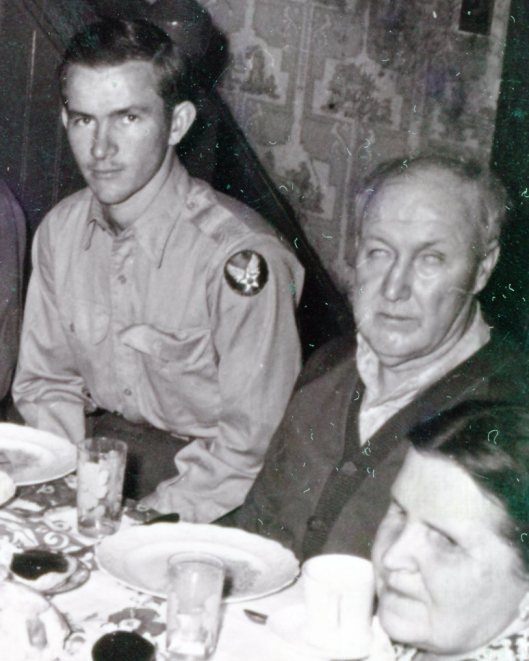
Noah Haley, Ed Haley, and Ella Haley seated for a holiday dinner in Ashland, Kentucky, Christmas 1946. Photo courtesy of Patsy Haley.

In Search of Ed Haley 351

07 Thursday Aug 2014

Posted by Brandon Ray Kirk in Ed Haley, John Hartford

≈ Leave a comment

Tags

Allie Trumbo, Ashland, Beautiful Isle of Somewhere, Brandon Kirk, California, Cincinnati, Cleveland, Doug Owsley, Ed Haley, Ella Haley, Florida, genealogy, history, Jack Haley, Janet Haley, Jimmy Haley, John Hartford, Kentucky, Lawrence Haley, life, Margaret Ryan, Mona Haley, music, Noah Haley, Oak Hill Cemetery, Ohio, Pat Haley, Patsy Haley, Ralph Haley, Ralph Payne, Rosemary Haley, Wilson Mullins, World War II, writing

Early in December, Brandon and I met at Pat Haley’s. All of our excitement focused on the upcoming meeting with Owsley’s forensic team, although it wasn’t long until we were in the familiar routine of asking Pat and Mona questions. Mostly they spoke of Ralph, a key player in Ed’s story. It was Ralph who recorded Ed’s and Ella’s music. Pat said Patsy knew a lot about Ralph, so she called her in Cleveland.

Patsy said Ralph was a nice and intelligent person.

“All the kids looked up to him when they were growing up,” she said.

As far as Patsy knew, Ralph never had any contact with his real father but he did take the last name of Payne when he was older.

Around 1936, Ralph married Margaret Ryan, an eighteen- or nineteen-year-old Cincinnati girl. The newlyweds took up residence with Ed and Ella, and Ralph stopped drinking (at his wife’s insistence). Margaret remained living with the Haleys during the war, when Ralph was overseas fighting the Japanese.

During the war, Ralph had an affair with a Filipino woman named Celeste, who Pat said bore him a son. Mona thought he actually married Celeste. According to her, his plan was to “set” Margaret up after the war, divorce her and return to his Filipino bride. He had Celeste’s name tattooed on his body. When he returned home from the war, he told Margaret, when she saw his tattoo, that Celeste had been the name of his ship. Ralph and Margaret soon left Ashland and moved to Cincinnati.

It was around that time that Patsy came into the family. She said she married Jack in California on October 25, 1946 and met Ed the following Thanksgiving in Ashland. She and Jack moved in with him for three months at 105 17th Street. Mona, Wilson Mullins, and little Ralph were also living there at the time. Jack only stayed for about three months because he couldn’t find work. Patsy said they moved out near Ralph in Cincinnati. Ella’s brother Allie Trumbo lived there, as did several of her close friends. Mona and her family soon followed them there and found an apartment in the same building.

Mona said Ralph’s thoughts were with Celeste: he was in the process of getting Margaret “set up” when tragedy intervened.

One Sunday in May of 1947, Jack, Patsy, Ralph, Margaret, Mona, Wilson, and little Ralph went fishing at a park about 25 miles outside of Cincinnati. At some point, Patsy said Ralph and Mona began talking about hanging upside down in a nearby tree. Mona climbed up the tree and Patsy took her picture. Then Ralph got in the tree and fell. As he lay on the ground, he told his family that his neck was broken and requested that they put a board under him until the doctors could arrive. Ralph was taken to a hospital where he told Ella, “When I bite down on the ice it makes a musical tone in my head.”

On Thursday, May 22, 1947, Ralph died at the age of 34. The family was afraid that Ella might hear of his death over the radio. She was staying at Mona’s apartment at the time.

On May 24 — Mona’s birthday — Ralph was buried in the Oak Hill Cemetery near Cincinnati. Patsy said Ed never made it to Ralph’s funeral, nor did Lawrence, who was in the service in Florida but Mona remembered that Lawrence was there on emergency leave. Someone played “Beautiful Isle of Somewhere”, Ralph’s favorite hymn.

Celeste later wrote Ella, mentioning how her son had an ear problem. When the family wrote to tell her of Ralph’s death, she figured they were making it up just so she would stop writing.

We figured that Ralph was Mona’s favorite brother since she had named her oldest son after him, but she said Jack was her favorite brother because he had taken up for her the most. She said Ella had been the one who named her son after Ralph. She also spoke highly of Noah, who contracted malaria and saw a lot of combat during World War II.

“Noah was good to send things home to Mom and Pop during the war,” Mona said. “And when he came home he laid carpet and fixed doorbells did things like that for Mom there at 17th Street.”

Noah went to Cleveland around 1950. Pat said Noah’s wife was a high-strung person. Their daughter Rosemary killed herself when she was eighteen. She wanted to get married but her mother protested, so she went into her brother’s room and shot herself in the head. In later years, Noah and Janet divorced. Pat said Noah’s son Jimmy really did a good job of looking after them. Janet died several years ago.

In Search of Ed Haley 350

06 Wednesday Aug 2014

Posted by Brandon Ray Kirk in Ed Haley, John Hartford, Lincoln County Feud, Music

≈ Leave a comment

Tags

Ashland, Brandon Kirk, Clyde Haley, Doug Owsley, Ed Haley, fiddle, Green McCoy, Haley-McCoy grave, Harts, Harts Fas Chek, Jimmy Johnson Bring Your Jug Around the Hill, Jimmy McCoy, John Hartford, Kentucky, mandolin, Milt Haley, Mona Haley, Noah Haley, Pat Haley, Salt River, Shove That Hog's Foot, Ugee Postalwait, West Virginia, writing

After the contest, we all gathered at Pat Haley’s. The dining room table was crammed with food and the refrigerator was stuffed with every conceivable drink. People filled the downstairs rooms, many even spilling out onto the front and back porches. Once the kitchen was cleared, I got my fiddle and planted myself in a hard-back chair near Clyde and Noah. I immediately gave Mona a mandolin I’d brought so she could second me with those haunting “Ella chords.” Ugee perched nearby us in a chair where she hollered out the names of tunes and lyrics and even danced when she got too excited. We kept the music going, while Pat served up the food.

There were some new musical developments, little comments here and there that were important to know. When I played “Salt River”, for instance, Mona said it was the same tune as “Shove That Hog’s Foot”. She sang:

Shove that hog’s foot further in the bed,

Further in the bed, further in the bed.

Shove that hog’s foot further in the bed,

Katy, won’t you listen to me now?

Ugee said Ed had a way of making his fiddle sound like moonshine pouring from a jug when he played “Jimmy Johnson Bring Your Jug Around the Hill”. It took me a while to figure out what she meant by that.

As music filled the kitchen, Brandon was busy with Jimmy McCoy in the TV room. Jimmy knew very little about Green’s death, although he’d heard that the Brumfields killed him because they were jealous of his music. At some point, we got Jimmy to sit for pictures with all of Ed’s grandsons, mimicking the Milt and Green picture. Everyone did it, even those who weren’t really sure why they were sitting with a stranger crossing their legs and gripping invisible jacket cuffs.

I headed back to Nasvhille the next day but Brandon went to Harts with Jimmy, where he and Billy Adkins showed him the local sites…including the Haley-McCoy grave. Brandon figured it was the first time any of the McCoys had been to the grave in at least 45 years.

A month or so later, Brandon received a letter from Doug Owsley regarding the exhumation of the Haley-McCoy grave.

“Thanks for the McCoy family permissions for the excavations at the Haley/McCoy Burial Site,” it partly read. “I think that it will be advisable for me to make a short trip to West Virginia in advance of the arrival of the field crew to meet you and Mr. Hartford and to make a quick survey of the site area.”

A few letters and telephone calls later, we learned from Owsley that he wouldn’t be able to make the preliminary trip to Harts. However, he was sending two associates, who we were to meet at the Harts Fas Chek.

In Search of Ed Haley 341

23 Wednesday Jul 2014

Posted by Brandon Ray Kirk in Calhoun County, Ed Haley, John Hartford, Music

≈ Leave a comment

Tags

Alabama, blind, Brandon Kirk, Calhoun County, Clyde Haley, Ed Haley, Ella Haley, genealogy, history, Jack Haley, John Hartford, Lawrence Haley, Mona Haley, Noah Haley, Ralph Haley, Rogersville, Ugee Postalwait, West Virginia, writing

Ugee said, “I never will forget the first time I seen Ella. I’d fixed cabbage for supper — big head of cabbage. Next morning, Ed said, ‘Where’s the cabbage?’ I said, ‘Well you don’t want cabbage for breakfast.’ ‘Oh,’ Ella said, ‘We love cabbage for breakfast.’ I went and got that cabbage and heated it up. I wish you’d a seen her eating that cabbage. I didn’t know anyone ate cabbage for breakfast. I was a fixing eggs and bacon.”

Brandon asked about Ella’s appearance.

“Ella wasn’t no bad looking woman at all,” Ugee said. “She was a nice looking woman, I thought. When I seen her, she had had three kids and she was a little heavier then. She kept herself nice-looking. She liked to wear nice dresses and she liked to wear hose. You’d be surprised to see her wash them kids and clean them. Now really you would. She’d pick them kids up and say, ‘Come here, you’ve got a dirty face.’ How she knowed they had a dirty face, I don’t know.”

I asked Ugee if Ed ever got into any fights, because his face looked lop-sided in one of his pictures.

“Aw, he’s fell a lot of times,” she said. “I’ve seen his boy Clyde and that Ralph — wasn’t his son, but he called him his son — I’ve seen them lead him across logs and let him fall down and laugh about it. Yeah, they didn’t care for doing anything like that. No wonder when he’d get up, if he could get to one of them, he’d whoop one of them. They was into everything. I never seen Lawrence or Jack either one into anything. But you turned Ralph or Clyde loose anyplace, they might ‘weigh’ chickens and kill your chickens. Maybe put a string around their neck and hold them up and maybe kill two or three hens — choke them to death. Why, Ed’d get mad. Ella would, too, over things like that. She’d say, ‘My, my, my.’ They’d run in and grab their purse and take their money. Ella’d buy anything they wanted.”

Even though Ed’s kids treated him rough, Ugee said he “liked to joke and talk and laugh. I never seen Ed Haley mad but once in my life. Me and him almost fit, too, that time. He whooped Clyde. He oughta whipped Clyde but not like he did. Clyde aimed to jerk him off the porch. If he had, he’d a killed him. And he jerked his belt off and he went to whooping Clyde. And he was whooping hard. He was trying to beat him to death. I walked out on the porch and said, ‘That’s enough, Ed.’ And he said, ‘Damn him. He tried to kill me.’ I grabbed a hold of the belt. He said, ‘Ugee, let loose of it.’ I said, ‘I ain’t letting loose of it. You’ve whooped him enough and I don’t want to see no more of that. While I’m living, don’t you ever hit one of them kids with a belt. I don’t allow that.’ He said, ‘I’ll whip them with a belt when I’m damn good and ready.’ I said, ‘You’ll not whip them here — not like that.’ I mean, he was beating him.”

Brandon asked if the other boys were mean to Ed or ever got whipped and Ugee said, “Clyde’s the only one I ever seen him whoop. They was about to send him to reform school — stealing, I think. He musta been about fourteen years old. That there Ralph, he was ornerier than… That Ralph even shot hisself with a gun to see how it’d feel to be shot. That was up where we lived. My mother doctored him. Mona, she was ornery. She’d steal off her mom. Take stuff out and destroy it. She was pretty as she could be. She’d just look at you as if to say, ‘I’ll do as I please.’ Ed swore she was just like her aunt on her mother’s side. And Noah was sneaking — dangerous sneaking. He was into everything and he’d lie. Noah was awful bad about gambling.”

Ugee really contrasted Ralph, Clyde, Noah, and Mona with Jack and Lawrence.

“Jack and Lawrence was gentlemen,” she said. “None of them come up with Lawrence, far as I’m concerned. He would lead his mom and dad anyplace. I can see how careful he was. That little hand of his leading his mother around this mud hole, ’round this log and stuff. Really, I’m not taking up for him because he’s dead or anything like that. I always called him ‘my little boy.’ He was always littler than the rest of them.”

In Search of Ed Haley 331

03 Thursday Jul 2014

Posted by Brandon Ray Kirk in Ed Haley, Music

≈ Leave a comment

Tags

Ashland, Brandon Kirk, Clyde Haley, Ed Haley, Ella Haley, genealogy, history, John Hartford, Kentucky, Keyser Creek, life, music, Noah Haley, Pat Haley, Ralph Haley, writing

About an hour later, Brandon showed up at Pat’s, followed by various members of the Haley clan: Noah, Clyde, and a bunch of children and grandchildren. The house was soon full of people — talking and eating. It was a bittersweet moment due to Lawrence’s absence, although his spirit was everywhere. I watched the Haleys — Ed’s children and grandchildren — business executives, gamblers, bar owners — mix with one another. Conversation was friendly between them, although there seemed to be an estrangement — especially among the younger ones. Basically, they were raised up separate from each other (the “Kentucky Haleys” vs. the “Ohio Haleys”); to be honest, it was as if they really didn’t know each other that well.

I realized that the binding force in Ed’s family — the glue that held all of them together — was the music…or at least the memory of it. Children who had never met before were sitting in the floor together or running through the house and yard — some hearing about Ed for the first time. I kept thinking about how one of them might some day pick up a fiddle and naturally crank out some of those “Haley licks.”

Brandon and I sat in the living room with Noah, Clyde, and Mona. Clyde immediately started talking about Ed.

“I used to hate him — hate that man — the way he treated Mom,” he said.

“Evidently, Mom cared for him or she wouldn’t a let it go on,” Noah said.

“I learnt as I got older and got a little tolerance in my mind I learned to forgive my hate for my dad to something else,” Clyde said. “I give it to God or whatever you want to call it.”

“I think the reason you didn’t like him Clyde was because when we stole them ducks there at Keyser Creek, he took each one in a room by ourself and he took a strap and he held us by the arm and he beat the hell out of us,” Noah said, laughing.

“That was Mr. Runyon’s ducks,” Clyde said. “Yeah, he beat us with the buckle part of that belt.”

“Yeah, and I think that’s why you didn’t like him,” Noah said. “I remember that beating we got.”

Clyde said, “Oh, we got a good one, didn’t we?”

I asked where Ed lived when that happened and Clyde said, “That was a four-room house. Ralph, our oldest brother, he had made a trapdoor in that floor and he used to bootleg moonshine through that trapdoor.”

“Clyde, you remember the cow he stole and kept it under the porch?” Noah asked.

Clyde said, “Yeah, Ralph did that. That wasn’t a cow. That was a calf. Our house stood up on stilts and Ralph or somebody had fenced that all in to keep that calf in. Got that while he was in the CCCs.”

Noah said, “And he built a trapdoor so he could go down through the floor…”

“In the bedroom,” Mona added.

Clyde laughed and said, “Ralph got that calf in the house and he was trying to put that calf up in Mom’s lap and it done something all over Mom.”

In Search of Ed Haley 293

21 Monday Apr 2014

Posted by Brandon Ray Kirk in Ed Haley

≈ Leave a comment

Tags

Ashland, blind, Ed Haley, Ella Haley, history, Jack Haley, Kentucky, Lawrence Haley, life, Luther Trumbo, Mona Haley, Nellie Muncy, Noah Haley, Pat Haley, The Waltons, West Virginia, Williamson, writing

The more I played for Mona, the more Pat’s little dogs barked at me — especially when I got up and danced. Their commotion caused Mona to say, “We always had an animal. We used to have an old blue-tick hound named King and every time Pop would play the fiddle he’d howl. Uncle Luther gave him to Pop when I was a baby. I don’t know if it was as much Pop as it was Mom, but they all loved King. All of us did. He was smart. He was a good hunter. He taught all the dogs in the neighborhood to hunt. Everybody wanted to hunt with him — they come from miles around to borrow him to go hunting — and someone stole him one time and he was gone about a week and when he came back blood was running out of all four paws and he just flopped on the front porch. He had a broken-like front paw right here in the first joint. He was young then. We had him till he died. He growed old and died. I was about fourteen when he died — maybe thirteen.”

I wondered if Ed ever used a seeing eye-dog and Pat said no, although Ella did. She said the family had a pet dog named “Jaybird” when she married Lawrence.

I could tell that Mona was in the mood to talk, so I put my fiddle away and told her about our recent research on Milt Haley. When I told her that Milt appeared to have been an illegitimate son of Nellie Muncy, she immediately told me how Ed visited a family of Muncys around Williamson, West Virginia. Her memories of such trips were vague.

“I remember a place we had to go in an automobile so far and then we had to cross the river in a boat to get to where we was a going — in a rowboat — but I don’t remember where it was. It had to be in West Virginia somewhere. I remember a store building where we went and we slept upstairs over that store building. I remember Pop getting real mean and mad at Mom up there one night and I wanted to crawl under the covers and pull it on me. He was getting real nasty with her.”

I asked Mona what they were into it over and she said, “Sex, I reckon. He wanted it and she didn’t want it and he said he had to have it. That’s how nasty he was — but he didn’t say it in those nice words. My dad happened to be drinking that time, too, so it made it that much worse.”

Trying to lighten the memory, I told her that sex had been a sore spot with married couples for thousands of years.

Pat said what was remarkable about Mona’s memories was the fact that Lawrence had never said a bad word about his father.

“He never talked bad about Pop,” she said. “Of course, he was Momma’s boy.”

Mona said Ed only whipped her once.

“It was on my birthday and I was getting ready to cry and he said, ‘Four, five, six.’ That’s the only time he ever whipped me. I do remember a time that Jack and Noah got into a fight and they was young men. And Pop jumped up — he wore suspenders — and he had them down. He jumped up to part them and got a hold of each of them and his pants fell down. The fight stopped and we all started laughing.”

Pat said that happened at 1040 Greenup after she’d married into the family — “right out on the front porch.”

Mona added, “But he had long underwear on.”

That fond memory caused her to say, “You know, The Waltons remind me a lot of the way we were brought up. We had a pretty good family life. We’d tell each other good night and stuff. Lawrence and I usually slept with Mom.”

Pat said, “Scratch each other’s backs,” and Mona said, “Yeah.”

I asked if Ed came around and kissed every one goodnight at bedtime and Mona said, “No, no. Mom did. Pop didn’t. If she’d tell him to go see about one of us, why, he would.”

For entertainment, the family gathered around the radio or listened to Ed’s “wild stories.”

In Search of Ed Haley 280

02 Wednesday Apr 2014

Posted by Brandon Ray Kirk in Ed Haley

≈ Leave a comment

Tags

blind, Calhoun County, Clay Hicks, Clyde Haley, Ed Haley, Ella Haley, history, Jack Haley, John Hartford, Laury Hicks, Lawrence Haley, Mona Haley, Noah Haley, Ralph Haley, Ugee Postalwait, West Virginia, writing

Ugee and I turned our attention back to the family photographs, where she spotted a picture of Ed’s son, Clyde. I told her about my visit with Clyde the previous year in California. She totally dismissed his story about Ed teaching him to drink, saying, “His dad never done no such stuff as that.” She paused for a second then said, “I went out and stopped Ed from whooping him one time. I think he’d stole some money or something. But he didn’t steal it. Noah did. I walked out and Ed had his belt off and I just took a hold of it. He said, ‘Who’s got a hold of me?’ He thought it was Ella. I said, ‘It’s me. You hit him another lick and the next lick’s mine. If you’re gonna whip him, whip the other’n.’ I said, ‘Noah’s the one was in your wallet.’ I seen Noah in it. I thought they’d sent him to get it. And Ed walked in and said, ‘Goddamn him, I ought to kill him.’ Then he told me, said, ‘Ugee, you ought to be careful with Clyde. He’s dangerous. He’ll sneak around and hurt ya.'”

Ugee had other run-ins with Noah, who was apparently one of Ella’s favorite children.

“Noah was picking on Lawrence and if he cried Noah’d say, ‘I never touched him.’ I said, ‘You do it again, I’ll whip you.’ Ella took Noah and went to Clay Hicks’ and stayed three days and when he come back he done just what I told him not to do. I never let on — I was a cooking. I said, ‘Noah, come here.’ I gave him three licks. I said, ‘I told you I’d whip you and I will.’ I looked at Ella and I said, ‘You needn’t take him and leave the country with him because I’ll follow wherever he’s at a whooping him.'”

This was interesting new information in the daily goings-on for Ed’s children. It was logical that since their parents were both blind they could get pretty wild. No doubt, Ed and Ella depended on family and friends to help raise the kids. Ugee, I noticed, had a close attachment to and interest in Ed’s children, almost as if they were her own family. She didn’t hesitate to tell how mean they could be.

“See, them kids had a hard time ’cause their dad and mother was blind and a lot of people didn’t want to bother with them,” she said. “People wanted the music of Ed and Ella but they didn’t want to put up with the family. That’s the truth of the matter. They was ornery. In other ways they wasn’t bad, either. You know, they was just children.”

Ugee seemed to think Mona was the meanest of the children.

“Mona was the orneriest young’n you ever seen in your life — to the core. She had to have all the attention. And she was pretty as a doll baby — curly-headed — just pretty as she could be. But my god, you couldn’t turn your back on her for a minute. If you was a baking a cake, she’d stick her hand in it. She could really get under your skin. I said, ‘Mona, you’re gonna keep on till I smack you.’ Ella said, ‘You don’t have to — I’ll give it to her.'”

Ugee lightly patted the air mimicking Ella.

“That’s the way she smacked — didn’t hurt them a bit. Mona would get up and look at her and laugh. Mona’d get out and go play a while, then she’d think of something to get into, like picking up chickens — ‘gonna weigh them’ — ringing their necks, throwing them down. ‘I’m weighing the chickens,’ she’d say. Killed about six or seven of them chickens. But that Ralph, he even shot hisself to see what it felt like. He’d do anything. You didn’t trust him out of your sight. He wouldn’t a cared to go out there and cut a cow’s throat or anything like that.”

I told Ugee what Mona had said about Ed being mean to her when she was growing up and she said, “Oh, I don’t think he was really mean to her. He’d fly up and cuss maybe. Now, the one they was really mean to was Clyde. Ella and Ed both was mean to Clyde.”

Wonder why?

“I’ve studied about that,” Ugee said. “Dad kept him all summer there at home to keep him from going to reform school. Now my dad woulda fought over him in a minute ’cause whatever he told him to do he minded him. And Mom, too. But I guess he was awful ornery when they were living in town. You know, kids a getting up to twelve, fourteen years old or something like that, there’s so much to get into. Now it would be awful to raise a family. I don’t remember Lawrence ever being like that. Jack and Lawrence was so good. Jack was a beautiful young man. Slender, dressy. He was a fine boy, but none of them came up with Lawrence far as I’m concerned. He was the best ole boy you ever seen. He would lead his mom and dad anyplace. I can see how careful he was. That little hand of his leading his mother ’round this mudhole — and his dad, too. I always called him my little boy. He was always better than the rest of them.”

Ugee said Lawrence always seemed bothered by the family troubles, even as a child.

In Search of Ed Haley 154

20 Tuesday Aug 2013

Posted by Brandon Ray Kirk in Ed Haley

≈ Leave a comment

Tags

Bruce Nemerov, Clyde Haley, Ed Haley, fiddling, history, Jack Haley, John Hartford, Kentucky, Lawrence Haley, Mona Haley, music, Noah Haley, writing

Not long after my call to Wilson, I received word from Bruce Nemerov that he’d finished dubbing about a third of Haley’s recordings. He sent me cassette copies, along with an audio log (which gave detailed information about the records). I listened extra close to the Nemerov copies and noticed how Ed’s playing gave the impression of being very notey, as I had originally interpreted it. This was, I determined, somewhat of an illusion.

“I don’t think your dad played as many notes as he sounds like he’s playing,” I said to Lawrence by telephone. “It sounds to me like he’s putting so much into some of those notes that they sound like they’re more than one note.”

Lawrence said, “He might be doing that, I really don’t know. The only thing I’ll go on is what it sounds to me like. I’ve seen and heard some fiddlers that it just seems like they draw a bow completely just to get one little note. Pop could get a dozen or two out of a draw of the bow. It seemed to me like that his fingers was all the time moving. He was probably touching the strings so lightly a lot of people might not have even heard some of the notes. That’s just my speculation. Pop knew how to use that bow to get force whenever he needed it and when to let up on it and to let a general sweet note come through.”

Lawrence continued, “I guess that’s what helped him in his technique that nobody else seemed to a been able to master. They might have been seeing him make the notes, but how he was pressuring the bow they might not have paid that much attention. You would have to have, I guess, a camera of some sort on it so you could go back and study what was done. You’d hear a note then you’d watch the finger and then you’d go back and hear the note and watch the bow. Maybe the little change in the muscles in his fingers or hand or wrist or something. You’d have to watch all of that and just keep going back and just keep going over it and going over it. But he got them in there, I know that. All of them wasn’t exactly crisp and clear. You could probably hear it in some of the records. I wish you’d been able to have met my dad. I think he’d a liked you and I think he’d a taught you all he could — all you was capable of or all he was capable of teaching you anyway.”

Lawrence said, “I don’t know how many fiddlers that I wouldn’t even have an idea of their names that used to come around to watch Pop play. They wasn’t there all the time, I don’t think, for the entertainment. They was there to learn some of the stuff, too. We used to go out on Route 5 about eight or ten miles. They was an old man out there that played and he said, ‘Ed, come see me whenever you can.’ He had a boy that had polio or something — had a short leg. It was a typical Kentucky hillside home. It had a big banistered front porch. And we used to go out there and maybe spend the weekend with these people. They’d just sit out there and play on the front porch. I can’t remember their name. I remember seeing the boy — he was quite a bit older than me at the time. He was almost a full-grown man. He’d walk with his hand on his knee a lot to keep that leg from giving way. That’s about all I can remember. Course I was probably eating better than I was if I had been home. People out in the country like that have usually got a cow and a good garden or good canned stuff anyway. These people were good people. They liked my dad, too.”

I asked Lawrence how things were going in his family and he seemed a little down about Mona and Noah.

“Mona passes our house just about every day — at the foot of the hill down here — and won’t even stop by,” he said. “Noah, whenever he’s in town, he’ll usually stop by. He’s back in Cleveland and got him an apartment and he likes it back up there. See, Noah gets in trouble every now and then; he has to move. I think he gets in gambling debts. He got down in Newport one year — it might have been eight or ten years after he got married — and got down there on a three or four day drinking and gambling spree and they liked to beat him to death down there, I think, ’cause he couldn’t come up with his tab on his gambling. So I think he gets in that condition every now and then and he has to take off somewhere else.”

I asked if Mona was a gambler and Lawrence said, “Now Mona, she goes over in Catlettsburg and she plays Soda Rum or something like that and gambles on that. I quit gambling of all sorts before I was married. Whenever Noah and Clyde and Jack would come around and want to play nickel-and-dime poker, I’d say, ‘Well, Pat will give you a blanket. You guys go right on outside, spread it out on the lawn, and play your nickel-and-dime poker out there.’ I wouldn’t let them play it in the house.”

A few days after speaking with Lawrence, I received word from Pat that he’d suffered a massive heart attack. It came as quite a shock, even though his health had been failing since my last trip to Ashland. Pat said the doctors didn’t give him long to live.

In Search of Ed Haley 147

09 Friday Aug 2013

Posted by Brandon Ray Kirk in Ed Haley

≈ Leave a comment

Tags

Appalachia, Blue Goose, Brandon Kirk, Ed Haley, Harts Creek, history, Imogene Haley, Joe Mullins, Kentucky, Lawrence Haley, Noah Haley, Wrigley, writing

Throughout the summer of 1994, Lawrence Haley and I spoke frequently on the telephone. I was excited about some of the information I’d been getting in the mail from Brandon Kirk, the Harts genealogist. Lawrence seemed curious about it too, since Ed’s family background was something he’d never known a lot about.

“I don’t know that much about it, because you know how ignorant I was about the whole affair when I first went up there with you,” he said. “I didn’t know a heck of a lot about my dad’s people or anything. I seen their faces and heard them talked about, but I wouldn’t know them if I’d walk nose to nose with some of them. We never probably asked a lot of the questions we should have asked of Mom and Pop while they were still alive. I know my mother would have told me a heck of a lot more. They wasn’t no reason why I shouldn’t have asked her questions. It was just one of those things you accept, I guess, and don’t question.”

Lawrence paused, then said, “So we didn’t find out a lot about the history of our families. I really didn’t know that much about my mother’s people, either. I know she had some people out in Wrigley, Kentucky. We used to go up there every now and then. Go to a little self-contained train — back in them days, it was just a one-car thing; they called it the ‘Blue Goose’ — and it run on a little ol’ track up into Elliott County, and up through there. And that’s about all I knew. That’s the place where I found the ‘milk well.’ I thought this gal was bringing that milk right up out of the milk well in the yard. And I told Mom about it and she said, ‘Well, that’s the way they keep the milk cool. They stick it in a bucket or something — a lard bucket — and put the lid on it, stick it down in the well, and let it cool like that.’ Anyway, that’s the reason that I guess we just accepted things as children mostly, because they weren’t like that. We accepted it as, ‘That’s life.'”

Lawrence and I got on the subject of Ed’s mother, which led us into a whole variety of topics. I asked if he knew what year she was supposed to’ve been killed and he said, “I really couldn’t tell you that, John. If it happened that way, I imagine they’d been something in The Logan Banner or The Huntington Herald-Dispatch.”

Lawrence said he wasn’t even sure where he got the story of her death.

“No, I never heard Pop talk about it,” he said. “I don’t know where it came from. I don’t know who told who and how it got started. Between me and Mona and Jack and Patsy and Noah, I guess. Noah didn’t seem like he showed as much interest in things like that as… I know whenever he’d go up there he’d get homesick. He didn’t like it up there too much. I remember there used to be a paw paw patch we’d all go down to where Trace and Harts join there. We’d go down there and cut slips of that paw paw — eat the paw paws when they’s in season — and make whistles out of them, you know. They had a slick bark. You could skin off a chunk of bark at the right time of the year and then you’d take and plug each end of that bark and make you a nice little whistle out of it. Then take the bark and plaid it into whips and things. Just something to occupy a kid’s time that didn’t have a heck of a lot to do. We invented a lot of things like that. I guess Joe showed us a lot of that stuff.”

In Search of Ed Haley 133

23 Sunday Jun 2013

Posted by Brandon Ray Kirk in Ed Haley

≈ 1 Comment

Tags

Ashland, Clyde Haley, Ella Haley, history, Jack Haley, Lawrence Haley, life, Mona Haley, music, Noah Haley, Pat Haley, Peter Mullins, Ralph Haley

Later in the day, Pat told me more about the Haley family when we were away from Lawrence.

“I only knew Larry three months before we were married,” she said. “I knew he had a sister that he didn’t like to talk about. He talked mainly about his brother Ralph and Jack. I had no idea that Clyde was in San Quentin. And about a week before Beverly was born, I was ironing at 1040 Greenup and his face was looking at me through the window and I screamed bloody murder. Clyde’s got a funny laugh and he laughed. He didn’t know me. Larry was gone taking a class at the time. And Clyde came in and all of his luggage had EDWARDS on it. It was stolen and he was giving things away out of it. Then Larry told me about Clyde — that he was scitzofrenic. But he was a very intelligent man. I guess he did a lot of reading. He had a brain and he could work it, too, when he wanted to. He could always find a job when nobody else could. Then Noah came home from the service that Christmas. Beverly was about three weeks, four weeks old. And Noah came in his uniform and from the very beginning him and I disliked each other. I don’t know why. I irritated him and he irritated me. And then we moved right after that to 2144 Greenup Avenue.”

Pat said Ella — who she called “Mom” — was great, that she was very emotional with her children.

“Mom always regretted leaving the kids somewhere when she and Pop were off playing music together,” she said. “Larry’s told me that Noah didn’t like it at Harts and he would go down to the mouth of the hollow a ways from where Uncle Peter and Aunt Liza lived and he would sit and cry wanting his mother to come back. Where Larry and Jack could play — and half the time I would assume Clyde was in trouble — Noah would cry for his momma. It must have been very heart-wrenching for her. And I know she hated to leave Larry because even Mona will tell you: he was her favorite. She loved her boy Ralph more than anything and Larry came next.”

What about Ed? How did he treat the children?

“I’m sure Pop had genuine feelings for his kids but he didn’t know how to express it,” Pat said. “I remember Larry telling me about Pop rocking him because he had such terrible ear-aches and Pop took him to the doctor to get ear medicine and then when he took him home he rocked him. And that’s the only memory of his dad showing him any love. And Mona doesn’t have anything like that.”

How did Ed treat you?

“Pop was always very nice to me,” Pat said. “The only problem Pop and I had was his chewing tobacco and spitting it around toilets. And he was kinda dirty. The boys would have to make him bath. But my mother-in-law, she was always sad the way Mona behaved and the sad part is she never got to see Mona settle down. And Mona regrets that now, too. But Mom had three sons that had been good to her — that was Ralph, Jack, and Lawrence. Noah was never bad to Mom — he thought the world of his Mom — but Noah was much like Pop: he didn’t know how to express his feelings.”

Pat told me a little more about Clyde’s deviancies at the end of Ed’s life.

“Mom had this radio in her bedroom and this Electrolux sweeper and Clyde came through my bedroom, got that sweeper, and took Mom’s radio and was picked up on Greenup Avenue at 3 o’clock in the morning trying to sell those things,” she said. “That must have been the week before his daddy died because he was in jail when his daddy died and we could not get him out of jail to attend his daddy’s funeral.”

Later when Ella was sick in bed Clyde stole money from beneath her pillow.

“He was in prison in Michigan when his mother died,” Pat said. “And Larry tried to get him home for that but he would’ve had to’ve paid the way for two guards to bring him home and he just couldn’t afford it. And he was in Michigan for quite some time.”

In Search of Ed Haley 94

24 Wednesday Apr 2013

Posted by Brandon Ray Kirk in Ashland, Ed Haley, Music

≈ 2 Comments

Tags

Appalachia, Ben Haley, Chloe Mullins, Cleveland, Clyde Haley, Ed Haley, Ella Haley, genealogy, history, Imogene Haley, Jack Haley, Jackson Mullins, Janet Haley, Laura Belle Trumbo, Lawrence Haley, Margaret Ryan, Milt Haley, Mona Haley, music, Nellie Muncy, Noah Haley, Pat Haley, Patsy Haley, Ralph Payne, Sherman Luther Haley, William Trumbo, Wilson Mullins

Not too long after talking with Patsy, her son Scott sent me a copy of Ed’s genealogy, most of which came directly from Ed and Ella. “James Edward Haley was born in August and was the son of Milt and Imogene (Mullins) Haley,” the notes began. “He died February 4, 1951 in Ashland, KY. He married Martha Ella Trumbo, a daughter of William A. and Laura Belle (Whitt) Payne Trumbo. She was born July 14, 1888 and died November 26, 1954 in Cleveland, OH. At the time of their marriage, Ella had one child from a previous relationship: Ralph A. Payne who married Margaret Ryan and who died on May 22, 1947.”

Patsy listed Milt Haley’s parents as Benjamin Haley and Nellie Muncy, and Emma Jean (Imogene) Haley’s parents as Andrew Jackson Mullins and Chloe Ann Gore.

There was detailed information on Ed and Ella’s children.

“Sherman Luther Haley, the oldest, died as an infant. Clyde Frederick Haley was born on June 13, 1921 and never married. Noah Earl Haley was born on October 26, 1922 and married Janet J. Fried in September of 1951. Allie Jackson Haley was born on April 6, 1924. He married Patsy J. Cox on October 25, 1946 and died on March 23, 1982. Lawrence Alfred Haley was born on January 8, 1928. He married Patricia M. Hulse in February of 1949. Monnie May Haley was born on May 5, 1930 and married in 1945 to Wilson Mullins.”

In Search of Ed Haley 77

06 Wednesday Mar 2013

Posted by Brandon Ray Kirk in Ashland, Cemeteries, Ed Haley, Music

≈ Leave a comment

Tags

Allie Trumbo, Appalachia, Ashland, Ashland Cemetery, Bath Avenue, Boyd County, Calvary Episcopal Church, Cincinnati, Cleveland, Clyde Haley, Ed Haley, Ella Haley, Francis M. Cooper, genealogy, history, Huntington, Jack Haley, John Hartford, Kentucky, Lawrence Haley, Lezear Funeral Home, Michigan, Minnie Hicks, Mona Haley, Morehead, Noah Haley, Ohio, Patsy Haley, South Point, William Trumbo

After Ed’s death, Ella lived with Lawrence and his family in Ashland. Every Thursday, she went to Cincinnati where she sold newspapers until Saturday. On Saturday nights, Lawrence would meet her at the bus station in Ashland and bring her home. She and Lawrence would then go into her bedroom where she would empty out her bounty from special slips Aunt Minnie had sewn into her bodice and count her money. It was somewhat of a humbling job for Ella; her own brother Allie Trumbo would call her “Penny Elly” and tease her for taking in pennies and nickels at Cincinnati. The whole experience came to a humiliating end when she “wet” on herself at the bus depot one afternoon. Apparently, no one would help her to a bathroom.

Pat said Ella took to her bed shortly afterwards and didn’t live much longer.

The day after Thanksgiving in 1954, Ella died of a stroke while staying with Jack and Patsy in Cleveland. Lawrence showed me her obituary from a Huntington newspaper:

HALEY – Funeral services for Mrs. Martha Haley, 66, 4916 Bath Avenue, who died Friday night at the home of a son, Allen Haley, at Cleveland, O., will be held today at 3:30 P.M., at the Lezear Funeral Home by the Very Rev. Francis M. Cooper, rector of the Calvary Episcopal Church.  Burial will be in Ashland Cemetery. The body is at the funeral home.

Mrs. Haley suffered a stroke while visiting her son. She was born July 14, 1888, at Morehead, Ky., a daughter of Mr. and Mrs. William Trumbo. 

Surviving are three other sons, Lawrence Haley, Ashland, Noah E. Haley, Cleveland, and Clyde F. Haley, Michigan; one daughter, Mrs. Mona Mae Smith, South Point, O.; a brother, Allie Trumbo, Cincinnati; and nine grandchildren.

Sensing that Ella’s death might be a sensitive subject, I just kind of left it at that.

In Search of Ed Haley 73

26 Tuesday Feb 2013

Posted by Brandon Ray Kirk in African American History, Big Harts Creek, Ed Haley, Hatfield-McCoy Feud, Logan, Music, Sports

≈ Leave a comment

Tags

Appalachia, Aracoma, Big Foot, blind, Blues, Clyde Haley, Come Take A Trip in My Airship, Coney Island, Devil Anse Hatfield, Done Got the 'Chines in My Mind, Ed Haley, Ella Haley, fiddler, Fox Cod Knob, Franklin Roosevelt, Harts Creek, Hester Mullins, Hiram Dempsey, history, Island Queen, Jack Dempsey, John Hartford, Lawrence Haley, Logan, Logan County, Mona Haley, music, mystery, Noah Haley, Nora Martin, Pink Mullins, steamboats, Trace Fork, Turkey in the Straw, West Virginia

Mona’s memories were really pouring out, about a variety of things. I asked her what Ed was like and she said, “Noah is a lot like Pop in a way. He always liked the outdoors, Pop did. He’d get out and sleep on the porch at night. He could peel an apple without breaking the skin. There was an old man up on Harts Creek and I’m almost sure that his name was Devil Anse Hatfield and Pop trimmed his fingernails out on his porch with his pocketknife. Aw, he could trim my nails or yours or anybody’s.”

Ed was good at predicting the future.

“Pop said machines was gonna take over man’s work and we was gonna go to the moon one day,” Mona said. She figured he wrote the song “Come Take A Trip in My Airship” because it sounded like his kind of foresight.

Mona said she remembered some of Ed’s stories but warned me that I wouldn’t want to hear them.

Of course, I did.

I asked her if they were off-color and she said, “Well, not really, but he was kind of an off-color guy. I can’t really remember any of the tales about him. What was that one about him dreaming he was on Fox Cod Knob and dragging a big log chain and he fell over a big cliff and when he come to hisself he was standing on his head on a chicken coop with his legs locked around a clothes line?”

What?

“He told some weird stories sometimes — ghost stories and things that I can’t remember,” she continued. “He told that story about Big Foot up in the hills of Harts Creek. A wild banshee. Pop talked about it. Clyde said he saw a Big Foot.”

Lawrence said, “It was up in the head of the Trace Fork of Harts Creek somewhere. Pop was on the back of this horse behind somebody. They was coming down through there and all at once something jumped up on back of the horse behind him and it was just rattling chains all the way down through there and the more that chain rattled the faster that horse would go. They absolutely run that horse almost to death getting away from it.”

I asked about Ed’s travels. Mona said her parents walked and hitchhiked a lot. Along the way, Ella sang to occupy the kids. Lawrence remembered buses and trains, where Ed sometimes played the fiddle for a little extra money from passengers. I asked if he ever talked about playing on any boats and Mona said, “No, but I know they did because I was with them on the ISLAND QUEEN that was going back and forth to Coney Island. Up by the calliope on the top deck.”

Mona said Ed always set up in towns near a movie theatre so the kids could watch movies.

“Every time he played he drawed a crowd,” she said. “He was loud and he was good. I never seen him play any that he didn’t have a crowd around him — anywhere.”

Ed was “all business” but would talk to people if they came up to him.

“One time we went in a beer joint up in Logan, West Virginia, that sat by the railroad tracks,” she said. “They played over at the courthouse and we walked over there. Pop wanted to get a beer while I ate supper. It was back when Roosevelt was president I reckon and he got in an argument with some guy about President Roosevelt. That was his favorite fella, you know. This guy started a fight with him and he backed off and walked away. Pop just let the man walk the length of his cane, hooked it around his neck, brought him back and beat him nearly to death. He was strong. He was dangerous if he ever got a hold of you, if he was mad at you. He always carried a pocketknife and it was sharp as a razor. He whittled on that knife — I mean, sharpened it every day.”

“Everybody liked Pop — everybody that I ever knew,” Mona said. “He had some pretty high people as friends.”

In Logan County, Ed visited Pink and Hester Mullins on Mud Fork and Rosie Day’s daughter Nora Martin in Aracoma. Mona said Ed was also friends with a famous boxer in town whose father played the fiddle, but she couldn’t remember his name. I later learned from Lawrence that it was Jack Dempsey, the heavyweight champion of the world from 1919-1926. Dempsey wrote in his biography that his father had fiddled “Turkey in the Straw” so much that all the children thought it was the National Anthem.

Ed mixed freely with some of the colored folks in Logan, and sometimes even left Mona at a “bootleg joint” operated by a black lady named Tootsie. She and Lawrence both felt Ed absorbed a lot of the Blues from the blacks in the coalfields. Mona sang one of her father’s songs — which I had never heard — to make the point:

Done got the [ma]chines in my mind, Lord, Lord.

Done got the ‘chines in my mind.

‘Chines in my mind and I can’t make a dime.

Done got the ‘chines in my mind.


My old gal got mad at me.

I never did her any harm.

‘Chines in my mind and I can’t make a dime.

Done got the ‘chines in my mind.

In Search of Ed Haley 72

24 Sunday Feb 2013

Posted by Brandon Ray Kirk in Ed Haley

≈ Leave a comment

Tags

blind, Clyde Haley, Ed Haley, Ella Haley, fiddle, fiddler, Great Depression, Green McCoy, Harts Creek, history, Imogene Haley, Lawrence Haley, Milt Haley, Mona Haley, music, Noah Haley, Peter Mullins, writing

We all met up with Mona later in the day. She acted surprised that I was even interested in seeing her again, joking, “I’m good for something, aren’t I?” She was extremely talkative and almost immediately took over the conversation in a way that gave me the impression she really knew a great deal about Ed and Ella’s music. It was quite a different presentation than my first meeting with her.

“See my brothers don’t know about music like I know about music,” she said right away. “They know the tunes and they know the keys and stuff, but I don’t think they listened like I did. I paid attention to Pop’s music because I love music. I always loved music.”

She told Lawrence, “You don’t have the ear for it like I do.”

It was the first time I had heard someone be so candid with Lawrence. He seemed a little put off by it, muttering, “Probably not.”

We told Mona about talking with Bob Adkins and she said, “Pop’s mother was supposed to had the whole side of her face blown away. Now whether she was killed or not, I don’t know. That happened on Harts Creek and that’s what made Milt Haley get in with Green McCoy ’cause one of the Hatfields shot my dad’s mother’s face away. Side of her face. Well now, that’s how I understood it. But I’ve heard it said about that sinkhole that fills up with blood where that Milt Haley and Green McCoy was beat to death — buried in the same grave — and every time it rains, the grave fills up with blood.”

Noah said of Milt, “Well, ain’t he the guy that shot the person that shot Pop’s mom in the face? I thought Pop’s dad shot and killed the guy that shot his mother in the face.”

Mona wasn’t sure about that but said, “I know that Pop said that if he could see, he would get the guy that hurt his mother. Shot her. Her name was Emma Jean.”

Mona was sure the measles had caused her father to go blind, not Milt or ice water.

“No,” she said emphatically, “Ice water wouldn’t make you go blind. He had the measles.”

She said Ed started playing the fiddle when he was small and never talked about learning from anyone.

“Did you know that he started out on a cornstalk homemade fiddle?” she asked me. “I heard that his uncle or somebody up in the hills made him a cornstalk fiddle. Musta been Uncle Peter, I don’t know. Uncle Peter was a crippled man. His foot was turned backwards.”

Noah said, “He was a mean one, too.”

Mona knew little else about Ed’s life on Harts Creek.

“I don’t know if I told you about him talking about… As a young boy he was sitting on one of those log fences that goes this way — zig-zag, I call it — and it was a bull pasture inside. And he always carried a pistol with him. For what, I don’t know. It was a bull pasture fence he was sitting on and he was playing his little cornstalk fiddle and somebody come back behind him and was playing a joke on him by acting like a bull — you know, making noises like a bull. So Pop pulled that pistol out and shot and missed him by about an inch.”

Mona was quick to mention Ella, pointing out that “she figures in a lot of this, too.” I agreed, of course, but hadn’t been able to find out much about her from Lawrence, who seemed to keep his memories of her to himself. Every time Pat brought her name up, he said things like, “John doesn’t want to hear about Mom — he wants to know about Pop.” He always said it in a straightforward way that I knew to basically avoid the subject, as did Pat.

Mona said her parents met when Ella came to one of Ed’s “concerts”.

“I remember a lot of things about Mom,” she said. “Me and Mom was close. She walked around to feel if there was dirt on the floor — to see if it was clean — and if it wasn’t heads would roll. And she could cook. I remember back, I guess, during the Depression, her making lard cans full of soup so she could feed the neighbors and she had big bread pans full of cornbread for the dogs. And she could type as good as any typist.”

Mona looked at Lawrence and said, “Remember that whistle she had for us? It was like a calliope whistle. It was plastic or tin or something. And every one of us had a different tune. Each one of us knew our tunes. Different note.”

Mona’s pride in Ed and Ella seemed a little more on-the-surface than what I had detected with Lawrence.

“If there was a movie made, then there should’ve been one made about that — two blind people raising kids,” she said. “I’m just in awe of them and how they took care of all of us kids. They kept food and they kept shelter for us and we never went hungry. And they kept clothes on us. And I just don’t know how they done it. We always had a stable home. They always kept us occupied. We’d sit around in the wintertime and they’d give us soda crackers and apples and tell us to take a bite of one of them and then try to say a tongue twister.”

Mona said, “And we’re all reasonably intelligent,” although she jokingly pointed out that there were “some rogues in the family.”

Noah smiled and said, “I don’t know but one rogue.”

Mona knew exactly who he meant, so she told me, “That’s my other brother Clyde he’s talking about. He’s a rogue, but he’s all right.”

She said she was probably the real rogue of the family.

“Mom was real strict with me, but I was pretty head-strong,” she said. “I was rougher than all the boys put together, I reckon. At least that’s what they told me.”

In Search of Ed Haley 71

23 Saturday Feb 2013

Posted by Brandon Ray Kirk in Ed Haley

≈ Leave a comment

Tags

Ashland, Ella Haley, fiddler, Harts Creek, history, Joe Mullins, John Hartford, Kentucky, Lawrence Haley, Milt Haley, music, Noah Haley, Ralph Haley, West Virginia, writing

     The next day, Lawrence and I dropped in on Noah and told him about our intentions to find Milt Haley’s grave on Harts Creek. He said he had gone to Harts some time ago only to find that everyone who ever knew his father had passed away. Lawrence said Joe Mullins was still around so far as he knew. Joe was a first cousin to Ed and the son of Uncle Peter Mullins…as well as Lawrence’s major source of information about his father’s early life.

     “Well, he should know quite a bit about Pop,” Noah said. “He sure defended him.”

     He looked at me and said, “Pop would get drunk — drunker’n dickens. He’d start on Mom and us kids would take up for Mom. Then Joe would jump all over us. Joe and Noah both would.”

     Noah, Lawrence explained, was referring here to Noah Mullins, a first cousin to his dad and a brother to Joe. Noah Haley was named after him, although it seemed apparent to me he thought more of his mother’s people than his father’s on Harts Creek.

     “Joe should know a lot about those things,” Noah continued. “He knows when we used to get moonshine out of them hills.”

     Well, that was an interesting subject to open with — very different from my talks with Lawrence. I could sense that Noah had brought up a touchy subject with Lawrence — domestic problems and alcohol — but I wanted to know a little more. I asked Noah if Ed drank a lot in his early days and he said, “Well, if somebody’d give it to him, he’d drink, yeah. He’d get stone drunk. But he didn’t drink unless somebody’d give it to him. He was meaner than hell when he was drinking.”

     Unlike Lawrence and Mona, Noah seemed to have no musical inclination whatsoever.

     “Well, the only thing I can show you, he never held the fiddle under his neck. He held it right here,” he said, motioning toward his arm. “That’s about all I can tell you about him holding the fiddle. Of course, when he’d come across this way with the bow, he’d make two chords instead of one with one streak across the bow.”

     Make two notes in other words?

     “Yeah, two chords or notes or whatever you call them.”

     Lawrence said, “I was telling John that Pop could play the banjo real good, too.”

     Noah quickly agreed, “Yeah, he could play the banjo, he could play guitar, he could play a mandolin — any kind of a stringed instrument, just about.”

     Noah remembered Ed living at several different places around Ashland.

     “I was born on Horse Branch,” he said. “We lived in three different places on Keyes Creek — maybe four. Then we lived at Ward Hollow. Then we lived on 17thStreet. We lived in two places on Greenup.”

     Noah told me about Ed and Ella going downtown to play on the streets.

     “Soon as they could get a ride downtown, that’s when they’d go. It would be kinda early, before two o’clock. Sometimes the’d have quite a few people standing around listening to them. And of course, they played for just change that people’d give them. Sometimes they’d have ten, fifteen people standing around wanting them to play a piece of music. He’d never play the same song unless somebody would, you know, give him a quarter or a dime or a nickel or something to suggest a song for him to play, then he might play the same one he just played. Sometimes they would play a couple three hours and then they’d go eat or go to the restroom or whatever. And then they’d come back and play another two or three hours.”

     Lawrence said his oldest brother Ralph was a part of the act during the First World War.

     “There’s a picture of Ralph in a little jumpsuit type of thing and they said he’d be up on a stage,” he said. “Pop and Mom might be playing and he would dance around up here on that stage with them and then when he’d get ready to come off of it he’d stand on the edge and do a flip and come off on his feet.”

     Noah said, “Yeah, Ralph always was acrobatic.”

     I said, “Well that’s what got him, wasn’t it?” and Noah said, “Yeah, hanging by his toes from a tree about two feet from the ground. He slipped and broke his neck. But he always was acrobatic. He could run and make a complete turnover. His whole body.”

     Noah said Ed never played on the street at night, allotting that time for square dances. I asked him how much he made per dance and he said, “I don’t know, maybe he’d go play at a dance, he’d get, sometimes, maybe five dollars. He wouldn’t get a whole lot. Hell, a dollar a day then did what ten does today. I remember Ralph, our brother, going out and working for a dollar a day. If they made a dollar a day — or two dollars a day — they was doing good enough to keep us surviving.”

     I said, “So, by today’s standards, it would’ve been like making twenty dollars a day?” and Noah agreed, “I would guess so, yeah.”

     Lawrence added, “It was according to economic times.”

     Noah didn’t hesitate to brag on his father.

     “I think they come there one time from the Grand Ole Opry and wanted him to come play on it and he wouldn’t go,” he said. “I went with them a lot of times when they was playing at the courthouses. They worked all over West Virginia — Beckley. Well, they went downtown here in Ironton. You know we’d take a bus everywhere we’d go. We didn’t have no car. We’d generally stay with friends there up around Logan or Harts Creek.”

     Speaking of Harts Creek, I wondered if Ed had ever talked about learning to play the fiddle from anyone around there. Noah said no — “he just took it up hisself when he was a kid.” He and Lawrence both agreed that Ed never talked about his early life and only seldom mentioned his parents.

     “The only thing I know about my grandfather on my father’s side is about him shooting this guy and they killed him,” Noah said. “Shot his wife through the mouth, I think it was. I think Pop said it was. And then his dad went after this guy with a pistol, killed him, and somebody killed his dad, is the way I heard it. But he never did confide much in anything like that with us.”

     Well, that sure was a different version of things from what Lawrence had initially heard from his dad — and it was much closer to the truth.

Parkersburg Landing 70

22 Friday Feb 2013

Posted by Brandon Ray Kirk in Ed Haley

≈ Leave a comment

Tags

blind, Clyde Haley, Ella Haley, Frank Creech, genealogy, history, Kentucky, Lawrence Haley, life, Mona Haley, Noah Haley, Pat Haley, Ralph Haley, writers, writing

     Later that evening, Lawrence showed a 1989 home movie of him reminiscing with Clyde, Noah and Mona about their father at Christmas. I immediately focused in on Clyde, a natural storyteller who swooped his arms at just the right moments and embellished every detail. He mostly talked about Ed getting into a fight with someone named Frank Creech.

     “Frank’s the one that Pop put the chair rungs down around his head and was choking him to death till Ralph got him,” Clyde said. “Frank said something pretty nasty to Mom about keeping her mouth shut. Boy, he no sooner got it outta his mouth than Pop had that cane-bottom chair right down across the top of his head. Pop reached through there with his left hand — I’ll remember it just as plain as if it was happening right now — and got his throat with his left hand, and then he was reaching for his Barlow knife in the pocket of his old coat and Ralph got the knife out of his hand.”

     Pat said Clyde reminded her of Ed the most on the tape but pointed out that “Pop was a bigger man than Clyde. He had a heavier face. When he died, I would say he weighed about 180. He was a tall man — 5’11”, something like that. He had very blue eyes. They were very cloudy. If you were speaking to him, you would think he was looking at you. He had peculiar facial expressions.”

     Pat said she and Lawrence had told Clyde about me — that he was somewhere near Stockton, California.

     “Well, he was there for, I would say, eighteen months and he hangs around all the rough, low-down places,” she said.

     What about Noah?

     “Noah is an eccentric,” Pat said, a little later when Lawrence was out of ear shot. “Noah is a gambler. He has a very good income every month and it makes me angry because he draws twice as much as Larry and he blows it all away and when they’re in trouble they come to Larry. Of course, he won’t turn them down. He just doesn’t want to know anything about them. Noah will stop in here once in a while. I think Noah looks a lot like Pop.”

In Search of Ed Haley 54

20 Sunday Jan 2013

Posted by Brandon Ray Kirk in Ed Haley

≈ Leave a comment

Tags

Appalachia, Ashland, Big Sandy River, Bill Bowler, blind, Cabell County, Ed Haley, Ella Haley, Field Furniture Store, Gibson's Furniture Store, Green McCoy, guitar, Harts Creek, history, Ironton, John Hartford, Kentucky, Lawrence County, Lawrence Haley, life, Logan, Milt Haley, Mona Haley, music, Noah Haley, Ohio, Paintsville, Peter Mullins, Portsmouth, Ralph Haley, Route 23, Route 60, Russell, South Point, West Virginia, writing

Lawrence said we could go see Mona if Noah would show us the way. Apparently, Lawrence didn’t know where his own sister lived. Noah agreed to guide us there, but drove a separate car so he could leave right away. He and Mona weren’t getting along. On the way, I said to Lawrence, “Now this sister is the youngest one?” and he said, “Yeah, she’s the baby.” I said, “She’s the only sister you have, and her name is?” “Mona,” he finished. “M-O-N-A. That wasn’t what she was intended to be named. Mother intended her to be named after old Doc Holbrook’s wife — her name was Monnie.”

Mona was staying with her daughter in nearby Ironton, Ohio. At the door, before Lawrence could tell her who I was or the reason for our visit, she looked right at me and said, “Well I know you. I’ve seen you on television.” It was an instant connection. I noticed that she had a high forehead just like her father.

We went on out in the yard where she showed a little surprise that Noah had led us to her house.

“He’s mad at me,” she said before sighing, “I feel sorry for poor old Noah. So lonely. Has to buy his friendship.” Right away, she dispelled our hopes that she had any of Ed’s records.

“No, I don’t have any,” she said. “I let my part of the records get away from me. I lost mine in my travels. I left them somewhere and never did get them back. It was around ’56. I went back to get them and the lady — Dorothy Bates — had moved. And I think she’s dead. I was living here in Ironton.”

Mona seemed a little emotionless — her voice was hollow, distant, as if her mind was a million miles away. She didn’t seem to show much remorse about losing her father’s records — “I’m sorry that I did, but you know hindsight’s 20/20.”

I asked her if Ed ever talked about his father or mother and she said, “He talked about his dad getting killed. He said that he was in the Hatfield-McCoy feud and he got killed with Green McCoy. He was a friend to the McCoys, I guess. And that’s all I can tell you about that. And he never talked about his mother at all.” Mona had no idea who Ed’s mother was and knew nothing about her connection with Uncle Peter Mullins on Harts Creek. She didn’t even remember what year her father died, saying, “My memory is failing me. I was married and living at South Point.”

I noticed again how much Mona looked like her dad.

I asked her if she ever had any long talks with him and she said, “My mother and I were very close but we didn’t talk much about my dad. I’ll tell you, I loved my dad but I didn’t like him very much because he was mean.”

She laughed and said to Lawrence, “Wasn’t he?”

“Yeah, if you struck him the wrong way,” Lawrence admitted. “He never was mean to me. I can’t even remember Pop whipping me.”

Mona insisted, “He wasn’t ever mean to me either but he was mean to Mom.”

I asked her what Ed did to her mother and Lawrence said (somewhat agitated), “He was a little bit mean to Mom. He’d fight with her sometimes and we’d have to stop things like that.”

It got a little quiet — a whole new facet of Ed’s life had just opened up to me.

“Maybe I shouldn’t have said that,” Mona said, “but that’s how I feel. I sympathize with him now but he was a mean man.”

Lawrence tried to smooth it over by saying, “I put that down, part of it, to frustration with his condition. Really, I do.”

Sensing Lawrence’s dislike of the topic, I got the conversation directed back toward Ed’s music. He and Mona remembered Pop playing frequently on the streets of Ashland at Gibson’s Furniture Store, Field Furniture Store (later Sears) on 17th and Winchester and at the Ashland (later Second) National Bank on 16th and Winchester. It made sense that Ed often played on Winchester Avenue, the main east-west thoroughfare through town, currently merged with Route 60 and Route 23. I asked if Ralph ever played with Ed and Ella on the street and Mona said no — that he only played with them at home. Bill Bowler, a blind guitarist, was the person she remembered playing with her father on the street.

“He wasn’t very good,” Mona said. “When they’d get ready to set down and make music Pop would have to tune up his guitar for him.”

Ed hung around Ashland through the winter, Lawrence said, then took off around February. There was not a particular place he went first; it just depended on his mood. Mona said he was in Greenup County, Kentucky, often.

“He played in front of the courthouse there,” she said. “I’ve seen them have that whole front of the courthouse with people standing around dancing.”

She and Lawrence also remembered Pop playing in Portsmouth, Ohio; Cabell County, West Virginia; Logan, West Virginia; Lawrence County, Kentucky; Paintsville, Kentucky; and “all up and down the Big Sandy River.”

“They’d play around railroad YMCAs, too,” Lawrence said. “They had one in Ashland, one in Russell. And down on the N&W they had a big railroad YMCA in Portsmouth — New Boston, I guess. And there was a big steel mill at New Boston. Mom used to play there more than Pop, I guess. Mom used to play at the main gate.”

Mona and Lawrence gave me a great idea of how Ed dressed when on the road. She said he wore “moleskin pants and a long-sleeve shirt — sometimes a top coat when it was cold.” Lawrence said his dad always buttoned his shirt “all the way to the top button” but never wore a tie and mostly wore blue pants. For shoes, he preferred some type of slipper, although he sometimes wore “high top patent leather shoes” — what I call “old man comfort shoes.” Mona said he always donned a hat, whether it was a Panama hat, straw hat or felt hat. He also packed his fiddle in a “black, leather-covered case” — never in a paper sack as Lawrence remembered. “No,” she stressed, seeming amused at the idea of Ed having anything other than a case. Lawrence disagreed, clearly recalling to the contrary — “Buddy, I have.” He said Ed seldom had his fiddle in a case when he went through the country, usually just tucking it under his arm. “Same way with Mom. She didn’t have a case for her mandolin a lot of times. I guess that’s the reason he wore out so many, reckon?”

Parkersburg Landing 53

18 Friday Jan 2013

Posted by Brandon Ray Kirk in Ed Haley

≈ 2 Comments

Tags

Appalachia, Ashland, Ed Haley, Ella Haley, history, John Hartford, Kentucky, Lawrence Haley, life, Mona Haley, music, Noah Haley, West Virginia, World War II, writing

     We drove over to Noah’s rented apartment and parked near a Chrysler with “NOAH HALEY” emblazoned on its bumper in big stick-on letters. At the door, Lawrence told Noah, “I got a fella here that wants to talk to you.” Noah was surprised but seemed happy to see Lawrence. “Come on in,” he said. “I’ll just straighten up in here a little bit, but come on in.” He led us into a living room where the TV was blaring. It was a real bachelor pad. We all sat down and Lawrence introduced me. It was the first time I had met any of Ed’s children other than Lawrence and I was very curious to watch Noah for clues about his father and to shore up his memories of his dad with what Lawrence had told me.

     “I’ll tell you anything I can,” Noah said. “It’s been so long ago, I’ve just about forgot everything.”

     “I told him you probably couldn’t tell him much because you went into the service in 1939,” Lawrence said.

     Noah said, “Right. I stayed in the service nine and a half years — from 1940 until 1949. And then in ’51 I went to work on the railroad in Cleveland and I worked there until I retired. The only thing I know is they made their living by playing music on the streets and at fairs and churches and everywhere else. We’d go with them — one of us kids — to lead them around. And they would go to Logan, West Virginia. They used to set out on the street and play music at the courthouse, and we’d just wait till they got done. They would play sometimes all day long on Saturdays in the courtyard. People’d come along and give them money. That’s about all I can remember about them.”

     I asked if Ed ever talked about any older fiddlers he learned from and Noah said, “The only thing I ever heard him say was he taught himself. He couldn’t read music or nothing but my mother could read music by Braille. She was pretty well-educated. Pop played by ear.”

     The room got a little quiet for a few seconds — we were waiting on Noah to tell us something (anything) about Ed. Instead, he kind of laughed and said, “I’m not gonna be much help to you on this.” Lawrence asked Noah if Pop ever talked about his parents and Noah said, “The way I understood it, this guy shot his mother and… I don’t remember now how it went. Whether his dad got a gun and killed him or how.”

     Basically, Noah was saying just enough to confirm that he’d “been there,” but his memories were so vague that I wasn’t getting any great insight out of them. I wasn’t ready to give up though, next asking him about his share of Ed’s records. He assured us that he didn’t have any, which caused Lawrence to say, “You know, when Mom divided those records out, she gave you so many, she gave Mona so many, she gave Jack so many, and she gave me so many of them. And the only ones that was left, Jack had eight or nine left, I think.”

     “I don’t have a one of them,” Noah said. “The only ones I had I give them to Pat. She made tapes of them.”

     Pat, Lawrence explained, was Patsy Haley — his sister-in-law.

     “My sister, she could tell you more than I could,” Noah said to me. “Mona knows all them things. And she’s even got records of Mom and Pop’s music.” He looked at Lawrence and said, “I think she’s got some like you have — round and aluminum.”

     That was all I needed to hear.

     Looking back, I realize I lost almost all interest in talking with Noah — sacrificing his memories — at the prospect of getting to hear more of Ed’s records. That’s a strange thing to consider from a biographical standpoint but I was just so into Ed’s music.

In Search of Ed Haley 52

18 Friday Jan 2013

Posted by Brandon Ray Kirk in Ed Haley

≈ Leave a comment

Tags

Appalachia, Ashland, Ed Haley, Ella Haley, genealogy, history, John Hartford, Kentucky, Lawrence Haley, life, Milt Haley, Noah Haley, U.S. South, writing

     Lawrence Haley and I spent an hour or so driving around Ashland looking at many of the sites where Ed had lived in town. Not one single residence was still standing. As we visited each site, I noticed that the Haley residences seemed to have been in poor areas of town…although I didn’t suggest this to Lawrence.

     “They never did own a home,” Lawrence said of his parents. “They always rented. About eight different places in Ashland and one in Catlettsburg that I can remember.”

     In 1933, according to city directories, Ed and Ella lived at 805 45th Street. The next year, Ella received a postcard at 1030 45t Street. The 45th Street area of Ashland — renamed Blackburn Avenue in recent years — was a long street situated to the back of town, with schools and churches intermixed occasionally with small residences. It was the longest street in town.

     Lawrence guided me to 37th Street, also known as Ward Hollow, where the Haleys settled around 1937-38. Ward Hollow, I discovered, was recently cleared entirely of homes and filled with dirt as part of some planned business development. It was nothing like Lawrence or Curly Wellman remembered it.

     “This was a two-lane road at that time,” Lawrence said, looking up the hollow where he once lived. “And they was a bunch of houses sat up on the bank. There wasn’t too many trees up through there. About twelve to fifteen houses — small homes, twenty-five or thirty foot long. We lived in a three-bedroom house. I was just a kid then.”

     In 1944, the Haleys moved downtown to 105 17th Street, the spot where Haley made his home recordings. From this location, presently occupied by a dull gas building and a partially empty lot near the floodwall, Haley could easily walk up 17th Street past City Hall to the post office or Central Park.

     In 1947, the Haleys were briefly at 5210 45th Street, before settling at 1040 Greenup Avenue. Two years later, Ella was listed in city directories at 932 45th Street. Today, this spot is almost wiped out, although a Little Caesar’s pizza is on the corner of a modern building at 933 45th Street.

     Around 1950, the Haleys lived at 2144 Greenup Avenue. This spot, where Ed Haley died in 1951, is the current site of a Boyd County Ford parking lot and Pathways, Inc. “They’ve got a mental health center there where Pop died,” Lawrence said.

     In 1952, Ella lived at 932 45th Street.

     As Lawrence and I made our way around town, I suggested going to see his older brother Noah who had recently moved back to town.

     “Well that’ll be fine John, but if he’s playing cards I ain’t even gonna go around him because that’s one of his vices,” he said. “He used to go down there to Covington, Kentucky, some and lose his shirt. Two or three shady people have been after him to collect his debts.”

     It seemed as if each of the Haley children had some kind of a major hang-up, which kept me thinking about Milt Haley’s genetics — as well as Ed’s. I asked Lawrence if Noah was a drinker and he said, “He doesn’t drink any more. I think he’s got to the point where drinking aggravates his system too much.” There was also the restlessness. Milt Haley came to Harts Creek from “over the mountain” — probably the Tug Valley — and married a local girl. After the trouble with Al Brumfield, he hid out in Kentucky. Ed Haley, perhaps taking a genetic cue from his father, left Harts Creek at a young age and roamed throughout West Virginia and eastern Kentucky. Even after marrying and settling down in Ashland, it was a Haley ritual to always be on the go — moving through town or taking off on a season-long jaunt. Lawrence Haley did not seem to “inherit” that desire, preferring to live the quiet life of a laborer and postman in Ashland. But his half-brother Ralph had went overseas during World War II and then on to live in Cincinnati. His brother Clyde had been all over the United States — everywhere from Alaska to New Orleans. Likewise, Jack had moved away to Cleveland and Mona had been in different cities in Ohio.

     Noah, a veteran of the Pacific Theater and longtime resident of Cleveland, was apparently a roamer, too. “He moves around,” Lawrence said. “The last place he lived was up on Winchester Avenue in an apartment out over a garage. He’s getting ready to go out to California, I guess. He’s about 71.”

In Search of Ed Haley 48

09 Wednesday Jan 2013

Posted by Brandon Ray Kirk in Ed Haley

≈ Leave a comment

Tags

Alaska, blind, California, Cleveland, Clyde Haley, Ed Haley, genealogy, Harts Creek, Hawaii, history, Japan, John Hartford, Kentucky, Lawrence Haley, Liza Mullins, Louisiana, Milt Haley, Montana, New York, Noah Haley, Ohio, Pacific Theatre, Pike County, Scoffield Barracks, Virginia, World War II

I asked Lawrence if he’d heard from any of his brothers or sister and he said, “I’ve got one that lives in town now. He moved back from Cleveland, Ohio. He lives in town. Noah was a little bit… You might want to talk to him, I don’t know. But Noah, he went away, I guess, in 1939. He went in the service. He was at Scoffield Barracks in Hawaii when the Japanese… He was in all that Pacific Theater. I think he was wounded a couple of times. The Japanese bayoneted him one time in a bonsai attack or something. It left Noah a little bit shell-shocked or something. He gets a pension from it. He’s not together all there, I guess. You know, in a way, if you talked to him you’d never notice it. He was married to a woman of Hungarian descent and raised a family — a boy and a girl. He had a problem with the girl, too. She was having a problem with a boyfriend or something and her boyfriend was there at the house. Well, the boy had a pistol or some sort of a gun and she went and got that pistol and said, ‘If you don’t love me,’ or something and she shot herself. She committed suicide. I think it was non-intentional. It was just a bluff.”

I said to Lawrence, “Well now, aren’t your other brothers, they’re all kind of hard to get along with, aren’t they?”

“Yeah, a little bit odd,” he answered. “Clyde just moved out and took off and went his way, I guess. Followed the sun, I call it. We’d hear from him in Louisiana one year and the next year he might be in Montana or Upper State New York. He did hobo. Noah went to see him about ten years ago out in California and they started back and Noah was going to stop and get some gasoline. Clyde said, ‘No, don’t stop here and get gas. I’ll get your gasoline.’ He went over to this big church and told them he was on the road back to Ohio and didn’t have money to get there. I guess they give them a tank of gas and they come all the way back from California like that. Clyde was good at that. He did work and we’d get his W-2 forms. He never did turn in his income tax, I don’t think. He’d send his W-2 forms home. Some years he was out on an oil rig in Louisiana. Apparently during the time he was working for them they had rigs off the coast of Alaska.”

Hearing Lawrence speak of his brothers caused me to ask if maybe any of Milt Haley’s “stuff” — which I now presumed to be sort of bad — might’ve come down in their genetics.

“I don’t know, John,” he said. “I couldn’t say. They never met their granddad. I don’t think… My dad, if he’d been a sighted man, he’d probably been as gentle as a lamb. But he had frustrations in his own life.”

“Sometimes in a situation like that, sometimes a gene will come and it won’t get everybody,” I said, pressing Lawrence a little further. “Like it’ll skip your dad, and like skip you, but pick out a brother there and one over there.”

Lawrence totally disagreed.

“Well, I don’t think any of them… And I really don’t think my grandfather, from what I’ve heard of that tale… It was caused by hard times. I’m not trying to defend my grandpa because, hell, it don’t make any difference to me now.”

Milt in so many ways seemed like a critical character in the story: an ambiguous rogue — a key player in causing Ed’s blindness and inspiring his music, whose very genetic attributes or deficiencies might still live on strongly in his grandchildren.

I wondered if Lawrence knew where Milt came from before his settlement on Harts Creek.

“I think maybe over in Old Virginia or over in Pike County,” he said. “I understand there’s some Haleys in Pike County. I’d ask Aunt Liza, ‘Where’d Milt Haley come from?’ ‘Well, he come from over the mountain.’ Now, that’s as far as I could get from her.”

Lawrence thought his father had resolved his hard feelings toward the Brumfields in later years.

“Pop was supposed to have made the remark that if he’d had his eyesight he’d hunted down the people that killed his dad,” Lawrence said. “But afterwards, him and one of the Brumfield sons, they settled their trouble.”

I said, “Well obviously if your grandmother was at the Brumfields’ house the night she got shot, there was no animosity between her and the Brumfields.”

I was starting to understand how the tragedies of Ed’s early life, as well as the legacy of his father, had manifested itself into the pain, rage, and lonesomeness I’d been so drawn to in his music. I kept telling Lawrence, “We’re gonna have to go back up Harts Creek,” but it would be a year before we actually did so.

← Older posts

Feud Poll 1

If you had lived in the Harts Creek community during the 1880s, to which faction of feudists might you have given your loyalty?

Categories

  • Adkins Mill
  • African American History
  • American Revolutionary War
  • Ashland
  • Atenville
  • Banco
  • Barboursville
  • Battle of Blair Mountain
  • Beech Creek
  • Big Creek
  • Big Harts Creek
  • Big Sandy Valley
  • Big Ugly Creek
  • Boone County
  • Breeden
  • Calhoun County
  • Cemeteries
  • Chapmanville
  • Civil War
  • Clay County
  • Clothier
  • Coal
  • Cove Gap
  • Crawley Creek
  • Culture of Honor
  • Dingess
  • Dollie
  • Dunlow
  • East Lynn
  • Ed Haley
  • Eden Park
  • Enslow
  • Estep
  • Ethel
  • Ferrellsburg
  • Fourteen
  • French-Eversole Feud
  • Gilbert
  • Giles County
  • Gill
  • Green Shoal
  • Guyandotte River
  • Halcyon
  • Hamlin
  • Harts
  • Hatfield-McCoy Feud
  • Holden
  • Hungarian-American History
  • Huntington
  • Inez
  • Irish-Americans
  • Italian American History
  • Jamboree
  • Jewish History
  • John Hartford
  • Kermit
  • Kiahsville
  • Kitchen
  • Leet
  • Lincoln County Feud
  • Little Harts Creek
  • Logan
  • Man
  • Matewan
  • Meador
  • Midkiff
  • Monroe County
  • Montgomery County
  • Music
  • Native American History
  • Peach Creek
  • Pearl Adkins Diary
  • Pecks Mill
  • Peter Creek
  • Pikeville
  • Pilgrim
  • Poetry
  • Queens Ridge
  • Ranger
  • Rector
  • Roane County
  • Rowan County Feud
  • Salt Rock
  • Sand Creek
  • Shively
  • Spears
  • Sports
  • Spottswood
  • Spurlockville
  • Stiltner
  • Stone Branch
  • Tazewell County
  • Timber
  • Tom Dula
  • Toney
  • Turner-Howard Feud
  • Twelve Pole Creek
  • Uncategorized
  • Warren
  • Wayne
  • West Hamlin
  • Wewanta
  • Wharncliffe
  • Whirlwind
  • Williamson
  • Women's History
  • World War I
  • Wyoming County
  • Yantus

Feud Poll 2

Do you think Milt Haley and Green McCoy committed the ambush on Al and Hollene Brumfield in 1889?

Blogroll

  • Ancestry.com
  • Ashland (KY) Daily Independent News Article
  • Author FB page
  • Beckley (WV) Register-Herald News Article
  • Big Sandy News (KY) News Article
  • Blood in West Virginia FB
  • Blood in West Virginia order
  • Chapters TV Program
  • Facebook
  • Ghosts of Guyan
  • Herald-Dispatch News Article 1
  • Herald-Dispatch News Article 2
  • In Search of Ed Haley
  • Instagram
  • Lincoln (WV) Journal News Article
  • Lincoln (WV) Journal Thumbs Up
  • Lincoln County
  • Lincoln County Feud
  • Lincoln County Feud Lecture
  • LinkedIn
  • Logan (WV) Banner News Article
  • Lunch With Books
  • Our Overmountain Men: The Revolutionary War in Western Virginia (1775-1783)
  • Pinterest
  • Scarborough Society's Art and Lecture Series
  • Smithsonian Article
  • Spirit of Jefferson News Article
  • The Friendly Neighbor Radio Show 1
  • The Friendly Neighbor Radio Show 2
  • The Friendly Neighbor Radio Show 3
  • The Friendly Neighbor Radio Show 4
  • The New Yorker
  • The State Journal's 55 Good Things About WV
  • tumblr.
  • Twitter
  • Website
  • Weirton (WV) Daily Times Article
  • Wheeling (WV) Intelligencer News Article 1
  • Wheeling (WV) Intelligencer News Article 2
  • WOWK TV
  • Writers Can Read Open Mic Night

Feud Poll 3

Who do you think organized the ambush of Al and Hollene Brumfield in 1889?

Recent Posts

  • Logan County Jail in Logan, WV
  • Absentee Landowners of Magnolia District (1890, 1892, 1894)
  • Charles Spurlock Survey at Fourteen Mile Creek, Lincoln County, WV (1815)

Ed Haley Poll 1

What do you think caused Ed Haley to lose his sight when he was three years old?

Top Posts & Pages

  • Baisden Family Troubles
  • Jeff Baisden
  • Man High School Girls' Basketball Team (1928)
  • Jeff and Harriet Baisden
  • Origin of Place Names in Logan County, WV (1937)

Copyright

© Brandon Ray Kirk and brandonraykirk.wordpress.com, 1987-2023. Unauthorized use and/or duplication of this material without express and written permission from this blog’s author and/or owner is strictly prohibited. Excerpts and links may be used, provided that full and clear credit is given to Brandon Ray Kirk and brandonraykirk.wordpress.com with appropriate and specific direction to the original content.

Archives

  • February 2025
  • January 2025
  • October 2023
  • September 2023
  • December 2022
  • November 2022
  • May 2022
  • April 2022
  • February 2022
  • November 2021
  • October 2021
  • September 2021
  • June 2021
  • May 2021
  • April 2021
  • March 2021
  • February 2021
  • January 2021
  • December 2020
  • November 2020
  • October 2020
  • July 2020
  • June 2020
  • May 2020
  • April 2020
  • March 2020
  • February 2020
  • January 2020
  • December 2019
  • November 2019
  • October 2019
  • September 2019
  • August 2019
  • July 2019
  • June 2019
  • May 2019
  • April 2019
  • March 2019
  • February 2019
  • January 2019
  • December 2018
  • November 2018
  • October 2018
  • September 2018
  • August 2018
  • July 2018
  • June 2018
  • May 2018
  • April 2018
  • March 2018
  • February 2018
  • January 2018
  • December 2017
  • November 2017
  • October 2017
  • September 2017
  • August 2017
  • July 2017
  • June 2017
  • May 2017
  • April 2017
  • March 2017
  • February 2017
  • January 2017
  • December 2016
  • November 2016
  • October 2016
  • September 2016
  • August 2016
  • July 2016
  • June 2016
  • May 2016
  • April 2016
  • March 2016
  • February 2016
  • January 2016
  • December 2015
  • November 2015
  • October 2015
  • September 2015
  • August 2015
  • July 2015
  • June 2015
  • May 2015
  • April 2015
  • March 2015
  • February 2015
  • January 2015
  • December 2014
  • October 2014
  • September 2014
  • August 2014
  • July 2014
  • June 2014
  • May 2014
  • April 2014
  • March 2014
  • February 2014
  • January 2014
  • December 2013
  • November 2013
  • October 2013
  • September 2013
  • August 2013
  • July 2013
  • June 2013
  • May 2013
  • April 2013
  • March 2013
  • February 2013
  • January 2013
  • December 2012
  • November 2012

Enter your email address to follow this blog and receive notifications of new posts by email.

Join 2,925 other subscribers

Tags

Appalachia Ashland Big Creek Big Ugly Creek Blood in West Virginia Brandon Kirk Cabell County cemeteries Chapmanville Charleston civil war coal Confederate Army crime culture Ed Haley Ella Haley Ferrellsburg feud fiddler fiddling genealogy Green McCoy Guyandotte River Harts Harts Creek Hatfield-McCoy Feud history Huntington John Hartford Kentucky Lawrence Haley life Lincoln County Lincoln County Feud Logan Logan Banner Logan County Milt Haley Mingo County music Ohio photos timbering U.S. South Virginia Wayne County West Virginia Whirlwind writing

Blogs I Follow

  • OtterTales
  • Our Appalachia: A Blog Created by Students of Brandon Kirk
  • Piedmont Trails
  • Truman Capote
  • Appalachian Diaspora

BLOOD IN WEST VIRGINIA is now available for order at Amazon!

Blog at WordPress.com.

OtterTales

Writings from my travels and experiences. High and fine literature is wine, and mine is only water; but everybody likes water. Mark Twain

Our Appalachia: A Blog Created by Students of Brandon Kirk

This site is dedicated to the collection, preservation, and promotion of history and culture in Appalachia.

Piedmont Trails

Genealogy and History in North Carolina and Beyond

Truman Capote

A site about one of the most beautiful, interesting, tallented, outrageous and colorful personalities of the 20th Century

Appalachian Diaspora

  • Subscribe Subscribed
    • Brandon Ray Kirk
    • Join 787 other subscribers
    • Already have a WordPress.com account? Log in now.
    • Brandon Ray Kirk
    • Subscribe Subscribed
    • Sign up
    • Log in
    • Report this content
    • View site in Reader
    • Manage subscriptions
    • Collapse this bar
 

Loading Comments...