Tags
bluegrass, culture, John Hartford, life, music, Nashville, notecards, Tennessee, thoughts, writing
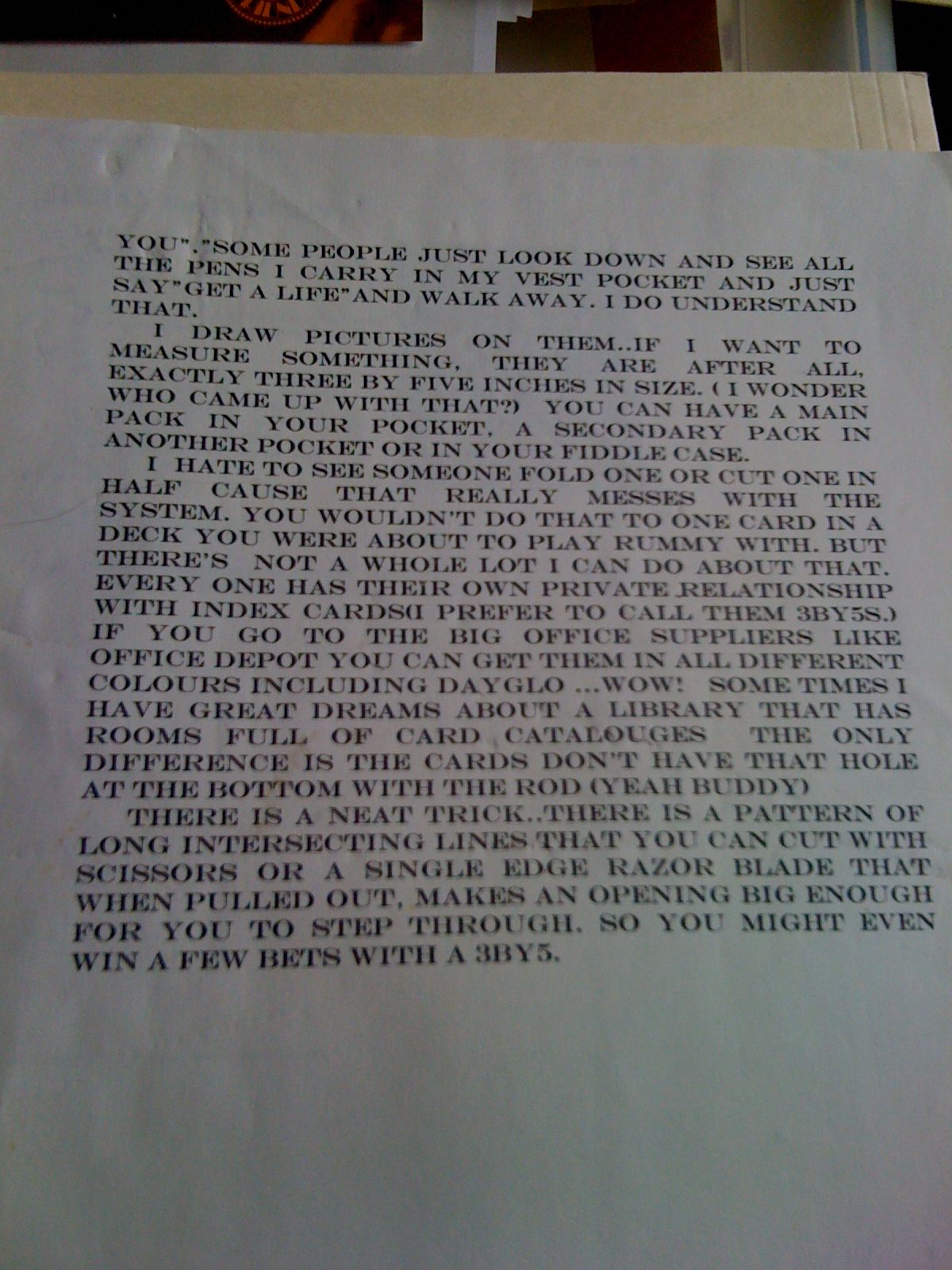
John’s thoughts about notecards, page 2. Nashville, TN, c.2000.

20 Wednesday Nov 2013
Posted in John Hartford
20 Wednesday Nov 2013
Posted in Ed Haley
Tags
Bruce Nemerov, Ed Haley, fiddling, history, John Hartford, Lee Hazen, Lynn Davis, Mark Wilson, music, Nashville, Parkersburg Landing, writing
When I got back to Nashville, I had this boxed package in the mail from Mark Wilson, the folklorist who co-produced Parkersburg Landing. Inside the box was a pile of wire recordings, looking very much like a gossamer bird’s nest, which Mark said were Lynn Davis’ recordings of Ed Haley from the forties. I had no idea why Mark had these wires, or really why he had sent them to me. Some years before, I had called him about Ed and received a cool reception, sort of like, “Why don’t you leave all of this to the real folklorists?”
I took the wire recordings to Lee Hazen, a studio engineer and friend whose life-long hobby was wire recordings, and he told me right away that they were way beyond hope. “Even if you took pieces of them and run them through and taped them and then assembled the tape?” I asked.
Nope.
He said it would require someone with enough patience to spend the rest of their life untangling them. I decided to keep them safe though and maybe someday, who knows? But wouldn’t it be awful to get them all together and discover that they were not even of Ed?
Later that spring, Bruce Nemerov notified me that he’d completed his work on Ed Haley’s recordings. I got a hold of the new copies, which included an audio log. There were several records that Bruce didn’t copy.
03 Tuesday Sep 2013
Posted in Ed Haley
Tags
Appalachia, Ashland, Cincinnati, Ed Haley, fiddle, history, John Hartford, Lawrence Haley, life, music, Nashville, Portsmouth, U.S. South
Once I returned to Nashville, I called Lawrence Haley, who was in the mood to reminisce.
“Me and Pop hitch-hiked to Cincinnati out of Portsmouth a time or two,” he said. “We took old 52. And we’d had about three rides to get there.”
I asked him if Ed took his fiddle on those trips and he said, “Yeah, if he thought he was gonna be in a little bit other than country settings, he would put it in the case. But most of the time, he’d just carry it in his hand, tucked under his arm, maybe, with the bow in his hand.”
I wondered if Ed packed any extra bags on the road and Lawrence said, “Mostly just the clothes on his back, unless he was going on an extended trip — then he’d pack him a suitcase. He’d, of course, fill it up about a third with his homemade tobacco. His own cure — apple or peach or something. He’d take him some of that with him and off he’d go.”
Lawrence Haley passed away on February 3, 1995, the 44th anniversary of his father’s death.
27 Saturday Apr 2013
Posted in John Hartford
Tags
banjo, bluegrass, culture, fiddler, John Hartford, music, Nashville, photos, Tennessee, U.S. South
1 9 9 5
27 Saturday Apr 2013
Posted in Ed Haley, John Hartford, Music
Tags
Appalachia, Catlettsburg, Clyde Haley, Ed Haley, Ella Haley, fiddle, fiddlers, fiddling, Harts Creek, history, Irish lilt, Kenova, Kermit, Kevin Burke, Lawrence Haley, music, Nashville, Noah Mullins, Norfolk and Western Railroad, Patsy Haley, snap bowing, West Virginia, Williamson, writing
Nestled in Nashville, I worked obsessively on Ed Haley’s music. First, I made a real effort to transcribe it note for note and break it down “under the microscope.” Initially, I had tried to play it generally the way he did while keeping its spirit — with my own twists, of course, which is nearly impossible not to do. This time, though, I wanted to study it as you might a fabulous book — break it down, look at it mechanically… I made a huge discovery regarding Ed’s bowing during that time. With Lawrence’s help via telephone conversations, I deduced that Ed used what Scotch fiddlers call “snap bowing,” which is when you separate notes by applying pressure (“little stops”) with the bow — not by changing its direction. Of course, Ed didn’t use those patterns exclusively and mixed them with more conventional strokes.
I also spent a lot of time listening to Ed’s recordings and playing my versions of his songs into a tape recorder. One of the first things I figured out was that he used what fiddler Kevin Burke calls the “Irish lilt” to give his music a “dotted note feel.” It would be like playing a tune in triplets with the middle note taken out.
I also discovered that Lawrence was right about Ed not playing so many notes; instead, he created the illusion of doing so by phrasing his tunes in a way that gave them a nice “crooked” flavor.
Throughout these discoveries, Lawrence continued his role as my brutally honest fiddle teacher. His comments were surprisingly musical for someone who kept reminding me that he didn’t even play anything. When I played “Yellow Barber” for him over the telephone, he said, “That sounded right except when you get down to that low end, you’re doing a little skipping in there and it seemed to me like Pop played that a little bit smoother. Like he had a roll to his… And I noticed you had a few jumping notes in there that really I don’t remember hearing. Maybe you can hear them. Other than that, it sounded great to me.”
Lawrence seemed pleased with my playing of Ed’s “Catlettsburg”.
“That was good, John,” he said. “That was really good.”
I told him I didn’t know how Ed was able to get up into second position on that tune with the fiddle sitting at his shoulder.
“I always thought that he kinda controlled the violin with his thumb and the meaty part of his hand between his finger and thumb,” Lawrence said. “He could relax that up and down the neck of the violin or he could tighten that and he could still have the flexibility of his fingers, plus that give him the ability to rock that violin body underneath the bow, too.”
I was trying that and eventually got to where I could will my fingers into third position still holding the fiddle at my shoulder, which if you have to play for a long time is sure easier on the neck of the player.
I told Lawrence about talking with Clyde, especially about his memories of Ed mistreating him as a child.
“I don’t know, maybe my dad was mean to him when he was a young’n,” Lawrence said. “But I can’t remember my dad ever laying a hand on me to hurt me. I musta been a rowdy little kid ’cause it seemed like whenever Pop’d pick me up he’d call me ‘muddy duck’ because I was always dirty, I reckon, whenever he’d get a hold of me. He’d just rub my head or something like that and call me his ‘muddy duck.’ I don’t know where Clyde got his story from.”
Lawrence agreed that his dad sometimes abused his mother, although he placed a lot of blame for their marital problems on her.
“Well, he could be temperamental with my mother at times, but I think she was temperamental, too. I think my mother’s people had higher tempers than Dad’s people did. They seemed to be kinda quiet people. Noah Mullins was supposed to killed a revenuer up there at Harts. They waylaid a revenuer and they laid it on Noah, but Noah Mullins always seemed to me like just as quiet and as calm a fella as could be. But I had some of my uncles on my mother’s side, they were a little bit of a temperamental type of people. So I’d put some of the blame on my mother for her treatment of my dad. You know, a woman can upset a man and whip him quicker with words than he can whip her with his fists.”
I totally agreed, then asked Lawrence if he knew anything about the Muncys from Patsy’s genealogy.
“We’d ride the Norfork and Western train up from Kenova and stop at Kermit and stay there with Muncy people,” he said. “They lived in an apartment up over their store and filling station-type thing and they had one of them small monkeys. I went up there one day and got right at the top of the steps and was playing with that monkey and I musta made it mad and it made a rush at me and I musta jumped back and I went to the bottom of them steps. That made me remember it more than anything else. I can’t even remember that Pop played music while he was there for them. They mighta just talked. We used to stop there maybe and stay all night and Pop and Mom and me would go on to Williamson and they’d play at courthouse days or something there. Pop musta had people up in there, but he never said anything to me about it.”
11 Thursday Apr 2013
Posted in Ed Haley
Tags
California, Clyde Haley, Dingess, Ed Haley, Ella Haley, fiddler, Harts Creek, John Hartford, Lawrence Haley, Logan County, Mona Haley, music, Nashville, Ralph Haley, Stockton, Wayne County, West Virginia, writing
In January of 1994, Lawrence put me in touch with his brother Clyde Haley, an old bachelor who had spent most of his life roaming the country, working here and there and always managing to get into some kind of trouble. Lawrence called Clyde “the black sheep of the family,” while Mona laughingly dubbed him as a “rogue.” He was Ed Haley’s oldest son and some seven years older than Lawrence. Each time I went to Harts Creek, people had asked about Clyde. Apparently, he made quite an impression.
When I first called Clyde, he lived in a minimum-security nursing home in Stockton, California. Our conversation started like this:
“Hello, John!”
Hey, Clyde. How’re you doing?
“Well, I’m still in the hospital.”
Well, all right. I been wanting to talk to you for two years now.
“Who is this?”
This is John Hartford in Nashville.
“Well, I don’t know whether I know you personally, do I?”
Well, you may not. I’m a real good friend of Lawrence and Pat’s. And I play the fiddle myself and I’m on television. I wear a little derby hat and I dance while I play the fiddle.
Clyde laughed.
But the reason I want to talk to you is I think your father was the greatest old-time fiddler that ever lived.
“I do, too,” he said.
Apparently, Clyde spent a lot of time bragging on Ed’s music at the nursing home. I told him I would send him copies of his father’s music and he got really excited.
“Okay,” he said. “We do a lot of little dancing here in our recreation periods. I think I’ll be outta here in March. It’s not a jail or anything — it’s a hospital.”
I told him I would be touring California in June and he said, “Well, you’ve got my address. Drop by and see me. I’m in Stockton.”
In the meantime, there were a lot of things we could talk about over the telephone. I could tell early in our conversation that Clyde was sometimes right on with his stories, while at other times he was completely out to lunch. His memories were sporadic — in no particular order — like bits of broken glass in a huge pile of garbage that you have to sort through and put back together.
I knew Clyde was Lawrence’s oldest living brother, but wasn’t exactly sure of his age.
“I was born in 1921,” he said. “That’d make me about 73.”
Clyde said he went with his father on trips more than any of the other Haley children.
“When my dad wanted to leave Mom and get away from her for a change, he’d always take me as his crutch,” he said. “I was his favorite son outside of Ralph. He called me ‘Reecko’. That was his nickname for me. I used to carry the fiddle case for him. And I went with him when he’d go to Logan County and go up on Harts Creek and up in Dingess and up that way. And he’d go over around Wayne County. He knew people up there.”
I asked Clyde to describe his father and he said, “My dad, he was about 6’2″ and he had real small feet. He had feet like a dancer would have and he wore a size six shoe. I remember that because I used to wear his shoes. I never saw him with a suit on in my life.”
04 Thursday Apr 2013
Posted in Big Harts Creek, Ed Haley, Harts, John Hartford
Tags
Appalachia, Bill Mullins, Chloe Mullins, Ed Haley, Imogene Haley, Jackson Mullins, Joe Mullins, John Hartford, Lawrence Haley, Liza McKenzie, Nashville, Peter Mullins, photos, Turley Adams, Violet Adams, West Virginia
I returned to Nashville talking not so much about new musical developments but rambling on to my wife about murders and the people I’d met in Harts. I spent a lot of time studying over Joe’s photographs, especially the faded family group shot. One of the boys in the picture was propped inside a young woman’s arms and appeared very much to be blind. Was it Ed and his mother? Unfortunately, since the woman was almost completely faded away I couldn’t make a positive identification of her, even when I compared it to the photo of Emma Jean found by Lawrence and I on our first trip to Harts.
There was another interesting development: when I removed the picture of Bill and Peter Mullins from its frame, another equally large picture of the “old couple” kind of popped out from behind it. That made three pictures of those folks and it sure seemed logical to me that Joe Mullins would’ve had three pictures of his grandparents — meaning Ed’s grandparents — and not of an uncle and an aunt.
I sent copies of Joe’s old pictures to Turley and Violet Adams to see if they could show them around for identification. A few weeks later, we spoke over the telephone and they said Liza McKenzie had fingered Ed as the child to the right in the faded group picture. She also said the old folks in the back row were Jackson Mullins and his wife, Chloe.
30 Wednesday Jan 2013
Posted in Big Sandy Valley, Ed Haley, Huntington, Music, Pikeville, Williamson
Tags
Appalachia, Beaver Creek, Big Sandy River, Bill Necessary, Carter Caves State Park, Curly Wellman, Ed Haley, Ella Haley, fiddler, fiddling, Floyd County, Fraley Family Festival, Grayson, history, Huntington, J P Fraley, John Hartford, Kentucky, Lawrence Haley, Levisa Fork, Lynn Davis, Mingo County, Molly O Day, Molly O'Day, Mona Hager, music, Nashville, Paintsville, Prestonsburg, Snake Chapman, Tug Fork, U.S. South, Ugee Postalwait, West Virginia, Williamson, writers, writing
A few months later, I met Lawrence Haley at the Fraley Family Festival at Carter Caves State Park near Grayson, Kentucky. Lawrence and I spoke with Bill Necessary, a musician who saw Ed and Ella all over the Big Sandy Valley when he was about twenty years old. He said they rode a train up Levisa Fork to Paintsville, the seat of government for Johnson County, where they spent the day playing music at the courthouse. From there, they continued by train to Prestonsburg, county seat of Floyd County. At times, they went into the nearby coal camps of Beaver Creek and played at theatres. From Prestonsburg, they took the train to Pikeville, the county seat of Pike County, and then continued over to the Tug River around Williamson, county seat of Mingo County, West Virginia.
“Aw, they took in the whole dern country up through there,” Bill said. “By the time they made that circuit, why it’d be time for them to come again. I guess they’d tour a couple of weeks. By God, I just followed them around, son.”
Lawrence didn’t remember going to all of those places with Ed but did remember staying with Molly O’Day’s family around Williamson. Bill said Molly’s widow Lynn Davis was still living around Huntington, West Virginia.
Bill said Ed always wore a long overcoat — “rain or shine” — and even played in it. He never sang or entered contests.
“He was pretty up to date on music at that time,” Bill said. “His notes were real clear, boy.”
Back in Nashville, I worked really hard trying to figure out Ed’s bowing. There was a lot of contradictory information to consider. Snake Chapman said he bowed short strokes, indicating a lot of sawstrokes and pronounced note separation. J.P. Fraley, Slim Clere, Lawrence and Mona said that he favored the long bow approach and only used short strokes when necessary, like for hoedowns. Preacher Gore, Ugee Postalwait and Curly Wellman spoke about how smooth his fiddling was, which kind of hinted at him being a long bow fiddler. All were probably accurate in some respect. It seemed plain to me that one reason why there were so many contrasting and sometimes completely opposite accounts of how or even what Ed played was that everyone I’d talked to witnessed him playing at different times and places during his musical evolution. All along the way, he was experimenting, looking for that “right combination” or playing the style needed to create the sounds popular in a certain area. Even what I could actually hear on his home recordings was really just a glimpse into the world of his fiddling as it existed at that moment toward the end of his lifetime.
25 Friday Jan 2013
Posted in Ed Haley, Huntington, Music
Tags
Ashland, Boyd County, Curly Wellman, Dixie Lee, Ed Haley, history, Huntington, Hymns from the Hills, John Hartford, Kentucky, Laverne Williamson, Lawrence Haley, Lynn Davis, McVeigh, Molly O Day, Molly O'Day, Mountain Fern, Mountaineer Jamboree, music, Nashville, Snake Chapman, U.S. South, WEMM-FM, West Virginia, writers, writing
Back in Nashville, I followed up on some leads from Curly Wellman. I focused in on Molly O’Day, the famous singer who grew up hearing Ed’s music at her parents’ home in McVeigh, Kentucky. Snake Chapman and Lawrence Haley had both implied a strong connection between she and Ed. Named Laverne Williamson at birth, she initially used the stage names Dixie Lee and Mountain Fern. In 1941, she married Lynn Davis; the following year, she changed her name to Molly O’Day. During the 1940s, she was one of the leading female vocalists in country music.
“Uncomfortable with fame, Lynn and Molly found consolation in religion and evangelism from 1950,” according to Mountaineer Jamboree. “More often than not Huntington or its suburbs has been their home and since 1974 they have had a program called ‘Hymns from the Hills’ on WEMM-FM radio which features country gospel records and inspirational talk. Molly O’Day continued as a familiar voice on WEMM-FM radio in Huntington until she was diagnosed with cancer. She ‘went home to be with the Lord’ on December 4, 1987, and Lynn Davis has continued their radio ministry alone.”
I definitely wanted to look up Molly’s widower the next time I was in Ashland.
22 Tuesday Jan 2013
Posted in Ed Haley
Tags
Christmas, history, John Hartford, Lawrence Haley, life, music, Nashville, Pat Haley, photos, Steve Haley, Tennessee, U.S. South
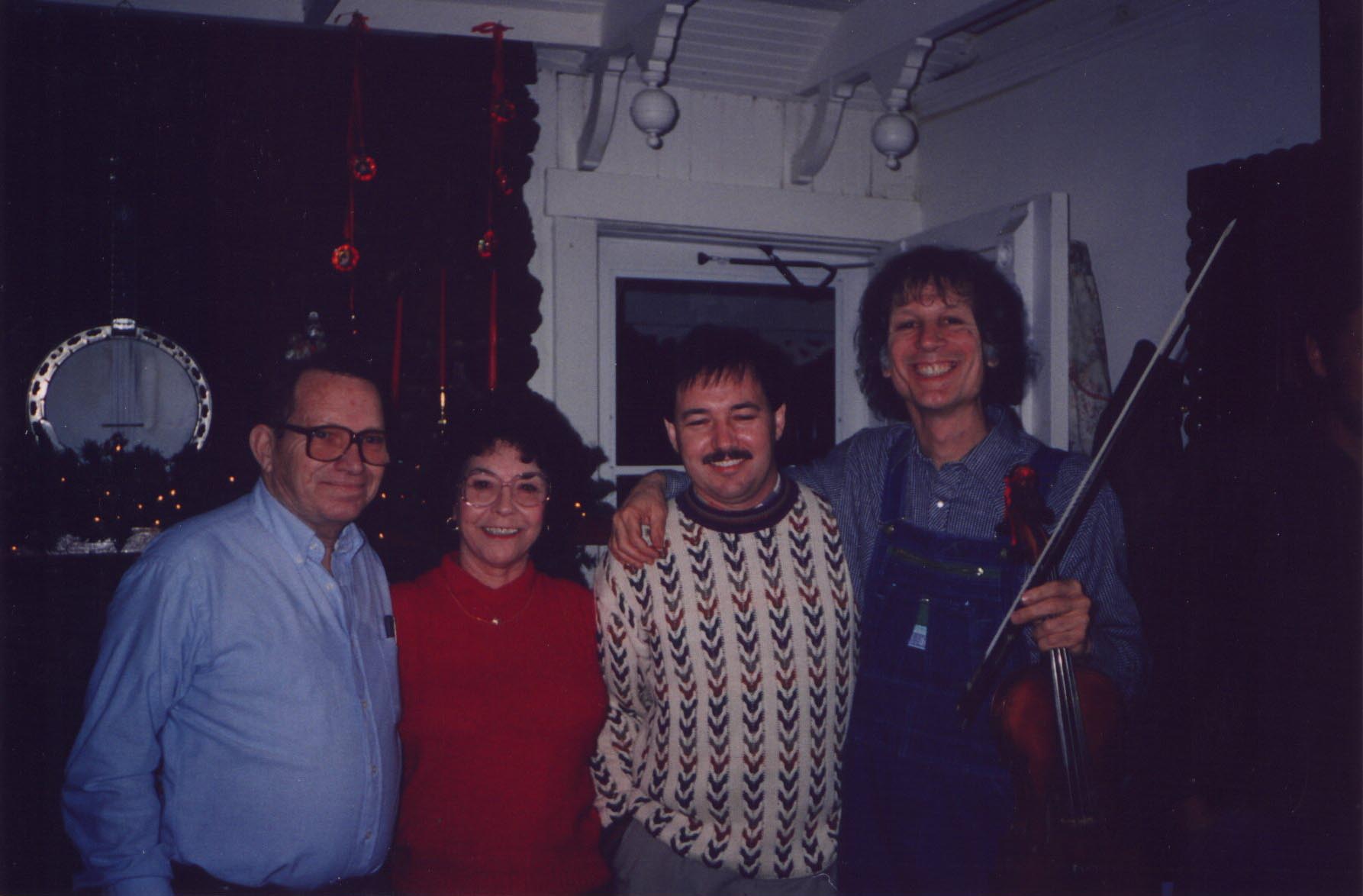
Lawrence Haley, Pat Haley, Steve Haley, and John Hartford at a Hartford Christmas Party, Madison, TN, 1991-1994
27 Thursday Dec 2012
Posted in Ed Haley
Tags
Ed Haley, fiddle, Harts Creek, history, John Hartford, John Hedgecoth, Lawrence Haley, Logan County, music, Nashville, Noah Mullins, Steve Haley, U.S. South, West Virginia, writing
When I got back in Nashville, I ranted and raved over Haley’s fiddle before taking it downtown to John Hedgecoth, an instrument repairman. John and I went over its every detail. We fitted a bridge to it and put Black Diamond strings on it (the brand Haley supposedly used), then I brought it home and played on it for about two weeks. I focused on learning Ed’s version of a fabulous tune called “Half Past Four”.
“It just sounds like a dream,” I said to Lawrence when I called him. “You play on it real light and it’s got that sound in it.”
“Well, that’s great, John,” he said.
“Now I had to put a chin rest on it and I am using a shoulder rest with it because that’s what I’m used to and I had to put tuners on it because I like to keep it in tune,” I said.
“Okay. Well, that’s all right,” Lawrence laughed.
I said, “I tell you what’s interesting about it. It looks like at one time the back had been taken off and re-glued.”
Lawrence said, “Yeah, it got damp and the glue came loose on it and I guess that back warped or something. I don’t think it was completely off. Well, my son Steve had somebody down there in Nashville to repair it but that bridge — that thing looked real odd to me. I had an old bridge here. It’s in a drawer around here somewhere, I’d say, and I’ll look for it. I never really got it strung up since then. I just figured, well, there’s enough glue on that old fiddle that it ain’t gonna sound right anyway. If you use too much glue, you’re gonna lose a lot of the resonance in the wood.”
I said, “Now, it also looks like at one time the neck was broken out of it and reglued.”
Lawrence said, “Well now, it was not in the best of shape when Steve snuck it out of here. He took it out and had it repaired for me for a Christmas present. I just figured it’s gonna lay around here and just deteriorate again, maybe draw dampness some way or it’ll fall apart anyway. I just thought since you showed so much interest in it I’ll just let you have it.”
I said, “Well, I sure appreciate that. One of the things… The fingerboard, when you look at it straight on, lays over to the right in a funny kind of an angle.”
Lawrence said, “Yeah, that’s what I figured. I don’t remember it being like that. That fingerboard, it looked to me like it had some wear on it where my dad had fingered it so much. It looked like it had slight indentations from his fingers. I didn’t know whether it would fret right.”
I said, “And also, the sound post is an inch back from where it ought to be.” I wasn’t sure if Ed had kept it there or not; I felt it likely that it had fallen over in the decades after his death and been misplaced by some half-wit repairman.
I got Ed’s fiddle and played “Half Past Four” for Lawrence, who said, somewhat amused, “You’re trying to play one of his pieces. Sounds pretty good. Well, maybe some time down the line you’ll get that ‘Cacklin’ Hen’ down. It’s just working at it. And that fiddle does sound good from over the phone.”
I said, “It’s got a little overtone in it that none of these other fiddles have and when I go back and listen to those tapes I hear that overtone in there.”
Lawrence said, “Maybe you got a prize there. I don’t know. I think everybody agrees that you should have it. Steve seems to know more about you than what we do. I don’t know how he does but he’s a musician too, you know. He taught high school band for a while and he plays in a jazz band some. Plays the trumpet. His wife’s a musician. She’s a church organist — used to be. Two of the children… One of them’s in some kind of Nashville junior symphony. Plays the cello. The other plays the violin.”
I told Lawrence I wanted to be sure and go back to Harts Creek in the fall and find out more about his dad’s early years there.
“All right,” he said. “We’ll go back up there. I don’t think anybody up there, once they find out who you are will have any objections. One of my second cousins, Noah Mullins, he killed one of the revenuers that come up through there and that give Harts Creek a bad name, I guess. Those days are gone. I believe the second time up there everybody’d be glad to see you and talk to you like they were this last time. They won’t be any problem about that. People are a little suspicious if they don’t know who you are. But if they know you got a purpose and reason for being up there that isn’t detrimental to their causes they ain’t gonna jump you or anything or give you problems.”
27 Thursday Dec 2012
Tags
Black Sheep, David Haley, Ed Haley, fiddle, fiddling, history, John Hartford, Lawrence Haley, music, Nashville, Ohio, St. Clairsville, Steve Haley, writing
In Nashville, I spent several months working with Ed’s music and calling Lawrence Haley with questions and comments. I continued to study every intricate detail of Ed’s fiddling — supplementing it with recently learned facts about his life as well as devoting some attention to his songs. When I called Lawrence with questions about new “discoveries,” he said my visit to Ashland had inspired one of his granddaughters to take up the fiddle. I was very curious about that because of my belief in genetic memory. Who knew what secrets she had locked away inside her DNA? I told him I would bring her one of my fiddles the next time I saw him.
A few months later, I met Lawrence and his family at my show in St. Clairsville, Ohio. It was the first time Lawrence had seen me play on stage and I was ridiculously nervous. He listened intently from backstage and kept his criticisms to a minimum. He said his father played a lot faster than I did and really bragged on how Pop played the fiddle while singing, like with the tune “Black Sheep.”
In a quiet country town not very far away
There lived a rich and aging man whose hair was few and gray.
He had three sons, his only ones, Jack and Tom was sly.
Ted was honest as could be and could not tell a lie.
When we gathered on the bus, I gave Lawrence’s granddaughter one of my fiddles.
“Well I have something to give you, too,” Lawrence said before making a quick trip to his car. He returned with Ed’s fiddle, which he reached to me and said, “We brought something for you. We’re not using it and we know you would appreciate it and know its value.”
I carefully turned Ed Haley’s fiddle over in my hands.
It was a tremendously emotional experience.
“Are you sure you want to do this?” I asked.
Lawrence said he had talked about it with his sons Steve and David and every one agreed it was the right thing to do.
“I discussed it with the kids here,” he said. “David, he kind of showed a little bit of objection but I told him, ‘Well, John’s gonna bring a fiddle up here to Andrea. I just may as well turn loose of this one because it’s just gonna lay here and deteriorate. Why not let John have this one?’ He agreed to it. If anybody would’ve had any objections I think Steve would because his girls are both string instrumentalists. But they didn’t seem to mind too much so you got it and we won’t worry about it anymore.”
I immediately took Ed’s fiddle to my bedroom on the bus, put it in a case and laid it on the bed for safety.
25 Tuesday Dec 2012
Tags
banjo, Banjo News Letter, bluegrass, fiddler, Fiddler Magazine, history, John Hartford, magazines, Mississippi River, music, Nashville, photos, Tennessee, Tennessee Folklore Society, The Devil's Box, U.S. South
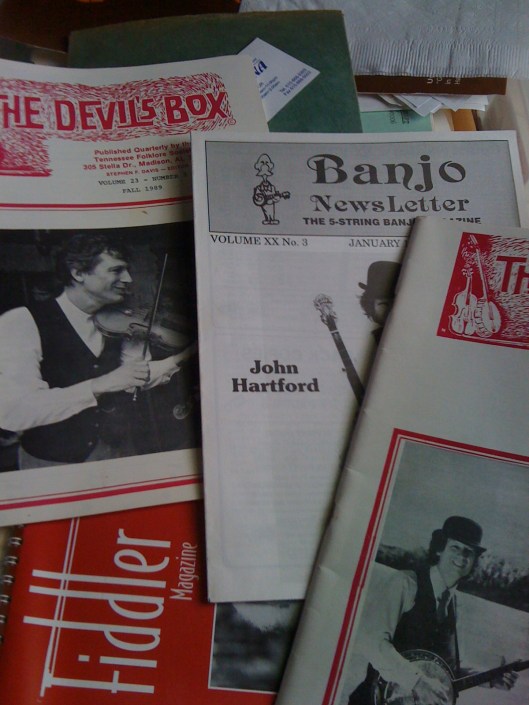
Posted by Brandon Ray Kirk | Filed under John Hartford, Music
09 Sunday Dec 2012
Posted in Big Harts Creek, Ed Haley, Spottswood
Tags
Appalachia, Ashland, Ashland Cemetery, Buck Fork, Clifford Belcher, Connie Woods, Dingess, Ed Belcher, Ed Haley, Ella Haley, fiddle, fiddler, fiddling, genealogy, George Greasy Adams, guitar, Harts Creek, history, Hoover Fork, Jackson Mullins, Jeff Baisden, John Frock Adams, John Hartford, Johnny Hager, Kentucky, Lawrence Haley, Liza Mullins, Logan, Logan County, Maynard's Store, music, Nashville, Peach Creek, Peter Mullins, Ralph Haley, Sol Bumgarner, square dances, Trace Fork, Turley Adams, Violet Mullins, Weddie Mullins, West Virginia
At some point, Connie showed up with a small entourage of women toting some of Joe Mullins’ old pictures. My eyes immediately went to a large, framed photograph of two serious mustachioed men. Turley said one was Weddie Mullins — his grandfather on “both sides” of the family tree — while the other was Ed Haley’s Uncle Peter Mullins. Both men were brothers. Turley said his grandfather Weddie — Ed’s uncle — was murdered at the little town of Dingess just after the turn of the century.
Lawrence said, “Mom and Pop used to play at Dingess — just a little community over in MingoCounty.”
That got us back on the subject of Ed, although most of the commentary was choppy and mixed between looking at photographs. One of the girls said, “We’ve heard talk of Ed all our lives.” Another made the unusual remark, “He could see lightning. Some way he could feel it or something and tell it was hitting.” Someone said Ella could tell the difference between the Haley children by their smell.
Turley, who had been fairly quiet throughout our visit, said to Lawrence, “Bernie Adams used to play a lot of music with your dad.”
Violet said, “Bernie’s the one took him in the chicken house for the toilet. They stayed all night up at our house. Robert Martin and Bernie and Ed and them played music all night. I can remember it. I was just a little girl. Mother said Ed played many a time where she was raised up over in the head of Francis Creek.”
Lawrence said, “You know, these different places like Hoover and places like that don’t ring a bell to me. I can remember going down here to the end of Trace, and maybe down to Smoke House, and up to George Adams’ who lived on up this way, and up to that store — Maynard’s Store — and buying candy, but that’s about the limit of my travel, except coming up from the mouth of Harts.”
Basically, the next half-hour or so was a giant “get to know everybody session” — mostly between Lawrence and the locals. I sort of hung back a little, taking it all in, while Lawrence spoke of and listened to stories about his father. There was a glow about his face that had been absent in Ashland.
At one juncture, he told Connie how her grandparents, Peter and Liza Mullins, raised his father.
“Oh, really?” she said. “I didn’t know that. Now I remember Granny. They wanted me to stay all night with her and I was always afraid she’d die in her sleep or something. That’s terrible.”
She asked Lawrence if he remembered Uncle Jeff — “he was Granny’s brother and he was kinda slow.”
Violet said, “He liked to go to all these dinner meetings they’d have out in the country. He’d walk for miles and miles.”
Connie asked Lawrence if Ed ever played at Logan — the seat of government for Logan County — and he said, “Yeah, he used to play around Logan quite a bit and Peach Creek. He’d play up there during court days especially. Back in them days, the town would load up. I’ve been there with him during those times. The old courthouse, I think it faced toward the river. One side of it was on Stratton Street.”
Connie asked where Ed was buried and Lawrence said, “He’s buried in the Ashland Cemetery in Ashland. Mom’s buried in the same cemetery but not with him. By the time my mother died — she died three years after Pop — they’d filled that section up.”
I’d never really thought about that. Ed and his wife were not buried together, the kind of seemingly minor detail tossed out randomly that took on somewhat of a greater meaning at a later date. I made a note to myself right then that I would visit Ed’s grave in Ashland before heading back to Nashville.
Violet wondered about Lawrence’s older brother, Clyde.
“Clyde’s out in Stockton, California,” he said. “He’s what I call the black sheep of the family. Never married. He just followed the sun for work. When it was summertime, he’d go north; when it was wintertime, he’d go south.”
Just then, an old man called Bum showed up at Turley’s. Bum remembered Ed and his family well. He asked Lawrence about the Haleys. It was hard to focus on their conversation — everyone in the room seemed to be talking at once — but I heard Bum mention something about how Lawrence’s brother Ralph used to hang from tree limbs by his “sticky toes” and would “do anything.”
“That’s exactly how he got killed,” Lawrence said. “He was hanging by his toes and he was gonna let go with his toes and flip over and land on his feet but he didn’t make it. He was just active like that. See, Ralph danced around these carnivals and fairs and places.”
A few minutes later, things quieted down a little. I moved over near Bum to ask him about Haley. His answers seemed to come through his nose more than his mouth and were usually followed by a little chuckle. He was great. Bum said he was 67 years old and first saw “Uncle Ed” in the thirties.
“He lived down in Ashland and he’d come up pretty often,” Bum said. “People come from everywhere to listen at him play whenever they’d have them big dances and stuff. He’d play half the night. Yeah, I’ve been right there.”
I asked Bum about Ed’s tunes and he said, “Ah, he played so many… There was one religious tune he’d put the bow under the fiddle, and the hair, he’d turn it right over and slip his fiddle between it, and play that. I forgot what it was.”
Bum told me all about the old dances.
“They used to have a big working,” he said. “About every family on this creek and Harts Creek down here, they’d all gather up and hoe one man’s field out and then move to the next one. And they’d all go to each other’s farms that way and help each other, and when they got done one man would have a big dance. They’d have a dance on Saturday night. They’d have them at just about every home, mostly at Uncle Peter’s up here, in the house. Like one room in there, they’d gather everything up and take it outside and they’d have a dance in there, and when they got through they’d put the furniture all back in. Anybody that wanted to come was invited. They’d have food right in the house. There were usually three or four around to call the reel: ‘Dosy doe and here she comes and there she goes.'”
“It’d just be Uncle Ed and John Hager playing?” I asked.
“Well, Ed mostly,” Bum said. “Uncle Johnny, he played some with him. Uncle Ed, he played by himself most all of these dances. Mrs. Haley played with him a lot. She played the mandolin, guitar or accordion.”
“Did Johnny Hager play the banjo about like Grandpa Jones?” Turley asked Bum.
“Yeah, over-handed they call it,” Bum said. “Molly O’Day, she played that way. My grandpaw would whittle out two little sticks and he’d sit and beat on them strings and Ed a playing the fiddle.”
“Ed played with Ed Belcher,” Turley said.
“Yeah, I’ve heard Pop talk about Ed Belcher,” Lawrence said.
Now who was Ed Belcher?
“He played the guitar,” Bum said. “He could play the piano, too. They’d get together at times and play together. They’d go up Buck Fork.”
Bum said he last saw Ed Haley “over here on that mountain yonder” at Clifford Belcher’s beer joint.
“He’d go down there and play and people’d give him beer and stuff. That’s about all he wanted. I run into him over there one night. I said, ‘Uncle Ed, where you been?’ He said, ‘I ain’t been no where but right here. I come up here to sit around and play music a while.’ I bought him a beer and he sat there and played music. Well, a Conley boy run in and went to playing and thought he was better than Ed and everything. Ed finally told that boy, said, ‘Why don’t you quit playing that music? You can’t play. You’re cutting my music up too much.’ That boy come back at him, you know, and aimed to fight him. He said, ‘Shut up, old man. You don’t know what you’re a talking about.’ I was standing there and I told him, I said, ‘Now listen. If you jump on that man, you’ll have me to fight and him both.’ And Ed took his fiddle and hit that feller right down over the head with it and busted that fiddle all to pieces.”
Lawrence laughed.
Turley said Ed Haley was high-tempered, as well as strong, and hinted at his mean streak.
“Dad said Peter had a dog that Ed couldn’t get along with at all. Ed told Uncle Johnny, ‘You get me close to him and I’ll hit him in the mouth. I’ll knock him out.’ And he said Ed hit that dog and killed him with his fist. Hit him in the ear and killed him. That’s what my daddy told.”
Bum was very familiar with Ed Haley’s family on Trace. He said Uncle Peter Mullins was “pretty bad to get out and get drunk and get into it with people.” He knew all about Ed’s uncle Weddie Mullins’ murder at an election in Dingess. “There used to be a train come in there and they’d bring flour and stuff over there and people’d go over there to Dingess and get it,” he said. “They’d take wagons and go through these hills, like up Henderson and all them places and they got into it over there.” Bum wasn’t sure who shot Weddie but knew that his killer survived the fracas. Once the news reached Harts Creek, John Adams got a pistol from Jackson Mullins and rode to Dingess where he found Weddie’s killer laid up in a bed clinging to life. Someone told him the guy probably wouldn’t make it so (like something out of a Hollywood Western) he pulled out a .38 pistol and said, “I know he won’t,” and shot him in cold blood.
I wasn’t exactly sure who any of these people were — Jackson Mullins, John Adams — but I had the impression that they were some relation to Ed Haley. At that juncture, I just let the tape recorder roll and tried to take notes and absorb everything, figuring that what seemed like unimportant details would perhaps later develop into major items of interest.
30 Friday Nov 2012
Posted in John Hartford
Tags

John Hartford, sketch of himself on a napkin
28 Wednesday Nov 2012
Posted in Ed Haley
Tags
Appalachia, Arthur Smith, Benny Thomasson, books, Cacklin Hen, Clark Kessinger, Clayton McMichen, Dr. Charles Wolfe, Earl Spielman, Eck Robertson, Ed Haley, fiddler, Forked Deer, Georgia Slim Rutland, history, J P Fraley, John Hartford, Ladies on the Steamboat, music, Nashville, National Folklore Festival, Parkersburg Landing, Skeets Williamson, Snake Chapman, Tennessee, Texas, The Devil's Box, Tug Boat, U.S. South, writers, writing
Back in Nashville, I thought a great deal about Ed Haley’s place in relation to other fiddlers of his time. I’m not much on categorizing people but I agreed with Dr. Wolfe, who put Ed in a “creative” class of fiddlers that included Eck Robertson, Clark Kessinger, Arthur Smith and Clayton McMichen. These fiddlers, according to Dr. Wolfe, felt that technique was just as important as repertoire – one of the trademarks of the Texas contest fiddling style so popular today.
“I like to flavor up a tune so that nobody in the world could tell what I’m playing,” Haley once told Skeets Williamson.
For creative fiddlers, writes forensic musicologist Earl Spielman in The Devil’s Box, “a fiddle tune is not just an ornamented melody; a melody is merely the raw, undeveloped, unprocessed material out of which a tune can grow and reach maturity. In Texas, instead of playing a repetition of the melody, the fiddler plays a variation of the original material. Each new variation can be radically different from the preceding one. The object of the fiddler is to avoid duplication and to be as innovative as possible within the limits of what is acceptable. As might be expected, any regular pattern of bowing is avoided. The bowing characteristic of Texas fiddling consists of fairly long bow strokes executed very smoothly with the bow rarely leaving the strings and with the number of notes played on each stroke varying from a single note to as many as seven or eight.”
Creation of the Texas contest style is accredited to Benny Thomasson, who competed with rival Major Franklin to such a fierce degree that he started improvising tunes and adding new parts onto them.
“Back when I started they had only two part tunes, and that was it,” Thomasson said in a 1982 interview. “In the older days when I began to come up I took these old tunes and began to build different sections to them. Like there would be two parts. Well, I’d add another. It would be the same part but in a different position. The old-timey fiddling that they try and hang onto nowadays, it’s all right. It’s good to listen to but we take those same tunes and just weave a web around them and make it come out real pretty.”
Many fiddle scholars agree that Benny Thomasson got his ideas about adding onto tunes from Texas fiddler, Eck Robertson. He was inspired enough by Robertson’s multi-part version of “Sally Gooden” (recorded in 1922) to say that Eck played it “better than anyone else in the world.” Haley was also proficient at adding parts; his “Forked Deer” had four parts, while his “Cacklin’ Hen” had eleven.
While there is no documented evidence that Ed Haley ever met Eck Robertson or Benny Thomasson, there is a link between Thomasson and Ed through Clark Kessinger and Georgia Slim Rutland. Benny borrowed heavily from Kessinger’s Haley-like early records, particularly “Tug Boat”, which Kessinger had gotten from Haley’s “Ladies on the Steamboat”. Likewise, Georgia Slim Rutland – one of radio’s top fiddlers in the 1940s – “allegedly spent one year in Ashland listening to Ed Haley play,” according to Parkersburg Landing, and was personally acquainted with Thomasson.
Because of Haley’s connection to Clark Kessinger and Georgia Slim, and their subsequent influence on Benny Thomasson, I began to formulate a theory that Haley was a “grandfather” of the Texas contest fiddling style. I must have been onto something because when I later mentioned it to J.P. Fraley, he said, “Well see, I knew Benny Thomasson and he knew about Ed Haley because I was playing at the National Folklore Festival and he wanted to know about that fella.”
Aside from such speculation, I also tried to discover more about Haley’s music from Parkersburg Landing. Hearing Snake Chapman and J.P. Fraley’s account of their experiences with him made my thirst to know more about his life and music overwhelming. I hated that I would never be able to see him play or talk to him. My family kidded me about trying to make up for that impossibility by doing everything short of digging him up and screwing him back together. They were aware – even before I – that I was obsessed with his story. My wife often poked her head into my office thinking I’d gone crazy listening to his recordings over and over. To her, they were nothing more than a bunch of surface noise and static, but the music was there and the feelings and pictures it made were unforgettable.
26 Monday Nov 2012
Posted in Ashland, Big Sandy Valley, Ed Haley, Matewan, Music, Pikeville, Williamson
Tags
Appalachia, Art Stamper, Arthur Smith, Ashland, Big Sandy River, Billy Lyons, Blackberry Blossom, blind, Charles Wolfe, Clark Kessinger, Clayton McMichen, Duke Williamson, Ed Haley, fiddle, fiddler, fiddlers, fiddling, Fox in the Mud, Frazier Moss, Fred Way, Ft. Gay, Grand Ole Opry, history, Huntington, Joe Williamson, John Hartford, Kentucky, Kermit, Kirk McGee, Levisa Fork, Louisa, Mark Howard, Matewan, Mississippi River, Molly O'Day, music, Nashville, Natchee the Indian, Ohio River, Old Sledge, Packet Directory, Paintsville, Parkersburg Landing, Pikeville, Prestonsburg, Red Apple Rag, River Steamboats and Steamboat Men, Robert Owens, Roy Acuff, Sam McGee, Skeets Williamson, Snake Chapman, square dances, St. Louis, Stacker Lee, Stackolee, steamboats, Tennessee Valley Boys, Tri-State Jamboree, Trouble Among the Yearlings, Tug Fork, West Virginia, Williamson, WSAZ
Back in Nashville, I was knee-deep in Haley’s music, devoting more time to it than I care to admit. I talked so much about it that my friends began to tease me. Mark Howard, who was producing my albums at the time, joked that if Ed’s recordings were of better quality, I might not like them so much. As my obsession with Haley’s music grew, so did my interest in his life. For a long time, my only source was the liner notes for Parkersburg Landing, which I had almost committed to memory. Then came Frazier Moss, a fiddling buddy in town, who presented me with a cassette tape of Snake Chapman, an old-time fiddler from the Tug Fork of the Big Sandy in eastern Kentucky. On the tape, Snake said he’d heard Haley play the “old original” version of “Blackberry Blossom” after he “came in on the boats” at Williamson, West Virginia.
The boats?
This was making for a great story. I was already enthralled by Haley’s fiddling…but to think of him riding on “the boats.” It was the marriage of my two loves. I immediately immersed myself in books like Captain Fred Way’s Packet Directory 1848-1983: Passenger Steamboats of the Mississippi River System Since the Advent of Photography in Mid-Continent America (1983) to see which boats ran in the Big Sandy Valley during Haley’s lifetime. Most of the boats were wooden-hulled, lightweight batwings – much smaller than the ones that plied the Mississippi River in my St. Louis youth – but they were exciting fixtures in the Big Sandy Valley culture.
“I have seen these boats coming down the river like they were shot out of a cannon, turning these bends, missing great limbs hanging over the stream from huge trees, and finally shooting out of the Big Sandy into the Ohio so fast that often they would be nearly a mile below the wharf boat before they could be stopped,” Captain Robert Owens wrote in Captain Mace’s River Steamboats and Steamboat Men (1944). “They carried full capacity loads of sorghum, chickens and eggs. These days were times of great prosperity around the mouth of Sandy. Today, great cities have sprung up on the Tug and Levisa forks. The railroad runs on both sides, and the great activity that these old-time steamboats caused has all disappeared.”
During the next few weeks, I scoured through my steamboat photograph collection and assembled pictures of Big Sandy boats, drunk with images of Haley riding on any one of them, maybe stopping to play at Louisa, Paintsville, Prestonsburg and Pikeville, Kentucky on the Levisa Fork or on the Tug Fork at Ft. Gay, Kermit, Williamson, and Matewan, West Virginia.
Finally, I resolved to call Snake Chapman and ask him about his memories. It was a nervous moment – for the first time, I was contacting someone with personal memories of Ed Haley. Snake, I soon discovered, was a little confused about exactly who I was and why I was so interested in Haley’s life and then, just like that, he began to offer his memories of Ed Haley.
“Yeah, he’s one of the influences that started me a fiddling back years ago,” Snake said, his memories slowly trickling out. “I used to go over to Molly O’Day’s home – her name was Laverne Williamson – and me and her and her two brothers, Skeets and Duke, used to play for square dances when we first started playing the fiddle. And Uncle Ed, he’d come up there to old man Joe Williamson’s home – that’s Molly’s dad – and he just played a lot for us and then us boys would play for him, me and Cecil would, and he’d show us a lot of things with the bow.”
Molly O’Day, I knew, was regarded by many as the most famous female vocalist in country music in the 1940s; she had retired at a young age in order to dedicate her life to the church.
“And he’s the one that told me all he could about old-time fiddling,” Snake continued. “He said, ‘Son, you’re gonna make a good fiddler, but it takes about ten years to do it.'”
I told Snake about reading in the Parkersburg Landing liner notes how Haley reportedly wished that “someone might pattern after” him after his death and he totally disagreed. He said, “I could have copied Uncle Ed – his type of playing – but I didn’t want to do it because he told me not to. He told me not to ever copy after anyone. Said, ‘Just play what you feel and when you get good, you’re as good as anybody else.’ That was his advice.”
I didn’t really know what to make of that comment. I mean, was Haley serious? Was he speaking from personal experience or was it just something he told to a beginning fiddler for encouragement?
After that, my conversation with Snake consisted of me asking questions – everything from how much Haley weighed to all the intricate details of his fiddling. I wondered, for instance, if Ed held the bow at the end or toward the middle, if he played with the fiddle under his chin, and if he ever tried to play words in his tunes. I wanted to know all of these things so that I could just inhabit them, not realizing that later on what were perceived as trivial details would often become major items of interest.
Snake answered my questions precisely: he said Haley held the bow “up a little in the middle, not plumb on the end” and usually played with the fiddle at his chest – “just down ordinarily.” He also said Haley “single-noted” most of his bow strokes, played frequently in cross-key, hated vibrato and used a lot of “sliding notes.” He seldom got out of first position, only occasionally “going down and getting some notes” that he wanted to “bring in the tune” and he definitely tried to play words in his music.
“The old fiddlers through the mountains here – and I guess it’s that way everywhere – they tried to make the fiddle say the words of the old tunes,” Snake said.
“Uncle Ed, he was a kind of a fast fiddler,” he went on. “Most old-time fiddlers are slow fiddlers, but he played snappy fiddling, kindly like I do. Ah, he could do anything with a fiddle, Uncle Ed could. He could play a tune and he could throw everything in the world in it if he wanted to or he could just play it out straight as it should be. If you could just hear him in person because those tapes didn’t do him justice. None of them didn’t. To me, he was one of the greatest old-time fiddlers of all time. He was telling me, when I was young, he said, ‘Well, I could make a fiddle tune any time I want to,’ but he said he just knowed so many tunes he didn’t care about making any more. He played a variety of tunes that a lot of people didn’t play, and a lot of people couldn’t play. He knew so many tunes he wouldn’t play one tune too long.”
I asked Snake about Haley’s repertoire and he said, “He played an old tune called ‘Old Sledge’ and it was one of his good ones. He played tunes like ‘Trouble Among the Yearlings’, but when he was gonna play it he called it ‘Fox in the Mud’. He made that up himself. One of the favorite tunes of mine he played was the old-time way of playing ‘Blackberry Blossom’ and he played it in G-minor. Ed could really play it good. They was somebody else that made the tune. Uncle Ed told me who it was – Garfield. He said he was a standing fiddling near a big blackberry patch and it was in bloom at the mouth of the hollow one time and this fella Garfield played this tune and he asked this fella Garfield what the name of the tune was. He said, ‘Well, I ain’t named it, yet,’ and he turned around and spit in that blackberry patch with a big bunch of ambeer and said, ‘We’ll just call it ‘Blackberry Blossom’.”
Snake laughed.
“Yeah, Uncle Ed, he had tales behind every one of them like that, but that’s where he said he got the name of it. He said he named it there…spitting in the blackberry blossom.”
Snake only remembered Haley singing “Stacker Lee”, a tune I’d heard him fiddle and sing simultaneously on Parkersburg Landing:
Oh Stacker Lee went to town with a .44 in his hand.
He looked around for old Billy Lyons. Gonna kill him if he can.
All about his John B. Stetson hat.
Stacker Lee entered a bar room, called up a glass of beer.
He looked around for old Billy Lyons, said, “What’re you a doin’ here?
This is Stacker Lee. That bad man Stacker Lee.”
Old Billy Lyons said, “Stacker Lee, please don’t take my life.
Got a half a dozen children and one sweet loving wife
Looking for my honey on the next train.”
“Well God bless your children. I will take care of your wife.
You’ve stole my John B. Stetson hat, and I’m gonna take your life.”
All about that broad-rimmed Stetson hat.
Old Billy Lyons said, “Mother, great God don’t weep and cry.”
Oh Billy Lyons said, “Mother, I’m bound to die.”
All about that broad-rimmed Stetson hat.
Stacker Lee’s mother said, “Son, what have you done?”
“I’ve murdered a man in the first degree and Mother I’m bound to be hung.”
All about that John B. Stetson hat.
Oh Stacker Lee said, “Jailor, jailor, I can’t sleep.
Old Billy Lyons around my bedside does creep.”
All about that John B. Stetson hat.
Stacker Lee said, “Judge, have a little pity on me.
Got one gray-haired mother dear left to weep for me.”
All about that broad-rimmed Stetson hat.
That judge said, “Old Stacker Lee, gonna have a little pity on you.”
I’m gonna give you twenty-five years in the penitentiary.”
All about that John B. Stetson hat.
It was one awful cold and rainy day
When they laid old Billy Lyons away
In Tennessee. In Tennessee.
Snake said Haley used to play on the streets of Williamson, West Virginia where he remembered him catching money in a tin cup. In earlier years, he supposedly played on the Ohio River and Big Sandy boats and probably participated in the old fiddlers’ contests, which Snake’s father said was held on boat landings. These impromptu contests were very informal and usually audience-judged, meaning whoever got the most applause was considered the winner. Sometimes, fiddlers would just play and whoever drew the biggest crowd was considered the winner.
I asked Snake if he ever heard Ed talk about Clark Kessinger and he said, “Skeets was telling me Ed didn’t like Clark at all. He said, ‘That damned old son-of-a-gun stands around and tries to pick up everything he can pick up from you.’ And he did. Clark tried to pick up everything from Uncle Ed. He was a good fiddler, too.”
Snake said Clayton McMichen (the famous Skillet Licker) was Haley’s favorite fiddler, although he said he knew just how to beat him. This made me think of the line from Parkersburg Landing, “In regard to his own fiddling, Haley was not particularly vain, although he was aware that he could put ‘slurs and insults’ into a tune in a manner that set him apart from all other fiddlers.” (I wasn’t exactly sure he meant by slurs and insults.)
Snake could tell that I was really into Haley.
“Try to come see me and we’ll make you as welcome as we possibly can,” he said. “I tell you, my wife is poorly sick, and I have a little trouble with my heart. I’m 71. Doctors don’t want me to play over two or three hours at a time, but I always like to meet other people and play with them. I wouldn’t have no way of putting you up, but you can come any time.”
Just before hanging up, I asked Snake if he had any Haley recordings. He said Skeets Williamson had given him some tapes a few years back and “was to bring more, but he died two years ago of cancer.” Haley had a son in Ashland, Kentucky, he said, who might have more recordings. “I don’t know whether he’s got any of Uncle Ed’s stuff or not. See, most of them old tapes they made, they made them on wire recordings, and I don’t know if he’s got any more of his stuff than what I’ve got or not.”
I told Snake I would drive up and see him in the spring but ended up calling him a week later to ask him if he knew any of Ed’s early influences. He said Ed never talked about those things. “No sir, he never did tell me. He never did say. Evidently, he learned from somebody, but I never did hear him say who he learned from.” I felt pretty sure that he picked up tunes from the radio. “Ed liked to listen to the radio, preferring soap operas and mystery chillers, but also in order to hear new fiddle tunes,” the Parkersburg Landing liner notes read. “A good piece would cause him to slap his leg with excitement.” I asked Snake if he remembered Haley ever listening to fiddlers on the radio and he said, “I don’t know. He must have from the way he talked, because he didn’t like Arthur Smith and he liked Clayton McMichen.”
What about pop tunes? Did he play any of those?
“He played ragtime pretty good in some tunes,” Snake said. “Really you can listen to him play and he slides a little bit of ragtime off in his old-time fiddling – and I never did hear him play a waltz in all the time I ever heard him play. He’d play slow songs that sound old lonesome sounds.”
Snake quickly got into specifics, mentioning how Haley only carried one fiddle around with him. He said, “He could tune right quick, you know. He didn’t have tuners. He just had the keys.”
Did fiddlers tune low back in those days?
“I’d say they did. They didn’t have any such thing as a pitch-pipe, so they had to tune just to whatever they liked to play.”
Haley was the exception.
“Well, it seemed like to me he tuned in standard pitch, I’m not sure. But from hearing his fiddling – like we hear on those tapes we play now – I believe he musta had a pitch-pipe at that time.”
I wondered if Haley spent a lot of time messing around with his fiddle, like adjusting the sound post, and Snake said, “No, I never did see him do that. He might have did it at home but when he was out playing he already had it set up the way he wanted to play.”
Surprisingly, Snake didn’t recall Haley playing for dances. “I don’t think he did because I never did know of him playing for a dance. He was mostly just for somebody to listen to, and what he did mostly was to make money for a living playing on the street corner. I seen him at a fiddling contest or two – that was back before I learned to play the fiddle. That’s when I heard him play ‘Trouble Among the Yearlings’. He won the fiddling contest.”
What about playing with other fiddlers?
“Well, around in this area here he was so much better than all the other fiddle players, they all just laid their fiddles down and let him play. The old fiddlers through here, they wasn’t what I’d call too good fiddlers. We had one or two in the Pikeville area over through there that played a pretty good fiddle. Art Stamper’s dad, he was a good old-time fiddler, and so was Kenny Baker’s dad.”
After hanging up with Snake, I gave a lot of thought to Haley reportedly not liking Arthur Smith. His dislike for Smith was documented on Parkersburg Landing, which stated plainly: “Another fiddler he didn’t care for was Arthur Smith. An Arthur Smith record would send him into an outrage, probably because of Smith’s notoriously uncertain sense of pitch. Cecil Williamson remembers being severely lectured for attempting to play like ‘that fellow Smith.'”
Haley probably first heard Smith over the radio on the Grand Ole Opry, where he debuted in December of 1927. Almost right away, he became a radio star, putting fiddlers all over the country under his spell. His popularity continued to skyrocket throughout the 1930s, during his collaboration with Sam and Kirk McGee. In the late thirties, Haley had a perfect chance to meet Smith, who traveled through southern West Virginia and eastern Kentucky with the Tennessee Valley Boys. While unlikely, Haley may have met him at fiddling contests during the Depression. “In the thirties, Haley occasionally went to fiddle contests to earn money,” according to Parkersburg Landing. At that same time, Smith was participating in well-publicized (usually staged) contests with Clark Kessinger, Clayton McMichen and Natchee the Indian. Haley, however, tended to avoid any contest featuring Natchee the Indian, who “dressed in buckskins and kept his hair very long” and was generally a “personification of modern tendencies toward show fiddling.”
In the early 1940s, Haley had a perfect opportunity to meet Smith, who appeared regularly on WSAZ’s “Tri-State Jamboree” in Huntington, West Virginia. Huntington is located several miles up the Ohio River from Ashland, Kentucky and is West Virginia’s second largest city.
In the end, Haley’s reported low opinion of Smith’s fiddling was interesting. Arthur Smith was one of the most influential fiddlers in American history. Roy Acuff regarded him as the “king of the fiddlers,” while Dr. Wolfe referred to him as the “one figure” who “looms like a giant over Southern fiddling.” Haley even had one of his tunes – “Red Apple Rag” – in his repertoire. Maybe he got a lot of requests for Smith tunes on the street and had to learn them. Who knows how many of his tunes Haley actually played, or if his motives for playing them were genuine?
25 Sunday Nov 2012
Tags
accordion, Alan Jabbour, American Folklife Center, Appalachia, Ashland, Blackberry Blossom, blind, books, Charles Wolfe, Charleston, Clark Kessinger, Dick Burnett, Ed Haley, Ella Haley, fiddler, Fire on the Mountain, Forks of Sandy, Great Depression, guitar, Gus Meade, history, John Hartford, Kentucky, Ladies on the Steamboat, Lawrence Haley, Leonard Rutherford, Library of Congress, Logan, Man of Constant Sorrow, mandolin, Mark Wilson, Money Musk, Monticello, Murfreesboro, music, Nashville, National Fiddlers Association, Ohio, Parkersburg Landing, Ralph Haley, Rounder Records, Salt River, Tennessee, Tommy Magness, Washington DC, West Virginia, writers, writing
In the early days of my interest in Ed Haley, I did locate one enthusiast of his music. Dr. Charles Wolfe, a foremost country music historian at Murfreesboro, Tennessee regarded Haley as “a misty legend – perhaps the most influential of all the early eastern Kentucky traditional fiddlers…whose contributions [to country music has] been little known or appreciated.” Of the Haley recordings he had written: “The quality of the fiddling comes through even on these scratchy home recordings, and makes us wonder what this man might have sounded like in his twenties or thirties.”
Dr. Wolfe said Clark Kessinger, the famous fiddler from Charleston, West Virginia was a huge fan of Haley’s music. “Ed Haley, an old blind fellow, he was from over around Logan, close to the Kentucky-West Virginia line,” Kessinger said in an interview several years before his 1975 death. “Yeah, he was a great fiddler…he was a smooth fiddler. Oh, that Haley I thought was the best. Him and Tommy Magness used to play around Nashville, Grand Ole Opry.” There was a reference on Parkersburg Landing to Haley liking Kessinger’s fiddling, although he “once complained that Kessinger always shied away from playing in front of him.”
Clark Kessinger, born in 1896, was only slightly younger than Haley. He took up the fiddle at the age of five and was playing for dances when he was ten. By the twenties, he was a local radio star and recording artist. His career fizzled during the Great Depression, although the National Fiddlers Association declared him as the “fiddling champion of the East” in 1936. All of these accolades were in sharp contrast to Haley, who refused to make a commercial record for fear of having his music “stolen” and who sometimes shied away from contests because they were often rigged.
“Ed was always afraid the companies would take advantage of a blind man,” Parkersburg Landing claimed. “This suspicion also kept him from the folklorists recording in Ashland.”
In time, Kessinger was rediscovered. During the folk music revival of the sixties and seventies, he made appearances on the Today show, at the White House and even at the Grand Ole Opry.
Dr. Wolfe also mentioned Dick Burnett, the blind minstrel of Monticello, Kentucky. Burnett traveled extensively through the South with Leonard Rutherford during the early decades of the twentieth century. Haley played Burnett’s “Man of Constant Sorrow”, while Burnett credited him as his source for “Ladies on the Steamboat” and “Blackberry Blossom”.
“Ed Haley was the first man to play that in the State of Kentucky that I know of,” Burnett said, referencing the latter tune. “He was a blind fiddler in Ashland, Kentucky. I played in Ashland different times. He’d go down every day to meet the crowds comin’ in at the river. He was a good fiddler. He played that, and Bob Johnson of Paintsville, Kentucky, he learned it. I never heard any words to it. It’s just an old time hillbilly piece.”
Dr. Wolfe told me about Mark Wilson and Gus Meade, the two scholars who had produced Parkersburg Landing in the mid-seventies. He said they first heard about Haley from older fiddlers in the Tri-State region of West Virginia, Kentucky and Ohio. Inspired by stories of his greatness, they located Haley’s son Lawrence in Ashland, Kentucky. Lawrence Haley had most of his father’s home recordings and he agreed to allow the Library of Congress to copy them. This led to the release of Parkersburg Landing in 1976 by Rounder Records. Since then, Lawrence had made it clear that he wanted to keep his father’s records only in the family. Dr. Wolfe suggested I contact him for more information on Haley’s life and music.
The next time I was in Washington, DC, I visited Gus Meade at his home near Alexandria, Virginia. Gus had spent years of his spare time at the Library of Congress making lists of fiddle tunes, fiddlers, and old-time recordings, scanning newspapers, documenting fiddlers’ contests, studying the evolution of tunes, and going on expeditions with fiddle-buffs John Harrod and Mark Wilson. I spent much of my visit looking through various manifestations of his research, most of which was congested in the basement of his home. He had more copies of Haley’s recordings than what was used on Parkersburg Landing, which he agreed to share with me so long as I didn’t tell anyone about it.
I next went to the Library of Congress to access its complete archive of Haley’s home recordings. I initially spoke with Alan Jabbour, head of the American Folklife Center. Alan had supervised the original copying of the records with Lawrence Haley. Within a few minutes, I was given a mimeographed list of Haley’s recordings, which included the following introductory notes:
Three 10″ reels of tape double-track at 7.5 ips. Copy of 54 original discs of Ed Haley, fiddle and vocal, Mrs. Haley, mandolin, accordion, and vocal, and their son Ralph Haley, guitar. Recorded April and September 1946 and (probably) other occasions by Ralph Haley. Lent for duplication by Lawrence Haley (son of Mr. and Mrs. Ed Haley), May 23-25, 1973. An interview of Lawrence Haley by Alan Jabbour (May 25, 1973) concludes the B-side of tape 3. The interview concentrates on the musical life of his parents, who were traveling professional musicians throughout eastern Kentucky and southern and central West Virginia during the first half of the 20th century. They were both blind and relied upon music for their livelihood.
Just before giving me access to the recordings, Alan warned me of their poor sound quality. He said the Library had secured the best copies possible by playing them on a special turntable with weighted tone arms and hi-tech filters and equalization but had been unable to overcome their general overuse and fragility.
A few minutes later, I was lightly searched – no recording equipment was allowed – and placed in a booth with a volume knob, where I communicated with an engineer on the other side of a wall by use of a talkback switch. Referencing the mimeographed list, I called out the names of Ed’s tunes one by one: “Forks of Sandy”, “Money Musk”, “Salt River”, “Fire on the Mountain”… As they played back to me, it seemed like they were coming through the radio on a distant station during a rainstorm.
25 Sunday Nov 2012
Posted in Ed Haley
Tags
Appalachia, blind, books, Ed Haley, fiddler, Jesse Stuart, John Hartford, Kentucky, music, Nashville, Tennessee, writers, writing
These thoughts and pursuits filled many hours of my time. At home, in my studio or on my porch overlooking the Cumberland River, I supplemented what little I knew about Haley’s background with any related material I could find. When I was out on the road in my bus, I kept a small selection of Haley-related reading selections. In The Man With a Bull Tongue Plow (1934), Jesse Stuart (easily the most esteemed eastern Kentucky writer of his time) memorialized Haley as a fictional character named “Blind” Frailey. Stuart watched Haley play in Greenup, Kentucky. “I’ve seen country people reach into their pockets and give him their last nickel or quarter just to hear one more song,” he said. There was this passage in Man With a Bull Tongue Plow:
When old “Blind” Frailey starts his magic fiddle
And a Plum Grove man is there by chance,
You ought to watch this man step out and dance.
Of course he has some patches on his pants
And by his side the old men jig a little
And laugh and listen to the talking fiddle.
“Blind” Frailey stops for resin on his bow
And when he starts to fiddle up he cries:
“‘Girl With the Blue Dress On!’ Boys, let’s go!”
And then coarse shoes like mauls thug on the ground
Until they nearly drown the fiddle sound,
And soon a jolly crowd is gathered there
With the best of drink upon the courthouse square
And talk about dancing and the fiddling there!
The boys give freely to “Blind” Frailey here, –
Nickels, dimes and quarters that the boys can spare,
The boys pay freely for good drinks of booze,
And they pay dearly for new soles on shoes;
But it is dance and drink these countrymen choose.
And of all days first Mondays are the best
Of each month when the boys come in to rest,
Come in to town to rest and buy and sell –
This day of all the merchants wish them well.
But fiddler Frailey takes the boys by spell,
They dance and let all business go to hell,
Under the maples on the courtyard square,
And all you have to do is venture there
And listen to “Blind” Frailey play the fiddle
Where a crowd is parted under the maple tree
And dancing men step up and down the middle.
But as much as I was curious about Haley’s life, it was his music that mostly held my attention. I was very interested in his motivation to take up music, as well as to know about his early musical influences. The reason for his playing, I surmised, was connected to his blindness as many blind children have been encouraged take up an instrument throughout history. According to Parkersburg Landing, “a neighbor made him a cornstalk fiddle for a toy [when he was young], but he soon graduated to a full-sized violin. He followed the old-time fiddlers of his vicinity [by] resting the fiddle against his upper arm and chest, supported solely by his left hand.” Who were these fiddlers, I wondered, and what else did they contribute to Haley’s playing?
From the outset, I also wanted to know how Ed Haley played the way he did. From Parkersburg Landing, I could glean this one hint which served as a source of interest and amusement for me: “Holding the fiddle against his chest allowed Haley to develop an unusual skill, apparently unique to him and a few of his followers. Instead of moving his bow, Ed would often rock the violin body underneath the bow as he played. This device allowed him to execute many difficult transitions from low to high strings as well as facilitating his particular approach to syncopation.”
I remember sitting in my office trying to replicate that technique and laughing about it.
24 Saturday Nov 2012
Posted in Ed Haley, John Hartford, Music
Tags
Alan Jabbour, Appalachia, Ashland, Bill Monroe, blind, Boulder, Cherokee Polka, Cherry River Rag, Colorado, Dunbar, Ed Haley, fiddler, fiddling, Flatt and Scruggs, Flower of the Morning, Forked Deer, history, Humphrey's Jig, John Hartford, Kentucky, Lawrence Haley, Library of Congress, Man of Constant Sorrow, music, Nashville, Parkersburg Landing, Ralph Haley, Signal Corps, Skillet Lickers, West Virginia
In 1981, roughly thirty years after Ed Haley’s death, my search to know everything about his life and music began at a second hand music store in Boulder, Colorado. While thumbing through a box of records by early radio stars and bluegrass artists with such familiar names as The Skillet Lickers, Bill Monroe and Flatt & Scruggs I saw this certain green and yellow album cover. On its front was a picture of a blind fiddler buttoned up in an overcoat. On its back was a drawing of a steamboat landed at a wharf. Nearby the drawing was a brief note: “This album consists of home recordings made in 1946 by Ed Haley, a blind Kentucky fiddler who never made a commercial record. The original discs were prepared by his family in order to preserve some of their father’s music and were never intended for public use.”
The album was titled Parkersburg Landing, an apparent geographical reference to the small city by that name on the Ohio River. “Even twenty-five years after his death, anyone researching fiddle music in West Virginia or eastern Kentucky is certain to learn of Ed Haley,” the album cover proclaimed. I had never heard of anyone named Ed Haley, but I bought the album and mailed it home to Nashville anyway. I knew that part of the country was a traditional hotbed of great musicians.
Some time later (I forget exactly when – it’s difficult to recall now), I rediscovered Parkersburg Landing filed away on one of the crowded shelves in my office. I put it on the record player and as soon as the title track started, I thought, “Uh oh. This is pretty good.” I turned up the volume knob and slumped down in my chair. I sat there stunned for the next twenty or so minutes listening to Haley plow through tunes with names like “Humphrey’s Jig”, “Cherokee Polka” and “Cherry River Rag”. By the time I reached out to flip the album to Side 2, my fingers were trembling and I was almost breathless. I tried to focus on every nuance as Haley played “Flower of the Morning”, “Man of Constant Sorrow” and “Dunbar”. Then, when he took off on “Forked Deer”, I almost fell out of my chair. It was a profound experience…the kind that pulls you away from everything you’ve done up to that moment and sends you off into another direction. I don’t even remember listening to the rest of the album, although I’m sure I did.
Where did these recordings come from?
“The present recordings were made by Ralph Haley, who also plays guitar on several selections,” I read in the album liner notes. “Ralph had served in the Signal Corps during the war and used a home disc-cutting machine of the Wilcox-Gay type. After Ralph’s death in the late forties, the collection of discs were evenly divided among the five remaining children. It is estimated that the 106 sides presently accounted for represent approximately one third of the original total. Most of these records were preserved by Lawrence Haley of Ashland, who kindly gave us permission to issue them here. The discs were transferred at the Library of Congress under the supervision of Larry Haley and Alan Jabbour and were remastered at Intermedia Studios in Boston.”
I spent the next several years glued to Parkersburg Landing. I talked about Haley constantly. Every now and then I would call up friends and play some of the album, saying, “Now, that’s how it’s supposed to go.” No one had a clue who Ed Haley was; most seemed unimpressed. But to me, the scratchy recordings were like old faded photographs and I was so excited by what I heard that the imperfections in recording technique quickly disappeared to my ear.
Writings from my travels and experiences. High and fine literature is wine, and mine is only water; but everybody likes water. Mark Twain
This site is dedicated to the collection, preservation, and promotion of history and culture in Appalachia.
Genealogy and History in North Carolina and Beyond
A site about one of the most beautiful, interesting, tallented, outrageous and colorful personalities of the 20th Century
 Brandon Ray Kirk