
• About

Brandon Ray Kirk

~ This site is dedicated to the collection, preservation, and promotion of history and culture in my section of Appalachia.

Brandon Ray Kirk

Tag Archives: Mona Haley

In Search of Ed Haley 292

20 Sunday Apr 2014

Posted by Brandon Ray Kirk in Ed Haley, Music

≈ Leave a comment

Tags

Ashland, Blackberry Blossom, Calhoun County Blues, Cherry River Rag, Come Take A Trip in My Airship, Dunbar, fiddling, history, John Hartford, John Lozier, Kentucky, Lawrence Haley, Man of Constant Sorrow, Mona Haley, music, Parkersburg Landing, Pat Haley, Ragtime Annie, writing

“Pop put a lot of emotions in his music,” Mona said. “He was real excited with his playing. He would put things in there that no one else would.”

She described Ed’s music as loud and lively — contrary to testimony from John Lozier and others — and told how it generated a great deal of excitement. She re-iterated that Ed had very little body movements when playing and seemed a little bothered by my energy when I played the fiddle — all the facial and head gestures, loud tapping, leg movements.

I asked her if Ed played much around home and she said, “When he was sad or when he was drinking or when he was happy he played — especially when he was happy.”

I wondered what made Ed happy.

“I don’t know,” she said. “Maybe hearing about a place to play or some money to be made. Music was his life. There wasn’t much about the family that made him happy. I mean, we was always fighting.”

In no time at all, Mona and I slipped into a familiar routine: me playing and asking things like “Did Ed play this?” or “Did Ed play it like this?” I played a lot of tunes for her — mostly ones I knew Ed played but also ones I had heard or suspected him of playing based on talking with Ugee Postalwait and Wilson Douglas and reading notes in the Lambert Collection.

When I played “Cherry River Rag”, Mona said, “I always loved that. Now that’s one that Pop put the slurs and insults in.”

Lawrence Haley had spoken of the “slurs and insults”, but I had never really figured out what they were. I had this theory that they were when Ed used tiny chromatic slides to create a modal and “slidey” note, thereby broadening and helping to achieve more of a “human voice effect” — much like vibrato does. This concept goes way back into Celtic history and may be much more a source for Blues than anything African. (Scholars have, incidentally, found no historical precedent for the Blues in the music of the continent of Africa.) I figured that Ed hit a little “dead” grace note beforehand which helped separate the notes in his long bow style. It is what the Irish call a “cut:” the finger on the grace note barely touches the string so as to give a good stop or separation.

As for the “slurs and insults,” Mona couldn’t seem to explain them either. I suggested listening to “Cherry River Rag” on Pat’s copy of Parkersburg Landing and having Mona point them out to me. We went into the living room and gathered around the record player. As “Cherry River Rag” played, Mona pointed out the slurs and insults. Basically, she described them as being when Ed slid a note for emphasis.

“Sounded to me, John, like when he was getting tired,” she said, back in the kitchen. “He was just wanting to get out of it as easy as he could.”

I asked if there were ever times when Ed would play and just slide the notes a lot and she said, “No, not unless he was drinking. He’d slide those notes a lot when he was drinking. Screech a lot when he was drinking — especially on those high keys.”

Mona loved it when I played “Man of Constant Sorrow”, saying, “Beautiful. That reminds me of Pop being sad. I love it, though. I wanted to tell you, they made a lot of requests, people on the street. They’d say, ‘Ed, play ‘Blackberry Blossom’. If he knew it, he’d play it. He had people dancing on the street, John. He could play forever.”

I played a variety of tunes for Mona that I thought Ed might have played but she only recognized one called “Wilson’s Jig”. She said her father played “Dunbar” a lot and recognized the melody for “Run Here Granny”. She said he made up the tunes “You Can’t Blame Me for That” and “Come Take A Trip in My Airship”. She said “Ragtime Annie” was one of her father’s “main attractions,” while “Birdie” sounded “very familiar.” She said Ed played “Old Joe Clark” and “Money Musk” and fiddled “Done Gone” in B-flat. She said something in my version of “Wild Hog in the Red Brush” was familiar, although she said she never heard Ed play anything with that title. When I played “Uncle Joe”, she immediately recognized the melody but not the title.

“See, I know so many of the tunes I’ve heard but I don’t know the title,” she said.

It was probably a little confusing for her to sit and listen while I assaulted her with a whole barrage of tunes, but I was so excited about picking her brain that I just kept playing.

She remembered Ed playing “Waggoner” and “Paddy on the Turnpike”, as well as the very similar “Snowbird on the Ashbank”. She recognized “Pumpkin Ridge”, “Old Joe Clark”, and “Money Musk”. She didn’t know the melody for “Brownlow’s Dream” but recognized the title, while she knew the melody for “Indian Squaw” but not the title. She said Ed never played “Orange Blossom Special” but did play “Listen to the Mockingbird” and even “made the bird sounds, too.”

When I played “Calhoun County Blues”, she said, “I’ve heard him play that lots. You put a lot more notes in it than what he did.”
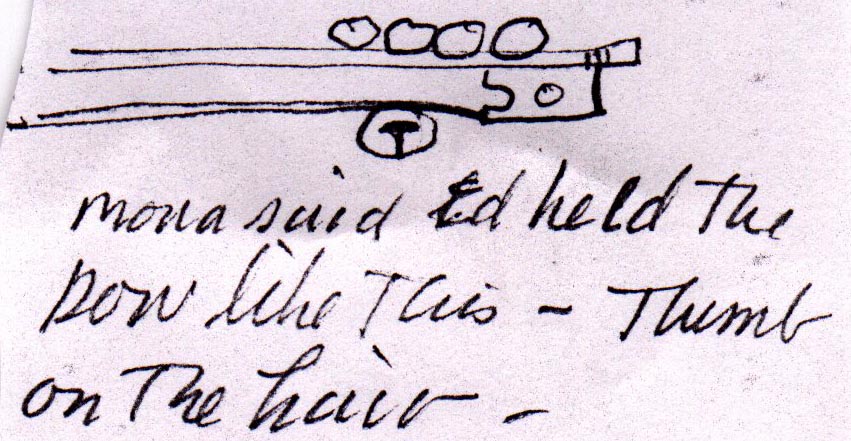
Ed Haley Bow Hold

18 Friday Apr 2014

Posted by Brandon Ray Kirk in Ed Haley, Music

≈ Leave a comment

Tags

Appalachia, art, Ed Haley, fiddling, history, John Hartford, Mona Haley, music

Ed Haley bow hold, according to Mona Haley

Ed Haley bow hold, according to Mona Haley

In Search of Ed Haley 291

18 Friday Apr 2014

Posted by Brandon Ray Kirk in Ed Haley, Music

≈ Leave a comment

Tags

Appalachia, Ashland, Curly Wellman, Dunbar, Ed Haley, Ella Haley, fiddling, Grand Ole Opry, history, John Hartford, Judge Imes, Kentucky, Mona Haley, music, Pat Haley, Ralph Haley, writing, You Can't Blame Me For That

After visiting Curly and Wilson, I went to Pat Haley’s and met Mona, who was waiting to see me. Mona and I sat down at the kitchen table, while Pat washed dishes. It was my first visit with Mona in some time. I told her about visiting Curly Wellman, hoping to stir a memory, but she didn’t even remember him. I pulled out his picture and she and Pat both really bragged on his looks.

“He must have been a hunk when he was young,” Mona said. “You know, I always fell in love with guitar players.”

We all laughed and things got kind of loud, which caused Pat’s two little housedogs, Shady and Josie, to bark furiously from under the table. A few seconds later, after Pat’s commands had calmed the dogs, Mona surprised me by saying that she had heard “all her life” that Curly was the person who taught her brother Ralph to play the guitar. (It was actually the other way around.)

I had a lot of questions for Mona, who was exuding an openness I had not seen up to that point. It was obvious that she was going to be more candid in Lawrence’s absence. Before I could ask anything, she apologized for having not been more helpful in my efforts to know about Ed. I quickly pointed out, though, that she had been helpful, especially in regard to “the family troubles.” That aspect of Ed’s life was really important because it likely helped to explain a lot of the rage and lonesomeness I heard in his music.

“I wasn’t really scared of Pop,” Mona said. “I loved Pop. I just didn’t like the way he done Mom. It hurt all of us kids, I guess. The earliest memories I got is of me running away from Pop fighting with Mom and that has a whole lot to do with me not getting close to him like I did my mother. I think my mother was a remarkable woman. She probably taught Pop a lot of that music, too.”

I told her what Lawrence had said about Ed and Ella getting a “bed and board divorce” and she said, “No, I remember Mom did divorce him because she got Judge Imes to do the divorce. I think she divorced him when we lived on 17th Street. I never looked at them as being divorced because they had long since stopped being man and wife before they divorced.”

I got some paper from Pat’s granddaughter and asked Mona to describe Ed’s residence at 17th Street. In addition to serving as Ed’s home at the time of his divorce from Ella, it was also the place where he made his recordings. Mona described the downstairs, then the upstairs where “there was two bedrooms and a bathroom. Large bedrooms.”

After I’d sketched everything out based on Mona’s memory, she said, “I was gonna tell you about that living room couch that you drew the picture of with the radio on the end of it. I went in one day and I was just a teenager or young kid and I turned on some jitterbug music. Pop was laying on the couch and he said, ‘Turn that off,’ and I said, ‘No Pop, I want to hear it.’ And he said, ‘Mona, I’ll cuss you all to pieces.'”

Speaking of radios, I wondered if Ed ever listened to the Grand Ole Opry.

“No, I don’t think so,” Mona said. “He listened to mysteries, like ‘The Shadow’ and ‘The Green Hornet’ and all that kind of stuff. And ‘Amos ‘n Andy’ and ‘Little Abner.’ ‘Lone Ranger’, I remember that. And those opera singers, he called them belly shakers.”

While I had the pen and paper in hand, I asked Mona to describe Ed’s house at Ward Hollow.

“Well, they was a porch, then a living room, dining room, and kitchen — straight back — and all the way down through here was another bedroom and hallway and another bedroom. Then in through here was a bathroom and back here was another bedroom. That’s where Pop slept. And right off the kitchen was another little porch.”

Mona said she could draw it better than describe it to me, so I gave her a pen and some paper. When she was finished, she seemed pleased with her effort, saying, “I might have a good memory after all.”

Satisfied, I got out my fiddle and played some tunes for Pat and Mona. After I finished “Dunbar”, I told them how I figured it was one that Ed made up.

“See,” I said, “I’ve got all these lists of tunes at home and lists of tunes on other tapes and so I look these tunes up and try to find out where they come from. And some of them you can research and some of them just ain’t there and those are the ones I think he wrote.”

Mona figured Ed made the tune “You Can’t Blame Me For That”:

My dog she’s always fighting, in spite of what she loves.

And when her little pups was born we all wore boxing gloves.

An old hen once was sitting on twelve eggs. Oh, what luck!

She hatched 11 baby chicks and the other was a duck.

But you can’t blame me for that, oh no, you can’t blame me for that.

If a felt hat feels bad when it’s felt, you can’t blame me for that.

 I got the impression in watching Mona sing those words to me that she was able to picture Ed playing.

In Search of Ed Haley 288

14 Monday Apr 2014

Posted by Brandon Ray Kirk in Ed Haley, Music

≈ Leave a comment

Tags

Ashland, Big Foot Keaton, Bill Day, Catlettsburg, Coal Grove, Curly Wellman, Ed Haley, Ella Haley, fiddle, fiddling, history, Horse Branch, Jack's Auto, Jason Summers, John Hartford, Kentucky, Lawrence Drugs, mandolin, Mona Haley, Morehead, music, Ohio, Ralph Haley, The Rowan County Crew, writing

I wondered if Ed had other accompaniment aside from Curly.

“Most of the times that I saw Ed, why, he would be by hisself,” Curly said. “Ed played a whole lot by the church up at 16th Street and across from Lawrence Drugs. I don’t know of him ever playing in a bar. Ed was a fellow that would follow these big court days because there was a lot of people on the ground. Morehead, Kentucky, was one of the places where Ed never missed on court days and he wrote a song about Morehead, Kentucky. It was called ‘The Rowan County Crew’. ‘It was in the town of Morehead on one election day…’ It was like in English minors. And that’s the only song I ever heard him try to sing, and Ralph would be playing. Never heard him sing nothing other than that because he wrote it and because the people wanted to hear it.”

Well that was a new twist: I never heard that Ed wrote “The Rowan County Crew”. Actually, most attributed the song to Bill Day.

I asked if Ed composed any other tunes aside from “The Rowan County Crew” and Curly said he made “Catlettsburg”. He was sure of it.

“Well, Ralph and I talked, you know, later, and Ralph told me, he said, talking about ‘Dad playing so-and-so last night. Well, he wrote that tune,’ something like that,” Curly said. “I know that he wrote it without a doubt. He wrote that while he was on Horse Branch.”

I’d never considered that Ralph might have told Curly anything about Ed’s music. He and Curly were about the same age. I asked about Ralph. What was he like? Curly thought for a few seconds, then said, “Ah, Ralph was different from the rest of the family. Ralph was a little more… I don’t know how to put it. He wasn’t a bad person but he kindly drifted out. He wasn’t a homebody like the rest of the children, I’ll say that. I never remember Ralph being on the street with them.”

I told Curly that Ralph wasn’t really Ed’s son — that he was Ella’s by a previous relationship — and he said, “Oh, I never did know that. He left home pretty early.”

Curly didn’t remember Ed’s other kids very well, except for Mona.

“I do remember Mona but I think I remember Mona from being with her mother when she would play on the streets,” he said. “Mona was never with her father — just her mother — as far as I saw. She would stand beside of her while her mother played the mandolin. Mona held the cup but usually the cup was on the head of the mandolin with a piece of wire or something that hooked it on there.”

What about Ella?

“I used to watch Ella, that poor old soul, out here in town,” Curly said. “She always carried one of them little fold-out canvas bottomed chairs and played about every Saturday night at Jack’s Auto on the 13th Street block on Winchester Avenue. At that time Jack’s Auto handled material like Sears today. They had a variety of all different kinds of stuff and there was a lot of people on Saturday nights that went in and out of that place. And she played terrific chords on the mandolin. Her timing was good. And you know she didn’t sing or anything.”

I pressed Curly for more details about Ed’s music.

“Just about every fiddle player that I talk to — including Big Foot Keaton — they all talk about the long bow that he pulled and how many notes that he would get from the length of the bow,” Curly said. “How many notes was in there with the finger work. It’s very amazing to have watched him. It’s a shame that you didn’t get to see the man or hear him.”

I said, “Well, I stayed with Lawrence, you know, and we worked and talked and everything like that and we discovered quite a bit. I want to show you some of what we discovered and see if it rings bells.”

I got my fiddle out and started playing — holding the bow way out on the end and using the Scotch snap bowing. Curly got excited and said, “There you go. That’s it! Well, you’ve completely changed your bow arm from the last time I’ve saw you. Well now, you’ve got the bow arm down. It’s just like looking at him dragging the bow again.”

Curly added that Ed played a lot of double stops because they gave a tune “more volume, more life.”

I asked him what kind of guitar playing Ed liked behind his fiddling and he took his guitar and played something he called “Riley Puckett style.”

Curly said he remembered that Ed packed his fiddle in a case that looked like “a square box.”

His memories seemed to be right on target so I asked him very specific questions, like who repaired Ed’s fiddle.

“There was an old man here just about that time that did most of the work,” Curly said. “I don’t say that he did the maintenance on Ed’s fiddle. I’m trying to think of that old man’s name. He was supposed to have played for the king and queen of England.”

“Bill Day,” I suggested, even though I figured it unlikely.

“Bill Day worked on fiddles,” Curly confirmed. “Blind man. And there was another old man by the name of Jason Summers that made fiddles. He coulda done Ed’s work. And he lived in this area — either Coal Grove, Ohio, or over in here. That was before my time. I didn’t know Bill Day — never met him in my life — nor Jason Summers, either one.”

In Search of Ed Haley 280

02 Wednesday Apr 2014

Posted by Brandon Ray Kirk in Ed Haley

≈ Leave a comment

Tags

blind, Calhoun County, Clay Hicks, Clyde Haley, Ed Haley, Ella Haley, history, Jack Haley, John Hartford, Laury Hicks, Lawrence Haley, Mona Haley, Noah Haley, Ralph Haley, Ugee Postalwait, West Virginia, writing

Ugee and I turned our attention back to the family photographs, where she spotted a picture of Ed’s son, Clyde. I told her about my visit with Clyde the previous year in California. She totally dismissed his story about Ed teaching him to drink, saying, “His dad never done no such stuff as that.” She paused for a second then said, “I went out and stopped Ed from whooping him one time. I think he’d stole some money or something. But he didn’t steal it. Noah did. I walked out and Ed had his belt off and I just took a hold of it. He said, ‘Who’s got a hold of me?’ He thought it was Ella. I said, ‘It’s me. You hit him another lick and the next lick’s mine. If you’re gonna whip him, whip the other’n.’ I said, ‘Noah’s the one was in your wallet.’ I seen Noah in it. I thought they’d sent him to get it. And Ed walked in and said, ‘Goddamn him, I ought to kill him.’ Then he told me, said, ‘Ugee, you ought to be careful with Clyde. He’s dangerous. He’ll sneak around and hurt ya.'”

Ugee had other run-ins with Noah, who was apparently one of Ella’s favorite children.

“Noah was picking on Lawrence and if he cried Noah’d say, ‘I never touched him.’ I said, ‘You do it again, I’ll whip you.’ Ella took Noah and went to Clay Hicks’ and stayed three days and when he come back he done just what I told him not to do. I never let on — I was a cooking. I said, ‘Noah, come here.’ I gave him three licks. I said, ‘I told you I’d whip you and I will.’ I looked at Ella and I said, ‘You needn’t take him and leave the country with him because I’ll follow wherever he’s at a whooping him.'”

This was interesting new information in the daily goings-on for Ed’s children. It was logical that since their parents were both blind they could get pretty wild. No doubt, Ed and Ella depended on family and friends to help raise the kids. Ugee, I noticed, had a close attachment to and interest in Ed’s children, almost as if they were her own family. She didn’t hesitate to tell how mean they could be.

“See, them kids had a hard time ’cause their dad and mother was blind and a lot of people didn’t want to bother with them,” she said. “People wanted the music of Ed and Ella but they didn’t want to put up with the family. That’s the truth of the matter. They was ornery. In other ways they wasn’t bad, either. You know, they was just children.”

Ugee seemed to think Mona was the meanest of the children.

“Mona was the orneriest young’n you ever seen in your life — to the core. She had to have all the attention. And she was pretty as a doll baby — curly-headed — just pretty as she could be. But my god, you couldn’t turn your back on her for a minute. If you was a baking a cake, she’d stick her hand in it. She could really get under your skin. I said, ‘Mona, you’re gonna keep on till I smack you.’ Ella said, ‘You don’t have to — I’ll give it to her.'”

Ugee lightly patted the air mimicking Ella.

“That’s the way she smacked — didn’t hurt them a bit. Mona would get up and look at her and laugh. Mona’d get out and go play a while, then she’d think of something to get into, like picking up chickens — ‘gonna weigh them’ — ringing their necks, throwing them down. ‘I’m weighing the chickens,’ she’d say. Killed about six or seven of them chickens. But that Ralph, he even shot hisself to see what it felt like. He’d do anything. You didn’t trust him out of your sight. He wouldn’t a cared to go out there and cut a cow’s throat or anything like that.”

I told Ugee what Mona had said about Ed being mean to her when she was growing up and she said, “Oh, I don’t think he was really mean to her. He’d fly up and cuss maybe. Now, the one they was really mean to was Clyde. Ella and Ed both was mean to Clyde.”

Wonder why?

“I’ve studied about that,” Ugee said. “Dad kept him all summer there at home to keep him from going to reform school. Now my dad woulda fought over him in a minute ’cause whatever he told him to do he minded him. And Mom, too. But I guess he was awful ornery when they were living in town. You know, kids a getting up to twelve, fourteen years old or something like that, there’s so much to get into. Now it would be awful to raise a family. I don’t remember Lawrence ever being like that. Jack and Lawrence was so good. Jack was a beautiful young man. Slender, dressy. He was a fine boy, but none of them came up with Lawrence far as I’m concerned. He was the best ole boy you ever seen. He would lead his mom and dad anyplace. I can see how careful he was. That little hand of his leading his mother ’round this mudhole — and his dad, too. I always called him my little boy. He was always better than the rest of them.”

Ugee said Lawrence always seemed bothered by the family troubles, even as a child.

In Search of Ed Haley 263

11 Tuesday Mar 2014

Posted by Brandon Ray Kirk in Big Harts Creek, Ed Haley, Music

≈ Leave a comment

Tags

Bernie Adams, Billy Adkins, Dood Dalton, Ed Haley, Ella Haley, Ezra Jake Dalton, fiddlers, fiddling, Harts Creek, history, Lincoln County, Logan, Mona Haley, moonshine, Nary Dalton, West Virginia, World War II, writing

Along the way, we stopped and picked up Billy Adkins, who guided us to Jake’s home on Big Branch. Jake, we found, was a little skinny fellow, somewhat quiet, and — I was told — a decorated World War II veteran.

I asked Jake if he remembered the first time he ever saw Ed.

“I don’t remember that,” he said right away. “I was born in 1916 but I didn’t stay at home like the rest of my family. I’d slip off from home here when I was a little bitty fella and maybe stay a week or two before I come back or they’d come get me or something another. Then after I got up in years, I joined the Army and I stayed over four years in the Army. I was in there nineteen months before they bombed Pearl Harbor. So I didn’t stay home like the rest of the kids.”

A little later in the conversation, Jake made it clear that he remembered more about Ed and his family than he realized.

“He stayed with Mother and Dad a lot, Ed did, and them young’ns,” he said. “She was a music teacher, the old woman was. She was from out of Kentucky and he was off’n Harts Creek. They had about five, six children.”

I asked Jake how long Ed usually stayed with his father and he said, “Aw, he might stay a week. They’d go up there at the courthouse at Logan and play music, him and her, and she had this little boy tied to the rope so she could draw him in you know out on the sidewalk. And somebody give him some pennies and he had them pennies you know and he dropped them and she started drawing them in. He ripped out a big oath, ‘Wait till I get my money!’ You know, they couldn’t see what they done or nothing.”

Sometimes, Ed left his kids with Dood when he was playing in Logan.

“Now them kids, they was pretty mean, but people most of the time helped him correct them,” Jake said. “They raised one girl, Mona. That girl, she was a bad one. She’d run up and down the road with them boys if Dad didn’t get after her. She was just a young gal, you know. Ed, he didn’t care if you corrected them kids. If you busted the hide on one that was all right.”

Jake didn’t remember much about Ed’s appearance other than that his eyes were “milky-looking.”

When Brandon asked him what it was like to hang around with Ed, Jake said, “He talked to Dad a whole lot. He said to my dad one time, ‘Dood, where do you think hell’s gonna be at?’ Dad said, ‘I never thought about where it’s gonna be, Ed.’ He said, ‘I have an idea where it’s gonna be. I believe it’ll be on the outside of this world.’ He was a good ole man in a way, but he was bad to drink in a way.”

Oh…so Jake remembered Ed drinking.

I asked him if Ed drank a lot and he said, “No, I never did see him come to Dad’s drunk. Dad didn’t allow no bad stuff around his house, even when he wasn’t a Christian.”

Jake thought for a second, then said, “Ed was a healthy eater. He’d come in there — get up for breakfast — he’d say to my mother, ‘Nary, have you got ary onion?’ And she’d get him an onion. He’d eat an onion head for breakfast. My mother was a person that would feed anybody that came along. It didn’t make no difference whether he was a drunk, a hobo, or what he mighta been, Mom would feed him. We had a big long table with a bench on one side and about ten people to eat off of it besides who come in. We kept Bernie Adams half the time. He was the puniest feller that ever you saw — a plumb weakling he was — and he’d stay with Dad for maybe two or three weeks.”

Jake tried to describe his memories of Ed and Dood playing around the house.

“We just had an old log house,” he said. “A door over there and one here and one room and Dad had a lot of trees around here. They’d sit out there in the yard. They’d start in on Saturday evening and they’d be a sitting right there when Monday morning come with a half a gallon of moonshine playing music. They’d fiddle that long.”

In Search of Ed Haley 252

28 Friday Feb 2014

Posted by Brandon Ray Kirk in Big Harts Creek, Chapmanville, Ed Haley, Music

≈ Leave a comment

Tags

Anna Adams, Billy Adkins, Brandon Kirk, Chapmanville, Ed Haley, Ella Haley, fiddling, Gaynelle Thompson, history, Imogene Haley, John Adams, Kiahs Creek, Little Harts Creek, Logan County, Milt Haley, Mona Haley, music, Roxie Mullins, Ticky George Adams, Wayne County, West Virginia, writing

In Chapmanville, Brandon and Billy dropped in on Gaynelle (Adams) Thompson, a granddaughter of Ticky George Adams who spent a lot of time with Aunt Roxie Mullins during her “last days.” Gaynelle said Ed Haley’s mother never remarried after Milt’s death and died prematurely when Ed was eight to ten years old. She said Ed used to visit her parents, John and Anna Adams, on Trace Fork during the summers in the ’30s and ’40s. “Everybody in the country thought they was nothing like him,” she said. Gaynelle heard that Ed was a drinker and could get rough but said he was well mannered at the Adams home. He never cursed or drank and talked mostly to Gaynelle’s mother. He came with his daughter and wife and stopped visiting when he became too sick to travel just a few years before his death. In earlier years, he played on Kiah’s Creek and Little Harts Creek near the Wayne County line.

In Search of Ed Haley

20 Wednesday Nov 2013

Posted by Brandon Ray Kirk in Ed Haley

≈ Leave a comment

Tags

Ed Haley, Ella Haley, genealogy, history, Ironton, Kentucky, life, Mona Haley, Ohio, photos

Mona Haley Mullins-Hager, daughter of Ed Haley.

Mona Haley Mullins-Hager, daughter of Ed Haley.

In Search of Ed Haley 202

20 Wednesday Nov 2013

Posted by Brandon Ray Kirk in Ed Haley

≈ Leave a comment

Tags

Ashland, blind, Catlettsburg, Ed Haley, Ella Haley, fiddling, Green McCoy, history, Mona Haley, music, Pat Haley, Ralph Haley, Wicks Music Store

A few days later, Pat Haley called me from Ashland with news that Mona was visiting. This was a new development: Pat and Mona were apparently patching up some of their differences. Pat knew I would want to speak with Mona and, in spite of whatever hard feelings existed between them, she was willing to give me access to her.

When Mona took the telephone, I told her about getting the new copies of Ed’s recordings. She immediately began to talk about her father making them.

“I was only about fourteen, fifteen,” she said. “I didn’t pay much attention. My oldest brother made the records, him and his wife.”

The whole thing took place around the dining room table.

“You know, they were made on plastic,” Mona said. “And they would brush the plastic strips away as the thing would cut the records. It was kinda tedious, I do remember that.”

Mona said Ed sat about three feet across the table from the recording machine, while Ella was a little closer.

“It shows in the records, don’t it?” she said. I didn’t want to say anything but I totally agreed.

She remembered that Ed listened to each record after it was made and liked what he heard.

“He was talking mostly to my oldest brother,” she said.

I had other questions for Mona, mostly dealing with her general childhood memories. I asked, “Do you remember the house being dark when you were growing up, because obviously they didn’t have any need for light.”

“We had gas lights at home, and after that we had electric,” she said. “Not overly dark, no. We had plenty of light. Always except bedtime, and then my mother would get her big New York Point books out and read to us in the dark.”

“Could your dad see any light at all?” I asked.

“No,” Mona said. “They were both completely blind. My mother said the only thing she remembered was daylight. And I don’t know how old she was when she went blind, but it was infancy, toddler, something like that.”

Mona seemed to be in a particularly talkative mood, so I pressed her for clues about Ed’s music. I asked her how her father’s eyes appeared when he played and she said, “He looked straight out. He never slouched unless he was drinking and then he put one leg behind him and one in front of him.”

Mona said Ed was not a short bow fiddler.

“Long bow, except where it was needed. But he always played that bow to the end,” she insisted.

She didn’t remember her father “rotating” the fiddle at all, although Lawrence Haley (and others) had sure made a big deal out of it. She said Pop always rosined his bow up “real good” before playing but never had any caked on the fiddle. She thought he used Diamond steel strings, which he bought in a local music store named Wicks. He patted his foot in what I call two-four-time when fiddling but “it didn’t override the music.”

I asked Mona if Ed was a loud fiddler and she said, “Oh, yes. You know his voice was strong, too. I’ve been around places with Pop and Mom and people would hear him from far off and come to him. You know, like in the workplace. He always had a crowd around him — always. Always when he played on the street or at the court house square or when he played at the Catlettsburg Stock Market.”

I asked if she remembered Ed playing on trains and she said, “Yes, we’d get in the backseat longways the width of the train and he’d play.” People sometimes gave him money but he mainly played for himself. “Just to pass time,” Mona said.

I was very curious about Ed’s mode of travel, especially considering his blindness and the great distance of ground he covered in his lifetime. I asked Mona if her father hitchhiked a lot and she said, “I don’t think he did. I think he walked more than he hitchhiked.”

Did he sing or whistle while he walked?

“No,” she said. “My mother did that for our benefit, you know. To pacify us, I guess.”

Mona said Ed loved playing for dances because he “enjoyed hearing people dance” and preferred it to the street “a hundred percent.”

I told her that someone said Ella didn’t care a whole lot for playing on the street and she said, “I never heard Mom complain about nothing except Pop drinking.”

I wondered if Ed drank on general principles.

“Whenever he felt like it,” she said. “Whenever somebody brought him something and asked him to take a drink, he would. And there’s times he has gone out and got it, too. Aw he’d cuss real bad. He’d say, ‘god almighty goddamn,’ like he was disgusted with the whole world. We lived down on Greenup Avenue between Greenup and Front and trains went by. His bedroom was in the front, and he cussed one time. I’ll never forget it. He said, ‘Them god almighty goddamn trains just act like they put their damn whistles in the window and blow.'”

I said, “Let me ask you this. In their relationship, was your mother or your father the dominant one, would you say?”

Mona surprised me a little bit when she said, “I’d say my mother was the dominant one until Pop was drinking.”

Ella was also the disciplinarian.

“Mom, she’d pinch a piece out of you, buddy,” Mona said. “She wouldn’t make a scene in a store or anything but she’d just grab you and pinch you and say, ‘Quieten down.’ She did it to me.”

Just before I hung up with Mona, I told her some of the things I’d found out about Ed’s genealogy on my recent trip to Harts. She listened quietly, then said, “Well see, the story I got was that Green McCoy shot this lady. And that’s the story that Pop told me, that I understood. Now, it may be wrong. My memory might be wrong or maybe I didn’t want to believe it the other way.”

In Search of Ed Haley 171

18 Wednesday Sep 2013

Posted by Brandon Ray Kirk in Ed Haley

≈ Leave a comment

Tags

Appalachia, Ashland, blind, Ed Haley, Ella Haley, genealogy, history, Kentucky, Lawrence Haley, life, Mona Haley, Pat Haley, writing

“So when Larry and I got there, my mother-in-law, she was the one opened the door. I fell in love with her right away. And I didn’t see Ed until the next day. He was in bed and he was also hard-of-hearing and he didn’t hear us come in. Mom led us inside and, of course, Jack’s wife Patsy had the house very clean.”

One of the first things they did after arriving was eat a meal.

“Mom asked Lawrence, she said, ‘’awrencey boy, are you hungry?’ He said, ‘We’re starving, Mom.’ Well, Mom called upstairs and told Pat and Jack that we was here and they came down and Mom told Patsy we were hungry and Pat said, ‘Well, we don’t have much ready to eat. Would you like sausage and eggs?’ Well, I thought that was fine. But when these little patties came up… There was an oilcloth on the table — everything was clean and nice but the silverware was in a Mason jar in the middle of the table. I was just amazed that nobody set the table like I had been used to. I’d never seen sausage fried black. After dinner, they told us they had the bedroom upstairs fixed up for us. My mother-in-law had bought a new bedspread and new doilies for the dresser and Patsy had bought a lamp and some doilies and a picture for the wall. She’d really tried to fix up the room and make it nice for us. Mom had bought a very nice wardrobe and a dresser. The bed was Mom’s. The other furniture had belonged to Patsy and Jack.”

The next morning, Pat first met Ed.

“He came into the dining room and I was in the dining room, me and Larry. Larry just said, ‘Pop, this is Patricia.’ He just, you know, said, ‘Howdy do.’ And I went up to him to shake his hand. Larry had told me that I would have to go to him. If you looked at Ed Haley, it looked as though he was looking right at you. When I got up to him, Larry put his hand on my head and told him I was as short as Mom. Larry had told me that Pop would put his hands on me and check my head and face and my arms to see what kind of woman I was. He took his fingers — that’s the way he checked your features. And he could tell how you was built. Then he patted me on the shoulder to see what sort of made woman I was. But he had the smoothest hands. They were not a bit rough. Larry took Pop’s hand and put it on my belly and said, ‘See here, Pop.'”

Pat said she met Mona later that day.

“Mona came over the next day after I got here — her and her husband and her mother-in-law and her sister-in-law. Sometime after that, Mona came over and was playing a mandolin and her and Mom was playing. Mom played me some English tunes. And I don’t know how come they played but they got Pop to play a tune or two and he wouldn’t play much because he had whittled on his fingers and made them raw. He always loved my salmon. Course he called them salmon cakes. I call them croquettes.”

In Search of Ed Haley 168

08 Sunday Sep 2013

Posted by Brandon Ray Kirk in Ed Haley

≈ Leave a comment

Tags

Allie Trumbo, Cincinnati, Ed Haley, Ella Haley, Harts Creek, history, Imogene Haley, Liza Mullins, Mona Haley, Patsy Haley, Ralph Haley, West Virginia, writing

After getting familiar with the postcards, I called Patsy Haley to see if she could tell me any more about Ella’s young life with Ralph.

“Ralph was about five years old when Mom married Ed Haley,” Patsy said. “Ralph is not by Ed Haley. I figure that Mom and Pop must’ve got married about the end of the teens.”

I asked Patsy if Ed was very close to Allie Trumbo, who often wrote to Ella in her younger days.

“They weren’t really close or anything like that,” she said. “My husband and I moved to Cincinnati and that’s when I got acquainted with Allie and his wife. In fact, we lived right across the street from them. They really didn’t talk too much. Allie used to tell me about their father Mr. Trumbo auctioning off land and selling it for a dollar ’cause he owned quite a bit of land by that college. I think Mom had a falling out with him. Mom used to go and stay with them, like on weekends, when she’d go to Cincinnati to work. Allie had called her ‘Penny Ella’ ’cause when she paid them for staying with them she always paid them with change ’cause that’s what Mom got from selling her newspapers.”

Was Allie a musician?

“No, not that I know of,” Patsy said. “He was a fine pool player.”

Patsy didn’t remember Ralph making the records.

“No, that was just before I come in the family,” she said. “I don’t think he did any more recordings after I came into the family. You know, Mom had divorced when I come in the family and they never got remarried. But he lived in the house because the kids wanted him there. Now I can remember when I first came in the family and Mona and I talked, she was quite afraid of her father when she was a little girl because I guess he must’ve been mean. And he musta been abusive and mean to Mom or she wouldn’t a divorced him. But he was a sweet old guy when I knew him. I never ever saw Pop drunk or drinking. But I do remember one time — it was at the holidays — and Noah took his father and went up to Ferguson’s I believe for Pop to play music for them. Well, he kept them out all night ’cause I guess he got pretty loaded. But I never ever saw Pop drink. Now Pat said she had, but I never had.”

I updated Patsy on some of the things I’d found out about Ed’s past on Harts Creek and asked if she knew anything about his mother.

“He really didn’t talk about her too much,” she said. “Only thing that I understood — and he didn’t tell me this — Mom told me — that she was killed when the father was killed. There was never no bad feelings about his parents, either one.”

Patsy said she learned more about Ed’s parents on a trip to Harts in 1947.

“We went up to Harts Creek because Pop had gone up there and we went to get him back,” she said. “That was the first time I met Aunt Liza.”

Aunt Liza said Milt came from “the other side of the mountain,” and that he and his wife were buried up behind their old log cabin on Trace Fork.

“I can remember Aunt Liza pointing to where they were buried,” she said. “When she pointed up, she pointed over towards where the log cabin was.”

In Search of Ed Haley 160

27 Tuesday Aug 2013

Posted by Brandon Ray Kirk in Ed Haley

≈ Leave a comment

Tags

Clyde Haley, family, feud, history, John Hartford, Lawrence Haley, Lawrence Kirk, life, Milt Haley, Mona Haley, Pat Haley, Tug River, writing

A few weeks later, I called Lawrence Kirk, whose ancestors had played various roles in the story of Milt Haley’s death. I hadn’t spoken with him for several months. We talked more about Milt Haley’s murder.

“Back in the old days, these people’d get into trouble here and they’d run backwards and forwards across that Tug River,” he said. “That was the state line and the law didn’t bother them. If you crossed the state line, you was safe. But they got the papers out and went over there and got Haley and McCoy. Inez is where they went to and got them. Yes, sir. They either came up Jenny’s Creek or Marrowbone Creek. See, they had horse trails all through these woods back in them days. They come right across Twelve Pole and down Henderson up there in the head of main Hart. Come right down and up what they call the Bill Branch — some people calls it the Hugh Dingess Branch — right down Piney Fork. It’s a straight shoot through there. I’ll tell you what. Come up sometime when you’ve got a day or two and we can drive right through there.”

Boy, that sure sounded good to me.

In the meantime, Pat kept me up on everything. She said Mona was helping her look after Lawrence and had even spent the night. Clyde had come in for Christmas.

“They had a red hat on him and a great big sign across the front which said ‘Clyde.’ They had a pair of pants that was rolled over about three times tops, the shoes was way too big, and, I mean, it was sad. The hat was red, his sweater was blue, and his shoes was white. Mona said they got half-way home from Cincinnati, and he was just talking away, you know, about things that had happened in their past, and then he began looking out the window and all of a sudden he turned around and he said, ‘Who in the hell are you?’ And she thought, ‘Uh, oh, it’s gonna be good.’ Larry was very happy to see him.”

In Search of Ed Haley 159

26 Monday Aug 2013

Posted by Brandon Ray Kirk in Ed Haley

≈ Leave a comment

Tags

Appalachia, blind, Ed Haley, feud, fiddling, history, Kentucky, Lawrence Haley, Milt Haley, Mona Haley, music, U.S. South, writing

In one of those “passing the torch moments,” Lawrence reached the telephone to his sister, Mona. I told her about Milt Haley being a fiddler, and she said, “Really? Well we didn’t never know that.”

I figured that Ed had kept all of the details about Milt hidden from his kids, but Mona said, “Well, he talked about it some, because I wouldn’t know what I know about it if he hadn’t. You did find out what I told you was true, didn’t you? It wasn’t my dad’s mother that was killed, the way I heard it. It was one of the Hatfield women. Got half her face shot away and it killed her. That’s why they retaliated against Green McCoy and my grandfather. That’s only hearsay, but it had to come from Pop. I do remember him saying that.”

Pat seemed pleased that Mona was visiting Lawrence.

“He asks for her a lot,” she said.

I wanted to know more about Lawrence’s condition.

“He sits with his eyes closed and he found a pair of sunglasses that look exactly like the ones his daddy wore,” Pat said. “These are a pair that one of the kids bought. They were laying on the dining room table and he picked them up and said, ‘There’s my glasses.’ He insists on wearing them and you would think it was Ed Haley back many years ago. He talks about horse and buggies a lot. He sits with your book constantly. He does not like to look at the picture of his mother’s tombstone. What keeps you in his mind a lot, he listens to the tapes and he knows he gave you the records. Beverly was here this past weekend. He knew who she was but he was still talking in riddles. But today he’s pretty much himself. He got up and got dressed about 5:30 and he’s been roaming ever since.”

In Search of Ed Haley 158

25 Sunday Aug 2013

Posted by Brandon Ray Kirk in Ed Haley

≈ Leave a comment

Tags

Appalachia, Ed Haley, Ella Haley, fiddling, history, Lawrence Haley, Mona Haley, music, writing

I called Lawrence and Pat to tell them about this new discovery. Pat put me on the telephone with Lawrence, who seemed to be doing better. I asked him why he thought none of the Haley kids ever learned the fiddle.

“I think Pop took interest in us as far as he knew how to take interest in us,” he said. “Whatever he could’ve taught us he most certainly would have. But we’d ruther be out running in the woods than sitting at a table trying to learn ‘Forks of Sandy’ or something like that. He would ruther teach it to the ones who could and who showed interest in it, and let it go at that. Pop never did try to get me to learn the fiddle because I was left-handed. I guess he figured that would be too much of a challenge for him even, to try to teach violin to a left-handed violin player.”

I told Lawrence he knew more about the fiddle than a lot of professional musicians and he said, “Well, I guess I learned just about as much of it as he did. I appreciate any good words that can be said about me and the violin. My sister’s here and if you could get her interested, she might be able to tell you as much about it as I can. She took more interest in the music of our mother, I know that. But she could pick up the fiddle and play the fiddle and play the mandolin and the piano and other instruments.”

Lawrence said, “Now if you want to talk to my sister a minute, maybe she can tell you something. If she can’t, I don’t know who else to tell you. She could probably tell you as much about it as any of us.”

In Search of Ed Haley

23 Friday Aug 2013

Posted by Brandon Ray Kirk in Ed Haley

≈ Leave a comment

Tags

Appalachia, Ashland, genealogy, history, Kentucky, life, Mona Haley, photos

Mona Haley, 1945

Mona Haley, 1945

In Search of Ed Haley 156

23 Friday Aug 2013

Posted by Brandon Ray Kirk in Ed Haley

≈ Leave a comment

Tags

Appalachia, blind, Ed Haley, Ella Haley, history, John Hartford, Kentucky, Lawrence Haley, life, Mona Haley, Morehead, Pat Haley, writing

I gave Pat a call to check on Lawrence, who was back at home in Ashland. Pat said Mona had been a frequent visitor since Lawrence’s heart attack and was starting to open up about her painful memories of Ed.

“Mona said her father was the cruelest, most horrible man to her,” Pat said. “Even her mother was not the mother to her that she was to Lawrence. And she said Lawrence was always the favorite. And I said to her, ‘I didn’t see any of the ugliness of your daddy or your mother,’ and Larry has never ever said anything about his father except he’ll tell you he got drunk or he’ll tell you he was mean to Mom once in a while. But he has told me he never did see his father strike his mother. Mona said she has heard them and said the things that her daddy has said to her mother were just too horrible for her to repeat. She used to put her head under the covers to keep from listening. But Larry has none of these memories. Memories he has of his dad were always good memories. But Mona will agree: there was two out of all that were the favorites: the oldest boy Ralph and Lawrence. Mona says she is very sorry that in the last years of her mother’s life she did not help me any more than she did. I was very young when his mother passed away and I had three small children.”

Pat said Lawrence was starting to act a great deal like his mother.

“There is so much that is coming back to me that was exactly like his mother,” she said. “For one thing, when I help him to the bathroom, he takes the same little steps. He goes with his eyes closed most of the time, just like he can’t see. And he’ll sit with his eyes closed. You know there is those little things, like he won’t ever eat with a fork anymore — he eats with a spoon. His mother always did. And he drinks a lot of water, just like she did. There’s just so many of his little mannerisms that remind me so much of his mother. He will call me ‘Mom’ a lot. I don’t know if I told you, but one night he was crying and I went in to him and I said, ‘Honey, what’s the matter?’ and he said, ‘Mommy, rock me. Rock me, Mommy.’ He was back in his childhood and it just breaks your heart John when that happens. He’d been talking, he wanted to go to Morehead.”

There was more bad news for Pat. Her daughter Beverly had recently been diagnosed with cancer.

In Search of Ed Haley 154

20 Tuesday Aug 2013

Posted by Brandon Ray Kirk in Ed Haley

≈ Leave a comment

Tags

Bruce Nemerov, Clyde Haley, Ed Haley, fiddling, history, Jack Haley, John Hartford, Kentucky, Lawrence Haley, Mona Haley, music, Noah Haley, writing

Not long after my call to Wilson, I received word from Bruce Nemerov that he’d finished dubbing about a third of Haley’s recordings. He sent me cassette copies, along with an audio log (which gave detailed information about the records). I listened extra close to the Nemerov copies and noticed how Ed’s playing gave the impression of being very notey, as I had originally interpreted it. This was, I determined, somewhat of an illusion.

“I don’t think your dad played as many notes as he sounds like he’s playing,” I said to Lawrence by telephone. “It sounds to me like he’s putting so much into some of those notes that they sound like they’re more than one note.”

Lawrence said, “He might be doing that, I really don’t know. The only thing I’ll go on is what it sounds to me like. I’ve seen and heard some fiddlers that it just seems like they draw a bow completely just to get one little note. Pop could get a dozen or two out of a draw of the bow. It seemed to me like that his fingers was all the time moving. He was probably touching the strings so lightly a lot of people might not have even heard some of the notes. That’s just my speculation. Pop knew how to use that bow to get force whenever he needed it and when to let up on it and to let a general sweet note come through.”

Lawrence continued, “I guess that’s what helped him in his technique that nobody else seemed to a been able to master. They might have been seeing him make the notes, but how he was pressuring the bow they might not have paid that much attention. You would have to have, I guess, a camera of some sort on it so you could go back and study what was done. You’d hear a note then you’d watch the finger and then you’d go back and hear the note and watch the bow. Maybe the little change in the muscles in his fingers or hand or wrist or something. You’d have to watch all of that and just keep going back and just keep going over it and going over it. But he got them in there, I know that. All of them wasn’t exactly crisp and clear. You could probably hear it in some of the records. I wish you’d been able to have met my dad. I think he’d a liked you and I think he’d a taught you all he could — all you was capable of or all he was capable of teaching you anyway.”

Lawrence said, “I don’t know how many fiddlers that I wouldn’t even have an idea of their names that used to come around to watch Pop play. They wasn’t there all the time, I don’t think, for the entertainment. They was there to learn some of the stuff, too. We used to go out on Route 5 about eight or ten miles. They was an old man out there that played and he said, ‘Ed, come see me whenever you can.’ He had a boy that had polio or something — had a short leg. It was a typical Kentucky hillside home. It had a big banistered front porch. And we used to go out there and maybe spend the weekend with these people. They’d just sit out there and play on the front porch. I can’t remember their name. I remember seeing the boy — he was quite a bit older than me at the time. He was almost a full-grown man. He’d walk with his hand on his knee a lot to keep that leg from giving way. That’s about all I can remember. Course I was probably eating better than I was if I had been home. People out in the country like that have usually got a cow and a good garden or good canned stuff anyway. These people were good people. They liked my dad, too.”

I asked Lawrence how things were going in his family and he seemed a little down about Mona and Noah.

“Mona passes our house just about every day — at the foot of the hill down here — and won’t even stop by,” he said. “Noah, whenever he’s in town, he’ll usually stop by. He’s back in Cleveland and got him an apartment and he likes it back up there. See, Noah gets in trouble every now and then; he has to move. I think he gets in gambling debts. He got down in Newport one year — it might have been eight or ten years after he got married — and got down there on a three or four day drinking and gambling spree and they liked to beat him to death down there, I think, ’cause he couldn’t come up with his tab on his gambling. So I think he gets in that condition every now and then and he has to take off somewhere else.”

I asked if Mona was a gambler and Lawrence said, “Now Mona, she goes over in Catlettsburg and she plays Soda Rum or something like that and gambles on that. I quit gambling of all sorts before I was married. Whenever Noah and Clyde and Jack would come around and want to play nickel-and-dime poker, I’d say, ‘Well, Pat will give you a blanket. You guys go right on outside, spread it out on the lawn, and play your nickel-and-dime poker out there.’ I wouldn’t let them play it in the house.”

A few days after speaking with Lawrence, I received word from Pat that he’d suffered a massive heart attack. It came as quite a shock, even though his health had been failing since my last trip to Ashland. Pat said the doctors didn’t give him long to live.

In Search of Ed Haley 133

23 Sunday Jun 2013

Posted by Brandon Ray Kirk in Ed Haley

≈ 1 Comment

Tags

Ashland, Clyde Haley, Ella Haley, history, Jack Haley, Lawrence Haley, life, Mona Haley, music, Noah Haley, Pat Haley, Peter Mullins, Ralph Haley

Later in the day, Pat told me more about the Haley family when we were away from Lawrence.

“I only knew Larry three months before we were married,” she said. “I knew he had a sister that he didn’t like to talk about. He talked mainly about his brother Ralph and Jack. I had no idea that Clyde was in San Quentin. And about a week before Beverly was born, I was ironing at 1040 Greenup and his face was looking at me through the window and I screamed bloody murder. Clyde’s got a funny laugh and he laughed. He didn’t know me. Larry was gone taking a class at the time. And Clyde came in and all of his luggage had EDWARDS on it. It was stolen and he was giving things away out of it. Then Larry told me about Clyde — that he was scitzofrenic. But he was a very intelligent man. I guess he did a lot of reading. He had a brain and he could work it, too, when he wanted to. He could always find a job when nobody else could. Then Noah came home from the service that Christmas. Beverly was about three weeks, four weeks old. And Noah came in his uniform and from the very beginning him and I disliked each other. I don’t know why. I irritated him and he irritated me. And then we moved right after that to 2144 Greenup Avenue.”

Pat said Ella — who she called “Mom” — was great, that she was very emotional with her children.

“Mom always regretted leaving the kids somewhere when she and Pop were off playing music together,” she said. “Larry’s told me that Noah didn’t like it at Harts and he would go down to the mouth of the hollow a ways from where Uncle Peter and Aunt Liza lived and he would sit and cry wanting his mother to come back. Where Larry and Jack could play — and half the time I would assume Clyde was in trouble — Noah would cry for his momma. It must have been very heart-wrenching for her. And I know she hated to leave Larry because even Mona will tell you: he was her favorite. She loved her boy Ralph more than anything and Larry came next.”

What about Ed? How did he treat the children?

“I’m sure Pop had genuine feelings for his kids but he didn’t know how to express it,” Pat said. “I remember Larry telling me about Pop rocking him because he had such terrible ear-aches and Pop took him to the doctor to get ear medicine and then when he took him home he rocked him. And that’s the only memory of his dad showing him any love. And Mona doesn’t have anything like that.”

How did Ed treat you?

“Pop was always very nice to me,” Pat said. “The only problem Pop and I had was his chewing tobacco and spitting it around toilets. And he was kinda dirty. The boys would have to make him bath. But my mother-in-law, she was always sad the way Mona behaved and the sad part is she never got to see Mona settle down. And Mona regrets that now, too. But Mom had three sons that had been good to her — that was Ralph, Jack, and Lawrence. Noah was never bad to Mom — he thought the world of his Mom — but Noah was much like Pop: he didn’t know how to express his feelings.”

Pat told me a little more about Clyde’s deviancies at the end of Ed’s life.

“Mom had this radio in her bedroom and this Electrolux sweeper and Clyde came through my bedroom, got that sweeper, and took Mom’s radio and was picked up on Greenup Avenue at 3 o’clock in the morning trying to sell those things,” she said. “That must have been the week before his daddy died because he was in jail when his daddy died and we could not get him out of jail to attend his daddy’s funeral.”

Later when Ella was sick in bed Clyde stole money from beneath her pillow.

“He was in prison in Michigan when his mother died,” Pat said. “And Larry tried to get him home for that but he would’ve had to’ve paid the way for two guards to bring him home and he just couldn’t afford it. And he was in Michigan for quite some time.”

In Search of Ed Haley 108

11 Saturday May 2013

Posted by Brandon Ray Kirk in Ed Haley

≈ Leave a comment

Tags

blind, Clyde Haley, Ella Haley, fiddle, fiddler, Harts Creek, John Hartford, Kentucky School for the Blind, Lawrence Haley, Mona Haley, music, West Virginia, writing

I asked Lawrence if he knew anything about his brother Clyde supposedly trying to play the fiddle.

“Well, he never said anything about it to me and if he ever played the violin I never saw him, John,” he said. “But he did sit around and play a little on the guitar. Then he got away from home and got in some kind of industrial accident working in a woodshop or something and a band saw got his fingers. Mona, she’d take off with Pop a lot of times up into West Virginia and they’d be gone a week or two. She went with him as much as any of the rest of us did. Most of the time whenever I’d go, there’d be my mother, too.”

I told Lawrence what Wilson Douglas had said about Ed being able to get around extremely well on his own.

“I can remember, just like going up Harts Creek,” he said. “Remember where you turn off to the Trace Fork they got a big new church and stuff? They wasn’t anything in there then. They wasn’t even a road. People made their own footpaths around close to the hillside. Most of it was just pathways. And that’s how Pop could go from one house to another, I guess. He’d know when he was on that path — how many steps or something it was from his place to anybody else’s he wanted to go to. It’d be like if somebody could count the streets in succession — if they’re numbered streets… Mom could get around Ashland here anywhere she wanted to by herself, but Pop wasn’t too good at that. He couldn’t keep track of how many blocks he’d walked or where he’d started from a lot of times. He just didn’t have the training, I guess, to learn how to handle hisself as a blind man. Mom went to that Louisville School for the Blind. She was there about twelve or thirteen years, I reckon, and they taught her piano music.”

Lawrence told me more about his memories of his father’s appearance.

“He walked fairly fast and upright as a fence post with his shoulders throwed back,” he said. “He was no slouch. He set in his chair upright. A lot went through his mind, I know that. He used to tell me, ‘Son, if a man can think it up and imagine it, then it’s possible.’ In later years, he was always having some problems with his arms and hands. I remember him shaking his hand real vigorously, like he was trying to get circulation going back in it. He’d walk through the house a lot. ‘Course he’d go up and down the street some. If he felt like he wanted a beer or something, he might get out and go and play down at Russ’s Place half a day and drink what beer he wanted to and then he’d come home. I’ve seen Pop get pretty high at times.”

Lawrence said, “Well, I’ve tried to think and tell you everything I know my dad did. If I’m helping you at all, I’m tickled to death. I didn’t know him that long. He was about 44 or 45 when I was born. I went into the service when I was about eighteen and I wasn’t out of the service maybe a year and a half and he was dead.”

In Search of Ed Haley 94

24 Wednesday Apr 2013

Posted by Brandon Ray Kirk in Ashland, Ed Haley, Music

≈ 2 Comments

Tags

Appalachia, Ben Haley, Chloe Mullins, Cleveland, Clyde Haley, Ed Haley, Ella Haley, genealogy, history, Imogene Haley, Jack Haley, Jackson Mullins, Janet Haley, Laura Belle Trumbo, Lawrence Haley, Margaret Ryan, Milt Haley, Mona Haley, music, Nellie Muncy, Noah Haley, Pat Haley, Patsy Haley, Ralph Payne, Sherman Luther Haley, William Trumbo, Wilson Mullins

Not too long after talking with Patsy, her son Scott sent me a copy of Ed’s genealogy, most of which came directly from Ed and Ella. “James Edward Haley was born in August and was the son of Milt and Imogene (Mullins) Haley,” the notes began. “He died February 4, 1951 in Ashland, KY. He married Martha Ella Trumbo, a daughter of William A. and Laura Belle (Whitt) Payne Trumbo. She was born July 14, 1888 and died November 26, 1954 in Cleveland, OH. At the time of their marriage, Ella had one child from a previous relationship: Ralph A. Payne who married Margaret Ryan and who died on May 22, 1947.”

Patsy listed Milt Haley’s parents as Benjamin Haley and Nellie Muncy, and Emma Jean (Imogene) Haley’s parents as Andrew Jackson Mullins and Chloe Ann Gore.

There was detailed information on Ed and Ella’s children.

“Sherman Luther Haley, the oldest, died as an infant. Clyde Frederick Haley was born on June 13, 1921 and never married. Noah Earl Haley was born on October 26, 1922 and married Janet J. Fried in September of 1951. Allie Jackson Haley was born on April 6, 1924. He married Patsy J. Cox on October 25, 1946 and died on March 23, 1982. Lawrence Alfred Haley was born on January 8, 1928. He married Patricia M. Hulse in February of 1949. Monnie May Haley was born on May 5, 1930 and married in 1945 to Wilson Mullins.”

← Older posts
Newer posts →

Feud Poll 1

If you had lived in the Harts Creek community during the 1880s, to which faction of feudists might you have given your loyalty?

Categories

  • Adkins Mill
  • African American History
  • American Revolutionary War
  • Ashland
  • Atenville
  • Banco
  • Barboursville
  • Battle of Blair Mountain
  • Beech Creek
  • Big Creek
  • Big Harts Creek
  • Big Sandy Valley
  • Big Ugly Creek
  • Boone County
  • Breeden
  • Calhoun County
  • Cemeteries
  • Chapmanville
  • Civil War
  • Clay County
  • Clothier
  • Coal
  • Cove Gap
  • Crawley Creek
  • Culture of Honor
  • Dingess
  • Dollie
  • Dunlow
  • East Lynn
  • Ed Haley
  • Eden Park
  • Enslow
  • Estep
  • Ethel
  • Ferrellsburg
  • Fourteen
  • French-Eversole Feud
  • Gilbert
  • Giles County
  • Gill
  • Green Shoal
  • Guyandotte River
  • Halcyon
  • Hamlin
  • Harts
  • Hatfield-McCoy Feud
  • Holden
  • Hungarian-American History
  • Huntington
  • Inez
  • Irish-Americans
  • Italian American History
  • Jamboree
  • Jewish History
  • John Hartford
  • Kermit
  • Kiahsville
  • Kitchen
  • Leet
  • Lincoln County Feud
  • Little Harts Creek
  • Logan
  • Man
  • Matewan
  • Meador
  • Midkiff
  • Monroe County
  • Montgomery County
  • Music
  • Native American History
  • Peach Creek
  • Pearl Adkins Diary
  • Pecks Mill
  • Peter Creek
  • Pikeville
  • Pilgrim
  • Poetry
  • Queens Ridge
  • Ranger
  • Rector
  • Roane County
  • Rowan County Feud
  • Salt Rock
  • Sand Creek
  • Shively
  • Spears
  • Sports
  • Spottswood
  • Spurlockville
  • Stiltner
  • Stone Branch
  • Tazewell County
  • Timber
  • Tom Dula
  • Toney
  • Turner-Howard Feud
  • Twelve Pole Creek
  • Uncategorized
  • Warren
  • Wayne
  • West Hamlin
  • Wewanta
  • Wharncliffe
  • Whirlwind
  • Williamson
  • Women's History
  • World War I
  • Wyoming County
  • Yantus

Feud Poll 2

Do you think Milt Haley and Green McCoy committed the ambush on Al and Hollene Brumfield in 1889?

Blogroll

  • Ancestry.com
  • Ashland (KY) Daily Independent News Article
  • Author FB page
  • Beckley (WV) Register-Herald News Article
  • Big Sandy News (KY) News Article
  • Blood in West Virginia FB
  • Blood in West Virginia order
  • Chapters TV Program
  • Facebook
  • Ghosts of Guyan
  • Herald-Dispatch News Article 1
  • Herald-Dispatch News Article 2
  • In Search of Ed Haley
  • Instagram
  • Lincoln (WV) Journal News Article
  • Lincoln (WV) Journal Thumbs Up
  • Lincoln County
  • Lincoln County Feud
  • Lincoln County Feud Lecture
  • LinkedIn
  • Logan (WV) Banner News Article
  • Lunch With Books
  • Our Overmountain Men: The Revolutionary War in Western Virginia (1775-1783)
  • Pinterest
  • Scarborough Society's Art and Lecture Series
  • Smithsonian Article
  • Spirit of Jefferson News Article
  • The Friendly Neighbor Radio Show 1
  • The Friendly Neighbor Radio Show 2
  • The Friendly Neighbor Radio Show 3
  • The Friendly Neighbor Radio Show 4
  • The New Yorker
  • The State Journal's 55 Good Things About WV
  • tumblr.
  • Twitter
  • Website
  • Weirton (WV) Daily Times Article
  • Wheeling (WV) Intelligencer News Article 1
  • Wheeling (WV) Intelligencer News Article 2
  • WOWK TV
  • Writers Can Read Open Mic Night

Feud Poll 3

Who do you think organized the ambush of Al and Hollene Brumfield in 1889?

Recent Posts

  • Logan County Jail in Logan, WV
  • Absentee Landowners of Magnolia District (1890, 1892, 1894)
  • Charles Spurlock Survey at Fourteen Mile Creek, Lincoln County, WV (1815)

Ed Haley Poll 1

What do you think caused Ed Haley to lose his sight when he was three years old?

Top Posts & Pages

  • Halcyon 4.10.1919
  • Halcyon-Yantus 12.08.1911
  • Civil War Gold Coins Hidden Near Chapmanville, WV
  • Ran'l McCoy's Final Months (1914)
  • Buskirk Cemetery at Buskirk, KY (2015)

Copyright

© Brandon Ray Kirk and brandonraykirk.wordpress.com, 1987-2023. Unauthorized use and/or duplication of this material without express and written permission from this blog’s author and/or owner is strictly prohibited. Excerpts and links may be used, provided that full and clear credit is given to Brandon Ray Kirk and brandonraykirk.wordpress.com with appropriate and specific direction to the original content.

Archives

  • February 2025
  • January 2025
  • October 2023
  • September 2023
  • December 2022
  • November 2022
  • May 2022
  • April 2022
  • February 2022
  • November 2021
  • October 2021
  • September 2021
  • June 2021
  • May 2021
  • April 2021
  • March 2021
  • February 2021
  • January 2021
  • December 2020
  • November 2020
  • October 2020
  • July 2020
  • June 2020
  • May 2020
  • April 2020
  • March 2020
  • February 2020
  • January 2020
  • December 2019
  • November 2019
  • October 2019
  • September 2019
  • August 2019
  • July 2019
  • June 2019
  • May 2019
  • April 2019
  • March 2019
  • February 2019
  • January 2019
  • December 2018
  • November 2018
  • October 2018
  • September 2018
  • August 2018
  • July 2018
  • June 2018
  • May 2018
  • April 2018
  • March 2018
  • February 2018
  • January 2018
  • December 2017
  • November 2017
  • October 2017
  • September 2017
  • August 2017
  • July 2017
  • June 2017
  • May 2017
  • April 2017
  • March 2017
  • February 2017
  • January 2017
  • December 2016
  • November 2016
  • October 2016
  • September 2016
  • August 2016
  • July 2016
  • June 2016
  • May 2016
  • April 2016
  • March 2016
  • February 2016
  • January 2016
  • December 2015
  • November 2015
  • October 2015
  • September 2015
  • August 2015
  • July 2015
  • June 2015
  • May 2015
  • April 2015
  • March 2015
  • February 2015
  • January 2015
  • December 2014
  • October 2014
  • September 2014
  • August 2014
  • July 2014
  • June 2014
  • May 2014
  • April 2014
  • March 2014
  • February 2014
  • January 2014
  • December 2013
  • November 2013
  • October 2013
  • September 2013
  • August 2013
  • July 2013
  • June 2013
  • May 2013
  • April 2013
  • March 2013
  • February 2013
  • January 2013
  • December 2012
  • November 2012

Enter your email address to follow this blog and receive notifications of new posts by email.

Join 2,927 other subscribers

Tags

Appalachia Ashland Big Creek Big Ugly Creek Blood in West Virginia Brandon Kirk Cabell County cemeteries Chapmanville Charleston civil war coal Confederate Army crime culture Ed Haley Ella Haley Ferrellsburg feud fiddler fiddling genealogy Green McCoy Guyandotte River Harts Harts Creek Hatfield-McCoy Feud history Huntington John Hartford Kentucky Lawrence Haley life Lincoln County Lincoln County Feud Logan Logan Banner Logan County Milt Haley Mingo County music Ohio photos timbering U.S. South Virginia Wayne County West Virginia Whirlwind writing

Blogs I Follow

  • OtterTales
  • Our Appalachia: A Blog Created by Students of Brandon Kirk
  • Piedmont Trails
  • Truman Capote
  • Appalachian Diaspora

BLOOD IN WEST VIRGINIA is now available for order at Amazon!

Blog at WordPress.com.

OtterTales

Writings from my travels and experiences. High and fine literature is wine, and mine is only water; but everybody likes water. Mark Twain

Our Appalachia: A Blog Created by Students of Brandon Kirk

This site is dedicated to the collection, preservation, and promotion of history and culture in Appalachia.

Piedmont Trails

Genealogy and History in North Carolina and Beyond

Truman Capote

A site about one of the most beautiful, interesting, tallented, outrageous and colorful personalities of the 20th Century

Appalachian Diaspora

  • Subscribe Subscribed
    • Brandon Ray Kirk
    • Join 789 other subscribers
    • Already have a WordPress.com account? Log in now.
    • Brandon Ray Kirk
    • Subscribe Subscribed
    • Sign up
    • Log in
    • Report this content
    • View site in Reader
    • Manage subscriptions
    • Collapse this bar
 

Loading Comments...