Tags
Appalachia, banjo, Charles Ballard Workman, culture, fiddle, fiddler, genealogy, history, life, Logan County, music, U.S. South, West Virginia


24 Wednesday Apr 2013
22 Monday Apr 2013
Posted in Music
Tags
Appalachia, banjo, culture, genealogy, Harts Creek, history, life, Logan County, music, photos, Stella Mullins, U.S. South, West Virginia

Stella Baisden Mullins, a resident of Trace Fork of Harts Creek, Logan County, West Virginia, 1930-1955
17 Wednesday Apr 2013
Posted in Music
Tags
Andy Mullins, Appalachia, culture, Dobie Mullins, genealogy, history, life, Logan County, music, photos, U.S. South, West Virginia

Mullins family of Harts Creek, Logan County, 1935-1955
16 Tuesday Apr 2013
Posted in Big Harts Creek, Ed Haley, Lincoln County Feud, Music
Tags
Appalachia, Clyde Haley, Ewell Mullins, fiddler, Harts Creek, Harts Mountain, history, Hollene Brumfield, John Hartford, Liza Mullins, Logan County, Milt Haley, music, Peter Mullins, West Virginia, Zack Williams
I asked Clyde if Ed ever talked about his early life on Harts Creek and he said, “He didn’t talk to us kids too much. My dad’s folks were from all around Logan County, West Virginia. I didn’t know who they were. I remember his Aunt Liza and Uncle Peter Mullins. ‘Club-Footed Peter’ Mullins, they called him, and ‘Reel-Footed Peter’ Mullins. That was his uncle. I remember them because I was the one that went with him when he went up that way. As a matter of fact, I went up there one time and stayed just for a whole year.”
I said, “Your grandfather Milt Haley was involved in an attempted murder…” before being cut off. “Yeah, Hollene Brumfield. I know about that. I know things about it, because I’ve been up there. He killed this guy and in the process of trying to kill this guy, he shot Hollene Brumfield in the face and mutilated her pretty bad. It was a accident. Hollene was riding behind her husband on a horse down Harts Creek. He missed him and shot Hollene — killed her. That’s the way I always got the story from my dad.”
Clyde seemed to have Milt’s story down better than any of Ed’s other kids, so I pressed him for more details about Harts Creek. I asked him about the musicians in that vicinity and he said, “They didn’t play the kind of music my dad played. There was one old fiddler up there, lived up in the head of Harts Creek. Not off on one of the branches — right straight up Harts Creek past Ewell Mullins’ store. This guy’s name was Zack Williams. Him and my dad used to fiddle together. Never went out on big sprees or anything like that, but he’d go up to Zack Williams’ house up on the top of the mountain — head of Harts Mountain — and they’d make music up there. Zack was a pretty good fiddle player.”
11 Thursday Apr 2013
Posted in Ed Haley
Tags
California, Clyde Haley, Dingess, Ed Haley, Ella Haley, fiddler, Harts Creek, John Hartford, Lawrence Haley, Logan County, Mona Haley, music, Nashville, Ralph Haley, Stockton, Wayne County, West Virginia, writing
In January of 1994, Lawrence put me in touch with his brother Clyde Haley, an old bachelor who had spent most of his life roaming the country, working here and there and always managing to get into some kind of trouble. Lawrence called Clyde “the black sheep of the family,” while Mona laughingly dubbed him as a “rogue.” He was Ed Haley’s oldest son and some seven years older than Lawrence. Each time I went to Harts Creek, people had asked about Clyde. Apparently, he made quite an impression.
When I first called Clyde, he lived in a minimum-security nursing home in Stockton, California. Our conversation started like this:
“Hello, John!”
Hey, Clyde. How’re you doing?
“Well, I’m still in the hospital.”
Well, all right. I been wanting to talk to you for two years now.
“Who is this?”
This is John Hartford in Nashville.
“Well, I don’t know whether I know you personally, do I?”
Well, you may not. I’m a real good friend of Lawrence and Pat’s. And I play the fiddle myself and I’m on television. I wear a little derby hat and I dance while I play the fiddle.
Clyde laughed.
But the reason I want to talk to you is I think your father was the greatest old-time fiddler that ever lived.
“I do, too,” he said.
Apparently, Clyde spent a lot of time bragging on Ed’s music at the nursing home. I told him I would send him copies of his father’s music and he got really excited.
“Okay,” he said. “We do a lot of little dancing here in our recreation periods. I think I’ll be outta here in March. It’s not a jail or anything — it’s a hospital.”
I told him I would be touring California in June and he said, “Well, you’ve got my address. Drop by and see me. I’m in Stockton.”
In the meantime, there were a lot of things we could talk about over the telephone. I could tell early in our conversation that Clyde was sometimes right on with his stories, while at other times he was completely out to lunch. His memories were sporadic — in no particular order — like bits of broken glass in a huge pile of garbage that you have to sort through and put back together.
I knew Clyde was Lawrence’s oldest living brother, but wasn’t exactly sure of his age.
“I was born in 1921,” he said. “That’d make me about 73.”
Clyde said he went with his father on trips more than any of the other Haley children.
“When my dad wanted to leave Mom and get away from her for a change, he’d always take me as his crutch,” he said. “I was his favorite son outside of Ralph. He called me ‘Reecko’. That was his nickname for me. I used to carry the fiddle case for him. And I went with him when he’d go to Logan County and go up on Harts Creek and up in Dingess and up that way. And he’d go over around Wayne County. He knew people up there.”
I asked Clyde to describe his father and he said, “My dad, he was about 6’2″ and he had real small feet. He had feet like a dancer would have and he wore a size six shoe. I remember that because I used to wear his shoes. I never saw him with a suit on in my life.”
04 Thursday Apr 2013
Posted in Big Harts Creek, Ed Haley, John Hartford, Spottswood
Tags
Appalachia, art, genealogy, Harts Creek, history, Jackson Mullins, John Hartford, Logan County, Milt Haley, Turley Adams, West Virginia
Jackson Mullins Home, Sketch by John Hartford, 1993
01 Monday Apr 2013
Posted in Big Harts Creek, Ed Haley, Spottswood
Tags
Appalachia, Bill Mullins, Harts Creek, history, Logan County, Peter Mullins, photos, West Virginia

Bill Mullins and Peter Mullins, 1900-1910. Courtesy of Joe Mullins.
01 Monday Apr 2013
Posted in Ed Haley
Tags
Clifton Mullins, Harts Creek, Jackson Mullins, John Hartford, Lawrence Haley, Liza Mullins, Logan County, Milt Haley, Peter Mullins, Turley Adams, Weddie Mullins, West Virginia, writing
Lawrence, Clifton, and I headed back down to Joe’s in order to see more of his pictures. We first looked in a smokehouse near Joe’s trailer. As Clifton took hold of the door, he proudly mentioned that it had come from Uncle Peter’s old log home. Almost as soon as I stepped inside, just back of an ancient spinning wheel, piles of rotting furniture and bags of god-knows-what, I spotted the large framed photograph of Bill and Peter Mullins — two very serious young men with thick mustaches. Thinking that the picture showed Peter and his brother Weddie, Clifton began to tell of Weddie’s death.
“They went over to Dingess and they got into a fight about an election or something and one of them got shot over there and they brought him back across the mountain, you know, on the horses. Weddie, he got killed.”
Nearby this picture was a faded one of equal size featuring what appeared to be a whole family of people. My first inclination was to assume it was the Jackson Mullins family, maybe even showing Milt Haley and Ed somewhere in the shadows.
Clifton said we were welcome to borrow the two large pictures. He then fetched a box from which we borrowed 22 small photographs. Satisfied, we headed down to Turley’s for his input on their identification.
Turley was very interested in the large photo of what we thought was Weddie and Peter Mullins, since Weddie was his grandfather.
“They shot and wounded a constable or sheriff or something another over at Dingess,” he said. “John Dillon was the sheriff over there, or deputy-sheriff. He killed Weddie, and Peter, he got away. Peter come home and Uncle John went back over there and Peter went with him but he didn’t go in, I don’t think. He went in, said this guy was laying there dying, said he asked him how he was. They said, ‘Well, seems to me like he’s a dying.’ Said he just pulled a gun there and shot him and said, ‘He’s dead now.'”
I was most interested in the large faded photo of what I presumed to be the Jackson Mullins family. The picture showed a very old couple, who I figured to be Jackson and Chloe, Ed’s grandparents. There was another smaller picture of the couple, which we had borrowed from Joe’s box. Turley, though, didn’t think it was Jackson and Chloe Mullins.
“I can tell you who I think that is,” he said. “Lude and Van Mullins.”
Van Mullins, he said, was a brother to Peter’s wife Liza.
“So Aunt Liza was a Mullins before she married Peter Mullins?” I asked.
“Yeah, I guess so,” Turley said, as if he’d never thought of it before.
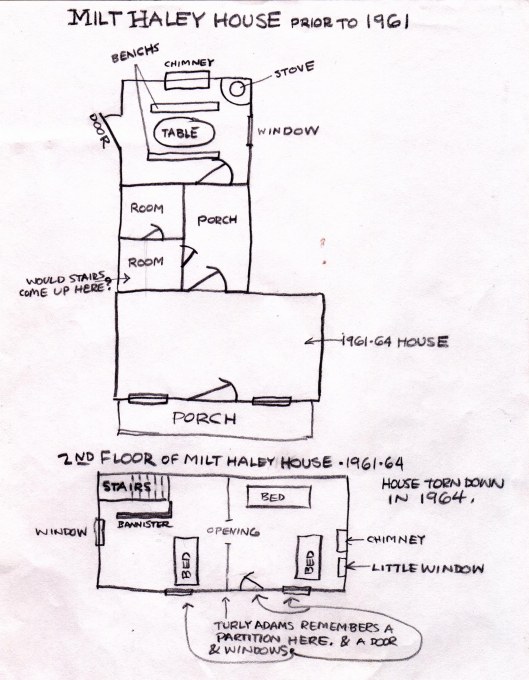
After looking at more of Joe’s pictures, I asked Turley about the location of the old Milt Haley house. He said it used to sit at the site of his present-day home.
“When I was a little boy I could remember it,” he said. “They was a big old log house front and they was a big long porch. And they had guest rooms. And then the kitchen was back there. Had a big chimney in it. And then they had that porch and everything back through there. Had that big kitchen in it and big fireplace. They could just put a big kettle in there and make a whole big kettle of stuff.”
It resembled the old Stonewall Workman home, Turley said, although I had no idea what that meant.
“The year I was six years old is when they remodeled that house — seven,” he said. “I remember after they took a part of it off the top, made it a story and a half.”
I drew out a floor plan of “The Milt Haley House” based on Turley’s memories.
26 Tuesday Mar 2013
Posted in Big Harts Creek, Ed Haley, John Hartford, Lincoln County Feud, Spottswood
Tags
Appalachia, culture, Ed Haley, genealogy, Harts Creek, history, John Hartford, life, Logan County, photos, Sol Bumgarner, Trace Fork, U.S. South, West Virginia

Sol Bumgarner, a key source of information about Ed Haley and the history of Trace Fork of Harts Creek, Logan County, WV, 1993
26 Tuesday Mar 2013
Posted in Big Harts Creek, Ed Haley, John Hartford, Music, Spottswood
Tags
Appalachia, Clifton Mullins, Connie Mullins, Crawley Mountain, Ed Haley, Enslow Baisden, fiddle, Harts Creek, history, Joe Mullins, John Hartford, Lawrence Haley, Logan County, Loretta Mullins, Peter Mullins, Sol Bumgarner, Trace Fork, Turley Adams, West Virginia
I told Turley that Lawrence and I needed to visit Joe Mullins, who had been gone during our last trip to Harts Creek. Turley completely deflated us: Joe, he said, had recently suffered a stroke. He now lived with his daughter Connie Mullins in a trailer just up the creek. Turley pointed the way. Driving a short distance, Lawrence and I parked our car by the creek and walked over a little narrow bridge where an army of barking dogs greeted us. At the porch, Connie introduced us to her brother, Clifton. We stepped on inside and found Joe seated in a wheelchair, surrounded by more dogs. His mind — or at least his ability to communicate a great deal — was all but gone due to the lingering effects of his stroke. Lawrence sat next to him with his hand on his arm. Almost in tears over Joe’s condition, he tried to rekindle Joe’s memories by saying, “I’m Ed Haley’s boy.”
I hung out with Joe’s kids — Connie, Clifton and Loretta. While all were reasonably young, Clifton and Connie had Parkinson’s Disease.
“They’s four of us got it,” Clifton said. “They said it runs through the family some way another. Musta come down the tree somewhere.”
I asked him how old he was.
“38,” he said.
Clifton had just moved back to Harts.
“I got hurt in Michigan and Daddy was sick so I said, ‘Well, it’s a good chance for me to go help my daddy and my sisters.'”
Clifton’s sisters said he was the one who found Ed’s smashed fiddle years ago in the rafters of Uncle Peter’s old smokehouse.
“I was up in there — we was playing around one day — and it fell out on me,” he said. “And I just looked at it and I said, ‘Well, I’ll try to glue it together.’ I started gluing it and it wouldn’t glue so I dumped it into the creek. I didn’t know whose it was. I was about eight but all the pieces wasn’t there to it. When it hit that guy it just splintered everywhere.”
Clifton suggested that we visit Bum and his family just up the hollow. Two years earlier, Bum had told originally Lawrence and I how he had witnessed Ed smash the fiddle over a man’s head while at a tavern on Crawley Mountain. Bum lived only a short distance from Joe’s trailer, up the hollow past Uncle Peter’s old homeplace, in a house situated near Enslow Baisden’s log cabin.
10 Sunday Mar 2013
Posted in Culture of Honor, Whirlwind
Tags
Appalachia, culture, genealogy, Harts Creek, history, Logan County, photos, U.S. South, West Virginia, Whirlwind

Couple from Whirlwind, West Virginia, 1890-1915
04 Monday Mar 2013
Posted in Big Harts Creek, Ed Haley, Music
Tags
Appalachia, banjo, Boone County, Ed Haley, fiddler, genealogy, history, Johnny Hager, Logan County, music, photos, U.S. South, West Virginia
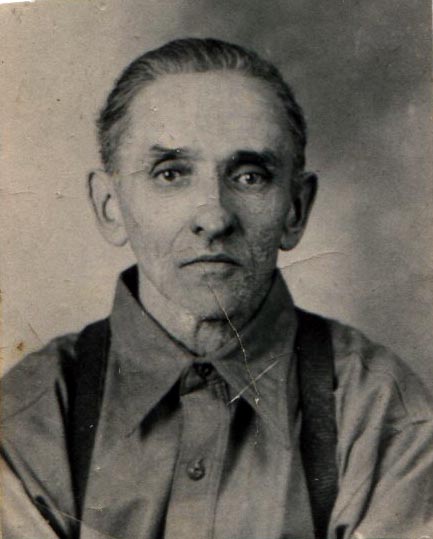
Johnny Hager (1876-1955), a banjo player and fiddler who lived in Boone County, West Virginia
26 Tuesday Feb 2013
Posted in African American History, Big Harts Creek, Ed Haley, Hatfield-McCoy Feud, Logan, Music, Sports
Tags
Appalachia, Aracoma, Big Foot, blind, Blues, Clyde Haley, Come Take A Trip in My Airship, Coney Island, Devil Anse Hatfield, Done Got the 'Chines in My Mind, Ed Haley, Ella Haley, fiddler, Fox Cod Knob, Franklin Roosevelt, Harts Creek, Hester Mullins, Hiram Dempsey, history, Island Queen, Jack Dempsey, John Hartford, Lawrence Haley, Logan, Logan County, Mona Haley, music, mystery, Noah Haley, Nora Martin, Pink Mullins, steamboats, Trace Fork, Turkey in the Straw, West Virginia
Mona’s memories were really pouring out, about a variety of things. I asked her what Ed was like and she said, “Noah is a lot like Pop in a way. He always liked the outdoors, Pop did. He’d get out and sleep on the porch at night. He could peel an apple without breaking the skin. There was an old man up on Harts Creek and I’m almost sure that his name was Devil Anse Hatfield and Pop trimmed his fingernails out on his porch with his pocketknife. Aw, he could trim my nails or yours or anybody’s.”
Ed was good at predicting the future.
“Pop said machines was gonna take over man’s work and we was gonna go to the moon one day,” Mona said. She figured he wrote the song “Come Take A Trip in My Airship” because it sounded like his kind of foresight.
Mona said she remembered some of Ed’s stories but warned me that I wouldn’t want to hear them.
Of course, I did.
I asked her if they were off-color and she said, “Well, not really, but he was kind of an off-color guy. I can’t really remember any of the tales about him. What was that one about him dreaming he was on Fox Cod Knob and dragging a big log chain and he fell over a big cliff and when he come to hisself he was standing on his head on a chicken coop with his legs locked around a clothes line?”
What?
“He told some weird stories sometimes — ghost stories and things that I can’t remember,” she continued. “He told that story about Big Foot up in the hills of Harts Creek. A wild banshee. Pop talked about it. Clyde said he saw a Big Foot.”
Lawrence said, “It was up in the head of the Trace Fork of Harts Creek somewhere. Pop was on the back of this horse behind somebody. They was coming down through there and all at once something jumped up on back of the horse behind him and it was just rattling chains all the way down through there and the more that chain rattled the faster that horse would go. They absolutely run that horse almost to death getting away from it.”
I asked about Ed’s travels. Mona said her parents walked and hitchhiked a lot. Along the way, Ella sang to occupy the kids. Lawrence remembered buses and trains, where Ed sometimes played the fiddle for a little extra money from passengers. I asked if he ever talked about playing on any boats and Mona said, “No, but I know they did because I was with them on the ISLAND QUEEN that was going back and forth to Coney Island. Up by the calliope on the top deck.”
Mona said Ed always set up in towns near a movie theatre so the kids could watch movies.
“Every time he played he drawed a crowd,” she said. “He was loud and he was good. I never seen him play any that he didn’t have a crowd around him — anywhere.”
Ed was “all business” but would talk to people if they came up to him.
“One time we went in a beer joint up in Logan, West Virginia, that sat by the railroad tracks,” she said. “They played over at the courthouse and we walked over there. Pop wanted to get a beer while I ate supper. It was back when Roosevelt was president I reckon and he got in an argument with some guy about President Roosevelt. That was his favorite fella, you know. This guy started a fight with him and he backed off and walked away. Pop just let the man walk the length of his cane, hooked it around his neck, brought him back and beat him nearly to death. He was strong. He was dangerous if he ever got a hold of you, if he was mad at you. He always carried a pocketknife and it was sharp as a razor. He whittled on that knife — I mean, sharpened it every day.”
“Everybody liked Pop — everybody that I ever knew,” Mona said. “He had some pretty high people as friends.”
In Logan County, Ed visited Pink and Hester Mullins on Mud Fork and Rosie Day’s daughter Nora Martin in Aracoma. Mona said Ed was also friends with a famous boxer in town whose father played the fiddle, but she couldn’t remember his name. I later learned from Lawrence that it was Jack Dempsey, the heavyweight champion of the world from 1919-1926. Dempsey wrote in his biography that his father had fiddled “Turkey in the Straw” so much that all the children thought it was the National Anthem.
Ed mixed freely with some of the colored folks in Logan, and sometimes even left Mona at a “bootleg joint” operated by a black lady named Tootsie. She and Lawrence both felt Ed absorbed a lot of the Blues from the blacks in the coalfields. Mona sang one of her father’s songs — which I had never heard — to make the point:
Done got the [ma]chines in my mind, Lord, Lord.
Done got the ‘chines in my mind.
‘Chines in my mind and I can’t make a dime.
Done got the ‘chines in my mind.
My old gal got mad at me.
I never did her any harm.
‘Chines in my mind and I can’t make a dime.
Done got the ‘chines in my mind.
18 Friday Jan 2013
Posted in Ed Haley
Tags
Appalachia, culture, Ed Haley, genealogy, Harts Creek, history, John Hartford, life, Logan County, photos, Roxie Mullins, West Virginia

Roxie Mullins, 1991
16 Wednesday Jan 2013
Posted in Big Harts Creek, Culture of Honor, Halcyon
Tags
Appalachia, crime, culture, Doc Workman, genealogy, Harts Creek, history, Logan County, murder, mystery, photos, true crime, U.S. South, West Fork, West Virginia, Workman Fork

Wilson “Doc” Workman Home, about 2002
14 Monday Jan 2013
Posted in Big Harts Creek, Halcyon
Tags
Appalachia, Doc Workman, Harts Creek, history, Logan County, photos, U.S. South, West Fork, West Virginia, Workman Fork, World War I

Wilson “Doc” Workman, veteran of the First World War, resident of Workman Fork of West Fork of Harts Creek, Logan County, WV
13 Sunday Jan 2013
Posted in Ed Haley
Tags
Appalachia, Ashland, banjo, Billy in the Lowground, Blackberry Blossom, blind, Cacklin Hen, Catlettsburg, Clark Kessinger, Clayton McMichen, culture, Curly Wellman, Curt Polton, Ed Haley, Elvis Presley, fiddler, Floyd Collins, Forked Deer, Grand Ole Opry, guitar, Hatfield-McCoy Feud, history, Horse Branch, Huntington, Ivan Tribe, John Hartford, Kentucky, Lawrence Haley, Logan County, Mid-Day Merry-Go-Round, Morehead, Mountain Melody Boys, Mountaineer Jamboree, music, National Fiddling Association, Old Sledge, Poplar Bluff, Rowan County Crew, Ugee Postalwait, Ward Hollow, WCHS, WCMT, Westphalia Waltz, writing, WSAZ
I asked Curly if he remembered any of Ed’s tunes and he said, “Ah, I remember ‘Forked Deer’ and I remember ‘Billy in the Lowground’ and I remember the ‘Old Sledge’ and I remember ‘Poplar Bluff.’ ‘Blackberry Blossom.’ The longer he played a tune, the meaner he got on it. If he got the feel, it hit him. And the more he played the better he got and the more tunes come to him. He played one waltz — ‘Westphalia Waltz’ — and that’s really the only waltz that I can recall that he played. And it was all double stop fiddle.”
Curly never heard Ed sing a note — a very surprising recollection considering the way that Ugee Postalwait had hyped Haley’s singing abilities.
“I got a copy of a song from him,” Curly said. “He had somebody to write it down. Because at this time, out at Morehead, Kentucky, they had a feud out there. And they had a shoot-out there on the steps and then somebody wrote this song called ‘Rowan County Crew.’ And Ed, they tell me, would sing that at different places throughout Kentucky. At that time, it was like Floyd Collins that was in the cave and like the Hatfields and the McCoys — only this was called the ‘Rowan County Crew.’ Well, at that time it was hot as a pistol through the state. Now evidently he sang that song, but he never sang it for me.”
Curly said, “Ed could have been as great as the Blue Yodeler or any of those people. He could have been right on those records with them but under no reason did he want to record commercially. Had he been living today and with the equipment they’ve got today, he would’ve been in more demand than Elvis Presley ever was. Nobody played ‘Cacklin’ Hen’ like him. And a very humble man. I never heard Ed down anybody else, I never heard him put anybody below him and I never had him to tell me how good he was. In fact, I wonder sometimes if he knew how good he was. But I knew it. He was a brilliant man. He’d just about keep a check up on everything during his lifetime. He knew the news, he knew the political field, he knew what was going on in the state.”
I asked Curly about the first time he ever saw Haley play.
“I played with Ed when I was a kid — twelve, thirteen years old — and we lived at a place called Horse Branch. That’s as you enter Catlettsburg, Kentucky. And I was a kid carrying an old flat-top guitar — no case — trying to learn how to play. In the evening, he’d come out on the front porch after dinner and Ralph would get the guitar and the mother would get the mandolin and the neighborhood would gather because at that time radio was just coming into being. And I’d go down there and sit and bang while they were playing. And that’s where I first heard Ed Haley.”
Curly lost track of Ed when he started playing music out on his own at the age of fifteen. Throughout the mid-thirties, he played over the radio on Huntington’s WSAZ and Ashland’s WCMT with the “Mountain Melody Boys,” then made several appearances on the Grand Ole Opry and Knoxville’s Mid-Day Merry-Go-Round with Curt Polton’s band. It was during that time, he said, around 1936, that Ed got into a contest with Clark Kessinger and Clayton McMichen at the WCHS radio station in Charleston. Clayton was the National Fiddling Champion, while Clark was the National Fiddling Association’s champion of the East. The whole thing was “built up for months — it was a showdown.” In the contest, each fiddler got to play two tunes and someone named Banjo Murphy seconded every one using a three-finger picking style on a four-string banjo. First prize was a “live baby” (a little pig) and the winner was determined by a clapping meter. Curly wasn’t sure what tunes Ed played (probably “Cacklin’ Hen,” his contest specialty) but remembered the results clearly.
“Ed Haley beat the two men on stage,” he said. “McMichen was out of it in a little bit but it took several rounds to eliminate Clark Kessinger.”
Curly returned to Ashland in the early forties and found Ed living in the bottom of a weather-boarded, two-story apartment building on 37th Street (Ward Hollow). He started visiting Haley again, usually on cold days when he knew that he’d be close to home. He’d put his D-18 flat-top Martin guitar in the trunk of his car and “go pick up a pint or a half a pint of moonshine,” then head on over to Ed’s house.
I’d go in. I wouldn’t take the guitar in at all. I’d just knock on the door and go in and I’d say, “Hi, Uncle Ed.” “Hi, Curly.” He knew me by my voice. And I’d go in and sit down, you know, and say, “How’s the weather?” and “How’s things?” and “How’s the family?” and so forth and so on. We’d sit around there and talk a little bit. I’d say, “Ed, been playing any lately?” “No, I haven’t felt like it. I just haven’t felt like it.” I’d say, “Well, how about a little nip? You think that would help?” “Well now you know you might have something there.” So I’d go on to the car and I’d get the bottle and come in and we’d sit back down and I’d pass it to him. He’d hit it. He’d sit right there a little bit you know and I’d say, “Take another little nip, Ed.” “Well, I believe I will,” he’d say. “It’s too wet to plow.” And he’d sit there and he’d rock a little bit in that chair and… Being blind, he talked a little loud. “Hey, did I ever play that ‘Old Sledge’ for you?” I’d say, “Well, I can’t remember Ed. Just can’t remember.” Well, he’d get up and he’d go over and he’d lay his hand right on that fiddle laying on the mantle of the fireplace. By that time I’d be out the door and getting the Martin. I’d come back in and he’d tune ‘er up there and feel her across you know and touch her a little bit here and there. He’d take off on it.
Curly and I got our instruments out and played a few of Haley’s tunes. He showed me the type of runs he used to play behind Ed and gave me a few more tips about his fiddling. He said Ed was “all fingers…so smooth” and could play all over the fingerboard — even in second and third positions. He “put a lot of his upper body into the fiddling” and patted one foot to keep time. If he fiddled for a long time, he put a handkerchief under his chin for comfort (never a chinrest) and dropped the fiddle down to his arm and played with a collapsed wrist.
Just before Lawrence and I left, Curly said, “I’ll tell you somebody that’s still living in Charleston and he’s a hell of a fiddle player — or was. They called him Slim Clere. He’s about 82. He knew Ed. In fact, he was the man that Clere looked up to as he was learning. And he could probably give you more information than I could because he’s followed the fiddle all of his life.”
Curly also recommended Mountaineer Jamboree (1984), a book written by Ivan Tribe that attemped to detail West Virginia’s contributions to country music. It briefly mentioned Ed: “Blind Ed Haley (1883-1954), a legendary Logan County fiddler who eventually settled in Ashland, Kentucky, repeatedly refused to record, but did belatedly cut some home discs for his children in 1946.”
03 Thursday Jan 2013
Posted in Big Harts Creek, Culture of Honor
Tags
Abbotts Branch, Appalachia, Ben Workman, Buster Stollings, crime, Doc Workman, Flora Workman, Gene Wilson Dingess, Harlen Mullins, Harts Creek, history, Logan County, murder, mystery, true crime, U.S. South, Weddie Mullins, West Virginia, Workman Fork, writers, writing
In the early morning hours of April 20, 1956, someone shot Doc Workman in the abdomen with a 20-gauge shotgun as he stood at the doorway to his little house on Workman Fork. “I heard the shot fired that killed him,” said Gene Wilson Dingess, a neighbor, in a 2004 interview. “It was way up in the morning. My sister Mildred and Mommy heard it, too. No one thought anything about it. People roamed all hours of the night with guns and shot rabbits and possoms.”
Upon learning the true nature of the incident, residents of Workman Fork reacted with shock and surprise. Nothing like this had ever happened on Workman Fork. Located somewhat remotely in the headwaters of Harts Creek, the fork constituted one of the most peaceful sections of the community. Moonshining was quite common, but murder? Doc’s killing — any killing — was unprecedented on Workman Fork. People were horrified.
Most everyone agreed that Doc knew the identity of his killer. “Doc knew the person at his door,” Dingess said. “He answered the door in his pajamas.” The killer’s choice of weaponry was a source of great interest. First of all, the 20-gauge shotgun used to commit the murder reportely belonged to Mr. Workman himself. Secondly, a 20-gauge shotgun was the type of low-powered firearm that a teenager or woman (or an old man) might use at close range, say, within 30-40 yards. And, oddly, it was left lying across Workman’s leg presumably without fingerprints. “It looked like someone had been standing by his door where they stood and plotted,” said the late late Roma Elkins in a 2004 interview.
One of the initial suspects in the murder was Doc’s former wife, Flora Lilly. Police also questioned Doc’s former brother-in-law, Weddie Mullins, a son of Harlen Mullins. Buster Stollings, who boarded with Flora, was another suspect. Other suspects were two men named Jake and Bill who were out that night riding mules and stealing corn. Apparently locals were so incensed by the tragedy that they investigated the matter themselves. Early the morning of the murder, one eyewitness saw two young men, dubbed as “Frank” and “Jesse” here to hide their true identities, run by as she milked cows on Abbott’s Branch. “Ben Workman said he saw tracks from a woman in high-heeled shoes leading from the mouth of Workman Fork up to the mouth of Long Branch,” Dingess said. “Now who would’ve wore high heels on this creek back then?”
Today, so many years later, it appears that two young men dubbed as “Frank” and “Jesse” were involved in the murder. Although suspects at the time of the killing, they were never questioned by authorities. Jesse’s own mother believed him to be the killer. “When Jesse come in at the house that morning he had a whole roll of money as big as your fist,” his mother later said. “Him and Wed Mullins was in on that killing together.” Reportedly, Frank was haunted by the murder years later when he was on his deathbed. “My uncle went up to Logan and Frank was in the hospital about to die,” Dingess said. “There was a preacher there and Frank said he couldn’t get forgiveness because he’d helped kill a man.”
01 Tuesday Jan 2013
Posted in Ed Haley
Tags
Appalachia, culture, genealogy, Harts Creek, history, Jack Haley, Lawrence Haley, life, Liza Mullins, Logan County, photos, West Virginia

Jack Haley, Aunt Liza, Lawrence Haley, 1948-1953
01 Tuesday Jan 2013
Posted in Big Harts Creek, Culture of Honor, Halcyon
Tags
Appalachia, Buck Mullins, crime, Dennie Workman, Doc Workman, Flora Workman, Gene Wilson Dingess, Harlen Mullins, Harts Creek, history, Lloyd Farley, Logan, Logan County, Martha Workman, murder, mystery, Thomas B. Workman, true crime, U.S. South, Weddie Mullins, West Fork, West Virginia, Workman Fork, World War I, writing
Doc Workman was born on January 20, 1893 at Halcyon in Logan County, West Virginia. His parents were Thomas B. and Martha (Hill) Workman. Doc served in the First World War. According to his draft registration record, he was blue-eyed, had dark brown hair and was of medium build. “I think he got gased over there and he just barely made it,” said Gene Wilson Dingess, a close relative and namesake, in a 2004 interview. “They were in foxholes most of the time.” A decorated veteran and prisoner of war, Mr. Workman spoke little of his war experience after returning home. “He never told big tales about his service,” Dingess said. “If you asked him about it, he’d answer you in about thirty seconds and then change the subject.”
In 1919, Doc married Flora Mullins, the pretty red-haired daughter of Harlen Mullins, a local farmer. For many years, the couple enjoyed a happy marriage. By the early 1930s however, according to neighborhood gossip, both began affairs. Doc, who some called “Slick” because of his charms with women, reportedly courted a sister-in-law, while Flora reportedly sparked a Dingess. The family remained intact until at least 1940. Some time thereafter, Doc and Flora separated and eventually divorced. Mr. Workman built himself a small dwelling house just below his wife where he lived with a stepson, Dennie. Around that time, perhaps in related events, a few homes were burned in the neighborhood.
A 1942 draft registration record described Dock as six-feet tall, 178 pounds, of ruddy complexion, with gray hair and blue eyes. In the opinion of most people on Workman Fork, he made for a good neighbor. Lloyd Farley, a son-in-law, in a 2005 interview, said, “Doc was a fine fellow. He was hard to get to know but he would give you the shirt off of his back.” Mr. Dingess also had fond memories of the old gentleman. “We stopped there at Doc’s every day after school to see him,” he said. “He had candy and marshmallows and he always offered us a dollar to let him bust an egg between our eyes.” Dingess recalled that Doc was an excellent marksman. “Doc kept a loaded gun just inside his door to shoot foxes when they got after his chickens,” Dingess said. “He could shoot a fox from 100 yards away.”
In his last days, Doc received a pension for his service in the Great War and began to carry a significant amount of cash on his person. “He drew a veteran’s pension,” said Mr. Farley. “He often packed one-thousand dollars on him.” Not long before his murder, he loaned fifty dollars to his brother-in-law, Buck Mullins, who then lived in Logan. (Mullins soon repaid the loan.) Neighbors spoke of Dock’s money, of his pension… Family members cautioned him against keeping so much cash on hand, afraid that someone might rob him. Adding fuel to the fire of neighborhood gossip, Doc occasionally disappeared from the creek. “Doc would go out of here and be gone for a month at a time when I was young,” Dingess said. “We never did know why he left.” Just a few weeks before the murder, his son Dennie moved away to find a job. “Dennie had just left to work away from here two or three weeks when Dock was killed,” Dingess said. About one week before the killing, according to Farley, Weddie Mullins, Doc’s former brother-in-law, caught him with his arm around his wife’s waist. He told him that he “better not do it again.”
Writings from my travels and experiences. High and fine literature is wine, and mine is only water; but everybody likes water. Mark Twain
This site is dedicated to the collection, preservation, and promotion of history and culture in Appalachia.
Genealogy and History in North Carolina and Beyond
A site about one of the most beautiful, interesting, tallented, outrageous and colorful personalities of the 20th Century
 Brandon Ray Kirk