
• About

Brandon Ray Kirk

~ This site is dedicated to the collection, preservation, and promotion of history and culture in my section of Appalachia.

Brandon Ray Kirk

Tag Archives: Logan County

Isaac E. Browning

13 Monday Apr 2015

Posted by Brandon Ray Kirk in Man

≈ Leave a comment

Tags

Alice B. Browning, Appalachia, Boone County, Buryle S. Browning, Christian, Ezera H. Browning, Francis S. Browning, genealogy, Grayson White, Guyandotte River, Haley W. Browning, Henry H. Hardesty, history, Isaac E. Browning, Jane Browning, justice of the peace, Lena T. Browning, Logan County, Minnie C. Browning, R.A. Brock, Rebecca J. White, Sarah A. Browning, Van D. Browning, Virginia and Virginians, West Virginia

From “Virginia and Virginians, 1606-1888,” published by H.H. Hardesty, we find this entry for Isaac E. Browning, who resided at Christian, West Virginia:

Was born in Logan county, W.Va., Sept. 2, 1849; married there to Mary A. White on 2d of November, 1869; his wife was born in the same county, March 23, 1848. The annals of their children are: Van D., born Aug. 30, 1870; Sarah A., born March 29, 1872, died Sept. 20, 1875; Buryle S., born Oct. 18, 1874; Alice B., born March 6, 1876; Lena T., born July 6, 1878; Minnie C., born June 2, 1882; Haley W., born April 4, 1886; Ezera H., born March 14, 1889; all reside with their parents. The subject of this record is one of the most highly respected citizens in Logan county having been elected justice of the peace in 1884, he held the office honorably and satisfactorily for two years. His home is beautifully situated on Guyandotte River, and he also owns extensive mineral and timber land. His address is Christian, Logan county, W.Va. His father, Francis S. Browning, was born in Logan county, W.Va., about the year 1825, and still resides in Boone county, same State; his mother, Jane (Spratt) Browning, was born in Logan county in 1823. Mrs. Isaac Browning’s father, Grayson White, was born in Logan county in 1828, and died there in 1851; her mother, whose maiden name was Rebecca J. Christian, was born in same county in 1830 and died there in 1886. The Browning family came from England in an early day. They were among the first settlers in Logan county, and are people of high standing and have held high positions in the State and county where they reside.

Source: Dr. R.A. Brock, Virginia and Virginians, 1606-1888 (Richmond, VA: H.H. Hardesty, Publisher, 1888), 818-819.

The Life of Pioneers 9

12 Sunday Apr 2015

Posted by Brandon Ray Kirk in Big Harts Creek

≈ Leave a comment

Tags

Appalachia, banjo, Daisy Adams, farming, fiddle, guitar, Harts Creek, history, Howard Adams, Logan County, music, square dances, U.S. South, West Virginia

This history of early life in Logan County, West Virginia, was written by Howard and Daisy Adams. Howard (1906-1976) and Daisy (b.1915) were children of Major and Belle Dora Adams of Trace Fork of Harts Creek. Titled “The life of pioneers during the latter half of the eighteenth century and the beginning of the 19th century” and written in the late 1960s or early 1970s, their history marks the only known attempt by local people to reconstruct the story of pioneer life. This part of the history includes information regarding industry, clearing of land, farming, and square dances.

The chief industries in those days were farming, raising stock, and timbering. Farming began with axes, saws, and mattocks all swinging. A good piece of land was chosen and clearing it began by chopping and sawing down all the trees on it. The trees had to be trimmed up. That was cutting off all the branches as limbs and putting them in big heaps or piles. The logs of the trees had to be sawed in lengths so they could be rolled together in piles for hauling. All small bushes were grubbed up and put on the brush piles. Clearing land was done mostly during winter months as soon as the land was cleared of all trees and brush and it piled up. Then began the burning of brush and logs. This usually took two or three days and it was hard work. After the burning off was completed, a nice big field or new ground as it was called was now the farmer’s pride. Planting began by sowing seed beds and planting vegetables. Corn was planted in late April or early May. Usually it was hoed two times, once when about 8 to 12 inches high and again when it was about 24 to 30 inches high. People in those days swapped work or had “corn hoeing.” Everybody for several miles around came to help at the workings or corn hoeing. The women came along, too. They usually had quilting parties and also helped with the cooking. Boy, they sure had plenty to eat at the big workings. They had chicken and dumplings, beans, bacon, onions, and corn dodger and lots of other eats from the farm. Everybody gathered around after the day’s work was over.

As soon as supper was over and the dishes washed and put away the beds were moved out of the room called the big house. Then the young men and young women began dancing. Square dancing was a thrilling experience. Some one who knew how called out the reels. The dancers then performed the instruction of the caller. A string band consisting of a fiddle, banjo, and sometimes a guitar furnished the music for the dance. They had refreshments of wine or liquor most all the men took part in the drinking. The girls seldom ever drank. If anyone got drunk he was put out of the dancing or off the floor as they called it. Sometimes the boys would have fist fights over the girls which never amounted to much. After the dance was over, the beds were put back in the big house room and the neighbors all said good night and went home tired and sleepy. All these things happened as time moved along.

Henderson Browning

11 Saturday Apr 2015

Posted by Brandon Ray Kirk in Man

≈ Leave a comment

Tags

Ballard P. Browning, Burl T. Christian, Chloe Ann Christian, Christian, civil war, Elizabeth Canterbury, genealogy, Guyandotte River, Henderson Browning, Henry H. Hardesty, history, James H. Christian, Lee R. Browning, Logan County, Marsilla Christian, Mary Canterbury, North Carolina, R.A. Brock, Rebecca Browning, Roxie J. Browning, Samuel Canterbury, Sarah Christian, Virginia and Virginians, West Virginia, William C. Browning

From “Virginia and Virginians, 1606-1888,” published by H.H. Hardesty, we find this entry for Henderson Browning, who resided at Christian, West Virginia:

Was born in Logan county, W.Va., July 6, 1839, and was married to Elizabeth (Canterbury) Christian, of same county, Aug. 15, 1866. To this union have been born two sons and a daughter: Ballard P., born Aug. 8, 1867; Lee R., born May 3, 1869, died the following year; and Roxie J. The first and last of these children are unmarried, and reside with the parents. Roxie, the youngest, now 15 years of age, is the largest girl in the county, weighing 264 3/4 pounds, measuring 45 inches around the waist, and 54 1/2 around the shoulders. Mrs. Browning was first married to James H. Christian, who died in prison during the late war. Of this marriage four children were born: Marsilla, died in infancy, Burl T., Chloe Ann, and Sarah. The last three are married. William C. Browning and Rebecca (Tola), parents of the subject of this sketch, are both still living in Logan county, at an advanced age; the mother is a native of this county; the father was born in North Carolina; his parents were some of the first settlers in Logan county. Samuel and Mary (Toler) Canterbury, Mrs. Browning’s parents, were born in this county, where the mother still lives, now in her 86th year; the father died several years ago. Mr. Henderson Browning’s post office is Christian, Logan county, W.Va. He has a beautiful home situated on Guyandotte River.

Source: Dr. R.A. Brock, Virginia and Virginians, 1606-1888 (Richmond, VA: H.H. Hardesty, Publisher, 1888), 818.

The Life of Pioneers 8

06 Monday Apr 2015

Posted by Brandon Ray Kirk in Big Harts Creek, Spottswood

≈ Leave a comment

Tags

Appalachia, Belle Dora Adams, culture, Daisy Adams, farming, Harts Creek, history, Howard Adams, life, Logan County, Major Adams, Trace Fork, U.S. South, West Virginia

This history of early life in Logan County, West Virginia, was written by Howard and Daisy Adams. Howard (1906-1976) and Daisy (b.1915) were children of Major and Belle Dora Adams of Trace Fork of Harts Creek. Titled “The life of pioneers during the latter half of the eighteenth century and the beginning of the 19th century” and written in the late 1960s or early 1970s, their history marks the only known attempt by local people to reconstruct the story of pioneer life. This part of the history includes information regarding hogs and the smoke house.

The hogs furnished the main meat supply. Most farmers let their hogs run loose out on the mast as they called it till late fall. Nuts were plentiful in those days. Around the last of November some of the largest hogs were called in and put up in a floored pen with a big trough placed inside the pen so the hogs could be watered and fed often. They were fed plenty of corn till around Christmas. Then they were butchered or killed for meat.

Hog killing time was a lot of fun and good eating. It began with the hogs being well fattened as they called it. Some big kettles were set in a furnace and filled with water, then a fire was built around the kettles to heat the water. Firewood was plentiful and they sure used a lot of it. A large barrel was set down in the ground about 2 feet. The barrel was tilted over to about a 45 degree angle. Next a board platform was made around 6 feet square. It was moved up till it touched the barrel. Now a hog was either shot or hit in the head with a hammer. Either way it was killed neat. A butcher knife was plunged in the hog’s neck, the point of the knife touching the heart. Now after the hog had bled most all of the blood out of it they dragged him up on the platform before the barrel. Now the hot water from the kettles was poured in the scalding barrel, then the hog would be pushed into the barrel by men and rolled over a time or two. Now they changed ends, with the hog scalding the whole hog. Well, the hair was scraped off with big knives. Now he was hanged up about 6 feet on some object. A stick called a gammor stick, which was about 2 feet long and 2 inches in diameter sharp on both ends, it was struck through the _____ of the hind legs of hog. This held him up while the intestines were removed by splitting the hog down his belly. Now some folks come from a long way just to roast the kidneys and _____. Next Mr. Hog was carried to the smoke house, laid on a heavy table and cut up as they called it.

First after the hog was laid on the cutting table its feet and head were cut off neat all the lean meat was cut out for making sausage. A lot of the fat was cut out for rendering lard. Now the 2 hams and 2 shoulders were cut off, leaving 2 big middlings. Now the pieces were carried in the smoke house, salted, and stacked in a big trough that had been made from a large log being chopped or dug out with a tool called a foot adz and axe. This trough was made to hold the pork. Now the meat had to be hung and smoked so a lot of hickory limbs about the size of your big finger and 3 feet long with a fork on the big end, these were tied to form a loop. These loops were slipped over poles laid on the joist in the smoke house. Now the meat had holes cut in it and the meat was hooked to the loop on the joist. Now for smoking: A fire made from green hickory wood was built on the ground under the meat so the smoke filtered up through the meat and it got smoked in the process. After it had been smoked several weeks it was taken down and sprinkled and covered with a mixture of black pepper, sugar, ashes, saltpeter, etc. Now it was again stacked in the big trough and covered up to keep out rats, mice, etc. Boy it was good eatin’.

The smoke house was also used to keep meat, a barrel of flour, a barrel of salt, a can of lard, and I remember we always kept a pair of old scales to weight farm products on. Also the family weighed each other to see who was the heaviest. Boy, this smoke house took a lot of paper and time but it played an important part in the lives of the pioneers.

Albert R. Browning

06 Monday Apr 2015

Posted by Brandon Ray Kirk in Man

≈ Leave a comment

Tags

Albert R. Browning, Anna B. Browning, board of education, Dora H. Browning, genealogy, Guyandotte River, Henry H. Browning, Henry H. Hardesty, history, Huff's Creek, John D. Browning, Kenis C. Browning, Lloyd R. Browning, Logan County, Man, Penelope Browning, R.A. Brock, Vicy P. Browning, Virginia and Virginians, West Virginia

From “Virginia and Virginians, 1606-1888,” published by H.H. Hardesty, we find this entry for Albert R. Browning, who resided at Man, West Virginia:

Is one of the best known and most estimable citizens of Logan county; at the present time holds the office of commissioner on the board of education, which position he fills wisely and honorably; having been elected in 1889, his term has not yet expired. With his interesting family he resides in his beautiful home situated on the Guyandotte River, near the mouth of Huff’s Creek. Besides his farm, his real estate consists of extensive and valuable mineral lands. The annals of Albert R. Browning and family may be briefly stated thus: Subject of this sketch was born in Logan county, W.Va., Feb. 14, 1857; his wife, Penelope E. Mullins, was born in same county June 18, 1859; they were married in that county Oct. 7, 1875; their children are: Henry H., born Feb. 14, 1877; Lloyd R., born Oct. 10, 1878; John D., born March 20, 1881; Anna B., born June 20, 1883; Kenis C., Jan. 27, 1885 — all reside with their parents; Dora H., born Feb. 27, 1887, died Sept. 12, 1888; Vicy P., born April 21, 1889. Mr. Browning’s vocation principally is conducting his farm; his post office is Man, Logan county., W.Va.

Source: Dr. R.A. Brock, Virginia and Virginians, 1606-1888 (Richmond, VA: H.H. Hardesty, Publisher, 1888), 817-818.

The Life of Pioneers 7

29 Sunday Mar 2015

Posted by Brandon Ray Kirk in Big Harts Creek

≈ Leave a comment

Tags

Appalachia, Belle Dora Adams, Daisy Adams, farming, Harts Creek, history, Howard Adams, Logan County, Major Adams, Trace Fork, U.S. South, West Virginia

This history of early life in Logan County, West Virginia, was written by Howard and Daisy Adams. Howard (1906-1976) and Daisy (b.1915) were children of Major and Belle Dora Adams of Trace Fork of Harts Creek. Titled “The life of pioneers during the latter half of the eighteenth century and the beginning of the 19th century” and written in the late 1960s or early 1970s, their history marks the only known attempt by local people to reconstruct the story of pioneer life. This part of the history includes information regarding coffee, livestock, and pets.

Coffee in those days came in the green berries split in half so you had to roast the berries then put them in a little machine known as a coffee mill. It had a little crank on top which you turned by hand, grinding the coffee up in small pieces. Now it could be put in the pot, add water, build a fire, and make coffee.

A farmer had to raise a large crop of corn along with grass, some for hay and some for pasture or grazing.

The livestock on a farm consisted of horses, cattle, sheep, hogs, chicken, turkeys, geese, ducks, dogs, cats, etc. The horses were used to ride and pull heavy loads around the farm. Cattle were used for beef, also for hauling big loads. They got milk from the cows too. Sheep were used for mutton. Wool from them supplied much of the family’s clothes. Wool was sheared off the sheep, then it was carded by using two small boards, one foot long, five inches wide, about three fourth of an inch thick. The cards had short stiff wife about 1/2 inch long on one side and one handle on each. The wool was put on the wire side of the cards in small amounts and the cards pulled back and forth over the wool and finally the wool was rolled in a roll about 1 inch in diameter and 2 feet long. Now it was ready for the spinning wheel. The spinning made the thread from the rolls of wool. Then the wool was put in the loom and woven into cloth. Warm winter clothes were made from the woolen cloth. Boy it took a lot of work to produce clothes this way but they were well worth it. The duck and geese furnished meat and feathers. The feathers were used for making pillows and big feather beds to put on the shuck or straw mattress. Boy you sure could sleep well on those beds if it wasn’t for the big old clock striking often and so loud. The chickens and turkeys furnished meat and eggs also. The ducks and geese furnished eggs too. Yes, and the rooster was the alarm clock. The dogs were used as watch dogs for chasing away varmints and running squirrel and rabbit, etc. The cats caught lots of mice and chipmunks.

John Bradbury

29 Sunday Mar 2015

Posted by Brandon Ray Kirk in Wyoming County

≈ Leave a comment

Tags

Amon R. Bradbury, Andrew J. Bradbury, Appalachia, Christiansburg, civil war, Confederacy, Confederate Army, Eva Bradbury, genealogy, George E. Bradbury, Henry H. Hardesty, history, James E. Bradbury, John Bradbury, John T. Bradbury, Logan County, Lucy J. Bradbury, Mark Bradbury, Mary E. Bradbury, Minerva Bradbury, Montgomery County, Nebraska, North Carolina, Oceana, Pearis E. Bradbury, Poindexter C. Bradbury, Pulaaski County, R.A. Brock, Rhoda E. Bradbury, Robert E. Lee Bradbury, U.S. South, Virginia, Virginia and Virginians, West Virginia, William B. Bradbury, Wyoming County

From “Virginia and Virginians, 1606-1888,” published by H.H. Hardesty, we find this entry for John Bradbury, who resided at Oceana, West Virginia:

Son of Mark and Minerva (Dason) Bradbury, was born May 6, 1835, in Montgomery county, Va. His father was born in Henry county, Va., on Mar. 6, 1791, and died Sept. 10, 1862, in Montgomery county, Va., and his wife, the mother of the subject of this sketch, was born in same county as her husband on Feb. 10, 1812, and she is now residing in Nebraska. July 28, 1858, John Bradbury was joined in weelock with Mary E. Farmer, who was born in Pulaski county, Va., on April 1, 1838, the marriage being solemnized in the State of North Carolina. Their children’s records are as follows: Poindexter C., born Oct. 6, 1857, married; Amon R., born Sept. 3, 1859; John T., born Jan. 12, 1862; William B. and James E. (twins), born May 6, 1865, the last named deceased; Andrew J., born Aug. 23, 1867, married; Rhoda E., born Aug. 1, 1869; George E., born Mar. 10, 1871; Lucy J., born May 3, 1873; Pearis E., born Sept. 23, 1875; Eva, born Jan. 12, 1877; Robert E. Lee, born April 3, 1879; Ida, born April 10, 1882. John T. died Feb. 24, 1864, and James E. died Feb. 28, 1868. Mr. Bradbury enlisted in the Confederate States army at Christiansburg, Va., in 1861, in Co. E, 54th Va. V.I., and served three years. He is a farmer, and has been trustee of public schools in his county for six years. His post office address is Oceana, W.Va.

Source: Dr. R.A. Brock, Virginia and Virginians, 1606-1888 (Richmond, VA: H.H. Hardesty, Publisher, 1888), 817.

The Life of Pioneers 6

22 Sunday Mar 2015

Posted by Brandon Ray Kirk in Big Harts Creek

≈ Leave a comment

Tags

agriculture, Appalachia, Belle Dora Adams, Daisy Adams, farming, Harts Creek, history, Howard Adams, Logan County, Major Adams, U.S. South, West Virginia

This history of early life in Logan County, West Virginia, was written by Howard and Daisy Adams. Howard (1906-1976) and Daisy (b.1915) were children of Major and Belle Dora Adams of Trace Fork of Harts Creek. Titled “The life of pioneers during the latter half of the eighteenth century and the beginning of the 19th century” and written in the late 1960s or early 1970s, their history marks the only known attempt by local people to reconstruct the story of pioneer life. This part of the history includes information regarding garden food and butter-making.

Everyone had a large garden which produced much of the eating of old-timers. Beans, corn, cucumbers, potatoes, beets, melons, pumpkins, squash, onions, mustard, and lettuce, parsnips, were all produced in large quantities. Yes, cabbage, tomatoes, peas, and a lot I’ve forgotten.

Most pioneers had an orchard of apples, pear, peaches, plums from which they got a lot of good eating. These fruits were put up in many ways, especially apples. They were canned, sulfured, dried, and made into apple butter. Making apple butter was done by peeling a lot of apples and slicing them up in small pieces. Then putting them in a big copper or brass kettle which was set in a furnace. To keep the apple butter from sticking or burning in the kettle after a fire was built around it a stir stick was used. To describe a stir stick it was a piece of one by five inch board about 2 feet long with a lot of holes bored in it. A handle was fastened to the top end of the board. The handle was around 8 feet long and was pushed and pulled across and around in the kettle of apples all day long. Apples were added to the big kettle about noon. Then the sugar or molasses was added along with flavor such as vanilla or cinnamon bark which gave the apple butter a good taste. After the sweetening was put in the butter began to flop out everywhere. You had to stir fast and watch out for the flopping butter because if it hit you it burned badly. Boyd I liked to lick those apple butter spoons. Well, enough about apple butter.

We mentioned butter from milk but never told how it was made. The milk from the cow was strained and put in a stone churn size 4 gallon. It was left in the churn until it soured or got thick as they called it. Then it was churned up and down by a churn-dasher: a one by 6 inch circular piece of wood on a handle. After it was churned about 30 minutes butter would form on top of the milk. Then it was dipped off with a spoon and put in a dish, salted, and set up to get cold. So long, butter.

David C. Bailey

22 Sunday Mar 2015

Posted by Brandon Ray Kirk in Wyoming County

≈ Leave a comment

Tags

Albert Bailey, Clear Fork, David C. Bailey, David H. Bailey, Frank O. Bailey, genealogy, George C. Bailey, Guyandotte River, Henry H. Hardesty, history, Humphrey Bailey, Ira Bailey, Logan County, Lucinda J. Bailey, Mary Bailey, Oceana, Ollie E. Bailey, Orvie Bailey, R.A. Brock, Rachel A. Bailey, Romeo Bailey, Tazewell County, Thomas J. Bailey, Virginia, Virginia and Virginians, West Virginia, Wyoming County

From “Virginia and Virginians, 1606-1888,” published by H.H. Hardesty, we find this entry for David C. Bailey, who resided at Oceana, West Virginia:

Was born in Logan county, W.Va., April 3, 1843, but subsequently removed to Wyoming county, where he was living at the breaking of the war of the rebellion. Here, June 28, 1865, he was united in marriage to Lucinda J. Lambert, native of Tazewell county, Va. Of this union 12 children have been born: Ollie E., Thomas J., George C., Humphrey, Ira, Mary, Rachel A., Frank O., Albert, Romeo, David H., and Orvie. They reside with their parents at their beautiful home on Clear Fork, not far from its junction with Guyandotte River. Mr. Bailey is at this time engaged in farming; besides his handsome residence, he owns extensive coal and timber lands. As a citizen, he is highly respected; as a friend, he is beloved by all who know him. He has held several offices with honor, among others that of county superintendent, to which he was elected in 1879, continued in office till 1885, having been re-elected in 1884. His post office is Oceana, Wyoming county, W.Va.

Source: Dr. R.A. Brock, Virginia and Virginians, 1606-1888 (Richmond, VA: H.H. Hardesty, Publisher, 1888), 816.

The Life of Pioneers 5

18 Wednesday Mar 2015

Posted by Brandon Ray Kirk in Big Harts Creek

≈ Leave a comment

Tags

Appalachia, Belle Dora Adams, Daisy Adams, Harts Creek, history, Howard Adams, Logan County, Major Adams, Trace Fork, U.S. South, West Virginia

This history of early life in Logan County, West Virginia, was written by Howard and Daisy Adams. Howard (1906-1976) and Daisy (b.1915) were children of Major and Belle Dora Adams of Trace Fork of Harts Creek. Titled “The life of pioneers during the latter half of the eighteenth century and the beginning of the 19th century” and written in the late 1960s or early 1970s, their history marks the only known attempt by local people to reconstruct the story of pioneer life. This part of the history includes information regarding clothes washing and outbuildings.

The pioneers done their own washing of clothes. They had a large black kettle set in a furnace made of mud and rocks. The kettle was partly filled with water and some homemade soap added to the water. Then the dirty clothes were dumped in the kettle and a fire built around the kettle and a fire built around the kettle to make it boil. After the clothes had boiled a while a small batch of them was taken out at a time and laid on a large block about 2 feet high and 2 feet in diameter. Then a paddle about 3 feet long 1 inch thick and 4 inches wide was used to pound the clothes as they were taken from the big kettle and placed on the bottling block as it was called. While the clothes were being pounded with the paddle the hot water and dirt would fly everyway. You had to watch out and not get burned from hot water. It was hard work, but the clothes were made clean. Later on a few people got hold of a gadget called a wash board. It had corrugated tin fastened on one side and the clothes were soaped and wet then rubbed up and down on the wash board which took the dirt out of them. This was a hard way doing laundry.

There had to be several buildings erected on the farm, such as barn for cows and horses to be sheltered in, sheep house for sheep. Cribs for corn. A smoke house to keep meat. Salt, flour, meal, etc. in a well house near the well. I will describe one or two of these houses. The well house first. It was about 6 feet wide by 10 feet long and had no floor except the dirt or ground. Some big flat rocks were laid on the ground in the well house and large tubs set on the rocks. Cold water from the well was poured in the tubs and milk, eggs, butter, etc. were set in the water to keep them cool. Water had to be changed 2 or 3 times a day especially on hot days. Now the smoke house. It was about 10 X 16 feet and had a floor in the front end. About 6 feet of floor across the back was left out. The ground space in back of smoke house was used for building a fire to smoke the meat. That would be stored in later. Some folks who put up a lot of canned vegetables made a cellar or can-house for them. The cellar was made by digging a hole in the side of a hill near the house and boarding it up or cribbing it up with logs, which ever were available. Shelves were made in it and the canned vegetables stored away.

Hugh C. Avis

18 Wednesday Mar 2015

Posted by Brandon Ray Kirk in Logan

≈ Leave a comment

Tags

Appalachia, Ella A. Avis, genealogy, Guyandotte River, Henry H. Hardesty, history, Hugh C. Avis, John C. Avis, John Dingess, Logan County, Martha J. Avis, Mary F. Avis, Monroe County, R.A. Brock, Rich Creek, Sarah Dingess, U.S. South, Virginia and Virginians, West Virginia

From “Virginia and Virginians, 1606-1888,” published by H.H. Hardesty, we find this entry for Hugh C. Avis, who resided at Rich Creek, West Virginia:

Was born in Logan county, W.Va., June 6, 1842, where he was married Jan. 21, 1869, to Martha J. Dingess, of same county. They have had six children: Ella A., born Nov. 28, 1869; Mary F., born June 18, 1871; next were twins, who died unnamed; John C., born Dec. 14 [year omitted]; James, born April 8, 1877. The oldest is married, the others live with their parents. John and Sarah (Moar) Dingess were parents of Mrs. Avis; her father was born in Logan county, where he died July 18, 1884, aged 76; the mother was born in Monroe county, Va., and now lives in Logan county at an advanced age. The subject of this sketch is at this time engaged in farming and merchandising; he owns a valuable farm on Guyandotte River, a large dry goods store and extensive coal and timber lands in Logan county. As a man of honor and moral excellence he is esteemed by all who know him. His post office address is Rich Creek, Logan county, W.Va.

Source: Dr. R.A. Brock, Virginia and Virginians, 1606-1888 (Richmond, VA: H.H. Hardesty, Publisher, 1888), 815-816.

Dr. Cecil L. Hudgins leaves Aracoma, WV (1890)

15 Sunday Mar 2015

Posted by Brandon Ray Kirk in Lincoln County Feud, Logan

≈ Leave a comment

Tags

Appalachia, Aracoma, Blood in West Virginia, Cecil L. Hudgins, doctor, genealogy, history, Hollene Brumfield, Lincoln County Feud, Logan County, Ohio, Portsmouth, West Virginia

Doc Hudgins moves LCB 09.25.1890 1

Dr. Cecil L. Hudgins leaves Aracoma, Logan County (WV) Banner, 25 September 1890. Doc Hudgins treated the wound of Hollena Brumfield in September 1889.

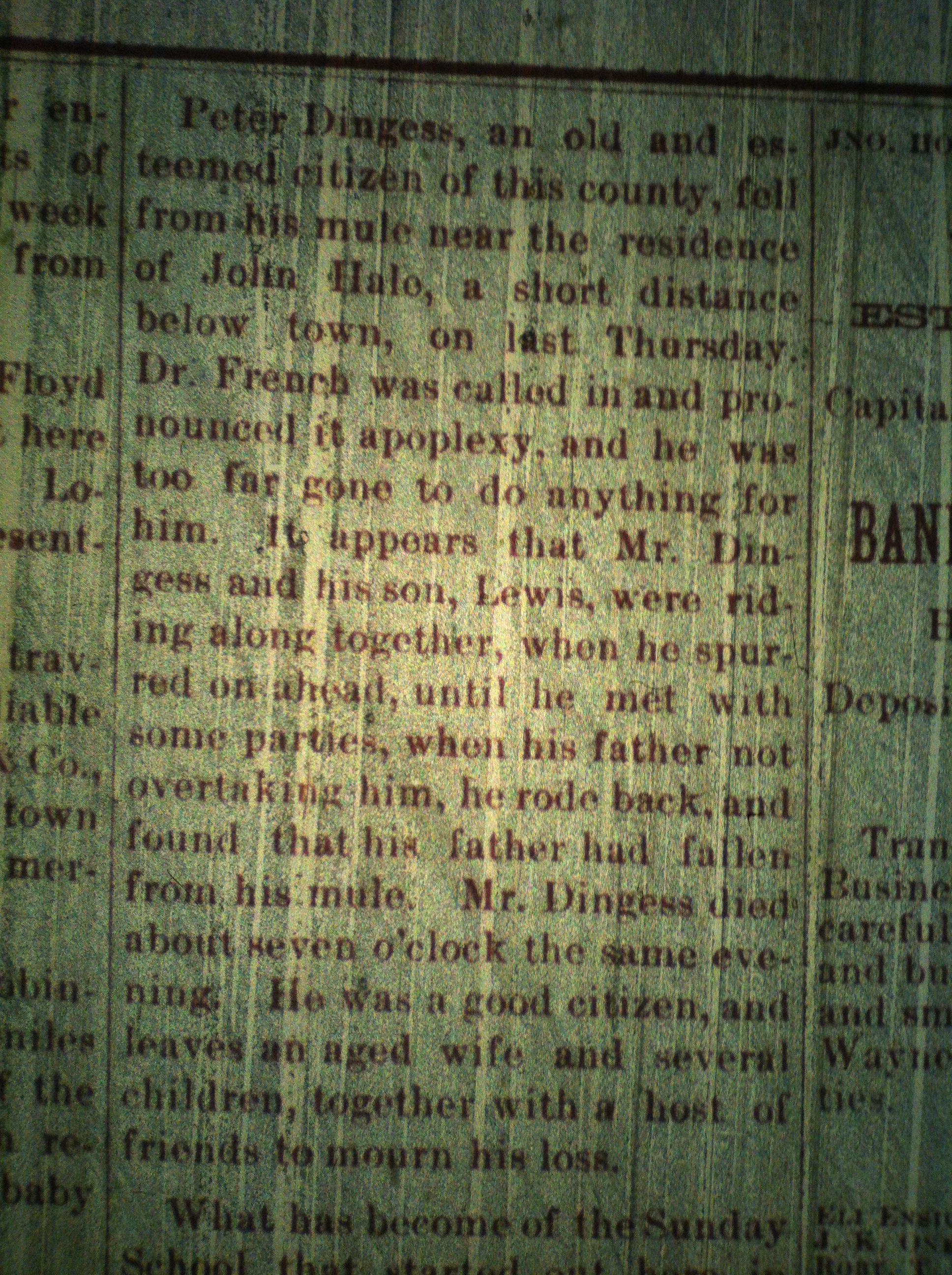
Peter “Coffee Pete” Dingess obituary (1890)

14 Saturday Mar 2015

Posted by Brandon Ray Kirk in Chapmanville

≈ Leave a comment

Tags

apoplexy, Appalachia, Dr. French, genealogy, history, John Hale, Lewis Dingess, Logan County, Peter Dingess, West Virginia

Peter "Coffee Pete" Dingess obituary, Logan County (WV) Banner, 23 January 1890.

Peter “Coffee Pete” Dingess obituary, Logan County (WV) Banner, 23 January 1890.

Dingess 6.26.1890

14 Saturday Mar 2015

Posted by Brandon Ray Kirk in Dingess

≈ Leave a comment

Tags

Dingess, farming, genealogy, history, Logan County, Logan County Banner, Mary Chafin, Mingo County, Norfolk and Western Railroad, Smith Dingess, teacher, W.F. Farley, West Virginia

“Jim Yats,” a local correspondent at Dingess in present-day Mingo County, West Virginia, offered the following items, which the Logan County Banner printed on June 26, 1890:

Farming is at a stand still in this locality on account of so much rain.

Railroading is lively along this part of the line. Mr. King is working two crews, one at day, the other at night.

W.F. Farley is teaching our public school at this place.

Smith Dingess and Mary Chafin were united in the holy bonds of matrimony at this place last Friday.

Don Chafin nearly drowns (1890)

13 Friday Mar 2015

Posted by Brandon Ray Kirk in Coal, Logan

≈ Leave a comment

Tags

Al M. Rodgers, Appalachia, Don Chafin, Francis M. Chafin, genealogy, history, Logan, Logan County, Logan County Banner, painter, sheriff, West Virginia

Don Chafin nearly drowns LCB 05.15.1889 1

Don Chafin, later Sheriff of Logan County, WV, during the Mine Wars, nearly drowned at the age of two years. Logan County (WV) Banner, 15 May 1890

Burl Farley

09 Monday Mar 2015

Posted by Brandon Ray Kirk in Big Harts Creek, Lincoln County Feud, Timber

≈ Leave a comment

Tags

Blood in West Virginia, Brown's Run, Burl Farley, Cabell County, feud, genealogy, Harts Creek, history, Lincoln County Feud, Logan County, photos, rafting, Roach, Smokehouse Fork, timber, timbering, U.S. South, West Virginia

Burl Farley, timber boss and feudist, resident of Browns Run of Smokehouse Fork of Harts Creek, Logan County, WV

Burl Farley, timber boss and feudist, resident of Browns Run of Smokehouse Fork of Harts Creek, Logan County, WV

Simon S. Altizer

09 Monday Mar 2015

Posted by Brandon Ray Kirk in Logan

≈ Leave a comment

Tags

county clerk, Ella E. Altizer, genealogy, Guyandotte River, Henry H. Hardesty, history, James N. Altizer, Julia Y. Altizer, Logan County, Logan Court House, Mary E. Altizer, Montgomery County, Nellie G. Altizer, R.A. Brock, Roxie Altizer, Roxie E. Altizer, Simon S. Altizer, Superintendent of Schools, Virginia, Virginia and Virginians, West Virginia, William E.A. Altizer

From “Virginia and Virginians, 1606-1888,” published by H.H. Hardesty, we find this entry for Simon S. Altizer, who resided at Logan Court House, West Virginia:

Present clerk of the county court, residing at Logan C.H., W.Va., is a native of Montgomery county, Va., where he was born Oct. 26, 1846. He is descended from a family that has always ranked as one of the most honorable and most highly respected of the State. The esteem in which he is held by his county people has been shown by the offices of trust to which they have frequently elected him, among others that of superintendent of public schools in Logan county, to which he was elected in 1880, and served until 1882; was for 10 years a member of the public school teachers’ examining board; was first appointed clerk of the county court in 1886, and after serving for one year was re-elected by ballot, and ever since has continued to hold this office with the same honor and integrity that has always distinguished him in all business and social relations. He owns a handsome residence in the town Logan Court House, and a large and valuable farm five miles from that place, situated on mineral lands adjacent to Guyandotte River. The records of his wife and children: Roxie Lawson, born in Logan county, W.Va., Oct. 5, 1856, married to Simon S. Altizer in same county, Sept. 7, 1870. Children: Ella E., born Dec. 7, 1872, died Sept. 21, 1886; Julia Y., born Aug. 13, 1875; Mary E., born Nov. 28, 1878; Nellie G., born Oct. 22, 1880; Roxie E., born Feb. 24, 1883; William E.A., born Aug. 4, 1885; James N., born Feb. 5, 1888; all residing with their parents.

Source: Dr. R.A. Brock, Virginia and Virginians, 1606-1888 (Richmond, VA: H.H. Hardesty, Publisher, 1888), 815.

The Life of Pioneers 4

05 Thursday Mar 2015

Posted by Brandon Ray Kirk in Big Harts Creek

≈ Leave a comment

Tags

Appalachia, Belle Dora Adams, culture, Daisy Adams, Harts Creek, history, Howard Adams, life, Logan County, Major Adams, Trace Fork, U.S. South, West Virginia

This history of early life in Logan County, West Virginia, was written by Howard and Daisy Adams. Howard (1906-1976) and Daisy (b.1915) were children of Major and Belle Dora Adams of Trace Fork of Harts Creek. Titled “The life of pioneers during the latter half of the eighteenth century and the beginning of the 19th century” and written in the late 1960s or early 1970s, their history marks the only known attempt by local people to reconstruct the story of pioneer life. This part of the history includes information regarding the well and bathing.

To get the water supply, a large hole was dug in the earth down till water was reached. Then a flat rock wall was made around the edge of the well to keep the dirt from falling in and filling up. Also the rocks kept the water clean and clear. Some folks had springs nearby from which they got their water. To get the water from a well a large post 12 or 15 feet high with forks on the top of it was set in the ground near the well. Then a long pole about 30 feet long was laid up in the fork of the post and a pin put through forks and pole. It worked as a swivel or pivot and was called a well sweep or ______. These words were not found in any dictionary. They were pioneer slang and to convey messages or to tell the idea to each other.

Back to getting the water out of the well. A long wire, chain, rope, or grapevine was tied on top of the pivot pole and the bottom end of the rope was tied to a oaken bucket. The bucket was made of oak staves and hoops or bands. The bucket was lowered in the well by pulling down the pivot pole. When the bucket was filled with water the pole or pivot drew the water up out of the well. So that was one way of getting water. It always worked too. Some pioneers had a wheel called a pulley with a chain or rope run through it and a bucket on each end of rope so you lowered one bucket in the well to be filled with water, then you pulled water up by hand at the same time lowering the other empty bucket.

Bathrooms were unheard of in those days. So to get a bath you put water in a big kettle, heated it with firewood, then poured the water in a big trough made from a big log that had been chopped out, or dug out as they said, which formed a basin for holding water. Then in you got and washed off, as it was called. If they did not have a trough or big tub for a bath, they just went down to the creek to the old swimming hole and stripped off all clothes and got in and washed off. Boy, I bet there were lots of peeping Toms in those days.

Aaron Altizer

05 Thursday Mar 2015

Posted by Brandon Ray Kirk in Man

≈ Leave a comment

Tags

Aaron Altizer, Aaron L. Altizer, Andrew B. Altizer, Appalachia, Charlest T. Altizer, Corilda B. Altizer, deputy sheriff, Emory Altizer, farming, Floyd County, genealogy, George R. Altizer, Henry Altizer, Henry H. Hardesty, history, Joseph Altizer, justice of the peace, Logan County, Man, Margaret Altizer, Mary Altizer, Mary M. Altizer, Montgomery County, Parthenia Altizer, Perry G. Altizer, Pittsylvania County, postmaster, Roanoke County, Sarah Altizer, Virginia, Virginia and Virginians, West Virginia, William Altizer

From “Virginia and Virginians, 1606-1888,” published by H.H. Hardesty, we find this entry for Aaron Altizer, who resided at Man, West Virginia:

Son of Emory and Margaret (Griffith) Altizer, was born July 23, 1826, in Floyd county, Va. His father was born Mar. 5, 1788, in Montgomery county, Va., and died there Jan. 10, 1875. His mother was born June 6, 1781, in Pittsylvania county, Va., and died Mar. 16, 1883, in Montgomery county. On May 27, 1847, he was married to Sarah Scaggs, the marriage occurring in Montgomery county, where she was born Mar. 22, 1828. She died June 7, 1876, leaving 10 living children and two deceased: Perry G., born Mar. 20, 1848; Joseph, born Aug. 23, 1849; Mary M., born April 6, 1851; Corilda B., born Sept. 8, 1853, and died Aug. 11, 1854; Charles T., born April 12, 1855; Parthenia, born Feb. 9, 1857, and died May 18, 1858; George R., born Jan. 30, 1859; Andrew B., born May 23, 1861; Emory, born April 9, 1863; William, born April 26, 1865; Aaron L., born May 8, 1868, and Henry, born April 6, 1871. On April 15, 1878, Mr. Altizer was married to Mary Aliff, who was born June 10, 1839, in Roanoke county, Va. Mr. Altizer was elected justice of the peace in 1865, serving until 1870; elected county superintendent, serving one term; elected deputy sheriff, serving from 1873 to 1875; again in 1884 he was elected justice of the peace, serving four years; is at present postmaster at Man, Logan county, W.Va., and is engaged in farming.

Source: Dr. R.A. Brock, Virginia and Virginians, 1606-1888 (Richmond, VA: H.H. Hardesty, Publisher, 1888), 814-815.

Henderson Dingess

05 Thursday Mar 2015

Posted by Brandon Ray Kirk in Big Harts Creek, Civil War, Lincoln County Feud, Shively, Warren

≈ Leave a comment

Tags

Appalachia, genealogy, Harts Creek, Henderson Dingess, history, Lincoln County Feud, Logan County, photos, Smokehouse Fork, U.S. South, West Virginia

Henderson Dingess 1

Henderson Dingess, resident of Smokehouse Fork of Harts Creek, Logan County, WV. Photo courtesy of Lily Ray.


← Older posts
Newer posts →

Feud Poll 1

If you had lived in the Harts Creek community during the 1880s, to which faction of feudists might you have given your loyalty?

Categories

  • Adkins Mill
  • African American History
  • American Revolutionary War
  • Ashland
  • Atenville
  • Banco
  • Barboursville
  • Battle of Blair Mountain
  • Beech Creek
  • Big Creek
  • Big Harts Creek
  • Big Sandy Valley
  • Big Ugly Creek
  • Boone County
  • Breeden
  • Calhoun County
  • Cemeteries
  • Chapmanville
  • Civil War
  • Clay County
  • Clothier
  • Coal
  • Cove Gap
  • Crawley Creek
  • Culture of Honor
  • Dingess
  • Dollie
  • Dunlow
  • East Lynn
  • Ed Haley
  • Eden Park
  • Enslow
  • Estep
  • Ethel
  • Ferrellsburg
  • Fourteen
  • French-Eversole Feud
  • Gilbert
  • Giles County
  • Gill
  • Green Shoal
  • Guyandotte River
  • Halcyon
  • Hamlin
  • Harts
  • Hatfield-McCoy Feud
  • Holden
  • Hungarian-American History
  • Huntington
  • Inez
  • Irish-Americans
  • Italian American History
  • Jamboree
  • Jewish History
  • John Hartford
  • Kermit
  • Kiahsville
  • Kitchen
  • Leet
  • Lincoln County Feud
  • Little Harts Creek
  • Logan
  • Man
  • Matewan
  • Meador
  • Midkiff
  • Monroe County
  • Montgomery County
  • Music
  • Native American History
  • Peach Creek
  • Pearl Adkins Diary
  • Pecks Mill
  • Peter Creek
  • Pikeville
  • Pilgrim
  • Poetry
  • Queens Ridge
  • Ranger
  • Rector
  • Roane County
  • Rowan County Feud
  • Salt Rock
  • Sand Creek
  • Shively
  • Spears
  • Sports
  • Spottswood
  • Spurlockville
  • Stiltner
  • Stone Branch
  • Tazewell County
  • Timber
  • Tom Dula
  • Toney
  • Turner-Howard Feud
  • Twelve Pole Creek
  • Uncategorized
  • Warren
  • Wayne
  • West Hamlin
  • Wewanta
  • Wharncliffe
  • Whirlwind
  • Williamson
  • Women's History
  • World War I
  • Wyoming County
  • Yantus

Feud Poll 2

Do you think Milt Haley and Green McCoy committed the ambush on Al and Hollene Brumfield in 1889?

Blogroll

  • Ancestry.com
  • Ashland (KY) Daily Independent News Article
  • Author FB page
  • Beckley (WV) Register-Herald News Article
  • Big Sandy News (KY) News Article
  • Blood in West Virginia FB
  • Blood in West Virginia order
  • Chapters TV Program
  • Facebook
  • Ghosts of Guyan
  • Herald-Dispatch News Article 1
  • Herald-Dispatch News Article 2
  • In Search of Ed Haley
  • Instagram
  • Lincoln (WV) Journal News Article
  • Lincoln (WV) Journal Thumbs Up
  • Lincoln County
  • Lincoln County Feud
  • Lincoln County Feud Lecture
  • LinkedIn
  • Logan (WV) Banner News Article
  • Lunch With Books
  • Our Overmountain Men: The Revolutionary War in Western Virginia (1775-1783)
  • Pinterest
  • Scarborough Society's Art and Lecture Series
  • Smithsonian Article
  • Spirit of Jefferson News Article
  • The Friendly Neighbor Radio Show 1
  • The Friendly Neighbor Radio Show 2
  • The Friendly Neighbor Radio Show 3
  • The Friendly Neighbor Radio Show 4
  • The New Yorker
  • The State Journal's 55 Good Things About WV
  • tumblr.
  • Twitter
  • Website
  • Weirton (WV) Daily Times Article
  • Wheeling (WV) Intelligencer News Article 1
  • Wheeling (WV) Intelligencer News Article 2
  • WOWK TV
  • Writers Can Read Open Mic Night

Feud Poll 3

Who do you think organized the ambush of Al and Hollene Brumfield in 1889?

Recent Posts

  • Logan County Jail in Logan, WV
  • Absentee Landowners of Magnolia District (1890, 1892, 1894)
  • Charles Spurlock Survey at Fourteen Mile Creek, Lincoln County, WV (1815)

Ed Haley Poll 1

What do you think caused Ed Haley to lose his sight when he was three years old?

Top Posts & Pages

  • Civil War Gold Coins Hidden Near Chapmanville, WV
  • Salt Rock Petroglyphs (2018)
  • Micco in Logan County, WV (1916)
  • Adkins-Davis Family Cemetery (2011)
  • Price Lucas Family Cemetery (2015)

Copyright

© Brandon Ray Kirk and brandonraykirk.wordpress.com, 1987-2023. Unauthorized use and/or duplication of this material without express and written permission from this blog’s author and/or owner is strictly prohibited. Excerpts and links may be used, provided that full and clear credit is given to Brandon Ray Kirk and brandonraykirk.wordpress.com with appropriate and specific direction to the original content.

Archives

  • February 2025
  • January 2025
  • October 2023
  • September 2023
  • December 2022
  • November 2022
  • May 2022
  • April 2022
  • February 2022
  • November 2021
  • October 2021
  • September 2021
  • June 2021
  • May 2021
  • April 2021
  • March 2021
  • February 2021
  • January 2021
  • December 2020
  • November 2020
  • October 2020
  • July 2020
  • June 2020
  • May 2020
  • April 2020
  • March 2020
  • February 2020
  • January 2020
  • December 2019
  • November 2019
  • October 2019
  • September 2019
  • August 2019
  • July 2019
  • June 2019
  • May 2019
  • April 2019
  • March 2019
  • February 2019
  • January 2019
  • December 2018
  • November 2018
  • October 2018
  • September 2018
  • August 2018
  • July 2018
  • June 2018
  • May 2018
  • April 2018
  • March 2018
  • February 2018
  • January 2018
  • December 2017
  • November 2017
  • October 2017
  • September 2017
  • August 2017
  • July 2017
  • June 2017
  • May 2017
  • April 2017
  • March 2017
  • February 2017
  • January 2017
  • December 2016
  • November 2016
  • October 2016
  • September 2016
  • August 2016
  • July 2016
  • June 2016
  • May 2016
  • April 2016
  • March 2016
  • February 2016
  • January 2016
  • December 2015
  • November 2015
  • October 2015
  • September 2015
  • August 2015
  • July 2015
  • June 2015
  • May 2015
  • April 2015
  • March 2015
  • February 2015
  • January 2015
  • December 2014
  • October 2014
  • September 2014
  • August 2014
  • July 2014
  • June 2014
  • May 2014
  • April 2014
  • March 2014
  • February 2014
  • January 2014
  • December 2013
  • November 2013
  • October 2013
  • September 2013
  • August 2013
  • July 2013
  • June 2013
  • May 2013
  • April 2013
  • March 2013
  • February 2013
  • January 2013
  • December 2012
  • November 2012

Enter your email address to follow this blog and receive notifications of new posts by email.

Join 2,927 other subscribers

Tags

Appalachia Ashland Big Creek Big Ugly Creek Blood in West Virginia Brandon Kirk Cabell County cemeteries Chapmanville Charleston civil war coal Confederate Army crime culture Ed Haley Ella Haley Ferrellsburg feud fiddler fiddling genealogy Green McCoy Guyandotte River Harts Harts Creek Hatfield-McCoy Feud history Huntington John Hartford Kentucky Lawrence Haley life Lincoln County Lincoln County Feud Logan Logan Banner Logan County Milt Haley Mingo County music Ohio photos timbering U.S. South Virginia Wayne County West Virginia Whirlwind writing

Blogs I Follow

  • OtterTales
  • Our Appalachia: A Blog Created by Students of Brandon Kirk
  • Piedmont Trails
  • Truman Capote
  • Appalachian Diaspora

BLOOD IN WEST VIRGINIA is now available for order at Amazon!

Blog at WordPress.com.

OtterTales

Writings from my travels and experiences. High and fine literature is wine, and mine is only water; but everybody likes water. Mark Twain

Our Appalachia: A Blog Created by Students of Brandon Kirk

This site is dedicated to the collection, preservation, and promotion of history and culture in Appalachia.

Piedmont Trails

Genealogy and History in North Carolina and Beyond

Truman Capote

A site about one of the most beautiful, interesting, tallented, outrageous and colorful personalities of the 20th Century

Appalachian Diaspora

  • Subscribe Subscribed
    • Brandon Ray Kirk
    • Join 789 other subscribers
    • Already have a WordPress.com account? Log in now.
    • Brandon Ray Kirk
    • Subscribe Subscribed
    • Sign up
    • Log in
    • Report this content
    • View site in Reader
    • Manage subscriptions
    • Collapse this bar
 

Loading Comments...