• About

Brandon Ray Kirk

~ This site is dedicated to the collection, preservation, and promotion of history and culture in my section of Appalachia.

Brandon Ray Kirk

Tag Archives: Lawrence County

Melvin and Susan (Thompson) Kirk Homeplace (2018)

28 Monday May 2018

Posted by Brandon Ray Kirk in Cemeteries, Halcyon, Lincoln County Feud, Timber

≈ Leave a comment

Tags

Appalachia, Brandon Kirk, Elizabeth Kirk, Floyd Caldwell, genealogy, Halcyon, Harts Creek, history, Hog Hollow, Kentucky, Lawrence County, Lincoln County, Lincoln County Feud, Logan County, Martin County, Melvin Kirk, Melvin Kirk Family Cemetery, photos, Phyllis Kirk, Piney Fork, Thomas Kirk, West Fork, West Virginia

IMG_1107.JPG

Melvin and Susan (Thompson) Kirk Homeplace, Piney Fork of West Fork of Harts Creek, Logan County, WV. 24 May 2018. Melvin and Susan are my great-great-grandparents.

IMG_1282

Kirk Homeplace sign, Piney Fork of West Fork of Harts Creek, Logan County, WV. 24 May 2018. Melvin was born in 1862 to Thomas and Elizabeth “Betty” (Maynard) Kirk and was partly raised in Lawrence (later Martin) County, KY. To see Melvin with his father in the 1870 Lawrence County, KY, Census, follow this link: https://www.familysearch.org/ark:/61903/3:1:S3HT-D8S9-4LS?i=7&cc=1438024 

IMG_1220

Kirk Cemetery sign, Piney Fork of West Fork of Harts Creek, Logan County, WV. 24 May 2018. Melvin followed his mother to Piney before 1880. To see Melvin in the 1880 Lincoln County Census, follow this link: https://www.familysearch.org/ark:/61903/3:1:33SQ-GYB2-9WFZ?cc=1417683 

IMG_1128

Heading up to the cemetery. 24 May 2018. Melvin was a powerful left-handed timberman. In 1888, he bought a 35-acre farm from Floyd Caldwell.

IMG_1209

Kirk Cemetery Statue, Kirk Cemetery, Piney Fork of West Fork of Harts Creek, Logan County, WV. 24 May 2018. Melvin played an important role in the Lincoln County Feud. https://www.amazon.com/Blood-West-Virginia-Brumfield-McCoy/dp/1455619183 

IMG_1194

Melvin Kirk grave, Kirk Cemetery. 24 May 2018. Photo by Mom. Melvin’s property was assessed in Lincoln County until 1897, when it transferred to Logan County. To see Melvin in the 1900 Logan County Census, follow this link: https://www.familysearch.org/ark:/61903/3:1:S3HY-68V3-C77?i=31&cc=1325221 

Mrs. Henry Clay Ragland’s Obituary (1914)

25 Monday Sep 2017

Posted by Brandon Ray Kirk in Civil War, Huntington, Logan, Matewan, Women's History

≈ 2 Comments

Tags

5th Virginia Cavalry, Appalachia, Aracoma Baptist Church, B.B. Goings, Blaine Creek, Christian Church, G.B. Hamilton, genealogy, Henry Clay Ragland, history, Huntington, John A. Sheppard, Kentucky, Lawrence County, Logan, Logan Banner, Logan County, Lou Ragland, Matewan, Mingo County, Robert W. Buskirk, Urias Buskirk, Urias Hotel, West Virginia, Williamson

From the Logan Banner of Logan, WV, we find the following story dated April 17, 1914:

“GRANDMA” RAGLAND PASSES TO THE BEYOND

MATE OF MAJOR HENRY CLAY RAGLAND, EDITOR OF THE LOGAN BANNER FOR MANY YEARS, PLACED BESIDE HIM EASTER SUNDAY

Mrs. Lou Ragland, mother of the Buskirk family, of this region died last Friday a.m. at the home of her son, Robert W. Buskirk, in the Urias Hotel at Matewan, Mingo county. She had married Henry Clay Ragland, for a long time editor of the Logan Banner, after the death of her first husband, Urias Buskirk. By her first marriage she raised a most interesting family of sons and daughters who are still residing in this section. Mrs. Buskirk was a most remarkable woman in many respects. She had always lived an exemplary and Christian life and assumed her responsibilities after the death of her first husband with efficiency and diligence. She was true to friend and family and was a good and faithful mother and a loving wife. Through her long life she has retained the confidence and respect of all who knew her. We grieve with her relatives and friends at her death. She was near the ninety-two milestone when she died and had been sick only for a few days.

“Grandma” Ragland’s exact age was 91 yrs. 11 mo. 20 days; born on Blain creek, Lawrence county, Ky., May 1st, 1823. For 30 years a member of the Christian church.

On May 1st also (1911) Major Ragland died. He was born on May 7th, 1844; belonged to Co. B 5th Va. Cavalry; member of the Aracoma Baptist church.

Mrs. Ragland’s last request, to rest one night in her old bedroom–the present residence of Rev. Bradshaw–was complied with. This parsonage now becomes the property of the Baptist church, according to the terms of Major Ragland’s deed, at her death.

Her age indicates her wonderful physical endurance, and while she knew she must die soon, retained her usual discretion and fortitude. She made plans with her kindred as to where her last resting place should be and desired that none of her children and friends be troubled about her demise. Up to the last she kept her mind intact and conversed with those near to her.

The mother of the Buskirks has gone, we hope, to a happier sphere. Mother is the dearest friend on earth. We grieve at the bier of the departed with the bereaved, and shed a tear with them in their desolation as we think of our own dear mother. Our sympathies go out to the bereaved ones in the loss of their one best comforter, but we hope and continue to hope that we may meet again in the unknown hereafter.

***

On April 17, 1914, the Logan Banner offered a small additional item: “Among those in attendance at the funeral of ‘Grandma’ Ragland last Sunday were: B.B. Goings, Williamson; Jno. A. Sheppard, Huntington; G.B. Hamilton, Matewan; in addition to the sons of the deceased.”

Burrell Spurlock

19 Wednesday Apr 2017

Posted by Brandon Ray Kirk in Civil War, Coal, Hamlin, Native American History, Timber

≈ 3 Comments

Tags

7th West Virginia Cavalry, Allen Spurlock, Appalachia, Battle of Floyd Mountain, Battle of Lynchburg, Battle of New River Bridge, Boone County, Burrell Spurlock, Charles Spurlock, civil war, coal, Eli Spurlock, Elizabeth Spears, Emily Alice Spurlock, Emily Spurlock, Evermont Green Spurlock, farming, genalogy, Hamlin, Henry H. Hardesty, history, Lawrence County, Leander Filmore Spurlock, Lincoln County, Louisa Jane Spurlock, Maria Spurlock, Mary Elizbaeth Spurlock, Mary Spurlock, Methodist Episcopal Church, Native Americans, Ohio, Phoebe Jane Spurlock, Preston Spears, Robert Spurlock, Sarah Ellen Spurlock, Thomas Preston Spears, timber, Union District, Victoria Spurlock, West Virginia, Wirt Spurlock

From “Hardesty’s History of Lincoln County, West Virginia,” published by H.H. Hardesty, we find this entry for Burrell Spurlock, who resided near Hamlin in Lincoln County, West Virginia:

Son of Eli and Mary (Cummings) Spurlock, was born in Boone county, (now) West Virginia, April 14, 1833, and in Lincoln county, January 7, 1857, he wedded Phoebe Jane, daughter of Preston and Elizabeth (Haskins) Spears. The children of this union number twelve, born as follows: Emily, December 17, 1858, died February 21, 1859; Louisa Jane, December 25, 1859; Emily Alice, October 10, 1861, died January 19, 1880; Robert, September 17, 1864; Allen and Wirt, twins, October 25, 1867; Evermont Green, born February 17, 1870; Sarah Ellen, May 20, 1873, died September 22, 1878; Victoria, February 19, 1876; Leander Filmore, June 30, 1878, died December 8, 1878; Maria, March 26, 1880; Mary Elizabeth, July 7, 1883. Mrs. Spurlock was born in Lawrence county, Ohio, June 10, 1840; she has been a member of the Methodist Episcopal Church for fifteen years. A brother of Mrs. Spurlock, Thomas Preston Spears, served in teh late war in the Federal army, and died a prisoner. The subject of this sketch was in the civil war, serving in the Federal army, in Company K, 7th West Virginia Cavalry. He enlisted, March 10, 1864, participated in the battles at Floyd Mountain, New River Bridge, Lynchburg, fighting continuously from Lynchburg to Kanawha valley, and was discharged August 5, 1865. Charles Spurlock, grandfather of Burrell, was born and raised ____. The country then was inhabited mostly by Indians. Burrell Spurlock is a farmer in union district, owning 360 acres of farming land, located on Big Laurel, nine miles from Hamlin. The timber on this land consists of pine, poplar, locust, sugar, maple, beech, hickory, and oak; good orchard; superior cannel and stone coal, and iron ore. Address Mr. Spurlock at Hamlin, Lincoln county, West Virginia.

Source: The West Virginia Encyclopedia, Vol. 7 (Richwood, WV: Jim Comstock, 1974), p. 132.

William Floyd Elkins

19 Thursday Jan 2017

Posted by Brandon Ray Kirk in Big Harts Creek, Fourteen, Harts

≈ Leave a comment

Tags

Alexander Dalton, Appalachia, Bithenia Estep, Corbin Estep, Elizabeth Dennison Elkins, Fourteen, Fourteen Mile Creek, genealogy, H.H. Hardesty, Harts Creek, Harts Creek District, Henry H. Hardesty, history, John Stephens, Kentucky, Lawrence County, Lincoln County, Matilda Dalton, Nancy Elkins, Overton Elkins, Richard Elkins, Sylvanus Elkins, West Virginia, William Floyd Elkins, William Overton Elkins

From “Hardesty’s History of Lincoln County, West Virginia,” published by H.H. Hardesty, we find this entry for William Floyd Elkins, who resided at Fourteen Mile Creek in Lincoln County, West Virginia:

Is a son of Overton and Nancy Ferguson (Estep) Elkins, who lived here at the formation of Lincoln county, and he was born in Cabell county, May 2, 1856. December 26, 1872, the Rev. John Stephens joined in wedlock, W.F. Elkins and Sarah, daughter of Alexander and Matilda Farley Dalton. Mrs. Elkins died October 15, 1875, leaving one child, Sylvanus, born October 9, 1873. In Lincoln county, July 13, 1876, Elizabeth Dennison Estep, daughter of Corbin and Bithenia Crocket (Elkins) Estep, became the wife of William Floyd Elkins, and to them one son has been given: William Overton, July 25, 1880. Elizabeth D. Elkins was born in Lawrence county, Kentucky, January 25, 1861, and came to Lincoln county with her parents in 1867. Richard Elkins, great-grandfather of William, came to the mouth of Big Hart creek, in the year 1816, and settled there, raising a large family of children, who are scattered throughout Hart Creek district. William Floyd Elkins is a farmer in this district, owning 45 acres of land on Fourteen-mile creek, 20 acres of which is cultivated. The land is well timbered and coal and iron ore abound quite largely, and there is upon the farm a lead mine, which makes the land more valuable. His post office address is Fourteen, Lincoln county, West Virginia.

Source: The West Virginia Encyclopedia, Vol. 7 (Richwood, WV: Jim Comstock, 1974), p. 134.

Henry Clay Ragland

04 Tuesday Aug 2015

Posted by Brandon Ray Kirk in Civil War, Logan

≈ 6 Comments

Tags

5th Virginia Cavalry, American Revolution, Appalachia, civil war, Confederate Army, Finch Ragland, genealogy, Henry Clay Ragland, Henry H. Hardesty, history, House of Delegates, John Ragland, Kentucky, Lawrence County, lawyer, Logan, Logan County, Logan County Banner, Louisa Ragland, Maryland, Point Lookout, R.A. Brock, Revolutionary War, Richmond, Thomas Eads, U.S. South, Virginia, Virginia and Virginians, Wales, War of 1812, West Virginia

From “Virginia and Virginians, 1606-1888,” published by H.H. Hardesty, we find this entry for Henry Clay Ragland, who resided at Logan, West Virginia:

Is of a family that has long been one of the most influential in the State. The founder of the family in America, John Ragland, came to this country directly from Wales, and settled in Virginia about the year 1630; his great-grandson, Finch Ragland, grandfather of the subject of the sketch, was a patriot of 1776 and fought through the Revolutionary war; his descendants have all inherited the spirit of patriotism, and have ever been foremost in enhancing the interests and defending the rights of their country. Thomas Eads, maternal grandfather of H.C. Ragland, was a soldier in the war of 1812. When the war between the States broke out in 1861 Henry Clay Ragland was among the first to volunteer his services in the cause of the South; he was a member of the 5th Va. Cav., was twice wounded, and was a prisoner at Point Lookout from Sept., 1864, to March, 1865. Since 1874 he has resided in Logan county, W.Va., where he is now editor of the Logan county Banner, besides has an extensive law practice in Logan and adjoining counties, being regarded as one of the leading lights in the profession. From 1886 to 1888 he was a member of the West Virginia legislature, in which he served with honor and distinction. His address is Logan Court House, W.Va. Mr. H.C. Ragland was born in Goochland county, Va., on the 7th of May, 1844; his wife, nee Miss Louisa Goings, was born in Lawrence county, Ky.; they were married at Logan Court House, W.Va., June 9, 1877.

Source: Dr. R.A. Brock, Virginia and Virginians, 1606-1888 (Richmond, VA: H.H. Hardesty, Publisher, 1888), p. 836-837.

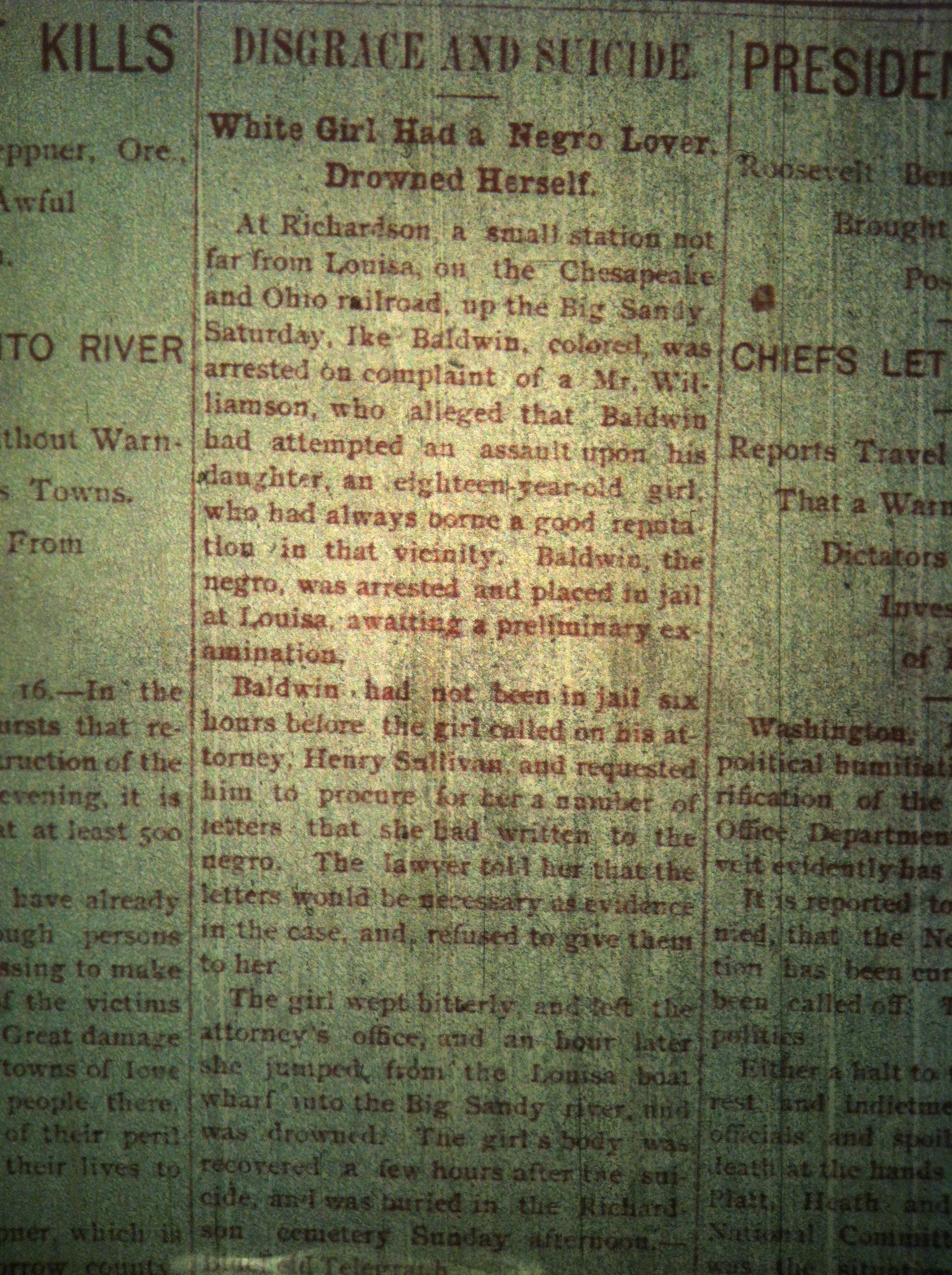
White Girl Had Negro Lover (1903)

12 Monday Jan 2015

Posted by Brandon Ray Kirk in African American History, Big Sandy Valley, Women's History

≈ Leave a comment

Tags

Appalachia, Big Sandy News, Big Sandy River, Chesapeake & Ohio Railroad, Henry Sullivan, Ike Baldwin, Kentucky, Lawrence County, Louisa, Richardson, Richardson Cemetery, U.S. South

"Disgrace and Suicide," Big Sandy News (Louisa, KY), 18 June 1903

“Disgrace and Suicide,” Big Sandy News (Louisa, KY), 18 June 1903

Chasing John Runyon (1996)

07 Monday Jul 2014

Posted by Brandon Ray Kirk in Cemeteries, Ed Haley, Inez, Lincoln County Feud

≈ Leave a comment

Tags

Appalachia, Aquillia Porter, Bill Duty, Bill Fields, Billy Adkins, Brandon Kirk, cemetery, Ed Haley, genealogy, Graveyard Point, Hinkle Valley Road, history, Inez, James A Garfield, Jim Webb, Joe Fannin, John W Runyon, Kentucky, Lawrence County, Leonard Porter, Martin County, Mary Runyon, Mary Runyon Fields, Mary United Baptist Church, Milo, Nat's Creek, Peach Orchard, Route 1884, Route 40, Samuel W. Porter, Stidham, Tomahawk, U.S. South, Walt Mollett, Wealthy Fry, Webb Music Store, writing

A month or so after “striking out” on the Ed Haley house, Brandon and Billy drove to Inez, Kentucky, and searched for more information about John Runyon. Venturing north of the county seat, they met Leonard Porter, who lived in a little settlement called Tomahawk. Porter remembered Mrs. Runyon staying with Mary Fields in a small house at the mouth of nearby Hall Branch and said she was likely buried in the Fields family cemetery on a point at nearby Hall Branch Road. Billy and Brandon headed up there, where they found the grave of Bill Fields (1882-1948) and Mary Fields (1888-1985), but none of John Runyon’s family. Just down the hill from the cemetery (presently a trailer court) was the old homestead of Mr. and Mrs. Fields. At one time, they later discovered, the Fieldses ran a store beside of their home. Across the road was the location of the former Mary United Baptist Church — named for Mary Runyon or Mary Fields – now converted into a house. As they stood on the hill, Billy reminded Brandon that Bill Duty’s mother-in-law was a Fields prior to her marriage.

They next tried to find the location of John Runyon’s homeplace. According to the Williamson family history, Runyon lived at the “old Stidham post office,” which they figured was located on Rockhouse Fork. Unfortunately, they found no sign of “Stidham” up the many branches of Rockhouse. There were no mailboxes labeled “RUNYON” or any signs to help them along. Many of the names of local hollows had changed since the time of the old deeds.

Feeling a little desperate, they pulled into a driveway with a mailbox labeled “HINKLE” and spoke with a very nice middle-aged man who told them the exact location of the old Stidham Post Office — actually, all three of them. The first location ran by Joe Fannin was situated at the mouth of Spence Branch near Milo. Around 1935, the office was relocated to a site on what is now called Hinkle Valley Road, just across the creek from a sign reading “Left Fork.” The final Stidham Post Office was in what is today James Webb’s Music Store. Upon viewing the sites, Billy deduced that the old Runyon homeplace had been near the second post office.

While in that vicinity, they talked with an elderly man named Walt Mollett who confirmed that John Runyon had been a local resident. He said Runyon was probably buried down the road in a cemetery on Graveyard Point at Stidham, basically the junction of Route 1884 and Route 40.

A few minutes later they were at the cemetery, parking beside the road in a treacherous curve and tromping through a forest of damp growth. At the center of the cemetery was a single, ancient pine tree. Near the pine, Brandon spotted the grave of Runyon’s daughter, Wealthy Fry. Just below her was Aquillia Porter. And below her was a grave with a new tombstone written as “Mary M. Runyons” and dated “January 28, 1861-January 29, 1958.” Beside of Wealthy Fry’s final resting place was an older stone originally created for “Mary Runyon” dated “January 28, 1861-January 29, 1956.” There were plenty of Williamsons in the cemetery — all relation to Mrs. Runyon — including Sam Porter’s second wife — but absolutely no sign of John Runyon’s grave.

Jim Webb, a gentle middle-aged musician and proprietor of Webb’s Music Store, told Brandon and Billy that someone had wrecked in the cemetery a few years earlier and destroyed many of the tombstones. Equally tragic, the wrecker that removed the vehicle from the cemetery had caused more damage to the stones. The community had organized a fund to restore the graves, Webb said, but it was little consolation. Brandon theorized that John was buried beside of Wealthy — that someone had used Mary’s old tombstone to “sort of” mark the spot. He didn’t rule out, though, that Runyon had been buried with his parents on nearby Nat’s Creek in Lawrence County. (The Graveyard Point cemetery was more oriented toward his wife’s family, the Williamsons.) A quick drive to Nat’s Creek, including a tour of the “town” of Peach Orchard (a virtually abandoned coal town once prominent in business affairs and the site of a General Garfield Civil War story), failed to produce any signs of a Runyon cemetery, although it did offer some of the most serene, peaceful, spooky and haunting countryside found in the locale.

Brandon felt a real frustration in not being able to positively find Runyon’s grave and thus achieve some sense of closure on that facet of the story. It was as if he and Billy, whose ancestors had supposedly spent years looking for Runyon, had also been evaded by ole John — even in his death.

John W. Runyon 1

30 Monday Jun 2014

Posted by Brandon Ray Kirk in Big Harts Creek, Big Sandy Valley, Harts, Inez, Timber, Wyoming County

≈ Leave a comment

Tags

Adam Runyon, Adam Runyon Sr., Alden Williamson Genealogy, Aquillia Runyon, Aubrey Lee Porter, Billy Adkins, Bob Spence, Brandon Kirk, Charleston, civil war, Clarence Hinkle, Crawley Creek, Cultural Center, Ellender Williamson, Enoch Baker, Garrett and Runyon, genealogy, Harts, Hattie Hinkle, Henderson Dingess, history, Inez, Izella Porter, James Bertrand Runyon, James Muncy, John W Runyon, John W. Porter, Kentucky, Land of the Guyandot, Lawrence County, Logan County, Logan County Banner, logging, Martin County, Mary Runyon, Milt Haley, Moses Parsley, Nat's Creek, Nellie Muncy, Nova Scotia, Peach Orchard, Pigeon Creek, Pike County, Pineville, Rockcastle Creek, Runyon Genealogy, Samuel W. Porter, Stephen Williamson, timbering, Wayne, Wayne County, Wealthy Runyon, West Virginia, Wolf Creek, writing, Wyoming County

In the late summer of 1996, Brandon and Billy turned their genealogical sights on John W. Runyon, that elusive character in the 1889 story who seemed to have stirred up a lot of trouble and then escaped unharmed into Kentucky. They arranged a biographical outline after locating two family history books titled Runyon Genealogy (1955) and Alden Williamson Genealogy (1962). Then, they chased down leads at the Cultural Center in Charleston, West Virginia; the Wyoming County Courthouse at Pineville, West Virginia; the Wayne County Courthouse in Wayne, West Virginia; the Martin County Courthouse at Inez, Kentucky; and at various small public libraries in eastern Kentucky. Runyon had left quite a trail.

John W. Runyon was born in February of 1856 to Adam and Wealthy (Muncy) Runyon, Jr. in Pike County, Kentucky. He was a twin to James Bertrand Runyon and the ninth child in his family. His mother was a daughter of James Muncy — making her a sister to Nellie Muncy and an aunt to Milt Haley. In other words, John Runyon and Milt Haley were first cousins.

According to Runyon Genealogy (1955), Adam and Wealthy Runyon left Pike County around 1858 and settled on the Emily Fork of Wolf Creek in present-day Martin County. In 1860, they sold out to, of all people, Milt Haley’s older half-brother, Moses Parsley, and moved to Pigeon Creek in Logan County. John’s grandfather, Adam Runyon, Sr., had first settled on Pigeon Creek around 1811. The family was primarily pro-Union during the Civil War.

At a young age, Runyon showed promise as a timber baron.

“The first lumber industry in Logan County of any importance was started on Crawley Creek by Garrett and Runyon during the year 1876,” Bob Spence wrote in Land of the Guyandot (1978). “Garrett and Runyon deserve credit for their efforts in opening the lumber business in Logan County. They were the first to hire labor in this field. It might be of interest to note here that they originally brought trained men from Catlettsburg… In a few years, Garrett and Runyon left Logan [County], and soon Enoch Baker from Nova Scotia came to Crawley Creek to take their place.”

John may have put his timber interests on hold due to new developments within his family. According to Runyon Genealogy, his mother died around 1878 and was buried at Peach Orchard on Nat’s Creek in Lawrence County, Kentucky. His father, meanwhile, went to live with a son in Minnesota. In that same time frame, on Christmas Day, 1878, Runyon married Mary M. Williamson, daughter of Stephen and Ellender (Blevins) Williamson, in Martin County, Kentucky. He and Mary were the parents of two children: Aquillia Runyon, born 1879; and Wealthy Runyon, born 1881. John settled on or near Nat’s Creek, where his father eventually returned to live with him and was later buried at his death around 1895.

During the late 1880s, of course, Runyon moved to Harts where he surely made the acquaintance of Enoch Baker, the timber baron from Nova Scotia. An 1883 deed for Henderson Dingess referenced “Baker’s lower dam,” while Baker was mentioned in the local newspaper in 1889. “Enoch Baker, who has been at work in the County Clerk’s office and post office for several weeks, is now on Hart’s creek,”  the Logan County Banner reported on September 12. Baker was still there in December, perhaps headquartered at a deluxe logging camp throughout the fall of 1889.

After the tragic events of ’89, Runyon made his way to Wayne County where he and his wife “Mary M. Runyons” were referenced in an 1892 deed. Wayne County, of course, was a border county between Lincoln County and the Tug Fork where Cain Adkins and others made their home. He was apparently trying to re-establish himself in Martin County, where his wife bought out three heirs to her late father’s farm on the Rockhouse Fork of Rockcastle Creek between 1892-1895.

In the late 1890s, John’s two daughters found husbands and began their families. On January 3, 1896, Wealthy Runyon married Clarence Hinkle at “John Runyonses” house in Martin County. She had one child named Hattie, born in 1899 in West Virginia. On March 29, 1896, Aquillia Runyon married Samuel W. Porter at Mary Runyon’s house in Martin County. They had three children: John W. Porter, born in 1897 in West Virginia; Aubrey Lee Porter, born in 1899 in Kentucky; and Izella Porter, who died young.

In Search of Ed Haley 247

22 Saturday Feb 2014

Posted by Brandon Ray Kirk in Big Sandy Valley, Ed Haley

≈ 4 Comments

Tags

Andrew Francis Messinger, Bill Duty, Blackburn Messinger, David Messinger, Fall Creek, genealogy, George T. Swain, George W. Parsley, history, James Muncy, James Parsley, John H. Messinger, Jr., Keenan Parsley, Kentucky, Lawrence County, Lincoln County, Marcum-Muncy Feud, Nellie Muncy, Nicholas Messinger, Pigeon Creek, Ryburn Parsley, Tug River, Wayne County, West Virginia, Wilson Messinger, writing

Penelope Muncy — Milt Haley’s mother — was born around 1823 to James Muncy and Mary Martha Copley. Nellie, as she was sometimes called, was probably an illegitimate child. On January 23, 1840, she married Ryburn Parsley in Lawrence County, Kentucky. In her marriage record, she gave her last name as Copley…not Muncy. According to Logan County historian George T. Swain, Nellie and her husband settled on Jenny’s Creek near the Tug Fork. They had at least four children: James Parsley (born c.1842), George W. Parsley (born c.1845), Sarah J. Parsley (born c.1848) and Martha Parsley (born c.1850). Ryburn was listed in the 1850 Logan County Census of (West) Virginia as a farmer then disappeared from local records. Swain’s history of Logan County gives a clue: “Riburn [Parsley], who married a Miss Muncey, became involved in the Muncey-Marcum feud and moved to Mississippi and became a brigadier general of the Confederate States in the Civil War.”

Strangely, Parsley left his wife and children in the Tug Valley.

In 1853, Nellie gave birth to a son named Keenan Parsley at Big Hurricane Creek near FortGay on the Big Sandy River in Wayne County. In Keenan’s birth record, no father was listed, perhaps indicating that he was an illegitimate child. Approximately three years later, Nellie gave birth to a son census records identify as Thomas P. Parsley – a.k.a. Thomas Milton Haley.

In 1860 Nellie married Wilson Messinger in Logan County. In her marriage record she gave her age as 37 years, her surname as Muncy instead of Copley or Parsley and listed her parents’ names as James and Mary Muncy. She also referred to herself, curiously enough, as a widow. At the time of the marriage, Wilson Messinger (also widowed) had five children: Mary Messinger, born about 1844; Blackburn Messinger, born about 1846; Andrew Francis Messinger, born about 1848; John H. Messinger, born about 1850; and David Messinger, born about 1855.

In the 1860 Logan County Census, Wilson and Nellie lived at the mouth of Pigeon Creek in the Tug Valley near Bill Duty. Wilson operated a mill and owned $250 worth of personal property. He had the following children in his household: two Parsley stepchildren (including Milt), five children, and a newborn son, Wilson Messinger, Jr., who was less than a year old.

By 1870, Nellie and Wilson had disappeared from West Virginia census records, possibly indicating their death or a move across the Tug into Kentucky. The family seems to have broken apart, as many of the Messinger children flocked to live near their wealthy grandfather Nicholas Messinger, a water mill operator in the Fall Creek area of Lincoln County.

Milt Haley apparently didn’t follow his stepsiblings to the GuyandotteValley. In 1870, he was still on Pigeon Creek in the home of Bill Duty, who was no apparent kin to him. Was it a coincidence that Duty had been a close neighbor to the Messingers in 1860?

In Search of Ed Haley 54

20 Sunday Jan 2013

Posted by Brandon Ray Kirk in Ed Haley

≈ Leave a comment

Tags

Appalachia, Ashland, Big Sandy River, Bill Bowler, blind, Cabell County, Ed Haley, Ella Haley, Field Furniture Store, Gibson's Furniture Store, Green McCoy, guitar, Harts Creek, history, Ironton, John Hartford, Kentucky, Lawrence County, Lawrence Haley, life, Logan, Milt Haley, Mona Haley, music, Noah Haley, Ohio, Paintsville, Peter Mullins, Portsmouth, Ralph Haley, Route 23, Route 60, Russell, South Point, West Virginia, writing

Lawrence said we could go see Mona if Noah would show us the way. Apparently, Lawrence didn’t know where his own sister lived. Noah agreed to guide us there, but drove a separate car so he could leave right away. He and Mona weren’t getting along. On the way, I said to Lawrence, “Now this sister is the youngest one?” and he said, “Yeah, she’s the baby.” I said, “She’s the only sister you have, and her name is?” “Mona,” he finished. “M-O-N-A. That wasn’t what she was intended to be named. Mother intended her to be named after old Doc Holbrook’s wife — her name was Monnie.”

Mona was staying with her daughter in nearby Ironton, Ohio. At the door, before Lawrence could tell her who I was or the reason for our visit, she looked right at me and said, “Well I know you. I’ve seen you on television.” It was an instant connection. I noticed that she had a high forehead just like her father.

We went on out in the yard where she showed a little surprise that Noah had led us to her house.

“He’s mad at me,” she said before sighing, “I feel sorry for poor old Noah. So lonely. Has to buy his friendship.” Right away, she dispelled our hopes that she had any of Ed’s records.

“No, I don’t have any,” she said. “I let my part of the records get away from me. I lost mine in my travels. I left them somewhere and never did get them back. It was around ’56. I went back to get them and the lady — Dorothy Bates — had moved. And I think she’s dead. I was living here in Ironton.”

Mona seemed a little emotionless — her voice was hollow, distant, as if her mind was a million miles away. She didn’t seem to show much remorse about losing her father’s records — “I’m sorry that I did, but you know hindsight’s 20/20.”

I asked her if Ed ever talked about his father or mother and she said, “He talked about his dad getting killed. He said that he was in the Hatfield-McCoy feud and he got killed with Green McCoy. He was a friend to the McCoys, I guess. And that’s all I can tell you about that. And he never talked about his mother at all.” Mona had no idea who Ed’s mother was and knew nothing about her connection with Uncle Peter Mullins on Harts Creek. She didn’t even remember what year her father died, saying, “My memory is failing me. I was married and living at South Point.”

I noticed again how much Mona looked like her dad.

I asked her if she ever had any long talks with him and she said, “My mother and I were very close but we didn’t talk much about my dad. I’ll tell you, I loved my dad but I didn’t like him very much because he was mean.”

She laughed and said to Lawrence, “Wasn’t he?”

“Yeah, if you struck him the wrong way,” Lawrence admitted. “He never was mean to me. I can’t even remember Pop whipping me.”

Mona insisted, “He wasn’t ever mean to me either but he was mean to Mom.”

I asked her what Ed did to her mother and Lawrence said (somewhat agitated), “He was a little bit mean to Mom. He’d fight with her sometimes and we’d have to stop things like that.”

It got a little quiet — a whole new facet of Ed’s life had just opened up to me.

“Maybe I shouldn’t have said that,” Mona said, “but that’s how I feel. I sympathize with him now but he was a mean man.”

Lawrence tried to smooth it over by saying, “I put that down, part of it, to frustration with his condition. Really, I do.”

Sensing Lawrence’s dislike of the topic, I got the conversation directed back toward Ed’s music. He and Mona remembered Pop playing frequently on the streets of Ashland at Gibson’s Furniture Store, Field Furniture Store (later Sears) on 17th and Winchester and at the Ashland (later Second) National Bank on 16th and Winchester. It made sense that Ed often played on Winchester Avenue, the main east-west thoroughfare through town, currently merged with Route 60 and Route 23. I asked if Ralph ever played with Ed and Ella on the street and Mona said no — that he only played with them at home. Bill Bowler, a blind guitarist, was the person she remembered playing with her father on the street.

“He wasn’t very good,” Mona said. “When they’d get ready to set down and make music Pop would have to tune up his guitar for him.”

Ed hung around Ashland through the winter, Lawrence said, then took off around February. There was not a particular place he went first; it just depended on his mood. Mona said he was in Greenup County, Kentucky, often.

“He played in front of the courthouse there,” she said. “I’ve seen them have that whole front of the courthouse with people standing around dancing.”

She and Lawrence also remembered Pop playing in Portsmouth, Ohio; Cabell County, West Virginia; Logan, West Virginia; Lawrence County, Kentucky; Paintsville, Kentucky; and “all up and down the Big Sandy River.”

“They’d play around railroad YMCAs, too,” Lawrence said. “They had one in Ashland, one in Russell. And down on the N&W they had a big railroad YMCA in Portsmouth — New Boston, I guess. And there was a big steel mill at New Boston. Mom used to play there more than Pop, I guess. Mom used to play at the main gate.”

Mona and Lawrence gave me a great idea of how Ed dressed when on the road. She said he wore “moleskin pants and a long-sleeve shirt — sometimes a top coat when it was cold.” Lawrence said his dad always buttoned his shirt “all the way to the top button” but never wore a tie and mostly wore blue pants. For shoes, he preferred some type of slipper, although he sometimes wore “high top patent leather shoes” — what I call “old man comfort shoes.” Mona said he always donned a hat, whether it was a Panama hat, straw hat or felt hat. He also packed his fiddle in a “black, leather-covered case” — never in a paper sack as Lawrence remembered. “No,” she stressed, seeming amused at the idea of Ed having anything other than a case. Lawrence disagreed, clearly recalling to the contrary — “Buddy, I have.” He said Ed seldom had his fiddle in a case when he went through the country, usually just tucking it under his arm. “Same way with Mom. She didn’t have a case for her mandolin a lot of times. I guess that’s the reason he wore out so many, reckon?”


Feud Poll 1

If you had lived in the Harts Creek community during the 1880s, to which faction of feudists might you have given your loyalty?

Categories

  • Adkins Mill
  • African American History
  • American Revolutionary War
  • Ashland
  • Atenville
  • Banco
  • Barboursville
  • Battle of Blair Mountain
  • Beech Creek
  • Big Creek
  • Big Harts Creek
  • Big Sandy Valley
  • Big Ugly Creek
  • Boone County
  • Breeden
  • Calhoun County
  • Cemeteries
  • Chapmanville
  • Civil War
  • Clay County
  • Clothier
  • Coal
  • Cove Gap
  • Crawley Creek
  • Culture of Honor
  • Dingess
  • Dollie
  • Dunlow
  • East Lynn
  • Ed Haley
  • Eden Park
  • Enslow
  • Estep
  • Ethel
  • Ferrellsburg
  • Fourteen
  • French-Eversole Feud
  • Gilbert
  • Giles County
  • Gill
  • Green Shoal
  • Guyandotte River
  • Halcyon
  • Hamlin
  • Harts
  • Hatfield-McCoy Feud
  • Holden
  • Hungarian-American History
  • Huntington
  • Inez
  • Irish-Americans
  • Italian American History
  • Jamboree
  • Jewish History
  • John Hartford
  • Kermit
  • Kiahsville
  • Kitchen
  • Leet
  • Lincoln County Feud
  • Little Harts Creek
  • Logan
  • Man
  • Matewan
  • Meador
  • Midkiff
  • Monroe County
  • Montgomery County
  • Music
  • Native American History
  • Peach Creek
  • Pearl Adkins Diary
  • Pecks Mill
  • Peter Creek
  • Pikeville
  • Pilgrim
  • Poetry
  • Queens Ridge
  • Ranger
  • Rector
  • Roane County
  • Rowan County Feud
  • Salt Rock
  • Sand Creek
  • Shively
  • Spears
  • Sports
  • Spottswood
  • Spurlockville
  • Stiltner
  • Stone Branch
  • Tazewell County
  • Timber
  • Tom Dula
  • Toney
  • Turner-Howard Feud
  • Twelve Pole Creek
  • Uncategorized
  • Warren
  • Wayne
  • West Hamlin
  • Wewanta
  • Wharncliffe
  • Whirlwind
  • Williamson
  • Women's History
  • World War I
  • Wyoming County
  • Yantus

Feud Poll 2

Do you think Milt Haley and Green McCoy committed the ambush on Al and Hollene Brumfield in 1889?

Blogroll

  • Ancestry.com
  • Ashland (KY) Daily Independent News Article
  • Author FB page
  • Beckley (WV) Register-Herald News Article
  • Big Sandy News (KY) News Article
  • Blood in West Virginia FB
  • Blood in West Virginia order
  • Chapters TV Program
  • Facebook
  • Ghosts of Guyan
  • Herald-Dispatch News Article 1
  • Herald-Dispatch News Article 2
  • In Search of Ed Haley
  • Instagram
  • Lincoln (WV) Journal News Article
  • Lincoln (WV) Journal Thumbs Up
  • Lincoln County
  • Lincoln County Feud
  • Lincoln County Feud Lecture
  • LinkedIn
  • Logan (WV) Banner News Article
  • Lunch With Books
  • Our Overmountain Men: The Revolutionary War in Western Virginia (1775-1783)
  • Pinterest
  • Scarborough Society's Art and Lecture Series
  • Smithsonian Article
  • Spirit of Jefferson News Article
  • The Friendly Neighbor Radio Show 1
  • The Friendly Neighbor Radio Show 2
  • The Friendly Neighbor Radio Show 3
  • The Friendly Neighbor Radio Show 4
  • The New Yorker
  • The State Journal's 55 Good Things About WV
  • tumblr.
  • Twitter
  • Website
  • Weirton (WV) Daily Times Article
  • Wheeling (WV) Intelligencer News Article 1
  • Wheeling (WV) Intelligencer News Article 2
  • WOWK TV
  • Writers Can Read Open Mic Night

Feud Poll 3

Who do you think organized the ambush of Al and Hollene Brumfield in 1889?

Recent Posts

  • Logan County Jail in Logan, WV
  • Absentee Landowners of Magnolia District (1890, 1892, 1894)
  • Charles Spurlock Survey at Fourteen Mile Creek, Lincoln County, WV (1815)

Ed Haley Poll 1

What do you think caused Ed Haley to lose his sight when he was three years old?

Top Posts & Pages

  • About
  • Boling Baker and Princess Aracoma (1937)
  • Trial of Don Chafin, the "Fighting Sheriff of Logan County" (1924)
  • Marshall Cottrell, Fiddler and Confederate Veteran
  • Manns Knob Fire Tower and Residence (2017)

Copyright

© Brandon Ray Kirk and brandonraykirk.wordpress.com, 1987-2023. Unauthorized use and/or duplication of this material without express and written permission from this blog’s author and/or owner is strictly prohibited. Excerpts and links may be used, provided that full and clear credit is given to Brandon Ray Kirk and brandonraykirk.wordpress.com with appropriate and specific direction to the original content.

Archives

  • February 2025
  • January 2025
  • October 2023
  • September 2023
  • December 2022
  • November 2022
  • May 2022
  • April 2022
  • February 2022
  • November 2021
  • October 2021
  • September 2021
  • June 2021
  • May 2021
  • April 2021
  • March 2021
  • February 2021
  • January 2021
  • December 2020
  • November 2020
  • October 2020
  • July 2020
  • June 2020
  • May 2020
  • April 2020
  • March 2020
  • February 2020
  • January 2020
  • December 2019
  • November 2019
  • October 2019
  • September 2019
  • August 2019
  • July 2019
  • June 2019
  • May 2019
  • April 2019
  • March 2019
  • February 2019
  • January 2019
  • December 2018
  • November 2018
  • October 2018
  • September 2018
  • August 2018
  • July 2018
  • June 2018
  • May 2018
  • April 2018
  • March 2018
  • February 2018
  • January 2018
  • December 2017
  • November 2017
  • October 2017
  • September 2017
  • August 2017
  • July 2017
  • June 2017
  • May 2017
  • April 2017
  • March 2017
  • February 2017
  • January 2017
  • December 2016
  • November 2016
  • October 2016
  • September 2016
  • August 2016
  • July 2016
  • June 2016
  • May 2016
  • April 2016
  • March 2016
  • February 2016
  • January 2016
  • December 2015
  • November 2015
  • October 2015
  • September 2015
  • August 2015
  • July 2015
  • June 2015
  • May 2015
  • April 2015
  • March 2015
  • February 2015
  • January 2015
  • December 2014
  • October 2014
  • September 2014
  • August 2014
  • July 2014
  • June 2014
  • May 2014
  • April 2014
  • March 2014
  • February 2014
  • January 2014
  • December 2013
  • November 2013
  • October 2013
  • September 2013
  • August 2013
  • July 2013
  • June 2013
  • May 2013
  • April 2013
  • March 2013
  • February 2013
  • January 2013
  • December 2012
  • November 2012

Enter your email address to follow this blog and receive notifications of new posts by email.

Join 2,922 other subscribers

Tags

Appalachia Ashland Big Creek Big Ugly Creek Blood in West Virginia Brandon Kirk Cabell County cemeteries Chapmanville Charleston civil war coal Confederate Army crime culture Ed Haley Ella Haley Ferrellsburg feud fiddler fiddling genealogy Green McCoy Guyandotte River Harts Harts Creek Hatfield-McCoy Feud history Huntington John Hartford Kentucky Lawrence Haley life Lincoln County Lincoln County Feud Logan Logan Banner Logan County Milt Haley Mingo County music Ohio photos timbering U.S. South Virginia Wayne County West Virginia Whirlwind writing

Blogs I Follow

  • OtterTales
  • Our Appalachia: A Blog Created by Students of Brandon Kirk
  • Piedmont Trails
  • Truman Capote
  • Appalachian Diaspora

BLOOD IN WEST VIRGINIA is now available for order at Amazon!

Blog at WordPress.com.

OtterTales

Writings from my travels and experiences. High and fine literature is wine, and mine is only water; but everybody likes water. Mark Twain

Our Appalachia: A Blog Created by Students of Brandon Kirk

This site is dedicated to the collection, preservation, and promotion of history and culture in Appalachia.

Piedmont Trails

Genealogy and History in North Carolina and Beyond

Truman Capote

A site about one of the most beautiful, interesting, tallented, outrageous and colorful personalities of the 20th Century

Appalachian Diaspora

  • Subscribe Subscribed
    • Brandon Ray Kirk
    • Join 787 other subscribers
    • Already have a WordPress.com account? Log in now.
    • Brandon Ray Kirk
    • Subscribe Subscribed
    • Sign up
    • Log in
    • Report this content
    • View site in Reader
    • Manage subscriptions
    • Collapse this bar
 

Loading Comments...