Tags
Appalachia, culture, history, Jackson Mullins, Joe Mullins, life, Logan County, Peter Mullins, photos, West Virginia
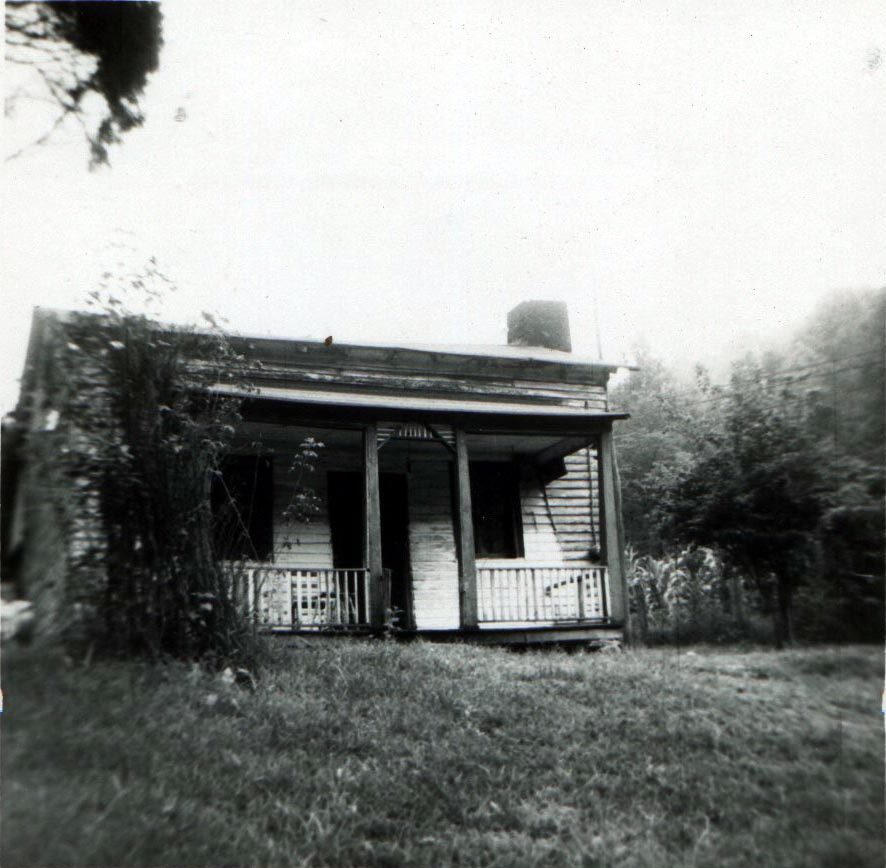
Mullins Homeplace, Trace Fork of Big Harts Creek, Logan County, WV, 1945-1950.

31 Tuesday Dec 2013
Posted in Big Harts Creek, Ed Haley
Tags
Appalachia, culture, history, Jackson Mullins, Joe Mullins, life, Logan County, Peter Mullins, photos, West Virginia
Mullins Homeplace, Trace Fork of Big Harts Creek, Logan County, WV, 1945-1950.
09 Friday Aug 2013
Posted in Ed Haley
Tags
Appalachia, Blue Goose, Brandon Kirk, Ed Haley, Harts Creek, history, Imogene Haley, Joe Mullins, Kentucky, Lawrence Haley, Noah Haley, Wrigley, writing
Throughout the summer of 1994, Lawrence Haley and I spoke frequently on the telephone. I was excited about some of the information I’d been getting in the mail from Brandon Kirk, the Harts genealogist. Lawrence seemed curious about it too, since Ed’s family background was something he’d never known a lot about.
“I don’t know that much about it, because you know how ignorant I was about the whole affair when I first went up there with you,” he said. “I didn’t know a heck of a lot about my dad’s people or anything. I seen their faces and heard them talked about, but I wouldn’t know them if I’d walk nose to nose with some of them. We never probably asked a lot of the questions we should have asked of Mom and Pop while they were still alive. I know my mother would have told me a heck of a lot more. They wasn’t no reason why I shouldn’t have asked her questions. It was just one of those things you accept, I guess, and don’t question.”
Lawrence paused, then said, “So we didn’t find out a lot about the history of our families. I really didn’t know that much about my mother’s people, either. I know she had some people out in Wrigley, Kentucky. We used to go up there every now and then. Go to a little self-contained train — back in them days, it was just a one-car thing; they called it the ‘Blue Goose’ — and it run on a little ol’ track up into Elliott County, and up through there. And that’s about all I knew. That’s the place where I found the ‘milk well.’ I thought this gal was bringing that milk right up out of the milk well in the yard. And I told Mom about it and she said, ‘Well, that’s the way they keep the milk cool. They stick it in a bucket or something — a lard bucket — and put the lid on it, stick it down in the well, and let it cool like that.’ Anyway, that’s the reason that I guess we just accepted things as children mostly, because they weren’t like that. We accepted it as, ‘That’s life.'”
Lawrence and I got on the subject of Ed’s mother, which led us into a whole variety of topics. I asked if he knew what year she was supposed to’ve been killed and he said, “I really couldn’t tell you that, John. If it happened that way, I imagine they’d been something in The Logan Banner or The Huntington Herald-Dispatch.”
Lawrence said he wasn’t even sure where he got the story of her death.
“No, I never heard Pop talk about it,” he said. “I don’t know where it came from. I don’t know who told who and how it got started. Between me and Mona and Jack and Patsy and Noah, I guess. Noah didn’t seem like he showed as much interest in things like that as… I know whenever he’d go up there he’d get homesick. He didn’t like it up there too much. I remember there used to be a paw paw patch we’d all go down to where Trace and Harts join there. We’d go down there and cut slips of that paw paw — eat the paw paws when they’s in season — and make whistles out of them, you know. They had a slick bark. You could skin off a chunk of bark at the right time of the year and then you’d take and plug each end of that bark and make you a nice little whistle out of it. Then take the bark and plaid it into whips and things. Just something to occupy a kid’s time that didn’t have a heck of a lot to do. We invented a lot of things like that. I guess Joe showed us a lot of that stuff.”
04 Thursday Apr 2013
Posted in Big Harts Creek, Ed Haley, Harts, John Hartford
Tags
Appalachia, Bill Mullins, Chloe Mullins, Ed Haley, Imogene Haley, Jackson Mullins, Joe Mullins, John Hartford, Lawrence Haley, Liza McKenzie, Nashville, Peter Mullins, photos, Turley Adams, Violet Adams, West Virginia
I returned to Nashville talking not so much about new musical developments but rambling on to my wife about murders and the people I’d met in Harts. I spent a lot of time studying over Joe’s photographs, especially the faded family group shot. One of the boys in the picture was propped inside a young woman’s arms and appeared very much to be blind. Was it Ed and his mother? Unfortunately, since the woman was almost completely faded away I couldn’t make a positive identification of her, even when I compared it to the photo of Emma Jean found by Lawrence and I on our first trip to Harts.
There was another interesting development: when I removed the picture of Bill and Peter Mullins from its frame, another equally large picture of the “old couple” kind of popped out from behind it. That made three pictures of those folks and it sure seemed logical to me that Joe Mullins would’ve had three pictures of his grandparents — meaning Ed’s grandparents — and not of an uncle and an aunt.
I sent copies of Joe’s old pictures to Turley and Violet Adams to see if they could show them around for identification. A few weeks later, we spoke over the telephone and they said Liza McKenzie had fingered Ed as the child to the right in the faded group picture. She also said the old folks in the back row were Jackson Mullins and his wife, Chloe.
26 Tuesday Mar 2013
Posted in Big Harts Creek, Ed Haley, John Hartford, Music, Spottswood
Tags
Appalachia, Clifton Mullins, Connie Mullins, Crawley Mountain, Ed Haley, Enslow Baisden, fiddle, Harts Creek, history, Joe Mullins, John Hartford, Lawrence Haley, Logan County, Loretta Mullins, Peter Mullins, Sol Bumgarner, Trace Fork, Turley Adams, West Virginia
I told Turley that Lawrence and I needed to visit Joe Mullins, who had been gone during our last trip to Harts Creek. Turley completely deflated us: Joe, he said, had recently suffered a stroke. He now lived with his daughter Connie Mullins in a trailer just up the creek. Turley pointed the way. Driving a short distance, Lawrence and I parked our car by the creek and walked over a little narrow bridge where an army of barking dogs greeted us. At the porch, Connie introduced us to her brother, Clifton. We stepped on inside and found Joe seated in a wheelchair, surrounded by more dogs. His mind — or at least his ability to communicate a great deal — was all but gone due to the lingering effects of his stroke. Lawrence sat next to him with his hand on his arm. Almost in tears over Joe’s condition, he tried to rekindle Joe’s memories by saying, “I’m Ed Haley’s boy.”
I hung out with Joe’s kids — Connie, Clifton and Loretta. While all were reasonably young, Clifton and Connie had Parkinson’s Disease.
“They’s four of us got it,” Clifton said. “They said it runs through the family some way another. Musta come down the tree somewhere.”
I asked him how old he was.
“38,” he said.
Clifton had just moved back to Harts.
“I got hurt in Michigan and Daddy was sick so I said, ‘Well, it’s a good chance for me to go help my daddy and my sisters.'”
Clifton’s sisters said he was the one who found Ed’s smashed fiddle years ago in the rafters of Uncle Peter’s old smokehouse.
“I was up in there — we was playing around one day — and it fell out on me,” he said. “And I just looked at it and I said, ‘Well, I’ll try to glue it together.’ I started gluing it and it wouldn’t glue so I dumped it into the creek. I didn’t know whose it was. I was about eight but all the pieces wasn’t there to it. When it hit that guy it just splintered everywhere.”
Clifton suggested that we visit Bum and his family just up the hollow. Two years earlier, Bum had told originally Lawrence and I how he had witnessed Ed smash the fiddle over a man’s head while at a tavern on Crawley Mountain. Bum lived only a short distance from Joe’s trailer, up the hollow past Uncle Peter’s old homeplace, in a house situated near Enslow Baisden’s log cabin.
23 Saturday Feb 2013
Posted in Ed Haley
Tags
Ashland, Ella Haley, fiddler, Harts Creek, history, Joe Mullins, John Hartford, Kentucky, Lawrence Haley, Milt Haley, music, Noah Haley, Ralph Haley, West Virginia, writing
The next day, Lawrence and I dropped in on Noah and told him about our intentions to find Milt Haley’s grave on Harts Creek. He said he had gone to Harts some time ago only to find that everyone who ever knew his father had passed away. Lawrence said Joe Mullins was still around so far as he knew. Joe was a first cousin to Ed and the son of Uncle Peter Mullins…as well as Lawrence’s major source of information about his father’s early life.
“Well, he should know quite a bit about Pop,” Noah said. “He sure defended him.”
He looked at me and said, “Pop would get drunk — drunker’n dickens. He’d start on Mom and us kids would take up for Mom. Then Joe would jump all over us. Joe and Noah both would.”
Noah, Lawrence explained, was referring here to Noah Mullins, a first cousin to his dad and a brother to Joe. Noah Haley was named after him, although it seemed apparent to me he thought more of his mother’s people than his father’s on Harts Creek.
“Joe should know a lot about those things,” Noah continued. “He knows when we used to get moonshine out of them hills.”
Well, that was an interesting subject to open with — very different from my talks with Lawrence. I could sense that Noah had brought up a touchy subject with Lawrence — domestic problems and alcohol — but I wanted to know a little more. I asked Noah if Ed drank a lot in his early days and he said, “Well, if somebody’d give it to him, he’d drink, yeah. He’d get stone drunk. But he didn’t drink unless somebody’d give it to him. He was meaner than hell when he was drinking.”
Unlike Lawrence and Mona, Noah seemed to have no musical inclination whatsoever.
“Well, the only thing I can show you, he never held the fiddle under his neck. He held it right here,” he said, motioning toward his arm. “That’s about all I can tell you about him holding the fiddle. Of course, when he’d come across this way with the bow, he’d make two chords instead of one with one streak across the bow.”
Make two notes in other words?
“Yeah, two chords or notes or whatever you call them.”
Lawrence said, “I was telling John that Pop could play the banjo real good, too.”
Noah quickly agreed, “Yeah, he could play the banjo, he could play guitar, he could play a mandolin — any kind of a stringed instrument, just about.”
Noah remembered Ed living at several different places around Ashland.
“I was born on Horse Branch,” he said. “We lived in three different places on Keyes Creek — maybe four. Then we lived at Ward Hollow. Then we lived on 17thStreet. We lived in two places on Greenup.”
Noah told me about Ed and Ella going downtown to play on the streets.
“Soon as they could get a ride downtown, that’s when they’d go. It would be kinda early, before two o’clock. Sometimes the’d have quite a few people standing around listening to them. And of course, they played for just change that people’d give them. Sometimes they’d have ten, fifteen people standing around wanting them to play a piece of music. He’d never play the same song unless somebody would, you know, give him a quarter or a dime or a nickel or something to suggest a song for him to play, then he might play the same one he just played. Sometimes they would play a couple three hours and then they’d go eat or go to the restroom or whatever. And then they’d come back and play another two or three hours.”
Lawrence said his oldest brother Ralph was a part of the act during the First World War.
“There’s a picture of Ralph in a little jumpsuit type of thing and they said he’d be up on a stage,” he said. “Pop and Mom might be playing and he would dance around up here on that stage with them and then when he’d get ready to come off of it he’d stand on the edge and do a flip and come off on his feet.”
Noah said, “Yeah, Ralph always was acrobatic.”
I said, “Well that’s what got him, wasn’t it?” and Noah said, “Yeah, hanging by his toes from a tree about two feet from the ground. He slipped and broke his neck. But he always was acrobatic. He could run and make a complete turnover. His whole body.”
Noah said Ed never played on the street at night, allotting that time for square dances. I asked him how much he made per dance and he said, “I don’t know, maybe he’d go play at a dance, he’d get, sometimes, maybe five dollars. He wouldn’t get a whole lot. Hell, a dollar a day then did what ten does today. I remember Ralph, our brother, going out and working for a dollar a day. If they made a dollar a day — or two dollars a day — they was doing good enough to keep us surviving.”
I said, “So, by today’s standards, it would’ve been like making twenty dollars a day?” and Noah agreed, “I would guess so, yeah.”
Lawrence added, “It was according to economic times.”
Noah didn’t hesitate to brag on his father.
“I think they come there one time from the Grand Ole Opry and wanted him to come play on it and he wouldn’t go,” he said. “I went with them a lot of times when they was playing at the courthouses. They worked all over West Virginia — Beckley. Well, they went downtown here in Ironton. You know we’d take a bus everywhere we’d go. We didn’t have no car. We’d generally stay with friends there up around Logan or Harts Creek.”
Speaking of Harts Creek, I wondered if Ed had ever talked about learning to play the fiddle from anyone around there. Noah said no — “he just took it up hisself when he was a kid.” He and Lawrence both agreed that Ed never talked about his early life and only seldom mentioned his parents.
“The only thing I know about my grandfather on my father’s side is about him shooting this guy and they killed him,” Noah said. “Shot his wife through the mouth, I think it was. I think Pop said it was. And then his dad went after this guy with a pistol, killed him, and somebody killed his dad, is the way I heard it. But he never did confide much in anything like that with us.”
Well, that sure was a different version of things from what Lawrence had initially heard from his dad — and it was much closer to the truth.
25 Tuesday Dec 2012
Posted in Big Harts Creek, Music
Tags
Appalachia, banjo, culture, Harts Creek, history, Joe Mullins, life, Logan County, music, photos, West Virginia
Joe Mullins, 1950-1968
09 Sunday Dec 2012
Posted in Ed Haley, Spottswood
Tags
Adeline Adkins, Appalachia, blind, Buck Fork, Connie Woods, Ed Haley, George W. Adams, Harts Creek, history, Jack Mullins, Joe Mullins, John Hartford, Johnny Hager, Lawrence Haley, life, Logan County, Louie Mullins, Milt Haley, music, Peter Mullins, Roxie Mullins, Trace Fork, Turley Adams, U.S. South, Victoria Adams, Violet Adams, West Virginia, Yellow Leg Spaulding
Connie suggested we go see her neighbor Turley Adams, who lived just down the creek near the mouth of a branch. She pointed toward a man working in his yard a few hundred yards away at his one-story white home. That’s Turley? We took off right away. As we approached the place, Lawrence mentioned that Turley lived at the same approximate location of Milt Haley’s old cabin. While the cabin was long gone, I noticed the front yard still had the same beautiful roll to it I had seen in an old picture at Lawrence’s house. I tried to imagine how the cabin would have looked in Ed Haley’s day.
Turley met us near the porch, where Lawrence introduced us and told our reason for visiting him. Turley was immediately friendly and, in his gruff voice, invited us inside. At first, our conversation went pretty slow. Then Lawrence said, “I never did get much about my granddad, Milton Haley. Joe said he’s buried down here somewhere in a graveyard and I thought maybe he was talking about down at the mouth of Trace somewhere.”
Turley’s wife Violet said there was an old cemetery just back of their house, although it had been in terrible condition for many years.
“Well now, they was some graves out there. Turley’s mom told me that some of them were Mullinses and some of them were Haleys. They was some babies and then they was some older people. All unmarked. They was sort of in a row and they was rocks up to them but by the time I married Turley they’d rolled down the hill so you couldn’t tell where the graves really were.”
Oh god. I could just imagine someone finding a Milt Haley tombstone (probably no more than a rock with “MH” carved on it) lying at the foot of the hill and just tossing it in the creek.
“Well one grave we could tell pretty well where it was at, the others we couldn’t,” Violet said. “It had all growed up so we started cutting the bushes and keeping it mowed and cleaned up but we still don’t know where the graves are.”
We walked outside briefly to survey the site.
“They’s eleven graves,” Turley said. “I used to help Uncle Jack Mullins keep them cleaned up a little bit.”
Was this little embankment with a sunken spot the final resting place of Ed Haley’s parents?
Back inside, Turley said he remembered Ed, which seemed to please Lawrence somewhat. He told this story about a local girl who danced to Ed’s music.
“When I was in high school, Ed was around my house and he said, ‘I’d like to fiddle for somebody to dance.’ And I asked this girl, Adeline Adkins from around here on Buck Fork, if she could dance and she said, ‘I can dance to anything.’ She danced three or four tunes and my dad come in. Ed said, ‘By god, John, she’s just like Yellow Leg Spaulding. She can hit ever thing I do on this fiddle. And Dad said that they was a guy that used to go with them and dance that he called Yellow Leg Spaulding.”
“Well I didn’t know whether we’d even find anybody up here now, except Joe,” Lawrence said. “I thought I’d come up and see if I could find him, maybe introduce John to somebody that could give us some information on my dad. I know they couldn’t be very many people old enough to probably appreciate his music.”
“He come to my mom and dad’s house one time and played music all night,” Violet said. “Robert Martin was with him. I guess they’d been drinking or whatever because they was gonna take him out to the toilet and instead of taking him to the toilet they took him into the chicken house. They didn’t pay no attention to what they was doing. But they played all night. I never will forget.”
I had never really considered the possibility that Ed’s cousins and neighbors played jokes on him. I saw him as this great musician — an elevated status that may not have been shared by many of his contemporaries. All of a sudden, I was flooded with images of this little blind orphan — alone in the world — victimized mercilessly throughout his childhood. How did he take it? And how would Lawrence react to hearing these kind of stories? In quick time, I had this latter question answered. Lawrence immediately countered Violet’s story about the outhouse with a tale that cast his father in a more triumphant light.
“Joe said when Pop was just a little kid he got to the point to where he could travel from this house over to Uncle Peter’s,” Lawrence said. “Uncle Peter kept cattle in the field out here or something — a bull or two. Well, the boys teased him. You know, he’d get about half way across that field and then they’d go to snorting like a bull — scare him — and then stand way back and laugh at him. Pop took that for a while and finally found a pistol over here at the old house and he went across the field and they started doing that to him. Well, he just pulled that pistol and, where that sound was coming from, he started shooting that pistol. I guess that broke that little game up.”
Lawrence was obviously determined to guard his father’s legacy, which was a perfectly legitimate thing to do.
Violet got out a few albums filled with old photographs of Ed’s kinfolk from up and down the creek, which stirred Lawrence’s memories.
“Seemed to me like we walked down here to Trace to go up the hill there and there was a store down there,” he said.
Violet said, “Turley’s dad run a store around on Hart at one time and Ewell Mullins had a store up here.”
Lawrence remembered Ewell’s store. “Yeah, he had a store up here, I know that. And then they was one on up and over the hill there where you could go and buy a nickel’s worth of brown sugar. We’d get one of them little penny-paper pokes full of brown sugar and we thought we was having a big time.”
Lawrence’s mind was starting to click in high gear. “I heard Pop talk about how he’d ride a horse up the hollow going up through there,” he said.
Lawrence asked Turley if he knew anything about a George Adams. Turley said his grandfather was named George Washington Adams but he went by the nickname of “Ticky George” to distinguish him from a cousin, “Greasy George.” Ticky George spent most of his life in the woods hunting for ginseng where he apparently acquired a great number of ticks.
“He didn’t have good mind,” Violet said later. “He just knowed enough to get by.”
Turley said his grandmother Adams was a sister to Ed’s friend, Johnny Hager.
“Well, there’s how Johnny Hager came into this,” Lawrence said.
Turley didn’t know much about his genealogy but said his aunt Roxie Mullins could tell us the “whole history” of the Hagers.
“She lives around there above Louie on Harts Creek there,” he said.
Louie Mullins was a grandson to Uncle Peter, making him a third cousin to Lawrence (at least by our count).
This was sort of a confusing moment. Names of people I’d never heard of were popping into the conversation and converging upon one another in seemingly irrelevant connections.
It was great.
There was an unmatchable poetry in it: Turley, Yellow Leg Spaulding, Ticky George… I mean nobody could make this kind of stuff up.
07 Friday Dec 2012
Posted in Big Harts Creek, Ed Haley, Spottswood, Whirlwind
Tags
Appalachia, Ashland, Harts Creek, history, Jack Haley, Joe Mullins, John Hartford, Kentucky, Lawrence Haley, Liza Mullins, Liza Napier, music, Pat Haley, Sherman Baisden, Stella Mullins, U.S. South, West Virginia
Later that night, Lawrence, Pat and I talked more at the kitchen table. For reasons I cannot remember — but possibly because I was so determined to get at the root of the music — our conversation kept returning to the subject of Ed’s childhood and birthplace in West Virginia.
Pat said she first went to Harts Creek with Lawrence, Jack and Jack’s wife Patsy in the summer of 1951. Noah and his wife Janet also made the trip.
“We went up in Jack’s Packard,” she said. “Three in the front and three in the back, plus Beverly and two babies. It was a horrible ride and it was at night and all the way up there the boys was telling us what to expect. They was telling us that you better be careful because going up to Harts like that at night — strangers — they could shoot you in a minute. They told us there was a headless horseman that rode up and down that hollow and a screaming banshee and they told us if the creek was up we’d have to walk it. Patsy and I was scared to death.”
I asked about Aunt Liza, the lady who raised Ed.
“When we went up there the first time, Aunt Liza was living in the old log homeplace,” Pat said. “Aunt Liza, Little Liza, Joe and Stella lived there.”
Aunt Liza was Ed’s aunt, Lawrence said, while Joe was his first cousin. Joe was married to Stella and was a close relative to Little Liza.
The Haley trip was a real experience for Pat and her sisters-in-law.
“When we went up there, Joe had a couple of kids,” Pat said. “One was about two maybe and it was wearing a little gown and had this beautiful blonde curly hair. I picked it up and said, ‘Oh, what a beautiful girl you are,’ but when I raised it up I saw that it didn’t have a diaper on and was a little boy. Aunt Liza said Stella had just had a baby the day before and was ‘feeling puny.’ That was a new word to me. Oh, we asked to see the baby and they said it was in the bed. Well, we couldn’t find that baby because it was down in the feather bed. And what surprised us was that Stella was up and about.”
Pat remembered the trip fondly.
“They were very down-to-earth people and I’m assuming that very little had changed from the time Pop grew up there,” she said. “It was like the cowboy movies where they cooked on those wood stoves and the way they served it at that great, big wooden table. Little Liza and Aunt Liza cooked us a meal. The food was good.”
Pat said she and the rest of the Haley wives probably made a big impression on Aunt Liza and company as well.
“We were outside on the porch and Aunt Liza said she’d never seen anybody dressed like us,” she said, laughing. “I guess we looked like painted jezebels. We had make-up on and modern hairdos. Janet was wearing a white blouse and a black skirt. I had a short-sleeved yellow dress on. Patsy’s was blue. Patsy used to wear a lot of make-up, always painted her fingernails. Janet didn’t wear too much make-up but she always dressed nice. She loved to wear those silk blouses, and they tied at the neck. I think something else that fascinated them: we weren’t smoking a pipe. Aunt Liza smoked a pipe.”
At one point, Pat said she was standing outside with the girls when this “funny boy” came up and scared them nearly to death. “We were outside when this boy came up through the yard making funny noises,” she said. “He got so excited — moreso than when we saw him — and touched Janet’s shoulder and she screamed bloody murder. Poor old Aunt Liza didn’t know what happened. And of course, Jack and Larry thought it was the funniest thing they’d ever heard.”
Pat made another trip to Harts a short time later with Jack and Lawrence.
“Jack took a movie camera and filmed everybody,” she said. “It seems like Jack took some pictures inside the cabin but I’m not sure. I know he was taking pictures outside of Aunt Liza and Little Liza and Liza’s daughter. I believe they thought he was just taking pictures. When he got back to Cleveland, he had the film developed.”
Later, in 1956, Pat made another trip to Harts Creek with Lawrence, Jack and Patsy. At that time, Joe Mullins was living in the old log cabin and Aunt Liza had moved into her daughter’s home just down the creek. Next door was an old log home covered in dilapidated paneling, which was supposedly built by Ed’s father, Milt Haley.
“And then when we went back the third time, Jack had brought the film from the previous visit,” Pat said. “I can almost hear him now saying, ‘Now Aunt Liza, I’ve got something I want you to see.’ They put a sheet over a mirror that was on the side wall and when the movie started Aunt Liza got real excited and started pointing toward Little Liza and saying, ‘There’s you. That’s me.’ You could see their lips moving in the movie but there wasn’t any sound. And Little Liza got excited too.”
A highlight of the trip occurred when Pat found herself in a conversation with Aunt Liza. “I suppose listening to Aunt Liza and Little Liza and me trying to talk was like a foreign language. Old Aunt Liza was telling me all about her property and I’m talking to her and I’m thinking she is talking about land but she isn’t. She’s talking cattle, dogs, and the oxen. And Little Liza was talking about her daughter going to school. And we got on the subject of the meals and what did she take for lunch. ‘Oh,’ she said, ‘she takes her lunch in the lard bucket and she put biscuits and cornbread and different things in it.’ And I asked her about her husband and she said, ‘We’re not certified,’ and I wasn’t really sure what that meant so I said, ‘Oh, Lawrence and I aren’t, either.'” On the way home, Lawrence asked her if she knew what she’d meant to say because Little Liza had meant that she and the girl’s father weren’t married.
Lawrence could tell that I was really interested in his father’s birthplace so he asked me if I would like to see it. I said I would love to — and was more than happy to provide the car and gasoline for such a trip.
30 Friday Nov 2012
Posted in Ed Haley
Tags
Appalachia, blind, Ed Haley, Ella Haley, feud, fiddler, Harts Creek, Hatfield-McCoy Feud, history, Imogene Haley, Joe Mullins, John Hartford, Lawrence Haley, Liza Mullins, Logan County, Milt Haley, music, Pat Haley, Peter Mullins, Stella Mullins, Trace Fork, U.S. South, West Virginia, writing
I told Lawrence that I wanted to know about Ed Haley’s early life but he said he really wasn’t old enough to know much about his father’s younger days.
“My dad was 45 years old, I guess, when I was born,” he said. “He was born in 1883 and I was born in 1928. That was about 45 years. I know my mother was 40 years old and to the best of my knowledge my dad was five years older. She was born in ’88 and he was born in ’83.”
Lawrence said his father was born on the Trace Fork of Harts Creek in Logan County, West Virginia. He was the only child of Milt Haley and Emma Jean Mullins. Milt was partly responsible for causing Ed’s blindness, according to one story that Lawrence had heard on Harts Creek, which he reluctantly told.
“We was up there approximately seven years ago and we stopped over on Harts Creek and visited with my dad’s first cousin, Joe Mullins,” Lawrence said. “He told me that when my dad was very young — he couldn’t a been over two or three — he had the measles or some childhood disease. And when his father came in from working in the timbers that evening he didn’t like the whiny way my dad was acting. It was the dead of winter. They was ice on the creeks. So to make him more of a man and cut out his babyish crying, he took him out and held him by the feet and dropped him in a rain barrel through the ice. Now according to my cousin Joe that’s partly what caused my dad to go blind.”
What? That wasn’t in the Parkersburg Landing liner notes.
“Now, I don’t know for sure about that,” Lawrence said. “That’s hearsay. I don’t want to bad-mouth anybody — my granddad or anybody — this many years after everybody’s in the ground and forgot about.”
Lawrence said Ed’s mother Emma Jean Haley was killed not too long after the rain barrel incident. “During the end of the Hatfield-McCoy feud, other families became involved. Pop’s mother Emma Jean was down at the mouth of Harts Creek visiting some feudists — seems like they were Brownings — when two or three people came to the door looking for somebody. I don’t know his name, whether he was a McCoy or Hatfield or some other person that had allegiance to one of them. And when my grandmother opened the door, they thought that he was going to answer the door so they just shot her and killed her. Now, that’s hearsay. I heard that story and that’s all I can tell you about that.”
I asked if the house was still standing and Lawrence said, “I don’t think so. It was a big two-story house. The best I can remember, it had a double porch on the front. It was standing there when I was just a little small child.”
Pat said she’d seen a picture of Ed’s mother during a visit to Joe Mullins’ place on Harts Creek several years ago. “Joe and his wife Stella had this beautiful enlarged picture and it was framed,” she said. “It was laying in some back room up there in Joe’s house. I don’t think it was on the wall, because it was very, very dusty when she brought it in to show me. And she said, ‘This is Larry’s grandmother,’ and she made a statement to the effect of, ‘We’ve no use for it.’ This lady has since passed away, but Joe should have the picture because it’s just been a few years ago.”
Already, I could see plenty of inspiration for a musician: tragic blindness — a cruel father — a murdered mother — an orphan alone in the world.
I asked Lawrence what happened to his grandfather Milt Haley and he said, “Apparently he stayed around there. Joe told me he’s buried somewhere down on Harts Creek in a cemetery. He apparently didn’t raise his child. Uncle Peter Mullins and Aunt Liza Mullins raised my dad after his mother was killed. My dad’s mother must have been an older sister to Uncle Peter.”
Uncle Peter, Lawrence said, was nicknamed “Club-Foot Peter” because one of his feet was “turned in.” He was the father of Joe Mullins, the source for many of Lawrence’s stories. “I guess Joe is about as old as my brother, Clyde. He might be around 70 now. He was a lot younger than my dad.”
Lawrence wasn’t sure when his father left Uncle Peter’s household.
“I guess he left when he got old enough to get out and start playing music,” he said. “I would say he was sixteen, seventeen, eighteen. People’d come after him to go play music.”
Writings from my travels and experiences. High and fine literature is wine, and mine is only water; but everybody likes water. Mark Twain
This site is dedicated to the collection, preservation, and promotion of history and culture in Appalachia.
Genealogy and History in North Carolina and Beyond
A site about one of the most beautiful, interesting, tallented, outrageous and colorful personalities of the 20th Century
 Brandon Ray Kirk