• About

Brandon Ray Kirk

~ This site is dedicated to the collection, preservation, and promotion of history and culture in my section of Appalachia.

Brandon Ray Kirk

Tag Archives: fiddlers

In Search of Ed Haley 258

06 Thursday Mar 2014

Posted by Brandon Ray Kirk in Big Harts Creek, Ed Haley, Music

≈ Leave a comment

Tags

Appalachia, Brandon Kirk, Dood Dalton, Doug Owsley, Ed Haley, fiddlers, Harts Creek, history, John Hartford, Lincoln County, Logan, Starlight Ramblers, Stump Dalton, West Virginia, writing

Late one October night, I rolled into Harts on the bus. I was full of excitement, having just read an article from Smithsonian magazine about Doug Owsley, one of the top forensic anthropologists in the country. According to the article, Doug had worked with the mass graves in Bosnia, identified some of David Koresh’s charred cult members at Waco, and helped to break the Jeffrey Dahmer case in Wisconsin. He was very interested in historical graves, having exhumed western outlaws, Indians, Civil War soldiers and no telling what else. He was known in some circles as “the Sherlock Holmes of Bones.”

The next morning, I told Brandon I had this idea of contacting Owsley to see if he would exhume the Haley-McCoy grave. He thought for a few seconds, then said it was risky. While he was as curious as I in wanting to know what was “down there,” he wasn’t really sure what we would gain by it. Besides, he said, people might think we were taking things a little too far. He could picture us sitting down to interview someone and all of a sudden they say, “Oh, you’re the guys going around digging people up.” He had a point: I wasn’t even sure what we might gain by exhuming the grave. We tabled the notion until later.

Turning our minds to more pressing thoughts, we decided to visit Stump Dalton at Ferrellsburg. Stump had popped onto my bus during my last trip to Harts and, looking very much like a thin-haired George Jones, said, “My family and Ed Haley was close. If he was in Ohio or somewhere and he come here the first place he come was our house. I knowed of Ed to stay as high as two months around there. We had him a bed all the time.”

Stump was a son of Dood Dalton, Ed’s fiddler-friend on the Big Branch of Harts Creek, as well as a former mandolin player for the Starlight Rambers, a local group featured on Logan radio many years ago. He was 66 years old.

“I’ve actually played with Ed Haley,” Stump had told me.

Brandon and I made the short drive to Ferrellsburg where we pulled the car into a wide spot near the railroad tracks. We walked across Route 10 to Stump’s turquoise-colored house. “Come on in, boys,” Stump said at the door. “I’ll tell you what I can about Ed Haley.” Immediately, as we sat down on couches inside, I asked Stump about his father, who was reportedly a great old-time fiddler and a good friend to Ed Haley.

“They called him Dood Dalton,” Stump said. “His real name was Moses. My dad used to play for a lot of them old-time square dances. Music follows the Daltons. Dad could play anything that had strings on it. He was a number one harp player. He could play anything on the French harp.”

Brandon asked Stump if he remembered any of his father’s tunes and he said, “‘Hell Amongst the Yearlings’, ‘Sally Goodin’, ‘Old Joe Clark’, and all that. See, when they would first start playing, Ed would say, ‘Now Dood, I want you to tune that fiddle up and play that ‘Lost Indian’.’ Now they used to take and clamp a little knife on the bridge. It softens that down. Then they would take two little sticks — about the size of straws, you know — and play that ‘Hell Amongst the Yearlings’ and beat on that and man you talk about a tune. Dad would either beat or play it or vice-versa, him or Ed would. That was a favorite tune for them two — that and the ‘Blackberry Blossom’. You know, they revised that ‘Blackberry Blossom’.”

Right away, it sounded a lot like the kind of relationship Ed shared with Laury Hicks, the fiddling veterinarian in Calhoun County.

I told Stump I thought Ed Haley was a master of improvisation and he agreed, saying, “They would play a tune and they’d put their own thing into it, you know. I’ve seen Ed Haley sit down and say, ‘Now Dood, what do you think of this?’ and vice-versa. And they’d sit there all day, all night. They could do about anything they wanted to do with a fiddle, both of them. When they was into fiddle playing, they was into fiddle playing. You didn’t come in there and start a conversation with them.”

I asked Stump if Ed and Dood played at the same time, as he had supposedly done with Hicks, and he said, “Not too much.”

In Search of Ed Haley 256

04 Tuesday Mar 2014

Posted by Brandon Ray Kirk in Big Ugly Creek, Ed Haley, Music

≈ Leave a comment

Tags

Big Ugly Creek, Bill Monroe, Boney Lucas, Carl Toney, charlie paris, Clarence Lambert, Durg Fry, fiddler, fiddlers, fiddling, Frank Fry, Grand Ole Opry, Green Shoal, Guyandotte River, history, Irvin Lucas, Jack Lucas, Jim Lucas, Jupiter Fry, Leander Fry, music, Paris Brumfield, Sam Lambert, writing

At the turn of the century, Jim Lucas was the best fiddler on Big Ugly Creek — that peculiarly named creek located a few miles downriver from Harts Creek. Jim was born in 1881 to Irvin Lucas (a fiddler), and was a nephew to Boney Lucas and Paris Brumfield. Based on interviews with Jim’s family, Jim always went clean-shaven and wore an overcoat year round because “whatever’d keep the cold out would keep the heat out.” He was also an avid hunter and cowboy — he could supposedly command cattle from across the Guyan River. As for his fiddling, Jim either cradled the fiddle on the inside of his shoulder or held it under his chin. He gripped the bow with two or three fingers right on its very end, used a lot of bow, and patted one of his feet when playing. He sometimes sang, typically played alone, and devoted a great deal of his time fiddling for children. Every Saturday, he’d get with Clarence Lambert at his home on the Rockhouse Fork of Big Ugly or at Sam Lambert’s porch on Green Shoal. Some of Sam’s daughters sang and played the guitar. Jim’s grandson Jack Lucas said they played a lot of gospel and bluegrass music but could only remember one tune Jim played: “Ticklish Reuben.” Jim had to give up the fiddle when he got old but always put an almost deaf ear up against the radio and listened to Bill Monroe on the Grand Ole Opry. He died in 1956.

Charlie Paris, a long-time resident of the Laurel Fork of Big Ugly Creek, remembered Jim Lucas coming to visit his grandfather Durg Fry in the thirties. He said his grandpa Durg lived on Laurel Fork in a home with cracks between the logs so large that “you could throw a dog through” them. He was a fiddler himself, as were his brothers Leander and Jupiter and his nephew Frank Fry. Charlie said Durg played with the fiddle under his chin and never sang or played gospel or bluegrass. He patted his feet when playing and, in his old age, would hold himself up by a chair and dance to music. One time, when he and Jim were hanging out on Laurel Fork, Jim reached his fiddle to a younger fella named Carl Toney and said, “Your turn.” Carl was a very animated fiddler and when he took off playing “Orange Blossom Special” Jim just shook his head and said, “I’ve quit.”

In Search of Ed Haley 255

03 Monday Mar 2014

Posted by Brandon Ray Kirk in Ed Haley, Harts, Music

≈ Leave a comment

Tags

Appalachia, Bill Adkins, Billy Adkins, Black John Adkins, Brandon Kirk, Dood Dalton, Fed Adkins, fiddlers, fiddling, Harts, history, Lincoln County, music, West Virginia

Meanwhile, Brandon and Billy were back at the bedside of Bill Adkins. Bill said Ed used to visit his father Fed Adkins for two or three days at a time when he was a boy. Fed and his family lived in Harts with Black John Adkins, a mulatto cousin who had neen present at the Haley-McCoy executions in 1889. When Haley came by, he usually traveled with Dood Dalton, a fiddler from Big Branch who played with a similar style. Ed and Dood played for all night dances at Fed’s but never sang anything. Bill said Ed played fast and smooth and was a “long bow” fiddler. He tapped his feet while playing.

Fed and Black John were both fiddlers, Bill said, but they never played with Ed and Dood. Instead, they tried to copy them after they left.

Bill said Ed didn’t drink at his father’s home and was a very serious person, never carrying on much. People led him around. When he stayed overnight, he slept in the same bed as Bill and the other Adkins boys.

In Search of Ed Haley 254

02 Sunday Mar 2014

Posted by Brandon Ray Kirk in Big Sandy Valley, Ed Haley, Music

≈ Leave a comment

Tags

blind, Charleston, Ed Haley, Ella Haley, fiddlers, history, John Spaulding, Josie Cline, Kentucky, Kermit, Martin County, Mont Spaulding, music, Norton, Virginia, Warfield, Wayne County, West Virginia, writing

John and Mary A. Spaulding were the parents of Josie Cline and Mont Spaulding, two fiddlers in Kermit, West Virginia, somehow affiliated with Ed Haley. In all, John and Mary had six children: Mont Spaulding (1860), Josephine Spaulding (c.1864), Virginia Spaulding (c.1867), Linsy Spaulding (1870), Nickiti Spaulding (c.1873) and Lizzie Spaulding (1878). In 1870, the Spauldings lived in the Lincoln District of Wayne County, West Virginia. In the late 1870s, they moved over to the Warfield area of Martin County, Kentucky. John died around 1878. In 1880, Mont was listed in census records as a blind person. In 1900, he and his mother Mary lived with his sister Lizzie Fitzpatrick in Martin County.

In 1910, according to census records, “Monterville Spaulding” lived in the Big Elk Precinct of Martin County where he was listed as a 48-year-old widowed traveling musician. Listed with him in that census were five children, including 20-year-old Dora Spaulding and 11-year-old James Spaulding. Based on this census, there was a solid (although not genealogical) connection between Ella Haley and the Spauldings. Between 1911-12, Ella received several postcards from a “Mont, Dora, and Jim Spaulding” from various places — Richmond, Virginia; Charleston, West Virginia; and Norton, Virginia. In light of the 1910 census, which gave Mont’s occupation as that of a traveling musician while listing him with two children named Dora and James, it seemed obvious that Ella knew Mont from her early years. Mont was gone from Martin County in 1920.

Station Inn

24 Friday Jan 2014

Posted by Brandon Ray Kirk in John Hartford, Music

≈ Leave a comment

Tags

bluegrass, fiddlers, fiddling, Gillian Welch, John Hartford, Larry Cordle, music, Nashville, Nashville Bluegrass Band, photos, Ronnie McCoury, Station Inn, Tennessee

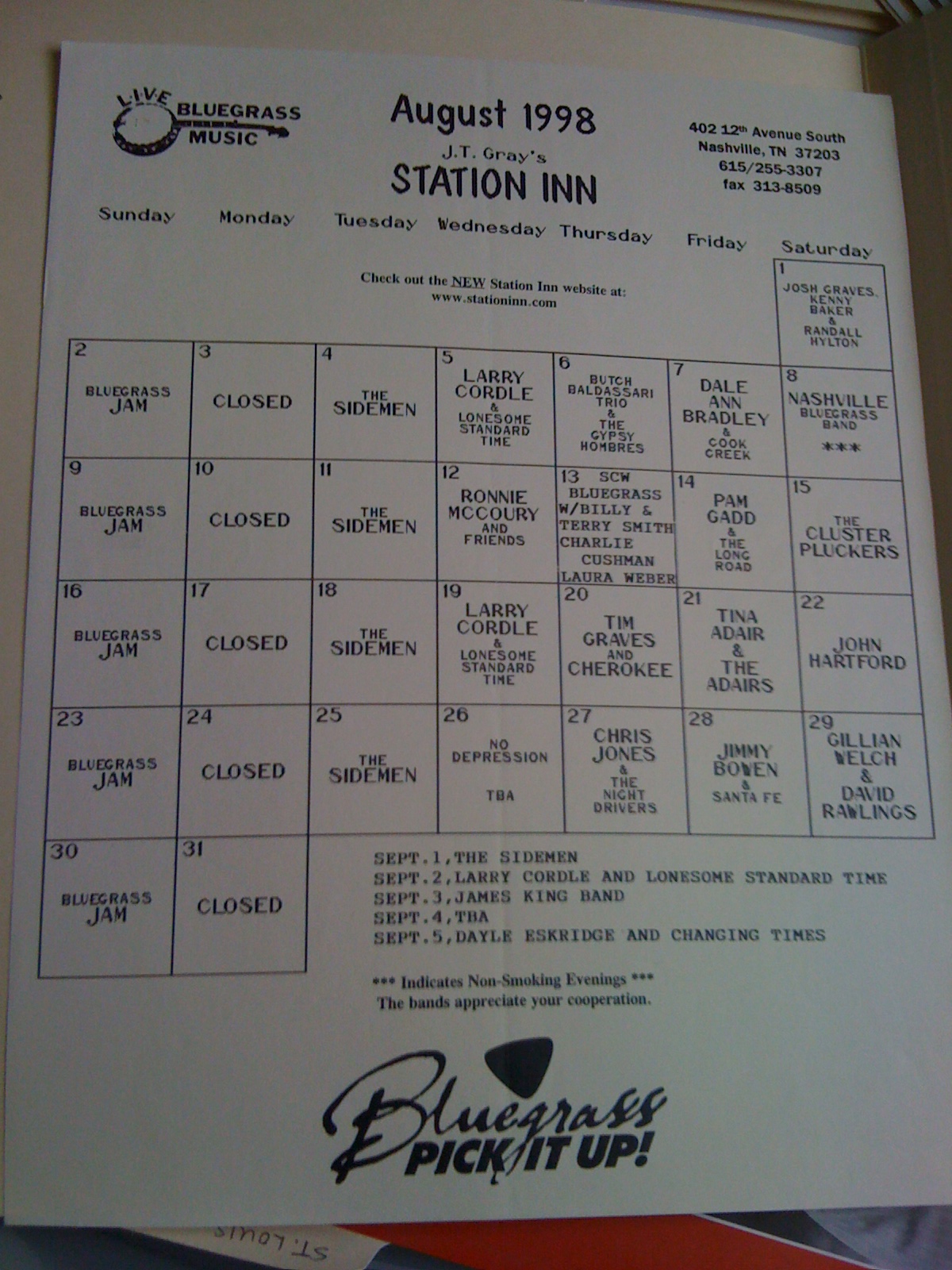
Station Inn, Nashville, TN, July 1998

Station Inn, Nashville, TN, August 1998

Cliff Top

22 Wednesday Jan 2014

Posted by Brandon Ray Kirk in Ed Haley, John Hartford, Music

≈ Leave a comment

Tags

Carol Hardway, Cliff Top, culture, fiddlers, fiddling, history, John Hartford, life, music, photos, West Virginia, Wilson Douglas

Carol Hardway, Wilson Douglas, and John Hartford at Cliff Top, West Virginia, 1995

Carol Hardway, Wilson Douglas, and John Hartford at the Appalachian String Band Festival in Cliff Top, West Virginia, 1995

In Search of Ed Haley 221

10 Friday Jan 2014

Posted by Brandon Ray Kirk in Ed Haley

≈ Leave a comment

Tags

Appalachia, Arthur Smith, banjo, Ed Belcher, Ed Haley, fiddlers, George Mullins, Geronie Adams, Grand Ole Opry, Harts Creek, history, Joe Adams, Johnny Hager, Logan County, music, Robert Martin, West Virginia, writing

I wondered if people around Trace listened to the radio, especially the Grand Ole Opry, in the early days.

“They was a few radios,” Joe said. “We had one here. We ordered it from a company called Jim Brown. It had five batteries. And like Jerry Clower said, you’d take them and set them in front of the fire and get them hot and then plug them in, they’d play. They was kindly hard to get — they didn’t cost much. I think they was about ten or twelve dollars for all of them. But Robert Martin had one on top of that hill and my brother had one on Twelve Pole, and on Saturday night when the Grand Ole Opry come on, it was a sight to watch these people a going. It come in good and clear. Robert learned a lot of Arthur Smith tunes off the radio. Yeah, Arthur Smith come down there at Branchland and stayed a week with him and I was talking to Robert after he left and he said, ‘I wish you boys’d come down.’ I said, ‘Well, if you’d a let us know, we woulda come.'”

Brandon said to Joe, “I remember you were telling me last time I talked to you that you thought Robert Martin was about the best around.”

Joe said, “In the modern music. Now, in the old-time music, you’d take Ed Haley and Johnny Hager and Ed Belcher. Ed Belcher, he stayed at George Mullins’ and he was like my brother: he was an all around musician. He could tune a piano and play it, he could play an organ. He could play anything he picked up. I never did hear him play a banjo but he could play anything on the fiddle or guitar. He’d note the guitar all the time. He played like these fellers play on Nashville. They was several people around here had banjos and played. Geronie Adams — Ticky George’s boy — he played a banjo a little bit. And they was a fella — Johnny Johnson — played with Robert Martin out on that hill. He was from someplace in Kentucky.”

I asked Joe what kind of banjo style Johnny Hager played.

“He played the old…,” he started. “They’s some of them calls it the ‘overhand’ and some of them call it just ‘plunking’ the banjo. They was several people played like that. Bob Dingess down here, he played that a way a little bit. My dad, he played the banjo and he played that.”

I asked Joe how Ed dressed in the early forties.

“Well, he wore dress pants most of the time,” he said. “He wore mostly colored shirts — blue or green or just any color. Work shirts. Most of the time he wore suspenders with them. And had buttons sewed on them to buttom them with. Buttons on the inside. Mostly he wore slippers. They was a lace-up slipper. Three laces. He could tie his shoes just as good as you could tie yorn. He wasn’t a big man — he was a little small man. About 5’4″, 5’5″.”

Brandon asked what Ed was like when he wasn’t playing and Joe said, “Well, he’d just sit around and talk and tell tales about first one thing and then another. They’d just talk about how hard they was raised and how they come up.”

Did the ladies like him?

Joe said, “They all liked him but they wasn’t girlfriends. If he went into a place to play, they’d all come around and hug him and talk to him.”

In Search of Ed Haley 220

08 Wednesday Jan 2014

Posted by Brandon Ray Kirk in Ed Haley

≈ Leave a comment

Tags

Billy Adkins, crime, Ed Haley, fiddlers, fiddling, George Mullins, Harts Creek, history, Joe Adams, Johnny Hager, music, Peter Mullins, Robert Martin, Ticky George Adams, writing

The next day, Billy and Brandon suggested that we visit 70-year-old Joe Adams on Trace Fork. Joe had all the right genealogical connections to know about many of the major characters in Ed and Milt’s story. According to Billy’s records, both of Joe’s grandfathers were brothers to Ben Adams, a key player in the 1889 feud. Joe’s grandmother was a Mullins, while the other was a half-sister to Burl Farley. (Burl Farley of course was in the Brumfield mob and even “gave the order to shoot” Milt and Green, according to some sources.) Brandon reminded me that he had talked with Joe earlier in the summer and heard him speak about having played music with Ed in his younger days.

As we pulled up to Joe’s nice house at the mouth of Trace, he and his wife met us at the end of their driveway. Joe, I noticed right away, looked a lot like Kenny Baker and was dressed in work clothes, indicating that he was probably in the middle of some project (a garden, working under a truck hood…). When we got out of the car, Mrs. Adams laughed and jokingly said, “Billy, is that you? What are you a doing up here?” Billy told them who I was and the reason for our visit and Joe basically said, “Well, come up to the porch and I’ll tell you boys all I can.” We gathered in chairs and swings under Joe’s carport where the conversation just took off. Joe was born in 1925.

I asked Joe when he first played with Ed and he said, “I’d say that was around ’40 up to ’43. It was before I went in the Army. We was down there at old man Peter Mullins’ — just out in the yard up there. They had a big old porch and they had a bunch of seats out under a bunch of big apple trees and stuff. Big shade. Had a swing out there. And I said, ‘How about bringing your fiddle out and playing a few tunes?’ And he told one of them boys — I forgot which one it was — said, ‘Go in there and bring my fiddle out here.’ He didn’t have it in a case that day but they brought it out and he played ‘Red Wing’ and he played ‘Soldiers Joy’ and he played ‘The Arkansas Traveler’ and he said, ‘Well, I’m tired now,’ and he just laid the fiddle down and we just quit. Sat around and talked a few minutes. He had some of them boys take it back and put it back in the house when he got through playing it. He took good care of his fiddle.”

“Now after I come out of the Army in ’46 and it seems to me like I seen Ed once after that and he left here and I never did see him anymore,” Joe said.

Brandon asked Joe where he remembered Ed staying on Harts Creek.

“I remember him staying up there with old man Peter and Liza and he stayed there off and on for years,” he said. “His wife and some of the children were there. Aunt Rosie married George Mullins on Buck Fork — he stayed up there a lot, too. Johnny Hager stayed with Ticky George Adams — old man George and Vic — that lived up in that holler up here at this store. Greasy George lived across the creek. And old man Ed, he’d go up there.”

What about Johnny Hager?

“Johnny Hager, he played a fiddle, too,” Joe said. “He didn’t play much. Just once in a while maybe he’d pick it up and play one tune. I had an older brother that’s dead, Howard — he played with them a lot. He played a fiddle, a guitar, mandolin, accordion, anything. He played anything he picked up. And we played around here for years.”

Joe said, “I played with a man lived right up in the head of this creek — I don’t know whether you ever heard tell of him — Robert Martin. He lived on top of the hill back there. Him and John Martin was the only two houses back there. He was a good fiddler. Robert played like ‘Lady of the Lake’ and ‘Blackberry Blossom’ and ‘Sugar Tree Stomp’. He had one he said he made it hisself and he made it for old man Will Farley — he called ‘Possom Creek’.”

Robert Martin left Harts, Joe said, after his brother John was murdered at Big Branch.

“You may have heard something about that,” he elaborated. “When they got in that trouble and his brother got killed down here at Big Branch they claimed that Robert cut him, but I don’t think so. I think it was somebody else. And he moved down here at Branchland and me and my brother’d go down there and play with him. He lived on that riverbank and he’d come out there and play with the fiddle till the bow got plum wet and he’d take it in and hang it up and go get another one. We played lots of times till three or four o’clock in the morning with him and then we’d come back to the house.”

In Search of Ed Haley 216

30 Monday Dec 2013

Posted by Brandon Ray Kirk in Big Ugly Creek, Ed Haley

≈ 3 Comments

Tags

Bill Duty, Billy Adkins, Chloe Mullins, Durg Fry, Ed Haley, fiddlers, genealogy, Green McCoy, history, Hollena Brumfield, John Wesley Berry, Jupiter Fry, Mayme Ferrell, Milt Ferrell, Milt Haley, music, writing

I asked Mayme who her father’s favorite fiddler was and she laughed and said, “I suppose my daddy’s favorite fiddler was a man named Jupiter Fry. He married my daddy’s aunt.”

Billy asked, “Was he a brother to Durg Fry?”

“Yes,” she said. “You smart people. He went to New York one time and won a fiddling contest. He used to live down the creek here on the Laurel Fork of Big Ugly. My daddy used to go around there to Uncle Jupiter’s — they didn’t have much — and they would play poker all night long with just two or three pennies. They were very, very poor. Not many people were very well off. You wouldn’t think it by looking at this dilapidated place now but we had quite a bit. All the buildings are torn down. We had plenty — enough for us. We had some money here all the time. But Uncle Jupiter was the best fiddler in the country at one time.”

I asked Mayme if Jupiter was a right- or left-handed fiddler and she said, “Oh goodness, I don’t know. I don’t remember Uncle Jupiter. I remember Durg. He played some, too. He was right-handed. Durg would play and dance while he played. He did the hoedown. He did enjoy dancing.”

I asked Mayme if she remembered hearing any talk about Milt Haley and Green McCoy and she said, “Heavens, yes. Why didn’t I listen? Daddy talked about them. There was a great deal said but I just dismissed it from my mind. I didn’t try to remember it. Did Hollene Ferguson come in there in any way? She was a real kind person. I was there a few times. Incidentally, my mother’s daddy built that house.”

What was his name?

“John Wesley Berry. He was a riverboat captain and a carpenter from Guyandotte.”

I said, “I know Hollene put people up for the night and I’ve heard that Ed Haley had gone through there and stopped off and played the fiddle.”

“Well, Ed Haley frequented the place in this area,” Mayme said. “He’s been on this creek, too.”

She wasn’t sure if her father ever met Ed but she heard him talk about him.

Brandon figured they knew each other based on some interesting genealogical connections: one of Milt Ferrell’s uncles married Money Makin’ Sol Mullins’ granddaughter, while another uncle married a sister to Chloe Mullins (Ed’s grandmother).

I got kinda excited about Mayme confirming Ed’s trips through Big Ugly.

“Well see, we knew that he’d been to see Bill Duty a lot,” I said. “And we have found that Milt Haley, his father, was actually living in Bill Duty’s household at one time.”

“Milt Haley lived with Bill Duty before Bill Duty ever moved here, when he was still down in Logan County,” Brandon said, “and we think Milt may’ve moved up this way with Bill when he moved up here.”

“Well, I think maybe he did,” Mayme said quickly. “I think maybe he did. You’re awakening some old memories. I think he lived with them.

“Was there music in Bill Duty’s household?” I asked.

“I don’t know about that,” Mayme said. “Bill Duty married my daddy’s aunt.”

“Let me ask you a question,” I said to Mayme. “In the community back when you were a little girl did most people talk about the Haley-McCoy affair, or did they try not to talk about it for fear that somebody might hurt them or something?”

“I don’t think that there was any fear of being hurt,” she said. “They were not quite as notorious as the Hatfields and McCoys were.”

Just before we left, Mayme “made” me promise to come back and play for her in the fall.

I asked her for a favor: Could I go up into the old part of her house?

“Sure,” she said, “Just be careful.”

When I opened the door from the living room leading into the original cabin, I was so overwhelmed with sights and smells of the nineteenth century that it chilled me to the bone. It was dark, except for a little light streaming through a window, and everything was dilapidated, dusty, damp — and in most cases, ruined. A lot of the furniture had just rotted or collapsed to the floor and there were piles of papers everywhere at my feet. It was as if the people living there fifty years ago had just walked out, blew out the candles and never went back. Upstairs was the same. The whole experience made such an impression on me that I later began packing a picture of Mayme’s cabin in my fiddle case and eventually used it as a graphic on one of my albums.

In Search of Ed Haley 215

27 Friday Dec 2013

Posted by Brandon Ray Kirk in Big Ugly Creek, Ed Haley

≈ Leave a comment

Tags

Big Ugly Creek, Bill Duty, Charley Brumfield, Clarence Lambert, Clinton Ferrell, Doska Adkins, Eunice Ferrell, fiddlers, fiddling, Fulton Ferrell, history, Jeff Duty, Jim Lucas, Mayme Ferrell, Milt Ferrell, Rector, writing

At Broad Branch, we found that Bill Duty’s old one-story log house was completely gone. We wanted to go to the family cemetery just across the creek and up the hill but didn’t because it was overran with giant weeds.

We were all just kinda hanging out there, crammed in the car, when Doska said, “Milt Ferrell could play a fiddle. He was a first cousin to my daddy.”

Wait a minute — another fiddler? I’d spent quite a bit of time trying to track down the names of the old fiddlers around Harts. All of a sudden, they were falling from the woodwork.

Milt Ferrell — a man related to the Dutys and with the first name of Ed’s father. I said, “Now who was he?”

“Mayme’s daddy,” Eunice said, as if that helped. “Mayme lives down there.”

“She’s bad off,” Doska added. “One of her lungs has collapsed.”

I just had to see this Mayme Ferrell, although I didn’t want to impose on her if she was in poor health.

Nonsense.

Doska and Eunice said she would love the company…and she just lived down the road.

On the way to Mayme’s someone mentioned that she lived at the old Rector Post Office, a settlement from earlier in the century. We soon turned over a little bridge and pulled up to the only structure left in “Rector proper”: Mayme’s incredible two-story log cabin. It was ancient and leaning, with an old cemetery just behind it on the hill. The whole scene was like something from a dream.

We got out of the car and walked up to a small back porch where Eunice pecked at the screen door and hollered, “Mayme? It’s Eunice.”

In no time at all, Mayme Ferrell was peeking back out at us. She was frail, half-blind and hooked to a breathing machine — and very surprised to see us all on her porch with fiddles, cameras, and notebooks.

Mayme invited us on inside where we sat down in the living room and started talking like old friends. She was well acquainted with Eunice and Doska and knew a lot about Billy and Brandon’s families. It was clear after a few minutes of interchange that her life had went beyond school teaching — she was an educated woman of the modern world, who’d spent twelve years in Los Angeles and San Francisco. She got me to play her a few tunes and the next thing I knew she was singing lyrics that she remembered from her childhood, like “Nigger looky here and nigger looky yander. The old gray goose is flirting with the gander.” Or things like: “I had a piece of pie and I had a piece of puddin’. I give it all away for to sleep with Sally Goodin.” Or this: “Old Aunt Sal, if you don’t care I’ll leave my liquor jug sitting right here. If it ain’t here when I come back we’ll raise hell in the Cumberland Gap.”

Eunice remembered “Cluck old hen, cluck and sing. Ain’t laid an egg since way last spring.” Doska said her father Jeff Duty used to play the tune.

I said to Mayme, “So your father was a fiddler? Tell me about him.”

She was immediately nostalgic.

“Daddy was named for a poet, but I don’t think his parents knew it,” she said. “John Milton Ferrell. He was a great guy. He was a wonderful person. My daddy’s people were just easy going. Most of them were musicians. My daddy, he would lead the songs in church. He was a board member for three terms and the last term he was the president of the board. They would meet over at Harts and those Brumfields — I’ll tell you what — most people were afraid to go through there. Charley Brumfield shot his daddy and killed him. His daddy was beating his mother and he made him leave, so I understand, and then when he came back — I guess he was drunk…”

Mayme looked at Brandon and said, “Those Brumfields were rough then, son. Good people. If they liked you they liked you, and if they didn’t you better leave them alone. They were ambitious people. They just got to feuding among themselves, but it wore out after a while. But my daddy was a good friend to all of them. Charley Brumfield would’ve done anything for daddy. They’d get in a poker game after they had their meeting and they’d all drink. Well daddy would come home with a pocket full of money. One time he came home drunk and he couldn’t hang his hat up. Of course, the older children laughed and I cried, but he sang, ‘Hey hey rushin’ the rabbit. Into the brush and then you’ll habit.’ Didn’t say ‘have it.’ I don’t know what they were getting in that brush. He was a very, very humble person and he was witty.”

Milt Ferrell, Mayme said, played the fiddle around election time, at weddings, at schools or on Friday at all-night dances.

“We’d have barn-raisings,” she said. “After they got the roof over the barn and put the second floor in — the floor where you put your fodder and hay — they’d have a barn dancing. They’d dance all night.”

Milt played with the fiddle under his chin, as did Jeff Duty.

Mayme cried when I played one of her father’s tunes, “Over the Waves”.

She said her father’s older brothers Clinton Ferrell and Fulton Ferrell were also fiddlers. Clint was the smoothest fiddler in the family but would only occasionally pick up Milt’s fiddle and play “Mississippi Sawyer”. Their cousin Jim Lucas was also good.

“Uncle Jim was an excellent fiddler,” she said. “He didn’t jiggle. A real smooth player.”

She didn’t recall any banjos or mandolins on Big Ugly in the old days, although her brother-in-law Clarence Lambert was a great guitarist (“as good as Chet Atkins”) who played Hawaiian music and tunes like “Guitar Rag”.

In Search of Ed Haley 183

16 Wednesday Oct 2013

Posted by Brandon Ray Kirk in Ed Haley, Timber

≈ Leave a comment

Tags

Appalachia, Cabell County, Doc Suiter, Dolph Spratt, fiddlers, Fred B. Lambert, Guyandotte River, history, John Thomas Moore, logging, Lucian Mitchell, Paris Brumfield, Thomas Dunn English, timbering, W.M. Carter, writing

The weather was also a problem for loggers, who often plied the river in freezing temperatures.

“I was on the water that cold Saturday, about 1900,” W.M. Carter of Ferrellsburg told Fred B. Lambert, regional historian. “People froze to death, finger and toe nails froze off, but we went on.”

Some loggers built fires on their rafts to battle the cold.

“I have had fires on a raft in winter by throwing sand between close logs,” Mitchell said.

For warmth and a little light-hearted comfort, the loggers drank whiskey along the way. A resident of the Salt Rock area told Lambert about hearing “a hundred men passing his home, one night, about 1896” who “were gloriously drunk and filled the air with such cursing and yelling as one hears not more than once in a lifetime.” Johnson’s Representative Men of Cabell County, West Virginia (1929) said “they were often so boisterous that children playing along the banks ran away in fright as they heard these raftsmen sweeping by, yelling and swearing lustily. Yet, they were only a lot of mountaineers taking their trips as high adventure.”

In addition to their whiskey, loggers also used music to alleviate the hardship of their trip. They always had one or two fiddlers with them who sometimes played on the ride downriver. Thomas Dunn English’s poem “Rafting on the Guyandot” hinted at that part of the journey with the line: “Where’s the fiddle? Boys, be gay!” The fiddles were brought out again after dark, when loggers were camped at various points on the riverbank, in the yard of inns or at houses along their route where people made a business of caring for them. Raftsmen spent their evening eating packed lunches (or fresh, home-cooked meals if they were lucky), drinking, dancing, then sleeping it all off in preparation for the next day.

I could just picture Milt Haley playing the fiddle under the stars and lifting the spirits of burly men who were gathered around their campfires.

“If no bad luck overtook them, they could make the whole journey to Guyandotte in one or two days,” according to The Llorrac.

At that location, their timber was caught in a boom, then examined by measuring crews, who paid them based on the quality and usability (per cubic foot) of each log.

“Here they were delivered to sawmills or run into the Ohio where they were gathered into ‘fleets’ containing many rafts,” Lambert wrote. “They were sold to lumber dealers in Cincinnati, Louisville, Jeffersonville, Indiana, or other cities, and floated down the river.”

Having rid themselves of their timber, the loggers found vacant hotel rooms or boarding houses in the town of Guyandotte and set about the business of “having a good time.” Locals had no choice but to surrender to them and prepare for the worst.

Ferrell’s Centennial Program put it thusly: “When the timbermen had anchored their rafts, the good people of the town anchored themselves at home.”

The whole scene was as exciting and dangerous as any thing in the Wild West. There were a lot of horrible atrocities, like when John T. Moore was burned to death after some loggers renting the upstairs of his large house caught the whole place on fire.

“I’ve seen some fancy fights in Huntington among the raftsmen,” Lucian Mitchell said. “Policemen usually didn’t interfere. Dolph Spratt of Mingo County or Paris Brumfield hit Doc Suiter. He toned down after that.”

After several days of hell-raising, loggers bought a final half-gallon of the best whiskey and made plans to return home. Most made their way back upriver on borrowed or rented horses and mules — or less dramatically by walking. (To get to Harts by foot was a six or seven day trip.)

“They often went in crowds of twenty-five to fifty,” Lambert wrote.

It was rare for them to return home sober, and when they did, it often warranted special attention by local newspapers.

“We note with satisfaction that the raftsmen all returned home safely,” one reported, “and we are pleased to say that the absence of drunkedness among them on this trip was indeed gratifying.”

Rector Hicks

30 Friday Aug 2013

Posted by Brandon Ray Kirk in Calhoun County, Ed Haley, Music

≈ Leave a comment

Tags

Akron, Appalachia, Calhoun County, culture, fiddler, fiddlers, fiddling, history, Kerry Blech, life, music, Ohio, photos, Rector Hicks, U.S. South, West Virginia

James Ward Jarvis (b.1894), fiddler from Braxton County, West Virginia, 1970s

Rector Hicks, fiddler from Calhoun County, West Virginia, c.1976. Photo courtesy of Kerry Blech

In Search of Ed Haley 127

11 Tuesday Jun 2013

Posted by Brandon Ray Kirk in Ed Haley, Music

≈ 1 Comment

Tags

Ashland, banjo, Bernard Postalwait, Calhoun County, Clay County, Clay Court House, Doc White, Ed Haley, fiddler, fiddlers, fiddling, Ivydale, Kim Johnson, Laury Hicks, Lawrence Haley, Minnora, music, Riley Puckett, Roane County, Steve Haley, West Virginia, Wilson Douglas, writing

In mid-summer of 1994, I was back in Ashland visiting Lawrence Haley. Lawrence, I noticed right away, was indeed in poor health. His overall appearance wasn’t good; actually, he seemed convinced that he probably wouldn’t get any better. Pat was ever so cheerful, saying that he would be back to his old self soon enough. Lawrence’s son Steve had driven in from Hendersonville, Tennessee, to serve as his replacement on any “Ed Haley trips.”

Early the next morning, Steve Haley and I left Ashland to see Wilson Douglas, the old-time fiddler who remembered Ed Haley in Calhoun County, West Virginia. We drove east on I-64 past Charleston, West Virginia, where we exited off onto a winding, two-lane road leading to Clendenin, an old oil town on the Elk River. We soon turned onto a little gravel driveway and cruised up a hill to Wilson’s nice two-story home. We parked and walked up to the porch where we met Wilson and his banjo-picker, Kim Johnson. Inside, he told me more about seeing Ed at Laury Hicks’ home. He was a great storyteller, so we naturally hung onto his every word.

“Laury Hicks got in touch with Ed Haley,” he began. “So, in them days, you come to Charleston by train and from Charleston to Clay Court House by train. All right, when you got to Clay Court House, you caught the B&O train on up to Otter, which is Ivydale. Well, the word would come out and they’d be somebody there in an old car or something to pick him up and take him about fifteen, 20 miles over to Hicks’ in Calhoun County. Well, the word’d get around, you know, and my god, it was just like a carnival a coming to town. And my dad had an old ’29 model A Ford pick-up truck. Well, gas was 11 cents a gallon. So, what we’d do, we’d take our pennies or whatever we had, we’d get us that old truck up — had a big cattle rack on it — and everybody’d load in that thing. Say, ‘Well, Ed Haley’s over at Laury Hicks’. Let’s go, boys!’ Everybody would grab their loose pennies, which were very few, and we’d get over there.

“Well, it’d be probably dark, or a little before, when he would start fiddling — about maybe eight o’clock — and last until three in the morning. And he would never repeat hisself unless somebody asked him. We just sat and never opened our mouth and he’d scare [them other fiddlers]. I’d sit there till I’d get so danged sleepy, I’d think I couldn’t make it. He’d start another tune and it’d just bring me up out of there. And that Chenneth on that banjo. And then they was a fellow, he lived down the road about seven or eight miles, a fellow by the name of Bernard Postalwait. And this man was a “second Riley Puckett” on the guitar. Well, Ed’d send for him. By god, they’d never miss a note. Ed had a little old tin cup sitting there. Everybody’d put some money in it, you know. And they was some rich feller, but I can’t think of that danged guy’s name, he liked fiddle music. He’s the only man in Roane County that had any money. Well, he’d give a few one-dollar bills, you know, and he’d mention a tune. Well, if he give him a dollar, he’d play it for fifteen minutes. Well, by the time the night ended, he’d have five or six dollars, which was equivalent to fifty now. Well the next night, we’d go over — all of us’d work that day. Next night, the same thing: we’d be right back over.”

Wilson said Ed would get drunk with Bernard Postalwait and “disappear” to some rough establishments. Bernard was with Ed when he played his fiddle at Laury Hicks’ grave.

Ed also ran around with a casual fiddler named Benjamin F. “Doc” White (1885-1973) of Ivydale. Doc was a banjo-picker, veteran of the Indian Wars, schoolteacher, midwife, doctor, photographer, local judge and dentist (he even pulled his own teeth). He took Ed to “court days” and other events where he could make money.

“I was around old Doc a lot,” Wilson said. “God, he was a clown. He had kids all over West Virginia. He couldn’t fiddle much but he tried.”

Doc asked Ed one night, “Ed, how do you play them tunes without changing keys?” and Ed said, “Well Doc, I change them with my fingers!”

Wilson said Ed wasn’t being sarcastic.

It seemed like Wilson knew a lot of stories about Ed’s “running around days” with guys like Postalwait and White — which would have been great to hear to get a better understanding of him — but he refused to be very specific. He did tell one story:

They went over to a place called Minnora. That’s over where Laury Hicks lived. Doc White and Ed. Somebody else was with them, I think that Bernard Postalwait. They went down there to a Moose Lodge or something and they had a little fiddle contest or something. Well, now, Ed said, “I ain’t gonna play in this contest.” Said, “I’d ruther be a judge.” Now Old Doc White, you know, he had quite a bit of money. I don’t know, they’s four or five fiddlers that played. Old Doc played a tune, you know. They said, “What do you think, Ed?” Well, Ed said, “Boys, I hate to say it. By God, old Doc’s gotcha all mastered.” Course Ed was wanting a drink of liquor, you know. After it was over, by God, they got drunk, all of them. Doc couldn’t play much, but Ed said, “Well, that old Doc’s got you boys bested.”

In Search of Ed Haley 96

27 Saturday Apr 2013

Posted by Brandon Ray Kirk in Ed Haley, John Hartford, Music

≈ Leave a comment

Tags

Appalachia, Catlettsburg, Clyde Haley, Ed Haley, Ella Haley, fiddle, fiddlers, fiddling, Harts Creek, history, Irish lilt, Kenova, Kermit, Kevin Burke, Lawrence Haley, music, Nashville, Noah Mullins, Norfolk and Western Railroad, Patsy Haley, snap bowing, West Virginia, Williamson, writing

Nestled in Nashville, I worked obsessively on Ed Haley’s music. First, I made a real effort to transcribe it note for note and break it down “under the microscope.” Initially, I had tried to play it generally the way he did while keeping its spirit — with my own twists, of course, which is nearly impossible not to do. This time, though, I wanted to study it as you might a fabulous book — break it down, look at it mechanically… I made a huge discovery regarding Ed’s bowing during that time. With Lawrence’s help via telephone conversations, I deduced that Ed used what Scotch fiddlers call “snap bowing,” which is when you separate notes by applying pressure (“little stops”) with the bow — not by changing its direction. Of course, Ed didn’t use those patterns exclusively and mixed them with more conventional strokes.

I also spent a lot of time listening to Ed’s recordings and playing my versions of his songs into a tape recorder. One of the first things I figured out was that he used what fiddler Kevin Burke calls the “Irish lilt” to give his music a “dotted note feel.” It would be like playing a tune in triplets with the middle note taken out.

I also discovered that Lawrence was right about Ed not playing so many notes; instead, he created the illusion of doing so by phrasing his tunes in a way that gave them a nice “crooked” flavor.

Throughout these discoveries, Lawrence continued his role as my brutally honest fiddle teacher. His comments were surprisingly musical for someone who kept reminding me that he didn’t even play anything. When I played “Yellow Barber” for him over the telephone, he said, “That sounded right except when you get down to that low end, you’re doing a little skipping in there and it seemed to me like Pop played that a little bit smoother. Like he had a roll to his… And I noticed you had a few jumping notes in there that really I don’t remember hearing. Maybe you can hear them. Other than that, it sounded great to me.”

Lawrence seemed pleased with my playing of Ed’s “Catlettsburg”.

“That was good, John,” he said. “That was really good.”

I told him I didn’t know how Ed was able to get up into second position on that tune with the fiddle sitting at his shoulder.

“I always thought that he kinda controlled the violin with his thumb and the meaty part of his hand between his finger and thumb,” Lawrence said. “He could relax that up and down the neck of the violin or he could tighten that and he could still have the flexibility of his fingers, plus that give him the ability to rock that violin body underneath the bow, too.”

I was trying that and eventually got to where I could will my fingers into third position still holding the fiddle at my shoulder, which if you have to play for a long time is sure easier on the neck of the player.

I told Lawrence about talking with Clyde, especially about his memories of Ed mistreating him as a child.

“I don’t know, maybe my dad was mean to him when he was a young’n,” Lawrence said. “But I can’t remember my dad ever laying a hand on me to hurt me. I musta been a rowdy little kid ’cause it seemed like whenever Pop’d pick me up he’d call me ‘muddy duck’ because I was always dirty, I reckon, whenever he’d get a hold of me. He’d just rub my head or something like that and call me his ‘muddy duck.’ I don’t know where Clyde got his story from.”

Lawrence agreed that his dad sometimes abused his mother, although he placed a lot of blame for their marital problems on her.

“Well, he could be temperamental with my mother at times, but I think she was temperamental, too. I think my mother’s people had higher tempers than Dad’s people did. They seemed to be kinda quiet people. Noah Mullins was supposed to killed a revenuer up there at Harts. They waylaid a revenuer and they laid it on Noah, but Noah Mullins always seemed to me like just as quiet and as calm a fella as could be. But I had some of my uncles on my mother’s side, they were a little bit of a temperamental type of people. So I’d put some of the blame on my mother for her treatment of my dad. You know, a woman can upset a man and whip him quicker with words than he can whip her with his fists.”

I totally agreed, then asked Lawrence if he knew anything about the Muncys from Patsy’s genealogy.

“We’d ride the Norfork and Western train up from Kenova and stop at Kermit and stay there with Muncy people,” he said. “They lived in an apartment up over their store and filling station-type thing and they had one of them small monkeys. I went up there one day and got right at the top of the steps and was playing with that monkey and I musta made it mad and it made a rush at me and I musta jumped back and I went to the bottom of them steps. That made me remember it more than anything else. I can’t even remember that Pop played music while he was there for them. They mighta just talked. We used to stop there maybe and stay all night and Pop and Mom and me would go on to Williamson and they’d play at courthouse days or something there. Pop musta had people up in there, but he never said anything to me about it.”

In Search of Ed Haley 64

12 Tuesday Feb 2013

Posted by Brandon Ray Kirk in Ashland, Big Sandy Valley, Ed Haley, Music

≈ 1 Comment

Tags

Ashland, Big Sandy River, Blackberry Blossom, Blaze Starr, Bluegrass Meadows, Boyd County, Clark Kessinger, Dave Peyton, Delbarton, Duke Williamson, Ed Haley, fiddle, fiddler, fiddlers, fiddling, Georgia Slim Rutland, Grand Ole Opry, Hank Williams, Herald-Dispatch, history, Huntington, Jennies Creek, John Fleming, John Hartford, Kentucky, Lawrence Haley, Lynn Davis, McVeigh, Mingo County, Minnie Pearl, Molly O Day, Molly O'Day, music, Parkersburg Landing, Pike County, Pond Creek, Short Tail Fork, Shove That Hog's Foot, Skeets Williamson, Snake Chapman, Texas, West Virginia, Williamson

Early that summer, I was back at Lawrence Haley’s in Ashland with plans to visit Lynn Davis in Huntington, West Virginia. Lynn had been mentioned in the Parkersburg Landing liner notes as a source for Haley’s biographical sketch and was the widower of Molly O’Day, the famous country singer. Snake Chapman had told me that Molly and her family were close friends to Haley, who visited their home regularly in Pike County, Kentucky. I was sure Lynn would have a lot of great stories to tell about Ed. At our arrival, he was incredibly friendly — almost overwhelming us with the “welcome mat.” All we had to do was mention Ed’s name and he started telling us how he and Molly used to pick him up in Ashland and drive him up the Big Sandy Valley to see Molly’s father in southeastern Kentucky.

“That was back in the early forties,” he said. “We’d come to Ashland and get him at his home up on Winchester about 37th Street. They was a market there or something you turned up by and we’d go there and pick him up and take him up to Molly’s dad and mother up in Pond Creek, Kentucky — above Williamson. There’s an old log house up there — it’s been boarded up and sort of a thing built around it so people couldn’t get in and tear it up or something — but it’s falling down. He’d stay up there with Molly’s dad and mother for several days. They’d take him to Delbarton, a coal town over there from Williamson, and they’d just drive him around, buddy. Now Molly’s brother, he really loved Ed’s fiddling.”

Lynn was referencing Skeets Williamson, Molly’s older brother and a good fiddler by all accounts. Lynn showed me an album titled Fiddlin’ Skeets Williamson (c.1977), which referenced him as “one of country music’s more skilled fiddlers during the 1940’s — one of the best in his day.”

Skeets was born in 1920 at McVeigh, Kentucky, meaning he was approximately 35 years younger than Haley. As a child, he played music with Molly and his older brother Duke Williamson, as well as Snake Chapman. “During these years, the famous fiddler of Eastern Kentucky, Blind Ed Haley, became a tremendous influence on him,” the album liner notes proclaimed. “Skeets (along with Clark Kessinger) still contend that Haley was the greatest fiddler who ever played.” During a brief stint on Texas radio, Skeets met Georgia Slim Rutland, the famous radio fiddler who spent a year listening to Haley in Ashland.

I asked Lynn more about his trips to Haley’s home on 37th Street.

“We used to go down to his house and Molly’d say, ‘Uncle Ed, I’d just love to hear you play me a tune.’ Well he’d be sitting on the couch and he’d just reach over behind the couch — that’s where he kept his fiddle. He always had it in hand reach. So he would get it out of there, man, and fiddle.”

Sometimes Lynn and Molly would join in, but they mostly just sat back in awe.

“You’ve seen people get under the anointing of the Holy Ghost, John,” Lynn said. “Well now, that’s the way he played. I mean, I’ve seen him be playing a tune and man just shake, you know. It was hitting him. I mean, it was vibrating right in his very spirit. Molly always said, ‘I believe that fiddlers get anointed to the fiddle just like a preacher gets anointed to preach.’ They feel it. Man, he’d rock that fiddle. He’d get with rocking it what a lot of people get with bowing. It was something else. But he got into it man. He moved all over.”

Lynn said Ed was a “great artist” but had no specific memories of his technique. He didn’t comment on Ed’s bowing, fingering or even his fiddle positioning but did say that he mostly played in standard tuning. Only occasionally did Ed “play some weird stuff” in other tunings.

Lynn’s memories of Haley’s tunes seemed limited.

“Well, he played one called ‘Bluegrass Meadows’,” he said. “He had some great names for them. Of course one of his specials was ‘Blackberry Blossoms’. He liked that real good, and he’d tell real stories. He would be a sawing his fiddle a little while he was telling the story, and everybody naturally was just quiet as a mouse. You know, they didn’t want to miss nothing.”

What kind of stories?

“Well, I know about the hog’s foot thing. He said they went someplace to play and they didn’t have anything to eat and those boys went out and stole a hog and said they brought it in and butchered it and heard somebody coming. It was the law. They run in and put that hog in the bed and covered it up like it was somebody sleeping. And Ed was sitting there fiddling and somebody whispered to him, said, ‘Ed, that hog’s foot’s stickin’ out from under the cover there.’ So he started fiddling and singing, ‘Shove that hog’s foot further under the cover…’ He made it up as he went.”

The next thing I knew, Lynn was telling me about his musical career. He’d been acquainted with everybody from country great Hank Williams to Opry star Minnie Pearl. We knew a lot of the same people — a source of “bonding” — and it wasn’t long until he started handing me tapes and records of Molly O’Day and Georgia Slim Rutland. He said he had a wire recording of Ed and Ella somewhere, but couldn’t find it. He promised me though, “When I find this wire — and I will find it — it’s yours.”

Sometime later, he called Dave Peyton, a reporter-friend from the Huntington Herald-Dispatch, to come over for an interview. With Peyton’s arrival, Lynn (ever the showman) spun some big tales.

“Now, Molly’s grandfather on her mother’s side was the king of the moonshiners in West Virginia and he was known as ‘Twelve-Toed John Fleming’,” Lynn said. “He had six toes on each foot. Man, he was a rounder. Little short fella, little handlebar mustache — barefooted. He was from the Short Tail Fork of Jenny’s Creek. And the reason they called it that, those boys didn’t have any britches and they wore those big long night shirts till they was twelve or fourteen years old.”

Lynn was on a roll.

“I preached Molly’s uncle’s funeral. Her uncle is the father of Blaze Starr — the stripper. That’s Molly’s first cousin. In her book, she said she would walk seven miles through the woods to somebody that had a radio so she could hear her pretty cousin Molly sing. She was here in town about three or four months ago. We had breakfast a couple times together. She’s not stripping anymore. She makes jewelry and sells it. She’s about 60 right now.”

In Search of Ed Haley 59

28 Monday Jan 2013

Posted by Brandon Ray Kirk in Ed Haley, Music

≈ Leave a comment

Tags

Abe Glenn, Abe Keibler, Asa Neal, Berea College, Bob Glenn, Buddy Thomas, Clark Kessinger, Ed Haley, fiddlers, Gus Meade, history, John Harrod, John Hartford, John Keibler, John Lozier, Kentucky, Lewis County, music, Ohio, Portsmouth, Roger Cooper, South Shore, writing

A few days later, I called Roger Cooper, a fiddler in Lewis County, Kentucky. Roger was a protégé of Buddy Thomas, the eastern Kentucky fiddler who captured the interest and won the hearts of folklorists in the 1970s. Roger was more than happy to talk with me but said, “Really, I don’t know very much about Ed Haley. Course, I’m just like 43 years old myself so I never did see him or nothing, but a lot of guys around here knew him and would see him and stuff. I’ve heard quite a bit of talk about him. He’d come down to the Portsmouth area and play sometimes. And the Portsmouth area had lots of fiddlers around during the 20s and 30s and on up into about the 50s before they started dying off. There was stories going around about how he played.”

I asked Roger if he knew anything about Asa Neal, the famous Portsmouth fiddler.

“Asa Neal, from what they say about him, he was from down here in this county starting out and lived on a shanty boat and I guess he went on up towards Portsmouth,” Roger said. “He even made some records, I think.”

I told Roger that I figured Asa and Clark Kessinger were Ed’s two chief competitors and he said, “Well, Clark Kessinger, he gave Ed Haley a lot of credit as to learning some stuff from him himself.”

Roger felt there were a lot of other good fiddlers in the area aside from Asa Neal and Clark Kessinger.

“There was six fiddlers in South Shore — that’s just across the river from Portsmouth — all brothers — Keiblers — and there was six of them played the fiddle and they was supposed to been the best around here,” Roger said. “They was a German people. Uncle John Keibler was supposed to have been the best. The old guys around here, they say they learned from the Glenn Brothers out of West Virginia. Their names were Bob and Abe Glenn. Those Glenns would come down through here and sometimes they’d stay maybe a year with those Keiblers and they learned a lot of tunes off them Glenns. They all say that Bob Glenn was a great fiddler. I’ll tell you a little story. John Keibler was over there and Ed Haley was playing in Portsmouth, you know, like for nickels and dimes, so he went over to see him and asked Ed if he could play him a tune. And Ed let him have the fiddle and after he played the tune he thought he was Glenn playing. He went over and started feeling of him. He said, ‘Are you Glenn? You sound just like him.’ That’s what Morris Allen told me. He was a nephew to the Keiblers.”

“I wish I could tell you more about Ed Haley myself,” Roger said. “An old man and some boys named Mershon, they was awful good fiddlers. The old man Mershon, he musta been something great. One of his boys came home and said, ‘Dad, I found a fiddle player that can beat you.’ He said, ‘Well, I’ll just have to go hear him.’ He said, ‘Well, come tomorrow and go with me and you can hear him.’ He took him into Portsmouth and there was Ed Haley playing for nickels and dimes and that old man watched him play for a while and said, ‘Boy, he is a great fiddler but he don’t play like I do.’ That’s all he had to say about it. Evidently, Ed really showed him some stuff. All I can hear from any of these guys around here, they just talk like there was hardly any way of describing how Ed Haley could play. They all just seem to think he was the greatest that ever was. And them old German fiddlers, it’d take something to win them over.”

Roger recommended that I contact Abraham Keibler — a nephew to “those good fiddlers” — who took up the fiddle himself when he was around 50 years old. He also suggested John Lozier, an 82-year-old harmonica player who used to watch Ed play in Portsmouth.

“He said Ed Haley was the smoothest fiddler he’d heard in his life,” Roger said of Lozier.

We talked a lot about the old tunes played in eastern Kentucky.

“A lot of those kinds of tunes I just didn’t get to get on tape or nothing and I wasn’t far enough along and my memory’s not that good, but I can tell you somebody that you really should talk to is John Harrod down there. John Harrod, he plays an awful lot of tunes and he’s researched them for years. He don’t try to be no star fiddler or nothing but he’s got a real good bow lick. He’s got bow licks down like a lot of the fiddlers in this area — the old ones. And he’s a real fine fella along with it. He researched all the old fiddlers, him and Gus Meade. I think he’s some kind of a schoolteacher. Also, he has a lot to do with Berea College.”

Roger gave me John’s telephone number just before we hung up. I put it away for later reference, trying to keep my focus on Ed Haley and not getting lost researching the fiddle music of eastern Kentucky in general.

In Search of Ed Haley 58: Slim Clere Recollects Ed Haley

27 Sunday Jan 2013

Posted by Brandon Ray Kirk in Ashland, Ed Haley, Music

≈ Leave a comment

Tags

Appalachia, Ashland, blind, Clark Kessinger, Doc Holbrook, Ed Haley, Ella Haley, fiddle, fiddler, fiddlers, fiddling, Georgia Slim Rutland, history, John Hartford, Kentucky, mandolin, music, Slim Clere

The cassette player was giving Slim fits. I used the opportunity to ask him more about Ed. His answers came swift and sure, leaving little room for doubt.

Me: What kind of strings did Ed Haley use?

Slim: Believe it or not — gut. He used an aluminum-wound A, an aluminum-wound gut D and a silver-wound G. Professional stuff.

Me: Did Ed use a flat bridge or a round bridge?

Slim: I would say a round bridge.

Me: Did he ever talk about who he learned from or any of that?

Slim: No, but I think Clark Kessinger stole some of his stuff.

Me: When Ed played, was it loud?

Slim: He played very soft. He wasn’t rough.

I could hear Slim’s wife talking — she was helping him with the cassette player. Slim told her I was on the other end of the line and she got on the telephone and said, “Are you the one that does the riverboat things? I have seen you on Ralph Emery’s show. I have enjoyed you tremendously because you’re different.” That flattered me, of course, but I had more questions for Slim, who was still battling the tape player.

Me: Did you ever hear Ed sing?

Slim: No, but I’ve heard people say that he could play a guitar well.

Me: Was he easy to get to know?

Slim: He was a very congenial guy. You’d go around where he was playing, he’d hand you his fiddle. “Here,” he’d say. In other words, he was a very cordial guy.

Me: Did you ever see him play away from his wife?

Slim: He always had that woman with him. And when she played with him it seemed like she was straining to keep her eyes closed. She did not have a happy look on her, I remember that. But she played a Taterbug mandolin; they had a good tone.

I asked Slim where he first met Ed and he said, “I knew him a long, long time – maybe 25 years. Down in Ashland, Kentucky. Well, I know exactly where he used to live down there. He lived in a little old four-room house that had a bunch of steps going up on the porch there. And he used to sit out there on the porch and rock and fiddle. I think it was a kind of open rocker. I don’t think the chair had those high handrails on them. It didn’t matter to him. He relaxed that way, see.”

I asked Slim to describe how Ed looked.

“His hair was a kind of a dark brown, I believe,” he said. “He was fair complected and his hands were as soft as a rag. He had a little hand — and his fingers were pointed. It seems to me like his eyes were pretty well blanked out. He didn’t wear glasses, like most blind men do. And his wife didn’t either. He didn’t have too much action. Being blind, he didn’t have any personality or anything like that. You almost had to close your eyes to appreciate the guy. He always had that woman with him. She kept good time. Of course, she didn’t make any runs or nothing. And he had a son that was a good guitar player but he was ashamed to play with Ed and his mother because they were blind.”

Slim remembered Doc Holbrook, although he didn’t necessarily equate him as Ed’s good friend.

“Doc Holbrook is the one that loaned Clark Kessinger a fiddle to play on. See, there was years and years that Clark never did own a fiddle. And when Doc Holbrook wanted his fiddle back, Clark got mad at him for taking his fiddle away from him. Doc said, ‘You’ve had it all this time. Had a chance to buy it and never would.'” I wondered if this was the same fiddle that Ed had given Doc but Slim didn’t know about any of that.

Slim confirmed that Ed was acquainted with Georgia Slim Rutland, the popular radio fiddler. “Yeah, I bumped into Georgia Slim in Macon, Georgia in a contest in 1937 and I was telling him what a great country this was up here and when I came back up here, here he was.” I had heard that Georgia Slim moved to Ashland just to hear Ed Haley and Slim sort of agreed. “Well, he was down there a while. I remember I told him about Ed Haley myself.”

In Search of Ed Haley 25

10 Monday Dec 2012

Posted by Brandon Ray Kirk in Big Harts Creek, Ed Haley, Music, Spottswood

≈ Leave a comment

Tags

Appalachia, Ashland, blind, Cleveland, Ed Haley, Ella Haley, Enslow Baisden, fiddler, fiddlers, fiddling, Harts Creek, Hell Up Coal Hollow, history, Huntington, Jack Haley, Jeff Baisden, John Hartford, John Martin, Kentucky, Las Vegas, Lawrence Haley, Liza Mullins, Logan County, Milt Haley, music, Nevada, Noah Mullins, Ohio, Oklahoma, Peter Mullins, Robert Martin, Sherman Baisden, Sol Bumgarner, Trace Fork, Turley Adams, U.S. South, West Virginia, writing

After visiting with Turley and Joe’s girls, Bum guided Lawrence and I up a nearby hollow to see his uncle Enslow Baisden. Enslow lived in a newly built single story log cabin. He said he’d gone blind recently due to sugar and cataracts. At Enslow’s, we met “Shermie”, who Lawrence indicated was the “funny boy” that chased the Haley women off of Aunt Liza’s porch in 1951.

“A lot of times I wouldn’t have no company if it wasn’t for him,” Enslow said of Shermie, who was epileptic. Shermie wasted little time in pulling out a few cards from the pocket of his overalls and sputtering toward me, even reaching for my fiddle case. I knew right then I was surrounded by “good people”: they had kept Shermie under their care all of these years as a valued member of the family in lieu of institutionalization.

When I mentioned Ed Haley’s name, Enslow said, “I was young but I can remember him all the time a coming. They was some Martins lived on top of a mountain out here — Robert Martin and John — and they fiddled all the time, and he’d go out there and fiddle with them. I don’t know how he walked from up this creek and out on that mountain and him blind, for I can’t find my way through the house.”

Enslow said he didn’t know much about Ed because he left Harts during the early years of the Depression.

“See, I lost all time, about everything nearly. I left here in ’35 and went up to the northern part of the state here and then went out in Las Vegas, Nevada, a while. Then, when I come out, I went in the Army in April of ’41. I stayed in there four and a half years and got married out in Oklahoma and we never did come back but just on visits. And Ed, he died in ’51.”

Enslow’s recounting of his travels was sort of an interesting revelation since it reminded me that these folks on Harts Creek — like many mountain people — were not as isolated as some may think. Ed Haley himself left the creek and traveled widely with his music just after the turn of the century, while Lawrence and his siblings had lived in Ashland and Cleveland and served overseas in the armed forces. Several of the people I had met on Harts Creek had been to faraway places and lived in big cities but chose at some point to return to the grounds of their ancestors.

I asked Enslow how old he was the first time he saw Haley and he said, “Oh man I was about nine or ten years old. He all the time played that fiddle. He used to come down here to old man Peter Mullins’ and Liza Mullins’. I guess they was real close kin to him. And Ed’s daddy’s name was Milt Haley. I don’t know whether Lawrence knowed that or not.”

Lawrence said, “Yeah, I knew that. But I understood from the way Aunt Liza told me, he came from over the mountain and I think that she was talking about from up around Williamson or over in that area. My dad, he was born right down here below Uncle Peter’s, where Turley’s at now, in the old house.”

Lawrence’s mentioning of “the old house” really got Enslow going. He remembered it well.

“There used to be an old log house there he was born in and they had a chimney outside on that old house down there — just an old rock chimney. Dad all the time talked about it. He said Ed got him one of them little old homemade sleds, you know, and he got him a ladder and put it on top of that house. And he got right up by that chimney and then when he come off’n there on that sled he knocked the rocks off with him.”

What? Why would he have done such a thing?

“I’ve always heard my dad tell it,” Enslow said. “Said that rock just barely did miss him.”

I wasn’t sure what to make of such a story but before I could really ask anything about it Enslow was off on another tale.

“Dad said one time they sent Ed down there to get some milk or butter or something. When Ed got out there on his way back he got in a briar patch. Dad took a notion to have some fun out of Ed. They had an old horse they called Fred. Dad got to stomping and snickering like that old horse and Ed said, ‘Old Fred, don’t you come here, now. Don’t you come here, Fred.’ Dad said he kept stomping and Ed throwed that stuff at him and tore hisself all to pieces in them briars.”

I asked Enslow to describe Haley and he said, “Well, he just always dressed pretty nice. He was a big man, too. They used to buy him these plugs of tobacco and these guys would get this beech bark and whittle it out about the size of a plug of tobacco and let Ed have that bark and they’d take his tobacco. If he ever got a hold of you, though, he’d eat you up, see. They said you couldn’t get loose from him.”

Apparently, Ed and his wife were so self-sufficient that locals sometimes forgot they were blind. Enslow told a great story about Ella and Aunt Liza, who were sitting by a lamp together one night. “Well, Mrs. Haley, I’m going to bed,” Liza said. “Well, just blow out the light,” Ella answered. “I’m going to read a while.” Liza said, “How’re you going to read in the dark?” Ella said, “Well, I can’t see no way.”

Enslow’s mentioning of Aunt Liza conjured up a great memory from Lawrence.

“Uncle Peter liked to wore me to death one time. Me and my brother Jack went with him up there behind his house and he had a old team of oxen we was snaking logs out of a hollow with. These oxen got hot. One of them got in the creek trying to cool off. Well, Uncle Peter couldn’t get him to move, so he went over underneath a tree and sat down. Well, me and my brother Jack was a cutting up, you know. He was teasing me. I was younger than he was. And I picked up a big rock and throwed it at him and hit Uncle Peter right where it hurts. And he got up. I knowed I could outrun him. My brother — I looked at him — he took off. And I was afraid to move. Uncle Peter come up there. I thought, ‘Well, I’m dead meat.’ It looked like he pulled down a half a tree and got a hold of me and he didn’t let go until he wore that limb out.”

I asked Enslow about Ed Haley’s music.

“I used to hear him play all them old tunes,” he said. “He’d sit and play for hours and hours at a time, him and her.”

Enslow motioned toward Lawrence, saying, “His mother played a mandolin and had a thing on that sat on her shoulders there and had a harp and played them both at the same time.”

He leaned back a little, reflecting, “Yeah, he played all the old music. He’d make up songs. Be sitting around and just directly he’d write a song. Like ‘Hell Up Coal Hollow’ and two or three more he made up that way. You’d come up and say, ‘What was that Ed?’ He’d just tell them what it was.”

Enslow and Bum said Haley made “Hell Up Coal Holler” and named it for Cole Branch, a tributary of Harts Creek. I didn’t know if Ed was the source of that story but I later learned that “Hell Up Coal Hollow” (at least the title) actually predated Haley’s lifetime. As I was gradually learning, Ed wasn’t preoccupied with historical accuracy and was good at creating temporary titles and weaving stories based on coincidence.

Enslow said, “Ed had some kind of saying he always said when he played on the radio down there about ‘carbide acid and acifidity gum’ or something.”

Lawrence said he’d never heard anything about his father playing on the radio but Enslow seemed sure of it.

“He played on the radio down there at Ashland or Huntington or somewheres way back there. I’m pretty sure they said he did.”

I wondered what acifidity gum was and no one knew, although Lawrence had heard Ed talk about it. (We later learned it was an old folk remedy for treating asthma.) Enslow said Uncle Peter asked Ed about it one time and he said, “Well, you have to get a little comedy with the music.”

Wow — so Ed told jokes?

Enslow said, “I guess to draw their attention or something.”

I asked Enslow if he’d ever heard Ed play for a dance and he said, “Well, I used to go to lots of things he played for, but I can’t remember now. They’d go out there on that mountain and play all night at Robert and John Martin’s. They’d be maybe two hundred people out there. Robert Martin all the time played the fiddle and I don’t know whether John played or not.”

Enslow thought Ed and Robert played their fiddles “together,” but Bum added, “Bob played a little different than Ed did. He played newer stuff.”

Enslow thought for a moment, then said, “Yeah, my dad, he used to play the banjo all the time, him and his nephew. They used to play for dances way back years ago.”

What was his name?

“Jeff Baisden.”

Bum said, “I was telling him about Grandpaw taking them two little sticks and beating on the fiddle for Ed.”

Someone said, “He’s the one had the big old feet and he’d get up and dance and play the banjo.”

Enslow said, “They called him ‘Jig-Toe’ Baisden. He wore a twelve or thirteen shoe and he’d get up on his toes and dance. And Noah Mullins, Uncle Peter’s son, he could flat dance. He’d get on his heels and dance all over. He called their square dance about all the time.”
In Search of Ed Haley 20

07 Friday Dec 2012

Posted by Brandon Ray Kirk in Ed Haley

≈ Leave a comment

Tags

Appalachia, Arkansas Traveler, Ashland, Blackberry Blossom, blind, Chillson Leach, Ella Haley, fiddler, fiddlers, fiddling, Fisher's Hornpipe, J P Fraley, John Hartford, Kentucky, Lawrence Haley, Mt. Sterling, music, Ralph Haley, Turkey in the Straw, U.S. South, Virgil Alfrey, West Virginia, Williamson

Later that evening, Lawrence and I went to see J.P. Fraley. On the way, he told me more about his father’s recordings.

“Well, he depended on my brother Ralph to tap him on the shoulder when he wanted him to start, and when he was getting near the end of the disc he’d tap him again, see? And Pop, sometimes he’d stop right then, cut it off real short, and then sometimes he’d go to the end of that run and hit that shave and a haircut at the end of it. Sometimes it sounded like he was gonna quit, see? Ralph hadn’t give him the signal that they was close to the end of the recording, so you can hear a little bit of hesitation at times. I thought Mom was getting ready to stop, too.”

Lawrence figured the records were made in the daytime but wasn’t sure of the time of year. “I guess the good part of maybe one spring or something because I was in the service and I wasn’t home.”

At the time of the recordings, Ed was no longer playing professionally. “He’d go out, like I say, a few times. Somebody’d come and get him, take him somewhere. He thought, ‘Well, if they’re gonna have a good time, I’ll go up and play for them and have a good time with them.’ As time went on, the older he got, the harder it was to get him to go. I guess he was having more trouble with his circulatory system.”

At J.P.’s, we met Virgil Alfrey and Chillson Leach, two old-time fiddlers from around Ashland. Virgil began playing the fiddle as a boy of twelve in the early thirties, around the time he used to see Ed in Williamson, West Virginia. The last time he saw him there he reached Ed a dollar and requested “Fisher’s Hornpipe”. Haley recognized his voice, played the tune then tried to give his dollar back because he liked him.

Chillson Leach, an 83-year-old retired rigger from Mt. Sterling, Kentucky, had been playing the fiddle since he was nine years old.

“Uncle Ed was one of the best fiddlers in this country,” he said. “He would get an audience in front of him and he kinda knowed that they was a lot of people by the sound of the money they throwed in his cup. And he’d say, ‘People, they’s a mental strain and a physical strain on playing the violin.’ Now that’s what he would tell them. He wanted them to know that he was earning his money when he was a playing that violin. And lord, when he would pull that bow across that fiddle he’d get some of the prettiest notes that ever you heard in your life. His fingers was long and slim and as nimble right up I reckon till he died.”

Lawrence, who was taking all of this in, said, “Pretty close. He slowed down the last five or six years.”

Chillson said, “Yeah but when I knowed him, my goodness, he’d get way down on that neck. Any position you wanted him to play. He was wonderful. It’s a shame that a person has to die. I’d give him a quarter and I’d say, ‘Play that ‘Blackberry Blossom’ and he played that for me and man he could just make your hair stand on your head. And then he played a lot of reels, you know. He could play anything you’d ask him: ‘Turkey in the Straw’, ‘Arkansas Traveler’.”

Chillson was obviously a fan.

“I just thought the world of him because he entertained everybody in Ashland,” he said. “He had a blind fellow that played the guitar with him and this blind fellow would sit there and man they’d make some pretty music.”

On the way home, Lawrence told me that his father hated to play “Turkey in the Straw”.

In Search of Ed Haley 18

05 Wednesday Dec 2012

Posted by Brandon Ray Kirk in Ed Haley

≈ Leave a comment

Tags

Appalachia, Ashland, blind, Charleston, Clark Kessinger, Ed Haley, fiddler, fiddlers, fiddling, history, John Hartford, Kentucky, Lawrence Haley, music, U.S. South, West Virginia

Lawrence and I drove to an Ashland restaurant where I asked more about Haley’s background between bites of seafood. I was desperate for clues about his early musical experience.

Just where did he learn to play?

Lawrence said his dad was like other mountain folks: music “absolutely come freely to these people.” He said, “A lot of people think old-time music is a simple art form because so many people that play it have a poor educational background. These people think, ‘If they can learn to play it, it has to be a simple thing to do.’ But it’s actually a complicated business.”

A little later, I asked him about Clark Kessinger and Charleston, West Virginia.

“I been to Charleston with Pop a few times, but if Clark Kessinger was around he never let Pop know,” he said. “He’d probably request a tune from him. Of course, Pop was pretty sharp on voices, too. He recognized a lot of people just by their voice. If Clark come up and requested a piece of music from him, Dad probably knew it. He never said anything to me about it. We were just kids.”

I said, “Well, Clark Kessinger studied your dad close. Of course, he knew what good fiddling was.”

“You have to give him credit for that,” Lawrence said, taking a bite of fish.

← Older posts
Newer posts →

Feud Poll 1

If you had lived in the Harts Creek community during the 1880s, to which faction of feudists might you have given your loyalty?

Categories

  • Adkins Mill
  • African American History
  • American Revolutionary War
  • Ashland
  • Atenville
  • Banco
  • Barboursville
  • Battle of Blair Mountain
  • Beech Creek
  • Big Creek
  • Big Harts Creek
  • Big Sandy Valley
  • Big Ugly Creek
  • Boone County
  • Breeden
  • Calhoun County
  • Cemeteries
  • Chapmanville
  • Civil War
  • Clay County
  • Clothier
  • Coal
  • Cove Gap
  • Crawley Creek
  • Culture of Honor
  • Dingess
  • Dollie
  • Dunlow
  • East Lynn
  • Ed Haley
  • Eden Park
  • Enslow
  • Estep
  • Ethel
  • Ferrellsburg
  • Fourteen
  • French-Eversole Feud
  • Gilbert
  • Giles County
  • Gill
  • Green Shoal
  • Guyandotte River
  • Halcyon
  • Hamlin
  • Harts
  • Hatfield-McCoy Feud
  • Holden
  • Hungarian-American History
  • Huntington
  • Inez
  • Irish-Americans
  • Italian American History
  • Jamboree
  • Jewish History
  • John Hartford
  • Kermit
  • Kiahsville
  • Kitchen
  • Leet
  • Lincoln County Feud
  • Little Harts Creek
  • Logan
  • Man
  • Matewan
  • Meador
  • Midkiff
  • Monroe County
  • Montgomery County
  • Music
  • Native American History
  • Peach Creek
  • Pearl Adkins Diary
  • Pecks Mill
  • Peter Creek
  • Pikeville
  • Pilgrim
  • Poetry
  • Queens Ridge
  • Ranger
  • Rector
  • Roane County
  • Rowan County Feud
  • Salt Rock
  • Sand Creek
  • Shively
  • Spears
  • Sports
  • Spottswood
  • Spurlockville
  • Stiltner
  • Stone Branch
  • Tazewell County
  • Timber
  • Tom Dula
  • Toney
  • Turner-Howard Feud
  • Twelve Pole Creek
  • Uncategorized
  • Warren
  • Wayne
  • West Hamlin
  • Wewanta
  • Wharncliffe
  • Whirlwind
  • Williamson
  • Women's History
  • World War I
  • Wyoming County
  • Yantus

Feud Poll 2

Do you think Milt Haley and Green McCoy committed the ambush on Al and Hollene Brumfield in 1889?

Blogroll

  • Ancestry.com
  • Ashland (KY) Daily Independent News Article
  • Author FB page
  • Beckley (WV) Register-Herald News Article
  • Big Sandy News (KY) News Article
  • Blood in West Virginia FB
  • Blood in West Virginia order
  • Chapters TV Program
  • Facebook
  • Ghosts of Guyan
  • Herald-Dispatch News Article 1
  • Herald-Dispatch News Article 2
  • In Search of Ed Haley
  • Instagram
  • Lincoln (WV) Journal News Article
  • Lincoln (WV) Journal Thumbs Up
  • Lincoln County
  • Lincoln County Feud
  • Lincoln County Feud Lecture
  • LinkedIn
  • Logan (WV) Banner News Article
  • Lunch With Books
  • Our Overmountain Men: The Revolutionary War in Western Virginia (1775-1783)
  • Pinterest
  • Scarborough Society's Art and Lecture Series
  • Smithsonian Article
  • Spirit of Jefferson News Article
  • The Friendly Neighbor Radio Show 1
  • The Friendly Neighbor Radio Show 2
  • The Friendly Neighbor Radio Show 3
  • The Friendly Neighbor Radio Show 4
  • The New Yorker
  • The State Journal's 55 Good Things About WV
  • tumblr.
  • Twitter
  • Website
  • Weirton (WV) Daily Times Article
  • Wheeling (WV) Intelligencer News Article 1
  • Wheeling (WV) Intelligencer News Article 2
  • WOWK TV
  • Writers Can Read Open Mic Night

Feud Poll 3

Who do you think organized the ambush of Al and Hollene Brumfield in 1889?

Recent Posts

  • Logan County Jail in Logan, WV
  • Absentee Landowners of Magnolia District (1890, 1892, 1894)
  • Charles Spurlock Survey at Fourteen Mile Creek, Lincoln County, WV (1815)

Ed Haley Poll 1

What do you think caused Ed Haley to lose his sight when he was three years old?

Top Posts & Pages

  • 129th Regiment Virginia Militia (Carter's Company)
  • Coal Miners in Ethel, Logan County, WV (1913)
  • About
  • Early Schools of Logan County, WV (1916)
  • Harts Creek and Big Ugly Creek land grants (prior to 1850)

Copyright

© Brandon Ray Kirk and brandonraykirk.wordpress.com, 1987-2023. Unauthorized use and/or duplication of this material without express and written permission from this blog’s author and/or owner is strictly prohibited. Excerpts and links may be used, provided that full and clear credit is given to Brandon Ray Kirk and brandonraykirk.wordpress.com with appropriate and specific direction to the original content.

Archives

  • February 2025
  • January 2025
  • October 2023
  • September 2023
  • December 2022
  • November 2022
  • May 2022
  • April 2022
  • February 2022
  • November 2021
  • October 2021
  • September 2021
  • June 2021
  • May 2021
  • April 2021
  • March 2021
  • February 2021
  • January 2021
  • December 2020
  • November 2020
  • October 2020
  • July 2020
  • June 2020
  • May 2020
  • April 2020
  • March 2020
  • February 2020
  • January 2020
  • December 2019
  • November 2019
  • October 2019
  • September 2019
  • August 2019
  • July 2019
  • June 2019
  • May 2019
  • April 2019
  • March 2019
  • February 2019
  • January 2019
  • December 2018
  • November 2018
  • October 2018
  • September 2018
  • August 2018
  • July 2018
  • June 2018
  • May 2018
  • April 2018
  • March 2018
  • February 2018
  • January 2018
  • December 2017
  • November 2017
  • October 2017
  • September 2017
  • August 2017
  • July 2017
  • June 2017
  • May 2017
  • April 2017
  • March 2017
  • February 2017
  • January 2017
  • December 2016
  • November 2016
  • October 2016
  • September 2016
  • August 2016
  • July 2016
  • June 2016
  • May 2016
  • April 2016
  • March 2016
  • February 2016
  • January 2016
  • December 2015
  • November 2015
  • October 2015
  • September 2015
  • August 2015
  • July 2015
  • June 2015
  • May 2015
  • April 2015
  • March 2015
  • February 2015
  • January 2015
  • December 2014
  • October 2014
  • September 2014
  • August 2014
  • July 2014
  • June 2014
  • May 2014
  • April 2014
  • March 2014
  • February 2014
  • January 2014
  • December 2013
  • November 2013
  • October 2013
  • September 2013
  • August 2013
  • July 2013
  • June 2013
  • May 2013
  • April 2013
  • March 2013
  • February 2013
  • January 2013
  • December 2012
  • November 2012

Enter your email address to follow this blog and receive notifications of new posts by email.

Join 2,927 other subscribers

Tags

Appalachia Ashland Big Creek Big Ugly Creek Blood in West Virginia Brandon Kirk Cabell County cemeteries Chapmanville Charleston civil war coal Confederate Army crime culture Ed Haley Ella Haley Ferrellsburg feud fiddler fiddling genealogy Green McCoy Guyandotte River Harts Harts Creek Hatfield-McCoy Feud history Huntington John Hartford Kentucky Lawrence Haley life Lincoln County Lincoln County Feud Logan Logan Banner Logan County Milt Haley Mingo County music Ohio photos timbering U.S. South Virginia Wayne County West Virginia Whirlwind writing

Blogs I Follow

  • OtterTales
  • Our Appalachia: A Blog Created by Students of Brandon Kirk
  • Piedmont Trails
  • Truman Capote
  • Appalachian Diaspora

BLOOD IN WEST VIRGINIA is now available for order at Amazon!

Blog at WordPress.com.

OtterTales

Writings from my travels and experiences. High and fine literature is wine, and mine is only water; but everybody likes water. Mark Twain

Our Appalachia: A Blog Created by Students of Brandon Kirk

This site is dedicated to the collection, preservation, and promotion of history and culture in Appalachia.

Piedmont Trails

Genealogy and History in North Carolina and Beyond

Truman Capote

A site about one of the most beautiful, interesting, tallented, outrageous and colorful personalities of the 20th Century

Appalachian Diaspora

  • Subscribe Subscribed
    • Brandon Ray Kirk
    • Join 789 other subscribers
    • Already have a WordPress.com account? Log in now.
    • Brandon Ray Kirk
    • Subscribe Subscribed
    • Sign up
    • Log in
    • Report this content
    • View site in Reader
    • Manage subscriptions
    • Collapse this bar
 

Loading Comments...