Tags
Appalachia, crime, culture, Harts Creek, Henry Mullins, Logan County, photos, U.S. South, West Virginia, writing

Henry Mullins, 1890-1905

07 Friday Dec 2012
Posted in Culture of Honor
Tags
Appalachia, crime, culture, Harts Creek, Henry Mullins, Logan County, photos, U.S. South, West Virginia, writing
Henry Mullins, 1890-1905
07 Friday Dec 2012
Posted in Timber
Tags
Appalachia, Boone County, culture, genealogy, history, John P Fowler, life, Lincoln County, photos, timbering, U.S. South, West Virginia, writing

John P. Fowler of Lincoln and Boone counties
07 Friday Dec 2012
Posted in Pearl Adkins Diary
Tags
Appalachia, culture, Harts Creek, history, inspiration, life, love, Pearl Adkins, thoughts, U.S. South, West Virginia, writers, writing
The latter portion of Pearl’s second diary closes with a cluster of entries dated from February until June for an unknown year. Thereafter is a smattering of monthly entries.
“No sadder or lonelier day ever passed over my old head,” Pearl wrote on February 7. “It will long be remembered by me. I never have hardly suffered as I did to day. My very heart was breaking. My yearning for what I knew not.”
Pearl was obviously inspired to write by some misfortune, although she never specified the source of her troubles.
“Oh God, what I suffered last night,” she continued the following day. “I cried till I couldn’t cry. No one seemed to notice my sorrow. Physical pain would be better than this some times.”
Pearl’s happiness was at an all time low.
“If I could have courage to go through with what I think of doing so often,” she wrote. “It’s a terrible thing to think of doing but I can’t. That would be far better than to suffer for maybe years on this old world of pain and woe. Lord help me to overcome my weakness of courage. Make me, dear Jesus, have something to want to live for. Oh Lord, help me to bear my troubles.”
It seems, based on the above entry, that Pearl was perhaps contemplating suicide at that point in her life.
“What a storm is brewing,” she wrote later in February. “The wind is roaring in the trees on top of the hill. The storm is on. The rain is pouring but the tempest out side is not much greater than the tempest in my breast. The storm is over. It is the beginning and ending of everything. Now, if I could only walk, my cup of happiness would be running over.”
“Oh, the troubled sleep I had last night,” she wrote the following day, on a Wednesday. “The snow is falling so fast and the ground is covered every where. The beautiful snow. This reminded me of a day some years ago, those short fleeing years for me. I was just a kid then and with a kid’s thoughts my future was beautifully paved then but that was short lived.”
“Today I was sitting alone in the kitchen by the stove with the odor of soup beans going up my nose,” Pearl next wrote in an undated entry. “Mama’s voice floats in on my hearing, singing ‘Shady Grove’ to the baby. Cora is over at Inez’s in bed a groaning with her side. Marg’s wanting a new hat. All of these things is passing through my jumbled up brain. I only wish my good old Friend would come for a talk to me so much. I can’t think.”
07 Friday Dec 2012
Posted in Music
Tags
Appalachia, Bill Adkins, culture, fiddler, Harts Creek, history, life, Lincoln County, music, photos, West Virginia
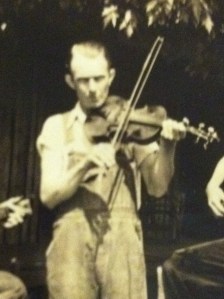
Bill Adkins, West Virginia fiddler
06 Thursday Dec 2012
Posted in Pearl Adkins Diary
Tags
Appalachia, culture, Harts Creek, history, inspiration, life, love, Pearl Adkins, thoughts, U.S. South, West Virginia, writers, writing
In August 1925, Pearl’s diary resumed, at first with a small upbeat entry.
“Pearl and I all alone talking our secrets,” wrote sister-in-law Inez Adkins on the evening of August 3. “Best friends on earth.”
Following this happy note, Pearl’s writings turned depressingly morbid.
“My last request,” she wrote on August 14. “I don’t feel that I shall be here so very long at the longest. Friends or relatives, when I die, I want to be buried anywhere where the rest of the family is buried. I want a white casket (a coffin will do). Cover it with white satin if you can’t get white. Any other nice white good will do but I would rather have it satin. I want a white shadow lace dress with a narrow white ribbon — not more than four of them. I want a light blue princess slip. If you can’t get the lace dress, get a georgetta crepe. If you can’t get crepe, get white satin. Put two rows of lace up the front and small bows of ribbon up the front too, or you can have streamers at the neck. Get them as near as you can if you are able to buy them. Buy what I said. Buy as near to it as you can. Comb my hair like I wear it in life. Powder me first a little bit. Remember Pearl.”
Then came one of the more powerful entries in the entire diary.
“No, there is not the slightest hope I shall ever be any better than I am now. It is not a pleasant prospect. It is just the thought of it at times that makes me worse. There is days and weeks at a time I don’t want to see any one. My sister tells me it is more my temper than my misfortune that afflicts me and perhaps she is right. I hate people because they expect me to see a blessing direct from God. In fact I am nothing more than a miserable clod on the face of the earth. I wish I could have a house all to myself where I could do as I please. None of them don’t seem to understand me or my way and I need some one to stay with me that could really understand me.”
“We could live an ideal existence,” Pearl continued, shifting the direction of her thoughts toward the object of her affections. “Nothing would please me better. I am sort of death’s head at home. I’m nothing but an annoyance and a burden to mother. I expect they would be glad if I could make a change like that. I could never be with out you. I don’t know how I ever did get along with out you as long as I did. It seems to me my life must have been cruelly empty. I love you very dearly — you have done more for me than talked with me. I think you have very near saved my soul for I was becoming very hard and bitter when you came. God has surely sent us to each other. You must think that my deformety is all I have to bear.”
“When God made the cripple he made the mistake of implanting in the poor deformed breast a heart like that which other people have — a heart to love,” Pearl wrote. “Hush, that is something that ought to be buried as deeply from sight as the heart itself. I am a fool to even give it a breath of air to feed upon. Does one think there is no design in that? Do you believe that I shut myself in these four walls because I despise all the world for its strength and beauty? I am not quite as bad as that. Perhaps it is my physical condition that makes me so very weak…; but I can not endure to look upon his face, to hear him speak in his kindly tone to me to know that the only feeling in his soul is pity; and but for that I should be less to him than the very dirt beneath his feet. Oh God! Do you think there is nothing in such suffering as mine? Can you see no further into it than the mere pain that rocks my wretched body? I can tell you it is ghostly. I cannot bear even to look into his face because I know that I shall see there the pitying smile that has grown hideous to me. To know that it can never be different! That I must be like an accursed log until I die, arousing nothing more than pity in the breast of any one. I should at least have the memories of the past — happiness to feed my empty heart. I could look back and say, ‘I was happy then.’ Oh it would be so much! So much! My life.”
06 Thursday Dec 2012
Posted in Timber
Tags
Appalachia, culture, history, life, photos, timbering, U.S. South, West Virginia, writers, writing

West Virginia timber job, 1890-1915
06 Thursday Dec 2012
Tags
Appalachia, Ashland, blind, California, Clyde Haley, culture, Cumberland Gap, Ed Haley, fiddler, fiddling, Halbert Street, history, Ida Red, John Hartford, Kentucky, Lawrence Haley, life, music, Pat Haley, square dances, Stockton, U.S. South
On the way home in the car, Lawrence told a story about his father getting drunk and trying to find his way home one winter night.
“We lived on Halbert Street,” he said. “The Prices down the street took Pop off somewhere or brought him back to their house and turned him loose after he got real good and drunk. Well, he was coming home by himself. It might have been two or three city blocks. He was walking on this blacktop street but he was so drunk and it was pretty cold weather, too, and he just fell over in the ditch and went to sleep. They found him the next day at daylight. They said if he hadn’t been drunk he would’ve froze to death. That was way back I guess when I was a baby.”
A hard picture began to emerge: alcohol, music, meanness and the desolation it produces. Lawrence, however, emphasized that his father was actually a happy person who lived an eventful life.
“These people that put these jackets on these albums and things, they take a tune like ‘Man of Constant Sorrow’ and make it out like my dad should play a piece of music like that because that was his place in life: being a poor old down-and-out blind man — that he lived the life of ‘constant sorrow,'” he said. “That’s the way they make these tunes seem: that should be maybe my dad’s signature tune or something, playing a dirge like that. When really he enjoyed life and had a good time whenever it could be had. If he had somebody to carouse with, he’d carouse as long as they would and probably wear three or four people out.”
I said, “I get the feeling that as well as he played the dirges, that his favorite stuff was like ‘Cumberland Gap’ and ‘Ida Red’.”
Lawrence agreed, “Yeah, and he enjoyed people dancing. My brother Clyde, I guess he stayed around Pop a lot and he could call any of those ‘birdie in the cage’-type clogging square dance. The old hoedown square dance. He lives in California. He’s in Stockton somewhere out there, or was the last time I heard.”
I wondered if it would be okay to call him.
“Yeah,” Lawrence said, “if Pat has his number at the house.”
06 Thursday Dec 2012
Tags
Appalachia, Ashland, blind, culture, Ed Haley, fiddler, history, John Hartford, Kentucky, life, music, photos, U.S. South

Ed Haley (1885-1951)
05 Wednesday Dec 2012
Posted in African American History, Ferrellsburg
Tags
Appalachia, culture, Ferrellsburg, history, life, Lincoln County, photos, U.S. South, West Virginia, writing

Ferrellsburg Ferry, 1900-1915
04 Tuesday Dec 2012
Posted in Pearl Adkins Diary
Tags
Appalachia, books, culture, Harts Creek, inspiration, life, love, Pearl Adkins, poetry, thoughts, U.S. South, West Virginia, writers, writing
The second volume of Pearl’s diary is filled with entries that specify a month but not a year. Chronologically, it appears a hopeless case, however there are two main clusters of writing periods, from February to March and from February to June. It’s not clear if these are overlapping time frames or if they refer to spring months for different years.
The bulk of the material seems to take place in 1925.
Volume 2 begins on January 30, 1925 when Pearl wrote this: “My heart is just as heavy as on that sad day. I’ve lost almost all interest in life.”
Her dissatisfaction with life more than likely had something to do with her inability to find a companion, which she blamed on her handicap.
“Sunday morning dawned cold and blue,” she wrote in February. “I had a feeling he was coming. I had not long to wait for he came real early. To my surprise he came in and set down so near me that I could have kicked him with my foot. He got up for some thing and when he set down again he set down on a bed that my chair was tilted back again. He was so clost that time his knee was against my knee. If he had only knew how I loved him and how his nearness caused my heart to beat wildly, he might not have set so clost to me and caused me to suffer untold misery. He got up to spit and motioned for a girl that was there to get in his place. Of course, I would have much rather for my darling boy to sit there as her but I couldn’t stand it no longer. I was afraid Cora would come in and see my confused look and guess the cause of my blushed face. As I have said she didn’t like him. Probably would talk about him. I would rather for them all to talk about him than her for she can say such hurtful things. No body likes to hear some one they love talked about. I love him and I can’t help it. Oh Lord, grant my earnest prayer. Cause him, oh Lord, to love me as I love him.”
The mysterious object of Pearl’s affection was clearly the primary motive for her taking up a pencil and recording her thoughts.
“Sunday morning all gone but just mother, Inez and me,” Pearl wrote in March. “I was primping up a little. I had one shoe on and one off when some one knocked at the door. Inez jumped to open it and who should it be but my sweet dream boy who came in smiling so happily and as always sit down facing me again and what causes him to sit down facing me always so clost too I can’t tell. It all happens just as if I had planned it out with him but a higher power rules our feeling. It must be the Lord’s will. I should love [name omitted] but he never speaks to me no more than if I wasn’t in miles of him but I would rather that than pity from my dear for I couldn’t stand it. Well, he didn’t stay long.”
“News of a joyous nature but not satisfying,” Pearl wrote later in March, “but it will be after while. Every little drought is sweetened by… Aw, I don’t know what.”
“Diary dear, you are the only thing I can tell my days and sorrows to,” Pearl wrote even later in March, “but it has been some time since I have told you any thing much of interest.”
In the subsequent months of early summer, Pearl took a break from her diary-keeping, preferring instead to scribble down various items of interest.
“The happier persons are those who don’t have much sense and don’t seem to know it,” Pearl wrote.
Poems followed.
“If to me your heart is true, send me back my bow of blue. If of me you sometimes think, send me back my bow of pink. If for me your love is dead, send me back my bow of red. If you do not wish me back, then send this bow of black.”
04 Tuesday Dec 2012
Posted in Ed Haley
Tags
Appalachia, Ashland, blind, Clyde Haley, culture, Ed Haley, Ella Haley, fiddler, Great Depression, history, Jack Haley, Kentucky, Lawrence Haley, life, music, Noah Haley, photos, Ralph Haley, U.S. South

Ed Haley family, circa 1929
03 Monday Dec 2012
Posted in Ed Haley
Tags
Appalachia, Arkansas Traveler, Ashland, Battle of New Orleans, Beautiful Ohio, Birdie, blind, culture, Down Yonder, Dry and Dusty, Ed Haley, fiddler, fiddling, Fire on the Mountain, Flop-Eared Rule, genetic memory, Goin' Up the River, history, John Hartford, Kentucky, Lawrence Haley, Midnight Serenade, Mississippi Sawyer, music, Sally Will You Marry Me, Soldiers Joy, U.S. South, Wagner, Whispering Hope
Hoping to stir Lawrence’s memory further, I got my fiddle out and played some tunes. He said Ed played something like my version of “Dry and Dusty”. He whistled a tune his dad played that resembled “Goin’ Up the River”. I asked him how many of Pop’s tunes he could name from memory and he called out several titles (many of them not among the records): “Mississippi Sawyer”, “Arkansas Traveler”, “Soldier’s Joy”, “Down Yonder”, “Midnight Serenade”, “Beautiful Ohio”, “Sally Will You Marry Me”, “Battle of New Orleans”, “Flop-Eared Mule”, “Wagner”, “Fire on the Mountain”, “Birdie” and “Whispering Hope”.
At some point, I asked him if there was anything in my fiddling that reminded him of his father and he said rather dryly that I sounded pretty good but, if I really wanted the truth, I didn’t play at all like him. Not even a little bit. My bowing was all wrong, he said, and I played way too many notes.
I really wanted to pick his brain about Ed’s technique, so I spent an hour just playing and asking, “Well, did he do this?” or “How about this?” He’d just shake his head no and tell me the difference between what I was doing and what Ed did. At times, I tried to triangulate the answer by asking the same questions in many different ways. It was somewhat frustrating for Lawrence. He kept pointing out that he had never been a musician and would never really be able to describe how his dad played.
I disagreed, though, based on my belief in what I call “genetic memory” — that we inherit our ancestors’ memories in our DNA or in our body’s chemicals somehow. Little commonplace clues and reminders can jar this knowledge loose or make it pop out like deja-vu. It made perfect sense to me that in addition to all of Lawrence’s conscious memory of Ed playing the fiddle, he might also have a genetic memory of it. I told him how I thought he had a lot of secrets locked away back in his mind that he didn’t even know he had and that with the right signals and clues maybe we could access that information. He had an “okay, whatever” attitude about the whole thing.
Lawrence and I mostly discussed Ed’s bowing. He said Pop held the bow at its very end and sometimes used so much of it (“one end to the other”) that it appeared as if he might “draw it right off and shove the tip end of it under the strings.” He “used every bit of that bow,” except when he wanted to “put a little force or drive into it or a slur” — then he “might work the bow.” Lawrence said, “Not many people can get that kind of music and do it at the speed and the purity that my dad played. I don’t think he was trying to make a big show of it. He was just trying to play the music and get it done.” Lawrence figured that his dad had to use his imagination in developing his style of bowing, since he “couldn’t see anybody else’s bow.”
02 Sunday Dec 2012
Posted in Pearl Adkins Diary
Tags
Appalachia, culture, dreams, Harts Creek, history, inspiration, life, Lincoln County, love, Pearl Adkins, superstitions, thoughts, West Virginia
“I had a dream last night,” Pearl wrote in July. “I dreamed he came here and I thought several were here too. They were enjoying their selfs but he didn’t have any thing to say and I thought he was the saddest looking boy I ever seen. He was sitting by the door.”
“I dreamed he was here again,” she continued in a later entry. “He was sad. That time he was handling a pistol some how. I think he was just as sad in my dream as he told me he was. I think them two dreams has a meaning and what it is I don’t know.”
“October is bright blue weather,” Pearl wrote a few months later, “but I could enjoy it if it wasn’t for this sad old heart of mine. But it will rejoice some day by and by. It’s sad so sad for me. I have thought for many many days I would get my one desire but all hopes have fled. But I pray on and on. My prayers have been for those sweet moments when the wonder of your love was fully known. I seem to feel your loving strong arms again and then — I miss you so my darling!”
02 Sunday Dec 2012
Posted in Ed Haley
Tags
Appalachia, blind, culture, Ed Haley, Ella Haley, fiddler, history, John Hartford, Kentucky, music, photos, U.S. South, writers, writing

Ed Haley and family, circa 1927
01 Saturday Dec 2012
Posted in Pearl Adkins Diary
Tags
Appalachia, culture, dreams, Harts Creek, history, life, Pearl Adkins, superstitions, thoughts, U.S. South, West Virginia, writers, writing
The opening fourteen pages of Pearl’s first volume consist of short poems and sayings written by Pearl and her sister, Cora.
“You may meet with many faces gliding down life’s merry stream,” Cora wrote to Pearl, “but remember my dear sister you are always in my dreams.”
Following such light-hearted entries was a superstitious passage of unknown origin dealing with dreams.
“Dreams come to pass when the moon is so many days old,” Pearl wrote. “Within 24 hours of a new moon, what is dreamt on will be fortunate and pleasing to the dreamer. On the third day, whatever is dreamed will prove true. On the fifth, the dreams will be tolerably successful. On the 6th day, the dream will not immediately come to pass. 7 do not tell your dreams for much depends on concealing them. On the 8th day the dreams will come to pass. The 9th differs very little from the 8th. On the 12th the dreams are rather fortunate. On the 13th the dreams will prove true in a very short time. On the 20th the dreams are true. On the 26th day the dreams are certain. 27th day is very favorable for dreams.”
On a tiny scrap of paper inserted in that section of the diary was written the word “clairvoyant.”
01 Saturday Dec 2012
Posted in Ed Haley
Tags
Appalachia, culture, Ed Haley, fiddler, history, John Hartford, Johnny Hager, life, music, photos, U.S. South, West Virginia

Johnny Hager and Ed Haley, about 1914
Writings from my travels and experiences. High and fine literature is wine, and mine is only water; but everybody likes water. Mark Twain
This site is dedicated to the collection, preservation, and promotion of history and culture in Appalachia.
Genealogy and History in North Carolina and Beyond
A site about one of the most beautiful, interesting, tallented, outrageous and colorful personalities of the 20th Century
 Brandon Ray Kirk